

Honeymoon resort room category upgrades are easy to want and surprisingly hard to pin down, because the words on a booking page, the promise in a confirmation email, and the room you are handed at the front desk can each mean something different, so this guide shows you how to read the fine print, price an offer honestly, and get the important parts in writing before you travel.
Quick answer
Treat every one of your honeymoon resort room category upgrades as one of three things: a confirmed purchase (you paid, it is on your itinerary, and it names a category), a status or courtesy upgrade (given at check-in if the resort has space), or a request (a note in the reservation that the resort may or may not honor). Only the first is dependable. Before you pay for honeymoon resort room category upgrades, get the exact category name, the bed type, the view and location terms, the total price including fees, and the rule for what happens if that category is not available, all in an email you can screenshot. Our worksheets below turn those questions into a one-page comparison.
What honeymoon resort room category upgrades actually are
Couples tend to use the word “upgrade” for anything that sounds like a better room, from a nicer view to a private plunge pool to a butler. Resorts and booking sites use it more precisely, and sometimes more loosely, depending on whether they are selling, rewarding, or hoping to impress you. Sorting out the vocabulary first makes every later decision about honeymoon resort room category upgrades easier.
Category, room type, and room are three different things
A resort rarely sells one specific room. It sells a place in a group of similar rooms, and the group has a name. Understanding the three levels, and which of them your confirmation actually names, is the foundation for reading honeymoon resort room category upgrades.
The category is the group you are buying into
A category is a named tier such as an entry-level room, a room with a view, a suite, or a swim-up suite. One Caribbean travel publication that explains the Sandals brand describes three broad service levels, Luxury as the base, Club Level as a step up with concierge service and lounge access, and Butler Level at the top, and it adds that names vary by resort. That is the useful lesson: the category name only has meaning inside the resort that uses it, so a word you learned at one property may not transfer to the next.
The room type adds bed and layout details
Within a category the resort may offer different bed configurations, such as one king or two doubles, and different layouts. A confirmation that says “ocean view king” has told you something about the view tier and the bed. It may not tell you which building, which floor, or whether the balcony is private. Treat the room type as the part of the description that can usually be checked against the resort’s own room listing, and ask the resort to confirm the match if the wording on your booking differs from the wording on its website.
The room is the actual door you open
The specific room, with a number and a location, is usually assigned late. Hotel guidance quoted in a consumer-travel report says that guarantees often cover only the bed configuration and not the view, the floor height, or the room size within a category. In other words, the thing you may care about most on your first night, the room itself, is often the thing nobody promised. Knowing that early lets you decide whether a specific room matters enough to pay for or request, which is the first real decision in honeymoon resort room category upgrades.
Who decides which room you get
On a honeymoon, several parties can influence the room: the resort, the person or company you booked through, a loyalty program, and you. They do not all have equal authority, and mixing them up is how couples end up with expectations nobody agreed to.
The resort assigns, and it can substitute
Consumer-travel reporting by Christopher Elliott found that standard confirmation language usually lets a hotel substitute rooms, and that a confirmation may be treated as a request for a room type unless the guest holds elite status. That is a report of how hotels often behave, not a statement about every resort, and some resorts are stricter than others. The practical point is to read the confirmation as a document that describes what the resort has agreed to provide, and to look for any wording that says availability or assignment is not assured.
The seller can promise only what the resort has agreed to
An online travel site, a tour operator, or a travel advisor can describe a category and pass along a request, but the resort decides what it can deliver. Elliott’s general trip-planning guide notes that online travel agencies publish their own terms, which may differ from the supplier’s, and that for a booking made through an agent you should go to the agent first because some suppliers will only work through the person who booked. If an upgrade matters, ask the seller whether the resort has confirmed it, and ask for that confirmation in writing.
Loyalty programs and promotions set their own rules
Hotel loyalty programs publish terms for complimentary upgrades, and those terms are narrower than the marketing around them. We read the published terms or detailed explanations for three large programs later in this guide, and the common thread is that a free status upgrade depends on what is available when you arrive. A resort’s honeymoon perk works the same way: it may depend on how and when you booked, how long you stay, and what you registered, so verify the current terms instead of assuming they apply.
Reading the category ladder: names, views, and locations
Category names are the first thing you compare and the first thing that confuses people. Three families of words do most of the work in honeymoon resort room category upgrades: words about the view, words about the location, and words about the service level. Each family has a shared everyday meaning and a resort-specific one.
View words and what they usually promise
View language sells many honeymoon upgrades, and it is also where couples most often feel misled. The terms below are explained in guides from a resort brand and a travel-search company, and both stress that the details depend on the property.
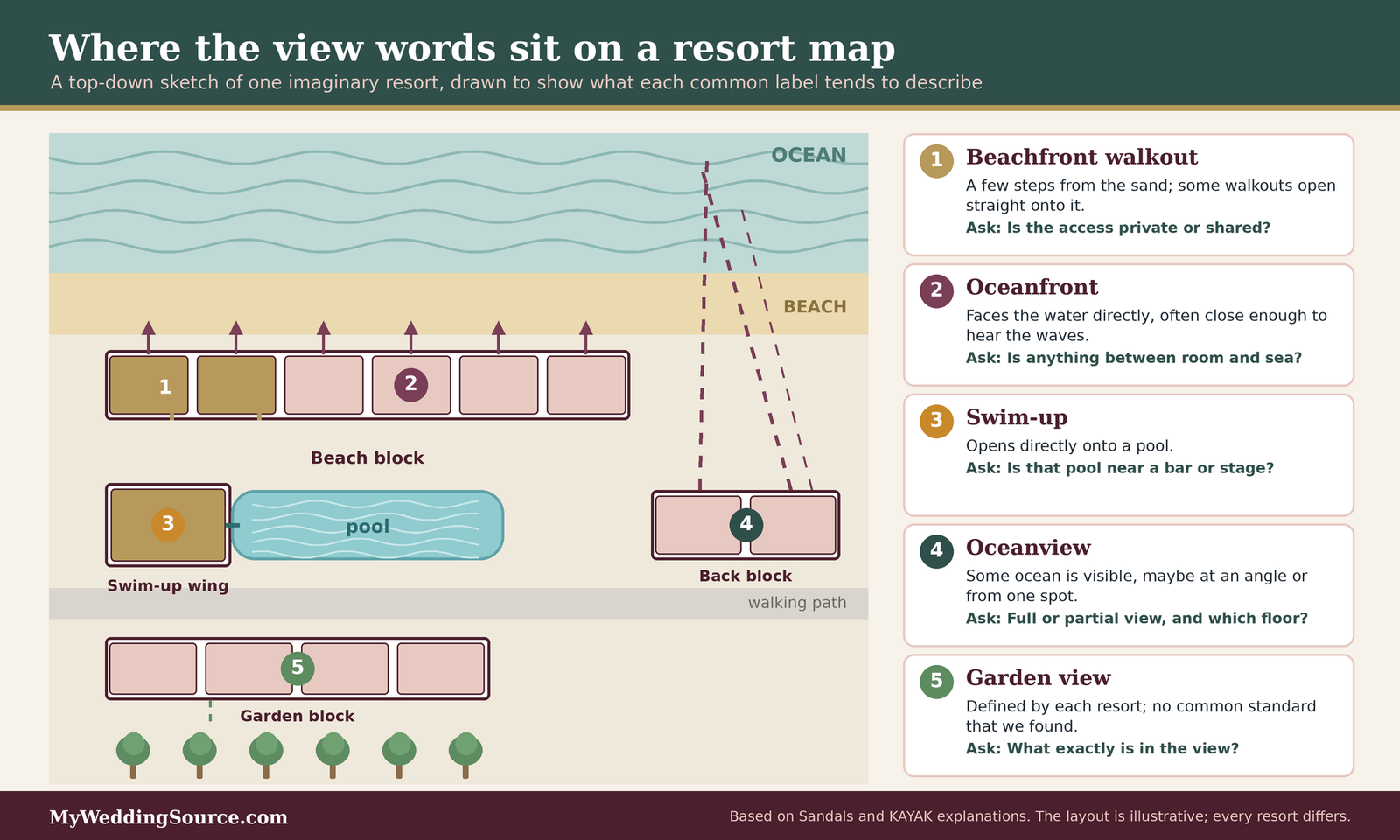
Oceanview means some ocean, not necessarily a clear one
According to Sandals’ own explainer, an oceanview room has at least some visible ocean, and you may need to look at an angle or stand in a particular spot. The room does not have to face the water and may sit farther inland. KAYAK’s guide makes a similar point, noting that oceanview rooms do not guarantee a clear view and that it may be partial, angled, or distant. When you see “oceanview” on a booking, ask whether the view is full or partial, and ask for a photo taken from that category’s balcony.
Oceanfront and beachfront describe position
Sandals explains that an oceanfront room directly faces the ocean, usually close enough to hear the waves, and that every oceanfront room also counts as oceanview. A beachfront room is a few steps from the beach or overlooks it, and it is not always oceanview because a private garden can block the sea, though in most cases beachfront suites are also oceanfront. For access straight to the sand from the ground floor, Sandals points to a “beachfront walkout” suite. These definitions come from one brand, so confirm what a different resort means.
Garden, pool, and lagoon views vary even more
A “garden view” can mean a quiet, planted courtyard or a view of a service road past a hedge. A “pool view” can mean a view of the quiet end or a view of the loudest bar. Because these terms have no shared standard, KAYAK suggests asking which floor the room is on, whether trees or buildings could block the view, and whether the room has a balcony or only a window that may not open. Those questions work for any view word.
Location words: where on the property the room sits
Location is often worth more to a couple than the room’s size. It decides how far you walk to the beach, how much noise you hear, and how private your terrace feels. Resorts describe it with words that are easy to skim past.
Ground floor, walkout, and swim-up
The Sandals guide describes swim-up suites as opening directly onto a pool and some beachfront rooms as walkouts to the sand. Ground-floor rooms with direct access can be wonderful for a honeymoon and can also face a path where other guests walk. If you choose one for privacy, ask about the screening, the distance from the path, and whether the pool or sand access is shared with other rooms.
Building, wing, and floor
Many resorts spread their categories across several buildings. A higher category may sit in a quieter wing, while an entry category may sit near the lobby, the elevators, or the entertainment area. Ask which building the category is in and whether it is possible to avoid sections near construction, entertainment, or service areas. The consumer-travel report we cite describes a guest who was moved to a ninth-floor room even though she had paid for a lower floor, which shows why floor preferences deserve a written request.
Renovated and older rooms inside the same name
The Caribbean travel guide notes that some lower-tier rooms at Sandals are described as more traditional or dated, while renovated suites are more modern. That pattern is not unique to one brand. If two rooms in the same category differ in age or renovation status, ask whether you can request the renovated section and whether the resort will note the request, understanding that it remains a request unless the resort confirms it.
Service-level words: butler, club, and concierge
Some honeymoon resort room category upgrades are really service upgrades. You are paying less for a different room than for a different level of attention, a private check-in, or a lounge. That is a legitimate choice, but it should be priced and described as one.
What the service level adds
The Caribbean travel guide describes Club Level as adding concierge service, premium in-room liquor, and access to a club lounge, and Butler Level as adding a personal butler, private check-in, and touches such as soaking tubs and larger balconies. It also notes that at Sandals Royal Plantation every suite comes with butler service and that at Sandals Ocho Rios the butler services include unpacking and reserving loungers. The lesson is to ask exactly which services come with the tier at the resort you are booking.
Service tiers can be excluded from free upgrades
Hilton’s published benefit terms exclude certain room types from complimentary elite upgrades, including “Club” room types and the Enclave or Club categories at its All-Inclusive resorts. If a service-level category is the one you want, expect to buy it instead of receiving it as a perk. The same terms say upgrades are limited to one room per member per stay, which matters if you are traveling as a couple with two loyalty accounts.
Ask what happens to the perks if the room changes
If a service tier is promised and the resort later moves you, you should know in advance whether the butler or lounge access moves with you. This is a question the sources do not answer for any specific property, which is exactly why it belongs on your list. Ask it before you pay and save the answer.
What a booking confirmation actually promises
A confirmation email feels like a contract because it arrives with a number and a price, and for honeymoon resort room category upgrades the same is true of every revised confirmation. It is a record of what the seller agreed to provide, and the sentences that matter most are often the shortest ones near the bottom. Learning to read it is the cheapest protection you have when you shop for honeymoon resort room category upgrades.
Guarantee versus request
The single most useful distinction in honeymoon resort room category upgrades is between something the resort has committed to and something it has noted. Both can appear in the same email, and they can look equally official.
Look for the verb that carries the commitment
A confirmed category usually appears as a named product with a price: “Oceanfront Suite, king bed, seven nights.” A request usually appears in softer language: “requested,” “noted,” “we will do our best,” or “subject to availability.” If a feature you care about appears only in a notes field or only in the second kind of language, treat it as a request. That is not a reason to skip it. It is a reason to know what you are relying on.
Elliott’s sources on what a hotel is bound to provide
In his report on hotel room guarantees, Christopher Elliott quotes hospitality professionals saying that guarantees often cover only the bed configuration, not the view, the floor height, or the room size within a category, and that floor and elevator choices are also commonly treated as requests. He also reports that standard confirmation language usually lets hotels substitute rooms. These are industry commentators describing a pattern, so use them as a prompt to check your own wording, not as a rule about your resort.
Say requirement, not preference, when it is one
The same report passes along advice from a travel professional that wording a need as a “requirement” instead of a “preference” in the reservation notes creates a stronger expectation. That is one adviser’s view and not a legal rule, but it costs nothing to be precise. If you truly need a quiet room, a particular bed, or a ground-floor entrance, say that plainly and ask the resort to confirm in writing that it has recorded it.
What tends to be firm and what tends to be soft
Not every detail carries equal weight. Based on the sources above and on how booking confirmations are usually built, some items are more likely to be fixed than others. Our reading is a starting point for questions, not a prediction.
Usually easier to confirm: dates, category name, bed type, price
These are the items the booking system itself records. The category name and price appear in the confirmation, and the bed configuration is the item Elliott’s sources say guarantees most often cover. Check that the category name in your confirmation matches the resort’s own wording exactly, that the bed type is what you intended, and that the dates and number of guests are correct. A one-word mismatch, such as a “garden view” label where you booked an “ocean view,” is easier to fix now than at the desk.
Usually softer: view quality, floor, quiet, adjacency, room number
Those are the features most couples picture, and they are the ones most often handled as requests. If any of them are part of why you chose a category, ask the resort how it handles them. Some resorts will place a request in the reservation and honor it when they can. Others will not hold anything until the day. Both answers are workable, provided you know which one you have.
Anything you plan around should be asked about by name
If your plan depends on a feature, such as a private plunge pool for a surprise, a ground-floor entrance for a mobility need, or a balcony that faces west, name the feature in your message and ask for a yes, a no, or a “we will try.” Elliott’s sources advise recording the name of the person who confirms anything by phone, so a yes can be traced later.
Where the escape hatches hide
Resorts and sellers protect themselves with wording that is perfectly legal and easy to miss. Finding it before you pay is the point of reading the confirmation slowly.
“Subject to availability” and “upon arrival”
Hilton’s published terms say elite upgrades are on a space-available basis and are decided at check-in. A detailed explanation of Marriott’s terms says its top-tier elite upgrade is subject to availability upon arrival. Both are describing free benefits, but similar language can appear in a resort’s own offer. If you see it next to one of your honeymoon resort room category upgrades, ask what happens if the space is not available and whether the money is refunded.
Substitution and “or similar”
Substitution language lets the resort move you to a different room. Elliott’s report says it is standard. Look for words like “or similar,” “equivalent,” and “at the discretion of the resort,” and ask what an equivalent room would be for your category. A fair answer names what stays constant, such as bed type, view tier, and service level, and what can change.
Different terms for different sellers
An online travel agency, a vacation package, and the resort’s own site can each have their own terms. Elliott’s trip-planning guide says to read the terms of each purchase, because an agency’s terms may differ from the supplier’s and each booking may show its own conditions before you pay. If you are using several tools to find a price, pick the seller whose terms you have actually read, and keep a copy of those terms with your confirmation.
Four routes to honeymoon resort room category upgrades, and how solid each one is
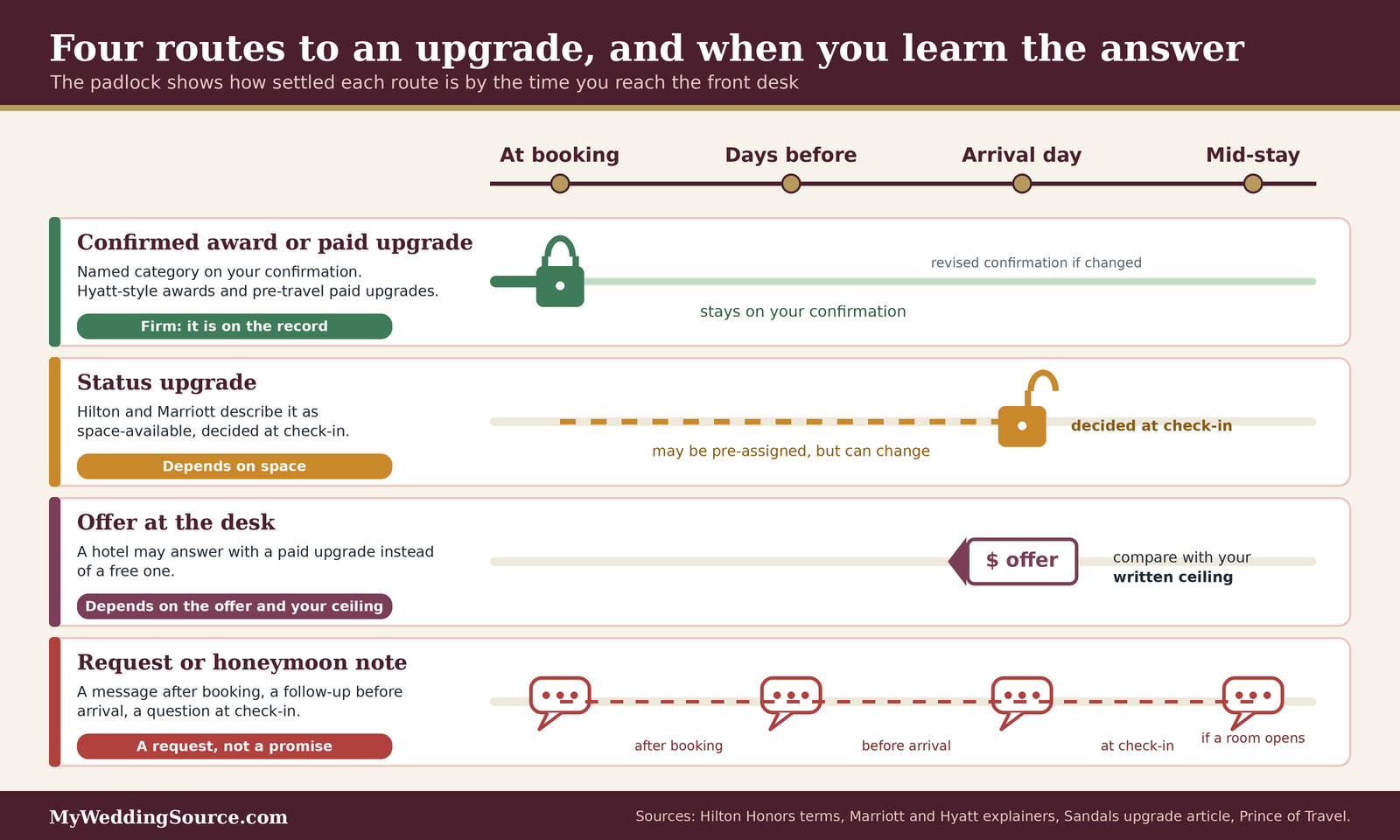
There are four common ways couples end up in a better room: through loyalty status, through a confirmed award, through payment, and through a request or courtesy. They differ most in when the answer is known and how much you can count on it, which is what separates one kind of honeymoon resort room category upgrades from another.
Status-based upgrades: free, but decided late
Hotel loyalty programs promise upgrades to higher-tier members, and couples often hope that one partner’s status will carry the honeymoon. The programs say what they will do in published terms, and those terms for honeymoon resort room category upgrades are more limited than the stories about them.
Marriott: upgrade subject to availability upon arrival
Writing in a detailed guide, travel blogger Ben Schlappig explains that Marriott’s current terms give top-tier members a complimentary upgrade “subject to availability upon arrival” for the length of the stay. He notes that hotels can block members into upgraded rooms in advance but that those assignments can change, that the earlier promise of the “best available room” has been replaced by a promise of an upgrade that need not be the best one, and that certain brands are excluded, including Marriott’s vacation-ownership brands and Ritz-Carlton Reserve.
Hilton: space-available, decided at check-in
Hilton’s published benefit terms say elite upgrades are space-available and determined at check-in for the whole stay. Gold members can receive “preferred” rooms, Diamond members can be upgraded as far as junior, standard, or one-bedroom suites, and several room types are excluded for all tiers, including executive suites, villas, specialty accommodations, and Club room types. Group reservations and certain rates may not qualify for upgrades at all, and several brands offer no complimentary upgrades.
What the two programs have in common
Both programs treat the free upgrade as a benefit to be applied when the room inventory allows, not as a purchase. Neither promises a particular room, and both list exclusions that can apply to the very categories honeymooners want, such as club levels and specialty rooms. If you plan to use status, treat any upgrade as a pleasant surprise and book the category you would be content with.
Confirmed awards and paid upgrades: the routes with a receipt
If you want a firmer answer on honeymoon resort room category upgrades before you travel, you generally have to buy certainty, either with a loyalty award that confirms at booking or with money. Both create a record that you can point to later.
Hyatt’s confirmed suite upgrade awards
According to the One Mile at a Time guide, Hyatt’s top-tier members can use a suite upgrade award to confirm an upgrade to a standard suite at booking, on an eligible rate, for up to seven consecutive nights, and awards can be applied online or afterward through Hyatt support. The guide says the award applies to the hotel’s “standard suite,” which each property defines differently, and that many properties and entire brands are excluded, including Bahia Principe. That is a good model of what a firm upgrade looks like: a named product, confirmed, with stated limits.
Paid upgrades before travel
The Sandals honeymoon-upgrade article we read lists room category upgrades and butler-level rooms among paid upgrades, notes that some are booked before travel while others may be added later depending on availability, and recommends discussing room and service-level upgrades early because availability may be limited. The practical takeaway is to ask the seller, not the front desk, about paid upgrades while the whole inventory is still open, and to ask for the new category name in a revised confirmation.
Paid upgrades at check-in
Prince of Travel notes that a hotel may respond to an upgrade request with a paid offer instead of a free one. An offer at the desk can be reasonable, but you will have less time to compare. If you want to consider one, set your ceiling in advance with the worksheet later in this guide, and ask for the offer in writing, with the price per night, the total, and any added fees, before you agree.
Requests, courtesies, and honeymoon notes
The last route to honeymoon resort room category upgrades is the one most couples try first and the least reliable. It is still worth doing well, because it costs nothing and sometimes works.
Asking well
Prince of Travel’s guide on suite upgrades suggests contacting the hotel after booking by email or phone, politely following up in the days before arrival, messaging again on arrival day with your estimated arrival time, asking at check-in whether any suites are available that night, and, if your stay is disrupted, asking the general manager about compensation. The same guide says that special occasions, genuine enthusiasm, and practical needs all help, that individual hotels decide how generous to be, and that no approach is assured.
Honeymoon registration and perks
The Sandals article says honeymoon-related inclusions may depend on booking timing, length of stay, and required documentation or registration, and warns that couples often assume a resort will do something special when a request and a paid inclusion are different things. If your resort advertises honeymoon perks, ask whether they are tied to a booking date, a minimum stay, a form, or a certificate, and ask whether a room upgrade is among them or only an amenity such as a welcome gift.
When a travel advisor can help
AARP reports that travel advisers can often get promotions, freebies, and upgrades that direct bookers cannot, and that advisers can intervene when problems arise. It also reports that advisers typically charge fees of roughly $25 to $250 or more per traveler and also earn commissions from suppliers. If you use one, ask what they can confirm in writing, what they cannot, and how their compensation works, so that “we will ask for an upgrade” is not confused with “we have booked an upgrade.”
The fine-print decoder worksheet for honeymoon resort room category upgrades
This section is the working tool of the guide for honeymoon resort room category upgrades. It turns common phrases on resort pages and confirmations into the questions that clarify them. Print it, copy it into a note, or screenshot the table before you call.
How to use the decoder
The table below lists phrases you are likely to meet, what each one may mean, and what to ask. Use it twice: once while shopping, to compare resorts on the same terms, and once after booking, to check your confirmation against what you were told.
Read the phrase, then ask the follow-up
Find the phrase in the left column, read the usual reading in the middle, and send the question in the right column to the seller. Where we cite a source for the reading, the table says so. Where we do not, the reading is our own cautious interpretation and the follow-up question is how you find out what your resort actually means.
Keep every answer where you can find it
Create one note or folder called “Room terms” and paste each reply into it with the date and the name of the person who sent it. Elliott’s trip-planning guide advises keeping written records of communications and taking screenshots of reservations, because agencies typically record calls but do not give you the recordings.
The phrase decoder
The first table covers wording about the room and the upgrade. The second covers wording about money. Both are meant to be read slowly.
Room and upgrade wording
| Wording | What it may mean | Ask the seller |
|---|---|---|
| “Upgrade subject to availability” | The resort will upgrade you only if space is open when you arrive (Hilton and Marriott use this logic for elite benefits). | What happens if no space is open? Is anything I paid refunded? |
| “Bed type guaranteed” | The bed configuration is held, which Elliott’s sources say is what guarantees most often cover. | Does the guarantee include view, floor, or building? If not, who can note those? |
| “Ocean view” | At least some visible ocean, possibly angled or partial (Sandals, KAYAK). | Is the view full or partial? Which floor and building? Is there a balcony? |
| “Oceanfront” | The room faces the water directly (Sandals). | Is anything, such as a path, building, or garden, between the room and the water? |
| “Beachfront” or “walkout” | A few steps from the beach or direct ground-floor access (Sandals). | Is the access private or shared? Who walks past the terrace? |
| “Preferred room” | A room the hotel designates as better, such as one with a better view (Hilton’s Gold terms). | What makes it preferred at this property, and is it a different category? |
| “Or similar” | The resort may substitute an equivalent room. | What stays the same: bed, view tier, service level, access to the lounge? |
| “Request noted” | Recorded as a wish, not a commitment. | Will you confirm in writing that it is in the reservation and what the resort does if it cannot meet it? |
| “Honeymoon perk” or “special occasion” | May be tied to booking date, stay length, or registration (Sandals article). | What do I have to do, and by when, to receive it? Does it include a room change? |
| “Club” or “butler” tier | A service level with its own inclusions, often excluded from free upgrades (Hilton’s terms). | What exactly is included, and what happens to the service if the room changes? |
Money wording
| Wording | What it may mean | Ask the seller |
|---|---|---|
| “Per room, per night” | The price is for the room, not each guest, and it repeats for every night. | What is the total for my dates, with every mandatory fee? |
| “Mandatory resort fee” | A fee required in addition to the room rate. Under the FTC rule on fees, mandatory fees must be included in the total price for short-term lodging. | Is this fee included in the total price I am being shown? Does an upgrade change it? |
| “Taxes extra” | Taxes and government charges may be excluded from the headline total, but must be disclosed before payment under the FTC rule. | What is the estimated tax, and is it figured on the upgrade amount as well? |
| “Upgrade price” | May be the extra amount only, not the new total. | What is the new nightly rate and the new total? |
| “Subject to change” | The seller may revise the offer. | Until what date is this price held, and will you confirm it in writing? |
| “Non-refundable upgrade” | The upgrade money may not come back if plans change or the room is not available. | If the category is not available, do I receive a refund or a different offer? |
A confirmation email you can adapt
You do not need legal language. You need short, specific sentences that a reservations agent can answer with a yes, a no, or a clarification. Keep the tone friendly, because the person who reads it is often the person who can help.
The message
Subject: Confirming room category for reservation [number], [dates]
“Hello, we are confirming our reservation [number] for [dates], two guests, honeymoon. Our confirmation shows [exact category name and bed type]. Could you confirm in writing: (1) that this is the category and bed type held for us; (2) whether the view, floor, or location terms are held or are requests; (3) what happens if this category is not available when we arrive; (4) the total price with all mandatory fees and an estimate of taxes; and (5) whether any honeymoon inclusion applies and what we need to do to receive it. We are requesting [specific need or preference, labeled as one or the other]. Thank you.”
What a useful reply looks like
A useful reply answers each numbered point in its own sentence and names the category. A reply that says “your room is confirmed” without a category name, or that repeats the marketing page, has not answered your questions. Thank the sender, restate the unanswered points, and ask again. If a phone call is easier, write down the agent’s name, the time, and what was said, and send a short email summarizing the call.
Pricing honeymoon resort room category upgrades honestly
An offer for honeymoon resort room category upgrades is a price, and a price is easier to judge when you know what it includes. This section covers what the federal fee rule says about showing prices for lodging, then works through an example so you can see how a modest-looking nightly add-on turns into a larger total.
Cost check before you say yes
Ask for four numbers, in writing: the new nightly rate, the number of nights it applies to, every mandatory fee that changes with the upgrade, and the estimated taxes on the new total. Subtract the total of your current booking from the new total. That difference, divided by the number of nights, is what the upgrade really costs per night. Compare it with what you would be willing to pay for the same change in a hotel you were not visiting on your honeymoon. Resort, loyalty, and tax rules vary, and this guide is not financial advice.
What the federal fee rule says about lodging prices
In the United States, the Federal Trade Commission has a rule on unfair or deceptive fees that covers short-term lodging. Its frequently asked questions page, which we read in full, explains the parts that matter to a traveler looking at an upgrade offer.
Scope and date
According to the FTC, the rule took effect May 12, 2025, and covers short-term lodging such as hotel rooms, motel and inn stays, and vacation rentals. It sets no minimum or maximum stay length. The FTC describes it as a rule about how prices are advertised and displayed. We did not find anything in the FAQ that addresses which room a resort assigns or whether a resort must honor a request, so the rule does not make an upgrade request binding.
Total price and mandatory fees
The FTC says that if a business shows any price in an ad or offer, it must disclose the total price up front, including all charges it knows about and can calculate in advance, and that the total must be displayed more prominently than other pricing information except the final payment amount. Mandatory fees must be included. The FTC gives a $39-per-day resort fee as an example, and says a fee that a guest cannot effectively decline, such as one removed only if the guest notices and challenges it, cannot be treated as optional.
What can be left out, and what must be disclosed
The FTC lists only three categories that may be excluded from the total: taxes and other government charges, shipping charges, and optional goods or services a customer chooses to add, such as trip protection that must be affirmatively selected. Before asking for payment, the business must clearly disclose the nature, purpose, and amount of each excluded charge and show the final amount of payment. Trade coverage of the rule notes that it does not ban any particular fee. It requires clear disclosure. If an upgrade offer shows only an add-on price and leaves the total unclear, ask for the total.
A worked example: three offers on the same booking
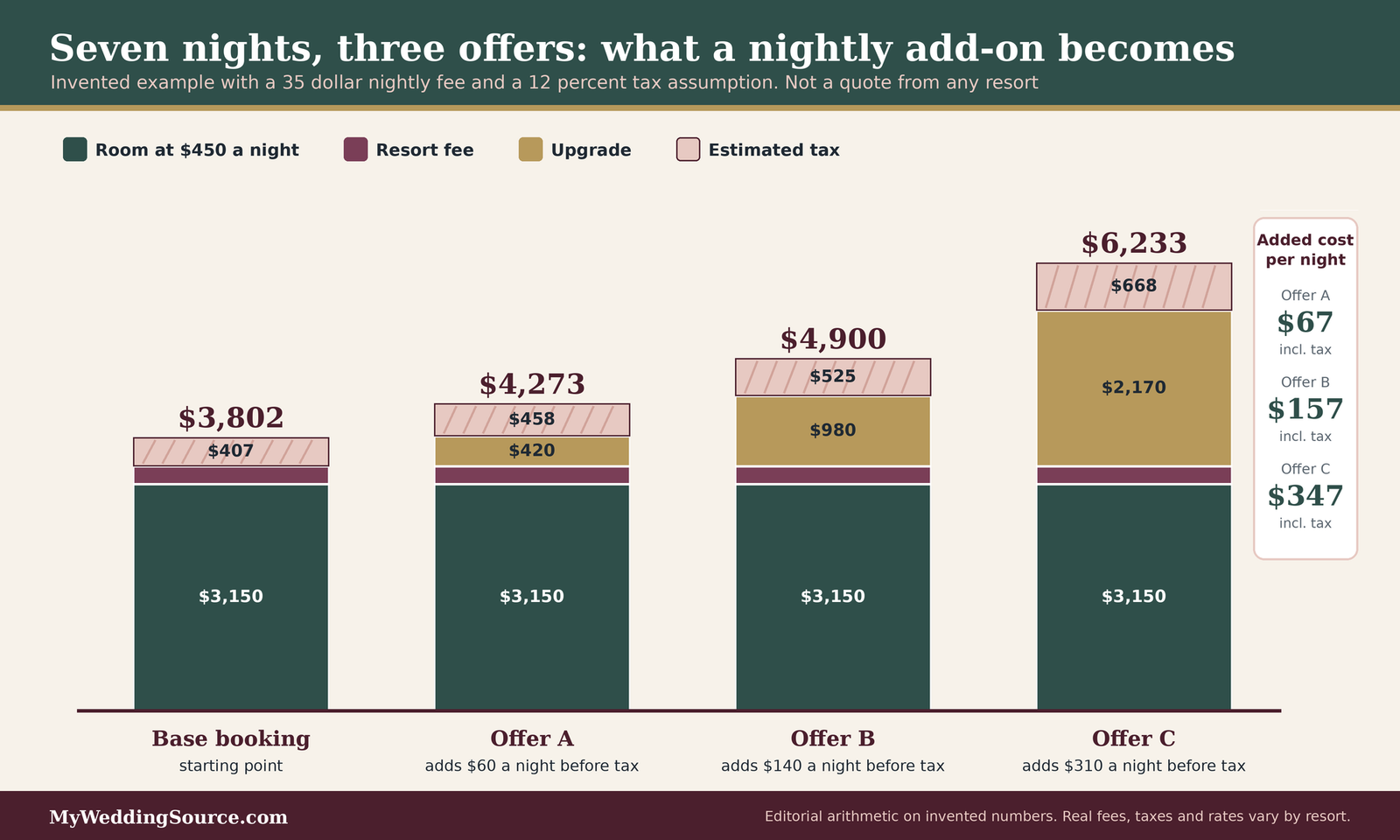
The numbers below are an invented example of honeymoon resort room category upgrades that we built to show the arithmetic. They are not a quote from any resort, and your resort’s prices, fees, and taxes will differ. We assume a seven-night stay, a base category at $450 per night, a mandatory resort fee of $35 per night that does not change with the upgrade, and a 12 percent tax applied to both room rate and fee. Real tax treatment varies by place, so treat the 12 percent as an assumption.
The three offers
Offer A is a paid upgrade to a better-view category arranged before travel at $60 more per night. Offer B is an oceanfront upgrade offered at the desk for $140 more per night, subject to space. Offer C is a swim-up suite offered as a package at $310 more per night. We chose these to show a small, a medium, and a large step. The percentage columns show how large each step is compared with the base rate, which is one useful way to see whether an offer is a small adjustment or a different purchase.
The arithmetic
| Base booking | Offer A | Offer B | Offer C | |
|---|---|---|---|---|
| Room rate per night | $450 | $510 | $590 | $760 |
| Added per night vs. base | $0 | $60 | $140 | $310 |
| Added as share of base rate | 0% | 13% | 31% | 69% |
| Room plus fee, seven nights | $3,395.00 | $3,815.00 | $4,375.00 | $5,565.00 |
| Estimated tax at 12% | $407.40 | $457.80 | $525.00 | $667.80 |
| Estimated total | $3,802.40 | $4,272.80 | $4,900.00 | $6,232.80 |
| Added vs. base, with tax | $0.00 | $470.40 | $1,097.60 | $2,430.40 |
| Added per night, with tax | $0.00 | $67.20 | $156.80 | $347.20 |
Reading the result
The $60 add-on is really about $67 a night once the assumed tax is applied, and it reaches $470 over the week. The $140 offer is about $157 a night and nearly $1,100 total, and the $310 offer is about $347 a night and more than $2,400 total. None of these is automatically too much. The point is that a nightly number sounds small at the desk and large on the statement, so do the multiplication before you answer.
Value beyond the price
Price is only half of the decision on honeymoon resort room category upgrades. The other half is whether the change fits how you will actually spend the trip, and whether the same money would do more elsewhere.
How much time you will spend in the room
KAYAK’s guide on oceanview and oceanfront rooms suggests splurging on a view for a special trip, in a destination known for its views, or if you will spend a lot of time in the room, and says an oceanview room is probably fine if you will mostly sleep there or can enjoy views from shared spaces. Apply that to your plan. A couple with a dawn-to-dusk excursion schedule uses a room differently from a couple planning slow mornings on a terrace.
What the upgrade changes that you will feel
List the specific things that would improve your days: a quieter location, a private plunge pool, a walkout to the sand, a lounge for breakfast, or a butler to handle dinner reservations. If you cannot name three, the upgrade may be a label more than a benefit. If you can, those three items are what you should ask the resort to confirm by name, because they are what you are paying for.
What the same money could do elsewhere
An added $1,000 might cover a special dinner, an excursion, or part of a longer stay. Our honeymoon budget guide shows how to place a room upgrade next to those other choices, and our honeymoon planning guide helps you decide what matters most before you shop. If the honeymoon is partly funded by guests, our note on a cash wedding registry can help you think about how to receive that money.
The upgrade offer worksheet
Use this worksheet each time an offer for honeymoon resort room category upgrades arrives, whether it comes by email, from a travel advisor, or across the front desk. Fill one copy per offer, and keep the filled copies together so you can compare them without relying on memory.
The fill-in form
The table below is the form. Each row is a fact you want to have in writing before you agree. If an answer is “unknown,” that is useful information too, and it tells you what to ask next.
Who is offering and what exactly is offered
| Field | Your entry |
|---|---|
| Date and time of the offer | |
| Who made it (resort, agency, advisor, desk agent) and their name | |
| Current category and bed type | |
| Offered category and bed type, exact wording | |
| View, floor, and location terms: held or requested? | |
| Service level included (club, butler, lounge, concierge) | |
| Is the offered category confirmed, or subject to availability? | |
| If not available on arrival, what happens? |
What it costs and what it changes
| Field | Your entry |
|---|---|
| New nightly rate | |
| Number of nights it applies to | |
| Mandatory fees that change | |
| Estimated taxes on the new total | |
| New total minus current total | |
| That difference divided by nights | |
| Refundable if plans change? Until when? | |
| Honeymoon inclusions that change or are lost |
What you need to receive and by when
Some offers have conditions, such as a payment deadline, a form, or a certificate. Write the condition and the date next to the offer, and put the date in your calendar. The Sandals honeymoon article says inclusions may depend on booking timing, length of stay, and required documentation or registration, so the deadline for a form can matter as much as the price.
Comparing two offers side by side
When you hold two offers, or an offer and the option of staying put, the worksheet makes the comparison concrete. The goal is not to find the cheapest choice. It is to choose a room whose terms you understand.
Put the facts next to each other
Copy the “Your entry” column for each offer into adjacent columns and read across. Look first for the rows where an answer is blank or unknown, and resolve those before comparing prices. An offer that costs less but leaves three terms undefined may be worse than one that costs more and spells everything out.
Decide your ceiling before you are asked
Choose a maximum total you would pay for the change, using the per-night difference with tax from the worksheet, and write it down. It might be a fixed amount or a share of the base rate. When an offer arrives at a desk or in a rushed message, compare it with the ceiling and answer. If it is above the ceiling, a polite “thank you, we will stay with our booking” is a complete response.
A timeline: before booking, before arrival, and on arrival day
The timing of each step in honeymoon resort room category upgrades matters, because some answers are easier to get early and some can only be known on the day. The checklist below sorts them by when to act. Our honeymoon booking checklist covers the wider plan, and this timeline focuses only on the room.
Before you book
The strongest position you will ever have on honeymoon resort room category upgrades is before you pay. Everything is available, nothing is committed, and you can compare resorts on equal terms.
Compare categories using the same questions
Pick two or three resorts and ask each the same questions about honeymoon resort room category upgrades from the worksheet. Notice which ones answer plainly. A resort that explains its view words, its guarantee, and its substitution policy clearly is giving you information you will need later. One that deflects may still be a good place to stay, but you will be doing more work to protect the room.
Check the terms of the seller you will use
Read the terms of the actual booking page, not a review. If you use an agency or a package, remember that its terms may differ from the resort’s. If you use a travel advisor, ask what they will confirm and in what form. If you plan to rely on loyalty status, read the program’s published terms for the brand and property, because several brands and properties are excluded from free upgrades.
Between booking and arrival
This is when requests are most useful and when paid upgrades are easiest to arrange, as long as you keep the paper trail tidy.
Send one clear message after booking
Send the confirmation email from the previous section, with your needs labeled as requirements and your wishes labeled as preferences. Prince of Travel suggests following up in the days before arrival and again on arrival day. Keep each message short. A resort that has to read five paragraphs to find your request is less likely to act on it.
Ask about paid upgrades while inventory is open
If you want a different category, ask now. The Sandals honeymoon article says some upgrades are booked before travel and others may be added later depending on availability, and recommends discussing them early. Ask for a revised confirmation that shows the new category and the new total, and compare it with your ceiling.
Confirm anything you need on the first night
If a late arrival, an early check-in, or a specific bed matters, ask now. Elliott’s report advises arriving before the afternoon check-in rush, ideally by noon, because late arrivals get whatever is left. That may not be possible after a long flight, so ask what the resort can hold and what it cannot.
Arrival day and the first night
Arrival is where the written record pays off. You are tired, the lobby is busy, and the person at the desk may not have read your emails.
Check in with the record, not from memory
Have your confirmation and any upgrade replies open before you reach the desk. State your category and ask the agent to confirm the room matches it. If an upgrade was confirmed, show it. If you asked for a free upgrade, ask politely whether anything is available, and accept the answer calmly. Prince of Travel notes that individual hotels decide how generous to be, and a gracious guest is easier to help than a frustrated one.
Look at the room before you unpack
Walk in, open the balcony door, check the view, listen for noise, and compare what you see with the category you booked. If something is clearly different, speak up at once. Elliott’s planning guide advises raising problems as soon as you notice them. Photograph what you see and note the time, because a prompt, calm complaint is the easiest to resolve.
Edge cases that change the answer
Some situations alter the rules for honeymoon resort room category upgrades, and a few of them matter enough to plan for in advance. None of this is legal advice, and rules in other countries may differ from those in the United States.
Accessibility and health needs
If a room feature is a necessity, as opposed to a preference, the way you ask and the rules that apply may change. Plan for this early, and ask for specifics in writing.
What the U.S. regulation says about accessible rooms
The federal regulation on reservations by places of lodging, 28 CFR 36.302(e), says hotels must let people with disabilities reserve accessible rooms in the same manner as everyone else, describe accessible features in enough detail for a guest to judge whether a room meets their needs, hold accessible rooms for guests who need them until all other rooms of that type are booked, reserve specific accessible rooms on request, and hold a specific accessible room reserved through the hotel’s service for that customer. Some of those requirements do not apply to rooms the operator does not own or substantially control.
Why abroad is a separate question
That regulation governs places of lodging in the United States. A resort in another country is not covered by it, so you cannot assume that the same promises apply. Ask the resort to describe the room’s accessible features in specific terms, such as door widths, shower type, and route to the beach, and ask it to confirm in writing that the exact room type is held. Elliott’s report notes that accessibility requirements may carry stronger obligations and should be stated clearly in writing.
Planning with a mobility need
If a mobility need is part of your trip, read our guide to honeymoon planning with mobility needs as well, and see our accessible wedding guest experience article for how we think about asking vendors for specific accessibility details. In this article, the key idea is that a room category upgrade is not an accessibility accommodation, and an accessibility need should be confirmed separately from any upgrade.
Names, dates, and who is on the booking
Small mismatches create large problems at check-in, including with honeymoon resort room category upgrades. A honeymoon booking made in the weeks around a wedding, name change, or passport renewal is especially prone to them.
The name on the reservation
We did not find a source describing a universal resort rule about matching the reservation name to identification, so ask your resort what it needs at check-in. If you are using a name that differs from the one on your passport, tell the seller when you book. Our passport name change guide and our related article on name mismatches on honeymoon airline tickets explain how to keep your travel documents consistent.
Honeymoon registration and proof
If a perk depends on a marriage date, ask what proof the resort wants and when it must be sent. The Sandals honeymoon article notes that inclusions can depend on documentation or registration. Our guide to marriage license versus marriage certificate explains which paper does which job.
Dates that shift
If a wedding date, flight, or arrival changes, tell the resort and ask for an updated confirmation. A change can reset a perk’s deadline or alter which category is available, and a revised confirmation is the document that proves what the new arrangement is.
Points, special rates, groups, and packages
How you pay or book can limit which honeymoon resort room category upgrades are even possible. Check before you rely on one.
Points and free-night rates
Hilton’s terms say certain rates may not qualify for upgrades, and the One Mile at a Time guide on Hyatt says free night certificates are not eligible for its confirmed suite upgrade awards. If you are booking with points or certificates, ask how that affects any upgrade. Our guide to using points on a honeymoon goes deeper on points bookings.
Group blocks and wedding-party rates
Hilton’s terms also say group reservations may not qualify for suite upgrades or any upgrade. If your honeymoon follows a destination wedding at the same resort, ask whether your honeymoon nights can be booked separately from the group block and whether that changes your category options. Our destination wedding guide covers the wider planning.
Packages and bundles
A package that bundles flights, rooms, and transfers may use its own category names and terms. Ask the seller to map its category name to the resort’s name, and ask whether the package’s terms or the resort’s terms govern a change. If the answer is unclear, ask for it in writing.
Advisors, insurance, and contracts
Other documents can interact with honeymoon resort room category upgrades, and a short look at each is worth the time.
If a travel advisor made the booking
AARP says advisers often act as an advocate when problems arise, and Elliott’s guide says that for a booking made through an agent, you should go to the agent first. Ask your advisor to send the upgrade confirmation to you, not only to the resort, and ask how they would escalate a mismatch. If you are using a wedding planner or another vendor for the trip, our vendor contract guide shows what to look for in the terms.
Travel insurance and the cost of the upgrade
We did not read your policy, so we cannot say how it treats an added upgrade. Ask your insurer whether the upgraded price is part of the insured trip cost, and whether anything changes if you add the upgrade after buying the policy. Our honeymoon travel insurance guide explains the questions to ask.
If the room is not what you were promised
Even careful couples who research honeymoon resort room category upgrades sometimes arrive to find something different from what they expected. The steps below are in order, from the quickest and friendliest to the most formal. We are describing common consumer options, not giving legal advice.
At the property
Most mismatches are solved at the desk, and the first hour matters most. Speaking calmly, early, and with documents in hand gives you the best chance.
Raise it right away
Elliott’s planning guide advises raising issues as soon as you notice them and escalating politely if front-line staff cannot help, by asking for a manager or supervisor and not accepting a flat no without a conversation. Describe the difference between what you booked and what you have, show your confirmation, and say what outcome you would like, such as moving to the booked category or adjusting the price.
Document what you see
Take photos of the view, the room, and any problem, with the time. Write down the names of the people you speak with and what they offer. Prince of Travel notes that if a stay is seriously disrupted, the general manager is usually the best person to ask about compensation, which can take the form of an upgrade or other adjustment.
Accept an alternative only if you understand it
A resort may offer a different room, a credit, or a future stay. Ask it to put the offer in writing, with the category, dates, and any conditions, before you agree. If the offer is a downgrade with a credit, ask what the credit can be used for and when it expires.
After you leave
If the matter is not resolved at the property, the next steps are written and can wait until you are home. Staying organized matters more than staying angry.
Send a written complaint with documents
Elliott’s trip-planning guide advises that if a problem cannot be fixed quickly, you put your complaint in writing. Send one concise message to the resort, and to the seller if you booked through one, with the booking number, the promised category, what you received, what you asked for at the time, and the outcome you want. Attach your confirmation and photos.
Consider a card dispute if the facts support one
The FTC’s guide to disputing credit card charges says that a written dispute must reach the card issuer within 60 days after the first bill showing the error was sent, that the issuer must acknowledge it within 30 days and resolve it within 90, and that billing errors, which include services not delivered, are handled separately from quality disputes, which fall under state law and have additional conditions. Elliott’s report adds that card issuers may review disputes over materially different rooms, but not automatically. Contact your issuer promptly.
Questions to ask before you say yes
Good questions turn a vague offer of honeymoon resort room category upgrades into something you can compare. Save the answers with your confirmation.
Questions to ask about any upgrade
- What is the exact category name and bed type, and is it confirmed or subject to availability?
- Are the view, floor, and location held, or are they requests?
- What happens if this category is not available when we arrive?
- What is the new nightly rate, the new total with all mandatory fees, and the estimated tax?
- Is the upgrade refundable, and until what date?
- Do any honeymoon inclusions change, and what do we need to do to receive them?
- Will you confirm all of this in writing?
Questions about the room
These confirm what the category actually gives you, which is the heart of honeymoon resort room category upgrades. Ask them of any seller, and ask for any photos to be of that category specifically.
The room itself
Ask which building and floor the category is in, whether the view is full or partial, whether there is a private balcony, and whether any construction, entertainment, or service areas are close. KAYAK’s guide recommends asking whether trees or buildings could block the view and whether the room has a balcony or only a window that may not open.
The service level
Ask which services are included at that tier, such as lounge access, concierge, a butler, or private check-in, and ask whether they apply for the entire stay or only certain hours. If the tier is a service upgrade and not a room change, make sure the price reflects that.
Questions about the money and the paper
These make sure the price and the promise match. Write the answers in the worksheet.
Price and fees
Ask for the total, not just the add-on. Ask whether the mandatory fee changes, whether taxes are included, and whether the price is held until a given date. The FTC says mandatory fees must be included in the total price for short-term lodging and excluded charges must be disclosed before payment.
Record and responsibility
Ask who will confirm the upgrade in writing, whether the resort or the seller is responsible if it is not delivered, and how to reach them on arrival day. If the answer is a phone number, ask for an email address too.
FAQ: honeymoon resort room category upgrades
Understanding the terms
Is a room upgrade the same as a room guarantee?
No. An upgrade changes the category you receive, while a guarantee is a promise about what the resort will provide. Reporting by Christopher Elliott found that guarantees often cover only the bed configuration, not the view or floor. Ask whether your upgrade is confirmed and which features, if any, are held.
What does “subject to availability” mean for an upgrade?
It means the resort will provide the upgrade only if space is open when you arrive. Hilton and Marriott describe their elite upgrades this way. If you paid for an upgrade, ask what happens when space is not available and whether you are refunded or offered an alternative in writing.
Do oceanview and oceanfront mean the same thing?
No. According to Sandals, an oceanview room has some visible ocean, possibly at an angle, while an oceanfront room directly faces the water. Beachfront means a few steps from the beach. These are one brand’s explanations, so ask your resort what it means by each term.
Getting an upgrade
Can I get a free upgrade because it is our honeymoon?
Sometimes, but it is not assured. Prince of Travel notes that special occasions help, yet individual hotels decide how generous to be. A Sandals honeymoon article says inclusions can depend on booking timing and registration. Ask in advance, be polite, and book a category you would enjoy even without an upgrade.
Is it better to pay for an upgrade before arrival or at check-in?
Before arrival gives you more time to compare and a written confirmation. The Sandals honeymoon article says some paid upgrades are booked before travel and others may be added later depending on availability. A desk offer can be fair, but you will have less time to check the total.
Money and problems
What should an upgrade price include?
It should show the new total for your dates, including mandatory fees. The FTC says mandatory fees must be part of the total price for short-term lodging, while taxes may be excluded but must be disclosed before payment. Ask for the new total, estimated tax, and refund terms before you agree.
What if the room is different from what we booked?
Raise it right away, calmly, with your confirmation in hand, and ask for a manager if needed. Photograph the room and write down names. If it is not resolved, send a written complaint, and consider a card dispute if the facts support one. This is general information, not legal advice.
Does an upgrade change anything about accessibility needs?
An accessibility need should be confirmed separately from any upgrade. The U.S. regulation on lodging reservations covers places of lodging in the United States and does not govern resorts abroad. Describe the exact feature you need, ask the resort to confirm the specific room type in writing, and keep the reply.
Your next steps
Before you shop
Write down what you actually want
List the three things that honeymoon resort room category upgrades would change in your days, such as quiet, a private pool, or sand access. Then check your plan against our honeymoon destinations guide and honeymoon planning guide so your resort fits the trip.
Set a ceiling
Using the worksheet, decide the most you would pay per night for honeymoon resort room category upgrades, with tax. Keep it where you can see it. Our wedding budget guide can help you place that number inside your larger plan.
After you book
Send the confirmation email
Adapt the message from the decoder section to your honeymoon resort room category upgrades, send it, and save the reply. If the reply is vague, ask again with one question at a time.
Build your record
Keep screenshots, replies, and filled worksheets for your honeymoon resort room category upgrades in one folder. Review the wider plan with our honeymoon booking checklist, and see our honeymoon travel insurance guide for the coverage questions that go with it.
Sources & methodology
How we built this guide
What we relied on
This guide combines a federal rule on how lodging prices must be displayed, a federal regulation on accessible-room reservations, the Federal Trade Commission’s consumer guidance on disputing card charges, the published benefit terms of one hotel loyalty program, detailed explanations of two others, a resort brand’s own explanation of view terms, and consumer-travel and trade reporting on how room confirmations and upgrades work in practice. Where a statement comes from a resort, loyalty program, or travel writer, we say so, because those sources reflect their own products and experience. The worked pricing example is our own arithmetic on invented numbers and is an estimate. Terms and policies change, and we read these pages on November 12, 2026. Please check current terms with your resort before you book.
What we did not do
We did not book rooms, test upgrade requests, or read any resort’s contract or any insurance policy. We could not read the ADA.gov plain-language hotel reservations page, so the accessibility summary rests on the text of the regulation itself. We found no source describing a universal resort rule on matching reservation names to identification, so we say to ask. This guide is general information, not legal, financial, or travel-insurance advice. Naming a brand here is an example, not an endorsement.
Source list
Government and regulatory sources
- Federal Trade Commission, Rule on Unfair or Deceptive Fees: Frequently Asked Questions (short-term lodging, 16 CFR Part 464): https://www.ftc.gov/business-guidance/resources/rule-unfair-or-deceptive-fees-frequently-asked-questions
- Legal Information Institute, 28 CFR 36.302, Modifications in policies, practices, or procedures (reservations by places of lodging, paragraph (e)): https://www.law.cornell.edu/cfr/text/28/36.302
- Federal Trade Commission, Using credit cards and disputing charges: https://consumer.ftc.gov/articles/using-credit-cards-and-disputing-charges
Loyalty program and resort sources
- Hilton, Hilton Honors benefit terms: https://www.hilton.com/en/hilton-honors/benefit-terms
- Sandals Resorts, Oceanview vs. oceanfront vs. beachfront (Hello Paradise blog): https://sandals.com/blog/difference-oceanview-vs-oceanfront-vs-beachfront
- One Mile at a Time, Marriott Bonvoy elite upgrade policy: https://onemileatatime.com/guides/marriott-bonvoy-elite-upgrade-policy-suites/
- One Mile at a Time, Guide to Hyatt Globalist suite upgrade awards: https://onemileatatime.com/hyatt-suite-upgrade-awards/
Consumer-travel and trade reporting
- Elliott Advocacy, Your hotel room isn’t guaranteed: https://www.elliott.org/safe-travels/your-hotel-room-isnt-guaranteed-heres-the-fine-print-theyre-hoping-you-wont-read/
- Elliott Advocacy, Everything you need to know about planning a trip: https://www.elliott.org/ultimate-consumer-guides-smart-travelers/planning-trip-ultimate-guide/
- Prince of Travel, How to get hotel suite upgrades: https://princeoftravel.com/guides/suite-talking-how-to-get-amazing-hotel-suite-upgrades
- Caribbean Magazine, Sandals room categories explained: https://caribbeanmag.com/sandals-room-categories-explained-luxury-vs-club-vs-butler-complete-2026-guide/
- Traveling Ears, Sandals honeymoon upgrades: https://travelingears.com/sandals-honeymoon-upgrades/
- KAYAK, Oceanview vs. oceanfront: https://www.kayak.com/news/oceanview-vs-oceanfront/
- AARP, Is a travel adviser worth it: https://www.aarp.org/travel/travel-tips/is-a-travel-adviser-worth-it/
- Hotel Dive, FTC cracks down on hotel junk fees: https://www.hoteldive.com/news/ftc-cracks-down-hotel-junk-fees/735759/