

Wedding songs do two jobs at once: they set the feeling of each moment, and they tell everyone in the room what happens next, so the strongest playlists are built moment by moment, with a few songs chosen by name and the rest steered by a clear brief.
Quick answer
Start with the feeling you want at each moment, then choose songs. In our worked example of a ceremony plus a five-and-a-half-hour reception, the day holds roughly 110 songs, but only about 11 of them need to be picked by name: the processional songs, the recessional, the entrance, the first dance, two parent dances, the cake cutting, the last dance, and the exit. Everything else can be steered with a genre brief, a must-play list, and a do-not-play list. Keep the first dance short (The Knot suggests no more than about 90 seconds), confirm in writing how your music will be played and by whom, and test the playlist on the actual sound system before the wedding.
What wedding songs have to do in a real evening
Most advice on wedding songs begins with lists: top first dance songs, top processional songs, top last dance songs. Lists are useful for ideas, but they skip the decision that makes a playlist work. A wedding is a sequence of moments, and wedding songs have to fit each one, each with a different audience, a different volume, and a different person responsible for pressing play. This guide treats wedding songs as a planning problem first and a taste question second, so that the songs you love end up playing at the right time, at the right volume, for the right length.
If you are still shaping the evening itself, our wedding reception guide covers block lengths, venue limits, and how to compare DJ and band quotes. This article stays narrower. It is about which wedding songs to choose, how many you really need, how to protect them from technical and family surprises, and how to hand them to the people who will run them.
Wedding songs are cues before they are taste
Every one of your wedding songs either marks a change or supports a stretch of time. A processional song marks the start of the ceremony, and guests stand because of it. An entrance song tells a seated room to look at the doors. A last-dance song tells people the evening is ending. Background songs during dinner do the opposite job: they should be noticeable enough to feel like a wedding and quiet enough to let tables talk. When couples are disappointed by a playlist, it is often because a song was doing the wrong job, such as a dramatic ballad playing while guests are trying to talk over appetizers, or a much-loved but slow song following the most energetic stretch of the night.
Songs that mark a moment
Moments that mark a change need a song that is recognizable within a few seconds, or one that a musician or DJ can start cleanly at a chosen point. These songs also need a clear start and a clear end, because someone has to begin them and someone has to stop them. We call these the named songs, and in our worked example later in this guide there are about eleven of them.
Songs that carry a stretch of time
Cocktail hour, dinner, and open dancing are long. Over an evening they consume far more wedding songs than the named moments, but they matter less song by song. What matters is the overall feel, the pace, and the absence of unpleasant surprises. These are the steered songs: you describe the mood, the genres, and the limits, and a person or a playlist fills in the rest. Treating them as a brief rather than a list saves a great deal of effort and usually produces a better room.
What couples choose, and how to read the numbers
Published studies are worth a glance, mostly to understand what is common, and not to decide for you. The Knot’s Real Weddings Study is the most widely cited U.S. source, and it is a survey of couples who joined by email invitation through The Knot or WeddingWire, so it describes that group and not every couple in the country.
What the studies say about first dances
The Knot’s article on its first dance rankings says the list is based on its Real Weddings Study of couples who married in 2024. It reports that Elvis Presley’s “Can’t Help Falling in Love” took the top spot from Ed Sheeran’s “Perfect,” followed by Chris Stapleton’s “Joy of My Life,” Kelsey Hart’s “Life With You,” Etta James’s “At Last,” and Taylor Swift’s “Lover.” The Knot’s earlier release on couples who married in 2023 describes the same Elvis song ending a six-year run for “Perfect.” In the study of couples who married in 2025, The Knot reports that 87 percent of couples open the reception with a first dance, which it calls the most enduring reception tradition.
How to use popularity without being ruled by it
A popular choice among wedding songs has two practical advantages: guests recognize it, and a live musician or DJ almost certainly has a version ready. It has one disadvantage: if your guests have heard it at three weddings this year, it may carry less of your own story. We suggest using popularity lists to find a style, then asking what a song would have to do for you. If the answer is “feel like us,” a less common song with a clear personal connection is a better fit. If the answer is “work without rehearsal in a room of 150 people,” a familiar song is the safer path.
Decide the story before choosing wedding songs
The first decisions are about feeling, not titles. A short brief written before you begin saves arguments later, because it gives you a way to say yes or no to any suggestion, from your partner, your parents, or your DJ.
Define the audience and the emotional purpose
Every wedding has one set of guests that most shapes the room. It may be a grandmother who needs to hear the words, college friends who will dance for hours, or a quiet group who would rather talk. The right wedding songs for your day depend on who is listening and what you want them to feel.
Four tones to choose from
Most couples find that one of four tones describes their day best, and that naming it shortens every later decision. A sentimental day leans on lyrics, slower tempos, and family dances. A celebratory day leans on familiar crowd songs and a long dance block. A private day uses fewer songs, more acoustic or instrumental music, and a short dance block. A playful day uses humor, surprise, and song changes, such as a recessional with a comic twist. Many weddings blend two, such as a sentimental ceremony and a celebratory reception, and that is fine. The point is to decide where each tone belongs, so the ceremony playlist and the dance playlist are not competing.
Why you should not copy a viral idea unchanged
Short videos make elaborate ideas look effortless: a choreographed entrance, a costume change timed to a beat drop, a mashup of ten songs under three minutes. What the video leaves out is the rehearsal, the custom audio edit, the lighting cue, and the guest list that already knew the joke. Before adopting an idea you have seen online, ask four questions. Who edited the audio, and will they be there? Does your venue’s sound system support it? Do your guests share the reference? What happens if it fails in the first ten seconds? If you cannot answer all four, choose a simpler version and keep the spirit of the idea.
List the practical constraints
Constraints are not a downer. They are the edges of the space in which your wedding songs will actually play, and it is cheaper to find them in advance than to meet them on the day.
Space, sound, weather, access, timing, and rules
Write down the facts that will limit your music. How large is the room, and does it echo? Is the ceremony outdoors, where wind carries sound away and a speaker cable may not reach? Does the venue limit volume or set a curfew? The Knot’s ceremony music guide notes that secular venues may limit volume, curfew, or band space, and that some religious sites restrict certain pieces, with the “Wedding March” given as an example, so confirm both your venue’s and your officiant’s rules before you commit to titles. Consider access as well: a guest who uses a hearing aid, a guest who is sensitive to loud sound, and a guest who cannot easily reach the dance floor are all part of the audience. Finally, check timing. Outdoor ceremonies often depend on daylight, and indoor ceremonies often depend on a room that has to be turned over, so the length of your music has to fit the clock, which is the subject of our wedding planning timeline.
Set a budget and a complexity ceiling
Music spending ranges widely. The Knot’s study of couples who married in 2025 reports an average of $1,800 for a DJ and $4,500 for a live band, and its ceremony music guide cites an average of $855 spent on wedding musicians, from the 2025 Real Weddings Study. These are averages, not quotes, and they are pulled up by couples at the high end, so use them as a rough check and not a price list. A complexity ceiling is just as useful as a budget. Decide in advance how many technical pieces you are willing to manage: one microphone or two, one sound system or several, one person pressing play or three. Each added piece is another place for something to go wrong, and adding a piece should have to earn its place by improving a moment that matters to you.
Cost context
The Knot’s 2026 study (couples married in 2025, 10,474 respondents recruited by email from its member base) lists an average of $1,800 for a DJ and $4,500 for a live band. Its ceremony music guide cites an average of $855 spent on wedding musicians from the same study series. The Knot says hours booked, travel, equipment, and custom requests all move the price. A streaming subscription for a backup playlist costs far less than either, but it comes with usage limits we cover later. These are survey averages, not quotes, and your price depends on your region, date, hours, and contract.
Build wedding songs moment by moment
A reliable way to build wedding songs is to walk through the day in order and ask the same three questions at every stop: what should people feel, who is the audience, and who starts and stops the music. The sections below follow the day from the first guest arrival to the last wave goodbye. Where a published source gives a range, we name it. Where the advice is our own judgment, we say so.
Ceremony music
The ceremony is the quietest part of the day and the part where one wrong choice is most noticeable, because there is no crowd noise to hide it. It is also where your officiant and venue have the most say. Our wedding ceremony guide covers the order of events, and our wedding officiant guide covers what to ask the person leading it.
Prelude and seating
The Knot’s ceremony music guide says the prelude plays as guests arrive, typically starting 20 to 30 minutes before the ceremony, and suggests 5 to 10 songs depending on its length. We would add one practical point: guests do not arrive on a schedule. Early guests find a seat, late guests rush, and a prelude that is too sparse leaves silence at exactly the moment people are looking for a place to sit. A calm, mostly instrumental set gives the room something to settle into, and it keeps the first sung lyric for later, when people are ready to listen.
Processional and recessional
The Knot says the processional usually runs about 3 to 10 minutes, depending on the size of the procession and the venue, and it suggests one song for the family, one for the wedding party, and one for the couple. Zola’s guide to the order of events lists the traditional order of entrance and notes that it can be adapted, with the couple exiting first at the recessional. Music has to match whichever order you choose. If the wedding party is small, a single song may last the whole procession; if it is large, you may need a second. The Knot describes the recessional as upbeat music, usually about five minutes, with a postlude of at least two songs in case guests move slowly. A common mismatch is a song that ends before the last person reaches the front. Ask the musician or DJ how to extend or fade a song when needed, and walk the aisle at the rehearsal with a stopwatch.
Cocktail hour and dinner
These two blocks account for a large share of the music in the day, and they are the easiest to over-plan. People are talking, eating, and moving between conversations, so the music’s job is to support that.
Background that supports conversation
The Knot’s ceremony guide advises against playing music while someone is speaking, and the same principle applies in the reception room: if the music competes with speech, people lean in, raise their voices, and the room gets louder without anyone choosing it. For cocktail hour, choose a tempo that is lively but not driving, and keep lyrics familiar enough to fade into the background. For dinner, go a little lower in tempo and volume. Vocals are fine, but avoid songs with an abrupt dynamic jump, such as a quiet verse followed by a loud chorus, because a sudden jump makes a seated table flinch. Our wedding reception guide explains why a well-paced dinner protects the dance floor later.
Toasts, announcements, and silence
Music should stop for toasts, and the stop should be planned. A tidy handoff is for the emcee to ask the DJ to lower the music before the first speaker begins, and for the DJ to bring it back up afterward at a prearranged level. If your wedding has no DJ and runs from a playlist, assign a person to pause it. Silence is not a problem here. A room that goes quiet for a toast is often the moment guests remember, so do not fill it.
Entrances, first dance, and family dances
These are the named moments of the reception. They are the ones people photograph, so they deserve the most care about start points, length, and the version of the song.
The entrance
An entrance song needs a strong, recognizable opening, ideally in the first five to ten seconds, since the room’s attention is divided at first. A long instrumental intro can leave you standing in the doorway while guests wonder what is happening. If your favorite song has a slow beginning, ask the DJ to start it at the first vocal or at a chosen point, and confirm that the edit sounds smooth when you hear it through the venue’s speakers. It also helps to decide whether the entrance song continues after you arrive or fades quickly into the first dance, and to tell the photographer so they know when to be in position.
The first dance
The Knot suggests keeping the first dance short, with no more than about 90 seconds, and recommends dance lessons if you are unsure how to move to your song. Many couples find a three- or four-minute song, even one of the best-loved wedding songs, longer on the floor than it seemed on the playlist, particularly when everyone is watching. A common solution, which we suggest and which is our own judgment, is to dance the first minute or so alone, then have the DJ invite the wedding party or the room onto the floor, so the pressure eases and the song can finish naturally. A DJ can also edit the song down or fade it at a chosen moment. If you have a live band, ask whether they will play a shortened arrangement, which The Knot notes is one option for couples who want a live version.
Parent dances and the cake cutting
Parent dances are among the most personal moments of the day and among the places where logistics can interfere, such as a parent who is not comfortable dancing or a relationship that is complicated. Decide with each parent before the wedding whether they want a dance, a different gesture, or a joint dance with others, and choose a song that suits their comfort and not only yours. For cake cutting, a short, playful song works well, and the photographer will thank you for something with a clear beat they can time a shot to. These are small moments, and they work best when the song is short, the cue is clear, and nobody feels they were put on the spot.
Open dancing
The open dance block is where a playlist most needs a person’s judgment, and where steering matters more than naming.
Open the floor with songs the room knows
The first songs of the dance block set whether the floor fills. A common approach, and one we suggest, is to open with familiar songs from a range of eras so that more than one generation is invited, then slowly move toward the genres your guests actually dance to. Holding a few lesser-known favorites for later, once the floor is full, protects them from an empty room. A DJ reads this in real time; a playlist cannot. If you are using a playlist alone, put your most recognizable songs in the first third of the block.
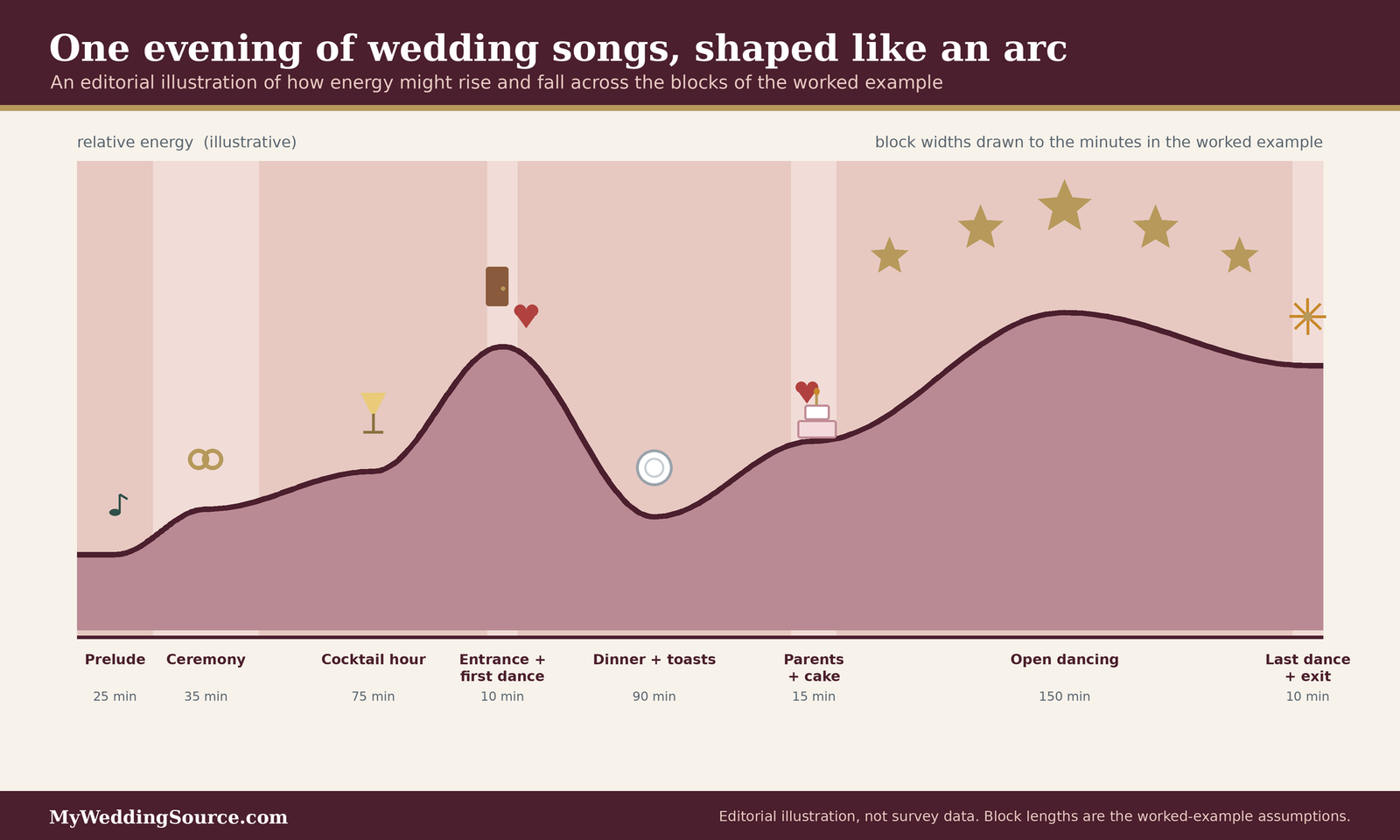
Shape the energy over time
An evening has an arc. Energy rises as people finish eating, peaks during the central stretch of the dance block, and needs a gentle landing before the last dance. Slow wedding songs are useful for giving dancers a breather, but a run of three slow songs at the wrong moment can clear a floor. We suggest placing one slow or mid-tempo song about every four to six songs, and watching the room for a mismatch. This is a rule of thumb from our own planning experience, not a published standard, so adapt it to your guests.
Last dance and exit
The end of the night is a good place to be deliberate, because it is the part guests carry home.
Choose the last dance on purpose
A last dance can be a sentimental slow song, a big sing-along, or a short song the couple dances alone while guests circle. Announce it so guests know it is the last, and make sure the DJ or the venue has the time to play it fully. Check the clock against your venue’s end time, because a song that runs past a hard stop is unlikely to be allowed to finish.
Plan the exit song with the venue
If you plan a send-off, decide on the song, the location, and the cue. Ask the venue whether props such as sparklers or bubbles are permitted and where they must be used, and confirm the exit song can be played outside the main room if that is where you leave. Tell the photographer, since they will need to position themselves in advance. Our wedding photographer shot list suggests asking for exit shots by name.
Matching wedding songs to moments with an idea matrix
Writing down your wedding songs ideas side by side makes it much easier to see which ones are worth the effort. The matrix below is our own planning tool for wedding songs. It compares common approaches by the feeling they create, the guests they suit, the setup required, and the main way each can fail. It is not a ranking and the ratings are editorial judgments, not measured findings.
| Moment and idea | Feeling it creates | Best for | Setup | Main failure risk |
|---|---|---|---|---|
| Processional played by a live musician | Warm, personal, flexible timing | Smaller ceremonies, outdoor or chapel settings | Musician booked, amplification checked, rehearsal | Weather, amplification, and a long wait if the musician cannot extend |
| Processional from a recording | Reliable, consistent | Any size, tight budgets | One speaker, one person pressing play | Wrong start point, Bluetooth dropout, no one assigned to cue |
| Instrumental covers of a favorite song | Familiar but quiet | Prelude, cocktail hour, dinner | Playlist with checked versions | Cover versions with unexpected vocals or abrupt changes |
| Entrance with a strong opening | High energy, shared attention | Celebratory weddings with a lively room | DJ or emcee, cue to photographer | Slow intro leaves couple waiting in doorway |
| First dance, edited short | Intimate without the long stare | Couples who dislike being watched | Audio edit or DJ fade | Edit sounds abrupt on the venue’s speakers |
| First dance, full length with others joining | Warm, shared | Families who like to dance | Emcee invitation, wedding party briefed | Nobody joins and the couple stands alone |
| Parent dance as a shared dance | Inclusive, lower pressure | Complicated family situations | Conversation in advance | A parent who did not agree to it |
| Dinner set of mellow familiar songs | Relaxed, talkative | Most weddings | Playlist with tempo and volume plan | Songs with sudden loud choruses |
| Dance block opening with crowd songs | Energy rises quickly | Mixed-age guest lists | DJ or a well-built playlist | Songs too narrow for the room |
| Last dance announced | Closure, togetherness | Any wedding | Clock check, announcement | Venue cutoff prevents the song finishing |
| Exit song with a send-off | Memorable ending | Weddings with venue permission | Venue approval, photographer briefed | Prop rules, wind, or darkness |
Reading the matrix
The matrix is a thinking aid, not a recipe. Its value is in seeing that the cheapest ideas, such as a recording and one speaker, are often the most reliable, and that every added element brings a new failure point.
Where the rows disagree
Some ideas pull in opposite directions. A live musician at the ceremony is warm but adds weather and amplification risk. A recording is reliable but needs someone to press play at the right second. Neither is wrong. Choose the failure you are better prepared to manage, and write down who manages it.
Choosing one idea per moment
We suggest picking one idea for each moment and resisting the urge to stack. A moment that has a live musician, a custom arrangement, and a surprise guest is three separate ways to fail at once. If you want something special, put your effort into one moment, usually the first dance or the processional, and let the others be straightforward.
Adapting the matrix to your own wedding
Copy the rows that apply to you from this wedding songs matrix, delete the rest, and add the ideas you are considering. The act of writing the failure risk next to each idea is the useful part, because it turns a vague worry into a question you can ask a vendor.
Add your own rows
If you are considering something not on the list, such as a choir, a family member singing, or a cultural tradition with its own music, give it a row. Ask the people involved what they need in terms of microphones, rehearsal time, and a signal for when to begin. Cultural and family traditions often have the strongest emotional weight, and they deserve the same careful cue as any other named moment.
Cross out what does not earn its place
For each row, ask whether the idea improves the moment for the people in the room. If the answer is “it looks good on video” and nothing else, it may be a candidate for the cut list. Fewer, cleaner moments are easier to run and easier to enjoy.
How many wedding songs you need, with a worked example
Couples are often surprised by how much music a wedding consumes, and by how few wedding songs actually need a name. A ceremony and a long reception use hours of music, and trying to pick every song by name is both unnecessary and exhausting. A little arithmetic shows how few songs really need your attention.
The method: minutes divided by song length
The calculation is simple. Estimate the minutes in each block, divide by an average song length, and round. We use 3.5 minutes as a working average, which is our own assumption and not a published figure. DJs often shorten or blend songs, so real counts are usually higher, and live musicians may play longer arrangements, so counts can be lower.
Choose block lengths
The Knot suggests a prelude starting 20 to 30 minutes before the ceremony. For the rest, we use illustrative lengths and label them as such: a 75-minute cocktail hour, a 90-minute dinner with toasts, and a 150-minute open dance block. Your own wedding will differ, and so will your wedding songs. Replace our numbers with yours from your timeline, which our wedding reception guide can help you build.
Separate named songs from steered songs
For each block, ask whether a person will notice if a specific song plays. If yes, it is a named song. If not, it is a steered song. The named songs in our example are three processional songs, one recessional, one entrance, one first dance, two parent dances, one cake-cutting song, one last dance, and one exit, which total eleven. Note that some couples skip parent dances or the exit, which lowers the count, and others add a bouquet toss or an anniversary dance, which raises it.
A worked example
The numbers below are an illustration, not data. We assume a Saturday wedding with a 25-minute prelude, a short ceremony, and a reception that runs from cocktail hour through the last dance, with an average of 3.5 minutes per song.

The arithmetic, block by block
The prelude, at 25 minutes, needs about 7 songs. The ceremony itself needs 3 processional songs, 1 recessional, and 2 postlude songs, for 6. Cocktail hour, at 75 minutes, needs about 21. The entrance and first dance add 2. Dinner and toasts, at 90 minutes, need about 26, although toasts will reduce that, so treat it as a ceiling. Parent dances and cake cutting add 3. The open dance block, at 150 minutes, needs about 43. The last dance and exit add 2. The total is roughly 110 songs, which is about seven hours of music.
What the arithmetic tells you
Of those 110 wedding songs, about 11 are named, and about 99 are steered. In other words, roughly nine in ten songs can be handled with a brief. That is good news for anyone who feels overwhelmed by the idea of picking a hundred songs. Spend your attention on the eleven named wedding songs, write a short brief for the rest, and let a DJ, a musician, or a well-built playlist handle the remainder.
Turning the brief into a playlist
A brief is a short description of what you want from each steered block. It can fit on a single page, and it should be specific enough that a stranger could follow it.
What goes in the brief
For each steered block, write the mood, the tempo range, the genres you like, the genres you would rather avoid, and one or two example songs that capture the feeling. For the dance block, add the age range of your guests and any language or cultural preferences. If you are using a DJ, give them this brief along with your must-play and do-not-play lists, and ask them to confirm they have read it.
Test the brief against a stranger
Hand the brief to a friend who does not know your taste and ask them to name five wedding songs they would play. If their choices surprise you in a bad way, the brief is too vague. If they surprise you in a good way, you may have found a better playlist than the one you would have made yourself.
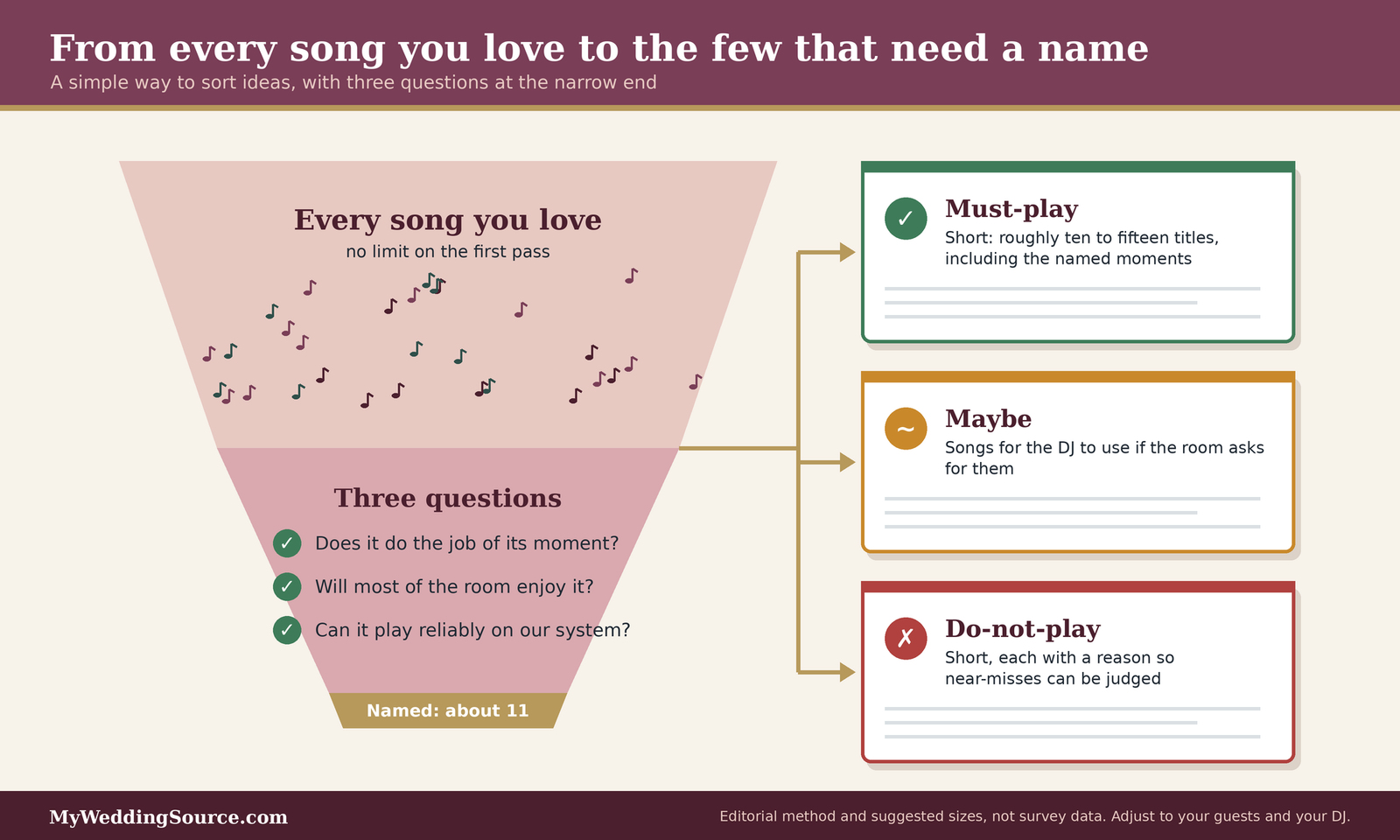
Make three lists: must-play, maybe, and do-not-play
Most DJs and many musicians ask for a must-play list and a do-not-play list of wedding songs. The Knot’s first dance coverage also points readers to a separate list of songs to avoid, which suggests how common the question is. A third list, the maybe list, gives your music person room to read the room.
How to build each list
The lists work best when they are short, specific, and explained. A long list takes the DJ’s judgment away, which is the opposite of what you are paying for.
Must-play songs
Keep this list short. We suggest roughly ten to fifteen wedding songs, including the named moments above and a few songs that would be missed if they did not play. Our figure is a rule of thumb, not a standard. A very long must-play list leaves no room to respond to the crowd, and a DJ who has to play thirty requested songs will have little freedom to adjust if the floor empties.
Do-not-play songs
Add a reason to each entry. For wedding songs on this list, a reason such as “a song from a past relationship” or “lyrics we find uncomfortable at a family event” lets the DJ judge near-misses, such as a remix of the same song or a different song by the same artist. A do-not-play list without reasons is easy to follow literally and miss in spirit. Keep it short enough to be useful, and do not use it to micromanage taste.
Check the version, not just the title
Two files with the same title can sound very different at a wedding. The version you choose affects length, language, and how the song feels in a room.
Radio edit, album version, live version, and remix
Studio versions vary in length and in the length of their introductions. A radio edit may begin faster and end earlier than an album version, and a live recording may have a long instrumental opening. A remix may change the tempo and feel of a song you know well. Listen to the exact file you plan to use and note the start time, the end time, and any point at which you would want a fade.
Language, lyrics, and the older relatives test
Read the lyrics of every one of your wedding songs, including the verses you may not remember. Wedding songs that seem sweet by title can contain lines that would feel awkward in front of a grandparent or a boss, and the reverse is also true. Check for explicit versions and choose a clean version when children or older relatives will be present. This takes ten minutes per song and prevents the single most common reaction from the back table.
Sorting ideas into lists with a simple test
When you have a long list of ideas, a short test helps you decide where each one goes. Ask three questions about each song: does it do the job of its moment, will most of the room recognize or enjoy it, and can it be played reliably on the system we have?
Songs that pass all three tests
These go on the must-play list or become named songs. They are the songs you can rely on to work.
Songs that pass two of three
These are good candidates for the maybe list, or for a different moment. A beloved but slow song that fails the energy test at the dance block may be perfect during dinner or as a postlude.
Streaming, files, licensing, and backups for wedding songs
How your wedding songs are played is as important as which ones you chose. A playlist that works at home can fail at a venue for reasons that have nothing to do with taste: a dropped connection, a subscription that logs out, an app that pauses for an ad, or a rule about commercial use.
What streaming services say about public use
If you plan to play your own playlist, read the terms of the service you use. Do not assume that a personal subscription covers a wedding.
What Spotify says
Spotify’s support page on public or commercial use says the service is for personal, non-commercial use only, as stated in its terms, and that you cannot play Spotify publicly from a business. It lists examples such as bars, restaurants, schools, and stores, and refers commercial settings to a separate service. The page does not mention weddings, private parties, or events. We read that as an open question that couples should not settle by guessing, and we are not offering a legal interpretation. If you plan to rely on a streaming account at your wedding, check the current terms of your service and, where it matters, ask the service directly.
What that means in practice
Whatever the terms say, streaming has practical weaknesses for wedding songs: it depends on a connection, it can pause or switch songs, it may play an ad on some account types, and it does not let you control an edit or a start point as precisely as a downloaded audio file you own. Many professional DJs use their own licensed libraries and software for these reasons. Ask your DJ or musician how they source and play music, and ask a venue whether it has its own sound system and music arrangements that cover events held there.
Copyright, public performance, and who to ask
We are not lawyers, and this section is general education and not legal advice. The goal is to help you ask the right questions, not to settle them.
How federal law describes a public performance
The U.S. Copyright Act gives copyright owners the exclusive right to perform a musical work publicly. The statute’s definition of performing “publicly” includes performing at a place open to the public, and at a place where a substantial number of people outside a normal circle of a family are gathered. The Copyright Office’s circular on copyright basics adds that, for sound recordings, the public performance right covers digital audio transmission. Whether any particular wedding falls under these definitions is a legal question that depends on the facts, and we do not answer it here. The practical point is that licensing for live and recorded music in event spaces is a recognized issue.
Who handles it and what to ask
In most real weddings, the people best placed to handle licensing are professionals and venues, not couples. Ask your venue whether it holds licenses for music performed there, and ask your DJ or band how they handle licensing for their performances. Put the answers in writing in the contract. If you plan to use a self-run playlist, ask the venue whether there are any rules about outside music, and if the question matters to you, consult a qualified attorney.
Backups that actually protect the day
A backup plan for music is mostly about removing single points of failure. Two of everything is usually enough.
Offline files and a second device
Where you control the setup, keep an offline copy of your named wedding songs on a device that does not depend on a connection, and keep a second device with the same files in case the first fails or its battery dies. Bring cables, adapters, and a power source, and label the files by moment so a stranger could play them in order. If a DJ is running the music, ask what happens if their laptop fails and whether they carry a second system.
A silent fallback for the ceremony
For outdoor ceremonies, decide what happens if the sound fails altogether. A fallback might be a single guitarist who can play unamplified, a small speaker with a manual start, or a decision to proceed with no music and let the room’s quiet carry the moment. Tell the officiant, the musician, and the person who cues the music which plan applies and who decides.
Protect the room: volume, sound checks, and access
Good wedding songs can be spoiled by sound that is too loud, too quiet, or muddy. Sound is a shared experience, and it is worth planning as one.
Volume and hearing
There is no single right volume for wedding songs, but there are good reasons to be careful with it, and a few facts help.
What a workplace standard shows
The CDC’s National Institute for Occupational Safety and Health (NIOSH) recommends an exposure limit of 85 A-weighted decibels averaged over an eight-hour workday, and says noise at or above that level is hazardous. The page also explains that the decibel scale is logarithmic, so a sound 10 decibels louder is ten times more intense. This is a workplace recommendation for employees, not a rule for weddings, and it does not tell you what level a dance floor should be. We cite it for one reason: it shows that sustained loud sound is a recognized risk, and the people running your music, who work for hours near the speakers, are exposed longer than any guest.
Practical volume rules for the room
We suggest setting different volumes for different blocks and writing them down: quiet enough for conversation at dinner, louder for dancing, and lower again near tables of older guests or families with young children. Ask the DJ or venue whether a decibel meter or phone app is available for a quick check, and agree on a simple signal, such as a nod to the emcee, that the couple or the coordinator can use to ask for a change. Offering earplugs at a table or station is a thoughtful extra for guests who are sensitive to sound.
Sound checks and microphones
A sound check is the cheapest insurance in your wedding songs plan. It reveals the problems that no playlist can solve.
Test with the real system, in the real room
Whenever possible, hear your named wedding songs through the actual speakers, in the actual room, at the actual volume, before the wedding. A song that sounds balanced through headphones can sound shrill or boomy through a venue’s system. Check the start point, the fade, and the transition between songs. If you cannot visit the room, ask the venue or DJ about a test at setup time, and ask for a short call to check the first song before guests enter.
Microphones for readings and toasts
The Knot notes that music should not play while someone is speaking, especially if you want readings captured on video. A wireless microphone that works in the ceremony space is therefore part of your music plan, and not a separate item. Ask who supplies it, who operates it, and what the backup is. Our wedding vows guide is a good place to look if you want your vows to be heard clearly by everyone present.
Making the music accessible
A welcoming playlist considers the guests who will have the hardest time with it.
Guests who need quiet or distance
Some guests need a place to be away from the loudest speakers. Plan a few tables farther from the sound, and keep a quieter room or patio available if your venue has one. This helps guests with hearing aids, sensory sensitivities, or young children, and it helps older relatives who want to talk. Telling guests where those spaces are, in a short sentence from the emcee or on a sign, is enough.
Guests who cannot get to the floor
Not every guest can walk across a dance floor, and not every guest wants to. Consider a slow song among your wedding songs during which seated guests can be involved, such as a table-side dance with a grandparent, and choose a dance floor location that is easy to reach and does not block the route to restrooms and the exit. These choices cost little and can matter a great deal to the people they help.
Run the music with a cue sheet
A cue sheet is a one-page document that lists each music moment, who starts it, how it begins, how it ends, and what happens if something goes wrong. It is the most useful single document you can give to a DJ, musician, coordinator, or friend, and it takes an evening to write.
What goes on the cue sheet
The sheet works best when every row answers four questions: what is the cue, who owns it, what is needed for setup, and what is the backup.
The run-of-show table
The table below is a short example for a ceremony and the first half of a reception. It is an illustration with invented times, and your own sheet will differ.
| Time | Moment | Cue | Owner | Setup | Backup | Cleanup |
|---|---|---|---|---|---|---|
| 4:05 pm | Prelude | Start when first guests arrive | Musician or friend | Speaker placed and tested | Offline playlist on phone | Disconnect speaker after recessional |
| 4:30 pm | Processional, family | Coordinator nods | Coordinator and musician | Song cued to start point | Silent walk if sound fails | None |
| 4:35 pm | Processional, wedding party | Last family member seated | Musician | Second song cued | Extend the first song | None |
| 4:40 pm | Processional, couple | Officiant signals guests to stand | Musician | Third song cued | Officiant asks guests to stand | None |
| 5:05 pm | Recessional | Officiant presents the couple | Musician | Upbeat song cued | Second device with same file | Collect equipment |
| 5:10 pm | Postlude and cocktail hour | Couple leaves aisle | DJ or playlist owner | Mellow playlist loaded | Venue’s house music | None |
| 6:20 pm | Entrance | Emcee announces the couple | DJ and emcee | Song starts at first vocal | Start song from the beginning | None |
| 6:25 pm | First dance | Emcee invites room to watch | DJ | Edited file ready | Fade at chosen second | None |
Giving it to the right people
Share the sheet with everyone who touches the music: the DJ or musician, the coordinator or planner, the officiant, the photographer, and a backup person for each cue. Ask each of them to read it and tell you if any cue is unclear. A sheet that only you understand protects nothing. Our wedding planning checklist can help you decide when to send it.
Name who starts and who ends each moment
Every moment needs an owner for the start and an owner for the stop. The same person is not always the right choice for both.
Starting a moment
A moment may start on a time, a signal, or an event. A time is risky because weddings rarely run exactly on schedule. A signal, such as the coordinator’s nod or the officiant’s words, is more reliable. Decide on one signal per moment and tell the person who will act on it.
Ending a moment
Moments also end by a time, a signal, or the end of the song. Name who may fade a song, and when. This matters most for the first dance, the processional, and the last dance, where someone may need to extend, shorten, or fade the music to match what is happening in the room.
Handling requests, family opinions, and disagreements
Music is personal, and wedding songs put several people’s tastes into the same room. A few agreements made in advance can protect your relationships and your playlist.
Guest requests
Many guests want to contribute. Handled well, requests make the playlist feel shared. Handled badly, they take over your dance floor.
Collecting songs before the wedding
Some couples add a line to the RSVP asking guests to name a song that will get them dancing, which is a gentle way to gather wedding songs from the people who will hear them. Our wedding RSVP wording guide shows how to phrase such a question. Treat the answers as a source of ideas for the maybe list, and not as a promise. Telling guests that you will add what fits keeps expectations realistic.
Handling requests on the day
Decide in advance whether the DJ will take requests on the day, and tell them what to do with a request that does not fit. A polite refusal from the DJ is much easier for guests to accept than one from the couple. If there is no DJ, ask a trusted friend to keep a list and pass the best choices to whoever runs the playlist. The principle of keeping the couple out of the middle of small disputes appears throughout our wedding etiquette guide.
Disagreements between partners and families
Taste differences are normal, and they are easier to resolve with a plan.
When you and your partner disagree
Give each person a set of named moments for wedding songs, and agree to accept each other’s choices within their set. For example, one partner chooses the processional and the other chooses the exit. For the first dance, which is shared, agree to a short list of finalists and listen together on the same speakers. If you are both stuck, ask whether the disagreement is about the song or about what it represents, because the second question often leads to an easier answer.
When a relative has strong opinions
A parent or grandparent may care deeply about a hymn, a cultural song, or a favorite from their own wedding. Consider where such a request can fit, such as the prelude, a parent dance, or a short moment in the reception, and where it cannot. Explain the reason kindly and offer an alternative. If the tension is part of a wider strain, our wedding planning stress guide offers ways to share decisions.
A decision timeline for wedding songs
Decisions about wedding songs fall into a natural order. The suggested windows below are our own editorial guidance and not industry standards, and they assume a wedding about a year away. Shorten or compress them if your date is closer, and our wedding planning timeline can help you place them among your other tasks.
Early decisions
The earliest choices shape everything that follows, and they are mostly about people.
Choose who will run the music
Decide whether you will hire a DJ, hire a band, hire ceremony musicians, or use a playlist, and book early if you hire. Compare quotes on the same basis, with hours, overtime, travel, equipment, and cancellation terms. If you want to set a music budget, our wedding budget calculator can help you see where it fits.
Confirm venue and officiant rules
Ask the venue about sound limits, curfews, power, and any rules for outside music, and ask the officiant about any restrictions on ceremony music. Put the answers in writing, since these rules can change what you choose.
Middle decisions
With people and rules settled, the work becomes creative.
Write the brief and the named songs
About four to six months before the wedding, write your one-page brief and choose the eleven or so named songs. Listen to the exact versions and note the start and end points.
Build the lists and share them
Make the must-play, maybe, and do-not-play lists of wedding songs, and send them with the brief to your DJ or musicians. Ask them to confirm they have read them and to tell you if any request is impractical.
Final decisions
In the last weeks, the work is about checking, not choosing.
Test, rehearse, and lock the cue sheet
Hear the named songs on the real system if you can, rehearse the processional with a stopwatch, and send the final cue sheet to everyone who needs it. Resist adding new surprises now.
Prepare the backups
Pack offline copies, a second device, cables, and a printed cue sheet. Tell the person in charge of each cue which backup applies, and confirm who decides if something fails.
Questions to ask about your wedding songs plan
Good questions protect you from vague promises about wedding songs. Ask for the answers in writing and keep them with your contracts.
Questions worth asking before you finalize the music
- How many hours of music are included, and what does overtime cost?
- Do you work from a must-play and a do-not-play list, and will you read them before the wedding?
- How will the music be played, and what is the backup if equipment fails?
- Who holds the licenses needed for the music performed at this venue, and is that stated in the contract?
- Can you edit a song to start or end at a chosen point, and can I hear the edit through the real speakers?
- What are the venue’s rules on volume, curfew, outside music, and sound checks?
- Who will cue each named moment, and what is the signal?
Questions for the DJ or musician
These questions clarify scope and style.
Scope, fees, and substitutions
Ask what the quote includes, what is extra, and what happens if the person you met cannot attend. Ask whether a substitute will be comparable, and whether the contract names the substitute process.
Style and flexibility
Ask how they handle a crowd that does not respond, how they handle requests, and whether they will follow your do-not-play list in spirit as well as letter. Ask to hear examples of how they run a wedding like yours.
Questions for the venue and officiant
These questions clarify the rules around your music.
Sound, power, and timing
Ask about the house sound system, power access, volume limits, and the time music must end. Ask whether a sound check is possible and when.
Ceremony restrictions
Ask whether any music is restricted in the ceremony space, whether the officiant needs to approve your choices, and whether anyone must be told in advance about readings or a live musician.
FAQ: wedding songs questions
Choosing songs
How many wedding songs do I actually need to choose?
In our worked example, a ceremony and long reception hold roughly 110 wedding songs, but only about 11 need to be picked by name: processional, recessional, entrance, first dance, parent dances, cake, last dance, and exit. The rest can follow a written brief plus must-play and do-not-play lists. This is our own arithmetic with an assumed 3.5-minute song, so adjust it.
How long should a first dance be?
The Knot suggests keeping it to about 90 seconds at most. A full song can feel long when everyone is watching, so many couples ask a DJ to fade it or invite guests onto the floor partway through. Choose whichever option you can rehearse, tell the DJ and photographer, and listen to the exact file beforehand.
Should I pick popular wedding songs or something personal?
Both work, for different reasons. The Knot reports that Elvis Presley’s “Can’t Help Falling in Love” was the top first dance song among couples married in 2024, and familiar songs are easy for guests and vendors to follow. A personal song can say more about you. Use popularity to find a style, then choose what fits your room.
Playing the music
Can I play my own Spotify playlist at the wedding?
Spotify’s support page says its service is for personal, non-commercial use and cannot be played publicly from a business, and it does not mention events. We cannot settle that for you. Check the current terms, ask your venue about its rules, consider downloaded files you control, and consult an attorney if the question matters to you.
Do I need a license to play music at my wedding?
Licensing depends on facts and the law, and we cannot give legal advice. The Copyright Act defines a public performance to include places open to the public or where many people outside a family circle gather. Ask your venue and DJ or band how licensing is handled, and get the answer in your contract.
What should I do if the sound system fails?
Plan two layers. First, keep offline copies of your named songs on a second device with cables and power. Second, decide on a silent fallback for the ceremony, such as an unamplified guitarist or proceeding without music. Tell the officiant and the cue owner which plan applies, and agree in advance who decides.
People and logistics
How do I handle guest song requests?
Collect ideas on the RSVP if you like, treat them as inputs for a maybe list, and tell guests you will add what fits. On the day, let the DJ decline politely. A request line is easier to manage when the couple is not the one saying no.
What should be on a music cue sheet?
For each moment, list the time, the cue, the owner, the setup, the backup, and the cleanup. Include the exact file or version and the start and end points for named songs. Send it to the DJ or musician, coordinator, officiant, and photographer, and ask each to confirm they understand their cues.
Your next steps
Decide the story and the count
Write a one-page brief
Describe the feeling you want for each block, the genres you like and want to avoid, and a few example songs. Keep it short enough for a stranger to follow, and make sure it covers the steered wedding songs as well as the named ones. Our wedding reception guide can help you set the block lengths that the brief depends on.
Pick the named songs
List the eleven or so moments that need a specific song, choose each one, and listen to the exact version. Decide where parent dances, an exit, or any family tradition fit among your wedding songs. Our wedding ceremony guide can help you place the ceremony music.
Protect the plan
Write the cue sheet
Give each moment an owner, a signal, and a backup, and share it with every vendor and helper. Ask for written confirmation of hours, equipment, licensing, and substitutions in your contracts, and use our wedding planning checklist to place the tasks on your calendar.
Test and rehearse
Hear the named songs on the real system, walk the processional with a stopwatch, and pack offline copies and a second device. Add the music moments you care about to your photo list with our wedding photographer shot list, so they are captured as well as heard.
A useful companion piece: Holiday Wedding Travel and Hotel Blocks: How to Reduce Guest Costs.
Sources & methodology
How we built this guide
What we relied on
This guide draws on The Knot’s published Real Weddings Study read-outs for couples married in 2023, 2024, and 2025, The Knot’s articles on ceremony music, first dances, and music costs, Zola’s guide to the ceremony order of events, Spotify’s support page on public and commercial use, the U.S. Copyright Act and a Copyright Office circular, and a NIOSH page on occupational noise. Where a number comes from The Knot or WeddingWire, it reflects couples who responded to an email invitation from those sites, so it describes that group. The song counts, the 3.5-minute average song length, the block lengths, the idea matrix, the cue sheet, and the decision timeline are our own illustrations and arithmetic, and are estimates and editorial judgments.
What we did not do
We did not survey couples, test sound systems, or interview DJs or musicians. We did not review every streaming service’s terms, and we did not give legal advice: licensing and public performance depend on facts and jurisdiction, so ask your venue and vendors, put answers in your contract, and consult an attorney if the question matters. Prices vary by region, date, and hours, and published averages are not quotes.
Source list
Government and public-agency sources
- U.S. Copyright Office, Copyright Act, Title 17, Chapter 1 (definitions of “perform” and “publicly” in section 101): https://www.copyright.gov/title17/92chap1.html
- U.S. Copyright Office, Circular 1, Copyright Basics: https://www.copyright.gov/circs/circ01.pdf
- CDC National Institute for Occupational Safety and Health, About noise and hearing loss prevention: https://www.cdc.gov/niosh/noise/about/index.html
Industry, survey, and platform sources
- The Knot, Wedding songs and first dance songs (Real Weddings Study, couples married in 2024): https://www.theknot.com/content/wedding-songs-the-knot-spotify-playlist
- The Knot, Everything you need to know about wedding ceremony music: https://theknot.com/content/ceremony-music-basics
- The Knot, Average cost of a wedding band or DJ: https://theknot.com/content/average-cost-wedding-band-dj
- The Knot, Real Weddings Study facts (couples married in 2025): https://www.theknot.com/content/real-weddings-study-facts
- The Knot Worldwide, 2026 Real Weddings Study release (Business Wire, February 18, 2026): https://www.businesswire.com/news/home/20260218045442/en
- The Knot Worldwide, 2024 Real Weddings Study release (Business Wire, February 14, 2024): https://www.businesswire.com/news/home/20240214332119/en
- Zola, A guide to the wedding ceremony order of events: https://www.zola.com/expert-advice/a-guide-to-the-wedding-ceremony-order-of-events
- Spotify Support, Spotify for public or commercial use: https://support.spotify.com/us/account_payment_help/account_help/use-spotify-in-my-bar-restaurant-store-school-etc