
A wedding travel page is the one place on your wedding website where a guest flying in from another country can find everything between the airport gate and the venue door: how to arrive, where to go, whom to call, and what to expect in the first day. This guide gives you a tested structure, a translation method and a worked example, so the wedding travel page works for a tired traveler holding a phone in a baggage hall.
Build the wedding travel page as a ladder of seven rungs, in the order a guest meets them: before booking, documents, the arrival airport, the ground transfer, the first night, the venue days and the departure. Put one copy-ready arrival card at the top of the wedding travel page, with the address, a phone number and a one-sentence instruction in each guest’s language. Translate only what a guest must act on, have a fluent person review it, and test the wedding travel page on a phone with a weak connection. Leave entry rules to the agencies that set them.
Most wedding websites have a travel tab, and few have a proper wedding travel page. Most of those tabs say the same thing: a hotel name, a link to a block, and a line about renting a car. That is enough for a cousin driving two hours; a wedding travel page for international guests has to do more.
It falls apart for a grandmother landing after fourteen hours in the air, who does not read English comfortably, whose phone has no local data plan, and who has never seen the word “shuttle” used to mean a van that leaves only twice.
A good wedding travel page treats the journey as a sequence of small problems, each with a right answer you can write down in advance. It does not try to be a guidebook. It tries to remove the moments when a guest stands somewhere unfamiliar and cannot tell what to do next.
This article is about that page only. It is not a guide to choosing hotels, writing invitations or planning a destination wedding from scratch. If you need those, the guide on coordinating wedding guest hotels across budgets and mobility needs and the wedding guest list guide cover them in depth. Here the focus is narrower: the airport-to-venue chain, written for people who are crossing a border to be there.
A note on scope. This is general planning information, not legal, immigration or travel-insurance advice, and entry rules are decided by governments, so each guest should confirm requirements with the official source for their own passport.
What a wedding travel page does for guests who fly in
Think about what a guest from abroad has already done by the time they open your link. They have asked for time off, probably paid for a long and expensive flight, perhaps applied for a visa or an electronic travel authorization, and arranged for someone to look after a house, a business or a pet. They are committed. What they lack is local knowledge, and that is exactly what a wedding travel page can supply.
The wedding travel page has four jobs, and it helps to name them because they pull in different directions.
It reduces risk. A missed document, a wrong terminal or an unclear pickup point can cost a guest an afternoon or a night’s lodging. The wedding travel page cannot prevent every problem, but it can make the common ones unlikely.
It reduces your workload. Every question a guest asks you directly, you answer once per guest. Every question the page answers, you answer once in total. In the last month before a wedding, that difference is large.
It signals welcome. A guest who finds a page with their language, their time zone and a plain description of what happens when they land feels expected. That feeling matters more than any single fact on the wedding travel page.
It creates a single source of truth. When a shuttle time changes or a hotel moves a check-in window, you edit one place. The alternative is a group chat in four languages where the old information lives forever.
What the wedding travel page is not
The wedding travel page is not an immigration service. It should never tell a guest that they do or do not need a visa, because that depends on a passport, a travel history and rules that change. It should send them to the right government source and say plainly that the decision belongs to the authority, not to you.
It is also not a replacement for the invitation or the hotel confirmation. Those carry the official details. The wedding travel page is the practical layer on top: the same facts arranged by what a traveler needs at each moment, with the extra context that formal documents leave out.
Finally, it is not a place for private data. Do not ask guests to upload passport scans, post flight numbers on a public page, or list who is staying in which room. The privacy section later in this guide explains a simple way to keep the wedding travel page open enough to be useful and closed enough to be safe.
Why the airport-to-venue chain is the right frame
Guests think in journeys, not in categories. A typical travel tab is organized by category: lodging, transportation, things to do. A traveler asks different questions: what do I need before I leave, what happens when I land, how do I get from here to there, where do I sleep tonight, where do I need to be tomorrow, and how do I get home?
Organizing by journey order has a practical benefit. A guest can follow the wedding travel page from top to bottom, in sequence, and stop when they have what they need. It also makes gaps visible. If you try to write the rung about the ground transfer and realize you do not know where the pickup point is, you have found a problem before a guest did.
Who is arriving: five guest profiles to write for
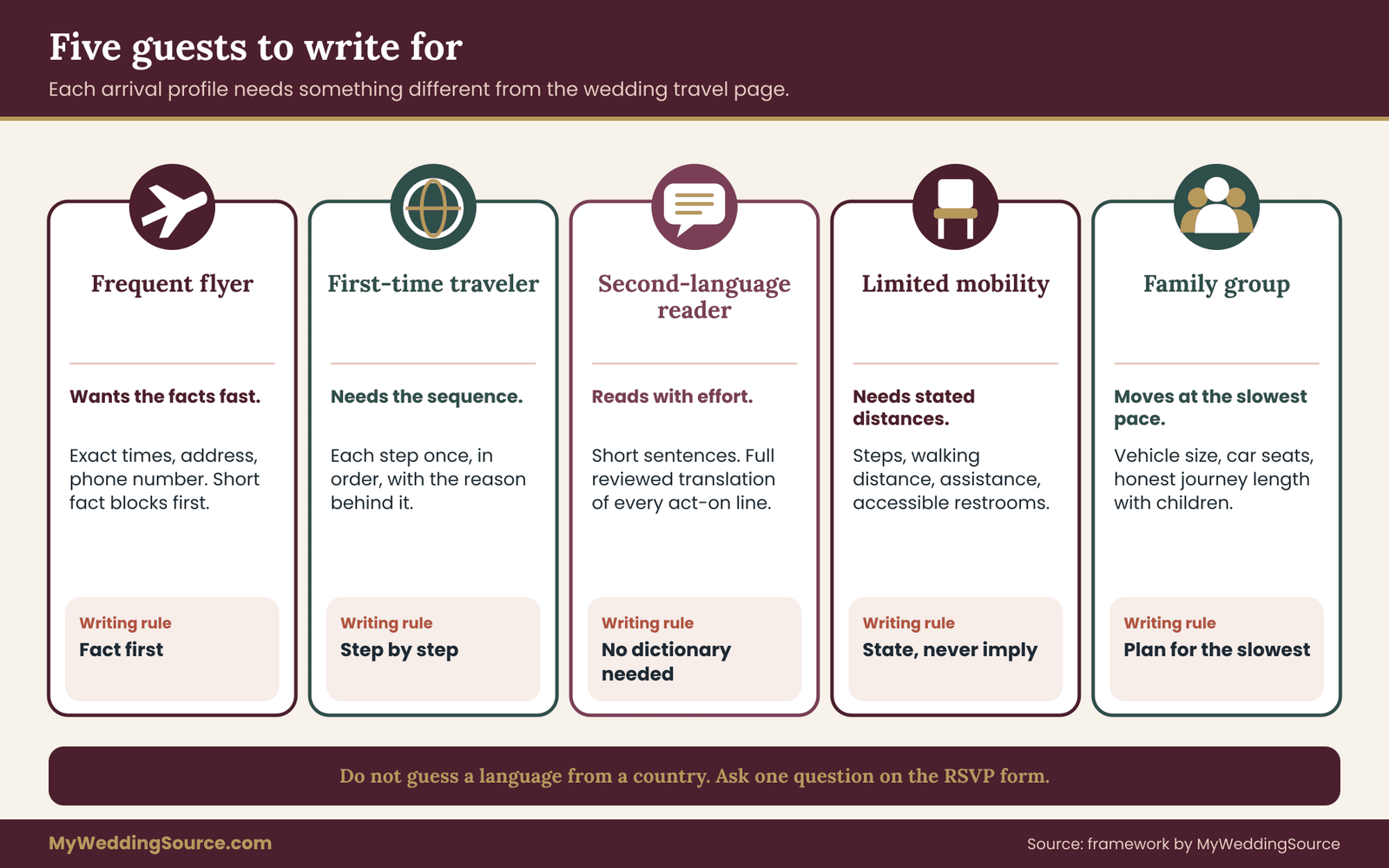
Before choosing any words, decide who the page must serve. “Guests from abroad” is not one group. Writing for an imaginary average traveler produces a page that fits nobody. Five profiles cover most real guest lists, and most weddings include at least three of them.
The confident frequent flyer. This guest has flown internationally many times, reads English well and wants the facts fast. They need exact times, the address and a phone number, and they will skip anything chatty. A page that makes them scroll through paragraphs to find a terminal name will lose them.
The first-time international traveler. This guest may be excellent at everything else and still feel exposed in an airport that is new to them. They need sequence, reassurance and a plain description of each step, including steps that frequent travelers consider obvious, such as where the immigration queue is and why it is long.
The guest reading in a second language. They may read your language well enough for a menu and poorly enough for a legal paragraph. They need short sentences, concrete nouns and, for the critical parts, a full translation they can trust.
The guest traveling with limited mobility or a medical need. They need to know how far the walk is from arrival gate to the exit, whether there is step-free access at the venue and where assistance can be requested. This page works together with the hotel and venue access information, and the section on the venue days returns to it.
The family group. A family of five with two children and a stroller has different logistics from a couple. They need vehicle capacity, car-seat information, and an honest note about how long the whole journey takes with tired children.
Turning the profiles into writing rules
Each profile produces a rule you can apply to every sentence on the wedding travel page. The frequent flyer gives you the rule that every fact appears first, in a short form. The first-time traveler gives you the rule that every step appears once, in order, with its reason. The second-language reader gives you the rule that no sentence needs a dictionary. The mobility profile gives you the rule that distances and surfaces are stated rather than implied. The family gives you the rule that time estimates assume the slowest traveler in the group.
These rules sometimes conflict. The frequent flyer wants brevity and the first-time traveler wants explanation. The way through is layering: lead each rung with a one-line fact block, and put the explanation underneath for anyone who wants it. A reader can stop after the line or keep going. The same approach is used on well-built government and airline pages, and it works for the same reason.
Finding out who is actually coming
You do not need a survey. You already have an RSVP list with addresses and, if you collected them, a few notes. Go through it once and sort invited households by country of departure, by the language they probably prefer, and by anyone with a stated access need. Ten minutes of sorting tells you how many versions of the wedding travel page you need, and which of the five profiles you must serve first.
If you have not yet sent invitations, the wedding invitation etiquette guide explains how to word the invitation itself, and the wedding travel page described here becomes the link on the card. If RSVPs are already coming in, the wedding RSVP etiquette guide covers how to ask follow-up questions, such as arrival dates, without making guests feel interrogated.
One last point on audience. Do not guess a guest’s language from their country. A guest living in Canada may prefer French or Mandarin or English. A guest in Brazil may be a native English speaker. Ask in one gentle line on the RSVP form: which language would you like for travel information? Then build only the versions that people actually chose.
The door-to-door ladder for a wedding travel page
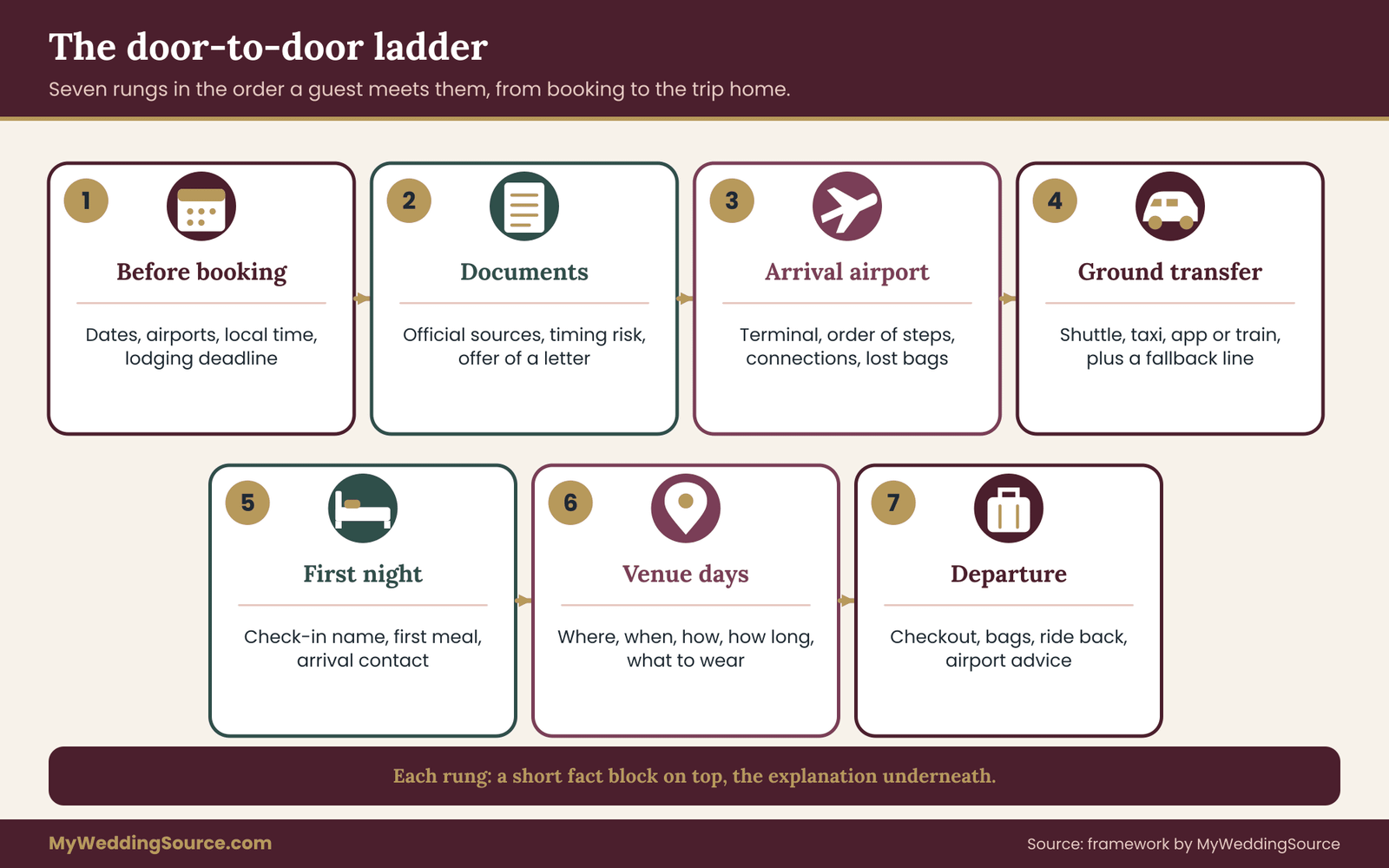
The structure at the heart of this guide is a ladder with seven rungs. Each rung matches one stage of a guest’s trip, and each has a fixed set of contents. You do not have to invent a layout. You fill in the rungs in order, and you leave out only the ones that truly do not apply.
Rung one: before booking. Dates, the nearest airports and what the guest should decide before buying a ticket.
Rung two: documents. A short block that tells guests to confirm entry requirements with the official agency, with links to those agencies and a note on timing.
Rung three: the arrival airport. The terminal and the steps between the aircraft door and the exit, in plain words.
Rung four: the ground transfer. How a guest gets from the airport to the hotel or the venue, with a fallback if the first choice fails.
Rung five: the first night. Check-in, the first meal, how to reach the hosts and how to recover from a long flight.
Rung six: the venue days. Where to be, when, what to wear, how to get there and how to get back.
Rung seven: departure. Checkout, the ride back, and the airport instructions for the return flight.
The fact block and the explanation layer
Every rung follows the same two-layer pattern. The top is a fact block of three to five lines that a tired person can read in ten seconds. Below it is an explanation layer, a few short paragraphs that say why, what could go wrong and what to do about it.
For the arrival airport rung, the fact block might read: terminal, the name of the arrivals hall, the meeting point for the shuttle, the phone number to call if nobody is there. The explanation layer then describes the immigration queue, how long a first-time visitor should plan for it, and what to do if the bags are slow.
Keeping to this pattern across all seven rungs makes the wedding travel page predictable. A guest who learns the pattern on rung one finds everything faster by rung four. It also makes the wedding travel page easy to translate, because the fact blocks are short and the explanation layers can be translated in a second pass.
The one-screen arrival card
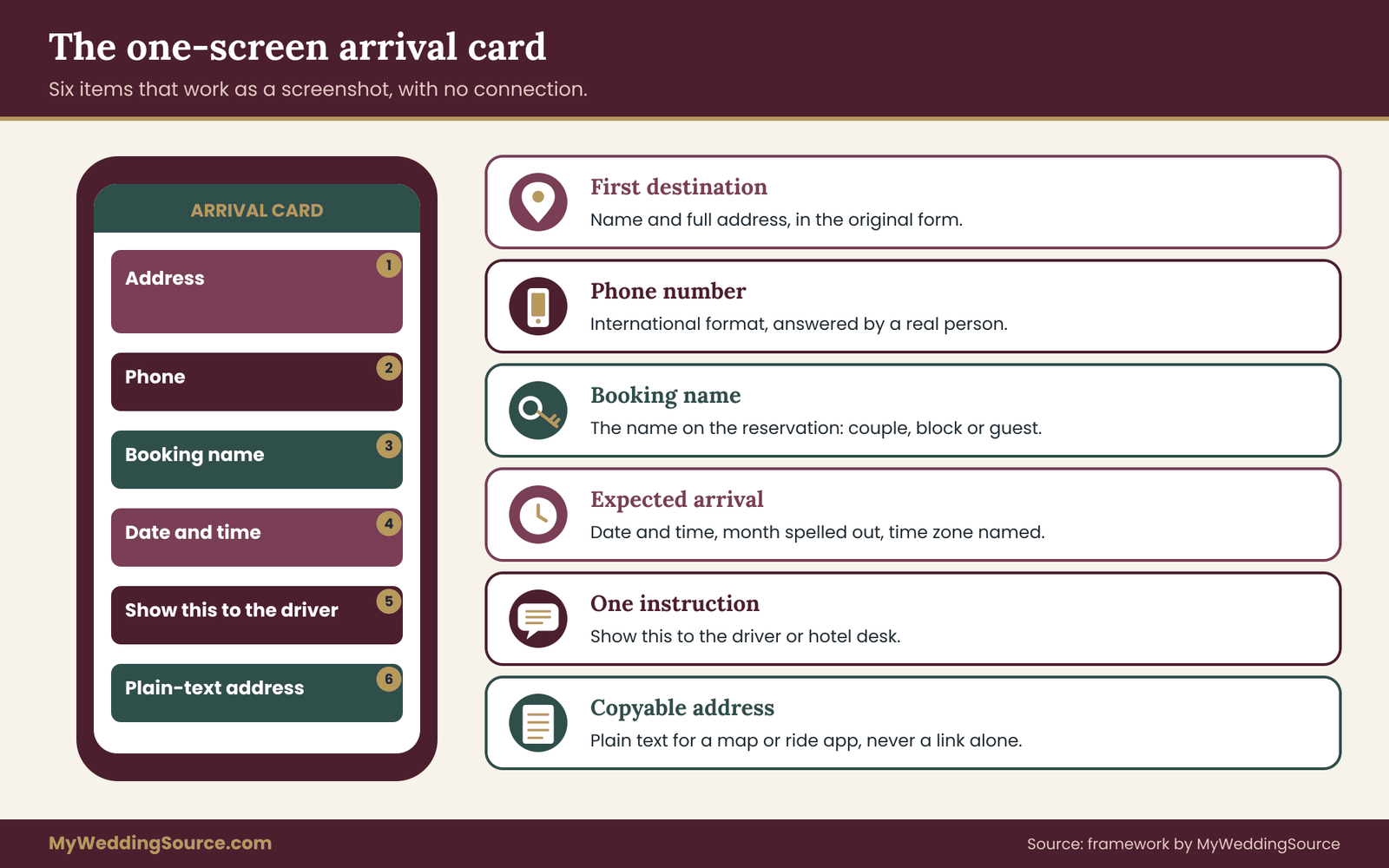
On top of the ladder sits a single card, designed to fit on one phone screen, that a guest can screenshot and keep. We will call it the arrival card. It has six items: the name and full address of the first place they are going; the phone number of a real person who will answer; the name the booking is under; the date and time they are expected; a one-sentence instruction such as “Show this to the driver”; and the same address written in the local script and in the guest’s own language.
The reason for the card is simple. A screenshot works without a connection. A taxi driver or a hotel clerk can read it without the guest speaking a word. And when a guest is stressed, the card is the single thing they do not have to think about. A later section shows how to lay it out.
What stays off the ladder
Resist the urge to add rungs. Sightseeing, restaurant lists and shopping belong on a separate page, or in a section clearly labeled optional. If you mix them into the ladder, the guest who just needs to know how to reach the hotel has to wade through recommendations to find it. A short “if you have a free afternoon” link at the bottom is enough.
Rung one: before booking
The first rung exists because the most expensive mistakes happen before a guest buys a ticket. Once a flight is booked, changing it costs money. A short, honest rung one prevents some of those changes.
Dates and the shape of the weekend
State the wedding date, the ceremony start time and the full schedule of events in one compact block. Then state what you suggest: arrive the day before the first event at the latest, and plan to leave the day after the last one. Give the reason, not just the instruction. Jet lag after a long eastbound or westbound flight can make a guest feel unwell for a day or two, and a flight that lands three hours before the ceremony leaves no margin for a delayed bag or a missed connection.
Be careful with phrases that sound like rules. A guest on a tight budget or with a work obligation may truly need to arrive on the morning of the wedding. The wedding travel page should say “we recommend” and explain the risk, not forbid anything. The key idea fits in a sentence: choose arrival times that leave slack for the unplanned.
Which airport to fly into
List the realistic airports, in order of preference, with one honest line about each. Name the code and the city. State how far each is from the venue and the usual ways to cover that distance: a pre-booked shuttle, a rental car, a train, a ride-hailing app. Do not invent drive times. Give the distance and let a map confirm the time, or say “about” and name the source of the estimate.
An example of the right tone: “Most guests fly into the large airport two hours from the venue. The small regional airport is closer but has fewer flights and usually requires a connection. If you are unsure, write to us before booking.” That is honest, short and invites a question instead of a guess.
Local time, currency and the date format
International guests are often tripped by small conventions. State the local time zone by name and by its difference from UTC, and write dates in an unambiguous format, such as 14 June or June 14 with the month spelled out. Many countries write the day first and the United States writes the month first, so “06/07” can mean two different dates. This single habit prevents a surprising number of misunderstandings.
Mention the currency, whether cards are widely accepted and whether a guest is likely to need cash for tips or taxis. Avoid giving exchange rates or prices that will go out of date. A line that says “bring a card that works abroad and tell your bank you are traveling” is more useful than a figure.
The question of lodging and booking links
Rung one should link to your lodging information rather than repeat it. State the block deadline and the booking method in one line, and point to the hotel page. For guests flying in from abroad, add one thing hotel pages often omit: whether the hotel can hold a room from an early arrival, and what happens if a flight lands at five in the morning. A line that says “ask the hotel about early check-in when you book” saves an awkward morning in a lobby.
Rung two: documents, without giving legal advice
This rung is the most sensitive and the one most likely to be written badly. Two mistakes are common. One is to say too much, repeating rules that may be wrong or out of date. The other is to say too little, leaving guests to discover on their own that they needed something. The right balance is a short block that points to the authority, states the timing risk and offers help with the one thing you can truly help with.
What the block should say
The block should contain four things.
First, a sentence that entry requirements depend on the traveler’s passport and travel history and are decided by the destination country’s government. Second, a link or a named source for the official information. For travel to the United States, that means the Department of State’s travel pages and the Customs and Border Protection pages for international visitors, listed in the sources at the end of this guide.
Third, a note on timing: some authorizations and visas take time to process, so guests should check requirements as soon as they decide to attend rather than shortly before the flight. Fourth, an offer: “If you need a letter confirming the wedding date and our relationship, write to us and we will send one.”
The page should not say who needs a visa, who is eligible for a waiver, how long a passport must remain valid or what an officer will ask. Those answers belong to the agency, and the agency’s pages change. A statement that was accurate when you wrote it can be wrong a year later.
An invitation letter is not a visa
Some guests will ask for a letter of invitation. A letter from you can confirm that you are getting married, when and where, and that you invited them. It does not guarantee entry, and it does not replace any official application. Say so plainly in the block, once, in a neutral voice. That protects guests from a false sense of security and protects you from being blamed for a decision you do not control.
If a guest applies and is refused, they will be disappointed, and the right response is kindness, not argument. The wedding travel page can mention in one sentence that if a guest cannot attend, you would like to hear early so you can plan, and that you will arrange to share the day by other means if you can. A livestream is one option, offered only if the two of you choose it.
Health, insurance and the optional extras
Keep a short optional line about travel insurance and any health requirements the destination states. The Centers for Disease Control and Prevention maintain a traveler information site, linked in the sources, and the wedding travel page can point there for general health information for visitors. Do not give medical advice, and do not describe any vaccination as required or recommended unless an official page states it for the guest’s own situation.
One practical suggestion belongs here: encourage guests to save digital and paper copies of their travel documents separately from the originals, and to keep a note of the phone number for their own embassy or consulate. The Department of State pages explain how foreign governments can be reached. That is the kind of small, kind and unremarkable tip that makes a page feel written by a person who has traveled.
How to word the documents rung in a worked sentence
A good version reads like this: “Entry requirements depend on your passport and are set by the government of the country you are entering. Please check the official sources below as soon as you decide to come, because some applications take time. If you would like a letter confirming the wedding, write to us. We cannot tell you whether you will be admitted, and a letter does not guarantee entry.”
That is fifty-odd words, it does not overreach, and it translates cleanly. Notice that it uses the word “please” once and does not apologize. The tone is that of a helpful host who knows where their responsibility ends.
Rungs three and four: from the aircraft door to the hotel
The middle of the ladder is where a guest is most tired and most dependent on your words. The airport and the ground transfer are two rungs, but a guest experiences them as one continuous problem: get out of the airport and into the right vehicle. Write them as a pair, and keep them together on the wedding travel page.
Rung three: the arrival airport
Start the fact block with the terminal and the arrivals area. Airports reuse names, and a guest on an international flight may land in a terminal that is different from the one a domestic traveler uses. If you cannot confirm the terminal, say that it depends on the airline and tell guests to check their boarding documents or the airport’s own site.
Then describe the sequence in the order a guest meets it. For arrivals from another country into the United States, the usual sequence is passport control, baggage claim, customs and then the public arrivals area. The wedding travel page should say that these steps happen in that order, that the first one can take a while at busy times, and that a guest should not book a pickup for twenty minutes after landing. Customs and Border Protection publishes information for international visitors, and the wedding travel page can link to it rather than describing procedures that may change.
Add the small human details that official pages skip. Where is the first restroom after the baggage hall? Does the arrivals hall have a place to sit while waiting for a driver? Is there free airport wifi, and does a guest need to register for it? If you have not been there, ask someone who has, or use the airport’s website. If you cannot find an answer, leave it out rather than guess.
Connecting flights inside the country
Many guests from abroad will connect through a large hub before reaching the airport nearest the venue. The first arrival may be the immigration point, which means that a guest could clear entry at an airport hundreds of miles from the wedding and then take a domestic flight. A connection needs time for passport control, baggage re-check and sometimes a terminal change. The Transportation Security Administration has traveler information pages that explain the security process for domestic flights, and the wedding travel page can link to them.
State a connection recommendation in terms of risk, not a number you cannot verify: “A short connection after an international arrival is a common cause of missed flights. Ask your airline what minimum connection time applies, and consider a longer one.” That sentence sends the guest to the party that knows, which is the airline, and it does not invent a figure.
What to do if the bags do not arrive
Bags are delayed often enough that the page should say what to do. A short instruction is all it needs: report the missing bag at the airline’s baggage desk before leaving the airport, keep the claim receipt, and give the airline the hotel address. The Department of Transportation publishes consumer information about airline obligations, linked in the sources, and the wedding travel page can name it as a place to learn more.
Add the part that matters to a wedding. A guest whose bag is lost may have the outfit for the ceremony inside it. A kind line reads: “If your bag is delayed and your clothes are inside, tell us. We will help you find something to wear.” That is the sort of sentence that makes someone feel looked after, and it costs you nothing until the day it is needed. A short list of nearby stores that sell formal clothes is a useful addition.
Rung four: the ground transfer
The ground transfer is the question of how a guest gets from the airport to where they are sleeping. There are usually four realistic answers, and the wedding travel page should present the ones that exist at your location, in the order you prefer.
A shared shuttle you have arranged. This is the simplest for guests, and the hardest for you, because it requires exact times and a headcount. If you offer one, state the pickup point with a landmark, such as “outside door three, look for a sign with our names”, and give the time window. State what happens if a flight is late: does the driver wait, and for how long?
A private car or taxi. State where taxis queue and how a guest recognizes an official one. Do not quote fares. Say that the fare depends on traffic and distance and that a guest can ask the driver for an estimate before leaving. If the airport has an official taxi desk, name it.
A ride-hailing app. These are widely used in the United States, but a guest from abroad may not have the app, an account or a data plan that works on arrival. Say so. A line such as “ride apps work, but you need the app installed and a payment method added before you land” helps more than assuming a guest can download one at the curb.
Public transit or a train. If a train runs from the airport to a town near the venue, describe it, including where to buy a ticket and what the last departure is, but only if you have verified it. If you have not, link to the operator’s site.
The fallback line
Every ground transfer fails sometimes. Drivers are late, flights are delayed, someone is standing at the wrong door. The wedding travel page needs a fallback line that tells a guest what to do when the plan stops working. It should contain a phone number answered by a person, ideally two, and a sentence: “If you cannot find your ride within thirty minutes of leaving the baggage hall, call this number.”
Pick the numbers carefully. They should belong to people who are awake and available during the arrival window, not the couple on the morning of the wedding. A bridesmaid, a cousin or a planner can be the arrival contact for the weekend. The point is that the number is real and the person has agreed to the job. The advice in the wedding day digital contingency plan about backup communication applies here as well: one primary channel, one backup, and a rule for who answers.
Writing phone numbers for people abroad
Phone numbers need care. A guest dialing from a foreign phone needs the country code. Write the number in international format, with a plus sign, the country code and the rest, for example plus one followed by the area code and number for the United States. Do not write a leading zero or parentheses in a way that confuses a dialer. A guest who has a local SIM card dials differently from a guest roaming on their home plan.
Add whether the number can receive text messages and a messaging app. Many travelers use messaging apps that work over wifi, which costs nothing. If the arrival contact is on one of those apps, name it and say whether they are available there. Do not assume that a guest has an international calling plan.
Reading the transfer from the guest’s side
A useful exercise is to read your own rung four as if you were a guest who has just stood in a line for ninety minutes. Does every sentence tell you what to do next? Is there any point where you would have to guess? Where would you be if the shuttle driver was not there? Rewrite until each of those questions has a short answer.
Most failures in this rung come from three causes: an ambiguous pickup point, a missing phone number and an unstated assumption about data service. Fix those three and the rung works. The next section moves from the journey to the destination.
Rungs five to seven: the first night, the venue days and the trip home
After the journey comes the stay. These three rungs are the ones guests read last, usually the night before they leave home, and they are where the wedding travel page earns its place as a working document rather than a brochure.
Rung five: the first night
A guest who has crossed several time zones wants three things on arrival: a bed, a meal and the knowledge that someone is expecting them. The fact block for this rung covers check-in, a first meal option and the arrival contact.
For check-in, state the earliest time a room is normally available and what to do if a guest arrives before it. State that the room may be booked under a name, which could be the couple’s, a block code or the guest’s own, and say which. Guests have lost an hour at a hotel desk because they gave their own name when the room was reserved under the group name. One line prevents it.
For the first meal, name one or two places that are open late and within walking distance, or say that the hotel has food available. A traveler who lands at nine in the evening and finds the hotel restaurant closed is unhappy for a reason you could have prevented. If no food is nearby, say so, and suggest that guests buy something at the airport.
For the arrival contact, repeat the phone number from rung four. Repetition here is deliberate. A guest reading rung five on a phone, in a lobby, should not have to scroll up to find the number.
Recovery from a long flight
A kind and practical note about jet lag belongs on this rung, in a sentence or two. Suggest that guests drink water, avoid scheduling anything important on the first evening and spend time outside in daylight if they can. Do not give medical advice, and do not promise that any approach prevents jet lag. The Centers for Disease Control and Prevention has general traveler information, and the wedding travel page can link to it.
If you are hosting a welcome event on the first night, mark it clearly as optional for guests who have just arrived. An international guest who lands that afternoon may not have the energy, and a page that says “come if you feel up to it” respects that. A note about what the hotel provides, such as a kettle, an iron or a refrigerator, is useful on this rung.
Rung six: the venue days
The venue days rung is where the schedule lives. It should answer, for each event, five questions: where, when, how to get there, how long, and what to wear. Present each event as a short block with those five lines. A guest can then scan for the event they care about without reading prose.
For “where,” give the venue name and the full address.
Give the address in the format a map application will accept, and in the local script if relevant. For “when,” give the start time and the time guests should arrive. For “how to get there,” say whether the hotel runs a shuttle, how often, from where, and what to do if it is full. For “how long,” give an end time, because guests plan their return rides around it. For “what to wear,” describe the dress code in plain words and mention footwear if the venue is outdoors or has a lawn or gravel.
Local customs and the quiet assumptions
Weddings carry assumptions that local guests share and international guests may not. A guest from another country may not know whether the ceremony is formal, whether gifts are brought to the event or sent in advance, whether children are invited, whether the reception includes a seated dinner or a buffet, or whether alcohol is served. Each of these can be a line.
Do not explain the entire wedding. Choose the five or six assumptions most likely to surprise an international guest and write them as a short list. A line about tipping, for example, helps visitors from countries where tipping is not customary, but only if your region and event involve it. If the caterer or venue adds a service charge, that is useful information. A guest-facing sentence is enough.
Keep these notes neutral. “In the United States, guests usually arrive a little before the ceremony and the ceremony begins close to the stated time” is better than “Americans are punctual,” which is both a generalization and a bit rude. The aim is to help, not to rank cultures.
Getting between events
A common failure for guests from abroad is the gap between events. They arrive at the ceremony by a hotel shuttle and then find that the shuttle to the reception runs at a different time. Add a one-line summary of the transport plan for each day, in addition to the per-event blocks, so a guest sees the whole day at a glance. If transportation is not provided, say so clearly and give practical options, with the same caveats about ride apps and data plans.
Access and comfort
For guests with limited mobility, add a short access note per venue: whether there are steps, how far it is from the drop-off point to the seating, whether there are accessible restrooms and who to ask for help. The accessible wedding venue red flags guide lists the questions worth asking a venue. State the answers on the wedding travel page so a guest does not have to write to ask.
Rung seven: departure
The last rung is the one couples most often forget, because by then the wedding is over and everyone is tired. But a guest still has to get home, and the same airport process runs in reverse.
State the checkout time and what happens to luggage after checkout if a guest’s flight is in the evening. Many hotels hold bags at the front desk, and it is worth asking and saying so. State when the shuttle to the airport leaves and whether it needs a reservation, or point to the ride options from rung four. Add a suggestion about how early to arrive at the airport for an international departure, framed as a recommendation to check with the airline, which sets the rules for its flights.
The Transportation Security Administration publishes information on what travelers can bring through security, and the page can point guests there for souvenirs, cake and gifts. Cake is a real question for guests who want to carry a slice home, and a sentence about checking rules for food on international flights is helpful.
A closing line that people remember
End the departure rung with a short, sincere note of thanks, written in the guest’s language where you can. Something like: “Thank you for traveling so far to be with us. Please tell us when you are home safely.” Asking guests to message you on arrival at home is a small ritual that many families already follow, and it gives you a quiet way to know that everyone landed.
Putting the three rungs together
When the ladder is complete, test it with this sequence: read rung one to find a flight; rung two to confirm documents; rung three through seven in order, as a traveler would. At every step, ask whether the guest knows where to be, how to get there and whom to call. If the answer is yes seven times, the wedding travel page does its job. If it is no even once, that is the rung to revise, and the section on failure conditions later in this guide explains how to find out which one it is.
Writing a multilingual wedding travel page without losing accuracy
Translation is where a well-meaning wedding travel page can go wrong. A machine translation of an entire page looks generous and hides errors. A hand translation of every word by a relative is slow and uneven. The method that works is to decide, sentence by sentence, how much accuracy the sentence needs, and spend your effort there.
The three translation tiers
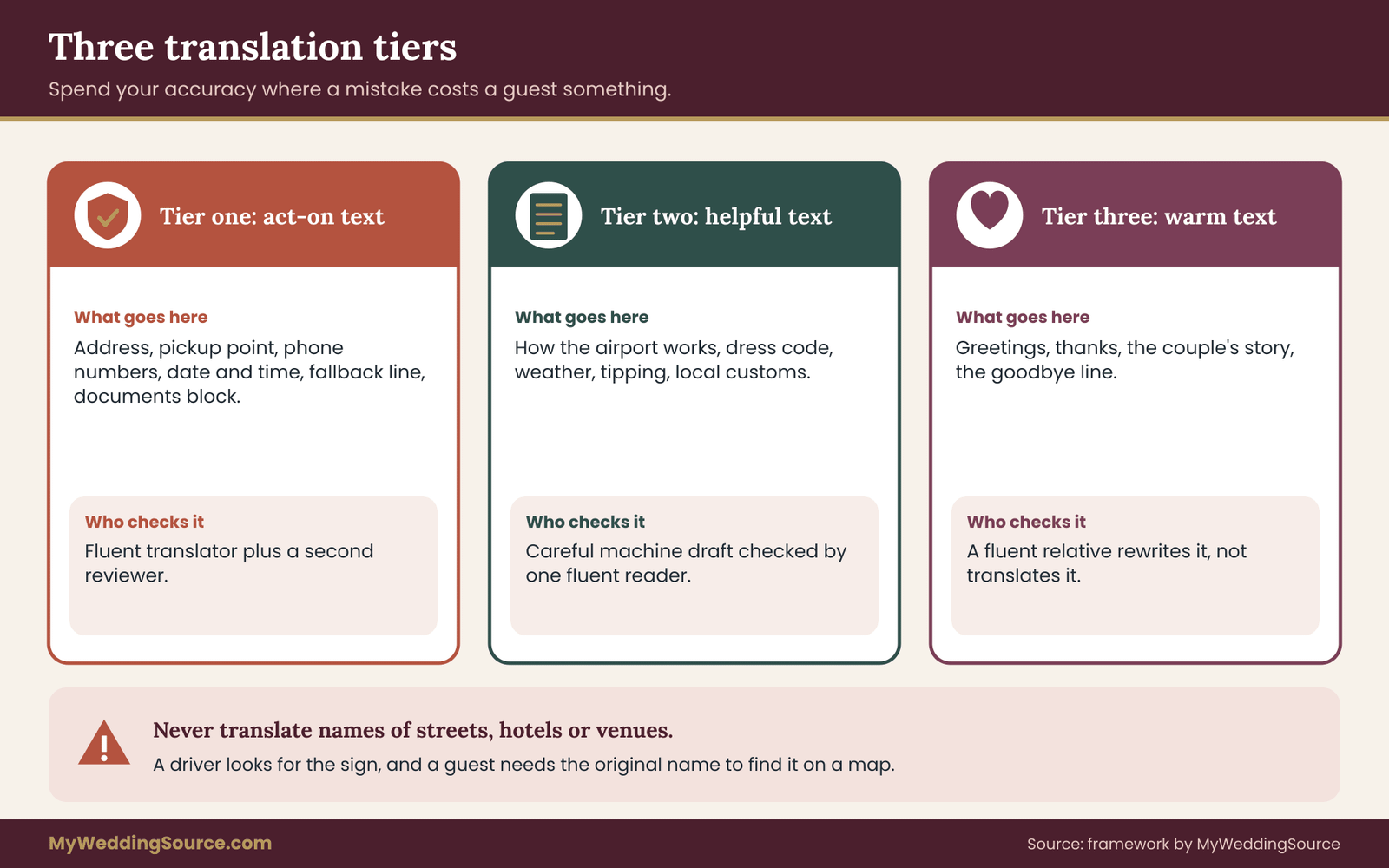
Sort every piece of text on the wedding travel page into one of three tiers.
Tier one: act-on text. These are the words a guest must read correctly to avoid a problem: the address, the pickup point, the phone numbers, the date and time, the fallback instruction and the documents block. An error here can cost a guest a night or a missed ceremony. Tier one text must be translated by a fluent person and reviewed by a second.
Tier two: helpful text. These are the explanations: how the airport works, what to wear, what the weather is usually like, how tipping works. A mistake here is annoying but rarely serious. A careful machine translation, checked by one fluent reader, is a reasonable approach.
Tier three: warm text. These are the greetings, the thanks, the little notes about the couple’s story. A literal translation can sound stiff. Ask a fluent friend or family member to rewrite it, not to translate it. The goal is that a guest smiles, and that is a matter of tone, not of accuracy.
Names, places and addresses are never translated
Proper nouns are the most common source of confusion. Do not translate the name of a hotel, a street or a venue. Write it exactly as it appears on a sign and a map, in the original form. A driver is looking for “Maple Street,” not an equivalent in another language, and a guest who has learned a translated street name cannot find it on a map.
Do translate the type of thing when it helps: “hotel,” “train station,” “entrance.” And add the local script alongside the Latin form for any name that will be read by a driver or hotel clerk who does not read the guest’s language. For travel in the United States, the local script is English, so the arrival card should show the address in English, and the guest’s language should appear as the explanation around it.
Writing source text that translates well
The best translation of a wedding travel page starts with the English. Short sentences, one idea each, active verbs and concrete nouns translate with fewer errors, whether the translator is a person or a program. Compare two versions of one instruction.
A difficult version: “Guests may wish to consider arranging their own ground transportation should the shuttle service be unavailable owing to flight delays.”
A clear version: “If your flight is late, the shuttle may leave without you. Call this number, and we will help you find another ride.”
The second is shorter, has no idiom, and tells the guest what to do. It also survives a round trip through any translator. Aim for sentences under twenty words, avoid phrasal verbs such as “pick up” and “drop off” where a plainer word works, and avoid humor and idiom in tier one and tier two text. Save the jokes for tier three.
Be careful with measurements. Distances in miles, temperatures in Fahrenheit and weights in pounds are normal in the United States and unfamiliar to most of the world. Give both units, or the one a guest uses, and say which is which. “About 40 miles (65 kilometers)” is clear. Time should be written in a way that cannot be misread. Using “2:00 p.m.” with a time zone name is clear, and writing 14:00 beside it helps guests who use a twenty-four-hour clock.
Who reviews the translation
Review is the step most pages skip. The reviewer should be a fluent reader who did not write the translation, who reads on a phone and who is asked one specific question: “If you only read this, could you get from the airport to the hotel?” That question tests function, not grammar. A translation can be grammatical and useless.
If you do not know a fluent person in a language, you have options. A guest from that country may be glad to help, and being asked is a compliment. A professional translator can review short tier one text for a modest fee, which you should confirm directly rather than assume. A local community organization or a university language program may also help. What you should not do is publish tier one text that nobody fluent has read.
The same principle applies to printed pieces: the reviewer should be a native reader of the target language, not the person who wrote the original.
What to say when you are not sure
If you cannot get a language reviewed, say so honestly rather than hide it. A line such as “This page was translated with software and has not been reviewed by a person. For anything important, please write to us” is better than false confidence. It tells guests where the risk is and gives them an easy next step. Keep the tier one text in English too, so that a guest can compare.
Right-to-left languages, scripts and fonts
If any of your guests read a language that runs right to left, such as Arabic or Hebrew, the wedding travel page has to display it correctly. Words in the text still run in the correct order, but the layout, the alignment of lists and the direction of arrows need to flip. Mixed text, where an English address sits inside an Arabic sentence, can scramble punctuation if the wedding travel page does not mark the language and direction of each part.
The World Wide Web Consortium publishes guidance on declaring the language of a page and of parts of a page, linked in the sources. In plain terms, each block of text should say which language it is in, so that browsers, screen readers and translation tools handle it correctly. If you use a wedding website builder, check whether it supports multiple languages and a direction setting, and test the result on a phone.
Fonts matter for scripts such as Chinese, Japanese, Korean, Thai, Arabic and Devanagari. A decorative wedding font often lacks the characters, and the browser then substitutes a different font or shows empty boxes. Test each language version on at least one phone and one computer, and if a character fails to display, change the font for that block.
Language selection that guests can find
Do not guess a guest’s language from their browser or location. Put a visible language selector at the top of the wedding travel page, with each language named in its own script, such as “Español,” “Deutsch” and “日本語,” rather than as flags. Flags stand for countries, not languages, and a Spanish speaker in Mexico may not feel represented by a flag from Spain.
Make the selector work without a download or a login. Link the personal invitation or RSVP reply directly to the right language, so the guest lands on the wedding travel page they asked for. A guest who cannot find their language in three seconds will leave, and may not come back.
Keep one source of truth
Translations multiply the cost of any change. If the shuttle time changes, you must update every language. Reduce that burden by keeping tier one text in a single place, a short document with the address, times and phone numbers in each language, and pasting from it. Do not let each language version carry its own copy of the facts and drift.
Keep a simple log, with the date of each change and which languages are updated. If a language is out of date, mark it clearly rather than leave a guest to read stale information. This habit saves arguments, and it is easy to start. The maintenance section later in this guide builds on it.
Layout, access and privacy for a wedding travel page on a phone
A guest from abroad will probably open your page on a phone, in an airport, on a connection that may be slow or absent. Design for that situation and every other situation becomes easier.
Build for a weak connection
Keep the wedding travel page light. A page with large photographs, auto-playing video and embedded maps can take a long time to load on a roaming connection, and may not load at all. Put the text first and the images second. Compress images, avoid background video and do not hide key facts inside an image, because text inside a picture cannot be translated, searched or read aloud.
Offer a downloadable version of the arrival card and the ladder summary as a single file, such as a PDF of one or two pages. A guest can save it before leaving home and open it offline. Name the file in a way that makes sense in the guest’s language and write the date it was last updated on the first page. An undated file is a hazard, because nobody knows whether it is current.
The anatomy of the arrival card
The arrival card, introduced earlier, deserves careful layout. Put the largest text at the top: the name and address of the first destination. Under it, put the phone number in international format, with a line that says who will answer and in what languages. Then the booking name, the expected arrival date and time, and the instruction “Show this to the driver or hotel desk.”
Add a small block at the bottom with the address in a plain, copy-friendly text line. A guest can paste it into a map application or a ride app. Do not rely on a map link alone, because links can break and some map services are not reachable in every country. A text address always works, and a guest can type it into whatever service they use.
Map links and services that may not load everywhere
Maps are essential and sometimes unreliable. A link to one map provider will not load for guests in a country where that provider is restricted or slow. Offer the address as text, and, where you can, a link to a second map service. Test the links yourself on a phone using mobile data, not your home wifi, to see what a guest will see.
The same caution applies to social platforms and file-sharing services. If you share a photo album or a document through a platform that some guests cannot open, they are left out. Publish the essentials on the wedding website itself, and treat outside services as extras.
Accessibility for readers and assistive tools
The Web Content Accessibility Guidelines, published by the World Wide Web Consortium and linked in the sources, are the standard reference for making web content usable by people with disabilities. You do not need to read them all. A handful of habits cover most of the benefit: use real headings in order, write descriptive link text such as “terminal map” instead of “click here,” give images a text description, keep strong contrast between text and background, and make buttons large enough to tap.
Accessibility is not a separate audience. An older guest with failing eyesight, a guest reading in bright sun and a guest using a screen reader all benefit from the same choices. Large, plain type on the arrival card helps all of them, along with the guest who is simply tired.
Privacy: a page that is open enough and closed enough
A wedding travel page contains information you would rather not leave open to the whole internet: the venue address, the names of the people providing phone support and the hotel details. Most wedding website builders offer a password or a hidden link. Use one. Put the password on the invitation or in the RSVP confirmation, and keep it simple enough to type on a phone.
Do not post individual guests’ flight numbers, arrival times or room numbers on any page. If you need to coordinate arrivals, collect them through a form that only you can read, and share group information in aggregate, such as “most guests land between noon and four.” If you use a spreadsheet, restrict who can see it. The Federal Trade Commission publishes general guidance on protecting personal information, linked in the sources, and its basic advice applies: collect only what you need and keep it only as long as you need it.
Never ask guests to submit passport numbers, passport scans or other identity documents through a wedding website. You do not need them, and the risk of mishandling them is real. If a vendor or an airline needs such details, the guest should give them directly to that organization through its own secure process.
Delete or archive after the wedding
When the event is over, close the wedding travel page. Remove personal contact numbers and set the page to private or take it down after a reasonable period. The wedding website you built stays on the internet until you remove it, and phone numbers published for arrival day have no reason to remain public afterward.
A worked case: one wedding travel page for guests from four countries
The following example is invented to show how the method works. The couple, the venue and the guests are fictional, and the details are not a recommendation of any real airport, hotel or service. The wedding is held at a lakeside lodge about two hours by road from a large international airport in the United States.
Step one: sort the guests
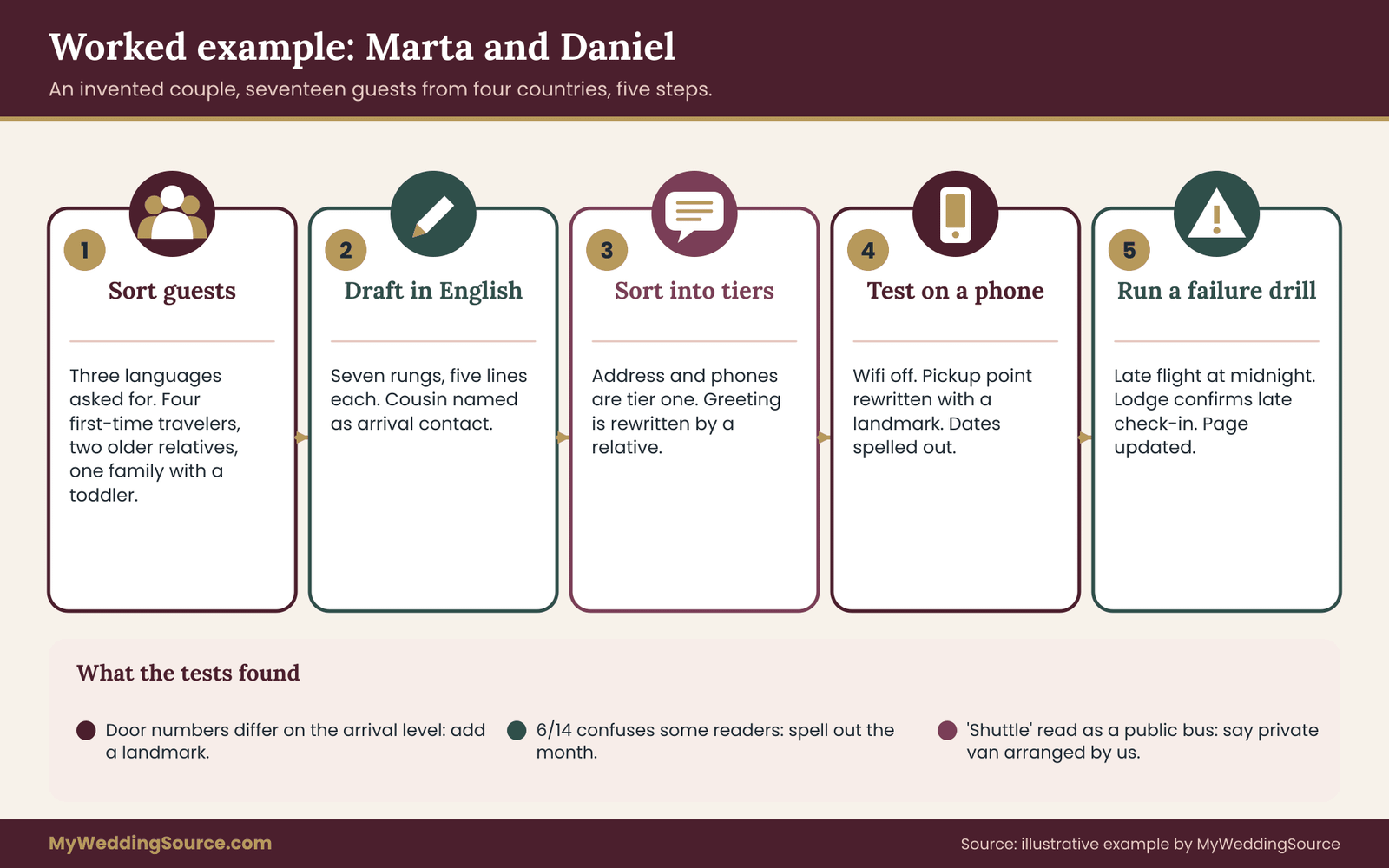
The couple, Marta and Daniel, have eighty-six guests. Seventeen are traveling from abroad: eight from Brazil, five from Japan, three from Germany and one from Nigeria, a retired teacher who prefers English. Their RSVP form asked for a preferred language for travel information. Marta tallies the answers and finds three languages to build: Portuguese, Japanese and German, plus English as the base.
She then sorts guests against the five profiles. Four are first-time international travelers, two are older relatives who need step-free access, and one family of four has a toddler. The other guests are experienced travelers. This tells her which rungs to write most carefully: the airport and transfer rungs for first-time travelers, the venue access notes for older relatives, and the car-seat information for the family.
Step two: draft the ladder in English
Daniel writes the English fact blocks for all seven rungs in one sitting. He keeps each to five lines and does not translate yet. The arrival card gives the lodge’s address, the arrival contact, a booking name and the shuttle details. The arrival contact is Marta’s cousin, who agreed to answer calls during the arrival window on both days before the wedding and to reply on a messaging app.
On the documents rung, he writes a short block pointing to the Department of State and Customs and Border Protection pages. He adds the sentence offering a letter confirming the wedding date, and he states that the letter does not promise entry. He does not mention visas by country or passport validity.
Step three: sort the text into tiers
Marta marks every line as tier one, two or three. The address, the pickup point, the phone numbers, the times, the fallback line and the documents block go into tier one. The airport explanation, the dress code and the weather note are tier two. The greeting and the thanks are tier three.
She finds two fluent reviewers among the guests. A Brazilian cousin offers to review the Portuguese tier one text. A friend of Daniel’s who lives in Japan agrees to review the Japanese. For German, they use a professional translator for tier one and a colleague of Marta’s for tier two. Tier three, in all three languages, is rewritten by a relative, not translated.
Step four: build, test and revise
They build the wedding travel page with a language selector at the top, a short arrival card for each language and a PDF of the card and the ladder summary. They set the wedding travel page to a password shared on the RSVP confirmation. Then they test.
Marta asks the Brazilian cousin to open the Portuguese page on a phone, with wifi off, and answer a single question: “From landing to the lodge, what do you do?” The cousin gets as far as the shuttle pickup and then stops. The pickup point is described as “outside door three,” but at that airport the doors are numbered differently on the arrival level. Marta rewrites the line with a landmark and a photograph description, and the problem disappears.
The Japanese reviewer finds that dates written as 6/14 confuse some readers, and the team spells out the month. The German translator points out that “shuttle” is rendered in a way that suggests a scheduled public bus, and the team changes it to “private van arranged by us.” Each fix is small. Together they are the difference between a page that looks complete and a page that works.
Step five: the failure drill
Finally, they run a failure drill. They ask the cousin who answers calls: what if a guest calls at midnight and the flight was delayed by six hours? The cousin does not know whether the lodge holds rooms for late arrivals. Daniel calls the lodge and adds the answer to the wedding travel page. The drill takes twenty minutes and produces two edits.
What the example shows
The method is not complicated, and none of it requires software or special skill. It requires sorting guests, writing in order, separating text by risk, finding a fluent reviewer and testing on a phone. The case also shows that most fixes are tiny and discovered by watching a real person use the wedding travel page. That is why a test with a single guest is worth more than another hour of polishing.
Alternatives to a full wedding travel page
A full multilingual wedding travel page is not always the right tool. Sometimes it is too much, and sometimes it is not enough. Choose the format by the size of the problem, not by habit.
A single shared document. If you have only a handful of guests from abroad, a two-page document sent by email may serve better than a new section of a website. It can be translated once per language, attached to a personal message and updated by sending a new version. The cost is that old versions linger in inboxes, so date every copy.
A messaging group for each language. For small groups, a chat that includes the couple’s arrival contact can answer live questions and carry last-minute changes. It is warm and fast. Its weakness is that facts vanish into scrollback, so pin the arrival card and repeat it before each travel day.
A personal note from a relative. Where a guest is older, or does not use the internet comfortably, a phone call from someone in the family, followed by a printed card in the post, may be the only approach that works. Do not assume that everyone will open a link.
A printed arrival card in the welcome bag or at the hotel desk. A guest who has already arrived but lost the wedding travel page can still find the way to the venue. It also serves as a backup if a phone dies. The hotel front desk can hold copies,.
A hired concierge or planner. If you have budget for it and a large number of international guests, a planner or a destination-management company may handle arrivals. Confirm what is included in the contract before assuming it. This does not remove the need for a page, but it changes what goes on it.
Choosing by a simple rule
If fewer than five households travel from abroad, a wedding travel page is optional and a document and a messaging group are enough. If between five and thirty do, build the page with one or two extra languages. If more than that, or if more than three languages are involved, consider help from a planner or a translator, because the coordination work grows faster than the guest count. These thresholds are judgment calls, not rules, so adjust them for your guests.
Combining formats
Most couples end up with a mix: the wedding travel page as the main source, a PDF for offline use, a messaging group for live help and a printed card at the hotel. That is fine. The one condition is that the facts come from one place. If the shuttle time appears in four formats and you change it in only two, the guests with the old version will be the ones standing at the curb.
Failure conditions and how to catch them early
A wedding travel page can look finished and still fail. The failures are predictable, and each has a test that costs little. Think of this as a short list of ways the plan can break and the quiet check that finds each one.
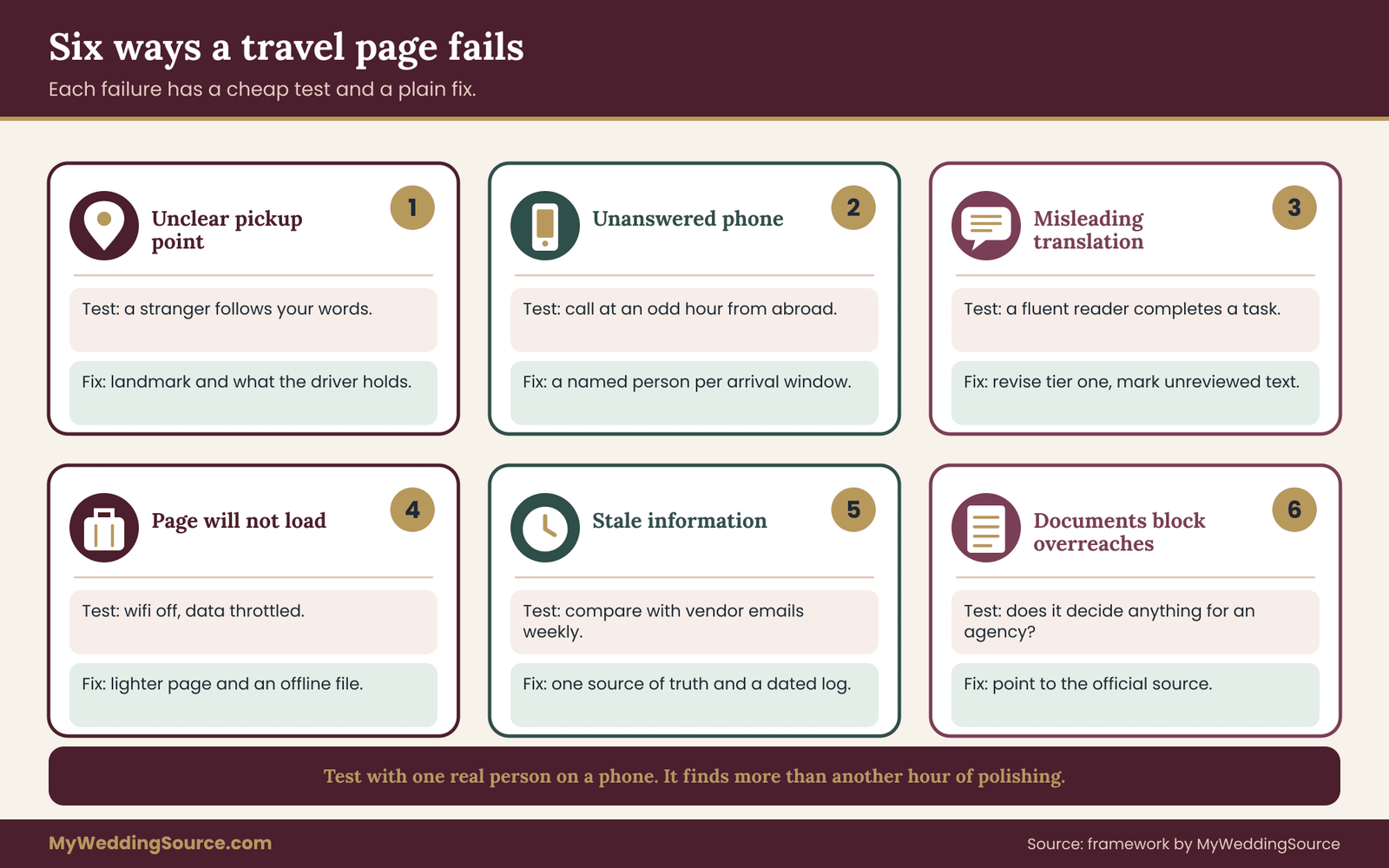
Failure one: the pickup point is ambiguous. Symptom: a guest cannot find the driver. Test: ask someone who has never been to the airport to follow your words and find the spot. Fix: add a landmark and a description of what the driver will hold or wear.
Failure two: the phone number is unanswered. Symptom: a guest calls and nobody picks up. Test: call the number from a phone with a foreign SIM or from a messaging app at an odd hour. Fix: assign a named person for each arrival window and a backup.
Failure three: the translation misleads. Symptom: a guest follows the wrong instruction. Test: have a fluent reader who did not write it complete a task using only the translation. Fix: revise the tier one text and mark any untranslated parts honestly.
Failure four: the wedding travel page does not load. Symptom: a guest sees a blank screen on a weak signal. Test: open the wedding travel page on a phone with wifi off and with data throttled. Fix: lighten the wedding travel page and provide the offline file.
Failure five: the information is out of date. Symptom: a guest follows a shuttle time that has changed. Test: compare the wedding travel page with the vendor’s confirmation each week. Fix: use a single source of truth and a dated change log.
Failure six: the documents block overreaches. Symptom: a guest believes your page’s word about entry over the official one. Test: read the block aloud and ask whether it states or implies any decision that belongs to an agency. Fix: rewrite to point to the official source.
Edge cases worth a sentence each
A guest who arrives a week early to travel on their own may need nothing from the arrival card except the venue address. Do not insist that every guest follow the ladder. A guest who arrives on an overnight flight and heads straight to the ceremony needs a place to change and leave bags, which the hotel or venue may provide if asked. A guest connecting from another trip may arrive without luggage, and a friendly line about nearby shops helps.
A guest who must travel on a different date than the group, for example because of a visa appointment or work schedule, may miss the shuttle. Offer an alternative and a number to call, and avoid making anyone feel they are a burden. A guest in a wheelchair or with a service animal may need extra time at the airport and a vehicle that fits. Ask in advance and write the answer on the wedding travel page for everyone.
When a flight is canceled
Flights are sometimes canceled or delayed, and the page should tell guests who to tell. A single line suffices: “If your flight changes, send us your new arrival time as soon as you know it.” The Department of Transportation explains passenger rights regarding delays and cancellations, linked in the sources, and the wedding travel page can point there. Do not describe what an airline owes a guest, because that depends on the situation and the airline. For couples who want a broader contingency plan, the wedding day digital contingency plan covers backup channels in more detail.
Keeping the wedding travel page current until the day
A wedding travel page is a living document for several months. The risk is not that it is wrong on day one, but that it drifts out of date as vendors, schedules and rules change. A short maintenance routine prevents drift.
A review calendar
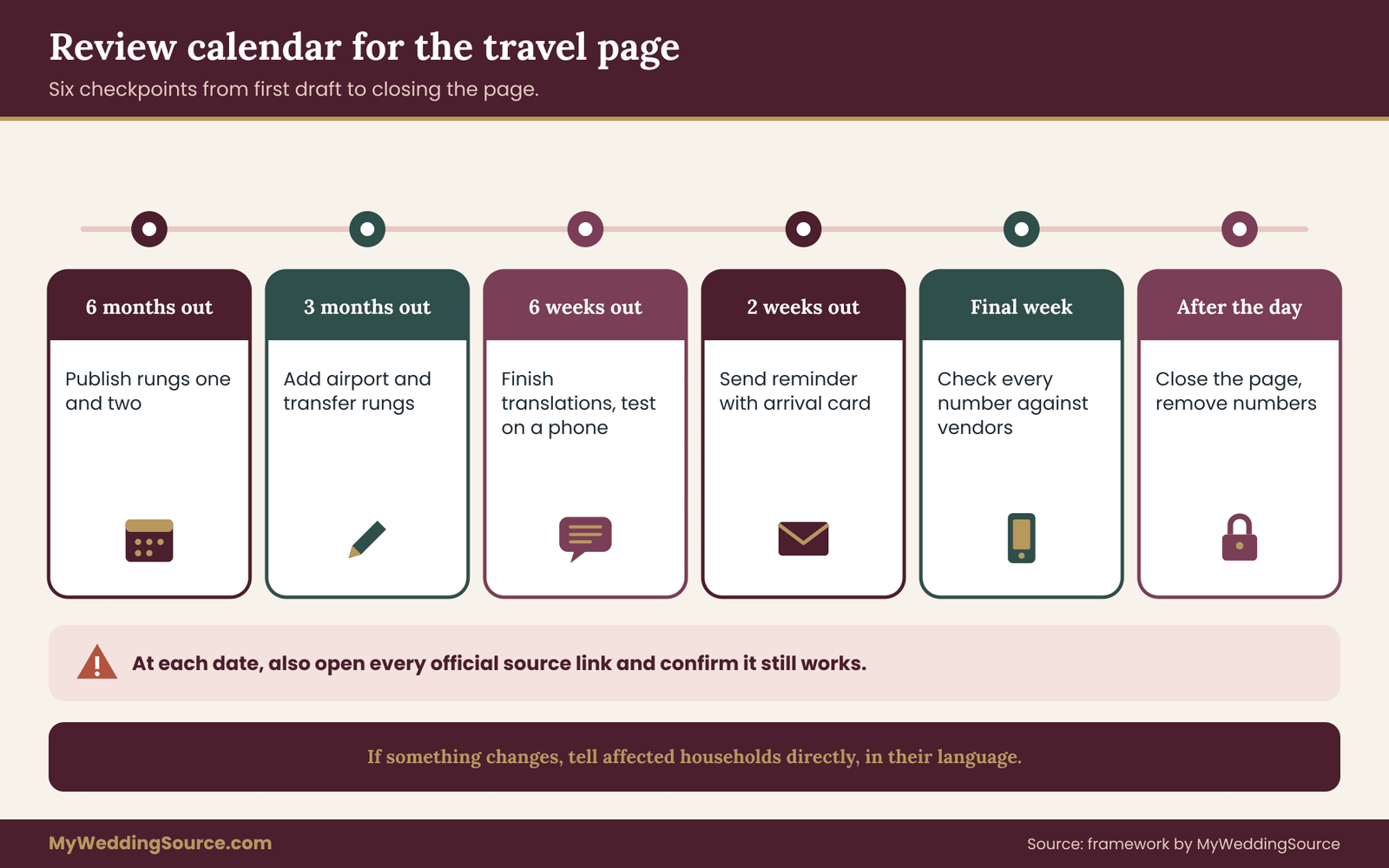
Set a small number of review dates and keep them. Six months before the wedding, publish the first version with rungs one and two. Three months before, add the airport and transfer rungs once the shuttle and the hotel are confirmed. Six weeks before, finalize translations and test the wedding travel page on a phone. Two weeks before, send a travel reminder with the arrival card. In the final week, check every phone number and every time against vendor confirmations. After the wedding, close the wedding travel page.
Rechecking the official sources
Entry requirements, airport procedures and airline rules change. The wedding travel page links to official sources, so it does not need to repeat the rules, but you should check that the links still work. A broken link to an agency page is a quiet failure. Open each source link at the same review dates and replace any that have moved. If you notice that an agency has announced a change that affects guests, add a one-line notice at the top of the wedding travel page and send a message.
The change log
Keep a simple log of changes: the date, what changed, and in which languages it was updated. Write it for yourself, not for guests, though a short “last updated” line at the top of the page helps guests trust what they read. If you hand off arrival duties to a cousin or a planner, share the log so they know what changed.
When an update affects guests who have already planned, tell them directly. A line in the wedding travel page is not enough, because a guest who read it last month will not read it again. A short message to each affected household, in their language, is kind and effective. The wedding guest list guide explains how to keep contact details organized so that these messages are easy to send.
Your next steps
Start with the guest list. Sort the households traveling from abroad by country and by preferred language, and note anyone with an access need. That tells you how many versions you need and which profile to serve first.
Next, write the seven rungs in English, in order, using the fact block and the explanation layer. Build the arrival card last, from the finished facts. Mark each line as tier one, two or three, and find a fluent reviewer for every tier one line.
Then test. Open the wedding travel page on a phone with wifi off, ask one guest to follow it from landing to check-in, and fix what they tell you. Schedule your review dates now, while there is time, and add them to your wedding planning checklist so they are not forgotten. If you are early in planning, the broader wedding guest hotels guide helps you settle the lodging facts that the travel page will repeat.
FAQ
Do we need a separate page for guests traveling from abroad?
Not always. If only a few guests travel from abroad, a short section on your main travel page or a shared document may be enough. A separate page makes sense when several households arrive from other countries, when more than one language is needed, or when the journey from the airport is complicated. Start with a section and split it only if it grows.
How many languages should the wedding travel page include?
Include the languages your guests asked for, not the languages of their countries. Ask one question on the RSVP form about preferred language for travel information, then build only those versions. Keep English as the base so you can compare. For each language, translate and review the critical text first, then add the rest as time allows.
Can we use machine translation?
Yes, for explanations and background text, with a fluent reader checking it. For addresses, times, phone numbers and the fallback instruction, have a fluent person translate and a second person review. Never translate names of streets, hotels or venues. If a version is unreviewed, say so on the wedding travel page and keep the key facts in English as well.
Should the wedding travel page say who needs a visa?
No. Entry requirements depend on a traveler’s passport and history, and the destination government decides them. Point guests to the Department of State and Customs and Border Protection pages, remind them that some applications take time, and offer a letter confirming the wedding. State that the letter does not guarantee entry and that you cannot say whether anyone will be admitted.
What belongs on the one-screen arrival card?
Put the first destination’s name and address, a phone number in international format that a real person answers, the name the booking is under, the expected date and time, and a one-line instruction such as “Show this to the driver.” Add the address as plain text for copying. It should work as a screenshot with no connection.
How do we protect guests’ privacy on the wedding travel page?
Put the page behind a password or a hidden link, and share the password with invited guests only. Do not post flight numbers, room numbers or guest names with travel details. Never collect passport numbers or scans through the site. Take the wedding travel page down, or remove phone numbers, after the wedding so contact details do not remain public.
How early should we publish the wedding travel page?
Publish a first version, covering dates, airports and the documents block, about six months before the wedding, because international guests book flights early and need time for any applications. Add the transfer and venue rungs when those are confirmed, and finish translations about six weeks before. Send a reminder with the arrival card two weeks out.
What if a guest cannot get the right documents in time?
Respond with kindness and speed. Ask them to tell you as soon as they know, so you can plan, and remind them that the decision belongs to the authorities. Offer to share the day by another route, such as a recorded message or a livestream, if you choose to provide one. Avoid pressing them to take risks with travel rules.
Sources
- U.S. Department of State, Bureau of Consular Affairs: travel.state.gov
- U.S. visas, U.S. Department of State
- Visit the U.S.: information for international visitors, U.S. Customs and Border Protection
- Electronic System for Travel Authorization (ESTA), U.S. Customs and Border Protection
- Travel information for passengers, Transportation Security Administration
- Aviation consumer protection, U.S. Department of Transportation
- Traveler’s Health, Centers for Disease Control and Prevention
- Web Content Accessibility Guidelines overview, World Wide Web Consortium
- Declaring language in HTML, World Wide Web Consortium Internationalization
- Protecting personal information, Federal Trade Commission