
Second wedding invitations have one hard job: telling some guests they are invited to a small ceremony and everyone else they are invited to a larger party, without making either group feel like an afterthought. This guide gives you a decision chart by event format, wording you can adapt, a worked case and the failure points to check before anything is printed.
Start with the event format, not the wording. Decide whether the ceremony and the party happen on the same day, on different days, or with the legal marriage already done. Then write one invitation for each guest group, and make each one say plainly what the event is, who is hosting it and what the guest is being asked to do. Never apologize for the small ceremony and never rank guests in the text. State what is happening, and let the second wedding invitations carry the rest.
Second weddings often split into two events. A couple may want ten or twenty people in the room when they exchange vows, and a hundred people at the party that follows. Sometimes the ceremony is private because of venue size, because children are part of it, because a parent is frail, or simply because the couple wants it quiet. The party is where everyone else gets to celebrate.
That split is easy to plan and hard to explain. A guest who receives a party invitation may wonder why they were not asked to the ceremony. A guest who receives both may wonder whether to bring a gift twice. The couple may feel they owe everyone an explanation, and so they write three paragraphs of justification that nobody asked for. Well-built second wedding invitations avoid most of this, because the wording itself answers the questions before they are asked.
This article is about that wording and the decisions behind it. It does not repeat general invitation manners, which the wedding invitation etiquette guide on this site already covers, and it does not rebuild the whole planning process for a remarriage. It stays on one task: how to word, sort and send invitations when the ceremony is small and the celebration is larger.
A note on scope. This is general information, not legal, tax or financial advice. Marriage license rules, name-change procedures and postal requirements differ by place and change over time, so where a rule matters, the article points you to the office that issues it.
What second wedding invitations have to explain
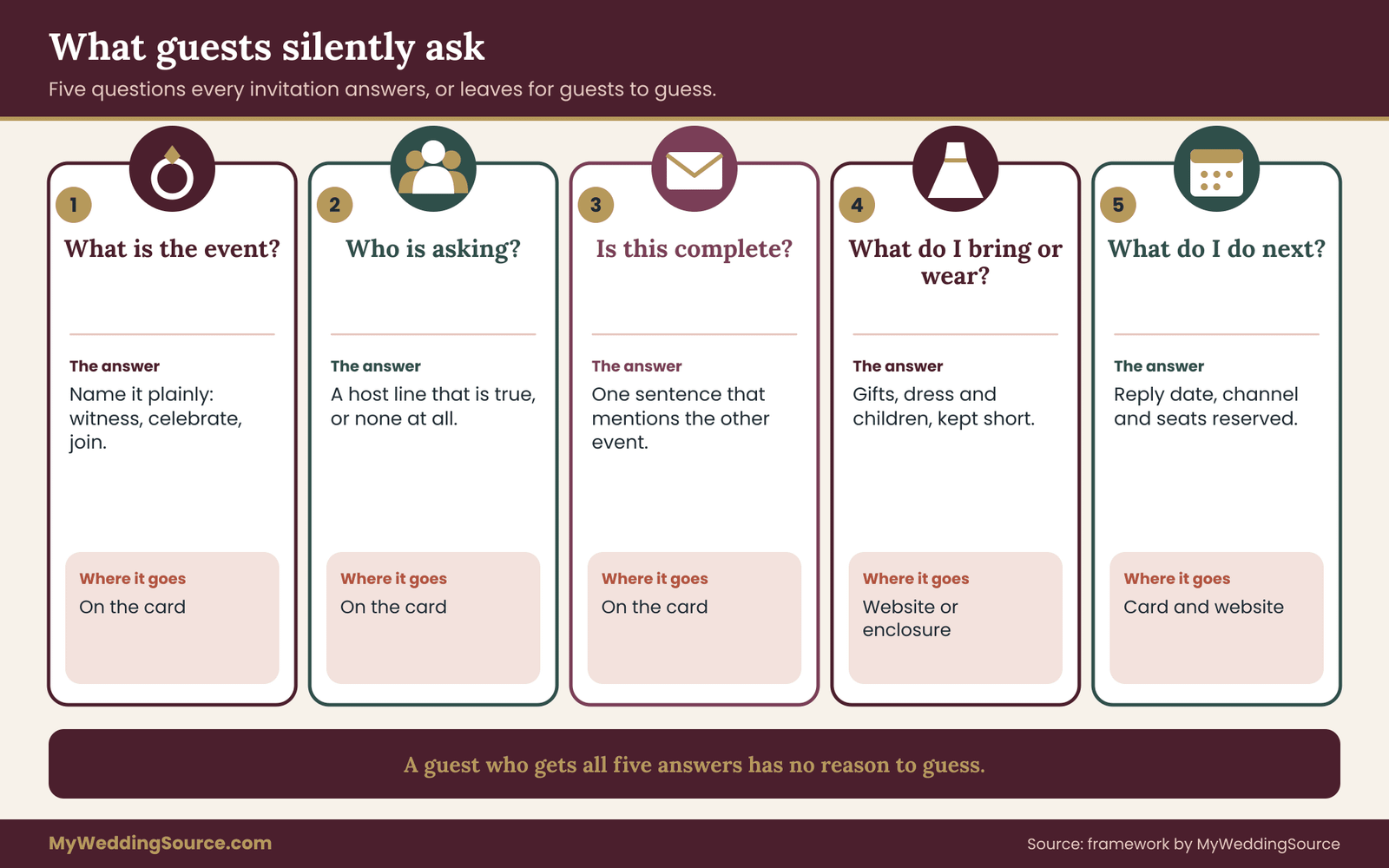
A first wedding invitation usually carries one event. Second wedding invitations often carry two, and each guest group needs a different slice of the story. Before you write a word, it helps to list what a guest silently wants to know when the envelope arrives.
The first question is what the event actually is. Is it the wedding ceremony, a celebration after a ceremony the guest will not attend, or a reception for a marriage that already took place? Guests answer this question differently depending on the verbs and nouns you choose, so the choice has to be deliberate.
The second question is who is asking. A guest wants to know who is hosting, because that tells them how formal the event is and whom to thank. In a second marriage the couple often host themselves, but not always, and the invitation should say what is true in your case.
The third question is whether this invitation is complete. If a guest knows there was a ceremony and did not receive an invitation to it, they will look for a reason in the text. If the party invitation mentions the ceremony in a clear, friendly sentence, the guest stops looking. If it says nothing, they fill the silence with their own theory.
The fourth question is what to bring and what to wear. Gifts, dress and children are three of the topics where a second marriage most often differs from a first, and a guest unsure of any of them may simply decline.
The fifth question is what to do next. Reply by when, to whom, through what channel, and for how many people.
The two-event problem in plain terms
With second wedding invitations, the core difficulty is that two audiences read two documents with different information needs. Ceremony guests are close to the couple and usually know the story. They need logistics: arrival time, seating, whether children attend, whether photographs are allowed, what happens before the party. Party guests are a wider circle. They need a clear, warm statement of what they are invited to and a simple way to answer.
Mixing the two needs in one document is where most second wedding invitations go wrong. A single card that tries to explain the ceremony list, the party list and the reasons behind both becomes long and awkward, and it still leaves someone feeling sorted.
The cleaner approach for second wedding invitations is to treat each group as a separate reader. You can use the same design, paper and typeface so the set looks related. What changes is the text, and the text changes only where the guest’s situation changes.
What this guide will not tell you
It will not tell you that a small ceremony is more polite than a large one, or the reverse. Neither is true. It will not tell you who has to be at the ceremony, because that depends on the couple and on family relationships the article cannot see. Some couples have children from earlier marriages, some do not. Some have parents who remarry, some have a former spouse who remains close to the family. None of that is assumed here.
It also will not offer a single sample wording for second wedding invitations to copy. A line that fits a courthouse ceremony followed by a garden party will sound odd on an invitation to a chapel ceremony followed by a hotel reception. What it offers instead is a chart that matches wording to format, and a set of building blocks you can combine.
If you are still deciding how large the guest list should be, the wedding guest list guide walks through that earlier decision. The rest of this article assumes you already know roughly who belongs to the small circle and who belongs to the larger one.
Who is speaking: hosting lines and names in second wedding invitations
The first line of any invitation tells the reader who is inviting them, and on second wedding invitations it carries extra weight. In a traditional first wedding, that line often names the bride’s parents. In a second wedding, the host line is a real decision, and getting it right removes a lot of awkwardness later.
There are four common patterns, and each one communicates something slightly different. None is more correct than another. The correct choice is the one that matches who is actually paying for and organizing the event, or the one the couple chooses to present.
Couple as hosts
The most common pattern on second wedding invitations is a line such as “Together with their families, Dana Reyes and Marcus Webb invite you.” Here the couple invite in their own names, and the phrase about families acknowledges relatives without assigning any of them a specific role.
This phrase is useful because it does not presume who is alive, who is involved or who is on good terms. A guest reading it sees warmth and inclusion. A relative who is not involved is not named, and a relative who is involved is covered. If the family situation is complicated, “their families” is a quiet, flexible phrase.
The simpler version leaves out the families altogether: “Dana Reyes and Marcus Webb invite you to celebrate their marriage.” It is clean and has no assumptions in it.
Parents or others as hosts
Some couples have a parent, a sibling or an adult child who is genuinely hosting. In that case the line names them, for example “Eleanor Webb requests the pleasure of your company at the marriage of her son.” Use this on second wedding invitations only when it is true. A host line is a statement about who is taking responsibility for the event, and guests notice when it does not match what they know.
A related choice is when the children of the couple are hosting or co-hosting. This works well when the children are adults and have asked to take part. It does not work as a way to make a point. If you are unsure whether a child wants to be named, ask them in a private conversation and accept the answer, including a no.
No host line at all
A third pattern leaves out any host and begins with the invitation itself: “Please join us for a celebration of the marriage of Dana and Marcus.” It is common when several people share the cost, or when the couple do not want to make the question of who is paying visible. The text is shorter and often easier to read.
Names on the card
Names on second wedding invitations deserve more thought than they usually get. Decide how each person wants to be named and confirm it before printing. Some people use a middle name, a nickname, a maiden name or a name they have used for years. A name used on the marriage license may differ from the name used socially.
If either of you will change your name, remember that the invitation shows the name you use now, not the name you plan to use. The invitation is not the document that records the change. Agencies handle that, and the USAGov guidance on changing your name explains where to start.
Avoid including a former spouse’s surname, titles from a previous marriage or any detail that exists only to explain your history. An invitation is not a biography. The guest needs the names of the two people being celebrated, spelled the way they want them spelled.
A note on “Mr. and Mrs.” and similar forms
Formal address forms can create problems on second wedding invitations. “Mr. and Mrs. Marcus Webb” assumes a name change and a household form that may not fit. When in doubt, use full names for both people, or use the neutral “Dana Reyes and Marcus Webb.” The same applies to the envelope. Address each guest the way they would address themselves, and if you do not know, ask a mutual friend or leave out the title.
The site’s guide to etiquette for traditional invitation forms covers them in full. For second wedding invitations, the practical rule is to write what is true, avoid assumptions about roles, and keep every line short enough to read in one glance.
Choosing and testing the host line
A simple test works well. Read the host line aloud to a close friend who has not seen the guest list. If the friend asks “who is that?” about anyone named, the line needs work. If the friend asks “why are you not hosting?” the line is hiding something that does not need hiding.
Then read it as a guest from each group. A ceremony guest, a party guest and a guest who was not invited to either event should all find the line neutral and clear. If one of them would feel pointed at, rewrite it. Once the host line is settled, everything else in your second wedding invitations can rest on it, and the rest of this guide assumes it is done.
The invitation decision chart for second wedding invitations, by event format
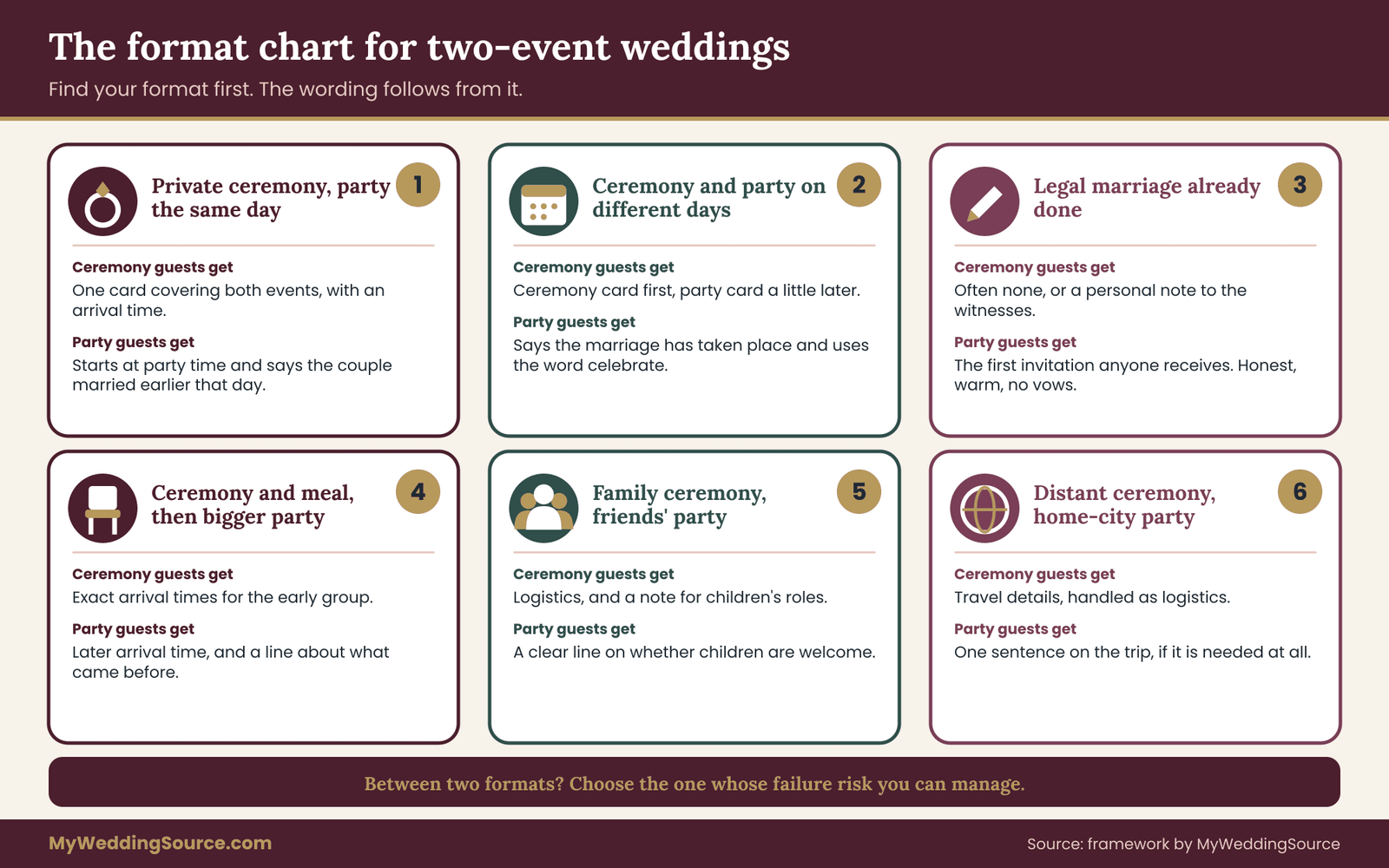
Wording follows format, and that is truer of second wedding invitations than of most others. Before you pick a single phrase, decide which of six formats you are actually planning, because the right sentence for a private vow exchange followed by a party is different from the right sentence for a marriage that is already legally complete. The chart below organizes that decision into four questions and six formats.
The four questions
Question one: when does the legal marriage happen? It may take place at the small ceremony, at an earlier appointment with an officiant or a clerk, or at a later date. The answer controls whether the party card among your second wedding invitations may honestly say “wedding” or should say “celebration of the marriage.” Marriage license requirements and the process for recording a marriage are set by the place that issues the license, and the USAGov page on marriage certificates is a reasonable starting point for confirming yours.
Question two: do the two events happen on the same day? Same-day formats need a clear gap in the invitation so party guests know when to arrive. Different-day formats need two separate dates, and a clear sentence connecting them.
Question three: do ceremony guests also attend the party? In most cases they do. If so, they need a party invitation as well, or a single card that covers both. If some ceremony guests will not attend the party, such as an elderly relative or a guest who lives far away, that is a different, smaller set of messages.
Question four: will any party guests see part of the ceremony? Some couples let everyone watch a short exchange of rings or a blessing, then close the doors for vows. Others stream or record the ceremony and share it afterward. Each choice changes what the invitation can promise.
The six formats
Format one: private ceremony, then a party on the same day. The ceremony takes place in the morning or afternoon with a small group. The party follows in the evening, at the same venue or elsewhere. Ceremony guests receive an invitation that covers both events. Party guests receive an invitation that begins at the party time and says in one sentence that the couple will have married earlier in the day.
Format two: ceremony on one day, party on another. The ceremony may be days or weeks before the party. Party guests receive an invitation to celebrate, and the card states the marriage as a fact, in past tense or present perfect. The ceremony guests receive a ceremony invitation first, and a party invitation later, usually with an added warm line.
Format three: legal marriage already done, party only. The couple married at a clerk’s office, at home or in front of an officiant with only witnesses. The party is the first event guests are invited to. The wording uses the language of celebration and does not pretend the party is the ceremony. A line such as “Dana and Marcus were married on March the ninth. Please join us to celebrate” is honest and warm.
Format four: ceremony with a seated meal, then a bigger evening party. The ceremony and the meal include perhaps thirty or forty guests. The evening party adds more. Two guest groups attend one stretch of the day and the second group joins later. The invitations need exact arrival times, and the late group needs to be told the earlier events exist, so they do not feel they were late.
Format five: family-and-children ceremony, party for friends. The ceremony is built around people who are family, including children, and the party is a broader gathering where children may or may not be welcome. This format needs the clearest statement about children in the invitation, because the two events may have different rules. The section on children later in this article addresses that question.
Format six: distant ceremony, home-city party. The couple marries in another city or country with a few people present, and then hold a party where most of their friends live. The ceremony guests are mostly travelers, and their invitations are really travel information. The party guests need the story of the trip in one sentence, if they need it at all.
How to use the chart
Find your format and write one line for yourself that fills in the blanks. “Our ceremony guests receive ___ and our party guests receive . Our party invitation says the marriage .” If you cannot fill in the sentence, the format is not yet settled, and printing anything would be premature.
Many couples planning second wedding invitations find that they sit between two formats. A common case is somewhere between formats one and four, where the ceremony group is large enough to need a seated meal but small enough that a printed card is overkill. When that happens, pick the format whose failure risk you can better manage. Format four, for example, carries a higher risk that late arrivals feel secondary, so it requires more careful arrival wording.
The chart is also a conversation tool for anyone who asks about your second wedding invitations. If a relative asks why they are invited to the party but not the ceremony, you can answer with the format and not the person: “We are doing a very small ceremony and a larger party after it.” It is a statement about structure, not about ranking.
For the rest of the ceremony itself, including who stands where and what is said, the wedding ceremony step by step guide covers the order of events. This article stays with second wedding invitations.
Wording the ceremony invitation
The ceremony invitation goes to a small group, and it can be warmer and more specific than a typical formal invitation. These guests are close to you, they will likely be asked to do something (arrive early, sit in a certain place, witness a document), and they need more logistics than a party guest does.
The ceremony card among second wedding invitations needs six pieces of information.
- Who is inviting them (the host line).
- What the event is, in plain words.
- The date, the time and the arrival time.
- The place, with any access or parking detail that matters.
- What happens after, including whether the guest is expected at the party.
- How to reply and by when.
A sample structure
The following is a structure for second wedding invitations, not text to copy. It shows how the pieces fit together on a format-one invitation, where a private ceremony is followed by a party the same evening.
Together with their families
Dana Reyes and Marcus Webb
invite you to witness their marriage
Saturday, the fourteenth of June, at four o’clock
The Rosewood Room, 220 Garden Street
Please arrive by half past three.
A celebration for all our friends follows at seven o’clock.
Kindly reply by the first of May.
Notice what the card does. It names the event as witnessing a marriage, a phrase that does not assume a religious setting. It gives an arrival time. It mentions the party without including the party’s location, since ceremony guests will receive a separate invitation to it. It sets a reply date.
If the ceremony happens at the same venue as the party, the last line before the reply can say “dinner and dancing follow.” If it does not, you can include the party address on a small enclosure.
Phrases to choose from
For the verb, “witness,” “share,” “celebrate” and “join us for” all work. “Witness” is the most specific and suits a ceremony with few guests. “Celebrate” is broader and suits a ceremony that blends into a celebration. “Request the honor of your presence” is traditional and formal, and it suits formal settings.
For the setting, say what the place is: a chapel, a courtroom, a garden, a living room. A guest planning travel, clothing or accessibility needs that detail. Add short logistics lines only when they matter, such as “the ceremony is outdoors” or “the building has a ramp at the east entrance.”
What to leave out
Leave out of second wedding invitations any phrase that ranks guests, such as “immediate family only.” It reads as exclusion. Leave out explanations of why the ceremony is small. A ceremony guest knows they were invited, and the explanation helps only the people who were not.
Leave out gift language on the ceremony invitation unless you have a specific reason to include it. A gift line on an intimate invitation can read as an expectation. The later section on gifts and dress covers the wording that works when a line is needed.
When the ceremony is also the legal event
If the ceremony is the legal marriage, the invitation should reflect that its guests are witnesses in a literal sense. Some places require witnesses, and some do not. Ask the office that issues your license what is required, and whether a guest must bring identification. Do not assume a rule from another place.
Wording the party invitation
The party invitation is the document most guests will see, and it carries the main burden of explanation. The aim is to be clear and warm in as few words as possible.
A party card among second wedding invitations needs the same six pieces, with one addition: a short, honest statement about the marriage. That statement is where most of the delicacy sits. It has to say that a marriage has taken place, or will take place, and that the guest is invited to celebrate it.
The three honest statements
There are three statements that work, depending on your format.
Past tense. “Dana and Marcus were married on the fourteenth of June in a small ceremony with family. Please join us to celebrate.” It fits formats one, two, three and six.
Same day. “Dana and Marcus will be married earlier in the day in a small ceremony. Please join us at seven o’clock to celebrate.” It fits format one when the party invitation goes out before the ceremony.
Neutral. “Please join us to celebrate the marriage of Dana Reyes and Marcus Webb.” It says nothing about when the marriage happens, which is useful when the date is flexible or the legal details are not settled. It fits any format, though it provides less information than the other two.
Why one sentence is enough
A single sentence that states the facts answers the guest’s real question: what is this event, and was I supposed to be somewhere else? If the card says the ceremony was small and private, the guest understands without being told. If the card says nothing, the guest may assume they were left off a list.
Notice that none of these sentences apologizes, explains the choice or says “we wish we could have invited everyone.” Apology invites the guest to forgive you for something they had not accused you of. Explanation invites debate. A plain statement of fact does neither.
A sample structure
Dana Reyes and Marcus Webb
were married on June the fourteenth in a small ceremony.
Please join us to celebrate
Saturday, the fourteenth of June, at seven o’clock
The Rosewood Room, 220 Garden Street
Dinner, music and dancing
Kindly reply by the first of May.
The format is nearly identical to the ceremony card, which helps the set of second wedding invitations look like a family. The difference is the second line, which is the one-sentence statement, and the verb, which has become “celebrate.”
Notes on the verb and the noun
A party invitation that says “wedding” implies a ceremony will take place at that event. Use “wedding” only if that is true. If the marriage has already happened, “celebration,” “reception” or “party” are accurate and avoid mismatched expectations. Guests who arrive expecting vows and find a dinner may feel they missed something, and guests who arrive expecting a dinner and are asked to stand for a ceremony are surprised the other way.
The same attention applies to the time. A party that begins at seven and serves dinner at seven-thirty should say so, because guests deciding whether to eat first need that detail. The wedding reception guest flow guide on this site covers entry, seating, food and exit once guests are in the room.
Explaining a small ceremony without apology: scripts for second wedding invitations
The card is only half of the explanation. Most of the friction around second wedding invitations happens in conversation: a text from a cousin, a question from a coworker, a call from a relative who heard about the ceremony from someone else. A short script for each situation keeps you consistent, and keeps your second wedding invitations and your conversations telling the same story.
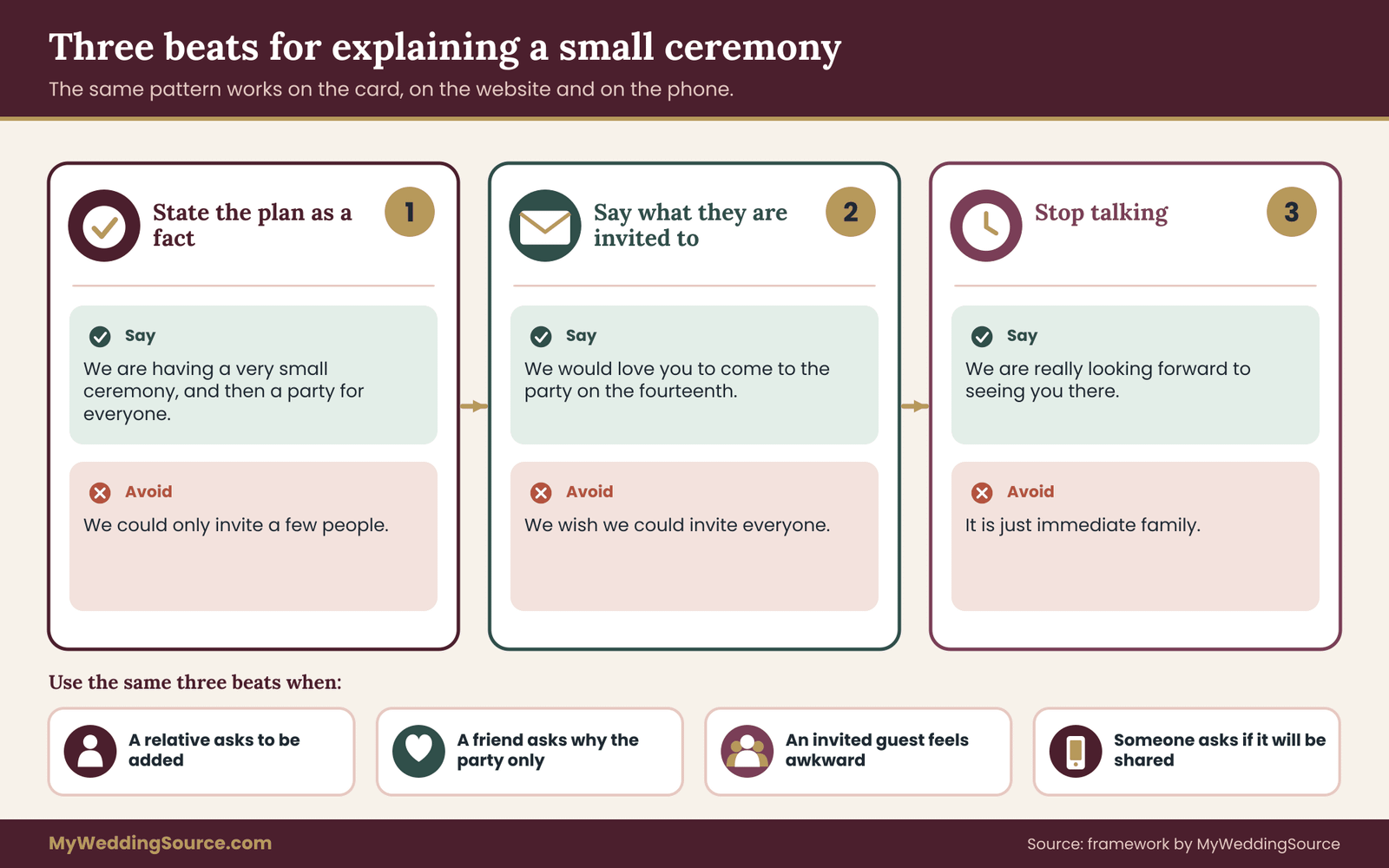
The pattern behind every script is the same three beats. First, state the plan as a fact. Second, say what the person is invited to. Third, stop. Do not add a justification, a list of who else was or was not invited, or a promise to make it up to anyone.
Beat one: state the plan as a fact
“We are having a very small ceremony with a few people, and then a party for everyone.” That sentence is true, short and non-judgmental. It frames the day as two different kinds of events instead of one event with a restricted list.
Compare it with “We could only invite a few people to the ceremony.” That version implies a limit imposed on you, and it invites the listener to propose ways around the limit. “We are having a small ceremony” describes a choice, and choices invite fewer negotiations than constraints do.
Beat two: say what they are invited to
“We would love you to come to the party on the fourteenth. The invitation is on its way.” This beat points the person to the thing they can attend. It turns attention from the ceremony they were not asked to and toward the event that includes them.
If the person is already attending the ceremony, this beat becomes logistics: “Arrive by half past three and wait in the lobby; we will seat everyone together.” The same structure holds.
Beat three: stop talking
Silence after a plain statement feels uncomfortable, and people fill it with explanations. The explanation is usually where the trouble begins. The more you say about why a person was or was not included, the more material you hand them to react to. A warm closing line, such as “We are really looking forward to seeing you there,” is enough.
Scripts for four common situations
A relative asks to be added to the ceremony. “I understand wanting to be there. We have kept the ceremony to a very small group, and we are not able to add people. We hope you will come to the party, where everyone is welcome.” You can hold the line kindly. If it is a question you genuinely want to reconsider, say instead, “Let me talk to Marcus and I will get back to you by Friday,” and then actually do it.
A friend asks why they are only invited to the party. “The ceremony is a very small family event, and the party is where we are celebrating with friends. We would be so glad to have you there.” Notice the phrase “very small family event” only works if it describes the real situation. If the ceremony group includes friends, change the description to something that is true.
An invited guest says they feel awkward about being at the ceremony when others are not. “We understand. We chose the people who will be standing closest to us, and we are very happy you are one of them. Everyone else is invited to the party.” This acknowledges the feeling without taking it back.
Someone asks if the ceremony will be shared. “We will be sharing a few photos afterward, and the party will include a toast.” If you plan to stream or record, you can say so. If you do not, that is a sufficient answer. You do not need to supply more detail than the person asked for.
What to avoid saying
Avoid “we wish we could invite everyone.” It signals regret and invites debate about why you cannot. Avoid “it is just immediate family,” since a guest who is a close friend of twenty years may hear that as a ranking. Avoid “we did not want a big fuss,” which can suggest that attending a big event is a burden for you, and so a party is a burden for guests.
Avoid also the promise to hold a second event for those who missed the first. If you will hold one, say so with a date. If you will not, do not suggest it.
Putting the script on paper
Some of these sentences can go on second wedding invitations or on a wedding website. A brief note on the website, such as “The ceremony will be a small family gathering. Everyone is invited to the party,” answers questions before they are asked and gives relatives a place to send curious friends. The wedding invitation etiquette guide discusses where information belongs on the website and where it belongs on a card, so you can keep each in its place.
If you are working with a family that has strong views on who should attend, remember that second wedding invitations are not the right place to resolve disputes. Resolve them in conversation, decide, and then print. The wedding decision rights guide describes how couples can listen to family input without handing over the final choices.
Children, prior spouses and family roles on second wedding invitations
Three topics appear on almost every second marriage guest list and rarely on a first: children from earlier relationships, a former spouse who remains part of family life, and relatives whose roles have changed. Each can be handled gracefully on second wedding invitations, provided the card does not presume anything.
Children
Children may appear in second wedding invitations as attendants, guests, hosts or not at all. Each position needs its own wording, and each depends on the child’s age, wishes and the venue.
If the children are part of the ceremony, the ceremony invitation does not need to say so. They know. A short line to their parent or guardian covers logistics. The children’s role belongs in a personal message and a schedule, not in the printed text.
If the children attend the party, say so plainly or let the envelope do it. Addressing an envelope to “The Okafor Family” or listing the children’s names tells a household who is invited. The wording “children are welcome” is clear and kind, and it is better than saying nothing.
If the party is adults only, say so on the invitation, once and plainly: “We kindly ask that this be an adults-only celebration.” Do not add an apology. If the ceremony includes children but the party does not, the invitation to the party should state that clearly and mention childcare options if you have arranged any. A parent who learns on the day that the children cannot stay will be far more upset than one who learns six weeks earlier.
Children of the couple themselves may have views about what they want. Some want to be named on the invitation, some do not. Ask each of them, accept the answer, and include them in the plan before it is final.
A former spouse
A former spouse may attend the ceremony, the party, both or neither. That decision belongs to the couple and the people involved, and no invitation wording can make it for you. What the invitation can do is avoid creating problems.
Do not name a former spouse on second wedding invitations. Do not list them as a host. Do not add a line that explains their relationship. If a former spouse is invited to an event, address them as you would any other guest, with a plain envelope and a plain card. If children split time between households, give both households the information they need, and use the same card for both.
If you are unsure about including a former spouse, talk first to the people most affected, such as the children, the new spouse and the former spouse. A personal conversation avoids the worst outcome, which is learning through an envelope.
Parents and step-relatives
Parents, step-parents, step-siblings and in-laws have roles that vary widely. A card that says “together with their families” is a safe choice. A card that names specific parents is accurate only if those parents are hosting.
When there is a step-parent, a divorced pair of parents or a grandparent raising a grandchild, resist the urge to build the card around a diagram of relationships. The invitation does not need to show it. A guest who knows the family already knows the structure, and a guest who does not know it does not need it.
If you want a family member to play a particular role, such as walking a parent down an aisle or standing beside a child, make that arrangement privately, and tell the person before anyone else hears about it.
Roles that may change
A relative who was a host at a first wedding may not be at this one. A friend who was an attendant may not be. This is not a problem for the card, because the card does not list roles. It becomes a problem only when the card or a conversation implies a role that has not been agreed. The safe approach for second wedding invitations is to avoid assigning roles in print, and to confirm each role in person before telling anyone else.
A checklist before printing
Before the text of your second wedding invitations is final, check each of the following with the people it affects.
- Every name is spelled the way its owner wants it spelled.
- The host line is true.
- The children’s status at each event is stated or implied clearly.
- No former spouse, partner or step-relative is named without their agreement.
- No role is assigned that has not been confirmed.
- Each envelope shows who is invited, by name, and not by assumption.
This short check takes twenty minutes, and it prevents the kind of mistake that is printed in a hundred copies.
Gifts, dress, RSVPs and practical lines in second wedding invitations
Once the main wording is set, a handful of small lines decide whether second wedding invitations feel easy or burdensome. They cover gifts, dress, replies, accessibility and the practical details guests ask about. Each line should be short, specific and kind.
Gifts
Many couples marrying for a second time already have a household. Some want no gifts, some want contributions to a cause, some are glad to receive presents and some have a registry. Second wedding invitations are not the place for a long statement, but guests do wonder, and a short line saves many private messages.
The simplest wording is a single sentence on the wedding website or an enclosure: “Your presence is the only gift we need.” It is polite and common. It does not forbid a gift, and some guests will bring one anyway. If you want to say more, you can add “If you would like to give something, we have listed a few ideas at the website address below.”
Avoid a line that asks for money, or one that tells guests what to buy. A line that says “no gifts, please” is clear, but it can sound stern. The softer version, “we have everything we need,” tends to be received better, though it is a matter of taste.
One question specific to two-event weddings is whether a ceremony guest who also attends the party is expected to give a gift at each. They are not. State once, in the place guests read first, that gifts are not expected, or that one gift is plenty. A guest who receives two invitations should never feel they owe two presents. The wedding registry ideas guide covers registry design for couples who do want one.
Dress
Dress code is a frequent source of anxiety for guests reading second wedding invitations, and it matters more when the two events differ. A ceremony in a courtroom at four o’clock and a party in a garden at seven may call for different clothing. Guests who attend both need to know whether they can change, and where.
If one dress code covers both, say it once: “Festive cocktail attire.” If the two differ, say it in each invitation, in the lines for that event. Avoid vague terms such as “dressy casual” unless you are comfortable fielding questions about them. A phrase that names a specific mood, such as “garden party attire” or “dark suits and dresses,” is easier to apply.
For ceremony guests, add any practical dress note: an outdoor setting, an uneven path, a venue with stairs, a time of year when evenings turn cool. These notes are logistics, not instructions about taste.
RSVPs
An RSVP on second wedding invitations is a request for information. The more you ask, the more precise the information has to be. Decide what you need to know: whether the guest is coming, how many people in the household, dietary needs, whether children attend. Then ask only for that.
For the ceremony, use a firm reply date and a direct channel, such as a phone number or a short form on a website. The group is small, and you will likely follow up with each person anyway. For the party, use the channel most guests can easily use. If many guests are not comfortable with online forms, include a mailed response card or a phone number. The wedding RSVP etiquette guide explains reply wording and follow-up in detail.
Set the reply date earlier than you think you need it. Many hosts want a final count several weeks before the party, to give the caterer and venue time to adjust. The date on the card should be earlier still, since some guests will reply late and some will need a reminder.
Plus-ones and household names
State who is invited by naming them on the envelope or the response card. A line such as “We have reserved two seats in your honor” tells the guest exactly how many are invited. Without it, some guests will bring a partner or a child who was not counted. This is easier to prevent in the wording than to handle on the day.
For the ceremony, where the group is small, a plus-one is less common and should be stated clearly. A guest invited alone should not be left guessing. A line on the reply card, “We have reserved one seat for you,” is enough.
Accessibility and practical lines
Guests with mobility, hearing, vision or sensory needs will want to know about access before the day. Put concrete facts on the website or in an enclosure: step-free entry, accessible restrooms, seating, quiet spaces, lighting and music volume. The ADA.gov site publishes the federal framework for accessibility, and the venue can tell you what it provides. If you do not know an answer, say “please contact us if you have access needs,” and follow up personally.
Parking, transportation and lodging are the other practical lines. Add them to a small enclosure or the website and keep the card itself clean. For overnight guests, the wedding guest hotels guide covers room blocks and budget ranges.
Keeping the card short
Good second wedding invitations are a short list of facts that fits on one card. Extra detail goes on the website, on an enclosure card or in a follow-up message. When you are tempted to add a paragraph to the card, ask whether it is something every guest needs to know before they can say yes. If not, move it.
Timing, mailing and cost of two sets of second wedding invitations
Two events and two guest groups mean two sets of second wedding invitations, and that affects timing, printing, postage and budget. A good schedule keeps the two sets from colliding and keeps guests from receiving information in the wrong order.
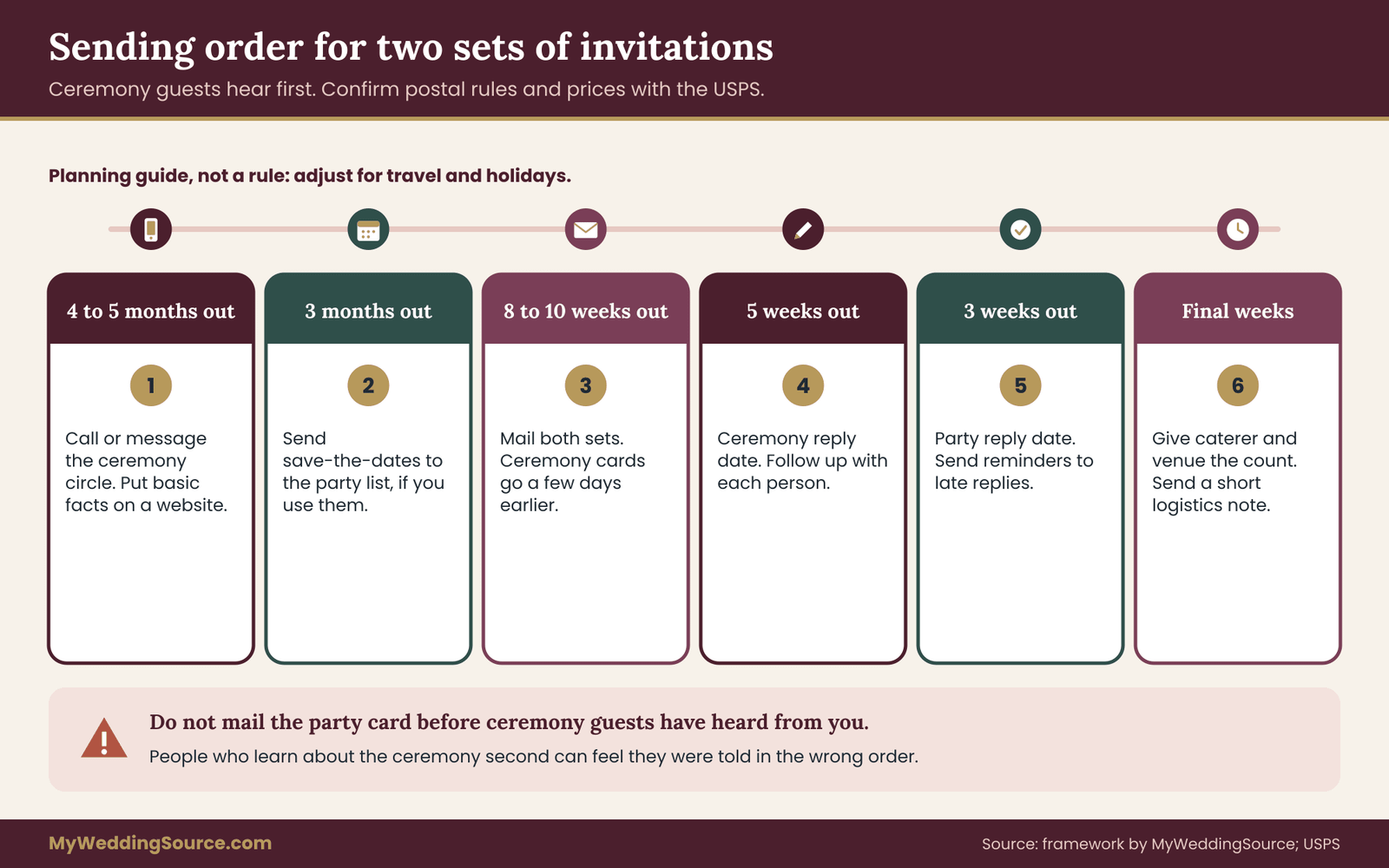
Sequence
The usual order for second wedding invitations is this. Ceremony guests learn first, because their commitment is larger and their logistics are heavier. Party guests learn next, because the party is the larger event and needs the longer lead time for travel and calendars. If you plan a save-the-date, it can go to the party group alone, since the ceremony guests will hear from you directly.
Do not send the party invitation before ceremony guests have heard from you, if you can help it. A guest who learns of the party from a card and the ceremony from a text a week later may feel they were told in the wrong order.
A practical timeline, working backward from the party, might look like this. About four to five months before: personal calls or messages to the ceremony circle, and a website live with the basic facts.
About three months before: save-the-dates to party guests, if you use them. About eight to ten weeks before: both sets of invitations mailed, with the ceremony invitations going first by a few days. About a month before: reply deadline for the ceremony. About three weeks before: reply deadline for the party. These are planning guides, not rules, and your own calendar and any travel involved will adjust them.
If many guests are traveling, give them more notice. The twelve-month wedding checklist lays out the wider planning calendar.
Mailing
Paper second wedding invitations travel through the postal system, and the rules for size, weight and shape are set by the postal service. Square or rigid cards, unusual envelopes and added items such as ribbons or wax can change the postage or the handling. The United States Postal Service publishes its mailing standards and price lists, and the physical standards for letters and the current price notice are the documents to check before you order paper. Pricing changes, so confirm the figures with your local post office at the time you mail.
Address accuracy matters more with two sets of second wedding invitations, because a mistake can be repeated across both. USPS Publication 28 describes the standard address format. A short audit of the address list before printing envelopes saves reprints.
For guests who prefer or need digital invitations, an email or message with the same text works well, and some couples send both. If you do, keep a single list of who received what, so nobody receives two conflicting versions.
Cost
With second wedding invitations you are not printing one set of identical pieces. You are printing two or more sets, possibly with different counts and different enclosures. Because the ceremony group is small, its set may be a few dozen pieces, and a short print run often costs more per piece than a long one. Some couples handle the ceremony set by hand, in letterpress or calligraphy, and the party set by a larger print run. Some use one design and change the text.
A simple way to budget second wedding invitations is to count pieces, not guests. List each type of piece, the number of copies, the cost per copy at that quantity, and the postage. Add a margin of about ten percent for errors, address changes and late additions, and confirm the margin with your printer. The wedding budget guide explains how to set up the categories, and the wedding invitation printing guide covers proofing, quantities and printer handoffs.
If the budget is tight, the choices that save the most are fewer enclosures, one design for both sets, digital delivery for part of the list, and no extra pieces beyond the invitation and reply information. The choices that tend to cost the most are special shapes, hand finishing and rush orders. A rush order caused by a late decision about wording is the most avoidable of them all.
Proofing two sets
With two sets of second wedding invitations, proofing is doubled, and the risk is that the wrong text lands on the wrong set. Label the files clearly, proof each set separately and ask a second reader to compare each proof against your format line. Check dates, times, names, addresses, the reply date and the web address. Then check that the party text does not mention anything that belongs only to the ceremony, and that the ceremony text does not give the party’s details in a way that contradicts the party invitation.
Finally, keep a record of what was sent to whom and on what date. A single list with columns for ceremony, party, sent date and reply is enough, and it is the tool you will rely on in the final weeks.
A worked case: one couple builds their second wedding invitations
The following example is invented, and it is labeled that way because the aim is to show the reasoning, not to report what any real couple did. The numbers are chosen to be easy to follow. Adjust every one of them to your own list.
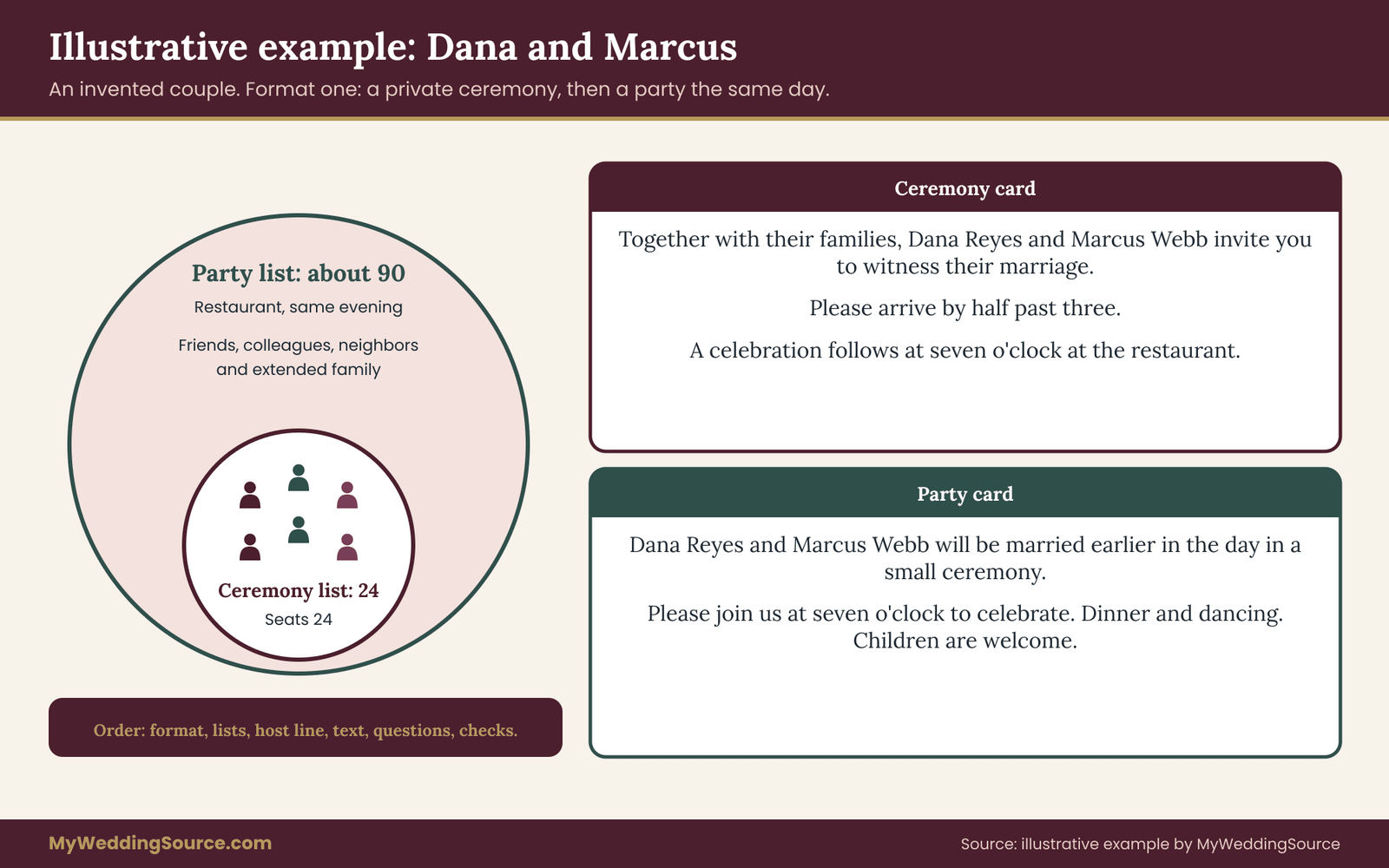
Dana Reyes and Marcus Webb are marrying for the second time. Each has a teenage child from an earlier marriage, and Marcus’s mother, who is in her eighties, does not travel easily. They want a ceremony in a small chapel room that seats twenty-four, and a larger party at a nearby restaurant that can host about ninety people. They also want the two events on the same day, with a gap between them so that the ceremony group can rest and the party group can arrive.
Step one: choose the format
Their answers to the four questions are straightforward. The legal marriage happens at the ceremony. Both events are on the same day. All the ceremony guests also attend the party. A few party guests will arrive early to hear a toast, but the ceremony itself is closed.
That puts their second wedding invitations in format one, a private ceremony with a same-day party. The format tells them the party invitation should use the language of celebration and should say in one sentence that the couple will have married earlier in the day.
Step two: sort the lists
They write two lists. The ceremony list has twenty-four names: both teenage children, four siblings and their partners, both sets of parents or guardians, Marcus’s mother, two close friends and an officiant who is also a guest. The party list has the same twenty-four plus about seventy others: friends, colleagues, neighbors and extended family.
The sorting rule they use is simple. For each person on the party list they ask one question: is this person someone we want standing beside us when we say our vows? If yes, they go on both lists. If no, they go on the party list only. They do not use “who would be offended” as a test, because the answer to that question is never stable.
Step three: choose the host line and names
They choose “Together with their families,” since both have complicated family arrangements and want to avoid naming anyone. Each confirms how they want their name printed. Marcus uses his full name, and Dana uses her first and last name. Neither changes a name at this time, so the card is straightforward.
They do not name Dana’s former spouse or Marcus’s. The teenage children are invited by name on the ceremony card, with a short personal conversation beforehand about whether they want to be named or not. One says yes and one prefers not to be named on a printed card, so each receives a card addressed to their household, and both are told what they will do during the ceremony in person.
Step four: write each of the second wedding invitations
The ceremony card says “invite you to witness their marriage,” gives the chapel address, the arrival time of half past three, and the sentence “A celebration follows at seven o’clock at the restaurant.” It sets a reply date of the first of May.
The party card begins at the party time. It says “Dana Reyes and Marcus Webb will be married earlier in the day in a small ceremony. Please join us at seven o’clock to celebrate.” It gives the restaurant address, mentions dinner and dancing, states that children are welcome, and gives a reply date two weeks later than the ceremony reply date.
The couple add a line on the website, not on the card: “Your presence is the only gift we need.” They add accessibility facts for the restaurant after phoning the manager, including step-free entry and the location of seating.
Step five: handle the questions
Within a week of mailing, three questions arrive. A cousin asks whether she can attend the ceremony. Dana answers with the first script: the ceremony is very small and cannot take additions, and everyone is welcome at the party. A colleague asks whether the party is “the wedding.” Marcus answers that the ceremony is earlier in the day and the party is the celebration, and that both are part of the same day. A friend asks whether the children will be there. The card said yes, and Dana points her to it.
None of these questions causes a problem, because each has a prepared and consistent answer.
Step six: test the failure points
Before printing, they check the failure conditions covered later in this guide. They confirm that each ceremony guest has both a ceremony card and a party card. They confirm that the party card does not use the word “wedding” in a way that suggests a ceremony at the restaurant. They confirm that the restaurant knows the party starts at seven and that the ceremony group will arrive together. They compare the printed proofs against the format line.
One error appears at this stage: the draft party card gave the same arrival time as the ceremony card. They correct it, which would have been much more expensive after printing.
What the case shows
The example is not a template for your second wedding invitations. It shows an order of decisions: format first, lists second, host line third, text fourth, questions fifth, checks last. Notice that the hardest conversations, with the teenagers and with Marcus’s mother, happen before the invitations are written. The second wedding invitations are the record of decisions already made in conversation, and they work because they do not carry decisions that were never discussed.
Notice too that the couple did not try to make the second wedding invitations carry their whole story. They did not describe the history of either marriage, the reasons for the small ceremony or their feelings about the guest list. The card names the event, the time and the place, and the conversations take care of the rest.
Alternatives to sending two separate sets of second wedding invitations
Two sets of second wedding invitations are not the only way to handle two events. For some couples, a different approach is simpler, cheaper or kinder. Each alternative has trade-offs, and none is right for everyone.
A single invitation with a clear line
One card can carry both events if the ceremony list and the party list are close in size, or if the ceremony is open to anyone who attends the party. The card names the ceremony time and the party time, and a short line says which guests are asked to arrive for each. It works for format four, in which the ceremony and meal include a larger group, and for informal events where a card is not the main communication.
The trade-off is that a single card makes the difference in guest groups visible. If only some guests are asked to the ceremony, the others will see that on the card. If everyone is asked to both, there is no sorting to hide. The single card is the best choice when the ceremony is small by choice and not by exclusion, and when no guest is likely to feel the line is aimed at them.
An announcement card after the ceremony
For a ceremony that is private by design, such as a courthouse appointment or a quiet vow exchange, a short announcement can follow. It says the marriage has taken place and, if there is a party, invites guests to it. This works well for format three, when the legal marriage is complete before any invitation goes out.
The announcement is simple and warm, and it avoids the question of who was or was not invited, since no one was. It does not work if you want guests to prepare for the ceremony itself. Keep the legal marriage and the celebration separate in your mind when you choose the wording, because the announcement should say only what has actually happened.
A website as the main source
For a couple with many guests who use the internet comfortably, a website can carry most of the detail, and the printed card can be minimal. The website lists the two events, who is invited to each and how to reply. This lowers print costs and makes corrections easy.
The trade-off is that guests who do not use websites are left out unless a paper or phone alternative exists. It also puts the sorting on a screen where any guest with the link can see it, unless you protect it with a password or a separate page for each group.
Personal invitations for the ceremony
For a ceremony of ten or twenty close people, a printed card may be more than you need. A phone call, a handwritten note or a message can be warmer and more direct. The conversation gives you the chance to explain what the event is and to hear any concerns. If you use a call, follow it with a short written confirmation of the date, time, place and arrival time so that nobody relies on memory.
The trade-off is consistency. A call leaves no record, and a family member who hears a slightly different version can be confused. Keep the follow-up written and identical for everyone.
A party-only plan
Some couples hold the ceremony in private with no guests, and invite everyone to the party. The invitation is a single set with no ceremony text at all, and the party invitation states that the couple have married or will marry privately. This is the simplest structure and the one with the fewest places for something to go wrong.
The trade-off is that people who would have wanted to attend the ceremony do not get to. For some couples that is a relief, and for others it is a loss. Decide with your eyes open.
Choosing among the alternatives
Use the format chart as the guide to second wedding invitations. Formats three and six lean toward announcements and party-only cards. Formats one and two lean toward two sets. Format four leans toward a single card with a clear line. Format five depends most on children and may need two sets with different wording even when the guest groups overlap.
If you are weighing cost against clarity, remember that the second set is the smaller of the two. The extra expense is usually modest compared with the cost of a misunderstanding. If the second wedding invitations are doing their job, the money goes to the right place.
When second wedding invitations fail: failure conditions and repairs
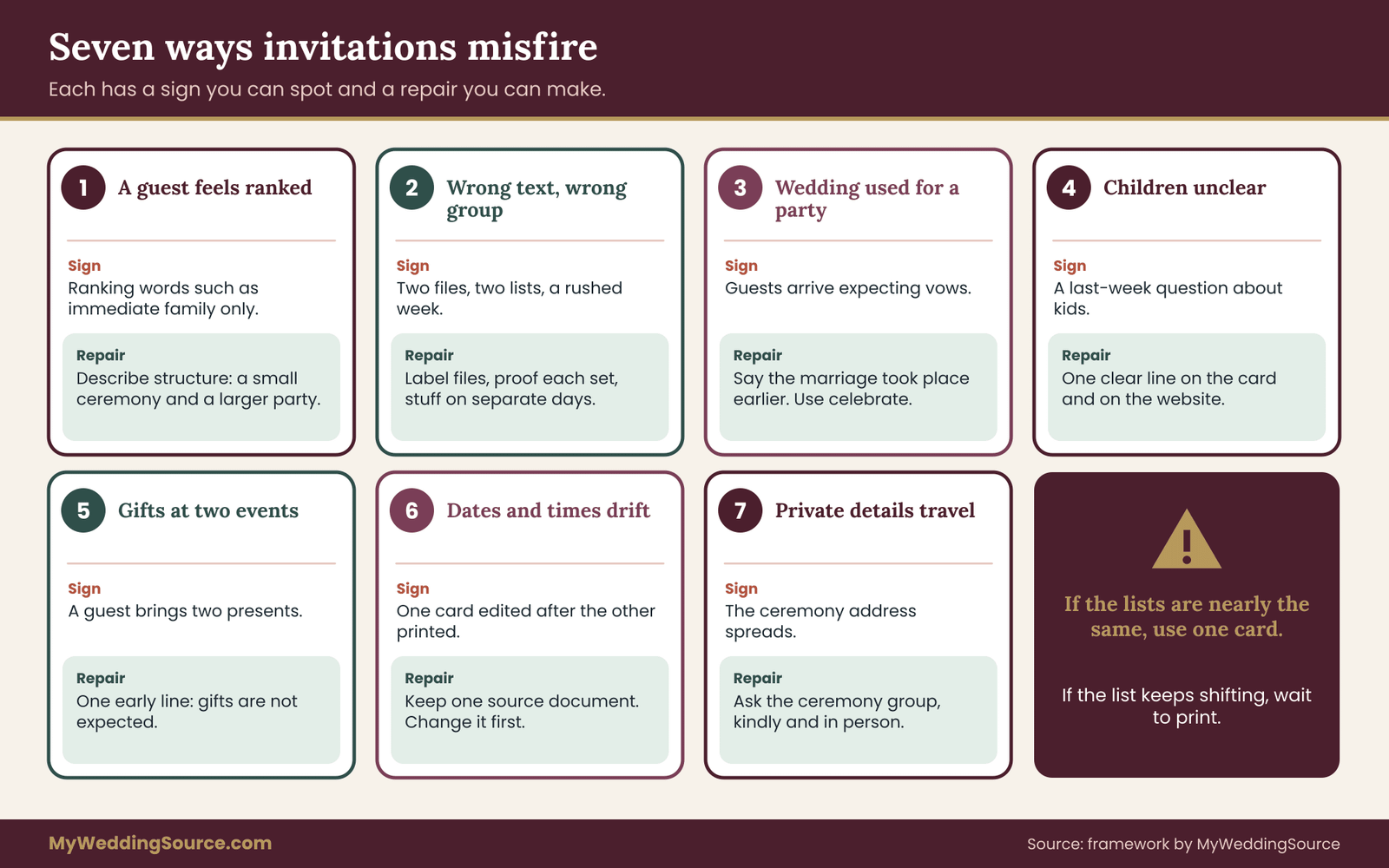
A decision chart is only useful if you know where it breaks. Second wedding invitations fail in a small number of predictable ways, and most of them can be caught before printing if you know what to look for. Each failure of second wedding invitations below has a sign, a cause and a repair.
Failure one: a guest feels ranked
The sign is a guest who says, or whose silence suggests, “so I am not close enough for the ceremony.” The cause is usually wording that sorts people out loud: “immediate family only,” “intimate ceremony for those closest to us,” or a long note about space limits. The repair is to remove ranking language from every printed piece of your second wedding invitations and describe the structure instead: a small ceremony and a larger party. If a guest has already felt the sting, a short, direct call is better than an explanation in writing.
Say you are glad they are coming to the party, and leave the rest alone.
Failure two: the wrong text reaches the wrong group
The sign is a party guest holding a card with ceremony arrival instructions, or a ceremony guest who has no party details. The cause is two print files, two mailing lists and a rushed final week. The repair is prevention: label each file by group, order a single proof of each set, and stuff and address each set on a different day. If it happens anyway, send a short correction by message and in writing, and keep the corrected version consistent.
Failure three: “wedding” used for an event that is not one
The sign is a party guest who arrives dressed and ready for a ceremony that has already happened, or one who stays away because they think they missed the wedding. The cause is a party card that says “wedding” without saying the marriage took place earlier. The repair is the one-sentence statement from the earlier section, in past or future tense as needed, and the word “celebrate” in place of “wedding” when the marriage is complete.
Failure four: children are unclear
The sign is an email on the week of the event asking whether kids are welcome, or a child who arrives to a party that was meant for adults. The cause is a card that says nothing, or that signals one thing on the envelope and another in the text. The repair is a clear line on the invitation and a matching line on the website. If you arrange childcare for one event, say who is covered, for which hours and how to book it.
Failure five: gifts at two events
The sign is a ceremony guest who brings one present to each event, or who asks which is correct. The cause is silence. The repair is a single, early line, on the website or an enclosure: gifts are not expected, or one gift is plenty. If you do have a registry, the registry’s location should be given once.
Failure six: dates and times drift
The sign is a guest who shows up at the ceremony time to a party, or at the party time to a ceremony that has already started. The cause is two times, two places and two guest groups, with one copy edited after the other was printed. The repair is a single source document, the format line from the chart plus a list of dates, times and addresses, that every printed piece is checked against. Change the source first and the pieces second.
Failure seven: private details travel
The sign is a ceremony detail posted or repeated beyond the people meant to have it, such as the ceremony address or a plan to photograph the vows. The cause is the ordinary habit of sharing. The repair is to give the ceremony group a short request: please keep details to yourself until we share them. Make the request kindly and in person. Unplugged-ceremony wording and photo rules are separate decisions that deserve their own line on the ceremony card.
Failure conditions for the whole approach
Beyond these seven, there are three conditions under which the whole approach to second wedding invitations should be reconsidered. First, if the ceremony list and the party list are nearly the same, two sets add cost and confusion, and a single card with a clear line may be better. Second, if the ceremony list is shifting week to week, wait to print the ceremony set until it settles, and use personal messages in the meantime.
Third, if relatives are deeply divided about who should attend, the invitation will not fix it. Settle the list first, in conversation, and print afterward.
The pre-print proof
The last defense for second wedding invitations is a structured proof. It takes about an hour and is worth doing for both sets together, with a second person reading.
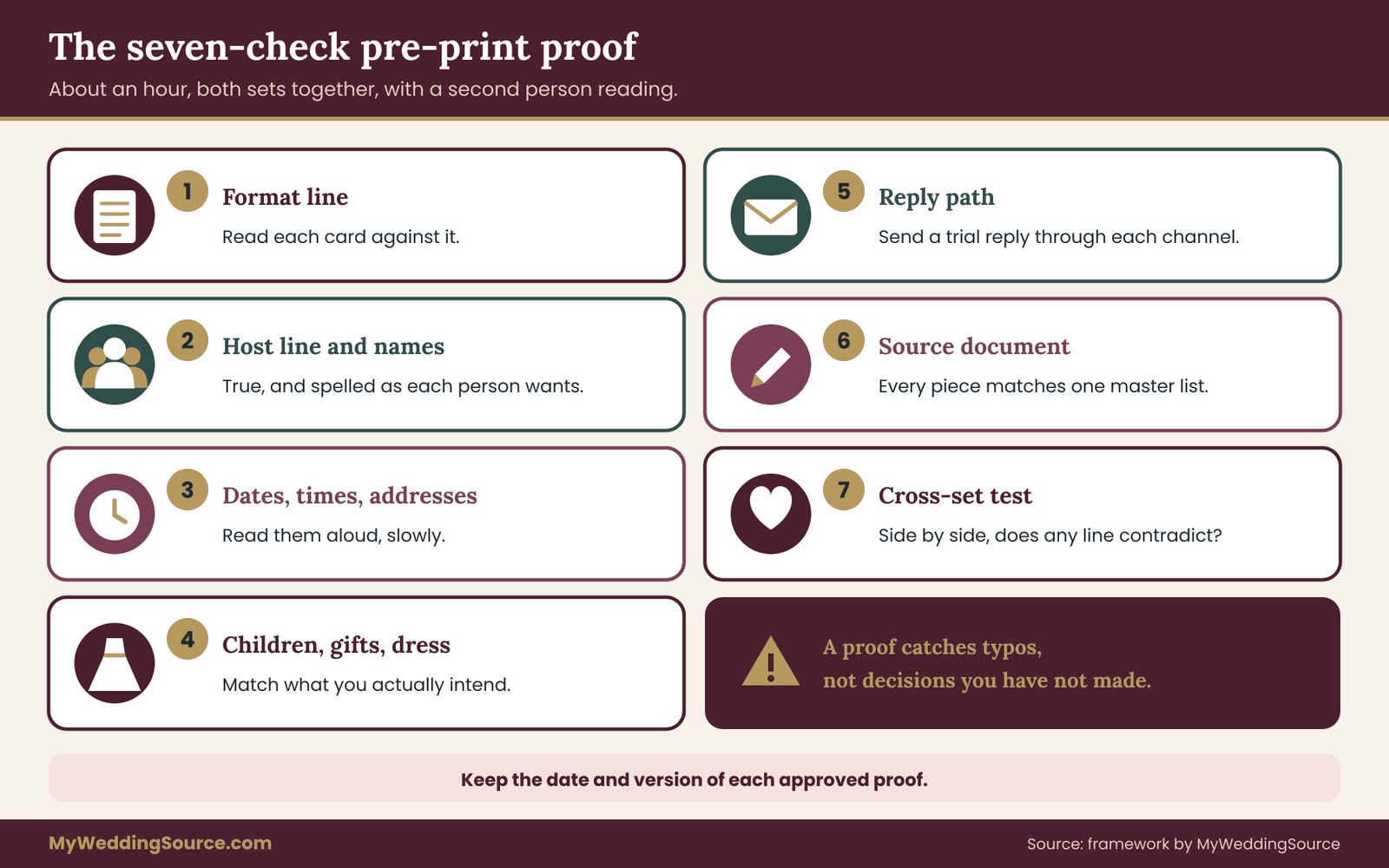
Start with the format line, and read each card against it. Then check the host line and the names, spelled as each person wants. Then read every date, time, address and reply date aloud, slowly. Then check the children, gift and dress lines against what you actually intend. Then test the reply path: submit a trial reply through each channel, and confirm it arrives where you expect.
The seventh check is the cross-set test. Place one ceremony card and one party card side by side and ask, as a guest who receives both, whether any line contradicts another, whether any detail is missing, and whether the second card makes the first one feel smaller. If the answer to any of these is yes, fix the text before printing.
What proofreading cannot catch
A proof catches mistakes in text. It does not catch decisions you have not made. If a line on the card depends on something that is still open, such as whether a former spouse will attend or whether a venue will allow children, the line is not ready to print. Close the question, or word the card so that it does not depend on the answer.
Keep a note of the date and version of each approved proof. If something is questioned later, the record shows what was approved and when.
Edge cases and judgment calls
The chart covers the common formats of second wedding invitations. Real lists produce odd cases, and a few come up often enough to be worth thinking through in advance.
A ceremony guest cannot attend the party
An older relative may be glad to attend the ceremony and unable to stay for an evening party. Invite them to both, and tell them they are welcome to leave early. Avoid asking them to decide in advance. If they decline the party, accept the reply warmly. Do not treat the decline as a problem, and do not leave them out of the photographs or the toast because they will not be at the party.
A party guest asks to attend the ceremony
Use the script from the conversation section. If you decide to make an exception, consider whether it creates a new group of people who now feel they were nearly left out. An exception is a decision to move the line, and moving it for one person leads naturally to questions from the next. Decide in advance whether the line is fixed.
The ceremony changes after invitations are out
A venue falls through, a date moves, or a guest on the ceremony list becomes unavailable. Contact the ceremony group first, personally, then follow with a written update. Then update the party group. The rule is simple: tell the people most affected first, in the form they will best receive, and then confirm in writing.
The couple wants a religious or cultural element
If the ceremony includes a religious or cultural element, such as a blessing, a particular ritual or a clergy member’s role, the ceremony card should say so if it affects what guests do. A guest may need to know whether to stand, to cover their head or to arrive earlier. The party card does not need to describe the ritual, but it should not contradict it. The order of a wedding ceremony shows where such moments usually fall.
For interfaith or multi-tradition ceremonies, an officiant or leader of each tradition can tell you what to put in print.
Guests from several households and several time zones
A family with children who live in different homes will need information in two places. Send the same information to each household, and avoid assuming that one parent will pass it on. For guests who live in other time zones, state the time zone on the card if it is unusual for them, and confirm travel details by message.
A very small ceremony with no guests
If the ceremony has only the couple, an officiant and required witnesses, the party invitation is the first and only event invitation. The wording follows format three, in the past tense. The people who serve as witnesses need no special invitation, since they are present as part of the legal process.
When the budget is the real reason
If the ceremony is small mainly because of cost, you can say that plainly in conversation. On the card, a statement of structure still works better than an explanation. People understand that cost shapes events, and they tend not to ask. If a guest does ask, “we are keeping the ceremony small and putting our budget into the party” is accurate and requires no apology.
A ceremony that is streamed or recorded
Some couples let party guests and distant relatives see the ceremony through a private stream or a recording. If so, say it on the party invitation or the website in one line: “A recording of the ceremony will be shared afterward,” or “Details for watching the ceremony online will follow.” Do not promise a live stream unless the equipment, connection and a person responsible for it are arranged. A promise of a stream that fails creates a new disappointment on top of the original one.
Ask permission from the ceremony guests before filming them, which takes a sentence on the ceremony card or a short message.
Remarrying after loss
A person who has been widowed may be marrying with a family around them that includes the memory of a late spouse. The invitation does not need to mention it. If the person wants a tribute or a remembered place at the ceremony, that belongs in the program or in a private conversation, and it should be the widowed person’s choice. Avoid wording that assumes a particular feeling, such as “a new chapter” or “a second chance.” Plain, factual wording gives people room to feel what they feel.
Two venues in one building
When the ceremony room and the party room are in the same building, guests may wonder whether to move, wait or stay. Add one short line about where the party guests will gather and what is happening in the meantime, for example a lobby with drinks while the ceremony group finishes photographs. A clear holding place keeps guests from drifting into a ceremony they were not asked to.
A previous wedding in the same circle
If many guests attended an earlier wedding of either person, the invitation does not need to refer to it. A guest does not need an explanation that this is a second marriage. The word “second” does not belong on the card, and neither does anything that compares this event with the earlier one. The couple’s names and the facts of the day are enough, and any reference to history belongs to the people who choose to share it.
A wording kit, by building block
A set of second wedding invitations is made from a handful of blocks. Mix and match according to your format, and write each in your own words, since the same sentence will not suit every couple.
For the host line, choose among a couple-as-hosts line, a family-hosts line, a shared-hosts line or none at all. For the request line, choose a verb that matches the event: witness, share, celebrate, join. For the event line, name the occasion plainly: the marriage of, a small ceremony, a celebration of the marriage of.
For the time line, give the date, the start time and, for ceremony guests, the arrival time. For the place line, give the venue name and street address, plus one access or parking note when it matters. For the bridge line, which connects the two events, say what happens next or what happened before. For the reply line, give a date, a channel and how many seats are reserved.
The bridge line is the one most couples forget, and it is the line that makes the two sets read as parts of one day. On the ceremony card it says that a celebration follows. On the party card it says that the couple married earlier or will marry earlier. It is usually one sentence, and it replaces most of the explanation you were tempted to write.
How this fits with the rest of your planning
Second wedding invitations are one part of a longer chain of decisions. The list comes first and the format second, then the host line, the wording, printing, mailing and replies. When the chain is in order, each step is easy. When the order is reversed, so that printing starts before the list is settled, the invitations become the place where unresolved decisions surface.
If you are early in planning, a calendar such as the wedding planning checklist can show where invitations fall among other tasks. Use it as a rough guide, and adjust for the shorter timeline that many second weddings keep.
Your next steps
Pick one evening this week and do four things. First, write your format line from the chart: who gets which invitation, what the party card says about the marriage, and when each event takes place. Second, write the two guest lists, and use one plain test for the ceremony list, such as who you want beside you when you say your vows. Third, choose the host line and confirm each name with its owner. Fourth, write the three beats of your explanation script, and say them aloud once.
Then draft both sets of second wedding invitations, using the building blocks, and ask one person who is not on either list to read them. Ask only what they think the event is, who is invited to what, and what they would do next. If their answers match your intentions, run the pre-print proof and send the files to the printer. Well-made second wedding invitations leave guests with no questions about the structure, and that is the whole goal.
FAQ
How do I word second wedding invitations when only some guests are invited to the ceremony?
Write two invitations. The ceremony guests receive a card that names the event, the time, the arrival time and the party that follows. Everyone else receives a party card that states, in one sentence, that the couple married or will marry in a small ceremony, then invites them to celebrate. Avoid ranking language such as immediate family only, and avoid apologies.
Should second wedding invitations say wedding or celebration?
Use wedding only if a ceremony will take place at that event. If the marriage happens earlier, the same day or on another date, say “celebrate the marriage of” or “join us to celebrate.” That wording is accurate and sets the right expectation. Guests who expect vows and find a dinner, or the reverse, tend to feel they missed something, so match the noun to the format.
Do second wedding invitations need to explain why the ceremony is small?
No. A short statement of structure, such as a small ceremony followed by a larger party, answers the question most guests have. Explanations invite debate and can sound like an apology. If someone asks directly, a calm sentence in conversation is enough, and you can add that you hope they will come to the party.
How should I handle children on second wedding invitations?
Say plainly whether children are welcome at each event. You can do this by addressing envelopes to the whole household or by adding one line, such as children are welcome or this is an adults-only celebration. Ask the couple’s own children, in private, whether they want to be named or to have a role, and accept their answers. Tell parents early if childcare is available.
Should second wedding invitations mention a former spouse or a step-parent?
Not unless they are actually hosting and have agreed to be named. A line such as together with their families covers relatives without assigning roles. If a former spouse is invited as a guest, treat them like any other guest, with a plain envelope and card. Speak with the people most affected before the card is printed.
What should second wedding invitations say about gifts?
Keep it brief and put it outside the main card if you can, on a website or an enclosure. A line such as your presence is the only gift we need works for many couples. If you have a registry, give its location once. Make clear that a guest invited to both events does not owe a gift for each.
When should second wedding invitations be mailed?
A common plan is to contact ceremony guests personally several months ahead, then mail both sets about eight to ten weeks before the party, with the ceremony set sent a few days earlier. Add time for travel, holidays and any special postage. Confirm current mailing rules and prices with the postal service, since both change.
What if a guest feels hurt about not being invited to the ceremony?
Acknowledge the feeling, state the structure and invite them to the party. For example, say you understand, that the ceremony is kept to a very small group, and that you would love them to celebrate with you. Do not reopen the list under pressure unless you truly want to change it. A short, kind call usually works better than a long message.
Sources
- How to get a copy of a marriage certificate or a marriage license, USAGov
- Change your name, USAGov
- Where to write for vital records, Centers for Disease Control and Prevention, National Center for Health Statistics
- Marriage and divorce statistics and resources, Centers for Disease Control and Prevention
- Domestic Mail Manual, physical standards for letters, United States Postal Service
- Price list, Notice 123, United States Postal Service
- Publication 28, Postal Addressing Standards, United States Postal Service
- Americans with Disabilities Act information and technical assistance, U.S. Department of Justice
- Wedding planning and etiquette resources, The Knot
- Etiquette resources, The Emily Post Institute