
Overseas guest flights are the single travel purchase where timing, price and risk all pull in different directions, and the right moment to buy is a decision you can make with a short model instead of a hunch. This guide gives couples and long-distance guests a way to decide when to hold a seat, when to pay, and when a flexible fare is worth the premium.
There is no single number of months that works for every guest. Book overseas guest flights when three things are true: the wedding date and venue are firm, the guest’s passport and any entry permission are in hand or on a known timeline, and the cost of a flexible fare is smaller than the money a change would put at risk. Until then, watch fares, use any free hold or 24-hour cancellation window, and keep a written decision date for each guest.
Ask ten wedding guests when to book a long-haul flight and you will hear ten confident answers: “as early as you can,” “six months out,” “wait for a sale,” “Tuesdays are cheap.” Most of those rules are folklore. Fares change by route, by season, by airline and by how many seats are left on a given day, and nobody outside the airline sees all of that. What you can see is your own situation, and that is where a good rule starts.
The couple’s side of the question is just as real. A wedding in a place where many guests must cross an ocean has a quiet dependency: if guests book too late, the headcount stays soft and the couple cannot commit to catering, rooms and seating. If guests book too early and the date moves, a few people lose money and trust. Both mistakes are avoidable with a shared calendar of decision dates.
A note on scope. This is general information, not legal, tax or financial advice, and fare rules, entry requirements and consumer protections differ by airline, route and country. Where a rule decides the outcome, the article names the agency or carrier page that publishes the current version, so you can confirm it before you pay.
Why overseas guest flights need their own booking rule
A domestic guest who lives a few hours away can decide about travel in a weekend. An overseas guest cannot, for reasons that stack up. The ticket often costs more than any other part of the trip. Flights may be fewer per day, so a sold-out date hurts more. Entry documents can take weeks or months. Time off work may need approval far ahead. Currency, baggage rules and connections add detail that a nearby guest never meets.
That stack changes the question. For a nearby guest, “when should I book?” is mostly about price. For overseas guest flights it is about sequence: what has to be true before money leaves the account, and what happens if one of those things stops being true.
The three questions behind every booking
Whatever the route, three questions decide the answer. Answer them before you open a fare calendar, because overseas guest flights punish guesses.
Is the trip real yet? A trip is real when the guest has said yes in writing, the date and location are firm, and nothing in the guest’s own life (health, work, family) is likely to block it in the next few months.
Can the guest enter and leave on this ticket? That means a passport with enough validity, any visa or electronic authorization the destination requires, and a ticket name that matches the passport exactly.
What does it cost to be wrong? If the ticket is nonrefundable and the trip falls through, the guest may lose the full fare, or keep only a credit with conditions. If a flexible fare costs more up front, the guest pays a certain small amount to avoid an uncertain large one.
The overseas guest flights model later in this guide turns those questions into numbers each guest can fill in with real fares. Before that, it helps to see who controls what, because couples and guests often assume the other side is handling something that nobody is handling.
What this guide does and does not cover
This article is about timing and fare flexibility for the flight itself. It does not cover visas, invitation letters or time-zone logistics in depth, and it does not repeat the whole guest-travel process. For the wider job of welcoming guests from other countries, start with the site’s wedding guest list guide and work outward from who is actually coming. Hotel blocks, mobility needs and budgets are covered in the guide to coordinating wedding guest hotels across budgets and mobility needs, and this article stays on the flight decision.
One more boundary. The article assumes a wedding abroad from the guest’s point of view, with examples that mention United States agencies because many readers plan a wedding in the U.S. or fly through it. If your wedding is elsewhere, use the same logic and swap in the consumer-protection and entry rules of that country.
Who decides what: the couple, the guest and the airline
Confusion about booking usually comes from blurred roles. Three parties touch every overseas ticket, and each has real limits.
What the couple controls
The couple controls information, not tickets. They set the date, publish the location, and decide when a guest’s yes becomes a plan. That sounds minor, but it is the whole trigger for the overseas guest flights model. A date that is “probably” fixed makes every guest’s decision harder, and a couple who has not settled their own deadlines cannot ask guests to settle theirs. Everything the couple does to firm up dates helps overseas guest flights get booked with confidence.
Couples also control how early they give notice. A save-the-date sent early lets distant guests start watching fares and asking for leave. A formal invitation sent too late squeezes everyone. The site’s guides on wedding invitation etiquette and the twelve-month wedding checklist show how those dates usually fall in a typical wedding timeline.
What the couple should not do is pick the flights, buy tickets on a guest’s behalf without a clear agreement, or promise to reimburse a change. If you want to help with travel costs, decide the rule first and write it down, because a vague “we will help if something happens” turns awkward fast.
What the guest controls
The guest controls three things: whether to go, when to pay, and which fare to buy. They also control the details only they know, such as whether a passport expires inside the validity window, whether a work schedule is truly flexible, and whether a family member’s health could change plans. Honest answers about leave, health and documents are what make overseas guest flights safe to buy.
Guests often wait for the couple to tell them when to book. Couples often wait for guests to say they have booked. Break the loop by agreeing on a date. For example, a couple might write in the invitation suite that the guest list will be final on a certain date and that guests who need to book earlier should use a flexible fare or a free hold. The guest then knows what the couple knows.
What the airline controls
The airline controls the fare rules, the schedule, and what happens if it cancels or changes a flight. A ticket is a contract with conditions: what can change, what a change costs, what is refundable, what turns into a credit, and what happens if you miss a leg. Those conditions are the only thing that separates a cheap fare from an expensive one, so reading them is not optional. Read those conditions first, since they set the real price of overseas guest flights.
In the United States, the Department of Transportation publishes consumer rules on refunds and on the one-day cancellation window for many tickets bought directly from airlines and sold far enough ahead of departure. It also explains when a refund, not only a credit, is owed. Those rules apply to flights to and from the U.S., and other countries have their own. The airline’s own page and the Department of Transportation’s consumer pages are where the current rules live.
A simple division of labor
Here is a division that holds up across most families. The couple publishes the date, location, and a “final guest list” deadline. Each guest picks a booking decision date that falls before that deadline for any step that needs lead time, such as documents or leave, and after it for any step that costs money and cannot be undone. The couple or a trusted relative keeps one shared sheet of decision dates, not fares, so nobody sees what anybody paid. With that split, overseas guest flights stop being a source of quiet friction.
That last point matters. Fare amounts are private and can feel like a comparison. The sheet only needs three columns: guest, decision date, and status. The overseas guest flights model below fills in the rest privately on each guest’s side.
The four dates that set the booking window
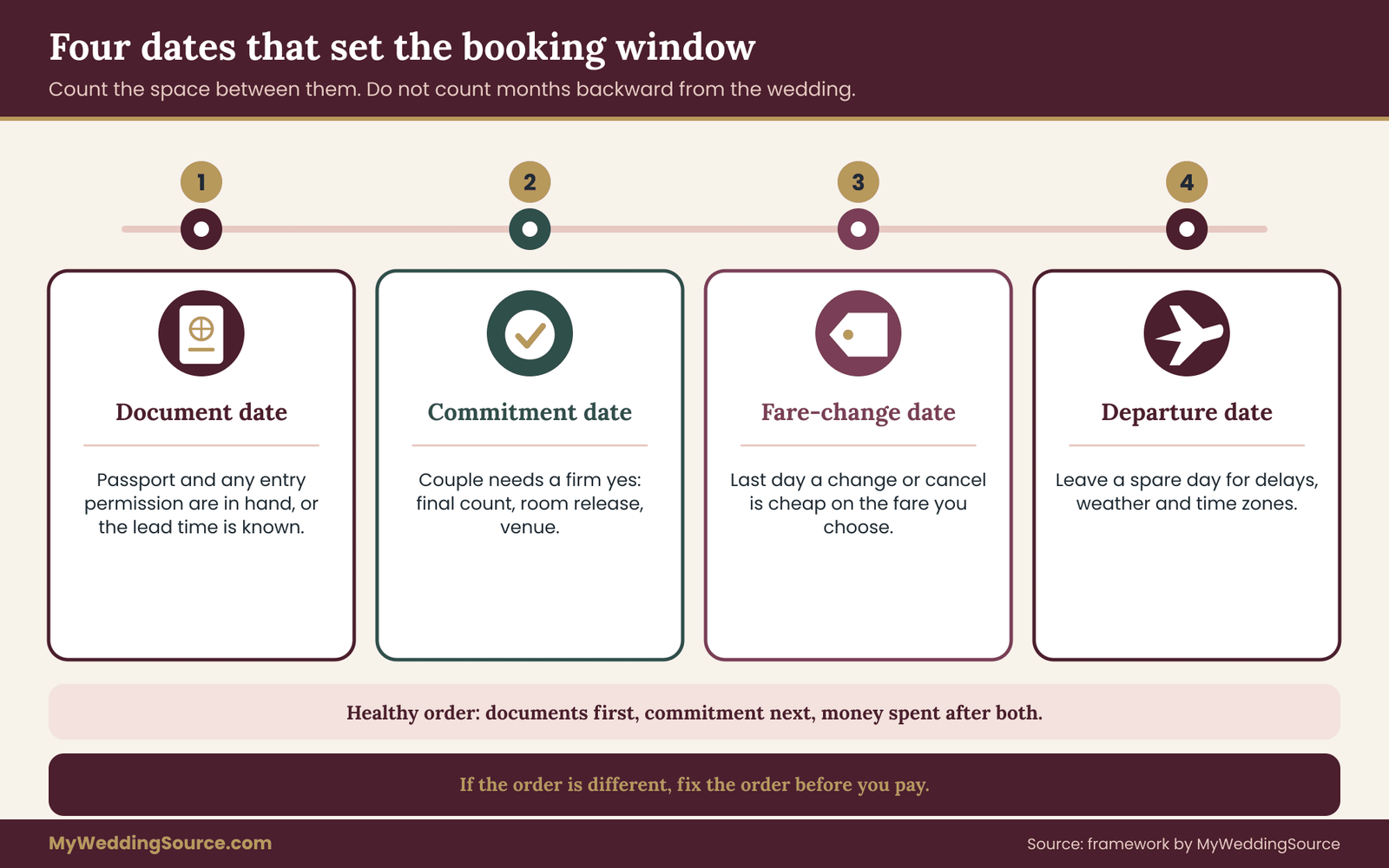
Most advice about booking starts from the wedding date and counts backward in months. That works for fare shoppers who only care about price. For overseas guest flights it hides the real constraints. A better method starts from four dates, and the booking window is whatever space is left between them.
Date one: the document date
This is the day the guest will have everything needed to board and enter: a passport valid for the period the destination requires, and any visa, electronic travel authorization or other permission. Passport rules differ by country, and some require validity for months beyond the planned departure. Processing times for passports and visas vary and change, so the document date is something the guest must check with the issuing authority, not estimate. Overseas guest flights should never be paid for ahead of this date unless the fare is refundable.
For travel to the United States, the Department of State publishes visa information and current visa appointment wait-time estimates by location, and U.S. Customs and Border Protection runs the electronic system for visitors from visa waiver countries. Neither guarantees an outcome, and a decision belongs to the authority. What the guest can do is find the real lead time and count it honestly.
The rule that follows is simple. If a document is not in hand, the guest should not pay for a nonrefundable ticket. They can still look at fares, set alerts, and use a free hold, but the money stays put until the document question is answered or the fare is flexible.
Date two: the commitment date
This is the day the couple needs a firm yes or no. It should come from the couple’s vendor contracts: the catering final count deadline, the venue’s attendance confirmation, and the date by which the hotel block releases unreserved rooms. The hotel block release date is often the earliest one, because rooms are released before the caterer asks for a count. Couples who share it early make overseas guest flights easier for everyone to time.
The commitment date is the couple’s date, but it shapes the guest’s. A guest who cannot commit by that date should tell the couple so, rather than letting a seat sit empty.
Date three: the fare-change date
Every fare has a point after which changing it costs more, and this date is different for every ticket. Some fares allow free changes. Some allow changes for a fee plus any fare difference. Some allow none. And the airline’s own schedule may shift, which sometimes opens a free change or a refund. The guest should read the fare rules before paying and write down the last day a change or cancellation is cheap. Knowing it turns overseas guest flights from a leap of faith into a priced choice.
This date is why the flexible-fare model works. It converts an abstract feeling of “I might not go” into a concrete cost: what is it worth to keep the ability to change until a later day?
Date four: the departure date
This is the day the guest actually leaves. Working back from it, two buffers matter. One is the check-in and arrival buffer, the days a guest wants before the wedding to settle in, adjust to time zones and handle a delayed flight without missing the ceremony. Couples can state the expected arrival day in the invitation details, and the guest decides how much cushion their own body and schedule need. Buffers around it protect overseas guest flights from the delays nobody schedules.
The other buffer is the weather and strike buffer for the season. A wedding in a stormy season or a peak holiday week has more risk of disruption than one in a quiet month, and an overseas guest should choose a departure day with at least one spare day in the schedule.
Putting the four dates on one line
Draw a line with four marks, in the order they usually fall: document date, commitment date, fare-change date, departure date. In a healthy plan the document date falls first, the commitment date falls next, and money is spent between the commitment date and the fare-change date. If the order is different, something needs fixing. Once the line is drawn, overseas guest flights have a visible window instead of a guess.
A few common patterns show how this works.
Documents are slow. The guest needs a visa appointment that has a long wait. The document date is far out, so the guest begins the document process the day the save-the-date arrives and holds off on the ticket. The overseas guest flights model still applies, but the guest buys a flexible fare or waits for the document before paying.
The couple’s commitment date is early. The hotel block releases rooms ten weeks out. The guest must therefore decide earlier than the airline requires. The guest can book the room with a free-cancellation rate and the flight later, or tell the couple clearly that the flight depends on a document.
The fare is only cheap early. The guest sees a good fare today but the document date is two months away. This is where the overseas guest flights model’s price comparison matters. A fare that is cheap and nonrefundable is not cheap if the document fails.
Why “the earlier the better” fails
Early booking has real benefits: more seats, more choice of times, and sometimes lower fares. But those benefits are never certain, and they come with a price in flexibility. A guest who books extremely early on a restrictive fare has locked in a cost long before the plan is stable. The overseas guest flights model treats the benefit of early booking as a number to weigh, not a rule to obey. For overseas guest flights, the cost of locking in early is paid in flexibility.
Why “wait for a sale” fails too
Waiting for a sale is a gamble with a deadline. If the wedding is in a peak week and the guest waits, the seats on the best flights may be gone. A guest who must be on a particular flight, for example to make the rehearsal dinner, should treat the schedule as the scarce resource, not the price. Overseas guest flights on a few daily departures do not forgive a long wait.
The honest summary on overseas guest flights is that nobody can tell a guest the cheapest day to buy. What the guest can know is the four dates and the cost of being wrong at each one.
The overseas guest flights scenario model, step by step
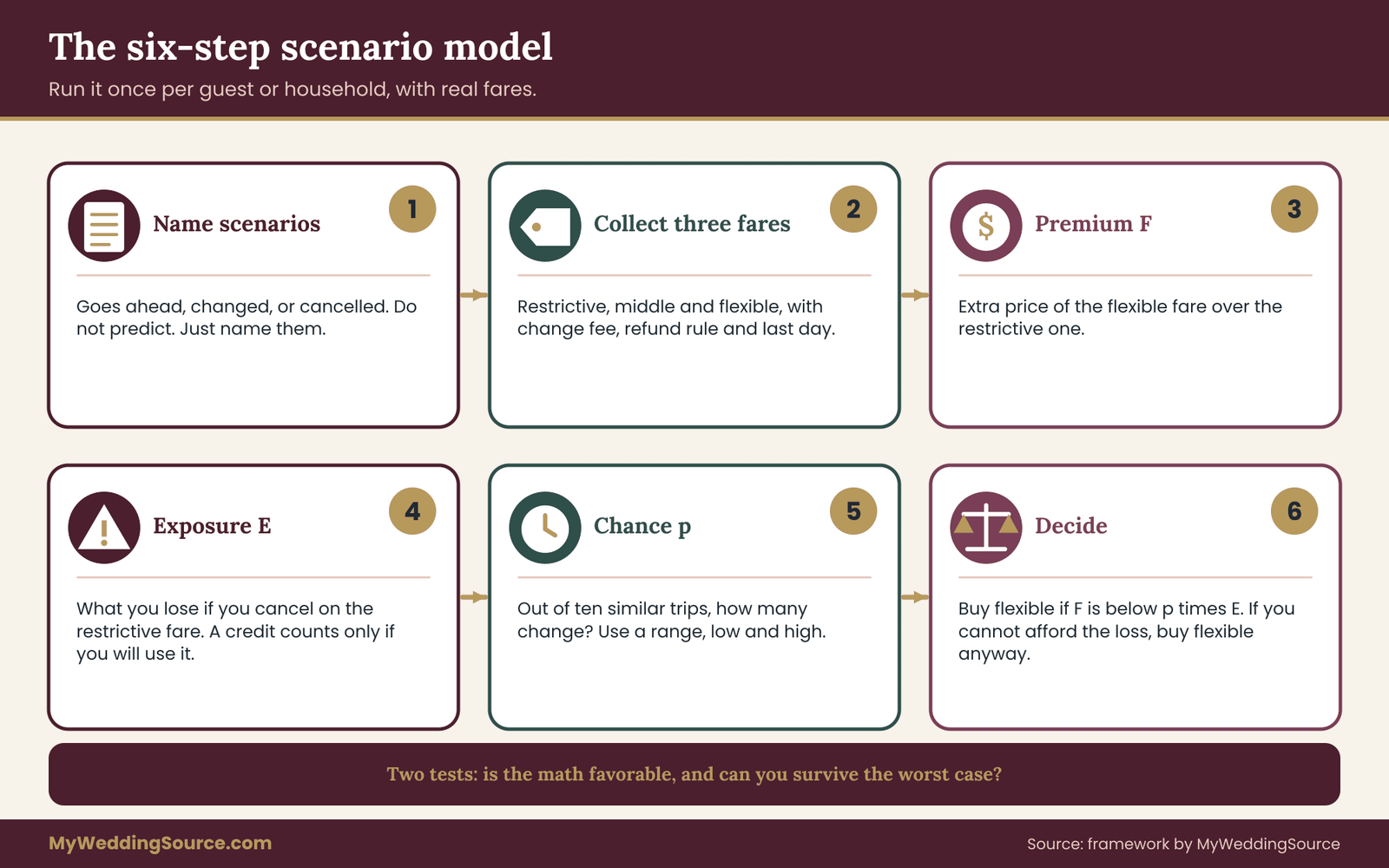
This is the original model for this guide. It has six steps, and each guest can complete it in about twenty minutes with real fares from an airline site or a booking tool. It uses a ratio, not a rule of thumb, because the right choice depends on each guest’s numbers.
Step one: name the scenarios
For each guest or traveling household, write down three outcomes. The first is “trip goes ahead as planned.” The second is “trip is changed,” such as a date shift of a few days, a different route, or one traveler dropping out. The third is “trip is cancelled,” for any reason, including documents, health, work, family or the wedding itself being moved. Each scenario changes how overseas guest flights should be bought.
Do not try to predict which one will happen. Just name them. Most guests find that writing the third scenario down is the step that makes the decision real.
Step two: collect three fares
For the same route and dates, collect up to three fares: a restrictive fare with no changes and no refund, a middle fare that allows changes for a fee, and a flexible fare that allows free changes or a refund. Many airlines publish these on one page. Write down the price, the change fee, the refund rule, and the last day each rule applies. Treat the three fares as three different products for overseas guest flights, not one product at three prices.
Use the full fare the guest would actually pay, including taxes, bag fees and seat selection if the guest needs them, because add-ons can change which fare is cheaper overall. Do not guess at amounts. If a number is missing, mark it as unknown and call the airline.
Step three: compute the flexibility premium
The flexibility premium, which this guide calls F, is the extra price of the flexible fare over the restrictive one, for the same trip. If the restrictive fare is the lowest and the flexible fare is the highest, F is the difference. Compute it for the middle fare too. Write it down for each guest, since overseas guest flights differ in price from one route to the next.
Step four: compute the exposure
The exposure, called E, is the money the guest would lose on the restrictive fare if the trip is cancelled at the fare-change date. If the airline would give a credit, the exposure is smaller than the full fare, because a credit has some value, but only if the guest can realistically use it before it expires. If the credit is likely to go unused, treat it as lost. Exposure is what makes overseas guest flights feel real before the money is spent.
Exposure is a worst case on purpose. The goal is not to predict what will happen, but to measure what could.
Step five: estimate the chance honestly
Now ask a plain question: out of ten similar trips in this guest’s life, how many would be changed or cancelled between today and the fare-change date? The answer, written as a fraction, is the guest’s honest estimate, called p. It is a personal number, not a statistic.
A healthy guest with flexible work and a passport in hand might say one in twenty. A guest waiting for a visa decision and caring for an elderly parent might say one in three. A calm, honest p is the most useful input to overseas guest flights decisions.
Do not invent precision. A range is fine. The overseas guest flights model works with a range by running it twice, once with the low end and once with the high end.
Step six: compare and decide
Compare F with p times E. If F is smaller than p times E, the flexible fare is worth its price, because the certain cost is less than the expected loss. If F is larger, the restrictive fare is the better bet, unless the guest cannot afford the loss at all, in which case flexibility is worth buying even when the math is close. This is the point where overseas guest flights stop being abstract.
That last clause is the second half of the overseas guest flights model. A guest on a tight budget cannot absorb a lost fare, so the question becomes “can I survive the worst case?” rather than “is the average case favorable?” The first test is arithmetic. The second test is about the guest’s life, and it overrides the first.
The decision grid in words
Put the two tests together and every guest lands in one of four places. If the numbers favor the flexible fare and the guest could not absorb the loss, buy flexible without hesitation. If the numbers favor the flexible fare but the guest could absorb the loss, buy flexible or a middle fare, depending on comfort.
If the numbers favor the restrictive fare and the loss is affordable, buy the restrictive fare once the document date has passed. If the numbers favor the restrictive fare but the loss would hurt, wait, use a hold, or choose the middle fare. Keep the grid nearby whenever overseas guest flights come up in family conversations.
The next section runs one guest through all six steps so the arithmetic is visible.
A worked case: one guest, three fare options
The following case is invented to show the arithmetic. The names are made up, and the amounts are not real fares. They are round numbers in an unnamed currency, called units, chosen only so the sums are easy to follow. Replace them with real quotes from an airline before you decide anything.
The situation
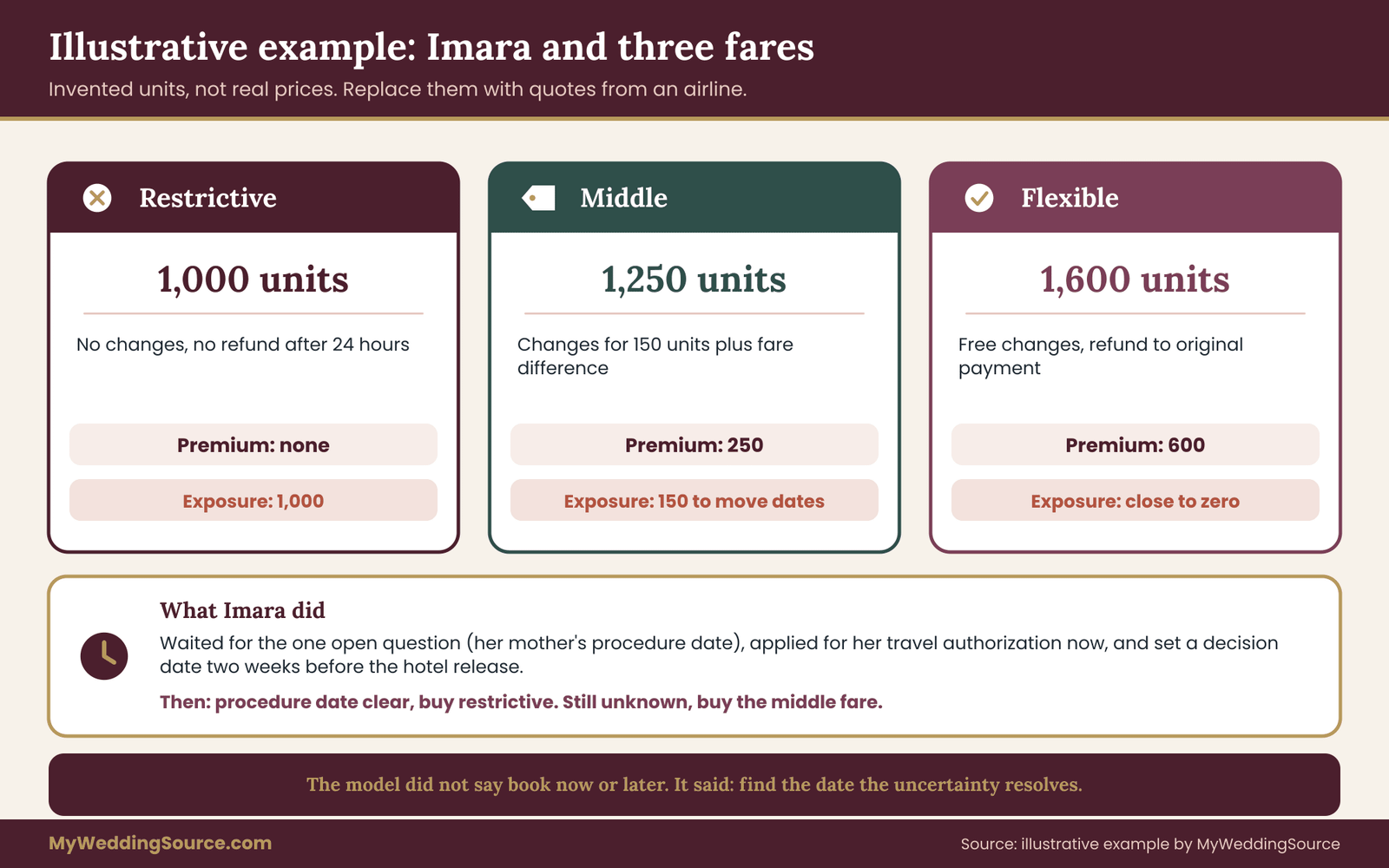
Imara lives overseas and has been invited to a wedding about seven months away. She is a citizen of a country whose travelers need an electronic travel authorization to enter the destination, and she has a passport with plenty of validity. She works for an employer who usually approves leave but has not yet signed off on this particular week. Her mother, who lives with her, has an upcoming medical procedure that has not been scheduled. This is a typical shape for overseas guest flights: one open document question and one open family question.
The couple has said the final guest count is due in four months. The hotel block releases unreserved rooms in three months.
The three fares Imara finds
For the same route and dates she finds a restrictive fare at 1,000 units with no changes and no refund after the 24-hour window, a middle fare at 1,250 units that allows changes for a fee of 150 units plus any fare difference, and a flexible fare at 1,600 units with free changes and a refund to the original payment up to a set day before departure. Those three fares are the raw material for overseas guest flights decisions of any size.
So the flexibility premium over the restrictive fare is 600 units for the flexible fare and 250 units for the middle fare.
Her exposure
If Imara cancels after the 24-hour window and the restrictive fare gives her nothing back, her exposure is 1,000 units. If the airline offered a credit, she would still need to use it before it expires, and she has no other planned trip on that airline, so she treats the credit as worth very little.
Exposure with the middle fare is the change fee, 150 units, if she merely moves the dates, or a larger loss if she cancels outright. Her exposure with the flexible fare is close to zero, assuming she reads the refund conditions and applies for the refund on time.
Her honest estimate
Imara asks herself how many of ten similar trips would be changed or cancelled before the fare-change date. Leave is likely to be approved, so that risk is small. The medical procedure is the real uncertainty, because the date is unknown. She decides her chance is somewhere between one in five and one in three. She uses both numbers.
The comparison
At one in five, the expected loss on the restrictive fare is 200 units. That is smaller than the 600-unit premium for the flexible fare, so the first test favors the restrictive fare. But the middle fare costs only 250 units more, and with a one-in-five chance of a date change costing 150 units, the expected cost is small.
At one in three, the expected loss on the restrictive fare is about 333 units, still below the 600-unit premium. So by arithmetic alone, Imara should take the restrictive fare.
Why the second test changes the answer
Now Imara runs the second test: can she survive the worst case? Losing 1,000 units would be a real hit to her budget, and she would resent the trip. That tips the choice. She also notices something the first test did not capture. The medical procedure is not a random event. It could land on the wedding week, and if it does, she would need to cancel, not just change.
So Imara picks neither extreme. She buys nothing today. She applies for the electronic travel authorization, because it is cheap and can be done now. She asks her mother’s doctor’s office when the procedure date will be known. She writes a decision date two weeks before the hotel block release. And she tells the couple she will confirm by that date.
On the decision date, two outcomes are possible. If the procedure date is clear of the wedding, she buys the restrictive fare, because the chance of a cancellation has dropped to a small number and the 600-unit premium is no longer worth it. If the date is still unknown, she buys the middle fare, because the 250-unit premium protects her from the worst case at a price she can accept.
What the example shows
Notice what happened. The overseas guest flights model did not say “book now” or “book later.” It said “find the date when the main uncertainty resolves, and buy after it unless the fare is likely to vanish.” It also said “if you must buy before then, buy the fare whose premium you can afford and whose worst case you can survive.” That habit is the practical core of buying overseas guest flights well.
That is the whole idea. The decision is tied to a resolving event, not a calendar month.
A second pass with a price drop
Suppose, between the first look and the decision date, the restrictive fare rises to 1,150 units and the middle fare rises to 1,400 units. The flexibility premium for the middle fare is still 250 units, but the absolute price has gone up. Imara has paid a cost for waiting, 150 units. Was waiting a mistake?
Not necessarily. The cost of waiting is the price change she actually saw. What she bought with that cost was information: she learned the procedure date and avoided a possible loss of 1,000 units. Whether that trade is good depends on the probability she assigned, and in a one-in-three case it was a reasonable trade. In a one-in-twenty case it may not have been. The overseas guest flights model teaches the guest to compare what waiting costs to what waiting protects against, rather than to regret the outcome.
What the couple does with this
The couple does not need Imara’s numbers. They need her decision date. If it falls before their own commitment date, they can plan around her yes. If it falls after, they can note her as “pending” and decide how many seats to hold. The wedding-side question is covered in the guides to cash-flow planning for deposits and balances and the wedding budget, since a firm headcount drives costs that the couple pays long before guests fly.
Booking rules by traveler type
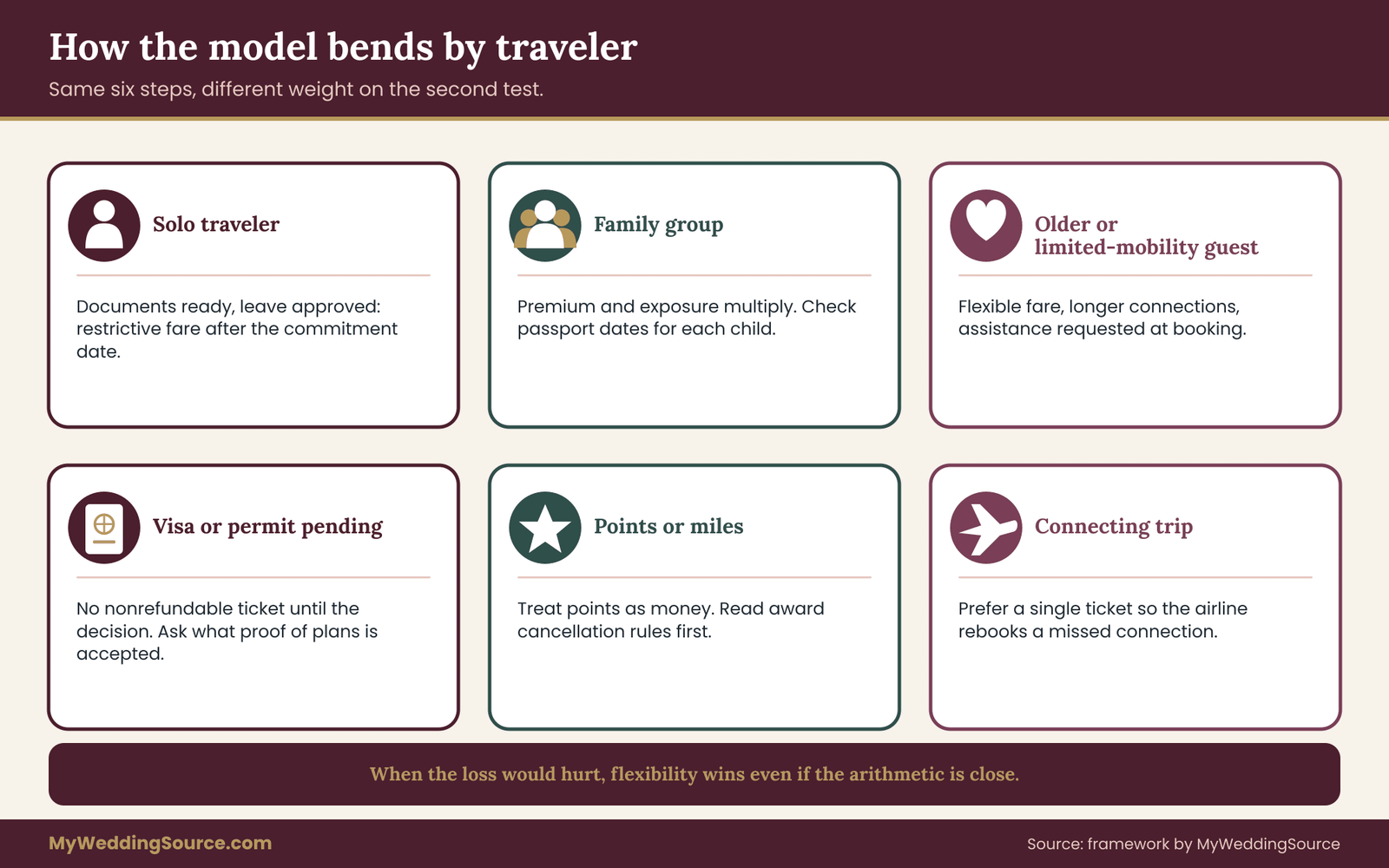
The scenario model is general, so it helps to see how it bends for common travelers. These are rules of thumb built from the overseas guest flights model, not guarantees, and each depends on real fares.
A single traveler with a firm schedule
A guest who travels alone, has leave approved, holds a valid passport and any needed authorization, and can absorb a loss, usually does best with a restrictive fare bought once the commitment date has passed. The premium for flexibility is smaller than the expected loss, and the savings are real.
The main caution is the schedule: a guest who must arrive on a specific day should check the number of daily flights and avoid a route with a single option. This is the easiest case for overseas guest flights, and the least likely to need insurance.
A family traveling together
A family multiplies every number. A flexibility premium of 250 units for one traveler is 1,000 units for four, and the exposure is multiplied by the same amount. But the chance of a change also rises, because any one member’s illness, exam, school date or document problem can derail the group. Family overseas guest flights are where a small premium per seat becomes a large number.
Families should check whether the airline lets them change one passenger without touching the rest, and whether the fare rules treat a booking as one unit. Splitting a booking into smaller reservations can help but may cost more. The overseas guest flights model still applies, with p set for the whole group.
Children add a document step that adults sometimes forget. A child’s passport may need to be renewed on a different schedule than an adult’s, and travel with only one parent can require a consent letter in some countries. Check each country’s current entry rules for minors and carry the paperwork.
An older guest or a guest with limited mobility
For a guest who needs assistance, the booking decision includes things the fare does not show: whether wheelchair assistance can be requested at booking, how long the connections are, and whether the seat map offers the right seats. A tight connection that a younger guest can sprint through can be unworkable for someone else. Overseas guest flights for these travelers should be judged on comfort and recoverability, not only on price.
For these guests, the overseas guest flights model’s second test usually dominates. The worst case is not only money but health and comfort, so a flexible fare and a longer connection are often the right choice even when the arithmetic is close. The site’s guides on wedding guest hotels across budgets and mobility needs cover the lodging side of the same need.
A guest waiting for a visa decision
Here the fare date and the document date are tied together. The guest should not buy a nonrefundable ticket until the decision is made. If the authority requires proof of travel plans as part of an application, check what kind of proof is accepted, because many authorities accept an itinerary or a refundable reservation instead of a paid ticket. Ask the authority and the airline, and do not assume. Overseas guest flights tied to a pending decision need the most patience.
A visa refusal is outside the guest’s control and outside the couple’s, and neither should treat it as a failure. The guest’s best protection is to apply early and buy flexible, and the couple’s best protection is to say plainly that a decision is out of everyone’s hands.
A guest using points or miles
Award tickets have their own rules. Some can be cancelled and the points redeposited for a fee or for free, and some cannot. The cost of an award ticket is partly points and partly cash for taxes, and the points have a value of their own. The overseas guest flights model works if the guest treats the points as money, but the airline’s award rules decide the exposure, so read them first. Points can make overseas guest flights cheaper in cash while still carrying rules that matter.
A guest connecting through several countries
A trip with one or more connections adds risk: a missed connection, a transit visa requirement, a second set of baggage rules. A single ticket protects the guest if the first leg runs late, because the airline is responsible for rebooking. Separate tickets do not, and the guest must buy a new ticket if they miss the second flight.
For overseas guest flights with a connection, a single ticket is almost always the safer choice, even when separate tickets look cheaper. The savings are small next to the loss from a missed connection on a wedding weekend.
Cancellation, refund and change rules to read before paying
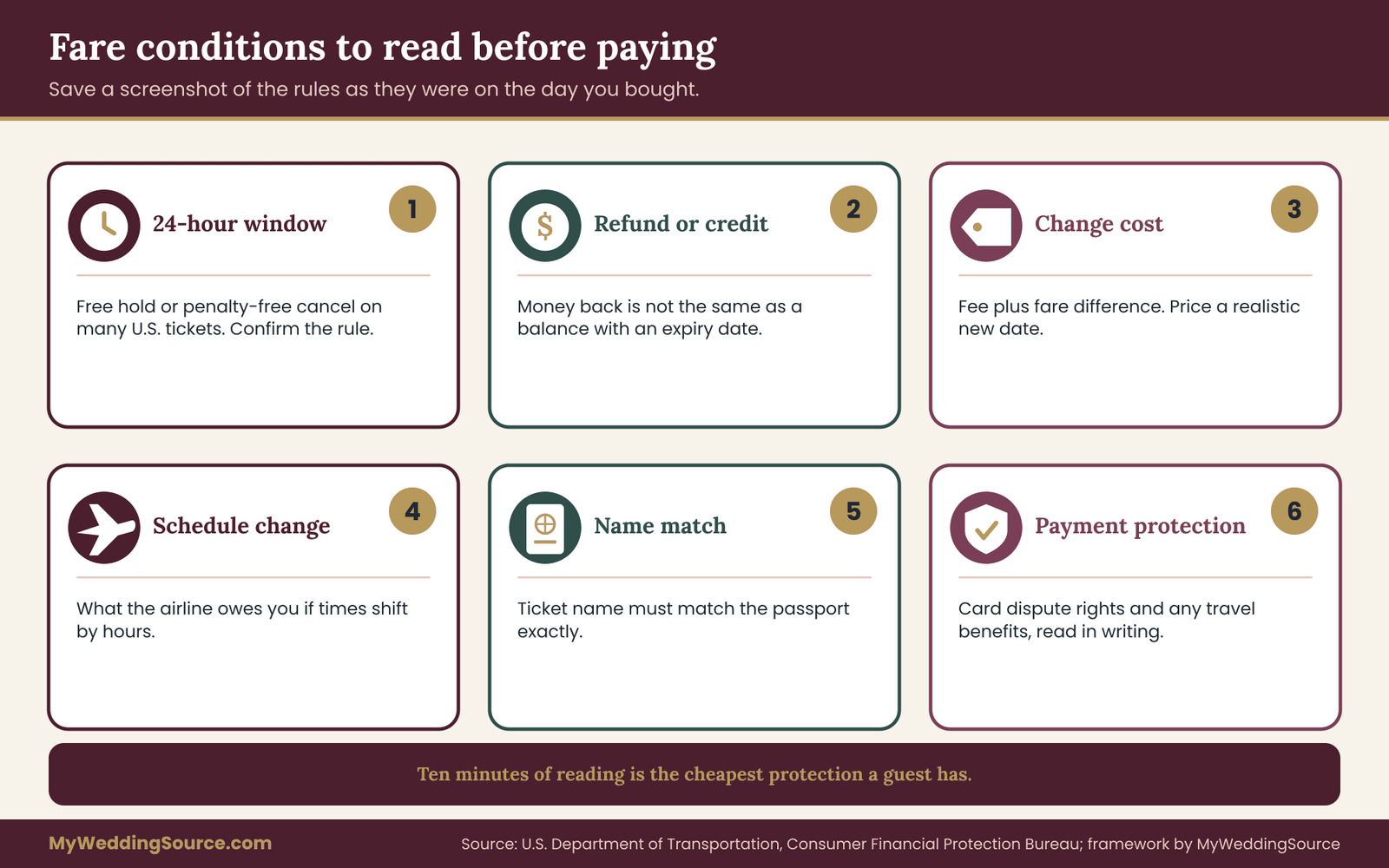
The overseas guest flights model depends on facts that only the airline can supply. Spending ten minutes on fare conditions before paying is the cheapest protection a guest has. The points below are the ones that most often change the answer.
The first twenty-four hours
For flights to and from the United States, Department of Transportation rules generally require airlines to let a customer cancel a booking without penalty within twenty-four hours of purchase, or to hold a fare for that long at no charge, when the booking is made at least a week before departure. Details such as which sellers are covered and how the rule treats different ticket types are published by the Department of Transportation, and other countries have different rules or none. Used well, it makes overseas guest flights safer to price and compare.
The practical value is large for the overseas guest flights model. A guest can buy a seat, confirm the fare conditions in writing, check the passport name against the ticket, and cancel within the window if something looks wrong. It is also a way to lock a fare while a family member confirms leave, as long as the guest sets a reminder so the window does not pass.
The window is not a way to hold a seat for weeks. It is a short safety valve, and the guest should treat it as one.
Refund versus credit
A refund returns money to the original form of payment. A credit is a balance with the airline, usually with an expiry date and conditions on who can use it and on which routes. The two are not equal, and the overseas guest flights model’s exposure number depends on which one the fare gives. Overseas guest flights bought with a credit in mind should be priced with a realistic view of the credit.
In the United States, the Department of Transportation says airlines must refund passengers when the airline cancels a flight, or significantly changes it, and the passenger chooses not to travel. That is a different situation from a passenger who cancels voluntarily, where the fare rules decide. Read the page for the current wording, including how “significant” change is defined, because the guest’s rights depend on it.
When the airline cancels or changes a flight, the guest should ask for the refund in writing if a refund is wanted, and keep the confirmation. Accepting a voucher can end the claim in some cases, so a guest who wants money back should not click through a rebooking prompt without reading it.
Change fees and fare difference
Even when a fare allows changes, the guest usually pays the difference between the old fare and the new fare for the new date. A change that moves the trip into a peak week can cost more than the change fee itself. The overseas guest flights model’s “trip is changed” scenario should therefore be priced with a realistic new fare, not with the fee alone. Check a few alternative dates on the airline’s site before deciding that a middle fare is protective enough.
The schedule change clause
Airlines can and do change schedules. A change of a few minutes is usually minor. A change of several hours, a change of route or a dropped connection is not. The ticket’s contract of carriage, available on the airline’s site, explains what the airline owes the guest in those cases. A guest on a flexible fare has more options, and a guest on a restrictive fare still has the rights the law gives.
For a wedding, the scenario to guard against is a schedule change that makes the guest miss the ceremony. A guest who learns of such a change should contact the airline promptly and ask for the earliest flight that works, and should tell the couple so they can adjust.
Name and passport match
The name on the ticket must match the name on the passport, and fixing a mismatch can cost money or be impossible after the 24-hour window, depending on the airline. A guest with several given names, a hyphenated surname or a recent name change should read the airline’s name-correction rules before buying. The same rule applies to couples: anyone changing a name around the wedding should book honeymoon flights in the name on the passport they will actually carry. Name errors are a small detail that can derail overseas guest flights on the day.
Payment method protections
How the guest pays can matter. Credit cards in the United States generally offer dispute rights for billing errors and for services not delivered, and some cards include travel protections as a feature. Terms vary a great deal. The Consumer Financial Protection Bureau explains how card disputes work, and the card issuer’s guide to benefits explains what the card actually covers. A guest should not assume a card’s travel coverage applies without reading it.
What to save
Whatever the guest chooses, they should save the fare rules as shown at the time of purchase (a screenshot is fine), the confirmation email, the receipt, the passport name used, and the date and time of purchase. If the airline later disputes something, those records settle it.
When the overseas guest flights model fails
A model that works only in good conditions is not worth having. Here are the conditions under which this one gives bad advice, and what to do instead.
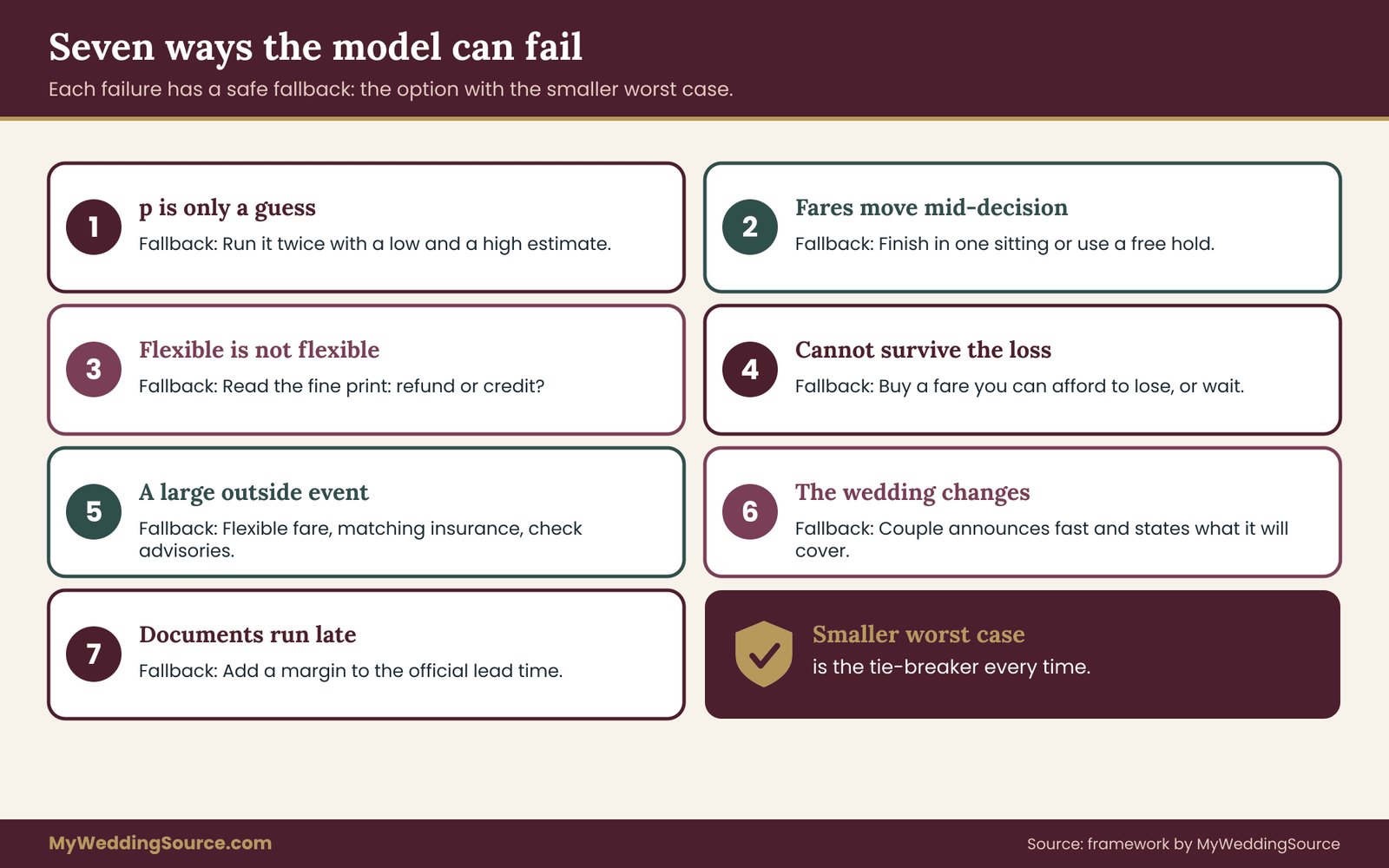
The probability is a guess
The whole model depends on p, which is a guess. A guest who is overly optimistic will underbuy flexibility, and a guest who is overly cautious will overpay. The remedy is the range: run the overseas guest flights model twice, and if the answer changes between the low and high estimates, take that as a signal that the decision is close and choose the option with the smaller worst case. Overseas guest flights decisions are safest when p is a range.
The fare changes between steps
Fares move while the guest decides. The overseas guest flights model compares fares at one moment, and a guest who takes a week to decide may be comparing stale numbers. Complete the six steps in one sitting, and if the guest needs time, use a free hold or the twenty-four-hour window to lock the fare while checking the last facts.
The flexible fare is not really flexible
Some fares called flexible have conditions: a deadline for changes, a fee that applies to certain routes, a refund that goes to a credit rather than to the original form of payment. The overseas guest flights model treats a flexible fare as exposure near zero, and if the fine print says otherwise, the exposure is higher. This is why the fare conditions are step two in the overseas guest flights model and not an afterthought.
The guest cannot stay solvent through the worst case
If the guest cannot afford the exposure at all, the arithmetic is irrelevant. The right answer is to buy a fare the guest can afford to lose, or not to book until the guest is confident, or to discuss with the couple whether travel assistance is possible. A couple who wants to help can ask what would be useful, and should never press a guest for financial details.
A systemic event
Some events are bigger than any individual choice: a strike, a storm system, an airspace closure, a public health measure, a sudden change in entry rules. The overseas guest flights model cannot price them. For these, the guest’s best tools are a flexible fare, travel insurance whose terms cover the cause, and an early check of official travel advisories. The Department of State publishes travel advisories by country, and a guest should read the one for the destination and for any transit country close to departure.
The wedding itself changes
The couple may move the date, change the venue or cancel. This is the scenario guests worry about most and the one nobody controls. Couples can reduce harm by announcing changes immediately, using the same channel they used for the invitation, and by being clear about whether they will help with costs. The site’s guide to choosing a wedding date around guest availability and travel disruptions explains how to reduce the chance of a date change in the first place.
The guest misreads the document timeline
A guest who underestimates how long a passport or visa takes can end up with a nonrefundable ticket and no document. The fix is to read the issuing authority’s current processing information and to add a margin. If the margin is thin, the guest should buy flexible or wait.
Summary of failure conditions
The overseas guest flights model fails when p is a guess and the guest does not use a range, when the fare moves during the decision, when the flexible fare has hidden conditions, when the guest cannot survive the loss, when a large event hits, when the wedding changes, or when a document takes longer than expected. In each case, the safe move is the option with the smaller worst case.
Alternatives to a flexible fare for overseas guest flights
A flexible fare is one way to buy protection. It is not the only way, and for some guests it is not the best way. Here are the main alternatives, with the trade-offs in plain terms.
Travel insurance
Trip cancellation insurance can reimburse nonrefundable costs if the trip is cancelled for a reason the policy covers. The list of covered reasons varies by policy, and it usually excludes things the buyer could have foreseen when buying. A guest who is already waiting on a medical procedure may find that the procedure is excluded as a pre-existing condition unless the policy says otherwise and was bought within a set window after the first trip payment. Insurance is a real option for overseas guest flights, but only for the reasons it covers.
Some policies offer “cancel for any reason” coverage, which usually reimburses only part of the cost, must be bought early, and costs more. The honest advice is to read the policy’s covered reasons and exclusions line by line, compare the premium to the flexibility premium, and remember that an insurer pays only for covered reasons.
A one-way or split-booking approach
Some guests buy the outbound flight first and the return later, or the reverse. This can cut risk, because the guest commits less money at once, but it can raise the total and, for entry rules, some countries ask for proof of onward travel. Read the entry rules before splitting a trip.
Points, miles and vouchers
A guest with a points balance can use it as a low-cost way to hold a seat, if the award rules allow free or cheap cancellation. This turns real money into points at risk, which can be easier to absorb. The guest should check how long redeposited points stay valid.
Waiting with alerts
A guest who is not ready to buy can still watch fares. Price alerts from an airline or booking site tell the guest when a fare moves, and a written target price gives the guest a trigger. The danger is falling in love with an old low price and ignoring the fact that the document date has not passed. Alerts are a patient way to watch overseas guest flights without paying early.
Booking later than the guest wants
Sometimes the right answer is to book later and accept the risk of a higher fare. If the guest’s main uncertainty will resolve in four weeks, waiting four weeks costs only the possible price change, and the price may even drop. This is the same logic as Imara’s case, and it works when the price risk is small relative to the exposure.
Letting the couple help
Some couples choose to help guests with the cost of travel, through a fund, a shared booking or a direct gift. If so, the couple should decide the rules before anyone buys: how much, for whom, in what form, and what happens if a trip is cancelled. A written note prevents misunderstandings, and the couple should keep the amount private.
Choosing not to travel
The last alternative is the most overlooked. A guest who cannot manage the cost, the time or the risk can decline with grace and send a gift, a message or a video. A good couple will want the guest to make the choice that works for their life, and a clear early no is kinder to everyone than a late cancellation.
What to tell guests about overseas guest flights, and when
Guests cannot follow a model nobody has explained to them. The couple’s job with overseas guest flights is not to tell people when to buy. It is to give them the dates and facts the overseas guest flights model needs, in a way that feels like hospitality and not like homework.
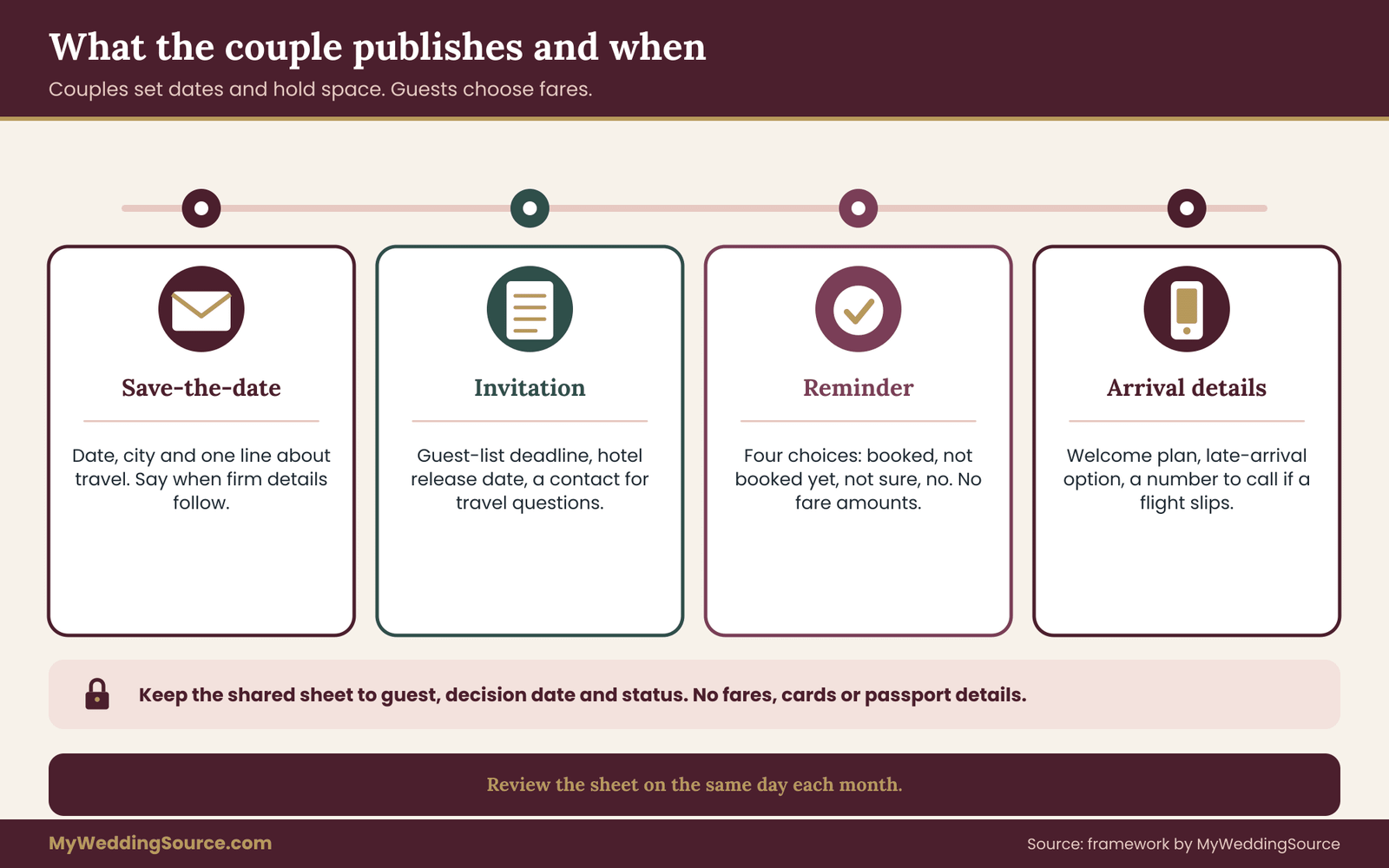
The save-the-date stage
The first message should carry the date, the city and a plain line about travel. Something like: “We know many of you are traveling a long way. We will send a firm guest-list date, a hotel link and arrival details by a stated month, and we suggest not paying for nonrefundable flights before then unless you are comfortable with the risk.” Early, specific information makes overseas guest flights easier for guests to time.
That one sentence does three jobs. It signals that the date is firm, it gives guests a reason to wait for specific information, and it removes the pressure to buy right now. Couples worry that this will cause guests to delay, and some will. But a guest who delays with a clear date in mind is better than a guest who buys early on a hunch and has to change.
If the wedding is during a holiday week or a peak season, the couple can add a line that seats on some routes sell out, and that guests who are certain they will attend may want to look at fares sooner, using a flexible option.
The invitation stage
The invitation should repeat the guest-list deadline, state the hotel block release date and give a contact for travel questions. The couple should avoid recommending specific flights, since the couple does not know each guest’s airport, budget or points balance. A short link to an official entry-requirements page for the destination is more useful than a list of flight tips.
Guests who need an invitation letter for a visa application should be able to request one easily. The couple can offer to write one with names, dates and the event’s address, and should state that it does not promise any outcome. The authority decides.
The follow-up stage
A few weeks before the deadline, send a brief reminder with a tick-box response: yes with flights booked, yes with flights not yet booked, not sure yet, and no. The second and third choices are the useful ones. They let the couple see who is waiting on a document or a fare and decide whether to offer help.
Do not ask for fare amounts or booking details beyond the arrival date and the airport. A guest who feels monitored is a guest who answers less honestly.
Scripts for common moments
Here are short messages for common situations. Adapt the tone to your own voice.
A guest asks, “Should I book now?” A good reply: “If your documents are ready and your leave is approved, booking now is fine, especially on a fare you can change. If anything is still open, wait for that to settle first. Our guest list is final on the date in the invitation, so you will not lose your place by taking a little time.”
A guest asks the couple to choose a flight. A good reply: “We cannot see your fares or your schedule, so we would only be guessing. Aim to arrive at least a day before the ceremony, and tell us the day and airport so we can plan the welcome.”
A guest says they are waiting for a visa decision. A good reply: “Thank you for telling us. We will keep your place until the date in the invitation. If it helps, we can send an invitation letter. Please buy a flexible fare or wait for the decision, because the outcome is outside both our hands.”
A guest has bought a nonrefundable fare and now has a problem. A good reply: “We are sorry. Thank you for telling us early. Please check the airline’s change rules and any insurance you bought, and tell us what you decide. We would rather see you than have you lose money.”
What not to say
Avoid saying that a guest “should have” bought a flexible fare, that fares are “always cheaper early,” or that the couple will “make it right” without a figure. Avoid comparing one guest’s choice to another’s. Avoid group messages that list who has and has not booked.
Coordinating with the hotel block
The hotel block and the flights are tied, and a guest who books a flight but not a room, or the reverse, can end up with a gap. The hotel guide on coordinating wedding guest hotels shows how blocks, release dates and cancellation rules work, and a guest who understands the release date knows the last day to confirm a room tied to a flight.
A helpful practice is to set the hotel release date after the guest-list deadline and to choose a cancellation-friendly rate, so a guest can reserve a room before the flight is settled and drop it without cost if plans change.
A tracking sheet turns the overseas guest flights model from a private exercise into a calm group process, without exposing anyone’s money. It needs only a few columns, and it should be maintained by one person.
The columns worth keeping
Keep the guest or household name, the number of travelers, the home airport region, the decision date, the status (not decided, document pending, flexible fare booked, restrictive fare booked, not coming), the planned arrival day, the planned departure day and a free-text note. Do not record fares, card details or passport numbers. Keeping the sheet short makes overseas guest flights easy to review.
The decision date is the most valuable column. It tells the couple when each uncertainty is expected to resolve and lets them plan their own commitments around real dates.
How to use the status column
“Document pending” is not a problem. It is information. If five guests share it, the couple knows that a visa-processing delay could change the headcount, and they can decide whether to hold extra seats with the caterer or ask for a final count a little later.
“Flexible fare booked” tells the couple that this guest has protected themselves. “Restrictive fare booked” tells them the guest is committed, and a change would hurt more, so the couple should avoid announcing changes casually.
A monthly rhythm
Review the sheet at the same time each month. Four months out, send a reminder to guests whose status is “not decided.” Three months out, check on the “document pending” guests and offer an invitation letter if it has not been requested. Two months out, confirm arrival days so that the welcome desk, transport and hotel check-in can be planned. One month out, send arrival details and a short note on what to do if a flight is delayed.
The broader timeline guides place those steps within the rest of the work, so the guest flight reviews do not take over the calendar.
Privacy and kindness
Share the sheet only with the people who need it, such as the couple, a planner and a parent who handles welcome logistics. Do not share it with the full guest list. A line in the invitation that says “we will keep your travel details private and use them only to plan arrivals” is a good habit.
Handling changes after overseas guests have booked
Booking is not the end of the story. Between the purchase and the wedding, things change: schedules shift, guests fall ill, entry rules tighten, and sometimes the couple moves a date. A short playbook, agreed before it is needed, keeps small problems small.
When the airline changes the schedule
The guest is the first to hear, usually through an email or app notice. The guest should read it carefully, check whether the new times still work, and contact the airline if they do not. The couple can help by making the welcome plan flexible, with a late-arrival option such as a self check-in instruction, a front-desk note or a text number to call. Schedule changes are the most common surprise for overseas guest flights.
The couple should not tell a guest to accept a bad schedule. A guest who lands after the ceremony because of a rebooked connection has lost the main reason for the trip, and the right move is to ask the airline for an earlier option or a refund if the rules allow it.
When a guest has to cancel
The kindest and most useful thing a couple can do is make cancellation easy to announce. A guest who knows the couple will not be upset is more likely to say so early, when the couple can still adjust a headcount, release a hotel room or fill a seat. A short reply works: “Thank you for telling us. We will miss you and we would love to celebrate with you another time.”
Do not ask why. If the guest wishes to share, they will. If they ask about reimbursement, the couple should answer honestly based on what was agreed, never promising something they did not plan to pay.
When the couple changes the date or place
This is the case that costs guests the most, so it deserves the most care. The couple should announce the change quickly to everyone through the same channel they used for the invitation, state the new date and place, and say plainly what they will and will not cover. Guests who bought flexible fares can usually move, and guests who bought restrictive fares may lose money.
If the couple wants to help, they can decide on a simple rule, such as paying a change fee up to a stated amount or reimbursing a documented change cost, and state it to everyone at once so no guest feels singled out. The couple’s cash-flow plan should include a small reserve line for this sort of event, since goodwill has a cost and it is better to decide it in advance.
When an entry rule changes
Entry rules can change between the invitation and the flight. Authorization systems can alter their fees, forms or eligibility, and countries can adjust passport validity requirements. A guest should check the official source again about a month before departure, and again a week before, because rules can shift. The couple cannot track every country’s rules and should not try. A short sentence about overseas guest flights in the final guest message that says “please confirm entry requirements on the official government site before you fly” is enough.
When a guest is stuck at an airport
A delayed or cancelled flight on the wedding weekend is stressful. The guest should speak with the airline’s staff or app first, ask for rebooking on the earliest workable flight, and keep receipts for meals and lodging in case the airline’s rules cover them. The couple should have a contact number and a plan for what happens if a guest misses the ceremony, such as offering to share video, to hold a small welcome gathering the next day or to arrange a transfer at an odd hour.
This is where the arrival buffer pays off. A guest who landed two days early can absorb a delay of a day without missing anything.
When the couple wants to support the cost
Support can be a gift, a shared fund, or help for a particular group such as an older relative. The respectful approach is to offer privately, state clearly what the offer is, and let the guest accept or decline. The couple should decide in advance how to handle a ticket that is later cancelled. A written note stating “this is a gift toward travel, and no repayment is needed if plans change” avoids confusion, if that is the couple’s intention.
A couple-side worked case
Here is another invented case, this time from the couple’s side, with made-up numbers used only to show the process.
Dana and Eli are marrying in a city that most of their families can reach only by long-haul flight. They have forty-two overseas guests on the invitation list. They send save-the-dates seven months out with a guest-list deadline four months out, and a hotel release date three months out.
On the sheet, thirty guests mark “yes, flexible fare booked or planned,” six mark “document pending,” four mark “not decided” and two mark “no.” The couple counts the two “no” guests as out and plans for the thirty. For the six pending guests, they decide to hold six places with the caterer until the final-count date and to ask those guests to confirm as soon as a document decision arrives. For the four undecided guests, they send a gentle reminder.
At the hotel release date, two of the document-pending guests receive good news and book. Two more are still waiting. The couple, who earlier asked the hotel for a cancellation-friendly rate, keeps rooms for both through the release date and then releases them. One of the two later confirms and books a different hotel, and the other cannot attend. The couple’s final count is accurate, nobody’s money was exposed beyond their choice, and the couple spent about an hour per month on the sheet.
The lesson is that the couple’s role is not to optimize anyone’s fare. It is to set dates, hold space for the uncertain, and avoid surprises.
The one-page version of the framework
For a guest, the framework is: write the four dates, collect three fares, compute the premium and exposure, estimate the chance as a range, run both tests, and buy only when the documents and the fare conditions are clear. For a couple, the framework is: publish firm dates, keep a status sheet without prices, hold space for pending guests until the commitment date, and answer changes quickly and kindly.
How much earlier is “early enough”
Readers who want a month count anyway deserve a straight answer. The overseas guest flights model usually produces a window, not a point. Guests with documents in hand and a firm wedding date can often act once the couple has published the venue and date, and a guest who cares most about preferred flights or who is traveling in a peak week has a reason to act sooner, ideally on a flexible fare. A guest with open uncertainties should wait for the uncertainty to resolve, or protect themselves with a flexible fare.
If you need a rough starting rule, use this: do not pay for a nonrefundable ticket before the document date has passed and the couple’s commitment date is firm, and do not wait past the point where the schedule you need is likely to sell out on your route. Only the airline’s own seat map and fare calendar can tell you that second point, and nobody can promise it from outside.
What the couple can do to widen the window
The couple widens the window by announcing the date early, by choosing a date away from major holidays when they can, and by keeping the guest-list deadline and the hotel release date after the guests’ likely document dates. The site’s guide to choosing a wedding date around guest availability and travel disruptions explains how date choice interacts with guest travel. Those choices cost the couple nothing, and they give overseas guests the space to buy sensibly.
Your next steps
If you are a guest, do three things this week. Write the four dates for your own trip: document date, the couple’s commitment date, the fare-change date for the fares you are looking at, and your departure date. Then collect up to three fares for the same route and read their change and refund rules in full. Finally, set a decision date and tell the couple what it is.
If you are a couple, do three different things. Fix your guest-list deadline and hotel release date, and make sure the deadline comes after the time guests need for documents. Put one clear travel sentence in your save-the-date. Then create the status sheet with no fares on it, and review it on the same day each month.
Either way, resist the urge to turn the choice into a contest. Overseas guest flights are expensive and personal, and the best result is a guest who arrives rested, on a fare they chose with open eyes, to a couple who knew the headcount in time.
FAQ
How early should overseas wedding guests book their flights?
There is no single lead time that fits every route. A sound rule is to buy after three things are settled: the wedding date and venue are firm, the guest holds the passport and any entry permission needed, and a flexible fare or free hold covers any remaining doubt. Guests flying in a peak season or needing one particular flight should lean earlier, on a changeable fare.
Is it better to book a flexible fare or a cheaper nonrefundable one?
Compare the flexibility premium with the money you would lose if the trip fell through, weighted by your honest chance of a change. If the premium is smaller, buy flexibility. If it is larger and you can afford the loss, the cheaper fare is reasonable. If you could not absorb the loss at all, buy flexibility even when the arithmetic is close.
Should guests wait for the couple to say when to book?
The couple should publish the guest-list deadline and hotel release date, and guests should choose their own decision date around those. Waiting for a signal that nobody plans to send helps no one. A guest with documents in hand and leave approved can book once the date and place are firm, and a guest with open questions can wait for them to resolve.
What if the guest is still waiting for a visa or travel authorization?
Do not pay for a nonrefundable ticket until the decision arrives. Ask the issuing authority and the airline what proof of travel plans is accepted, since many authorities do not require a paid ticket. A visa decision belongs to the authority, so neither the guest nor the couple should treat a refusal as a failure. Buy a flexible fare if you must commit sooner.
Does the 24-hour cancellation rule let guests hold a fare for free?
For many tickets to and from the United States, bought directly and at least a week before departure, Department of Transportation rules require a free hold or a penalty-free cancellation for a day. It is a short safety valve, not a way to reserve a seat for weeks. Other countries differ, so confirm the rule on the airline’s page and the department’s consumer site.
Can the couple pay for or help with guests’ flights?
Yes, but decide the rules before anyone buys: how much, for whom, in what form, and what happens if the trip is cancelled. Offer help privately and in writing so there is no confusion, and never ask guests to disclose finances. A written line that a contribution is a gift needing no repayment if plans change prevents awkwardness, if that is your intention.
Is travel insurance a substitute for a flexible fare?
Sometimes, but not always. Trip cancellation insurance pays only for reasons the policy lists, and it often excludes events you could foresee when buying, including some medical situations. Read the covered reasons and exclusions, compare the premium to the flexibility premium, and check any purchase-window requirements. Insurance may suit one guest and a flexible fare another.
What should a couple do if they must move the wedding date after guests have booked?
Announce it at once, through the same channel as the invitation, with the new details and a clear statement of what you will and will not cover. Guests with flexible fares can usually move, while those with restrictive fares may lose money. If you want to help, set one simple rule and tell everyone together so no one feels singled out.
Sources
- Fly Rights, U.S. Department of Transportation
- Aviation consumer protection and refunds, U.S. Department of Transportation
- Passports and international travel, U.S. Department of State
- Travel advisories, U.S. Department of State
- U.S. visas, U.S. Department of State
- Global visa wait times, U.S. Department of State
- Visa Waiver Program, U.S. Department of State
- Electronic System for Travel Authorization, U.S. Customs and Border Protection
- Travel, U.S. Customs and Border Protection
- How do I dispute a charge on my credit card bill?, Consumer Financial Protection Bureau