
A couple plans every visible detail of their wedding day with real care. The flowers, the vows, the seating chart, the first dance. Then, three days before the ceremony, someone asks a question nobody had thought to research. Who is actually going to sign the marriage license, and does that person meet their state’s legal requirements? In a surprising number of weddings, this question gets answered in a genuine scramble. Sometimes it involves a photographer, a hotel concierge, or a stranger pulled in from a nearby table.
This happens because wedding witness requirements sit in a genuine blind spot of wedding planning. They’re not glamorous enough to appear in most planning checklists. Yet they’re one of the few details that can actually affect whether a marriage is properly documented under the law. The requirements themselves vary dramatically by state. Zero witnesses are required in places like Texas and Pennsylvania. Two are mandatory in states like Arizona and New York. Almost no couple realizes this variation exists until they’re already deep into planning a ceremony in a specific location.
This guide covers wedding witnesses completely. The actual legal requirements by state. Who genuinely can and cannot serve in this role. How to choose someone thoughtfully, and what a witness is actually responsible for before, during, and after the ceremony. And the specific situations, elopements, destination weddings, religious ceremonies, virtual attendance, that change the standard picture. Every section is built to answer the real question couples eventually ask, sometimes at the worst possible moment. Does this actually matter? If so, what do we need to do about it?
Quick Answer: What Nobody Tells You About Wedding Witnesses
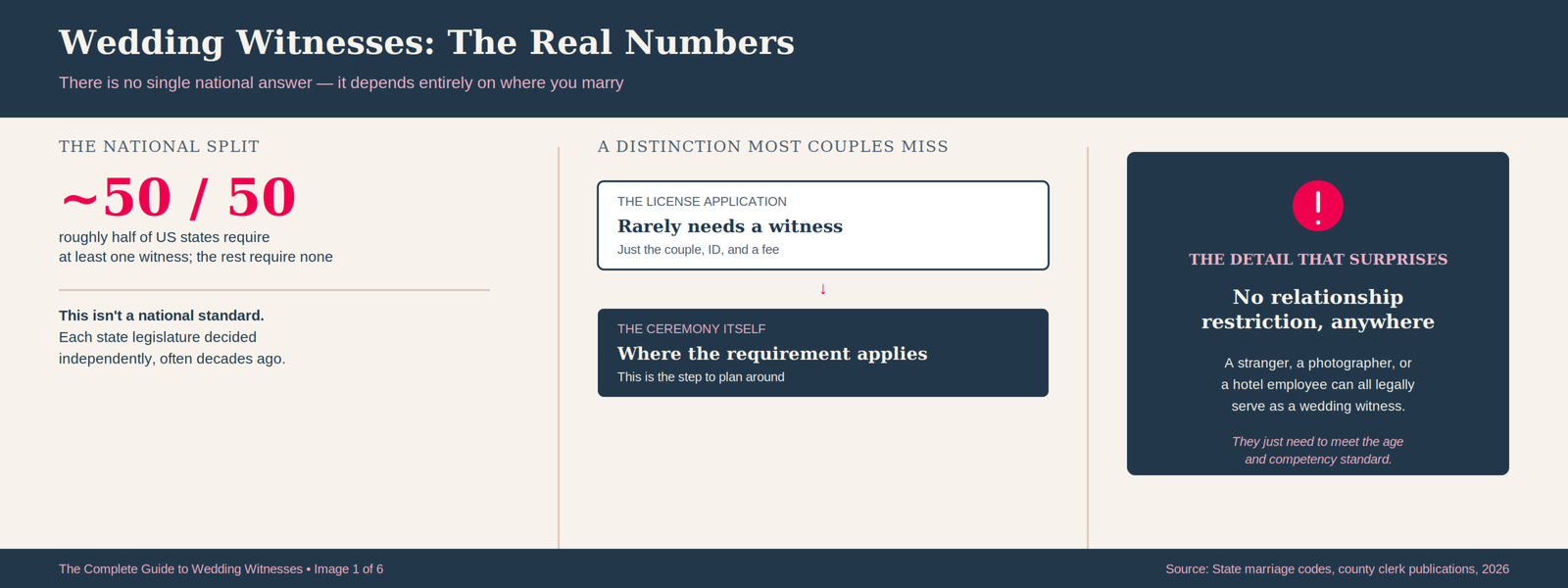
Whether you need a witness at all depends entirely on where you’re getting married, not on any national standard. As of 2026, roughly half of US states require at least one witness to sign the marriage license, with most of those requiring two. The rest require none at all. The requirement, when it exists, almost always applies to the actual ceremony rather than the earlier step of applying for the license itself. This is a distinction that trips up a genuine number of couples who assume the two processes work identically.
The detail most couples miss isn’t which states require witnesses. It’s that almost no state restricts who can serve as one. A witness doesn’t need to know you, approve of your relationship, or share your last name. In several documented cases, couples have used a photographer, a hotel employee, or a complete stranger standing nearby, and the marriage was perfectly legal.
Everything below unpacks the real state-by-state requirements, and exactly who is eligible to serve. It covers how to choose and prepare your witnesses thoughtfully, and what to do in every genuine edge case this role can create.
Do You Need a Witness? The State-by-State Reality
There is no single American answer to whether a wedding needs a witness. This genuinely surprises couples who assume marriage law works the same way nationwide. The United States handles marriage licensing at the state level. Each state legislature has independently decided, often decades ago and rarely revisited since, whether a witness is a legal necessity for a marriage to be valid. The result is a patchwork. It ranges from states requiring two witnesses with specific age and identification rules. On the other end, some states require none at all, and even permit a couple to marry without any officiant present. Understanding which category your specific state falls into is the single most important piece of practical information in this entire guide. It determines nearly every other planning decision that follows.
States That Require Two Witnesses
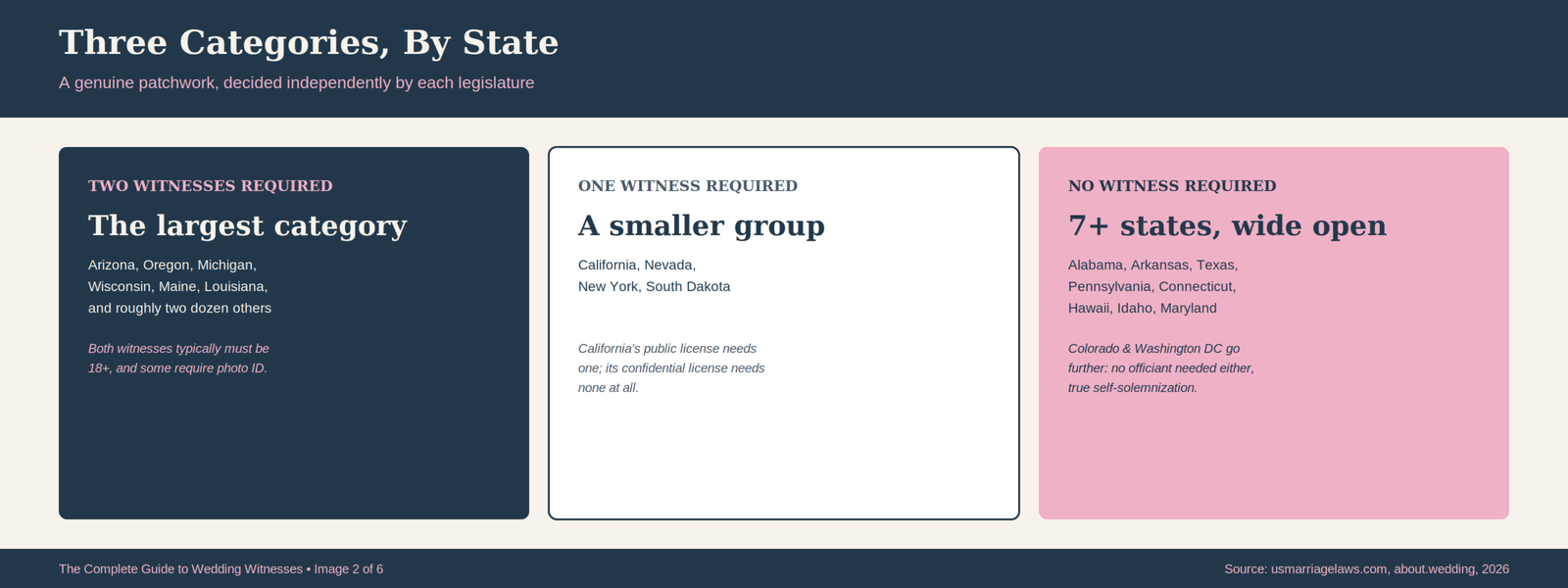
The largest single category among US states requires two witnesses to sign the marriage license. This group includes a genuinely long list of states spanning every region of the country. Arizona, Delaware, Iowa, Kansas, Kentucky, Louisiana, Maine, Michigan, Minnesota, Missouri, Nebraska, New Jersey, New Mexico, North Carolina, North Dakota, Oklahoma, Oregon, Rhode Island, Utah, Washington, Wisconsin, and Wyoming all fall into this group as of current 2026 marriage law. In nearly every one of these states, both witnesses must be at least 18 years old. Several jurisdictions specifically require the witnesses to present photo identification showing their date of birth before the license will be accepted as properly executed. This isn’t a symbolic formality. Clerks’ offices in these states have genuinely rejected licenses where a witness’s age or identity couldn’t be confirmed. This creates real delays for couples who hadn’t planned around this requirement.
The Age and Identification Rules
Within the two-witness states, the identification requirement deserves specific attention. It catches couples off guard more often than the witness count itself. A witness who forgets a driver’s license or passport on the actual wedding day can genuinely become ineligible in the moment. This holds true regardless of how well they otherwise qualify. Some county clerk offices are lenient about this in practice, accepting a witness’s word alongside secondary identification. Others hold firmly to the documented rule and will not process the license without it. This varies so significantly even within a single state, from county to county. The only reliable approach is confirming directly with the specific office issuing your license, not relying on a general sense of what the state requires.
Common States in This Category
Beyond the specific list above, it’s worth understanding why this category is so large. Many of these states adopted their marriage codes in earlier eras when a documented, witnessed public event was considered the primary safeguard against fraudulent or coerced marriages. That historical logic still shapes the letter of the law today. Enforcement in practice tends to be routine and unremarkable for the overwhelming majority of couples who simply bring two adult witnesses and complete the paperwork without incident. If your wedding is taking place in any of these states, the practical task is straightforward. Identify two people who meet the age requirement. Confirm they’ll actually be present and available to sign at the correct moment, and bring valid photo identification for both of them just in case it’s requested.
States That Require One Witness or None
A second, genuinely different category includes states requiring only a single witness, along with a separate group requiring none at all. California, Nevada, New York, and South Dakota fall into the single-witness category. California’s rules carry a specific nuance covered in detail later in this guide, regarding the difference between a public and confidential marriage license. The zero-witness category is substantial. It includes states like Alabama, Arkansas, Connecticut, Florida, Georgia, Hawaii, Idaho, Illinois, Indiana, Maryland, Massachusetts, Mississippi, Montana, New Hampshire, Ohio, Pennsylvania, South Carolina, Texas, Vermont, and Virginia, among others.
The Single-Witness States
In states requiring only one witness, the practical planning burden is genuinely lighter. The same age and competency principles still apply to whichever single person takes on the role. California’s public marriage license specifically requires at least one witness present at the ceremony. The standard form has room for a second signature if the couple wants to include one, even though it isn’t legally mandatory. This flexibility is part of why California weddings sometimes feature a single, meaningful witness chosen specifically for the role. Couples don’t need to default to two people simply because that’s the more common national pattern.
The No-Witness States and Self-Solemnization
The zero-witness states deserve a more careful explanation. “No witness required” doesn’t always mean the same thing in every one of them. In most of these states, a witness simply isn’t a mandatory line item on the marriage license itself. Couples are still expected to have an officiant perform the ceremony, though. Colorado stands apart as a genuine outlier, since it permits full self-solemnization. A couple can legally marry each other directly, with no officiant and no witness required at all. It’s just the two of them and a pen to sign their own license. This makes Colorado a specifically popular choice among couples planning a truly private elopement, a topic covered in considerably more depth later in this guide.
Who Can Legally Serve as a Witness
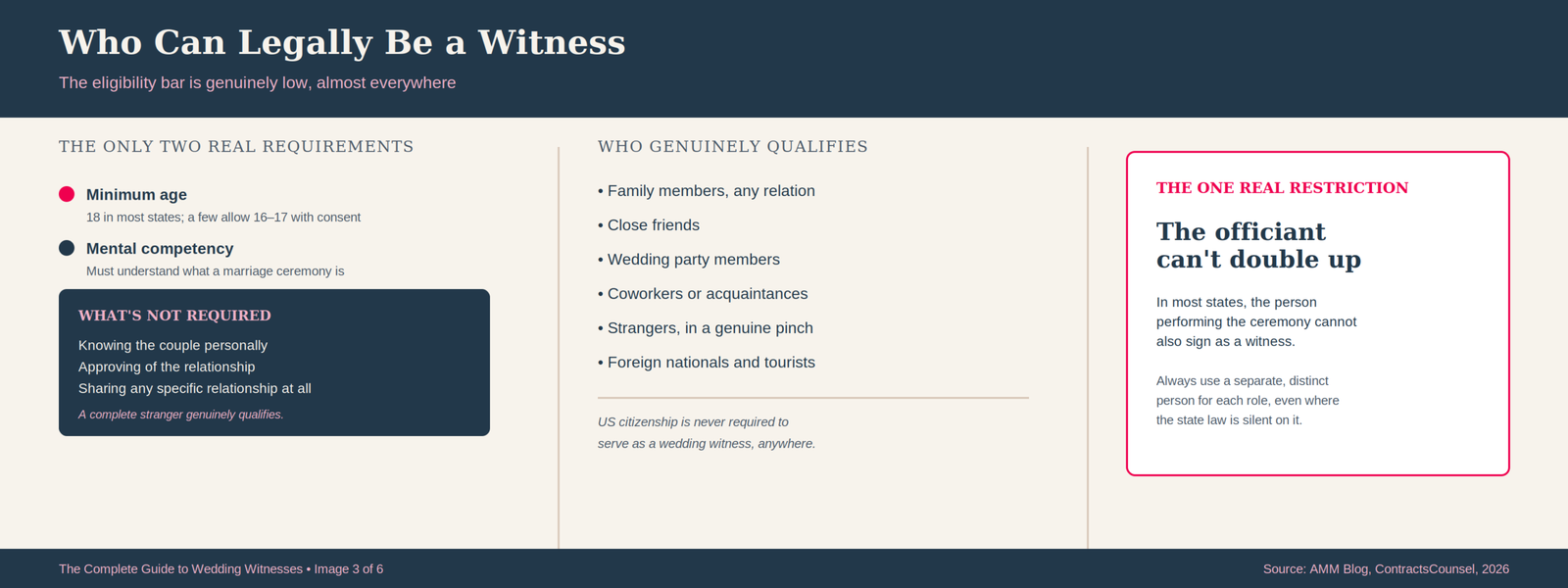
Once a couple knows how many witnesses their state actually requires, the next real question is who qualifies. The genuinely good news is that eligibility rules are simple almost everywhere in the country. Nearly any adult can serve. There’s no requirement that a witness know the couple personally, approve of the marriage, or share any specific relationship with either person getting married. This surprises many couples who assume the role carries more restriction than it actually does.
The Real Legal Requirements
Strip away the myths, and the actual legal bar for serving as a wedding witness is genuinely low. Most states ask for exactly two things: the person must meet a minimum age, and they must understand what they’re witnessing. Beyond that, the law generally stays silent. A witness can be a total stranger. They can be a family member, a close friend, a coworker, or someone the couple met an hour earlier. No state marriage code requires a witness to have known the couple for any minimum length of time. No state requires the witness to personally vouch for the relationship itself, either.
Age Requirements and Exceptions
The standard age threshold across most states is 18. This matches the general age of legal adulthood in the US, and it’s the number couples should plan around by default. A smaller group of states allows a witness as young as 16 or 17, often with parental consent required for the minor witness themselves. California is a genuine outlier here too. Its statute doesn’t specify a strict minimum age at all. It only requires that the witness be old enough to understand they’re witnessing a marriage taking place. Because this detail varies so much, confirming your specific state’s actual threshold directly, rather than assuming 18 applies everywhere, is worth the five minutes it takes.
Mental Competency and Understanding
Beyond age, states generally require a witness to have the mental capacity to understand what a marriage ceremony is and what their signature actually confirms. This standard exists to prevent a witness from being someone who couldn’t meaningfully observe or attest to the event. It’s not meant to create a high bar most adults would ever struggle to clear. In practice, this requirement rarely becomes an issue. Officiants and clerks are trained to use reasonable judgment. A witness who can hold a normal conversation and sign their name legibly will almost always satisfy this standard, without any formal test or evaluation ever taking place.
Who Cannot Serve as a Witness
While eligibility is broad, a small number of genuine restrictions do exist, and couples should know them before assuming literally anyone present can step into the role. These restrictions cluster around two specific situations: the officiant’s own role, and anyone who falls below the applicable age or competency threshold.
The Officiant Restriction
In the significant majority of states, the person performing the ceremony cannot also serve as a witness on the same license. This makes sense once you consider what each signature is actually confirming. The officiant is attesting that they legally performed the marriage, while a witness is attesting that they observed it happen. Combining both roles into one person would undermine the entire point of having a separate, independent witness in the first place. A handful of states are genuinely silent on this specific point. They neither explicitly permit nor forbid it. The safest, most universally accepted practice is always using a separate, distinct person for each role.
Below-Age or Incompetent Individuals
The second real restriction covers anyone who doesn’t meet the specific age or competency bar their state has set. A ten-year-old sibling, however excited to participate, generally cannot serve as an official witness anywhere in the country. Someone who is intoxicated at the moment of signing can also be turned away. The same applies to anyone who genuinely cannot understand what’s happening around them, using reasonable discretion from the officiant or clerk. These situations are rare in practice. They do occasionally arise, though, particularly at receptions where alcohol has been served well before the legal paperwork gets signed later in the evening.
Choosing Who to Ask
Legal eligibility is only half the picture. Once you know who technically qualifies, the real question becomes who you actually want standing beside you at this specific moment. This is a genuinely personal decision. It deserves more thought than simply defaulting to whoever happens to be closest at hand.
Emotional and Practical Considerations
Many couples instinctively reach for their maid of honor or best man first. This makes sense on paper. But it’s worth pausing to ask whether that person is actually the right fit, not just the expected one. A witness role carries real weight. It’s someone whose name will appear on a legal document tied to your marriage forever. Some couples choose a parent instead, or a sibling, or even a close friend who isn’t formally part of the wedding party at all.
Reliability Matters More Than Sentiment Alone
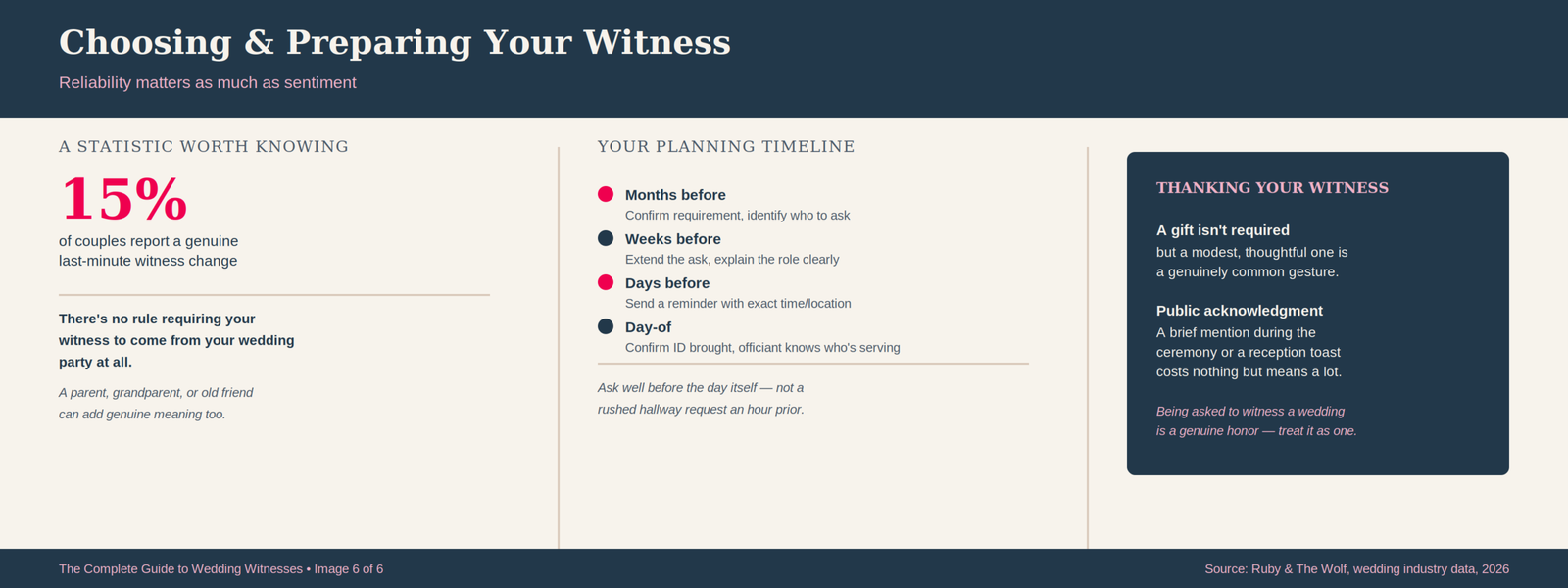
A genuine statistic worth knowing here: roughly 15 percent of couples report a last-minute witness change, according to wedding industry data. This usually happens because the chosen witness runs late, gets pulled into another task, or simply forgets they were asked at all. Reliability should weigh just as heavily as sentiment when you’re making this choice. Someone deeply meaningful to you but chronically late to everything may not be the right pick. This role has a specific, unmovable legal moment attached to it.
The Wedding Party vs. a Separate Choice
There’s no rule requiring your witness to come from your wedding party at all. Many couples assume the maid of honor and best man automatically take this role, but that’s tradition, not law. Choosing someone entirely separate, a grandparent, a mentor, an old family friend, can genuinely add meaning without disrupting your existing wedding party structure. This separation also solves a practical problem. It frees your wedding party members to focus fully on their existing responsibilities, instead of adding a legal task on top.
How to Actually Ask Someone
Once you’ve identified the right person, asking them well matters more than most couples expect. A witness role, done thoughtfully, can become a genuinely memorable part of someone’s own experience at your wedding.
Timing Your Request
Ask well before the wedding day itself, ideally weeks in advance rather than a rushed hallway request an hour before the ceremony. This gives your chosen witness real time to understand what’s being asked of them. They can confirm they meet any age or identification requirements, and mentally prepare for a role that carries genuine legal weight. A last-minute ask can feel like an afterthought, even when that’s genuinely not your intention.
What to Say
Be specific about what the role actually involves: attending the ceremony, being present at the exact moment of signing, and bringing valid identification if your state requires it. Many people don’t know what a wedding witness actually does, beyond a vague sense of “standing there.” A clear, warm explanation genuinely helps. Framing the ask around why you chose them specifically, not just the logistics, makes the moment feel like the honor it actually is.
What a Witness Actually Does Before, During, and After
The witness role is often misunderstood as purely ceremonial. In reality, it carries specific, practical steps at three distinct points: before the ceremony, during it, and immediately afterward. Understanding this full timeline helps both the couple and the witness prepare properly, rather than discovering a missing step in the moment.
Before the Ceremony
The preparation phase matters more than most couples realize. A witness who shows up without understanding their role can create real, avoidable friction right when everyone wants the day to run smoothly. Taking a few minutes to prepare your witness in advance genuinely prevents this.
Confirming Their Role and Requirements
Before the wedding day, confirm directly with your witness that they meet your state’s specific age and identification requirements. This isn’t a conversation to have the morning of. Send a simple message weeks ahead, explain the state’s rule, and ask them to bring a valid photo ID just in case. This single step prevents the overwhelming majority of witness-related problems couples encounter.
What They Should Bring
Beyond identification, a witness generally needs nothing special. They don’t need special attire, though most couples appreciate them dressing in line with the wedding’s overall formality. They don’t need to prepare a speech or a statement. Their entire practical obligation is showing up, staying present through the ceremony, and being available at the exact moment the paperwork requires their signature.
During and After
The actual moment of witnessing is simpler than most people expect. It doesn’t require special training or advance rehearsal.
The Actual Signing Process
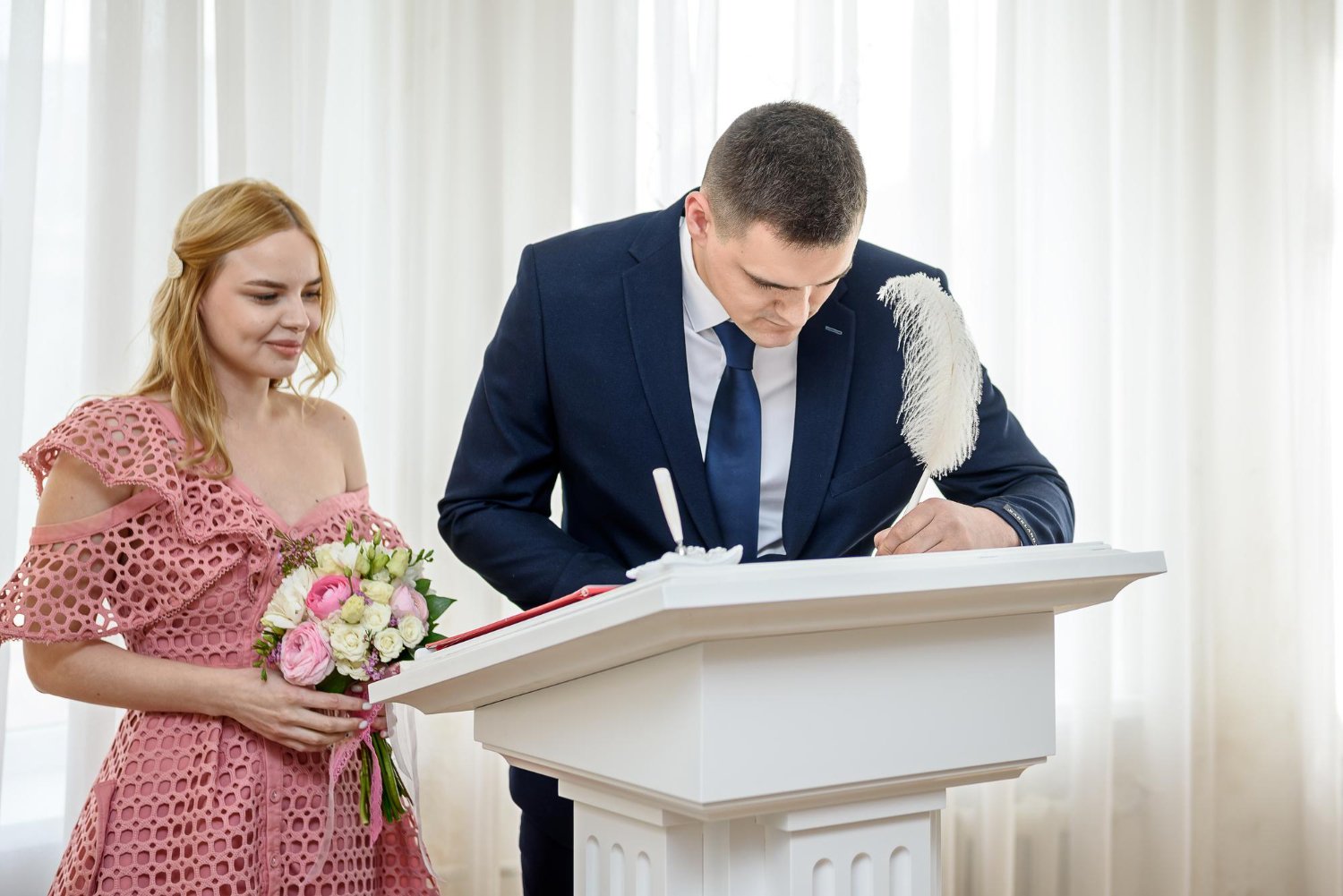
After the ceremony concludes, the officiant typically brings out the marriage license for everyone’s signatures. The couple signs first, followed by the officiant, followed by the witness or witnesses. This usually takes only a minute or two. Some venues handle this privately in a side room; others do it in front of all the guests as a small, additional ceremonial moment. Either approach is completely normal, and couples should confirm with their officiant which one to expect.
What Their Signature Legally Means
A witness’s signature is a legal attestation. It confirms they personally observed the marriage take place and that both parties appeared to enter into it willingly. This matters more than it might seem. In rare cases involving fraud, coercion, or a disputed marriage, a witness’s signature and testimony can become genuinely relevant evidence. This is precisely why the role exists in the eyes of the law, even though it rarely becomes an issue for the overwhelming majority of couples.
Almost anyone can legally witness a wedding
The License vs. the Ceremony: A Distinction Worth Understanding
One of the most common points of confusion involves two genuinely separate steps: applying for a marriage license, and actually getting married at the ceremony. Couples often assume these two processes carry identical witness requirements. In most states, they don’t.
Applying for the License
The license application is typically a bureaucratic step completed at a county clerk’s office, sometimes weeks before the actual wedding. This step establishes your legal eligibility to marry and issues the physical document your officiant will later use.
Why Witnesses Rarely Matter at This Stage
In the vast majority of states, no witness needs to be present when you apply for your marriage license. This step usually just requires both partners, valid identification, and the appropriate fee. The witness requirement, where it exists, almost always attaches to the ceremony itself, not this earlier administrative step. Couples who assume otherwise sometimes bring a witness to the clerk’s office unnecessarily, or worse, assume they’ve already satisfied the requirement and skip arranging a witness for the actual wedding.
Confidential and Private License Options
Some states, California being the clearest example, offer a separate confidential or private marriage license option. This version specifically waives the witness requirement even in a state that otherwise requires one for its standard public license. Couples wanting genuine privacy, without any witness at all, should ask their county clerk directly whether this option exists and what its specific eligibility rules are.
The Ceremony Itself
This is where the real witness requirement, if your state has one, actually applies. Understanding this timing helps you plan correctly.
Where the Witness Requirement Actually Applies
Your witness needs to be present at the ceremony itself, not at the earlier license application. They observe the vows and the pronouncement of marriage, then sign the license immediately afterward, confirming they watched the event happen. This is the step most couples actually need to plan around directly.
Confirming Your Specific County’s Rules
Because county-level procedures can add local nuances on top of state law, always confirm the exact requirement directly with the office issuing your specific license. A general online search can give you a solid starting point, but the clerk’s office itself remains the single most reliable source for your exact date and location.
Self-Solemnization and No-Witness States
A specific subset of states allows couples to skip the witness requirement entirely, and understanding this option genuinely matters for anyone planning an intimate or private ceremony. This isn’t a loophole. It’s a deliberate legal choice made by these states’ legislatures.
States Where You Can Skip Witnesses Entirely
A genuine cluster of states removes the witness requirement completely from the marriage ceremony. This opens up real options for couples who want to avoid the logistics of coordinating a witness altogether.
The Seven No-Witness States
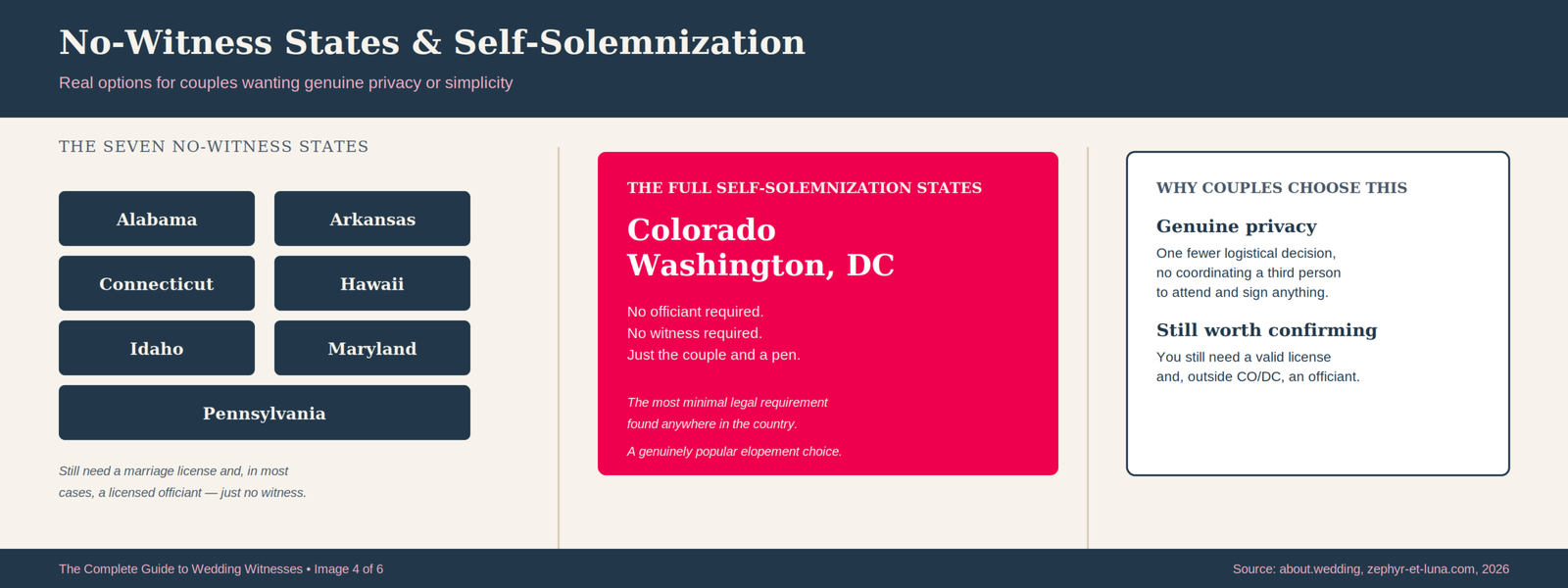
Alabama, Arkansas, Connecticut, Hawaii, Idaho, Maryland, and Pennsylvania all allow couples to marry without any witness signing the certificate. You’ll still need a valid marriage license and, in most of these states, an officiant to perform the ceremony. But no one else needs to stand beside you and sign anything afterward. This makes these states genuinely appealing for couples planning a small, intimate elopement without the added task of arranging a witness.
Colorado and DC Self-Solemnization
Colorado and Washington, DC go a full step further. Both allow complete self-solemnization. This means a couple can legally marry each other directly, with no officiant and no witness required at all. Just the two of them, the marriage license, and their own signatures make the marriage fully legal. This is genuinely unique among US jurisdictions, and it’s part of why Colorado specifically has become a popular elopement destination for couples wanting maximum privacy and minimum logistics.
Why Some Couples Choose This Path
Skipping witnesses entirely isn’t just a legal curiosity. Real couples deliberately choose this path for genuine, considered reasons.
Genuine Privacy and Simplicity
Some couples specifically want a wedding day with absolutely no one else present, not even a witness they’d otherwise have to select and coordinate. A no-witness state removes one more logistical decision from an already complex planning process. This can feel genuinely freeing, especially for couples who find the idea of an audience, even a single witness, at odds with the private, personal moment they’re trying to create.
What You Still Need to Handle
Choosing a no-witness state doesn’t eliminate every requirement. You’ll still need a valid marriage license, obtained in advance through the standard application process. Most of these states still expect an officiant, unless you’re specifically in Colorado or DC and pursuing full self-solemnization. Confirm every remaining requirement directly with your chosen state’s marriage license office well before your date. Removing the witness step doesn’t remove everything else involved in a legally valid marriage.
Elopement and Destination Wedding Witnesses
Elopements and destination weddings introduce genuinely different witness considerations than a standard local wedding. Distance, unfamiliar jurisdictions, and smaller guest counts all change the practical picture.
Domestic Elopement Witness Solutions
Couples eloping within the US face a specific, solvable challenge: finding witnesses when they’ve deliberately chosen not to invite a full guest list.
Practical Backup-Witness Strategies
Real couples have used photographers, wedding officiants’ own companions, hotel staff, and even friendly strangers at a scenic overlook as witnesses in a pinch. This is completely legal in nearly every jurisdiction, since most states place no restriction on the witness’s relationship to the couple. If you’re eloping without a built-in guest list, ask your officiant or venue directly whether they can help arrange a witness. Many have handled this exact situation many times before.
Choosing a No-Witness State Deliberately
Some eloping couples solve this problem entirely by choosing one of the seven no-witness states, or Colorado specifically for full self-solemnization, covered in detail earlier in this guide. This removes the witness question from the planning process altogether, letting the couple focus purely on the ceremony itself without needing to coordinate a third person’s presence.
International Destination Witnesses
Marrying abroad introduces a genuinely different set of rules, since you’re now working within a foreign country’s legal system rather than US state law.
Foreign National Eligibility
In the US, foreign nationals, including tourists on a visitor visa, can legally serve as wedding witnesses. Citizenship is never a requirement here. The same generosity doesn’t always extend to every destination abroad. Couples marrying internationally should verify this directly with their destination country’s marriage authority, rather than assuming US-style flexibility applies everywhere.
Country-Specific Requirements Worth Checking
Ireland, for example, requires two witnesses over 18 alongside a registered officiant and a three-month advance notice period. Other popular destination countries carry their own specific witness age, number, and documentation requirements, often stricter than what couples are used to from US law. Checking directly with the destination country’s embassy or official tourism marriage guidance well before booking travel prevents a genuinely stressful surprise upon arrival.

Seven states let you skip the witness entirely
Religious and Cultural Witness Traditions
Beyond civil law, many faith traditions maintain their own witness customs, sometimes running parallel to state requirements and sometimes standing entirely apart from them. Understanding both layers helps couples navigate a religious ceremony without confusion.
Catholic Marriage Witnesses
The Catholic Church maintains a specific, well-defined witness requirement that closely mirrors, but isn’t identical to, civil marriage law.
The Two-Witness Requirement
A Catholic wedding requires two witnesses, each at least 18 years old, who can attest to what occurred during the ceremony. This requirement exists independently of whatever your specific state’s civil law demands. A Catholic ceremony held in a zero-witness state still needs two witnesses to satisfy the Church’s own canonical rules, even though civil law wouldn’t otherwise require any.
How This Differs from Sponsors
Marriage witnesses are genuinely distinct from the sponsors used in other Catholic sacraments, like baptism or confirmation. A marriage witness carries no religious responsibility to mentor the couple or attest to their faith. Their function is purely to confirm the ceremony legitimately took place, exactly like a civil witness, just within a religious rather than secular context.
Other Faith Traditions
Beyond Catholic practice, other religious traditions maintain their own distinct witness customs worth understanding if they apply to your ceremony.
Jewish Ceremony Witnesses
Traditional Jewish weddings require two witnesses, called edim, who observe the signing of the ketubah, the Jewish marriage contract, before the ceremony itself begins. These witnesses traditionally must not be immediate family members of either the bride or groom. This is a genuine departure from the no-relationship-restriction rule that applies to civil witnesses in nearly every US state. Couples planning a traditional Jewish ceremony should discuss this specific requirement directly with their rabbi well in advance.
Blending Legal and Religious Witness Roles
Many couples simplify this by using the same people to satisfy both their state’s civil requirement and their faith tradition’s religious requirement simultaneously. This works, provided those individuals meet both sets of criteria. This isn’t always possible, particularly given the Jewish tradition’s family-member restriction noted above. Couples should confirm directly with their officiant or religious leader whether one set of witnesses can genuinely serve both purposes at once.
What Happens If You Don’t Have Enough Witnesses
Despite careful planning, couples sometimes find themselves without a required witness on the actual wedding day. Knowing your real options in this moment genuinely reduces panic.
The Day-Of Scramble
This situation is more common than most couples expect, and it’s almost always solvable in the moment.
Asking Vendors or Bystanders
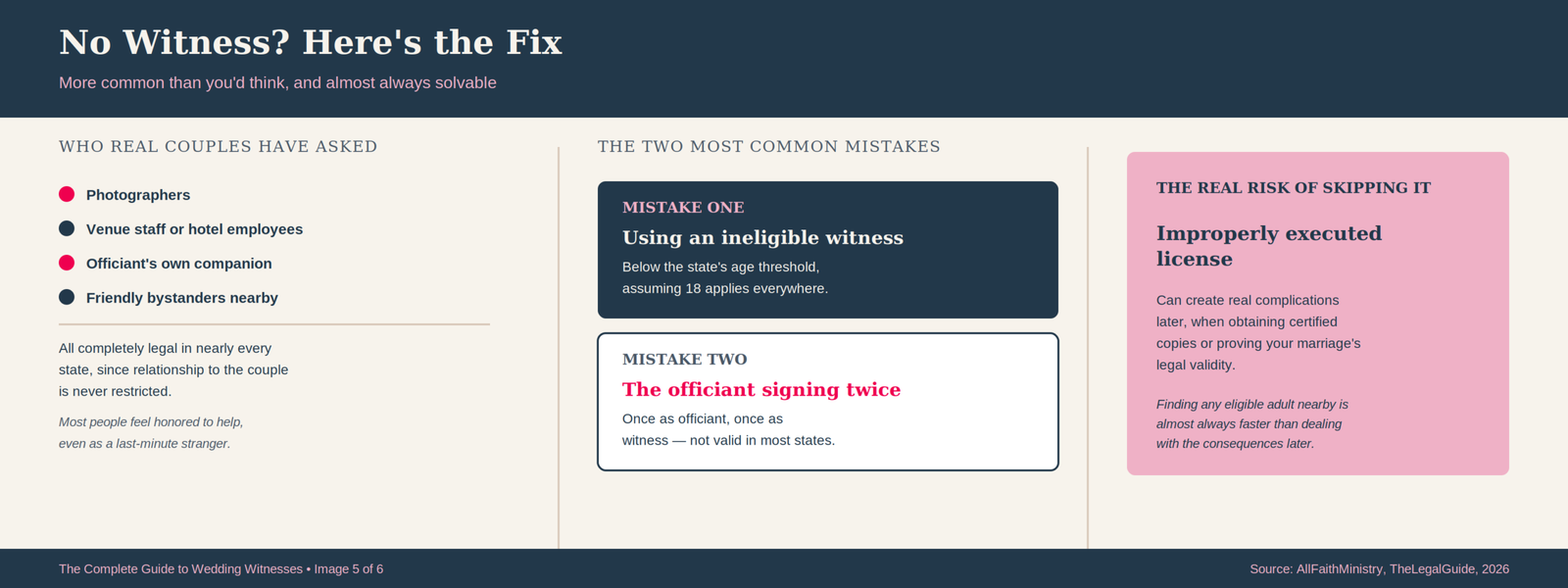
Photographers, venue staff, officiants’ companions, and even friendly strangers nearby can all legally serve, since most states place no restriction on a witness’s relationship to the couple. Simply asking someone present, explaining the situation briefly, and confirming they meet the age requirement usually solves the problem within minutes.
Why This Usually Works Out Fine
Most people are genuinely happy to help in this situation. Being asked to witness a wedding, even as a last-minute stranger, tends to feel like a small honor rather than an imposition. Officiants who perform weddings regularly have typically seen this exact scenario before and can often suggest a solution quickly, drawing on real experience with similar last-minute situations at previous ceremonies.
What Happens If You Genuinely Can’t Find One
In the rare case no witness can be found in the moment, real options still exist.
Rescheduling the Signing
Some officiants can hold the signed-but-unwitnessed license and arrange for witness signatures shortly afterward, though this depends heavily on your specific state’s exact procedural rules. Confirm this possibility directly with your officiant before assuming it’s an option, since not every state allows a delayed signature to satisfy the original requirement.
The Real Legal Risk of Skipping This Step
If your state genuinely requires a witness and you proceed without one, your marriage license may not be properly executed. This can create real complications later, when you try to obtain certified copies or prove your marriage’s legal validity. This isn’t a step worth skipping casually. Taking a few extra minutes to find any eligible adult nearby is almost always faster and simpler than dealing with the consequences later.
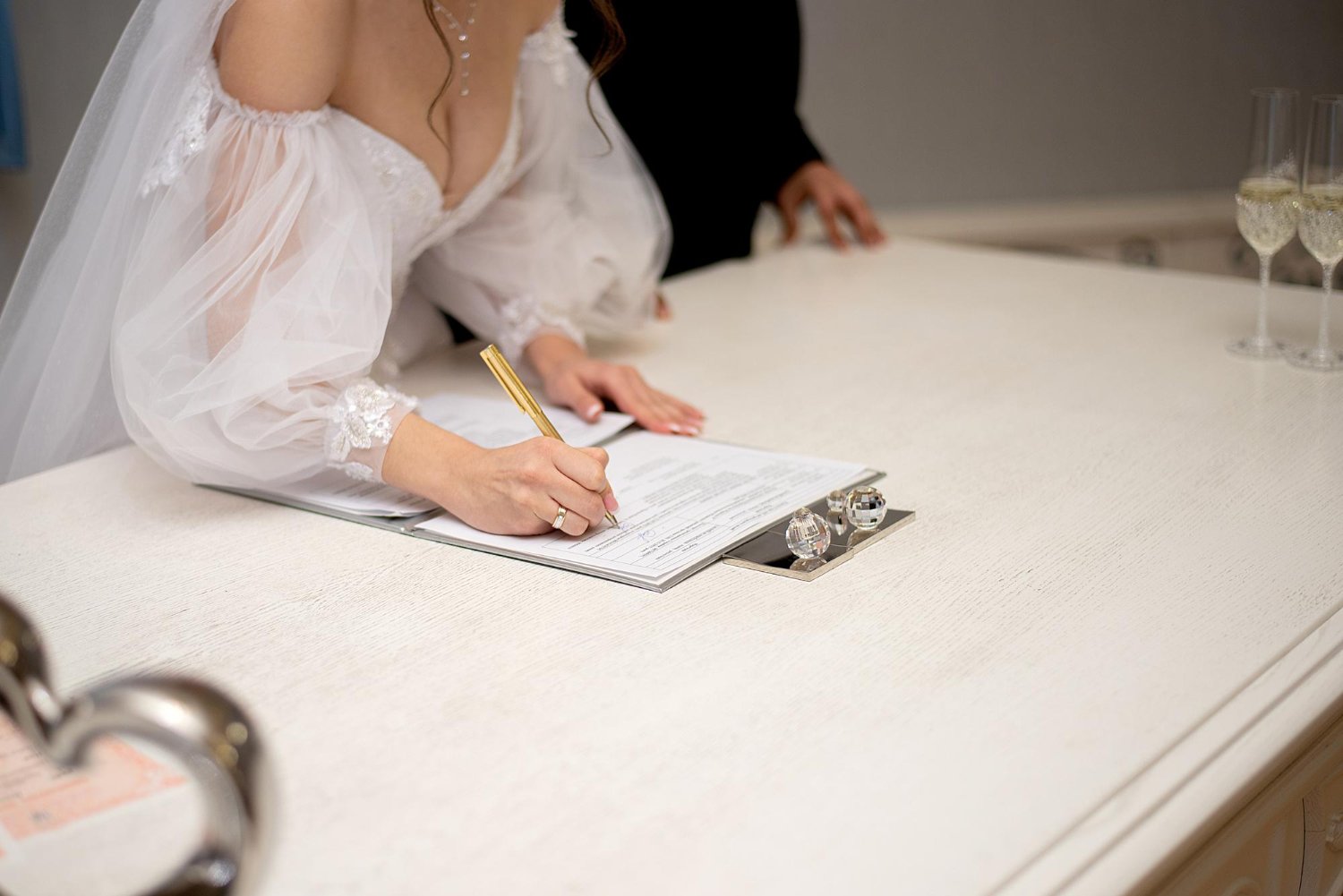
What to do if your witness doesn’t show up
Common Witness Mistakes and Legal Pitfalls
Most witness-related problems trace back to a small, predictable set of mistakes. Knowing them in advance genuinely helps couples avoid the entire category of issue.
Age and Eligibility Mistakes
These mistakes happen most often when couples assume national uniformity that simply doesn’t exist in US marriage law.
Using an Ineligible Witness
Choosing a witness below your state’s minimum age, or someone who doesn’t meet a specific competency standard, can genuinely invalidate the witnessing step. This happens most often when couples don’t realize their state’s specific age threshold differs from the 18-year assumption that applies almost everywhere else. Confirming this detail directly, well before the wedding day, prevents a genuinely avoidable problem.
The Officiant-as-Witness Mistake
In states where this combination isn’t allowed, couples sometimes mistakenly assume their officiant can simply sign twice, once as officiant and once as witness. This is a real, documented mistake that can create genuine complications with the license’s legal validity. Always use a separate, distinct person for each role, even in states that don’t explicitly forbid the combination, since this remains the universally safest practice.
Logistics and Documentation Mistakes
Beyond eligibility, a second category of mistakes involves the practical logistics of actually getting the signature completed correctly.
Witnesses Who Leave Before Signing
A genuinely common mistake involves a witness who attends the ceremony but leaves the reception before the actual signing moment happens. This is particularly common when the signing is scheduled later in the evening, well after the ceremony itself concludes. Confirm directly with your officiant when the signing will actually take place, and make sure your witness knows to stay present until that specific moment.
Illegible or Incomplete Signatures
An illegible signature, or one missing required information like a printed name or address, can create real processing delays when the license is submitted to the county for recording. Encourage your witness to write clearly and completely. Have your officiant double-check every signature before the ceremony concludes. This catches any issue while everyone’s still present, rather than discovering it days later.
Thanking and Honoring Your Witnesses
Being asked to witness a wedding is a genuine honor, and acknowledging that thoughtfully deepens the meaning of the role for everyone involved.
Thoughtful Gift Ideas
A gift for your witness isn’t required, but many couples choose to mark the role with something meaningful.
Sentimental vs. Practical Gifts
Some couples choose something sentimental, like a personalized keepsake referencing the date or the role itself. Others lean practical: a nice bottle of something they enjoy, or a genuinely useful item tied to a shared interest. Neither approach is more correct than the other. The right choice depends entirely on your specific witness’s own taste and your relationship with them.
Budget Guidance
This gift, when given, typically falls into a modest range, genuinely more symbolic than extravagant. Most couples spend comparably to what they’d spend on a smaller wedding party gift. This recognizes the witness role without treating it as a larger financial obligation than it needs to be.
Public Acknowledgment
Beyond a physical gift, a public moment of recognition can genuinely add meaning to the day itself.
Mentioning Them in Your Ceremony
Some couples ask their officiant to briefly acknowledge the witness by name during the ceremony itself, explaining their role and why they were chosen. This small addition genuinely helps guests understand what’s happening during the signing moment, rather than watching a quiet, unexplained administrative pause in an otherwise emotional ceremony.
A Toast or Reception Moment
A brief mention during a reception toast, thanking your witness specifically alongside your broader wedding party, is a genuinely simple way to honor the role. This doesn’t require a separate gift or gesture. This costs nothing beyond a few thoughtful words, and it publicly recognizes a role most guests don’t fully understand or notice otherwise.
Virtual and Remote Witnessing
A genuinely new development in marriage law emerged during the COVID-19 pandemic, when several states temporarily allowed witnesses to participate remotely rather than in person. Understanding this history, and its current status, matters for couples exploring flexible options.
The Pandemic-Era Precedent
Emergency orders during the pandemic created real, temporary flexibility that hadn’t existed in marriage law before.
Which States Allowed This
Several states issued emergency orders permitting witnesses to observe a ceremony via video call, using platforms like FaceTime or Zoom, and still count as having legally witnessed the marriage. This let family members who couldn’t travel due to pandemic restrictions still participate meaningfully in a legal sense, not just as a symbolic video guest.
Whether It’s Still Available
Most of these emergency provisions were temporary and tied specifically to the declared public health emergency, meaning they’ve generally expired as normal operations resumed. A small number of states have made narrower versions of remote witnessing permanent, but this varies considerably and changes over time. Never assume remote witnessing is available without confirming directly with your specific state’s current marriage law, since relying on outdated pandemic-era information can lead to a genuinely invalid signature.
Practical Considerations If Available
Where remote witnessing genuinely remains an option, a few practical details matter directly.
Technology and Legal Documentation
If your state still permits this, confirm the exact technical and documentation requirements directly with your county clerk. Some require the remote witness to sign a specific affidavit afterward, in addition to observing the ceremony live, rather than simply watching and never formally documenting their observation.
When This Genuinely Makes Sense
Remote witnessing, where available, genuinely helps couples with a witness who is elderly, has a health condition preventing travel, or lives internationally and can’t attend in person. It’s a meaningful option for specific, real circumstances, though most couples with an in-person witness available should simply use that more straightforward, universally accepted path instead.
Vow Renewals and Non-Legal Witnessing
Vow renewals occupy a genuinely different legal category than a first wedding, and this changes the entire witness conversation.
Why Legal Rules Don’t Apply
Since a vow renewal doesn’t create a new legal marriage, none of the state-specific witness requirements covered throughout this guide actually apply.
The Purely Ceremonial Role
A witness at a vow renewal serves an entirely symbolic function. There’s no license to sign, no legal document requiring their signature, and no state law dictating who’s eligible. This genuinely frees couples to choose witnesses based purely on meaning, without worrying about age thresholds or identification requirements at all.
Choosing Witnesses for Meaning, Not Law
Many couples specifically choose their own children as vow renewal witnesses. This role was legally unavailable to them at the original wedding, if they weren’t yet born or were too young at the time. This creates a genuinely full-circle moment unavailable in any legally binding ceremony, precisely because no legal constraint applies here at all.
Making It Meaningful Anyway
Without legal requirements attached, couples have genuine creative freedom in how they structure this moment.
Involving Children or Grandchildren
Beyond simply standing nearby, children or grandchildren can take on a genuine, active witnessing role. Some even sign a symbolic, non-legal renewal certificate. The couple keeps this as a keepsake, rather than filing it with any government office.
A Different Kind of Signing Moment
Some couples create their own symbolic certificate specifically for this purpose, letting their chosen witnesses sign something meaningful even though it carries no legal weight whatsoever. This transforms what could otherwise feel like an empty gesture into a genuinely personal keepsake the whole family can treasure long after the ceremony itself.

Choosing the right witness takes real thought
International and Foreign National Witnesses
Weddings increasingly bring together guests from different countries, and understanding how citizenship status affects the witness role genuinely matters for couples with international family or friends.
Citizenship Is Never a US Requirement
US marriage law treats witness eligibility based on age and competency alone, never on immigration or citizenship status.
Tourists and Visa Holders
A foreign national visiting on a tourist visa can legally serve as a wedding witness anywhere in the United States. They simply need to meet the same age and competency standard that applies to anyone else. This means a couple can genuinely invite an international friend or family member to serve in this role without worrying about their specific visa category creating any legal obstacle.
Green Card Holders and Permanent Residents
Green card holders face no additional restriction whatsoever beyond the standard age and competency requirement every witness must meet. Their permanent resident status, or lack of full citizenship, has zero bearing on their legal eligibility to witness a marriage anywhere in the country.
Practical Considerations for International Guests
While citizenship isn’t a legal barrier, a few practical details still deserve attention when your chosen witness is traveling internationally for your wedding.
Identification Requirements
A foreign passport generally satisfies any photo identification requirement your state might have for witnesses, though confirming this directly with your specific county clerk avoids any last-minute surprise. Some offices are more familiar with foreign documentation than others, so a quick confirmation call genuinely helps.
Travel Timing and Backup Planning
International travel carries genuine, real risk of delay, from flight cancellations to visa processing issues. If your primary witness is traveling from abroad, identify a backup local witness in advance. This protects your ceremony from an unexpected travel disruption derailing your legal paperwork on the actual day.
A Realistic Timeline and Final Checklist
Bringing every principle in this guide together, a clear timeline and checklist genuinely helps couples avoid every pitfall covered throughout these sections.
Your Witness Planning Timeline
Spreading this task across your broader wedding planning timeline, rather than leaving it for the final week, genuinely reduces stress.
Months Before
Confirm your specific state and county’s exact witness requirement, including age, number, and identification rules. Identify who you’d like to ask, considering both emotional significance and genuine reliability. Extend the actual ask with enough lead time for your chosen witness to plan around it.
Days Before and Day-Of
Send a friendly reminder a few days out, confirming the exact time and location they need to be present. On the day itself, confirm your witness has brought valid identification if required, and make sure your officiant knows exactly who’s serving in this role before the ceremony begins.
Final Confirmation Steps
A few last checks genuinely protect against the most common problems covered throughout this guide.
Contacting Your County Clerk
Before finalizing any plans, call or check your specific county clerk’s website directly, confirming the exact current requirement for your date and location. Requirements can shift, and a five-minute call prevents planning around outdated or incorrect information.
Backup Planning
Identify at least one backup witness option, even informally, in case your first choice becomes unavailable. This could be a family member, or a close friend attending regardless. It could simply be the knowledge that your officiant or venue can help you find someone, if genuinely needed at the last minute.
A Real Witness Planning Story
Concrete examples clarify abstract legal rules better than principles alone. Here’s how one couple’s witness planning actually unfolded, and what it teaches about the gap between assumption and reality.
The Initial Assumption
A couple planning their wedding in Oregon assumed, without checking directly, that witnesses were optional everywhere, based on a friend’s experience getting married in Texas the previous year.
What They Discovered Late
Three weeks before their ceremony, while finalizing paperwork with their officiant, they learned Oregon actually requires two witnesses, both at least 18, to sign the marriage license. Neither member of the wedding party they’d planned around met this requirement cleanly, since their chosen maid of honor was turning 18 only two days after the wedding date itself.
How They Adjusted
Rather than panic, they simply asked the groom’s older sister and a close family friend to serve instead. Both were genuinely happy to take on the role, once asked directly. The maid of honor remained fully involved in every other part of the ceremony, simply not as the legal witness.
The Lesson That Applies Broadly
Nothing about this couple’s experience was unusual. The gap was simply assuming a friend’s experience in a different state applied universally, rather than confirming their own specific state’s actual rule directly and early.
Why This Story Repeats Constantly
Wedding planning advice spreads informally, through friends, social media, and general wedding content that doesn’t always specify which state’s rules it’s actually describing. This genuinely creates a real risk of couples applying the wrong state’s requirement to their own wedding, exactly the pattern this entire guide has been built to prevent.
The Real Takeaway
Confirm your own specific state and county’s requirement directly, rather than relying on a friend’s experience, a general online claim, or an assumption based on what seems logical. This single habit, more than any other piece of advice in this guide, prevents the exact scramble this couple narrowly avoided.
Comparing Witness Requirements at a Glance
Bringing together every category covered throughout this guide, a direct comparison helps clarify how genuinely different these requirements are depending on where you marry.
The Three Core Categories
Every US state falls into one of three genuinely distinct categories when it comes to witness requirements.
Two-Witness States
The largest category requires two witnesses, both meeting the state’s age threshold, to sign the marriage license after the ceremony. This includes states like Arizona, Oregon, Michigan, and Wisconsin, among many others.
One-Witness States
A smaller group, including California, Nevada, New York, and South Dakota, requires only a single witness, genuinely simplifying the planning burden compared to the two-witness category.
The No-Witness Category
The final category removes the requirement entirely, though the specific mechanics still vary within this group.
Standard No-Witness States
States like Alabama, Arkansas, Pennsylvania, and Texas require no witness at all, though most still expect a licensed officiant to perform the ceremony itself.
Full Self-Solemnization States
Colorado and Washington, DC go further, allowing couples to marry without any officiant or witness whatsoever, the most minimal legal requirement found anywhere in the country.
Witness Etiquette and Practical Attire
Beyond the legal mechanics, a few genuine etiquette questions come up repeatedly around this role, worth addressing directly.
What Witnesses Should Wear
There’s no universal dress code specifically for witnesses, though a few practical principles genuinely help.
Matching the Wedding’s Formality
Most witnesses simply dress according to the wedding’s general dress code, exactly as any other guest would. If your witness is also part of your wedding party, they’ll typically already be wearing coordinated attire, making this a non-issue entirely.
When a Witness Isn’t a Guest Otherwise
Sometimes your witness is someone brought in specifically for the role, a photographer or venue staff member, for instance. In this case, there’s no expectation they dress beyond their normal professional attire. Their function is legal, not aesthetic, and no couple should feel obligated to provide special clothing for this purpose.
Where Witnesses Stand or Sit
Physical positioning during the ceremony is another common question worth addressing directly.
Traditional Positioning
Witnesses traditionally stand near the couple during the ceremony itself, often alongside the wedding party if they’re also serving in that role. This isn’t a legal requirement, simply a common practice that keeps them genuinely close enough to observe clearly.
Flexibility for Non-Wedding-Party Witnesses
If your witness isn’t part of your formal wedding party, they can simply sit in the front row. They can stand wherever makes sense for your specific ceremony layout. They just need to genuinely observe the vows and pronouncement, clearly enough to fulfill their legal function afterward.
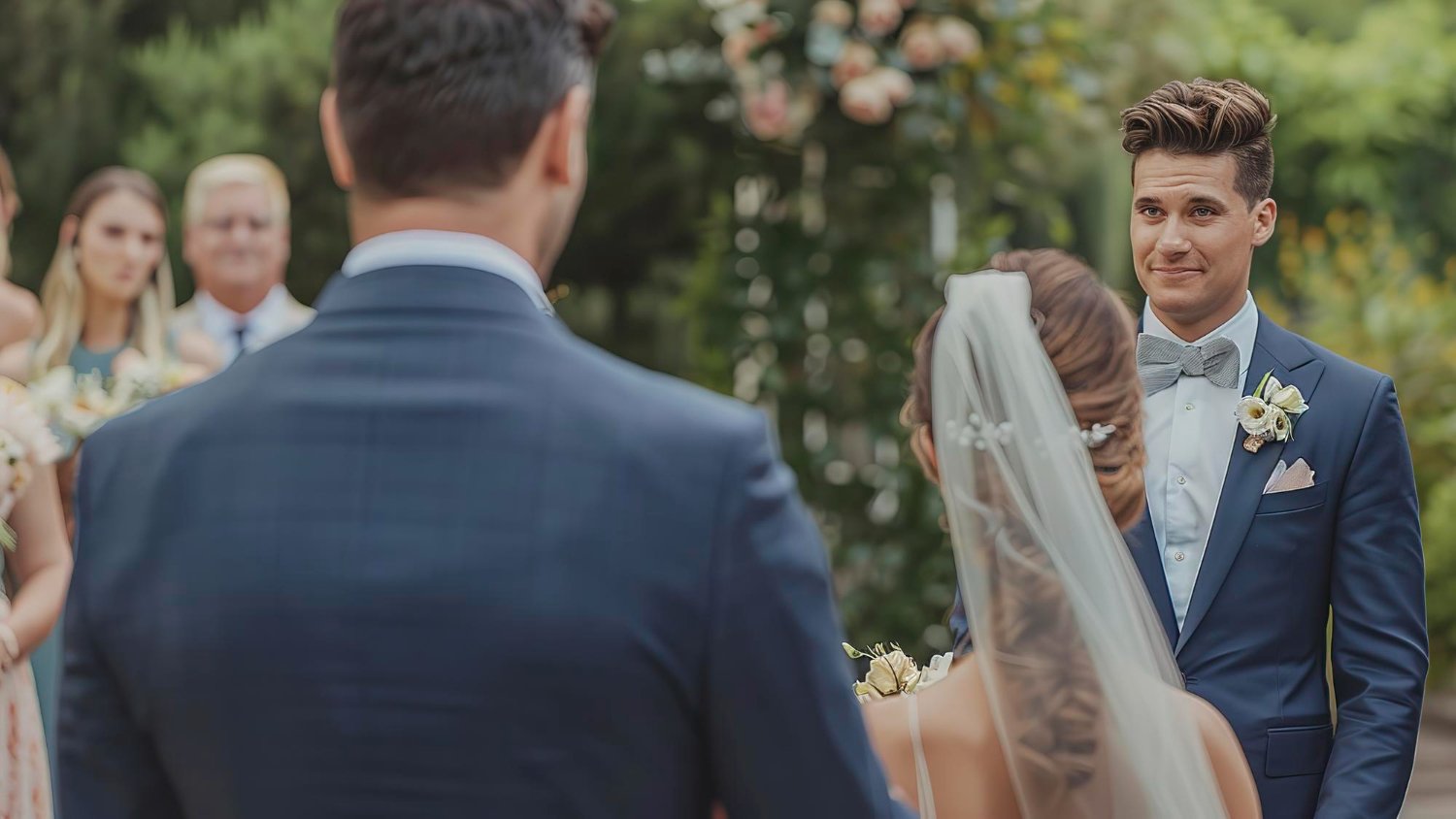
Someone who stood beside them when it counted
Frequently Asked Questions
Do all US states require a witness to get married?
No. Roughly half of US states require at least one witness, while the rest, including states like Texas, Pennsylvania, and Florida, require none at all.
Can a family member serve as a wedding witness?
Yes, in virtually every US state. There’s no legal restriction preventing a parent, sibling, or other relative from serving as a witness.
Can the officiant also be a witness?
Generally no. Most states require the officiant and witness to be separate, distinct people, since each role attests to something different on the marriage license.
What’s the minimum age to be a wedding witness?
Most states require witnesses to be at least 18, though a few allow 16 or 17 with parental consent, and California has no specific statutory minimum age at all.
Do witnesses need to know the couple personally?
No. A witness can be a complete stranger, provided they meet the age and competency requirements. Their job is to observe the marriage, not vouch for the relationship.
What happens if we don’t have a witness in a state that requires one?
Your marriage license may not be properly executed, which can create real complications later when obtaining certified copies or proving the marriage’s legal validity.
Can a foreign national or tourist serve as a witness?
Yes. US citizenship is never required to serve as a wedding witness anywhere in the country, only meeting the standard age and competency requirement.
Do we need a witness for a vow renewal?
No. Vow renewals aren’t legally binding marriages, so none of the state witness requirements covered throughout this guide actually apply.
Is it rude not to ask our maid of honor or best man to be our witness?
Not at all. There’s no etiquette rule requiring your witness to come from your wedding party. Many couples choose someone else entirely.
Should we give our witness a gift?
This is genuinely optional, though many couples choose a modest, thoughtful gift to acknowledge the role and its significance.
Can our witness be under 18 if they’re mature enough to understand what’s happening?
This depends entirely on your specific state. Most require 18, though a small number allow younger witnesses with parental consent or, in California’s case, no strict age minimum at all.
What if our chosen witness cancels last minute?
Ask a vendor, venue staff member, or even a friendly bystander. Most states place no restriction on a witness’s relationship to the couple, making this genuinely solvable in the moment.
A Quick-Reference Summary of Every Key Fact in This Guide
| Fact | Detail |
|---|---|
| States requiring two witnesses | The largest category, roughly two dozen states |
| States requiring one witness | California, Nevada, New York, South Dakota |
| Fully no-witness states | Alabama, Arkansas, Connecticut, Hawaii, Idaho, Maryland, Pennsylvania |
| Full self-solemnization | Colorado, Washington DC |
| Standard minimum witness age | 18 (some exceptions allow 16–17) |
| Relationship restriction on witnesses | None, in virtually every state |
| Citizenship requirement | None, anywhere in the US |
Keep this table as a genuine quick reference throughout your own planning, returning to the full sections above whenever you need complete context behind any specific fact.
Your Wedding Witness Checklist
- ☐ Confirmed exact state and county witness requirement directly: ____________
- ☐ Identified who to ask, weighing both meaning and reliability: ____________
- ☐ Asked with enough lead time, explaining the actual role clearly: ____________
- ☐ Confirmed witness meets age and identification requirements: ____________
- ☐ Identified a backup witness option just in case: ____________
- ☐ Confirmed with officiant exactly when and where signing will happen: ____________
- ☐ Sent a reminder in the days before the wedding: ____________
- ☐ Confirmed witness is present and available at the actual signing moment: ____________
Where This Leaves You
Wedding witness requirements come down to a genuinely simple, correctable gap. Couples assume the rules are uniform nationwide. In reality, they vary completely by state, from two mandatory witnesses down to none at all. None of this is complicated once you know your specific state’s actual rule. The complexity only appears when a couple discovers the requirement late, often in the final days before their wedding, exactly the scramble this guide was written to prevent.
The couple from the story earlier in this guide didn’t need a different wedding or a different witness. They needed one specific habit: confirming their own state’s actual requirement directly, rather than assuming a friend’s experience elsewhere applied to their own ceremony.
Your next step
Contact your specific county clerk’s office today and confirm the exact witness requirement for your wedding date and location. Then identify and ask your chosen witness with real lead time, giving them the same clear understanding of their role that this guide has given you.
Witnesses for Same-Sex and Non-Traditional Couples
Every principle covered throughout this guide applies identically regardless of the couple’s makeup, worth stating directly rather than assuming.
No Legal Distinction Exists
US marriage law treats witness eligibility identically regardless of the couple’s gender composition, following the same nationwide legal recognition established for all marriages.
Same State Rules Apply Equally
Whatever your state requires, two witnesses, one, or none, applies exactly the same way to every legally recognized marriage performed there. There’s no separate witness code for same-sex couples anywhere in the country, and no state imposes additional witness requirements based on the couple’s gender.
Choosing Witnesses Who Genuinely Celebrate You
Given this role’s real significance, choosing witnesses who authentically support and celebrate your specific relationship matters more than defaulting to convention. Some couples specifically choose witnesses from chosen family, close friends who’ve supported their relationship, rather than biological family members who may not share the same enthusiasm.
Practical Considerations Worth Knowing
Beyond the core legal equality, a few practical notes genuinely help couples navigate this smoothly.
Officiant and Venue Compatibility
Confirm your chosen officiant and venue are genuinely comfortable and experienced with your specific ceremony, a reasonable question during initial planning conversations, though this concerns the broader ceremony rather than witness eligibility specifically.
Documentation Consistency
Ensure your witness’s signature and printed information on the license match standard documentation practice, regardless of any other detail about your ceremony. The paperwork itself follows identical rules for every legally recognized marriage in your state.
Witnesses for Second Marriages and Blended Families
A second marriage carries no different legal witness requirement than a first one, though the practical and emotional considerations around choosing someone genuinely shift.
The Legal Requirements Remain Identical
Whatever your state requires applies exactly the same way regardless of whether this is your first marriage or a subsequent one.
No Special Rules for Remarriage
States don’t distinguish between first and subsequent marriages when it comes to witness requirements. The same age, number, and competency rules covered throughout this guide apply identically, without any additional documentation or waiting period specifically tied to witnesses.
Confirming Your Divorce Decree Is Separate
While unrelated to the witness role itself, most states do require proof your previous marriage has been legally dissolved before issuing a new marriage license. This is a separate requirement from witnessing, worth confirming directly with your county clerk alongside your witness planning.
Choosing Witnesses for a Blended Family Wedding
The emotional landscape of a second marriage, often involving children from a previous relationship, genuinely shapes who couples choose for this role.
Involving Adult Children Meaningfully
Many couples marrying later in life specifically choose their own adult children as witnesses, creating a genuinely meaningful bridge between their past family and their new marriage. This choice carries real symbolic weight beyond the purely legal function the role technically serves.
Navigating Complicated Family Dynamics
If family relationships feel complicated, choosing a witness entirely outside the immediate family can genuinely simplify an otherwise sensitive decision. A close friend or new in-law works well here. You won’t need to navigate whose side of a blended family gets this specific honor.
Multi-Day Weddings and Multiple Ceremony Witnesses
Couples hosting a wedding weekend face a genuinely distinct witness planning question worth addressing directly. This applies to a legal signing separate from a larger celebration, or events spread across multiple days.
Separating the Legal Ceremony from the Celebration
Some couples handle their actual legal marriage privately, then host a larger, separate celebration days or weeks later, a genuinely common and completely legal approach.
When the Legal Signing Happens Separately
Your legal ceremony might happen at a courthouse or with a small group, while your larger celebration happens separately afterward. In this case, your witness requirement applies specifically to the legal signing moment, not the larger party. This means your witness doesn’t need to attend your bigger celebration at all, simply the actual legal ceremony itself.
Coordinating Two Separate Guest Lists
This approach genuinely simplifies witness planning, since you’re choosing someone for a small, specific legal moment rather than coordinating around your full wedding guest list’s availability and travel logistics.
Destination Wedding Weekends
A wedding weekend at a single destination, with multiple events across several days, introduces its own specific witness timing consideration.
Confirming Which Day Requires the Witness
If your actual legally binding ceremony is just one event within a longer weekend, confirm directly with your officiant which specific day and moment requires your witness’s presence. Don’t assume they need to attend every event across the entire weekend.
Communicating Clearly With Your Chosen Witness
Give your witness a clear, specific schedule showing exactly when their presence is legally required. Keep this distinct from the broader social schedule other guests might follow. This prevents genuine confusion about what’s actually expected of them specifically.
Working With Your Officiant on Witness Logistics
Your officiant genuinely plays a central role in making sure the witness requirement gets satisfied correctly, worth a direct conversation well before your wedding day.
What to Ask Your Officiant Directly
A few specific questions genuinely clarify how this will actually work on your particular wedding day.
Confirming Their Experience With Your State’s Rules
Ask your officiant directly whether they’ve performed ceremonies in your specific state before, and whether they’re genuinely familiar with its exact witness requirement. An experienced local officiant should answer this specifically and confidently, not vaguely.
Clarifying Who Manages the Paperwork
Confirm directly who’s actually responsible for bringing the physical license, managing the signing process, and submitting the completed document afterward. Some officiants handle this entirely; others expect the couple to manage submission themselves.
Building Witness Logistics Into Your Timeline
Beyond the conversation itself, building this into your actual day-of timeline prevents a rushed, awkward moment later.
Scheduling the Signing Moment
Ask your officiant directly when they recommend the signing happen. Immediately after the ceremony, during a private moment before the reception, or at another specific point are all common choices. Build this into your printed timeline, so your witness and coordinator both know exactly when to expect it.
Confirming a Backup Plan Together
Discuss directly with your officiant what happens if your witness is delayed or unavailable. An experienced officiant has likely navigated this exact situation before. They can offer genuinely practical, tested guidance in the moment.
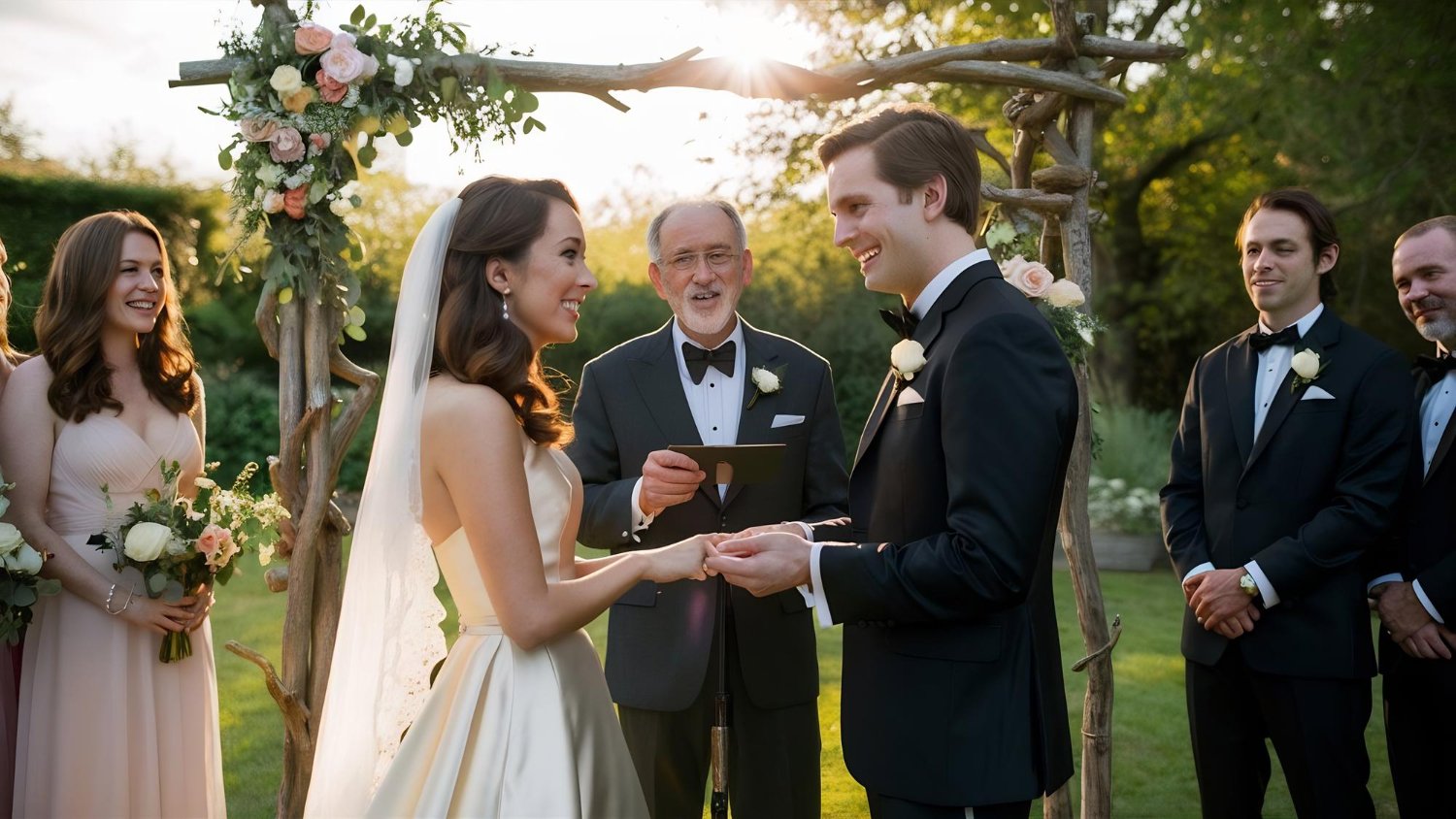
What Happens to the Signed License Afterward
Once the ceremony concludes and every signature is collected, the document’s journey isn’t quite finished, and understanding this final step genuinely completes the picture this guide has built throughout.
Submitting the License for Recording
The signed license needs to actually reach your county’s official records before your marriage is fully, formally documented.
Who Actually Submits It
In most states, the officiant is responsible for submitting the signed license back to the county clerk’s office. This must happen within a specific window, often ranging from a few days to several weeks, depending on your state’s exact rule. Confirm directly with your officiant that they understand and will handle this step, since a signed-but-unsubmitted license doesn’t complete the legal process.
The Submission Deadline
Every state sets its own deadline for returning the signed license, and missing it can genuinely create real complications, sometimes requiring the couple to redo the entire process. Ask your officiant directly what your state’s specific deadline is, and consider following up yourself a week or two afterward to confirm submission actually happened.
Obtaining Your Certified Marriage Certificate
Once recorded, you’ll want an official certified copy for practical purposes like a name change or updating other legal documents.
How Long This Typically Takes
After submission, most counties take anywhere from a few days to several weeks to process the recording. Certified copies become available depending on their specific office’s current workload and procedures. If you need documentation quickly, for an imminent name change or travel purposes, ask directly whether expedited processing is available.
Why Your Witness’s Signature Matters Here Too
A properly witnessed license, where your state requires one, processes without complication. A license missing a required witness signature can genuinely delay or complicate this final step. This is another real reason the witness requirement deserves the direct attention this guide has given it throughout.
A Final Word on Taking This Seriously Without Overthinking It
Every legal detail and state-specific rule covered throughout this guide is worth understanding correctly. None of it should overshadow what the witness role actually represents on your wedding day itself. Someone cared enough to stand beside you at a meaningful moment, and to help make your marriage official.
Keeping Genuine Perspective
The legal mechanics matter, but they shouldn’t dominate how you think about this choice.
Most Weddings Navigate This Smoothly
The overwhelming majority of couples choose a witness, confirm the basic requirement, and move through this step without any genuine difficulty. This guide exists for the specific gaps and edge cases, not because this process is inherently complicated for most weddings.
The Role Matters Beyond the Paperwork
Whoever you choose, the moment itself carries real meaning beyond the legal signature. Someone stood beside you, watched you make this commitment, and helped transform a personal moment into a legally recognized one. That’s genuinely worth honoring, regardless of which state’s specific rule brought you to that moment.
Moving Forward With Confidence
You now have everything this guide set out to provide.
What You’ve Learned Throughout This Guide
Real state-by-state requirements. Who genuinely qualifies, and why the rules vary so widely. How to choose someone thoughtfully, and how to prepare them properly. What actually happens before, during, and after the ceremony itself. And the specific edge cases, elopements, religious ceremonies, virtual attendance, blended families, that change the standard picture in genuinely important ways.
What to Do With This Information Next
Confirm your own specific requirement directly with your county clerk’s office. Choose your witness with real intention, not just convenience. Walk into your wedding day knowing this detail is genuinely, completely handled, freeing you to focus on everything else your wedding day actually means to you.
Witness Considerations for Military and Government Weddings
Couples with a military service member, or marrying at a government facility, sometimes encounter genuinely specific witness considerations beyond standard state civil law.
Military Base Weddings
Ceremonies performed on a military installation sometimes follow slightly different procedural rules than a standard civilian ceremony elsewhere in the same state.
Chaplain-Officiated Ceremonies
Many military weddings use a base chaplain as officiant, and these ceremonies generally still follow the witness requirement of the state where the base is physically located. Confirm this directly with the chaplain’s office, since base-specific administrative procedures can add extra steps beyond the state’s baseline civil requirement.
Deployment and Availability Considerations
If a service member’s schedule creates genuine uncertainty about who will be available to witness, discuss backup options directly with your chaplain or officiant well in advance. Military schedules can shift with less flexibility than a typical civilian timeline allows.
Courthouse and Government Facility Weddings
A courthouse wedding follows the same state witness law as any other ceremony, though the practical environment differs genuinely from a traditional venue.
Bringing Your Own Witness vs. Using Court Staff
Most courthouses allow couples to bring their own witness, though some also offer court staff or other available personnel to serve if a couple arrives without one. Confirm your specific courthouse’s actual practice directly, since this varies by jurisdiction even within the same state.
Same-Day Scheduling Realities
Courthouse weddings are often scheduled with less lead time than a traditional wedding. This makes witness planning something worth confirming immediately once your court date is set, rather than leaving it until the day itself arrives.
Documenting Your Witness’s Role for Your Own Records
Beyond the legal signature itself, some couples find genuine value in keeping their own personal record of who witnessed their marriage and why they were chosen.
Why This Matters Beyond the Legal Requirement
A personal record adds meaning that the bare legal document alone doesn’t capture.
A Genuine Keepsake Beyond the Certificate
Some couples write a short note, kept alongside their marriage certificate, explaining who their witnesses were and why they chose them specifically. This becomes a genuinely meaningful piece of your own wedding history, worth having decades later when the specific memory might otherwise fade.
Photos as Practical Documentation
A simple photo of your witness signing the license gives you something concrete to look back on, beyond the official paperwork itself. Take it purely for your own keepsake, not for any legal purpose.
Practical Record-Keeping
Beyond sentiment, keeping organized records genuinely helps with practical needs down the road.
Storing Copies of Key Documents
Keep a copy of your certified marriage certificate in a safe, accessible place, along with any notes about your witnesses. This is genuinely useful if you ever need to reference these details for legal or administrative purposes years later.
Sharing the Story With Future Generations
Many couples find that the story of who witnessed their marriage, and why, becomes a genuinely treasured piece of family history. Document it clearly enough that children or grandchildren can appreciate it someday.
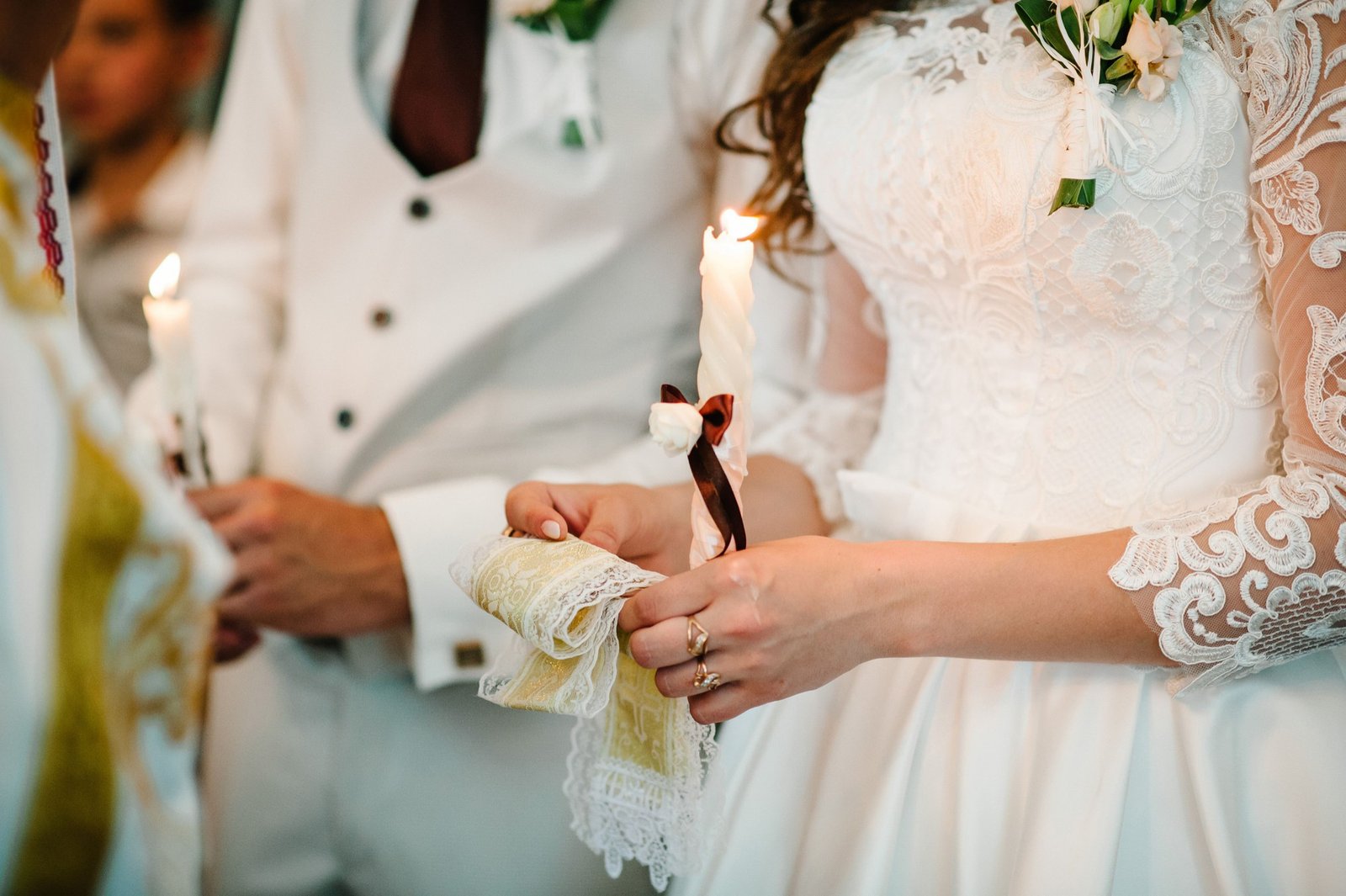
A simple courthouse ceremony, made official
Common Myths About Wedding Witnesses Worth Dropping
A handful of persistent myths circulate widely in wedding planning conversations, worth directly correcting before this guide closes.
Myths About Who Can Serve
These misconceptions genuinely limit couples unnecessarily, making an easy decision feel more restricted than it actually is.
“Witnesses Must Be Close Family or Wedding Party Members”
This is genuinely false almost everywhere. Covered extensively throughout this guide, virtually no state restricts witness eligibility based on relationship to the couple. A stranger, a coworker, or a distant acquaintance all qualify exactly as well as a sibling or best friend does.
“You Need a Witness to Get Married Anywhere in the US”
Also false. Roughly half the country requires no witness at all, and Colorado plus Washington, DC allow couples to skip even the officiant. This myth persists largely because two-witness states are genuinely the largest single category, creating a false sense of national uniformity.
Myths About the Process Itself
Beyond who can serve, a few myths about the actual mechanics deserve direct correction too.
“The Witness Must Give a Speech or Formal Statement”
This isn’t required anywhere. A witness’s entire legal obligation is observing the ceremony and signing the license afterward. Any speech or toast is a purely optional, separate tradition, not a legal requirement tied to the witness role itself.
“Witness Requirements Are the Same as Getting the License”
Covered in detail earlier in this guide, these are genuinely two separate steps with often different rules. Most states don’t require a witness at the license application stage, even in states that require one at the ceremony itself.
Appendix: A Complete Question List for Your Own Planning
For couples just starting this process, here’s a consolidated set of questions drawn from every relevant section throughout this guide, worth bringing to your own planning conversations.
Questions for Your County Clerk
These questions get you the authoritative, current answer for your exact location.
On the License Itself
How many witnesses does our specific county require at the ceremony? What’s the minimum age, and is photo identification required? Does the license application itself require a witness, separately from the ceremony?
On Special Circumstances
Do you offer a confidential or private license option that waives the witness requirement? What’s the deadline for returning the signed license after our ceremony? What happens if we can’t locate an eligible witness on the day itself?
Questions for Your Officiant
These questions confirm how the actual day-of logistics will unfold.
On Their Experience and Process
Have you performed ceremonies in this specific state before, and are you familiar with its exact witness requirement? When and where do you recommend the signing take place during our timeline? Who’s responsible for submitting the completed license afterward?
On Backup Planning
What’s your experience with a witness becoming unavailable at the last minute? Can you help us find a witness if we arrive without one? What happens if our specific state’s requirement isn’t met for some reason on the day itself?
An officiant or clerk who answers these questions specifically and confidently, rather than vaguely, is signaling something real. It’s exactly the kind of genuine expertise this entire guide has emphasized finding throughout.
A Very Last Practical Note
If you take away just one action item from this entire guide, make it this. Before you finalize any other wedding detail, confirm your specific state and county’s actual witness requirement directly with the office issuing your license. That single confirmation, more than any other piece of advice in this guide, is what actually prevents the exact scramble this guide opened with.
Every other detail, who to ask, how to prepare them, what happens afterward, follows naturally once you know that one foundational fact. Congratulations on your upcoming wedding, and here’s to a ceremony that’s not just meaningful, but properly, completely documented too.

The moment that makes it legal
Regional Variation Within States Worth Knowing
Beyond state-level law, county and city-level procedures sometimes add genuine local nuance on top of the baseline state requirement. This is worth understanding, before assuming statewide rules apply identically everywhere within a state.
Why Counties Can Differ Within the Same State
State marriage codes typically set a minimum standard, but individual counties sometimes administer the process with their own additional local procedures layered on top.
Local Clerk Discretion
Some county clerk offices interpret ambiguous state language more strictly than others, particularly around identification requirements or acceptable forms of proof for a witness’s age. This is exactly why this guide has repeatedly emphasized confirming directly with your specific county, not just your state generally.
Urban vs. Rural County Differences
Larger, urban counties sometimes have more standardized, high-volume procedures, while smaller rural counties may handle marriage licensing more informally, with a single clerk personally familiar with local practice. Neither approach is better, but they can genuinely feel different if you’re used to one and encounter the other.
New York City as a Specific Example
New York State’s witness requirement carries a genuinely specific nuance worth understanding if you’re marrying within the five boroughs.
NYC’s Additional Witness Expectation
New York State generally requires one witness. New York City specifically has been known to expect two in practice, though. This detail doesn’t always appear clearly in general statewide guidance. Couples marrying in NYC specifically should confirm this directly with the city clerk’s office rather than relying on the broader state-level figure alone.
Why This Example Matters Broadly
This NYC-specific nuance illustrates exactly why this guide has repeatedly pointed couples toward their specific local office. Don’t treat any state-level summary, including the ones provided throughout this guide, as the final, unconfirmed word for your exact location.
Final Thoughts on Building Your Own Plan
This guide has covered a genuinely large amount of ground. Real state-by-state witness requirements, and exactly who qualifies. How to choose and prepare someone thoughtfully. And every specific circumstance, elopements, religious ceremonies, military weddings, blended families, that changes the standard picture. You don’t need to apply every single section in order.
Using This Guide as an Ongoing Reference
Different sections will matter at different points in your own planning process, not all at once.
Early Planning Priorities
Early on, focus specifically on confirming your state’s actual requirement and identifying who you’d like to ask. These two steps genuinely shape everything else that follows.
Closer to the Wedding Day
As your date approaches, return to the sections on preparation, logistics, and backup planning, making sure every practical detail is genuinely confirmed rather than assumed.
A Genuine Closing Reminder
Pull whatever’s relevant to your specific situation, and skip what doesn’t apply to your own circumstances.
Sharing This Knowledge With Your Wedding Party
If your witness role involves someone from your wedding party or family, consider sharing the relevant sections of this guide directly with them. The parts covering what they’ll actually need to bring and do matter most. This genuinely helps them feel prepared rather than simply told where to stand on the day itself.
Returning Here as New Questions Arise
Return to any specific section as a reference whenever a new question comes up during your own planning process. That’s genuinely what this guide is here for, from your very first planning conversation through the moment your witness’s signature makes everything official.
One Last Word
Somewhere in the middle of planning flowers, venues, and vows, this guide hopes you’ve found a genuinely clear answer to a question that rarely gets the attention it deserves. Wedding witness requirements aren’t complicated once you know your specific state’s actual rule. Choosing the right person for this role can become one more genuinely meaningful part of your wedding day, rather than a last-minute scramble squeezed in between more visible details.
Confirm your requirement, choose thoughtfully, prepare your witness well, and walk into your ceremony knowing this detail is handled completely. That confidence, more than any single fact in this guide, is what actually makes the difference between a stressful surprise and a smooth, properly documented beginning to your marriage.
Thank You
Thank you for reading this guide in full. Wedding planning involves countless decisions, both large and small, and the witness requirement genuinely deserves more attention than it typically receives in most planning resources. Carrying accurate, complete, state-specific information into this decision protects both the legal validity of your marriage and your own peace of mind heading into the day itself. Wishing you a smooth planning process, a properly witnessed ceremony, and a marriage that begins exactly as it should, fully and correctly documented from the very first moment.
Complete
This guide is now finished. It covers wedding witnesses from every genuine angle a real couple encounters. The exact legal requirements state by state, who genuinely qualifies, how to choose someone well, and every specific circumstance that changes the standard picture. Return to it whenever your own planning raises a new question, and approach this small but genuinely meaningful role with the informed confidence it deserves throughout your entire wedding journey.
Congratulations again on your upcoming wedding, and genuinely good luck with everything ahead of you both, from this very first legal detail through every year of marriage that follows.
Whatever your state requires, whoever you choose, and whatever specific circumstances shape your own wedding, this guide has genuinely tried to leave nothing important unaddressed.
Congratulations, truly and genuinely, on this next chapter of your life together.
