

Holiday Engagement Announcement Etiquette for Family, Friends, and Social Media
Getting engaged over the holidays means the news travels before you have decided anything about it. Half the family was in the room, someone’s phone was out, a cousin posted a photo within the hour, and by the time you called your grandmother she already knew — from a Facebook comment thread.
That is the situation engagement announcement etiquette exists to prevent, and it is worth saying plainly what it is and is not. It is not a set of rules about the correct order of names on a card. It is the practical business of making sure the people who love you hear something significant in a way that matches how much they matter to you — and that nobody important learns it from a stranger’s comment.
The reason this matters more than it sounds is that people react to two separate things: the news itself, and how they found out. The first is almost always happy. The second is where the friction lives. A parent who hears from a sibling, a best friend who sees a post, a child who learns at the same moment as forty relatives — each of those can leave a small, durable dent that has nothing to do with whether they are pleased for you.
Holiday timing compresses all of it. A couple engaged in June tells people gradually over a week. You may have thirty people to inform in a single afternoon, several of whom are already in the same house, plus a workplace that reopens in January, plus complicated family relationships that a gathering does not simplify.
This guide covers the order that works and why, scripts you can adapt for calls, texts, and posts, how to handle divorced and blended families, children, workplaces, and social media, what to say about the ring and its price, and how to repair things when someone is hurt. It closes with a checklist you can work through in an evening. None of it assumes who proposed, that parents are involved, or that you want a public announcement at all.
What Announcement Etiquette Is Actually For
The two things people react to
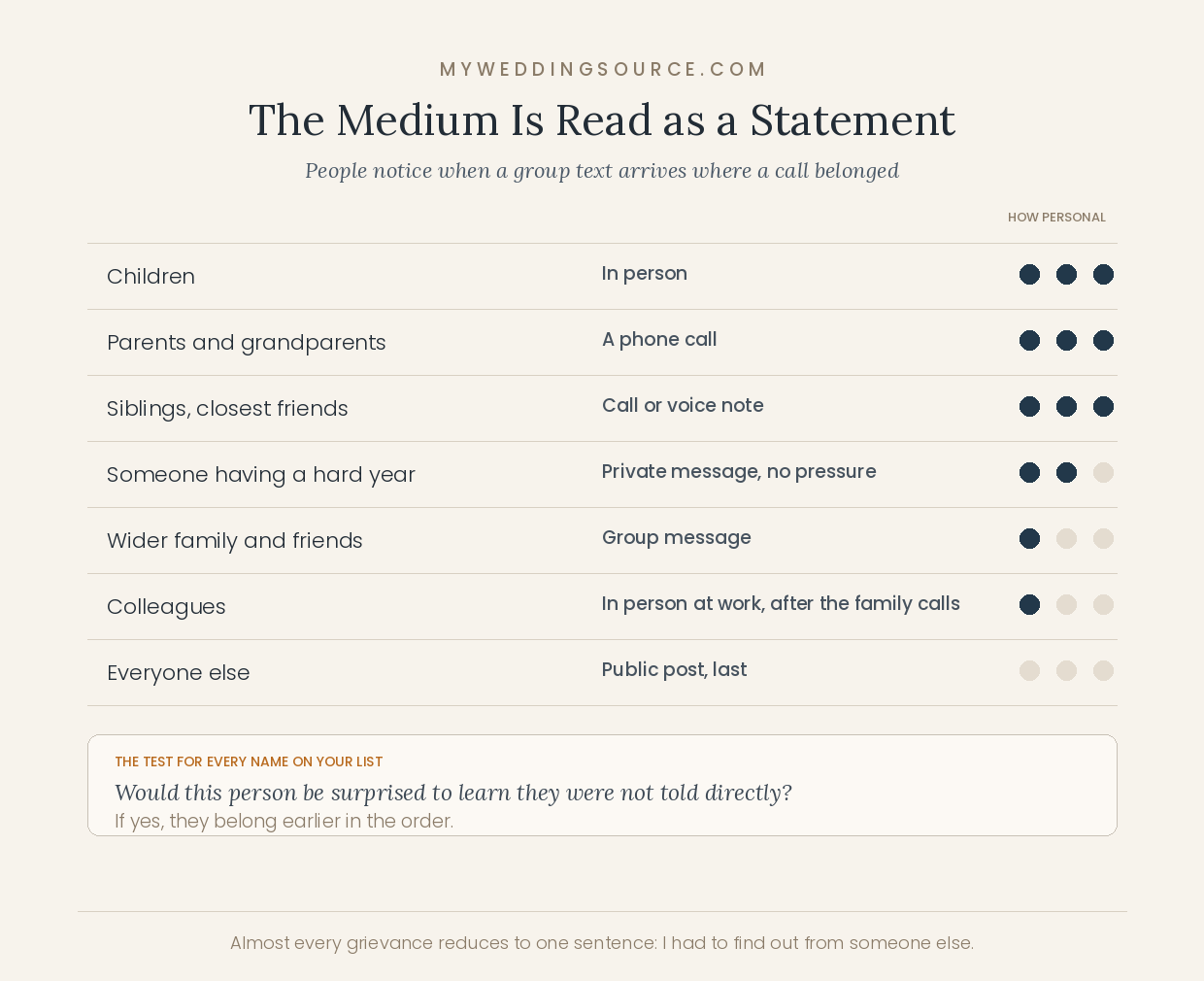
Almost every announcement grievance you will hear reduces to one sentence: “I had to find out from someone else.” The news was welcome; the route was not. Understanding that gives you a simple test for every decision in this guide: would this person be surprised to learn they were not told directly? If yes, they belong earlier in your order.
The second reaction people have is about proportion. A grandparent who gets a group text where a cousin got a phone call notices. So does a close friend who finds out in a public post while an acquaintance was messaged privately. The medium is read as a statement about the relationship, whether or not you meant it that way.
The holiday compression problem
Under normal circumstances you control the pace. A holiday engagement takes that away in three ways. People are physically together, so the news spreads in a room rather than through channels you chose. Phones are out, and someone else’s photo can become the announcement. And everyone is between gatherings, so the person you planned to call tomorrow will see three relatives tonight.
The fix is not speed. It is a short, deliberate list and one instruction to everyone present, both covered below.
The single principle
If you remember nothing else: tell people in an order that reflects your relationships, in a medium that reflects your relationships, and ask everyone who already knows to stay quiet until you are finished. Every specific piece of advice in this guide is that principle applied to a particular situation.
The sentence that does the most work
“We’re telling everyone ourselves over the next couple of days — would you mind not posting anything until we do?” Say it to every person who was present, including the ones you are certain would never post.
Who to Tell First, and How Long It Should Take
The order below is a default, not a law. Adjust it to your actual relationships — a couple whose closest person is an aunt or a former roommate should tell that person where the list says “parents.”
1. Children
If either of you has children, they come first, privately, before any adult outside the room. Hearing about a parent’s engagement in a crowd removes their ability to react honestly, and their reaction — whatever it is — deserves privacy. This holds regardless of age, and it holds even when you are confident they will be delighted.
2. Parents, or whoever functions as parents
By phone or in person, not by text. If you are in the same house, this is a short conversation somewhere quiet rather than an announcement to the room. If parents are divorced, tell them separately and on the same day; there is a whole section on that below.
Some couples tell parents before proposing. If yours already knew, they still deserve the “it happened” call before anyone else gets it.
3. Grandparents and elders
Frequently the most affected by how they learn things, and the least likely to see a post. A phone call is worth the ten minutes. If travel or health makes a call difficult, ask a relative to be with them when you call rather than delegating the news itself.
4. Siblings and the closest few friends
A call, a voice note, or a video call. This is the group most likely to be hurt by a group text, because they consider themselves individually close to you rather than part of a category.
5. Anyone whose situation makes this delicate
A friend going through a divorce, a breakup, a fertility struggle, or a recent loss. A separate, gentler, earlier message costs you two minutes and means they hear it in a form that lets them respond privately. More on this below.
6. Wider family and the broader friend group
Group chats, messages, and calls as suits each relationship. This is where volume is fine and speed becomes helpful.
7. Everyone else, publicly
A social post, if you want one. It reaches everybody at once, which is exactly why it comes last.
How long the whole thing should take
Twenty-four to seventy-two hours is a realistic window for the personal calls, and posting before you finish them is the single most common misstep. If you cannot reach someone important within that window, either delay the public post or send them a private message first that says the call is coming.
Two useful habits during the process: keep a written list and cross names off, because you will genuinely lose track after fifteen conversations, and split it between you — each of you takes your own family, which is faster and prevents the awkwardness of your partner breaking your family’s news.
Sample Scripts
Adapt the wording; the structure is what matters. Each of these does the same three things: delivers the news, names the relationship, and sets an expectation about timing.
Calling a parent
“Are you free for a minute? We have news — we got engaged last night. We wanted you to hear it from us before anyone else. We’re calling a few people today and then we’ll probably post something in a day or two.”
If they ask about the wedding: “We haven’t got anywhere near that yet. We’ll start thinking about dates in the new year.”
Telling a child (roughly 6–12)
“We wanted to tell you something before we tell anyone else, because you’re the most important person in this. Sam and I are getting married. That means we’ll be a family officially, and it doesn’t change anything about how much I love you or how things work with your mom. You can ask me anything, and it’s okay if you have big feelings about it.”
Then stop talking and let them react. Silence is not rejection; it is processing.
A sibling or closest friend, by voice note or text
“I wanted you to hear this from me before it goes anywhere else — we got engaged! I’ll call you properly tonight, I just couldn’t wait to tell you. Please keep it off the internet until the weekend, we’re still telling family.”
A friend going through something hard
“I have some news and I wanted to tell you privately rather than have you see it somewhere. We got engaged this weekend. I know this year has been really hard for you, and there’s absolutely no need to respond to this right now or at all. I love you and I’m not going anywhere.”
Do not follow up asking why they have not replied. Give it a week.
A co-parent or former spouse
“I wanted to let you know before the kids mention it: Sam and I got engaged. I’ve told them already. Nothing about our arrangements changes, and I’ll keep you posted on anything that might affect their schedule.”
Brief, factual, and focused on the children. This is a courtesy, not an invitation to discuss the relationship.
Someone you missed
“I’m so sorry — I meant to call you before you saw anything online and I completely lost track of who I’d reached. You should have heard it from me. Can I call you tonight and tell you properly?”
The last script is the most useful one on this list, because you will need it. With thirty people to tell in two days, someone gets missed, and a fast, unqualified apology repairs almost all of it.
Divorced, Blended, and Complicated Families
Divorced parents: separately, same day
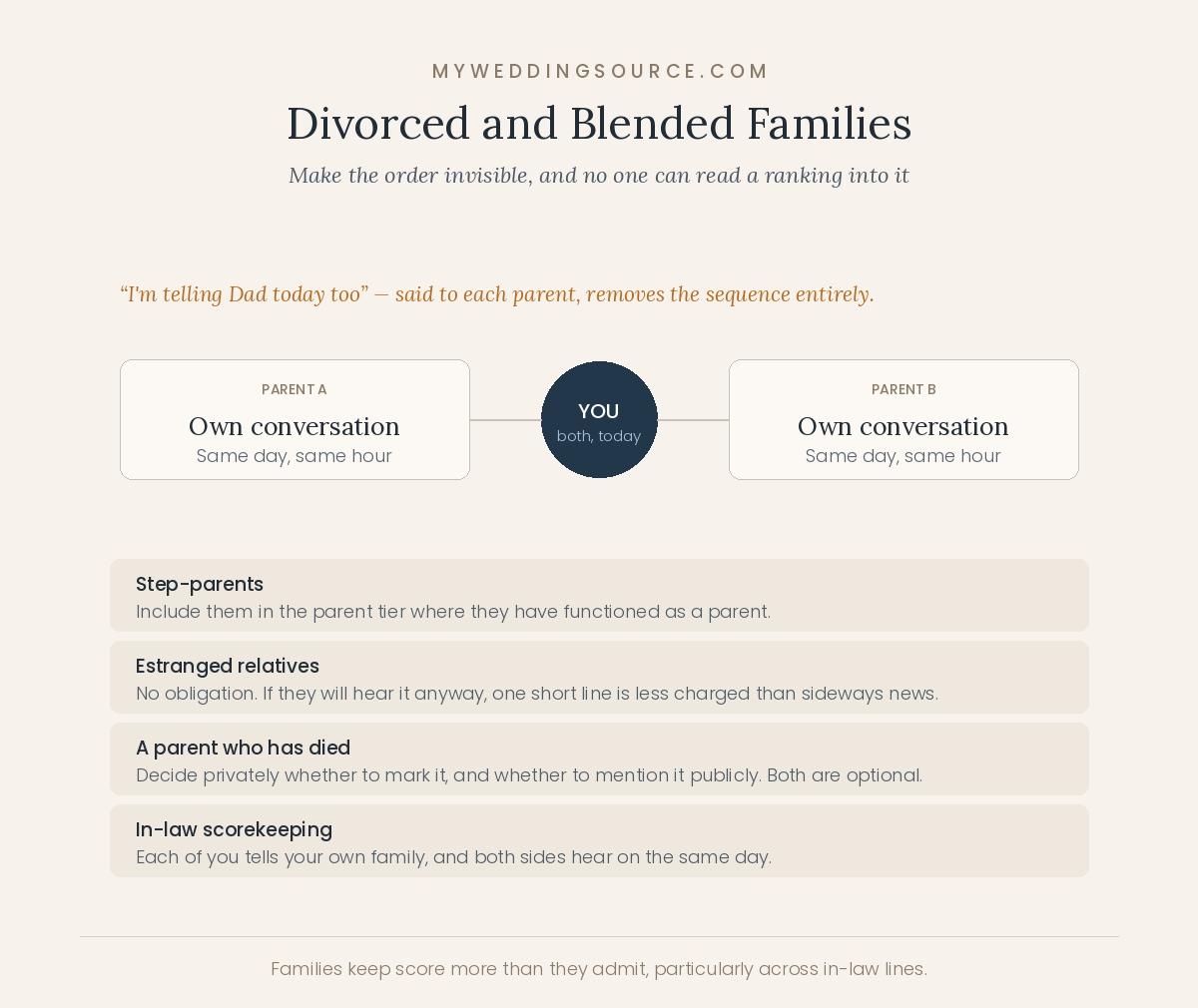
Tell each parent individually, in their own conversation, on the same day. Do not tell one and leave the other until tomorrow, and do not tell them together unless they have an established comfortable relationship and you know they would both prefer it.
If there is a difficult history, expect an unspoken competition about who was told first. You can defuse most of it by making the order invisible: call them within the same hour, and mention to each that you are telling the other today. Neither can then draw a conclusion from the sequence.
Step-parents and bonus parents
Include them in the parent conversation where they function as a parent. If a step-parent has been in your life for twenty years, learning about your engagement in the room after your biological parent has already been told privately is a distinction they will feel.
Where the relationship is more distant, the sibling or wider-family tier is appropriate and unremarkable.
Estranged relationships
There is no obligation to tell someone you are estranged from, and there is also no rule against it. Two practical considerations. First, decide whether they will hear it anyway through mutual family; if they will, telling them directly is usually less charged than letting it arrive sideways. Second, if you do reach out, keep it short and expect nothing in return.
A workable message: “I wanted you to hear from me that I’m engaged. I hope you’re well.” That is complete. You are not obliged to add anything about the relationship or the future.
The “who told whom” ledger
Families keep score more than they admit, particularly at holidays and particularly across in-law lines. The two habits that prevent most of it: each of you tells your own family, so nobody is hearing about their child’s engagement from someone else’s child; and both sets of parents hear on the same day, ideally within the same few hours.
When a parent has died
If one of you has lost a parent, the announcement can carry an ache that surprises people around you. Two things help. Decide privately whether you want to mark it — some couples visit a grave, light a candle, or simply say the person’s name out loud together — and decide whether to mention it publicly, which is entirely optional and often better kept off a post.
If a surviving parent is grieving, telling them privately and unhurried, with room for a complicated reaction, is kinder than including them in a group announcement.
Telling Children
First, privately, and with room to react
Children hear this best from their own parent, in a quiet moment, with the other adult either present or nearby depending on the relationship. Say it simply, say what will and will not change, and then stop and listen.
Allow for a reaction you did not want. Anger, tears, indifference, and questions about a parent who is not in the room are all normal, and none of them is a verdict on the marriage. A child who says “I don’t care” at eight is frequently delighted at nine. The response that helps is acknowledgment rather than persuasion: “That makes sense. You can feel however you feel about it.”
Age-appropriate framing
- Very young children need the concrete version: who will live where, what they will call the new person, whether anything changes about school or their room.
- School-age children often worry about loyalty to the other parent. Say directly that this does not replace anyone.
- Teenagers may need time more than conversation. Tell them, answer questions, then give them space rather than requesting enthusiasm.
- Adult children deserve the same courtesy as any close family member: a call, before anyone else, and no announcement they have to react to publicly.
Involving them in the announcement
Some children love being part of it — appearing in the photo, helping tell grandparents, being the one who says it at dinner. Others would hate it. Ask rather than assume, and do not make their participation a condition of the moment being complete.
A note on the co-parent
Telling a former partner before the children mention it is a courtesy that costs nothing and prevents an awkward phone call. Keep it factual and about logistics. If your relationship is difficult, a written message is fine and is often better.
The Workplace Announcement
When, and whether, to tell colleagues
There is no obligation to announce an engagement at work, and plenty of people simply do not. If you want to, the timing is straightforward: after the personal announcements, and generally on a normal working day rather than in a holiday-season all-hands.
Manager first, then the team
If your engagement will eventually affect your schedule — time off for a wedding, a honeymoon, possibly a relocation — your manager hearing it from you rather than from a group chat is worth ten minutes. That conversation does not require any detail: “I got engaged over the holidays. We haven’t set a date yet, but I wanted you to know so we can plan time off sensibly when we do.”
Then the team, in whatever way suits your workplace. In many offices the ring does the announcing before you say anything, which is fine.
What not to share at work
- The price of the ring, or any figure connected to it.
- Dates you have not confirmed. Colleagues remember and plan around them.
- Detailed personal circumstances — family conflict, money, previous relationships.
- Anything you would not want repeated, because workplace news travels with unusual speed.
Client-facing and public roles
If your work is public — teaching, healthcare, media, sales, anything with a personal profile — decide in advance what appears on which account. A personal post that reaches clients or students is not necessarily a problem, but it is better as a choice than a discovery. Check your privacy settings before the post rather than after.
If a colleague is going through something
The same courtesy as with friends applies. If someone on your team has recently had a loss, a divorce, or a difficult health year, a quiet word beforehand is kinder than letting them hear it in a celebratory group moment where they have to perform delight.
Social Media: Timing, Photos, and the Embargo
The timing rule
Post after the personal announcements, not before. In practice that means twenty-four to seventy-two hours after the proposal for most couples, and longer if key people are unreachable over the holidays. A public post is an announcement to everyone you have not called yet, which is precisely why it comes last.
There is no rule that you must post at all. Some couples never do, some post months later, and some share only in private groups. None of that is a failure of etiquette.
The embargo, and how to ask for it
The most common way a holiday engagement announcement goes wrong is that someone else posts first — usually a delighted relative who did not consider that you had not called your grandmother yet.
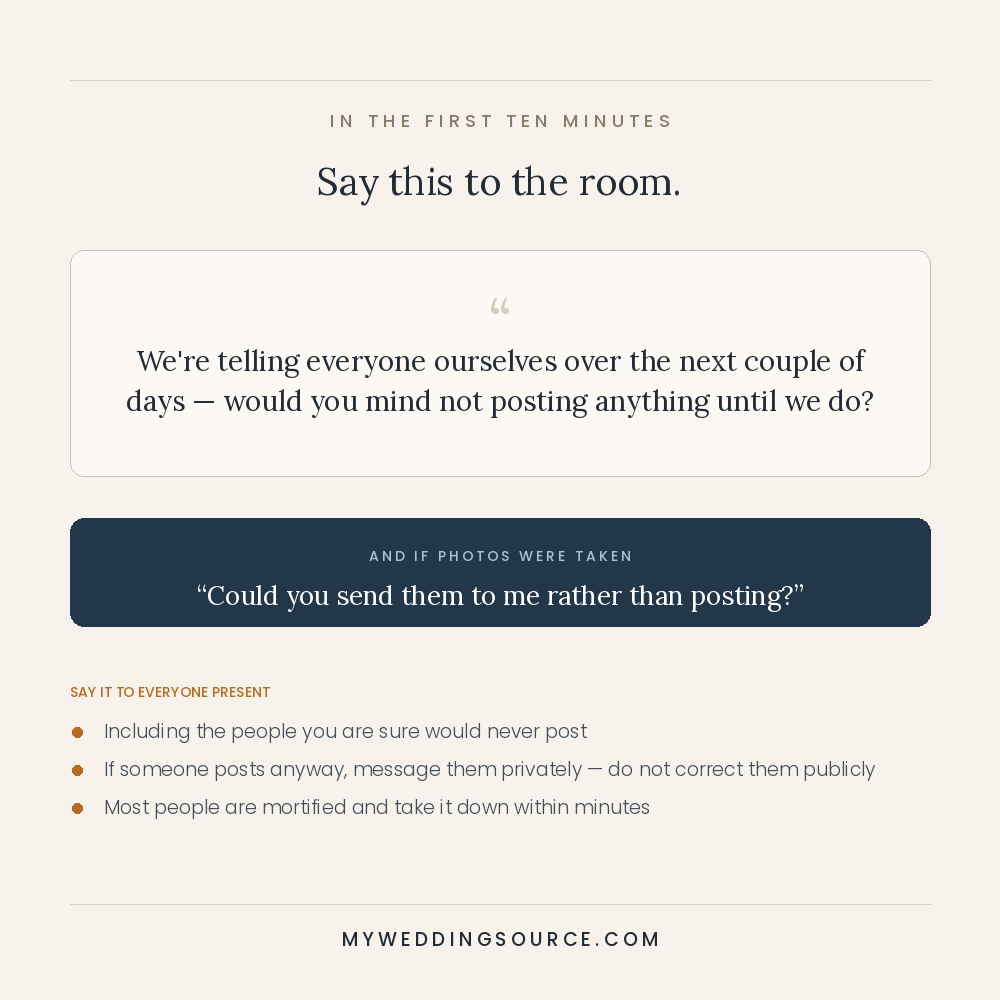
Prevent it with one sentence said to everyone present, warmly and immediately: “We’re telling people ourselves over the next couple of days — would you mind not posting anything until we do?” Say it even to people you are sure would never post. If a photo was taken, add: “Could you send me the pictures rather than putting them up?”
If someone posts anyway, assume good intent. A private message — “Would you mind taking that down for a day? We haven’t told my grandparents yet” — works far better than a public correction, and most people are mortified and comply immediately.
What to include, and what to leave out
A good announcement post is short. What tends to work: a photograph you both like, a sentence in your own voice, and nothing else. What tends to cause friction:
- A date you have not confirmed. It becomes fixed in people’s minds and calendars.
- Anything that reads as a guest-list signal, such as tagging a specific group of friends as “the crew who’ll be there.”
- The ring’s price, in any form, including jokes about it.
- Location details that reveal where you live, particularly alongside a close-up of a valuable ring.
- A story that is not yours to tell, such as a family member’s reaction or a private circumstance.
Ring photos and the security angle
Close-up ring photographs are the standard announcement image and they are worth two moments of thought. A high-resolution close-up combined with a public account, a tagged location, and travel posts is more information than most people intend to publish. If your account is public, consider a photo of both of you rather than a jewelry close-up, or post the close-up without location tags.
This is not a reason for anxiety; it is a reason to check your settings once before posting rather than never.
Three caption approaches
Short and plain
“We’re engaged. Best weekend.”
Warm and specific
“Twelve years ago he asked if I wanted to split a cab. On Saturday he asked something else. Yes to both.”
Boundary-setting, gently
“We got engaged over the weekend and we’re still floating. No date, no venue, no plan — we’ll get there. Thank you for all the love.”
The third version does real work: it answers the two questions everyone is about to ask, in public, once, so you do not answer them forty times in the comments.
Private accounts, tagging, and people who are not online
Check who can see the post, and remember that tagging your partner exports it to their entire network, which may include their workplace. Agree between you before either of you posts.
Anyone important who is not on social media needs a direct message or call regardless. It is easy to feel that you have announced it when in fact you have announced it to the half of your circle that happens to be online.
The price question
Someone will ask, usually cheerfully and without meaning any harm. You are not required to answer, and a light deflection is entirely polite:
“Enough that it’s insured!”
“We’re keeping that one between us, but thank you — I love it.”
And if they press: “I’d rather not say, but I appreciate you asking about it.”
Sharing the figure tends to change how people talk about the ring, and occasionally about the wedding budget, which is a conversation that becomes harder once numbers are in circulation.
Showing the ring
Holding your hand out is the norm and is fine. Taking the ring off and passing it around a room is where losses and damage happen, particularly at gatherings involving drinks, small children, and coat pockets. “I’d rather not take it off, but come and look” is a normal thing to say and nobody will remember it an hour later.
If there is no ring, or an unconventional one
Plenty of couples have no ring, matching bands, a family piece, an alternative stone, or a ring arriving later. Expect a beat of confusion from people whose script assumes a diamond, and have one cheerful sentence ready: “We’re doing bands instead,” or “It’s being made — I’ll show you in February.” Delivered lightly, it ends the topic without any defensiveness.
Handling Hurt Feelings
With thirty conversations in two days, someone will be hurt. Usually it is small and easily repaired. The mistake couples make is treating the complaint as an accusation to be defended rather than a feeling to be acknowledged.
The four common complaints
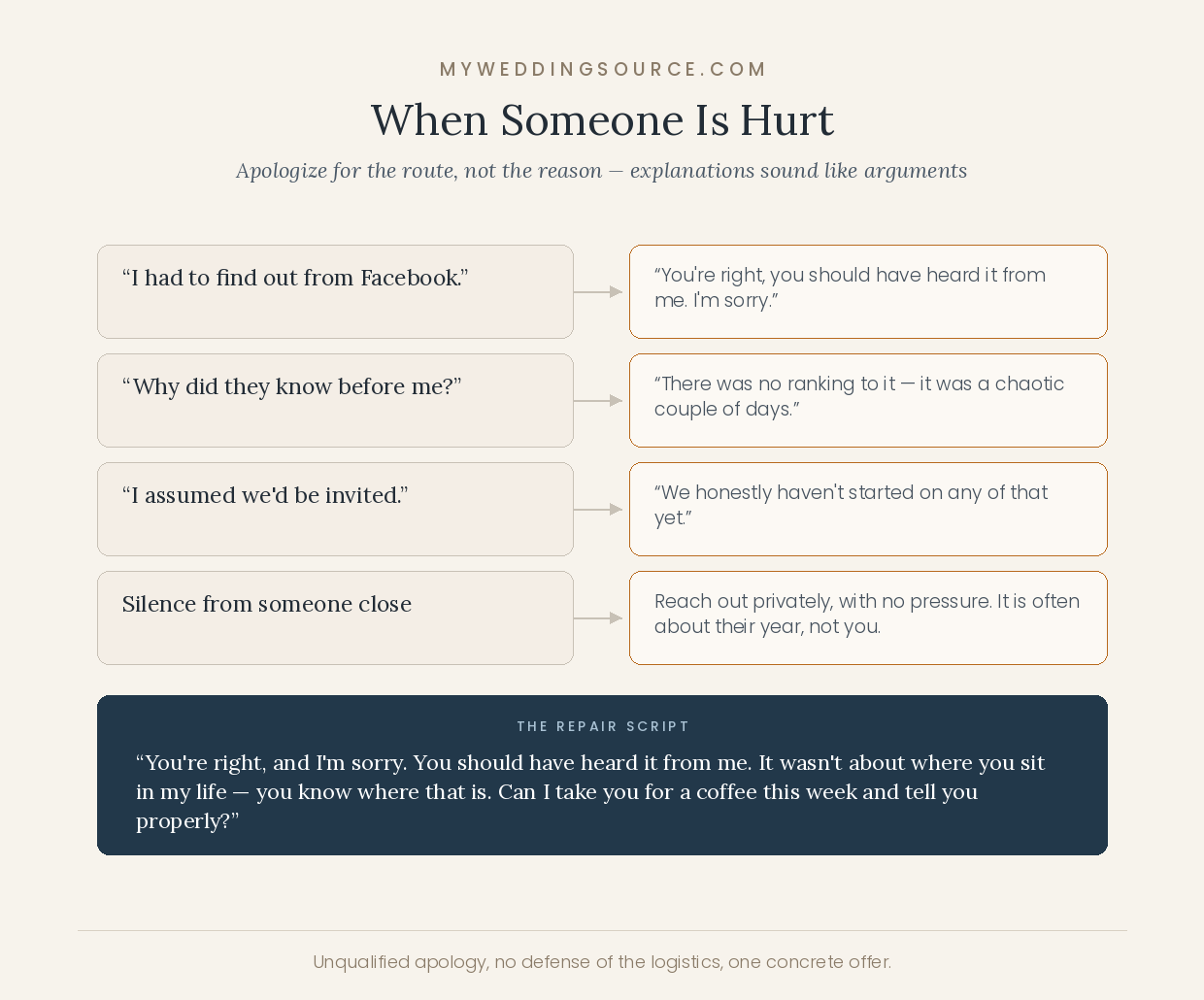
| What they say | What tends to work |
|---|---|
| “I had to find out from Facebook.” | Apologize for the route without defending the reason. “You’re right, you should have heard it from me. I’m sorry.” |
| “Why did they know before me?” | Do not litigate the order. “There was no ranking to it — it was a chaotic couple of days and I’m sorry it came out that way.” |
| “I assumed we’d be invited.” | Say nothing that sounds like a promise. “We honestly haven’t started on any of that yet.” |
| Silence from someone close | Reach out privately and without pressure. It is often about their own circumstances rather than about you. |
A repair script
“You’re right, and I’m sorry. You should have heard it from me directly and I got completely lost in a very chaotic weekend. It wasn’t about where you sit in my life — you know where that is. Can I take you for a coffee this week and tell you properly?”
Three elements make it work: an unqualified apology, no defense of the logistics, and a concrete offer. The most common repair failure is explaining why it happened, which sounds like an argument that the hurt is unwarranted.
When someone escalates
Occasionally an announcement grievance is really about something older, and no apology resolves it. When a conversation becomes about a long-running family issue rather than about a phone call, the answer is to stop expanding it: acknowledge the feeling, decline the argument, and let it rest.
If it is your family, you handle it. That division — each of you manages your own relatives — prevents more conflict in an engagement year than any other single habit.
When you were the one hurt
Sometimes the announcement produces a reaction that stings: a parent who is unenthusiastic, a friend who goes quiet, a sibling who changes the subject. Give it a week before drawing conclusions. Reactions to engagements are frequently about the other person’s own situation, and many of the coolest first responses warm up considerably once the news settles.
What an Announcement Implies About Invitations and Gifts
The guest-list trap
Every announcement conversation contains an invitation to say something you cannot take back. Keep one answer for the whole week: “We haven’t got anywhere near that yet.” Anything more specific is remembered as a promise, and at a holiday gathering you will have twenty opportunities to be generous in a way that costs you in month six.
Engagement parties
An engagement party is optional and traditionally hosted by someone else, most often a parent or close friend. If one is offered, one convention is worth knowing before you accept: anyone invited to an engagement party is generally expected to be invited to the wedding. That makes the guest list for a party you did not plan into a wedding decision you have not made. Later is better, and “let’s wait until we know what the wedding looks like” is a complete answer.
Gifts
Engagement gifts are not expected, and they do appear. Acknowledge each one personally within a couple of weeks — a written note where the relationship warrants it, a message where it does not. A registry is not appropriate at the announcement stage; it belongs later, alongside save-the-dates, and mentioning one now reads as a request. Emily Post’s overview of celebrating an engagement covers the traditional conventions if you want a fuller picture of where these expectations come from.
Announcements in print
Newspaper and local paper announcements still exist and are largely a family tradition question. If a parent asks to place one, the practical points are that it should follow your personal announcements, that you approve the wording and photograph, and that it should not include your home address or the wedding date if that has not been settled.
Common Mistakes
Posting before the calls are done
The single most common and most avoidable. Finish the list, then post.
Not asking the room to hold off
One sentence, said warmly to everyone present, prevents most announcement disasters. Say it in the first ten minutes.
Telling one divorced parent a day before the other
Same day, separately, ideally within the same hour. The gap is read as a ranking whether you meant one or not.
Letting a child hear it in a crowd
They lose the ability to react honestly, and their honest reaction is the one that matters most.
Announcing in a group text what deserved a call
The medium is read as a statement about the relationship. Grandparents, siblings, and closest friends notice.
Answering the guest-list question
All week, in every conversation, the answer is that you have not got there yet.
Defending yourself when someone is hurt
Apologize for the route, not the reason. Explanations sound like arguments.
Forgetting the people who are not online
A post is not an announcement to anyone who does not use the platform. Keep a written list and cross names off.
Sharing the ring’s price
It changes how people talk about the ring and, later, about your budget. A light deflection is entirely polite.
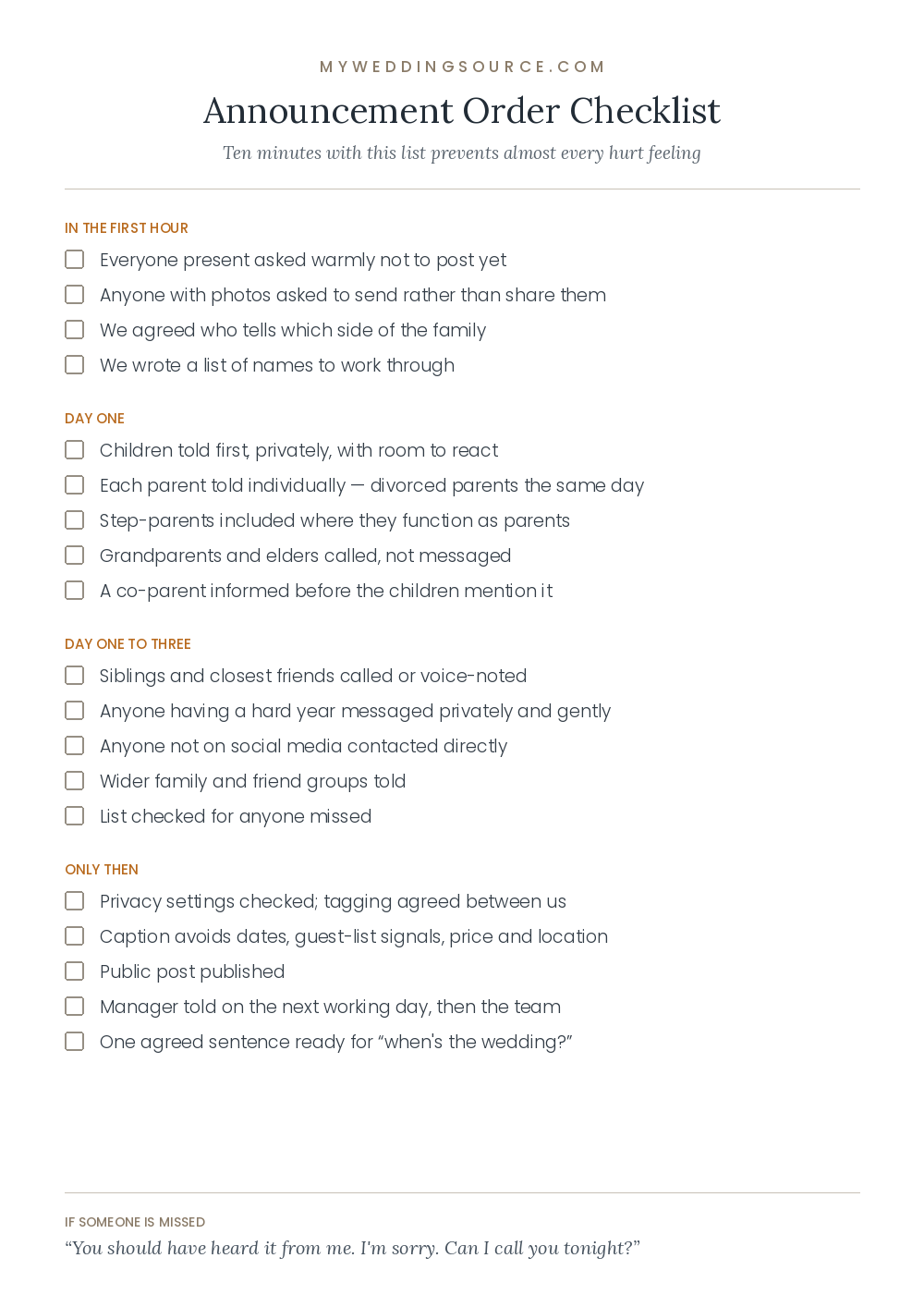
The Announcement-Order Checklist
In the first hour
- ☐ Everyone present asked warmly not to post yet
- ☐ Anyone who took photos asked to send rather than share them
- ☐ We agreed between us who tells which side of the family
- ☐ We wrote a list of names to work through
Day one
- ☐ Children told first, privately, with room to react
- ☐ Each parent told individually — divorced parents on the same day
- ☐ Step-parents included where they function as parents
- ☐ Grandparents and elders called, not messaged
- ☐ A co-parent informed before the children mention it
Day one to three
- ☐ Siblings and closest friends called or voice-noted
- ☐ Anyone going through something hard messaged privately and gently
- ☐ Anyone not on social media contacted directly
- ☐ Wider family and friend groups told
- ☐ List checked for anyone missed
Only then
- ☐ Privacy settings checked; tagging agreed between us
- ☐ Caption avoids dates, guest-list signals, price, and location
- ☐ Public post published
- ☐ Manager told on the next working day, then the team
- ☐ One agreed sentence ready for every “when’s the wedding?”
Frequently Asked Questions
Who should we tell first when we get engaged?
Children first if either of you has them, privately and before any adult outside the room. Then parents or whoever functions as parents, individually and by call rather than message. Then grandparents and elders, then siblings and your closest few friends, then anyone whose personal situation makes the news delicate, then wider family and friends, and only then a public post. Adjust the order to your actual relationships rather than to convention: if your closest person is an aunt or a former roommate, they belong near the top.
How long should we wait before posting on social media?
Long enough to finish the personal calls, which for most couples is twenty-four to seventy-two hours. The post reaches everyone at once, so it functions as an announcement to every person you have not yet told. If someone important is unreachable over the holidays, either delay the post or send them a private message saying a proper call is coming. There is also no obligation to post at all, and plenty of couples never do.
How do we stop relatives posting before we do?
Ask, warmly and immediately, in the first ten minutes: “We’re telling people ourselves over the next couple of days — would you mind not posting anything until we do?” Say it to everyone present, including the people you are certain would never post, and ask anyone with photos to send them to you rather than sharing. If someone posts anyway, a private message asking them to take it down for a day works far better than a public correction, and most people are mortified and comply straight away.
Our parents are divorced. How do we handle it?
Tell them separately, in their own conversations, on the same day and ideally within the same hour. Do not tell them together unless you know both would prefer that, and do not leave one until the following day. It helps to mention to each that you are telling the other today, which removes any conclusion they might draw from the sequence. Include step-parents in the parent tier where they have functioned as a parent in your life.
Do we have to tell an estranged family member?
No. There is no obligation, and there is also no rule against it. The practical question is whether they will hear it anyway through mutual family — if they will, a short direct message is usually less charged than letting it arrive sideways. “I wanted you to hear from me that I’m engaged. I hope you’re well” is a complete message. You are not required to add anything about the relationship, and you are not required to expect a reply.
Should we announce it at work?
Only if you want to. If your engagement will eventually affect your schedule, telling your manager before the office grapevine does is worth ten minutes, and it needs no detail beyond the fact and a note that you will discuss time off once a date exists. After that, tell the team however suits your workplace. Keep the ring’s price, unconfirmed dates, and complicated personal circumstances out of it, and check your privacy settings if your work is public-facing.
Someone is upset they found out late. What do we say?
Apologize for the route without defending the reason. “You’re right, you should have heard it from me, and I’m sorry” repairs almost all of it, especially with a concrete offer attached — a call that evening, a coffee this week. Avoid explaining the logistics, because an explanation sounds like an argument that the hurt is unwarranted. And do not respond by promising an invitation, which converts a small problem into a much more expensive one.
How do we tell a friend who is going through a hard time?
Privately, before they could see it anywhere else, and with the pressure removed. Something like: “I have some news and I wanted you to hear it from me rather than see it somewhere. We got engaged. I know this year has been hard, and there’s no need to reply to this now or at all.” Then leave it. Do not follow up asking why they have not responded, and do not read a delayed reply as a verdict on the friendship. Most people come back around within a week or two.
What if we do not want to make any announcement at all?
That is a legitimate choice. Tell the handful of people who genuinely need to hear it from you — children, parents, closest friends — and let the rest find out naturally. You might also tell those few that you are keeping it low-key and would rather it not be posted. Some couples share nothing publicly until the wedding itself, and etiquette has no objection at all.
Should we say anything about the wedding when we announce?
Say less than you think. A date you have not confirmed becomes fixed in people’s calendars, and anything that sounds like a guest-list signal is remembered precisely. One line handles nearly every conversation: “We haven’t got anywhere near that yet — we’ll start thinking about dates in the new year.” Putting a version of that in your public caption is a genuinely useful move, because it answers the two questions everyone is about to ask once, in public, instead of forty times in your messages.
Tell People in the Order They Matter
Good announcement etiquette is not a ranking system. It is a way of making sure that nobody who loves you learns something significant from a stranger’s comment section. That is the whole of it, and everything specific in this guide is that idea applied to a particular family, workplace, or platform.
The practical version is short. Ask everyone present not to post. Tell children first and privately. Call parents individually, divorced parents on the same day. Call grandparents. Reach your closest people directly, and reach the ones having a hard year privately and gently. Then, and only then, post — with no date, no guest-list signals, and no price.
Someone will still be missed, and that is genuinely fine. A fast, unqualified apology repairs almost everything: you should have heard it from me, I’m sorry, can I call you tonight. What does not repair well is a defense of why the order happened the way it did.
Your next step
Before you make a single call, sit down together for ten minutes and write the list. Names in order, who calls whom, and which ones need a call rather than a message. Then say the one sentence to everyone in the room. Those ten minutes prevent almost every hurt feeling this news is capable of producing.
