
Flower child supervision is the plan that says which adult is responsible for each small attendant at every moment of the wedding, from the first dress fitting that morning to the minute a parent takes a sleepy child home. This guide gives you a handoff chart, a backup adult for every handoff and an exit plan for when a child cannot or will not continue.
Break the day into seven transitions, from arrival to release at night. For each one, write down the adult who gives the child over, the adult who receives the child, a backup adult and the cue that triggers the handoff. Add an exit plan for each transition so that a crying, frozen or wandering child has a quiet way out. Choose adults who have no other job during that window. Share the one-page chart with parents, the photographer, the officiant and the venue before the rehearsal.
Ask people what they remember about a wedding processional and a surprising number will describe a small child. One stopped halfway down the aisle. One sat down and refused to move. One walked straight past the couple and into a grandmother’s lap. Almost none of those memories involve a disaster. They involve a gap: a moment when nobody was clearly in charge of the child, and the child, being small, filled the gap with whatever felt right.
A good flower child supervision plan closes those gaps before they open. It does not make children behave like adults, and it should not try. It makes sure that when a four-year-old lets go of one hand, another hand is already there, and that everyone around knows whose hand it is.
This article is about that single job. It covers ring bearers and flower children, meaning the flower girls and flower boys who walk, scatter petals, carry signs or pull wagons. It does not cover hiring a childcare provider for the reception, planning a kids’ room or seating families, which the broader wedding guest care planning guide handles. Here the focus is narrow: seven transitions, who handles each, and what happens when one fails.
A note on scope. This is general information, not legal, medical or safety advice. Child safety rules, venue policies and rules about who may supervise children differ by state, city and venue. Where a rule matters, the article points to the office or organization that issues it so you can confirm the current version yourself.
What flower child supervision covers
People use “supervision” to mean anything from “someone is nearby” to “someone is holding the child’s hand.” Those are different levels of care, and mixing them up is where plans go wrong. For a wedding, it helps to split supervision into three parts that always travel together.
Ownership. At any given minute, one named adult is the owner of each child. Not “the bridal party,” not “the family,” not “whoever is closest.” One person with a name. Ownership means that if the child needs something, goes quiet, wanders off or has an accident, that person knows it is theirs to handle.
Eyes. The owner can see the child, or knows exactly where the child is and who is with them. During most of a wedding day that is easy. During a processional it is not, because the child is walking away from every adult they know.
Hands. Someone is within reach. A child who is startled by a loud organ note, a large crowd or a flash needs a person, not a rule. Reach matters most in the minutes before and after the child’s moment on the aisle.
The reason a chart works better than good intentions is that these three parts can sit with different people. A mother may own her daughter all morning, a bridesmaid may have eyes on her in the staging area, and an usher may hold the child’s hand to the first row of chairs. If nobody writes down where each part passes from one person to the next, the passing happens by guesswork.

A flower child supervision plan covers every attendant under about age ten or whoever the family says needs company, plus any older child who has a disability, a medical need or a strong reaction to crowds. Teens can usually look after themselves, but they are still part of the flower child supervision plan, because a teen who is meant to be the “responsible one” for a younger sibling is a hidden handoff that needs a name on it.
Where flower child supervision breaks down
Most couples picture the processional as the risky part. It is certainly the most visible, but it is rarely where the real gaps are. The gaps cluster in the minutes around it. Here are the places where children are most often left without a clear owner, described as patterns rather than statistics, because every wedding is different.
The getting-ready crowd. Hair, makeup, photographs and a dozen relatives in one room is a busy place for adults and a confusing one for a child. Everyone assumes someone else is watching the ring bearer. The child may be on the other side of the building, eating cake in the wrong clothes.
The staging area. In the last ten minutes before the ceremony, adults are fixing flowers, checking microphones and lining up the wedding party. The children are waiting, which is the hardest thing a small child can be asked to do. Waiting time is when children wander, and when the ring bearer drops the pillow, the basket or both.
The aisle itself. Here the child is walking toward a crowd, usually alone, usually after someone has said “now go.” Some children love this. Some freeze. A few turn around. Without a person waiting at the other end, a frozen child has nowhere to go but back.
The first row. After the walk, the child arrives at the front. Who is there? Often the answer is “the parents are three rows back,” which puts a restless five-year-old on their own next to an officiant who is about to start.
The recessional and the photos. The ceremony ends, everyone stands, and the family photographer begins gathering groups. Children are pulled into pictures, passed between relatives and eventually put down somewhere. A flower child supervision plan has to say who has the child while the adults are being photographed.
The cocktail hour and the dinner. Once the formal duties are over, children are in a different role. They are guests again, but they are also tired, overstimulated and surrounded by open doors, stairs, parking lots and bars. The handoff back to a parent matters as much as the handoff at the start.
Notice that most of these are transitions between places or between roles, not moments of risk in themselves. A child who is calm in the staging area can still be lost on the way to the aisle if nobody walks them there. That is why the flower child supervision chart in this guide is organized around transitions, not around hours.
Why a one-page chart works better than “keep an eye on them”
Telling three bridesmaids to “keep an eye on the kids” feels like a plan. It is closer to a hope. Each bridesmaid assumes one of the others has the child, and each is busy with her own task: a zipper, a bouquet, a phone call from the florist. The sentence “keep an eye on them” transfers responsibility to a group, and responsibility held by a group tends to evaporate.
A flower child supervision chart does three things that a sentence cannot.
First, it forces a name. The act of writing “Priya, Marcus’s cousin” next to “staging area, 3:15 to 3:40” makes the assignment real. Priya sees it, agrees to it or says she cannot do it, and the problem surfaces a week before the wedding instead of ten minutes before.
Second, it forces a backup. Every named adult might be pulled away: a phone call, a medical need, a dress emergency. If the backup is also written down, nobody has to improvise.
Third, it makes the handoff a moment instead of a drift. In a drift, responsibility slides from one person to the next without either noticing. In a handoff, one person says, “I have her,” and the other says, “I’m handing her to you.” That small exchange is cheap and is the center of the whole method.
None of this requires special training or equipment. It requires a page, a few phone calls and a rehearsal. The cost is mostly attention, which is why the flower child supervision chart belongs near the front of your planning, after you know who the attendants are and before the rehearsal is scheduled. If you keep a master list of wedding tasks, the wedding planning checklist is a sensible place to add the chart’s deadlines.
Who counts as a flower child, and why it matters
Before building a flower child supervision chart, list the children. This sounds obvious, but the list is often longer than couples expect. Include every child who has a job, however small, and every child who might attach to one of the jobs.
The usual roles are the ring bearer, who carries or walks with the rings or a stand-in; the flower girls or flower boys, who scatter petals or carry baskets; and sign carriers or wagon pullers, who often take on the “here comes the bride” role. Some weddings add a Bible bearer, a train bearer, a program handler or a “ring security” child with a toy badge. Others have a child who simply walks with a parent or grandparent.
Then add the siblings. A six-year-old flower girl often has a three-year-old brother who is not in the processional, but who will follow her down the aisle if nobody holds him back. A toddler who is not an attendant can quietly become the hardest child to supervise, because nobody listed him.
For each child, note four things on the working copy of the flower child supervision chart. These are not records to share widely, just what the adults in charge need to know.
Age and comfort with strangers. A child who is happy with relatives may panic with a stranger in the usher role. If the child will be handed to someone they have not met, arrange a meeting before the day.
Medical or access needs. Allergies, medication times, mobility aids, hearing or vision needs, sensory sensitivities and anything the parent says matters. Keep it to what the parent chooses to share, and keep that page private. The ADA.gov site explains how disability access rules work in public places if you have questions about a venue.
The parent or guardian and their phone number. You need a number that will be answered during the ceremony, even if the phone is on silent. Decide in advance who watches that phone.
The “calm-down” person. Ask the parent who the child settles best with. It might be a grandparent, an older cousin or a family friend. That person often becomes the named adult or the backup.
Keep the list to what you need, because flower child supervision works best on a short, private page. A first name, an age and a contact number are enough for the working chart. Children’s information is sensitive, and the flower child supervision chart should live on paper or in a private document, not in a group chat or a public wedding website. The chapter on parents later in this guide covers how to share it without spreading it.
The handoff chart for flower child supervision
The chart is a single page with one row per transition. Each row answers six questions. Once you know the questions, you can build the flower child supervision chart in an evening, and you can fix it in minutes when something changes.
Giver. The adult who has the child now and who is responsible until the handoff is complete. The giver does not leave until the receiver has said “I have her.”
Receiver. The adult who takes the child next. The receiver is already in place before the giver arrives, which means they are waiting, not rushing.
Backup. A second named adult who can step into either role if the giver or the receiver is pulled away. The backup knows the flower child supervision chart, knows the child and knows where to stand.
Cue. The thing that triggers the handoff. A clock time is a weak cue, because weddings run late. A strong cue is an event: the string quartet changes pieces, the coordinator says “doors,” the officiant nods, the last guest sits.
Exit. What happens if the child cannot continue. This might mean going back to the giver, going to a quiet room, or sitting with a parent. The exit has a person and a place, not just an intention.
Check. A short confirmation, said aloud or sent by text, that the handoff happened. “I have Mia” is enough.
Those six items, repeated for seven transitions, are the whole method. The rest of this guide explains how to fill in each row and why the rows are in the order they are.

The seven transitions
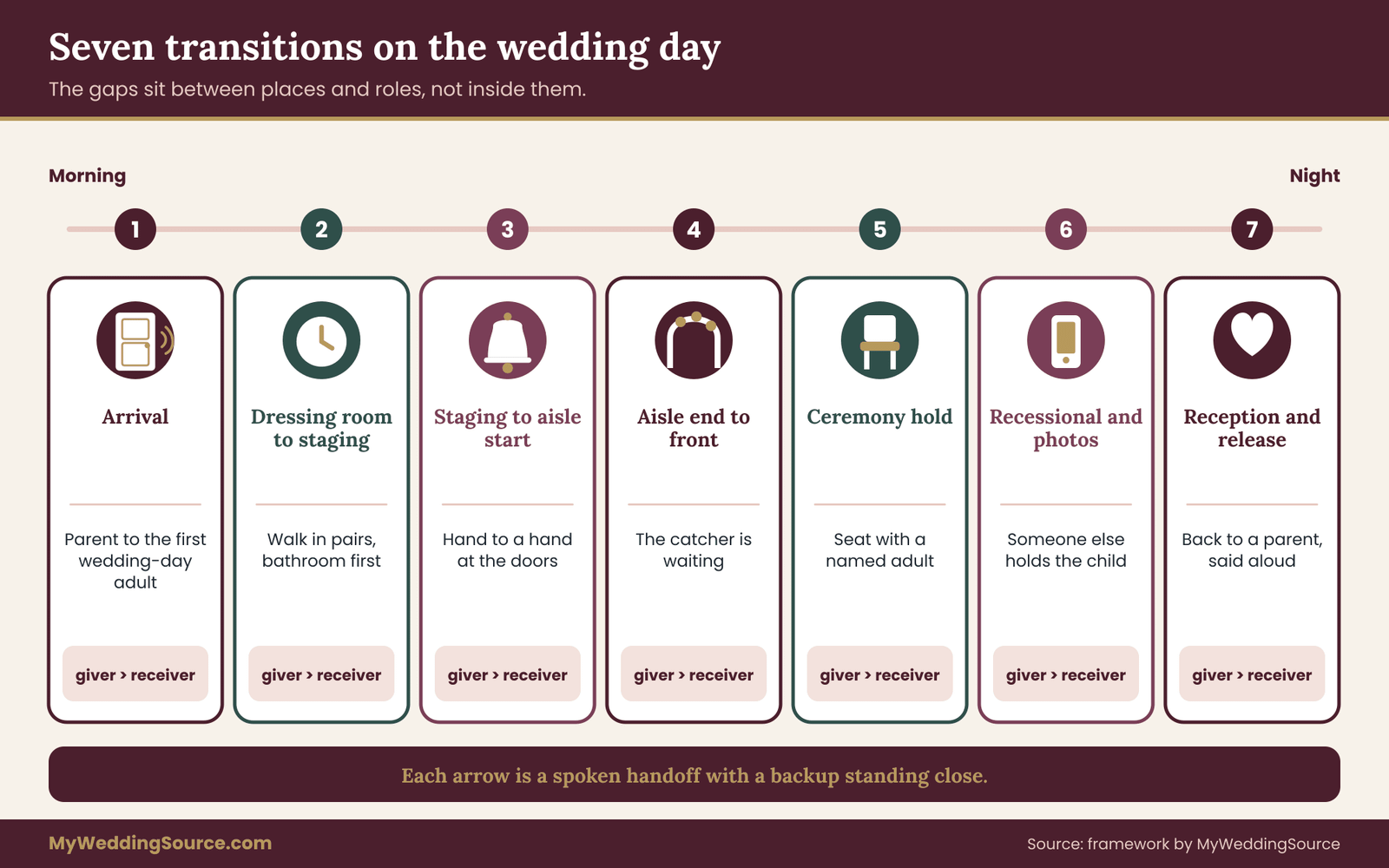
Here are the transitions in the order they occur on a typical wedding day. Your day may have fewer, or may split one into two if the venue is large.
- Arrival. The parent hands the child to the first wedding-day adult.
- Getting ready to staging. The child moves from wherever the family is getting dressed to the place where the processional lines up.
- Staging to the aisle start. The last walk to the doors or the first step onto the aisle.
- Aisle end to the front. The child reaches the end of the aisle and is received.
- The ceremony hold. The child waits through the ceremony, either seated with an adult or standing at the front.
- Recessional to photos. The child leaves with the wedding party and enters the photo session.
- Reception and release. The child moves into cocktail hour and dinner, and finally goes home with an adult.
Some couples skip number five because the child “just sits with mom.” That is fine, as long as someone wrote down that mom is the owner during the ceremony and the child is not expected to be in the front row. The row can be short. It should still exist.
How detailed should each row be?
Flower child supervision needs short, plain wording. A chart that is too long will not get read. A flower child supervision chart that is too short will not carry decisions. The test is whether a stranger could pick it up and know what to do in ten seconds. A row like “Staging to aisle: Dev gives to usher Tom, backup Priya, cue: music change, exit: Dev takes her back” passes that test. A row like “Dev and Tom will handle it” does not.
Use first names and, for adults with common names, a role in brackets. Two Marias in a wedding party will cause trouble. Write “Maria (groom’s sister)” and “Maria (florist)” if both matter.
Use plain words for the cue. “When the string quartet starts the second piece” works. “At 4:12” does not, because the quartet may start at 4:17.
Keep the exit short and concrete. “To the quiet room with Grandma Ruth” is a plan. “Calm her down” is a wish.
The check that makes a handoff real
Adults tend to treat the handoff as a vague moment. The check turns it into a fact. The giver says, “Mia, this is Tom. Tom has you now.” The receiver says, “I have Mia.” Both say it where the child can hear, because a child who hears her name and a clear statement is less likely to feel dropped.
For a handoff between rooms, the receiver can also send a one-word text to the coordinator or the parent: “Staged.” Some couples set up a small group message for this, limited to the five or six people on the flower child supervision chart. Use it only for the day. Delete it when the wedding is over, since it contains children’s names and locations.
Choosing the named adult and the backup
The named adult is the person who owns the child for a window of time. Choosing them is the most important decision in a flower child supervision plan, and it is the one most often made by default. Here is a way to make it on purpose.
The three tests
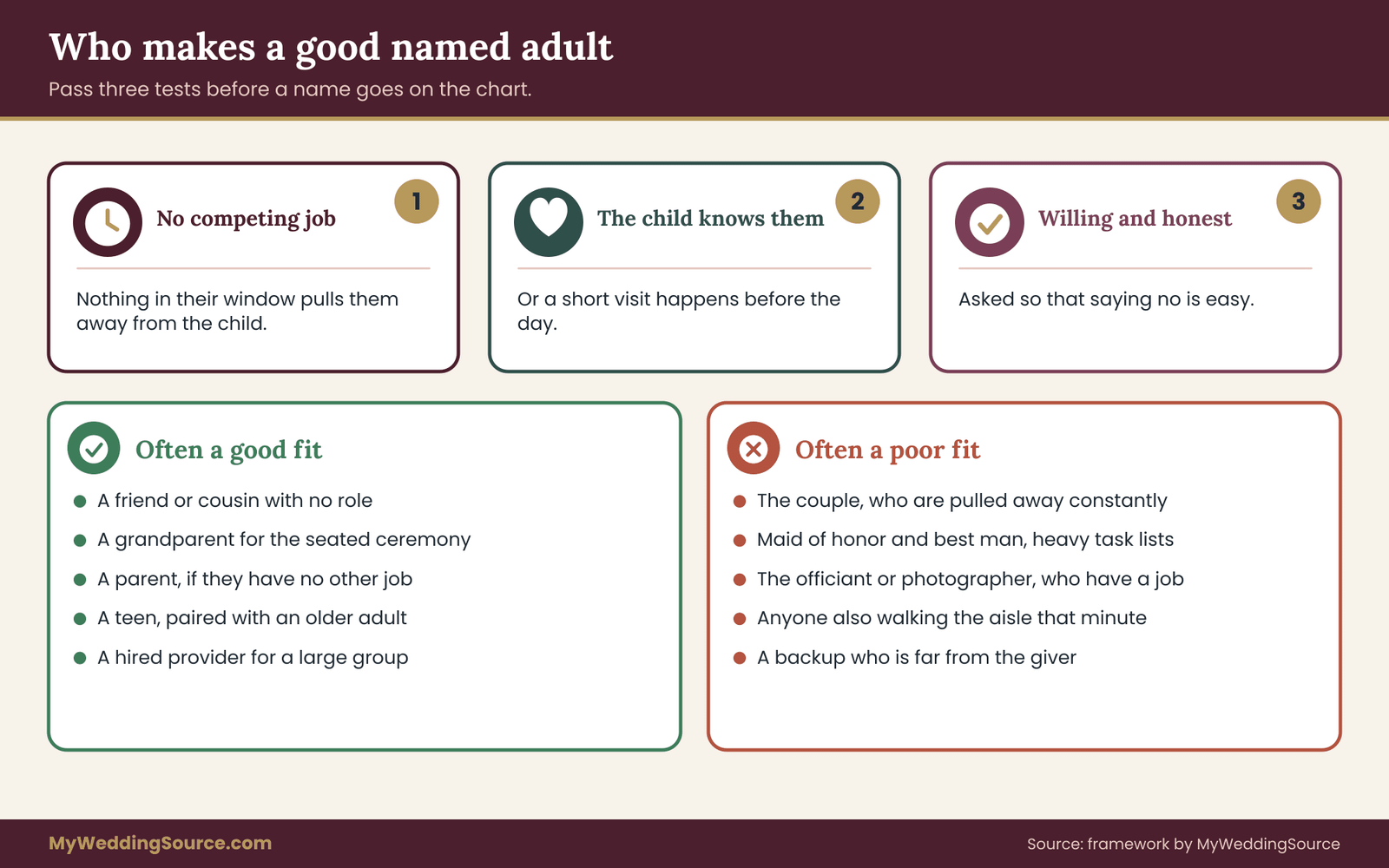
Every candidate should pass three tests.
No competing job. The adult has no task during their window that would make them leave the child. A bridesmaid who also has to walk the aisle, a groomsman who is holding the rings and a mother who is hosting out-of-town guests all have competing jobs. A guest with no role at all is often the best candidate, since their only job is the child.
The child knows them. For a young child, a familiar adult makes the whole job easier. If you must use someone new, arrange a short visit in advance and have the parent introduce them.
They are willing and honest about it. Ask in a way that makes it easy to say no. “Would you be able to be Mia’s person from 3:15 to 4:00? It would mean staying with her in the staging area and walking her to the doors. If it’s too much, tell me and I’ll find someone else.” That sentence lets a person decline without embarrassment.
Who often works well
Many couples find these groups are a good fit, with the caution that no group is right every time.
A parent is the natural owner for much of the day, since the child trusts them. The catch is that a parent may also be in the processional, giving a reading or greeting guests. Check for competing jobs.
A grandparent or older relative often has more patience than a busy parent and no formal role. The catch is mobility. A grandparent who cannot stand for long or walk quickly may not be the right choice for the staging area or the aisle. They can still be an excellent owner for the seated ceremony hold.
A teen cousin or sibling can be good company and a great calm-down person. They should not be the only adult in a window, because a teen is not an adult for supervision purposes. Pair them with an older adult who holds ownership.
A close friend not in the wedding party is often the cleanest answer. They are invited anyway and have time, and they are not entangled with the rush of the bridal party.
A professional such as a nanny, a childcare provider or a planner’s assistant is worth considering for a large group or a long day. If you do hire someone, see the guidance in the broader guest care guide on screening and vetting, and confirm locally what rules apply to the role. This guide does not set staffing numbers, because the right number depends on the children’s ages, the setting and the rules where you live.
Who often does not work well
The couple are poor owners on the wedding day. They are the center of attention and will be pulled away constantly. A couple can have a place in the flower child supervision chart as the people who give the child a hug, but they should not be the receiver for any handoff.
The maid of honor and best man usually have the heaviest task lists. They are also the people everyone asks for answers. Do not put them on the flower child supervision chart as primary owners.
The officiant and photographer are professionals with a job to do. They can take part in specific handoffs, such as the officiant guiding a child to a seat, but they should not own a child.
Naming a backup that is real
A backup is real if the person has seen the flower child supervision chart, knows the child’s name and face, and is within thirty seconds of the giver. A backup who is in the parking lot is not a backup. It helps to place the backup physically near the primary during their window. If the primary is in the staging area, the backup is in the staging area too, doing something else, such as arranging petals. If the primary slips away, the backup steps in without a word.
One more rule: the backup is never the same person as the next receiver. A person cannot back up themselves. If the usher is both the backup for the staging adult and the receiver at the aisle, the chart has a hidden hole.
The master name list
Once you have chosen your adults, compile a short list of everyone on the flower child supervision chart, with their phone numbers and their roles. Put the list in the same place as the flower child supervision chart and give it to the coordinator or day-of contact. If the day has a ceremony cue sheet, add the supervision cues to that sheet so that the music, the officiant and the child handoffs run off the same sequence. Two separate documents drift apart. One document stays accurate.
Transitions one to three: arrival, staging and the aisle start
The first three transitions happen before a single guest has sat down. They are also the ones couples tend to leave to chance, because nothing seems to be happening yet. A strong start makes the rest of the flower child supervision plan far easier to run.
Transition one: arrival
The child arrives with a parent, or is dropped off by one. This is the first handoff, and it sets the pattern for the others.
Giver: the parent or guardian. Receiver: the first adult on the flower child supervision chart for the morning or the afternoon, often a relative or friend who has agreed to be the child’s person during getting ready. Backup: a second adult in the same room.
The cue here is arrival itself, but a clock helps too. Give parents an arrival time that is earlier than strictly needed. A child who shows up ten minutes before photographs is a child who is already stressed.
At arrival, the parent and the receiver should do three things. The parent shows the receiver any medicines, snacks, a comfort item or a change of clothes. The parent tells the receiver anything that will help in the next two hours, such as “she gets shy around loud music” or “he needs the bathroom about every forty minutes.” And the parent says the goodbye out loud to the child, so that the child knows the parent is leaving the room and where the parent will be.
If the parent will stay, the handoff still happens. Say who owns the child while the parent has their own hair and makeup done. It may sound like a formality, but it prevents the situation where two adults each think the other has the child.
A short script for the arrival handoff:
Parent: “Noor, this is Jess. She’ll be with you until the photos at three. Her allergy medicine is in the blue bag. She likes to be told what’s next.”
Receiver: “I have Noor. Jess, I’ll text you when we move to the staging area.”
That is all. It takes thirty seconds. It also puts the receiver’s name in the parent’s phone, which helps if the day changes.
Exit plan for transition one: if the child is upset at the goodbye, the parent stays for ten minutes in the same room, not in a different room. The receiver keeps the child busy with something specific, like picking out a petal color or placing the basket in the right spot. If the child cannot settle, the parent takes the child to the quiet room, and the backup receiver is told.
Transition two: getting ready to staging
This is the move from the dressing room, the bridal suite or the hotel to the place where the processional lines up. It is the transition with the longest physical distance and, in many venues, the most doors, stairs and open spaces. It is also where a child is easiest to lose.
Giver: the adult who had the child during getting ready. Receiver: the adult who will be with the child in the staging area. These are often the same person, and that is fine. A person who owns the child from dressing room to staging area has fewer handoffs to get wrong. If they are different, the handoff happens at a named place, such as the end of the hallway or the foot of the stairs, not “somewhere on the way.”
Backup: a second adult who walks with them. Walking in pairs is slower but safer, particularly with more than one small child. A single adult leading three children across a car park or down a flight of stairs has run out of hands.
The cue is the coordinator’s call, not the clock. The coordinator or the venue’s event manager can say “attendants to staging now,” and everyone on the flower child supervision chart moves. If there is no coordinator, assign the cue to one person, often the most organized member of the wedding party, and tell everyone who it is.
Before leaving the dressing room, run a short checklist.
- Bathroom visit, whether or not the child says they need it.
- Water or a small drink, plus a snack if the child has had no food for a while and the venue allows it.
- Dress, shoes and any accessory secured. Tripping on a loose hem is a common reason for a stalled walk.
- The basket, pillow or sign in hand, and any practice reminder said once, in a few words.
- The child’s comfort item with a named adult, not in the child’s hands during the walk unless the parent says otherwise.
Leave the venue’s rules in mind here. Some venues restrict where children may walk, especially if there are loading areas, kitchens, water features or roads. If your venue has any hazards, walk the route in advance and mark the stairs, doors and drop-offs on the flower child supervision chart. The accessible venue red flags list is useful if any child or adult in the group uses a wheelchair, stroller or walker, because the route that works for most people may not work for them.
Exit plan for transition two: a child who will not leave the dressing room is not forced. The receiver stays with the child, the backup goes ahead to tell the coordinator, and the coordinator decides whether to delay the processional or adjust the child’s role. See the section on nerves and meltdowns for a full set of options.
Transition three: staging to the aisle start
The staging area is a waiting room, and children wait badly. This is where most coordinators lose the most time, and where a clear flower child supervision plan earns its place. The aim is to keep the child calm, fed, toileted and ready for ten or fifteen minutes, then to hand them to the person who will send them down the aisle.
Giver: the staging adult. Receiver: the person at the aisle start, often a coordinator, an usher or a trusted relative standing just inside the doors. Backup: a second adult at the aisle start, ideally one the child also knows.
The cue is usually a music change, a door opening or a coordinator’s nod. It must be something the staging adult and the receiver can both see or hear. Test it in the rehearsal. A cue that works in a quiet room may be inaudible at the real venue with the real guests.
The handoff itself should be physical. The staging adult walks the child to the receiver, says the child’s name and the receiver’s name, and lets go only when the receiver has taken a hand. If the child is a wagon-puller or sign-carrier, the receiver also checks that the wagon wheels are clear and the sign is facing the right way.
Then comes the part that many plans skip: the receiver tells the child, in one sentence, what to do. “Walk to Uncle Ben at the front. He’s waiting for you.” The simplest instruction is a destination with a face on it. A child who knows who is waiting for them at the other end has a reason to walk.
A few practical points about the aisle start.
The order. Put the most confident child first if you have a choice. A child who sets off cheerfully makes the next one braver. If the youngest is the least confident, send them with a buddy or put them near the end of the group so they are not the first one on show.
The gap. Leave a clear gap between children. A gap of several seconds gives each child their own moment and lets the receiver reset for the next one.
The pause. If a child stops at the doors, the receiver does not push. A child who is pushed digs in. A child who is given thirty seconds usually moves. After that, use the exit plan.
The second hand. For children who are unsure, a walk with a parent, grandparent or older sibling is a perfectly good alternative. Plan for it on the chart as a variant: “Plan A, walks alone. Plan B, walks with Gran.” Choosing Plan B in the moment is not a failure. It is a choice made ahead of time.
Exit plan for transition three: the standard exit is a quiet retreat to the receiver’s side, then to the backup, who takes the child back to the staging room or to the parent. Agree in advance whether the processional continues without that child, and tell the officiant and musicians. The exit should take less than a minute and should not change the rest of the processional.
The staging area as a place
The staging area deserves its own sketch, because flower child supervision there depends on the room as much as on the adults. If you can, stand in it at the same time of day as the ceremony. Note where the doors are, whether the area is visible to guests and whether children can reach the aisle without being seen. Note where the bathroom is, how far it is and whether a child can reach it with an adult in under two minutes.
Check the floor. Slick floors, loose rugs, thresholds and slopes are common trip hazards for small shoes. Check the temperature too. A hot, crowded staging room makes children cranky, and a cold one makes them want to go home.
If the staging area is outdoors, add sun, wind, insects and uneven ground. Put water in the shade and have a hat or sunscreen plan agreed with parents. If you have a canopy or a tent, make sure it is anchored. The planning that applies to the whole day is covered in the wider guidance on outdoor weddings, but for a child the issue is simple: is the child comfortable and safe for the wait?
What to give the children to do
A child with a task is a child who is less likely to wander, which makes flower child supervision easier for everyone. Give each attendant something small and real to do while they wait: arranging petals in a basket, counting the chairs, practicing the walk with a friendly adult, or sitting on a chair with a book. Do not give them items that will cause a mess, a hazard or a fight, such as loose small objects for a toddler or a tray of drinks.
If the ring bearer carries the actual rings, assign a second adult to hold the real rings until the last moment and attach a decoy or a secured pillow for the walk. Many couples simply use fake rings on the pillow and give the real ones to the best man. Choose the plan that your officiant and families agree on, and put it on the flower child supervision chart so the adult handling the rings knows it is their task, not the child’s.
Transitions four to seven: the front, the ceremony, the photos and the night
Once the child has walked, a new set of risks begins. The adults relax, the music changes and everyone’s attention moves to the couple. This is exactly when flower child supervision is most likely to lapse, because the dramatic part appears to be over.
Transition four: aisle end to the front
The child reaches the end of the aisle. Somebody has to be there.
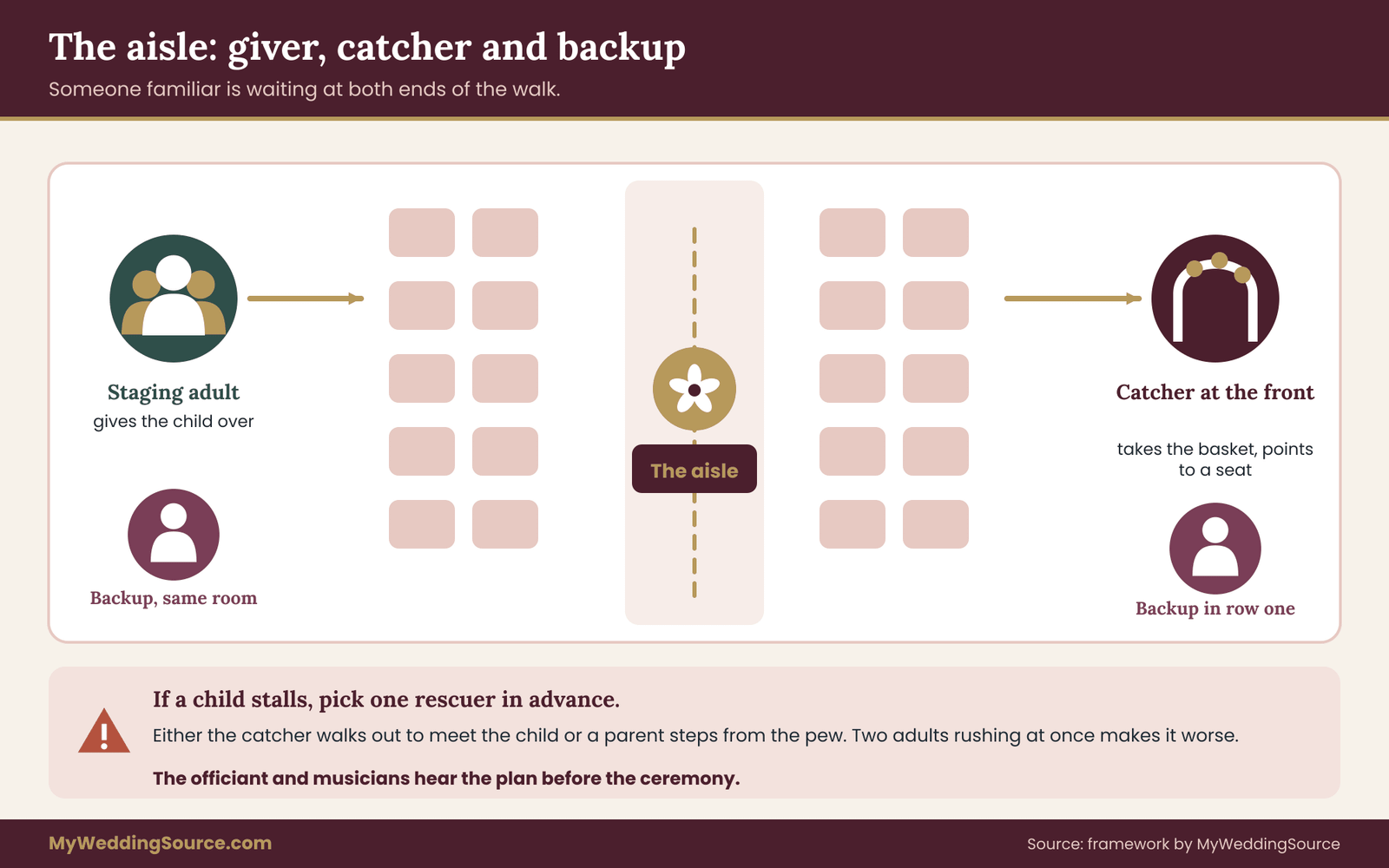
Giver: the aisle-start receiver, who handed the child off at the doors and is now effectively out of the picture. Receiver: a named adult at the front, often called the catcher in this guide because the job is to catch a child who arrives with nothing left to do. Backup: a second adult standing nearby, such as a groomsman at the end of the line, an usher or a relative in the front row.
The catcher should be someone the child knows. A beloved aunt in the front row who opens her arms is better than a stranger in a suit. If the child has been told “walk to Uncle Ben,” then Uncle Ben must be there, and he must be where the child can see him from the doors.
The catcher does four things.
First, they make eye contact and smile before the child reaches them. A child who sees a friendly face at the end of the aisle walks faster and straighter.
Second, they take the basket, pillow or sign so the child’s hands are free. A ring bearer holding a pillow with fake rings is not a child who can sit comfortably.
Third, they tell the child where to go next. “Sit here with me” or “Go sit with Mom” is a sentence a child can follow.
Fourth, they give a quiet check to the giver. A nod at the aisle start tells the person at the doors that the child has arrived.
The catcher is also the person who deals with the unexpected: the child who arrives in tears, the child who has lost the basket, the child who runs to a parent halfway down. The catcher should have a sentence ready. “You did it. Come sit with me” works for almost any of these.
Exit plan for transition four: if a child stalls partway down the aisle, the catcher walks out to meet them, or a parent steps from the pew and collects them. Pick one in advance, because two adults rushing at once makes it worse. Tell the officiant what the plan is so the ceremony does not stop for a surprise.
Transition five: the ceremony hold
The processional is done. Now the child must either stand at the front, sit in the first row or move to a parent. This is the longest transition in time and the shortest on the flower child supervision chart, which is why flower child supervision is so often forgotten at this point.
Giver: the catcher. Receiver: the adult who will own the child during the ceremony. This is often a parent, grandparent or a relative in the first or second row. Backup: another adult seated within reach.
The ceremony hold row has an unusual feature: the owner is also an audience member. They are listening to the vows, perhaps crying, perhaps recording on a phone. That is fine, but it makes this the easiest row to fail. The owner must not leave the child for any reason without handing the child on. If a parent needs to step out for a phone call or to deal with a baby, they tell the backup before they go.
Decide ahead of time whether children stand at the front or sit. Some couples like to have the attendants stand with the wedding party. For young children this can be hard, since a ceremony may last twenty or thirty minutes, and standing still is a major ask.
Others have the children sit in the first row with a parent. A third option is to let the children join the wedding party at the front for the first few minutes and then step to a seat during a reading or a song. If you choose that last route, the move to a seat is a handoff in itself: add a mini-row to the flower child supervision chart with a cue, such as “after the first reading.”
Seating arrangements matter. Seat the child on the aisle if you want a quick exit, and next to an adult who is not the parent if the child is easily upset by the parent being nearby. Put a small bag with quiet items, such as a book, a cloth toy or a tiny snack, under the seat. The goal is to keep the child at ease so that they do not make a noise that pulls the adults’ attention.
If the ceremony is long, because of a religious service, a mass or a ritual with several parts, the ceremony hold may need a plan for breaks. A parent or backup can take a child for a walk during a hymn or a reading and come back at a natural pause. Agree on the signal and the route. The ceremony step-by-step guide shows where the natural pauses fall in different ceremony types.
Exit plan for transition five: a restless or noisy child leaves quietly with the owner or the backup by the nearest side aisle or exit, to a place the flower child supervision chart names, such as the lobby or a side room. The owner brings the child back at the next pause, or the child skips the rest of the ceremony. Choose in advance who makes that decision. Usually it is the parent.
Transition six: recessional to photos
This is the point where the flower child supervision plan most often fails, and almost nobody sees it coming. The ceremony ends, the couple walks out, the wedding party follows and the children are swept up in a rush of hugging, clapping and movement.
Giver: the owner from the ceremony hold. Receiver: the adult who takes the child through the recessional, through the first minutes of congratulation and into the photo area. Backup: another adult who stays with the child during the first round of photos.
There are three different questions here, and each needs an answer.
Do the children join the recessional? Some couples have the attendants walk out with the wedding party. Others let them leave with the parents. Either works as long as the flower child supervision chart says which, and the catcher or receiver knows.
Who walks with the child in the recessional? If a child walks alone out of the ceremony, the same fear applies as at the aisle start. A familiar adult or an older child should go with them. If the child leaves with the wedding party, assign a groomsman or bridesmaid as the receiver, with a backup.
What happens during photos? The family photographer will call groups. The children may be in some photos and not in others. A child who is not in the next group should not be left standing alone. The family photo list can mark which groups include the attendants, so the owner can plan breaks, snacks and quiet time between the shots they appear in.
One detail often missed: the person holding the child during photographs should not be the person being photographed. If the grandmother is in the next group, she cannot also be watching a toddler. Name someone else.
The photographer needs to know who the children’s adults are. A short briefing before the ceremony is enough: “Here is the chart. Mia’s person during photos is Jess. If you need Mia, ask Jess.” That gives the photographer a name, not a guess. Photographers also tend to ask whether images of children can be shared. The wedding photography consent guide covers how couples set rules for photographs of guests and children, which is a separate question from supervision but touches the same moment.
Exit plan for transition six: a child who is tired or upset between photos goes to the owner or a backup in a quiet spot, away from the shoot. The family photographer is told the child may skip the remaining groups, and the couple agrees ahead of time that missing a photo is acceptable. A short pause is better than a photo of a crying child and an exhausted adult.
Transition seven: reception and release
Children move from attendants back to guests. The formal roles end, and many couples assume that supervision ends with them. It does not. The reception is full of hazards that have nothing to do with the processional: a dance floor, a bar, a parking lot, a dessert table, a staircase and unfamiliar adults.
Giver: the photo-time owner. Receiver: the child’s parent or guardian, or a named adult the parent has chosen for the evening. Backup: a second adult at the same table or in the same area.
The handoff should be explicit. The giver finds the parent and says, “Mia’s yours now.” The parent says, “Got her.” If the parent is not nearby, the giver does not leave the child alone. They hold the child until the parent can be found or until the backup arrives. The check text to the group, “Mia with Jess,” or “Mia with Mom,” can end the chain.
After that, a smaller question remains: how does the child leave?
Ask parents how they plan to take their children home. Some will leave early, some will stay late, and some will pass the child to a grandparent or a sitter. A child who is carried out of the room by someone the parent has not mentioned is a child whose release was never planned.
Wherever a wedding offers a coat-check or a child pickup arrangement, the release rule can follow the same pattern. If you have a childcare provider, follow the provider’s own pickup procedure. If you do not, a simple rule is that the child leaves only with an adult the parent has named to the person currently holding the child.
Exit plan for transition seven: a tired or over-stimulated child goes to the parent or to a quiet area. If a child is found away from an adult, whoever finds them takes them to the nearest named adult or the coordinator and tells the parent. A flower child supervision plan should include a one-line rule for a missing child: tell the coordinator and the venue manager at once, check the usual places, and do not wait to see whether the child turns up. If a child is in danger, call emergency services.
Putting the seven rows together
Flower child supervision is only as strong as the weakest row, so this last read-through matters.
Once you have written the seven transitions, read the flower child supervision chart from top to bottom as though you were a child. At every step, ask who is holding my hand and who is waiting for me. If you find a gap, fill it. If you find a handoff that depends on one person doing two things at once, split it. If you find two handoffs that need the same person at the same minute, change the person.
The flower child supervision chart is not a script that must be followed to the second. It is a map of responsibility. When something shifts, the people on the flower child supervision chart need to know who is now holding what. That is what keeps the day calm.
Backup adults and exit plans in a flower child supervision plan
Every row on the chart has two safety features that people tend to treat as extras: a backup adult and an exit plan. They are not extras. They are what turns a flower child supervision plan from a nice idea into something that survives a real day, with real delays, real children and real surprises.
Why the backup matters more than the primary
In flower child supervision, the spare adult is what keeps one interruption from becoming a gap.
The primary adult has a flower child supervision plan. The backup has a purpose. When the primary is pulled away, the backup is the only reason the child still has an owner. A wedding day is full of small interruptions: a vendor with a question, a relative who needs help, a dress that needs a pin, a phone call from the venue. Each of those can pull a primary away for a few minutes.
Think of the backup as a second pair of hands attached to the same row. They share the same cue, they know the same child and they stand close enough to step in without being asked. If they are never needed, they have lost nothing. If they are needed, they save the row.
Set three rules for backups.
The backup knows the flower child supervision chart. Give them the same page as the primary. Do not rely on someone telling them in the hall. A backup who has not seen the flower child supervision chart is only a spare person.
The backup is physically close. In the staging area, that means the same room. At the aisle start, that means within sight of the doors. In the ceremony, that means the same row or the row behind. If the backup is on the other side of the building, the backup is theoretical.
The backup has no conflicting task. A backup who is also a reader, a usher or a flower arranger is likely to leave at the exact moment they are needed. Ask the same three questions you asked of the primary.
Backup for the backup
Do you need a second backup? For most rows, no. For two rows, yes: the aisle start and the ceremony hold, because those are the moments when a single person leaving would leave a child unattended in front of a room. At those points the coordinator or a trusted guest is the unwritten third person. Tell them they are that person, so the role is not a surprise.
If your wedding has no coordinator, designate one adult as the floating backup for the whole day. Give them no other task. They carry the master chart, the parents’ numbers and a small bag with water, wipes, a spare snack and a spare shirt. They are not the owner of any child. They are the person who covers any gap.
Exit plans as a courtesy to the child
An exit plan is not a punishment or a sign of failure. It is permission. It tells the child, and the adults, that if something becomes too much, there is a kind way to stop. Children who know they can stop are less afraid to start, which is why a good exit plan often reduces the number of exits.
Each exit plan has three parts.
Trigger. What counts as “cannot continue”? A child who is crying, hiding, clinging, stalled or refusing is clear. A child who is quiet and pale, or who has begun to wander, is less clear. Name a few signs so the adult on the spot does not have to decide whether to act.
Person. Who takes the child out? It should be the same adult who would be the owner. A child who is upset needs someone familiar, not a stranger who happens to be nearby.
Place. Where does the child go? A named quiet space, such as a side room, a hallway or a car, is better than “away.” If the ceremony is outdoors, the place is a chair in the shade or a spot behind a screen. Do not choose a space that is too far for a parent to find the child quickly.
The three exit types
It helps to think about exits in three sizes.
A pause. The child stops, gets a hug or a drink and tries again. This is the smallest exit and, with young children, the most common. A pause may take thirty seconds or three minutes, and the plan should say whether the processional waits.
A change of role. The child’s job shrinks. The flower girl who froze with a basket joins her grandmother in the front row and the basket goes to the catcher. The ring bearer walks with a parent instead of alone. A child who changes role keeps their place in the day and loses only the part that was too much.
A full exit. The child leaves the ceremony and goes to a parent, a quiet room or a caregiver. The ceremony continues. A full exit is not a failure either. It is a decision that a child’s comfort matters more than a photograph.

When you write the flower child supervision plan, specify which exit the child will use first. For a child who has never done anything like this, a change of role is a good default. For a child who tends to melt down, a full exit may be the first choice. Ask the parent. Parents know which exit their child will accept.
Telling the officiant, musicians and photographer
An exit plan only works if the people who run the ceremony know it. The officiant needs one sentence: “If a child is upset, one of the adults will take them out; please carry on.” The musicians need to know whether the processional waits or goes on. The photographer needs to know that the family may need privacy for a moment and that the couple prefers a missed photo to a pressured child.
A short conversation with each, held during the rehearsal or the day before, is enough. Put the same lines in the cue sheet if you have one. A processional that stops for three minutes can still be a lovely processional if everyone knows what to expect.
What if no backup is available?
Sometimes a couple has very few adults they can ask. A small wedding, a destination wedding or a family with many young children may have no spare hands. In that case there are three honest choices.
Reduce the number of children in the processional. One flower child and one ring bearer, walking together or with a parent, takes less supervision than five children walking alone. Fewer roles is not a downgrade. It is a plan.
Reduce the number of handoffs. Let one adult own the child from getting ready to photos. That adult has fewer handoffs and a better view of the whole day.
Hire help. A trained babysitter, a childcare provider or a planner with a day-of assistant can add the hands you do not have. If you do, ask locally about rules and licensing for care at an event, and ask the provider for its own written procedures. The guide on hiring wedding childcare in the wider guest care guide explains how to check a provider before you sign.
Do not solve the shortage by asking the wedding party to do two jobs. The wedding party already has tasks. A bridesmaid who is both holding a bouquet and watching a toddler is doing neither well.
Nerves, meltdowns, bathrooms and other edge cases
Children do not read charts, and flower child supervision has to work anyway. They will do things the flower child supervision chart does not predict. The point of a plan is not to prevent every surprise but to make sure that when one happens, the adult on the spot knows what to do. Here are the situations that come up most often, with a sensible response to each.
The child who freezes at the doors
This is the most common scene and the best-known. A child who has been cheerful all day stops at the doors, looks at the crowd and refuses to move.
Do not push, plead or say “everyone is waiting.” That adds pressure to a child who is already overwhelmed. The receiver crouches to the child’s height, says something quiet and specific, such as “You can walk to Uncle Ben, or I’ll come with you,” and gives the child thirty seconds. If the child holds out a hand, the receiver walks with them. If the child shakes their head, the receiver hands them to the backup, who takes them to a parent or quiet space. The processional continues.
It can help to prepare the child ahead. Show a picture of the room. Let the child walk the aisle empty at the rehearsal, with music if possible. Let them meet the catcher in advance. Children who have seen the space and the people tend to fear it less.
The child who runs
A child who sees a parent in the crowd and runs to them is, in most cases, simply doing what children do. Respond calmly. The parent catches the child, a gentle hug follows and the parent either carries the child to the front or sits with the child in the pew. The catcher at the front waves and smiles to show it is fine.
The risk is a child who runs toward a door, a stair or the outdoors. For venues with such exits, assign a specific adult to stand near the nearest one during the processional. A person standing in a doorway is a gentle barrier without being a lock. Do not block exits that must stay open for fire safety, and ask your venue about its rules.
The child who needs the bathroom now
This will happen. Decide in advance who takes the child and where they go. If the nearest bathroom is across the building, the flower child supervision plan needs a faster option, such as a closer restroom or an accessible family restroom. Parents of toddlers in training should be asked directly, with an offer to adjust timing.
The person who takes the child should be the owner or backup, and they should tell the next adult on the flower child supervision chart. A child who vanishes into a restroom with an adult and returns without anyone noticing is a handoff that happened silently. Add a text: “Mia in restroom with Jess, back in five.”
The child who is sick, hot or hungry
A sick child should not stay in the processional if a parent decides they are not well. Ask parents to tell you before the day if the child has symptoms, and have a replacement or a modified role ready. The CDC offers general guidance on children’s health at CDC.gov, and a pediatrician is the right source for specific questions.
Heat, long waits and a full schedule can make healthy children miserable. Plan water, shade, snacks and a place to sit. Check with parents about allergies and food rules before you offer anything. For allergens, the FDA and Food Allergy Research & Education publish general guidance, and the parent’s own instructions override anything else.
The child with a disability or sensory needs
A child with a physical disability, a developmental difference, a sensory sensitivity or a medical need is part of the plan like any other child, and the parent is the best source of information about what helps. Ask the parent an open question: “What would make the processional work well for her?” Let them describe the support, the route and the timing.
Possible accommodations include a shorter walk, a different route, a seat at the front, a quiet space nearby, noise-reducing headphones, a visual schedule, an extra adult or a role that suits the child’s strengths. Avoid assumptions. Some children with disabilities want a typical role. Others prefer something different. The choice belongs to the child and the parent.
For venue access, the ADA.gov site explains the basics of accessibility requirements, and the venue manager can say what the building offers. The accessible venue red flags list covers the physical features to check, such as ramps, doorways and restrooms. If you want specific advice about rights or rules in your area, ask a qualified adviser.
The child who bolts after the ceremony
After the ceremony, children are relieved and excited. They may race around, climb furniture or hide. The owner for transition six or seven is the person who stays with the child, not the person who gives them permission to roam. If the group is large, a few adults can create a loose perimeter at doors and stairs while the children burn off energy in a safe space.
A rope line, a fenced area or a designated room can help, but only when the venue allows. Ask the venue first.
The child who does not want to be photographed
Some children dislike the camera or the attention. Do not force a photo. The family photographer can take shots from a distance, include the child in a candid frame or leave them out. Tell the parent in advance that skipping a posed shot is fine. A child who feels forced into a photo often shows it.
The unexpected adult
A well-meaning guest may offer to take a child to the dessert table, walk them to the car or pick them up for a photo. Many of these offers are kind. Some can leave a child in the wrong hands. The rule is simple: only the named adult hands a child to someone else, and only to another named adult or a parent. Share this with the wedding party in one sentence: “If someone you don’t know asks to take a child anywhere, ask them to check with the parent or the coordinator first.”
This rule is courteous and clear, and it keeps flower child supervision in the hands of the people named on the page. It does not accuse anyone. It lets the people on the flower child supervision chart say a friendly “let me check” without discomfort.
Briefing parents, vendors and the venue on flower child supervision
A chart that only the couple has read is only a draft. The plan works when the parents, the adults on the flower child supervision chart and the people who run the ceremony have seen it, agreed to it and know how to reach each other. This section covers who needs to see what, and how to share the information without spreading it further than it should go.
What parents need to know
Parents are the most important audience. They know their child best, and they will be the ones who decide in the moment whether the child continues, takes a break or leaves. A good flower child supervision briefing is short and specific. It tells them what you are planning, asks what they need and invites changes.
Send a message about two or three weeks ahead. Put the main points in plain words.
- The child’s role, and the choice of alternatives if the child prefers a smaller one.
- The names of the adults who will own the child at each stage, and a note that the parent can swap anyone out.
- The times and places for arrival, the rehearsal and photographs.
- The exit plan, in a sentence, so the parent knows that stopping is allowed.
- What you need from them: medical information they want to share, a phone number that will be answered, any food rules, a comfort item and a pickup plan for the evening.
Here is wording that couples have found easy to adapt, written as a template rather than a script to copy: “We would love for Mia to be our flower girl. We have a simple plan so that she always has a familiar grown-up nearby: Jess will be with her while she gets ready, Tom will meet her at the doors and Uncle Ben will meet her at the front.
If at any point she’d rather not walk, that is completely fine, and we’ve planned a way for her to sit with you instead. Could you tell us anything that would help, such as allergies, nap times or people she’s most comfortable with?”
That message invites the parent in. It also supports flower child supervision on the day, because the parent has already agreed to the names.
It also gives them a chance to say no to a name on the flower child supervision chart, which is far better to hear in advance.
Never put a child’s full name, birth date, school or photo in a group message or public wedding website. A first name, an age and a role are enough. Keep medical details out of shared threads and share them only with the adults who need them. The Federal Trade Commission explains how businesses must handle children’s online information, and the same caution is sensible for a personal project: share less, share privately and delete when the day is over.
What the adults on the flower child supervision chart need to know
Every adult on the chart should receive the same one-page document, plus a short call or message from the couple or the coordinator. The page should show the full chart so that each adult sees where they fit in the sequence, not just their own row. An adult who understands the whole is better at covering for the person before or after them.
Walk through the flower child supervision chart with the adults at the rehearsal, standing in the real places. The first time a usher meets a child should not be at the doors on the day. The first time the catcher stands at the front should not be when the music starts.
Give each adult a small card with their window, the child’s name, the cue, the exit and the backup’s number. Cards are easier to read than a phone in the middle of a ceremony, and they do not need a signal.
What the coordinator, officiant and musicians need to know
If you have a coordinator, they are the natural keeper of the flower child supervision chart on the day. Give them the master copy and the parents’ numbers. Ask them to call the cues and to be the third pair of eyes at the aisle start and the ceremony hold. If you do not have a coordinator, name a friend or a family member for that role and tell the other adults who it is.
The officiant needs to know the order of the children, where each will end up and what to do if one stalls. In most cases the answer is simply: carry on. A calm officiant sets the tone for a child, a family and a whole room. If the officiant has a rehearsal, make sure the children and their adults attend part of it, even if it is only ten minutes.
The musicians need to know about the cue. If a child freezes and the processional is paused, the music may need to loop or stop. Ask them for a flower child supervision plan, such as repeating a few bars of the piece or waiting for a signal. Do not rely on their guess at the moment. The cue sheet guide shows how to coordinate these signals across music, officiant and processional.
What the photographer and videographer need to know
The photographer should know who the children’s adults are, which rows the children sit in and the moments when they may need a break. Add a line to the shot list: “Children’s group photos, Jess to bring Mia and Noor, 4:20.” Photographers are used to working with children but not to guessing who is responsible.
Ask the photographer to keep a respectful distance from a child who is upset. A good one will step back without being asked. Raise the question of image rights for children early. The family photo list and the consent guide on this site both cover how to handle that, and the flower child supervision chart should note which parents have agreed to which uses.
What the venue needs to know
Ask the venue manager for a list of rules about children, doors, stairs, kitchens, water features, parking, balconies, elevators and any restricted areas. Ask whether children can use the aisle, the bridal suite and the staging area without a staff escort, and whether the venue has its own policies on child supervision. Some venues set rules of their own, and your contract may refer to them.
Ask whether there is a quiet space you can use for an exit, and whether it can be reserved from the start of the ceremony to the end of the photos. A small room with a closed door and a chair is often all a child needs.
Walk the routes. The route from the dressing room to the staging area, the route from the staging area to the doors and the route from the ceremony to the photo spot should all be walked at a child’s pace, not an adult’s. Note any step, slope, gap or door that could cause trouble. Add them to the chart.
If the venue has security staff, ask them what they do if a child is found alone. Their answer may shape your own plan.
The rehearsal
No part of flower child supervision benefits more from practice than the handoffs themselves.
The rehearsal is the most valuable hour in a flower child supervision plan, and it is easy to waste. A typical rehearsal focuses on the couple, the wedding party and the officiant. Children often arrive late, wander off and are sent home early. If you want the flower child supervision plan to work, give the children’s part its own slot.
Run the seven transitions. The children and their named adults walk through each row once, in the real space, at the real pace. If time allows, do it twice. The first time is for learning. The second is for confidence.
Make it a game rather than a drill. Children respond to a story: “You’re going to carry the rings to Uncle Ben like a very important messenger.” Let them practice the walk with the music. Let them meet the catcher. Let them sit in their seat. Show them where the quiet room is and tell them they can go there whenever they like.
Ask each adult to say their handoff aloud. “I have Mia” and “Mia’s yours now” are easy phrases to practice. It feels silly in a rehearsal and natural on the day.
If you cannot hold a full rehearsal, do a mini-rehearsal on the morning of the wedding, in the real space or in a similar room. Ten minutes is enough to walk the aisle, meet the catcher and practice the check.
Keeping the flower child supervision chart private
The chart contains children’s names, adults’ phone numbers and the times and places where children will be. That is more than a stranger should see. Keep it on paper or in a private document. Share it only with the people on it. Do not post it on a wedding website, in a public album or in a large group chat. Delete shared copies after the wedding.
If a venue or vendor asks for a copy, share only what they need: the aisle order, the cue and the contact. They do not need the medical notes or the parents’ phone numbers unless they are part of the flower child supervision plan.
A worked example: one wedding, five children, seven handoffs
The following example is invented. It is not based on a real wedding or a real family, and it is meant only to show how a chart is built. Names are made up for illustration.
Dana and Marcus are marrying at a garden venue with an indoor reception hall about a three-minute walk from the ceremony lawn. They have five children in the wedding.
Ruben, five, is the ring bearer. He will carry a pillow with decoy rings. His parents are guests, and his mother, Lena, is also giving a reading.
Ivy, four, and Noor, eight, are flower girls. Ivy is shy. Noor is confident and has done it before.
Theo, two, is Ivy’s brother. He is not in the processional, but he follows her everywhere.
Sam, eleven, is Marcus’s nephew and carries a sign. He is capable but not an adult for supervision purposes.
The first draft and what went wrong
Dana’s first plan said: “The bridesmaids will watch the kids, and Lena will take Ruben down the aisle.” On review, three problems appeared. Two of the three bridesmaids were also in the processional, which meant they would leave the children at the exact moment the children needed them. Lena was giving a reading and could not be at the front. Nobody had a name next to Theo.
This is a common pattern. The flower child supervision plan sounds fine until you ask who is holding which hand.
The revised chart
Dana and Marcus rewrote the flower child supervision chart with named adults.
Arrival. Each parent hands their child to Marcus’s cousin Priya, who has no role in the ceremony and is the “children’s person” for the afternoon. Backup: Ivy and Theo’s grandmother, Rosa, who sits in the same room. Check: Priya texts “All five here” to the coordinator.
Getting ready to staging. Priya walks the group to the staging area with Rosa. The cue is the coordinator’s call. They stop at the bathroom first. Exit: any child who will not go stays with Rosa in the dressing room, and Priya tells the coordinator.
Staging to the aisle start. Priya hands each child to the coordinator, Kelsey, at the doors in order: Sam, Noor, Ivy, Ruben. The cue is the second piece of music. Backup: Rosa at the doors. Exit: Ivy has Plan B, where she walks with Rosa, and Rosa is told so in advance.
Aisle end to the front. The catcher is Marcus’s brother Elias, who is a groomsman at the front and has a free hand. Backup: Lena’s husband, Joel, in the first row. Elias takes each basket and sign and points the child to a seat. If a child stalls, Joel steps out to meet them. Exit: Elias nods to Kelsey that the child has arrived.
The ceremony hold. Ruben sits with Joel. Noor sits with Priya. Ivy and Theo sit with Rosa. Sam sits with his parents. The backup for Ruben is Priya, for Ivy and Theo it is Noor’s father, who has a seat nearby. If Lena has to leave for her reading, Joel keeps Ruben. Exit: a side door leads to a covered patio with chairs. Rosa takes Ivy or Theo there if needed.
Recessional to photos. The children leave with their sitting adults. Priya gathers them at the photo spot at the end of the lawn. For the family photos, the photographer calls groups by name. Rosa is in two groups, so Priya covers Ivy and Theo during those. Exit: a child who is tired sits on a bench with Priya.
Reception and release. Priya hands each child to a parent in the reception hall, saying the name and the parent saying “got her” or “got him.” The check text ends the chain. Parents plan their own departures. Ivy and Theo leave early with Rosa, who tells Priya and the parents. Exit: any child found without an adult goes to the nearest table of named adults or the coordinator.
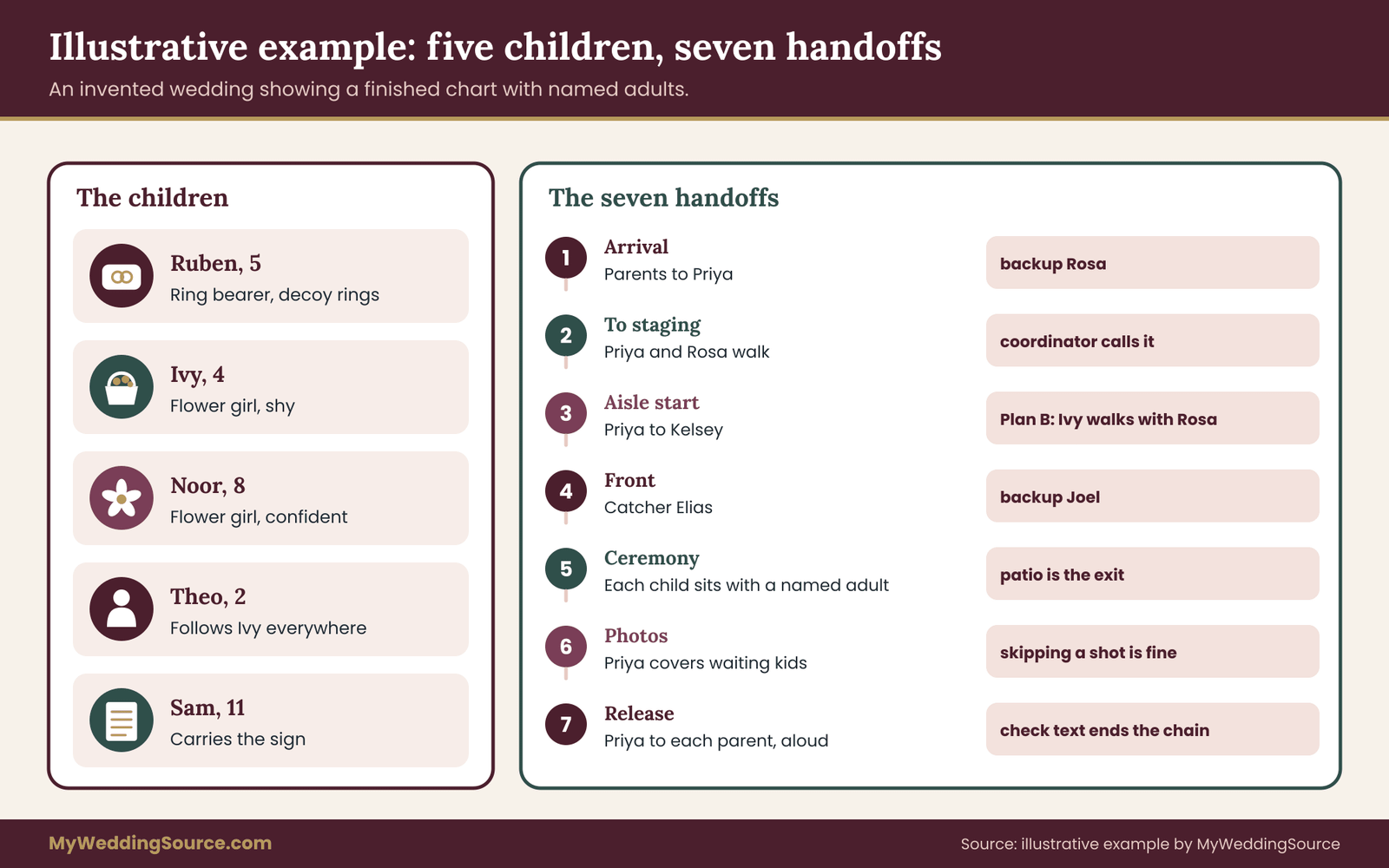
What changed
The lesson for flower child supervision in general is small: names beat groups.
The final chart used five named adults, none of whom had a competing task during their window. Priya’s role as children’s person made the day simpler for everyone. The backup for each row was seated or standing in the same area. The exit for each row was one sentence. The whole chart fit on one page.
Dana and Marcus also noted a few decisions they made ahead of time: the decoy rings, the shorter ceremony hold for Ivy and Theo, the covered patio as the quiet space and the fact that missing a family photo was acceptable. During the ceremony, Ivy froze at the doors, took Rosa’s hand and walked down the aisle with her. Nothing else changed. The processional continued, nobody had to improvise and the photographer got a lovely picture of a small girl and her grandmother.
It is only an example, and the details will differ for your wedding. The point is the structure: a named owner, a named backup, a cue and an exit, repeated seven times.
Limits, local rules and what to verify
A flower child supervision chart is a planning tool. It does not replace qualified care. It helps you decide who does what, and that is the whole value of flower child supervision on paper. It does not tell you how many adults a given group of children needs, which is set by rules and by judgment that vary from place to place.
What this guide does not decide
This guide does not set staffing ratios. A processional with two children and four adults is a different situation from a rehearsal dinner with twenty children and one sitter. Ratios, licensing and background-check rules depend on the type of care, the children’s ages and where you live. If you hire a childcare provider, ask the provider for its written procedures and confirm with your state or local child care licensing office what applies to care at an event. The federal ChildCare.gov site explains how state licensing works and points to each state’s office.
The guide does not tell you how to handle a medical condition. A parent and the child’s doctor can say what a child needs. Ask the parent to write down any instructions and give them to the named adult in a sealed note or a private message.
It does not replace the rules of your venue. A venue may set its own limits on where children can go, who can be in the bridal suite and what happens if a child is found alone. Ask, and write down the answers. Your contract and the venue manager are the source of those rules.
What to verify before the day
A short list of checks, each with the person to ask.
- Venue rules for children and access. Ask the venue manager. Request the answers in writing or in an email you can keep.
- Accessibility of the routes. Walk them with a stroller or a wheelchair if one will be used. The ADA.gov site describes public accessibility rules, and the venue can describe what the building offers.
- Care provider rules, if you hire one. Ask the provider and your state licensing office.
- Medical and allergy instructions. Ask each parent. The CDC and the American Academy of Pediatrics publish general information on children’s health, but your pediatrician is the source for a specific child.
- Insurance. Ask your venue and your insurance agent whether any event policy covers injuries to guests, and whether the policy has anything to say about children. Insurance terms are specific, and an agent can answer in a way an article cannot.
- Photo and data rules. Decide with parents how images and information about children will be used. The Federal Trade Commission publishes general guidance on children’s privacy, and the photography consent guide on this site shows how to put a rule in writing.
Freshness and review
Flower child supervision is also a living plan, so treat the chart as a document you revisit.
Venue policies, state rules and agency websites change. Check the details you rely on again two or three weeks before the wedding, and again the week of, in case anything has moved. If a venue changes its layout, a vendor changes a start time or a child’s role shifts, update the flower child supervision chart and tell the people it affects. A chart that was right in March may be wrong in June.
After the wedding, delete the shared copies of the flower child supervision chart and keep only what you need. If you want to keep a record of what worked, remove children’s names and phone numbers first and keep the structure, so you can reuse the idea for a family event later.
A note on professional advice
If you have a legal question, such as liability for a child’s injury at a private event, ask a licensed attorney. If you have a safety or care question, such as how many adults a group needs, ask a qualified childcare provider or your local licensing office. If you have an access question, ask the venue and, where needed, an accessibility adviser. The chart organizes information so those conversations are short and specific. It does not replace them.
Your next steps
Work through these in order to build a flower child supervision plan that fits on one page. Most take a few minutes, and the whole sequence fits into one or two evenings.
- List the children. Include everyone with a role and anyone who will follow one. Add age, a phone number for a parent and a calm-down person.
- Ask parents what helps. Send the short message from the briefing section and invite changes.
- Draft the seven rows. Giver, receiver, backup, cue, exit and check for each transition. Use first names.
- Test each name against the three tests. No competing job, known to the child, willing and honest about it. Replace anyone who fails.
- Add the cues to your ceremony sequence. If you have a cue sheet, put them in the same document as the music and the officiant’s notes.
- Walk the routes at a child’s pace. Note stairs, doors, slopes and the nearest bathroom.
- Brief the officiant, musicians, photographer and venue. One sentence each is often enough.
- Run the rehearsal. Give the children their own slot and let them practice the checks aloud.
- Print the cards. One per adult, with the window, the child, the cue, the exit and the backup’s number.
- Delete the copies after the wedding. Keep only what you need.
If you are still building your master timeline, a master wedding planning checklist is a useful place to hang these steps next to your other tasks, and the broader guide to guest care for babies, children and older relatives covers the people who are not in the processional but still need a flower child supervision plan.
FAQ
Who should supervise the flower girl and ring bearer on the wedding day?
Choose adults who have no other task during their window, whom the child knows and who agree willingly. A relative or friend who is not in the wedding party often works best. Avoid the couple, the maid of honor and the best man as owners, because they will be pulled away. Name one owner and one backup for each stage, and write both down.
What should we do if the flower girl or ring bearer freezes at the aisle?
Do not push or plead. The adult at the doors crouches, offers a simple choice such as walking alone or walking with an adult, and waits half a minute. If the child still will not go, a pre-chosen adult takes them to a parent or a quiet space, and the processional continues. Tell the officiant and musicians this plan beforehand.
How many adults do we need for the children in the processional?
This guide cannot give a number, because the right count depends on the children’s ages, the venue and local rules. A practical starting point is one named owner for each stage of the day and a backup within sight of each, then adjust after you walk the space. If you hire a provider, ask for its written ratio.
Should the child carry the real rings?
Many couples use decoy rings on the pillow and give the real rings to the best man or another adult. A small child can drop, lose or lose interest in real rings, and the child carrying them adds pressure. Whatever you choose, put it on the flower child supervision chart so a named adult knows the real rings are theirs to handle.
Where should the children sit during the ceremony?
It depends on their age and temperament. Many couples seat young children with a parent or relative in the first or second row, ideally on an aisle seat for a quick exit. Others have older children stand with the wedding party. Whichever you choose, name the adult who owns each child during the ceremony and the backup beside them.
Who watches the children during family photos?
Name an adult for each child who is not in the next group, and say so on the flower child supervision chart. The photographer should know who that adult is. Do not assign a grandparent or relative who is about to be photographed. Plan a snack, a seat and a short break for any child waiting between shots.
How do we protect children’s information when sharing the flower child supervision plan?
Share the minimum: a first name, an age, a role and the contact number of a parent. Keep medical details with the parent and the adults who need them. Use paper or a private document rather than a group chat or public website, and delete shared copies after the wedding. Ask parents before posting any child’s photo.
What if a child gets upset and cannot continue?
Use the exit plan you wrote for that stage. It may be a pause, a smaller role or a full exit to a parent or quiet room. The named adult takes the child, tells the next adult on the chart and rejoins when appropriate. Make sure the couple, parents and officiant know in advance that stopping is allowed and nobody will be blamed.
Sources
- ADA.gov: Americans with Disabilities Act
- ChildCare.gov: Child care licensing and regulated care
- Centers for Disease Control and Prevention: Child health and safety
- American Academy of Pediatrics: HealthyChildren.org
- Federal Trade Commission: Children’s privacy
- U.S. Food and Drug Administration: Food allergies
- U.S. Consumer Product Safety Commission
- American Red Cross: First aid and CPR training
- Administration for Children and Families, Office of Child Care