

Ring engraving is the smallest part of a wedding ring order and the part people regret most when it goes wrong, because a message that is too long, too ornate, or placed where the ring will later be cut cannot be fixed with a quick refund.
Quick answer
Most jewelers do ring engraving the inside of a wedding band with a laser, and most can fit somewhere between 8 and 35 characters depending on band width and font. Keep the message short, ask for a proof in the exact font, and keep the lettering away from the bottom of the band, where a jeweler usually cuts to resize. Treat these figures as jeweler rules of thumb: your ring’s own limit is the only one that counts, so ask for it in writing.
What ring engraving is, and what it is not
Ring engraving means marking text or a small symbol into the metal of a ring. In wedding work it usually refers to a short inscription on the inside of the band, a private line that only the wearer sees. It is a form of personalization, and like every form of personalization it is made to order, which is why so many retailers treat it differently from a standard purchase.
Ring engraving is a cut, not a sticker
Ring engraving removes a small amount of metal. That is the whole idea, and it has two consequences that shape the rest of this guide. First, the lettering is only as durable as the metal and the depth it is cut to. Second, anything that later changes the band, such as resizing or polishing, can change the lettering too.
The mark has a depth
A jeweler sets how deep the cut goes. Several jewelers say a shallow mark wears faster on softer metals such as yellow gold, while a well-calibrated deeper pass keeps its definition for years. Because a thin band has little metal to spare, depth is a trade-off, and a good jeweler will tell you what they use before they start.
The mark competes with the metal’s purpose
A wedding band has to survive decades of hand washing, gym equipment, and door handles. Ring engraving takes a little of its thickness at the point where the text sits. On an ordinary solid band that is a small matter. On a very thin band or a plated ring it is worth asking about, because less material means less margin.
What this guide covers
This guide covers the decisions that ring engraving actually forces on you: how much text fits, which method and font to ask for, what to write, where to put it, how metal and resizing interact with it, and how to order without locking yourself into a mistake. It does not cover engraving on signet rings or watches except where the same rules help, and it does not replace advice from the jeweler who will hold your ring.
Where it fits in your ring plan
Ring engraving is one of several details that should be settled together with the ring itself. Choosing the metal first narrows what can be engraved, and our guide to wedding ring metals explains why. Choosing the width second sets how much text fits, which is covered in our wedding band width guide. Ring engraving comes after both.
Who this guide is for
It is written for couples ordering matching or coordinated bands, for people adding an inscription to an engagement ring, and for anyone who inherits a ring and wonders whether an old inscription can be restored or replaced. Where a point applies mainly to one group, the text says so.
How much text fits: ring engraving character limits
The first practical question is always length. Jewelers talk about a character limit, which counts every letter, number, punctuation mark, and space. The limit is not a law. It is a rule of thumb set by band width, ring size, font, and the method used.
Character limits come from band width
Inside-band space is a strip of metal as wide as the band. A wider strip holds larger letters or more of them, and a narrower strip forces smaller letters or fewer. Several jewelry education pages publish similar ranges: roughly 8 to 15 characters for a band about 2 to 3 mm wide, roughly 15 to 25 for a band about 4 to 6 mm wide, and roughly 25 to 35 for a band 7 mm or wider. These are guidelines, not promises, and they vary by jeweler.
A rule of thumb for letter height
One jeweler explains that letter height is roughly half the band width, so a band under 2 mm supports lettering under about 1 mm tall and a band between 2 and 4 mm supports lettering about 1 to 2 mm tall. That is why a long message on a narrow band ends up tiny and hard to read.
Where retailers draw their own lines
Individual retailers publish their own caps. One large online jeweler, for example, states a standard limit of 15 characters for thinner rings and 20 for thicker rings, including spaces, and says longer text may be possible depending on the design. Another describes most rings at size 7 or 8 as holding about 16 to 22 characters on the inside. Both are consistent with the ranges above, and both say the exact limit depends on the ring.
Font and ring size change the limit
The number of characters that fit is only an estimate until you know the font. Script lettering needs more width per character than block lettering, so the same message can fit in block capitals and overflow in cursive. A larger ring size also has a longer inner circumference, so it can hold more text than a small size of the same width.
Script uses more space than block
Jewelers commonly say a script inscription fits fewer characters than block lettering on the same band. One repair shop suggests about 10 to 15 script characters on a band 2 to 3 mm wide, against 15 to 20 or more in a compact block or sans-serif font. The practical lesson is to choose the font before you write the final message, not after.
Ring size changes the circumference
A size 11 ring offers more inner length than a size 5. When a couple orders matching bands in different sizes and widths, the character limit and font height may differ between the two rings, as one retailer notes. If you want the same message on both rings, write it to the smaller limit.
Count everything in your ring engraving, then count again
When a jeweler says 20 characters, they mean every symbol counts. A date written as 06.14.2027 uses ten characters before any words are added. Counting is boring work, but it is the cheapest quality check in the whole process.
Spaces and punctuation count
A space is a character. So is a period, a slash, a heart symbol, and an ampersand. If the limit is tight, replacing “and” with an ampersand or dropping a middle initial can save space without changing the meaning.
Ask for the limit in writing
Do not accept a general number from a sales page as the limit for your ring. Ask the jeweler to confirm that your exact text fits your exact ring size, width, and font, and keep the confirmation with your order records. If the jeweler cannot give a number, ask for a proof.

Laser, machine, hand, and diamond-drag: the main ways to engrave
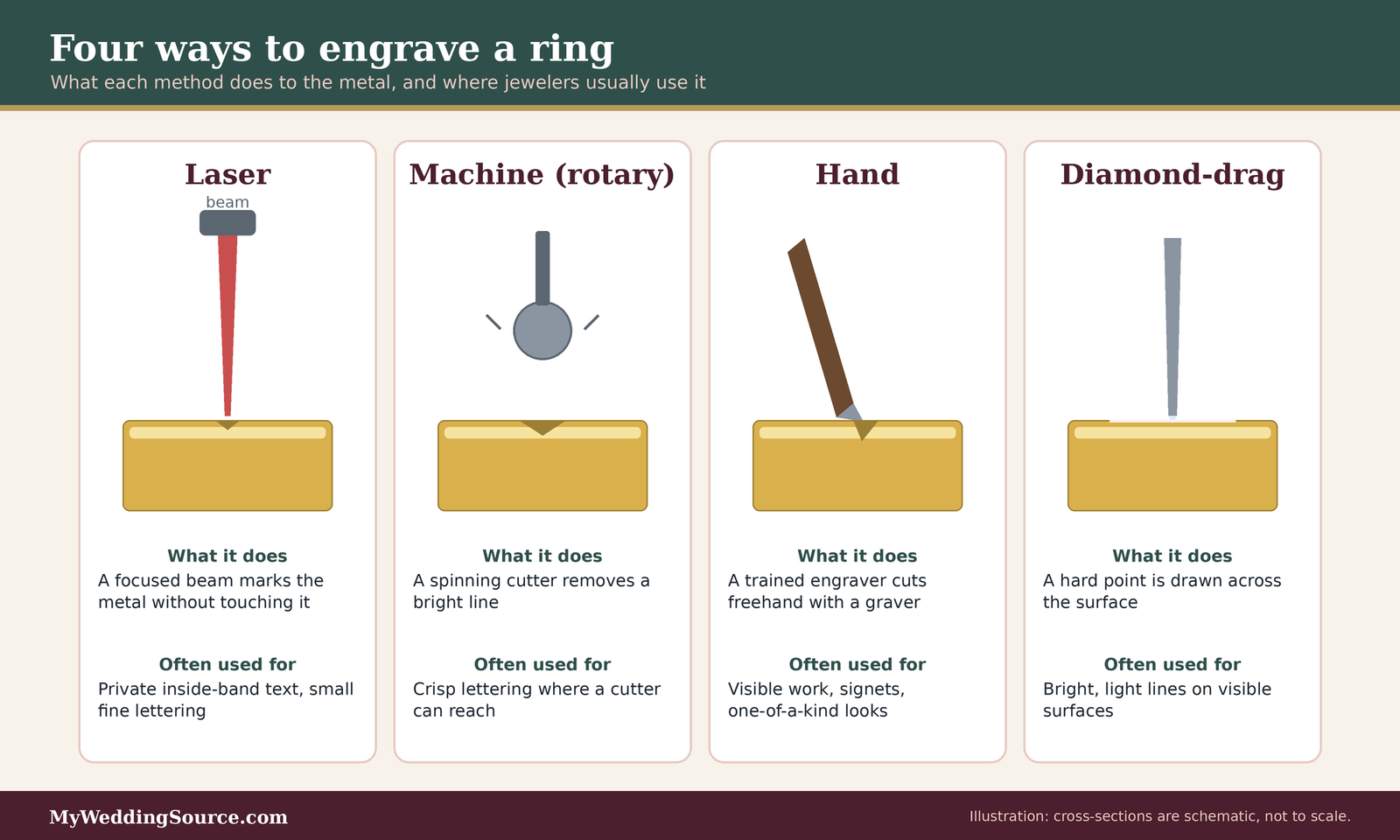
The method decides how the lettering looks, how deep it goes, how much it costs, and whether it can be done on your ring at all. Jewelers commonly describe four methods: laser, machine (rotary), hand, and diamond-drag.
Laser engraving
Laser engraving uses a focused beam of light to mark the metal. It does not touch the ring, which is one reason jewelers say it is safer near delicate settings, and it is the method most inside-band engraving uses. One retailer says it is the standard for inside-band work and includes it with every ring it sells.
What laser does well
Laser can reproduce small, precise lettering and a wide range of fonts, symbols, and sometimes custom artwork or signatures, within a minimum detail size. Several jewelers note that it can also mark hard metals such as tungsten that traditional tools struggle with, though not every jeweler offers it for every metal.
What laser asks of the metal and the ring
A laser needs a flat enough interior to focus on. One jeweler explains that a ring whose inside is extremely thin, or whose surface is too curved or crowded, may not have enough room for a laser engraving at all. If your band has a heavily domed comfort-fit interior or a narrow edge, ask whether the jeweler can engrave it before you commit to text.
Machine, hand, and diamond-drag engraving
The older methods still have a place, especially where the engraving is meant to be seen. They cost more and they vary more from jeweler to jeweler.
Machine and diamond-drag
Machine engraving uses a rotary cutter, and diamond-drag uses a hard point drawn across the surface to leave a bright line. Jewelers describe both as common for outside or visible lettering. Machine work is typically priced like laser work, and the finish looks crisper and brighter than a laser’s.
Hand engraving
Hand engraving is done freehand by a trained engraver with hand tools. Jewelers describe it as the slowest and most expensive option, with a one-of-a-kind, hand-drawn look. It is generally chosen for visible work such as a signet ring or watch case, not for the inside of a standard band. One retailer says hand engraving is not practical for inside-band work, while another says it is suitable for rings at least 2 mm wide, so confirm what your jeweler offers.
Choosing a ring engraving method for a wedding band
For the inside of a typical wedding band, laser is the default and the sensible choice, because the lettering is private and small. Choose another method only if you want visible lettering and your jeweler recommends it for your metal and design.
Match the method to where the text will be
An inside message is worn against skin and seen mainly by the wearer, so crisp small letters matter more than hand-drawn charm. An outside monogram is seen by everyone, so the look of the cut matters more.
Ask who does the work
If the retailer outsources the engraving, turnaround and price change, and so does the chance of a mistake being fixed quickly. Ask whether the work is done in-house, and ask who is responsible if the text is cut incorrectly.
Fonts, symbols, and languages for ring engraving
Once you know how much space you have, the next choice is how the lettering looks. This is where ring engraving most often goes wrong, because a sample on a screen is not the size of the real thing.
Script, block, and the fonts in between
Most jewelers offer at least two families. Script is flowing and romantic, and block is clean and compact. Some add italic, serif, or Old English styles, and a few accept custom fonts for an extra fee.
When script works
Script suits names, a short phrase, or a date on a band wide enough to carry it. Because each letter takes more room, it works best when the message is short. Some retailers recommend script mainly for bands about 2 mm or wider, and note that it becomes hard to read when it is squeezed.
When block works
Block lettering is the safer choice on thin bands, textured interiors, and anything you want to be easy to read. Jewelers often suggest block capitals for small curved surfaces. If you are unsure, block is the font least likely to disappoint at small sizes.
Symbols, coordinates, and special characters
Many jewelers can engrave any character found on a standard keyboard. Anything beyond that, such as hearts, infinity signs, accented letters, or non-Latin scripts, depends on the jeweler’s fonts and equipment.
Check the character before you design around it
A symbol that looks simple on a screen may be cut as a smudge at one millimeter. One retailer notes that nonstandard fonts and special characters are not typically offered, though custom requests may be reviewed. Ask to see the symbol in the actual size before you rely on it.
Coordinates, fingerprints, and handwriting
Coordinates are short strings of numbers and are easy to engrave, but they take a surprising number of characters. Handwriting and fingerprints are possible at some shops with laser equipment, but they need a minimum detail size, and a thin band may not carry them well. Ask for a proof.
Request a proof of your ring engraving, not a promise
A proof is a picture of your exact text in your exact font at the exact size on your ring. It is the only way to see whether the message is legible. A jeweler who cannot or will not provide a proof is giving you a reason to ask more questions.
What a good proof shows
It shows the text at actual scale, the font name, the position on the band, and the line breaks. It should also show the date format exactly as written, so you can catch a day and month swap before it is cut.
What to do if a proof looks cramped
Shorten the message, switch to block, or choose a wider band. Do not accept a smaller font unless you have seen it at real size and can read it.
What to write: wording that ages well
An inscription is the only part of a wedding ring that is truly yours, so people understandably want it to say something. The best messages are short and specific, and they still make sense in the thirtieth year.
Names, initials, and dates
The most common choices are a date, initials, a short name, or a pair of these. They fit almost any band, and they hold their meaning.
Dates
A wedding date is the classic option. Pick one format and use it on both rings. If you or your partner come from places that write day and month in a different order, confirm the order with the proof, because an engraved date cannot be tidied up with a pen. One jeweler specifically warns about this problem.
Initials and monograms
Initials save characters and look balanced in block capitals. A monogram, which stacks or interlocks letters, can look beautiful on an outside surface but needs space and a skilled hand. On the inside of a narrow band, plain initials are easier to read.
Short phrases and private references
Phrases are where the length limit bites. A short phrase of a few words is plausible on a wider band, and a longer line is usually only practical on the widest bands. Jewelers often suggest that a phrase needs a band of around 5 mm or more in most fonts.
A test for wording
Read the message aloud and ask whether it still sounds right if the relationship, or the language in your house, changes in ten years. A private joke that needs a footnote today may need a translator later. A name or a date does not.
Keep it kind to the next owner
Some couples hand their rings to children or have them resized or reset. A message that is personal to the two of you may not suit a ring that moves on. If that matters to you, choose something general or keep the message on a ring you do not plan to pass on.
Pairs, mirrored messages, and one-ring messages
Many couples engrave two halves of a phrase, one on each ring, or the same message on both. It is a charming idea with one risk: if one ring is later resized or replaced, the pair is no longer complete.
Write for the smaller limit
If the two bands differ in width or size, write the message so that both fit. A jeweler may be able to use a smaller font on the narrower ring, but then the pair will not look matched.
Keep a record of the exact text
Store the exact text, font, and date format with your ring paperwork. If a ring is ever lost, damaged, or replaced, you will want the exact wording to recreate it. Our wedding planning checklist has a place to keep these details.
Where to put the engraving: inside, outside, and near stones
Inside is the standard for ring engraving on wedding bands. It is private, it is protected from daily wear, and it does not change the look of the ring from the outside. Outside engraving is a design choice and belongs in a different conversation.
Inside the band
The inside surface is flat enough for a laser, and the text is less exposed to scratches. It rests against skin, so it is also the surface that will be polished least often.
Position matters more than people think
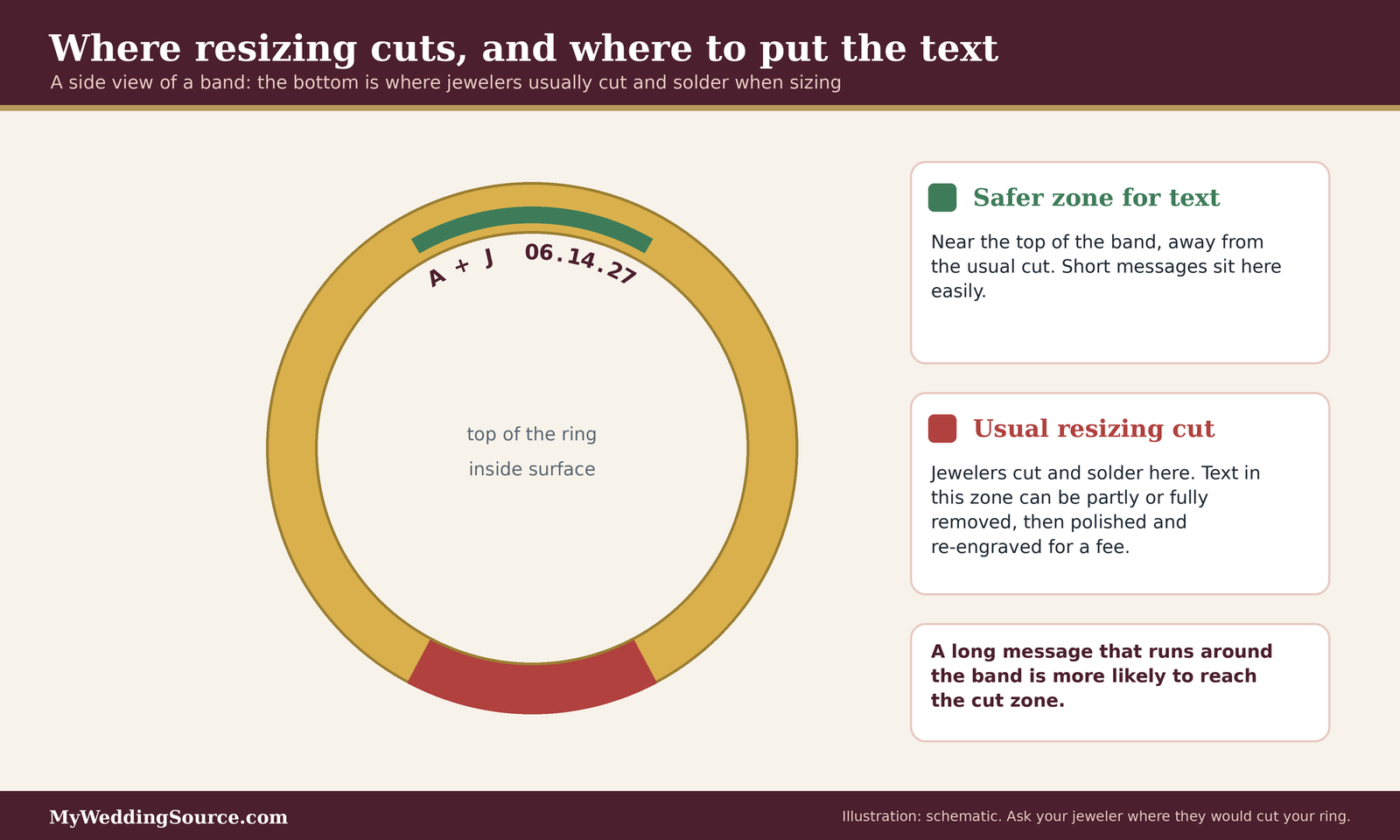
Where the text sits on the circumference matters later. The usual advice is to keep it away from the bottom of the band, the part opposite the top of the ring, because that is where a jeweler normally cuts to resize. A jeweler who knows you may resize can plan the position accordingly.
Centered or running the full length
A short message is often centered at the top. A longer one can run around more of the circumference. The longer the text runs, the more likely a later resize will touch it.
Outside the band
An outside inscription is visible and so is more of a design element. It is also exposed to wear. Jewelers say outside engraving is exposed to contact and needs a metal and depth that can take it. It also changes the look of a ring that was designed to be plain.
Texture and finish change the result
A satin, hammered, or brushed surface can make fine lettering hard to see. Block lettering on a polished area is usually the clearest.
Plating is a separate caution
On a plated ring, an inscription cuts through the plating at the point of the letters. Jewelers say inside-band engraving on a plated ring is generally acceptable because the interior surface is less visible, but they recommend asking about depth and wear first.
Near stones, pavé, and fine settings
If a ring has diamonds, channels, or fine prongs near the inside surface, space for text may be limited, and mechanical engraving tools can risk damage.
Laser is gentler near stones
Because a laser does not touch the metal, jewelers describe it as the safer choice near fragile settings. Even so, ask for an assessment before you commit to a message length.
Bring the ring in
If you already own the ring, bring it in for a quick look instead of guessing. A jeweler can tell you in a minute where the text can sit and how much room there is.
Special cases: ring engraving on rings you already own
Not every inscription is ordered with a new ring. Engagement rings, family rings, and rings bought months ago all raise their own questions, and the answers differ from the order-with-the-ring case.
Adding ring engraving after you bought the ring
Many jewelers will engrave a ring bought elsewhere, though policies differ, and a few will only work on rings they sold. One Canadian jeweler describes engraving on pieces bought elsewhere as routine but insists on inspecting the piece first, and some retailers add a longer lead time for post-purchase work.
Bring the ring for an assessment
Ask the jeweler to look at the interior, the metal, any plating, and the position of stones before quoting. This takes minutes and tells you whether laser or another method is possible and how much text fits.
Check the warranty and the finish
If the ring came with a warranty or a finish such as rhodium or black coating, ask whether engraving or polishing affects it. Get the answer in writing, because a polished-off finish may need to be redone.
Removing, replacing, or updating old ring engraving
Ring engraving can be polished out and replaced, which people do after a resize, after a divorce and remarriage, or simply to correct a mistake. The cost is a fee and a thin layer of metal.
How removal works
A jeweler polishes the interior until the lettering disappears, then re-engraves if you want new text. One jeweler recommends inspecting the band first because polishing removes metal, and a band that is already thin may not have much to give.
When to leave it alone
Old worn inscriptions on antique or inherited rings can carry history, such as a date or initials. If the ring is valuable or sentimental, ask a jeweler whether the text can be left and a new one added elsewhere, or photographed and recorded before anything is changed.
Ring engraving on an engagement ring
Engagement rings are often narrow and may have stones set low, so the space for ring engraving can be tight. A short date or a pair of initials is usually the practical choice.
Match the pair
If you plan to engrave both the engagement ring and the wedding band, decide whether the two should carry related text, and write it to the smaller limit. Our engagement ring guide explains how the setting changes the room available.
Think about resizing first
Engagement rings are often resized after the proposal, so many couples wait until the size is confirmed. That avoids paying twice for ring engraving.
Metal and ring engraving: what the ring is made of changes the answer
Not every metal engraves the same way, and some cannot be engraved by every jeweler. The metal decides the method, the depth, the durability, and whether the ring can be adjusted afterwards.
Gold and platinum
Gold and platinum are the standard metals for ring engraving. Both take a laser well and both can be polished and re-engraved.
Gold
Jewelers say shallow engraving on softer yellow gold wears faster than deeper work, so depth is worth asking about. Gold can also be resized by a jeweler, which matters if the engraving may need to be replaced.
Platinum
Platinum is dense and holds a mark well. It is also more labor to work, so some jewelers charge more to engrave or re-engrave it. Our guide to wedding ring metals explains how it compares with gold on weight and wear.
Titanium, tungsten, cobalt, and ceramic
Alternative metals are popular for men’s bands and for people who want a very hard ring. They are also the metals where engraving and resizing are most limited.
Laser is usually the method
Jewelers say laser engraving can add names, dates, initials, and short messages to tungsten, though not every jeweler offers it. At one large retailer, whether an alternative-metal band can be engraved depends on the individual ring design, so check the product page or ask.
Hardness has a price
A hard metal resists scratches, which also means it resists traditional tools. One repair shop states that tungsten, titanium, and ceramic carbide are not malleable and cannot be worked on with regular jeweler’s tools, so such rings usually cannot be resized and the engraving cannot be removed. That makes getting both the size and the text right the first time much more important.
Plated and mixed-metal rings
A plated ring has a thin layer of a precious metal over a base. Jewelers say inside-band engraving on plated rings is generally fine, but cutting through the plating can expose the base metal at the letters.
Ask about the layer
If the ring is plated, ask what the base is, how thick the plating is, and what happens at the letters. A different answer for each ring is normal.
Mixed metals and inlays
On a band with an inlay or a two-tone design, engraving may need to avoid the join. Ask your jeweler to mark where the text can sit before you finalize it.
Resizing and ring engraving: what a size change does to the text
Resizing is the single most common reason ring engraving is damaged, and the risk is mostly predictable. Jewelers usually resize by cutting the band at the bottom, removing or adding a section of metal, and soldering the ends together. Whatever lies in the cut zone is affected.
What happens to the engraving
If the text is far from the cut, it can often stay untouched. If it sits where the jeweler needs to cut, it may be partly or completely removed. Several jewelers describe the same three situations: engraving away from the adjustment area, engraving at the bottom, and engraving that is replaced afterward.
Away from the cut
A jeweler can often resize without touching the text if there is enough blank metal at the bottom. This is why placing the text near the top of the band is useful.
In the cut
If the text is where the jeweler needs to cut, it may be lost. If a long inscription runs around most of the band, even a small size change can reach it. Going several sizes down takes out more metal and makes this more likely.
Re-engraving after a resize
A jeweler can often polish out the old text and engrave it again. This is normal and routine, although it adds a fee and removes a thin layer of metal.
What polishing costs the ring
Polishing removes a little metal. Jewelers say to bring the ring in for inspection first, since a thin band may not have much to give. If the ring has already been polished several times, there may be less margin for another round.
Resizing also changes how the inside looks
One jeweler explains that the joint area gets the most finishing, so shallow engraving there can be overpolished, and that comfort-fit interiors complicate things further because heavy buffing can lighten the engraving. If you have a comfort-fit band, say so when you ask about resizing, and ask the jeweler to protect the engraved area during polishing.
Plan your ring engraving for the size you may become
Fingers change. Weight, pregnancy, age, and temperature can move a ring size by a half size or more. A little planning at the order stage can save a lot of trouble later.
Order unengraved if sizing is uncertain
Some retailers advise ordering a ring unengraved until you are sure of the size, because an engraved ring may be final sale. If you are not sure, ask for a sizer and wear it for a few days, then engrave. Our wedding band width guide explains why wider bands often need a different size.
Alternatives to cutting
For a small change, a jeweler may suggest sizing beads, a sizing bar, or a spring insert, which snug the ring without cutting it. These do not touch the engraving, though they are not a fix for a larger size change.
Timing, returns, and cost: how to order ring engraving without regret
Ring engraving is a made-to-order service, and the terms around it are where couples get surprised. The cutting is quick. The policies are what make it hard to undo.
When to schedule ring engraving
Ring engraving works best after the ring is settled: the metal, the width, and the size. It works worst when the ring is still a candidate.
Engrave after fit is confirmed
Wear the ring, or a sizer, long enough to be sure of the size. Then engrave. Our plan wedding timeline guide shows where ring orders fit in a longer schedule.
Leave time for the work
Turnaround ranges from a day or two for simple in-house laser work to several weeks for post-purchase engraving through a large online retailer. One online jeweler says post-purchase engraving typically takes two to three weeks. Order early enough that a mistake can be corrected before the day.
Returns and final sale for ring engraving
Many retailers treat engraved rings differently from plain ones. Policies vary, so read the terms before you order, not after.
What retailers say
Some state that engraved rings are final sale and cannot be returned or exchanged. Others accept returns of engraved wedding bands but keep the engraving fee, or charge a fee to remove the engraving. Some distinguish standard interior engraving from custom or hand-cut work. The range is wide, which is the point: assume nothing.
Questions to settle first
Ask whether engraving makes the ring final sale, whether a mistake by the jeweler is corrected at no cost, and whether a resize or exchange is possible after engraving. Get the answers in writing.
What ring engraving costs
Prices vary widely by jeweler, method, and length. Published examples show how wide the spread is, so use them to get oriented, not to budget.
Cost note
One large online jeweler lists standard wedding band engraving at a flat fee with an extra charge per character beyond the standard limit, while a Canadian jeweler publishes separate ranges for laser and hand work. A pricing site reports that hand engraving by independent engravers is often charged per character. These figures change and differ by region, so ask for a written quote, and add engraving and any later re-engraving to your wedding budget calculator.
Where cost hides
Costs add up through per-character fees above a standard limit, extra charges for fonts or symbols, a fee to remove engraving if you return a ring, and a fee to re-engrave after a resize. Ask about each of them.
Insurance and records
If you insure your rings, keep a record of the engraving in the appraisal and photos, since it helps identify the ring if it is lost. Our guide to engagement ring insurance and hidden costs covers what to document.
A proof-and-check plan for ring engraving
A checklist beats good intentions when you are planning ring engraving. Use this order to avoid the common mistakes.
Before you write the message
Settle the ring first, then the message. Fix the metal, the width, and the size, and ask the jeweler for the character limit for each ring.
Decide the method and font
Ask which method will be used, and whether the work is in-house. Choose a font based on the proof, not on a sample sheet.
Decide the position
Ask where the text will sit and whether a future resize would reach it. If you expect to resize, ask for the text to be placed away from the bottom.
Before you approve the proof
Read the proof aloud, letter by letter, then have someone else read it. Check names, dates, punctuation, and spacing, and confirm that the date format is the one you meant.
Check both rings
If you are engraving two rings, check each proof separately. Errors on one ring are easy to miss when you assume the two are the same.
Keep the final approval in writing
Save the approved proof and the order confirmation. If the ring comes back different, you will need them.
When the ring arrives
Inspect the engraving in good light, with a loupe if the jeweler offers one. Check legibility, depth, and position. Report any problem immediately, because return windows are often short and engraved items may be final sale.
What to do if it is wrong
If the text differs from the approved proof, contact the seller right away and send photos. If the proof itself was wrong, the policy matters, which is why the written terms are worth reading in advance.
Photograph it
Take a close photo of the inscription. It is useful for insurance, for a future re-engraving, and for ring photos. Our wedding photographer shot list suggests how to ask for detail shots of the rings.
The questions to bring to the jeweler
Put these questions on paper before the appointment. They are short, and every one of them has caught a real problem for somebody.
Ask the jeweler
Questions to ask
- What is the exact character limit for my ring size, width, and font, including spaces?
- Which method will be used, and is the work done in-house?
- Will you send a proof at actual size before cutting?
- How deep is the engraving, and how does it wear on this metal?
- Where will the text sit, and would a resize reach it?
- Is the ring final sale once engraved, and is a jeweler’s mistake corrected at no charge?
- What do you charge to remove or re-engrave the text?
Ask yourself
Would I still want this message if the ring were resized, replaced, or handed down? Is the date format unmistakable? Can I read the proof at actual size without squinting? If any answer is no, change the text before the cut, not after.
FAQ: ring engraving questions
Length and fonts
How many characters can I engrave inside a wedding band?
It depends on band width, ring size, and font. Jeweler guides commonly cite about 8 to 15 characters for a band 2 to 3 mm wide, about 15 to 25 for 4 to 6 mm, and about 25 to 35 for 7 mm or wider. Retailer limits can be lower, so ask for the limit for your ring.
Is script or block better for ring engraving?
Script looks romantic but takes more room per character, so it suits short messages on wider bands. Block is more compact and easier to read on thin bands. Ask for a proof in both if you are unsure.
Method and metal
Is laser engraving as good as hand engraving?
For private lettering inside a band, laser is the usual choice and gives clean small lettering. Hand engraving has a handmade look and is usually chosen for visible work. Which is better depends on where the text goes and on your jeweler.
Can a tungsten, titanium, or ceramic ring be engraved?
Often yes with a laser, but not every jeweler offers it, and eligibility depends on the ring. Such rings usually cannot be resized, so confirm both the engraving and the fit before you order.
Resizing and returns
Will resizing erase my engraving?
It can. If the text sits where the jeweler cuts, usually the bottom of the band, it may be partly or fully removed. Jewelers can often polish and re-engrave, for a fee. Placing the text near the top reduces the risk.
Can I return an engraved ring?
It depends on the seller. Some treat engraved rings as final sale, and others allow returns but keep the engraving fee or charge to remove it. Read the policy before you order and get it in writing.
Should I engrave before or after I know my size?
After. If you are unsure of your size, ask for a sizer, wear it for a few days, and confirm the size before the ring is engraved.
Your next steps
Settle the ring
Confirm metal, width, and size
Decide these before the text. Our guides to wedding ring metals and wedding band width cover the choices that set what your jeweler can engrave.
Compare it with your engagement ring
If you own an engagement ring, read our engagement ring guide for how it affects the pair, then try the bands together.
Lock in the message
Write two versions
Write a long version and a short version, then see which fits the proof. Keep the exact text with your records.
Put the dates on your plan
Add the engraving order to your wedding planning guide timeline, with a date for proof approval and a date by which the rings must be back.
Sources & methodology
How we built this guide
What we relied on
This guide combines published engraving, resizing, and return-policy information from jewelers and retailers with a federal rule on how jewelry is marked and described. Where a statement comes from a retailer or repair shop, we attribute it, because policies, prices, and limits vary by seller and change over time. The character ranges are published rules of thumb, not standards.
What we did not do
We did not test engraving methods or measure engraved rings, and we do not recommend a seller. Prices and policies in the sources were current when we read them and may have changed. Confirm limits, fees, and return terms with the jeweler who will hold your ring.
Source list
Government and regulatory sources
- Federal Trade Commission, Guides for the Jewelry, Precious Metals, and Pewter Industries, 16 CFR Part 23, final revisions (Federal Register, August 16, 2018): https://www.govinfo.gov/content/pkg/FR-2018-08-16/html/2018-17454.htm
Jeweler, retailer, and consumer sources
- Brilliant Earth, Engraving and resizing options: https://www.brilliantearth.com/wedding-ring-guide/engraving-resizing-options
- Brilliant Earth, Ring engraving ideas: https://www.brilliantearth.com/guides/ring-engraving-ideas/
- WeddingWire, Wedding ring engraving: https://www.weddingwire.com/wedding-ideas/wedding-ring-engraving
- Foreverings, Can you engrave a ring: https://foreveringsjewelry.com/blogs/news/can-you-engrave-a-ring
- USA Jewels, Engraving guide for wedding rings: https://www.usajewels.com/education/about-wedding-rings/engraving
- Quick Jewelry Repairs, Can you resize a ring with engraving: https://quickjewelryrepairs.com/articles/can-you-resize-a-ring-with-engraving/
- Whiteflash, Jewelry and ring engraving: https://www.whiteflash.com/jewelry-education/ring-engraving/
- Martin Busch Jewelers, Will my engraving be ruined if I resize my ring: https://www.martinbuschjewelers.com/blogs/news/will-my-engraving-be-ruined-if-i-resize-my-ring
- Bijouterie Jamil, Jewellery engraving guide: https://www.bjamil.com/blogs/expertise-en/engraving-guide
- Vrai, Is my item returnable if it is engraved: https://help.vrai.com/en/knowledge/is-my-item-returnable-if-it-is-engraved
- Jens Hansen, Are engraved rings able to be resized: https://help.jenshansen.com/knowledge/are-your-engraved-rings-able-to-be-resized-in-the-future