
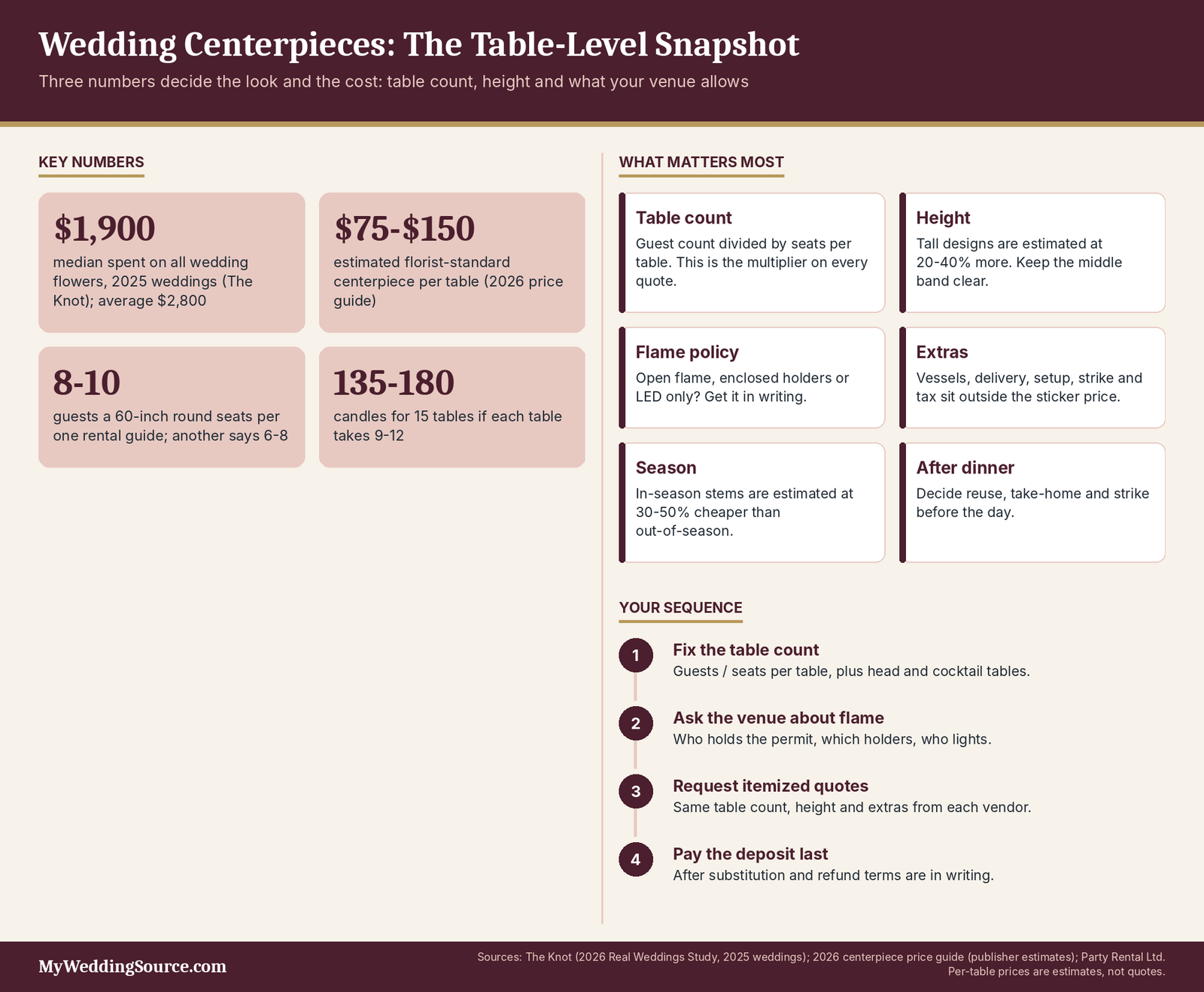
Wedding centerpieces cost what they cost because of three table-level numbers: how many tables you set, how tall each piece stands, and what your venue allows on a tabletop, so settle those before you fall for a style.
Your venue just sent the floor plan, and it shows 15 round tables. Your florist’s intake form asks whether you want pieces tall or low, with candles or without, and whether you would like a quote for “centerpieces” as a flat line or by the table. Meanwhile your phone is full of saved photos of long tables covered in taper candles, moss runners and cascading greenery, and not one of them tells you what that look costs at 15 tables, whether your venue will let you light anything, or whether guests across the table will be able to see each other. Those are the decisions that decide wedding centerpieces, and they are mostly arithmetic and logistics, not taste.
This guide takes the table as the unit of planning. It covers the main centerpiece styles and what each one asks of your room, a per-table cost ladder worked through at 10, 15 and 20 tables, the geometry of a round table and why height matters for conversation, and how fire codes and venue policies shape candles and greenery. It then compares renting, buying and doing it yourself, shows how seasons change what a table costs, and ends with reuse, safety, proposal comparison and a timeline. For the broader floral picture, including bouquets, ceremony pieces and florist selection, see our wedding flowers guide; this article stays at the dinner table.
Two honest limits before the numbers. National data on centerpieces specifically is thin: The Knot publishes what couples spent on flowers overall, not on tabletop pieces, so the per-table figures below come from published 2026 price guides and a florist’s help center, and we flag every one as an estimate. Prices, fire codes and tax rules also change by city and state, so treat each example as a prompt to ask your own venue and vendors, then get the answer in writing.
Which centerpiece style fits your tables, venue and season?
A centerpiece is the one decoration every guest sits next to for two to four hours, which is why the style decision is also a practical decision about light, height, food space and conversation. Styles overlap, and many tables combine two or three of them, but it helps to see what each one asks of your budget and your room before you mix them.
What are the main centerpiece styles?
What can floral arrangements do, and what do they cost you in height?
Floral centerpieces range from a handful of stems in bud vases to a lush compote or a tall arrangement on a stand, and the height you choose changes both the look and the price. One 2026 price guide estimates that tall arrangements cost 20 to 40 percent more than low ones, a plausible figure because taller designs use more stems, sturdier mechanics and more delivery care. Low arrangements keep sight lines open and are easier to move when a caterer needs table space. Tall designs read as more dramatic in photographs and can make a large room feel finished, but they are the style most likely to interrupt conversation if they are built in the wrong height band, a problem we cover in the sight-line section.
How do candle-led centerpieces work?
Candle-led tables rely on light and repetition rather than blooms: clusters of votives, taper candles in holders, or pillar candles at different heights on a runner or mirror tile. The same price guide notes that a cluster of nine to twelve candles fills a 60-inch round table, so at 15 tables you are planning for roughly 135 to 180 candles plus holders. That quantity matters twice, once for cost and once for the venue’s fire rules, since many venues limit open flame or require enclosed holders. Treat flameless candles as a real design option rather than a downgrade, and check the battery and safety notes later in this guide if children will be seated at your tables.
Where do greenery, garlands and foraged pieces fit?
Greenery-led centerpieces use eucalyptus, olive, ruscus, ferns, herbs or branches as the main visual, often with a few blooms as accents. The Knot’s advice on trimming a flower budget is to mix more greenery into arrangements, since blooms usually cost more per stem than foliage. Greenery also holds up well in warm rooms and photographs with a relaxed, organic look. One caution is volume: a garland that runs the length of a long table needs far more material than it appears to, and fresh greenery may be treated differently from artificial greenery under local fire rules, so ask the venue before you commit.
What counts as a non-floral centerpiece?
Non-floral options include fruit and produce, stacks of books, lanterns, terrariums, potted herbs, candlesticks, sculpture and found objects. Zola’s centerpiece roundup points out that flowers are optional and suggests ideas such as fruit displays that guests can take home. Pinterest’s 2026 wedding trend report lists vegetable centerpieces among its growth signals, which is a style direction rather than a price promise. Non-floral pieces can run lower than fresh flowers (the 2026 price guide estimates 30 to 50 percent lower), but they can also cost more when they are sculptural, custom-made or rented in quantity, so price them the same way you price flowers: per table, itemized.
| Style | Works well when | Watch for | Cost direction |
|---|---|---|---|
| Low floral | Conversation matters and tables are crowded | Needs enough stems to look full at low height | Mid; scales with stem count |
| Tall or elevated floral | High ceilings or a big room feel | Sight lines, weight of stands, extra delivery care | Higher; roughly 20 to 40 percent above low (estimate) |
| Candle-led | Evening dinners, warm light | Venue flame rules, wax, wind outdoors, count of holders | Varies; low for votives, higher for custom holders |
| Greenery and garlands | Long tables, relaxed or garden looks | Volume needed, fire-code treatment of vegetation | Lower per stem than blooms, but volume adds up |
| Non-floral | Budget flexibility, personalization | Custom items can cost more than expected | Often lower (estimate 30 to 50 percent), not guaranteed |
How do you choose between them?
Why should the room, not the mood board, make the first call?
Start by writing down what the venue gives you: ceiling height, lighting, table shape, table diameter, any existing candles or linens, and the rules on flame and décor. A tall arrangement that looks graceful in an 18-foot barn can feel heavy in an eight-foot hotel ballroom, and a candle-only look loses its point in a bright room with overhead lighting you cannot dim. The mood board still matters, but it becomes a filter applied to what the room can host. Couples who reverse that order tend to discover the constraint at the walk-through, when changing course costs more.
How do lighting and linens change what a style looks like?
Colors and textures shift with the light they sit in. A deep merlot or plum can read as nearly black under dim uplighting, a pale blush can wash out against ivory linens, and white blooms turn warm under amber bulbs. Ask your florist for photos of the actual stems and for a mock-up of one table, or see a sample set at your venue’s lighting if the venue allows it. If you rent linens, check the exact color names against the flowers, since “ivory” differs from vendor to vendor.
How much work should each table do?
Decide what you want the centerpiece to accomplish beyond looking nice. Some tables need to hold food service space for family-style plates, some need a place card holder or a menu, some should light the table at dusk, and some should travel home with a guest at the end of the night. A piece that has to do three jobs usually needs a bigger footprint, which loops back to table size, and a piece that has to do one job can be small and inexpensive. Ranking those jobs in one line each before you shop gives your florist, rental company and caterer the same brief.
What do wedding centerpieces cost per table at 10, 15 and 20 tables?
Centerpiece pricing is easiest to understand as a multiplication problem: price per table, times table count, plus a few flat charges that do not scale with either. This section builds that math from the data that exists, labels what is a survey finding and what is an estimate, and then walks one 15-table quote through every cost layer. For the whole floral budget, our wedding flowers cost guide covers bouquets, ceremony pieces and florist fees in more depth.
Where do the per-table numbers come from?
What does national flower spending data actually tell you?
The most reliable national figure is The Knot’s average cost of wedding flowers page, which reports an average of $2,800 and a median of $1,900 for couples married in 2025, with quartiles of $900 and $4,800 and a sample of 10,474 U.S. couples. That figure covers bouquets, boutonnieres, wedding party flowers and centerpieces together, so it cannot tell you what couples paid per table. It does show how wide the range is: the lowest quarter spent $900 or less on everything, while the top quarter spent $4,800 or more. Use it as a sanity check for your total floral budget, not as a per-table price.
How were the per-table tiers built?
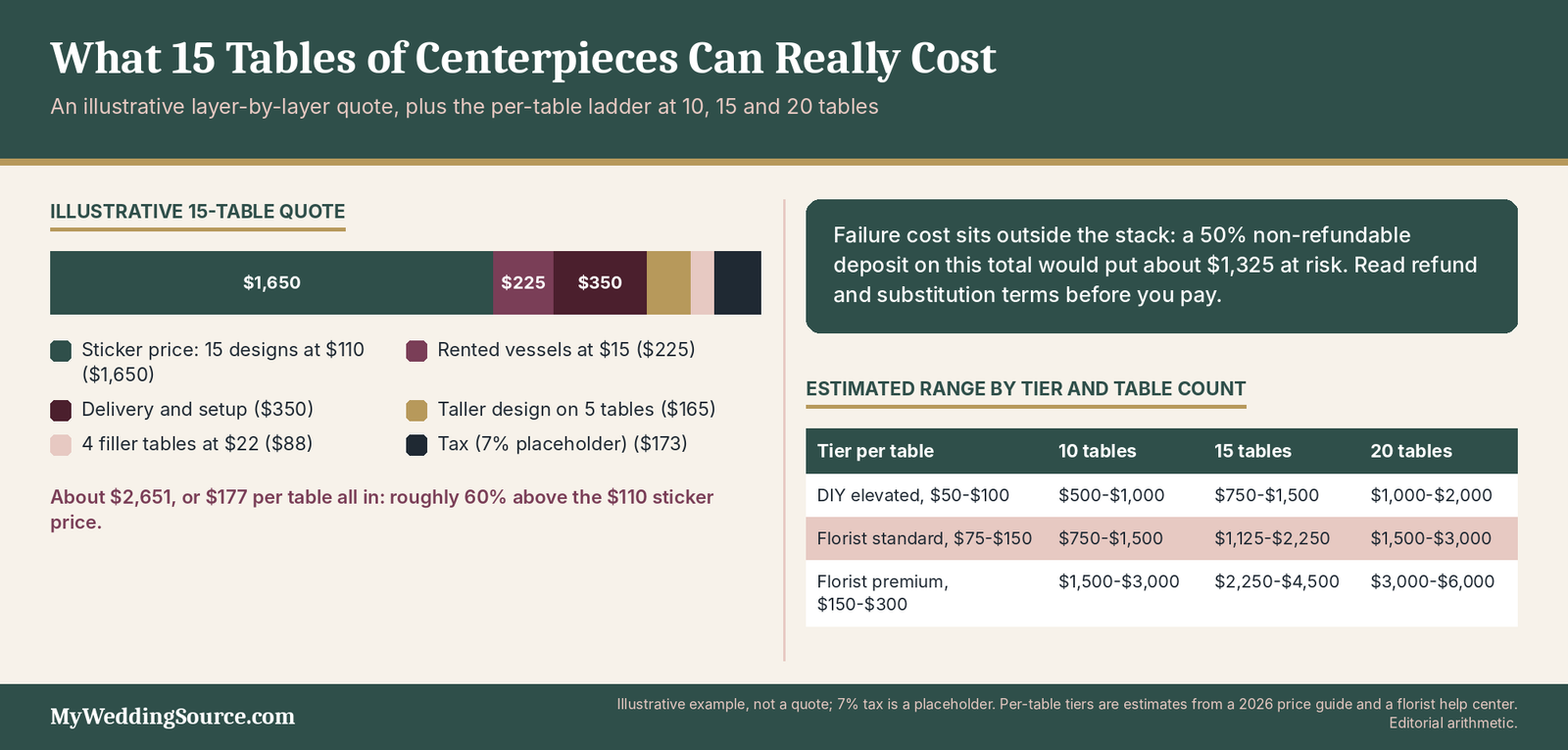
No national survey publishes per-table centerpiece prices, so the ladder below leans on two sources that agree reasonably well and one that adds a reality check. A 2026 centerpiece price guide lists DIY simple at $20 to $50 per table, DIY elevated at $50 to $100, florist standard at $75 to $150, florist premium at $150 to $300 and luxury installations at $300 to $500 or more. A florist’s help-center comparison estimates that traditional local florists charge $1,200 to $3,000 or more for 15 tables of centerpieces and budget florists $750 to $1,500, which works out to about $80 to $200 and $50 to $100 per table. Both are publisher or vendor estimates with no external data cited, so treat them as ballparks and expect your city to land above or below them.
Why do tall pieces cost more and non-floral pieces cost less?
Height changes the stem count, the mechanics and the delivery handling. The same price guide estimates that tall arrangements run 20 to 40 percent more than low ones, and that non-floral centerpieces can run 30 to 50 percent below fresh-flower arrangements. Both are estimates, but the direction is intuitive: stems are the biggest variable cost, and labor is the second. The Knot’s explainer on why wedding flowers cost what they do quotes designers describing 10 to 14 hour production days and weeks of prep, which is why a florist’s price is not simply the cost of the flowers in the bucket. When a proposal drops sharply for a “similar look”, ask which stems, how many and how tall.
What does the table math look like at 10, 15 and 20 tables?
What is the range at each table count?
At 8 to 10 guests per 60-inch round, 10 tables seat about 80 to 100 guests, 15 tables about 120 to 150 and 20 tables about 160 to 200. Multiplying the per-table tiers above by those counts gives the ranges in the table below, before any flat fees. These are centerpieces only; they exclude the head table, cocktail tables, ceremony pieces and personal flowers.
| Tier (per table) | 10 tables | 15 tables | 20 tables |
|---|---|---|---|
| DIY simple ($20 to $50) | $200 to $500 | $300 to $750 | $400 to $1,000 |
| DIY elevated ($50 to $100) | $500 to $1,000 | $750 to $1,500 | $1,000 to $2,000 |
| Florist standard ($75 to $150) | $750 to $1,500 | $1,125 to $2,250 | $1,500 to $3,000 |
| Florist premium ($150 to $300) | $1,500 to $3,000 | $2,250 to $4,500 | $3,000 to $6,000 |
| Luxury ($300 to $500+) | $3,000 to $5,000 | $4,500 to $7,500 | $6,000 to $10,000 |
What does that mean next to the national flower numbers?
Fifteen tables at the florist standard tier run $1,125 to $2,250, which by itself can equal or exceed the entire median floral spend of $1,900. That is not a contradiction, because many couples set fewer tables, use greenery-heavy designs or skip some floral categories, and the median includes people who spent very little. It does mean that centerpieces tend to be the line item that pushes a floral budget past what the “average” suggests. The Knot’s own saving tips include limiting the number of arrangements and mixing in more greenery, which are table-level moves.
How does table count change the strategy?
At 10 tables, a premium tier is feasible for many budgets because the multiplier is small, and a single statement piece per table can look intentional. At 15 tables, mixed tiers start to make sense: a stronger design on the head table and a few visible tables, with simpler pieces elsewhere. At 20 tables and above, the multiplier dominates, so decisions about height, vessel reuse and whether every table needs an arrangement save more than any single style choice. Fewer, larger tables can lower the piece count, though they change the room layout, so run the idea past your venue and caterer first.
What does a full 15-table quote look like, layer by layer?
What are the sticker price and the required extras?
The sticker price is the per-table design fee times the number of tables. In our illustrative example, a florist standard design at $110 per table across 15 tables is $1,650. Required extras come next: if vessels are rented rather than included, the price guide estimates $8 to $25 per piece, so at $15 each the 15 vessels add $225. Delivery and setup is a flat charge that the same guide says often lands at $200 to $500 per wedding; we use $350. Notice that the extras so far add $575, or about 35 percent on top of the sticker price, and nothing in the proposal has been upgraded yet.
Which realistic extras tend to appear?
Realistic extras are the items that appear once you look at the real event. If five visible tables get a taller design at a 30 percent premium, that adds about $33 each, or $165. If you want four cocktail-hour or buffet tables dressed with small pieces at the guide’s estimate of $15 to $30, using $22, that is $88. Some florists also charge separately for strike, meaning the pickup of rented items after the event, and The Knot’s list of florist questions asks directly about delivery, setup and breakdown charges, so ask whether strike is included. We have not added a strike fee here because no published source gives a typical amount.
What about taxes, fees and the cost of things going wrong?
Taxes depend on your state and sometimes your city. New York’s tax bulletin for florists, issued in 2012 and updated on the state site in 2026, says delivery charges are part of the taxable receipt on direct sales, but it does not address wedding arrangements, rentals or setup labor, which is a reminder to ask your florist how each line is taxed. Using an illustrative 7 percent on the whole subtotal of $2,478 adds $173. The failure cost is different in kind: if a florist requires a 50 percent non-refundable deposit on a $2,651 total, about $1,325 is at risk the day you sign, which is why the refund and substitution terms matter as much as the design.
| Layer | What is included | Illustrative amount |
|---|---|---|
| Sticker price | 15 florist-standard designs at $110 | $1,650 |
| Required extras | 15 rented vessels at $15; delivery and setup | $575 |
| Realistic extras | Taller design on 5 tables; 4 filler tables | $253 |
| Taxes | 7 percent placeholder on the subtotal | $173 |
| Total | About $177 per table all in | $2,651 |
| Failure cost | 50 percent non-refundable deposit | About $1,325 at risk |
How can you lower the total without making the tables look sparse?
Should you cut the number of pieces before you cut quality?
Often yes, because the multiplier is the biggest lever. Not every table needs the same centerpiece: a dense arrangement on every table can be replaced by a strong piece on the visible tables and a simple candle or greenery cluster elsewhere. The Knot’s saving tips also include choosing in-season flowers and asking the florist to work within a color palette rather than naming every stem, which gives the studio room to substitute what is fresh and fairly priced.
How do you mix volume with a few statement pieces?
Pair one inexpensive repeated element with one expensive moment. For instance, a continuous greenery runner or a row of rented votives can be the “volume” across all tables, while a taller or fuller arrangement appears at the head table, the cake table and the entry. This approach works because guests see the room as a whole before they notice any individual table. Ask your florist to price this as a split proposal so you can see the saving rather than guess at it.
Which savings are not worth the risk?
Skipping a mock-up, buying stems too early, or choosing a very low quote without asking what is excluded can cost more than the savings. Underpriced proposals sometimes leave out delivery, rentals or strike, and the difference lands on you at the end. Be cautious, too, with a contract that does not protect your color palette or stem count if the florist substitutes flowers.
How do you design for the table in front of you?
A table is a small, fixed stage with a plate, glass and cutlery for each guest, and the centerpiece gets whatever space is left. Knowing that space in inches turns “tall or low?” from a style argument into a measurement.
How much room does a centerpiece actually get?
How many guests fit at each table size?
Published rental guides do not fully agree. Party Rental Ltd’s table guide lists a 60-inch round at 8 to 10 guests and a 72-inch round at 10 to 12, while Hill Country Event Rentals lists a 60-inch round at 6 to 8 and a 72-inch round at 8 to 10 and notes that capacity varies with chair style and place settings. The event planning blog PCMA describes a 60-inch round seating 8 or 10, and a 72-inch round seating 10 to 12. Use your own rental company’s number for your own chairs and place settings, because that number sets how many tables you need and therefore how many centerpieces you buy.
What does the geometry leave for the middle of the table?
A 60-inch round has a circumference of about 188 inches, so 8 guests get roughly 23.6 inches each and 10 guests get about 18.8 inches. Place settings with chargers, glasses and bread plates typically take around 15 to 18 inches of depth from the edge (an editorial estimate, so measure your own), which leaves roughly 24 to 30 inches across the center of a 60-inch table. A 72-inch round leaves roughly 36 to 42 inches. Rental guidance also notes that tabletop items such as chargers, florals and candles increase the footprint and may require wider tables, so a wide arrangement on a 60-inch table can crowd the plates.
How do long and mixed layouts change the plan?
Long banquet tables ask for repetition rather than a single hero. An eight-foot banquet seats 8 to 10 guests by Hill Country’s guide, with the long runner needing a series of small pieces or a continuous garland rather than one central arrangement. Mixed layouts, with a few long tables among rounds, need a consistent visual language so the room reads as one design, for example the same vessel and candle height across both shapes. Ask your florist whether the quote is per table or per feature, since a continuous garland is priced by length and handled differently from ten small arrangements.
Should centerpieces be tall, low or in between?
What do low pieces do well?
Low arrangements, generally below the height of a seated guest’s eye line, keep conversation open across the table and leave sight lines to the toast, the dance floor and the screen. As a rule of thumb used by many planners (not a code requirement), keeping everything on the table at about 12 inches or less preserves a clear view. Low also suits family-style service and buffet-adjacent tables, since servers can pass dishes without moving the arrangement. The trade-off is volume: low pieces can look sparse in a large room unless you add repeats such as candles or greenery along the center.
When do elevated pieces make sense?
Elevated pieces, with the bloom or decor starting above head level on a slim stem or stand, can fill vertical space without blocking sight lines. A tall centerpiece blocks conversation when it sits in the middle band, which is why a planner commenting on PCMA’s article suggests placing them either well above head height or low. As a working rule (again editorial, not a standard), allow roughly 24 inches or more of open space between the tabletop and the lowest part of an elevated arrangement. Elevated designs cost more, need stable bases, and are riskier in wind or on uneven flooring, so ask the florist how they are anchored.
How should cocktail tables, the head table and the cake table be treated?
Cocktail-hour tables, where guests stand, need very small pieces, and the price guide estimates $15 to $30 each for filler tables. The head table or sweetheart table has its own constraints: guests face outward, photographers need clear angles, and arrangements usually work low and wide or hung behind the couple. The cake table can use a taller piece because nobody is seated behind it. Treating these as separate line items in the proposal prevents the “centerpiece” count from hiding a dozen smaller pieces.
What do venue rules allow on your tables?
Venue rules turn a centerpiece plan into a permitted one. Fire codes, insurance requirements and house policies decide whether you can light candles, hang greenery, use confetti or place anything on a table, and they vary by building and by city. The examples below show how real agencies write these rules; they are not a statement of what your county requires, and nothing here is legal advice.
How do flame policies work?
Why do candles trigger permits and special rules?
Candles are treated as open flames, and large gatherings in buildings are regulated more tightly than a dinner at home. The International Fire Code, which many jurisdictions adopt with local changes, requires an operational permit for open flames or candles in assembly areas and restaurant dining areas, according to a City of Las Vegas place-of-assembly sheet. The permit is usually the venue’s or caterer’s responsibility, though not always, so ask who holds it. If the venue answers “we have a permit”, ask whether it covers your event type and whether it limits candle style, number or placement.
What do three real fire-code documents say about table candles?
Fairfax County, Virginia, says candles on tables must sit on substantial noncombustible bases with the flame protected, that candles are prohibited in aisles and exits, and that a one-time permit is required for an event using open flame in a public gathering inside a building. Seattle’s fire department, in its guidance for nightlife venues, says a permit applies at 50 or more people if candles or open flames are used, versus 100 or more otherwise, that decorative materials must be flame resistant (dining tablecloths are not counted as decorative material), and that you should not treat decorations yourself with a flame-resistant coating. The Las Vegas sheet adds that decorative materials must meet NFPA 701 flame propagation criteria or be noncombustible. These are three jurisdictions with different details, and the common thread is that candles, decorations and occupancy together determine the paperwork.
Where do LED and enclosed-flame options fit?
Many venues that restrict open flame still permit enclosed candles, such as votives in closed glass cylinders, or flameless LED candles. Fairfax’s rule on enclosure is specific: the flame must be enclosed except for small side openings, or the top opening must pass a tissue-paper test. For a couple, the practical meaning is to ask for the venue’s wording on “enclosed” and to confirm the holder you plan to buy or rent meets it. LED options solve the permit question but bring their own concerns, including batteries (covered in the safety section) and a different look under camera flash.
| Venue answer | What it usually means for you | Question to ask next |
|---|---|---|
| “No open flame” | LED or non-candle centerpieces only | Are enclosed glass candles considered open flame? |
| “Enclosed candles only” | Votives in closed holders on noncombustible bases | What holder style does the fire marshal accept? |
| “Candles allowed with permit” | Someone must file, possibly with an inspection | Who files, who pays, and how early? |
| “Candles allowed, house rules” | Venue staff may light or snuff on a schedule | Who lights them and when are they extinguished? |
| “Ask the fire marshal” | Local authority decides | Can you get the answer in writing? |
What else should the venue confirm about your centerpieces?
What about access, setup time and strike?
Ask when vendors can enter, how long setup can last, what the earliest and latest access times are, and whether the venue charges for extra hours. The 2026 price guide cited earlier says delivery and setup often run $200 to $500 per wedding, and some venues add their own vendor access or load-in fees on top, so confirm both with your venue. Centerpieces are fragile and often among the last things placed, so a tight room flip can push setup into cocktail hour if you are not careful. Make sure your florist, rental company and venue coordinator share one timeline in writing.
Who owns the tables, linens and candles already on them?
Some venues include table numbers, votives, mirror tiles, linens and chairs, and some charge for each. If the venue’s candles are included, they may be the only candles allowed, which affects what your florist can add. If you plan to bring your own vessels or decor, ask about rental of venue items versus outside vendors, drop-off fees and whether items must leave the same night. All-inclusive venues sometimes bundle centerpieces in the package, which The Knot lists as a way to lower floral costs, though the in-house selection may be narrower than an independent florist’s.
How do outdoor sites and tents change the rules?
Outdoors, flame policies share space with wind, dry vegetation and tent regulations, and a candle that is fine in a ballroom may be restricted under canvas. New Hampshire’s State Fire Marshal notes that tents of 400 square feet or more must meet inspection requirements, and that local rules may add more. Wind knocks over tall arrangements and blows out unprotected flames, so outdoor tables favor heavier vessels, enclosed holders or low profiles. If accessibility matters for your guests, our accessible wedding venue red flags guide lists the venue-side questions worth asking, and centerpiece height and table spacing belong on that list.
Should you rent, buy or DIY your centerpieces?
The question is not which route is cheapest in the abstract; it is which route fits your budget, your time and your tolerance for risk on the day. Each route moves a different cost off the proposal and onto something else, whether labor, storage, returns or responsibility. The table below gives the shape of the trade-off, with figures that are estimates from the sources named.
What do the three routes really cost?
What does renting vessels and decor involve?
Renting suits the non-floral parts: vases, candle holders, lanterns, risers and mirror tiles. The price guide estimates $8 to $25 per vessel, and rental companies commonly charge delivery, pickup and damage or loss fees, so ask for all four numbers. Renting avoids storage and resale effort and gives you a matched set at 15 or 20 tables. Because rented items must be returned in good condition, confirm who handles cleanup and pickup at the end of the night, since your venue may expect its own staff to leave tables clear.
When does buying make sense?
Buying makes sense when you plan to reuse items, such as at a rehearsal dinner or a later celebration, or when you can resell them. Prices drop with quantity, but you also take on storage, transport and shipping damage risk. A common trap is buying vessels to avoid a rental fee, then discovering they need washing, labeling and a ride to the venue. The saving is real only if you count your time and the resale value realistically.
What does DIY cost when you count everything?
The Poppy help-center estimate for 15 tables puts bud-vase materials at $317 to $795, rising to $560 to $1,320 once hidden costs are counted, and compote-style arrangements at $535 to $1,405, rising to $830 to $2,030. Hidden costs in that estimate include 20 to 30 percent overage and waste, a cooler rental of $100 to $250, practice arrangements of $30 to $75 and vehicle rental of $50 to $150. Time is the larger cost: 12 to 20.5 hours for bud vases and 19 to 28.5 hours for compotes across 15 tables. Because the source is a florist, treat the numbers as a vendor’s view, but the cost categories are real whoever builds the arrangements.
| Route | What it saves | What it adds | Risk to watch |
|---|---|---|---|
| Florist full service | Design, labor, delivery, setup | Highest sticker price | Hidden extras if not itemized |
| Rent vessels, florist flowers | Storage, purchase cost | Delivery, pickup, damage fees | Missing or broken items |
| Buy and reuse | Per-use cost if reused | Storage, transport, resale effort | Items sit unused |
| DIY with wholesale flowers | Design labor fees | 12 to 28.5 hours (estimate), cooler, practice, vehicle | Quality varies; stress in final days |
| Hybrid: florist designs, you place | Part of labor | Coordination | Unclear who fixes a damaged piece |
When does DIY work, and what does a realistic plan look like?
How much would DIY actually save on the 15-table example?
Using the same 15 tables, imagine DIY elevated at $75 per table, or $1,125 in materials. Add 25 percent overage ($281), a cooler ($175), a practice run ($50) and a vehicle ($100), and the total is about $1,731, compared with the $2,651 florist example, a difference of roughly $920. If the compote-style work takes 19 to 28.5 hours, that saving is worth about $32 to $48 an hour. The Poppy article itself says DIY savings are often only $0 to $400 for bud vases before labor, so the honest answer is that DIY saves real money for some designs and almost none for others. Do this math with your own quotes before you decide.
What does a DIY timeline need?
Flowers need conditioning, which means cool storage and time. The Poppy estimate says flowers need 24 to 48 hours of conditioning, a timed practice run at least two weeks before the wedding, and an order that is 25 to 30 percent larger than the calculated number. FiftyFlowers’ bucket guide suggests 8 to 15 buckets for 50 to 100 guests, and a kitchen refrigerator rarely has room for that. Most assembly then lands in the two or three days before the wedding, which is exactly when rehearsal dinners and out-of-town guests compete for your time.
Who should take the hybrid route?
A hybrid plan hands the flower-heavy design to a professional and keeps the simple parts in your hands. Options include ordering a florist’s centerpiece for the head table and family tables only, buying greenery by the bunch and cutting it yourself, or having a friend with floral experience handle one step. The risk is unclear responsibility: if a friend builds the pieces and one arrives crushed, there is no vendor to fix it. If you plan any DIY, name a person responsible for the day-of setup who is not you and not the couple, and give that person a photo of each table.
Which flowers and materials make sense in your season?
Season changes centerpiece prices more than most couples expect, because the same flower can cost a few dollars a stem in peak season and several times that out of season. Understanding the supply chain helps you choose stems that photograph the way you want without paying a premium for scarcity.
What does seasonal actually mean for tables?
How much do seasons move the price?
A seasonal guide from Poppy Flowers estimates that in-season flowers cost 30 to 50 percent less than the same variety out of season, and gives an example of peonies at roughly $5 to $8 a stem wholesale in May versus $15 to $25 when imported in October. Those are one florist’s figures, not market data, but the direction is consistent with what The Knot’s explainer says about peonies being impossible or several times as expensive out of season. A garden rose that resembles a peony is a standard workaround, since it adds no premium.
Where do out-of-season flowers come from?
Many flowers sold in the United States are imported. A USDA Economic Research Service chart reports that U.S. imports of cut flowers, plants and nursery stock were nearly $3.3 billion in fiscal year 2022 from 81 countries, with Colombia supplying about 37 percent by value between 2018 and 2022 and fresh-cut roses topping $800 million. That does not tell you what share of your florist’s stock is imported, but it explains why roses are available in January. If local sourcing matters to you, ask the florist which stems come from nearby farms and how that affects price.
What grows in each season?
Your region’s real calendar will differ, so treat the table below as a general starting point to bring to a florist. For a detailed look at one month, our November wedding flowers guide covers seasonal options and substitutions.
| Season | Often in season (general, varies by region) | Often costly or scarce |
|---|---|---|
| Spring | Ranunculus, tulips, sweet peas, peonies, lilac | Few; peak supply for many |
| Summer | Dahlias, zinnias, sunflowers, hydrangeas | Sweet peas and tulips in extreme heat |
| Fall | Dahlias, chrysanthemums, celosia, eucalyptus | Peonies and ranunculus (imported or limited) |
| Winter | Amaryllis, anemones, forced tulips, paperwhites | Garden-style summer blooms |
Which 2026 and 2027 centerpiece ideas are worth borrowing?
What do the Pinterest trend numbers say?
Pinterest’s 2026 report lists growth percentages for ideas such as vegetable centerpieces (+380 percent), lace napkins (+270 percent), moss tablescapes (+90 percent) and herb weddings (+65 percent). The page we reviewed does not define the measurement window or baseline, so treat these as directional platform signals and not as search volume or evidence that many real weddings include them. A trend can still be useful as vocabulary: it gives you words to describe a look to a florist and photos to show what you mean. It does not tell you what the look will cost, what your venue allows, or whether your guests will like it.
Which color palettes are showing up?
The same Pinterest report lists growth for palettes such as merlot (+370 percent), plum and olive (+1,380 percent), fig (+515 percent), muted mauve (+365 percent) and midnight teal (+470 percent). Deep colors in centerpieces depend heavily on lighting and linen, so ask for sample stems under lighting similar to your venue’s. Dark tones also photograph differently in a bright outdoor setting than inside a dim room. Consider anchoring a rich palette with neutral candles and greenery so the tables do not feel heavy.
How do you use dried, preserved and greenery-forward looks sensibly?
Dried botanicals are another cost-saving option; The Knot notes that dried flowers are often cheaper, for example spray-painted dried baby’s breath. Dried materials can last, travel well and be prepared ahead, which reduces day-of stress and spoilage. They also change the venue conversation, because dry material near flame is a fire concern, so check the flame policy first. A greenery-forward table with a few fresh blooms is often the middle path, balancing cost, season and look.
What happens to centerpieces after dinner, and what should you watch for?
A centerpiece has a second life after the meal ends, whether it gets moved, taken home, composted or thrown away, and it also has a safety profile that depends on who is sitting nearby. Both are easy to settle in advance and awkward to improvise at 10:45 p.m.
What can happen to pieces after the reception?
Can ceremony pieces move to the reception?
Reusing pieces between spaces is a classic way to stretch a floral budget, but it needs a person and a clock. Aisle arrangements, altar flowers and welcome-table pieces can be carried to cocktail tables or the head table if the ceremony and reception are at the same site, and the venue’s flip time leaves room. Ask your florist whether they charge to move pieces, who does the moving, and what the plan is if the ceremony runs late. Count reuse into the plan from the start, because adding it later means someone has to re-water, re-fluff and re-place arrangements during cocktail hour.
Can guests take centerpieces home?
The Knot’s florist question list includes asking whether guests can take table arrangements home, and the answer affects what you buy and how it is built. Take-home pieces should be stable in a car, in vessels you do not need back, and ideally arranged so they can leave without tools. If the vessels are rented, you will need to collect them or arrange a swap. A short announcement at the end of the night keeps the process orderly.
What about fruit and other edible centerpieces?
Edible centerpieces, such as the unsliced fruit displays Zola mentions as take-home friendly, bring food safety into the planning. The USDA says perishable food should not stay in the danger zone of 40 to 140 degrees Fahrenheit for more than two hours, or one hour when temperatures are above 90 degrees. Whole, uncut fruit is a lower-risk choice than cut fruit, cheese or anything with dairy, and a decorative display can be styled with produce that stays whole. If food will be eaten from the tables, tell your caterer, because they handle food-safety rules and may not want unwashed produce near plates.
What safety and comfort issues do centerpieces raise?
Are any wedding flowers a problem for pets?
Pets at home are the usual concern when flowers go home from the reception. The ASPCA’s page on the Easter lily says it is toxic to cats, with signs that include vomiting and lethargy and possible kidney failure, and lists its poison control line at (888) 426-4435. Cats are the species the page flags; it does not cover every lily type, so ask your florist which varieties are in your arrangements and mention that guests may take them home. If you have a cat yourself, tell your florist before ordering the arrangements you will keep.
What should you know about flameless candles and batteries?
Flameless candles solve a venue’s open-flame question but bring a different hazard. A 2016 National Capital Poison Center release reported that flameless candles accounted for 14 percent of swallowed lithium coin cells over the prior two years, and it advised buying products with a screwdriver-closed or child-resistant battery compartment. The release is a decade old, so check current product labels and recalls before buying. If children will be at the reception, choose candles with secured compartments and store spare batteries out of reach. The center’s battery hotline is 1-800-498-8666.
Which candle practices apply, even when flame is allowed?
Where flame is permitted, apply the basic rules. The American Red Cross home candle guidance says to keep candles at least 12 inches from anything that can burn and to use sturdy, noncombustible holders wide enough to catch wax. That is home guidance, so a venue’s rule governs, but it is a useful design constraint: a candle cluster needs clear space around it, away from greenery, paper menus and napkins. Decide who will extinguish candles at the end of the night, since guests and venue staff both assume someone else will.
How do scent, access and floral foam come into it?
Strongly scented flowers such as lilies and some roses can bother guests with sensitivities, so consider lower-scent options for dining tables, where fragrance competes with food. Guests who use wheelchairs or other mobility devices need knee space at the table and clear paths between tables, and a centerpiece that crowds the edge of a table or sits on a pedestal can reduce both. On sustainability, Mississippi State University Extension notes that floral foam is non-compostable and ends up in landfills, and lists alternatives such as basalt or plant-fiber mechanics, curly willow and smilax, which may cost more. Ask your florist what mechanics they use and whether they can design without foam.
How do you compare proposals and keep the plan on schedule?
A good proposal lets you compare two studios on the same table count, the same height and the same extras, and a good timeline keeps that comparison from happening in a rush. This final section gives you the questions and the calendar.
What should a centerpiece proposal include?
Which line items should be separate?
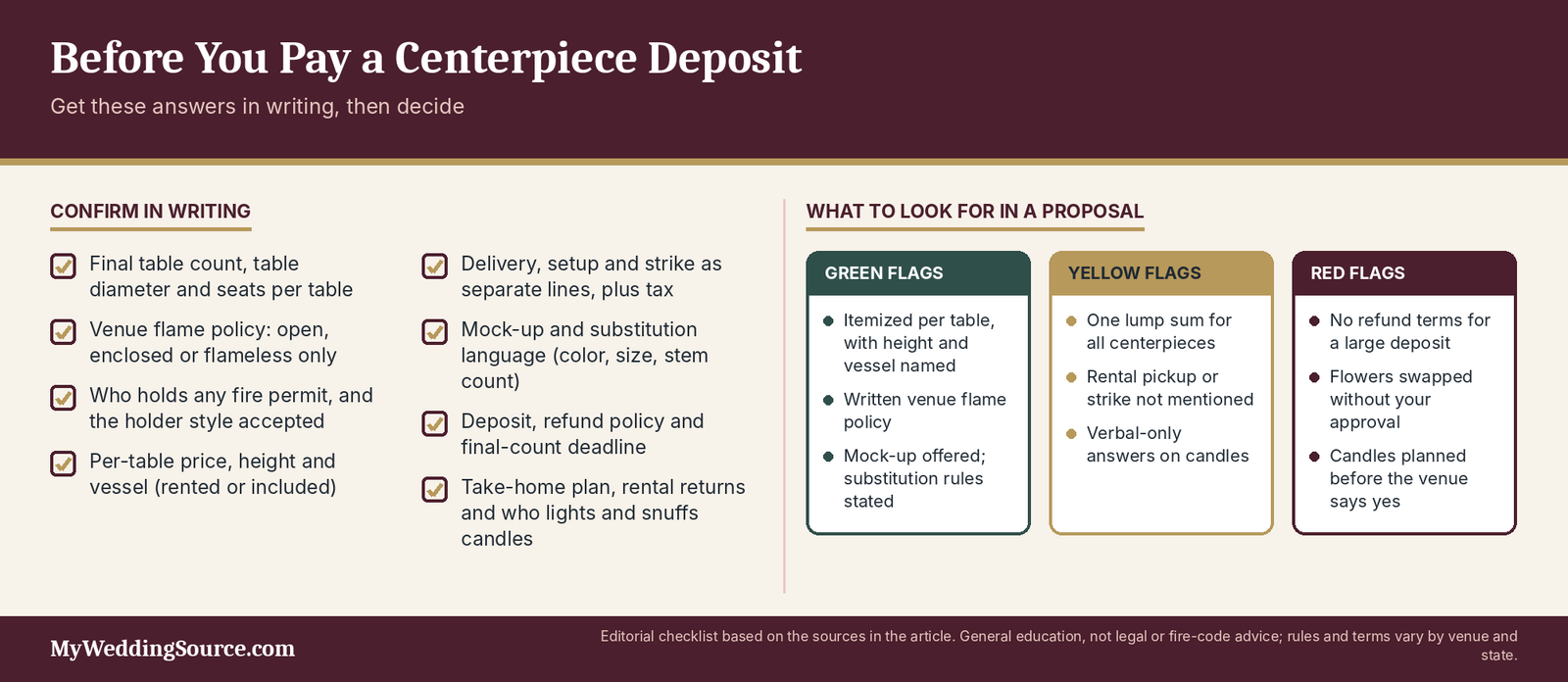
Ask for a per-table price, the number of tables, the height of each design, the vessel and whether it is rented or included, and separate lines for delivery, setup, strike, tax and any minimum. The Knot’s florist question list asks whether labor, delivery and breakdown are charged separately, whether there is a minimum floral budget, and what is not included in the pricing. It also notes that knowing what you do not get can be more valuable than reading what is included. A proposal that lumps everything into “centerpieces: $2,400” cannot be compared with one that itemizes.
How do mock-ups and substitutions protect you?
Ask whether a mock-up of one table is included and what it costs if not. The Knot’s list asks about mock-ups and about what the florist does if a flower is out of season on your date. Flowers are perishable and supply can shift, so a contract should say how substitutions work: same color family, same size, same stem count, with your approval for anything outside that range. The strongest protection is a photo-based design brief that names the look and a palette rather than every species.
What contract terms matter most?
Look for the deposit amount and whether it is refundable, the date by which you must give a final table count, the cancellation and rescheduling terms, and what happens if the florist cannot deliver. Also look for the agreed delivery window, what happens if the venue is not ready, and who is responsible for rented items. This is general education, not legal advice, and terms and state laws vary. If a clause seems unclear, ask the vendor to rewrite it in plain words before you sign.
| Question | Why it matters | Where it comes from |
|---|---|---|
| Is the price per table or per piece? | Prevents table-count surprises | Your table plan |
| What height and vessel are included? | Height changes stems and cost | Estimate: tall costs 20 to 40 percent more |
| Are delivery, setup and strike separate? | Flat fees add hundreds | The Knot florist questions |
| How are substitutions handled? | Protects color and size | Contract language |
| Is a mock-up included? | Lets you correct before the day | The Knot florist questions |
| What is the refund policy? | Defines your failure cost | The Knot florist questions |
What is the timeline from guest list to strike?
When should each decision happen?
Centerpiece decisions follow your guest list and venue, and they move quickly in the last two months. If your headcount is still shifting, our guide to wedding guest list problems can help firm it up, because table count drives every figure in this article. The table below is an editorial schedule, not a rule, and popular dates book earlier than quiet ones.
| When | What to settle | Who to involve |
|---|---|---|
| 9 to 12 months out | Venue, table size and shape, flame policy in writing | Venue, planner |
| 6 to 9 months out | Style direction, request itemized quotes at the same table count | Florist, rental company |
| 4 to 6 months out | Book vendors, pay deposit, agree substitution terms | Florist |
| 2 to 3 months out | Mock-up, rental order, candle plan | Florist, venue |
| 4 to 6 weeks out | Final table count, color confirmations | Florist, rentals, caterer |
| Final week | Delivery times, load-in, who lights and extinguishes candles, take-home plan | Venue, florist, coordinator |
| After the event | Strike, rental return, damage deposit | Venue, rental company |
What does the wedding-day setup sequence look like?
Tables and linens go on first, then place settings, then centerpieces, and candles are lit last, after fire and venue staff confirm everything is clear. Ask the catering team to place plates around the centerpiece rather than the reverse, because crowding the middle is easier to fix before glassware arrives. Our wedding planning checklist puts the wider timeline in one place, and the wedding food and catering hub covers service decisions that affect tabletop space. Give your coordinator or venue lead a photo of each table design so that nobody improvises.
What happens during strike, and who owns the leftovers?
Strike is the end-of-night sequence in which rented vessels are collected, candles are extinguished, and arrangements are either packed up or discarded. Name the person who owns each task in writing, and confirm whether the venue expects your vendors to clear the tables or its own staff. Put a name on the take-home pieces, the rental returns and the vessels you plan to keep, because unclaimed items tend to be thrown away.
FAQ: Wedding centerpiece questions couples ask
Cost and style questions
How much should I budget for wedding centerpieces?
Start with your final table count and the tier you want, then multiply. For 15 tables, the estimates in this guide give about $300 to $750 for simple DIY, $1,125 to $2,250 for a standard florist design and $2,250 to $4,500 for premium, before delivery, rentals and tax. Use The Knot’s national flower figures, a $1,900 median and $2,800 average for 2025 weddings, as a check on your total floral budget. Add roughly a third for extras and confirm with itemized quotes, because your region may be higher or lower.
Does every table need a centerpiece?
No. The Knot’s saving tips include limiting the number of arrangements, and a split plan, with statement pieces on the head and visible tables and a simple candle or greenery cluster elsewhere, can look intentional. Guests tend to read the room as a whole, and a few strong focal points often matter more than identical pieces everywhere. If you plan different treatments, make sure the vessels, colors and heights share a common thread. Ask your florist to price the split in the proposal so you can see the difference.
Are candle centerpieces cheaper than flowers?
Sometimes, but not automatically. A 60-inch round can take a cluster of nine to twelve candles according to one price guide, so 15 tables mean 135 to 180 candles and holders, which adds up in both cost and setup time. Candle-led tables also depend on your venue’s flame policy and on enclosed holders, so the saving can shrink. The same guide estimates non-floral centerpieces can cost 30 to 50 percent less than fresh flowers, but that is an estimate and not a guarantee.
Venue and logistics questions
Can I use real candles at my venue?
It depends on the venue, the building’s fire rules and your local fire marshal. Examples from Fairfax County, Seattle and Las Vegas show that candles can trigger permits, enclosed-holder requirements or occupancy thresholds, while some venues prohibit open flame entirely. Ask for the policy in writing, including who obtains any permit, what holders are acceptable and who lights and extinguishes the candles. If the answer is no, ask whether enclosed candles count as open flame, or switch to flameless candles with secured battery compartments.
How tall should centerpieces be so guests can see each other?
There is no legal standard, so this is a planning rule of thumb: keep anything in the middle of the table at about 12 inches or lower, or lift it so the lowest part sits well above head height. a reader comment on a PCMA Institute article recommends placing centerpieces either well above head height or low on the table. For a 60-inch round, make sure the footprint leaves room for the place settings, which means a 24 to 30 inch center in our estimate. Test it with a mock-up at a table, or ask the florist to show a sample at the planned height.
Can guests take the centerpieces home?
Often yes, but ask in advance. The Knot’s florist questions include whether guests can take arrangements home, and the answer affects the vessels (rented or owned) and whether you or the venue are comfortable with the clearing process. Consider what is safe to take: cats and lilies, and perishable food displays that sit out for hours, may call for a note or a different plan. Announce the plan at the end of the night so the pieces do not end up in the trash.
Your next steps
The sequence that saves the most money and stress is to fix the table count, ask for the flame policy, then request itemized quotes. Everything else in this guide follows from those three.
This week
What is the first number to nail down?
Write down your current guest range, the table diameter and shape your venue uses, and the number of seats per table in your rental company’s guide. Divide your guest count by that seat number to get a working table count, and then add the head table, the cake table and any cocktail tables. Use this as the multiplier in every quote. If your guest list is still moving, ask each vendor to price at two table counts so you can see the impact.
What should you ask the venue today?
Email the venue coordinator and ask four things: whether open flame, enclosed candles or only flameless candles are allowed; who holds any permit; what the access and strike times are; and whether any centerpiece items are included. Ask for the answers in writing, since verbal answers drift. Our wedding venues hub can help with other venue questions, and our wedding planning hub places this step in the larger timeline. Once you have written answers, you can narrow the styles that work.
Before you pay a deposit
What should the itemized quote show?
Request the same layout from two or three vendors: price per table, number of tables, height, vessel, delivery, setup, strike, tax, minimum and mock-up. Compare totals only after you have lined up those items, using the five cost layers described earlier. Our wedding flowers cost guide covers the rest of the floral budget if you are comparing full proposals. A proposal that cannot be itemized is a reason to ask more questions.
Which terms do you need in writing?
Confirm the deposit and whether it is refundable, the date for the final table count, the substitution language, the cancellation terms and who is responsible for rented items. Add a line on candle handling and a take-home plan if you want them. This is general education, not legal advice, and terms and state laws vary, so read the contract carefully and ask a professional if something is unclear. Then put a calendar reminder on the date your final table count is due.
Sources & methodology
- The Knot: average cost of wedding flowers — 2025 weddings: $2,800 average, $1,900 median, quartiles, sample of 10,474 couples, saving tips.
- The Knot: why wedding flowers cost what they do — labor, seasonality and supply.
- The Knot: florist questions before hiring — delivery, setup, strike, mock-ups, minimums and take-home questions.
- Paperlust: wedding centerpieces 2026 — per-table tiers, tall and non-floral differences, vessel rental and delivery estimates (publisher estimates).
- Poppy Flowers: DIY vs professional centerpieces — DIY cost, hours and hidden costs for 15 tables (vendor estimates).
- Poppy Flowers: seasonal availability — seasonal price differences and availability.
- Party Rental Ltd: how many people can sit at a table — table diameters and seating ranges.
- Hill Country Event Rentals: table rental guide — a second, different set of seating ranges.
- PCMA Institute: table sizes and centerpiece sight lines — seating at 60-inch and 72-inch rounds and a reader comment on sight lines.
- Fairfax County Fire Marshal: open flame and decorative devices — permit, table-candle and enclosure rules.
- Seattle Fire Department: nightlife venue guidance — permit thresholds and flame-resistant decorations.
- City of Las Vegas: place of assembly sheet — operational permit for candles and NFPA 701 for decorative materials.
- New Hampshire State Fire Marshal: places of assembly — tent inspection threshold.
- New York State Tax Bulletin ST-277: florists — delivery charges in taxable receipts (one state’s example).
- USDA Economic Research Service: cut flower imports — import value and source countries, fiscal year 2022.
- Pinterest 2026 wedding trend report — trend growth figures for centerpieces and palettes.
- Zola: wedding centerpiece ideas — non-floral styles and the point that flowers are optional.
- FiftyFlowers: bucket sizes and storage — bucket counts by guest count.
- USDA FSIS: danger zone — 2-hour and 1-hour rules.
- ASPCA: Easter lily — toxicity to cats.
- National Capital Poison Center: flameless candles — coin-cell battery warning (2016).
- American Red Cross: candle fact sheet — 12-inch clearance and holder guidance (home use).
- Mississippi State University Extension: eco-friendly florist primer — floral foam and alternatives.
Verified facts in this guide are the figures quoted from The Knot, USDA, the fire and tax agencies and the poison and animal-safety organizations, each tied to the page named at the point of use. The per-table prices, DIY hours, the 20 to 40 percent tall premium and the 30 to 50 percent non-floral discount are estimates from a 2026 price guide and a florist’s help center, which cite no external data, and the 10, 15 and 20 table ranges and the 15-table example are our own illustrative arithmetic, not quotes. Sight-line heights, table-center dimensions and the timeline are editorial judgment, and Pinterest percentages are platform trend signals, not search volume or prices.
Freshness note: recheck The Knot’s flower cost page after its next Real Weddings Study, which usually publishes in the first quarter of the year, and recheck local fire-code permit rules, sales tax treatment of florist delivery and rental items, and your vendors’ current price lists before you sign. Candle and battery safety guidance should be checked against current product labels and recalls.