
A dress fitting is, in physical terms, a long stand on a platform with your arms out while other people pin, pull and step back to look. This guide is for anyone who can stand only for short stretches. It shows how to count your standing minutes, ask for specific changes, run a seated dress fitting, and have a fallback if the first plan does not hold.
Before you book, estimate how many minutes you can stand comfortably and how many minutes of true standing a dress fitting needs. Then send the salon a short written request that names the changes you want: a chair within reach, a low platform or none, a seat-first order of work, shorter visits, and a pause signal. Ask for the answer in writing. If the shop cannot agree, move the dress fitting to a seamstress, a house call, or a dress form, and keep the dress itself the same.
Most advice about wedding gowns assumes the bride, or whoever is being fitted, can hold still on her feet for an hour. That assumption is built into the way salons schedule, price and staff appointments. A fitter pins the hem, steps back, asks you to turn, pins the bustle, asks you to turn again, and the clock keeps running. If standing is hard for you, the dress fitting can end with the dress half-finished and you worn out.
The good news is that almost none of this standing is required by the dress. It is required by habit. A fitter works faster when the client is upright, so the default is upright. When you ask clearly for a different order of work, most of the standing can be moved to a chair, a stool, a half-hour at a time, or a dress form that stands in for you.
A note on scope. This is general planning information, not legal, tax, financial or medical advice. How long you can stand, and what is safe for you, is a question for your own treating professionals, and nothing here replaces their guidance. Where a rule matters, the article points you to the agency that issues it so you can read the current version.
Why a dress fitting is mostly a standing event
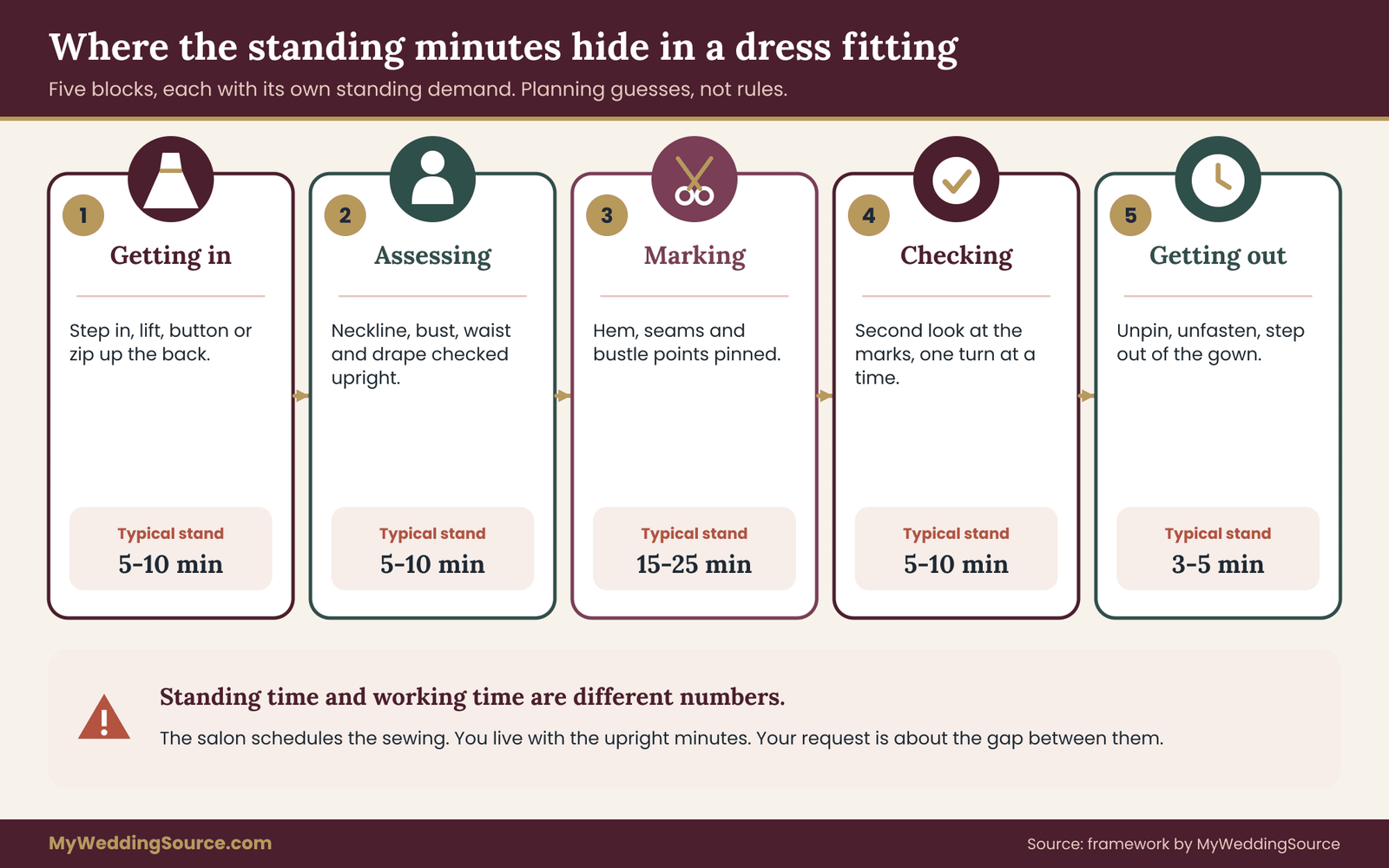
It helps to see where the minutes go. A first dress fitting at a salon often lasts well beyond the time anyone spends on actual sewing, because the fitter is working around you. Think of it as five blocks: getting into the gown, assessing the fit, marking changes, checking the marks, and getting out again.
Getting into the gown usually means standing, because the dress is lifted over your head or stepped into and then buttoned or laced up the back. Assessing the fit means standing still while the fitter looks at the neckline, bodice, waist and drape. Marking changes is the longest block. The fitter pins the hem, takes in seams, marks the bustle points and checks the length with the shoes you plan to wear.
Checking the marks is a second round of standing, often shorter, and getting out is a third. Add the walk to the mirror, the platform step, the turn, the second turn, and the wait while the fitter goes to find a pin or fetch a second opinion. A forty-five minute appointment can contain forty minutes of upright time even though only a few minutes involve any needlework.
That is the first useful fact about a dress fitting with limited standing tolerance: standing time and working time are different numbers. The salon schedules the second one. You live with the first one. Your request should be about the gap between them.
The second useful fact is that many of the standing moments are not needed at all. The fitter looks at the whole gown from the front, back and side. She does not need you to be standing for every look. A good fitter can pin a bodice with you seated, check a waist while you lean on a counter, and mark a hem with a stool under your heel. These are normal working methods in tailoring, not special favors.
The third fact is about money and time. Dress fittings are usually bundled into a purchase price or sold as a set number of visits. If one visit has to be abandoned halfway because standing became too much, the salon may count the visit as used. Planning the accommodation in advance protects the visits you are paying for, and that is as practical a reason to ask as any other.
What this guide covers and what it leaves to other guides
This guide covers the dress fitting itself: how to plan it, how to ask for changes, how to run it, and what to do when it does not work. It does not choose a dress for you, and it does not explain alterations in general. For the broad picture of how many fittings to expect, what a seamstress does at each stage and how to read an alterations quote, the site’s wedding dress fit and alterations guide covers it in detail.
Read that one for the standard process, and use this one to adjust the process to a body that tires of standing.
It also does not tell you what your limits are. The phrase “limited standing tolerance” is used here as a planning description, nothing more. It might mean that you can stand for five minutes before you need to sit, or fifteen, or that standing is fine in short bursts but not on a raised platform.
It may vary by day. Whatever the number is, this guide treats it as a given and builds the dress fitting around it. If you do not know your number, the next section shows a simple way to find a working estimate, and your clinician can refine it.
Who this is for
The plan works for anyone whose standing time is shorter than a typical dress fitting, whatever the reason. That includes people with chronic pain or fatigue conditions, people recovering from surgery or injury, people with balance or dizziness concerns, people who are pregnant, people with heart or breathing conditions that make standing tiring, and people who simply find that long stands with arms raised are hard. You do not need to name a reason to ask for a chair, and you do not owe a salon your medical history.
It also works for the person helping. A mother, partner or friend who comes along can use the same framework to keep the dress fitting on track, take notes, and speak up when the signal is given. Part of the plan is deciding who that person is before the day arrives.
The idea behind the plan
The approach has four moving parts, and each gets its own section below.
First, count: write down your comfortable standing time and the standing time the dress fitting needs, so the problem is a number and not a vague worry. Second, choose: pick a salon or seamstress whose setup suits a seated dress fitting. Third, ask: send a short written request built from a checklist, and get the answer in writing. Fourth, run and review: run the dress fitting seat-first, use a pause signal, and decide afterward whether to keep going, split the visits or switch to an alternative.
Nothing in this sequence asks the salon to do something unusual. It asks the salon to do ordinary tailoring in a different order. The first step, though, is yours alone, and it is the one most people skip.
Count your standing minutes before you book a dress fitting
Most people book a dress fitting by looking at the calendar and the salon’s availability. A better first step is a short private exercise that takes about twenty minutes and one sheet of paper. You are building two numbers: your comfortable standing window, and the standing demand of the dress fitting.
Finding a working estimate of your window
Your window is the length of time you can stand and still feel steady, with arms in a normal position, in the kind of shoes you would wear for a dress fitting. It is not a goal or a test. Think back over ordinary days and pick the number you could reliably meet on a middling day, not a good one.
A useful way to find it is to look at what you already do. How long do you stand at a kitchen counter, wait in a line, or stand in a shower before you start shifting weight or looking for a place to sit? Write the number down in minutes. Then lower it a little for the dress fitting, because the situation adds three things that make standing harder: arms held away from the body, a heavy garment, and the stress of being looked at.
If you work with a physical therapist, occupational therapist or doctor, ask them for a planning number, not a diagnosis. A phrase such as “plan for no more than ten minutes upright before a seated break” is enough for a salon and a helpful anchor for you. This is a conversation to have with your own clinician, and a number from an article or a friend is no substitute.
Estimating the standing demand
Now estimate the other side. For a first dress fitting, list the blocks from the previous section and put a rough time next to each. Try getting into the gown at five to ten minutes of standing, assessment at five to ten, marking at fifteen to twenty-five, checking at five to ten, and getting out at three to five. These ranges are planning guesses, not rules, and a salon can tell you its own typical numbers if you ask.
Add them up. If the total is, say, forty-five minutes and your window is ten, the gap is large, and you will want most of the standing moved to a chair, a stool, a dress form or a later visit. If the total is twenty and your window is fifteen, a few seated pauses may be all you need.
Here is the check that makes the exercise worth doing: count the number of stands, not only the minutes. Three stands of seven minutes are easier than one of twenty-one, even though the total is the same. A dress fitting that alternates short stands with seated rest can fit inside a small window, while a single long stand cannot. The number of stands is the lever you will use most in the request.
Recording your signals
The last piece of the exercise is deciding how you will know the window is closing. Some people feel it in their legs, some in their back, some as lightheadedness, some as an increase in pain or shakiness. Pick the one or two early signs that you can trust, and agree that the dress fitting pauses when they show up. A pause that begins at the first sign keeps the visit useful, while a pause that begins after a near-faint ends it.
Write the signs on the same sheet of paper. You will hand a short version to whoever is helping. Something like “Pause when I say ‘chair’ or when I look pale or start to sway” works, and you decide the words. Keep it short enough that a fitter who is concentrating on a hem will actually remember it.
Putting the two numbers side by side
With your window and the demand written down, the problem becomes concrete. You can now say to a salon, with no medical detail at all, “I can stand about ten minutes at a time. I would like the dress fitting planned in short stands with a seat in between.” That sentence is clear, polite and easy to act on.
It also guides the choices in the next sections. A short window points to a salon with seating built into the fitting room, a fitter who is comfortable working with a client seated, and a dress whose fit can be checked in pieces. A longer window points to fewer special arrangements and more of an ordinary visit with a chair nearby.
One more point on timing. Do the exercise before you try dresses on, not after. If you can stand only briefly, the try-on stage itself is a decision point. A dress fitting-heavy dress with a corset back and a long train will demand more upright time than a simpler silhouette, so your number is a legitimate input into the dress choice. It is not a reason to skip a dress you love, but it does belong in the conversation.

Choose a salon or seamstress for a seated dress fitting
Once you have your two numbers, the next decision is where the work happens. A large salon, a small boutique, an independent seamstress and a bridal tailor all run a dress fitting differently, and the differences matter more for you than for most clients. The question is not which is best. It is which one can run a short-stand, seat-first appointment without strain.
What to look for before you visit
Ask three practical questions by phone or email before you commit to a booking. First, is there a chair or stool in the fitting room itself, close to the mirror? A waiting-area sofa does not count. Second, is the platform optional? Many salons use a low raised block so the fitter can see the hem, but a hem can be marked with you standing on the floor and the fitter kneeling, or with you seated and the fitter working at your feet.
Third, who does the dress fitting, and how long has she been doing it? An experienced fitter has a settled routine and can change the order of work with little fuss.
Then look at the space. You need a route from the entrance to the fitting room without stairs you cannot manage, a fitting room wide enough for a chair and a helper, and a restroom you can reach. The site’s guide to accessible wedding venue red flags lists the same kinds of physical checks for ceremony and reception sites, and most of them apply to a shop just as well: step-free entrance, door widths, seating, restrooms and parking.
Salon, boutique, seamstress or house call
A large bridal salon has the most staff and often the most seating, but it also runs on appointment blocks and may rotate fitters. A small boutique may allow a longer slot and a quieter room, and the owner often does the alterations herself. An independent seamstress usually works in a home studio or a small shop, and the setup varies from excellent to difficult, so you need to ask the same questions rather than assume.
A house call is a different arrangement altogether. Some seamstresses and bridal tailors will travel, usually for a fee, and for a person whose standing time is short, a dress fitting in your own living room has real advantages. You have your own chair, your own bathroom and no travel, and the room is as warm or cool as you like. The downside is that the fitter needs a mirror, good light, a place to hang the gown and space to move, so check that your own space can do the job.
Keep your choice flexible. You can buy a gown at one place and have it altered somewhere else, as long as the contract does not forbid it. Some salons tie alterations to the purchase, and others let you take the dress to anyone. Read the policy before you assume, because it affects where the dress fitting can happen. The site’s wedding vendor contract guide explains how to read the clauses on alterations, cancellations and what counts as a completed service.
Questions that reveal how a salon works
A few direct questions sort out a lot. “How long is a dress fitting appointment, and can it be split into two shorter visits?” tells you about flexibility. “Do you fit clients while they are seated?” tells you about the fitter’s habits. “Have you worked with clients who need to sit during the dress fitting?” tells you whether the staff will treat your request as normal.
Listen less to the yes or no and more to the tone. A calm “of course, we do that often” is a better sign than a long explanation of why it might be difficult.
It is worth asking, too, whether the salon will let a helper stay in the room and take notes or photos of the pin marks. This matters because the person helping you becomes your second pair of eyes and a second set of legs. If a shop has a firm rule about one companion, ask whether the rule can include the helper you need.
When the salon will not or cannot adapt
Sometimes the answer is a polite no, or a vague answer that amounts to one. Treat that as information about the fit between you and the shop, not about your request. A salon that cannot offer a chair in the fitting room or cannot split the visit may still be a fine place to buy a dress. It may simply not be the right place for the alterations. A later section covers moving the work.
For now, hold on to the point that an accommodation request is a normal business request. You are asking for a service to be delivered in a particular way, and a professional shop should be able to say yes, say yes with a change, or say no clearly so you can plan around it. In the United States, businesses open to the public have obligations under the Americans with Disabilities Act, and the Department of Justice’s ADA site explains what a business may need to modify.
Whether a given shop must change a given practice depends on facts, so use the ADA site for general guidance, and a lawyer or a disability rights organization if you need advice on your own situation.
The accommodation request checklist for a dress fitting
This is the core tool of the guide. An accommodation request checklist is a short list of specific, ordinary changes you can ask a salon to make. Having it written down lets you pick the ones that matter, leave off the ones that do not, and send a message that is clear and short. The checklist has seven items. You will not need all of them.
The seven items
1. A chair within reach. A sturdy chair with a firm seat and arms, placed where you can reach it in one or two steps from the mirror. Ask for it to stay in the fitting room for the whole visit, not be fetched when you ask. If you need a particular height or a back support, say so.
2. A low platform, or none. Ask whether the platform can be skipped or replaced by a stool under your foot while you sit. Raised platforms add a step, a balance task and a longer time upright. If you need to use it for the hem check, ask for a short, supervised stand at the end of the dress fitting.
3. A seat-first order of work. Ask that the fitter do as much as possible while you are seated: bodice, sleeves, straps, back closure and any seam on the upper body. Hem and bustle checks come last and are done in short stands.
4. Short stands with scheduled breaks. Name your window, in minutes, and ask that the dress fitting be planned around it. For example, “stands of about ten minutes, followed by a sit.” If the salon prefers to batch the work, ask it to tell you before each stand how long it expects to need.
5. A pause signal. Agree on a word or gesture that stops the work immediately, with no questions. The point is to keep the dress fitting moving without anyone having to read your face.
6. A helper in the room. Ask that a named person be allowed to stay for the whole visit, and tell the salon what she will do: hold the chair steady, watch for the signal, take notes on the pin marks.
7. A split-visit option. Ask whether the dress fittings can be shorter and more numerous, whether this changes the price, and how the salon counts a visit. Get this answer in writing, because it is the one most likely to cause a misunderstanding later.

Why specific requests work better than general ones
“I need accommodations” is a statement. “Could we have a chair in the fitting room and plan on ten-minute stands?” is a request. A salon can say yes to the second without thinking, because it knows what is being asked. The first leaves the staff guessing, and guessing tends to produce either too little or an awkward fuss.
Specific requests also protect you if something goes wrong. If a fitter agreed by email to a chair and a seat-first order, and the room has no chair on the day, you have a clear reference point for the conversation. You are not complaining about a feeling. You are pointing to an agreement.
What you do not need to include
You do not need to describe a diagnosis, give medical records or explain your history. A business can ask what change you need, and it does not need a reason beyond that in order to provide a chair. If a salon asks for more detail than seems necessary, answer briefly and keep the focus on the change: “I can stand for short periods, and I would like to sit between stands.”
You also do not need to apologize. Phrases such as “sorry to be a bother” turn a normal request into a favor, and favors are easier to decline. A friendly, brisk tone does more for you than an apologetic one.
Choosing which items to send
Look at your window and the standing demand from the earlier exercise. If your window is under ten minutes, send all seven items. If it is closer to fifteen or twenty, items one, three, four and five may cover it, with a note that you may ask for a break at any point. If your difficulty is mainly balance on the platform, item two is the one that matters most, and a stool under the foot may solve it.
A good rule is to send the shortest list that would still allow the dress fitting to go well. A message with three requests is more likely to get a fast, clear answer than one with seven. You can raise the rest when you arrive, and you can ask for more after the first visit once you know how it went.
Timing and delivery
Send the request as soon as the dress fitting is booked, and at least a week before the visit. This gives the salon time to move a chair, schedule a longer slot or assign a fitter. Send it in writing, so there is a record, and ask for a written reply. If you phone first, follow with a short email that repeats what was agreed.
Keep a copy of the message and the reply in the same folder as your contract. If you are keeping dress paperwork in one place, the folder will be useful later, when you need to check what was promised about the number of fittings, the price of changes or the pickup date.
How to ask for a seated dress fitting: scripts that work
The checklist gives you the content. This section gives you the wording. The scripts below are templates in plain language, and you should change them to sound like you. They work for email, text or a phone call, and they share a pattern: say what you want, give one practical reason, and ask for a reply.
The first message after booking
Keep it short enough to read on a phone. A message might run like this: “Hello, I have a dress fitting booked for the fourteenth at ten. I can stand for about ten minutes at a time, so I would like to plan the dress fitting around that. Could you place a chair in the fitting room, skip the platform if possible, and do the bodice and upper body while I am seated? My sister will come along to help. Could you confirm by email?”
Notice what is missing. There is no diagnosis, no apology and no long explanation. There is also a concrete number, three clear requests and a named helper. A salon can answer this in one reply, and the reply becomes your record.
If you want to ask for a split visit, add a second short paragraph: “If it works better, I am happy to do two shorter visits, and I would like to know how you count visits and whether the price changes.” Asking about the price now removes a surprise later.
The phone version
Some salons prefer a call, and some people explain themselves better aloud. Open with the date and the purpose, then say what you need in the same order as the written message. Keep a pen handy and write down the name of the person you spoke with, the date and what she agreed to. After the call, send a two-line email: “Thanks for speaking with me today. To confirm, you will have a chair in the room and plan on ten-minute stands. Please let me know if anything changes.”
That email does two jobs. It checks that you both heard the same thing, and it puts the agreement in writing. If the person you spoke with is not the person who runs the dress fitting, the email also reaches the second person.
Replying to a partial yes
Salons often reply with a yes to some items and a “we will see” on others. Treat each item separately. If the chair is confirmed and the platform is “usually required,” ask whether a stool can stand in for it. If the split visit is “possible but we charge for each appointment,” ask what the charge is and whether it covers the work or only the booking. You are not negotiating against the salon. You are filling in the details so that the day runs well.
It helps to keep the tone steady. A reply such as “Thanks, that works. For the platform, would a low stool for the hem check be possible?” keeps the conversation friendly and specific. If an answer is unclear, ask for it in writing: “Could you confirm that in an email so I can plan?”
When someone else makes the request
If a relative, a friend or a wedding planner is making the request for you, give her the checklist and your number, and ask her to use the same pattern. She should not describe your situation in detail. She should state the changes. A line like “The bride can stand about ten minutes at a time and would like a chair in the room” is enough, and it keeps control of the information with you.
What to do if the response is cold
A short or defensive reply is not a reason to doubt your request. It may reflect an overworked front desk and no more. Reply once, politely, restating the two or three items that matter most. If the second reply is also unhelpful, treat it as a data point about the shop and look at the alternatives in a later section. You have no obligation to keep trying with a business that treats a chair as a burden.
If you believe a business has refused something that it should have provided, the ADA website explains how to file a complaint, and a local disability rights group can often advise on next steps. For most people planning a wedding, the practical answer is to move the work to a place that says yes, and to save the energy for the wedding.
How a seat-first dress fitting runs, step by step
Now to the dress fitting. A seat-first dress fitting is not a different kind of fitting. It is the usual sequence in an order that uses a chair and spreads out the standing. The fitter does the same work, and you spend most of it sitting.
Before you arrive
The night before, check the plan with your helper: who holds the chair, who watches for the signal, who takes notes. Eat and drink as you normally would, and wear the undergarments and shoes you will wear on the day, since they change how the dress sits. Bring a small bag with water, any medication you usually take, a snack and a spare layer, because fitting rooms are often warm or cool in unhelpful ways.
Plan your arrival so you are not rushed. A hurried walk from a distant parking spot spends the standing time you need for the dress fitting. If parking is far, ask the salon where the closest drop-off is, or arrive a few minutes early and use the time to sit in the waiting area first.
The sequence
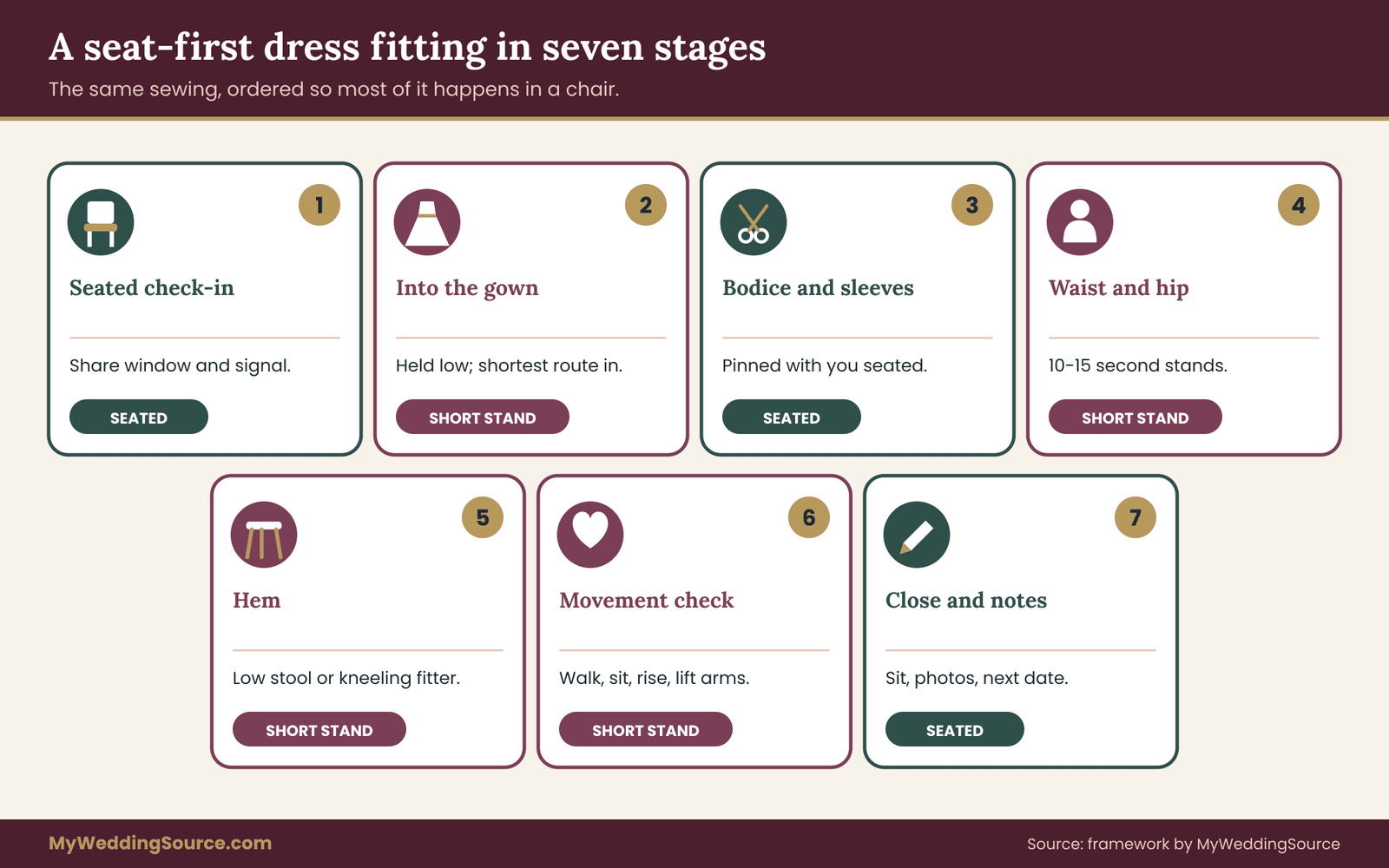
A seat-first dress fitting has seven stages, and each has a place for sitting or a short stand.
Stage one is arrival and a seated check-in. Sit, take off your coat, and spend two minutes going over the plan with the fitter. Say your window and the signal. This conversation takes less time than it sounds and sets the tone for the visit.
Stage two is getting into the dress. You may have to stand for this, so aim to make it short. A fitter can hold the gown low so that you step into it, or you can sit while she brings it up to your hips and then stand to have it lifted and fastened. Ask for it to be done in whichever order is shortest for you.
Stage three is a seated assessment of the bodice, straps and sleeves. Sit in the chair with the dress fastened. The fitter checks the neckline, the bust, the shoulders and the arm movement. She can pin the bodice with you seated, and most upper-body work is easier to see that way, because you are not shifting your weight.
Stage four is the waist and hip check. This usually needs a stand, but a short one. The fitter checks how the waist sits, how the skirt falls from the hip and whether the dress shifts when you breathe or move. Ten or fifteen seconds of standing is usually enough for each check, and you sit again while the pins are placed.
Stage five is the hem. The hem needs you upright in your shoes, but it does not need a platform. If the fitter can kneel, you can stand on the floor. If she prefers a platform, ask for a low one, or sit on a high stool with your feet supported while she marks the front and sides. The back is usually set last, in a single short stand.
Stage six is the movement check. Walk a few steps, sit, rise, lift your arms and, if you plan to dance, take a turn. This is the part that tells you whether the dress works in motion, and it is worth spending your last standing minutes on it, not on the third look at the mirror.
Stage seven is the close. Sit, change out of the gown, and spend a few minutes on notes: what was marked, what is still open, the next date. This is a good moment for the helper to photograph the pinned areas for your records.
Using the pause signal
The signal works only if everyone treats it as ordinary. When you say the word, the fitter stops, helps you sit, and waits. She does not need to ask what is wrong. Resume when you are ready, even if that takes five minutes. A visit that runs long but stays safe is a better outcome than one that finishes on time with a bad ending.
Some people hesitate to use the signal because they do not want to hold up the dress fitting. Decide before you arrive that the signal is part of the plan, and that using it early is the plan working. A fitter who knows the signal is coming will schedule her tasks in a way that makes the pauses natural.
What your helper does
The helper has four jobs. She keeps the chair in position, so you are never more than a step from it. She watches for the early signs you named. She takes notes and photos, so you do not have to hold details in your head. And she speaks for you if you are tired, which means asking the fitter to pause, or to move on to the next item, or to stop.
If your helper is someone who tends to take over, say so before the dress fitting and give her a clear role. The dress fitting goes best when the fitter talks to you and the helper supports quietly.
Design choices that shorten a dress fitting
The dress itself can lower the number of minutes you stand. This is not an argument for choosing a plainer gown than you want. It is a reminder that some features add standing time and some remove it, and that you can often keep the look while changing the construction.
Features that add standing time
A few features make a dress fitting longer. A fitted corset back with many laces or hooks takes time to close and to adjust. A long, heavy train needs extra checks for the bustle and for how it moves. A multi-layer skirt requires the hem to be checked in more than one layer. Beading and appliqué mean pins cannot go just anywhere, so marking is slower. Detachable sleeves, capes and overskirts each add a set of checks.
None of these is a reason to rule out a gown, but each one adds to the standing demand you estimated. When you try dresses on, ask the consultant how many fitting visits the style typically needs and which parts take the longest. Then compare with your window. A gown that needs two long fittings for the hem and bustle is a different proposition from one that needs one short check.
Features that reduce it
A zipper, hidden under a row of buttons, closes faster than a lace-up back and is easier to adjust. A lace-up can be swapped for a zipper with a panel of buttons for the same look, and a seamstress can usually explain whether that is practical for a given gown.
A simpler hemline, such as a straight or slightly curved edge, is faster to mark than a handkerchief or high-low shape. A bustle that uses fewer points, or a French bustle that ties under the skirt, can be checked in a single stand.
Fabric matters as well. A crepe or satin that drapes predictably is faster to pin than a slippery silk chiffon that shifts when you move. Heavy fabrics weigh on the shoulders and hips, and that weight tires you during the standing blocks. A lighter dress is kinder to a short window, and many designers offer a lighter version of the same silhouette.
Choosing shoes and undergarments early
Shoes decide the hem height, so they must be present at the hem check. If you plan to wear flats or a low heel, bring those, not a pair you will not wear on the day. Switching shoes after the hem is set means resetting the length, and that means another stand. The site’s article on wedding day accessories planning covers how to test shoes, shapewear and other items with the dress so nothing changes late in the process.
Undergarments change the way a bodice fits. If you rely on supportive shapewear, or you will not wear any, decide before the first dress fitting, and bring what you will use. A change after the bodice is pinned can mean re-marking the waist and the bust, and each re-mark is another stand.
Using a dress form as a stand-in
A dress form, also called a mannequin, can take over a lot of the work that would otherwise require you to stand. If your measurements are on file, the fitter can pin the hem, check the drape and position the bustle on the form, then check the result on you in one short stand. For some alterations, such as adjusting a train or a hem on a very full skirt, this saves a considerable number of standing minutes.
A form is not a substitute for you. It does not move, it does not breathe and it does not shift under a heavy skirt. That is why the plan treats it as a stand-in for the long, repetitive work and keeps you for the checks that need a body. Many seamstresses keep a form in the studio, and some will make an adjustable or custom form from your measurements, usually at an extra cost. Ask what the shop offers and how it affects the price of the visit.
Working from measurements and photographs
If your body measurements are recorded accurately, a seamstress can do a good deal of work between visits, with you absent. For this to be reliable, the measurements need to be taken carefully, ideally by the same person who will do the alterations, and they need to be updated if your body changes. Weight, swelling, medication and pregnancy can all change the fit, and a record that is a few months old may no longer be accurate.
Photographs of pinned areas, taken during one visit, can also help the fitter plan the next one. A clear photo from the front, back and side, with the pins visible, lets her check a decision without calling you in again. Ask whether the fitter is comfortable with this, and take the photos yourself if she prefers not to.
Timing the first appointment
The standing demand is highest at the first full alteration visit, because that is where most of the structural work is marked. If you can choose, schedule it at the time of day you feel best, and avoid days with other heavy commitments. Do not book it right after a long drive, a medical appointment or an evening of events. A rested first visit tends to go better, and a good first visit shortens the ones after it.
Allow a buffer on each side of the dress fitting. Arrive early enough to sit before you begin, and leave the hour after open, so you are not rushing to another place. These buffers cost nothing but a little room in the calendar, and they spend the standing time you have on the dress, not the trip.
Splitting the dress fitting into short visits
One of the most effective changes you can ask for is to break one long appointment into several short ones. A split dress fitting suits a short window because it spreads the standing across more days, and it gives you time to rest between visits.
How a split schedule works
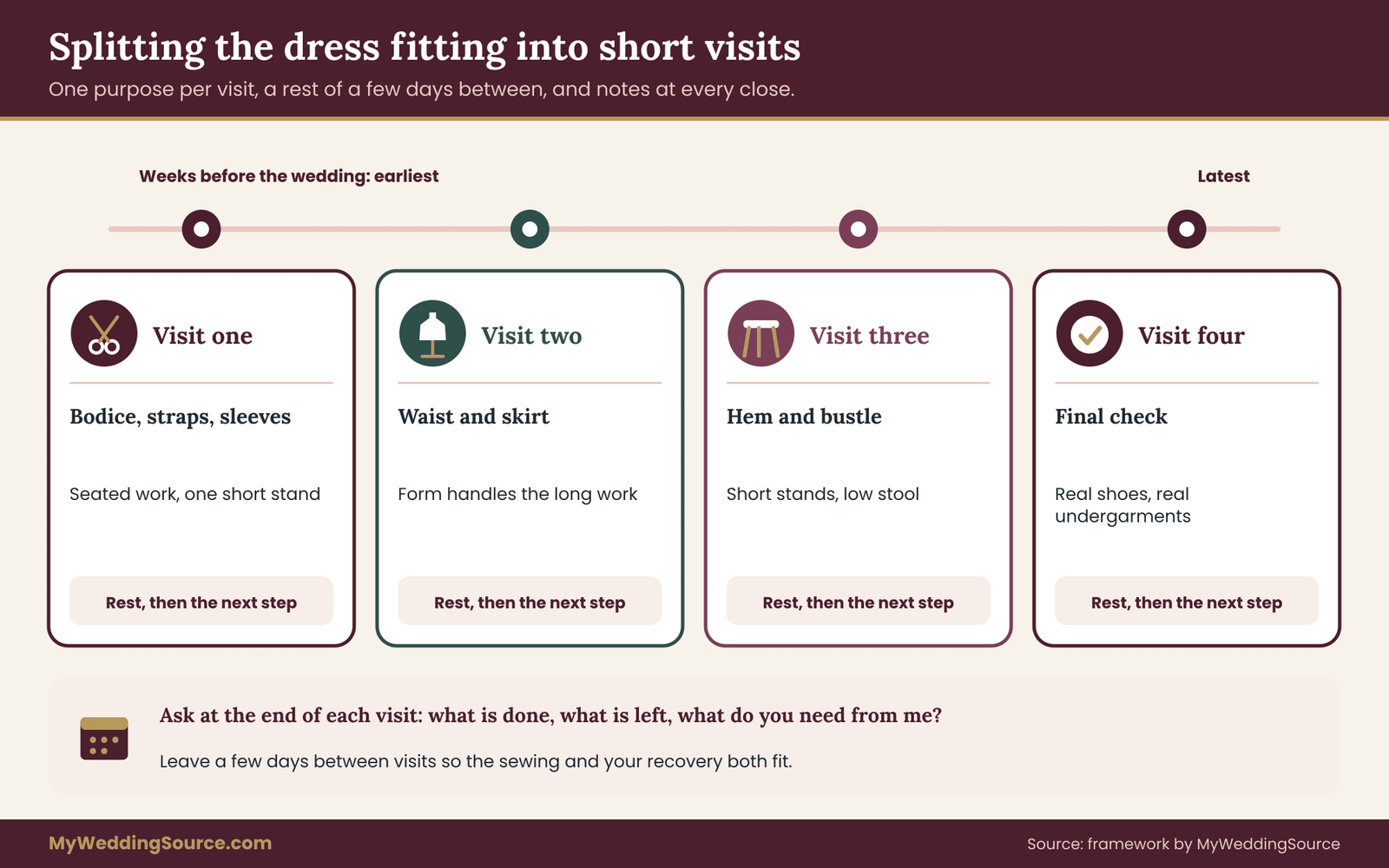
A standard schedule has two or three fittings: one for the main alterations, one to check them and one close to the wedding for the final adjustments. A split schedule divides the first and second visits by body area. A first short visit might cover the bodice and sleeves. A second might cover the waist and skirt. A third might cover the hem and bustle. A fourth is a final check.
Each visit has a single purpose and a limited standing demand, so it can fit inside your window. Between visits, the fitter does the sewing, and you rest. The total number of visits rises, but the total standing time may fall, because every visit starts with a clear target and ends when that target is met.
Costs and counting
A split schedule can affect the price, and the salon’s rules decide how. Some shops include a set number of fittings in the alteration price, and count each visit regardless of length. Others bill by time or by task. Ask before you agree: “How do you count a visit, and does a shorter visit count as one?” and “If we need more visits than usual because of the schedule, does the price change?” Get the answer in writing, and compare it with the contract.
If the salon wants to charge extra for each added visit, ask whether a longer first visit with built-in rests would work out cheaper. Sometimes it does. Sometimes the extra appointments are the better value because they avoid a bad visit and a repeat. The site’s wedding budget guide can help you place any extra alteration cost against the rest of your plan, so a few more visits do not push other categories off balance.
Planning the calendar
Work backward from the wedding date. The final dress fitting usually belongs a few weeks before the event, so you have room to correct a late problem, and the main alterations belong well before that. Salons often have busy seasons, and a short-window plan needs more slots than a standard plan, so book early. The site’s wedding vendor timeline gives a general sense of when vendors need to be booked, and it can help you place the dress work among everything else.
Leave a gap of at least a few days between visits so the fitter can finish the sewing and you can recover. If you tire easily, do not stack two fitting visits on consecutive days, and avoid stacking a dress fitting with other wedding tasks, such as a tasting or a venue walk-through. The energy cost of those days adds up.
Keeping the process on track
A split schedule works only if each visit ends with a clear note on what comes next. Ask the fitter at the end of every visit: What has been done? What is left? What do you need from me before the next one? Your helper writes this down. Without it, a short visit can leave the plan blurry, and the next one starts by repeating what was already decided.
Keep an eye on the total. If the number of visits starts to grow beyond what you planned, stop and ask why. It may be a sign that the fit is more complicated than expected, that a measurement was off, or that the fitter is working around your limits in a way that is slower than necessary. A short conversation can bring the plan back into shape.
When a longer single visit is better
A split schedule is not always the right answer. If travel to the salon is long and tiring, or you must come from out of town, one longer visit with generous seated breaks may take less out of you than several trips. The same is true if the appointments are hard to get. In that case, plan the single visit in blocks with a rest of ten to fifteen minutes between each, and ask the salon to book a room where you can lie down or sit comfortably.
For an out-of-town trip, the guide to wedding guest hotels across budgets and mobility needs has useful checks for finding a room that suits limited mobility, and they apply to your own stay as well.
Alternatives when a standard dress fitting will not work
Sometimes no amount of adjustment makes the usual appointment practical. The salon may be far away, the staff may not agree to a seated approach, or your standing window may be so short that even a split schedule is hard. The alternatives below keep the dress and change the way the work reaches it. They run from small changes to large ones, and you can stop at the first rung that solves the problem.
Rung one: stay with the salon and change the setting
The smallest change is to keep the salon and the fitter and alter only the room. Ask for the first or last appointment of the day, when the shop is quieter. Ask for the largest fitting room, or a private room, so a chair and a helper fit. Ask whether the fitter can come to you in a back office or a quiet corner where you can sit more easily. These changes cost nothing and sometimes make a large difference.
Rung two: move the alterations to a seamstress you choose
If the salon will sell you the dress but cannot adapt the dress fitting, move the alterations. An independent seamstress or bridal tailor often has more control over the schedule and the setup. Check the salon contract first, because some shops charge a fee if you take the dress elsewhere, and some void a warranty on the gown. If the contract allows it, the move is often smooth.
When you interview a seamstress, use the same checklist and ask to see the workspace, or to see photos of it. Ask how she works with clients who need to sit, and ask for references from people with similar needs. A short phone call with a previous client tells you more than a polished website does.
Rung three: a house call
A fitter who comes to your home removes the trip, the unfamiliar room and the wait. Ask whether she travels, what she charges for travel and what she needs in the space. She will need good light, a full-length mirror, a clear floor area and a place to hang the dress. A bedroom with a chair works for much of the upper-body work, and a hallway or living room may be better for the hem and train.
A house call can also be a good fit for a final check close to the wedding, when the stress of travel is least welcome. Some seamstresses reserve home visits for the last fitting even when earlier ones happen at the shop. That arrangement balances the cost of the dress fitting against the benefit of a calm room.
Rung four: a dress form and remote work
When the problem is the repeated standing, a custom or adjustable dress form can take on most of the work. The seamstress takes careful measurements, sets the form to match, and alters the gown on the form. You come in only for a short check. This approach needs good measurements and a fitter who is comfortable with it, and it works best for gowns with a stable shape, such as structured bodices and simple skirts.
Video calls can fill small gaps between visits. A fitter can look at a photo or a short clip to check a pinned hem, a strap length or a bustle point, and you can confirm or correct from home. The calls do not replace an in-person check, but they cut the number of visits that would otherwise be needed for small questions.
Rung five: change the dress
If every option so far strains your limits, consider changing the dress, not the process. A gown that needs fewer alterations, such as a ready-to-wear sample in the right size, a simpler cut or a gown with an adjustable back, can reduce the number of fittings dramatically. The same thinking that guides fittings for a body that changes quickly, with adjustable seams and late checks, applies here too. Rental and pre-owned gowns, sold in sizes close to yours, may also need less work than a made-to-order gown.
Changing the dress is a larger decision, and it should come last. It is not a failure. It is a choice to put your energy into the wedding and away from the appointments, and many people find the second dress is the one they love.
Choosing among the rungs
To choose, ask three questions in order. Can the salon adapt if I ask clearly? If not, can a different fitter do the same work for a similar cost? If not, can the work move to my home or to a form? Only after those three do you need to look at a different dress.
At each step, compare the cost, the risk and the effort. A house call costs more than a salon visit and saves energy. A form-based plan costs more up front and saves visits. A change of dress may save the most effort and carries the largest emotional weight. There is no single right answer, and the rungs exist so you can pick the smallest step that works.

Contracts, costs and policies behind a seated dress fitting
An accommodation is easier to rely on when it is written into the paperwork. This section covers what to look for in a contract, how to think about costs without guessing at prices, and how to keep records.
What to read in the contract
Look for five items. First, the number of fittings included in the price, and what counts as a dress fitting. Second, the policy on missed or shortened appointments, because a visit cut short for a pause should not be counted as missed. Third, the rules on who may do the alterations and where. Fourth, the timeline: when alterations will be finished and when the gown will be ready for pickup. Fifth, the policy on changes to measurements or the final fit.
If a clause conflicts with your plan, ask the salon to amend it in writing. A short addendum can say, “Fittings may be split into shorter visits, and a visit shortened for a rest break is counted as one visit.” This costs the shop nothing and removes a likely source of conflict. The wedding vendor contract guide explains how to read these clauses and what to ask for if the language is unclear.
Thinking about cost
Do not assume that an accommodation will cost extra. A chair, a stool and a seat-first order of work should be part of the normal service, and a shop should not charge for them. Some changes, such as a longer appointment slot, a house call, extra visits or a form, may carry a charge, and the price depends on the shop and the region. Ask for it in writing before you agree.
When you compare options, work with the total, not only the line items. A shop that charges for extra visits may still be cheaper than a house-call seamstress, and a house-call seamstress may still be cheaper than a dress change. The cheapest plan on paper is not always the plan that keeps you well enough to enjoy the wedding, so give your own energy a place in the calculation.
Deposits, refunds and cancellation
If you move the work to a new fitter, read the refund and cancellation terms for any deposit or alteration prepayment at the first shop. Many shops hold deposits for work that has not started, and some refund them under stated conditions. Ask for the policy in writing, and keep the answer.
If a shop refuses to refund for work not done, the Federal Trade Commission and your state consumer protection office explain what rights you have when a business does not deliver a service as agreed, and your credit card issuer may have a process for disputing a charge.
Do not cancel a service before you have a replacement. A gap in the alteration schedule can push the final dress fitting too close to the wedding, and that is the worst time to be rushed.
Keeping a paper trail
Keep a single folder, paper or digital, with your contract, your request, the salon’s reply, any amendment, receipts and the dress fitting notes. After each visit, add the date, the work done, the next steps and the photos of pinned areas. It takes five minutes and saves a lot of confusion later, especially if a different person takes over the work.
If you are already keeping wedding paperwork in one place, add the dress folder to it. After the wedding, the dress file also helps with cleaning, preservation or resale, since it records the alterations that were made.
What the law says in general terms
In the United States, the Americans with Disabilities Act applies to many businesses that serve the public, including shops and personal services. In general, such a business is expected to make reasonable changes to its policies or practices when needed to serve a person with a disability, unless the change would fundamentally alter the service or cause an undue burden.
Whether a particular request is reasonable depends on the facts. The Department of Justice’s ADA site and its information line explain how the rules work, and a local disability rights organization can help with a specific problem.
For most readers, the law is a background reason for shops to say yes, and not a tool to reach for first. A polite, specific request gets results nearly every time. If it does not, the practical answer is usually to take the work to a shop that is glad to have it.
A worked case: one dress fitting plan from request to final check
The case below is invented for illustration. It is not a real client, a real salon or a report of results. It shows how the pieces of this guide fit together, using round numbers a reader can adapt. Treat the names and numbers as placeholders.
The setup
Priya is getting married in the spring. She can stand comfortably for about ten minutes at a time before she needs to sit, a number her occupational therapist helped her set. She has bought a satin A-line gown with a zipper back and a chapel-length train from a large salon forty minutes from her home. Her sister Anika will come to the visits. The salon includes three fittings in the alteration price.
Priya estimates the standing demand of a typical dress fitting at about forty minutes, with a long hem and bustle block at the end. Against a ten-minute window, the gap is large, so she plans a request built on items one through five and seven of the checklist.
The request and the reply
Four months before the wedding, Priya emails the salon with her three most important requests: a chair in the fitting room, a seat-first order of work, and stands of about ten minutes. She asks whether the three included fittings can be split into shorter visits and how the salon counts a visit.
Within two days a coordinator replies. The chair and the seat-first order are fine. The platform is required for the hem, but a low stool can be used for the front and sides. Splitting is possible, and a visit shortened by a rest break still counts as one.
Priya asks for the last point in a one-line addendum to her contract, which the salon provides. She files the email, the reply and the addendum in a folder with her receipt.
Visit one: bodice and sleeves
The first visit is forty minutes, split into three blocks of about ten minutes of work separated by seated breaks. Priya steps into the gown with the fitter holding it low, sits while it is zipped, and the fitter pins the bodice and straps with Priya in the chair. A short stand follows for the waist, then another seated rest. Anika photographs the pinned areas and writes down the open items.
The fitter marks the hem in a single seven-minute stand on the low stool, and Priya says the pause word once, after a dizzy moment near the end. The fitter helps her sit, brings water and waits. They finish with notes on what the seamstress will do before the next visit.
Visit two: waist, skirt and train
Three weeks later, Priya returns for a second short visit. This one focuses on the skirt and bustle. The seamstress has altered the bodice, and Priya confirms it is comfortable with a seated check. The bustle, a French style with three ties, is pinned in a ten-minute stand. Because the fitter has the measurements from the first visit, she uses the shop’s dress form to adjust the length of the train before Priya stands, which saves about eight minutes of upright time.
At the end of the visit, the fitter says the train needs a second look in good light, and suggests a final home visit for a fee. Priya compares the fee with the cost of a longer, more tiring appointment at the salon and decides the home visit is worth it.

The final check
Two weeks before the wedding, the fitter comes to Priya’s home with a portable steamer and a pin cushion. Priya wears the shoes and the undergarments she will wear on the day. The check takes twenty-five minutes in three stands, with Anika holding the chair and the pause word agreed. The fitter confirms the bustle, adjusts one strap and leaves a short written note on the final length. The dress is picked up the following week.
What the case shows
Three things made the plan work. The request was specific and early, the answer was in writing and the contract matched it. The work followed a seat-first order, with the form handling the repetitive parts. And a fallback, the home visit, was ready when the shop’s setup was not enough.
Notice what did not happen. Priya did not explain her medical history, did not apologize for the request and did not push through a bad moment to finish on schedule. The pause word was used once, and the dress fitting continued after a rest. The standing total for all visits was well under what a standard schedule would have asked, though it came to more appointments. That is a fair trade for many people, and it is the logic of the whole approach.
Your own plan will look different. A shorter window may need smaller blocks. A longer one may need fewer visits. A salon with no chair may mean starting with a seamstress. Use the case as a model of the sequence and not as a set of numbers to copy.
When a dress fitting plan fails: failure conditions and fallbacks
Any plan can fail, and it is easier to handle a failure that you named in advance. The following conditions are the most common ways a short-window dress fitting goes wrong. For each, the response is a decision made beforehand, not an argument on the day.
The agreed chair is missing or in the wrong place
If you arrive and the chair is not in the room, ask for one before you begin. A fitter can bring a chair from the office or the waiting area in a minute. If she cannot or will not, reschedule rather than proceeding without it. The written agreement is your reference, and you can say plainly, “We agreed on a chair in the room. Could we get one before we start?”
The appointment runs past your window
If the fitter wants to keep going when your signal has been given, stop. Ask for a seat, rest and decide whether to resume. If you resume, set a new limit and name the remaining tasks. If the remaining tasks are not essential, move them to the next visit. A rule that works well is that the first signal ends the current stand, the second ends the visit.
You cannot finish the work on the planned schedule
Sometimes the number of visits grows or the date comes too near. When that happens, sort the remaining tasks into three groups: essential for the wedding day, comfortable but not essential and cosmetic. Finish the first group, ask for an honest estimate of the second and drop the third. A hem that is a little long on one side, or a bustle that is slightly looser than ideal, rarely affects how the wedding feels. A dress that is unsafe to move in does.
The fitter dismisses or resists the request
If a fitter treats your request as an inconvenience, say it once more, briefly, and ask to speak with the manager or the owner if the resistance continues. If the problem remains, end the dress fitting politely and look at the alternatives. You are free to leave a shop that does not do the work as agreed. Keep your notes, and ask for the refund policy on any unused portion of a prepaid service.
Your condition changes
Bodies change, and so does the standing window. A flare of symptoms, an injury, a medical procedure or a change in medication can shorten your window, and weight or swelling changes can change the fit. If this happens, tell the fitter early. Ask your clinician whether the plan needs changing, and tell the salon so it can adjust the schedule. If the fit has changed enough to matter, the seamstress needs updated measurements, which is a good moment to use the form or a house call.
If you cannot attend a visit because you are unwell, call as soon as you know. Ask the salon for its policy on rescheduling and whether a visit missed for a health reason can be moved without a fee. Many shops will agree, and a written policy helps if they do not.
The dress does not suit the plan
Occasionally the dress is the problem. A gown with a complex lace-up back, a heavy train and layers of beading may need so many standing minutes that no accommodation makes it comfortable. If your tests show this after the first visit, it is better to discuss it with the consultant than to push through. Ask whether the back can be changed, the train shortened or the layers reduced. If not, consider the fifth rung from the earlier section.
A short checklist for a bad day
If a dress fitting day arrives and you feel worse than expected, do not push through. Call the salon, explain that you need to reschedule or shorten the visit, and offer one or two new times. It is better to lose a slot than to have an unproductive or unsafe visit, and a salon that has agreed to a flexible plan will usually accept this. For the rest of the day, rest, and pick the thread up when you are better.
Safety first
Fainting, a fall or a sudden increase in pain at a dress fitting is a safety matter, not a scheduling one. If it happens, sit or lie down, ask for help, and follow the guidance of your clinician. Tell the fitter your signal is real and non-negotiable. For urgent symptoms, call emergency services, and do not let a pinned gown or an appointment slow you down. This article cannot assess your health, and the plan here is only about the logistics around it.
Your next steps
Start with the smallest action and let the rest follow. None of these steps needs a salon to agree before you begin, and most take less than an hour.
- Write your comfortable standing window in minutes, with your clinician’s input if you have one, and estimate the standing demand of a dress fitting.
- Choose the three or four items from the request checklist that matter most for you, and name your pause signal.
- Ask your helper to take on the four jobs: chair, signals, notes and speaking up.
- Send the written request as soon as the dress fitting is booked, and file the reply with your contract.
- If a salon cannot adapt, move to the next rung: a seamstress, a house call or a dress form.
- Book the final dress fitting early, and read the wedding dress fit and alterations guide on this site for the standard timeline.
- If a venue visit is also coming up, use the guide to accessible venue red flags so the day does not ask more of you than the dress fittings do.
FAQ
How long can a normal dress fitting last, and what if I cannot stand that long?
A salon appointment commonly runs from forty-five minutes to an hour, and most of that can involve standing. You can ask for the work to be done seated, in short stands, or split across several visits. Give the salon your comfortable window in minutes and ask it to plan around that number. If the shop cannot, a seamstress or a house call may fit better.
Do I have to tell the salon about my medical condition?
No. You can ask for a chair, a seat-first order of work and short stands without naming a condition. A short statement such as “I can stand for about ten minutes at a time” is enough for most shops. If a business asks for more detail than seems needed, answer briefly and keep returning to the specific change you want.
Can a salon charge extra for a chair or a seated fitting?
A chair and a seat-first order should be part of ordinary service, and it is reasonable to ask the salon to confirm that there is no charge. Other changes, such as extra visits, a longer slot or a house call, may carry a fee. Ask for the price in writing before you agree, and compare it with the cost of moving the work elsewhere.
What if the salon refuses to adapt the appointment?
Restate your two or three most important requests once, politely, and ask to speak with a manager if needed. If the answer is still no, treat it as a sign that the shop is a poor match for the alterations. Check your contract on where work may be done, then consider a seamstress, a house call or a dress form.
Should I split one dress fitting into several shorter ones?
Often yes, if your window is short, because each visit can fit inside it and you rest between visits. The trade-off is more appointments, more calendar planning and possibly a different price. Ask how the salon counts a visit and whether a shortened visit still counts as one. If travel is long, a single visit with seated breaks may be easier.
Who should come with me to the appointment?
Choose one person who can follow a plan and stay calm: a relative, partner or friend. Give her four jobs: keep the chair near, watch for your early signs, take notes and photos, and speak up if you need to pause. Tell the salon her name in advance, since some shops limit how many companions may stay.
Can a dress form replace me for part of the work?
For repetitive work such as setting a hem, shortening a train or placing bustle points, a dress form can save a good deal of standing time. It cannot replace a check on a real body, because it does not move or shift under the skirt. Plan on a short stand at the end of each stage to confirm what was done on the form.
What are my rights if a shop will not provide a reasonable change?
In the United States, the Americans with Disabilities Act covers many businesses open to the public, and the Department of Justice’s ADA site explains the general rules and the complaint process. How the rules apply depends on the facts, so for a specific problem, ask a lawyer or a local disability rights organization. For most people, moving the work to a willing shop is the faster fix.
Sources
- ADA.gov, U.S. Department of Justice: Americans with Disabilities Act information and technical assistance
- U.S. Access Board: accessibility guidelines and standards
- Job Accommodation Network: guidance on workplace and everyday accommodations
- Centers for Disease Control and Prevention: health and safety information
- National Institute on Aging: balance, fatigue and falls information
- National Institutes of Health: patient and health information
- Occupational Safety and Health Administration: guidance on prolonged standing and ergonomics
- NIOSH: workplace musculoskeletal and ergonomic resources
- Federal Trade Commission: consumer protection and refund guidance
- Consumer Financial Protection Bureau: payment disputes and credit card charges