
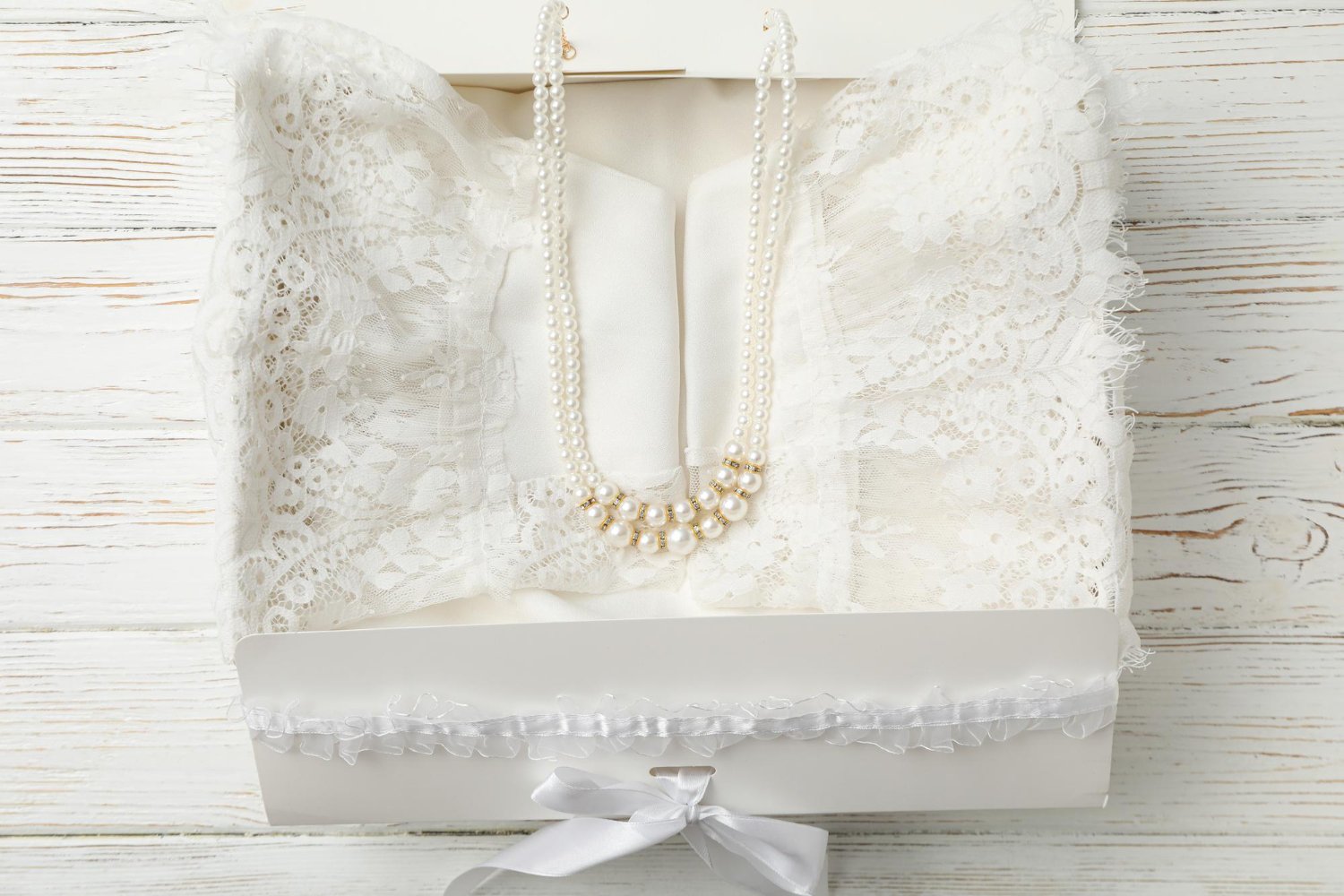
A bride in North Carolina paid $650 for “museum-quality” wedding dress preservation two weeks after her reception. She trusted the glossy brochure and the confident salesperson. Eight years later, she opened the sealed box to show her daughter the gown. The ivory silk had turned amber along every fold line. Brown blotches bloomed across the bodice, right where a champagne glass had splashed during the first dance. That wedding dress preservation cost bought her a box and a signature, not the protection she assumed she was buying.
Stories like that aren’t rare in the preservation industry, and they rarely involve an outright villain. Most gowns get damaged through an honest gap. Marketing language promises more than a box, a chemical process, or a guarantee actually delivers. Sealed boxes trap moisture nobody flagged during the sales pitch. Standard dry cleaning misses water-based stains that oxidize quietly for years. A hundred-year guarantee can exclude beading, transfers, and exactly the storage conditions a real home provides.
This guide breaks down what professional preservation actually costs, tier by tier, and what drives that price up. It covers the real chemistry behind invisible stains. It also covers the sealed-versus-unsealed debate conservators keep having, plus which fabrics and embellishments need extra care. It covers the box-swap scam that keeps showing up in local news. It covers the fine print inside most guarantees, too. And it covers what a dress is actually worth years later, if you sell it instead of storing it. None of this requires becoming a textile expert. It just requires asking a few specific questions before any dress, or any money, changes hands.
Quick Answer
Quick answer first, details below: wedding dress preservation cost typically runs $150 to $650. Most standard gowns land between $250 and $400. Clean the dress within two weeks of the wedding, before invisible sugar and body-oil stains start to oxidize. Choose a company that lets you inspect the dress before it’s boxed. Get the guarantee terms in writing, not just on a glossy card.
Wedding dress preservation red flags include a sealed box you’re told never to open. Another is a guarantee with no company name behind it. A third is pressure to decide same-day at a kiosk with no fixed address. Green flags include a written price breakdown, materials named specifically as acid-free and lignin-free, and a staff member willing to show you the dress right before it’s boxed. A cheap quote and an expensive one can both be a bad deal without a clear explanation of what’s inside the box.
What Nobody Mentions Until It Happens
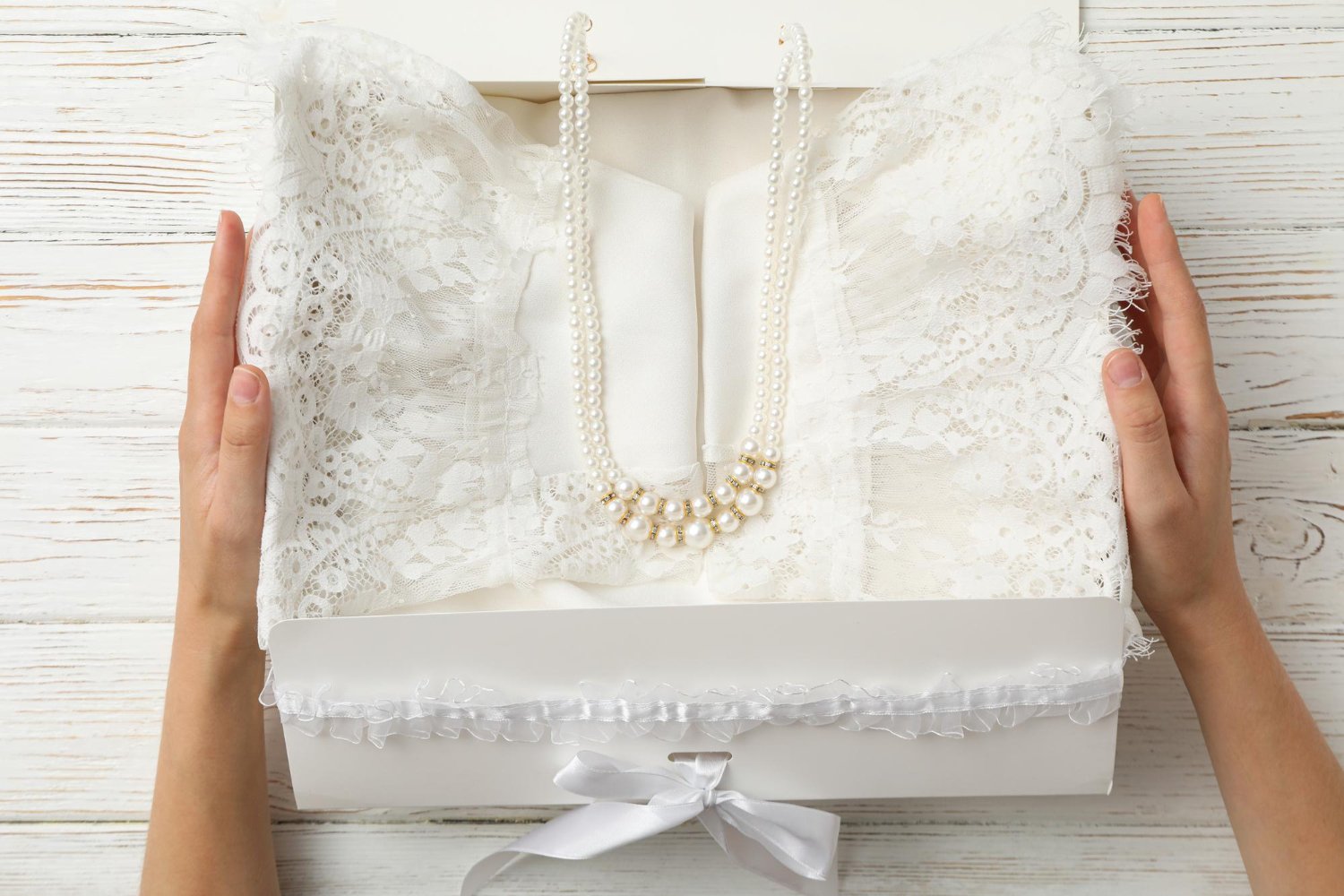
Wedding dress marketing focuses on the box: acid-free, archival, museum-quality. It rarely explains what’s actually happening to the fabric in the weeks before that box gets sealed. That gap is where most long-term damage actually starts, and it starts faster than most couples expect.
The Chemistry Nobody Explains at the Altar
A wedding dress picks up more than visible stains during one long day. Champagne, cake frosting, sweat, and perfume all leave residue that looks invisible at first glance. Understanding what that residue actually does over time changes how urgently you treat cleaning.
Sugar and alcohol residue turns invisible into permanent
Champagne, wine, and soda all dry clear on fabric, so nobody notices the spill by the time photos wrap up. That sugary residue doesn’t just sit there quietly, though. Over weeks and months, it oxidizes, slowly turning into a brown or yellow stain that wasn’t visible on the wedding day itself. By the time you can see it, the sugar has already bonded to the fibers.
Body oils and perspiration behave differently than visible stains
Perspiration and body oils soak into fabric near the underarms, the bodice, and anywhere skin meets fabric directly. These stains are odorless and colorless at first, so a quick visual check misses them completely. Left untreated, they oxidize the same way sugar does, just on a slightly different timeline. A professional cleaner checks these specific areas even when nothing looks wrong.
Dry cleaning solvent doesn’t touch water-based stains
Standard dry cleaning solvent dissolves oil-based residue well, but it largely ignores water-based residue. Sugar, perspiration, and most beverage stains fall into that water-based category, so a routine dry-clean cycle can leave them completely untouched. A dress can come back from the cleaner looking spotless and still carry the exact stains that will darken years later. This is one reason a regular cleaner and a bridal specialist don’t always produce the same result.
The clock starts within 24 to 48 hours
Oxidation doesn’t wait for you to schedule an appointment. Some specialists point to a window as short as 24 to 48 hours before invisible residue starts breaking down chemically. That doesn’t mean a dress is ruined if it sits for a week. It does mean the “I’ll get to it eventually” plan carries a real, measurable cost.
Why the Damage Compounds Instead of Staying Put
Stain damage on a wedding dress doesn’t stay at one severity level. It moves through fairly predictable stages, and each stage makes the fix more expensive and less certain.
Weeks one to four are still an easy fix
In the first month after the wedding, most stains remain genuinely treatable with routine professional cleaning. Nothing has fully oxidized yet, and the fabric hasn’t absorbed the residue permanently. This is the cheapest, most predictable window to act in, both for the dress and for your budget.
Months two through twelve are where oxidation takes hold
Somewhere between two and twelve months, sugar-based stains typically begin visibly changing color. Faint yellow or tan discoloration can appear at hems, underarms, and seams, spots that looked perfectly clean right after the wedding. Cleaning is still possible here, but it usually takes more time, more skill, and a higher price than it would have three months earlier.
Year one through five is when yellowing becomes visible
By the one-to-five-year mark, oxidized stains have often turned a clear yellow or brown, and they’ve chemically bonded to the fabric fibers. Routine cleaning frequently isn’t enough at this stage. Many specialists shift language from “cleaning” to “restoration,” a distinction that usually comes with a higher price tag and a less certain outcome.
Beyond five years often means restoration, not cleaning
Past the five-year mark, discoloration tends to deepen, and any permanent creases from improper storage can set in alongside it. Some damage becomes genuinely difficult to reverse at this stage, regardless of how skilled the specialist is. This is the practical argument for acting early, not the sentimental one: the math gets worse every year you wait.
Wedding Dress Preservation Cost: The Full Breakdown
Wedding dress preservation cost isn’t one number. It’s a base price plus a handful of add-ons that depend on your specific dress. Knowing what drives the price up before you get a quote makes it much easier to tell a fair estimate from an inflated one.
What Drives the Base Price
Most preservation companies price their service in tiers, and the differences between tiers are usually more than marketing dressing. Each level typically reflects a real difference in materials or labor.
Basic tier: cleaning plus a standard acid-free box
A basic package typically runs $200 to $300 and covers professional cleaning, standard stain removal, and a straightforward acid-free box. This tier suits a simpler gown without heavy beading or an especially long train. It’s a reasonable starting point, though it’s worth confirming which stain treatments and materials the price actually covers.
Mid-range tier: advanced stain work and archival tissue
A mid-range package generally falls between $300 and $450 and adds advanced stain treatment, archival-quality tissue, and sometimes a viewing window in the box. This tier tends to fit a dress with moderate embellishment or a couple of stubborn stains from the reception. The viewing window is a convenience worth noting, not a preservation upgrade on its own.
Premium tier: museum boxing and embellishment protection
Premium packages run $450 to $650 or more, and they usually include detailed embellishment protection, museum-quality archival boxing, and a longer written guarantee, sometimes covering 50 to 100 years. This tier makes sense for a heavily beaded gown, a designer piece, or a dress you’re already planning to hand down. It’s the tier where the fine print matters most, since it’s also where the biggest promises get made.
Fabric type changes the cleaning method and the price
Silk, lace, and chiffon generally need gentler solvents and a slower cleaning process than sturdier synthetic fabrics. That extra care usually shows up as a higher price, not just a longer timeline. A quote that skips asking about fabric type before naming a number is worth double-checking.
The Add-Ons That Aren’t Always in the Base Quote
Some costs show up on the initial estimate. Others surface only once the specialist actually examines the dress in person, which is exactly why an in-person quote beats a phone estimate.
Heavy beading and embellishment surcharges
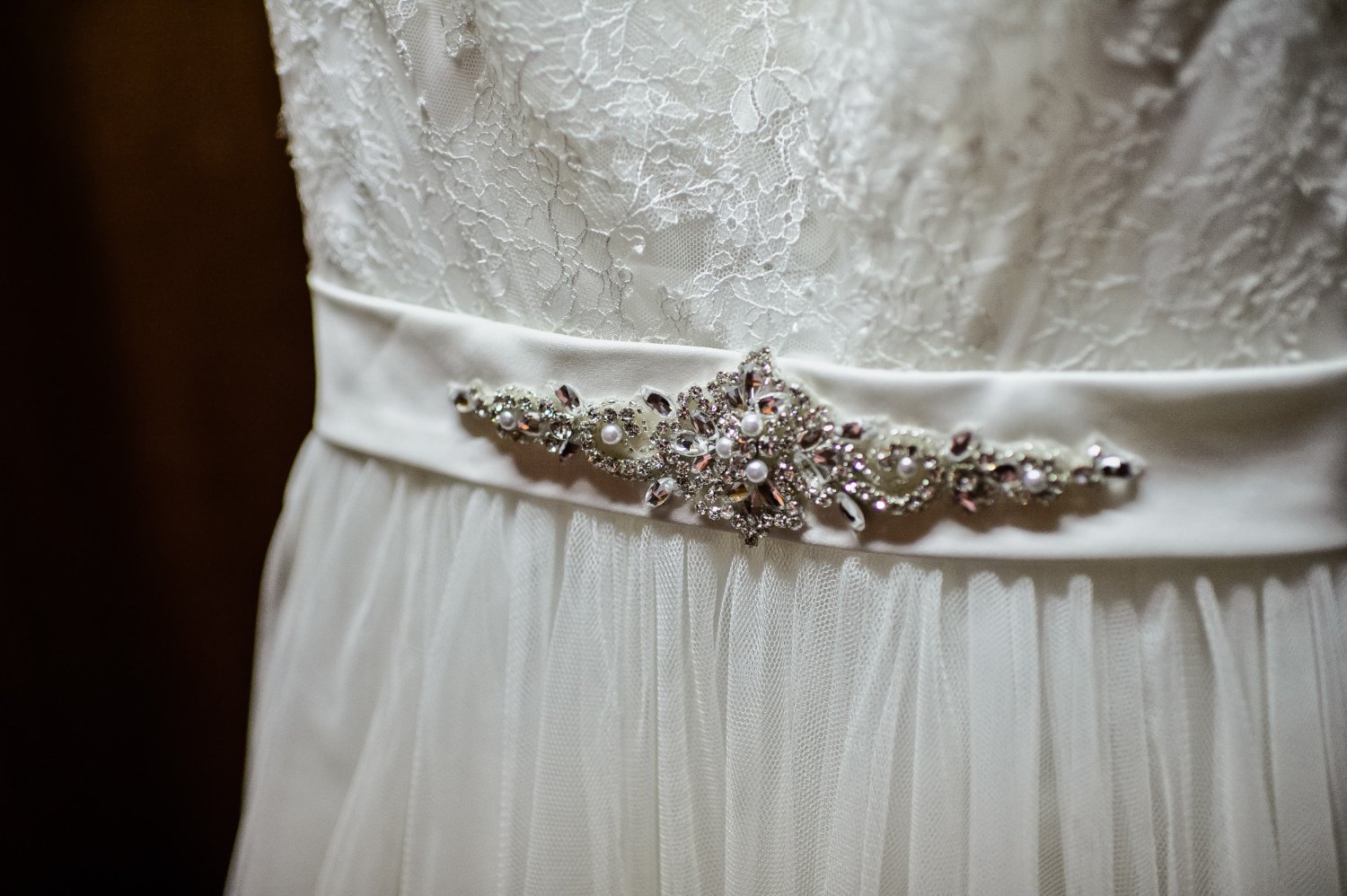
Heavy beadwork commonly adds $75 to $200 on top of the base preservation price. Each bead or sequin often needs individual inspection for loose thread or cracked adhesive before cleaning even starts. A dress with a fully beaded bodice takes meaningfully longer to process than a simple satin sheath, and the price generally reflects that extra labor.
Trains, veils, and separate accessories
Cathedral and chapel-length trains typically add $50 to $150, depending on length and fabric weight. Veils, gloves, and sashes often get preserved separately, sometimes for an additional fee per item. Ask specifically whether accessories come included in a quoted price or land on top of it, since this is one of the more common surprises on a final invoice.
Rush processing fees
Standard preservation typically takes several weeks from drop-off to a finished, boxed dress. Needing it back faster, for an anniversary or an early move, usually triggers a rush fee. That fee varies by company, so it’s worth asking upfront rather than discovering it on the final bill.
Restoration versus routine cleaning pricing
A dress that already shows oxidized staining or yellowing often needs restoration work, not standard cleaning. Restoration pricing runs meaningfully higher than routine preservation, and results are never fully guaranteed. This is the clearest financial argument for cleaning a dress soon after the wedding rather than years later.
The Museum-Quality Process, Step by Step
The phrase “museum-quality” gets used loosely across the preservation industry. The real process, done properly, follows a fairly specific sequence, and skipping steps is usually where things go wrong.
Inspection and Cleaning Before Anything Gets Boxed
Before any cleaning starts, a competent specialist examines the entire dress closely, not just the obviously stained areas.
A specialist inspects under strong light and sometimes black light
Bright, direct light reveals texture changes and stains that overhead store lighting easily hides. Some specialists also use black light technology specifically to spot sugar-based residue still invisible to the naked eye. This step happens before cleaning, so the treatment plan actually matches what’s really on the fabric.
Hand cleaning or controlled wet cleaning versus standard dry cleaning
Because dry cleaning solvent misses water-based stains, many specialists hand-clean or use a controlled wet-cleaning process instead. One preservation company reports hand-cleaning roughly 95% of the gowns it receives for exactly this reason. The method matters more than the marketing term attached to it, so ask which process your specific dress will actually get.
Spot treatment happens before, not after, boxing
Any stain identified during inspection gets treated individually before the dress goes anywhere near a box. Treating stains after boxing isn’t really an option, since the whole point of the box is to stop handling the dress further. This sequencing makes a decent test question: ask exactly when spot treatment happens in their process.
Pressing and drying methods matter as much as the cleaning itself
Embellished and delicate sections typically air-dry flat or on padded forms, away from direct heat that could warp beading or shrink fabric. Pressing, when it happens, needs low heat and a protective cloth barrier for anything beaded or sequined. A rushed drying or pressing step can undo careful cleaning work in a matter of minutes.
Boxing, Tissue, and the Materials That Actually Matter
The box gets most of the marketing attention, but the materials inside it do most of the actual protective work.
Acid-free is necessary but not sufficient — lignin-free matters too
Acid-free is the term most couples hear, but it’s only half the story. Lignin, a natural compound in wood pulp, breaks down over time and releases acid as it degrades. A box that’s acid-free today but not lignin-free can turn acidic within a few years, quietly undoing the protection it promised.
Unbuffered tissue for silk and unknown fiber content
Tissue paper comes in buffered and unbuffered varieties, and the difference matters for certain fabrics. Silk and dresses with unknown fiber content generally do better with unbuffered acid-free tissue, since buffering agents can react poorly with some dyes and fibers. A specialist who can explain this distinction is showing real, specific expertise, not a sales script.
Padding folds instead of creasing them flat
A dress folded flat against itself creates hard crease lines exactly where the fabric bends. Padding each fold with rolled acid-free tissue distributes that stress more evenly across the fabric. This single detail makes a meaningful difference between a rushed boxing job and a careful one.
A viewing window is a convenience feature, not a preservation feature
A clear viewing window lets you check on the dress without opening the box, which is genuinely nice to have. It does nothing, on its own, to actually protect the fabric inside. Don’t let a viewing window substitute for asking about the materials doing the real preservation work.
Sealed vs. Unsealed Boxes: The Debate Worth Understanding
Ask five preservation companies about sealed versus unsealed boxes, and you’ll likely get five confident, slightly different answers. Both approaches have real advocates in the industry, and understanding the actual trade-off helps more than picking a side based on marketing alone.
The Case for a Sealed, Oxygen-Limited Box
Sealed boxes get positioned as the premium option often, and there’s a real argument behind that positioning, not just a higher price tag.
Less exposure to air, humidity swings, and pests
A properly sealed box limits how much air, moisture, and pest activity can reach the fabric over time. For a dress stored somewhere with real humidity swings, that barrier can genuinely help. The protection depends entirely on the seal holding and the box materials staying stable, which isn’t automatic.
A tidy, tamper-evident presentation
Sealed boxes look finished and official, with a clear sense that nothing has been disturbed since the day it was packed. For some couples, that presentation itself carries real sentimental value. It’s a legitimate preference, separate from the purely technical preservation question.
Nitrogen-flushed options marketed as extra protection
Some companies offer nitrogen-flushed, airtight boxes specifically marketed for resale-ready storage, replacing regular air with inert gas to slow oxidation further. This is a more specialized, typically pricier option. Ask directly what gas replacement actually adds versus a standard sealed box, since the marketing language here tends to outrun the plain explanation.
Why some sellers push sealed boxes as the premium choice
A sealed box is genuinely faster and cheaper to produce than a system built for repeated safe opening and reclosing. That doesn’t make sealed boxes a scam by default. It does mean the “premium” label sometimes reflects production convenience as much as it reflects better preservation science.
The Case for an Unsealed Box You Can Actually Open
Several genuine preservation specialists argue the opposite case just as confidently, and their reasoning holds up under scrutiny.
Trapped fumes from cardboard and adhesives have nowhere to go
Sealing a box traps whatever fumes come off the cardboard, adhesives, and any residual moisture inside it. If any component isn’t fully lignin-free, those trapped fumes can accelerate exactly the yellowing the box was supposed to prevent. An unsealed box lets at least some of that off-gassing dissipate over time.
You can’t catch a developing stain you can’t see
A sealed box makes periodic inspection genuinely impossible without breaking the seal entirely. If an oxidized stain develops slowly inside, nobody notices until the guarantee claim, years later. An unsealed box, by contrast, lets you catch a developing problem early, when it’s still fixable.
Refolding every few years prevents permanent creasing
Fabric under sustained pressure at the same fold lines eventually creases permanently, regardless of how careful the original folding was. Opening an unsealed box every couple of years to refold along slightly different lines prevents that outcome. A sealed box makes this basic maintenance step physically impossible.
Resealing tabs let you inspect without voiding a guarantee
Some companies solve this tension with resealing tabs or squares, letting you open the box to check the dress without technically breaking the original seal. This is worth asking about directly if a sealed option appeals to you. A company that’s thought this through has a clear answer ready, not a hesitation.
Fabric-Specific Cleaning Risks
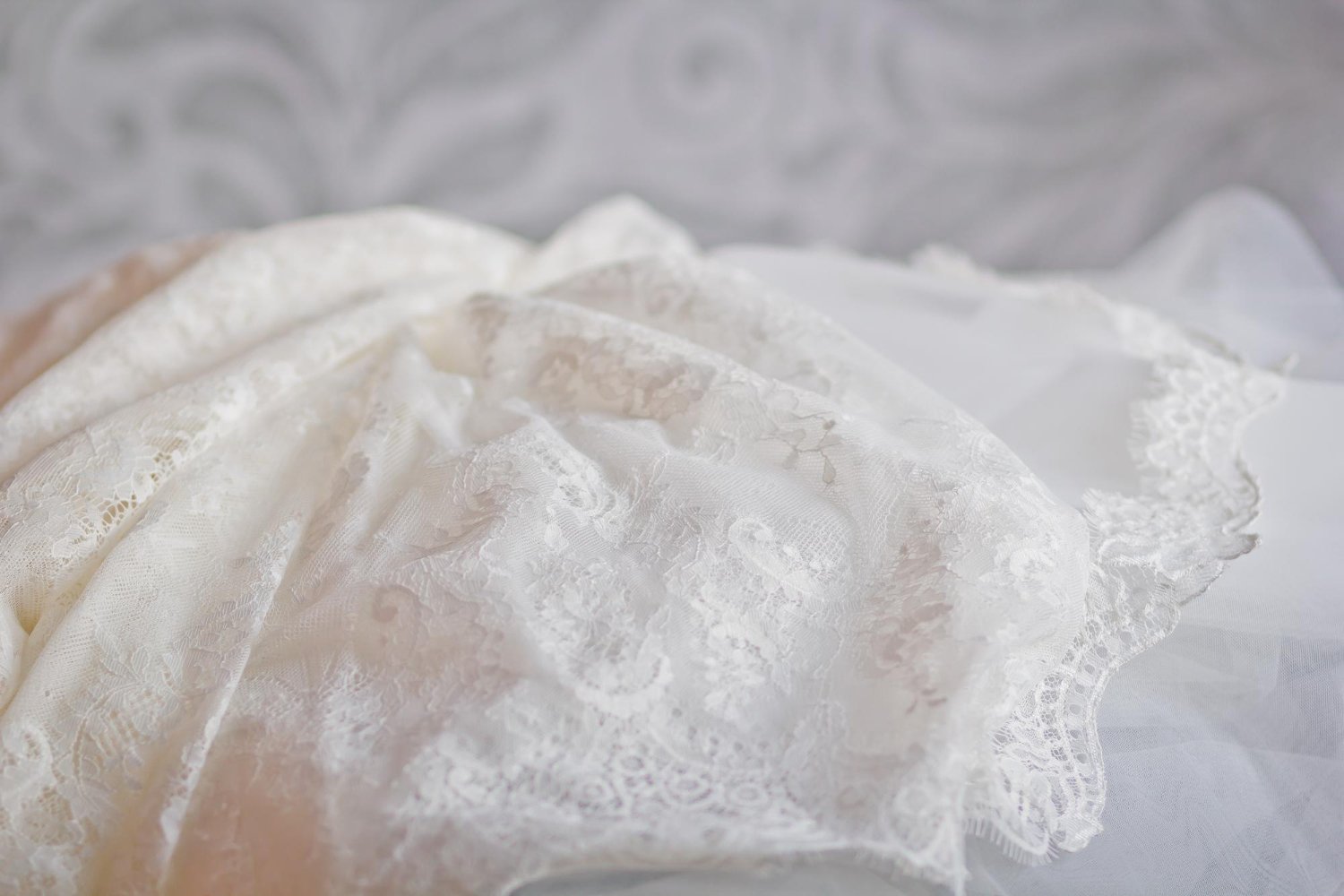
Not every wedding dress fabric responds to cleaning the same way. Knowing your dress’s specific fabric and embellishments changes which questions you actually need to ask a cleaner.
Delicate Natural Fibers
Natural fibers like silk and cotton lace behave beautifully on a hanger and considerably less predictably in a cleaning process.
Silk loses strength when moisture and stress combine
Silk fibers weaken when exposed to prolonged moisture, especially combined with any mechanical stress like folding or pressing. A silk gown sitting, damp with sweat, through a full reception already carries some of that stress before it ever reaches a cleaner. This is part of why timing matters as much as technique for silk specifically.
Lace fibers break under the wrong solvent or agitation
Lace, particularly antique or delicate styles, can fray or tear under standard agitation cycles built for sturdier fabrics. The wrong solvent can also strip the slight stiffness that gives lace its pattern definition. A specialist familiar with lace typically hand-cleans these sections separately from the rest of the gown.
Chiffon and organza show water spotting easily
Chiffon and organza are lightweight, sheer fabrics that show water spots and ring marks more visibly than heavier materials. A single drop of the wrong liquid, applied unevenly during cleaning, can leave a mark arguably worse than the original stain. This is a fabric type where an inexperienced cleaner’s mistakes show up clearly.
Ivory and champagne dyes shift color under mild chemical exposure
Ivory and champagne aren’t just lighter shades of white. They’re specific dye formulations, and some of those dyes shift subtly under exposure to certain cleaning chemicals. A shifted dye isn’t always dramatic, but it can create a visible difference between, say, a bodice and a detachable train cleaned separately.
Embellishments That Complicate Standard Cleaning
Beads, sequins, and embroidery add visual drama to a gown, and they also add real complexity to the cleaning process.
Glued-on beads and crystals versus sewn-on ones
Some embellishments get sewn on individually, and others get attached with adhesive, a difference that’s not always obvious from a quick look. Standard cleaning solvents can weaken or dissolve certain adhesives, loosening beads that looked perfectly secure before cleaning. A specialist checks adhesive integrity during inspection, before committing to a cleaning method.
Metallic-backed beads can corrode or discolor
Beads with a metallic backing or coating can tarnish or discolor when exposed to specific cleaning chemicals, sometimes in ways that don’t reverse. This risk is easy to miss during a quick visual inspection, since the damage often stays hidden until well after cleaning. Ask directly whether your beading has any metallic components before agreeing to a standard process.
Acetate sequins warp under heat or the wrong solvent
Acetate sequins, common on more budget-friendly gowns, can warp or lose their reflective shine under heat or the wrong solvent exposure. Once warped, that damage generally sticks around for good. A specialist familiar with sequin types can usually identify acetate versus more heat-resistant materials before cleaning starts.
Embroidery can pucker if the base fabric shifts unevenly
Embroidered sections rely on the base fabric staying flat and stable throughout cleaning and drying. If that base fabric shrinks or shifts unevenly, the embroidery on top can pucker or distort, even though the thread itself stays intact. This is one more reason air-drying flat, rather than hanging or high-heat drying, matters for an embellished gown.
Hidden Costs to Check
Individually, most wedding dress preservation cost add-ons look small on their own. Stacked across a single invoice, they can turn a $300 quote into a $500 final bill. That gap catches a lot of couples off guard when they only budgeted for one number.
Costs Baked Into the Preservation Itself
These costs exist regardless of whether anything ever goes wrong with the dress or a future claim.
Embellishment surcharges rarely shown on the initial quote
A phone or online quote often can’t account for exactly how much beading a specific dress carries. The real surcharge frequently only appears once someone examines the dress in person. Ask for a written, itemized estimate after that in-person look, not just a verbal range.
Accessory preservation billed separately
Veils, garters, gloves, and sashes commonly get preserved as separate line items, each with its own fee. A base preservation price advertised for “the dress” doesn’t always cover these pieces automatically. Confirm exactly what’s covered before assuming your entire bridal outfit fits into one quoted number.
Re-preservation and refolding service fees
Some companies offer periodic refolding or re-boxing as a paid service, separate from the original preservation fee. Others include a set number of free re-openings within the guarantee period. Ask specifically what happens, cost-wise, if you want the dress checked or refolded five or ten years down the road.
Shipping both directions if you use a mail-in service
National preservation companies that operate by mail typically charge shipping to send the dress in, and sometimes charge again to ship the finished box back. Insurance on that shipment is worth confirming separately, since a dress lost or damaged in transit becomes a genuinely complicated dispute. A local specialist avoids this cost entirely, which is worth weighing against a lower advertised price from a mail-in competitor.
Costs Tied to Timing and Circumstances
Some costs depend less on the dress itself and more on when, and under what circumstances, you’re getting it preserved.
Rush fees for a dress cleaned close to the wedding date
Needing a dress cleaned and boxed quickly, ahead of a move or an early anniversary, often triggers an expedited-service fee. That fee varies widely by company and season, since wedding season creates real backlogs at busy cleaners. Booking preservation early in your planning, the same way you’d book a caterer, avoids this cost entirely.
Restoration pricing once oxidation has already set
As covered earlier, a dress with existing oxidized staining needs restoration, not routine cleaning, and restoration costs meaningfully more. This cost is entirely avoidable with early action, which makes it one of the more frustrating hidden costs on this list. Nobody plans to wait five years; it just tends to happen anyway.
Storage unit or climate-controlled rental costs
A dress that doesn’t fit comfortably in a home closet sometimes ends up in a climate-controlled storage unit instead. That’s an ongoing monthly cost, not a one-time fee, and it’s easy to forget once the initial excitement of preservation wears off. Factor this into the real, long-term cost if your living situation lacks obvious storage space.
Replacement box fees if the original is damaged
A preservation box that gets crushed, water-damaged, or otherwise compromised during a move or a flood usually falls outside a standard guarantee. Replacing the box itself, separate from the dress inside it, can carry its own fee. Confirm this specific scenario with any company before assuming the guarantee covers every possible mishap.
| Preservation approach | Typical cost | Turnaround time | Best suited for |
|---|---|---|---|
| DIY home preservation kit | $60–$150 | Same day, once the dress is already clean | An already professionally cleaned gown with minimal embellishment |
| Basic professional preservation | $200–$300 | 2–4 weeks | A simpler gown without heavy beading or a long train |
| Mid-range professional preservation | $300–$450 | 3–5 weeks | A moderately embellished gown or one with a few set-in stains |
| Premium museum-quality preservation | $450–$650+ | 4–8 weeks | Heavily beaded, designer, or heirloom-bound gowns |
| Restoration (delayed cleaning) | $300–$800+ | 6–12 weeks, results not guaranteed | A dress cleaned years after the wedding with visible yellowing |
Scam Check
Most problems in this industry come from vague promises, not outright fraud. A smaller, more serious category involves companies that never intended to protect the dress at all.
How the Classic Preservation Scam Works
One specific scam pattern shows up repeatedly in local news investigations across the country, and it’s worth understanding exactly how it operates.
The dress gets sold, and a weighted box replaces it
In documented cases, some companies quietly sold the actual wedding dresses they were paid to preserve. In their place, customers received a sealed box weighted to feel like it still contained a gown. The substitution worked precisely because nobody ever opened the box to check.
“Never open the box” is the line that makes it work
Customers in these cases were specifically told that opening the box would ruin the preservation, undoing years of protection instantly. That claim isn’t actually true for a properly made box with resealing capability. It functions mainly as a way to discourage exactly the kind of check that would expose the scam.
Years pass before anyone checks
Because a wedding dress typically isn’t needed again for years, sometimes decades, the fraud often goes undiscovered for a very long time. By the time a daughter wants to see the dress, or a couple wants to sell it, the original company may be long gone. This is exactly why the box-swap scam works so well against sentimental, rarely-opened items.
The company is often gone by the time it’s discovered
Small preservation companies can close, rebrand, or simply disappear within a few years, especially ones without ties to a larger, established dry cleaner. A hundred-year guarantee from a company that lasted three years is effectively worthless. Checking a company’s history and longevity matters as much as reading its guarantee language.
Smaller-Scale Red Flags to Watch For
Most preservation companies aren’t running an outright scam, but plenty exhibit smaller warning signs worth taking seriously.
Mall-kiosk upsells with no fixed address
A pop-up table or mall kiosk offering deep preservation discounts can be perfectly legitimate, or it can disappear after wedding season ends. Ask for a permanent business address and a phone number that isn’t just a personal cell. A company confident in its work generally has no problem sharing this information.
Pressure to decide same-day without a written quote
Legitimate preservation pricing doesn’t usually depend on signing before you leave the building. Artificial urgency, like a discount that expires the moment you walk out, is a pressure tactic more common among less reputable sellers. A written quote you can take home and compare costs nothing to ask for.
No willingness to show the dress before sealing
A company that hesitates or refuses to let you see the finished, cleaned dress before it’s boxed deserves real caution. This single step confirms the cleaning actually happened as described. Reasonable companies build this check into their process without being asked.
A guarantee with no named company behind it
Some guarantees reference a generic brand name without clearly stating the legal business entity actually backing the promise. If that entity can’t turn up in state business registries, the guarantee likely won’t survive a real dispute, let alone a business closure. A quick search of the company’s registered name takes a few minutes and can save considerable regret.
Contract Fine Print and Guarantee Terms
A hundred-year guarantee sounds reassuring printed on a brochure. The actual value of that guarantee lives in a few specific clauses most couples never read closely.
What a 100-Year Guarantee Actually Promises
Long guarantee periods are common in this industry, and reading exactly what they cover changes how much weight to put on the number itself.
Coverage usually applies to fabric, not beads or sequins
Many guarantees explicitly cover the base fabric against yellowing while excluding beads, sequins, and other embellishments entirely. For a heavily decorated gown, that exclusion can leave a meaningful portion of the dress genuinely unprotected. Ask specifically whether embellishments fall inside or outside the written guarantee before you sign anything.
Opening the box to look doesn’t have to void anything
Some reputable companies build resealing tabs directly into the box design, specifically so a simple inspection doesn’t void coverage. Others aren’t as clear about this distinction, leaving customers afraid to check on a dress they’ve already paid to protect. Confirm this detail explicitly before assuming you can never look inside.
Reprocessing and refund terms if the fix doesn’t work
A well-written guarantee typically spells out what happens if a yellowing problem can’t fully reverse: free reprocessing first, then a refund if that reprocessing genuinely fails. A vague guarantee that promises only to “address the issue” without specifics gives the company far more room to do very little. Specific language protects you; vague language protects them.
Turnaround time for a claim can run into months
Filing a guarantee claim isn’t usually instant. Reprocessing a dress that’s showing yellowing can take four to fourteen weeks, depending on the company and the extent of the damage. That’s worth knowing in advance, especially if the dress needs to make an upcoming event like a vow renewal or a daughter’s wedding.
What Voids Coverage Without You Realizing It
Guarantees typically come with a list of conditions that void coverage entirely, and several of them are easy to trigger accidentally.
Wearing or trying on the dress again after preservation
Most guarantees void automatically the moment the dress gets worn again, even briefly, even just for a photo. This matters directly for anyone hoping to pass the gown down for a “something borrowed” moment or an actual second wearing. Ask upfront how re-wearing interacts with the guarantee, since the answer affects real family plans.
Outside cleaning, alterations, or repairs
Having the dress cleaned, altered, or repaired by a different company after preservation typically voids the original guarantee entirely. This makes sense from the preservation company’s side, since they can no longer verify what actually happened to the fabric. It’s still worth knowing before you casually hand the dress to a local tailor for “just one small fix.”
Transferring the dress to a new owner
Many guarantees name only the original owner and explicitly don’t transfer if the dress is given, sold, or willed to someone else. For a dress intended as a future heirloom, this detail is genuinely significant, not a minor technicality. A daughter inheriting the dress may be inheriting a beautifully preserved gown with zero remaining guarantee coverage.
Storage conditions the company can point to later
Guarantees typically exclude damage from flooding, fire, pests, and improper storage conditions like an attic or a damp basement. If a dispute arises, the company can point to storage conditions as the reason a claim gets denied, whether or not that’s the actual cause. Keeping the dress in a stable, climate-controlled space isn’t just good practice; it protects your ability to actually use the guarantee.
Green, Yellow, and Red Flags
Sorting what a preservation company tells you into these three categories makes a confusing sales conversation much easier to evaluate afterward.
What a Trustworthy Company Sounds Like
Trustworthy answers tend to get more specific, not vaguer, the more questions you ask.
Specific answers about materials, not just buzzwords
A company that names its tissue as unbuffered, acid-free, and lignin-free, unprompted, is showing genuine expertise rather than reciting marketing copy. Vague reassurances like “the finest materials,” with no specifics behind them, are worth a direct follow-up question. Precision is a fairly reliable signal in this particular industry.
A physical location you can actually visit
An established storefront, with a real address and visible operating history, tells you something a website alone can’t. It also means someone stays answerable if a dispute comes up later. This doesn’t rule out reputable mail-in services entirely, but it does raise the bar for how thoroughly you check them.
Willingness to explain the guarantee’s exclusions unprompted
A company that proactively explains what its guarantee doesn’t cover, rather than waiting to be asked, demonstrates real confidence in its process. That kind of transparency stays rare enough in this industry to count as a meaningful green flag on its own.
Portfolio examples of restoration work, not just clean gowns
Showing a genuinely difficult restoration, with a believable before-and-after, demonstrates real skill far better than a stack of routine cleaning photos. Ask to see the hardest case they’ve handled, not just their easiest success stories. How they answer that specific question tells you a great deal.
What a Warning Sign Sounds Like
None of these signs automatically means fraud, but each one deserves a direct, specific follow-up question before you commit any money.
Defensiveness when asked about the guarantee’s fine print
A staff member who gets short or evasive when asked direct questions about exclusions is telling you something real about how claims likely get handled later. Confident companies answer fine-print questions calmly, because they already know the answer and aren’t hiding anything in it.
Only one storage or boxing option offered, with no explanation
A company that pushes one single box style without explaining the sealed-versus-unsealed trade-off may not have thought through the actual preservation science. It might also just mean they only stock one option; either way, the lack of explanation deserves further probing.
Reluctance to let you see the dress before boxing
This stands out as one of the clearer warning signs in the entire process. A legitimate company has no real reason to skip this step, since it costs them nothing and builds real trust.
A price that seems unusually low for a heavily beaded gown
A quote significantly below the typical range for a heavily embellished dress isn’t automatically dishonest, but it deserves a direct question about what’s actually included. Sometimes it reflects a genuinely efficient operation; sometimes it reflects corners cut on inspection, materials, or both.
Legal and Consumer Protection Check
Preservation companies operate under real consumer protection rules, and knowing them matters just as much as knowing the wedding dress preservation cost breakdown itself.
What Actually Protects You as a Customer
A handful of specific protections apply to dry cleaning and preservation services, and knowing them changes how you can respond if something goes wrong.
State consumer protection laws cover deceptive business practices
Every state has some version of a consumer protection or deceptive trade practices law, and a company that swaps a real dress for a weighted decoy box clearly violates it. Filing a complaint with your state attorney general’s consumer protection office is a legitimate, formal step if a company acts in bad faith. It won’t necessarily get your specific dress back, but it creates a real record.
The Better Business Bureau tracks complaint patterns
The Better Business Bureau maintains complaint histories and accreditation status for thousands of preservation and dry-cleaning businesses nationwide. Checking a company there before paying takes a few minutes and can surface a pattern that a single glowing review never would. An unaccredited company isn’t automatically untrustworthy, but a string of unresolved complaints is a real, checkable warning sign.
Small claims court is realistic for a specific dollar loss
For a dispute involving a clear dollar amount, like a refund the company refuses to honor, small claims court is generally accessible without hiring a lawyer. Filing fees stay low, and the process suits exactly this kind of straightforward consumer dispute. It’s a genuinely useful backup option, not just a theoretical one.
Care labeling rules affect what a cleaner must disclose
Federal textile care labeling rules require garments to carry accurate care instructions, and cleaners are expected to follow those instructions or explain any deviation. This doesn’t cover every possible dispute, but it does give you a documented standard to point to if a cleaner ignored a dress’s stated care requirements. Keeping the original care label, if the dress still has one, is worth doing before it ever leaves your hands.
What the Law Won’t Necessarily Fix for You
Some frustrating outcomes in this industry are completely legal, however unfair they feel from the customer’s side of the counter.
A company legally closing doesn’t obligate anyone to honor a guarantee
If a preservation company goes out of business entirely, its guarantee generally dies with it, unless another company formally purchased and assumed those obligations. There’s rarely a straightforward legal path to force a closed business to fulfill a promise it can no longer keep. This is exactly why company longevity matters as much as guarantee length.
Excluded scenarios in a contract are usually enforceable as written
Courts generally enforce exclusion clauses, like the flood, fire, and pest exclusions common in most guarantees, as written, provided the company disclosed them at signing. That’s frustrating in an actual loss, but it’s rarely something you can successfully challenge after the fact. Reading exclusions before signing remains the more effective form of protection.
Non-transferable guarantees are legal, even for family heirlooms
A guarantee limited to the original owner counts as a completely standard and legal contract term in this industry, even though it can feel unfair for a dress meant to get handed down. If a transferable guarantee matters to your family’s plans, ask about it specifically and get any exception in writing before you pay.
Verbal promises rarely hold up against written contract terms
A friendly, verbal reassurance during a sales conversation carries far less legal weight than the written contract you actually sign. If a staff member promises something the paperwork doesn’t reflect, ask for it in writing before proceeding. This single habit resolves more disputes before they ever start than almost anything else on this list.
DIY Storage: When It’s Fine and When It Isn’t
Professional preservation isn’t the only reasonable option for every couple, every budget, and every dress. A DIY approach can work well in some specific situations and poorly in others.
What a Home Preservation Kit Actually Includes
Home preservation kits offer a real, budget-friendly middle ground between full professional service and simply hanging the dress in a closet.
Acid-free box, unbuffered tissue, and instructions
A typical home preservation kit runs $60 to $150 and includes an acid-free box, unbuffered acid-free tissue, and written folding instructions. It’s essentially the materials half of professional preservation, without the cleaning or the inspection. For a couple on a tighter budget, it’s a genuinely reasonable middle step.
Price range and what it does not include
That $60-to-$150 price skips professional cleaning, stain treatment, and any written guarantee. It’s purely a storage solution for a dress that’s already clean. Buying a kit for a dress that still carries uninspected, unaddressed stains just boxes up a problem for later, more expensive discovery.
Best suited for a dress that’s already clean
A DIY kit makes the most sense for a dress cleaned professionally elsewhere, or one genuinely free of any spills, stains, or heavy sweat exposure. It also suits a simpler gown without extensive beading that needs individual inspection. A heavily embellished dress with unknown stain history makes a poor candidate for the DIY route.
Where a kit falls short of a professional process
A kit can’t replicate a trained eye checking for oxidized stains under strong or black light. It also can’t replicate hand-inspecting every bead for loose thread or cracked adhesive. For a dress with real sentimental or resale value, that gap in expertise is worth weighing against the cost savings.
Storage Habits That Matter More Than the Box
The box gets the attention, but where and how you actually store that box does most of the long-term work.
Temperature and humidity stability beat any container
Textile conservation guidance generally recommends storing fabric around 65 to 70 degrees Fahrenheit, with roughly 50% relative humidity and minimal fluctuation. A perfect acid-free box in an unstable environment still deteriorates faster than a decent box in a stable one. Consistency matters more than any single material choice.
Attics, basements, and garages are the worst options
These spaces swing dramatically in both temperature and humidity across seasons, exactly the instability that accelerates fabric breakdown. They’re also more prone to pests and, in basements especially, flooding. A closet inside the main living space, away from direct sunlight, makes a far better default choice.
Cedar chests and plastic bags both cause problems
Cedar releases oils that can stain or discolor fabric over years of direct contact, despite the chest’s reputation as a classic storage solution. Plastic bags trap moisture and can off-gas chemicals that yellow fabric from the inside. Neither serves as a safe substitute for acid-free tissue and a breathable, sturdy box.
A periodic check-in catches trouble early
Whether the dress sits in a sealed box or an open one, checking on it every couple of years catches developing problems while they’re still fixable. This five-minute habit pays off in the long run. Treat it the same way you’d treat checking smoke detector batteries: unglamorous, easy to forget, genuinely worth doing anyway.
Heirloom and Resale Considerations
What happens to a wedding dress ten or twenty years later depends heavily on decisions made right after the wedding. Passing it down and selling it require different kinds of preparation, and it’s worth thinking through both before boxing anything.
Passing the Dress Down
A dress intended for a future daughter, niece, or family member needs some specific planning beyond standard preservation.
A non-transferable guarantee is worth knowing about early
As covered above, many guarantees only apply to the original owner and don’t automatically transfer to a family member later. If handing the dress down matters to you, ask directly whether the guarantee can be reassigned, and get that answer in writing rather than a verbal assurance.
Fit and styling change across generations
Bodies, height, and personal style genuinely vary across generations, and a dress preserved perfectly may still need significant alteration to fit someone new. This doesn’t reduce the value of preservation; it just means the dress is a starting point, not a finished garment ready for a second wedding. Budgeting for future alterations belongs in the same conversation as preservation.
Re-preservation makes sense before a second wearing
A dress stored for fifteen or twenty years generally benefits from a fresh inspection and light re-preservation before anyone wears it again. Fabric can grow more fragile over decades, even under ideal storage conditions. A quick specialist check before the big day protects both the dress and the new wearer’s experience.
Sentimental value doesn’t require a perfect original state
Some families choose to repurpose a portion of an old gown, like the lace or a piece of fabric, into a new garment, a christening outfit, or a small keepsake instead of preserving the entire dress intact. This is a completely valid choice, not a lesser one. Preservation stays a default option, not an obligation.
Selling Instead of Storing
Not every dress ends up in a box in a closet. A meaningful number get sold, and preservation status directly affects what a buyer will actually pay.
Resale value drops fastest in the first few years
Resale prices for wedding dresses under about two and a half years old often land around half of the original purchase price, and that number drops further with each subsequent sale. A designer gown originally priced at $8,000 might resell for roughly $5,000 the first time and closer to $4,000 the second. Timing a sale sooner rather than later generally captures more of the original value.
Condition and preservation status affect what buyers pay
A buyer shopping secondhand cares directly about whether a dress went through professional cleaning and how it was stored afterward. Visible staining, yellowing, or a musty smell from improper storage meaningfully lowers what a reasonable buyer will offer. Preservation, even a basic version, is a genuinely worthwhile investment if resale is even a possibility down the road.
Photos, honesty about wear, and timing the listing
Clear photos from multiple angles, in natural light, sell a used gown far better than a single dark phone photo. Honest descriptions of any alterations, minor flaws, or wear meaningfully build buyer trust and reduce the odds of a return dispute. Listing within a couple of weeks of the wedding, or in a peak engagement-shopping month, tends to attract more serious buyers.
Preservation and resale are not mutually exclusive plans
Some couples assume preservation and resale sit at opposite ends of a choice, but that’s not really true. A dress preserved properly and never worn again remains a perfectly sellable dress years later, sometimes a more valuable one for the documented care. Deciding definitively can wait; keeping the option open just requires treating the dress well in the meantime.
Questions That Feel Awkward but Are Worth Asking
Some of the most useful questions in this whole process feel a little confrontational to ask a friendly cleaner or a warm preservation consultant. Ask them anyway, calmly, and pay close attention to how directly they’re answered.
Questions for a Preservation Company
These questions cut through brochure language and get at how the company actually operates day to day.
Who actually cleans the dress, and where
Some companies handle cleaning entirely in-house, while others outsource it to a third party you’ll never interact with directly. Outsourcing isn’t automatically a problem, but it can add markup without necessarily adding expertise. A direct answer to “where does my dress physically go?” tells you a lot.
What happens if the company closes
This question rarely gets asked, and it’s arguably the most important one on this entire list. Ask whether the guarantee has backing from any kind of insurance, bond, or larger parent company, rather than just the small business itself. A vague or uncomfortable answer here is genuinely informative.
What voids the guarantee, in writing
Ask for the specific exclusion list in writing, not a verbal summary of “the usual stuff.” A company confident in its guarantee keeps this document ready to hand over without hesitation. One that stalls or can’t produce it is telling you something important about how a future claim might actually go.
Can you see the dress before it’s sealed
This is a simple, reasonable request, and a legitimate company should have no issue accommodating it. If a company discourages this check, treat that reluctance as real information rather than an inconvenience to brush past.
Questions for a Regular Dry Cleaner Instead
Not every couple uses a dedicated bridal specialist, and a good general dry cleaner can still make a reasonable choice with the right questions answered first.
Do they have experience with bridal fabrics specifically
General dry cleaning experience doesn’t automatically translate to comfort with silk, lace, and heavy beading. Ask directly how many wedding dresses they handle in a typical year, and ask to see examples if possible. A cleaner who mostly handles suits and everyday clothing may fit poorly with a delicate, embellished gown.
What solvent or process will they use
PERC, a common dry-cleaning solvent, can be genuinely harsh on delicate bridal fabrics, sometimes causing damage that resembles a chemical burn on close inspection. Ask specifically what solvent or process they’ll use, and whether they offer a gentler wet-cleaning alternative for water-based stains. A cleaner who answers this clearly and specifically is showing real expertise.
Do they carry insurance for the piece
Ask directly whether the cleaner carries insurance covering damage to a garment while it’s in their possession. A cleaner unwilling to offer any insurance is implicitly telling you something about their own confidence in the process. This is a fair, reasonable question for any high-value item, not just a wedding dress.
Can they show past bridal work
Ask to see photos or references from past wedding dress jobs specifically, not just general cleaning work. A cleaner with genuine bridal experience usually has at least a few examples ready to share. If they don’t, that’s useful information, not necessarily a dealbreaker, but a reason to ask a few more careful questions before committing your dress to their care.
Worst-Case Scenario and the Backup Plan
The worst version of this problem isn’t a dress that yellows slightly at the hem. It’s opening a “preserved” box decades later and finding a stranger’s old curtain, a stack of newspaper, or nothing recognizable as your actual wedding dress at all. That’s the box-swap scam at its most extreme, and while it’s rare, it’s documented and real.
Picture a mother, decades after her own wedding, opening a sealed box to show her daughter the gown before an engagement party. Instead of silk and lace, she finds a weighted, empty shell built to pass a casual shake test. The company that sold her “100-year preservation” closed years earlier, leaving no one to answer for it. Nothing about that moment can be undone.
The backup plan starts well before any box gets sealed. Photograph the actual dress thoroughly right after cleaning, including close-ups of any beading, lace detail, and the inside tags or labels. Keep those photos somewhere separate from the box itself, ideally backed up digitally. If a company offers resealing tabs, use the ability to check on the dress every few years rather than treating “never open it” as gospel.
If you ever do open a box and find something wrong, document it immediately with photos and dates before contacting the company. File a complaint with your state consumer protection office and the Better Business Bureau if the company stays unresponsive or evasive. A dress can’t always come back once it’s gone, but a documented, prompt response gives you the best possible chance at either a resolution or, at minimum, a warning that helps the next bride avoid the same company.
Frequently Asked Questions
These are the specific questions that come up most often once couples start comparing preservation quotes side by side.
What is the average wedding dress preservation cost?
Most standard gowns cost $250 to $400 to professionally clean and preserve, with a wider range of $150 to $650 depending on fabric, beading, and box quality. A heavily embellished designer gown can run higher once every add-on gets included.
How soon after the wedding should I get my dress cleaned?
Aim for within two weeks. Invisible sugar and body-oil stains can start oxidizing within 24 to 48 hours, and cleaning gets harder and less predictable the longer you wait.
Is a sealed box better than an unsealed one?
Not necessarily. Sealed boxes limit air exposure but make periodic inspection impossible, while unsealed boxes let you catch developing problems early at the cost of slightly more air exposure. Both work as legitimate approaches when the materials themselves are genuinely acid-free and lignin-free.
Can I clean a wedding dress myself at home?
It’s not recommended for anything beyond very minor spot cleaning. Bridal fabrics and embellishments react unpredictably to home cleaning products, and a mistake here is often permanent.
What’s the difference between cleaning and preservation?
Cleaning removes visible and invisible stains from the fabric. Preservation is the boxing and storage process that follows cleaning. A company offering one without the other isn’t necessarily dishonest, but it’s important to know exactly which service you’re paying for.
Does dry cleaning actually damage wedding dresses?
Standard dry cleaning solvent, particularly PERC, can be harsh on delicate silk, lace, and certain beading adhesives. A bridal specialist typically uses gentler methods, including hand cleaning or controlled wet cleaning, specifically to avoid this risk.
What happens if the preservation company goes out of business?
In most cases, the guarantee simply becomes unenforceable, since there’s no company left to honor it. This is why checking a company’s longevity and financial stability matters as much as reading the guarantee’s stated terms.
Are mall kiosk preservation deals legitimate?
Some are, but many are seasonal and temporary. Ask for a permanent business address and confirm the company still exists a few months after your wedding before fully trusting a kiosk deal.
Will opening the box void my guarantee?
It depends entirely on the specific company. Some build in resealing tabs specifically so inspection doesn’t void coverage, while others don’t clarify this at all. Ask directly before you assume either answer.
Does preservation cover beading and sequins, or just the fabric?
Many guarantees cover only the base fabric against yellowing and specifically exclude beads, sequins, and other embellishments. Confirm this distinction before assuming your entire dress carries protection under one guarantee.
Can I still sell a dress that’s been professionally preserved?
Yes, and preservation status often helps rather than hurts resale value. Buyers shopping secondhand generally prefer a documented, professionally cleaned and stored gown over one with unknown cleaning history.
How much does DIY home preservation cost compared to professional service?
A home preservation kit typically runs $60 to $150, compared to $200 to $650 or more for full professional service. The kit only covers materials and storage, not professional cleaning or stain inspection.
What if I want to wear my dress again someday?
Ask specifically before preserving, since most guarantees void automatically the moment the dress gets worn again. If a future second wearing seems genuinely likely, factor that into which guarantee terms you accept.
Is it normal for a preservation quote to change after an in-person look?
Yes, this happens commonly and often for legitimate reasons, especially for a heavily beaded or long-trained gown. A significant, unexplained jump in price without a clear reason deserves a direct question, though.
What’s the biggest mistake couples make with wedding dress preservation?
Waiting too long to get the dress cleaned. Every month of delay makes oxidized stains harder, and eventually impossible, to fully remove during routine cleaning.
Should I get my dress re-preserved before handing it down?
Generally, yes, especially if it’s been sitting in storage for over a decade. A fresh inspection catches any fragility or developing issues before someone else actually wears the gown.
Does homeowners insurance cover a wedding dress in storage?
Sometimes, but usually with a low sublimit similar to jewelry coverage, and rarely enough to replace a designer gown. Check your policy’s personal property limits, or consider a specific rider if the dress carries significant value.
Wedding dress preservation cost is never really about the box alone. It’s about the cleaning method that happens before the box, the specific materials inside it, and the guarantee language that determines whether any of it actually holds up years later. A dress deserves all three getting real attention, not just the one that photographs well on a website.
Start with the cleaning, and start soon. Ask the specific, sometimes-awkward questions in this guide before any money changes hands, and get the important answers in writing. The couples who avoid the worst outcomes here aren’t the ones who paid the most. They’re the ones who checked the details before trusting a box they’d never see opened again for years.
Sources: Association of Wedding Gown Specialists; Heritage Garment Preservation; Drycleaning & Laundry Institute International; Better Business Bureau; Gaylord Archival; Dayton Daily News. Accessed September 29, 2026.
