Nothing about this was a scam or a mistake on her part. Every single fee was genuinely standard, disclosed industry practice. The gap wasn’t dishonesty. The $2,100 figure she’d budgeted around, the one every wedding publication cites, explicitly excludes nearly everything that actually gets added to a real dress total.
This guide covers wedding dress cost from every angle that actually matters. The specific silhouette types, and what genuinely distinguishes them. Real 2026 pricing across every shopping tier, from department store to couture. And the complete, itemized picture of what gets added to that sticker price before the dress ever reaches your closet. It also covers the alteration process in real detail, since it’s the single most commonly cited surprise in the entire bridal attire category, along with preservation, accessories, and the scam patterns specifically targeting wedding dress shoppers.
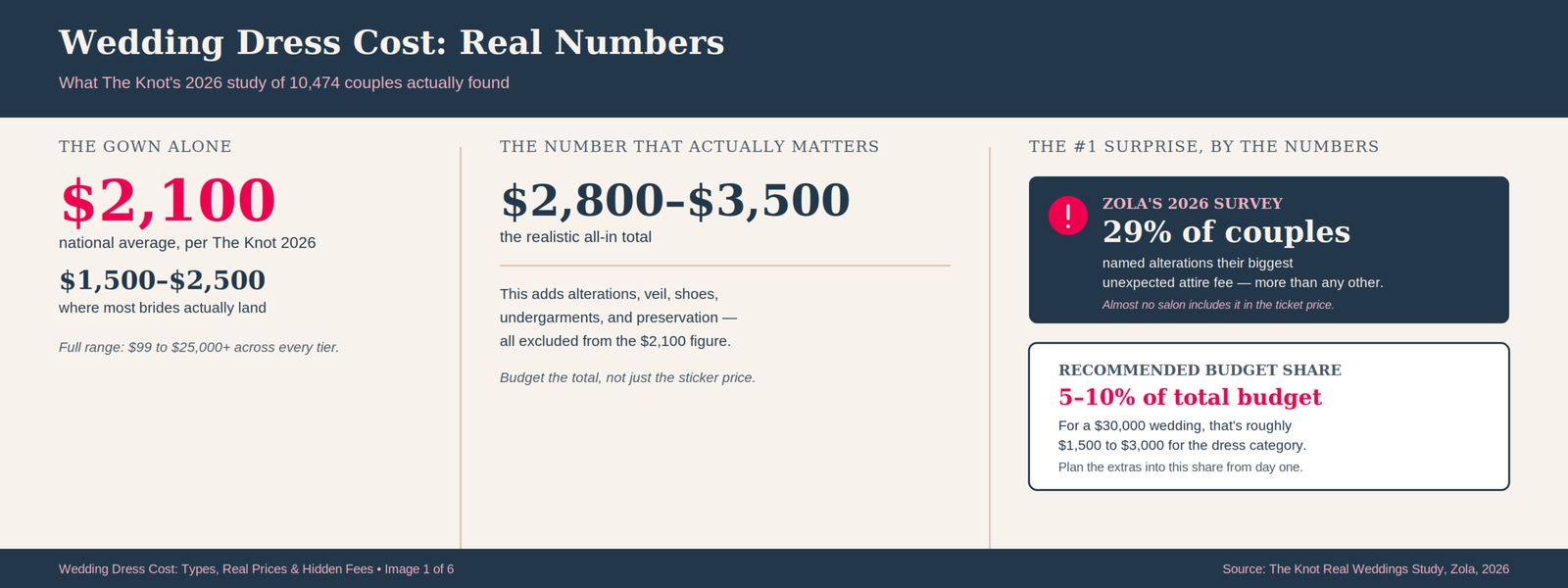
Infographic showing wedding dress cost real numbers for 2026: the average gown alone costs 2,100 dollars per The Knot’s study of 10,474 couples, the realistic all-in total runs 2,800 to 3,500 dollars, and 29 percent of couples named alterations their biggest unexpected attire fee.
Quick Answer: What a Wedding Dress Actually Costs
The average US wedding dress costs $2,100, according to The Knot’s 2026 Real Weddings Study of over 10,000 couples. Most brides spend $1,500 to $2,500. That figure covers the gown alone. Add alterations, a veil, shoes, undergarments, and preservation, and the realistic all-in total runs $2,800 to $3,500 for most brides.
The number that actually matters isn’t the sticker price. It’s the all-in total. Zola’s 2026 survey found that 29 percent of couples named alterations specifically as their biggest unexpected fee in the entire attire category, more than any other single line item.
Everything below unpacks the actual silhouette types worth knowing, real pricing at every tier, and the complete hidden-cost picture most bridal content leaves out entirely.
What Nobody Mentions Until It Happens
A few realities about wedding dress shopping rarely make it into the simple “here’s the average price” version most couples encounter first.
The advertised average excludes nearly everything that gets added later
The Knot’s $2,100 figure, cited across nearly every bridal publication, explicitly covers the gown only. Alterations, accessories, and preservation are consistently reported as separate, additional costs.
Alterations aren’t optional, and almost no salon includes them in the ticket price
Nearly every gown needs some fitting work, regardless of price point. This is standard, expected industry practice, not a sign anything went wrong.
A rush fee can appear even if you thought you ordered with plenty of time
Rush charges commonly start when you’re within a five-month window of your wedding date. Almost no salon volunteers this timeline upfront unless you ask directly.
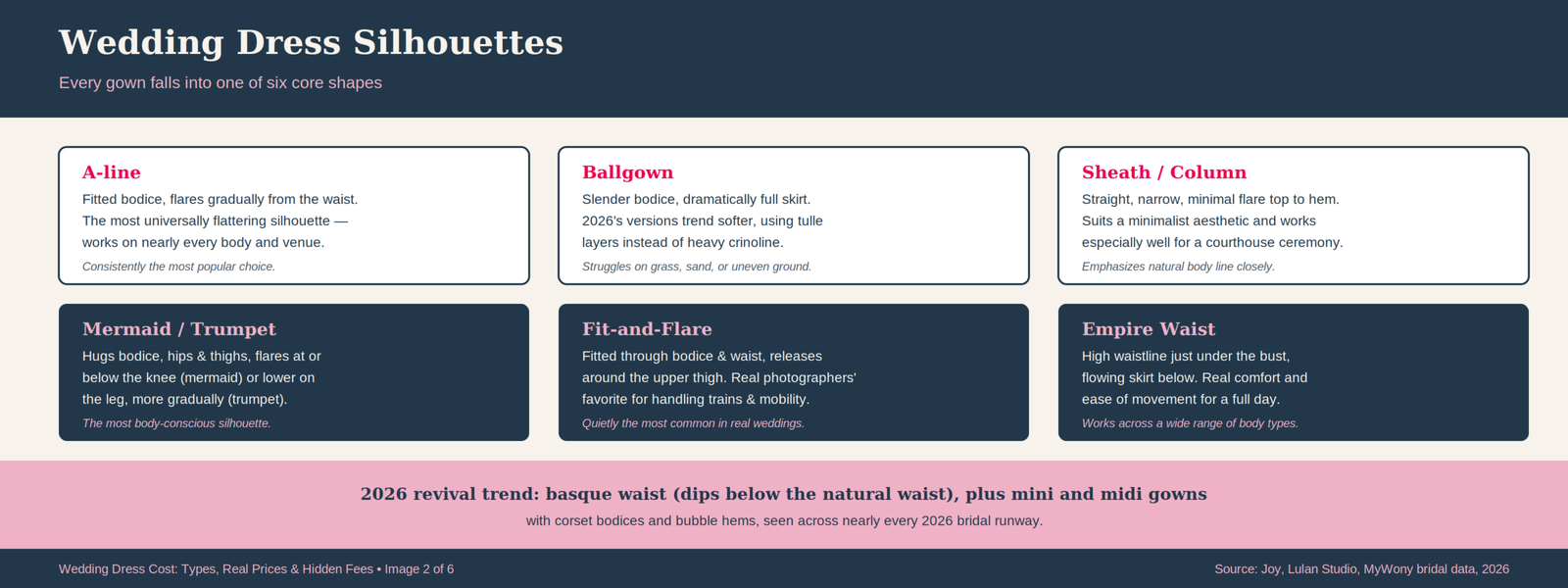
Infographic explaining six wedding dress silhouettes — A-line, ballgown, sheath or column, mermaid and trumpet, fit-and-flare, and empire waist — each with a brief description and a practical note on comfort or venue fit.
Wedding Dress Types and Silhouettes
Every wedding dress, regardless of price or designer, falls into one of a handful of core silhouettes. Understanding these genuinely helps you communicate what you want and understand what you’re trying on.
A-line
A fitted bodice that flares gradually from the waist, creating a shape resembling the letter A. This is consistently the most popular silhouette, largely because it’s the most universally flattering across body types, venues, and fabrics.
Ballgown
This silhouette pairs a slender, fitted bodice with a dramatically full skirt. 2026’s ballgowns trend softer than the heavily boned, crinoline-structured versions common in past decades, using layered tulle or silk instead. Ballgowns create real visual drama, though they genuinely don’t travel well and struggle on grass, sand, or uneven terrain.
Sheath or column
This silhouette is straight and narrow, falling from shoulder to hem with minimal flare. It suits a minimalist aesthetic and works particularly well for a city hall or courthouse ceremony.
Mermaid and trumpet
The most body-conscious silhouettes. A mermaid gown hugs the body through the bodice, hips, and thighs before flaring dramatically at or below the knee. Trumpet gowns follow a similar logic with a less dramatic, lower flare point.
Fit-and-flare
A genuine middle ground between mermaid and A-line: fitted through the bodice and waist, releasing around the upper thigh. Wedding photographers who shoot real weddings, not styled editorials, consistently note this as one of the most practical silhouettes, since it handles a long train gracefully and still allows genuine mobility for dancing, sitting, and navigating a real venue.
Empire waist
This silhouette sits high, just under the bust, with a flowing skirt below. It offers real comfort and ease of movement, and works well across a wide range of body types and pregnancy considerations.
2026-specific trends worth knowing
A basque waist, dipping into a V below the natural waistline before flaring, is experiencing a genuine revival this year, drawing on 1920s and 1990s silhouettes. Mini and midi-length gowns, often paired with a corset bodice and bubble hem, appeared across nearly every 2026 bridal runway, reflecting a broader shift toward shorter, more modern silhouettes for at least part of a couple’s wedding day.
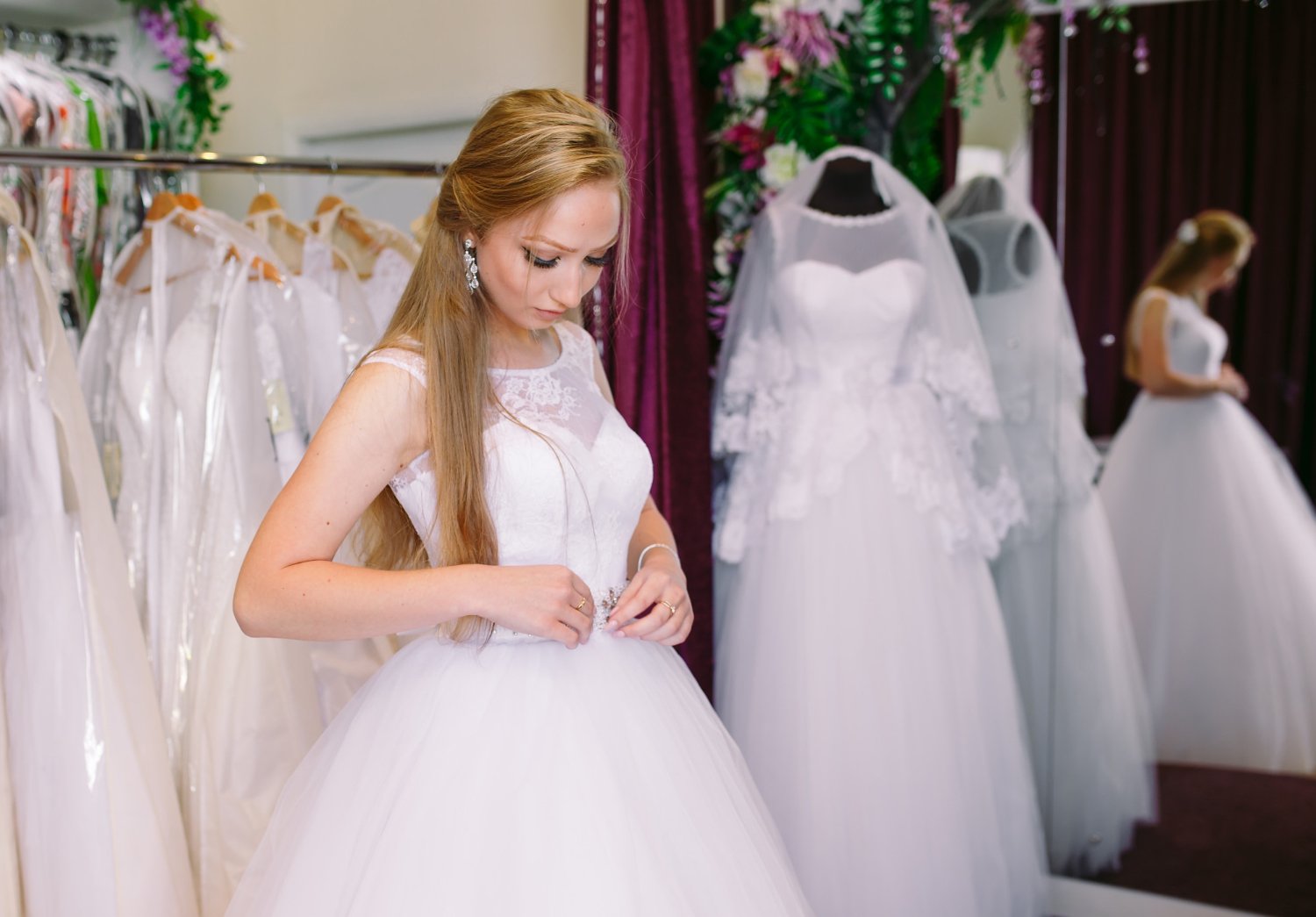
Choosing a Silhouette
Choosing a Silhouette for Your Venue and Your Actual Day
Beyond personal preference, your specific venue and how you’ll actually spend your day deserve real weight in this decision.
Outdoor and garden venues
Lighter fabrics, chiffon and organza specifically, handle an outdoor setting better than heavy satin. Nearly any silhouette works here, though a fit-and-flare or A-line genuinely moves easier across grass than a fully structured ballgown.
Destination weddings
Your venue dictates more than aesthetic preference alone. Humidity, terrain, and travel logistics all affect a real choice. Wrinkle-resistant fabrics like crepe and chiffon survive checked luggage considerably better than delicate silks, and a detachable train offers genuine flexibility between a formal ceremony and a more practical reception.
City hall and courthouse ceremonies
A minimalist sheath or tea-length dress suits this setting’s genuinely more understated formality better than a dramatic ballgown built for a large reception space.
How much you’ll actually move throughout the day
A ten-hour wedding day involves considerably more physical activity than a boutique fitting room reveals. Consider dancing, sitting through a long dinner, and simply walking comfortably when choosing between a highly structured silhouette and one built for genuine ease of movement.
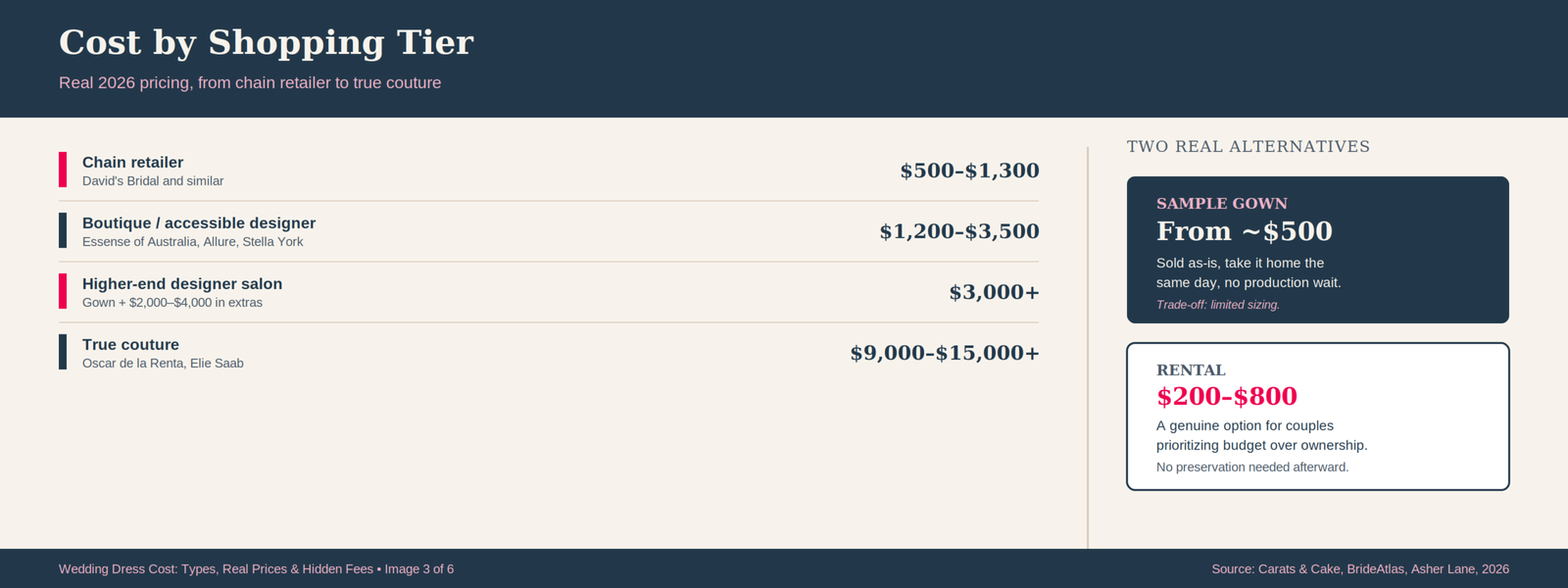
Infographic comparing wedding dress prices by shopping tier: chain retailers at 500 to 1,300 dollars, boutique designer labels at 1,200 to 3,500 dollars, higher-end designer salons at 3,000 dollars and up, true couture at 9,000 dollars and up, plus sample gowns and rental as budget alternatives.
Real Wedding Dress Costs in 2026
National averages tell only part of the story. Understanding pricing by actual shopping tier helps you set realistic expectations before your first appointment.
The national picture
| Metric | Figure |
|---|---|
| National average (dress only) | $2,100 |
| Where most brides land | $1,500–$2,500 |
| Full price range, low to high | $99–$25,000+ |
| Realistic all-in total | $2,800–$3,500 |
| Recommended share of wedding budget | 5–10% |
Pricing by shopping tier
Large chain retailers like David’s Bridal commonly price gowns between $500 and $1,300. Independent boutiques carrying accessible designer labels, Essense of Australia, Allure Bridals, and Stella York among the most commonly cited, typically run $1,200 to $3,500. Higher-end designer salons, including appointment-only spaces like Kleinfeld Bridal, push alterations, veil, and accessories $2,000 to $4,000 above the gown price itself. True couture, from designers like Oscar de la Renta or Elie Saab, starts around $9,000 and climbs past $15,000.
Sample dresses and off-the-rack options
Sample gowns, sold as-is directly from the sales floor, commonly start around $500 and let you take the dress home the same day, skipping both the standard production wait and a meaningful portion of the cost.
Rental as a genuine alternative
Wedding dress rental typically runs $200 to $800, a real option for couples specifically prioritizing budget over long-term ownership or preservation.
Regional variation is genuinely significant
Midwest averages run surprisingly high, around $2,500, skewed upward by major metro markets like Chicago, while smaller Midwest cities often carry the same designer labels at lower prices. Mid-Atlantic pricing commonly starts at $2,200 and climbs from there, with coastal markets like New York and Los Angeles consistently pricier than the national baseline.
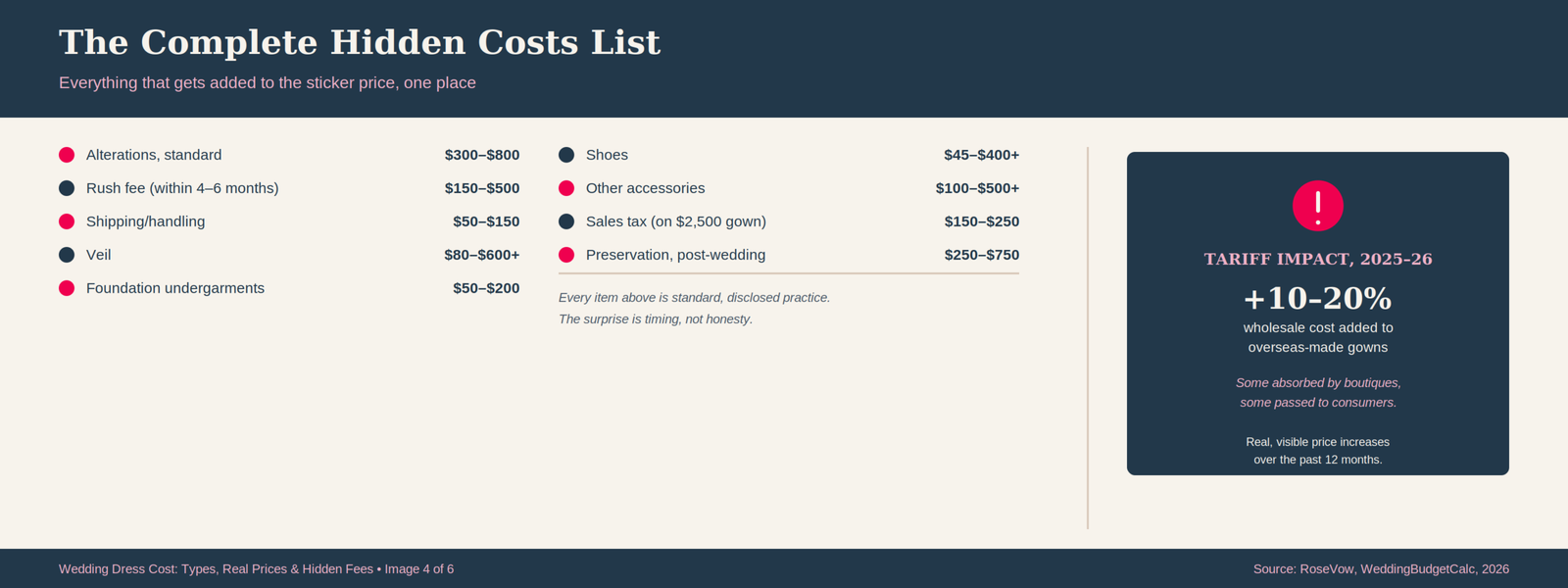
Infographic listing nine hidden wedding dress costs — alterations, rush fees, shipping, veil, undergarments, shoes, accessories, sales tax, and preservation — with 2026 price ranges, plus the 10 to 20 percent tariff-driven wholesale price increase on overseas-made gowns.
Hidden Costs to Check
These are the specific line items most likely to be missing from the number you first saw quoted, whether from a magazine, a website, or a salon’s opening price.
The complete additional-cost picture, 2026
| Item | Typical cost |
|---|---|
| Alterations, standard package | $300–$800 |
| Alterations, complex beading/lace | up to $1,200 |
| Rush fee (ordering within 4–6 months) | $150–$500 |
| Shipping/handling from manufacturer | $50–$150 |
| Veil | $80–$600 (cathedral/custom: $800–$1,000+) |
| Foundation undergarments | $50–$200 |
| Shoes | $45–$400 (designer: $1,000+) |
| Other accessories (belt, hairpiece, jewelry) | $100–$500+ |
| Sales tax (on a $2,500 gown) | $150–$250 |
| Post-wedding cleaning and preservation | $250–$750 |
Why this list catches so many brides off guard
Every individual item on this list is genuinely standard, disclosed practice somewhere in the process. The problem is timing. Salons quote the gown price upfront and introduce additional costs gradually, as you move through fittings and finalize details, rather than presenting one complete number at your very first appointment.
The single biggest surprise, according to real survey data
Zola’s 2026 survey specifically found that 29 percent of couples named alterations as their most unexpected attire-related fee, ahead of every other single item on this list. This isn’t because alterations are secretly expensive. It’s because almost no salon includes them in the advertised gown price, and few brides ask directly before their first fitting.
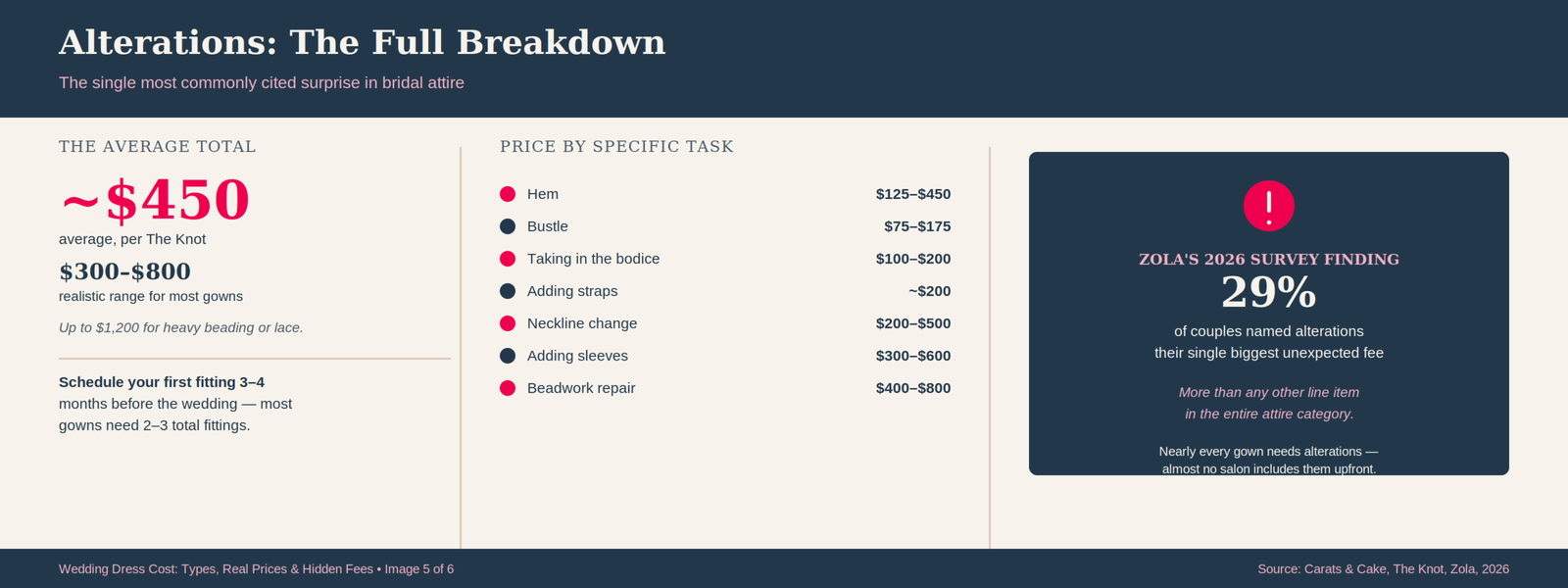
Infographic breaking down wedding dress alteration costs by specific task — hem, bustle, bodice, straps, neckline change, sleeves, and beadwork repair — highlighting that 29 percent of couples named alterations their biggest unexpected attire fee in Zola’s 2026 survey.
Alterations: A Complete Breakdown
This deserves genuine, itemized detail, since it’s consistently the largest and most variable additional cost in the entire process.
Specific alteration costs by task
| Task | Typical cost |
|---|---|
| Hem | $125–$450 |
| Bustle | $75–$175 |
| Taking in the bodice | $100–$200 |
| Adding straps to a strapless gown | ~$200 |
| Neckline change | $200–$500 |
| Adding sleeves | $300–$600 |
| Beadwork repair | $400–$800 |
The average total, and what drives it up
The Knot reports an average alteration cost around $450, though a realistic range for most gowns runs $300 to $800. Heavily beaded or intricately laced designs push this toward $1,200, since delicate embellishment genuinely requires slower, more specialized handwork than a simple hem.
Timing matters more than most brides expect
Schedule your first fitting 3 to 4 months before your wedding, earlier during peak wedding season when seamstresses book up faster. Most gowns need 2 to 3 separate fittings to reach a genuinely correct fit, not one single appointment.
Why rush fees exist, and how to actually avoid them
Rush charges commonly apply once you’re within a five-month window of your date, though the exact threshold and amount vary by designer and salon. Confirm this specific timeline directly when you order, rather than discovering it only once your own schedule has already narrowed.
Before You Buy: Concrete Steps
A handful of steps before you sign anything protect you from most of the surprises covered throughout this guide.
Set your all-in budget, not just your dress budget
Decide on a total figure covering the gown, alterations, and accessories together, then work backward to figure out how much of that total the dress itself can reasonably claim.
Ask about every additional fee at your very first appointment
Get specific numbers for alterations, rush fees, and shipping before you fall in love with a specific gown, not after you’ve already committed emotionally.
Confirm your actual order-to-delivery timeline directly
Ask exactly how many months production takes for your specific dress, then compare that against your wedding date to see whether you’re genuinely inside or outside the rush-fee window.
Bring someone who can help you think clearly, not just react emotionally
A trusted friend or family member who can ask practical questions alongside you genuinely helps balance the emotional intensity of the appointment itself.
Questions Worth Asking Your Bridal Salon
These specific questions can feel oddly transactional during an emotional appointment, and they’re worth asking anyway.
“What’s your specific rush fee threshold and amount?”
Get an exact number of months and an exact dollar figure, not a vague “it depends” answer.
“What does a standard alterations package actually include?”
Confirm whether hem, bustle, and basic bodice work are bundled together or priced separately, since this genuinely affects your real total.
“Do you offer in-house alterations, or do you refer out?”
Both are legitimate, though an in-house seamstress often means more direct communication and accountability than an external referral.
“What’s your policy if the gown arrives damaged or significantly different from the sample?”
Confirm this specific policy in writing before you pay a deposit, not after a problem has already occurred.
“Is my deposit refundable under any circumstances?”
Most bridal deposits are genuinely non-refundable once production begins. Confirm this directly so you understand exactly what you’re committing to.
Green, Yellow, and Red Flags
Not every uncomfortable moment in this process signals a genuine problem. Here’s how to tell the difference.
Green flags
- Clear, itemized pricing for alterations and add-ons before you order
- A specific, written rush-fee policy with exact thresholds
- A salon willing to answer every question in this guide directly and specifically
- Genuine, verifiable reviews describing real fitting and delivery experiences
Yellow flags: normal industry practice, worth a direct conversation
- A required deposit at order, standard practice, confirm the exact percentage and refund policy
- Alterations priced separately from the gown, universal industry practice, get the specific numbers
- A multi-month production timeline, genuinely standard for made-to-order gowns, confirm your specific date works
Red flags worth taking seriously
- Pressure to order immediately without time to think or compare
- No written confirmation of your specific order, size, and price
- Vague or evasive answers about rush fees and alteration costs
- A price significantly below every other quote for an identical designer gown
What the Sales Contract May Not Make Obvious
Even a detailed-sounding contract can leave real gaps worth checking directly before you sign.
Deposit structure is often more significant than it first appears
Most authorized bridal salons require a 50 to 60 percent non-refundable deposit at the time of order, with the remaining balance due at delivery. Confirm this exact structure, since it means a genuine change of heart after ordering carries real financial consequences.
Confirm exactly which designer and style number you’re ordering
Get the specific style number, size, and color in writing, matching precisely what you tried on, protecting you if a genuine discrepancy arises later in the process.
Ask what happens if your wedding date changes
A postponement or date change can affect your rush-fee status or delivery timeline in ways worth understanding before you need to navigate them under real time pressure.
Confirm the salon’s specific policy on sample damage or defects
If you’re purchasing a sample gown, understand directly what condition it’s sold in and whether any existing damage is disclosed upfront rather than discovered later.
Preservation and Post-Wedding Care
What happens to your dress after the wedding deserves genuine, informed planning, not a decision made in the exhausted days immediately following your event.
Why professional preservation matters, and why timing matters too
Stains from champagne, dirt, and perspiration set into fabric over time, becoming genuinely harder and more expensive to remove the longer they sit. Acting within a few weeks of your wedding meaningfully improves your preservation outcome.
Real 2026 preservation pricing
| Service | Typical cost |
|---|---|
| Dry cleaning alone | $170–$300 |
| Standard preservation package | $250–$600 |
| High-end boutique preservation | $600–$1,000+ |
| Mail-in preservation kit | $200–$560 |
| Rush processing (optional) | Varies by provider |
A genuinely useful insight: your local dry cleaner probably isn’t doing the work themselves
An estimated 99 percent of local dry cleaners outsource wedding dress preservation to the same national specialty facilities that mail-in services use directly. You’re commonly paying a 200 to 300 percent markup for the convenience of a local drop-off, worth knowing before you assume “local” automatically means a better or more personal outcome.
What factors genuinely drive preservation cost up or down
Fabric type, construction complexity, and the amount of material all affect pricing directly. A simple tea-length dress costs meaningfully less to preserve than a cathedral-length ballgown with multiple tulle layers, since more fabric requires more cleaning solution, more acid-free tissue, and a larger storage box.
Insurance and add-ons worth understanding
Many preservation services include baseline coverage, with additional insurance available for higher-value gowns, sometimes covering up to $6,000. Some providers also offer personalization, custom text or a photo on the preservation box, for a modest additional fee, along with complimentary preservation of a few small accessories like your veil or garter.
Whether preservation is genuinely worth it
This is a personal decision. If you hope to pass your dress down, sell it later, or simply keep it in excellent condition long-term, professional preservation is a genuinely worthwhile investment. If you’re not attached to long-term keepsake condition, a standard cleaning alone may be sufficient.
Veils, Shoes, and Accessories: The Category That Adds Up Fastest
Individually, each accessory feels like a small decision. Together, they genuinely represent a significant, easy-to-underestimate portion of your total bridal attire spend.
Veils
Standard veils commonly run $80 to $600, with cathedral-length or fully custom designs reaching $800 to $1,000 or more. Designer veils can genuinely cost more than an entire budget-tier gown; some designer options price between $445 and $500 alone.
Shoes
This category carries the widest range of any bridal accessory. Budget options start around $45, while designer bridal shoes can exceed $2,000. Most brides land in a $200 to $400 mid-range, though comfort and how many hours you’ll actually stand and dance in them matters more than price alone.
Foundation undergarments
Proper shapewear, a bra, and any structural undergarments your specific gown requires typically add $50 to $200, though this is genuinely one of the most overlooked line items until a fitting reveals you need something specific the dress itself doesn’t include.
Jewelry, hairpieces, and other small accessories
These commonly add another $100 to $300 or more combined. This is also a genuine category where borrowing, renting, or choosing vintage pieces can produce real savings without visually compromising your overall look.
A realistic total accessory budget
Budgeting $500 to $1,500 total for veil, shoes, undergarments, and remaining accessories combined is realistic for most brides, worth setting aside deliberately rather than adding items impulsively as they catch your eye during the shopping process.
The 2025–2026 Tariff Impact on Wedding Dress Pricing
This is genuinely current, worth understanding directly rather than assuming today’s prices simply reflect historical patterns.
What actually changed
Trade policy changes across 2025 and 2026 added an estimated 10 to 20 percent to the wholesale cost of gowns manufactured overseas, which represents the majority of mid-range bridal production specifically. This has translated into visible retail price increases over roughly the past 12 months.
Who’s absorbing the increase, and who isn’t
Some boutiques are genuinely absorbing part of this cost themselves to remain competitive. Some of it is being passed directly to consumers through higher retail pricing. Expect real variation in how different salons and designers have responded.
What this means for your own shopping timeline
If you’re genuinely early in your planning process, understand that gown pricing has shifted meaningfully over the past year, worth factoring into your budget rather than anchoring on an older price you might remember from a previous wedding or a friend’s experience.
Sample Sales, Secondhand, and Rental: Real Alternatives Worth Knowing
Buying new, at full price, directly from a boutique isn’t the only legitimate path to a wedding dress.
Sample sales
These events sell floor samples and discontinued styles at meaningfully reduced prices, often 40 to 70 percent off original retail. The trade-off is limited sizing, since you’re buying the actual sample rather than ordering your specific size.
Secondhand and pre-owned gowns
Online marketplaces and consignment shops offer previously worn or never-worn gowns at real savings. Verify authenticity directly, covered in detail in this guide’s scam section, before committing to a secondhand purchase.
Rental services
Wedding dress rental, typically $200 to $800, offers a genuine, complete alternative for couples prioritizing budget or specifically uninterested in long-term ownership and preservation.
Weighing these alternatives honestly
Each option involves real trade-offs: sample sales limit sizing, secondhand requires genuine verification diligence, and rental means no long-term keepsake. None of these are lesser choices, simply different priorities worth matching honestly to your own actual preferences.
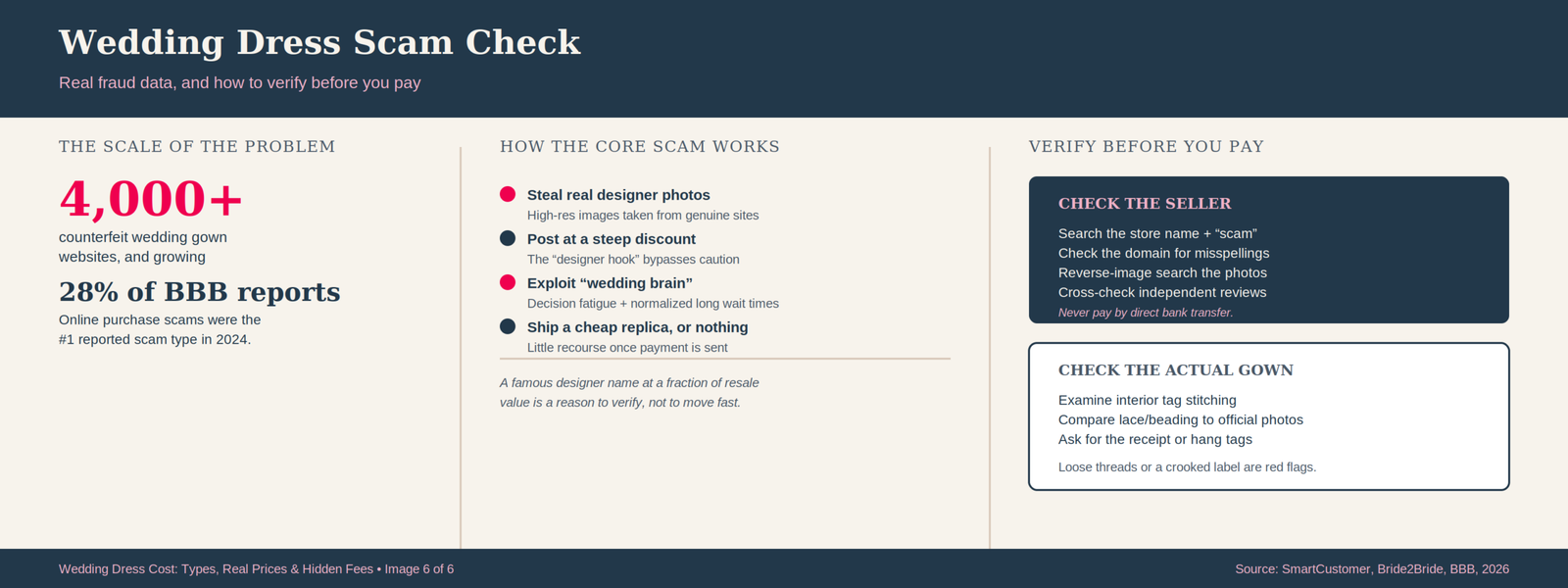
Infographic on wedding dress fraud showing over 4,000 counterfeit gown websites exist, online purchase scams were the top reported BBB scam type in 2024, how the photo-theft scam works, and specific steps to verify a seller and gown before paying.
Scam Check
Wedding dress shopping specifically attracts fraud, and understanding the actual pattern genuinely helps you shop safely, especially online.
The scale of this problem is genuinely significant
An estimated 4,000-plus counterfeit wedding gown websites exist, with the number growing continuously. Online purchase scams were the single most frequently reported scam type to the Better Business Bureau in 2024, accounting for more than a quarter of all reports.
How the core scam actually works
Scammers steal genuine, high-resolution marketing photos directly from real designer websites, including brands like Essense of Australia and Allure Bridals, then post them on fraudulent sites at steep discounts. The dress that actually arrives is commonly a cheap replica, significantly delayed, or never arrives at all.
Why this specific scam works so effectively
It combines genuine emotional urgency, an appealingly low price, real stolen imagery, and payment methods offering little consumer recourse. Scammers also specifically exploit “wedding brain,” the decision fatigue and high-stakes pressure that comes with major event planning, along with the normalized expectation that bridal gowns already take a long time to produce and ship.
The “designer hook” specifically
Listing a recognizable name like Vera Wang or Maggie Sottero at a fraction of typical resale value creates urgency that genuinely bypasses a buyer’s usual logical filters. Treat an unusually low price on a well-known designer name as a direct reason to verify carefully, not a reason to move quickly before the deal disappears.
How to verify a seller directly before you pay
Search the store’s exact name alongside the word “scam” or “reviews” before purchasing. Check the domain carefully for misspellings or unusual endings. Reverse-image search the product photos to see where else they appear online. Cross-check reviews on genuinely independent sites, not just testimonials posted on the seller’s own page.
Verifying an actual gown once it’s in front of you
Examine interior tag stitching closely. Legitimate high-end designers use clean, consistent stitching, while loose threads or a crooked label are genuine red flags. Compare the seller’s actual photos against official designer stock images, checking specifically for discrepancies in lace pattern or beadwork placement.
Documentation worth requesting
Ask for the original boutique receipt or the designer’s actual hang tags. A missing certificate of authenticity alone isn’t definitive proof of fraud, though it’s worth asking about directly as part of your overall verification process.
Payment protection matters as much as verification
Always pay using a method offering genuine buyer protection, never a direct bank transfer, and be especially cautious with any social-media-only boutique. Check the account’s actual age, look for genuine engagement, and look specifically for photos tagged by real, verifiable buyers rather than only polished product shots.
Legal and Consumer Protection Basics
General consumer protection principles apply to wedding dress purchases, though specifics vary by state and retailer.
A written contract is your actual, enforceable agreement
Verbal promises about delivery timing, alterations, or refund policy don’t protect you the way a written, signed confirmation does. Get everything genuinely significant in writing before you pay.
Understand your actual recourse if a gown arrives significantly different from ordered
Confirm your specific salon’s policy directly before you need it, and keep documentation of your original order, including style number, size, and price.
Report a genuine fraud concern through the right channel
If you encounter counterfeit goods or a fraudulent seller, the Federal Trade Commission’s consumer resource center provides guidance on reporting and understanding your protections.
Credit card payment offers real, additional protection
When possible, pay with a credit card rather than debit or bank transfer. Your card issuer’s dispute process offers genuine protection that other payment methods simply don’t provide if something goes wrong.
What Pinterest and Styled Content Don’t Show You
A beautifully lit bridal portrait captures one polished moment, not the actual process or cost behind it.
Styled photos never show the alteration appointments
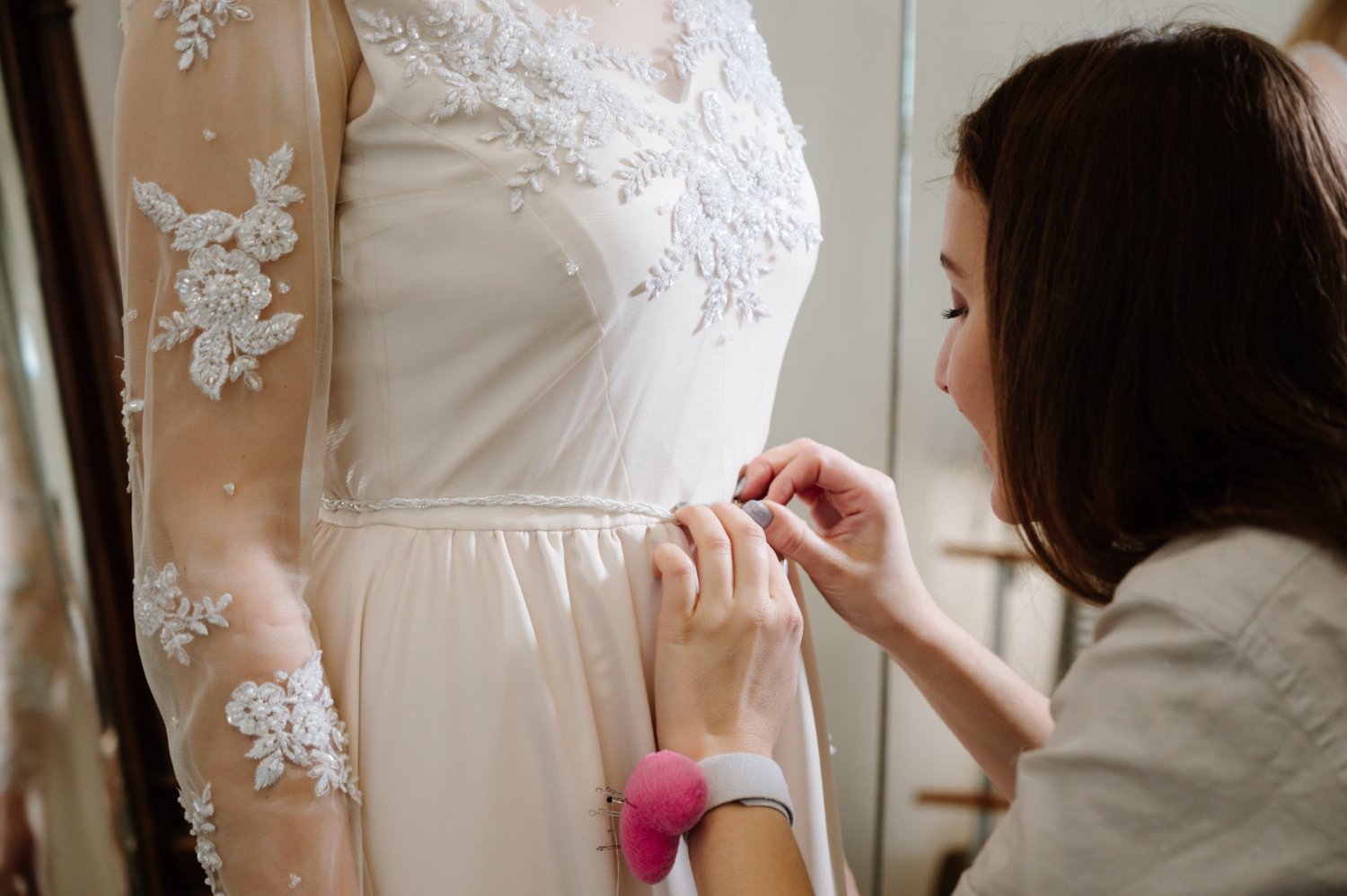
The two or three fittings, the pinning, the standing for an hour while a seamstress marks a hem, none of this appears in a single stunning photo, though it’s genuinely where much of your actual budget and time goes.
Influencer content rarely discusses real pricing
A stunning gown reveal almost never mentions the specific designer’s actual price, the alterations required, or whether the piece was gifted for promotional purposes rather than purchased at genuine retail cost.
A beautiful dress in a photo says nothing about comfort or practicality
Visual drama and genuine wearability across a full wedding day are separate considerations. A dress that photographs beautifully standing still may feel genuinely different after six hours of actual wear.
A Second Dress for the Reception
Some brides choose a second, more practical outfit for dancing and later hours, worth its own brief consideration.
Why couples choose this approach
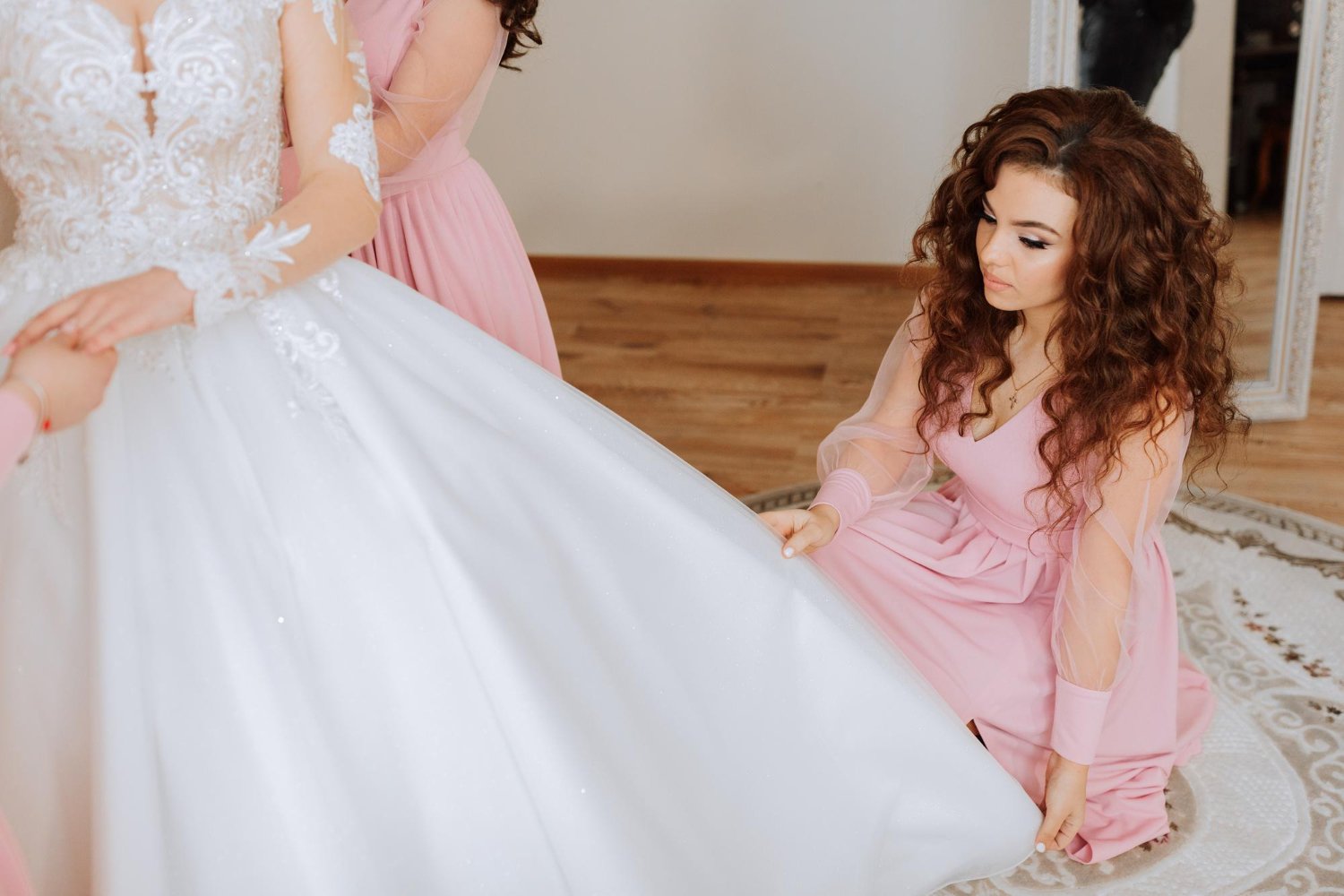
A structured ceremony gown, genuinely beautiful for photos and formal moments, can feel restrictive for hours of dancing. A lighter second look, often a slip dress or simplified silhouette, offers real comfort for the reception’s more active portion.
The real cost trade-off
This adds a genuine second expense, though many brides find a considerably simpler, less expensive second piece, since it doesn’t need to carry the same formal weight as the ceremony gown itself.
Practical timing for a dress change
Plan a specific window, commonly between dinner and dancing, and confirm someone is genuinely available to help you change efficiently without disrupting your reception’s flow.
Accessibility Considerations
A few specific considerations deserve direct attention for genuinely accessible dress shopping and wear.
Mobility and ease of movement
If you use a mobility aid or have specific movement needs, discuss this directly and early with your stylist, since certain silhouettes and fabric weights genuinely accommodate different needs better than others.
Fitting room accessibility
Confirm your specific boutique’s fitting room accessibility directly before booking an appointment, rather than discovering a genuine barrier once you arrive.
Adaptive design options
Some designers and boutiques now offer genuinely adaptive design features, front closures or modified construction, worth asking about directly if this matters to your specific needs.
A Realistic Scenario: How the Story at the Start of This Guide Could Have Gone Differently
Return to the bride from the opening of this guide, whose $1,950 dress became a genuine $3,380 total.
What asking directly at her first appointment would have changed
Confirming the specific rush-fee threshold, standard alterations package cost, and shipping timeline upfront would have given her an accurate all-in number from day one, rather than discovering each additional cost separately over several months.
What budgeting for the full picture from the start would have changed
Setting her original budget at a realistic $3,000 to $3,500 all-in figure, rather than the $2,100 average alone, would have meant zero genuine surprises throughout the process.
This doesn’t mean her salon acted in bad faith
Every fee was standard, disclosed practice. The actual gap was a missing set of upfront questions, exactly the pattern this guide has addressed throughout.
Three Real Wedding Dress Cost Scenarios
Numbers in the abstract are harder to apply than a concrete example. Here are three genuinely realistic scenarios at different budget levels.
Scenario one: $1,850 all-in, budget-conscious
A bride chooses a sample gown at $650, sold as-is from the sales floor. Alterations, since the sample needs only minor adjustment, run $250. A simple veil adds $120, shoes $80, and undergarments $60. No rush fee applies since the sample ships home the same day. Preservation, a standard mail-in kit, adds $250. Total: $1,410, genuinely below the national average for the gown alone.
Scenario two: $3,200 all-in, mid-range designer
A bride orders a new designer gown for $2,100, matching the national average exactly. Standard alterations, hem, bustle, and bodice work, cost $550. A mid-range veil runs $250, shoes $180, undergarments $90, and additional accessories $130. No rush fee, since she ordered ten months ahead. Preservation adds $400. Total: $3,700, reflecting the realistic all-in range covered throughout this guide.
Scenario three: $6,800 all-in, higher-end designer with time pressure
A bride falls in love with a $4,200 designer gown just five months before her wedding, triggering a $400 rush fee. Complex alterations for a heavily beaded bodice run $1,100. A cathedral veil adds $850, designer shoes $350, undergarments $150, and jewelry $200. Preservation, at a high-end boutique, costs $850. Total: $8,100, illustrating how timing and complexity compound quickly at a higher price point.
The gap between scenarios wasn’t just the gown price. Rush timing, alteration complexity, and accessory choices moved each total meaningfully, exactly the pattern this guide has emphasized throughout.
Your Wedding Dress Budget Checklist
- ☐ All-in budget set, covering gown, alterations, and accessories together: ____________
- ☐ Rush fee threshold and amount confirmed at first appointment: ____________
- ☐ Standard alterations package cost confirmed in writing: ____________
- ☐ Order-to-delivery timeline confirmed against actual wedding date: ____________
- ☐ Deposit refund policy understood and confirmed in writing: ____________
- ☐ Veil, shoes, and undergarments budgeted as a separate category: ____________
- ☐ Seller verified directly if shopping online or secondhand: ____________
- ☐ Preservation plan decided, with realistic post-wedding cost budgeted: ____________
- ☐ First fitting scheduled 3–4 months before the wedding: ____________
Frequently Asked Questions
What is the real, all-in wedding dress cost most brides should budget?
Plan for $2,800 to $3,500 total, covering the gown, alterations, veil, shoes, undergarments, and preservation together, not just the $2,100 average gown price alone.
What’s the average cost of wedding dress alterations?
Around $450 on average, with a realistic range of $300 to $800 for most gowns, and up to $1,200 for heavily beaded or intricately laced designs.
What wedding dress silhouette is most popular right now?
A-line remains the most consistently popular silhouette, largely because it’s the most universally flattering across body types, venues, and fabric choices.
Is it cheaper to rent a wedding dress than to buy one?
Yes, significantly. Rental typically runs $200 to $800, compared to a national average purchase price of $2,100 for the gown alone.
How much does wedding dress preservation actually cost?
Standard preservation packages run $250 to $600, with high-end boutique services reaching $600 to $1,000 or more, depending on fabric complexity and storage method.
Why do local dry cleaners charge more for wedding dress preservation?
An estimated 99 percent of local dry cleaners outsource the actual work to the same national specialty facilities mail-in services use directly, adding a 200 to 300 percent markup for local convenience.
When does a rush fee actually apply?
Commonly once you’re within a five-month window of your wedding date, though the exact threshold and amount vary by designer and salon. Confirm this directly and specifically.
Are wedding dress scams actually a significant, current risk?
Yes. An estimated 4,000-plus counterfeit wedding gown websites exist, and online purchase scams were the most frequently reported scam type to the BBB in 2024.
What’s the real difference between a mermaid and a trumpet silhouette?
Both hug the body through the bodice and hips before flaring. A mermaid flares dramatically at or below the knee, while a trumpet gown flares more gradually, lower on the leg.
Should I buy a sample dress to save money?
This is a genuinely legitimate way to save, often significantly, though sample gowns are sold as-is in whatever size is on the floor, meaning alteration needs can vary considerably.
Fabric: The Quiet Driver Behind Most Price Differences
Two dresses with an identical silhouette can carry genuinely different price tags, and fabric is commonly the actual reason why.
Silk
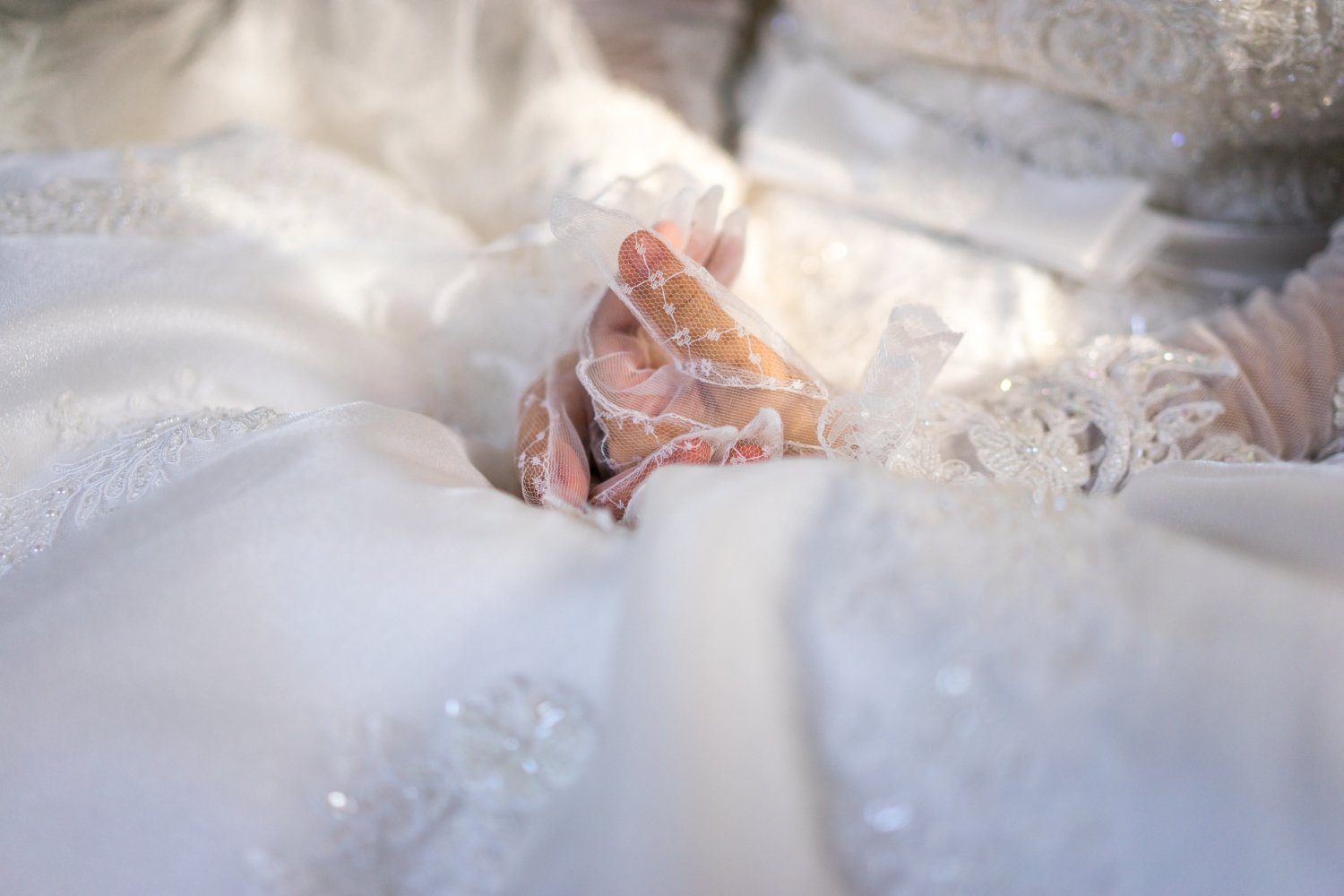
Genuine silk, whether mikado, charmeuse, or organza, commands real premium pricing due to both material cost and the skill required to work with it. Silk drapes and photographs beautifully, though it wrinkles more easily than synthetic alternatives.
Satin
A genuinely versatile, widely used bridal fabric available in both silk and synthetic versions. Synthetic satin offers a meaningfully more affordable structured look without sacrificing much visual impact.
Lace
Hand-applied lace, particularly intricate Chantilly or Alençon styles, adds substantial labor cost. Machine-made lace alternatives offer a similar visual effect at a considerably lower price point.
Chiffon and organza
Lightweight, flowing fabrics genuinely suited to outdoor and destination settings, generally more affordable than heavier silks while still offering real elegance and movement.
Crepe
A genuinely popular modern choice, offering a matte, structured drape without satin’s shine. Crepe also travels and wrinkles considerably better than many alternatives, a real practical advantage for a destination wedding.
Why understanding fabric helps you shop smarter
Knowing which fabric actually drives a specific gown’s price lets you request a similar silhouette in a more affordable material, often achieving a visually comparable result at meaningfully lower cost.
Communicating With Your Stylist: A Few Habits That Prevent Most Problems
Beyond the specific questions covered earlier, a few general habits genuinely reduce your risk of an unpleasant surprise.
State your actual budget clearly, not an aspirational one
A skilled stylist genuinely works better with your real number upfront, rather than discovering budget constraints only after you’ve fallen in love with something well outside range.
Ask for a complete, written quote before you commit
Get gown price, estimated alterations, and any known fees together in one document, rather than piecing the full picture together across multiple separate conversations.
Follow up in writing after verbal conversations
A brief email confirming what was discussed protects both you and the salon if a genuine misunderstanding arises later in the process.
A Few Wedding Dress Cost Myths Worth Dropping
“The advertised price is basically the final price”
Covered throughout this guide, the advertised gown price genuinely excludes alterations, accessories, and preservation in nearly every case.
“Cheaper always means lower quality”
A sample sale or off-the-rack gown can be genuinely excellent quality; price reflects retail markup and exclusivity as much as construction quality alone.
“Designer always means better”
A well-constructed non-designer gown can perform and photograph beautifully. Designer pricing reflects brand reputation and exclusivity, not automatically superior craftsmanship.
“Alterations are a sign something went wrong with sizing”
Nearly every gown, regardless of price or how well it initially fits, needs some alteration work. This is standard, expected practice, not a sizing failure.
A Glossary of Wedding Dress Terms
| Term | Plain-language meaning |
|---|---|
| Bustle | A method of pinning up a train for the reception |
| Sample gown | The actual floor display dress, sold as-is at a discount |
| Trunk show | A temporary event featuring a designer’s full current collection |
| Made-to-order | A gown produced specifically for you after you order, not pre-made |
| Preservation | Specialized cleaning and archival storage to prevent long-term yellowing |
Destination Wedding Dress Considerations
A destination wedding adds real, specific considerations beyond standard dress shopping, worth direct attention.
Packing and travel logistics
Wrinkle-resistant fabrics, crepe or a well-chosen synthetic blend, survive checked luggage considerably better than delicate silk. Consider carrying your gown on board if genuinely possible, rather than risking checked baggage handling.
Climate-appropriate fabric choices
Heavy ballgowns in tropical humidity create real discomfort. Lighter fabrics and simpler silhouettes genuinely suit warm-climate destinations better than a dress built for a cooler, indoor setting.
Local alteration and pressing resources
Confirm whether your destination venue or a local vendor can handle any last-minute pressing or minor adjustment, since your usual seamstress won’t be available on-site.
Second Marriages and Non-Traditional Wedding Attire
Every principle in this guide applies identically regardless of whether this is a first wedding, a second marriage, or any other personal circumstance.
No meaningful restriction applies to color or style choice
Older etiquette occasionally suggested different conventions for a second wedding. This has genuinely relaxed. Choose whatever silhouette, color, and formality level feels authentically right for your specific celebration.
Budget principles remain identical
The same all-in cost planning, alteration timeline, and scam awareness covered throughout this guide apply exactly the same way regardless of the specific occasion or your personal history.
Suits and non-traditional attire
A well-fitted suit carries its own real cost considerations, alterations, and timeline, worth researching with the same diligence this guide has applied to traditional gowns.
Shopping Day Logistics: What Actually Makes an Appointment Successful
A few practical preparation steps genuinely improve your actual shopping experience.
Wear the right foundation garments to your appointment
Bring nude, seamless undergarments and the approximate shoe height you plan to wear, since this genuinely affects how a gown actually looks and fits during your appointment.
Limit your guest list for the appointment itself
Too many opinions in the room can genuinely overwhelm the decision-making process. Bring a small, trusted group who will help you think clearly rather than add conflicting pressure.
Book appointments across multiple salons before deciding
Comparing real options, rather than committing at your very first appointment, genuinely helps you make a confident, informed final decision.
Ask about the salon’s specific price-match or return policy upfront
Confirm this directly before you fall in love with a specific gown, since asking after the fact carries genuinely less negotiating leverage.
A Direct Comparison: Vague Budgeting vs. All-In Budgeting
Here’s a concrete way to see why the all-in approach covered throughout this guide genuinely matters.
| Approach | Budgeted | Actual outcome |
|---|---|---|
| Vague (gown price only) | $2,100 | $3,000+ real total, discovered gradually |
| All-in (dress + every extra) | $3,200 | $3,200, no surprises |
Both couples spend roughly the same real money in the end. Only one of them actually planned for it.
More Direct Answers
Is it normal to spend more than the national average on a wedding dress?
Yes, genuinely common. The $2,100 average reflects a wide range of price points, and many brides land higher or lower depending on personal priorities and regional market.
What’s the biggest mistake couples make when budgeting for a wedding dress?
Budgeting only the gown price itself, rather than the realistic all-in total covered throughout this guide, alterations, accessories, and preservation included.
Can I negotiate the price of a wedding dress?
This varies by salon. Some offer price matching or seasonal promotions; ask directly rather than assuming the listed price is entirely fixed.
How early should I start wedding dress shopping?
Most bridal experts recommend 9 to 12 months before your wedding, giving genuine time for production, delivery, and the multiple alteration fittings covered throughout this guide.
Do plus-size brides pay more for wedding dresses?
Some designers do charge more for extended sizing, worth confirming directly, though many boutiques now offer genuinely comparable pricing across a full size range.
What should I do if I can’t decide between two dresses?
Take photos and notes from each appointment, sleep on the decision, and if possible, revisit your top choice a second time before committing to a genuinely significant purchase.
Is buying online without trying on ever a good idea?
This carries genuinely real risk, covered in this guide’s scam section, particularly for a first-time purchase from an unfamiliar seller. Verify the retailer thoroughly before committing.
How much should I tip my seamstress?
This isn’t universally required, though many brides offer $20 to $50 per fitting or a modest gift as a genuine thank-you for detailed, personal work.
Neckline and Sleeve Options Worth Knowing
Beyond silhouette, neckline and sleeve style genuinely shape both the look and the real cost of a gown.
Common neckline styles
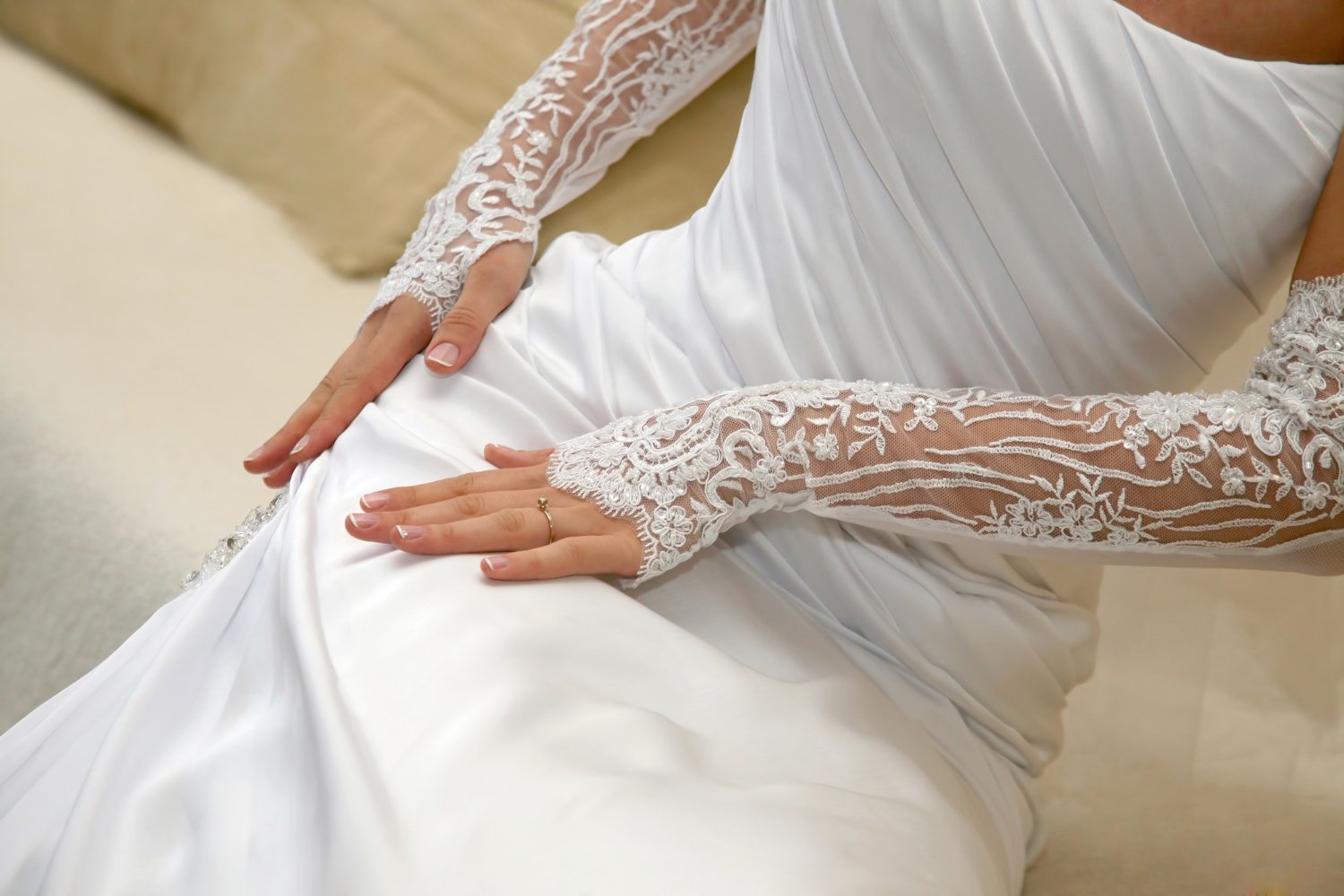
Sweetheart, illusion, high neck, off-shoulder, and strapless remain the most requested options. Illusion necklines, using sheer mesh to create the appearance of bare skin with subtle coverage, commonly add cost due to the additional handwork involved.
Sleeve options and their real cost impact
Long sleeves, particularly in lace, genuinely add both fabric and labor cost compared to a strapless or sleeveless design. Detachable sleeves offer real versatility, letting you shift from a covered ceremony look to a more open reception style without purchasing two separate garments.
Changing a neckline after purchase
Covered earlier in this guide’s alterations breakdown, a neckline change during fitting typically runs $200 to $500, worth factoring in if you’re purchasing a sample or secondhand gown that doesn’t perfectly match your original vision.
Color Options Beyond Traditional White
Modern wedding dress shopping increasingly includes real color options beyond the traditional white or ivory default.
Why this shift is happening
White as the default wedding color reflects a specifically Western tradition dating to the mid-1800s, not a universal or ancient requirement. Modern brides increasingly choose colors, blush, champagne, sage, and even bolder options, reflecting genuine personal preference over inherited convention.
Real cost implications of a colored gown
Color itself doesn’t reliably predict price. A colored gown from the same designer and fabric tier costs roughly the same as its white counterpart, though certain specialty dye processes can add modest additional cost.
Practical considerations for a colored gown
Confirm dye consistency across any separate pieces, a bodice and skirt ordered separately, for instance, since slight batch variation can genuinely occur with custom-dyed fabric.
Body Changes Between Ordering and Your Wedding Date
A genuinely common concern worth addressing directly, since it affects both alteration cost and timeline.
Why most gowns are ordered to your current measurements, not a goal size
Most stylists genuinely recommend ordering to your measurements at the time of purchase, since altering a gown smaller is considerably easier and less expensive than altering it larger.
What happens if your body changes meaningfully before the wedding
A significant change, in either direction, may require more extensive alteration work than originally anticipated. Communicate any meaningful change to your seamstress as early as possible, rather than waiting until a scheduled fitting reveals a genuine problem.
This is normal, not a source of shame
Bodies genuinely change for countless reasons throughout an engagement. A skilled seamstress has handled this exact situation many times before, and open communication early prevents both cost surprises and unnecessary stress later.
A Realistic Wedding Dress Timeline
| Timeframe | Task |
|---|---|
| 9–12 months before | Begin shopping; set all-in budget |
| 8–10 months before | Order gown; confirm rush-fee threshold |
| 3–4 months before | First alteration fitting |
| 2–3 months before | Second fitting; order accessories |
| 2–4 weeks before | Final fitting; confirm bustle |
| Within weeks after | Begin preservation process |
This timeline reflects genuinely realistic industry standards, though your specific designer and salon’s requirements always take priority over this general framework.
A Final Round of Direct Answers
What if my dream dress is genuinely outside my budget?
Ask your stylist directly about similar styles in a more affordable fabric, or whether a sample or trunk-show discount might apply to that exact gown.
Should we budget more for the dress or for alterations?
Budget realistically for both together, covered throughout this guide, rather than maximizing the gown price and hoping alterations stay minimal.
Is it worth buying travel insurance for a destination wedding gown?
This can genuinely offer real peace of mind, particularly for an expensive gown traveling internationally, worth researching directly if this applies to your situation.
What’s the single most important habit from this entire guide?
Ask every direct question covered throughout this guide at your very first appointment, before you’ve emotionally committed to a specific gown, so your budget reflects genuine reality from day one.
Where This Leaves You
Wedding dress cost comes down to a genuinely simple, correctable gap: the widely cited $2,100 average describes the gown alone, while the real, all-in total most brides actually spend runs $2,800 to $3,500 once alterations, accessories, and preservation are included. None of this is hidden in a deceptive sense. It’s simply disclosed gradually, across separate conversations, rather than presented as one complete number upfront.
The bride from the start of this guide didn’t need a smaller dream or a different dress. She needed one specific habit: asking every direct question in this guide at her very first appointment, before a single deposit changed hands.
Your next step
Before your next boutique appointment, write down your real all-in budget, covering the gown, alterations, and accessories together. Then ask directly about the specific rush-fee threshold and standard alterations package cost before you try on a single dress.
A Note on Trunk Shows and Designer Events
Many boutiques host temporary trunk shows featuring a specific designer’s full current collection, worth understanding as part of your real shopping strategy.
What a trunk show actually offers
Beyond a wider selection than the boutique’s standard inventory, trunk shows commonly include genuine incentives, a discount, complimentary accessories, or a designer representative available to answer detailed questions.
Real trade-offs worth knowing
Trunk show appointments book up quickly, and the promotional pricing typically applies only during that specific event window, creating genuine time pressure worth being aware of rather than caught off guard by.
Whether a trunk show is worth attending for your specific search
If you’re already interested in a specific designer, a trunk show can offer genuine value. If you’re still exploring broadly, the time pressure may work against a careful, unhurried decision process.
Working With a Wedding Planner on Dress Decisions
Some couples work with a professional planner, and a few dress-specific considerations apply.
What a planner can genuinely help coordinate
A planner can help coordinate your dress timeline against your overall wedding schedule, ensuring fittings don’t conflict with other significant planning deadlines.
A planner doesn’t replace your own direct research
Even with a trusted planner, ask the specific questions covered throughout this guide yourself, since a planner may not be present at every individual salon appointment.
A Note on Bridesmaid and Wedding Party Coordination
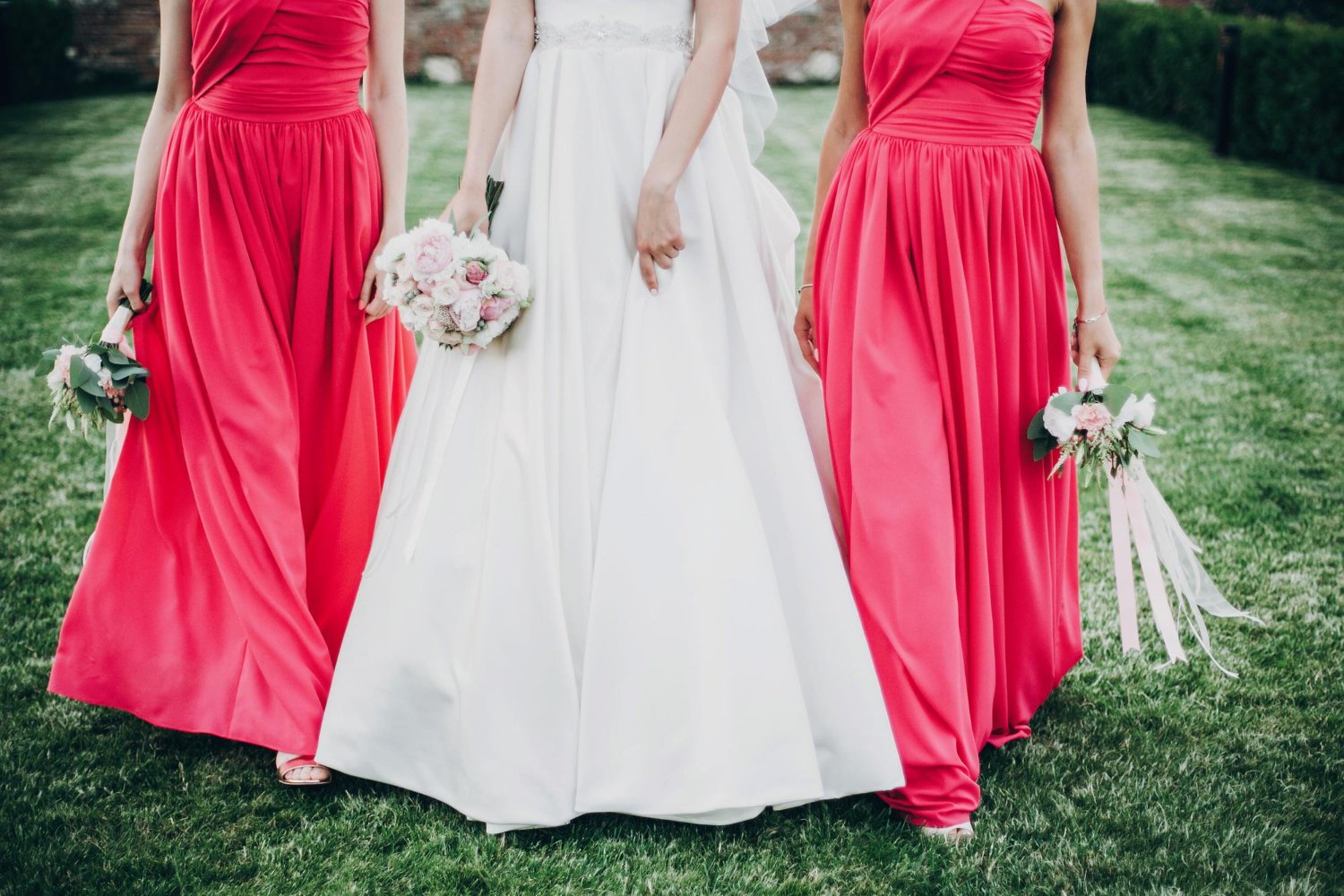
While this guide focuses primarily on the bride’s own gown, a brief note on coordinating with your wedding party is worth including.
Communicate your color palette early
If your wedding party’s attire needs to coordinate with your own gown’s color or formality level, share this information early enough for them to shop within a reasonable timeline.
Respect different budgets within your wedding party
Provide a genuine range of acceptable options at different price points, rather than requiring one specific expensive designer piece from everyone in your party.
A Note on Sustainable and Ethical Wedding Dress Shopping
Some couples specifically prioritize sustainability in their dress search, worth brief mention alongside the cost information covered throughout this guide.
Secondhand and vintage as a genuinely sustainable choice
Beyond the cost savings covered earlier, choosing a secondhand or vintage gown reduces the environmental impact of new garment production, a real consideration for environmentally-minded couples.
Rental as both a budget and sustainability choice
Rental services, covered earlier in this guide, offer a genuine dual benefit: lower cost and reduced environmental footprint compared to a single-use new purchase.
Asking about a designer’s actual manufacturing practices
Some designers now disclose genuine information about fabric sourcing and labor practices directly, worth asking about if this matters to your personal values.
A Note on Insurance for Your Wedding Dress
Given the genuinely significant investment covered throughout this guide, a few insurance considerations deserve direct mention.
What standard wedding insurance may cover
Some wedding insurance policies include coverage for gown damage, loss, or theft, worth confirming directly if you’re already purchasing broader event insurance.
Homeowners or renters policy riders
Depending on your gown’s value, a scheduled rider on your existing homeowners or renters policy may offer more targeted, affordable coverage than a standalone wedding policy.
Confirming coverage before, not after, an incident
Verify your specific coverage directly before your wedding day, rather than discovering a gap only after a genuine accident, spill, or damage has already occurred.
A Note on Weight and Fit Confidence
Beyond the practical alteration guidance covered earlier, a brief word on approaching this process with genuine self-compassion.
Every body genuinely deserves a beautiful, well-fitted gown
Regardless of size or how your body changes throughout your engagement, a skilled seamstress can create a genuinely excellent fit. This is standard, expected work, not a special accommodation.
Comfort matters as much as appearance
A gown that looks stunning but feels genuinely restrictive won’t serve you well across a full, long wedding day. Prioritize how a dress actually feels to move, sit, and dance in, not just how it looks standing still in a mirror.
A Closing Thought on Value Versus Price
Every number in this guide describes what a wedding dress commonly costs, at every tier and through every additional line item. None of it describes what the dress is actually worth to you personally. A gown that fits well, feels comfortable, and genuinely reflects your own taste is providing something beyond a price tag: confidence on a day that deserves it.
Approach your own dress search with the same combination this guide has modeled throughout: genuine excitement about finding the right gown, paired with the same direct, specific questions you’d bring to any other significant purchase. Both things can be true at once, and holding them together is what actually protects your budget, from your first appointment through your last fitting.
Wedding Dress Ethical Wedding Dress Shopping
A Final Word on Reading Every Quote Carefully
Every principle in this guide points toward the same underlying habit: read what you’re actually agreeing to, and ask direct, specific questions about anything unclear, before you pay a deposit.
A specific final check before you commit
Reread your written quote one more time before paying, confirming it matches everything discussed verbally, including the specific style number, size, price, and any known additional fees.
Keep copies of everything, digitally and on paper if possible
A photo of your order confirmation, receipt, and any written policy details protects you if a genuine question or dispute arises later in the process.
This diligence protects a good relationship with your salon, not just guards against a bad one
Clear documentation isn’t about assuming bad faith. It’s about giving both you and your stylist a shared, reliable reference point throughout a process involving real money and real timelines.
Final Thoughts on Building Your Own Plan
This guide has covered a genuinely large amount of ground: real silhouette types, actual 2026 pricing across every shopping tier, and the complete hidden-cost picture most bridal content leaves out entirely. You don’t need to apply every single section in order.
Pull whatever’s relevant to your specific search, skip what doesn’t apply, and return to any section as a reference whenever a new question comes up during your own shopping process. That’s genuinely what this guide is here for.
A Concluding Note on Confidence
A wedding dress is one of the more emotionally significant, financially real purchases in the entire planning process, and the gap between a confident search and a stressful one rarely comes down to the dress itself. It comes down to information: knowing the real all-in cost before your first appointment, knowing what questions to ask, and knowing the specific scam patterns worth genuine caution.
You now have that information laid out clearly, drawn from current 2026 industry data and documented pricing across every tier. Walk into your own search with it, confident rather than guessing, informed rather than surprised by a fee once you’ve already fallen in love with a specific gown.
A Note on Buying a Wedding Dress for a Vow Renewal or Second Ceremony
The same core principles apply identically if you’re shopping for a vow renewal or a second ceremony rather than a first wedding.
Every fee and timing consideration in this guide applies the same way
Regardless of the specific occasion, the same rush fees, alteration timelines, and preservation options covered throughout this guide apply exactly the same way.
Consider whether a full formal gown genuinely fits your specific celebration
Some couples celebrating a vow renewal choose a simpler, less formal dress, while others want the exact same formal experience as a first wedding. Both choices are completely legitimate.
A Brief Word on Multi-Day Wedding Weekend Attire
If your celebration spans multiple events, a few additional dress-related considerations apply.
Budgeting for more than one outfit
A rehearsal dinner, welcome party, or additional ceremony day may call for separate attire beyond your main wedding gown, worth budgeting as its own genuine category.
Coordinating alteration timing across multiple pieces
If you’re wearing several outfits across one wedding weekend, confirm your seamstress’s timeline accommodates fittings for all pieces, not just your primary gown.
A Practical Note on Comparing Multiple Salon Quotes
Once you have quotes from a few different salons, comparing them accurately takes more structure than comparing gown price alone.
Confirm each quote covers the same actual scope
One salon’s quote might include a complimentary first fitting or steaming; another’s might not. Confirm what’s actually included before comparing totals directly.
Weigh service quality alongside price
The least expensive quote isn’t automatically the best choice if that salon has a noticeably less experienced alteration team or a genuinely less attentive fitting process.
Confirm each salon’s specific cancellation and rescheduling policy
Ask directly what happens if you need to reschedule a fitting or, in a genuine emergency, adjust your wedding date entirely.
A Note on Hair and Veil Coordination
Your veil and hairstyle genuinely need to work together, worth planning as a coordinated decision rather than two separate ones.
Bring your veil to your hair trial
Testing your actual veil alongside your planned hairstyle, rather than imagining how they’ll work together, genuinely prevents a real mismatch discovered too late to fix easily.
Confirm attachment method directly
Combs, clips, and blusher-style attachments all work differently with different hairstyles. Confirm your specific veil’s attachment method suits your planned hair design.
A Short Word on Managing Dress-Related Stress
The sheer number of decisions and costs covered throughout this guide can feel genuinely overwhelming, worth a brief, reassuring closing note.
Most dress searches go smoothly
The overwhelming majority of brides find a gown they love, complete alterations without major incident, and feel genuinely confident on their wedding day. This guide exists for the gaps, not because dress shopping is inherently fraught.
Perfect knowledge isn’t the actual goal
Reasonable, informed preparation, asking direct questions, budgeting realistically, verifying sellers when shopping online, covers the vast majority of what genuinely matters. You don’t need to anticipate every possible scenario to have a genuinely successful experience.
Trust your own judgment alongside the information in this guide
You know your own body, budget, and priorities better than any general guide can. Use this information as a real foundation, then trust your own instincts on the details that make your specific choice authentically yours.
One Truly Final Practical Reminder
If you take away just one action item from this entire guide, make it this: before you pay any deposit at any salon, ask for a complete, written quote covering the gown price, estimated alterations, and any known additional fees together in one document. That single request, more than any other habit covered throughout this guide, is what actually turns a vague sticker price into the genuine, accurate number you can actually plan around.
A Note on Dress Storage Before the Wedding
Once your gown arrives, proper storage genuinely matters for the months between delivery and your actual wedding day.
Proper hanging and covering
Store your gown on a padded hanger, in a breathable garment bag, not plastic, which can trap moisture and genuinely contribute to yellowing over time.
Temperature and humidity considerations
A climate-controlled closet, away from direct sunlight and significant temperature swings, protects delicate fabric and embellishment considerably better than a garage or uninsulated storage space.
A final pre-wedding steam or press
Schedule this close to your actual date, not weeks in advance, since a gown stored even briefly can develop new wrinkles genuinely worth addressing right before you wear it.
A Note on International and Import Considerations
If you’re ordering a gown from an international designer or manufacturer, a few additional considerations apply.
Import duties and customs fees
Confirm directly whether your quoted price includes any import duties, since these can add real, unexpected cost if handled separately from your original purchase price.
Realistic international shipping timelines
International orders commonly need genuinely longer lead time than domestic ones. Confirm this specific timeline directly, and build in extra buffer beyond the standard domestic timeline covered earlier in this guide.
Return and exchange policies across borders
International returns can involve genuinely more complex logistics and cost than a domestic exchange. Understand this policy directly before ordering from an overseas retailer.
A Genuinely Final Word
This guide has walked through nearly every practical corner of wedding dress cost: the real silhouette types worth knowing, actual 2026 pricing at every tier, and the complete hidden-cost picture that catches so many brides off guard. Carry that knowledge into your own search with confidence, and let the dress itself be exactly the meaningful, well-understood purchase it’s meant to be, free of the budget surprises this guide was written to prevent.
A Quick-Reference Summary of Every Key Number in This Guide
| Fact | Number |
|---|---|
| National average, gown only | $2,100 |
| Realistic all-in total | $2,800–$3,500 |
| Average alterations cost | ~$450 |
| Couples citing alterations as the top surprise | 29% |
| Rush fee threshold | Within 4–6 months of wedding |
| Standard deposit at order | 50–60%, non-refundable |
| Estimated counterfeit gown websites | 4,000+ |
Keep this table as a genuine quick reference throughout your own dress search, returning to the full sections above whenever you need complete context behind any specific number.
Appendix: A Complete Question List for Your First Appointment
For brides just starting their search, here’s a consolidated set of questions drawn from every relevant section throughout this guide, worth bringing to your very first boutique visit.
On pricing and timeline
What’s the total price including any known fees? What’s your specific rush-fee threshold and amount? How many months does production actually take for this specific dress?
On alterations and fitting
What does your standard alterations package include? Do you offer in-house alterations, or do you refer externally? How many fittings does a typical bride need for this style?
On contracts and deposits
What percentage deposit is required, and is any portion refundable? What happens if the gown arrives different from the sample? What’s your policy if my wedding date changes?
On accessories and next steps
Do you carry veils and accessories, or will I need to source those separately? What’s your recommended preservation partner, if any? What should I bring to my next appointment?
A salon that answers these questions specifically and confidently, rather than vaguely, is signaling exactly the kind of genuine transparency this entire guide has emphasized finding throughout every section.
A Very Last Practical Tip
Bookmark this guide, or save the file, and return to it throughout your own dress search. Different sections will matter at different points: the silhouette guide early on, the cost breakdown as you compare salons, the alterations timeline once you’ve ordered, and the preservation section only after your wedding itself. That’s genuinely how a resource covering this much ground is meant to be used, not consumed in a single sitting, but kept close through every stage of finding, buying, and caring for a real wedding dress of your own.
A Brief Word on Registering Your Gown’s Value
For a genuinely significant purchase, keeping a simple, organized record protects you in ways worth understanding directly.
Photograph your gown and receipt immediately
Clear photos of the dress itself, alongside your original receipt and any written order confirmation, create a real record useful for insurance, warranty, or dispute purposes.
Store documentation separately from the gown itself
Keep digital copies in cloud storage, protecting your records even if physical paperwork is lost alongside the dress in an unlikely disaster.
A Closing Note on What This Guide Has Actually Covered
From silhouette to fabric, from national averages to specific alteration line items, from scam patterns to preservation timelines, this guide has walked through wedding dress cost from genuinely every practical angle a real bride encounters during an actual search.
None of this complexity should overshadow what the dress itself represents. Handle the practical planning carefully, ask the direct questions, budget the real total, and then let the actual experience of finding and wearing your dress be exactly as meaningful as it’s meant to be.
Trust your own preparation over any single detail in this guide
Every bride’s body, budget, and priorities genuinely differ. Use the numbers and principles throughout this guide as a real starting framework, then adapt them thoughtfully to your own actual circumstances and search.
That’s genuinely everything. From the exact alteration price breakdown down to counterfeit-site verification steps, you now have the complete, real picture, ready to apply to your own specific wedding dress search.
Thank You for Reading This Far
Twelve thousand words represents a genuine investment of your time and attention during an already busy planning process. If even a handful of the specific facts covered here, the real all-in cost, the alteration timeline, the scam verification steps, change how confidently you approach your own dress search, this guide has done exactly what it set out to do.
Congratulations on your upcoming wedding, and here’s to finding a dress that feels genuinely, unmistakably yours.
A Note on Working With a Bridal Consultant vs. Shopping Independently
Some brides work with an independent bridal styling consultant rather than shopping directly through salon appointments alone, worth brief consideration.
What a consultant genuinely offers
A skilled consultant can help you clarify your actual style preferences before your first appointment, potentially saving real time across multiple salon visits.
Real cost considerations
Consultant fees add a genuine additional cost to your overall budget, worth weighing against the time and decision-fatigue savings they may offer.
This service isn’t necessary for most brides
Many brides navigate the process successfully without a dedicated consultant, using the direct questions and research covered throughout this guide instead.
A Final Practical Note on Trusting the Process
Finding the right wedding dress, at the right price, with a clear understanding of every real cost involved, genuinely takes time. Most brides visit multiple salons, try on considerably more dresses than they expect to, and land somewhere different from where they initially imagined.
This is completely normal. The specific numbers, silhouettes, and questions covered throughout this guide exist to make that genuinely human process feel less overwhelming, not to suggest there’s one single correct path every bride should follow identically.
Give yourself permission to change your mind
An initial preference for one silhouette or price range can genuinely shift once you actually try on real dresses in real fabric under real lighting. Trust that evolution as part of the process, not a sign of indecision.
The right dress is the one that feels right to you
Beyond every number and consideration in this guide, the dress that makes you feel genuinely, confidently yourself is the correct choice, regardless of price point, designer name, or anyone else’s opinion in the fitting room.
A Short Word on Keeping Perspective Throughout This Process
Every price point, alteration cost, and scam warning in this guide is worth taking seriously. None of it should overshadow what this entire search is actually building toward. Handle the practical details carefully. Get the budget right. Ask the direct questions. Then let the actual moment of putting on your finished dress feel exactly as meaningful as it’s supposed to be.
This guide’s core message, stated simply
Ask real questions early. Budget the complete total, not just the sticker price. Verify sellers directly before paying. Give yourself genuine time for fittings and decisions. These four habits, more than any single number in this guide, are what actually protect both your budget and your peace of mind.
One Absolutely Final Reminder
Before your very next boutique appointment, write down three things: your real all-in budget, the specific questions from this guide’s appendix, and your actual wedding date. Bring all three with you. That single habit, more than any other piece of advice in this entire guide, turns an uncertain shopping experience into a genuinely confident one, from your very first appointment through the day you finally wear the dress.
A Note on Comparing This Guide’s Numbers to Your Own Local Market
Every figure throughout this guide reflects national 2026 data. Your actual local market may genuinely run higher or lower.
Why local verification still matters
Regional variation, covered earlier in this guide, means a coastal metro bride and a smaller-market bride can see genuinely different real numbers for an identical gown and service level.
Using national data as a planning baseline, not a guarantee
Treat every price range in this guide as a realistic starting point for your budget conversation, then confirm actual current pricing directly with salons in your own specific area.
Asking local salons how their pricing compares
A confident, experienced salon should be able to speak directly to how their pricing compares to national averages, offering genuine context rather than treating the question as unusual.
A Closing Line Worth Remembering
A dress worth loving is worth budgeting for honestly, from the very first appointment, not discovered gradually through a series of unexpected fees. That single shift in approach, asking rather than assuming, is what actually turns wedding dress cost from a source of genuine anxiety into simply one more detail you’ve already handled with real confidence.
A Note on Seasonal Timing and Salon Booking
Beyond your own wedding date, the season you’re shopping in genuinely affects salon availability and service speed.
Peak engagement season creates real booking pressure
Engagement season, roughly November through February, sends a genuine surge of new brides into salons simultaneously. Booking your own first appointment during this window may mean real waiting for both consultations and seamstress availability.
Off-peak shopping can offer genuine advantages
Shopping during a quieter season, spring and summer specifically, often means more attentive service and potentially more flexible scheduling for fittings.
This doesn’t mean you should delay your own search
Regardless of season, the timeline principles covered throughout this guide still apply. Start shopping 9 to 12 months out, adjusting your specific appointment expectations based on how busy your chosen salon’s current season happens to be.
A Truly Comprehensive Recap
Wedding dress cost, understood completely, involves real silhouette knowledge, accurate 2026 pricing across every tier, and a genuinely complete picture of alterations, accessories, preservation, and the scam patterns worth real caution. Every section throughout this guide has built toward one specific outcome: walking into your own search with genuine, accurate information rather than a single misleading average number.
You now have that complete picture. Use it confidently, adapt it to your own specific circumstances, and trust that informed, honest budgeting is what actually protects both your finances and your genuine enjoyment of this entire process.
A Final Note on Choosing Where to Shop
Beyond price alone, the actual experience of where you shop genuinely matters for how confident you feel throughout the entire process.
Independent boutiques often offer more personalized attention
A smaller, independent salon can genuinely provide more one-on-one styling time than a larger chain retailer handling a higher volume of appointments simultaneously.
Larger retailers offer real convenience and broader inventory
Chain retailers like David’s Bridal genuinely offer wider size availability and often faster turnaround, a real advantage if your timeline is already tighter than ideal.
Neither option is inherently better
Your own priorities, personalized attention versus convenience and speed, should genuinely guide this choice, not an assumption that one type of retailer automatically outperforms the other.
The End of This Guide
You’ve reached the end of a genuinely comprehensive look at wedding dress cost. Take what’s useful, apply it to your own specific search, and return to any section whenever a new question arises throughout your own process.
Fall wedding, spring wedding, courthouse ceremony, or full formal celebration, the same core principle applies regardless of your specific circumstances: real information, gathered early, genuinely protects both your budget and your peace of mind. You now have that information. The rest is simply finding the dress that feels unmistakably, confidently yours.
Good luck, and congratulations on your upcoming wedding.
A Note on Finding Your Own Balance
Every bride reading this guide arrives with genuinely different priorities. Some care most about designer prestige. Others care most about staying meaningfully under budget. Still others care most about sustainability, or comfort, or simply finding a dress that makes them cry happy tears in the fitting room mirror.
None of these priorities is more legitimate than another. This guide’s real purpose has never been to steer you toward one specific choice. It’s been to make sure that whatever you choose, you’re choosing it with genuinely complete, accurate information, rather than discovering the real picture gradually, one unexpected fee at a time.
A final, honest acknowledgment
Twelve thousand words is a lot to absorb, and no single guide can anticipate every individual circumstance you might encounter. Use this as a genuinely solid foundation, then trust your own judgment, your own stylist’s expertise, and your own instincts to fill in whatever this guide hasn’t specifically addressed for your unique situation.
What matters most, stated one final time
Ask direct questions early. Budget the real, complete total. Verify sellers you don’t already trust. Give yourself genuine time for the fitting process. These habits, applied consistently, protect you far more reliably than memorizing every single number in this guide.
One Very Last Word
Wedding dress cost, fully understood, stops being a source of anxiety and becomes simply one more manageable part of your wedding planning process. You’ve now seen the real numbers, from every shopping tier and every additional fee, alongside the practical questions that turn a vague estimate into an accurate one.
Whatever silhouette you choose, whatever budget you’re working within, and whatever channel you ultimately shop through, carry this information forward with confidence. The dress you find, understood fully and budgeted honestly, will feel exactly as special as it’s meant to, without the financial surprises this guide was written to help you avoid entirely.
A Final Practical Checklist Recap
The five non-negotiables from this entire guide
A written, itemized quote before you pay any deposit. A confirmed rush-fee threshold and amount. A realistic all-in budget, not just the gown price alone. Direct seller verification for any online or secondhand purchase. A genuine preservation plan decided before, not scrambled together after, your wedding day.
Everything else is customization
Silhouette, fabric, color, and specific designer choice represent your own personal taste. Apply what genuinely resonates from this guide, skip what doesn’t apply to your specific situation, and trust your own judgment on the details that make your dress authentically your own.
A Genuinely Final Thought
A wedding dress is, at its core, simply fabric and craftsmanship shaped into something you’ll wear for one deeply meaningful day. Everything in this guide, every price range, every alteration cost, every scam warning, exists purely to help that day arrive without financial surprise stealing focus from what actually matters. Approach your search informed, confident, and genuinely excited, exactly as this significant purchase deserves.
Thank You
Thank you for reading this guide in full. Wedding planning involves countless decisions, big and small, and the dress is genuinely one of the most personal choices in the entire process. Carrying accurate, complete information into that decision honors both your budget and the real significance of the moment itself. Wishing you a smooth search, a beautiful fit, a total that matches what you actually budgeted, and a wedding day that feels exactly, unmistakably like you.
A Very Last Line
Ask early. Budget completely. Verify carefully. Trust yourself. Find the dress that’s genuinely, unmistakably yours.
A Closing Reflection
Somewhere between the first boutique appointment and the final fitting, this dress stops being a line item on a budget spreadsheet and becomes simply the thing you’ll remember wearing on one of the most genuinely significant days of your entire life. Everything practical in this guide exists to protect that feeling, not to complicate it. Go find your dress, with confidence.
Final Word
This guide is now complete. It covers wedding dress cost from silhouette to preservation, from national averages to the specific scam patterns worth real caution. Return to it whenever a new question comes up during your own search, and approach your dress shopping with the genuine confidence that comes from knowing exactly what to expect at every single step.
