

The plated vs buffet wedding decision comes down to five things you can check this month: how many guests your room and kitchen can serve smoothly, how long dinner is allowed to take, what your guests need to eat safely, how formal the evening should feel, and what each style adds to your caterer’s invoice.
You have a venue, a guest count that is still moving a little, and a caterer who has asked a deceptively simple question: plated, buffet, family-style, or stations? Most couples answer it with a gut feeling. A buffet feels relaxed and generous, a plated dinner feels polished, and everyone has a story about a wedding where the line took forty minutes or the chicken arrived cold.
A gut feeling is a reasonable place to start, but it is a poor place to stop, because the service style quietly decides how many servers you pay for, how much floor space dinner needs, how long guests sit before the dancing starts, and how safely a guest with a shellfish allergy can eat.
This guide is built for the choosing, not the haggling. Our companion piece on plated vs buffet wedding hidden costs already walks through the fees that surface after the proposal arrives, so here we spend the time on the decision itself: how each service style works, what it needs from your venue and timeline, how it handles dietary needs, and which kind of wedding it tends to suit. The cost section gives you per-person ranges and a worked 100-guest scenario, and the rest of the article helps you weigh the non-dollar factors that often matter more.
If you are earlier in the process and still sorting out the whole menu, our wedding food and catering hub covers the bigger picture.
Two honest caveats before we start. Nobody here is suspicious of caterers; pricing is complicated, and a buffet and a plated dinner are genuinely different products with different labor and equipment behind them. And the numbers in this guide are context, not quotes: they come from published surveys and guides, they reflect national averages, and your market, menu, and date will move them. This is general education, not legal, tax, or food-safety advice for your specific event, so confirm licensing, tax, and health rules with your venue, your caterer, and your local health department.

Four ways to serve dinner, and what each one asks of the room
Every service style is a package of choices about who carries the food, where guests stand or sit, and how the kitchen sequences its work. Understanding the mechanics first makes the later comparisons about cost, timing, and dietary handling much easier to follow. The four formats below cover most of what American caterers offer, though many companies blend them.
Plated and buffet: the two poles
Plated and buffet service sit at opposite ends of the spectrum. One keeps guests seated and brings everything to them, while the other asks guests to move and serve themselves, and nearly every other format borrows from one or the other. Knowing what each one does well, and what it asks of the room, makes every later choice about cost, timing, and dietary handling easier to weigh.
Plated dinner: what guests and the kitchen each experience
At a plated dinner, guests stay at their tables while servers bring each course, usually a salad or starter, an entree, and then dessert or a cake slice. Behind the scenes, the kitchen works from a count of each entree, builds plates on a line at the same moment, and sends servers out in coordinated waves so the whole table eats together. That choreography is why plated service is associated with formality: everyone is served at roughly the same time, toasts can be placed neatly between courses, and the room stays orderly. The tradeoff is rigidity.
Entree choices usually have to be collected on your RSVP cards, the count is locked weeks ahead, and a plate that nobody orders is a plate you still pay for. If your guest list is still shifting, ask the caterer how late entree counts can change and what the policy is for extra or missing plates.
Buffet: one line, two lines, or served from behind the table
A buffet puts the food on tables and lets guests build their own plates, either serving themselves or being served by attendants behind chafing dishes. The format has several variations that change the experience a lot: a single line moves slowly, a double-sided line serves two guests at a time, and multiple lines split the room into groups. Attended buffets, where staff portion the food, control quantities and reduce cross-contact at the cost of more labor. Because guests choose their own portions, buffets give people with strong preferences more control and often leave them feeling well fed.
The planning challenge is flow: someone has to decide which tables go first, how long the food stays hot, and how the room avoids a conga line of guests holding plates while the speeches wait.
Family-style, stations, and hybrids
The in-between formats exist because many couples want some of the warmth of a buffet with some of the order of a plated meal. Each one moves the work to a different place, which changes what it needs from your venue. Each one moves the work to a different place in the room, so each one asks something different of your venue and your caterer.
Family-style: platters on every table
Family-style service sends large platters and bowls to each table, and guests pass them around. It tends to feel communal and unhurried, which suits long tables, smaller guest counts, and weddings where conversation is the point. The kitchen works in bulk rather than plate by plate, but it still needs servers to deliver and refill platters, and it needs more serving pieces than a plated dinner does. Table space is the hidden constraint: a standard round table that seats ten can get crowded once you add platters, centerpieces, bread baskets, and glassware.
Ask your caterer how they plan the platters per table and who refills them, because a family-style dinner without refills can feel stingy even when the total amount of food is generous.
Stations and hybrid formats: when two styles share one dinner
Food stations scatter small serving points around the room, such as a carving station, a pasta station, or a taco bar, and guests visit as they like. Stations suit receptions where mingling and movement matter more than a single seated moment, and they can shorten lines because several smaller queues form instead of one long one. Hybrids are common and sensible: a plated first course followed by a buffet entree, a plated dinner with a dessert table, or family-style mains with plated salads. These blends let you place formality where it counts most and relax elsewhere.
They also complicate pricing, since each element carries its own staffing and equipment, so ask for a written proposal of the exact hybrid you have in mind instead of assuming the price falls between two styles.
What couples actually choose
It helps to know where other couples land, as long as you treat the data as context and not as an instruction. The Knot’s latest study and a recent trend report each add a piece of context. Neither one tells you what to choose, but both help you place your own plan on the map.
What The Knot’s data says about the share of each style
The Knot’s Real Weddings Study, published in 2026 and covering 10,474 U.S. couples who married in 2025, found that 60% of couples had a buffet or self-serve stations and 30% had a plated sit-down meal. That means interactive formats are now the majority choice, and plated is the choice of roughly three couples in ten. The study also puts the average guest count at 117 and the average catering spend at about $80 per person, which gives a rough benchmark for the total you are trying to match against a proposal.
Keep in mind that these figures come from couples who chose to answer a survey through The Knot and WeddingWire, so they describe a large and useful group, not every wedding in the country.
Why a popular format is not a verdict for your wedding
A majority choice tells you what is common, not what is right for your room. A couple with 180 guests in a ballroom with a commercial kitchen faces different constraints from a couple with 45 guests in a rented barn. The Knot’s 2027 Wedding Trends Report, released in September 2026, reports interactive food and beverage up 66% and describes a shift from buffets and sit-down dinners toward roaming appetizers, but it is a trend signal and not a count of what couples book.
Use popularity as a reminder that every style is normal, and let your venue, timeline, and guests make the actual call. The decision framework later in this guide shows how to do that in about an hour.
What the choice does to your catering cost
Cost is where couples expect the clearest answer and where the honest answer is the most qualified. Service style changes the labor and equipment behind your dinner, but it is only one of several things that move the total, and the published ranges for each style overlap more than most people expect. The sections below give you ranges and a worked scenario with the arithmetic shown.
Per-person ranges and why they overlap
Per-person ranges are useful for checking whether a quote is in the neighborhood. They are poor at predicting your total, because the menu, the market, and the venue’s rules change the result more than the label on the service style. Treat each range as a way to notice when a proposal looks unusually low or high, and then ask why.
Zola’s 2026 ranges by service style
Zola’s 2026 catering guide reports per-person ranges of $65 to $85 for plated dinners, $40 to $65 for buffets, $50 to $70 for family-style service, and $35 to $55 for cocktail-style receptions. The Knot’s catering cost page gives a different kind of number, an average of $80 per person with regional averages from $62 to $123, and its guidance says buffet or family-style service may cost less than plated meals and that elaborate plated menus cost more than thematic buffets, without giving dollar ranges by style.
The Knot and Zola count different things, and neither number is a quote for your city, so use them as a sanity check on a proposal rather than a target. If a plated quote lands far below Zola’s range or a buffet quote lands far above it, ask what is missing or what is included that you would not otherwise buy.
Why a buffet is not automatically the cheaper plan
A buffet usually uses fewer servers, which is where most of the savings come from, but it brings its own costs. Caterers generally prepare more food per person for a buffet because every chafing dish has to stay full until the last guest has been through the line, and the extra food shows up in the price. Buffets can also need extra tables, linens, chafing fuel, serving utensils, and sometimes a second line to keep the wait reasonable, and some caterers charge for those items separately.
Plated service, by contrast, lets the kitchen portion precisely, so there is less unplanned surplus. If a caterer quotes the same per-person price for both styles, ask why, and if the prices differ, ask which line changed.
A 100-guest scenario with the arithmetic shown
The table below applies Zola’s published ranges to 100 guests. The service charge and tax rates are our assumptions for illustration; your caterer’s charge, the tax treatment, and the local rate will differ. Everything here is arithmetic you can repeat with your own caterer’s numbers once proposals arrive.
Illustrative all-in totals
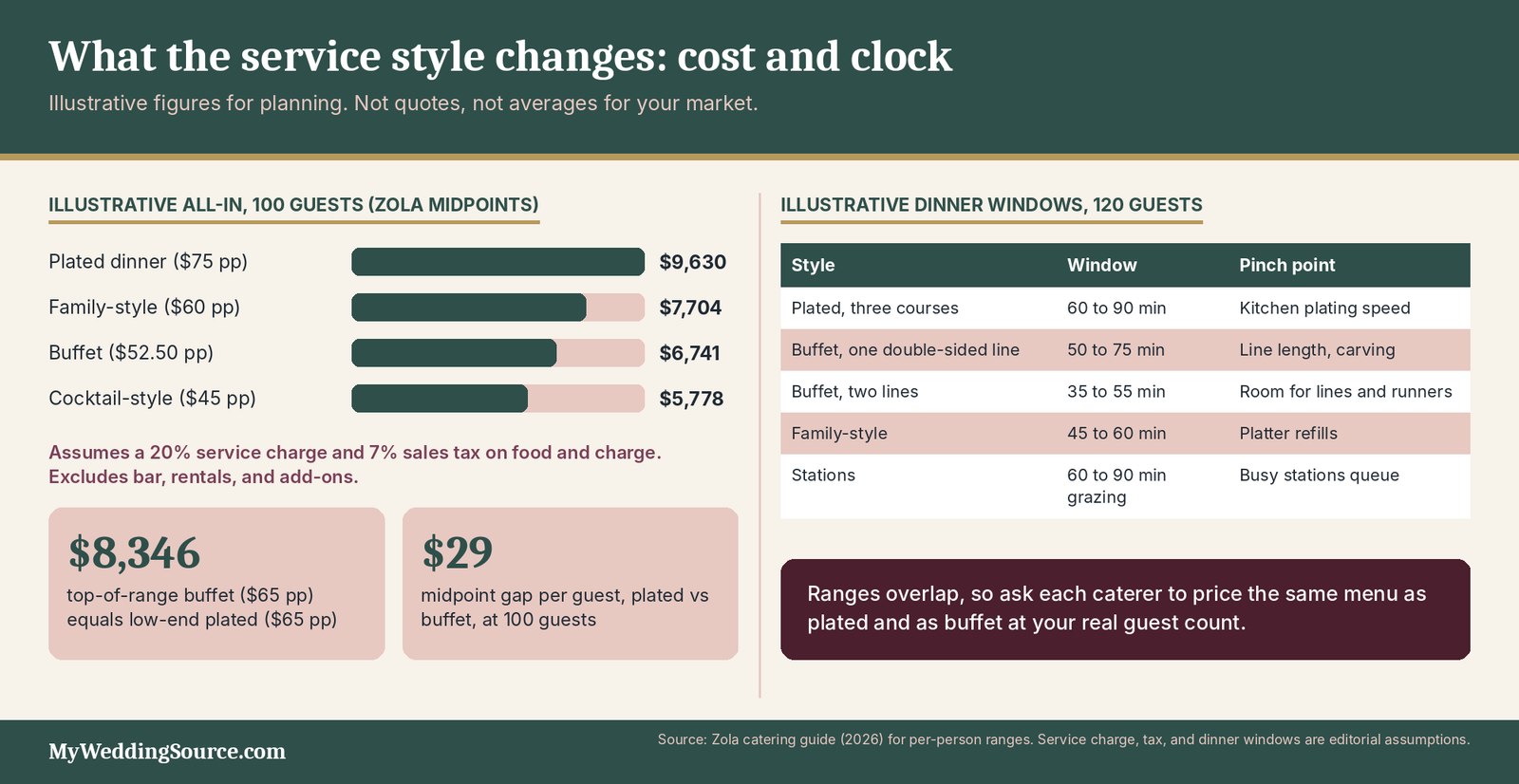
Using a 20% service charge, which sits inside the 18% to 22% range Zola reports, and an assumed 7% sales tax applied to both food and the service charge, the arithmetic is simple enough to check with a calculator. A plated dinner at the low end of Zola’s range costs $6,500 for food, $7,800 with the service charge, and about $8,346 with tax. A buffet at the top of Zola’s range, $65 per person, lands at exactly the same $8,346, which shows how a premium buffet can cost as much as an entry-level plated menu.
The midpoints are further apart: a plated dinner at $75 per person comes to about $9,630 all in, while a buffet at $52.50 comes to about $6,741, a gap of roughly $2,900 or $29 per guest at 100 guests.
| Service style | Zola per-person range | Food at 100 guests | With 20% service charge | With 7% tax (illustrative) |
|---|---|---|---|---|
| Plated dinner | $65 to $85 | $6,500 to $8,500 | $7,800 to $10,200 | $8,346 to $10,914 |
| Buffet | $40 to $65 | $4,000 to $6,500 | $4,800 to $7,800 | $5,136 to $8,346 |
| Family-style | $50 to $70 | $5,000 to $7,000 | $6,000 to $8,400 | $6,420 to $8,988 |
| Cocktail-style reception | $35 to $55 | $3,500 to $5,500 | $4,200 to $6,600 | $4,494 to $7,062 |
What moves the total more than the service style
Three choices usually matter more than the label on the service style: the number of entree options, the number of courses, and the guest count. Offering three entrees on a plated menu means the kitchen prepares and plates three things, which can cost more than a two-option buffet. A second course, a passed appetizer, or a late-night snack adds a layer that has nothing to do with plated versus buffet. Guest count matters because caterers often have minimums, and Zola’s 2026 guide reports minimums of $2,500 to $4,000 that can raise the effective per-person price at small weddings.
For a deeper walk through quote structure, our guide to wedding catering cost covers price drivers and the quote traps to watch for.
Staffing, speed, and how dinner fits your timeline
Service style is a decision about people and minutes as much as food. How many staff each style needs, and how long guests wait to eat, decide whether the evening feels smooth or strained, and both are things you can ask a caterer to put in numbers. Both can be written into a proposal, which is why this section focuses on what to ask for.
Who serves your guests
Staffing is the largest cost behind a catering price and the least visible one, so it helps to picture what each person on the team actually does. The ratios below are illustrations of how to think, not industry standards, and the number that matters is the one in your caterer’s proposal. Asking for specifics lets you compare proposals on service and not only on the food.
Plated: servers, captains, and the plating line
A plated dinner needs a plating line in the kitchen, runners or servers to carry plates, and a captain who directs the timing of each course. As an illustration only, a 120-guest plated dinner at one server for every 12 guests needs about ten servers, while the same dinner at one for every 15 needs eight, and the difference can show up both on your invoice and in how quickly the entree reaches the back tables.
The pinch point is usually the kitchen, because every plate for a table has to be ready at roughly the same moment, and a venue with a small kitchen or an outdoor prep tent limits how many plates can be built at once. Ask the caterer for the staffing ratio in writing and ask how the team plates a course for 120 people without letting the first tables sit with cold food.
Buffet: attendants, runners, and replenishment
A buffet shifts labor from carrying plates to managing a line: attendants portion or supervise each station, runners bring fresh trays from the kitchen, and someone monitors temperature and cleanliness. Fewer people are needed for the dinner itself, which is why buffets are often quoted lower, but the people you do have must be quick, because a line that runs out of an item at the halfway point becomes a complaint.
As an illustration, a two-sided buffet for 120 guests might use two attendants on each side plus one or two runners, which is roughly six staff, compared with the ten servers above, though your caterer’s actual plan will differ. Ask how the kitchen replaces trays instead of topping them off, and who is responsible for the line if the caterer’s lead is pulled away to handle a problem.
Time on the clock
Timing is the practical difference guests notice most. A reception has a fixed length, typically set by the venue’s end time and your DJ or band booking, so every extra minute at the table is a minute you do not have for dancing, toasts, or cake. Dinner length therefore deserves the same scrutiny as price when you compare styles.
How long each style takes to feed a room
The table gives illustrative windows for 120 guests, which are editorial planning ranges we have assembled from how caterers describe their service, not measured data. The arithmetic behind the buffet figures is simple: if a guest clears a single-sided line in 45 to 60 seconds, 100 guests take 75 to 100 minutes on one line, 38 to 50 minutes on one double-sided line, and about 19 to 25 minutes on two. In practice guests do not all arrive at once, because tables are released in waves, so the first guest waits very little and the last may wait a few minutes.
| Style | Illustrative window for 120 guests | Pinch point | What shortens it |
|---|---|---|---|
| Plated, three courses | 60 to 90 minutes | Kitchen plating speed | More servers, a two-course menu, pre-set salad |
| Buffet, one double-sided line | 50 to 75 minutes | Line length, slow items like carving | A second line, pre-plated items, releasing tables in waves |
| Buffet, two lines | 35 to 55 minutes | Room for two lines and runners | Clear signs, attendants who portion quickly |
| Family-style | 45 to 60 minutes | Platter refills | Extra servers, smaller platters per table |
| Stations | 60 to 90 minutes of grazing | Popular stations with queues | Duplicate the busiest station, open all stations at once |
Releasing tables, toasts, and the emcee
A buffet works best when someone owns the release order. The Knot’s guidance for buffets has the emcee, coordinator, or bandleader call tables to the line, which keeps the room from forming one long queue and gives the head table, older guests, and anyone with a special meal a clear place to go. A common sequence is to release the head table and guests who need assistance first, then the remaining tables in a planned order, but a clear plan matters more than the specific sequence.
Toasts work differently by style: at a plated dinner they slot neatly between courses, while at a buffet they usually happen once most guests are seated or before the line opens, so food does not cool while someone gives a long speech. If your reception layout uses assigned tables, the same chart that tells guests where to sit can tell the emcee which table goes next, and our wedding seating chart guide shows how to build one that serves both purposes.
Venue and kitchen: the constraints that make the decision for you
For many couples the venue answers the plated-versus-buffet question before any taste test happens. A kitchen, a floor plan, and a caterer policy can each rule a style in or out, so it is worth checking them before you fall in love with a menu. Checking the constraints early saves you from choosing a style your space cannot actually support.
What your space can physically support
Think of the venue as the third party in the conversation. It has a kitchen or it does not, a floor that holds a limited number of tables and lines, and rules about what can happen where. The two subsections below cover the kitchen and the floor, which are the physical limits worth confirming first.
Full kitchen, catering kitchen, or no kitchen at all
A venue with a full commercial kitchen can support any style, including complex plated courses that need ovens, burners, and a plating line close to the dining room. A venue with only a catering or prep kitchen usually supports buffets, family-style, and simpler plated meals, because the caterer finishes food on site rather than cooking it from scratch. A tent, barn, field, or backyard often has no kitchen at all, so the caterer builds a temporary one, brings warming cabinets and refrigeration, and must keep hot food hot and cold food cold from the truck to the guest.
The table shows how those situations typically line up with service styles, and the right-hand column is a starting point for your conversation with the caterer, not a rule.
| Venue situation | What to check | Styles that tend to fit |
|---|---|---|
| Hotel or ballroom with a full kitchen | Kitchen capacity, house service style, minimums | Plated, buffet, family-style, stations |
| Venue with a prep or catering kitchen | Ovens, refrigeration, plating space, power | Buffet, family-style, simpler plated menus |
| Barn, field, or tent with no kitchen | Off-site prep, hold times, power, tent size | Buffet, family-style, stations, plated with a short menu |
| Restaurant buyout or private room | Restaurant’s own menu and staff rules | Plated or family-style from the restaurant’s menu |
| Home or backyard | Refrigeration, parking for staff, neighbors | Family-style, buffet, stations |
| Historic site or museum | Open-flame, load-in, and cleaning restrictions | Plated or cold-plate menus, depending on rules |
Floor plan: how much room dinner takes
A guest count describes people, but a floor plan also has to hold a dance floor, a bar, a DJ or band, a cake table, and the dinner format you choose. A buffet needs space on both sides of each table for lines, plus a clear route for runners and room for guests to walk to their seats with a full plate, which takes more floor than a plated dinner does.
A capacity number on a venue’s website is typically a maximum for a defined layout, often without a dance floor, stage, or buffet, so ask for the capacity at your guest count with every element you plan to include. Keep accessible routes in mind as well: avoid placing a buffet where it forces wheelchair users or guests with walkers to squeeze behind a line, and ask the venue for a floor plan you can mark up. Our wedding venues hub gives you more questions to ask when you compare spaces.
Rules that come from the venue and the weather
Beyond the building itself, policies and conditions can narrow your options. These are the two to look at first. Both are quick to confirm with a call to the venue manager and your caterer.
In-house, preferred, and outside caterers
Many hotels and event venues require you to use their catering, and some limit what styles they offer, for example, by serving plated dinners only above a certain headcount or by offering a house buffet at a lower price tier. Other venues allow outside caterers but require a preferred list, a certificate of insurance, or specific rentals, any of which can add to the cost of the style you choose. Read the venue contract for language about service style, kitchen access, rentals, and who may set up or clear the dining room.
If a venue allows only its own staff to handle food, ask whether that includes buffet attendants, because the answer determines who is responsible for the line. If you need help comparing proposals from a venue caterer and an outside company, our wedding caterer questions guide gives a structured list.
Heat, power, and food safety outdoors
Outdoor weddings put time and temperature rules in the spotlight, and the service style changes how long food is exposed. The CDC describes 40°F to 140°F as the danger zone, where bacteria multiply rapidly, and USDA guidance says perishable food should not sit at room temperature for more than two hours, or for more than one hour when the air temperature is above 90°F.
A plated dinner keeps most food in the kitchen until it is plated, while a buffet puts it on the table for the length of the line and any seconds, which is why the caterer’s plan for chilling, hot holding, and replacing trays matters more outdoors. USDA also says cold food left out on a buffet for more than two hours should be discarded. Ask how salads, dairy, seafood, and desserts are kept cold at your venue, where chafing dishes get power or fuel, and whether there is shade for the serving area.
Guest experience, formality, and your crowd
Two weddings with the same budget can feel very different depending on how dinner is served. The style shapes the mood of the room and the comfort of particular guests, and both are worth thinking about before you decide. The sections below look at the mood of the room first and then at the specific guests who will be sitting in it.
How the evening feels
Think about the arc of the evening: when guests sit, when they move, when they talk, and when they dance. Service style shapes that arc more than almost any other single choice. The two subsections below separate the question of tone from the practical question of movement and music.
Formality: what each style signals, and what it does not
Plated service tends to read as formal because it resembles a restaurant dinner or a banquet, with courses, place settings, and servers at each table. A buffet tends to read as relaxed and generous, and stations read as social and modern. These associations are real but loose, since an elegantly styled buffet with carved meats and fine linens can feel more special than a hurried plated meal, and a family-style dinner at a long candlelit table can feel intimate and polished.
Choose the format that matches how you want guests to feel rather than the one that signals a level of formality you do not enjoy. No style is more mature or more generous than another, and nobody should feel they need a more expensive format to host a good wedding.
Conversation, movement, and the dance floor
Seated service keeps guests at their tables for a stretch of time, which gives everyone a chance to talk, gives toasts a quiet room, and lets the couple visit tables between courses. A buffet or stations get guests out of their seats, which helps with mingling and can energize a room, but they also fragment attention, so speeches and announcements may need a clear signal. Dinner length also shapes the dance floor: a long plated meal can cool down a room that was lively during cocktail hour, while a shorter buffet or station service may let the dancing start sooner.
If you have a DJ or band booked for a fixed number of hours, subtract dinner service from the total and see how much open dancing remains. That arithmetic helps you decide whether your priority is a leisurely meal or a longer dance floor.
Your guests, specifically
A guest list is a collection of individuals with different needs, and it is worth checking how each style works for the people who will be in the room. The two groups below are the ones most often overlooked when a couple chooses a style in the abstract. Asking about them early costs little and often changes the plan.
Older guests, children, and guests who use mobility aids
Guests who have difficulty standing, carrying a plate, or waiting in line are often more comfortable with plated or family-style service, where food comes to them. If you choose a buffet, ask the caterer to arrange table service for guests who need it, such as having a server fill and deliver a plate, and make sure the route to the buffet is accessible. Children often do better with a simple meal that arrives quickly, either a separate kids’ plate or a place at the buffet with a parent, and many caterers offer a children’s menu at a reduced price.
Do not assume which guests need help; a quiet note on the RSVP card inviting guests to share seating or meal needs makes it easy for people to ask.
Family food traditions and portion expectations
Food is often the part of a wedding where family expectations are strongest. Some families will expect abundant, shared dishes passed around the table, which family-style service reflects naturally, while others are most at ease with a seated multi-course meal or a generous buffet with several cuisines. Think about whether a particular cuisine or a dish tied to your heritage matters more than the format, because it may narrow the caterers who can serve you.
If a religious or cultural dietary practice applies, such as kosher or halal preparation, check what your community expects in terms of certification, kitchen, and supervision, since those requirements may matter more than service style. A direct conversation with the family members who care most, held early, prevents later surprises.
Dietary needs, allergens, and fair plates for every guest
Dietary handling is where service style stops being about taste and starts being about safety. It deserves its own comparison because a style that works for 95% of the room can be the wrong one for the guest who cannot afford a mistake. This section is general education and not medical advice; a guest with a serious allergy should speak directly with the caterer about their own needs.
Allergens and cross-contact
Allergy risk at a catered event comes less from the menu on paper than from what happens between the kitchen and the guest’s fork. Service style changes how many hands and utensils touch the food in that stretch. That is why the comparison below focuses on process, meaning who touches the food, which utensils are used, and how the plate reaches the guest.
Why buffets need a plan for shared utensils and shared tables
The FDA recognizes nine major food allergens in the United States: milk, eggs, fish, crustacean shellfish, tree nuts, peanuts, wheat, soybeans, and sesame, and its federal labeling rules apply to packaged foods, not to most unpackaged food prepared and served at an event. The FDA describes cross-contact as the unintentional transfer of an allergen from one food to another, and a self-serve line creates many chances for it, since serving spoons wander between dishes, a drip lands in the next tray, and guests reach across.
Food Allergy Research & Education, known as FARE, estimates that about 32 million people in the United States have food allergies, including nearly 11% of adults, so a 117-guest wedding will probably include at least a few people managing one. Our editorial view is that a buffet can be made safer with attendants who serve from each dish, labeled items, and dedicated utensils, but each of those is a process you have to ask the caterer to describe.
How plated service handles an allergy plate
A plated dinner gives the kitchen a clear point of control, because each plate is built, checked, and carried to a specific guest. A caterer can prepare an allergy plate separately, with clean equipment, tag it with the guest’s name and table number, and have a named server deliver it directly rather than leaving it among the other entrees. That traceability is a real advantage for a guest with a severe allergy, and it is why many couples with this concern choose plated service or provide a plated alternative at an otherwise buffet-style wedding.
The control depends on the process, so ask who is trained to handle allergy plates, whether the chef will talk with the guest beforehand, and how the team confirms the plate before it leaves the kitchen. Our wedding caterer questions guide lists the allergen questions to ask in more detail.
Counting and serving dietary meals
Beyond allergies, most weddings include guests who are vegetarian, vegan, avoiding gluten, or following another diet for reasons of health, belief, or preference. The question is how each style gets a suitable meal to those guests without singling them out. Each style has a natural way of handling these needs, and each has a place where it can go wrong.
Vegetarian, vegan, gluten-free, and other preferences
At a buffet, vegetarian and vegan guests can usually build a meal from the dishes available, though they may be limited to side dishes unless the caterer plans a real main course for them. At a plated dinner, the kitchen has to prepare a separate meal and the caterer has to know who gets it, which takes more planning but ensures the guest receives a full plate. “Gluten-free” needs particular care, since the FDA’s gluten-free definition is a voluntary labeling claim for packaged foods and does not automatically govern a caterer’s menu description.
Ask whether a dish labeled gluten-free means made without gluten ingredients or also prepared with separate equipment, because the answer matters a great deal to a guest with celiac disease.
| Need | Plated dinner | Buffet | Family-style or stations |
|---|---|---|---|
| Serious food allergy | Separate plate, delivered to a named guest | Needs attendants, labels, dedicated utensils, or a plated alternative | Shared platters raise cross-contact questions; ask for a separate plate |
| Vegetarian or vegan | Pre-ordered entree, counted ahead | Usually built from the line, confirm a real main course | Confirm a vegetarian platter on each table |
| Gluten-free | Pre-ordered, plated separately | Labels and shared-utensil rules matter | Ask for a separate plate or labeled platter |
| Children or soft-food needs | Kids’ plate, served first | Parent-assisted line, or a plate delivered to the table | Easy to adapt at the table |
Collecting entree choices and counting meals
Plated dinners with a choice of entrees need a way to learn what each guest wants, which usually means a line on the RSVP card, and a way to tell servers which plate goes to which person, such as a symbol or color on the place card. The caterer will ask for a final guarantee a week or two before the wedding, and you pay for the guaranteed number of meals even if fewer guests attend.
As an illustration, if you guarantee 110 plated meals at $75 each and 98 guests attend, the 12 empty plates cost about $900 before the service charge and tax, or about $1,156 with the assumptions from the cost section. A buffet is more forgiving of a late count because unused food can often be adjusted, though caterers still plan quantities from the guarantee.
A decision framework: choose with five filters and four scenarios
Most couples do not need a spreadsheet to decide, only a clear order of questions. The framework below starts with the factors that can rule a style out and moves toward the ones that are about preference. Working through them in order usually settles the question in an hour.
Run your wedding through five filters
The five filters are guest count, venue, timeline, guest needs, and formality plus budget. The table summarizes which way each one tends to lean, and the paragraphs that follow explain how to apply them. Treat the table as a prompt for your own conversation and not as a formula.
| Filter | Question to ask | Leans plated when | Leans buffet or other when |
|---|---|---|---|
| Guest count | How many people eat at once? | 120 or more in a room with a real kitchen | 25 to 100, or space for two-sided lines |
| Venue | What does the kitchen and floor allow? | Full kitchen, tight floor plan | Prep kitchen, tent, or ample floor space |
| Timeline | How long can dinner take? | You can spend 60 to 90 minutes | You want dinner under about an hour |
| Guest needs | Who needs special handling? | Serious allergies, mobility needs | Mostly flexible eaters who like choice |
| Formality and budget | What tone, and how much flexibility? | Formal tone, fixed headcount | Relaxed tone, uncertain headcount |
Filters 1 and 2: guest count and venue
Guest count and venue come first because they can rule a style out. A large guest list in a small room with a modest kitchen makes a plated dinner hard to execute well, but it also makes a buffet hard, because lines and tables compete for the same floor. A small guest list at a restaurant or private room often fits plated or family-style dinners naturally, since the staff and kitchen are already set up for them.
If the venue has a full commercial kitchen and an experienced banquet team, nearly every style is possible, and you can decide on other grounds. If the venue is a tent or a barn with no kitchen, ask the caterer which styles they have run there successfully and request references from similar events.
Filters 3 and 4: timeline and guest needs
Timeline and guest needs are the next filters because they affect comfort and safety. If your reception has a tight end time or a band booked for a fixed number of hours, shorter dinner service gives you more of what you are paying for, and a buffet with two lines or stations can help. If you have guests with serious allergies, mobility needs, or a very young or elderly group, plated or family-style service gives you more control over how each person eats.
These two filters can override your preferences, because they are about whether everyone can enjoy the evening and not about style. If they point to different styles, a hybrid, such as plated mains with a dessert buffet, often resolves the conflict.
Filter 5: formality and budget tolerance
Formality and budget are the final filters because they are the most flexible. If you want a formal tone and have a fixed headcount, plated service is a natural fit, and if you want a relaxed tone and expect some changes in the guest list, a buffet or family-style meal tends to suit you. For budget, remember the cost section: the ranges overlap, so a well-priced plated meal can cost less than a premium buffet. Decide how much flexibility you want in your budget by asking each caterer for a written price on both styles at your guest count.
If the gap between them is small, choose on the other four filters; if it is large, ask what is driving it before you decide.
Four sample weddings
Scenarios help because they show how the filters interact. The four below are illustrations built from the factors in this guide, not recommendations for a specific wedding.
How the filters play out in four situations
Consider a 40-guest dinner at a restaurant’s private room, where family-style service from the restaurant’s own menu keeps costs and logistics simple. Consider a 100-guest wedding in a hotel ballroom with a three-hour dinner window, where plated service is natural but a hybrid with a plated first course and a buffet dessert can save time. Consider a 150-guest barn wedding with no kitchen and a July date, where two double-sided buffet lines with attendants and a clear cold-holding plan are practical. Consider a 200-guest outdoor wedding where mingling matters, which is a good candidate for stations with duplicated popular items.
The table lays out the reasoning and the main watch-out for each.
| Wedding | Likely fit | Why | Main watch-out |
|---|---|---|---|
| 40 guests, restaurant private room | Family-style or plated from the restaurant menu | Staff and kitchen already set up, simple logistics | Minimum spend and room time limits |
| 100 guests, hotel ballroom, 5-hour reception | Plated, or plated first course plus dessert buffet | Full kitchen, formal tone, controlled timing | Entree counts and guarantee date |
| 150 guests, barn with no kitchen, July | Two-sided buffet with attendants | Fewer servers needed, easier in a temporary kitchen | Heat, cold holding, power for warming |
| 200 guests, outdoor, mingling focus | Food stations with duplicated popular items | Spreads guests out, shortens queues | Staffing per station and allergy labeling |
When a hybrid is the better answer
Hybrids exist because real weddings rarely fit one style neatly. A plated first course and a buffet entree gives guests a formal opening and the freedom to choose their main dish, while family-style mains with a plated salad keeps the table communal and the kitchen organized. A plated dinner with a late-night snack station spreads food over the evening and keeps the dance floor energized. Ask the caterer to price the exact blend you are considering, because each element carries its own labor and equipment.
If a hybrid solves a conflict between your filters, such as a serious allergy at an otherwise casual wedding, treat it as a considered choice rather than a compromise.
Locking in your choice: what to put in writing
Once you have chosen a direction, the next step is to turn it into proposals you can compare and a contract that reflects what you were told. The goal is to protect the decision you made, not to relitigate it. Three conversations and one contract review usually cover it.
Ask for style-specific proposals
You will learn more from two comparable proposals than from any article, so ask for them in a form that makes the comparison easy. The two requests below do that without making a caterer feel interrogated.
Price the same menu two ways
Ask each caterer to price the same menu, at your real guest count, as plated and as a buffet or family-style meal, with every fee shown. This isolates the effect of service style from the effect of the menu and shows you where the real difference lies, whether in servers, rentals, food quantity, or the service charge. If one caterer offers only one style, that is useful information about how they work, and you can still compare totals with the others. For help interpreting what the proposals include, our guide to plated vs buffet wedding hidden costs lists the line items most often missed.
Ask about entree counts and change windows
Ask when entree counts and dietary meals are due, how late the total guarantee can change, and what happens if a guest’s needs change after the deadline. A plated dinner usually has a firmer cutoff than a buffet, because the kitchen builds exact plates. If your list is likely to shift, ask whether a plated dinner can include a flexible number of extra plates, and what each one costs. Get the deadline, the charge for late changes, and the policy for last-minute dietary requests in writing, since these are the clauses that matter most when someone cancels the week of the wedding.
Write the service plan into the contract
A good proposal describes the food, but a good contract describes the service. These details are the ones that make the style you chose actually happen. Write them down while the conversation is fresh, and ask for them in the contract and not just in an email.
Staffing, lines, and service windows
Ask for the staffing ratio or the number of servers and attendants in writing, along with the number of buffet lines, who attends each one, and how long dinner service is planned to take. If you chose family-style, ask how many platters each table receives and who refills them. If you chose plated, ask how many servers work per table and when the first course is planned to go out. These numbers let you check on the day that what you paid for is what appears, and they give you something concrete to point to if the service falls short.
What happens if you change styles or your guest count
Life changes, and a good contract anticipates that. Ask whether you can switch from plated to buffet, or the reverse, after signing, by when, and what the price consequence would be. Ask how the minimum, the service charge, and the rentals respond if your guest count falls or rises, because a lower count can trigger a minimum or a different per-person tier. Keep a written record of any change you agree to, and have both parties sign it. Terms and state laws vary, so for contract questions that go beyond these basics, ask a qualified professional in your state.
FAQ: Plated vs buffet wedding questions couples ask
Cost, staffing, and timing
Is a buffet cheaper than a plated dinner at a wedding?
Often, but not always. Zola’s 2026 catering guide reports buffets at $40 to $65 per person and plated dinners at $65 to $85, and The Knot says buffet or family-style service may cost less than plated meals, so the typical gap favors the buffet. The ranges overlap, however, because a buffet with several proteins, carving stations, and a second line can cost as much as a simple plated menu. Ask each caterer to price the same menu both ways at your real guest count so you see the difference in your market and not the national one.
How many servers does a plated wedding dinner need?
There is no single standard, and the right number depends on the menu, the room, and the kitchen. As an illustration only, one server for every 10 to 15 guests is a ratio some couples hear, which would mean eight to twelve servers for 120 guests. Ask your caterer for the ratio in writing, plus the number of captains and kitchen staff, and ask how they cover a sick call.
How long does a wedding buffet take for 100 guests?
It depends on the number and type of lines and on how guests are released. If a guest clears a single-sided line in 45 to 60 seconds, which is an editorial assumption and not measured data, 100 guests would take 75 to 100 minutes at one line, about 38 to 50 minutes at a double-sided line, and about 19 to 25 minutes at two. Releasing tables in waves means most guests wait far less than the total. Ask your caterer how many lines they recommend for your guest count and how long dinner service has taken at similar weddings.
Guests, safety, and etiquette
Is a buffet safe for guests with food allergies?
It can be made safer, but it needs a plan. A buffet creates more chances for cross-contact, such as shared serving spoons and drips between dishes, so ask for attendants who serve each dish, clear labels for the major allergens, and dedicated utensils. Many guests with serious allergies are more comfortable with a separate plate prepared by the kitchen and delivered by a named server, which is possible even at a buffet wedding. Encourage guests to share their needs on the RSVP card and invite them to speak with the caterer directly, since only the guest and their clinician can judge their own risk.
Is it rude to have a buffet at a wedding?
No. Buffets are the most common style in The Knot’s 2026 study, where 60% of couples had a buffet or self-serve stations, and nothing in etiquette says a seated plated dinner shows more care. What guests remember is whether they were fed well, comfortably, and without long waits, and a well-run buffet delivers that. If you want the buffet to feel considered, plan table release, signage, attendants for guests who need help, and a seat for everyone.
Your next steps
A practical way to finish this decision is to gather a few facts, ask for comparable proposals, and put the plan in writing before you pay anything. The steps below take a few hours spread over a couple of weeks. The steps below take a few hours spread across a couple of weeks, and none requires a deposit.
This week
Start with information you already have or can get from a phone call, so that your conversations with caterers are specific. The two steps below are small, but they change the quality of every answer you get afterward.
Write down your five facts
List your guest count range, your venue’s kitchen type and floor plan, how long you can allow for dinner, the dietary needs you already know about, and the tone you want. Often the answer is obvious once the facts are on one page, and where it is not, you know which question to research. Shorter notes work too, as long as every one of the five facts is on the page. Where the answer is still unclear, you will know which question to research first.
Request two-style proposals
Send the same menu and guest count to two or three caterers and ask for pricing as plated and as buffet or family-style, with the service charge, tax treatment, rentals, and staffing shown. Ask each one how many lines or servers they would use at your venue and how long dinner would take. Compare the totals at your real guest count, not the per-person headline, and keep the answers in one document.
Before you pay a deposit
Once you have a preferred caterer, shift from comparing to confirming, because the contract is where the style you chose becomes a promise. Both steps below happen before any money changes hands, and neither takes long.
Confirm the service plan in writing
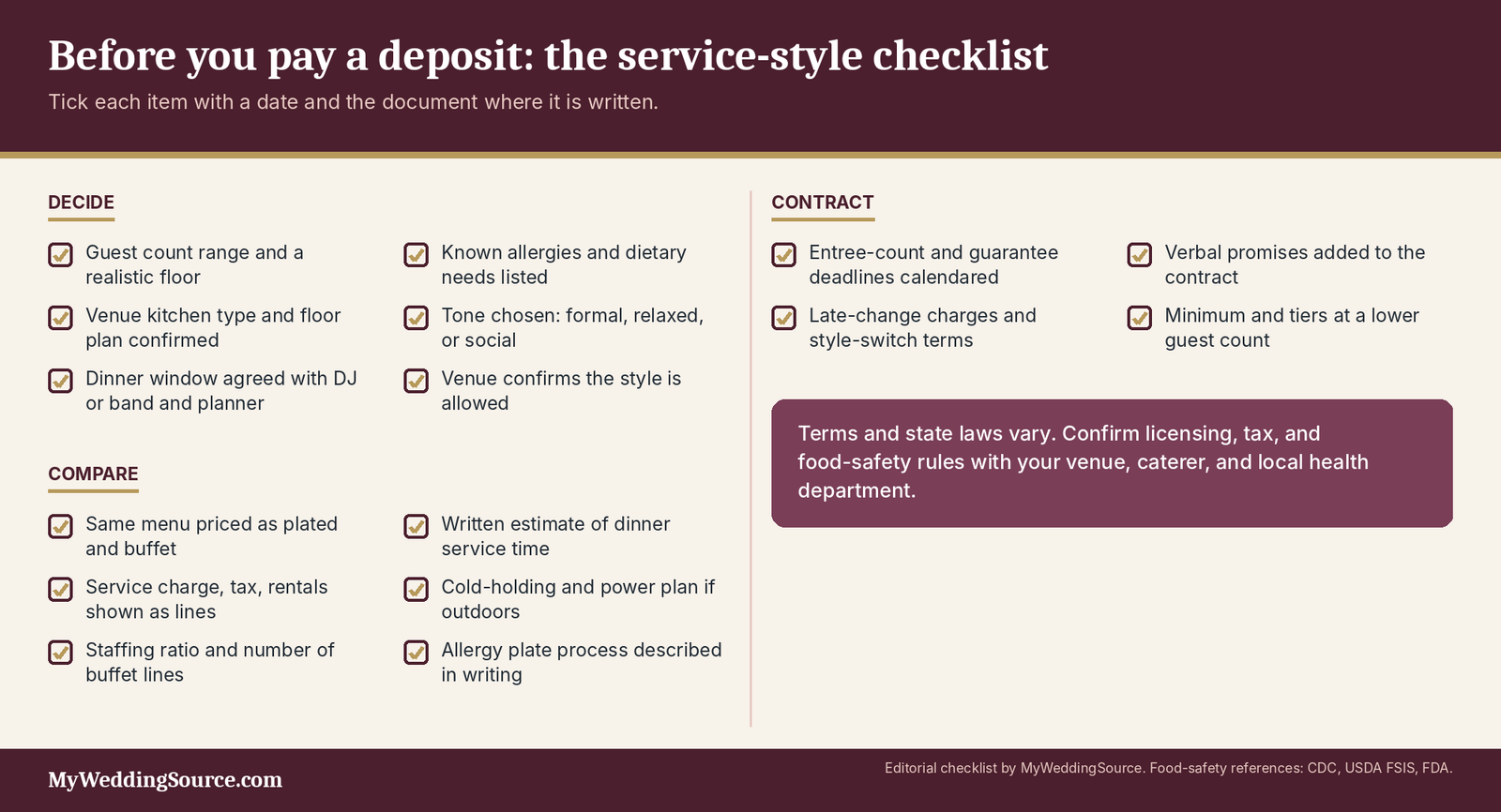
Check that the contract names the service style, the number of servers or attendants, the number of buffet lines, the planned service window, and the allergy and dietary process. Add anything promised in conversation, since a verbal assurance is hard to enforce. If you want more structure, our wedding caterer questions guide offers 25 questions to review before you sign, and our wedding planning guide shows where this decision fits in the overall timeline.
Calendar the deadlines and the safety plan
Put the entree-count deadline, the guarantee date, and the final payment date on your calendar, and ask who on the caterer’s team is responsible for temperature control if you are outdoors. Confirm with your venue that the style you chose is allowed and that the kitchen, power, and floor plan can support it. Missing one of these dates is a common way for a decision made well to become an expensive surprise. A calendar reminder one week before each deadline is a small habit that prevents most of them.
Sources & methodology
- The Knot 2026 Real Weddings Study (data read-out page) — U.S. couples married in 2025; share of couples with a buffet or self-serve stations (60%) and a plated sit-down meal (30%).
- The Knot 2026 Real Weddings Study data read-out (PDF) — sample of 10,474 couples, average guest count of 117, and average caterer spend of about $80 per person.
- The Knot: Average Wedding Catering Cost — $80 per person average, regional averages from $62 to $123, and guidance that buffet or family-style service may cost less than plated.
- The Knot: ideal wedding budget breakdown — service fees typically 20% to 25% of the food-and-drink fee.
- The Knot: reception timeline — sample reception sequence and the role of an emcee, coordinator, or bandleader in directing guests.
- The Knot 2027 Wedding Trends Report (Business Wire, Sept. 28, 2026) — interactive food and beverage growth signal and the reported shift toward roaming appetizers.
- Zola: Wedding Catering Costs — per-person ranges by service style, 18% to 22% service charges, and caterer minimums of $2,500 to $4,000 (last updated February 2026).
- FDA: Food Allergies — the nine major food allergens, the scope of federal labeling, and the definition of cross-contact.
- FDA: Gluten-Free Labeling of Foods — gluten-free as a labeling claim for packaged foods.
- FARE: Food allergy facts — prevalence estimates for U.S. adults and the overall population.
- CDC: Food Safety Prevention — the 40°F to 140°F danger zone and the 2-hour and 1-hour guidance.
- USDA FSIS: Leftovers and food safety — the two-hour and one-hour limits for perishable food, including cold food on a buffet.
- New York State Department of Taxation and Finance: caterers and catering services — one state’s example of how service charges and gratuities can be taxed.
Methodology. Statistics from The Knot, Zola, and FARE are survey findings or organizational estimates, labeled with their source and year, and they are context rather than quotes for any caterer or location. Statements about the FDA, CDC, USDA, and New York tax guidance reflect those agencies’ published pages as read by our editors, and they describe general rules that vary by jurisdiction. The cost table, the dinner-service windows, the staffing ratios, the line-throughput arithmetic, the filter thresholds, the venue pairings, and the scenario recommendations are editorial judgment and illustrative arithmetic, not data from a study.
We could not re-open every source in October 2026, so figures that rely on The Knot and Zola pages are carried forward from our earlier verified reading and flagged for recheck.
Freshness note. Recheck The Knot and Zola cost figures when their next annual studies publish, usually early in the year, and verify the Zola per-person ranges against its current catering guide before quoting them. Confirm the sales tax treatment of service charges in your state, the Food Code edition your county applies, and any venue rules on service style directly with the venue, your local health department, and a qualified professional before you sign.