
Micro wedding ideas work best when you stop asking how to shrink a big wedding and start asking what 20 people could do together for one evening: a long dinner, a private room, a house for a weekend, a ceremony with real witnesses and a photographer who stays for the toasts.
Your list has 14 names on it, or maybe 18, and every quote you open seems to have been written for 120. The caterer has a minimum that assumes a bigger crowd, the photographer’s package starts at the same price whether 15 people or 150 show up, and the venue talks about “capacity” as though a half-empty ballroom were a feature. None of that means a very small wedding is a bad idea. It means the planning problem is different from the one most wedding advice is written to solve, and the ideas that work at this size come from using a different kind of room, a different kind of meal and a different kind of day.
This guide covers micro weddings of roughly 20 guests or fewer, a working range we chose because it is where wedding logistics stop looking like a scaled-down reception and start looking like a dinner party, a ceremony and a legal filing. If your list runs from about 25 to 75, our guide to small wedding ideas is the better fit, and our broader wedding ideas page covers themes and styling across sizes. Here we look at how the term is defined, what the budget really does at this size, which formats and venues suit a table of 16, how the legal ceremony works when you are the whole guest list, what to serve and photograph, and how to handle the people who are not in the room.
Two limits before the details. The national figures we cite come from The Knot, Zola and other published sources, and almost none of them isolate weddings under 20 guests, so where a number comes from a vendor blog or from our own arithmetic, we say so. And the legal rules for getting married vary by state and often by county, so the examples in this guide show how different offices answer the same question rather than a rule you can assume applies to you.

What counts as a micro wedding, and how is it different from an elopement?
Micro wedding is a marketing-friendly label rather than a defined category, and the sources that use it draw the line in different places. That matters because the ideas, the budget and even the legal steps change as the guest count falls. This section sorts out where the term starts and stops, how it differs from an elopement and from a small wedding, and what the data says about how common weddings this size are.
Where does “micro” start and stop?
What guest counts do published sources use?
Zola’s micro wedding guide describes a micro wedding as typically 50 or fewer guests with an average around 30, and a “minimony” as a gathering of 10 people or fewer. A Joy photographer-pricing guide groups weddings differently, treating elopements as under 20 guests and micro weddings as 20 to 50. A Paperlust cost guide published in 2026 uses 10 to 50 guests. These definitions overlap heavily, which is why a search for micro wedding ideas returns everything from a six-person courthouse lunch to a 45-person garden dinner. This guide uses 20 or fewer because the planning decisions in that range, such as one table, one kitchen or one house, differ from those at 40 or 50.
Who counts toward the headcount?
Count seats, not invitations. The couple, the officiant, a witness and often the photographer all occupy space, and a venue or a park permit may count them even if your guest list does not. The National Park Service’s Cowpens National Battlefield, for example, sets a ceremony maximum of 25 people and says that number includes the wedding party, guests, officiant and photographer. Restaurants and caterers usually price per person served, so ask whether vendors who eat are included in your count. A list of 16 guests can quietly become 20 seats once you add the couple, an officiant and a photographer, and that changes both the table size and the invoice.
How is a micro wedding different from an elopement or a small wedding?
Is a micro wedding the same as an elopement?
Not quite, although the two overlap. Zola describes an elopement as a ceremony with an officiant and a witness, sometimes at a city hall or on a mountaintop, while a micro wedding keeps the structure of a traditional wedding, with a ceremony, a cocktail hour and a reception, at a smaller scale. Elopements tend to be about the ceremony and the setting, and micro weddings tend to be about the meal and the people at the table. The two combine well, and a hybrid format in which you marry in a small ceremony and then share dinner with a handful of guests is among the most flexible options we cover below.
How does it differ from a small wedding of 25 to 75 guests?
At 25 to 75 guests you still need a room, a floor plan, a bar setup and a staffed service, and the planning questions are about room size, rentals and minimums. Our small wedding guide handles that range. At 20 or fewer, a single long table replaces the floor plan, a private dining room or a house replaces the ballroom, and the vendors whose price does not move with headcount, such as the photographer and officiant, become the largest items. The result is that a micro wedding is usually decided by choosing an experience first and the building second, whereas a small wedding is often decided by the building first.
How common are weddings this size?
What does the data say?
Direct data is limited. CNBC reported in July 2024 that, according to The Wedding Report, weddings with 25 to 50 guests made up about 15% of the market in 2023 and weddings with fewer than 25 guests about 2%. The Knot’s 2025 data puts the average wedding at 117 guests, down from 131 in 2019, and shows that couples spending under $12,000 still averaged 92 guests. International destination weddings, which tend to be smaller because guests must travel, averaged 69. In other words, a wedding of 20 or fewer remains an outlier in national surveys, even though it is widely discussed online, and we found no current national figure for its exact share.
Why do couples choose it?
The reasons cluster around cost, control and attention. Zola’s vice president of brand marketing, Allison Cullman, told CNBC that a minimony or micro wedding lets couples celebrate without paying for 150 meals, and The Wedding Report’s CEO, Shane McMurray, called cutting the guest count the number one way to save money. Joy’s 2026 trends report describes couples who choose smaller guest counts deliberately and then reinvest the budget in the people who are there. Zola lists more intimacy, lower planning time and more budget for priorities as advantages, along with real costs: some people will not be invited, cost per head can rise, and you may miss the energy of a large party.
What does a micro wedding cost, and why does the cost per guest rise?
A wedding for 16 people costs less in total than a wedding for 120, but it rarely costs one-seventh as much. The reason is structural. Some costs follow the number of people in the room, and others follow the number of hours, the number of vendors or the number of legal steps. This section shows the published numbers, separates the two kinds of cost and works through the arithmetic so you can set a realistic number before you tour anything.
What do the published numbers say?
What do national averages tell you about a very small wedding?
They tell you where the ceiling is more than where you will land. The Knot’s 2026 Real Weddings Study, which surveyed couples married in 2025, reports a $34,200 average, 117 guests and $292 per guest, and an average of $17,100 for weddings of 1 to 50 guests. Zola puts the 2026 average at $36,000 and says some couples celebrate for $10,000 or less, including everything from backyard micro weddings to black-tie ballroom galas in its totals. The $17,100 figure is the nearest official benchmark, but it blends a 45-guest dinner with a 12-person garden ceremony, so use it as a sanity check rather than a target.
Is there a cost-per-guest figure for 20 guests or fewer?
Only an unverified one. A 2026 Paperlust guide, which is a vendor blog rather than a survey, estimates $8,000 to $25,000 for 10 to 50 guests, $10,000 to $20,000 for 16 to 30 guests and $5,000 to $12,000 for 10 to 15 guests, and says per-guest cost lands around $400 to $600 because fixed fees are spread across fewer people. The guide does not explain its method, so treat these as a plausibility check. They do match the pattern in the arithmetic below: when a few thousand dollars of fixed costs are divided by 16 instead of 117, the per-guest number climbs even if the total stays modest.
Where does the money go at 12 to 20 guests?
Which costs follow headcount, and which ones do not?
Zola separates guest-driven costs, such as catering and bar service, venue size requirements, rentals and invitations, from relatively fixed costs such as photography, videography and music, which depend on coverage hours and service level. For a micro wedding, add three more fixed items: the officiant, the marriage license and what you wear. Each of those costs about the same whether 8 or 80 people watch. The practical consequence is that cutting from 40 guests to 16 can reduce the food, drink and rental lines sharply, but the photographer, officiant and attire lines stay put, so they become a larger share of a smaller total.
| Line item | Paperlust 2026 estimate, 20 to 30 guests | Published national average, 2025 weddings |
|---|---|---|
| Venue | $1,000 to $5,000 | Knot reception venue $12,900 (all sizes) |
| Catering, food and bar | $3,000 to $8,000 | Knot caterer $80 per person; Zola catering $6,927 |
| Photography | $1,500 to $3,500 | Knot $3,000; Zola $4,400 |
| Officiant | $200 to $600 | Knot $260; Zola $325 |
| Florals and decor | $500 to $2,000 | Knot florist $2,800; Zola flowers and design $6,345 |
| Hair and makeup | $300 to $800 | Knot hair $150 and makeup $150 for one person |
| Attire, both partners | $500 to $3,000 | Knot wedding dress $2,100 |
What does the whole bill look like?
Adding the full set of Paperlust line items, which also include music, cake, stationery and gratuity, gives roughly $7,900 at the low end and $26,700 at the high end for 20 to 30 guests (our addition). That is a wide band, and the guide itself says most couples at 20 to 30 guests land between $13,000 and $18,000. At 12 to 16 guests, catering and rentals shrink further while photography and attire do not, so the realistic range narrows toward the lower half. Whatever your total, expect the venue and food together to take about half, as Paperlust notes, and expect the vendors who charge by the hour to take most of the rest.
How do you set a budget without guessing?
How does a fixed total divide across different guest counts?
Dividing a total by the number of seats shows how quickly the per-guest figure climbs as the list shrinks, which is the number to hold in mind when a venue or caterer quotes per person. The table below is plain arithmetic, not a forecast, and compares each result with The Knot’s $292 national average per guest. A $15,000 wedding at 16 seats works out to about $938 per seat, more than three times the national average, even though $15,000 is less than half the national total. That is not a sign of overspending. It is the arithmetic of fixed costs, and it is why per-guest comparisons mislead at this size.
| Total spent | 10 guests | 16 guests | 20 guests | 30 guests |
|---|---|---|---|---|
| $8,000 | $800 | $500 | $400 | $267 |
| $12,000 | $1,200 | $750 | $600 | $400 |
| $15,000 | $1,500 | $938 | $750 | $500 |
| $20,000 | $2,000 | $1,250 | $1,000 | $667 |
Which priorities should come first?
Zola’s Cullman advised couples to set a clear and realistic budget and rank their priorities, and the same advice becomes sharper at this size because each choice is a larger share of the total. Name the two or three things you want guests to remember, such as the meal, the room or the photographs, and fund those first. Then set aside a cushion for the items that surprise people, such as service charges, rentals, travel for a vendor or an extra hour of coverage. Our wedding cost per guest guide explains why the per-guest figure behaves this way and how to read quotes built on it.
What does one illustrative dinner cost?
Take a restaurant example from a 2025 Tulle Together roundup of New York venues, where one restaurant charged $120 per person for a three-course dinner and $85 per guest for a wine and beer package. At 16 guests that is $205 each, or $3,280 before extras. If tax, service charge and gratuity add 20 to 25%, an assumption that varies by city and venue, the bill is about $3,940 to $4,100. This is an illustrative example, not a quote, and it covers food and drink only: a private-room fee, a minimum spend, flowers, photography and the officiant would come on top, which is why a firm quote at your own headcount matters more than any average.
Which micro wedding formats work for 20 or fewer guests?
The most useful micro wedding ideas start from the format, because at this size the format decides almost everything else: which room you need, how many vendors you hire and what the day feels like. A format that works for 16 people may be impossible for 60, and the reverse is also true. The formats below sort into three families, built around the dinner, the ceremony or the weekend, and the table at the end compares them side by side. For ideas that stretch past this size and style, see our unique wedding ideas guide.
Which dinner-led formats put the meal at the center?
Why does a restaurant private room or buyout work?
A restaurant already owns the hard parts of a seated dinner: the kitchen, the staff, the tables, the glassware and the liquor license. At 16 guests you rarely need a full buyout, which means renting the entire restaurant; a private dining room or a semi-private corner is usually enough and costs far less. The Washingtonian reported in 2025 that restaurants often have buyout availability on a month or two of notice, while traditional venues can book up to two years ahead, and that restaurant weddings usually skip the large custom decor builds of ballrooms. The trade-off is flexibility, since you work inside the restaurant’s menu, hours and music rules, but couples who care most about the food often find that a fair exchange.
What does a long-table dinner at a rented or family home look like?
A single long table, or two parallel tables, turns the dinner into one conversation instead of several, and Paperlust’s 2026 micro wedding trends list names long-table seating among its ideas. Hosting at a home or a rented house gives you control over timing and lets the evening run as long as the group wants, but it also moves the work to you: rentals, a caterer or private chef, restrooms, parking, cleanup and the house’s own rules. For 16 people, a home is feasible mainly if the kitchen can be used by a caterer or if the food is prepared elsewhere and delivered. We cover permission and insurance questions for homes in the venue section below.
Is a tasting menu or chef’s counter evening realistic?
It can be, and it suits a very small group because the kitchen prepares for a handful of people rather than a banquet hall. Paperlust lists a chef’s counter, a sommelier-led pairing and custom desserts among its micro wedding ideas, and Zola notes that a smaller guest count can free budget for higher-quality catering. A 2025 Tulle Together roundup shows prix fixe menus at roughly $45 to $75 per person at one New York restaurant and $120 for a three-course dinner at another, so the price of a polished menu varies by a factor of two or more in a single city. Whichever you choose, ask the kitchen how it handles dietary restrictions for a fixed menu, since a set menu leaves less room to swap dishes on the night.
Which ceremony-led formats work as elopement hybrids?
How does an elopement plus dinner work?
You marry in a very small ceremony, often with only an officiant and the witnesses the law requires, and then share a meal with a handful of guests. The ceremony can happen at a city hall, a courthouse, a garden or a scenic overlook, and the dinner can be a restaurant table or a rented house the same evening. Joy’s 2026 photographer guide puts elopement coverage at 2 to 4 hours, which is enough for the ceremony, portraits and the start of dinner. The strength of this format is that the legal ceremony and the celebration are separate steps, so a rain delay, a missing witness or a permit problem does not take down the whole day.
What is a sequel wedding?
A sequel wedding is a larger celebration held weeks, months or years after a small ceremony, and Zola lists it among its minimony and micro wedding ideas. The first event is the marriage; the second is the party, and it can be as large or as casual as you like. This format answers the hardest question about a micro wedding, which is how to avoid excluding people forever. Paperlust describes a related pattern, a destination ceremony followed by a reception closer to home, and Zola suggests livestreaming the ceremony for guests who cannot attend. Plan the second event separately, because a later party has its own budget and its own guest list.
How does a courthouse or city hall ceremony fit in?
Many county clerks and courts perform civil ceremonies, and a short courthouse ceremony followed by a restaurant lunch is one of the lowest-pressure ways to marry. What differs is the paperwork and the rules for the room: some offices may limit how many people attend, set appointment windows or require witnesses, and fees and hours vary by county. Because the ceremony is brief, the photographer’s role changes from covering a day to capturing a few key moments, and a short package or a single session may fit. We cover the license, witness and officiant requirements in detail in the legal section below, using examples from four jurisdictions.
Which weekend-led formats stretch a small guest list?
Why consider a weekend instead of one evening?
When the guest list is 16, you can afford to give each person more time, and a weekend format does that. Joy’s 2026 trends report says multi-day celebrations are gaining momentum, describing welcome dinners, morning-after brunches and group activities, and notes that spreading the celebration out changes the food, the entertainment and the pacing. A rented house or a small inn works well here, because guests stay in one place and the days need little scheduling. The cost is more meals, more lodging decisions and more time off for guests, so it fits best when everyone on the list is close enough to want the extra hours.
Do weekday, Sunday and brunch formats save money?
Often, though the size of the saving depends on the city and the venue. Paperlust’s 2026 guide says Friday evenings or Sunday afternoons can save 10 to 25% on venue and entertainment, and The Washingtonian notes that a Sunday brunch or Thursday evening is easier to book on short notice. A Tulle Together example shows how wide the gap can run: one New York restaurant charged $280 per person with a $28,000 minimum on a peak Saturday but $100 per person with a $3,000 minimum on an off-peak Sunday, though that Saturday example describes a 130-guest dinner, not a micro wedding. If your guests are few and flexible, ask each venue for its Sunday and weekday prices alongside the Saturday one.
| Format | Works best when | Main cost drivers | Watch for |
|---|---|---|---|
| Restaurant private room | You care most about the meal | Per-person menu, minimum, service charge | Headcount floors, music limits |
| Long table at a house | You want control of the evening | Caterer, rentals, cleanup | Host rules, insurance, restrooms |
| Elopement plus dinner | The ceremony and the meal can be separate | Photographer, officiant, dinner | Witness and license rules |
| Sequel wedding | You want a legal day now and a party later | Two budgets | Keeping the second event funded |
| Weekend at a house or inn | Guests are close and can travel | Lodging, several meals | Guest cost and time off |
| Weekday or Sunday dinner | Dates and guests are flexible | Venue and vendor day rates | Availability of key people |

Where can you hold a micro wedding, and what should you ask before you book?
At 20 guests or fewer, a good venue is often a room that was never meant to host weddings, such as a restaurant’s private dining room, a rental house or a small inn. That freedom comes with a different set of risks than a traditional venue: pricing models that were designed for other uses, policies written for other kinds of guests and permissions that depend on a landlord, a host or a park service. This section walks through the main options and the questions that protect you at each. Our wedding venues hub covers the wider field.
What should you know about restaurants and private dining rooms?
How do restaurant pricing models work at 16 guests?
Restaurants usually price weddings in one of four ways: a per-person menu, a minimum spend, a buyout fee or a hybrid. The Tulle Together roundup lists examples of each in New York, including a wine room with a weekday food and beverage minimum starting at $900, a private dining room seating 16 and a garden room for 20, while its full-buyout examples run from about $19,000 to $120,000 or more. The Washingtonian’s Washington-area examples include a Sunday wedding at $2,000 for the space plus a $7,000 minimum and buyouts quoted at roughly $5,000 to $30,000. Paperlust estimates private restaurant rooms at $0 to $1,500 in minimums, a figure that varies enormously by city. For 16 guests the useful question is not what a buyout costs, but whether a private room exists and what it requires.
Which questions protect you at a restaurant?
Start with the minimum: ask whether it includes tax, service charge and gratuity, because Tulle Together notes that many quoted prices exclude them, and ask what happens if you fall short or exceed the count. The same roundup shows that some restaurants charge a per-person fee beyond a base count, that one adds a 3% card-processing fee waived for cash and that one charges close-out fees of $100 to $1,000 depending on the space and day. Ask about the deposit, since one example requires 50%, and about music, decor and outside vendors, since some restaurants keep approved lists. Get every answer in writing, because a conversation with a manager is not a contract term.
What about homes, rental houses and family property?
Can you rent a vacation house for a wedding?
Sometimes, but not on every platform and not in every house. Airbnb announced a global ban on parties and events in August 2020 and made it permanent in June 2022, saying it would continue to prohibit disruptive parties and events and open-invite gatherings, and the 2020 announcement capped occupancy at 16 people. We could not confirm from the sources we read how Airbnb applies the policy to a small, invited wedding dinner, so do not assume either way. Ask the host directly, get permission in writing, and check the local occupancy and noise rules, since a listing that sleeps 12 may not legally host 20 for dinner. A venue or house that markets itself for events is a safer bet than one that does not.
What should you check before hosting at a home?
Check insurance, logistics and the neighbors, in that order. NerdWallet says that if a friend or relative hosts the wedding at their house, their homeowners policy typically covers liability and they should ask their agent about liquor liability, and Consumer Reports says a homeowners policy generally covers injuries to guests and suggests considering an umbrella policy for a home wedding. Then count practicalities: restrooms for 20 people, parking, power for lighting and a caterer, a rain plan and where the kitchen waste goes. Finally, check any homeowners association or lease rules and local noise ordinances, because a small gathering is still an event to a neighbor who did not expect one.
Which public, civic and lodging options fit?
When does a park or scenic overlook need a permit?
Often at lower guest counts than you might expect, and the rules differ by site. The National Park Service’s Denali National Park says a special use permit with a $200 application fee is required for most ceremonies for groups larger than 12. Grand Canyon National Park lists a wedding application fee of $70 and a management fee of $210, a two-hour block at most sites and the warning that permits do not give exclusive use of a site. Cowpens National Battlefield caps ceremonies at 25 people, bars chairs, tents and receptions and asks for applications six weeks ahead. These are three examples, not a national rule, so contact the managing agency for any public site you are considering, and expect a ceremony-only plan with the meal somewhere else.
Do small inns, bed-and-breakfasts and boutique hotels work?
They can, particularly for the weekend format. Paperlust lists boutique hotels, galleries and estates among venues that are too costly or too large for bigger guest lists but within reach at micro scale, and estimates hotel event spaces for about 30 guests at $8,000 to $12,000, a vendor estimate rather than a survey. A whole-property rental, where you book every room, solves lodging and privacy at once, and it lets you control the schedule. Ask for the food and beverage minimum in writing, whether the staff will cater for 16 or whether you must bring someone in, and whether guests who stay on site pay their own rooms.
| Option | Why it fits 20 or fewer | What to confirm |
|---|---|---|
| Restaurant private room | Food, staff and tables included | Minimum, tax and service, headcount floor |
| Rental house | Private; schedule is yours | Event policy in writing, occupancy, noise |
| Family home | Personal; low venue fee | Insurance, restrooms, parking, rentals |
| Small inn or B&B | Lodging on site; whole-property option | Minimum, catering rules, guest room rates |
| Park or overlook | Setting does the decorating | Permit, group cap, hours, no-exclusive-use |
| Courthouse or city hall | Legal ceremony in one stop | Appointment rules, witnesses, attendee limit |
How does the legal ceremony work when the guest list is tiny?
A micro wedding often shrinks the party but not the paperwork. You still need a marriage license from the right office, an authorized person to solemnize the marriage and, in many places, witnesses. This is the area where couples most often assume the rules are the same everywhere, and they are not. The four examples below show how different offices answer the same questions, and they are examples only: check the issuing office for your county before you set a date. This is general education, not legal advice, and the rules change.
What does the law require at a micro wedding?
Which steps come before the ceremony?
You typically apply for a license in person or online at a county or state office, show identification and pay a fee, and the license is valid for a limited time. The Clark County, Nevada clerk’s page says the license costs $102, that there is no waiting period, that you must present government-issued photo identification and that the license expires one year from the date it is issued. Douglas County, Colorado charges $30, requires that the license be used in Colorado within 35 days and requires it to be returned to the recording office within 63 days of the ceremony. The difference between a one-year window and a 35-day window can decide whether you apply before or after you book a venue. Our marriage license guide covers the process in general terms.
How many witnesses do you need?
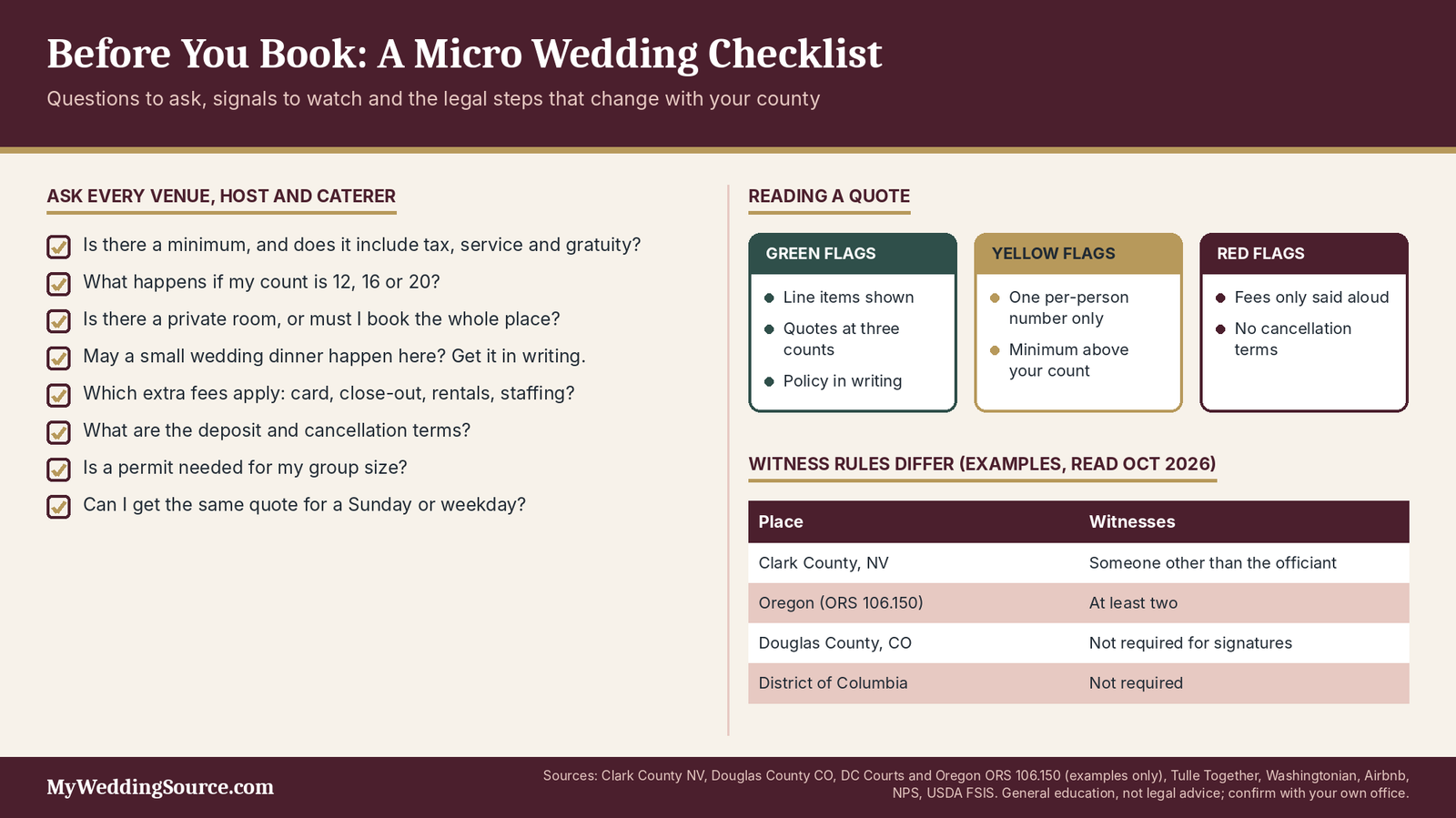
It depends on where you marry, and in a micro wedding the answer changes who must be in the room. Clark County says someone other than the officiant must witness you saying your vows. Oregon law, in ORS 106.150, requires that the parties declare the marriage in the presence of at least two witnesses. Douglas County, Colorado says witness signatures are not required on the license, and the District of Columbia Courts say you do not need witnesses. If your plan is a ceremony with only the officiant present, confirm the witness rule first, and if you do need witnesses, choose people who can sign legibly and will be on time.
| Place | Witnesses | Other detail from the office |
|---|---|---|
| Clark County, Nevada | Someone other than the officiant | $102 license; expires after one year |
| Oregon (ORS 106.150) | At least two | Declaration made before authorized solemnizer |
| Douglas County, Colorado | Not required for signatures | $30 license; use within 35 days |
| District of Columbia | Not required | Self-officiating and friend-officiant forms exist |
Who can officiate, and can you do it yourselves?
Can a friend officiate?
In many places a friend can, but not automatically. Douglas County, Colorado says friends or relatives cannot solemnize a marriage unless they are authorized to conduct a religious or civil ceremony, and the DC Courts say a friend or family member can apply to officiate by completing a form. Clark County requires that the ceremony be performed in Nevada by an officiant licensed in Nevada. Officiants for hire cost less at this size than other vendors: The Knot reports an average of $260 for couples married in 2025 and Zola reports $325, with a typical range of $200 to $450. Our who can officiate a wedding guide covers the categories in more depth.
Can you marry yourselves?
A few places allow it, which can suit a ceremony with no guests. Douglas County, Colorado says a couple may self-solemnize and declare themselves married by signing and recording their license, and the DC Courts say you can apply to self-officiate by listing yourself as the officiant on the application. The DC page adds that both parties must appear in person at the Marriage Bureau and each present a photo ID. Most states do not offer this option, so a general claim that you can marry yourselves anywhere is wrong. Verify with your own issuing office before you plan a ceremony around it.
Can the legal signing and the party happen on different days?
What are the timing limits?
Yes, and many micro weddings do exactly this, but every license carries a clock. A one-year window such as Clark County’s gives you room to apply early, while a 35-day window such as Douglas County’s means you must have the date and the officiant settled before you apply. The return deadline matters too: in Douglas County the signed license must reach the recording office within 63 days of the ceremony, and late returns may incur a fee. If your celebration is months away, the safest sequence is to marry legally first, file the license promptly and treat the party as a separate event.
How do you tell guests which event is which?
Say it plainly, in the invitation and on the website, so nobody feels they attended a rehearsal or missed the real thing. Wording such as “we were married on October 3 and are celebrating on June 12” avoids confusion and removes any implication that the party is a re-do. Decide in advance whether the party will include a ceremony, a toast or only a meal, and tell guests what to expect. Because the legal marriage is already complete, the celebration can be as relaxed or as formal as you like, and your officiant or a friend can lead a short blessing if you want one.
What should you serve and pour for 20 or fewer guests?
Food is where a very small wedding can feel most generous, because the same budget that stretches thin across 120 plates can pay for something memorable across 16. It is also where small-group pricing surprises people, since caterers and bars carry fixed costs that do not scale down evenly. This section covers service styles, the minimum-and-staffing issue and the drink and food-safety decisions that matter most at this size. Our wedding food and catering hub goes deeper on menus and contracts.
Which service style fits a table of 16?
Should you choose plated, family-style or stations?
For one long table, family-style is the natural fit, because shared platters make the meal feel like a dinner party rather than a banquet and need less choreography from the staff. Paperlust’s 2026 micro wedding estimates, which come from a vendor blog and not a survey, put plated service at $100 to $200 per person, family-style or station setups at $60 to $150, and bar service at an additional $30 to $60. The Knot’s 2026 study puts the average caterer at $80 per person, with regional averages from $62 to $123, so a plated menu for 16 can land well above the national average once the per-person rate meets a small-event floor. Ask for two quotes, family-style and plated, and compare the totals rather than the headline rates.
Why do small catering jobs cost more per person?
Because the caterer still has to cover the same setup, travel, staffing and kitchen time for 16 as for 60. A 2026 BestFoodTrucks pricing guide illustrates the pattern, reporting that events under 50 people usually cost more per person since the truck must cover its baseline costs, with minimum spends of $800 to $1,200 for events under 75 guests. A food truck is one catering model, not the norm, but the logic carries over: ask any caterer about a minimum, a flat staffing fee, a travel charge and whether the per-person price changes below a certain count. The Knot’s catering guide says a quote should itemize entrées, appetizers, desserts, drinks, rentals, labor, travel and tax, and it does not address small-count minimums, so ask the question directly.
How should you handle drinks, dietary needs and food safety?
Do you need a full bar for 16 people?
Rarely. A short drink list with wine, beer and one signature cocktail serves a small table well and avoids the bartender fees and tiered packages that make bars costly at larger scale. The Tulle Together roundup lists one restaurant’s wine and beer package at $85 per guest, and Paperlust’s $30 to $60 per person for bar service shows how widely the range can run, so ask whether you pay per drink, per person or per hour. If you bring your own alcohol, ask about corkage fees and check your state’s rules for serving alcohol at a private event, since they vary by state. Whatever you serve, confirm who is responsible for checking identification and for guests who drink too much.
How do you handle dietary needs and leftovers safely?
With 16 guests, you can ask every person about allergies and restrictions when they reply and pass the list to the kitchen, which is much easier than managing 120 menu cards. Ask the caterer or restaurant to confirm in writing how each restricted dish will be prepared, because a general promise to accommodate is not the same as an ingredient check. For food that sits out at a house or outdoor setting, the USDA says perishable food should be refrigerated within two hours, and within one hour when the temperature is above 90°F, and that leftovers last three to four days in the refrigerator. Small gatherings tend to produce generous leftovers, so bring containers and plan who takes what.
How do you photograph and style a wedding with 16 people?
Photography and atmosphere are where a micro wedding can look most different from its larger cousins. With few guests you can photograph everyone, hear the toasts and let the room do much of the decorating, but you are also paying for hours rather than headcount. This section covers how much coverage you need, how to make a small table feel like an occasion and where to put the money a smaller list frees up. Our wedding photography cost guide explains what drives photographer pricing in more detail.
How much photography does a 20-person wedding need?
How many hours do you actually need?
Joy’s 2026 photographer guide estimates $800 to $2,500 for elopements of under 20 guests with 2 to 4 hours of coverage, and $1,500 to $3,500 for micro weddings of 20 to 50 guests with 4 to 6 hours. The Knot’s 2026 study puts the average at $3,000, with a lower quartile of $1,500 and an upper quartile of $4,700, and Zola reports $4,400. Hours, not guests, drive these prices, which is why photography often becomes the biggest single line for a small wedding. Match coverage to the schedule: a 2-hour ceremony and portraits, a 4-hour version that includes dinner and toasts, or a longer package for a weekend.
Is a second photographer or videographer worth it?
Usually not at this size. Joy puts a second shooter at $500 to $1,500, and a single photographer can cover 16 people and a seated dinner without help. If you want a second angle, ask whether a friend can record the vows on a phone, and confirm with the photographer in writing whether guest photography is allowed during the ceremony. Ask also about delivery time, usage rights and whether the quoted price includes edited images, since those terms vary by contract and are worth settling before you pay a deposit.
How do you make 16 people feel like a wedding?
What changes with seating and lighting?
One long table, or two parallel tables, makes a small group feel like a single party, and Paperlust lists this among its micro wedding ideas. Warm lighting from candles or lamps does more for a small room than extra decor, and it is inexpensive, so spend on light before flowers. Place the couple among the guests rather than at a separate head table, because the point of the format is to be close to the people you invited. If the room is large, ask to use only a section of it, so the table is not lost in empty space.
How can you personalize it without spending much?
Zola advises using the extra time to spend quality moments with each guest and choosing a space that reflects what you love. Paperlust’s idea list adds personalized ceremonies with custom vows and readings, and custom favors for every guest. At this size, a toast from each guest, a note at each place setting or a short ceremony written with your officiant costs little and changes the evening more than a new centerpiece would. Keep the personal touches few and specific so they do not turn into a to-do list.
Where should the savings go?
What are the highest-impact upgrades?
Pick the one or two upgrades guests will notice, such as the menu, the beverages, longer photography or a second day, and price them before you commit. The table below uses published rates and simple arithmetic, so it is illustrative rather than a quote. The most common mistake is to spread the savings thinly across many small upgrades, which tends to produce a wedding that looks like a larger event on a lower budget rather than a smaller event done well. Choose the upgrade that fits your top priority from earlier.
| Upgrade | What it buys | Illustrative added cost for 16 guests |
|---|---|---|
| Menu from $80 to $150 per person | Richer food at the same table | $1,120 |
| Wine and beer package at $85 per guest | Drinks with dinner | $1,360 |
| Morning-after brunch at $60 to $150 per person | A second shared meal | $960 to $2,400 |
| Extra photography hours at $200 to $500 per hour | Coverage through toasts | $400 to $1,000 for two hours |
| Second photographer at $500 to $1,500 | Another angle | $500 to $1,500 |
What should you hold back?
Hold back a cushion before you spend the rest. Service charges, an extra hour of coverage, a rental you forgot or a permit fee can each land after the budget feels settled, and with a small total they take a larger bite. Food truck bookings, according to the BestFoodTrucks guide, typically require a deposit of 25 to 50% that is usually non-refundable close to the event, and other caterers have their own schedules, so know when your money is committed. Paperlust also lists a longer honeymoon among the ways couples use savings, which is a reasonable choice if the rest of the plan is already funded.
How do you handle the guest list for 20 or fewer?
At this size, every name has a seat, a plate and an opinion about being left out, and the hardest part of a micro wedding is often the list rather than the budget. The way to keep it kind is to decide the rules before you decide the names. This section covers how to set the number, apply it fairly and tell people who are not coming. For a longer look at the problems that arise, see our guest list problems guide.
How do you decide who is in the room?
What rules make the cut fair?
The Knot’s planners suggest asking about each relationship whether you invite the person because you think you should or because you want to, and sorting names into family by side, friends and other groups so you can see where the bulk comes from. One planner suggests the couple supply half the names and each set of parents a quarter, a split that can shift when one family is larger or contributes more, and at 16 seats that would be about 8, 4 and 4. You do not have to follow that formula, and you should not assume parents are paying, but a written rule is easier to defend than a case-by-case decision. Pick a rule you can say out loud to anyone.
What about plus-ones, children and the wedding party?
The Knot’s advice is to set firm rules, such as inviting only plus-ones you have met or only the children of immediate family, and then cut from there. At 16 guests the wedding party matters more than usual: Axios reported in January 2026, citing The Knot, that the average wedding party has shrunk to eight, down from ten in 2019, and eight attendants would be half your guest list. Many micro-wedding couples skip attendants entirely or keep one or two, and the effect is to make every guest a participant. Remember that the officiant, the witnesses and the photographer occupy chairs too.
How do you tell people, and include those who cannot come?
How do you say no kindly?
Zola recommends telling people early that you are hosting a smaller event so nobody is surprised, and asking yourself whether you can imagine the wedding without a given person. Describe the constraint rather than ranking the person, apply the same rule to everyone in a category and say it before an invitation, a social post or a family group chat can do it for you. A personal call to the people closest to the line usually lands better than a mass message. Avoid public posts of the day itself for a few days if you can, since photographs of a small event make comparison easy.
How can people who are not invited still share the day?
You have more options than you might think. Zola suggests a livestreamed ceremony or a video call for guests who cannot attend, and a sequel wedding or a later party gives the wider circle a real celebration. Some couples send a short video after the ceremony, share photographs the same week or host a casual open house months later. These gestures do not erase the disappointment, but they signal that the smaller list was a decision about size and not about the person. Choose the one that fits your energy and budget, and make it a separate event with its own plan.
FAQ: Micro wedding questions couples ask
These answers give general information based on the sources named in this guide. Prices and rules vary by place, so confirm specifics with your vendors, venue and the government office that issues your license.
Planning and cost questions
How many guests is a micro wedding?
There is no official number. Zola describes a micro wedding as typically 50 or fewer guests, with an average around 30, and a minimony as 10 or fewer, while other sources start the range at 10 or 20. This guide uses 20 or fewer, because below that count a single table, a private room or a house replaces the floor plan of a reception. If your list is closer to 40, the small wedding approach will probably fit your venue and vendor questions better.
Is a micro wedding cheaper than a regular wedding?
The total almost always is, but the cost per guest usually is not. The Knot reports an average of $17,100 for weddings of 1 to 50 guests, against $34,200 overall, yet fixed costs such as photography, the officiant and attire barely change with the list. A $15,000 wedding for 16 guests works out to about $938 per seat, compared with the $292 national average, which is why the total is the number to manage and the per-guest figure is the one to ignore. Savings come mainly from catering, bar, rentals and stationery.
Can I hold a micro wedding in a rental house or at a park?
Possibly, but permission comes first. Airbnb prohibits disruptive parties and events and open-invite gatherings, and we could not confirm how it treats a small invited wedding dinner, so get the host’s permission in writing. Public parks often require a permit: Denali requires one for most ceremonies of more than 12 people, and Cowpens National Battlefield caps ceremonies at 25 and bars chairs and receptions. Check local occupancy and noise rules, and read any lease, condo or homeowners association terms.
Ceremony and guest questions
Do I need witnesses or an officiant for a micro wedding?
It depends on where you marry. Clark County, Nevada requires someone other than the officiant to witness your vows, Oregon requires at least two witnesses, and Douglas County, Colorado and the District of Columbia do not require witnesses. Several places also let a friend officiate with authorization or let a couple self-solemnize, but most do not. Check your county clerk or state vital records office before you plan a ceremony with no one else present.
Do I have to invite family if the list is tiny?
No rule requires it, but the choice is easier to defend if you decide it by rule rather than by person. Many couples invite immediate family and the closest friends, then offer a later party or livestream for the wider circle, as Zola suggests. Tell people early, describe the size limit instead of ranking relationships and treat every category the same way. If a parent is contributing money, discuss which seats come with that contribution before you build the list.
Your next steps
Micro weddings reward early decisions, because a table of 16 leaves little slack and a legal ceremony has a clock. These steps run from the first conversation to a signed contract, in the order that avoids the most expensive surprises.
This week
Which numbers should you set first?
Write down your guest ceiling as a count of seats, including the couple, the officiant and any vendors who eat, and your total budget as a single number. Add the two or three things you want guests to remember, and hold a cushion of 10 to 15% for fees, which is our editorial rule of thumb and not a published figure. If family is contributing, settle who is paying for what and who gets how many seats before you contact a vendor. A one-page summary saves you from explaining the plan to each vendor separately.
Who should you ask for quotes?
Ask one restaurant with a private room, one caterer who works at small scale and one rental house or inn, each at 12, 16 and 20 guests. Request itemized quotes with tax, service charge, gratuity, minimums, rentals and any card fees, and ask for the same dinner on a Saturday and on a Sunday or weekday. Keep every quote in one document and compare totals rather than headline rates. Ask the county clerk about license timing and witness rules in the same week, because those answers can change the date.
Before you pay a deposit
What should you confirm in writing?
Confirm the headcount the price assumes, the minimum spend and whether it includes tax and service, the deposit amount and schedule, and the cancellation and guest-count change policies. For a house or an event space, get the event policy, the occupancy limit and any insurance requirement in writing, and for a park, confirm the permit and the group cap. For the legal ceremony, confirm who officiates, how many witnesses you need and when the license must be used and returned. Terms and state laws vary, so this is general education and not legal advice.
How do you protect yourself if plans change?
Ask what happens if the count falls below a minimum, if you move the date or if a key person cannot attend, and whether the deposit is refundable in each case. Consumer Reports describes event cancellation coverage as separate from liability coverage, with one example of $255 for $25,000 of cancellation coverage, and cautions that policies carry exclusions, so read the fine print and check what your existing policies already cover. Also ask whether a house or venue’s own insurance covers your event or whether you need a one-day policy. Once those answers are written into the contract, you are ready to pay the deposit.
Sources & methodology
- The Knot, The Average Cost of a Wedding — 2026 Real Weddings Study (10,474 U.S. couples married in 2025): $34,200 average, $292 per guest, $17,100 for 1 to 50 guests, vendor averages.
- The Knot, Average Wedding Guest List Size — 117 average guests, 2019 to 2025 trend, guests by spending band and destination type; intimate defined as under 50.
- The Knot, Average Cost of a Wedding Photographer — $3,000 average, quartiles, hourly assumption, add-on factors.
- The Knot, Average Wedding Catering Cost — $80 per person average, regional range, what a quote should itemize.
- The Knot, How to Cut Your Wedding Guest List — planner advice on relationships, contribution splits, plus-ones and children.
- Zola, Micro Weddings — definitions of micro wedding and minimony, ideas, pros and cons, tips (published December 2023, updated February 2024).
- Zola, Average Cost of Weddings in 2026 — $36,000 average, guest-driven versus fixed costs, vendor averages.
- CNBC via NBC Bay Area, The average wedding costs well over $30,000 — The Wedding Report shares of 2023 weddings by size; Zola and The Wedding Report quotes (July 2024).
- Paperlust, How Much Does a Micro Wedding Cost? (2026) — vendor-blog estimates of total, per-guest, line-item and catering ranges; unverified method.
- Paperlust, Micro Wedding Trends 2026 — micro wedding format ideas; some growth figures are cited without clear sourcing and were not used.
- Joy, Wedding Photographer Cost — elopement and micro wedding coverage hours and price ranges, second shooter and extra-hour rates.
- Joy, 2026 Wedding Trends — deliberate downsizing and multi-day celebrations (updated July 2026).
- Axios, Latest wedding trend: Smaller entourages — average wedding party of eight, down from ten in 2019, citing The Knot.
- Tulle Together, NYC Restaurant Wedding Venues and How Much They Cost — restaurant pricing models, private room sizes and add-on fees, with New York examples (2025).
- Washingtonian, Need a Last-Minute Wedding Venue? Book a Restaurant — Washington-area restaurant minimums, buyouts and lead times.
- BestFoodTrucks, Cost to Hire a Food Truck (2026) — small-event minimums, per-person costs and deposits; one catering model only.
- National Park Service, Cowpens National Battlefield wedding permits — 25-person ceremony cap, fees, restrictions and lead time.
- National Park Service, Denali weddings, ceremonies and gatherings — permit required for most groups larger than 12; $200 application fee.
- National Park Service, Grand Canyon special use permits — wedding application and management fees, two-hour blocks, no exclusive use.
- Clark County, Nevada: how to get married — $102 license, witness requirement, one-year validity, Nevada-licensed officiant.
- Douglas County, Colorado: marriage licenses — self-solemnization, no witness signatures required, $30 fee, 35-day use window, 63-day return.
- District of Columbia Courts: marriage FAQs — no witnesses required, self-officiating and friend-officiant applications.
- Oregon Revised Statutes, Chapter 106 — ORS 106.150, declaration before at least two witnesses.
- Airbnb, Airbnb announces global party ban — August 2020 party and event ban and 16-person occupancy cap.
- CBS Los Angeles, Airbnb makes its ban on house parties permanent — June 2022 announcement making the ban permanent.
- Consumer Reports, Should You Buy Wedding Insurance? — cancellation versus liability coverage, example premiums, exclusions, homeowners coverage (article date not stated on the page we read).
- NerdWallet, Wedding Insurance — liability versus cancellation, hosting at a friend’s home and liquor liability.
- USDA Food Safety and Inspection Service, Leftovers and Food Safety — two-hour and one-hour rules, leftover storage times.
Methodology. The Knot and Zola figures are survey or published-average findings that cover weddings of every size, and no source we found isolates weddings of 20 guests or fewer, so the Knot 1-to-50 band and the Paperlust estimates serve only as plausibility checks. Statutes and official clerk, court and park pages are treated as verified facts for the single office named, as read in October 2026, and are examples rather than national rules. The per-guest table, the $3,940 to $4,100 dinner example, the $7,900 to $26,700 line-item sum and the upgrade costs are our own arithmetic from published figures and are labeled illustrative, and the choice of 20 guests as the working range and the 10 to 15% cushion are editorial judgment. Vendor blogs and restaurant examples reflect specific businesses and cities and are not quotes.
Freshness. Recheck the Knot and Zola figures when the 2027 Real Weddings Study and Zola’s next cost report appear, and recheck any license fee, witness rule, officiant rule, park permit fee or restaurant price directly with the issuing office or vendor before you commit, since all of them change. Airbnb’s event policy and any host’s rules should be confirmed with the host in writing.