

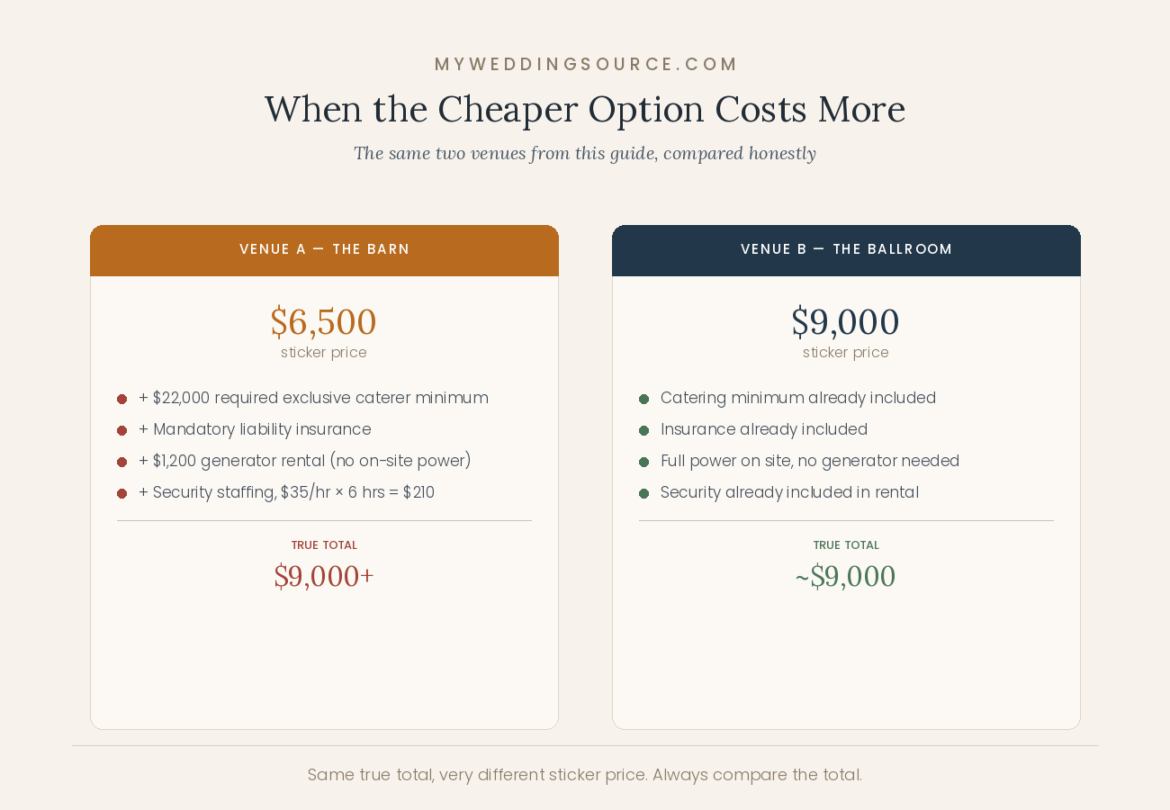
Two venues quote nearly the same number. One is a barn with a $6,500 rental fee. The other is a hotel ballroom at $9,000. On paper, the barn wins by $2,500. Six months later, the couple who picked the barn discovers what the low price left out. It requires an exclusive caterer with a $22,000 food-and-beverage minimum and mandatory liability insurance. It also requires a $1,200 generator rental, because the property has no permanent power for a tent. On top of that comes a security guard at $35 an hour for six hours. The “cheaper” venue ends up costing several thousand dollars more than the one they passed over.
When planning your wedding budget, remember to account for all hidden costs that may arise. A comprehensive wedding budget is crucial for ensuring you do not exceed your financial limits.
Nothing about that story involves a scam or a dishonest vendor. It involves a sticker price that never claimed to be the total cost, and a couple who compared two numbers instead of two full pictures. This is the actual shape of most wedding budget problems. It is rarely a single dramatic mistake, and much more often a series of reasonable-sounding numbers that never quite line up with what actually gets paid.
To avoid potential pitfalls, couples need to have transparent discussions about their wedding budget and financial expectations. Understanding how to navigate your wedding budget effectively can save you from unexpected expenses.
A wedding budget is not one number you set once and defend. It is a moving comparison between what vendors quote, what contracts require, what fees add on top, and what real life does to a plan between booking and the wedding day. This guide walks through how to build that comparison honestly. It shows where the real costs hide, which quotes deserve a second question, how deposits create risk, and what a genuine red flag looks like versus normal industry practice. It closes with a full pre-signing audit you can run before money changes hands.
Establishing a realistic wedding budget requires looking at all potential costs, including those that might not be immediately apparent when planning. This guide provides a roadmap to help you with your wedding budget.

Save money for a wedding, wise to manage your finance by investing in gold, utilizing banking services, and understanding the broader economy and currency business, even down to every last coin.
1Quick Answer: What a Realistic Wedding Budget Actually Requires
Understanding the elements of a wedding budget is essential for any couple. Make sure your wedding budget has room for the unexpected and doesn’t overlook any crucial aspects.
A workable wedding budget has four parts, and most budget problems trace back to skipping one of them.
Calculating your wedding budget isn’t solely about gathering quotes; it’s about ensuring those quotes reflect total costs. Every couple should be aware of how their wedding budget can impact their overall planning.
A real total, not a sticker price. Every category needs its taxes, service charges, gratuities, and commonly-required extras added before you compare it to anything else.
Creating a wedding budget should involve setting aside a contingency fund for any potential overruns. A flexible wedding budget is crucial for managing unexpected changes.
A category breakdown built around your actual guest count, since guest count moves the total more than almost any other single decision.
As you establish your wedding budget, include an analysis of how each category contributes to your overall spending. This will ensure your wedding budget stays on track and within limits.
A contingency amount set aside on purpose, not assumed to exist somewhere in the gap between quotes and reality.
Make room in your wedding budget for necessary expenses like gratuities or last-minute purchases. These often overlooked details can significantly affect your total wedding budget.
A habit of verifying before paying, applied every time, not just for the vendors that feel risky.
Budgeting for your wedding is more than just about tracking large expenses; it’s the little things that can add up and impact your wedding budget significantly.
The rest of this guide builds out each of those four pieces in enough detail that you can actually use them. It starts with the part almost no one warns you about before it happens to them.
Setting priorities early in the planning process is important for your wedding budget. Identify which aspects are most important to you and allocate your wedding budget accordingly.
2What Nobody Mentions Until It Happens
3The Real Cost Structure of a Wedding Budget
4Hidden Costs to Check
“Hidden” does not mean secret. It usually means the cost sits one layer below the number a vendor leads with, and nobody points it out unless you ask.
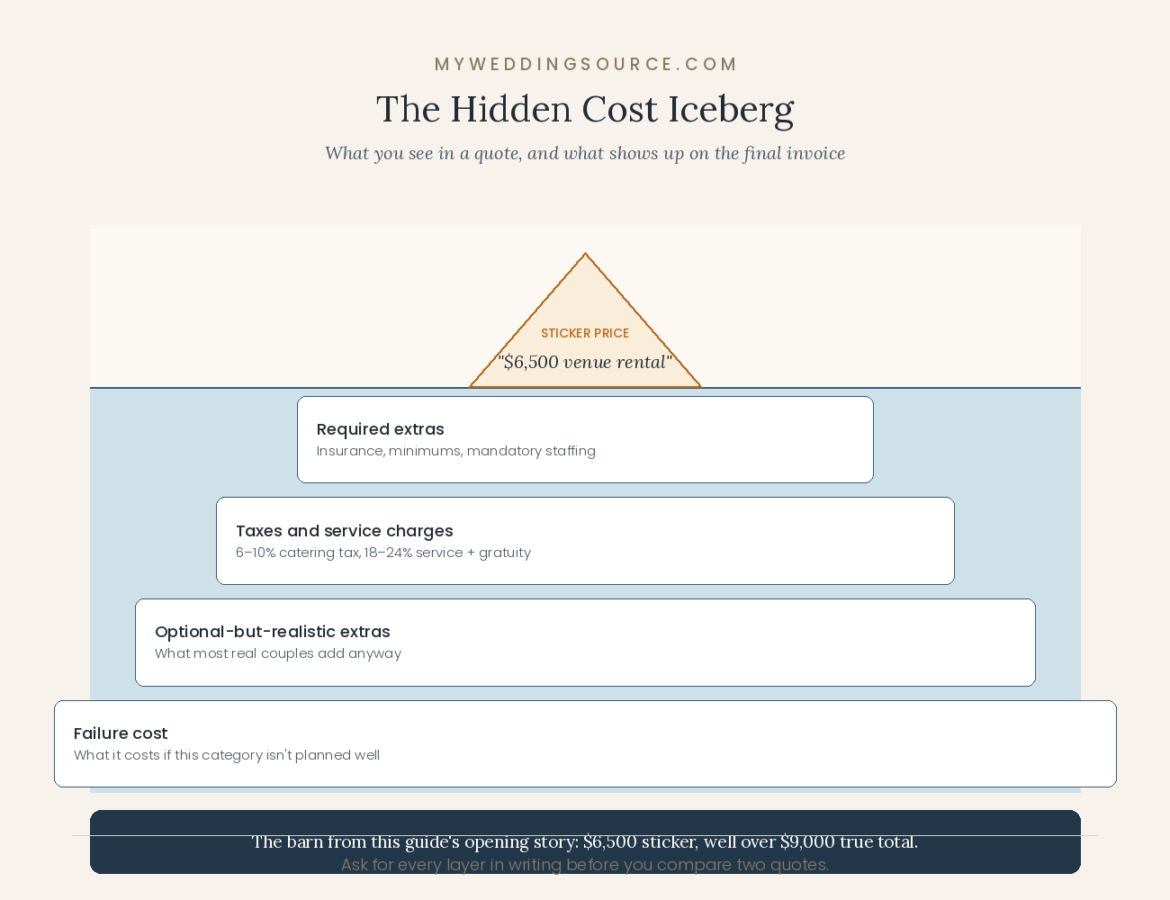
The five-part framework
Almost every wedding budget category breaks down into the same five layers. Learning to check all five, every time, catches most of the surprises before they become surprises.
- Sticker price: the headline number advertised or quoted first.
- Required extras: costs the vendor requires as a condition of booking, whether or not they are mentioned up front.
- Optional but realistic extras: not contractually required, but chosen by most real couples in practice.
- Taxes and fees: sales tax, service charges, gratuity, and administrative fees layered on top of the base price.
- Failure cost: what it costs you if something in this category is not planned correctly.
Where this shows up by category
Venues. Roughly 57 percent of couples encounter mandatory service fees at their venue, according to recent industry cost surveys. Those who do typically face close to double the unexpected fees of couples at venues without them. Ask directly whether the quote includes required insurance, a security deposit, overtime charges, a cleaning fee, or a mandatory vendor list that limits your options.
Catering. Sales tax on catering adds 6 to 10 percent in many states, and it is not always included in the number a caterer first quotes verbally. Service charge and gratuity, often 18 to 24 percent combined, can functionally double a modest per-plate price by the time the final invoice arrives.
Attire. A dress’s quoted price almost never includes alterations, which commonly run $300 to $800 and are treated as a completely separate transaction with a separate vendor.
Overtime, across nearly every vendor category. Photographers, DJs, venues, and planners frequently charge $200 to $500 per hour once an event runs past its contracted end time. A reception that runs 90 minutes long across three vendors can add over $1,000 in overtime alone.
Delivery, setup, and breakdown. Florists, rental companies, and bakeries often price delivery and setup separately from the product itself. These fees scale with distance, complexity, and how early or late the vendor needs access to the venue.
Before You Pay Anything
Run this check before sending a deposit to any vendor, not just the ones that feel expensive or unfamiliar.
- Ask for the total price including tax, service charge, and gratuity, in writing, not just the base rate.
- Ask what is required versus optional, and get the required list in writing.
- Ask what triggers an overtime charge, and what that charge costs per hour.
- Ask what happens if your guest count changes after the deposit is paid.
- Compare the total, not the sticker price, against every other quote you are considering.
A hidden cost is not automatically dishonest
A venue charging an administrative fee is not inherently suspicious. It does, however, make “What exactly does this fee cover?” a completely reasonable question to ask before you sign anything.
5How to Compare Quotes Without Getting Fooled by “Starting At” Pricing
6Payment Schedules, Deposits, and Where Refund Risk Hides
A deposit is not just an upfront cost. It is the moment your wedding budget stops being a plan and starts being money a vendor actually holds.
Typical deposit structures
Most wedding vendors request 25 to 50 percent at booking. The remainder is typically due somewhere between 30 and 90 days before the event, though exact terms vary widely by vendor type and individual business. Some request three or more smaller payments spread across the planning timeline instead of two large ones. Neither structure is inherently better. What matters is whether the schedule fits your own cash flow, and whether the cancellation terms attached to each payment are ones you can live with.
Green, Yellow, and Red Flags in Payment Terms
Green flag. The contract states the total price, exact payment amounts and due dates, and a specific, written cancellation and refund policy for both sides.
Yellow flag. The vendor asks for a large deposit, well above the typical range for their category. This alone does not prove a problem. Check the refund policy, the payment method required, and how long the business has operated before deciding whether it is a reasonable term or a warning sign.
Red flag. The vendor pressures immediate full payment before any contract exists. Or they insist on a payment method that is difficult to reverse, or grow evasive when asked direct questions about refund terms.
Why payment method matters as much as payment amount
Paying by credit card gives you a real, practical protection. You can typically dispute a charge if a vendor fails to deliver, within about 60 days of the statement date, depending on your card issuer’s policy. Wire transfers, cash, payment apps like Venmo or Zelle, and cryptocurrency generally do not offer that same recourse once the money has moved. This does not mean every vendor requesting a non-card payment is dishonest. It means the protection you have if something goes wrong depends heavily on how you pay, not just who you pay.
Questions That Feel Awkward but Are Worth Asking
These questions can feel confrontational to ask a vendor you are excited about. Ask them anyway, ideally before any money changes hands.
- What happens if you become unable to work before our wedding, due to illness, injury, or an emergency?
- What happens if your business closes or you stop operating before our date?
- Is our deposit refundable under any circumstances, and specifically which ones?
- Who exactly will be performing the service on our wedding day, and is that person named in the contract?
- What happens if we need to change our date after booking?
- Do you carry liability insurance, and can you provide proof if our venue requires it?
A professional vendor answers these directly, often with language already sitting in their standard contract. Repeated deflection is more informative than any single answer.
7Three Sample Budgets at Different Total Levels
These are illustrative examples, not templates to copy exactly. Use them to see how the same categories shift proportionally at different total budgets, then build your own version from your actual priorities.
A modest budget: roughly $15,000, 60 guests
| Category | Illustrative amount |
|---|---|
| Venue and catering | $7,200 |
| Photography (photo only) | $2,200 |
| Attire and beauty | $1,300 |
| Florals (minimal, DIY-supplemented) | $900 |
| Music (playlist + speaker rental) | $300 |
| Stationery, cake, admin, misc | $1,400 |
| Contingency (~7%) | $1,000 |
| Total | ~$14,300 |
At this level, the biggest savings usually come from a smaller guest list and a self-serve or playlist-based approach to music. Many couples treat professional photography as the one non-negotiable while trimming almost everything else.
A mid-range budget: roughly $35,000, 120 guests
| Category | Illustrative amount |
|---|---|
| Venue and catering | $17,500 |
| Photography and videography | $4,500 |
| Florals and decor | $3,200 |
| Music and entertainment (live band or DJ) | $2,400 |
| Attire, alterations, beauty | $2,600 |
| Stationery, cake, transport, admin | $2,600 |
| Contingency (~6%) | $2,000 |
| Total | ~$34,800 |
An elevated budget: roughly $75,000, 150 guests
| Category | Illustrative amount |
|---|---|
| Venue and catering | $38,000 |
| Photography and videography | $9,500 |
| Florals and decor (larger installations) | $8,500 |
| Music and entertainment | $5,500 |
| Attire, alterations, beauty | $5,200 |
| Planner or coordinator | $3,800 |
| Stationery, cake, transport, admin | $3,000 |
| Contingency (~5%) | $3,700 |
| Total | ~$77,200 |
Notice that the contingency percentage actually shrinks slightly as the total budget grows. Larger budgets often have more built-in flexibility across categories already. This is a general pattern, though, not a reason to skip a real contingency line at any budget level.
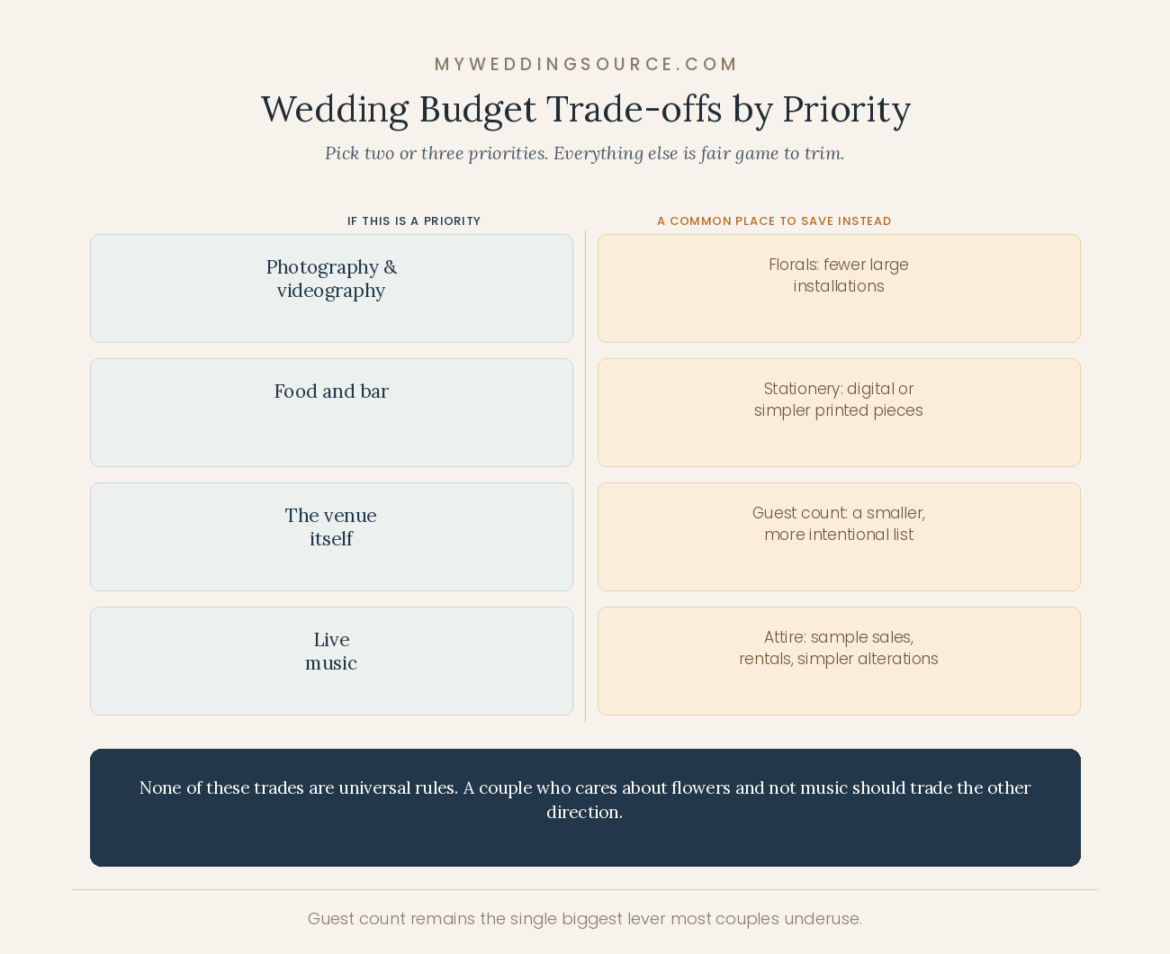
8Wedding Budget Trade-offs by Priority
Every dollar moved toward one category comes from somewhere else. Couples who name their priorities early tend to end up happier with the trade-offs than couples who cut evenly across every category under pressure.
Pick two or three priorities, honestly
Photography, food, the venue itself, music, or the guest experience: any of these might top your list. Choose the two or three that genuinely matter most to you as a couple, not the ones you assume you are supposed to care about. Everything else becomes a place to look for savings without guilt.
What trading up or down actually looks like
| If this is a priority | A common place to save instead |
|---|---|
| Photography and videography | Florals: fewer large installations, more reused ceremony-to-reception pieces |
| Food and bar | Stationery: digital invitations or simpler printed pieces |
| The venue itself | Guest count: a smaller, more intentional list |
| Live music | Attire: sample sales, rental options, simpler alterations |
None of these trades are universal rules. A couple who cares deeply about flowers and barely about music should trade in the opposite direction. The table exists to show that trade-offs are normal and expected, not a sign that the budget failed.
Guest count as the biggest lever
Each additional guest commonly adds $200 to $450 once every category scales with headcount. Trimming the guest list by even 15 to 20 people can free up meaningfully more room than most individual vendor negotiations. This is often the least emotionally comfortable lever, and the most financially powerful one. That is exactly why it deserves an honest look before assuming the budget itself is simply too small.
9What the Contract May Not Make Obvious
A contract can be entirely honest and still fail to make certain consequences obvious until you go looking for them specifically.
What “final headcount” actually locks in
Most catering and venue contracts set a deadline, often two to three weeks out, after which your guest count can only go up, not down, without penalty. A guest list that shrinks after that date rarely refunds anything. Confirm this deadline explicitly and treat it as the real cutoff for late invitations or last-minute additions.
What “postponement” costs versus “cancellation”
Many contracts treat postponing a wedding very differently from cancelling one outright, sometimes preserving your deposit toward a new date and sometimes not. Read this clause specifically rather than assuming either outcome, since assuming the more generous interpretation can be an expensive mistake if it turns out to be wrong.
What counts as “your responsibility” for damage or overage
Some venue and rental contracts hold the couple financially responsible for damage caused by guests, vendors, or weather, not just the couple directly. Confirm who is liable for a spilled drink on a rented dance floor, a broken rental chair, or storm damage to an outdoor setup. Then consider whether event insurance makes sense given what you find.
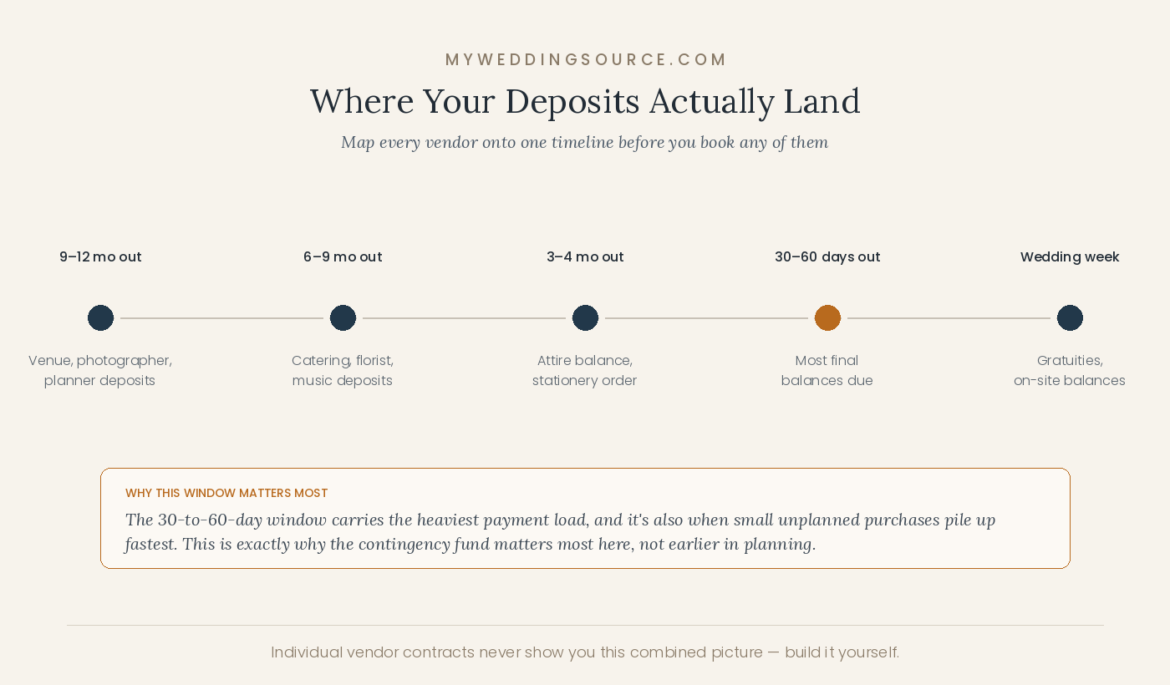
10A Sample Payment Timeline Across Multiple Vendors
Individual vendor contracts rarely show you the combined picture. Building your own combined timeline is the only way to see whether your payment schedule actually fits your cash flow.
| Timing | Typical payments due |
|---|---|
| At booking, 9–12 months out | Venue deposit, photographer deposit, planner deposit if hired |
| 6–9 months out | Catering deposit, florist deposit, music/entertainment deposit |
| 3–4 months out | Attire final fitting balance, stationery final order |
| 30–60 days out | Most vendor final balances, based on confirmed final guest count |
| Wedding week | Cash gratuities for day-of vendors, any remaining balances due on-site |
Notice how many payments cluster in the 30-to-60-day window before the wedding. This is exactly the period when couples also tend to make the most small, unplanned purchases. That is precisely why the contingency fund matters most in these final weeks, not earlier in the process when spending feels more spread out.
11How to Talk to Your Partner About Wedding Budget Money
For many couples, this is the first time they have jointly managed a budget this large. The conversation itself deserves as much planning as any single vendor decision.
Start with numbers, not vendors
Before browsing venues or photographers, sit down separately. Write down a number each of you would be comfortable spending, along with where that money would come from. Compare the two numbers before falling in love with anything that costs more than either of you actually feels good about spending.
Talk about debt tolerance explicitly
Some couples are comfortable financing part of a wedding; others consider that a firm boundary. This is a values conversation, not just a math problem. Assuming your partner shares your comfort level without asking directly is a common source of tension later in planning. It tends to surface at the exact moment a beautiful but expensive option appears.
Revisit the budget together, on a schedule
Set a recurring check-in, monthly is reasonable for most timelines, to review what has been spent, what is still due, and whether the contingency fund remains intact. A budget that only gets discussed when something goes wrong tends to generate more conflict than one reviewed calmly and regularly.
12Building a Contingency Fund That Actually Covers Real Scenarios
A contingency fund only works if it is sized against real, specific risks rather than a vague sense that something might come up.
How much is realistic
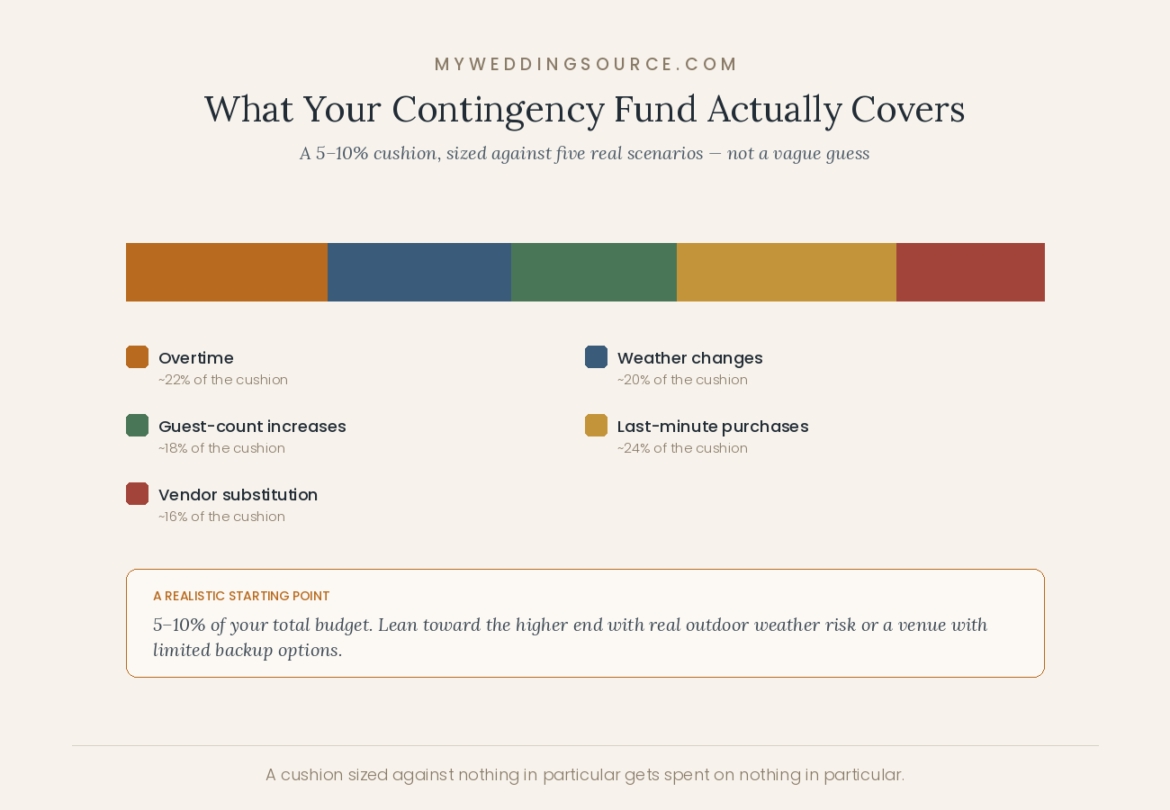
A cushion of roughly 5 to 10 percent of the total budget covers most ordinary overruns without requiring a dramatic buffer that sits unused. Couples in regions with real weather risk, or planning outdoor events with limited backup options, often lean toward the higher end of that range.
What the cushion is actually for
- Overtime. A reception that runs long across two or three vendors can add several hundred dollars per hour, per vendor.
- Weather changes. A last-minute tent rental, additional heaters, or a change of ceremony location can cost more precisely because it is arranged on short notice.
- Guest-count increases before the final headcount deadline. A handful of late additions, multiplied by your per-guest catering cost, adds up faster than it seems.
- Last-minute purchases. Forgotten items, from an extension cord to a missing undergarment, tend to surface in the final week, when convenience pricing is the only option left.
- Vendor substitution. If a vendor becomes unavailable close to the date, a replacement booked on short notice often costs more than one booked a year in advance.
Worst-Case Scenario — and the Backup Plan
Picture this: three weeks before the wedding, your caterer calls to say they are closing the business immediately, with your deposit already spent on other obligations. This happens more often than couples expect, particularly with smaller, independent operators.
A workable backup plan starts well before this moment, not during it. Keep a running list of two or three alternative vendors in each major category, even ones you did not book, along with their general price range. Keep every contract and payment record in one place you can access quickly. Disputing a charge or filing a complaint requires documentation, and searching for it under pressure is the last thing you want. If you paid by credit card, you likely have a real path to recovering some or all of the lost deposit. If you paid by wire transfer or cash, recovery becomes considerably harder, which circles back to why payment method matters as much as it does.
None of this means you should expect a vendor to fail. Most do not. It means a plan that only works if nothing goes wrong is not really a plan. A few hours of preparation now costs far less than a scramble later.
13Scam Check: Wedding Budget Red Flags Worth Knowing

The wedding industry has a specific set of features that make it genuinely attractive to fraud. Large upfront payments, one-time transactions, emotional urgency, and couples who have never hired this type of vendor before, all play a role. Most wedding fraud is not dramatic. It is a photographer who disappears after the deposit, or a rental company that never existed at the address on its website.
Common patterns worth recognizing
- A website or listing that only recently appeared, with no verifiable business history, physical address, or reviews outside its own site.
- Pressure to pay the full amount immediately, before a written contract exists.
- A request for wire transfer, cash, gift cards, or cryptocurrency as the only accepted payment method.
- Portfolio images that appear elsewhere online under a different name, a sign of a stolen or borrowed portfolio.
- Reviews that all appeared within a short window, use similar phrasing, or cannot be verified on an independent platform.
- A vendor who resists providing a written contract or grows vague when asked direct questions about deliverables and refunds.
How to verify a vendor before paying anything
Search the business name along with the word “complaint” or “scam” as a first, quick check. Confirm a real business address exists and matches what the vendor lists publicly. Ask for a reference from a couple who used the vendor in roughly the past year, not an old testimonial pulled from a website. The Federal Trade Commission’s consumer protection resources maintain general, current guidance on recognizing scam patterns and your options if a payment already went through. The same warning signs apply whether the scam involves a wedding vendor or any other large purchase.
What to do if you already paid
Act quickly rather than waiting to see if the situation resolves itself. If you paid by credit card, contact your card issuer immediately to dispute the charge. Most issuers set a limited window, often around 60 days, for filing one. Report the vendor to your state’s consumer protection or attorney general’s office, and to the platform where you found them if applicable. Keep every piece of correspondence, since a documented pattern strengthens both a dispute and any report you file.
A red flag is information, not a verdict
A newer business or a vendor without hundreds of reviews is not automatically a scam. Plenty of excellent vendors are new, small, or simply do not prioritize online reviews. Treat any single warning sign as a reason to ask more questions, not an automatic disqualifier.
14What Pinterest Does Not Show You About Wedding Budgets
Pinterest is genuinely excellent at showing you a candle-lined aisle, a five-tier cake, and a reception dripping in greenery. It is considerably less committed to showing you the extension cords, the fire-code restrictions, and the delivery window. It is especially uncommitted to showing what happens to that greenery after six hours in an unair-conditioned tent.
The gap between inspiration and logistics
A styled photo shoot is built by professionals, over hours, for one perfect frame. It often includes details that never had to survive an actual event. Candles that never had to meet an open-flame policy. Florals that never had to be delivered on a tight morning-of schedule. A cake that never had to sit through a 90-degree cocktail hour. None of this makes the inspiration dishonest. It means the photo is showing you a result, not the budget, permits, labor, and contingency planning that made the result possible.
A cake is food, architecture, and a delivery problem wearing frosting
A five-tier buttercream cake outdoors in August can look spectacular in a photo. Butter, unfortunately, has strong opinions about 92-degree weather. A cake that looked flawless during a morning delivery can look considerably less structural by the time it is cut at 8 p.m. Budget for the reality of your actual venue and season, not just the version of the design that exists in a controlled studio shoot.
Translating inspiration into a budget line, not just a mood board
When a specific image is the goal, ask your vendor directly what it would take to recreate it under your actual conditions. Name your venue, your season, your timeline, and your guest count specifically. The answer is often a real number. Sometimes it differs from the sticker price you saw associated with a similar-looking package, but it is always more useful than the photo alone.
15The Final Budget Audit Before You Sign Anything
Run this audit before signing a major contract. Run it again roughly 60 to 90 days before the wedding, once most vendors are booked and most of the picture is visible.
The pre-signing audit
- Total cost, not sticker price, confirmed for this specific vendor at your actual guest count and date.
- Payment schedule mapped against your actual cash flow, not just the total amount due.
- Cancellation and refund terms read in full, not skimmed.
- Overtime, damage liability, and substitution clauses identified specifically, not assumed.
- Payment method chosen for the protection it offers, not just convenience.
The pre-wedding audit, 60 to 90 days out
- Every vendor total added up against the master budget, including any add-ons booked after the original contract.
- Remaining balances and their due dates listed in one place, not scattered across separate contracts.
- Contingency fund confirmed as still intact, not already absorbed by smaller purchases along the way.
- Commonly missed expenses checked specifically: gratuities for day-of vendors, marriage license fees, postage for final mailings, and welcome bags or favors if planned.
- A single point of contact designated for wedding-day payment issues, so a last-minute problem does not require finding the couple in the middle of their own reception.
A budget that survives this audit twice, once before signing and once before the wedding, is far more likely to survive contact with the actual day. Most budget failures are not one catastrophic mistake. They are several small, unverified assumptions that compound quietly until the final invoice arrives.
16Who Actually Pays: A Modern Look at Wedding Budget Contributions
Traditional advice about who covers which category assumes a specific family structure. It also assumes a specific set of financial relationships that do not describe most couples planning weddings today.
There is no default anymore, and treating one as default causes real problems
Some couples fund the entire wedding themselves. Others receive contributions from one or both sets of parents, split in ways that have nothing to do with older tradition. Blended families sometimes contribute from more than two households at once. Couples marrying a second time may have adult children who are or are not involved financially. None of these arrangements is more correct than another. Assuming a traditional split before confirming what is actually being offered is a common source of both budget errors and family tension.
Get contributions confirmed early, specifically, and in a form you can plan around
A vague offer to “help with the wedding” is not a budget line item. Ask directly: how much, for what category, and by when. If a contribution is tied to a specific vendor category, such as covering catering, confirm that before signing a contract that assumes the money will arrive. Written confirmation, even an informal text message summarizing the conversation, gives everyone a shared reference point if memories differ later.
Build the budget around confirmed money, not hoped-for money
Structure your working budget in two tiers. Confirmed contributions are ones you can rely on for contracts and deposits. Possible future contributions become a bonus toward the contingency fund, or a specific splurge, if they materialize. This protects you from signing a contract that only works if an uncertain contribution comes through exactly as hoped.
17Weather Check: Budgeting for a Backup Plan
Weather risk is a budget line item, not just a logistics concern. Couples who treat it as purely logistical often discover the cost only when they need the backup plan on short notice.
What a real backup plan costs
A tent rental arranged months in advance costs meaningfully less than the same tent arranged four days before a forecasted storm. Availability is limited then, and pricing reflects the urgency. Sidewalls, flooring, additional heaters or fans, and extra labor for a rapid setup change all add cost on top of the base rental. If your venue has any outdoor component, price the backup plan now, at today’s rates. Treat that number as a real, budgeted possibility, not something to figure out if it comes up.
What to ask your venue specifically
- Is there an indoor backup space included in the rental, or is it a separate cost?
- How much advance notice do you need to activate the weather plan?
- Who decides when the backup plan activates, and by what deadline?
- Does the backup plan change your guest capacity or layout?
18Accessibility Check: The Costs Couples Forget to Budget For

19Legal Check: Fees That Belong in Every Wedding Budget
Marriage-related legal costs are small individually and easy to forget collectively, which makes them a common source of last-minute, unplanned spending.
The core legal line items
- Marriage license fee, which varies by state and county and is rarely more than $100, but is still a real cost to budget for.
- Officiant fee, if you are not using a friend or family member, commonly a few hundred dollars.
- Name-change costs, including a new passport, a new driver’s license, and updated account documentation, which add up to a real, if modest, total across every institution involved.
- Event insurance, commonly $150 to $600 depending on coverage, and worth pricing even if you ultimately decide against it.
None of these individually breaks a budget. Collectively, they are exactly the kind of small, easy-to-forget costs this guide warned about earlier. They deserve their own line, rather than getting absorbed silently into a miscellaneous category.
20Regional and Seasonal Cost Variation
The single biggest lever many couples never fully consider is not a vendor choice at all. It is location.
The regional gap is enormous
Average wedding costs in New Jersey run above $60,000. Comparable celebrations in Mississippi average closer to $20,000, a roughly $40,000 gap for a similar guest count and vendor quality. A domestic destination wedding averages around $41,700, compared to roughly $32,600 for a hometown celebration, according to recent industry cost studies. If your plans have any flexibility on location, this is worth exploring before assuming your budget is simply too small for the wedding you want.
Season and day of week move price too
Saturdays in peak season, typically late spring through early fall in most U.S. regions, command the highest prices across nearly every vendor category. A Friday or Sunday date, or a wedding in a shoulder season, can meaningfully lower costs on venue rental, catering minimums, and vendor availability. Often, this comes without any visible difference in quality of service.
21Guest Experience Check: The Costs Your Guests Absorb
A wedding budget usually tracks what the couple spends. It rarely tracks what the guest list collectively spends to attend, and that second number shapes real decisions guests make about whether and how they participate.
What attending actually costs a guest
Travel, lodging, a gift, appropriate attire, and often time off work all add up before a guest sets foot at your reception. A destination wedding or a Saturday-night event with no hotel block can easily push a single guest’s total cost past $500 to $1,000. That is especially true for out-of-town family and wedding party members already covering their own attire and, in some cases, additional pre-wedding events.
Budget-conscious choices that genuinely help guests
- Negotiating a hotel room block, even a small one, which often costs the couple nothing but time.
- Choosing a date and location with reasonable flight and lodging costs, if guest travel is a real factor.
- Being upfront on your wedding website about a cash bar, dietary options, or other details that affect a guest’s own planning and spending.
- Avoiding a second, separate formal-attire request for a welcome event on top of the wedding itself.
None of this means guest cost should override your own priorities. It means factoring guest experience into your planning honestly. Attendance decisions have everything to do with what you are asking financially of the people you invited.
22Vendor Substitution: What Happens When Someone Cannot Perform
Vendors get sick, get into accidents, and occasionally close their businesses without much warning. A contract’s substitution clause determines what happens to your budget when this happens to you.
What a strong substitution clause actually says
A well-written contract names what happens if the specific person you hired cannot perform. It should state whether the business must provide a comparable substitute. It should also cover whether you are entitled to a partial refund if no substitute is available, and what “comparable” actually means in practice. A contract that stays silent on this question leaves you negotiating from a position of weakness at the worst possible moment, days or hours before your wedding.
What to do if it happens to you
Contact the vendor immediately for a written explanation and their proposed solution. Review your contract’s specific language rather than relying on memory or assumption. If a business has genuinely closed, check whether you paid by a method that allows a dispute. Contact your venue coordinator or planner too, if you have one. They often maintain relationships with vendors who can step in on short notice, sometimes at a rushed but reasonable rate.
23DIY Versus Hiring Out: The Real Cost Comparison
DIY elements can genuinely save money. They can also cost more than expected once materials, tools, storage, transportation, and your own time enter the calculation honestly.
Where DIY tends to actually save money
Simple, low-risk elements with forgiving margins for error tend to save real money without much downside. Printed welcome signage, favor packaging, or simple centerpiece elements using purchased flowers rather than professionally arranged ones are good examples, even if the result is imperfect.
Where DIY tends to cost more than it looks like it will
Anything involving food safety, structural stability, or specialized skill carries real risk. A DIY wedding cake for a large guest count, homemade alcohol-based favors, or a friend “doing” the flowers without professional experience are common examples. Each can lead to an expensive redo, a food-safety problem, or a result that costs more in fixes than a professional quote would have cost from the start. Price the professional option first, then decide whether the DIY version genuinely saves enough to justify the time and risk involved.
24Mistakes That Are Easy to Avoid Once You See Them
Most of these connect back to sections earlier in this guide. Together, they cover the patterns behind the majority of wedding budget problems.
- Comparing sticker prices instead of total costs across vendors in the same category.
- Assuming a promised family contribution is confirmed money before it actually arrives.
- Treating the guest list as fixed while negotiating hard on much smaller line items.
- Skipping the contingency fund because the base budget already feels tight.
- Paying by a method with no dispute protection to save a small transaction fee.
- Not reading the postponement and cancellation clauses until they suddenly matter.
- Forgetting small, recurring purchases that never get their own line item.
- Pricing DIY only by materials, without accounting for time, tools, and the cost of a redo.
25Safety Check: Where Safety and Budget Actually Overlap
Safety measures are easy to treat as optional extras when a budget feels tight. Some of them are worth protecting even when money is limited.
Where cutting corners creates real risk, not just inconvenience
Alcohol service without a licensed bartender or without a plan for cutting off visibly intoxicated guests creates real liability, not just a logistics gap. Open flames, whether candles or a fire feature, without checking your venue’s specific policy can void insurance coverage or create an actual fire risk. Extreme heat or cold without a real plan genuinely endangers elderly guests, young children, and anyone with a health condition sensitive to temperature. An assumption that people will manage is not a plan.
What this means for your budget, specifically
Event liability insurance, commonly $150 to $600, is one of the least expensive line items in an entire wedding budget relative to what it protects against. A licensed, insured bartender costs more than an unlicensed friend pouring drinks, and that gap is a reasonable place to spend rather than save. Weather mitigation for genuine heat or cold risk, covered earlier in this guide, belongs in the same category. It is a cost worth protecting even when other line items get trimmed.
This is not a call to panic about safety at your own wedding. Most weddings happen without incident. It is a reminder that a few specific categories are worth funding even under budget pressure. The failure cost in these particular areas is genuinely higher than the money saved by cutting them.
26How Inflation and Economic Conditions Affect Your Wedding Budget
Wedding costs do not move in isolation from the broader economy, and understanding that connection helps explain why a number that felt accurate a year ago may not hold today.
Why quotes change faster than couples expect
Labor costs, food prices, and fuel costs for delivery all feed directly into vendor pricing. Wedding industry costs have climbed roughly 8 to 12 percent since 2021, as broader inflation worked through catering, florals, and labor-intensive services. A quote a friend received two years ago is not a reliable anchor for your own wedding budget today, even for a similar event in a similar location.
What this means for your own planning
Get current quotes rather than relying on older figures, including your own notes from early in your engagement if planning has stretched across a year or more. Build a slightly larger contingency if your wedding date sits far enough in the future that costs may shift meaningfully between booking and the event. Ask vendors directly whether their quoted price is locked at signing or subject to change closer to your date, since policies genuinely differ across the industry.
27How Wedding Costs Compare Across States
Location changes your total more than almost any single vendor decision you will make. These figures are illustrative, drawn from recent industry cost studies, and will shift year to year.
| State | Approximate average |
|---|---|
| New Jersey | $60,000+ |
| New York | $50,000–$55,000 |
| California | $40,000–$48,000 |
| Texas | $28,000–$32,000 |
| Ohio | $24,000–$28,000 |
| Mississippi | ~$20,000 |
The gap between the highest and lowest states shown here is roughly $40,000, for celebrations that can look broadly similar in guest count and formality. If your plans have any real flexibility on location, this is worth exploring seriously. Consider whether family or friends might host part of the celebration in a different, less expensive market. Do this before assuming your vision requires a bigger budget than you actually have.
28Wedding Party Costs: What Is Reasonable to Expect
Wedding party members traditionally cover their own attire and travel. “Traditionally” is doing a lot of work in that sentence, though, and modern expectations vary widely by friend group and family.
What wedding party members commonly pay for themselves
Attire, alterations, travel to the wedding, and often a contribution toward a shower or bachelor or bachelorette celebration are commonly treated as the wedding party’s own expense. This can add up to a genuinely significant amount, particularly for a wedding party member attending multiple pre-wedding events or traveling from out of state.
What couples can reasonably do to ease that burden
- Choose attire with a realistic price range in mind, or offer a rental option alongside a purchase option.
- Give wedding party members as much advance notice as possible for any pre-wedding travel.
- Consider covering hair and makeup for the wedding party, a comparatively small couple-side expense that removes a real cost from each individual.
- Be explicit about what is and is not expected, rather than assuming everyone shares the same financial flexibility.
A wedding party member’s willingness to participate should not depend on financial strain they feel unable to mention. A direct, early conversation about costs prevents far more resentment than it creates.
29Does Hiring a Wedding Planner Save Money or Cost More?
This question does not have one universal answer, and the honest answer depends heavily on your own time, negotiating comfort, and how complex your specific wedding is.
Where a planner genuinely tends to save money
Experienced planners often have existing vendor relationships that unlock discounts unavailable to a couple booking independently. They frequently catch hidden costs and unfavorable contract terms before signing too, precisely the kind of details this entire guide has walked through. This is especially true for a complex wedding, a destination event, or a couple with genuinely limited time to research and negotiate. A planner’s fee can pay for itself through avoided mistakes alone.
Where a planner adds cost without adding much value
For a smaller, simpler wedding, or a couple who enjoys the research and negotiation process, a full-service planner’s fee can exceed what it actually saves. That fee often runs 10 to 20 percent of the total budget. A day-of coordinator, a much smaller cost, may cover the specific gap many couples actually need. That gap is someone managing the wedding-day timeline without taking over the entire planning process.
Questions to ask before hiring one
- Do you receive a commission or referral fee from vendors you recommend, and is that disclosed to us?
- What is included in full planning versus partial planning versus day-of coordination specifically?
- Can you provide references from weddings in a similar budget range to ours?
- What happens if you are unavailable on our wedding day due to illness or emergency?
30Multi-Day and Multi-Event Weddings: A Different Budget Shape
Welcome parties, rehearsal dinners that have grown into full events, and next-day brunches have shifted many weddings from a single-day expense into a multi-day one. The budget implications are easy to underestimate.
Each additional event is a small wedding of its own
A welcome party for 80 guests carries its own venue, catering, and often rental costs, even at a modest scale. Couples who budget carefully for the wedding day itself sometimes treat surrounding events as an afterthought. They then discover the cumulative cost of two or three additional gatherings rivals a meaningful fraction of the main event.
What to ask before adding another event
- What is the realistic total cost of this additional event, including venue, food, and any rentals, not just the idea of it?
- Who is expected to attend, and does that guest list overlap heavily with the main wedding day?
- Who is paying for this specific event, and has that been confirmed the same way the main wedding budget was?
None of this means additional events are a mistake. Many couples genuinely value a multi-day celebration. It means each additional event deserves its own honest line item, not a vague assumption that it will be “small” or “casual” enough not to matter financially.
31Post-Wedding Budget Cleanup
The financial side of a wedding does not end when the reception does. A short list of follow-up tasks protects money that is easy to simply let go.
What to check in the weeks after
- Return any rented items on schedule to avoid late fees, which some rental contracts apply automatically and without much warning.
- Reconcile final invoices against contracts, confirming no unexpected charges appeared that were not previously agreed to in writing.
- Follow up on any deposit meant to be refunded, such as a venue damage deposit, since these do not always return automatically without a request.
- Cancel any wedding-specific insurance or services no longer needed, if applicable.
- File away every contract and receipt for at least a year, in case a dispute or warranty question arises later.
32Negotiation: What Actually Works, and What Does Not
Wedding vendors negotiate more than couples often assume, though not always in the way couples expect.
What tends to work
Flexibility on date or day of week is one of the strongest negotiating positions available. A Friday or Sunday, or an off-peak month, is genuinely worth less to a vendor than a peak Saturday, and they often price accordingly if asked. Booking multiple services with one vendor, such as a florist who also offers rentals, sometimes unlocks a bundled discount. Ask directly what is included at a lower package tier, then request specific additions. This often produces a better outcome than asking for a blanket discount on a fixed package.
What tends not to work
Asking a vendor to simply lower their price, with no flexibility offered in return, rarely succeeds with established, in-demand vendors. It can also create an awkward dynamic that outlasts the negotiation itself. Comparing a vendor’s price to a much cheaper, much less experienced competitor as leverage often backfires. An experienced vendor may simply decline rather than match a price that does not reflect their actual costs or skill level.
A reasonable way to ask
Frame the conversation around genuine flexibility rather than pressure: “Our budget for this category is around $X. Is there a way to get close to that, whether through a different package, a different date, or a different scope?” This invites a real conversation. It works better than a simple yes-or-no negotiation, which many vendors are not set up to have.
33Same-Sex and Non-Traditional Couples: Budget Considerations Worth Knowing
Most wedding budget guidance is written as if every couple looks the same. Real budgets belong to every kind of couple, and a few considerations deserve specific mention.
Vendor familiarity varies more than couples expect
Some vendors have deep experience with same-sex weddings and non-traditional ceremonies. Others have limited experience. They may unintentionally default to assumptions that do not fit your wedding, from planning language to sample portfolios that show only one kind of couple. Ask directly about a vendor’s experience with weddings like yours before booking. This is not a test, but a genuine planning question that affects how smoothly the actual day runs.
Family contribution patterns can differ meaningfully
Family financial support for a wedding sometimes follows different patterns. This is true for LGBTQ+ couples, couples who married later in life, or couples whose families have not fully embraced the relationship. If this describes your situation, build your working budget around confirmed contributions specifically. Treat any additional family support as a genuine bonus rather than an assumed line item, exactly as this guide recommends for any couple navigating uncertain contributions.
Legal and paperwork costs can vary by state
Name-change processes, marriage license requirements, and related legal costs can vary by state in ways that matter more for some couples than others. This is especially true around parental rights. It also matters for name changes involving a hyphenation or a completely new shared name. The same goes for documentation, if a couple married in one state and lives in another. Budget a small amount of flexibility here. Verify specific requirements with your state’s official resources, rather than assuming they mirror a friend’s experience in a different state.
34Reading Vendor Reviews Without Getting Fooled
Reviews shape which vendors couples even consider, which makes them a genuine target for manipulation, both fake positive reviews and occasionally coordinated negative ones from a competitor.
Signs a review pattern deserves skepticism
- A cluster of five-star reviews posted within days of each other, especially if they use similar phrasing or focus on generic praise rather than specific details.
- Reviews with no verifiable purchase or booking on platforms that do not confirm the reviewer actually used the service.
- An unusually large gap between a vendor’s rating on one platform and a very different rating on another, worth investigating rather than simply picking whichever number looks better.
- A single bad review answered with an aggressive or personal public response, which says as much about how a vendor handles conflict as the original complaint does.
What a genuinely useful review pattern looks like
Look for reviews spread out naturally over months or years. The strongest ones are written with specific, varied details about the actual wedding, and include at least some constructive or mixed feedback rather than uniform praise. A vendor with mostly strong reviews and a small number of specific, addressed criticisms is often more trustworthy than one with suspiciously flawless ratings and nothing else.
One negative review rarely means avoid a vendor entirely. A repeated, specific pattern across multiple independent reviewers, describing the same kind of problem, deserves real attention regardless of how strong the overall rating looks.
35Registry, Cash Funds, and Post-Wedding Money Questions
A registry is a budget tool as much as a gift list
A thoughtfully built registry, spanning a real range of price points, gives guests genuine flexibility and can meaningfully offset early married-life expenses. A registry stocked only with expensive items leaves many guests either overspending or opting for cash instead. That is not inherently a problem, but it is worth being intentional about rather than accidental.
Cash funds and honeymoon registries
Cash or honeymoon funds have become widely accepted, though etiquette around requesting them directly on an invitation still varies by family and region. A wedding website is generally a more comfortable place to mention a cash fund than the invitation itself. Guests who want that information can find it there, without it feeling like a direct request printed alongside the ceremony details.
36Green, Yellow, and Red Flags by Vendor Type
The general flag framework earlier in this guide applies everywhere. A few categories have their own specific patterns worth knowing before you commit any part of your wedding budget to them.
Photographers and videographers
Green flag: a full, recent gallery from a complete wedding, not just curated highlights, plus a written contract naming the specific photographer who will shoot your day. Red flag: a portfolio that never shows a complete event start to finish. Also a red flag: a studio that will not confirm who is actually shooting your wedding until close to the date.
Caterers
Green flag: a detailed, itemized quote showing tax, service charge, and gratuity separately, plus a recent tasting available before you sign. Red flag: a verbal per-plate price with no written breakdown, or reluctance to specify what happens if your guest count changes after the deposit.
Florists and rental companies
Green flag: delivery, setup, and breakdown costs itemized separately from the product cost, with a specific delivery window confirmed in writing. Red flag: a quote that bundles everything into one number with no way to see what delivery and labor actually cost on their own.
DJs and live music
Green flag: a contract naming the specific performer or DJ, backup equipment plans, and a clear overtime rate stated in writing before the event. Red flag: a booking agency that cannot confirm who will actually perform until shortly before your wedding date.
37Wedding Budget Tools Worth Using, and Their Real Limits
Spreadsheets, wedding-planning apps, and built-in registry budget calculators can all genuinely help track a wedding budget. None of them replace the verification work this guide has walked through.
What these tools do well
A shared spreadsheet or app keeps every category, deposit, and due date visible to both partners in one place, which solves the “scattered contracts” problem directly. Many apps also include a default percentage breakdown by category, a genuinely useful starting point for a first draft of a wedding budget.
What these tools cannot do for you
No app can tell you whether a specific vendor’s contract has an unfavorable cancellation clause. It cannot tell you whether a “starting at” price will actually match your guest count, or whether a business is a legitimate operation rather than a fraud risk. Treat any wedding budget tool as a place to record verified numbers, not a substitute for verifying them in the first place.
38Building Your Own Wedding Budget Document
Everything in this guide points toward one practical output: a single, living document you and your partner both trust and update together.
What belongs in it
- Every category, with sticker price, required extras, tax, service charge, and true total listed separately.
- Every deposit and balance, with its due date and payment method.
- Confirmed contributions versus possible future ones, kept clearly separate.
- A visible contingency line that is not quietly spent on smaller purchases along the way.
- A running list of small, easy-to-forget purchases as they come up, not reconstructed from memory later.
- Notes on every verbal promise or quote, written down the same day, before details blur together.
- A short note on where each number came from, so a figure never becomes a mystery months later.
Keep it honest, not just organized
A beautifully formatted wedding budget spreadsheet with inaccurate numbers is less useful than a messy one with real, verified totals. Update it as actual quotes replace estimates, not just once at the very beginning. Treat every number in it as something you can defend if asked where it came from. Revisit it often enough that nothing in it ever feels like a surprise.
39How Your Engagement Length Affects Your Wedding Budget
The average U.S. engagement now runs around 14 months, but the length of your own timeline changes which budget strategies actually make sense.
A longer engagement gives you real leverage
Twelve months or more gives you time to book vendors during off-peak booking windows, spread payments across more paychecks, and watch for seasonal sales on attire and rentals. It also gives inflation more time to shift prices, which is exactly why the earlier section on current quotes matters more the further out your date sits.
A shorter engagement narrows your options, not your standards
Six months or less generally means fewer available dates at popular venues. It also means less room to negotiate on price, since vendors have less incentive to discount a slot they can likely fill anyway. It does not mean abandoning the verification habits in this guide. If anything, a compressed timeline makes reading contracts carefully and confirming true totals even more important, since there is less time to recover from an expensive misunderstanding.
Either way, the fundamentals do not change
Whether you have eighteen months or five, the same wedding budget principles apply. Compare true totals, verify before you pay, build in a real contingency, and keep everyone involved, from your partner to your family, on the same page about the numbers. Timeline changes the pace of planning. It does not change what a sound wedding budget actually requires.
40Frequently Asked Questions
What is a realistic wedding budget for 2026?
The national average sits around $34,000 to $36,000, but the median, meaning what half of real couples actually spend, runs closer to $18,000 to $25,000. Location moves this figure more than almost any other factor. A wedding in New Jersey averages tens of thousands more than one in Mississippi, for a comparable guest count. Build your own number from your actual priorities and location rather than anchoring to a national average that may not reflect your market at all.
What percentage of a wedding budget should go to the venue and catering?
Venue and catering combined commonly take up 45 to 55 percent of a total wedding budget, making this the single largest category by a wide margin. That said, this is a common pattern, not a rule. A couple who cares far more about photography or music than an elaborate venue should allocate accordingly. There is nothing wrong with a budget that looks different from the typical percentage breakdown.
How much should we set aside for a contingency fund?
A cushion of roughly 5 to 10 percent of your total budget covers most ordinary overruns. That includes overtime charges, last-minute purchases, and small guest-count changes before the final headcount deadline. Couples with real outdoor weather risk often lean toward the higher end of that range rather than the lower one. The same goes for anyone planning in a region prone to severe weather.
How do we compare quotes from different vendors fairly?
Confirm each quote includes the same guest count, the same hours of service, and the same inclusions. Then add tax, service charge, gratuity, and any required extras to get a true total for each option. Comparing sticker prices alone routinely produces a misleading ranking, since a lower base price can hide a higher total once required extras are added.
What is the safest way to pay a wedding vendor deposit?
Credit card generally offers the strongest protection. It gives you the ability to dispute a charge if a vendor fails to deliver, typically within a window of about 60 days from the statement date. Wire transfers, cash, payment apps, and cryptocurrency generally do not offer that same recourse once the money has moved. Weigh that against any small savings a vendor might offer for using one of those methods.
How do we know if a wedding vendor is a scam?
No single sign proves fraud, but several patterns deserve real caution together. Watch for pressure to pay in full before a contract exists. Also watch for a request for wire transfer, cash, gift cards, or cryptocurrency as the only accepted payment. A business with no verifiable address or history, and portfolio images that turn out to belong to someone else, are equally worth noting. Verify a vendor’s real business address, ask for a recent reference, and search the business name alongside “complaint” before paying any deposit.
Who typically pays for a wedding?
There is no single default arrangement anymore. Some couples fund the entire wedding themselves. Others receive contributions from one or both families. Blended or remarried families often split costs in ways that reflect their own specific relationships rather than older tradition. Confirm any contribution specifically, in writing where possible, before building a budget or signing contracts that assume the money will arrive on schedule.
What happens if a vendor cancels close to our wedding date?
Review your contract’s substitution and cancellation clause immediately, since it determines whether you are entitled to a refund, a comparable replacement, or neither. Contact your venue coordinator or planner if you have one, since they often know of vendors available on short notice. If you paid by credit card, contact your card issuer promptly to explore a dispute, since most issuers set a limited window for filing one.
How much does the guest list actually affect the total budget?
Significantly. Industry data commonly puts the added cost of each additional guest between $200 and $450 once catering, seating, favors, and rentals scale with headcount. That means the difference between 100 and 150 guests can easily total $10,000 to $22,000, independent of any vendor choice at all. This makes the guest list one of the most powerful budget levers available.
Should we buy wedding insurance?
It depends on your specific risk exposure, and this guide cannot make that decision for you. Worth weighing: event liability insurance commonly costs $150 to $600, and it can cover vendor no-shows, cancellations, and certain liability claims. That is inexpensive relative to the total money already committed to nonrefundable deposits. Price a policy and compare its cost against your actual nonrefundable exposure before deciding either way.
What are the most commonly forgotten wedding budget line items?
Dress alterations, overtime fees, and sales tax on catering are among the most frequently missed items. So are marriage license and name-change costs, gratuities for day-of vendors, and small recurring purchases like signage or table numbers. Individually small, these commonly add up to a meaningful percentage of the total budget when they are not tracked as their own category from the start.
Is it normal for wedding costs to go over budget?
Some increase is common, which is exactly why a contingency fund belongs in the original budget rather than getting added after the fact. A significant, repeated overage across many categories, though, usually signals a deeper problem. Either the original budget was built from sticker prices rather than full totals, or the guest list grew without a matching budget adjustment. Both are fixable once identified.
How far in advance should we finalize our wedding budget?
Build an initial budget as early as possible, ideally before booking any vendor, so you have a real number to compare quotes against. Expect to revise it as actual quotes come in. Then run a full audit around 60 to 90 days before the wedding, once most categories are booked and the picture is largely complete.
Does hiring a wedding planner actually save money?
It depends on the complexity of your wedding and how much time you have to research and negotiate on your own. A planner’s existing vendor relationships and ability to catch unfavorable contract terms can offset their fee for a complex or destination wedding. A simpler celebration, though, may only need a lower-cost day-of coordinator rather than full-service planning.
Should our wedding party split costs for a shower or bachelor and bachelorette event?
This varies widely by friend group and family, and there is no single correct answer. What matters more than any specific arrangement is having an explicit conversation early. Do not assume every wedding party member has the same financial flexibility, or the same expectations about who plans and pays for these events.
Is it rude to ask for cash instead of traditional gifts?
Requesting cash directly on a wedding invitation is still considered poor etiquette by many traditional standards, though attitudes have shifted considerably. A wedding website mention, or a honeymoon fund set up through your registry platform, is generally viewed as a more comfortable middle ground. A direct request printed alongside your ceremony details is not.
What is the biggest single mistake couples make with their wedding budget?
Comparing sticker prices instead of total costs is the single most common thread behind expensive budget surprises. A vendor’s headline number rarely includes tax, service charges, gratuity, and required extras. Couples who rank options by that headline number alone frequently end up paying more than they expected. Sometimes they choose an option that was never actually the cheaper one.
41What a Healthy Wedding Budget Actually Feels Like
Every framework in this guide points toward the same underlying feeling. It is easy to describe and surprisingly rare in practice: knowing exactly where your money is going, why, and what happens if something changes.
Signs your wedding budget is in good shape
- You can name your true total for every booked vendor, not just the number on their homepage.
- You know your next three payment due dates without checking five different emails.
- Your contingency fund has never been quietly absorbed by smaller purchases.
- You and your partner agree on what happens if a major contribution falls through.
Signs it is time to run the audit again
If any of the above feels uncertain, that uncertainty is worth resolving before it becomes a problem, not after. A wedding budget that feels vague rarely becomes clearer on its own, no matter how many times you glance at the total and hope it still adds up. It becomes clearer through the same verification habit this entire guide has walked through: ask, confirm, write it down, and check again before the next payment is due. Repeat that habit consistently, from your very first vendor meeting to your final walk down the aisle. It is what actually separates a wedding budget that holds together from one that quietly falls apart under its own assumptions.
42The Decision Principle, and Your Next Step
A wedding budget is not the number you set once. It is the number that survives contact with taxes, fees, deposits, family promises, and weather. It is also the number that survives every vendor’s own definition of “included.” Couples who avoid expensive surprises are rarely the ones who found a magic spreadsheet template. They are the ones who compared total costs instead of sticker prices, verified before they paid, and built in room for the plan to bend without breaking.
Start today with one specific action: take the vendor quote you are most excited about right now, and run it through the comparison worksheet in this guide. Add the tax, the service charge, the required extras, and the realistic optional ones. That single total, not the number at the top of the quote, is the one to compare against everything else. It is also the one that will actually appear on your final invoice.
Your next step
Pick your single most exciting vendor quote. Calculate its true total using the framework in this guide: base price, required extras, tax, service charge, and a realistic contingency share. Do this before you pay a deposit, not after, and do it for every vendor you seriously consider from this point forward.
