Table of Contents
November Wedding Flowers: Seasonal Options, Costs, and Smart Substitutions
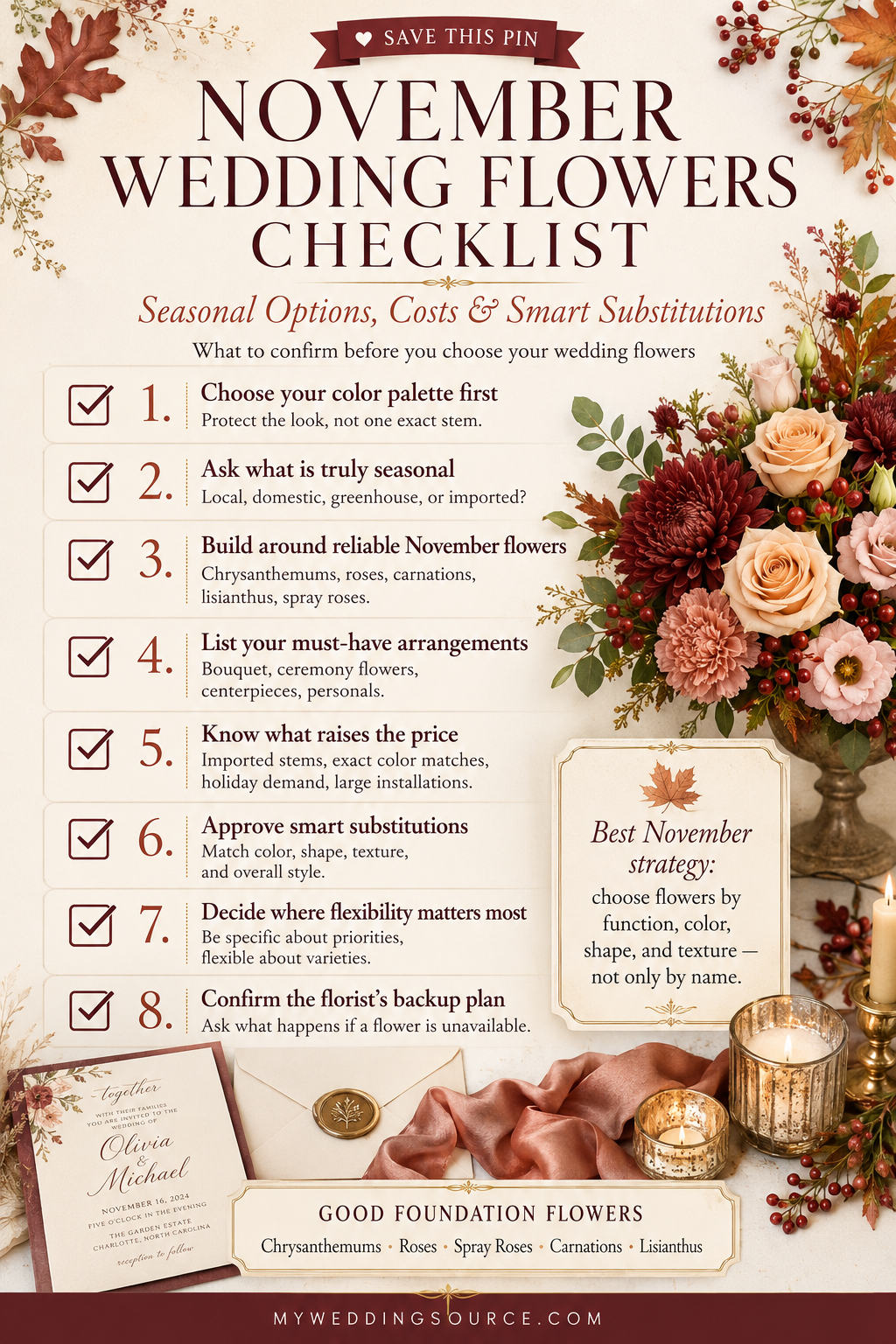
The Practical Answer: Choose November Wedding Flowers by Function, Not Only by Name
The safest way to plan November wedding flowers is to define the visual job each flower needs to perform. Instead of requiring a specific variety in every arrangement, identify the color range, bloom size, shape, texture, movement, and level of formality you want. Your florist can then select the strongest available stems within those boundaries.
For example, you may like a photograph featuring large burgundy dahlias, but the real design qualities you are responding to may be a deep wine color, a rounded focal shape, soft petals, and a slightly organic silhouette. If frost or supply conditions make dahlias unreliable for your date, a florist may recreate the same visual role with garden-style roses, disbud chrysanthemums, carnations, or a combination of smaller flowers clustered to create a larger focal area.
The most flexible floral brief does not say, “Use anything you want.” It says, “Protect these specific design priorities, and use professional judgment to change the ingredients when necessary.”
A practical November floral brief should establish your nonnegotiable colors, the arrangements that matter most, the general level of fullness, flowers or materials you strongly dislike, and any allergy, fragrance, cultural, venue, or sustainability concerns. The florist should also know which parts of the design can become simpler if product costs or labor requirements exceed the agreed budget.
In most cases, flexibility is most valuable at the variety level. You can still be specific about the overall appearance. A muted palette of rust, cream, plum, and soft brown is a meaningful direction. Requiring an exact named rose, exact dahlia variety, exact imported berry, and exact foliage in every design creates a much narrower and more fragile plan.
What “Seasonal” Actually Means for November Wedding Flowers
Seasonality in the American floral market is not a simple calendar showing that one flower is available and another is not. The United States receives flowers from domestic farms, regional growers, protected greenhouses, and international suppliers. A stem that is no longer growing outdoors near your venue may still be available through a wholesaler. That does not make the flower locally seasonal, but it may make it commercially obtainable.
This distinction matters because imported and greenhouse-grown flowers can provide consistent access to familiar wedding flowers such as roses, carnations, chrysanthemums, alstroemeria, lilies, and some types of greenery. At the same time, weather events, transportation interruptions, inspection issues, crop quality, holiday demand, and color variation can affect individual shipments.
The Society of American Florists maintains a professional floral education and industry resource hub covering topics such as pricing, labor, design-room efficiency, holiday preparation, and supply-market changes. These factors are relevant to wedding pricing because the final invoice reflects more than the farm price of the flowers.
Locally Seasonal Flowers
A locally seasonal flower is grown relatively close to the wedding market and harvested during its natural or protected local production period. Local availability can reduce long-distance transportation and may give the florist access to unusual textures or varieties that are not common in conventional wholesale channels.
However, “local” does not automatically mean inexpensive or guaranteed. Small farms may grow specialty varieties in limited quantities. A crop can be affected by frost, wind, rain, disease, heat, or an earlier-than-expected end to the growing season. A local flower may also cost more because it is carefully grown and harvested on a smaller scale.
For November weddings in northern states, the list of locally field-grown flowers may be limited after the first hard frost. In southern California, parts of the Southeast, Hawaii, or other mild climates, local production may continue much later. A greenhouse operation can also extend the growing season in a cold region, although the protected crop still has labor, energy, and infrastructure costs.
Domestically Grown but Not Locally Grown
A flower can be grown in the United States without being grown near the wedding. Domestic farms in warmer or highly productive regions may ship flowers to wholesalers and florists across the country. This can broaden the available selection while still supporting American production.
Transportation remains part of the process. A flower traveling from California to the Northeast or from Florida to the Midwest still needs appropriate harvesting, cooling, packing, freight, hydration, and processing. The florist must allow time for the product to arrive, recover from shipping, open to the appropriate stage, and be evaluated for quality.
Imported Flowers
Imported flowers form a significant part of the American floral supply. Roses, carnations, chrysanthemums, lilies, and many other products may arrive from international growing regions. This makes it possible to use flowers that would not be naturally blooming near the venue in November.
Imported product is not automatically lower quality, less sustainable, or less desirable. Many international farms specialize in particular crops and produce consistent wedding-grade flowers. The planning issue is that the supply chain contains more stages. The flowers must be harvested, packed, transported, cleared through the appropriate process, delivered to a wholesaler, and then transferred to the florist.
Commercial availability should not be confused with guaranteed availability. A wholesaler may normally carry a flower, but the exact variety, shade, stem length, maturity, or quantity may change before the wedding. A substitution policy protects both the design and the budget when normal supply does not arrive as expected.
Year-Round Does Not Mean Risk-Free
Some flowers are described as year-round because the wholesale market can usually provide them throughout the year. Roses, carnations, chrysanthemums, and alstroemeria often fall into this broad category. That makes them useful foundations for November wedding flowers, but it does not guarantee that every specialty color will be available at the same price.
A standard cream rose may be easier to obtain than a very specific muted caramel variety. White chrysanthemums may be widely available while a rare bronze form is limited. The more narrowly the color and variety are defined, the more the florist may need to preorder, source from multiple suppliers, or purchase extra product to account for inconsistency.
Regional Differences in November Flower Availability
National wedding advice often describes November flowers as though every couple is shopping in the same market. In reality, a florist in Miami may have different local products and delivery patterns from a florist in Minneapolis. Venue location, nearby farms, wholesale access, freight routes, and climate all affect the options.
Northeast and Upper Midwest
By November, much of the Northeast and Upper Midwest has experienced frost or freezing conditions. Field-grown dahlias, zinnias, cosmos, and many other warm-season flowers may no longer be reliable local options. Local farms may still offer dried materials, seed heads, preserved foliage, branches, greenhouse crops, stored products, ornamental kale, or cold-tolerant greenery.
Florists in these regions commonly rely on wholesalers, domestic shipments from warmer regions, and imports. That does not prevent an abundant floral design, but it changes the meaning of “seasonal.” A design may feel seasonally appropriate through color, foliage, fruit, texture, and form even if some flowers were grown elsewhere.
Pacific Northwest
The Pacific Northwest may still provide interesting greenery, branches, berries, evergreen materials, and selected late-season flowers. Rain and moisture can affect harvesting and handling, while the first frost date varies considerably by location and elevation.
A florist with relationships to local farms may be able to obtain distinctive materials that are not listed in a standard wedding catalog. Those ingredients may need flexibility because the final mix depends on what the farm can harvest at the correct stage.
California and Other Mild Growing Regions
California’s diverse climates support a wide range of floral production, but availability still varies by region and crop. A coastal farm, inland greenhouse, high-elevation grower, and southern farm will not have identical harvest periods. November can provide strong access to foliage, roses, chrysanthemums, specialty greenery, and selected seasonal crops, but the final list should come from the florist’s actual suppliers.
Couples should avoid assuming that every flower shown by a California farm is locally available to every California florist. Distance, minimum orders, freight, harvest quantities, and existing farm relationships still matter.
Southeast and Gulf Coast
Milder temperatures may extend local growing opportunities, although hurricanes, heavy rain, humidity, and sudden temperature changes can affect production. Some local farms may continue harvesting warm-season flowers into late fall, while others transition to cool-season crops.
Humidity and venue conditions can also affect flower performance. A stem that handles a cool indoor ballroom well may react differently in a warm outdoor ceremony followed by air-conditioned storage. The florist should choose varieties and mechanics that suit the entire event environment.
Mountain and High-Elevation Markets
High-elevation venues may experience freezing temperatures earlier than nearby cities. Local flower production may have ended even when the broader region still appears mild. Deliveries can also be affected by mountain roads, weather, distance, and restricted venue access.
At remote venues, replacement capacity may be more important than the advertised availability of the original flower. A florist located several hours away may need to transport extra product, tools, water, mechanics, and repair materials because a replacement wholesale market is not available nearby.
Reliable Flower Categories for November Wedding Designs
No flower should be treated as universally guaranteed, but some categories are generally more practical foundations for November wedding flowers than highly seasonal field crops. The final choice depends on the florist’s market and the required color.
Chrysanthemums
Chrysanthemums are one of the most versatile choices for November wedding flowers. The category includes large disbud forms, smaller spray chrysanthemums, cushion shapes, button varieties, spider forms, and textural specialty types. They are available in whites, creams, yellows, bronze tones, rust, burgundy, green, blush-adjacent shades, and other colors.
Large disbud chrysanthemums can perform the visual role of a rounded focal flower. Smaller varieties provide texture and volume. Their reputation as an ordinary grocery-store flower often comes from seeing only a limited form and color. A florist using specialty chrysanthemums with roses, foliage, delicate line flowers, and restrained color combinations can create a sophisticated result.
They are also useful in larger arrangements because they provide visual impact without requiring every focal point to be an expensive garden rose. This can reduce product cost, although design labor and arrangement scale remain important.
Roses and Spray Roses
Roses remain a common wedding flower because they are commercially available in a wide range of colors, bloom forms, stem lengths, and price levels. Standard roses can provide structure and focal points, while spray roses create smaller blooms and movement.
Specialty garden-style roses can be more expensive and may require careful ordering. Some open dramatically, while others remain tighter. The florist may purchase extra stems because a portion of the product can arrive bruised, uneven, or at the wrong stage for the wedding date.
A mixed rose design can be more flexible than a design dependent on one named variety. For example, a cream and muted peach palette might use several compatible rose types rather than requiring every arrangement to feature the same premium garden rose.
Carnations and Dianthus
Carnations are durable, sculptural, and available in many nuanced colors. They can create ruffled volume, support large installations, and perform well in bouquets. Mini carnations provide smaller clusters that blend naturally with other flowers.
Dismissal of carnations often comes from inexpensive mass-market arrangements using bright colors and rigid spacing. In a wedding design, closely grouped carnations in a controlled palette can resemble a soft field of petals. They can also replace some premium ruffled flowers without making the arrangement appear sparse.
Carnations are not merely a budget substitute. In the right palette, they are a practical design material with strong texture and reliable vase performance.
Lisianthus
Lisianthus offers delicate petals, multiple blooms on a stem, and a romantic appearance. It can support soft, garden-inspired designs without requiring every bloom to be a garden rose. Common colors include white, cream, lavender, purple, pink, and bicolored forms, although exact shades vary.
Its branching structure can create movement, but the florist must account for the direction and maturity of the blooms. Lisianthus should not be priced solely by the number of flowers visible in a photograph because the cost also includes careful processing and placement.
Alstroemeria
Alstroemeria can provide multiple blooms per stem, useful volume, and strong longevity. It may appear less formal when used alone, but it can blend effectively into layered centerpieces and ceremony arrangements.
The spotted petals and leaf structure are visually distinctive, so it may not suit every design. If you dislike its natural markings, tell the florist rather than rejecting all economical secondary flowers. Other materials may perform the same supporting role.
Lilies
Lilies provide scale, fragrance, and strong visual form. Their use should be intentional because the fragrance can be noticeable, pollen can stain, and fully open blooms occupy considerable space.
Some florists remove pollen-bearing anthers during processing, but couples should still discuss allergies, fragrance sensitivity, pets, food-service proximity, and venue conditions. A few lilies can create significant impact; a room filled with heavily fragrant varieties may become uncomfortable for some guests.
Hydrangeas
Hydrangeas create large areas of color and volume. They can be useful in centerpieces, ceremony arrangements, and installations, but they require reliable hydration and careful handling. A large bloom can lose visual value quickly if it wilts.
Hydrangeas may reduce the number of individual stems required to fill a visual area, but they are not automatically a low-cost choice. Premium varieties, special colors, water sources, mechanics, and replacement product can affect the final price.
Dahlias
Dahlias are strongly associated with late-summer and fall weddings, but November availability is highly regional and weather-dependent. In cold climates, local field production may end with frost. Imported or warmer-region product may be available, but exact varieties can be inconsistent.
If dahlias are central to your design, ask how the florist plans to source them and what will replace them if the crop ends early. A November contract should not treat locally field-grown dahlias as guaranteed unless the florist has a protected source and is comfortable making that commitment.
A practical alternative is to use dahlias as a preferred ingredient rather than a required ingredient. The florist can include them if quality is strong and replace them with roses, chrysanthemums, carnations, ranunculus, or another focal form if necessary.
Ranunculus and Anemones
Ranunculus and anemones are often associated with cool-season designs, but their availability and pricing can vary during November. Some markets may begin receiving strong product, while others may consider them early, limited, or premium.
Both flowers have recognizable forms. Ranunculus provides layered petals and a compact bloom, while anemones often provide a dark center and graphic contrast. If either flower is essential to the design, ask whether the florist considers it a reliable November product in your market or a conditional ingredient.
Amaranthus, Celosia, and Textural Flowers
Hanging amaranthus, upright amaranthus, celosia, and other textural flowers can reinforce an autumn design. Local availability may decline after frost, but wholesalers may still have selected products.
These materials are visually dominant. A small quantity can establish movement or texture without requiring every arrangement to use them. If fresh product is unavailable, preserved or dried forms may sometimes create a similar effect.
Use Foliage, Branches, Berries, and Fruit to Make the Design Feel Seasonal
November wedding flowers do not need to rely on orange blooms, miniature pumpkins, or obvious Thanksgiving references. Seasonal character can come from foliage, branches, seed heads, berries, fruit, bark, grasses, and the balance between flowers and negative space.
Foliage-Heavy Arrangements
Foliage-heavy designs can create scale and movement while reducing the number of premium flowers required. Suitable materials may include eucalyptus, ruscus, salal, smilax, magnolia, oak foliage, camellia, olive, evergreen materials, or other florist greens. The actual selection depends on the region, venue, and supplier.
Greenery is not free filler. Large foliage installations require conditioning, sorting, wiring, mechanics, ladder work, transportation, and cleanup. Some specialty foliage can cost as much as flowers, particularly when it must be shipped, preserved, painted, or ordered in unusual quantities.
The aesthetic also matters. A foliage-heavy design may feel organic, woodland-inspired, modern, or architectural depending on how it is arranged. It is not automatically rustic. Dark magnolia leaves with candlelight can feel formal, while airy branches and loose greenery may feel natural and informal.
Branches and Structural Materials
Branches can add height and shape without filling every inch with flowers. Bare branches, colored foliage, berries, seed pods, and textural stems can be especially effective in November.
Structural materials need stable mechanics. Tall branches create leverage and can make an arrangement top-heavy. The florist may require weighted containers, rigging, floor bases, or additional setup time. Venue rules may limit ceiling attachment, wall attachment, floor anchoring, or the use of natural materials that shed.
A visually sparse branch installation can require more engineering and labor than a compact flower arrangement. Do not assume that fewer flowers automatically means a lower invoice.
Berries and Fruit
Berries, grapes, pears, pomegranates, figs, persimmons, apples, or other fruit can add color and seasonal depth. Some materials may be fresh, decorative, inedible, wired, or treated. Fruit adds weight and can attract insects or create food-safety and cleanup concerns if damaged.
Ask whether fruit will sit directly on linens, near food, or within reach of children. The florist and caterer should agree on placement. Edible appearance should not be treated as confirmation that a decorative product is safe to eat.
Thanksgiving-Week Weddings Need Additional Floral Flexibility
A wedding held during Thanksgiving week is not simply an ordinary November wedding with a holiday occurring nearby. Farms, wholesalers, freight companies, delivery services, venues, and florist teams may use shortened or adjusted schedules. At the same time, demand may rise for Thanksgiving centerpieces, commercial displays, hospitality installations, and private events.
This does not mean flowers will be unavailable. It means the ordering and production timeline may be less forgiving. A wholesaler that normally delivers on Thursday may change the schedule. A florist may need to receive wedding flowers earlier, which creates additional refrigeration, processing, and quality-management needs. Replacement product may also be harder to obtain late in the week.
Approve the Design Earlier
Complete major design decisions before the holiday period. The florist should have the final guest count, table count, ceremony layout, delivery address, access time, and installation requirements early enough to place orders and schedule labor.
Last-minute changes that seem small can affect the entire order. Adding five tables may require more flowers, containers, candles, transport space, setup labor, and breakdown labor. If the original product has already been allocated, the added arrangements may need different ingredients.
Allow Earlier Product Delivery
Your florist may need to receive flowers several days before the wedding. This is normal for many products because flowers require processing, hydration, temperature control, opening time, and quality review.
Some varieties arrive tight and need time to open. Others are more fragile and should be used closer to delivery. The florist coordinates those differences. Couples should not assume that flowers received early are old or that every stem should arrive the morning of the wedding.
Use a Wider Substitution Range
For a Thanksgiving-week wedding, consider approving substitutions by color family and visual function rather than exact variety. A contract might permit the florist to replace a burgundy focal flower with another burgundy or deep plum flower of comparable size and value.
The substitution should protect the design standard, not give permission to reduce quality silently. Ask how substitutions are documented, whether the florist will contact you for major visual changes, and how equivalent value is assessed.
What November Wedding Flowers Really Cost
There is no useful nationwide price for November wedding flowers. A bouquet in a low-cost market using standard roses and chrysanthemums cannot be compared directly with a bouquet in a major city using imported garden roses, specialty foliage, premium ribbon, complex wiring, and on-site delivery.
The final floral invoice usually combines product, design labor, supplies, mechanics, vessels, candles, transportation, installation, venue access, staffing, breakdown, rentals, taxes, and business overhead. Some florists list these categories separately. Others build several costs into package prices.
Flower and Foliage Product
The wholesale cost of the flowers is only the starting point. Florists often order more stems than the exact recipe requires because some flowers may be damaged, too open, too closed, incorrectly colored, or otherwise unsuitable. Extra product also allows the team to maintain consistent quality across bouquets and arrangements.
Premium varieties, long stems, unusual colors, imported products, and flowers sold in limited bunch quantities can increase cost. If a recipe requires five stems but the florist must purchase a full bunch of ten or twenty-five, the pricing must account for the required purchase quantity.
Design Labor
Labor includes consultation, proposal development, ordering, receiving, unpacking, cleaning buckets, removing packaging, trimming stems, hydrating flowers, conditioning foliage, monitoring bloom stages, designing arrangements, packing vehicles, loading, unloading, installation, repair, cleanup, and breakdown.
A low, compact centerpiece may be completed in the design studio and placed quickly. A floral arch may require several designers, ladders, tools, mechanics, water sources, safety checks, and hours of on-site work. The installation may also need to be removed late at night.
Installation flowers are priced partly as temporary construction projects. Their cost reflects engineering, access, labor, transportation, and risk in addition to the visible flowers.
Mechanics and Supplies
Mechanics include containers, cages, wire, tape, pins, water sources, reusable structures, rigging, weights, bases, trays, protective materials, and other equipment used to keep arrangements stable and hydrated.
Venue restrictions can increase the complexity. If nothing may be attached to a wall, staircase, ceiling, or fireplace, the florist may need a freestanding structure. If floral foam is prohibited, the design may require alternative water mechanics and more installation time.
Delivery and Transportation
Flowers take up more vehicle space than their final appearance suggests. Arrangements must be transported upright, separated, protected from crushing, and maintained at an appropriate temperature. Tall installations may require box trucks, multiple vehicles, or partial assembly on-site.
Distance, tolls, parking, loading docks, elevators, stairs, security procedures, and restricted access windows can all affect the fee. A venue that allows only one hour for setup may require a larger crew than a venue that provides four hours.
Breakdown and Rental Retrieval
If the florist owns the vessels, candles, structures, stands, arches, or mechanics, the team may need to return after the reception. Late-night breakdown can involve labor premiums, transportation, parking, and venue deadlines.
Ask whether guests may take flowers, whether containers must remain, and who removes personal flowers from the venue. Taking rented vessels can lead to replacement charges.
Hypothetical November Wedding Flower Budgets
The following examples are not national price averages. They illustrate how priorities and labor can change the allocation of a floral budget. Actual proposals may be significantly lower or higher depending on market, date, scale, and design.
Focused Floral Plan
Imagine a 75-guest wedding with a floral budget of approximately $2,500 to $3,500. The couple prioritizes one bouquet, a smaller partner bouquet or boutonniere set, personal flowers for immediate family, one ceremony arrangement that can be moved, and low centerpieces for eight tables.
The florist uses chrysanthemums, carnations, roses, seasonal foliage, and a limited number of premium focal flowers. The ceremony arrangement is designed in a freestanding container and moved to the reception entrance. Candles belong to the venue, which reduces rental and breakdown costs.
The design feels intentional because the budget is concentrated. The couple does not divide the same amount across a large arch, aisle flowers, bar installation, fireplace flowers, escort-card display, cake flowers, and numerous personal flowers.
Layered Mid-Range Floral Plan
Consider a 125-guest wedding with approximately $6,000 to $9,000 available for flowers, delivery, setup, and rentals. The plan includes personal flowers, two substantial ceremony arrangements, aisle accents on selected rows, 14 centerpieces in two complementary styles, bar flowers, cocktail-table accents, and candles.
The florist combines roses, chrysanthemums, lisianthus, spray roses, carnations, foliage, branches, and limited specialty product. Ceremony arrangements are moved behind the sweetheart table. The centerpieces alternate between flower-forward designs and candle-based groupings with small floral elements.
Labor remains manageable because the installations are freestanding and the venue provides adequate setup access. If the venue required a suspended installation or a same-night room transformation, the same visual materials could cost substantially more.
Installation-Heavy Floral Plan
A 175-guest wedding may spend $15,000 or considerably more when the design includes a large ceremony structure, staircase or fireplace installation, elevated centerpieces, premium flowers, specialty vessels, extensive candles, multiple delivery vehicles, and late-night breakdown.
The increase is not caused only by choosing expensive flowers. A large crew may spend an entire day installing and later removing the designs. Structures need to be transported, assembled, weighted, protected, and inspected. Additional flowers may be ordered to guarantee visual consistency at scale.
When reducing this type of proposal, replacing every rose with a less expensive flower may not solve the budget problem. Simplifying the number of installations, reducing height, eliminating suspended work, or increasing setup time may have a greater effect.
Smart Substitutions That Preserve the Original Design
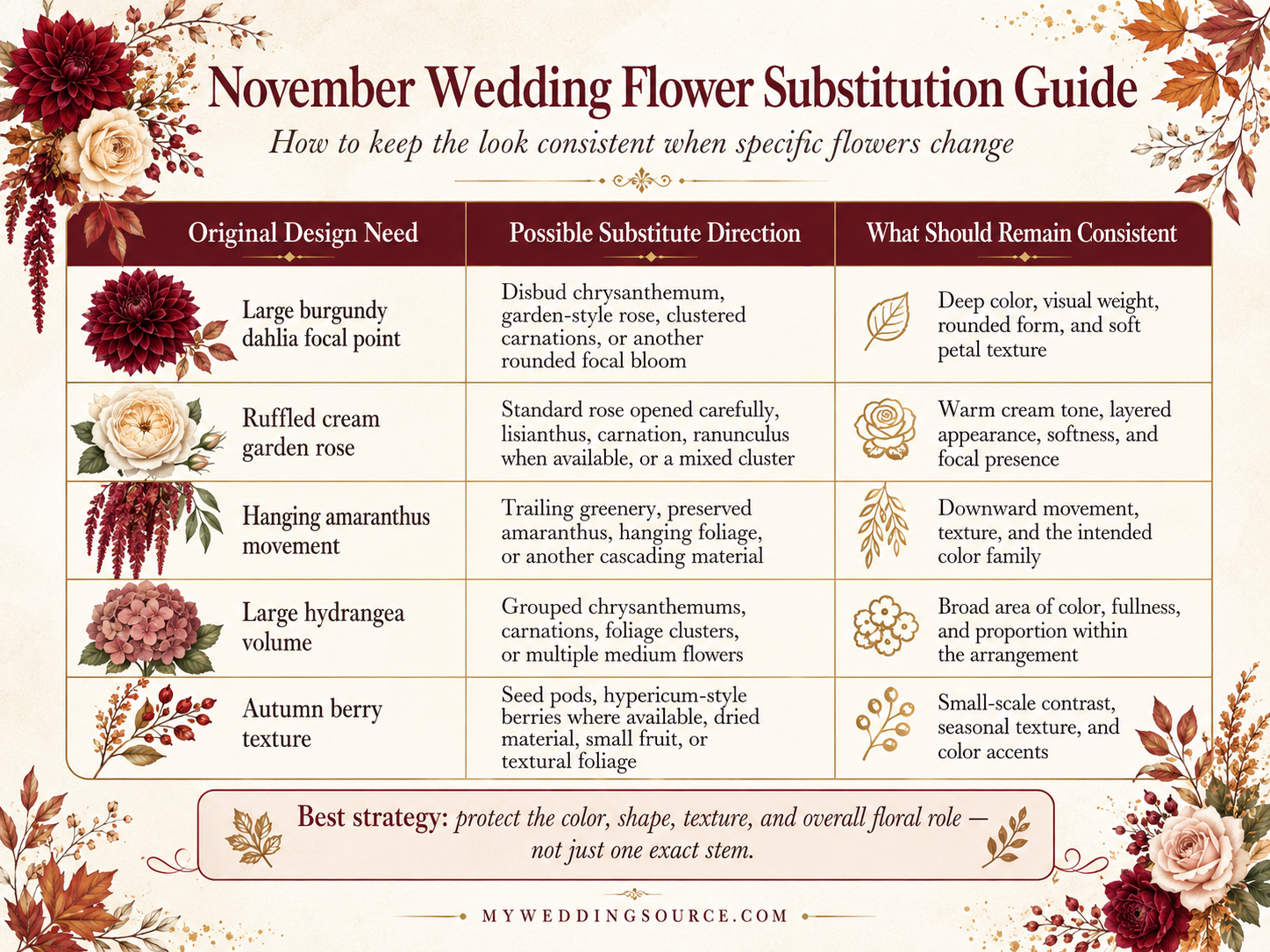
Substitute by Color Temperature
Matching color temperature is often more important than matching a common color name. One florist’s “ivory” may lean yellow, while another product appears gray or blush. Burgundy can lean red, purple, brown, or nearly black.
Give the florist a range rather than a digital color code. Fabric swatches, stationery samples, or actual attire materials are more useful than a color viewed on different screens. The florist can then avoid a substitute that technically belongs to the same color category but conflicts with the rest of the palette.
Substitute by Shape
Rounded focal flowers, line flowers, airy filler, trailing materials, and broad foliage each perform different jobs. Replacing a tall line flower with a compact round bloom can change the silhouette even if the color is identical.
Ask the florist which shapes define the design. A low centerpiece may need broad focal blooms and soft movement, while a ceremony installation may need long branches and line flowers to create height.
Substitute by Texture
Texture determines whether an arrangement feels smooth, ruffled, wild, dense, delicate, glossy, or dry. Carnations may replace ruffled flowers more effectively than a smooth-petaled bloom. Chrysanthemums may provide a dense, dimensional texture. Seed heads and dried grasses may replace unavailable fresh textural materials.
A visually successful substitution may use a completely different species while preserving the same color, scale, texture, and role.
Substitute by Placement
Sometimes the best substitution is not another flower. If premium focal blooms become expensive, the florist may use them in bouquets and eye-level arrangements while choosing more economical materials for distant ceremony installations.
Guests see a bouquet closely. They may view an arch from several rows away. The arch needs overall color and shape more than it needs one specific rose variety. Strategic placement protects the areas where detail matters most.
Fresh Flowers, Dried Elements, Potted Plants, or Candles
Fresh Flower Designs
Fresh flowers offer natural movement, fragrance, variation, and softness. They can create a formal, organic, modern, garden-inspired, or minimalist result depending on the materials and arrangement style.
The disadvantages include perishability, hydration needs, temperature sensitivity, and dependence on supply quality. Fresh installations must often be created close to the event and may require on-site work.
Foliage-Heavy Designs
Foliage-heavy designs can feel abundant without using a large number of premium flowers. They may also connect the indoor reception with a wooded, garden, mountain, or historic venue.
The cost depends on the greenery and installation. Smilax or specialty vines may be expensive. Large branch work may require substantial labor and mechanics. Foliage should therefore be treated as a design choice, not an automatic budget shortcut.
Dried and Preserved Elements
Dried grasses, seed pods, preserved foliage, dried hydrangea, strawflower, statice, and similar materials can add texture and reduce dependence on fresh seasonal crops. They work particularly well when the desired palette includes beige, tan, rust, brown, muted pink, or faded green.
Dried materials can be brittle, dusty, highly flammable, or prone to shedding. Venue candle rules and fire codes matter. Preserved or dyed products may transfer color to linens or clothing if exposed to moisture.
Dried does not automatically mean reusable or inexpensive. Specialty preserved flowers may cost more than standard fresh flowers, and delicate pieces can break during installation or transport.
Potted Plants
Potted herbs, ferns, cyclamen, orchids, foliage plants, or other living plants can become centerpieces or ceremony accents. They may be given to guests, donated, or taken home after the wedding.
Potted plants introduce soil, drainage, weight, saucers, insects, and venue restrictions. They also need consistent size and appearance. A plant that survives outdoors in one climate may not tolerate transportation, a cold loading dock, or a heated ballroom.
Discuss whether the plants are intended as rentals, favors, or decor. If guests may take them, provide packaging that protects vehicles and clothing.
Candle-Based Centerpieces
Candle-based centerpieces can reduce the number of flowers while creating warmth and visual depth. A design may combine taper candles, pillars, votives, or enclosed candles with small floral groupings, fruit, foliage, or individual bud vases.
Venue rules can significantly affect the plan. Some venues require enclosed flames, specific glass heights, dripless candles, fire-resistant surfaces, or flameless products. Candle quantity, rental cost, setup time, lighting, replacement, wax cleanup, and breakdown should be included in the proposal.
Candles should not be used simply to disguise an underfilled room. Their strongest effect comes from repeated, intentional placement and appropriate ambient lighting.
How to Prioritize Bouquets, Centerpieces, and Installations
When the budget cannot fund every inspiration image, prioritize according to visibility, emotional importance, photography, and reusability.
Personal Flowers
Bouquets are seen closely and appear throughout the photography. They are also carried, moved, and exposed to body heat, weather, and handling. This makes durability and comfortable weight important.
Tell the florist whether you prefer a compact bouquet, loose garden shape, cascading form, or asymmetrical design. A photograph does not show weight or stem comfort. Very large bouquets may become tiring to hold and can hide attire details.
Boutonnieres and corsages require durable flowers and secure attachment. Magnetic attachments may not work with every fabric or for guests with certain medical devices. Wrist corsages, pin-on flowers, pocket flowers, or small bouquets may be better alternatives depending on clothing and mobility.
Ceremony Flowers
Ceremony flowers are used for a relatively short period, so portability can increase their value. Freestanding arrangements may move to the reception entrance, sweetheart table, stage, bar, or lounge.
Repurposing should be designed in advance. A heavy arrangement cannot be moved casually through a crowd. The receiving location must accommodate its size, water source, mechanics, and appearance from the new angle.
“We will reuse it” is not a complete plan until the responsible person, route, timing, destination, and installation method are confirmed.
Reception Centerpieces
Centerpieces influence the entire dining room because they repeat across many tables. They should support conversation, food service, table numbers, glassware, and shared dishes where applicable.
Alternating designs can control cost and create visual rhythm. Some tables may use fuller flowers, while others use candles, bud vases, foliage, fruit, or smaller arrangements. The styles should share color and material so the room still feels coordinated.
Large Installations
Installations are useful when one architectural area needs a strong visual focal point. They can be more effective than scattering small flowers across many low-priority surfaces.
Before approving an installation, confirm dimensions, venue access, attachment rules, load restrictions, ladder or lift requirements, setup time, breakdown time, and what happens if the ceremony moves indoors.
Questions to Ask Your Wedding Florist
The consultation should establish how the florist handles design, supply, labor, and risk. Rather than asking only whether a favorite flower is available, ask how confidently it can be sourced and what happens if the quality is poor.
Discuss which flowers are expected to be locally grown, domestically shipped, imported, greenhouse-grown, dried, preserved, or rented. Ask which ingredients are considered reliable foundations and which are conditional accent flowers.
Request clarification about substitutions. Will the florist contact you before making changes? What level of change can be made without approval? Will substitutions remain within the agreed palette and approximate value? Can the florist show examples of several flowers that could perform the same role?
Ask how labor is calculated, whether installation and breakdown are included, what rental items must be returned, and whether the florist charges additional fees for stairs, elevators, remote venues, restricted access, room flips, or late-night pickup.
For Thanksgiving-week weddings, confirm ordering deadlines, delivery schedules, refrigeration capacity, staff availability, and the final date for changing quantities. Ask whether a shortened wholesale schedule affects the recommended flower list.
Finally, discuss the venue rules. The florist should know whether candles are permitted, whether floral foam is restricted, whether anything can attach to walls or ceilings, and how quickly the team must complete setup and breakdown.
Common November Wedding Flower Mistakes
Treating an Inspiration Photograph as a Shopping List
An inspiration photograph should communicate palette, mood, proportion, and style. Treating every visible stem as mandatory can create a proposal that is expensive, fragile, or impossible for the date.
Ask the florist to explain which elements create the photograph’s overall effect. You may discover that the important features are asymmetry, a dense focal area, loose greenery, and a muted palette rather than the exact named flowers.
Assuming Fall Flowers Must Be Orange
November designs can use cream, white, blush, mauve, plum, burgundy, green, brown, soft yellow, blue-gray, or monochromatic palettes. Seasonality can come from texture and foliage rather than an obvious autumn color scheme.
Assuming Local Means Cheaper
Local flowers may offer freshness, character, and a relationship with nearby farms, but small-scale specialty production has real costs. Limited quantities and hand harvesting can make local product more expensive than imported commodity flowers.
Ignoring Labor While Reducing Flower Quantity
A design made with fewer flowers may still require extensive wiring, branch construction, candle setup, potted-plant preparation, or dried-material installation. Product reduction does not always reduce labor proportionally.
Requiring Exact Flower Colors
Flowers are natural products. Burgundy roses from two farms may look different. Cream flowers may contain yellow, peach, green, or pink undertones. Approve a color range and explain which undertones should be avoided.
Adding Tables After the Floral Order Is Final
Late guest-count increases affect more than centerpiece quantity. The florist may need additional vessels, candles, transport space, setup labor, and flowers that are no longer available from the original shipment.
Expecting the Florist to Move Every Arrangement
Repurposing requires time and staff. If all designers are installing the reception while ceremony flowers must be moved, the florist may need a separate transfer crew. Include that labor in the plan.
Using Fragrant Flowers Without Discussion
Strongly fragrant lilies, herbs, eucalyptus, jasmine-like materials, or other flowers may affect sensitive guests. Fragrance can also compete with food during dinner. Ask the florist which ingredients have a noticeable scent.
Using Dried Materials Near Open Flame
Dried grasses, leaves, and flowers can be highly combustible. Candle placement must comply with venue rules and adequate clearance. Do not move candles closer to arrangements after the florist leaves.
November Wedding Flower Priority Worksheet
Complete this worksheet before requesting or revising a floral proposal. It helps the florist protect the parts of the design that matter while identifying where flexibility is acceptable.
| Decision Area | Your Priority | Questions to Resolve |
|---|---|---|
| Overall palette | List three to five acceptable colors and any unwanted undertones. | Which colors are essential, and which may shift according to natural availability? |
| Essential flowers | Identify no more than one or two strongly preferred flowers. | Are they required or preferred? What substitutes are acceptable? |
| Highest-priority arrangement | Choose the bouquet, ceremony focal point, or reception tables. | Where should premium product and design labor be concentrated? |
| Lowest-priority decor | Identify areas that can use candles, greenery, or no flowers. | Which surfaces do not meaningfully affect the guest experience or photographs? |
| Repurposing | List arrangements that may move between spaces. | Who moves them, when, how, and where? |
| Substitution authority | Define the level of change the florist may make. | Which visual changes require approval? |
| Budget boundary | Provide a realistic maximum including labor and delivery. | What should be simplified first if the proposal exceeds the budget? |
Frequently Asked Questions
What flowers are naturally in season for a November wedding?
The answer depends on the wedding location, weather, and whether you mean local field-grown flowers or commercially available flowers. Chrysanthemums, roses, carnations, lisianthus, alstroemeria, lilies, foliage, branches, and textural materials may be practical options in many American markets.
Local dahlias and other warm-season flowers may still be available in mild regions but may end after frost in colder climates. Ask your florist for a list based on the actual farms and wholesalers serving your venue rather than relying on a national seasonal chart.
Are November wedding flowers less expensive than summer flowers?
Not automatically. November may provide strong access to certain flowers, foliage, and textural materials, but imported products, greenhouse production, holiday schedules, freight, installation, and labor can increase costs.
The design has a greater effect on price than the month alone. A compact bouquet of standard flowers may be economical, while a large November installation using branches, premium roses, mechanics, and a substantial crew can be expensive.
Can I use dahlias in a November wedding?
You may be able to use dahlias, but local availability is highly dependent on climate and frost. In many northern regions, field-grown dahlias are unreliable by November. Product from warmer regions or other suppliers may be available.
Treat dahlias as a preferred flower unless the florist is willing to guarantee a source. Approve a rounded focal substitute such as a disbud chrysanthemum, garden-style rose, or another flower within the same color and scale.
What is the best substitute for peonies in November?
The best substitute depends on what you like about peonies. Garden-style roses may provide a large layered appearance. Open standard roses, carnations, ranunculus when available, lisianthus, or clustered flowers may create similar softness.
No substitute is visually identical. Ask the florist to preserve the bloom size, ruffled texture, color, and romantic proportion rather than promising a perfect copy.
Are chrysanthemums appropriate for an elegant wedding?
Yes. Chrysanthemums include many forms beyond the familiar basic bouquet varieties. Large disbud chrysanthemums, spider forms, buttons, and specialty spray varieties can look modern, organic, sculptural, or formal.
The surrounding palette and design determine the result. A large bronze chrysanthemum paired with roses, dark foliage, and candlelight creates a different impression from a brightly colored mixed arrangement.
Should I choose dried flowers to save money?
Dried flowers may reduce dependence on fresh supply, but they do not always reduce cost. Specialty dried and preserved materials can be expensive, fragile, labor-intensive, and difficult to transport.
Use them because their texture and color support the design. Ask the florist to compare a fresh, dried, and mixed version of the same concept if cost is the main concern.
Can ceremony flowers be reused at the reception?
Yes, when the arrangements are designed to move safely and the timeline allows it. Freestanding ceremony arrangements can often be placed behind a sweetheart table, near the bar, at the reception entrance, or beside a stage.
The transfer requires an assigned person, clear route, destination, timing, and sufficient labor. Attached arch flowers, very heavy structures, or arrangements built for one viewing angle may not transfer effectively.
How early should I book a florist for a November wedding?
Booking earlier generally provides more choice, especially for large weddings, Thanksgiving-week dates, complex installations, or florists who limit the number of events they accept. Many couples begin contacting florists after confirming the venue, date, approximate guest count, and overall budget.
A shorter timeline may still be workable if the florist has availability and you remain flexible about flowers, rentals, and installation scale. Do not delay simply because you believe November is outside peak wedding season; holiday work can affect florist capacity.
Will Thanksgiving increase the cost of wedding flowers?
It can. The effect depends on the florist’s market, wholesale schedule, labor needs, delivery timing, holiday demand, and event complexity. The flowers themselves may not all cost more, but shortened workweeks and adjusted delivery schedules can create additional operational pressure.
Ask whether your date requires earlier ordering, extra refrigeration, different delivery arrangements, holiday labor, or a wider substitution policy.
How much should I budget for November wedding flowers?
Start with the arrangements and services you need rather than a universal national average. A florist needs the guest count, table count, wedding-party size, ceremony plan, venue access, delivery distance, installation requirements, rental needs, and breakdown schedule.
When comparing proposals, confirm whether prices include taxes, delivery, setup, breakdown, candles, vessels, mechanics, rentals, and repurposing labor. A lower flower subtotal may not produce a lower final invoice.
Build a November Floral Plan That Can Adapt Without Losing Its Identity
The strongest November wedding flowers are not necessarily the stems most closely associated with autumn on social media. They are the flowers, foliage, branches, dried materials, plants, and candles that support your palette, venue, budget, and installation conditions while remaining realistic for the date and market.
Begin by distinguishing local seasonality from commercial availability. A flower may be imported or greenhouse-grown and still be a sensible choice. A locally grown flower may be beautiful but too weather-dependent to guarantee. Neither category is automatically superior in every situation.
Next, prioritize visual function. Decide which flowers provide focal size, which create movement, which add texture, and which supply economical volume. Give the florist permission to substitute at the variety level while protecting the color, shape, proportion, and quality you approved.
Finally, compare the full cost. Flowers are only one part of the proposal. Labor, mechanics, delivery, installation, rentals, venue access, room changes, and breakdown can determine whether a design remains within budget. This is particularly important for Thanksgiving-week weddings and large installations.
Your next step is to prepare a one-page floral priority brief containing your palette, two preferred flowers, acceptable substitutions, highest-priority arrangement, maximum total budget, venue restrictions, and Thanksgiving-week schedule if applicable. Send that document to your florist before the design consultation. It gives the florist enough direction to protect your vision without creating a plan that depends on one fragile or unavailable ingredient.
