
Small wedding ideas work best when you treat 25 to 75 guests as a budget lever rather than a shrunken version of a big wedding: the costs that follow headcount fall, the costs that do not stay put, and the difference can buy a better room, a better meal or a longer weekend.
Your guest list keeps landing somewhere between 30 and 70 names, and every quote you open seems to have been written for 150. The venue wants a food and beverage minimum that a table of 40 will never reach. The photographer’s price did not move when you trimmed the list. A caterer who is happy to feed 50 asks for a flat staffing fee that makes the per-person number look worse than it did at 120. None of this means a small wedding is a bad idea. It means the math works differently at this size, and the ideas that suit it work differently too.
This guide covers weddings of roughly 25 to 75 guests. It starts with what “small” means and what the data says about how common it is, then shows how the budget actually changes, which venue types and contract terms matter at this size, and how to plan the menu and bar. After that come experience-led ideas, a menu of upgrades to buy with the savings, styling and fall-season choices, and a way to hold the guest list without bruising feelings. Weddings under about 25 guests are a different planning problem, with different venue and permit constraints, and we cover micro weddings separately.
Two honest limits before the details. The national figures we cite come from The Knot, Zola and other published sources and describe averages across very different cities, not a quote you can expect from a specific vendor. And no source we found publishes a clean, current cost-per-guest figure for weddings in the 25 to 75 range, so where we calculate one we label it as our arithmetic or an illustrative example.
What counts as a small wedding, and is it the right size for you?
A small wedding is a celebration large enough to need real catering, a real venue plan and several vendors, but small enough that you can talk to every guest. There is no official line, so definitions differ by publication and by vendor. This section sets the working range used in this guide, shows what the data says about how common the size is, and helps you decide whether 25 to 75 suits your situation.
Where does a small wedding start and stop?
How many guests make a wedding “small”?
The Knot describes an intimate wedding as one with 50 or fewer people and treats “small” and “intimate” as interchangeable, while it calls anything over 100 large. This guide stretches the working range to roughly 25 to 75 guests, because vendors tend to price in that band the same way: one or two serving staff teams, one main dining room, and a single catering kitchen setup. Below that range you often fit in a private dining room or a house, and above it you start paying for the staffing, rentals and floor space that define a traditional reception.
How is a small wedding different from a micro wedding?
The difference is not only the headcount but which constraints you face. A very small wedding can happen at a courthouse, a chapel, a restaurant table or a public site that caps groups, and those caps can be strict. One National Park Service battlefield site, for example, limits wedding permits to 25 people including the officiant and photographer, allows no food or receptions and charges an application fee plus a use fee, which shows how quickly a tiny list narrows your venue choices.
At 40 to 70 guests you are back in the world of caterers, bars, rentals and floor plans, with a smaller version of the same decisions larger weddings make. That is why we separate the two: micro weddings are mostly about permits, whole-property rentals and elopement-style logistics, while small weddings are mostly about budget allocation and contract terms.
Is a small wedding becoming more common?
What does the data say about guest counts?
Guest counts have drifted back toward their pre-pandemic range but not all the way. The Knot’s Real Weddings Study reports an average of 131 guests in 2019, 66 in 2020, 105 in 2021, 117 in 2022, 115 in 2023, 116 in 2024 and 117 in 2025.
The study materials we could read do not publish the share of weddings under 50 or 75 guests, so we cannot say how many couples choose this size, but they do show that size varies with place and circumstance: The Knot reports averages of 140 guests in the Midwest and 102 in the South and Southeast, 92 for domestic destination weddings and 69 for international ones. Couples who spent under $12,000 averaged 92 guests, which means a small guest list and a small budget are not the same thing.
Why are couples choosing smaller guest lists?
Cost is the most documented reason. In The Knot’s 2026 study, 59% of couples said the economy affected their overall wedding budget and 40% said they scaled back their guest count because of rising costs. Joy, the wedding website and registry company, describes a different motivation from the pandemic era: couples deliberately choosing smaller lists and reinvesting the money in the people who attend, with many cutting from around 200 guests to 80 to 100 (a qualitative observation with no stated sample).
The Knot’s own 2026 outlook points the same way, describing more intimate ceremonies with more luxury experiences for a smaller crowd. The practical reading is that smaller is increasingly a choice about where to put money, not only a way to spend less.
Is 25 to 75 guests the right size for you?
Which couples tend to like this size?
Couples who care more about conversation than spectacle tend to feel at home here. At 40 or 50 guests, one table plan can put everyone within a few seats of someone they know, toasts can come from many people without running long, and you can realistically greet every guest. Couples with a big extended family, or a culture where the whole community is part of the celebration, may find the list hard to hold at this size, and that is a reasonable thing to weigh rather than a flaw. If you picture a long table more than a dance floor, this range deserves a serious look.
What trade-offs come with a smaller wedding?
Every decision about who is invited becomes more visible, because a list of 50 has few places to hide a snub. A quiet dance floor is a real possibility, since a dozen people on a floor built for a hundred look sparse, so entertainment needs planning rather than assuming a crowd will generate energy. Go in knowing the trade-offs, and most of them turn out to be solvable with a venue that fits the group and a plan for how the evening will flow.
How does a smaller guest list change your budget?
A smaller guest list lowers the total, but it does not lower every line equally, and it can raise the cost per guest. The useful skill at this size is knowing which costs follow headcount and which follow hours, service level and the vendor’s minimum. This section uses The Knot’s cost-by-guest-count data, then separates guest-driven costs from fixed ones, and then covers the taxes and fees that change the real total.
What is the real size of the savings?
What does The Knot’s cost-by-guest-count data show?
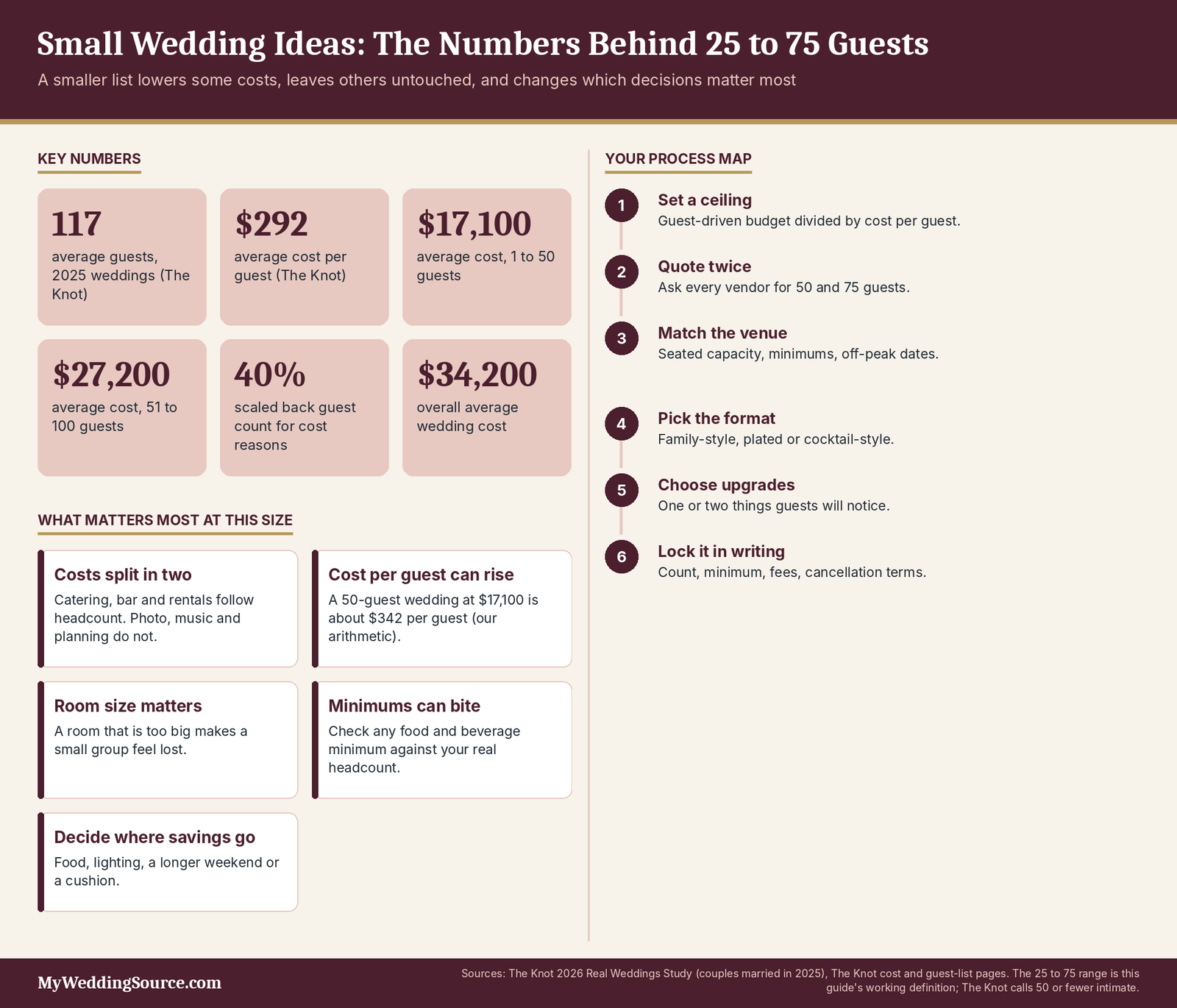
The Knot’s average-cost page reports ceremony and reception averages by guest count for weddings in its 2026 study: $17,100 for 1 to 50 guests, $27,200 for 51 to 100 and $43,300 for more than 100. The step from the middle band to the smallest is about 37%, which is meaningful but far less than the reduction in headcount. Use the figures as a sanity check on direction and scale, not as a target. The table below puts them next to the overall averages from the same study.
| Guest count band | Average cost | Notes |
|---|---|---|
| 1 to 50 guests | $17,100 | Includes very small weddings under 25 |
| 51 to 100 guests | $27,200 | Overlaps the upper end of this guide’s range |
| More than 100 guests | $43,300 | The traditional reception range |
| All weddings (117 guests) | $34,200 | $292 per guest, The Knot 2026 study |
Does a small wedding cost less per guest?
Not automatically, and often not. The Knot reports $292 per guest on average across all weddings, but if a wedding of 50 guests cost the band average of $17,100, that would be $342 per guest (our arithmetic), and at 30 guests it would be $570. Neither number is published by The Knot, which reports only the overall per-guest figure, so treat them as an illustration of the direction rather than as a benchmark. The reason is that a photographer, a venue, an officiant and a planner each cost something close to the same amount whether 30 people or 130 attend.
Zola’s budgeting guidance takes a different approach by suggesting about $150 to $300 per guest for guest-driven costs such as food, drinks and rentals, which excludes the fixed vendors; at 50 guests that range is $7,500 to $15,000. Expect a smaller total and a higher all-in cost per head, and judge your wedding by the total and by what you get for it.
Which costs shrink and which stay put?
Which line items follow headcount?
Catering, bar service, rentals, stationery, cake or desserts, favors and, in many cases, transportation scale with the number of guests. The Knot’s cost page says it plainly: a DJ’s or photographer’s price usually does not change with headcount, while catering, baking and rentals do. At the average catering spend of $80 per person, The Knot’s own arithmetic puts 50 guests at $4,000 against $8,000 for 100, which is where most of the savings come from.
Zola agrees that catering, bar service, venue size, rentals and invitation quantities rise with more guests, and it suggests that cutting about 20 people could free up thousands of dollars. Those savings are real, but they are concentrated in a few lines, so know which ones before you count on them.
Which line items barely move?
Photography, videography, music, planning and officiant fees are priced by hours, scope and expertise rather than by the number of people in the room. In The Knot’s 2026 study of 2025 weddings, the average photographer cost $3,000, a videographer $2,300, a reception DJ $1,800, a live band $4,500, a planner $2,100 and an officiant $260. Those are averages across all sizes, so a small wedding does not automatically earn a discount on any of them. Ask each vendor what changes when the day is shorter and the room is smaller, because some will offer a package and some will not.
| Line item | Knot average (2025 weddings) | Follows headcount? |
|---|---|---|
| Catering | $80 per person | Yes, almost directly |
| Alcohol | $2,800 | Mostly, by drinks served |
| Event rentals | $2,000 | Mostly, by seats and tables |
| Invitations and stationery | $510 | Partly, by quantity |
| Wedding cake | $540 | Partly, by servings |
| Photographer | $3,000 | No, by coverage hours |
| Reception DJ | $1,800 | No, by hours and service |
| Live band | $4,500 | No, by size and hours |
| Wedding or event planner | $2,100 | No, by scope |
How do taxes and fees change the picture?
How much do tax, service charge and gratuity add?
Quoted subtotals for food and drink are rarely the final number. Paperlust’s 2026 wedding bar guide says tax, service charge and gratuity add roughly 20 to 25% on top of quoted bar subtotals, and a MayFair Farms guide to food and beverage minimums says the real cost of a stated minimum can run 25 to 40% higher after tax and gratuity. Tax rates and service charges are also separate things, since tax goes to the government and a service charge goes to the business, which is why the contract language matters. Always ask whether a quoted per-person price includes tax, service charge and gratuity.
What should you ask every vendor to quote twice?
Ask for two versions of every quote: one at your target headcount and one at the top of your range. If you are deciding between 50 and 75, request both so you can see where costs rise by the head and where they jump in steps, such as an extra bartender, another server or a larger rental package. This also exposes minimums, because a venue with a guarantee of 60 guests will tell you that when you ask for a 50-person price. Compare the two quotes line by line rather than only by total, since the lines that do not change tell you which costs are fixed.
Where can you hold a small wedding?
The right venue for 25 to 75 guests is one that fits the group, not one that you can squeeze the group into. Traditional ballrooms are built around 100 to 200 seats and price accordingly, while restaurants, inns, historic homes and gardens are often built around smaller parties. This section covers the venue types that suit the size, how to judge whether a room will feel full, and the contract terms that can undo a small guest count. For a wider look at venue categories, see our wedding venues hub.
Which venue types fit 25 to 75 guests?
Do restaurants and private dining rooms work for a wedding?
They can, and they price in three common ways. A per-person menu sets a rate for each guest, a minimum spend requires you to reach a set food and beverage total that varies by date, and a buyout rents the whole restaurant or a large portion, often combining a room fee with a minimum. A Tulle Together roundup of New York restaurants from 2025 shows the range: one restaurant charged about $280 per person with a $28,000 minimum on peak Saturdays but $100 per person with a $3,000 minimum on off-peak Sundays.
A Washingtonian report from the same year quoted one Washington restaurant’s buyouts at roughly $5,000 to $30,000 plus tax and service, and noted that restaurants can often be booked on one or two months’ notice, while traditional venues may book up to two years ahead.
Are inns, historic homes and ranches a good match?
Many are built for exactly this size, and some rent the whole property. The Knot’s small-venue roundup lists examples with stated capacities such as a Vermont farm with full wedding services for up to 49 guests, an Alabama historic house for up to 50 with guest suites, a Louisiana mansion best suited to 30 or fewer and a Colorado ranch for up to 40 with an entire weekend rental and lodging. The appeal is control and time: with a whole-property rental, you decide the schedule, guests can stay on site and the wedding can stretch across a weekend.
The trade-off is that remote properties may require you to arrange catering, rentals and restrooms yourself, so ask what is included before assuming a one-stop price.
What about gardens, public land and backyards?
Outdoor settings can feel generous at this size, but they come with permission and logistics questions. The Knot suggests choosing a space that will not make a small group feel lost, and lists a rooftop, greenhouse, art gallery or arboretum as examples. Public sites often have caps and rules: the national park battlefield mentioned earlier limits groups to 25 and prohibits food and tents, while other sites allow more people but still require permits. Whatever the setting, confirm permits and restrictions with the owning agency or local government in writing before you pay a deposit.
| Venue type | Why it suits 25 to 75 | What to check |
|---|---|---|
| Restaurant or private room | Food is built in; few rentals | Minimum spend, buyout terms, service charge |
| Inn or boutique hotel | Lodging on site; whole-property option | Whole-property rate, vendor rules, quiet hours |
| Historic home or mansion | Character reduces decor needs | Capacity at seated dinner, accessibility, caterer list |
| Ranch, lodge or farm | Weekend format; remote privacy | What is included, restrooms, travel for guests |
| Garden or park | Scenic setting; flexible layout | Permits, group caps, rain plan, rental needs |
| Backyard or family home | Personal; low venue fee | Rentals, restrooms, parking, local rules |
How do you size a room for a small group?
Why can a room that is too large hurt a small wedding?
A small group in a large room can feel like a meeting at a conference center. The Knot’s own advice is to choose a space that does not make a small group feel lost, and its ideas for fixing a large room include hanging florals and candles so guests can see each other across the table. Joy calls lighting one of the highest-impact investments for tight budgets, and warm, low lighting is often the cheapest way to make a room feel smaller and more intimate.
If a venue you love is bigger than you need, ask whether you can use only part of it, such as one room, one wing or a screened-off section.
What capacity numbers should you ask for?
Venues usually advertise a maximum capacity, but that number may be for a standing reception or theater-style seating rather than a seated dinner with a dance floor. Ask for the capacity at your guest count with tables, a head table or sweetheart table, a buffet or serving station and any dance floor, band or DJ equipment you plan to include. The answers tell you whether the space will work and whether it will feel full when your guests are inside.
What do venue contracts do to small guest counts?
How does a food and beverage minimum work at 40 guests?
A food and beverage minimum is the least you must spend on food and drink at the venue, and if your actual spending falls short, you may owe the difference. A MayFair Farms guide puts traditional venue minimums at roughly $12,000 to $35,000 for a Saturday night, though its figures lean on forum anecdotes and it says to confirm everything in writing.
Here is an illustrative example, not a quote: a $12,000 minimum with 50 guests means about $240 per guest before tax and gratuity, and at 40 guests it is $300, which is well above the $80 catering average plus a typical bar. If your list is below what the minimum assumes, ask the venue to lower it proportionally, or ask for value-adds such as an enhanced dessert or a late-night snack so the shortfall buys something.
When do off-peak dates make the biggest difference?
Friday, Sunday and weekday weddings usually cost less than a peak Saturday, and the gap can be large. The Knot’s savings advice says off-season and shoulder-season dates, typically late fall and early spring, could save hundreds or even thousands of dollars, and that Fridays and Sundays are cheaper than Saturdays.
The New York restaurant example above, with a $28,000 minimum on a peak Saturday and $3,000 on an off-peak Sunday, shows how steep the difference can be in one city, and the MayFair Farms guide says Friday or Sunday weddings may lower minimums by 20 to 40%, though that figure is anecdotal. If an off-peak date is possible, ask for both prices before you decide.
What should you serve and pour at a small wedding?
A small guest list lets you choose a menu format that would be expensive or awkward at scale, and it makes the bar easier to size. The Knot’s 2026 study found that 60% of receptions featured a buffet or self-serve stations and 30% a plated dinner, which suggests that other formats are open to you. This section covers menu formats, what catering and bar service cost per guest, how to avoid the common alcohol and food-safety traps, and the questions to ask before you sign. Our wedding food and catering hub goes deeper on caterer selection and contracts.
How do menu styles change for a small group?
Is family-style or plated service better for 50 guests?
Neither is better in general, and each has a cost and an experience trade-off. The Knot’s savings tips note that buffet or family-style service can cost less than plated dinners, and The Knot’s small-wedding ideas suggest a long estate table where food is passed. For groups of 25 to 75, family-style tends to suit a single long table or two, while plated suits a more formal seated room. Ask your caterer to price both so you can compare the actual difference rather than guessing.
Do cocktail-style receptions, brunches and food trucks work?
They work well when you plan for how people eat. The Knot suggests cocktail-style or brunch receptions as lower-cost options and notes that stationary appetizers cost less than passed hors d’oeuvres, and The Knot’s small-wedding ideas list a private chef or food truck as alternatives to a traditional caterer. Our wedding cocktail hour guide covers how to make that part of the day work if you want a longer one.
What does catering cost for 25 to 75 guests?
The Knot’s catering article, based on its 2025 study of 2024 weddings, reports an average of $80 per person, with regional averages from $62 in the Midwest to $123 in the Mid-Atlantic, $79 for hometown weddings, $104 for domestic destinations and $114 for international ones. At the $80 average, The Knot’s arithmetic puts 50 guests at $4,000, so 25 guests would be $2,000 and 75 guests $6,000.
The Real Weddings Study read-out lists an average of $80 for 2025 weddings as well, with a range around it from about $60 at the low end to $130 at the high end, though we could not confirm how the study defines each tier. Catering quotes should itemize entrees, appetizers, desserts, beverages, rentals, labor, travel, setup, breakdown and tax.
How should you handle the bar?
What does a bar cost per guest?
Paperlust’s July 2026 wedding bar guide, last updated in October, gives per-person ranges before tax, service charge and gratuity: $25 to $45 for beer and wine, $40 to $65 for a full open bar with house spirits, $65 to $90 with premium brands and $90 to $120 top-shelf. At 50 guests, beer and wine would run about $1,250 to $2,250 and a premium open bar $3,250 to $4,500 (our arithmetic from those ranges).
The guide’s planning rule of two drinks per guest in the first hour and one per hour after works out to about six drinks per guest over five hours, or roughly 300 servings for 50 guests, which is the number a bar vendor converts into bottles.
Can you bring your own alcohol?
Sometimes, and the rules depend on the venue, the caterer and your state. The Knot’s savings guidance says buying your own alcohol can save money if the venue allows it, but a licensed bartender must serve it. Some venues require their in-house bar, some allow a licensed caterer or independent bar service and some charge corkage or setup fees, and Paperlust notes that independent bartenders may be quoted separately at roughly $100 to $300 per bartender plus gratuity.
Liquor laws and liability insurance rules vary by state and locality, so this is general information, not legal advice, and you should confirm requirements with the venue and the relevant state alcohol agency. Ask who carries liquor liability coverage before you buy a single bottle.
What food-safety and logistics issues show up at small weddings?
What if friends or family do the cooking?
A homemade or potluck-style meal can be a meaningful choice at small scale, but it raises food-safety and venue-rule questions. The U.S. Department of Agriculture advises discarding perishable food left at room temperature for more than two hours, and for only one hour when the temperature is above 90 degrees Fahrenheit, which matters for outdoor summer buffets. If you do it, plan for refrigeration, hot holding, serving utensils, labeled dishes and someone to manage the buffet who is not also the host. This is general food-safety information, not a substitute for local health department rules.
How do you handle allergies and dietary needs when the list is short?
With 40 guests, every plate is visible, so a missed allergy is hard to hide. Ask about allergies and dietary needs on the RSVP, give the caterer a written list well before the event and ask how they prevent cross-contact in the kitchen and at serving stations. Guests with serious allergies should be encouraged to tell you early so that you and the caterer have time to plan.
What does the whole food and drink bill look like?
How much do guest-driven costs fall between 120 and 50 guests?
The easiest way to see the effect of a smaller list is to put the same assumptions side by side. The table below uses The Knot’s $80 catering average and the midpoint of Paperlust’s beer-and-wine range, and it leaves out rentals, desserts and staffing extras that would widen the gap. It is an illustration of how the lines move, not a quote for any wedding.
| Cost layer | 120 guests | 50 guests |
|---|---|---|
| Catering at $80 per person | $9,600 | $4,000 |
| Beer and wine at $35 per person | $4,200 | $1,750 |
| Subtotal | $13,800 | $5,750 |
| Plus tax, service and gratuity (20 to 25%) | $16,560 to $17,250 | $6,900 to $7,188 |
At those assumptions, the difference between 120 and 50 guests on food and drink alone is roughly $9,700 to $10,100. That is the pool that can be redirected to something guests will feel, and later sections look at where it can go.
What should a small-wedding catering quote include before you sign?
The Knot’s catering guidance says quotes should itemize entrees, appetizers, desserts, drinks, rentals, labor, travel, setup, breakdown, cake-cutting fees and tax, and it notes that dinnerware, tables and chairs may or may not be included. Vendor meals are a small but common surprise: photographers, videographers and DJs typically need a hot meal, and some caterers offer lower-priced vendor meals if you ask. Also ask whether there is a minimum guest count or charge, because a short list may fall below it, and request a second quote at your top-of-range count so you can see where the price steps up.

Which experience-led ideas make 25 to 75 guests feel looked after?
An experience-led small wedding puts money and attention into what guests do, taste and talk about rather than into scale. The Knot’s own small-wedding advice is to concentrate the budget on a standout element, such as a private chef or custom reception decor, instead of spreading it thin. This section covers how to build the dinner into the main event, how to stretch the celebration across a weekend, and what entertainment suits a crowd that is too small for a big dance floor.
How do you turn dinner into the main event?
What makes a long table or family-style dinner work?
A single long table, or two or three shorter ones, turns dinner into the central activity and lets everyone see everyone. The Knot’s small-wedding ideas include a long estate table with food passed family-style, hanging florals and candles so that guests can see each other across the table, and varied table designs tied together by one hero color. Ask the venue for the table length it can actually accommodate, and have the caterer confirm that platters can reach the middle of the table without a server leaning over guests.
Are private chefs, tableside service and food stations realistic?
At this size, they can be. The Knot lists a private chef, a food truck, tableside service of premium items such as caviar or truffles and interactive stations among its small-wedding ideas, and none of them is practical at 250 guests. Pricing for these formats is not published nationally, so ask for quotes and compare them with a standard caterer’s per-person rate rather than assuming a premium. A good question is what a chef-led menu costs at 40 guests versus 60, since hands-on formats can have steep steps in price when the headcount crosses a staffing threshold.
Does an extended cocktail hour replace a traditional reception?
It can, and The Knot lists it as an option, with the speeches and dancing of a traditional reception replaced by a longer period of food, drinks and mingling. The format suits couples who do not want a dance floor, and it pairs well with a short ceremony and a late-afternoon start. Our wedding cocktail hour guide covers the timing, food quantities and bar planning that make a longer cocktail hour work.
How do you make the whole weekend the wedding?
How common are welcome dinners and multi-day celebrations?
More common than the one-day wedding people picture. The Knot’s 2026 study found that 71% of celebrations spanned two to three days, and of multi-day celebrations, 75% included a rehearsal dinner, 27% an after-party, 26% welcome drinks and 21% a day-after brunch. A relaxed welcome dinner for 40 is a very different cost from a second reception for 120.
Why do whole-property bookings and shared getting-ready time work?
When a small group takes over an inn, ranch or large rental house, the wedding stops being a few hours and becomes a shared stay. The Knot’s venue roundup highlights whole-property rentals, entire-weekend bookings and lodging on site, and its ideas include getting ready together at home. Benefits include fewer logistics for guests, because no one needs a ride after the party, and more control over the schedule, with fewer neighbors and noise limits to worry about.
The cost is that you may be paying for a full weekend and for lodging whether or not every room is used, so count the rooms you will fill and what the rental includes.
What entertainment fits a smaller crowd?
Should you hire a live musician, a small band or a DJ?
The answer depends on whether you want music to be the background or the focus. The Knot’s 2026 study of 2025 weddings reports a live band averaging $4,500 and a reception DJ averaging $1,800, which suggests a gap of roughly $2,700 on average across all wedding sizes. The Knot’s small-wedding ideas suggest a live musician or small band, but we could not find national price data for solo and duo musicians, so ask local musicians for quotes.
A solo guitarist or pianist during dinner can set the tone for a fraction of a full band, and a DJ can handle announcements and dancing for the part of the evening that needs it. Match the format to the number of people likely to dance, not to the size of the room.
What fills the time between dinner and the end of the night?
A small wedding has no built-in schedule of events, so a few simple things help. Open toasts, where any guest can speak, are practical at 40 to 60 people and often become the most memorable part of the evening. Lawn games outdoors or printable games indoors, both on The Knot’s list of guest experience ideas, give guests something to do together, and a lounge area with varied seating lets conversations form in small groups.
How do you spend what a smaller guest list saves?
Savings from a smaller list disappear quickly unless you decide where they go. The Knot says that a smaller guest count can free up budget for personalized touches and recommends putting more into one standout element. This section ranks the upgrades by what guests tend to notice, shows what a few cost at 50 guests, and covers the case for not spending all of it.
What are the highest-impact upgrades at this size?
Which food and drink upgrades give the most for the money?
Food and drink are where per-guest upgrades are cheapest to make at small scale, because the same $50 increase per person costs $2,500 at 50 guests but $6,000 at 120. If the caterer’s high-end tier is around $130 per person, as the Real Weddings Study read-out suggests, moving from the $80 average to $130 adds $2,500 for 50 guests before tax and service. A better non-alcoholic option, a signature cocktail or a shared first course can make the meal feel more generous without moving to a full premium bar. Use the table below to compare the options we can put numbers on.
| Upgrade | Added cost at 50 guests | Basis |
|---|---|---|
| Menu from $80 to $130 per person | $2,500 | Knot average; read-out high tier. Before tax and service |
| Premium open bar instead of beer and wine | About $1,000 to $3,250 | Paperlust per-person ranges, our arithmetic |
| Second catered meal, such as a welcome dinner | About $4,000 | $80 average times 50. Drinks extra |
| Live band instead of a DJ | About $2,700 on average | Knot averages, $4,500 vs $1,800, all sizes |
| Videographer | About $2,300 on average | Knot average, all sizes |
| Wedding or event planner | About $2,100 on average | Knot average, all sizes |
Is lighting and room atmosphere worth the money?
Often yes, and it is one of the few upgrades that works for every guest at once. Joy calls lighting one of the highest-impact investments for limited budgets, and The Knot’s decor ideas lean on candles and hanging florals to make a space feel intimate. The Knot’s 2026 study puts average spending on lighting and decor at $1,900 and on event rentals at $2,000, so it is a line you can raise or lower deliberately.
Should you spend on photography, video or planning?
These are the fixed costs that do not shrink, and a smaller wedding can justify them because the budget has room. The Knot’s study puts the average photographer at $3,000, a videographer at $2,300 and a planner or coordinator at $2,100. A planner is a particularly good use of savings if your list is small but your logistics are complex, such as an out-of-town inn, a restaurant buyout with outside vendors or a ceremony on public land. Hours drive photography and video pricing, so a ceremony and dinner may need fewer hours than a full evening reception.
What should you not upgrade, and what should you hold back?
Should you save some of the savings?
Yes, and for a practical reason: plans change. In The Knot’s 2026 study, about one in four couples changed their budget, and of those, 77% increased it and 16% decreased it. A smaller wedding has fewer line items to run over, but a cushion still helps with price changes, a venue fee you missed or a decision to add a night. Setting aside a portion of the savings, rather than assigning every dollar, is an editorial suggestion rather than a data-backed rule, and the right amount depends on your total.
When does spending more not help?
Spending more does not improve the day if it does not match what you and your guests value. The Knot recommends choosing a venue whose existing features you like, such as a museum or botanical garden, to reduce decor costs, and that logic applies to upgrades generally. Spend where the gap between ordinary and excellent is something people can taste, hear or feel. Bigger spending does not mean a better wedding, and a smaller guest list lets you prove it.
How do you style a small wedding, and does a fall date make sense?
Styling a small wedding is mostly an editing job: fewer tables, fewer places to look and more attention on each. That makes choices about color, aesthetic, flowers and season more visible than they would be in a ballroom of 150. This section covers how to design for 50 people, why a fall or off-peak date can suit this size, and how 2027 trends fit a smaller guest list.
How do you design a room for 50 people?
How do you choose a wedding aesthetic and colors for a small room?
Start with the room and let it set the limits. The Knot’s small-wedding ideas suggest varied table designs tied together by one hero color from your palette, which works because a small room has fewer tables to coordinate and guests see all of them at once. Pick one dominant color, one supporting color and one accent, then check them against the venue’s carpet, wood and walls in the light you will have at dinner. A small group also forgives a more personal aesthetic, such as heirloom china, mismatched candlesticks or handwritten menus, which The Knot lists among its personal-touch ideas.
Where should the flower and decor budget go?
Concentrate it where guests will look for the longest time. The Knot’s savings advice is to focus floral spending on guest-visible arrangements such as dinner tables, use in-season flowers, choose year-round options like roses, calla lilies or orchids, use fewer stems and fill space with greenery. It also suggests non-floral decor such as books, votives or candles to reduce floral needs, and carrying ceremony flowers from the aisle to the reception. The Knot’s 2026 study puts average flower spending at $2,800 across all wedding sizes, which is a ceiling worth testing against a room that seats 40.
Is a fall or off-peak small wedding a smart choice?
Why do fall small wedding ideas suit this size?
Fall and other shoulder seasons offer a pricing advantage, and smaller lists are more flexible about dates. The Knot says off-season and shoulder-season dates, typically late fall and early spring, could save hundreds or even thousands of dollars, and its guest-count data show that October to December weddings averaged 112 guests, the lowest of any season, compared with 123 for July to September. Fall also suits the long-table, candlelit style that small weddings do well, with seasonal menus, warm lighting and rich colors that need little decoration.
A harvest-style menu built from seasonal, local ingredients also fits The Knot’s advice to serve a few high-quality dishes instead of a multi-course meal.
How do you plan for cold, rain and early sunsets?
A small outdoor wedding in the fall needs a plan for weather and light. Ask the venue what the indoor backup is, who makes the call and when, and whether the rain plan fits all of your guests at the same seating. ceremony in late October may end in near darkness, which can be beautiful but affects photographs and guest safety on paths. If the cost of a weather plan rises beyond what you want to spend, consider moving the ceremony and dinner indoors and keeping a short outdoor moment for photographs.
How do 2027 trends fit a small wedding?
Which trends suit a small guest list?
Several current trends fit the size well. The Knot’s 2026 outlook describes more intimate ceremonies with more luxurious experiences for a smaller crowd, and an Axios report citing The Knot says the average wedding party has shrunk to eight people, four per side, from ten in 2019. Our wedding trends 2027 guide covers what is rising and fading in more detail. The trends that work best at small scale are those that need people to be close together: shared dining, personalized details and a slower pace.
Which trends add cost without adding value at this size?
Large installations, extensive custom signage and elaborate production elements designed for scale can cost more than they give back when the room holds 40 people. A hanging floral installation that looks dramatic in a 200-seat ballroom may overwhelm a 50-seat dining room or take a large share of your flower budget. Ask yourself whether a trend improves the experience of the people in the room or the photographs of the room. If the answer is only the photographs, keep it small.
How do you keep the guest list between 25 and 75 without hurting feelings?
The guest list is the lever that drives most of the budget, and at this size it is also the hardest to hold. Zola’s guidance is that cutting about 20 people can free up thousands of dollars, and The Knot calls trimming the list the easiest way to reduce a budget. This section covers how to set a ceiling, how to say no kindly and consistently, and how the wedding party and extra events fit in. For the wider planning sequence, our how to plan a wedding guide sets this decision in context.
How do you set the number?
How do you choose a guest-count ceiling?
Work backward from the money you have for guest-driven costs rather than from the list you wish you had. Zola’s rule of thumb is about $150 to $300 per guest for food, drinks and rentals, so, as an illustrative example, a guest-driven budget of $12,000 supports roughly 60 guests at $200 each, or 40 at $300. Add tax, service charge and gratuity before dividing, because those can add 20 to 25% or more to what you pay. Choose a ceiling, share it with anyone contributing names, and treat it as the constraint rather than the starting point of a negotiation.
How do you split names between you, your partner and your families?
A split agreed in advance stops the list from growing a name at a time. The Knot’s guest list article, from a 2023 update, quotes planner Jordan Xu on giving the couple about 50% of the names and each set of parents about 25%, adjusted for larger families or for who is paying. Whatever the proportion, give each contributor a number and a deadline, and agree that the numbers are final before invitations go out.
How do you say no kindly?
What rules work for plus-ones and children?
A rule you can explain in a sentence is easier to defend than a case-by-case decision. The Knot’s guest list advice quotes planner Jamie Chang suggesting firm rules, such as inviting only plus-ones you have met or only children from immediate family, and then reducing further if you still need to. Whatever the rule, apply it to everyone, including people close to you, because a visible exception tends to cause more hurt than the rule itself. Put the rule on the invitation and your wedding website in neutral language, and let guests with childcare needs know early.
What do you say to people who are not invited?
Something like “We’re keeping the wedding very small, and we wish we could include everyone” works, because it describes the constraint rather than ranking people. The Knot’s advice is to ask how close you are to each person, how well they know you and your partner, and whether you are inviting them out of desire or obligation, and a list built on that question is easier to explain. If a relationship matters, a phone call, a dinner or a post-wedding get-together can say what the invitation cannot.
What about the wedding party and extra events?
How big should the wedding party be at a small wedding?
Smaller than the traditional one, and probably smaller than you think. An Axios report citing The Knot says the average wedding party has shrunk to eight people, four per side, from ten in 2019, and The Knot’s small-wedding ideas note that a wedding party makes sense once you have more than ten guests. With a guest list of 40, a party of eight would be 20% of the room, so the question is whether every person has a real role. You can honor friends and family in other ways, such as a reading, a toast or a seat at the head table.
Should you host a second, casual celebration for people you could not invite?
Some couples do, but it is a second event with its own costs. A casual backyard party or a restaurant gathering after the wedding can include friends and coworkers who were not invited, and it can be a way to soften a hard list decision. At the Knot’s $80 catering average, a second meal for 40 would be about $3,200 before drinks and tax, which is our arithmetic and not a quote. If you plan one, budget for it from the start rather than from leftover money.

FAQ: Small wedding questions couples ask
These answers give general information based on the sources named in this guide. Prices and rules vary by place, so confirm specifics with your vendors, venue and local government.
Planning and budget questions
How many guests is a small wedding?
There is no official number, but The Knot describes an intimate wedding as 50 or fewer guests and a large one as more than 100, and this guide uses roughly 25 to 75 guests as a working range. Under about 25 guests, planning shifts toward permits, private dining and whole-property rentals, which we treat as a separate micro-wedding topic. Over 75 you begin to need the staffing, rentals and floor plan of a traditional reception. The average wedding in The Knot’s 2025 data had 117 guests, so a small wedding is meaningfully below the norm.
Is a small wedding cheaper?
The total usually is, but the cost per guest often is not. The Knot reports an average of $17,100 for weddings of 1 to 50 guests, $27,200 for 51 to 100 and $43,300 for over 100, but fixed costs like photography, music and planning do not shrink with headcount. That means a wedding of 50 can cost more per guest than the $292 national average. The savings come mostly from catering, bar, rentals and stationery, so ask for quotes at two guest counts to see them in your own market.
Can I use a restaurant as my wedding venue, and is it cheaper?
Often yes, but not always. Restaurants price weddings as a per-person menu, a minimum spend or a buyout, and the numbers swing widely by city, day of the week and season, as New York and Washington examples show. A restaurant can be easier to book on short notice and may need fewer rentals, but you still pay tax, service charge and gratuity on top. Ask for the minimum in dollars, whether it includes tax and service, what is included and which days are cheaper, and compare it against an itemized quote from a traditional venue.
Guest list and etiquette questions
How do I tell someone they are not invited to a small wedding?
Be brief, kind and consistent. Describe the constraint, such as a very small venue or guest count, rather than ranking the person, and apply the same rule to everyone in a category, such as coworkers or plus-ones. A phone call or a personal note usually lands better than a mass message, and a later get-together can acknowledge people you could not include. Avoid public posts that make comparison easy.
Do I have to invite plus-ones and children?
Etiquette gives you room to set your own rules, as long as you apply them fairly. Many couples invite plus-ones only for married, engaged or long-term couples, or those the couple has met, and limit children to immediate family. The Knot’s advice is to set firm rules and then reduce further if the list is still too large. Communicate the rule early, on the invitation and website, so that nobody is surprised.
Your next steps
The most useful next step is to put numbers on your own situation, since national averages only get you part of the way. These steps move from a first conversation to a signed contract, in the order that avoids the most expensive surprises. Our wedding planning timeline shows where they fit in a full schedule, and the wedding planning hub collects the rest of the series.
This week
Which numbers should you decide first?
Write down your total budget, your guest-count ceiling and the two or three things you most want guests to remember. Use the arithmetic in this guide to divide the budget into guest-driven and fixed costs, and decide how much you will hold as a cushion. If you are contributing money with family, have the conversation about who is paying for what before you tour venues. A one-page summary of these decisions saves hours of explaining to each vendor.
Who should you ask for quotes?
Request quotes from three types of vendor: one venue you like, one restaurant or inn that offers whole-event packages and one caterer who works at small scale. Ask each to quote at 50 and at 75 guests and to itemize tax, service charge, gratuity, rentals and any minimums. Compare totals and lines rather than the headline per-person rate. Keep the quotes in one document so the comparison is clear when you decide.
Before you pay a deposit
What should you confirm in writing?
Confirm the exact guest count the price assumes, the minimum spend and how it is calculated, the deposit amount and schedule, and the cancellation and guest-count change policies. Ask what happens if you drop below a minimum or exceed capacity. Confirm alcohol rules, insurance requirements and vendor restrictions, along with the rain or weather plan. Terms and state laws vary, so this is general education rather than legal advice, and a contract question that matters deserves a read by someone qualified.
How do you protect yourself if your plans change?
Ask whether the venue lets you reduce the guest count and by how much, and by what date, since a count that falls below a guarantee can leave you paying for guests who are not there. Ask whether the deposit is refundable and what happens to it if you move the date. Consider event cancellation insurance and understand that it differs from liability coverage a venue may require, and from the insurance vendors carry themselves. Get answers in the contract itself, since a conversation is not a term. Once those answers are in writing, you are ready to pay the deposit.
Related reading: Micro Wedding Ideas: Search-Driven Ideas Couples Can Actually Use.
Sources & methodology
- The Knot, The Average Cost of a Wedding — 2026 Real Weddings Study (couples married in 2025): $34,200 average, 117 guests, $292 per guest, vendor line items, cost by guest-count band, state and regional averages.
- The Knot, Real Weddings Study 2026 Data Read-Out (PDF) — guest count history 2019 to 2025, multi-day celebration shares, caterer range, budget changes.
- The Knot, Average Wedding Guest List Size — guest count by region, season and destination; 59% and 40% economic effects; intimate and large definitions.
- The Knot, Small Wedding Ideas — definition of intimate, ideas for dinner, decor and guest experience.
- The Knot, Small Wedding Venues — venue types and example capacities.
- The Knot, Average Wedding Catering Cost — $80 per person, regional and destination averages, what quotes should itemize.
- The Knot, 40 Expert-Approved Ways to Save Money on Your Wedding — off-peak dates, buffet and family-style, bar, flowers and own-alcohol advice.
- The Knot, How to Cut Your Wedding Guest List — planner advice on splitting names, plus-ones and children.
- Zola, How Much Does the Average Wedding Cost? — $36,000 average for 2026, $150 to $300 per guest guidance, fixed versus guest-driven costs.
- Joy, 2026 Wedding Trends — qualitative observations on deliberate downsizing and lighting.
- Axios, Latest wedding trend: Smaller entourages — average wedding party of eight, down from ten in 2019, citing The Knot.
- Paperlust, How Much Does a Wedding Bar Cost? (2026) — bar cost per person, drinks per guest, bartender fees, tax and service load.
- MayFair Farms, Wedding Venues With No Food and Beverage Minimum — how minimums work and questions to ask; figures are anecdotal.
- Washingtonian, Need a Last-Minute Wedding Venue? Book a Restaurant — restaurant buyout and minimum examples, booking lead times.
- Tulle Together, NYC Restaurant Wedding Venues and How Much They Cost — per-person, minimum-spend, buyout and hybrid pricing models, with New York examples.
- USDA Food Safety and Inspection Service, Leftovers and Food Safety — two-hour and one-hour rules for perishable food.
- National Park Service, Cowpens National Battlefield wedding permits — one example of a public-site group cap, fees and restrictions.
Methodology. Survey findings (The Knot, Zola) are self-reported by couples and describe averages across all wedding sizes and places. Verified facts are limited to published rules such as the USDA food-safety limits and the single National Park Service site’s permit conditions. The dollar arithmetic in the tables, including per-guest figures, the 120-versus-50 comparison and the upgrade costs, is our illustration from published averages and is labeled as such, and the classification of which costs follow headcount is editorial judgment.
Several price ranges come from industry blogs rather than government or survey sources, and The Knot does not publish a cost per guest by size band or the share of weddings under 50 guests, so those points are thin.
Freshness. Recheck the Knot and Zola figures when the 2027 Real Weddings Study and Zola’s next cost report appear, and recheck any venue or restaurant pricing, state alcohol rules and local permit requirements directly with the vendor or agency before you commit, since all of them change.