

Plus one wedding etiquette gets simple once you decide, in writing and before invitations go out, which relationships get a named seat, which get an open “and guest,” and what each extra seat adds to your bill.
You are looking at a guest list with 14 single friends, two cousins who just got engaged, a coworker who has mentioned a “new person” twice, and a venue that holds exactly as many people as you have names. Your parents have opinions, your best friend has already asked whether she can bring someone, and every answer you give feels like it will be remembered at the next family dinner. The reason plus-ones cause so much stress is that most couples treat them as a series of individual favors instead of one policy. A written rule that you can explain in two sentences is easier on you, fairer to your guests, and far easier to defend when someone pushes back.
This guide is written from the host’s side of the table: who gets one, how to write the policy, how to word it on envelopes and RSVP cards, what an extra seat does to your budget, and what to say when a guest asks for something you cannot give. If you are a guest wondering what is polite to ask for, our existing guide to plus-one etiquette for weddings covers that side, and the broader problems that come up around invitations are collected in our look at real wedding guest list problems. Here, the focus is the host decision framework and the cost math behind it.
How do you decide who gets a plus-one?
What does etiquette actually require of a host?
Which guests should always be invited as a pair?
Married guests are invited together, and the major etiquette sources agree on this without much debate. The Knot’s plus-one guide tells hosts to invite both spouses even if they are closer to one than the other, and a planner quoted by WeddingWire calls spouses a package deal regardless of how well you know the partner. Emily Post’s advice on extra RSVP names goes a step further and says partners who are engaged or living together should also be on the invitation, even if no one in the wedding party has met them. In practical terms, that means three groups are not really “plus-ones” at all: married guests, engaged guests and cohabiting guests. They are invited guests whose partner’s name goes on the list, and they belong in your headcount from the first draft, not as a later add-on.
Which guests are a courtesy rather than an obligation?
Single guests are where the real choice begins. Emily Post’s guidance describes letting an unattached guest bring a date as a kind gesture, not a requirement, and The Knot’s separate article on single guests recommends deciding case by case rather than applying one rule to everyone. That leaves you free to say no without breaking any etiquette rule, though it does not make the conversation painless. The useful distinction is between a courtesy that costs you little (a guest who will know half the room anyway) and one that protects the guest’s experience (a friend who knows only you, traveling alone, to a wedding where everyone else is paired up). When you cannot give a courtesy to everyone, the question to ask is which guests benefit most from it.
How do you turn etiquette into a rule you can apply to 100 names?
What are the three tiers that sort every guest?
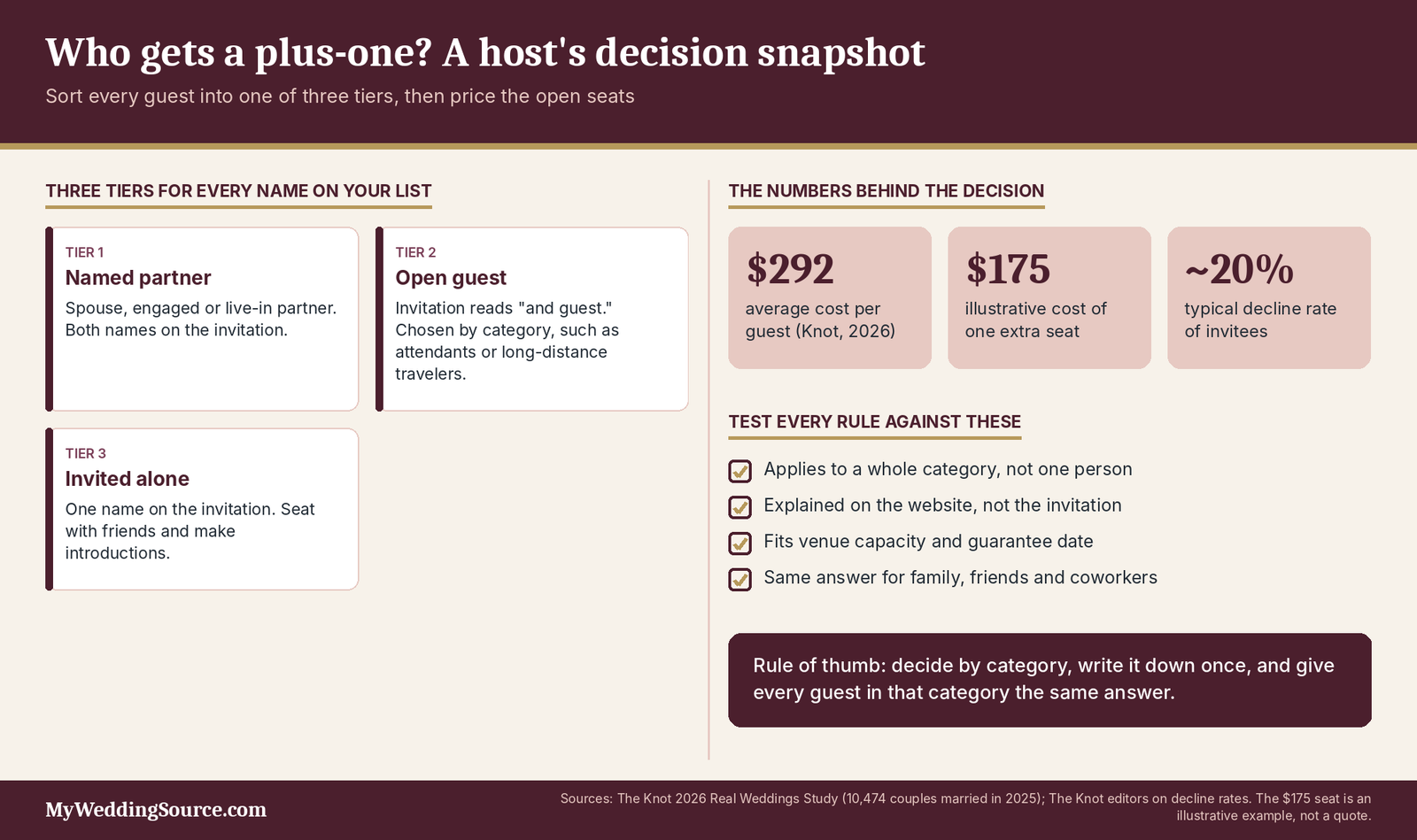
The simplest working system sorts every name on your list into one of three tiers. Tier 1 is “named partner”: the guest has a spouse, fiance or live-in partner, and both names go on the invitation. Tier 2 is “open guest”: the invitation reads “and guest,” and the guest can bring anyone they like. Tier 3 is “invited alone”: the invitation carries one name only. Sorting the list this way takes about an hour with a spreadsheet, and it forces the questions you would otherwise answer in a panic when a guest texts you. Most couples find that Tier 1 is large, Tier 3 is the biggest group, and Tier 2 is a short, deliberate list that they can actually afford.
What consistency test makes the list defensible?
The test is whether you could explain the rule to a guest in Tier 3 without apologizing for it. A rule built on a category (“all wedding party members, anyone traveling from out of state, and any couple living together”) survives scrutiny, while a rule built on mood (“we like Dana’s partner”) does not. The Knot’s guide recommends consistency within groups: if one coworker or one attendant gets a plus-one, the whole group should. WeddingWire’s expert panel makes a related point about changing your mind under pressure, which can upset the guests who have already accepted the original rule. Write the category rule down once, run every name through it, and keep a short list of documented exceptions, such as a guest who needs a support person.
What does a plus-one actually cost you?
What does one extra guest add to the bill?
Why is the average cost per guest not the price of one more seat?
The Knot’s 2026 Real Weddings Study, which surveyed 10,474 U.S. couples who married in 2025, reports an average total of $34,200, an average of 117 guests and an average cost of $292 per guest. That last number is simply the total divided by the headcount, so it spreads fixed costs such as the photographer, the florist’s design fee and the band across every guest. Adding one person does not add another photographer, which is why the cost of one more seat is usually lower than $292. Zola’s 2026 cost guidance frames the guest-dependent portion differently, estimating roughly $150 to $300 per guest for food, drinks, rentals and similar items (the page cites Zola’s Wedding Spend Survey of 720 couples and was last updated March 6, 2026). Use $292 to sanity-check your overall plan, and use the layers below to price a specific plus-one.
For a deeper breakdown of how those averages split across categories, see our guide to wedding cost per guest. The short version is that your own caterer’s per-person quote, with service charge and tax shown, is a better number than any national average.
What are the layers of a plus-one’s cost?
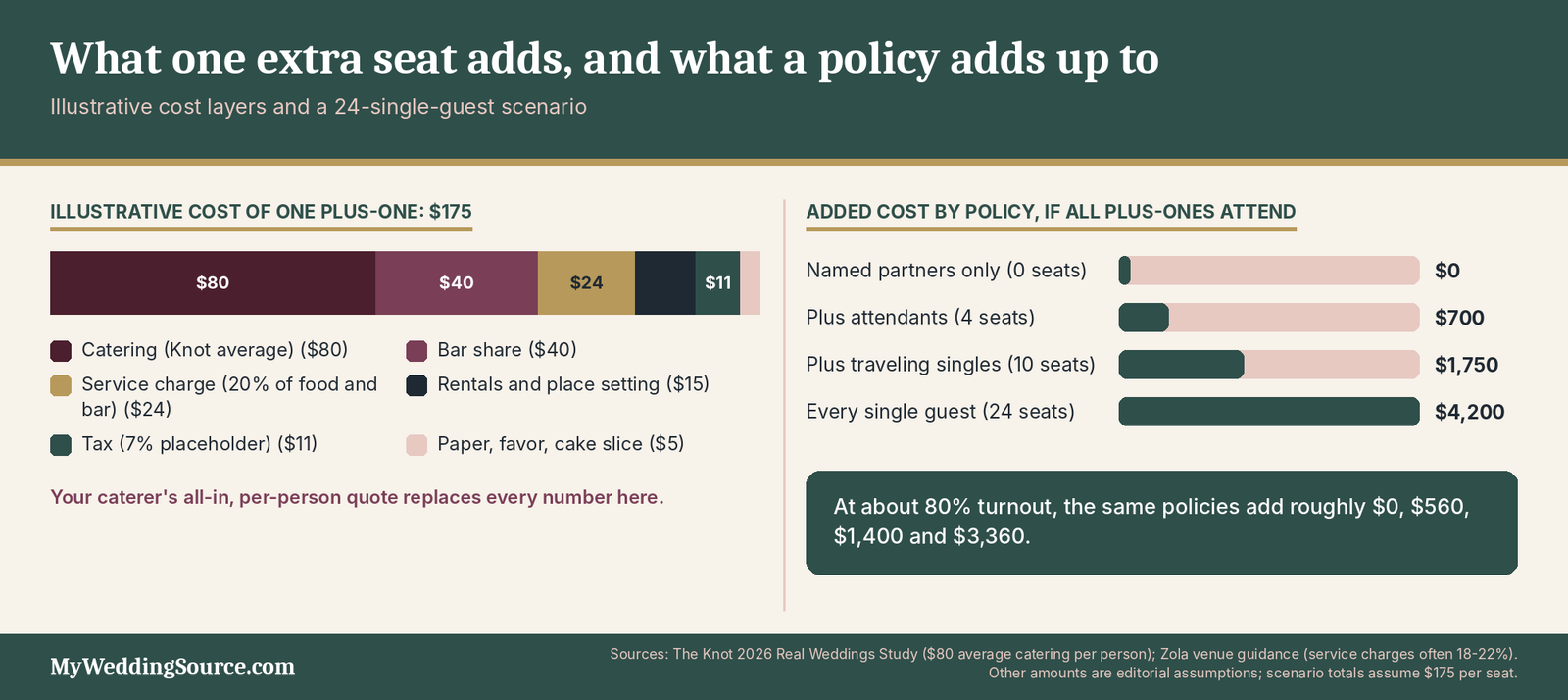
A plus-one touches five cost layers, and the first one is the only layer most couples price. The sticker price is the caterer’s per-person food price (The Knot’s study puts the average at about $80 per person), and the required extras are the service charge or gratuity that venues and caterers often add on top. Realistic extras include the bar, the rental chair and place setting, the escort card, the favor and the cake slice. Taxes depend on where you marry and how your vendors itemize, and the failure cost is what you owe if a plus-one is on the guarantee and then does not attend. The table below uses an illustrative $175 example, which is not a quote, to show how the pieces stack up.
| Cost layer | Illustrative amount | What to verify with your vendors |
|---|---|---|
| Catering (sticker) | $80 | Per-person menu price, not package average |
| Bar share | $40 | Open bar, beer and wine, or consumption |
| Rentals and place setting | $15 | Chair, linen, glassware, plate, flatware |
| Paper, favor, cake slice | $5 | Escort card, menu, favor, cake cutting fee |
| Service charge (20% of $120) | $24 | Whether it covers food only or more |
| Tax (7% placeholder on $164) | $11 | State and local rules; ask for itemized tax |
| Illustrative total | $175 | Compare with $150 to $300 range from Zola |
How do plus-ones change a whole guest-list total?
What does each policy add to a 100-guest list?
Consider an illustrative list of 100 named guests (including every spouse and live-in partner) plus 24 single guests, four of whom are in the wedding party and six of whom are traveling from out of state. Each policy below multiplies the number of extra seats by the $175 example. The point is not the exact dollar figure, which will differ in your market, but the size of the steps: moving from “partners only” to “everyone unattached” in this example is a jump of roughly $4,200 if every single guest brings someone. That is roughly 12 percent of The Knot’s $34,200 average wedding total, so it deserves a conscious decision rather than a default.
| Policy for the 24 single guests | Extra seats | Added cost if all attend | Added cost at 80% turnout |
|---|---|---|---|
| Named partners only | 0 | $0 | $0 |
| Plus wedding party singles | 4 | $700 | $560 |
| Plus wedding party and traveling singles | 10 | $1,750 | $1,400 |
| Every single guest gets a plus-one | 24 | $4,200 | $3,360 |
Why do attendance and the guarantee date change the math?
The Knot’s editors describe a typical decline rate of about 20 percent of invitees, which they call a starting point that shifts with the season and with travel distance. That is why the 80 percent column above is lower, but it is not a reason to over-invite, because your venue’s capacity and your caterer’s guarantee are both measured in confirmed heads. Most contracts set a final guaranteed count some days before the wedding (ask whether it is 7, 10 or 14 days), and you generally pay for that number whether or not everyone arrives. Plus-ones also change the rest of the logistics: a bigger room, one more shuttle seat, one more place card and one more person for the kitchen to feed. A guest’s gift may not offset the difference either; The Knot’s Guest Study (a 1,000-person survey from October 2024) put the average gift from a guest’s date or plus-one at $120, against $150 overall, and gifts are a personal choice that should not be part of your budget math.
Which plus-one policy fits your wedding?
Which common policies fit most weddings?
Why is “named partners plus the wedding party” the default for many couples?
This policy invites every spouse, engaged partner and live-in partner by name, offers each attendant a guest, and leaves everyone else to attend alone or with a partner you already know. It maps closely onto what The Knot’s planners and WeddingWire’s experts describe as common practice, and it is easy to explain: the people who are helping with your day, and the people whose partners are part of their household, come as pairs. The cost is predictable because the number of extra seats is a short list you can count today. In the illustrative math above, adding four attendants’ guests costs about $700 at full attendance, which is a modest line next to the benefit of treating your closest people consistently. The weak point is the guest who does not fit a category, such as a friend who has been dating someone for eight months, so decide ahead of time how you will treat a relationship that falls just short.
When does a generous “every unattached guest” policy work?
The Knot’s guide notes that couples with a large budget and a roomy venue could offer every unattached guest a plus-one, though most cannot. If you are in that position, the generous policy removes almost every awkward conversation, because no one has to argue about whose relationship counts. It also protects the guests who would otherwise travel alone to a wedding where they know only you. The trade is a larger room, a bigger caterer guarantee and a seating chart full of people you have never met, so confirm capacity, fire-code limits and the guarantee deadline before you promise it. It also works best at weddings where the guest list is already large and social, and less well at an intimate dinner where a stranger changes the feel of the whole table.
Which policies need extra care?
Is a spouses-only rule fair to unmarried couples?
A spouses-only rule is the easiest one to administer, because you never have to judge a relationship, but it carries the most risk of hurt feelings. THE WED’s June 2026 discussion of the rule notes the objection directly: many couples live together, buy homes and raise children without marrying, so marriage is an imperfect proxy for commitment. Pew Research Center’s analysis of Census Bureau data found that in 2023 about 51% of U.S. adults were married and about 7% were living with an unmarried partner, which means a spouses-only rule will exclude partners who are, in practice, part of a household. Census Bureau data also counted about 551,000 unmarried same-sex couple households in 2024, and a marriage-based rule treats those households differently from married ones. If you choose this rule for capacity reasons, say so plainly and apply it to everyone, including family.
What about “named guests only” for small or adults-only weddings?
Some weddings simply cannot add anyone: a 40-person dinner in a restaurant’s private room, a ceremony at a venue with a hard occupancy limit, or a destination wedding where the villa sleeps a set number. In those cases the honest rule is “only the people named on your invitation,” with partners named in advance rather than added later. Because every seat is accounted for, the invitation itself becomes the policy, and the key is to make sure no one is surprised by it. Name every serious partner on the first mailing, post a short note on your website, and expect that a few guests may decline rather than attend without a partner. If your wedding is also adults-only, keep the two policies separate in your wording; our guide to child-free wedding etiquette shows how to explain a guest-list limit without making it sound personal.
| Policy | Fits | Main risk | Cost predictability |
|---|---|---|---|
| Named partners plus attendants | Most weddings, 60 to 200 guests | A gray-area relationship | High |
| Every unattached guest | Large budget, flexible room | Capacity, guarantee, strangers at tables | Moderate |
| Spouses only | Tight capacity, formal guest lists | Perceived ranking of marriage over others | High |
| Named guests only | Under 50 guests, hard occupancy limits | Guests declining rather than attend alone | Very high |
| Case by case | Rarely; very small, flexible weddings | Inconsistency, resentment, extra work | Low |
How do you handle partners and long-term relationships?
How do you define a serious relationship without interviewing anyone?
What benchmarks do etiquette sources suggest?
The Knot’s plus-one guide offers a workable benchmark: treat engaged couples, cohabiting couples and couples who have been dating for more than a year as committed, and when a long-term relationship is unclear, lean toward giving the plus-one. These benchmarks are not laws, and they are most useful as a way to avoid deciding on feelings. The one-year line is the one most likely to be tested, because a relationship of 10 months and one of 14 months look much the same from the outside. A simple way to handle that is to write the benchmark down as “in a committed relationship as of the date we send invitations,” then hold the same line for everyone. If you would rather err on the generous side for cases at the boundary, you can budget a small buffer, such as five or six seats, specifically for those guests.
What do you do when a relationship starts after invitations go out?
Relationships change between the save-the-date and the wedding, and a guest may ask to add a new partner several months later. The Knot suggests that casual daters generally sit lower on the priority list and that you add a plus-one later if the relationship becomes serious and your budget allows. That advice also explains why you should avoid naming vague plus-ones on a save-the-date: a name you add later can be a happy addition, while an “and guest” you have to withdraw is a hard conversation. Order a few extra invitations in the first print run, since The Knot notes that small reorders cost more, and set a date by which you will accept additions, ideally two to three weeks before your caterer’s guarantee. If you already know the policy has an expiration date, put it in the website FAQ.
How do you treat every kind of couple the same way?
Why should unmarried and same-sex couples follow the same rule?
The cleanest policy is the one that defines commitment by how people live, not by their marital status or gender. Census Bureau data from 2024 counted about 1.4 million same-sex couple households, around 836,000 married and 551,000 unmarried, and Pew’s analysis shows cohabiting adults are a meaningful share of the population overall. If your list includes guests in these relationships, write the policy as “partners who are married, engaged or living together,” and avoid shorthand such as “wives and husbands” or “boyfriends and girlfriends.” On the invitation, both partners are addressed with equal prominence, each with their own title, either on separate lines or joined by “and.” That is the formatting WeddingWire’s addressing guide describes for unmarried couples who live together, and it sends the same message regardless of who is on the envelope.
What about long-distance partners and attendants’ partners?
Long-distance couples are the most common gray area, because they may be committed but seldom seen. A planner quoted in WeddingWire’s article recommends that wedding party members generally be offered a plus-one regardless of relationship status unless the budget is very tight, which is a courtesy to people who are giving you time and money. For long-distance partners who are not in the wedding party, the question becomes how serious the relationship is and whether the guest would otherwise be alone for a long weekend of events. If you decide to include them, ask for the partner’s name and spelling early so it appears correctly on place cards and escort cards. If you decide not to, say so before the RSVP deadline, so that the guest can make their own decision about attending.
What about single guests, friend groups and family?
Should single guests get an “and guest”?
When does a plus-one genuinely help the guest?
The Knot’s article on single guests suggests offering a date to guests who would otherwise feel awkward or left out, particularly those who will know few people at the wedding. That description fits three kinds of guests: a friend from another city who knows only you, a coworker invited because of a close professional tie, and anyone who is traveling alone to a multi-day event. Travel raises the stakes because attending is expensive; The Knot’s 2024 Guest Study (1,000 U.S. adults) reported an average of $610 per wedding, with guests who fly spending far more than guests who attend in their own town. For a destination or holiday-weekend wedding, an invitation that leaves a guest alone and out of pocket may lead to a decline, which our guides to destination wedding guest costs and Thanksgiving weekend wedding costs and etiquette explore in more depth. If you can afford only a few open plus-ones, these guests are the strongest use of them.
When is it fine to skip, and how do you help a guest attending alone?
Skipping a plus-one is within etiquette. Emily Post’s advice states plainly that you are not rude to decline a request for a date, and The Knot adds that cutting people you actually know to make room for plus-ones is worse than withholding the plus-ones. What matters is the guest’s experience after you say no. WeddingWire’s planners recommend seating single guests like everyone else, with friends or with people they would likely enjoy, instead of creating a singles-only table. A few small steps help: tell the guest early so they can plan, seat them with at least one person they know, ask a friend or a family member to make introductions at cocktail hour, and avoid language that labels them as “single.” Those steps cost nothing and make a plus-one far less necessary.
How do you handle groups that expect the same answer?
Should the whole wedding party get plus-ones?
Consistency matters most with the wedding party, because the people closest to you will compare notes. The Knot says that if one attendant is offered a plus-one, every attendant should be offered the same; a WeddingWire planner adds that attendants should generally receive the courtesy unless the budget is very tight. The cost is easy to calculate: with four single attendants and the illustrative $175 seat, you are looking at about $700 in the worst case. If you cannot afford the full group, name that limit before you choose the party, not afterward, or offer a different recognition such as a seated place at a table with other friends. Do not exempt a sibling or a best friend on a hunch; the exception will be noticed within a week and will be harder to explain than the rule.
How do coworkers, college friends and cousins fit the rule?
Groups that know each other share information, so the same rule must apply across the group. The Knot’s guide gives the example of coworkers: if one gets a plus-one, all of them should. The same logic applies to a college friend group, a team from the same office or a row of cousins, and the practical solution is to define each group once and apply the same tier to everyone in it. If a group is large, such as 20 coworkers, the plus-one question can multiply the cost of that group by close to two. For that reason, many couples decide the tier of a group when they build the A list, before they have any individual preference to defend. Keep the categories broad (“coworkers,” “college roommates”) so that exceptions are visible and rare.
What about older relatives, support people and adult children?
Some guests need a companion for reasons that have nothing to do with dating. The Knot’s plus-one guide notes that a plus-one can be an older guest’s family member who helps them attend, and a caregiver or support person is a separate budget line from an optional date. Ask the guest directly and privately what would make the day workable, name the support person on the invitation, and treat the seat the way you would treat any other guest seat. Adult children are a related case: WeddingWire’s addressing guide says invited children over 18 typically receive their own invitation, which keeps them from counting as someone else’s plus-one. If you are also limiting children, the questions in our guide to child-free wedding policy wording help you separate those rules.
How should you word plus-one policies on invitations and RSVPs?
How do you show who is invited on envelopes and RSVP cards?
How do you address a named partner?
When you know the partner’s name, use it. The Knot recommends listing both names on the outer envelope for a plus-one you know, and its planners say a serious partner should be added to the guest list by name, not as an anonymous plus-one. WeddingWire’s addressing guide says that for couples who live together but are not married, each person’s full name and title go on separate lines, though a long-term couple may share one line, and Shutterfly’s guide adds that the order can follow whichever name you know best, alphabetical order or whatever looks most balanced. Shutterfly’s separate plus-one guide offers a clean example format of “Ms. Rachel Kim and Mr. Daniel Perez.” Shutterfly also notes that most couples now use a single envelope, with inner envelopes mostly a feature of very formal weddings, so the outer envelope has to carry the whole message.
How does an open “and guest” work on the invitation and reply card?
Use “and guest” only when you are offering the plus-one but do not know the name, which is how both WeddingWire and Shutterfly describe it. On the invitation it signals that the guest may bring anyone, and on the reply card you can print a line that reads “We have reserved ___ seat(s) in your honor” or “You are invited to bring one guest,” the latter being one of the card options The Knot lists. Ask for the guest’s full name on the reply card so you can make the place card, the seating chart and the caterer’s allergy list accurate. Shutterfly notes that the guest can add the partner’s name when they return the card, which is why a name line makes your headcount easier to confirm. Our guide to wedding invitation wording has fuller examples for the rest of the suite.
Where do you explain the policy, and what do you say?
What should the wedding website say?
The Knot’s planners recommend putting limits on your website, not on the invitation, and one of them describes stating a no-plus-one policy on the invitation itself as rude. The website is a good home for a short FAQ that answers the question before it is asked. A workable pattern has three parts: what the invitation means (“Your invitation lists everyone invited to celebrate with us”), why the limit exists (“We are keeping the guest list to the capacity of our venue”), and what to do with questions (“Please write to us if you have questions about your invitation”). Avoid language that ranks relationships or implies that a guest should have asked. Keep it factual, kind and short, and link to it from your RSVP page so guests see it at the moment they respond.
What do you say on a save-the-date or in a text?
Save-the-dates go out earlier, and The Knot’s guidance says to name only the plus-ones you plan to allow instead of using vague “plus-one” language. If you can already name a partner, include the name, and if you cannot, leave the line to the guest alone and handle questions individually. When a guest texts to ask, a short, kind answer works better than a long explanation. A script like “We would love to have you, and we are only able to invite the people named on the invitation because of our venue’s capacity” is honest and does not invite a debate. Our guide to wedding RSVP etiquette covers reply deadlines and follow-ups once the cards are out.
| Where it appears | What to put there | Illustrative wording |
|---|---|---|
| Save-the-date | Named partners only; no vague plus-ones | “Alex Rivera and Sam Okafor” |
| Outer envelope, known pair | Both names, equal prominence | “Ms. Rachel Kim and Mr. Daniel Perez” |
| Outer envelope, open guest | Guest’s name plus “and guest” | “Ms. Rachel Kim and Guest” |
| Reply card | Name line(s) and seats reserved | “We have reserved 2 seats in your honor” |
| Website FAQ | Reason for the limit, how to ask a question | “Your invitation lists everyone we are able to host” |
| Direct message | Warm, brief, no debate | “We wish we could, and our venue holds only our list” |
What do you say when a guest asks for a plus-one?
How do you respond before the RSVP?
What is a reply that is kind, clear and short?
A good reply has four parts: thanks, the limit, the invitation, and an exit. Thank the guest for asking, name the limit in one sentence (“our venue holds a fixed number of people”), say that you are delighted they are coming, and stop. The Knot’s planners suggest buying yourself a moment by saying you will check with your planner and venue, which is useful when you are caught off guard but should be followed by a prompt answer, not a long silence. A planner quoted by WeddingWire recommends being direct and honest instead of vague, and warns that changing your mind under pressure can upset the guests who accepted the original rule. Avoid inventing a reason you do not have: if the real reason is budget, “we are keeping the list to what we can host” is true and does not require a defense. Three scripts you can adapt appear in the table at the end of this section.
How do you handle parents, partners and the wedding party who push you to add people?
Pressure from the people closest to you tends to arrive as a list of names, so translate it into a number. If a parent asks you to add 10 plus-ones to the family side, 10 seats at the illustrative $175 is about $1,750, and at The Knot’s $292 average cost per guest the same request frames out at $2,920. Share the figure kindly and offer choices: they can cover the added seats, they can swap names with people already on the list, or you can keep to the plan. Some couples also use a two-round list, though planners disagree about it; one in The Knot’s guide supports an A and B list with an early RSVP date for the A list, while another warns that B-list guests often find out. Either way, protect the rule you set and keep the answer the same for everyone in a category.
What if it has already gone wrong?
What if a guest writes an extra name on the reply card?
This happens more often than couples expect, particularly with digital RSVPs where a guest sees a free-text field. Emily Post’s advice on extra RSVP names says guests should not assume they can bring a date and that declining is not rude, and it also notes that allowing a single guest to bring a date is a kind gesture but not a requirement. Treat the invitation as the source of truth: contact the guest privately, thank them for responding, explain that you can only host the people named on the invitation, and ask whether they still plan to attend. If you decide to make an exception, make it consciously and for a reason you would be comfortable explaining to the next person, because RSVPs and guest lists travel quickly through friend groups. If your RSVP form allows free text, consider switching to a form that lists each invited person by name so extra names cannot be added.
What if an uninvited guest shows up on the day?
The calmest approach is to decide in advance who handles it, usually the venue manager or your coordinator, so neither of you has to do it from the dance floor. Ask the caterer in your contract how it treats a few extra plates and whether the kitchen keeps any buffer beyond the guarantee, because some venues will add a plate for a fee and others cannot. A plated meal with a fixed count is harder to adjust than a buffet, and a seated table with no empty chairs is harder than one with a spare setting. If the guest arrives, welcome them, seat them somewhere reasonable and have the conversation about the rule afterward if it matters to you. A simple day-of line such as “we are so glad you are both here, let me get you seated” protects the guest, the mood and the other guests who followed the rule.
| Situation | A response that works | What to avoid |
|---|---|---|
| Guest asks to bring a date | “We wish we could. We can only host the people named on invites.” | Inventing a reason or promising to “see” |
| Parent asks to add 10 names | Share the cost per seat; offer to swap names or have them cover it | Debating whose relationship counts |
| Extra name on the reply card | Private call; the invitation governs; ask if they still attend | Public replies or group-chat threads |
| Guest threatens to decline | “We understand, and we will miss you.” | Reversing the rule for one guest |
| Uninvited guest arrives | Venue manager or coordinator seats them quietly | Confronting the guest in front of others |
When should you decide, and how do you keep track?
When do plus-one decisions need to happen?
What should be settled in the first weeks of guest-list planning?
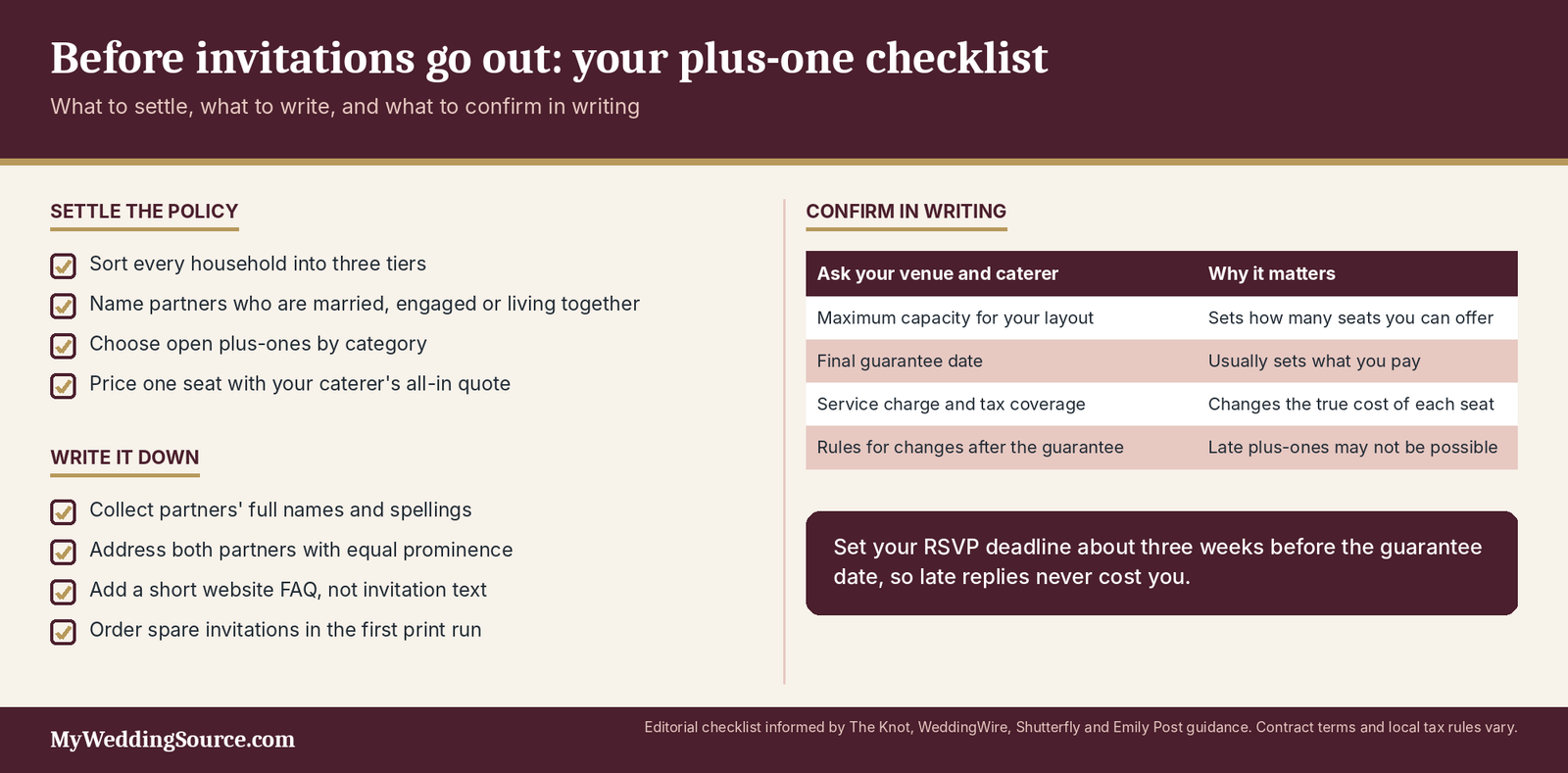
The plus-one policy should be settled when you set your guest count, not when the invitations are being printed. At that point you already know your venue’s capacity, and your cost per guest is still adjustable, so the policy can respond to the numbers. Start with the three tiers: list every household, mark each guest as a named partner, an open guest or invited alone, and add up the extra seats. Then ask your caterer for an all-in per-person price, including service charge and tax, and multiply it by the number of open plus-ones to see the range. If the number is too high, change the policy before you change any individual guest, because it is easier to adjust a rule than to disinvite a person. Our wedding planning hub places this step in the larger planning order.
What happens between the save-the-date and the invitation?
This stretch is for collecting names and closing gaps. Ask the guests you plan to invite as pairs for their partners’ full names, with correct spelling, so that the save-the-date, the invitation and the escort card all match. The Knot recommends learning the correct spelling of every plus-one’s name for exactly this reason, and it also suggests ordering extra invitations in the first print run, since small reorders cost more. Post your website FAQ before the invitations arrive, so that guests with questions find the answer before they text you. Finally, decide your cutoff for adding a plus-one, ideally two to three weeks before the caterer’s guarantee date, and write it in your own planning notes so that the answer to a late request is already decided.
How do you keep the list organized and accurate?
What should your guest-list spreadsheet track?
A plus-one policy is only as good as your records, and a basic spreadsheet is enough. Use one row per person, not per household, with these columns: name, household, relationship tier, plus-one status (named, open, none), partner’s full name, whether the name was confirmed, RSVP status, meal choice and allergies, and table. Adding a column for “reason for exception” keeps your rule honest, because you have to write down why a guest was treated differently. When a plus-one’s name is still unknown, mark it as “pending” and set a reminder for the date by which you need the name for the place cards. The same sheet can feed your caterer’s final count, your seating chart and your thank-you list, which saves a long evening of reconciliation later.
How do you handle the last few weeks before the guarantee date?
The RSVP deadline should come well before the guarantee date so you have time to follow up with late responders. A buffer of about three weeks gives you time to call or text the guests who have not replied, fill any gaps from an A-list or waitlist if you use one, and confirm the final number in writing with your caterer and venue. Check that every confirmed plus-one has a name, a meal choice and any allergy information, since a pending “guest” is hard to place and hard to feed. Reconcile your count against the venue’s capacity and the table plan before you send the final number. After the guarantee date, treat changes as exceptions that need the caterer’s written approval, and ask what the vendor will charge if the number goes up or down.
| When | What to do | Why it matters |
|---|---|---|
| When guest count is set | Sort guests into three tiers; price one seat | Policy follows the numbers |
| Before save-the-dates | Collect partner names; draft website FAQ | Correct spelling, fewer surprises |
| First invitation print run | Order spare invitations | Small reorders cost more |
| Invitations mailed | Publish the FAQ; send the invite with named guests | Guests see the rule before they ask |
| About three weeks before guarantee | Close the RSVP window; follow up with non-responders | Time to correct headcount |
| Guarantee date (per your contract) | Send the final number in writing | Usually sets what you pay |
Frequently asked questions about plus-ones
Questions about who gets a plus-one
Do I have to give every guest a plus-one?
No. Etiquette sources agree that married, engaged and cohabiting partners should be invited by name, but they treat a date for a single guest as a kindness, not a requirement. That means your obligation is to be consistent and clear, not to say yes to every request. If you can afford only some open plus-ones, give them first to wedding party members and to guests who would otherwise travel alone and know almost no one. Everything else is a judgment call that you can make by category.
Is “no ring, no bring” proper etiquette?
Not according to the planners quoted by The Knot, who both say it is not a proper way to decide plus-ones. The rule treats marriage as the only proof of commitment, and it leaves out engaged couples, couples who live together and couples who cannot or do not marry. A better test is whether the relationship is committed and known to you, using benchmarks such as engagement, living together or dating for more than a year. Whichever test you choose, apply it to everyone.
Can I give plus-ones to some single guests and not others?
Yes, as long as the difference is based on a category you can explain, such as the wedding party or guests traveling from out of state. Guests compare notes, and an exception that cannot be explained by a category will feel like favoritism. If you do make an exception for a support person or caregiver, treat it as an accessibility accommodation and keep it separate from the plus-one policy. Write the exception down in your spreadsheet so the reason is recorded.
Questions about wording and cost
How do I decline a plus-one request without hurting feelings?
Say thank you, name the limit in one sentence, and tell the guest how glad you are that they will be there. A script such as “We would love to have you, and we can only host the people named on the invitation” is true, short and warm. Do not apologize repeatedly or offer a long explanation, since that tends to invite a negotiation. If the guest declines in response, accept the decision and reply with warmth.
How much should I budget for each extra guest?
Start with your caterer’s all-in per-person price, then add the bar share, rentals and paper. The Knot’s 2026 study puts the average catering cost at about $80 per person and the average cost per guest at $292, and Zola estimates $150 to $300 for guest-dependent costs; this guide’s illustrative example uses $175. Use your own quote for the real figure, and multiply it by the number of open plus-ones you can afford, with a small buffer for gray-area relationships.
Your next steps
This week
Sort every guest into the three tiers
Open your guest list and mark each household as named partner, open guest or invited alone. Count the extra seats in each scenario from the table above, and note which guests are in the gray area. Do this before anyone else sees the list, so your first draft reflects your priorities and not the loudest request. The exercise usually takes an evening and settles most of the debate in advance.
Price one seat with your own quotes
Email your caterer and venue and ask for an all-in, per-person price for your date, with service charge and tax shown. Multiply that figure by the number of open plus-ones you are considering, and compare the total to your guest-list budget. If the number is higher than you expected, adjust the policy by category, not by person. Keep the written quote with your planning notes so you can show it to anyone who contributes.
Before you pay a deposit or order invitations
Confirm capacity and the guarantee date in writing
Ask your venue and caterer for the maximum capacity for your layout, the date the final guaranteed count is due, what happens if the count goes up or down after that date, and whether there is a minimum. Look for the phrases “guaranteed guest count,” “food and beverage minimum,” and “service charge” in the contract, and ask what each covers. General guidance only applies here, because contract terms and local rules vary, so get the answers in writing before you sign.
Draft the website FAQ and your scripts
Write the three-sentence website explanation, the one-sentence reply you will use for texts and the line you will use for parents. Order a few spare invitations in the first print run, and decide the last date you will accept additions. When those pieces are ready, you can send invitations knowing that every guest will receive the same answer, whoever asks.
Sources & methodology
- The Knot 2026 Real Weddings Study — survey of couples married in 2025; study scope and year
- The Knot, average wedding cost — $34,200 average, 117 guests, $292 per guest, about $80 catering per person, cost by guest-count bracket
- The Knot, plus-one etiquette — who typically gets a plus-one, wording options, saying no, A and B lists
- The Knot, plus-one etiquette guide — benchmarks for committed relationships, save-the-date and spare-invitation advice
- The Knot, giving single guests plus-ones — case-by-case approach, budget trade-offs (article updated 2018)
- The Knot, how many guests decline — roughly 20 percent typical decline rate, as an editor’s starting point
- The Knot Guest Study via wedding guest cost — $610 average guest spending, gift averages (1,000 adults, October 2024)
- Zola 2026 First Look Report — 11,500+ couples marrying in 2026, 145 average guests, $36,000 average budget
- Zola, what weddings really cost — $150 to $300 guest-dependent cost per guest, catering and bar averages (updated March 2026)
- Zola, how much wedding venues cost — service charges often 18 to 22 percent of vendor costs
- WeddingWire, plus-one etiquette — planner views on wedding party plus-ones, saying no, seating singles
- WeddingWire, how to address invitations — unmarried couples, “and guest,” children over 18
- Shutterfly, who gets a plus-one — sample envelope wording and invitation counts
- Shutterfly, how to address wedding invitations — separate lines for unmarried couples, single envelopes
- Emily Post, missing or extra RSVPs — partners of invited guests, declining date requests
- THE WED, should only married couples get a plus-one — arguments for and against spouses-only rules (June 2026 opinion piece)
- Pew Research Center, adults living without a partner — 2023 share of adults married, cohabiting and unpartnered
- U.S. Census Bureau, same-sex couple households in 2024 — about 1.4 million households, married and unmarried split
Methodology: Verified facts here are the published figures from The Knot, Zola, Pew Research Center and the U.S. Census Bureau, each labeled with its year and sample where the source gives one. Etiquette guidance is editorial judgment informed by the published views of Emily Post, The Knot, WeddingWire and Shutterfly, which sometimes disagree, and the cost layers other than the $80 Knot catering average and the Zola service-charge range are illustrative assumptions, not quotes. The $175 per-seat example and the scenario table are our own arithmetic, and your market, contract and state or local tax rules will change them.
Freshness note: Recheck The Knot and Zola figures when each publishes its next annual study, usually in the first half of the year, and confirm service charges, tax treatment and guarantee deadlines directly with your own venue and caterer before you rely on any estimate. Etiquette norms shift slowly, but wording conventions on invitations and websites are worth rechecking against current sources once a year.