
Wedding dress styles are easiest to choose when you start with how you will sit, move, and stay comfortable on the day, and then match silhouette, fabric, and price to that plan.
You have saved forty gowns and cannot say why half of them caught your eye. Most of those photos show a person standing still, turned slightly, with a train arranged for the camera. They do not show the six-hour version: the car ride, the ceremony steps, a seated dinner, a long line of hugs, a dance floor, and at least one bathroom trip. Names like A-line, mermaid, and sheath describe a shape on the hanger, while fabric, lining, and construction decide how that shape behaves once you are inside it.
This guide sorts wedding dress styles by behavior instead of by label. It covers silhouettes, necklines, sleeves, backs, trains, fabrics, embellishment, color, weather, venue, trend context, and what each choice tends to cost. It does not tell you which shape belongs to which body, because comfort depends on construction, tailoring, and your own preferences far more than on a category name. Where a claim comes from a study or a designer report, the source is linked beside it; where it is our editorial judgment, we say so. For the buying process itself, including appointments, deposits, and timelines, see our wedding dresses guide, and for the money side see our breakdown of wedding dress costs and hidden fees.
Where should you start when choosing a wedding dress style?
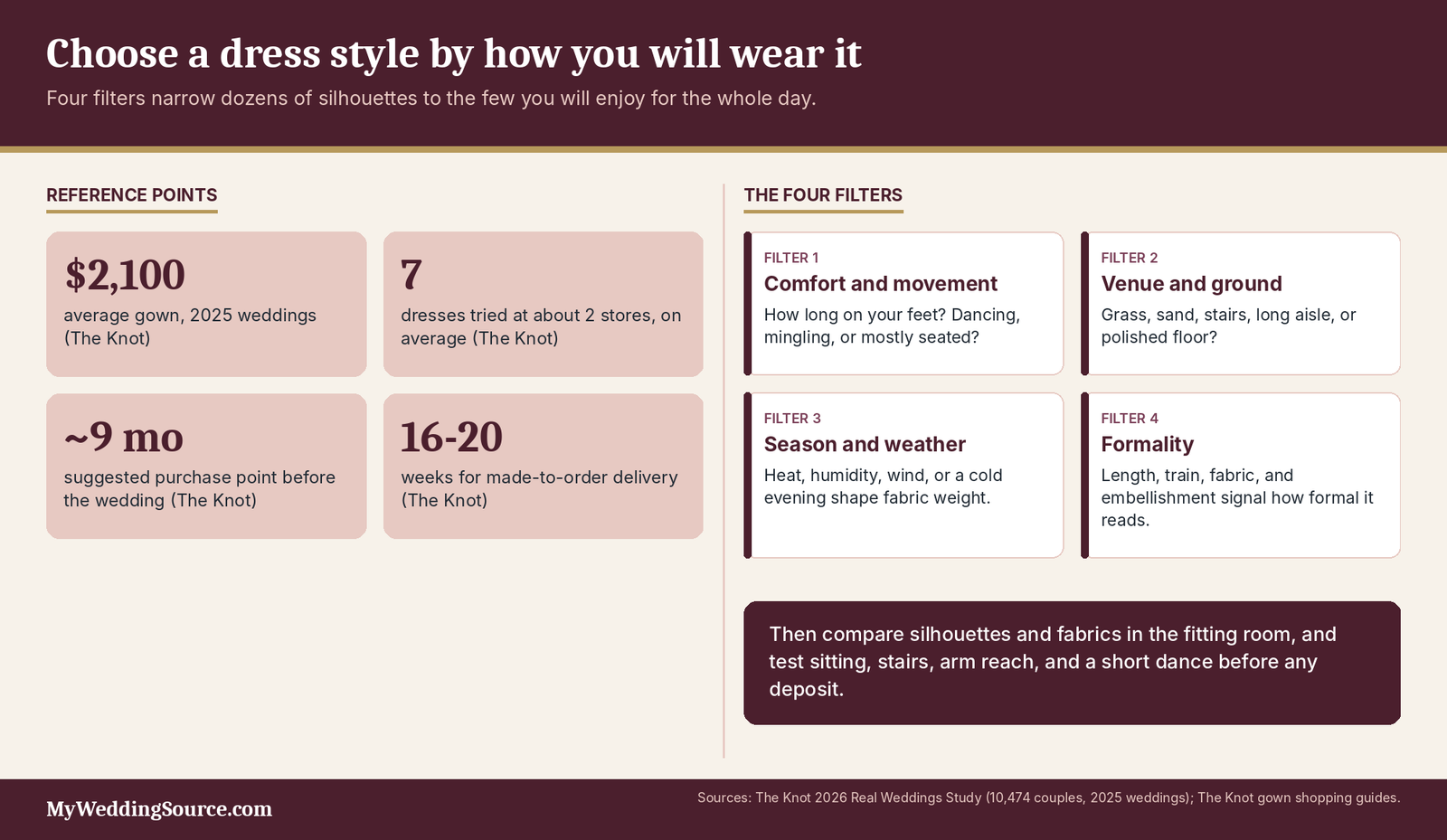
Starting with a name like “ball gown” or “slip dress” skips the more useful question, which is what you need the dress to do. A short list of filters narrows dozens of silhouettes to a handful you will enjoy wearing, and it protects you from the common pattern of choosing a dress for one photograph and then managing it all day. The sections below set up the filters first, then walk through the real-day tests that expose problems early.
What are the four filters that narrow your options?
Comfort, venue, season, and formality work together, and each one eliminates certain combinations before you book a salon appointment. Treat them as constraints you set once and revisit only when something important changes, such as moving the ceremony outdoors. A couple who writes all four down tends to give a stylist much clearer direction than one who says “something classic.”
How much comfort and movement do you want?
Think about the longest stretch you will be on your feet and the most active thing you plan to do. Some people want to dance for two hours, others plan one first dance and a lot of mingling, and a few plan to change into a second outfit for the reception. The Knot’s silhouette guide quotes a bridal designer describing the A-line as offering “danceable functionality,” and it calls the fit-and-flare a “nice hug and release” that reads as comfortable for a full night. Those are style descriptions rather than measurements, so write down your honest movement plan and bring it to the first appointment.
How will the venue’s floor, stairs, and light affect the dress?
Hems and trains meet the ground your guests walk on, so the venue matters as much as the dress. Grass, gravel, sand, stone steps, and polished ballroom floors each treat fabric differently, and a long skirt that glides across a ballroom may collect dirt and damp on a lawn. Bright outdoor light also shows sheer layers and lace more clearly than a dim hall does. Our wedding venues guide covers questions that affect attire, such as indoor backup space and floor surfaces, and photos of your ceremony spot are worth carrying to every try-on.
How do season and formality change the fabric and length?
Season changes how heavy a dress can be before it becomes tiring. Summer ceremonies often call for lighter layers and fewer petticoats, while winter weddings can carry heavier crepe, mikado, or long sleeves, and the Knot’s guide notes that airy fabrics suit summer and outdoor events while heavier gowns suit winter. Formality shows up in length, train, embellishment, and fabric rather than in one silhouette; the same guide says beading, lace, fabric, sleeves, and train length all change how formal a dress reads. A sheath in structured crepe with a short train can look quite formal, while a heavily embellished ball gown in a barn may feel mismatched to a casual guest list. Match the dress to your invitation wording so your guests’ attire and yours agree.
What does the dress have to handle between the ceremony and the last dance?
A wedding day contains more physical tasks than most people picture while shopping. Mapping those tasks before you try on dresses means you can test for them in the fitting room instead of discovering them at the reception. Four situations cause most of the surprises: sitting down, dancing and hugging, using the bathroom, and getting in and out of vehicles.
Can you sit and eat comfortably?
You will likely sit for a ceremony, a meal, toasts, and photos, and some dresses make that harder than others. A fitted bodice that feels fine standing can pinch at the ribs when you sit, and a stiff corset or boned bodice may limit how deeply you can breathe after dinner. Voluminous skirts take up space at a table, so check how the skirt behaves in a chair. During a fitting, sit for at least five minutes and notice whether anything digs, rides up, or restricts your breathing, then ask the seamstress whether it can be adjusted or whether the pattern itself is the issue.
Can you dance, hug, and move your arms?
Arm range is one of the most overlooked tests. Raise your arms above your head, reach forward as if hugging someone, and mimic lifting a drink, because a snug armhole or a heavily beaded sleeve can limit all three. Zola’s guide notes that mermaid gowns can be hard to move in and that ball gowns usually need a crinoline, which can feel hot. Those tradeoffs are not reasons to avoid a silhouette; they are reasons to dance in the fitting room and ask about bustle and skirt options.
How will bathroom logistics and getting around work?
Bathroom trips are a practical constraint for any dress with a lot of fabric, a long train, or a one-piece design like a jumpsuit. Ask who will help you, how many layers you need to lift, and whether you can reach zippers or buttons alone. A bustle keeps a train off the floor, and a lined skirt with a modest petticoat is easier to manage than one with several stiff tulle layers. Getting into a car in a full skirt takes technique, and stairs can hide a hem under your foot, so practice both, along with the whole bathroom routine and your helper’s role, during your final fitting.
What do the main wedding dress silhouettes feel like to wear?
Silhouette is the outline of the dress, and it is the first thing most people name. It is also the least predictable part of the experience, because two A-lines can feel completely different depending on fabric, lining, and bodice construction. The Zola and Knot guides used here group roughly thirteen to sixteen silhouettes, from A-line to jumpsuit, and agree on the core definitions. We describe them by how they tend to move and what they ask of you, and we leave out body-type matching.
How do volume and structure change the experience: ball gown and A-line?
Ball gown: how much skirt is manageable?
Per the Knot’s description, a ball gown is fitted at the waist or hip and flares dramatically, often with layered tulle. Zola adds that it usually sits over a crinoline, which can make it feel warm. In practical terms, expect a ball gown to need more floor space, a longer dressing process, and a bustle that works for dancing. A designer quoted by The Knot suggests choosing one that feels manageable while still letting you twirl. When trying one on, walk through a doorway and sit down so you can judge how much skirt you will be managing.
A-line: why is it the common starting point?
The A-line fits at the natural waist and then flares softly toward the hem, forming a shape like the letter A. It offers a middle ground between a slim skirt and a ball gown, and it works across many fabrics, from chiffon to crepe to lace. Zola notes it comes in almost any fabric, which is why salons often use it as a starting point for new shoppers. The movement it allows is a major reason: legs are free, the skirt does not limit step length, and the train can be adjusted without much structural change. If you are unsure where to start, an A-line in two different fabrics is a useful comparison because it isolates how the material changes the feel.
How do shapes closer to the body behave: fit-and-flare, trumpet, mermaid, sheath, column, slip, and empire?
Fit-and-flare, trumpet, and mermaid: where does the flare start?
All three follow the figure through the bodice and hips, and the difference is where the skirt widens. A fit-and-flare flares at the upper thigh, a trumpet flares at mid-thigh with some volume, and a mermaid flares dramatically at or below the knee. Zola points out that a trumpet is less restrictive than a mermaid and that mermaid gowns often need extra alterations, so budget time for them. The higher the flare starts, the easier it usually is to walk and dance, while a low flare gives a dramatic outline but can shorten your stride. If you want the look of a mermaid and plan to dance, ask the stylist for a version with a stretch panel or a godet that opens the skirt.
Sheath, column, and slip: what holds the shape?
A sheath or column falls straight to the floor, and a slip dress skims the figure in an unstructured way, usually in satin or silk. With less structure, these dresses depend on fabric weight and lining to look smooth. Per the Knot, column dresses often use structured fabrics that hold their shape, while sheaths tend to use more fluid ones. They are generally light to wear and easy to move in, but slimmer skirts may limit step length on stairs. They also show underlying seams and lines, so undergarment planning matters more, which we cover in the try-on section.
Empire and drop-waist: where does the waistline sit?
An empire waist sits just below the bust and then flows, which many wearers find comfortable because nothing presses at the midsection. Chiffon and other light fabrics are common choices, per Zola, and the style suits warm weather. A basque or drop waist, by contrast, dips below the natural waist and often appears on ball gowns and sheaths. Pinterest’s 2026 wedding report lists “drop waist wedding dress corset” as the fastest-growing term in its dress and attire list, and The Knot’s coverage of New York Bridal Fashion Week points to basque and drop-waist hybrids as a 2027 trend. Where the waistline sits changes how a bodice moves when you sit, so try the same waist position in more than one version.
What if you do not want a traditional gown: tea-length, midi, separates, jumpsuits, and suits?
Short, tea-length, and midi hems: when do they make sense?
Tea-length typically falls just above the ankle, midi between the knee and ankle, and mini above the knee. The Knot suggests minis for elopements, courthouse ceremonies, second reception outfits, and after-parties, and says shorter hemlines feel more breathable in warm weather. Hems that clear the floor remove the train-management problem, show off shoes, and keep fabric away from grass or damp ground. In its short-dress roundup, the Knot lists top picks from $69 to $1,420 and rentals starting at $65, which shows how wide the price range is. Short styles can also work as a second look for the reception, a trend Zola’s 2026 report mentions without giving a percentage.
Separates, jumpsuits, and suits: how do they work in practice?
A separates set pairs a top and skirt, or a top and pants, and gives you two pieces you can mix, wear again, or change between ceremony and party. A jumpsuit is a one-piece with pant legs, while suits range from tailored white sets to colored or textured versions. Pinterest’s 2026 report lists searches like “wedding dress men” and “halter neck suit design” among its growth terms, though the report does not define its baseline. For bathroom logistics, separates are usually the easiest, while a one-piece jumpsuit needs more planning.
| Silhouette | How it tends to move | Sitting and dancing notes | Worth asking |
|---|---|---|---|
| Ball gown | Full skirt, often over a crinoline | Needs space at a table; bustle essential for dancing | How heavy is the skirt, and how is it bustled? |
| A-line | Soft flare from the waist | Legs are free; easy to sit and dance | Does the fabric add or remove bulk? |
| Fit-and-flare | Fitted to the upper thigh, then flares | Comfortable for most movement | Where does the flare begin? |
| Trumpet / mermaid | Fitted through the hips, flare at mid-thigh or knee | Shorter stride; mermaid is hardest to move in | Is there a stretch panel or godet? |
| Sheath / column | Straight line to the floor | Light, but narrow hem on stairs | Does the lining prevent clinging? |
| Slip | Skims the figure, unstructured | Soft and easy; shows seams and lines | What undergarments work with the fabric? |
| Empire | Waist under the bust, loose flow | Little pressure at the midsection | Does the bodice support stay in place? |
| Tea-length / midi | Hem clears the floor | No train to manage | How will shoes look in photos? |
| Separates / jumpsuit / suit | Two pieces or one piece with legs | Varies; jumpsuits need bathroom planning | Can pieces be altered independently? |
How do necklines, sleeves, backs, and trains change comfort and movement?
Once a silhouette is narrowed down, the details above and below the waist decide how the dress feels hour by hour. Necklines and straps govern support, sleeves govern arm range and warmth, backs govern what you can wear underneath, and trains govern floor space. Each is separate from the silhouette, which means a favorite shape often comes in several versions, and the version you try may not be the one that suits your day.
How do necklines and straps affect support and comfort?
Strapless and sweetheart lines: what holds them up?
A strapless dress stays in place through internal boning, a fitted bodice, or a built-in corset, which means the fit at the first appointment needs to be tested by moving, not just standing. The Knot’s coverage of New York Bridal Fashion Week found strapless gowns returning for spring-summer 2027 with new neckline shapes, including cat-eye, scalloped, envelope, and semi-sweetheart cuts. Those shapes change how the top edge sits against your chest and arms, so a style that looked secure in one neckline may behave differently in another. Test by raising your arms, hugging someone, and sitting, then ask whether the bodice can be taken in or whether silicone grip tape or a built-in bra cup is part of the design.
High necks, halters, and off-the-shoulder lines: what limits the arms?
High necks and halters shift the weight of the dress to your neck and upper back, which many people find stable and comfortable, though some feel closed in during warm weather. Off-the-shoulder lines hold the arms closer to the body, which can restrict reaching and hugging if the band is snug. Pinterest’s 2026 wedding report lists “halter neck wedding dresses” among its dress-related growth terms, and the Knot’s silhouette guide shows halter, high-neck, plunging, square, and off-the-shoulder styles on different gowns. Because those are photo-caption mentions rather than a dedicated guide, treat them as examples, not rules. In the fitting room, practice your full reach: lift both arms, cross them, and take a step backward as if hugging someone.
How do sleeves and backs change how you move and what you wear underneath?
What do different sleeves do for arm range, warmth, and sun?
Sleeves are a coverage and climate decision as much as a style decision, and the Knot’s guidance for older brides treats coverage as a personal preference, suggesting long sleeves for winter and capes or roomy short sleeves for anyone who wants more coverage, without tying that choice to age. Tight long sleeves look sleek but can limit reach, while sheer or lace sleeves add warmth without much weight if the armhole is cut with room. The Knot’s short-dress article adds that sleeves can be worn in any season and that some are detachable, which gives you a way to switch from ceremony to dance floor. Ask how the sleeve is attached, whether the armhole is cut for movement, and whether a sleeve can be removed without a visible seam.
How do backs affect closures, support, and photos?
Backs range from covered buttons and zipper-and-corset closures to low, open, and illusion styles. Covered buttons can look beautiful but may take several minutes to fasten and need a helper, while a zipper with a covered placket is faster. A corset-style lace-up back is adjustable, which can help if your size changes between fittings or after a long day, though it usually takes a second person to tighten. Pinterest’s report lists “silk backless wedding dress” and The Knot’s trend report describes bow-back details, including a full-length bow on one gown. If you plan a low back, ask about adhesive cups or a backless bodysuit, which the Knot’s shapewear tests include for dresses with plunging backs, and bring the undergarment to your fittings.
What should you know about trains, lengths, bustles, and veils?
Trains and veils add drama and also add logistics. They change how the dress moves in photos and how much work it takes to keep clean. Decide how much you want to manage, then choose the length that fits.
How long is each train, and what does it do on the day?
Wikipedia’s entry on trains lists common reference lengths that run from a sweep train, which barely touches the floor, to a court train extending about one meter (3.3 feet), a chapel train at roughly 3.5 to 5 feet, a cathedral train up to about 8 feet, and a royal cathedral train about 10 feet or more. Specific designers label their trains differently, so ask for the measurement in inches. Longer trains photograph dramatically in a church aisle but need a helper to arrange them, can catch on stairs or furniture, and pick up dirt on grass or sand. A shorter train or a sweep keeps the drama while reducing the handling, and a removable overskirt can give you a long train for the ceremony and a lighter dress for the party.
How do bustles and veils work with the dress?
A bustle is a set of hooks, buttons, or ties that lifts the train off the floor after the ceremony, and the type depends on the fabric and train length. Bustles are usually added during alterations, so ask the seamstress to show you how it works and have your helper practice during a fitting. Bustle prices vary by seamstress and complexity; our alterations guide lists typical ranges and lead times in its wedding dress alterations breakdown. Veils add another layer, and their length, fullness, and attachment should work with your dress back and hairstyle; see our guide to the meaning and history of the wedding veil for the traditions behind the choices.
How do wedding dress fabrics behave, and which suit your day?
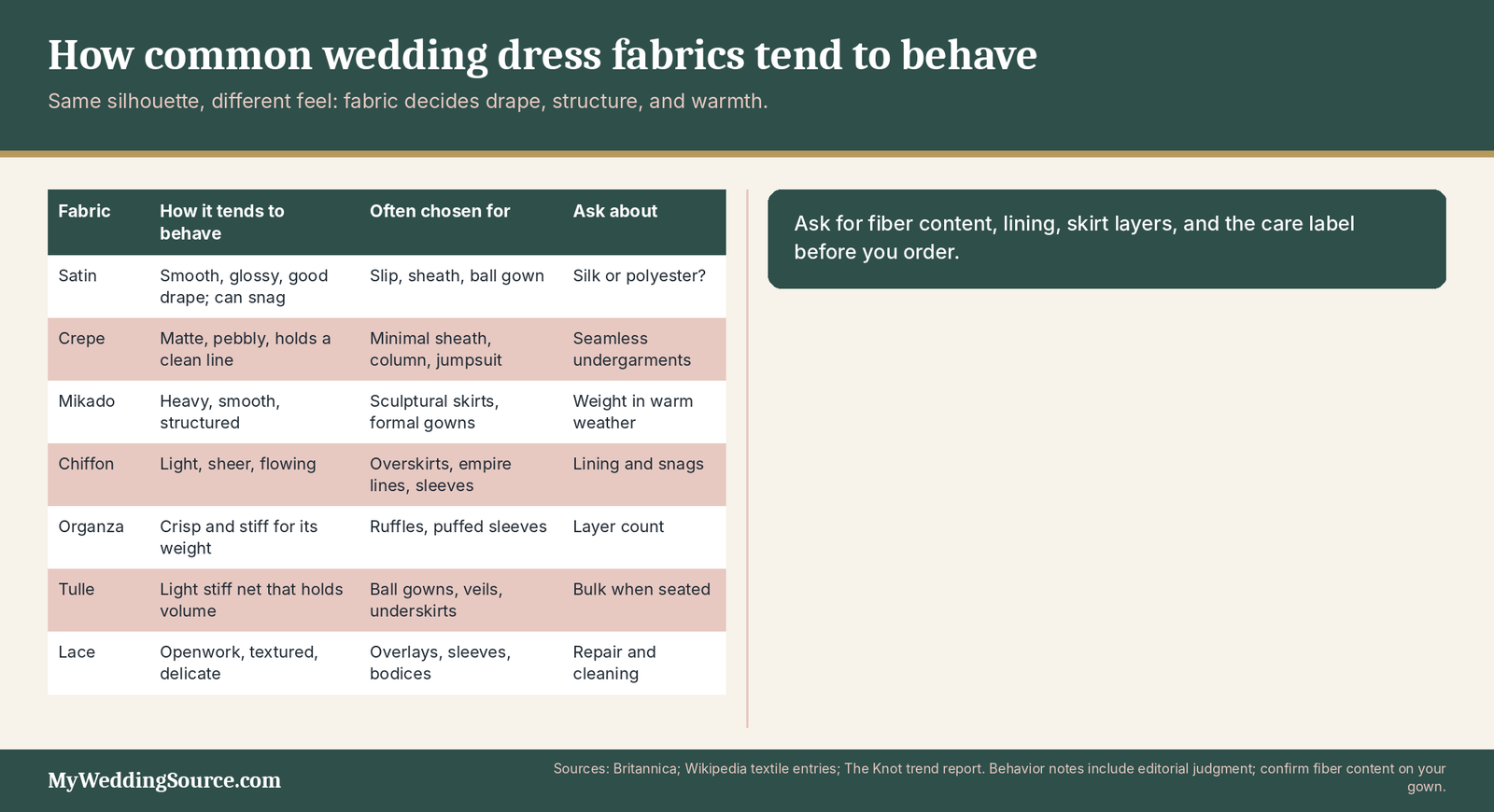
Two dresses with the same silhouette can feel and photograph differently because of fabric. Fabric decides drape, structure, weight, breathability, wrinkle behavior, and how the dress responds to heat, humidity, and sitting. It also drives a lot of the price, which we cover later. Descriptions below draw on textile references for the basic properties of each material and on editorial judgment for how they tend to behave in a gown.
Which smooth and structured fabrics are common: satin, crepe, and mikado?
Satin: is it a fiber or a weave?
Satin is a weave rather than a fiber, which surprises many shoppers. As Britannica explains, a satin weave produces a smooth, lustrous face and a duller back, and it was originally made from silk but is now woven from many other yarns. Wikipedia’s satin entry adds that satin-weave fabrics drape better than plain weaves, that satin can snag, and that duchesse satin is heavy and stiff while charmeuse is lightweight and fluid. In practice, polyester satin and silk satin look similar on a hanger but can differ in breathability, price, and how they respond to heat. Ask for the fiber content, since a “satin gown” may be silk, polyester, or a blend.
Crepe: why does it hold a line without much shine?
Crepe gets its pebbly, matte surface from tightly twisted yarns, according to Wikipedia’s crepe entry, and the range runs from soft, lustrous, drapey versions to stiffer, crisped ones. A smooth “flat” crepe imitates the look without the twisted yarns. In gowns, crepe tends to produce a clean, minimal look that skims the figure and stays opaque. It can show every bump under it, so undergarment choice matters, and the Knot’s shapewear piece specifically recommends seamless pieces under crepe, satin, and silk.
Mikado: what makes it structured?
Mikado is a heavy, smooth, lustrous fabric, usually silk or a silk blend, that holds sculptural shapes like pleats and large skirts without extra layers. The Knot’s 2027 trend report names Italian mikado among the “maximal fabrics” shown at New York Bridal Fashion Week. That description comes from general industry usage, so confirm fiber content with the salon rather than assuming it from the name. Structured fabrics like mikado generally feel more formal, can be heavier for a warm outdoor ceremony, and typically show creases that need professional steaming.
Which light, sheer, and airy fabrics are common: chiffon, organza, tulle, and lace?
Chiffon and organza: how do they differ?
Chiffon is a very light, sheer plain weave. Britannica notes that although it looks delicate it is a relatively strong, balanced fabric, traditionally silk and now often synthetic. Organza is also a thin, sheer plain weave, but Wikipedia describes it as crisp and stiff for its weight with a slippery surface, which is why it holds ruffles and puffed sleeves while chiffon flows. Chiffon tends to work for empire waists, overskirts, and sleeves in warm settings. Organza can be layered for structure without the weight of mikado.
Tulle: how does a net create volume?
Tulle is a fine, stiff netting that Wikipedia says is typically made of polyester, nylon, or silk and is often starched for body. Layers of tulle create the cloud-like volume of many ball gowns and the bell shape of petticoats, and a single layer can add a soft, airy overlay. The Knot’s decade history notes tulle becoming lighter and more ballet-inspired in the 2020s, with less volume. More layers means more warmth and more bulk when you sit, so ask how many layers the skirt contains and whether you can reduce the count.
Lace: what are the main types?
Lace is an openwork textile built from threads rather than woven cloth. Wikipedia’s lace entry describes bobbin lace, with Chantilly as an example, needle lace, and machine-made lace including a chemical lace method where a dissolvable ground is embroidered and then removed. It is described as delicate, which matters for care and alteration. In gowns, lace can be used as an overlay, an appliqué, a sleeve, or a full bodice. Heavily beaded lace adds weight and repair complexity, and some alterations require re-appliquéing motifs, which seamstresses may price by the hour.
How does embellishment change weight, labor, and care?
How heavy and labor-intensive can beading be?
The Knot’s trend coverage reports that one designer’s nude mermaid dress reportedly took 13,000 hours and another gown required more than 600 hours of hand embroidery, which are extreme examples from runway collections rather than typical salon gowns. Even modest beading takes skilled labor, and The Knot’s cost article lists beading, embroidery, and 3D appliqués as price factors that can take hours or weeks per gown. Weight adds up over a full skirt, so consider walking and dancing in the dress for ten minutes before deciding. Also ask whether loose beads can be replaced, how the seamstress handles beaded hems, and whether embellishment charges are quoted per hour.
How do you check care and cleaning before you buy?
Under the FTC’s Care Labeling Rule, textile apparel must carry a permanent label with regular care instructions, and if a product cannot be cleaned safely by any method, the label must say so. Ask to see the care label on the sample or the label that will be attached to your gown, since it tells you whether the fabric is dry-clean only or can be spot treated. Ask the salon what they recommend for cleaning and preserving a gown with lace, beading, or silk, and keep the label information with your receipt. This is general consumer information and not a legal opinion, and a salon or cleaner can tell you how it applies to your specific dress.
| Fabric | How it tends to behave | Often chosen for | Watch for |
|---|---|---|---|
| Satin (silk or polyester) | Smooth, glossy, drapes well | Slip, sheath, ball gown | Snags, shows creases; confirm fiber |
| Crepe | Matte, pebbly, holds a clean line | Minimal sheaths, columns, jumpsuits | Shows lines under it; seamless undergarments |
| Mikado | Heavy, smooth, structured | Sculptural skirts, formal gowns | Weight and heat; creases need steaming |
| Chiffon | Light, sheer, flowing | Overskirts, empire lines, sleeves | Needs lining; can snag |
| Organza | Crisp, stiff for its weight | Ruffles, puffed sleeves, layered skirts | Slippery surface; stiffness limits drape |
| Tulle | Light, stiff net that holds volume | Ball gowns, underskirts, veils | Bulk when seated; layer count |
| Lace | Openwork, textured, delicate | Overlays, sleeves, bodices | Fragile; alterations and cleaning cost |
How do color, season, and venue change which dress makes sense?
A dress is worn in a place, in a particular light, at a particular temperature. Those three variables change how a color photographs, how a fabric behaves, and how long a hem stays clean. The goal of this section is to turn “outdoor summer wedding” or “winter ceremony in a historic church” into specific style choices you can bring to a stylist.
What do white, ivory, blush, and color look like in practice?
How do white, ivory, and champagne differ on camera?
White, ivory, and champagne shades vary by designer, fabric, and dye lot, so a swatch name tells you less than seeing the dress. Wikipedia’s wedding dress entry notes that white spread widely after Queen Victoria’s 1840 wedding and that mid-century Western gowns come in shades such as eggshell, ecru, and ivory, which shows how many “white” options exist. Cool, stark whites can look crisp in daylight and slightly flat under warm indoor lighting, while warmer ivories and champagnes tend to look softer in candlelight but can read yellow in bright sun. Ask to see the dress by a window as well as under the salon’s lights, and compare it against the veil, shoes, and any lace overlay, since mismatched whites can stand out in photographs. Color on a screen is unreliable, so rely on the dress itself.
What about blush, muted color, and cultural traditions?
Soft color is moving into bridal collections, and The Knot’s coverage of New York Bridal Fashion Week reports muted shades such as butter yellow, dusty rose, and pistachio green at several designers for spring-summer 2027. Pinterest’s 2026 report lists color palette terms like muted rose, merlot, and plum among its growth terms, and pink and green suit searches among its suiting terms, though it does not publish its baseline. Outside Western tradition, red is a common wedding color in many Chinese and Indian ceremonies, according to Wikipedia’s wedding dress entry, and many couples wear culturally specific attire for all or part of the day. If color matters to your family or faith, ask early whether the dress or outfit works for a ceremony, a reception, or both.
How do you match a dress to a beach, barn, cathedral, or hot outdoor setting?
Beach and windy waterfronts: what moves well?
Wind and sand favor lighter fabrics and hems that clear the ground, so chiffon, soft crepe, and short or tea-length styles are common choices. A long train collects sand and salt, can be pulled by wind, and is harder to bustle on soft ground. Shoes sink into sand, so many couples choose bare feet, flat sandals, or a firm ceremony platform, and your hem length should be measured with whatever you plan to wear. Bring a fabric swatch to your alterations appointment and ask what happens to the hem if it gets wet. If you are marrying near water, a veil can be dramatic in photos but may blow into your face, so consider a shorter or weighted version.
Barns, gardens, and lawns: how do you handle grass, dust, and uneven ground?
Grass, gravel, and dirt floors add friction and dirt to any hem that touches the ground. A sweep train, a removable overskirt, or a tea-length hem can reduce the cleanup, and a well-built bustle lets you move around the reception without carrying the skirt. Evenings can turn cool outdoors, so a wrap, cape, or jacket adds warmth without changing the dress. Ask whether the venue has an indoor backup, because rain turns lawns to mud and some barns have uneven plank floors that catch heels.
Cathedrals and formal indoor spaces: when does a long train make sense?
Long aisles, wide steps, and formal ceremonies are where cathedral and chapel trains show best, and where structured fabrics like mikado or heavy crepe hold their shape. Stairs and tight pews are the practical limit, so ask your officiant or the venue how much train will fit through the processional, and plan for a helper to arrange it. Some houses of worship have guidelines about shoulders or arms, so confirm requirements with the officiant before you buy, and consider a shrug, sleeves, or a detachable layer for the ceremony. Heavy gowns with multiple petticoats can be warm in a crowded sanctuary, so ask about breathable linings. A detachable or bustled train lets you keep the ceremony look and move more freely at the reception.
Hot outdoor weddings: what should you plan for?
The National Weather Service’s heat index chart shows that a heat index of 90 to 103 degrees Fahrenheit falls into its “extreme caution” band, where heat cramps, heat exhaustion, or heat stroke are possible, and it notes that direct sunlight can raise the heat index by as much as 15 degrees. The CDC advises scheduling outdoor activity for the coolest parts of the day when possible, drinking fluids regularly, and taking shade breaks. For a dress, that translates into breathable fabrics, fewer layers, light linings, and a ceremony time that avoids the afternoon peak. Plan shade, water, and a place to sit for yourself and your party, and consider a second, lighter look for the reception. This is general planning information and not medical advice; if you have a health condition that heat affects, talk with your clinician about planning.
| Setting | What tends to work | What to watch | Question to ask |
|---|---|---|---|
| Beach | Chiffon, soft crepe, tea-length or sweep train | Sand and salt on hems, wind on veils | Can I walk the surface in this hem? |
| Barn, garden, lawn | Sweep train, removable overskirt, wrap | Damp grass, uneven floors, cool evenings | What is the rain plan and floor surface? |
| Cathedral or formal hall | Structured fabrics, chapel or cathedral train | Aisle width, stair handling, coverage rules | How much train fits the processional? |
| Hot outdoor | Light fabrics, fewer layers, breathable lining | Heat index, direct sun, long exposure | Where is the shade and when is the ceremony? |
| Courthouse or city hall | Midi, separates, suit, short hem | Travel in transit, photo backgrounds | Is there a place to change after? |
What do different wedding dress styles cost, and why?
Price differences between dresses come from a combination of fabric, labor, construction, brand, and place of sale. Understanding which of those you are paying for helps you spend where it matters to you. It also prevents the common surprise of choosing a style on appearance and discovering its alterations or care requirements later. For a complete price breakdown, tier by tier, see our guide to wedding dress costs and hidden fees; this section focuses on how style choices affect price.
What drives the price of one style compared with another?
How do fabric and yardage change the price?
The Knot’s cost article states that luxury materials cost more and that silk is more labor-intensive to produce than satin, which matches the broader point that fiber choice shapes price. Yardage matters too: all else equal, a full skirt uses far more fabric than a straight column, and layered tulle or organza multiplies the amount. That relationship is editorial reasoning rather than a published formula, so treat it as a reason to ask how many layers the skirt has. The Knot reports that one expert estimated brands pay 15 to 50 percent more on inputs alone, a cost pressure that can show up in what retailers charge. If cost matters, compare two dresses in the same fabric before comparing different silhouettes.
How do labor, construction, and embellishment change the price?
According to the Knot, built-in corsets, boning, and multilayered skirts raise labor and cost, and embellishments such as beading, embroidery, and 3D appliqués require skilled artisans who can spend hours or weeks on a gown. Runway examples show the extreme end, with reported figures of 13,000 hours for one designer’s gown and more than 600 hours of hand embroidery for another, but even ordinary beading adds hours of skilled work. A minimalist crepe gown may cost less to make than a heavily beaded lace one, even when the silhouette is the same. Ask which parts of the dress are hand-applied and whether a version with less embellishment exists.
How do designer, region, and import costs affect what you pay?
The Knot reports luxury designers often charge higher markups regardless of production methods, and its 2026 study shows regional averages ranging from about $2,000 for hometown weddings to about $2,900 for international destination weddings. Zola’s 2026 report notes that some couples worry about price increases in categories including attire because of potential tariffs, without attaching a number to attire. We could not verify a tariff amount specific to gowns, so treat any firm percentage you see online with caution and ask the salon directly how pricing changed for the dress you are considering.
What should you budget around the sticker price?
What is the average, and how wide is the range?
The Knot’s 2026 Real Weddings Study, which surveyed 10,474 U.S. couples married in 2025, put the average wedding dress at about $2,100. Its budget tiers show about $1,200 for lower-budget weddings, $2,000 for mid-budget, and $3,200 for higher-budget weddings. Because only 19 percent of the female respondents wore custom-made attire, most figures reflect off-the-rack and made-to-order gowns. An average is not a quote, and dresses cost far less and far more than it, so use it to sanity-check a quote and not to set a target.
How does an illustrative total come together?
The following is an illustrative example, not a quote. Start with a $2,100 gown, the national average. The Knot’s cost article says retailers typically require a deposit of 30 to 50 percent when you order, with the balance due at pickup, and its gown checklist says basic hems start around $200 while major adjustments can exceed $1,000. Its shapewear guide puts basic options around $30 and specialized pieces at roughly $50 to $150 or more. Add those and your gown, alterations, and undergarments could land between roughly $2,330 and $3,250, before sales tax, shoes, veil, jewelry, shipping, and cleaning or preservation. A style that needs more alteration or care, such as a heavily beaded mermaid, moves toward the high end, while a simple A-line moves toward the low end.
| Cost driver | How it tends to affect price | Styles it shows up in | Evidence level |
|---|---|---|---|
| Fabric type | Silk and luxury materials cost more than synthetics | Satin, mikado, silk crepe | The Knot cost article |
| Yardage and layers | More fabric and layers add material and labor | Ball gowns, multilayer tulle | Editorial reasoning |
| Embellishment | Hand beading and appliqué add hours of labor | Lace, beaded bodices | The Knot cost article |
| Structure | Corsets, boning, and multilayer skirts add labor | Fitted gowns, mermaids | The Knot cost article |
| Brand and region | Designer markups and regional differences | All styles | The Knot, 2025 data |
| Alterations | Complex shapes and embellishment cost more to adjust | Mermaid, beaded, layered | Zola note; see alterations guide |
Which 2026 and 2027 wedding dress trends are backed by data, and how should you use them?
Trend data comes in several forms, and each answers a different question. Designer reports show what is on runways, platform data shows what people are saving or searching, and surveys show what couples say they are doing. None of those is the same as Google search volume, and none tells you what will suit your day. Our 2027 wedding trends article covers trends beyond attire; this section focuses on dresses.
What did designers show for spring-summer 2027?
The most detailed recent source is The Knot’s report from New York Bridal Fashion Week, published September 29, 2026, which lists thirteen trends across collections. These are what designers showed, which is a different signal from what most couples will buy. It is useful as a map of options that will appear in salons over the next year.
Which silhouette and structure trends appeared?
The Knot’s report lists strapless gowns returning with new necklines, basque and drop-waist hybrids, asymmetry, flared peplums, long-line and exposed corsetry, draping, continued 1990s minimalism with slip dresses, and an elevated bridal midi. For wearers, the practical meaning is that structure is returning to some designs, which can mean boning and longer bodices that need more fitting time. Slip and minimal styles continue for those who want softness and less structure. A midi hem is a way to get a shorter look with a dressy finish, and the Knot names crystals and pearls on midi designs at several labels.
Which details, colors, and accessories appeared?
Details in the report include muted colors like butter yellow, dusty rose, and pistachio, micro bows, mantilla veils, and maximal fabrics such as Italian mikado, brocade, ruffles, and heavy beading. Accessories included neck scarves, chokers, capelets, and fingerless gloves. These items are easier to add or remove than a silhouette, which makes them a lower-commitment way to follow a trend. Heavily beaded and brocade pieces carry the weight, cost, and care issues described earlier, so ask for the full care and alteration picture before choosing them.
What do Pinterest and Zola add, and what do they not tell you?
Platform and survey data show direction without showing size or reliability. They are worth reading with questions about baseline, time window, and sample. Using them alongside the designer report gives a fuller picture than any one source.
How should you read Pinterest’s dress growth figures?
Pinterest’s 2026 wedding trend report lists dress and attire terms with reported growth, including “drop waist wedding dress corset” at +1,405 percent, “1980 wedding dress” at +1,090 percent, “mermaid drape” at +330 percent, “silk backless wedding dress” at +155 percent, and “halter neck wedding dresses” at +145 percent. Its headwear list includes “fascinator styles” at +1,865 percent and “red veil wedding” at +255 percent. The page does not state the time period, baseline, or methodology for those percentages, and a large percentage can come from a small starting number. These are platform search-trend signals, not Google search volume and not a count of dresses sold. Use them as evidence of curiosity, not demand.
What do Zola’s survey results suggest, and how do you use trends?
Zola’s 2026 First Look report, based on more than 11,500 couples getting married in 2026, mentions couples adding a second fashion look for the reception, worrying about price increases in attire, and using image-based AI tools for decor, attire, or floral inspiration; it reports 31 percent for that last item. It gives no percentage for second looks or attire price worry. A reasonable way to use trend data is to treat it as a list of options, then run each through your own filters: comfort, venue, season, formality, and budget. If a trend fits all five, it is a candidate, and if it only fits the photo, it is worth a second thought.
| Trend | Source and strength | Practical question |
|---|---|---|
| Reinvented strapless necklines | The Knot, designer showings for spring-summer 2027 | How is the bodice held up when I move? |
| Basque and drop-waist hybrids | The Knot designer report; Pinterest drop-waist corset search growth | Does it work when I sit? |
| Muted color (butter, dusty rose, pistachio) | The Knot designer report | How does it look in daylight and flash? |
| Mantilla and fascinator headwear | The Knot (mantilla); Pinterest (fascinator growth) | Does it work with my hair and dress back? |
| Midi and short looks | The Knot designer report; The Knot short-dress guide | Is it my ceremony look or a second look? |
| Exposed corsetry and boning | The Knot designer report | How many fittings will it need? |
How should you try on wedding dress styles so the fitting room tells you the truth?
A salon appointment is short, and the setting is designed to feel special, which can make it hard to notice practical problems. A plan for what to bring, how many styles to try, and which tests to run turns the hour into usable information. The process side of shopping, including salon types and contract steps, is covered in our wedding dresses guide, so this section stays on how to evaluate style.
What should you do before the appointment?
Preparation takes an evening and prevents the most common fitting-room frustration, which is not knowing what to ask for. It also protects your budget, since a stylist can pull dresses within your range only if you say what it is. Do the thinking at home, where nobody is waiting.
When should you start, and how long do the steps take?
The Knot’s shopping guidance suggests starting about 12 months before the wedding, or as soon as the date and venue are set, and aiming to buy around nine months out. Its gown checklist says made-to-order delivery takes about 16 to 20 weeks, dresses commonly arrive three to four months before the wedding, and alterations typically involve one to three fittings. Survey respondents in that piece bought at about 7.5 months, so a later start is common, but a short timeline narrows your choices toward off-the-rack, sample, or ready-to-wear gowns. Your own timeline may differ by retailer and designer, so confirm the delivery date in writing when you order. Plan the order of appointments around the dress, not the other way around.
What should you bring?
Bring a short list of screenshots sorted by features, such as necklines, sleeves, and fabric, because The Knot suggests saving Pinterest inspiration to show your stylist. Also bring your budget, your four filters, your movement plan, and a photo or description of the venue. Wear or bring the undergarments you plan to use; the Knot’s shapewear piece recommends wearing shapewear during fittings so you can see how the dress looks and feels with it, and test-wearing it for a few hours at home beforehand. A light meal and water help you stay patient through a one-hour appointment, which the Knot describes as standard, and shoes with a similar heel height make hem and train judgments more accurate. Check the salon’s guest policy and keep your group to two or three people so opinions do not compete.
How many dresses should you try, and in what order?
How many styles are enough?
The Knot, citing its 2025 Real Weddings Study, reports that the average bride visits two stores and tries on about seven dresses, and it adds that loving the first dress you try is also normal. We suggest a small structure for the first visit: at least three different silhouettes, two different fabrics in the silhouette you like best, and one dress you would not normally choose. The wildcard is useful because it shows you what you dislike, and a surprising number of couples find that a dress they expected to avoid fits their plan. If you love something early, write down why, then keep trying a few more so the choice is informed. Dress tests are easier to compare if you take photos or video of each one in the same spot.
Which tests should every finalist pass?
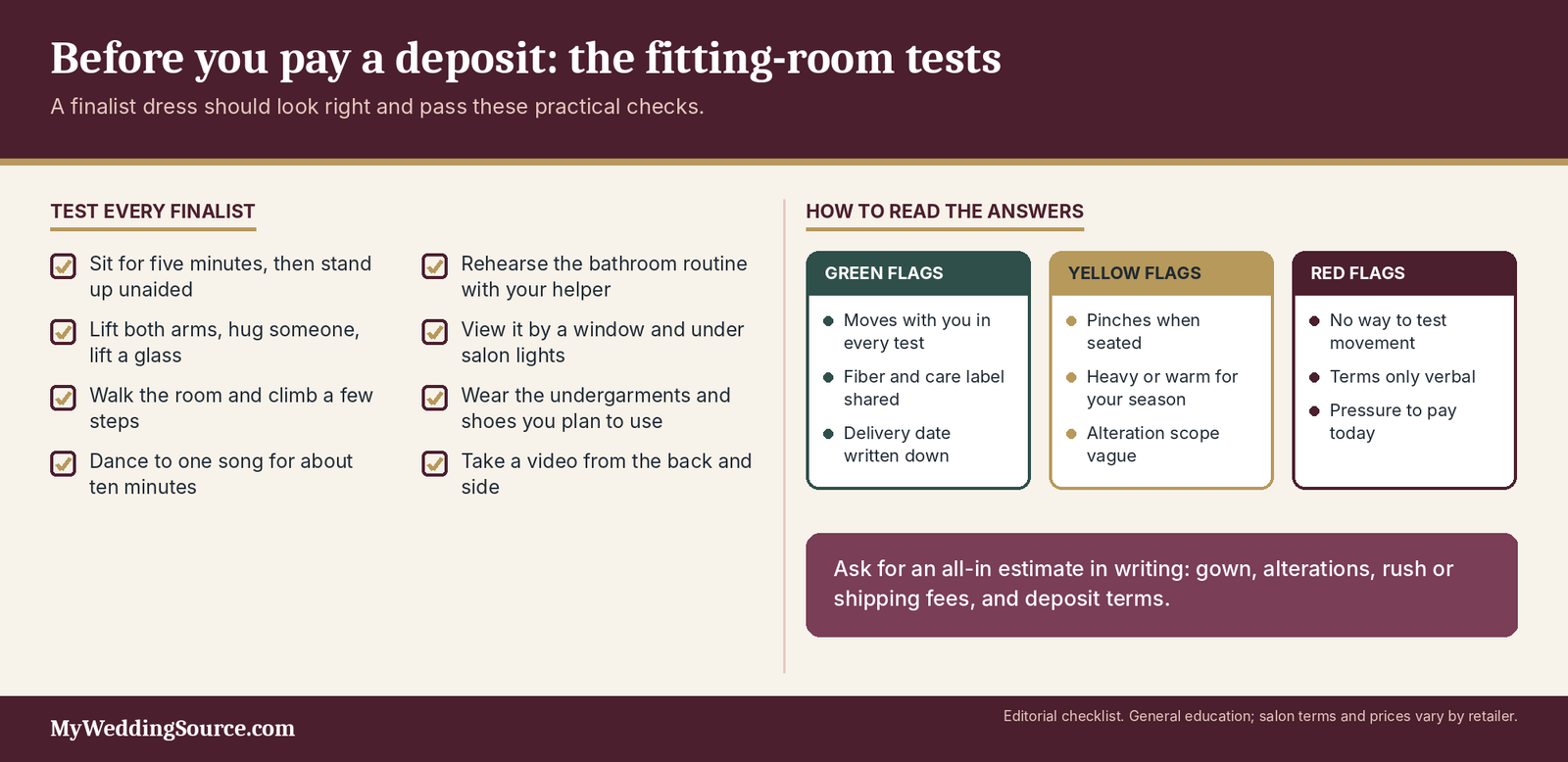
A finalist is a dress that looks good and also passes basic function tests. Run them while you are still in the salon, because the stylist can show you options like detachable straps, extra bustle points, or a different lining. Ask permission to move around, since most salons expect it. If a test fails, ask whether the issue can be altered or whether it comes from the pattern, then decide whether you want that trade.
| Test | How to run it | What it tells you |
|---|---|---|
| Sit for five minutes | Sit in a chair, then stand up without help | Whether the bodice pinches and how the skirt behaves |
| Arm reach | Lift both arms, hug someone, lift a glass | Whether the armholes and sleeves allow movement |
| Walk and stairs | Walk the length of the room, then climb steps | Step length, hem clearance, and train handling |
| Ten-minute dance | Move to a song for ten minutes | Weight, heat, and whether the bodice shifts |
| Bathroom rehearsal | Practice with your helper, layer by layer | How many layers, who helps, and whether closures are reachable |
| Light check | View near a window and under different lights | Color shifts, sheerness, and lining |
What should you avoid when choosing a wedding dress style?
Most regrets come from a small set of patterns that are easy to see in advance. Avoiding them does not require a specific style, and it protects your comfort and your budget. The first group concerns how you choose, and the second concerns how you shop.
Which style choices lead to the most regret?
Why avoid choosing from a single photo or runway look?
A hanger photo or runway image shows a dress styled by professionals, with pinned fabric, flattering lighting, and no movement. Runway collections show what designers want to say, which the Knot’s trend report makes clear with examples like gowns that took thousands of hours to make. Salon samples can also be altered or pinned for display. Judge a dress by how it behaves on you, in motion, in several views, and with the undergarments you will wear. A good habit is to take a photo from behind and a short video as you walk and turn.
Why avoid ignoring the venue, weather, and your own movement plan?
A dress that ignores the day’s conditions turns into a daily management task. Heavy fabrics in July, long trains on sand, tight sleeves for a dance-heavy reception, and sheer layers in bright sun can all be fixed with planning, but they are cheaper to avoid than to repair. Return to your four filters before you pay a deposit and confirm that the dress passes each one. If a favorite dress fails one filter, look for a version with a different fabric, hem, sleeve, or train rather than dropping it entirely. Many designers offer variations, and a seamstress can sometimes change the length or add straps.
Which shopping traps are worth avoiding?
What should you check about sizing, alterations, and delivery?
Wedding dresses are made in fixed sizes and often need alterations, and The Knot notes that alteration costs are not included in the average gown price. Ask which size the salon plans to order and why, how many fittings are included, and what the estimated delivery date is. Our wedding dress alterations guide covers typical costs, the timing of fittings, and rush fees, which the Knot warns can apply if you book alterations too late. Different sources give different ranges for basic hems and bustles, so ask your seamstress for a written quote for your specific dress.
What should you check in the contract and care instructions?
Read the order for deposit amount, refund terms, delivery date, and what happens if the dress arrives late or damaged. The Knot reports that retailers typically require deposits of 30 to 50 percent, with the balance due at pickup, but terms vary by store and state laws differ, so this is general information and not legal advice. Ask for the care label details, as described in the FTC’s Care Labeling Rule, and ask what the salon recommends for cleaning and storage. Keep your receipt, contract, and a photo of the dress’s label in one folder.
FAQ: wedding dress styles
These answers are short on purpose; the sections above explain the reasoning. Where a source or an editorial judgment sits behind an answer, we say so.
What are the most common questions about choosing and wearing a style?
Comfort depends on construction, fabric, and your own preferences, so no single silhouette is right for everyone. Style editors often describe A-line and fit-and-flare shapes as friendly to dancing, and tea-length, midi, and separates remove the train-handling problem. A mermaid or very fitted gown can still work for dancing if it has a stretch panel or a high flare, so test it rather than ruling it out.
What is the most comfortable wedding dress style for dancing?
The Knot’s silhouette guide quotes a designer describing the A-line as offering “danceable functionality” and calls the fit-and-flare a “nice hug and release,” and Zola suggests a trumpet or fit-and-flare for anyone who plans to dance. The reliable answer is to dance in the fitting room for ten minutes in the specific dress you are considering. A bustle that works for dancing matters as much as the silhouette.
Are ball gowns too hot for a summer wedding?
They can be, since Zola notes that ball gowns often need a crinoline that can make them hot. Ask how many layers the skirt has, whether the lining is breathable, and whether some layers can be removed. For an outdoor summer ceremony, plan shade, water, and a later start time, and consider a lighter reception look. Heat is a function of weather, fabric, and the amount of time outside, so check the forecast and the heat index for your date.
Can I wear a short dress, separates, or a suit for the ceremony?
Yes, and The Knot suggests shorter dresses for elopements, courthouse weddings, and second looks, and calls them breathable in warm weather. Separates, jumpsuits, and suits are also covered in the silhouette guides from The Knot and Zola. Check your venue and officiant for any dress guidelines, such as coverage in a house of worship, and think about whether you want the same look for photos and the reception.
What do shoppers ask about color, cost, and timing?
Color, price, and timing are the three areas where shoppers most often receive conflicting advice. The short answers below reflect the sources used in this article and note where figures vary.
What is the difference between white, ivory, and champagne?
There is no universal standard; shades vary by designer, fabric, and dye lot. White is generally cooler and starker, ivory and champagne are warmer, and each reads differently in daylight, candlelight, and photographs. Compare the dress, veil, and any lace overlay together by a window, and bring a fabric sample to your fittings. Wikipedia’s wedding dress entry notes that eggshell, ecru, and ivory are common Western shades.
How much does a wedding dress cost, and how far ahead should I order?
The Knot’s 2026 Real Weddings Study reports an average of about $2,100 for 2025 weddings, with an average of about $1,200 for lower-budget weddings and $3,200 for higher-budget ones. Those figures do not include alterations. The Knot suggests buying about nine months before the wedding and says made-to-order delivery takes about 16 to 20 weeks. If your timeline is shorter, ask about off-the-rack and sample gowns, and confirm delivery dates in writing.
Your next steps
The goal of this week’s work is a one-page brief you can hand to a stylist. The goal before the deposit is confirming that the dress and the paperwork match that brief. Neither requires buying anything yet.
What should you do this week?
Two tasks make the biggest difference: writing your constraints and sorting your inspiration. Both can be done in an evening and they shape every appointment after. Keep the result somewhere you can open on your phone in the salon.
How do you write your four filters and movement plan?
Write one line each for comfort, venue, season, and formality, and add a line about how you want to move: dancing, mingling, long ceremony, or mostly seated. Add your dress budget, including alterations and undergarments, and the date by which you would like to order. Check the venue’s floor surface and weather exposure using your venue contract or your planner. Bring the page to your first appointment and share the budget so the stylist can pull dresses within your range.
How do you sort your inspiration by feature?
Open your saved photos and label each by feature: silhouette, neckline, sleeve, back, fabric, and train. Look for patterns, such as always saving open backs or structured fabrics, and ignore features you saved only because the photo was beautiful. Pick three silhouettes and two fabrics to try first, plus one wildcard. Screenshots of a single feature are often more useful to a stylist than screenshots of a whole dress.
What should you check before you pay a deposit?
A deposit commits you to a dress, a delivery date, and a set of terms. Reviewing those items before you pay takes ten minutes and keeps surprises out of the middle of your timeline. Ask for everything in writing.
Has the dress passed your tests?
Confirm that your finalist passed the sitting, arm reach, walk and stairs, dance, bathroom, and light tests, and that you have photos or video from several angles. Ask for the fiber content, the lining, the number of skirt layers, and the care instructions. If you plan an outdoor or hot-weather ceremony, ask about a lighter or detachable layer. If any test failed, ask whether the issue can be changed before you order.
Are the money and timing terms clear?
Ask for an all-in estimate that includes the gown, alterations, and any rush or shipping fees, and ask what deposit you owe and whether any part is refundable. Confirm the estimated delivery date and what happens if the dress arrives late. Book your seamstress around the time the dress arrives, and set a reminder for your first fitting.
Sources & methodology
- The Knot: 2026 Real Weddings Study — study of couples married in 2025 (updated February 17, 2026); context for average costs.
- The Knot: The Average Wedding Dress Cost — $2,100 average, budget tiers, regional averages, price factors, deposits.
- The Knot: Wedding Dress Trends (spring-summer 2027) — thirteen trends from New York Bridal Fashion Week, published September 29, 2026.
- The Knot: Wedding Dress Silhouettes — silhouette definitions and designer comments on movement.
- The Knot: 14 Things to Know Before Trying On Wedding Dresses — seven dresses at two stores on average, appointment length, guests, timing.
- The Knot: Wedding Gown Shopping Checklist — buying timeline, lead times, alterations and fittings, deposits.
- The Knot: Short Wedding Dresses — occasions, seasons, price examples for short dresses.
- The Knot: Wedding Dress Trends Through the Decades — silhouette history, tulle and structure shifts.
- The Knot: Bridal Shapewear — undergarments by neckline, back, and fabric; price ranges.
- The Knot: Wedding Dresses for Older Brides — coverage and comfort as personal choices.
- Zola: Wedding Dress Silhouettes — silhouette definitions and comfort notes.
- Zola: 2026 First Look Report — survey of more than 11,500 couples marrying in 2026; attire-related mentions.
- Pinterest: Wedding Trend Report 2026 — dress, headwear, and color growth terms; methodology not stated on the page.
- Britannica: Satin and Chiffon — weave and fiber basics.
- Wikipedia: Crêpe, Organza, Tulle, Lace, and Train (clothing) — fabric construction and train lengths.
- Wikipedia: Wedding dress — history of white gowns and color traditions.
- National Weather Service: Heat Index — risk bands and the effect of direct sunlight.
- CDC: About Heat and Your Health — hydration, timing, and heat illness signs.
- eCFR: 16 CFR Part 423, Care Labeling Rule — care label requirements for textile apparel.
Methodology: Verified facts, such as study samples, published averages, and the Care Labeling Rule’s requirements, are attributed to the named source. Survey and platform figures come from the pages cited, and Pinterest percentages are platform search-trend signals that the source does not define by baseline or window. Fabric and silhouette behavior combines textile references with editorial judgment, and statements about how a style “tends” to feel are not measurements. The illustrative total is arithmetic on the cited figures and not a quote. We did not verify tariff amounts for gowns, mikado fiber specifics, or yardage by silhouette, and we say so where relevant.
Freshness note: Recheck The Knot’s average gown cost and Pinterest’s trend report when each publishes its next annual edition, and review the spring-summer 2027 designer trends after the next bridal fashion week. Confirm salon delivery estimates, deposit terms, and alteration pricing directly with your retailer and seamstress, since they change by store and season.