
To plan a wedding timeline that holds up, decide in dependency order (guest count, budget, date and venue, then vendors, attire, stationery, and details) and count backward from the wedding date for every contract deadline.
You are engaged, and every calendar you find says something different: one wants the venue booked 18 months out, another says 11, a third opens with the dress. That disagreement does not mean anyone is wrong. A wedding timeline is a chain of dependencies, and the chain runs in a fixed order even when the number of months in your engagement changes. This guide shows how to plan a wedding timeline month by month for a 12-to-18-month engagement, then compresses the same logic into 9-, 6-, and 3-month versions.
It also explains why each item sits where it does, so you can move things around when your venue, your family, or your contracts force a change. The broad decisions (priorities, budget framework, venue types, vendor categories) live in our complete wedding planning guide; this page is the calendar that sits on top of it. The hour-by-hour schedule for the wedding day itself belongs to our guide to wedding day timeline failure points, so here you will find the handoff to that day rather than a second copy of it.
A note on the numbers before you rely on them. Booking lead times in this article are typical, drawn from planning checklists published by Zola, The Knot, and WeddingWire, and they vary by region, season, vendor, and contract. Your signed paperwork always outranks a generic calendar, including this one.
Why the order matters: the dependency chain behind every timeline
Most wedding calendars read like a list of tasks, which hides the thing that makes the list work: each decision narrows the options for the next one. If you book a photographer before you know the venue’s ceremony start time, you may be negotiating coverage hours you cannot yet define. If you order invitations before the guest list is stable, you pay for printing twice. The timeline in this guide is built on a single chain, and once you can see the chain, you can rebuild the schedule for any engagement length.
What depends on what?
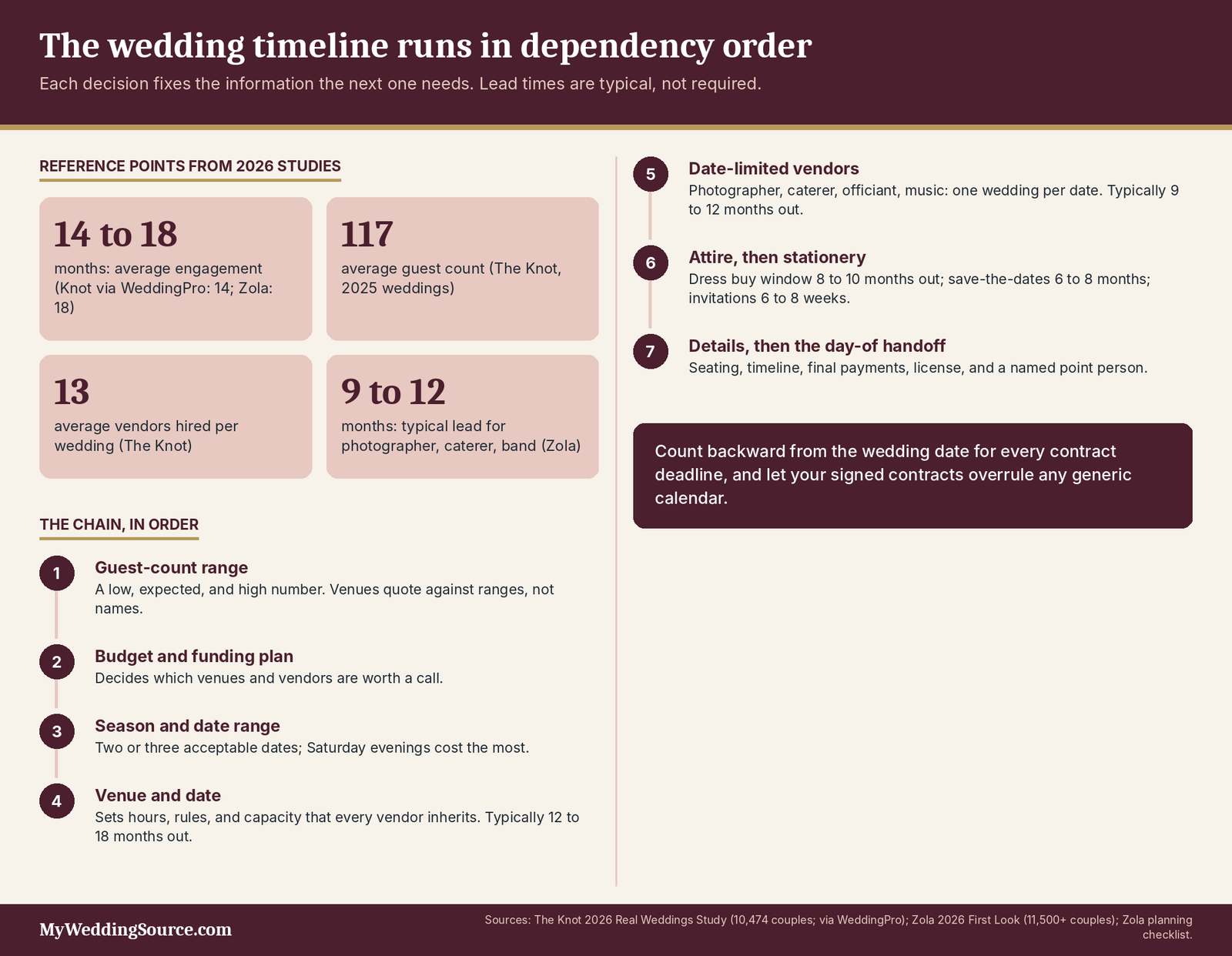
The chain has seven links: guest count, budget, date and season, venue, core vendors, attire and stationery, then details. Each link is a gate. You can research ahead of a gate, but you cannot responsibly sign past it, because the information you need to evaluate a contract is not yet fixed.
Why do guest count and budget come first?
Guest count drives nearly every per-person cost and every capacity limit. The Knot’s 2026 Real Weddings Study, which surveyed 10,474 U.S. couples married in 2025, reports an average of 117 guests and $292 per guest, figures that show how directly headcount multiplies the bill. Budget comes next because it decides which venues and vendors are even worth a conversation. A couple who tours venues without a number tends to fall in love with rooms that cost twice what they can commit, which burns both time and goodwill.
You do not need a final guest list in month 18. You need a range (for example, 80 to 110 invited, with a realistic attendance below that), because venues and caterers quote against ranges before they quote against names. Our complete wedding planning guide walks through building the list and the budget framework in detail.
Why do date and venue come before the other vendors?
A date is not really a date until a venue holds it. Photographers, caterers, bands, and officiants all sell the same scarce resource, which is one wedding per day, so they will ask for the date and the location before they quote. The venue also sets rules that other vendors inherit: how many hours you have, whether outside caterers are allowed, when load-in starts, and where the ceremony can happen.
That is why venue research belongs at the front of the vendor phase rather than in the middle. Once the venue is signed, every other vendor quote can be written against known hours, a known room, and a known capacity. Before that, quotes are guesses with a logo on them.
What can safely wait?
The opposite mistake is trying to settle everything at once. A calendar that front-loads every decision creates deposits you may regret and choices you will revisit. Some items have a clock, and some only feel urgent because they are fun.
Which decisions look urgent but are not?
Color palettes, table linens, favors, signage, and most decor decisions feel like progress, and they are easy to research on a lunch break. They are also the decisions most likely to change once you see your venue’s actual room, lighting, and rental inventory. Spending months 18 to 13 on them tends to produce a mood board that your venue cannot support. Keep these in an inspiration folder and revisit them after the venue and florist are booked.
A useful test is to ask what breaks if the decision slips by three months. If the answer is “nothing, except it feels slow,” it can wait. If the answer is “a vendor may be unavailable” or “a legal window may close,” it belongs on the calendar.
Which decisions look optional but have a clock?
Alterations, hotel block cutoffs, name-change paperwork, passport timing for an international honeymoon, and the marriage license window all look like details until they become the single thing standing between you and the day. The U.S. Department of State lists routine passport service at 4 to 6 weeks and expedited at 2 to 3 weeks, both excluding mailing time, on a page last updated June 28, 2025. A couple who remembers the passport 5 weeks before a honeymoon flight is already paying for speed.
Those hidden clocks are the reason this guide has a dedicated section on legal timeline items and another on payment and decision deadlines. They do not feel romantic, and they are exactly the tasks that cause avoidable stress in the final month. A useful habit is to put the earliest hidden clock for each of these items on your calendar the same day you make your first vendor booking, so they arrive as reminders instead of surprises.
| Decision | What it unlocks | Typical cost of deciding late |
|---|---|---|
| Guest-count range | Venue capacity, catering quotes, invitation quantity | Venues that fit are already booked; you re-quote everything |
| Total budget | Which venues and vendors are worth a call | Overspending on early bookings that crowd out later categories |
| Season and date range | Which dates venues can offer; pricing tiers | Fewer dates to choose from, especially peak Saturdays |
| Venue and date | Vendor availability, hours, rules, rain plan | Vendors quote hours you cannot confirm; bookings stall |
| Core vendors | Design decisions, floor plan, schedule | Preferred vendors booked; fewer choices at your budget |
| Attire | Fittings, accessories, party coordination | Rush fees, limited options, shorter alteration window |
| Stationery | Mailing dates, RSVP data, headcount | Rush printing, late mail, unreliable headcount |
| Details and day-of plan | Final confirmations, handoff to vendors | Last-minute questions land on you in wedding week |
How to plan a wedding timeline: choose how long you actually have
Before you open a month-by-month schedule, decide which schedule applies to you. The honest answer depends on your engagement length, your season, and whether your preferred dates are already taken. Two big studies publish engagement-length averages, and they disagree by several months, which tells you something useful about how wide the real spread is.
How long do couples typically plan?
Averages are a place to start, not a deadline. They help you calibrate whether your runway is short, standard, or generous compared with other couples, and they remind you that a 12-month engagement is not a failure of planning. If your own runway is shorter than the averages, that changes which row of the schedule table you use, not whether the wedding can be well planned.
What do the 2026 studies report?
The Knot’s 2026 Real Weddings Study puts the average engagement at 14 months, based on more than 10,000 couples who married in 2025. Zola’s 2026 First Look Report, built on more than 11,500 couples, reports an average engagement of 18 months, unchanged from the prior year. Zola also found that roughly 1 in 5 couples take real planning steps before getting engaged, such as touring venues, which means the “clock” for some couples starts before the proposal.
The two surveys sample different populations and define engagement differently, so treat the range of 14 to 18 months as the typical window rather than choosing one number. Neither study says couples who plan faster or slower have better outcomes. The useful takeaway is that most couples have a year or more, and the schedules in this guide are written for that runway first.
Why does the average hide such a wide range?
An average engagement of 14 months blends couples who marry at a courthouse six weeks after proposing with couples who wait three years for a family-friendly date. It also blends peak-season Saturday weddings, where venues book a year or more out, with Friday or Sunday weddings that can often be arranged in a few months. Your own timeline depends less on the national average than on three local facts: how many venues you would be happy with, how flexible your date is, and how large the guest list is.
A couple with a 60-person list and a flexible weekday has far more options in a short window than a couple with 180 guests set on a June Saturday. When you read the schedule chooser below, pick the row that matches your real constraints rather than the one that matches the average. The reverse also holds: a long runway does not guarantee options if the date, the venue type, and the guest count are all narrow.
Which schedule fits your runway?
The schedules in this guide share one structure. The longer ones simply spread the same tasks across more months, while the shorter ones overlap tasks and accept fewer choices. The table gives you a starting point, with the compressed versions covered in detail later in the 9-, 6-, and 3-month section.
| Months until the wedding | What it feels like | What to prioritize first | Main trade-off |
|---|---|---|---|
| 18 or more | Room to compare and wait | Priorities, money, venue touring | Risk of over-planning and decision fatigue |
| 12 to 17 | The standard runway | Venue within the first 90 days of planning | Peak-season dates may already be limited |
| 9 | Brisk but workable | Venue, photographer, and caterer within weeks | Fewer vendor choices on popular dates |
| 6 | Compressed | Venue and major vendors in parallel | Less time to compare; faster decisions |
| 3 | Sprint | Date and venue first; simplified scope | Smaller list, off-peak date, limited customization |
Which row should you use if you are between two?
If your engagement falls between two rows, use the shorter schedule’s booking order and the longer schedule’s spacing for everything after the vendors are signed. For example, at 10 months, you follow the 9-month booking sequence (venue and photographer in the first weeks) but keep the standard spacing for fittings and stationery. That mix avoids the most common error, which is assuming that a slightly shorter timeline means everything must be rushed.
If you are weighing whether to shorten the engagement on purpose, ask which resource you lack: money, vendor options, or family availability. A shorter runway tends to cost options, not necessarily dollars. Zola reports that weekday celebrations or winter weekend dates can save 20 to 30 percent on most vendor costs, which is a trade many short-engagement couples make deliberately.
How should you treat the timeline if you are still deciding whether to hire a planner?
Make the planner decision early, ideally in the first 90 days, because a planner or day-of coordinator changes the shape of the calendar. A full-service planner often helps you book vendors, so they enter the sequence before the venue is signed. A coordinator or day-of provider usually joins later and focuses on the final two months and the wedding day.
Comparing scope before you sign is worth an evening of questions, and whichever route you choose, decide who owns the calendar and name that person in writing. A planner who joins late can still be valuable, but the vendor shortlist may already be set by then. Ask any planner you interview which phase of this calendar they take over and which they expect you to keep.
Booking lead times: what to book when, and why
Lead time is the gap between the day you sign and the day you need the service. It exists because vendors sell a limited number of dates, because custom products take weeks or months to produce, and because some tasks (like fittings) need several rounds. The table below gathers typical lead times; the sections that follow explain the reasoning so you can adjust it.
What are the typical lead times?
There is no national standard for booking lead times, and no published dataset tracks them across all vendors. The ranges below come from planning checklists at Zola, The Knot, and WeddingWire, and they should be read as typical rather than required. Where sources disagree, the table shows the disagreement rather than hiding it.
What does the lead-time table show?
| Item | Typical lead time before the wedding | Why it takes that long | Basis |
|---|---|---|---|
| Venue | 12 to 18 months (one Zola section says about 11) | Popular dates book first; every vendor depends on it | Zola checklist and FAQ; WeddingWire (about 12) |
| Planner or coordinator | Decide in the first 12 months | Shapes who books the rest | Zola checklist |
| Photographer | 9 to 12 months | One wedding per date | Zola FAQ |
| Caterer | 9 to 12 months (earlier if not venue-provided) | Menu, staffing, rentals | Zola FAQ |
| Band or DJ | About 8 months, sooner for in-demand acts | Good acts fill peak dates | Zola checklist |
| Officiant | About 11 months, confirm state eligibility | Must be authorized in your wedding state | Zola checklist |
| Florist | 6 to 9 months | Design depends on venue and palette | Zola checklist and FAQ |
| Baker | 4 to 8 months | Smaller scope, fewer date conflicts | Zola checklist and FAQ |
| Hair and makeup | About 5 months | Popular artists book peak dates | Zola checklist |
| Wedding dress | Shop 9 to 12 months out; buy 8 to 10 months out | Production takes 4 to 6 months plus fittings | The Knot (updated January 2025) |
| Save-the-dates | 6 to 8 months out | Guests need travel lead time | The Knot |
| Invitations | Mail 6 to 8 weeks out; order about 4 months out | Design, print, address, mail | The Knot; Zola checklist |
The lead times do not add up to one neat sequence, because many of them overlap. What the table does show is the clustering: the date-limited vendors sit at 9 to 12 months and beyond, the custom-production items at 4 to 10 months, and the guest-facing paper at the end. In practice you will book in waves, with the first wave early in the engagement and the last wave in the final four months. Use the table as a list of questions to ask each vendor about their own lead time, since a vendor’s answer is more reliable than any generic range.
Why do the sources disagree about the venue?
Zola’s own planning article lists the venue at about 11 months in the checklist and 12 to 18 months in its FAQ, and WeddingWire’s timeline places it about 12 months out. The gap reflects different assumptions about season and region. In a large metro area with a popular Saturday in June or October, 12 to 18 months is realistic, and some in-demand venues book further out than that. In a smaller market or for an off-peak weekday, 6 to 9 months may be enough.
A reliable way to resolve it is to call two or three venues you would happily book and ask which dates in your preferred month are still open. That one conversation tells you more about your market than any national guideline, and it takes about an hour. Write down the answers so you can compare markets on equal terms, and ask whether the open dates carry different pricing tiers.
Why do vendors need that much notice?
Understanding the mechanism makes it easier to judge when a quoted deadline is reasonable and when to ask questions. Lead times come from two sources: scarcity of dates, and production time.
How does date scarcity shape the calendar?
Photographers, caterers, officiants, and musicians can usually serve one wedding per day, and the most sought-after ones have a limited number of peak Saturdays per year. When a vendor says they are “booked for your date,” they mean the one slot is gone. That is why the first-tier bookings cluster at 9 to 12 months or more. If your date is a Saturday in May, June, September, or October, treat those as the lead times, and consider moving earlier for in-demand vendors.
If your date is off-peak, a Friday, or a Sunday, the same vendors may have far more availability, and you gain leverage on both timing and price. The risk of waiting is smaller, though not zero: a vendor you love can still be taken by someone else the week you hesitate. That is also why a vendor’s line that they “book up fast” deserves a follow-up question about how many dates remain in your month.
How does production time shape the calendar?
Dresses, custom stationery, and some rentals are produced after you order, and production times stack on top of shipping and alterations. The Knot reports that made-to-order dresses take 16 to 20 weeks from order to arrival, that the dress typically arrives 3 to 4 months before the wedding, and that a couple should plan for one to three alteration fittings. Work backward from the fittings, and the buy window of 8 to 10 months makes sense.
Production-based items are also where rush fees appear. Booking alterations late or ordering stationery in a hurry can add charges that did not exist on the original quote. The cheapest way to avoid rush fees is simply to order when the lead time says to, even if the deadline feels far away.
Months 18 to 12: priorities, money, and the venue decision
The first six months of a long engagement feel slow, and that is intentional. The work here is mostly conversations and constraints, not purchases, and the couples who treat it as real work tend to book faster and regret less later. If you have fewer than 12 months, this phase compresses into the first two or three weeks, and the compressed schedules show how. If you want a gentler on-ramp for the first weeks after the proposal, our engagement season checklist covers the announcement, ring, and first-month decisions.
Months 18 to 15: what to decide before you book anything
Think of this stretch as setting the rules of the game. Everything you sign later will be easier to evaluate if the rules are written down and agreed on by both partners.
How should the first money and priority conversations go?
Start with three questions: what matters most to each of you, who is contributing money, and what you are willing to skip. Write the answers down in a shared document, because memory shifts once vendors start asking for deposits. Zola’s checklist places the budget conversation, including who is contributing, in the 12-plus-months window, and The Knot’s guidance on paying for a wedding points out that vendor products and services usually must be paid before registry cash gifts arrive, which is a reason to decide your funding plan before the first deposit.
Pick your top three priorities (for example, food, photography, and a venue that holds everyone) and agree on how to settle conflicts when two priorities collide. Do not assume any particular person pays, and do not assume the budget must be large; couples plan satisfying weddings at every price point. The point of this conversation is to make later decisions faster, not to fix a number forever.
How do you build a guest-count range?
Draft a list in tiers: the people who must be there, the people you very much want, and the people you would invite if space allows. Add a rough count for each tier and you have a low, expected, and high number. That range, rather than a single figure, is what you give venues and caterers in the early quotes.
Then adjust for attendance. The Knot suggests starting with a rule of thumb that about 20 percent of invitees decline, noting that cited studies range from 60 to 85 percent saying yes and that a sweet spot is around 80 percent. Destination weddings, holiday weekends, and wedding dates far from where most guests live tend to run lower, so adjust the assumption to your situation. Treat the result as a planning tool: the final number comes from RSVPs, not from arithmetic.
Months 15 to 12: date, venue, and first vendors
When the rules are written, the shopping starts. This stretch is where most couples make the single largest commitment of the entire timeline, so slow, comparative work pays off. Resist the urge to tour more than four or five venues, since each additional tour adds a week and rarely changes the answer.
How do you choose a date range?
Pick a season, a preferred day of the week, and a backup. Check the calendar for conflicts that can swallow a weekend: religious and cultural holidays, major local events, college graduation weekends in university towns, and holiday weekends that raise guest travel costs. Zola notes that Saturday evenings command the highest prices at venues, so flexibility on the day of the week often changes the quote more than flexibility on the month.
Give yourself at least two or three acceptable dates per venue. Venues rarely hold a single date without a deposit, and couples who arrive with one date and no alternatives often lose their leverage on both availability and negotiation. If your family or guest list needs particular travel lead time, factor that in now rather than after you sign.
How do you tour and sign a venue?
Request open dates in your range before you schedule a tour, because it saves travel time for dates that are gone. At the tour, ask for the full pricing sheet, the list of included and excluded items, the rain plan, the vendor policy, and the hours of access. Our venue guide lists the specific questions and red flags.
Before you pay a deposit, read the contract for cancellation and postponement terms, the payment schedule, any food and beverage minimum, and what happens if the venue closes or cannot host your event. A signed venue contract is the first moment your timeline becomes fixed, so this is the one place where taking an extra week is almost always worth it. Once it is signed, create a shared folder with the contract, receipts, and the payment calendar, because you will return to it often.
| Window | Core tasks | Decisions to lock | Watch for |
|---|---|---|---|
| Months 18 to 16 | Money conversation; priorities; start guest tiers | Funding plan; top three priorities | Verbal budget promises with no written record |
| Months 16 to 15 | Guest-count range; season and date range; research venues | Low, expected, high headcount | Falling for rooms outside your range |
| Months 15 to 13 | Tour venues; request pricing sheets; decide on planner or coordinator | Venue shortlist; planning support level | Holding dates without reading terms |
| Months 13 to 12 | Sign the venue contract; set up shared folder; begin vendor research | Venue and date; deposit schedule | Cancellation language; F&B minimums |
Months 11 to 7: the vendors and attire that run out of dates
With the venue signed, the vendor phase begins in earnest. This is the stretch of the timeline where speed matters most, because the people you are booking can only work one event per day. It is also the stretch where the budget starts to feel real, as deposits arrive in quick succession.
Months 11 to 9: date-limited vendors
Book in order of scarcity, not in order of excitement. The vendors who can serve only one wedding on your date go first, and everything else follows. Rank your own list from most to least date-limited, using what each vendor tells you about their calendar, and call the top of the list first.
Which vendors should you book first, and how do you compare them?
The first tier is usually the photographer, the caterer if your venue does not include one, the officiant, and the music. Zola’s FAQ puts photographers, caterers, and bands at 9 to 12 months out, and its checklist places the officiant around month 11 and engagement photos at the same time. Compare at least three quotes per category, using the same scope (hours, deliverables, travel) so you are comparing like with like.
Do not choose purely on price or purely on portfolio. Ask about backup plans, substitutions, and what happens if the person you meet is not the person who arrives. For photography specifically, our guide to the wedding photography timeline covers the booking-to-delivery sequence in more depth than this calendar can.
What about the planner, the wedding website, and engagement photos?
If you decided on a planner or day-of coordinator, they should be signed in this window, because they can shorten every other vendor search. Start the wedding website now, even if it is only a date and a placeholder page, since it becomes the home for logistics, accommodations, and RSVPs later. Engagement photos are a low-pressure way to test a photographer’s style before the wedding, and they provide an image for save-the-dates.
This is also the window to confirm your officiant’s eligibility in the state where you will marry. Rules about who may solemnize a marriage are set by each state, so check with the issuing office, not with a general checklist. The marriage license section below explains how.
Months 9 to 7: attire, hotel block, and design
This stretch is where the wedding begins to look like your wedding. It is also where production lead times become the main constraint. Deposits arrive quickly in this window, so review the payment calendar before you sign the third contract rather than after the sixth.
When should you buy attire?
For a wedding dress, The Knot recommends starting to shop 9 months to a year out and buying 8 to 10 months before the date, noting that survey respondents bought an average of 7.5 months out. Production takes 4 to 6 months on average, which is why the purchase window is wider than it seems. A deposit of about 50 percent is common, with the balance due at pickup.
Suits, tuxedos, and attire for the wedding party have shorter production times in many cases, but fitting and alterations still need to be scheduled, and rental pickup dates need to be aligned with the final headcount. If any member of the wedding party lives elsewhere, decide now how measurements and fittings will be handled. Ask every salon what alterations typically cost before you commit, since basic hems and major reconstruction are priced very differently.
Which other bookings belong in this window?
Florists (typically 6 to 9 months out), bakers (4 to 8 months), hair and makeup (around 5 months), and hotel room blocks (Zola’s checklist suggests about 9 months) all fit here, because their quotes depend on the venue, the palette, and the guest count that you now know with more confidence. Open a room block at a hotel near the venue and read the attrition clause carefully, since it controls what you owe if guests do not book. The common thread is that each depends on a number or a decision you made earlier, which is why they sit after the venue and the guest range instead of before.
Registries and showers also begin here. Zola says couples typically start the registry 8 to 10 months before the wedding, which gives guests early notice for engagement parties and showers. Keep a running list of every vendor with their contract status, deposit paid, and next payment date; this is the single most useful tracking document in the whole process.
| Window | Core tasks | Contracts and deposits | Watch for |
|---|---|---|---|
| Months 11 to 10 | Book photographer, caterer, officiant, music; start the wedding website | Retainers; written scope and hours | Substitution clauses; travel fees |
| Months 10 to 9 | Engagement photos; order shot-list research; confirm planner scope | Planner or coordinator contract | Scope that stops before the wedding week |
| Months 9 to 8 | Buy wedding dress; wedding party attire plan; open hotel block | Dress deposit (often about 50%); room block terms | Attrition clauses; rush fees if buying late |
| Months 8 to 7 | Book florist, baker, hair and makeup; start registry; order rental quotes | Florist and baker deposits | Delivery windows; setup access times |
Months 6 to 3: save-the-dates, stationery, and the details that need lead time
The middle of the timeline is where the abstract plan starts producing physical things: paper, fabric, flowers, and an increasing number of confirmations. The tasks here are smaller than the vendor bookings, which makes them easy to postpone, but most of them have production or shipping times that punish delay. A short weekly review of what has been ordered, what has shipped, and what is still open keeps this phase from sliding.
Months 6 to 5: tell people the date and finalize design
This is the point at which your guests learn the date, which means the guest list needs to be stable enough to mail to. If the list is still shifting, send the save-the-date only to the core group and to people who must plan travel, and hold the rest until the list settles.
When should save-the-dates go out?
The Knot recommends sending save-the-dates six to eight months before the wedding, leaning toward eight for far-flung locations or holiday weekends, and skipping them if the wedding is under four months away. Our save-the-date timing guide goes further for destination weddings, suggesting 9 to 12 months, so use the longer window if guests need to book flights or use limited vacation time. Treat the earlier end of the range as the safer choice whenever guests are likely to buy plane tickets or take time off.
Make sure your wedding website is live before the save-the-dates go out, since many couples print the web address on them. Confirm that the addresses on your list are current, because stale addresses are the most common cause of missed save-the-dates. Keep the mailing list in a spreadsheet that also tracks plus-ones, children, and dietary notes, because you will reuse it for invitations and RSVPs.
What else belongs in months 6 and 5?
Schedule hair and makeup trials and book the artists if you have not already. Zola’s checklist puts the trial window around 5 months out, which also lines up with The Knot’s note that a hair and makeup trial happens around the same time. Look at rehearsal dinner options, aiming for a venue within a reasonable drive for most guests, and start a weather backup plan if any part of your day is outdoors. Write the decision trigger down with your venue, for example “call the weather switch at 10 a.m. the day before,” so the choice is not made in a panic.
Months 4 to 3: order the paper and lock the logistics
By four months out, the calendar should have fewer new choices and more confirmations. The goal of this stretch is to convert decisions into orders. Anything still undecided at this point should have an owner and a date, even if the date is only a week away.
How do you order invitations without rushing?
Zola places invitation ordering at about 4 months out, with advice to order one invitation per household, add 10 to 15 percent extra envelopes for errors, and budget for postage. Proof everything carefully (names, dates, times, and addresses), and have two people who did not design the suite read it. A single typo can force a reprint, and a reprint can cost a mailing deadline.
Check postage before you finalize the design, because size, weight, and extras like wax seals can change what the post office charges. Timing for mailing and wording is covered in the invitation section below and in our invitation timing and wording guide. Take one fully assembled sample, with every insert, to the post office and ask for the price in writing before you order the whole run.
What logistics need to be confirmed now?
Book transportation, ceremony musicians, and the rehearsal dinner venue if you have not already, and confirm honeymoon plans along with travel documents. Passport timing matters here: the State Department lists routine service at 4 to 6 weeks, plus mailing, so apply well before a honeymoon, and if you plan to change your name, read the guidance on name changes on a passport before you decide whether to renew first. Most of these are small contracts, but each has a deposit and a cancellation clause, so they belong in the same payment calendar as the large ones.
This is also a sensible moment to consider event insurance. The National Association of Insurance Commissioners notes that cancellation and liability coverage are the two most common types, that coverage can take several days to begin, and that cancelling voluntarily is typically not covered. The NAIC suggests considering coverage once contracts are signed or deposits are paid, because those are the costs at risk.
| Window | Core tasks | Orders and sign-offs | Watch for |
|---|---|---|---|
| Month 6 | Send save-the-dates; wedding website live | Save-the-dates mailed | Outdated addresses; no website link |
| Month 5 | Hair and makeup trial; rehearsal dinner scouting; rain plan | Artist bookings; backup space | Outdoor plans with no decision trigger |
| Month 4 | Order invitations; book transportation | Invitation proof signed; shuttle or car contract | Typos; postage size surcharges |
| Month 3 | Dress fitting; ceremony music; honeymoon documents; consider event insurance | Passport applications; insurance policy | Coverage waiting periods; passport timing |
Payment schedule milestones and decision deadlines
A wedding timeline is also a cash-flow timeline, and most couples underestimate how back-loaded the money is. Contracts set dates for deposits, installments, and final payments, and they set separate dates for decisions such as headcount and menu. This section pulls those two calendars together. It is general education about how contracts commonly work, not legal or financial advice, and your signed contract controls: terms and state laws vary, and vendors differ.
How do payment schedules usually work?
No national dataset tracks how vendors structure payments, so the patterns below come from planning checklists, vendor-contract conventions, and editorial judgment. Treat them as a vocabulary for reading your own contracts, not as a standard anyone is required to follow. The aim is to make you fluent in the questions rather than to recommend one structure.
What do deposits, installments, and final payments look like?
Most contracts use some combination of three payment types: a deposit or retainer at signing, one or more installments, and a balance due before the event. The dress example is documented: The Knot reports that a deposit of about 50 percent of the dress price is common, with the balance due at pickup. For service vendors, the pattern depends on the category and the vendor, and the dates that matter are written in the payment clause rather than in any checklist.
Three questions on every contract tell you most of what you need. Which part of the deposit is refundable, if any? What are the exact due dates and accepted payment methods? What happens if you move the date, shrink the guest count, or cancel? A vendor who answers those questions in plain language, in writing, is giving you the foundation of a manageable calendar.
What does a payment calendar look like in practice?
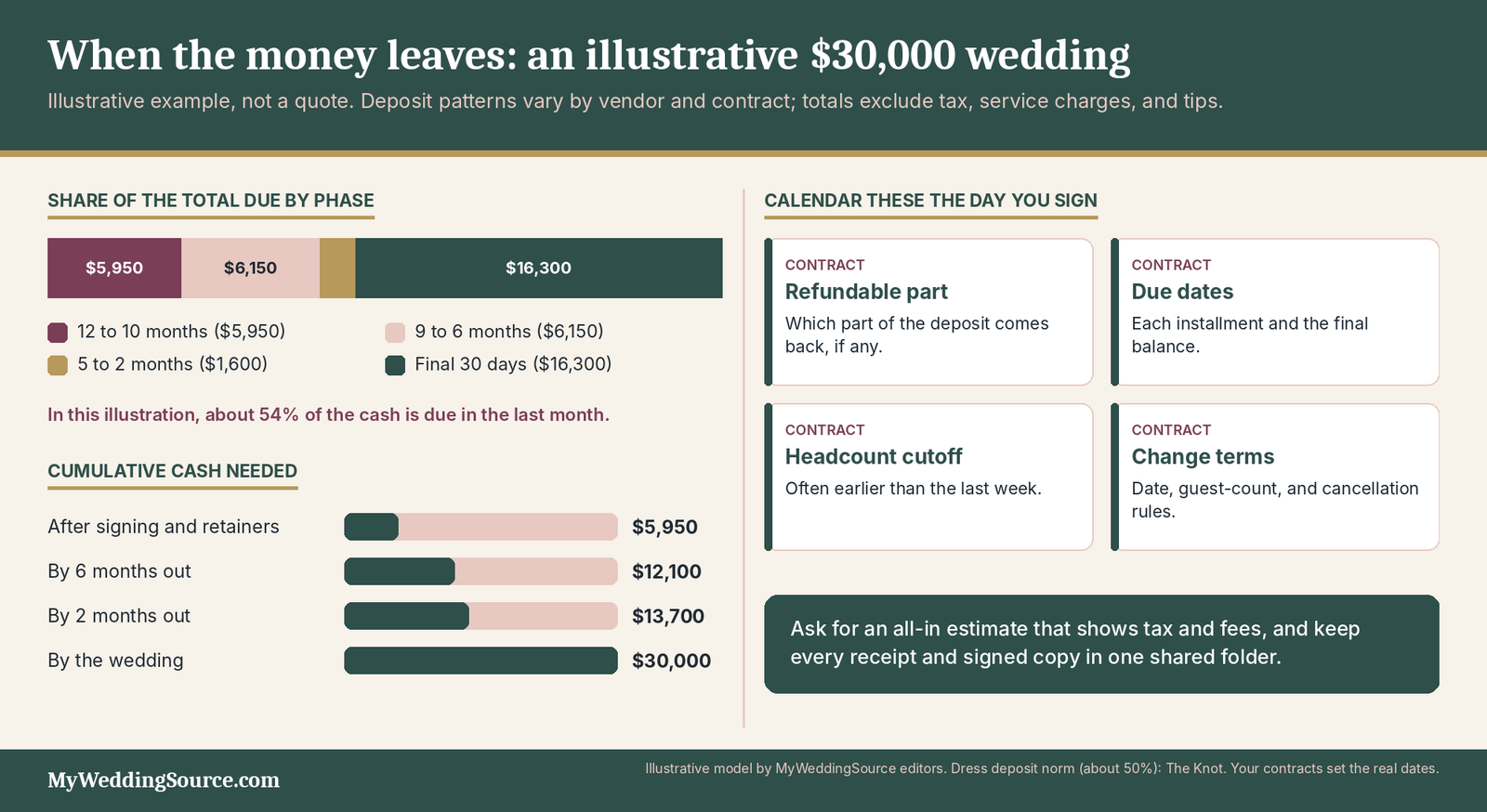
The table below is an illustrative example, not a quote. It models a hypothetical $30,000 wedding, with deposit and balance patterns that are common but far from universal, to show how the cash flow tends to behave. The totals exclude sales tax, gratuities, and service charges, which would raise the real figures.
| Phase | Months before the wedding | Illustrative cash due | Cumulative | Cumulative share |
|---|---|---|---|---|
| Signing and retainers | 12 to 10 | $5,950 | $5,950 | 20% |
| Second-wave deposits and installments | 9 to 6 | $6,150 | $12,100 | 40% |
| Orders and smaller balances | 5 to 2 | $1,600 | $13,700 | 46% |
| Final balances and license fees | Final 30 days | $16,300 | $30,000 | 100% |
In this illustration, about 54 percent of the money leaves in the last month. The exact share will differ, but the shape is typical enough to plan around: final balances for the venue, caterer, photographer, and music tend to cluster close to the wedding, which is when you are also busiest. A couple who funds only the deposits and assumes the balances will somehow arrive is the couple who finds the gap in week 51.
Which decisions have deadlines, and when are they usually due?
Decision deadlines are separate from payment deadlines, though they often fall on the same week. They exist because caterers order food, florists order stems, and rental companies reserve inventory against numbers you have to supply. Missing one is usually not a catastrophe, but it can mean paying for a guess, such as a catering order based on an outdated count.
When are headcount, menu, and seating decisions typically due?
Zola’s checklist places the caterer’s final numbers in the last week and the seating chart and processional order in the final month. That is a useful orientation, but many contracts require a firm guarantee earlier than a week out, and some require it two to three weeks ahead, so read the clause rather than assuming. The table gathers the decisions that most often carry a deadline, with the typical window and who sets it.
| Decision | Typical timing | Who sets the deadline | What to confirm |
|---|---|---|---|
| Venue date and deposit | At signing, 12 to 18 months out | Venue contract | Cancellation and postponement terms |
| Menu and bar selections | After a tasting; often 2 to 3 months out | Caterer or venue | Last date to change entrees and counts |
| Final guest count | Often a few weeks before; Zola lists the last week | Caterer, venue, rental company | Whether the count can go down, up, or both |
| Seating chart | Final month; needed before place cards print | Couple, then caterer or planner | Format the caterer needs (table numbers, meal codes) |
| Final payments | Often 2 to 4 weeks before; varies by vendor | Each vendor contract | Accepted methods, tips timing, who delivers |
| Day-of timeline | Shared with vendors about 2 to 4 weeks out | Planner or couple | Arrival, load-in, and photography start times |
| Hotel block cutoff | Often 30 to 60 days before, per hotel contract | Hotel | Attrition and release terms |
Apart from the items Zola’s checklist lists (final numbers in the last week, seating chart and day-of timeline in the final month), the timings in this table are editorial benchmarks, so confirm each one with the vendor. The hotel-block window comes from our save-the-date timing guide and is an editorial benchmark rather than a rule, so confirm it with the hotel. The Knot and Zola publish no universal final-payment due date, and different vendors choose their own.
How do you protect yourself when money changes hands?
Keep every receipt, every signed copy, and every email confirming terms in one shared folder, and make payments in a way that leaves a record. The Federal Trade Commission explains that under the Fair Credit Billing Act you must send a written dispute so it reaches the card issuer within 60 days after the first bill with the error, and that for problems with goods or services you generally must try to resolve the dispute with the seller first. The process has conditions, so read the FTC page before you rely on it, and note that it covers credit cards and revolving accounts, not every payment method.
The Knot cautions that couples using credit cards for deposits should do so only when they can pay the balance before interest starts. That advice is general education, and your own finances may point somewhere else. If a vendor asks for an unusual payment method or pressures you to pay on the spot, pause and ask for the request in writing.
Save-the-dates, invitations, and RSVP timing
Guest-facing paper is the part of the timeline everyone can see, so it is also where small timing errors become public. The windows are well established, and you can keep them straight by working backward from the date your caterer needs a final number. Our dedicated pages on save-the-date timing and invitation timing and wording go deep on wording and cost; this section ties the dates to the rest of the calendar.
When does each piece of paper go out?
There are three mailings: the save-the-date, the invitation, and (if you use paper) the reminder or details card. Each has a window, and each window depends on whether the wedding is local, holiday-adjacent, or destination. The windows are tied to what the guest has to do after reading the piece of paper, which is why a destination wedding needs the longest lead.
What are the standard mailing windows?
The Knot recommends save-the-dates six to eight months out and invitations six to eight weeks out. It suggests about eight weeks when you want paper RSVPs to have time to return by mail, and it says you can go closer to six weeks if the invitation links to an online RSVP. It also warns that mailing more than 12 weeks ahead risks last-minute changes, and that after six weeks you are generally mailing late.
The Knot’s special cases are useful: about eight weeks for destination weddings, nine to 10 weeks for overseas guests, and eight weeks up to about three months for holidays. Our own save-the-date guide recommends longer lead times for destination and holiday-weekend weddings, so if guests will buy flights, use the longer window. Both pages agree on the principle: the more your guests have to arrange, the earlier they need to know.
When should RSVPs be due, and how do you chase them?
WeddingWire’s timeline places the RSVP deadline about three to four weeks before the wedding, and Zola suggests following up with non-responders one to two weeks after the deadline. Your RSVP date is really the last day your caterer will accept a count minus a buffer for your own follow-up, so set it by working back from the caterer’s cutoff. If your caterer’s cutoff is earlier than that, the RSVP date moves earlier too.
Plan the chase before you send the invitation. Decide who calls which relatives, set aside an hour per evening for the week after the deadline, and keep a single master spreadsheet so you do not double-chase. Expect a few guests to cancel after saying yes, and some to appear after saying no; The Knot’s guidance notes that a few “yes” guests back out at the last minute, so a small cushion in your count is realistic.
How do invitation dates connect to the rest of the calendar?
Paper is a downstream decision: it depends on the guest list, the date, the venue’s address, and the RSVP method. When any of those change, the paper timeline changes with them. That is why the back-scheduled example below starts from the caterer’s cutoff rather than from the mailing date.
What does a back-scheduled example look like?
Consider an illustrative wedding on Saturday, October 16, 2027. Counting back eight weeks puts the invitation mailing on Saturday, August 21, 2027. A four-week RSVP deadline lands on Friday, September 17, and the follow-up window runs through roughly October 1. If the caterer needs a final guarantee ten days out (a number chosen here only for illustration), the couple needs a clean count by Wednesday, October 6.
Working backward this way exposes the real constraint, which is the gap between the RSVP deadline and the caterer’s cutoff. If that gap is a single week, you have no room for chasing, so you either move the RSVP date earlier or negotiate the cutoff. Build your own version on a calendar before you order stationery, because the printer needs to know the RSVP date to print it.
Which paper-timing mistakes are most common?
The first is mailing before the website is live, which leaves guests with a date and no logistics. The second is sending invitations before the wedding party, plus-ones, and children policy are settled, which creates awkward corrections. The third is ordering exactly the number of envelopes you need; Zola advises 10 to 15 percent extras for errors.
Another recurring mistake is treating the save-the-date as an invitation. A save-the-date is a courtesy that signals who is on the likely list, so only send them to people you intend to invite, and avoid sending them months earlier than the guidance suggests. The Knot cautions against going beyond about a year, since guests forget.
Legal timeline: the marriage license and other paperwork with a clock
The legal side of a wedding is short, but the rules are set by individual states and, in practice, enforced by individual counties. A waiting period of a few days or a validity window of a few weeks can change when you should apply. This section is general education, and you should verify the rules for your jurisdiction with the issuing office rather than rely on this page, a friend’s experience in another state, or a template calendar. Our marriage license verification guide walks through how to confirm the details.
What does the marriage license timeline look like?
A marriage license is permission to marry; a marriage certificate is the record that you did. USA.gov states plainly that a license legally allows you to marry and a certificate proves you married, which is why the license is a pre-wedding task and the certified copies are an after-wedding one. The distinction matters for timing, because the license has an expiration date and sometimes a waiting period, while the certificate does not.
How long is a license valid, and how long must you wait?
USA.gov reports that licenses typically expire anywhere from 30 days to a year after issuance, depending on the state, and that if a license expires or is lost you apply for a new one through the vital records office in the state where you are marrying. Some places also impose a waiting period between issuance and the ceremony. This combination is the reason generic advice such as “get it a month out” can fail: in a jurisdiction with a short validity window, a license obtained too early expires, and in one with a waiting period, a license obtained too late cannot be used on your date.
Zola’s checklist suggests researching your state and county requirements about six months out and obtaining the license in the final month, which is a sensible default. Use it as a prompt to check, not as a replacement for the check. Because county offices can differ in hours, appointment systems, and accepted identification, the research step is worth doing even in a state you think you know.
What do three real jurisdictions show about the variation?
The table compares three official sources. They are examples of variation, not a guide to your state, and fees and procedures change, so confirm on the issuing office’s own page before you act. Notice how each source frames the rule differently: one counts hours from purchase, one counts days from application, and one has the license itself state the permitted period.
| Jurisdiction | Waiting period before the ceremony | Validity window | Source |
|---|---|---|---|
| Fort Bend County, Texas | 72 hours, with listed exceptions such as active-duty military and a premarital education course | 90 days including the date of purchase | Fort Bend County Clerk page |
| New York State | A marriage may not be solemnized within 24 hours of issuance, unless a court authorizes it | Not solemnized after 60 days from issuance (veterans’ services exception noted) | NY Domestic Relations Law section 13-b |
| Florida | Effective date delayed 3 days from application, with exceptions for non-residents and premarital course completion | Not confirmed in the statute section reviewed; ask the clerk | Florida Statutes 741.04 |
The Fort Bend County page lists the 72-hour waiting period and 90-day validity, notes that appointments are available but not required, and lists a fee of $71 that drops to $11 with a state-approved premarital course, as posted when we reviewed it. New York’s statute says a marriage may not be solemnized within 24 hours or after 60 days from issuance and that each license states the permitted period. Florida’s statute directs clerks to delay the effective date by three days and exempts couples who submit a premarital course certificate.
Which other legal and administrative items have a clock?
The license is the headline item, but a few other tasks carry deadlines that are easy to miss when the calendar is full of vendor calls. None of them is difficult, but each depends on information from an office or a vendor outside your control.
What about the officiant, witnesses, and returning the license?
Rules about who may officiate, whether witnesses are required, and how the signed license is returned to the county differ by state. Zola’s checklist suggests confirming your officiant’s authority and license about two months out, and it advises choosing an officiant who is certified in the state where you marry. Ask your officiant who submits the signed license and by what date, because the return window is a legal step, not a courtesy.
If you are marrying away from home, the rules that matter are those of the place of the ceremony, not your home state. Check whether the office issuing the license requires both partners to appear in person, which can turn a simple errand into a trip. Our marriage license verification guide covers how to find the right office and what to ask when you call.
What should you handle before the wedding for names, travel, and insurance?
Decide early whether you will change your name, and sort the documents before travel. The State Department explains that if you changed your name within one year of your passport’s issuance you may use Form DS-5504 with a certified name-change document, with no fee other than optional expedited service, while older passports follow a renewal or in-person route. The Social Security Administration states that its SS-5 application is free and requires a recent document showing both your old and new names.
Those steps happen mostly after the wedding, and our name change after marriage guide covers the sequence. The pre-wedding decision is simpler: if you are traveling internationally right after the wedding, make sure the name on your tickets matches the passport you will carry, and do the passport renaming after the honeymoon rather than in the weeks before it. Put the passport decision on the calendar roughly ten weeks before any honeymoon flight, so that routine processing, mailing time, and a spare week all fit.
The final two months: confirmations, fittings, and paperwork
By eight weeks out, the creative decisions are mostly behind you, and the work shifts from choosing to verifying. This is the period where small gaps between what you assumed and what a contract says surface, and where early catches are cheap. The couples who keep this stretch calm are the ones who treat it as a series of short, scheduled confirmations rather than one giant to-do list.
Two months to one month out: lock the details
The eight-week mark is a natural checkpoint, because invitations are going out and vendors are beginning to finalize staffing. Use it to turn every verbal arrangement into a written one. A vendor who confirms in writing now is far easier to coordinate with in wedding week.
What should you confirm with every vendor?
Send each vendor a short confirmation email covering the date, the location, their arrival and load-in time, the contact person on the day, the agreed deliverables, and the next payment due. Zola’s checklist puts confirming vendors, times, and menus at about two months out, which lines up with the point where most vendors have enough information to give you a firm answer. Ask each vendor to reply with “confirmed” or a correction, and save the replies in your shared folder.
Vendors respond better to clear, specific questions than to a general “just checking in.” For example, ask the florist for the delivery window and the name of the person who will meet them at the venue, and ask the caterer for the final-count date and whether meal selections are due with it. If a reply creates a mismatch with the contract, raise it now, while there is time to adjust. Save each answer next to the contract so the confirmation and the original agreement can be read together.
How do fittings, seating, and the timeline fit in?
The Knot’s attire guidance lays out the sequence: a first fitting when the dress arrives around three to four months out, a second fitting six to eight weeks out, and a final fitting plus pickup two to three weeks out. Follow that rhythm for anyone else with tailored attire as well. Bring the shoes, undergarments, and accessories you will wear to every fitting, since they change how a garment hangs.
The seating chart and processional order typically come together in the final month, once the RSVPs are in. Start with the table count and the rough groupings, because the final shuffle is easier when the structure exists. Draft the day-of timeline at the same time, and expect to revise it after you hear from the photographer and the venue; the wedding photography timeline can help you decide how much time the photographs actually need.
The last 30 days: the short list that prevents the long scramble
The final month is the point where the calendar has the least slack. Everything on the list is small, and the sum of it is not. Grouping the tasks by who needs to hear from you (vendors, guests, or family) makes the month easier to schedule.
What belongs on the 30-day list?
Collect the final RSVPs and follow up with any non-responders. Send the caterer or venue the final count by the date in the contract, which Zola’s checklist shows as falling in the last week but which many contracts set earlier. Finalize the seating chart, the processional order, and the day-of timeline, and share the timeline with every vendor and the people who will be on site. Order extra paper goods such as menus or programs only after the count is firm.
Also confirm the details that live outside the vendors: who is carrying the rings, who is carrying the marriage license, who is bringing the emergency kit, and who is responsible for returning rentals the next day. Write these down and assign names. A task with no owner on the day tends to fall to the couple, which is exactly what you want to avoid.
How do you handle final payments, tips, and the license?
Prepare the final payments on the dates the contracts specify, and track each one as paid and confirmed rather than just sent. If any vendor expects tips on the day, put the amounts in labeled envelopes and give them to one trusted person to hand out; Zola’s checklist puts final vendor payments and tip envelopes in the final month and the final week. Tipping norms vary by vendor and contract, and some contracts already include a service charge, so check before you add to it.
Obtain the marriage license within its validity window and after any waiting period, using the issuing office’s own rules. If you have not yet confirmed those rules, do it this week; the legal timeline section above shows how much they vary. Keep the license somewhere secure, and tell the officiant who will return it after the ceremony.
| Window | Core tasks | Confirmations | Watch for |
|---|---|---|---|
| Weeks 8 to 6 | Mail invitations; first confirmation emails to vendors | Vendor replies saved; arrival times | Vendors with no written confirmation |
| Weeks 6 to 4 | Second fitting; start seating draft; track RSVPs | Fitting date for wedding party; officiant details | Attire not ready for pickup |
| Weeks 4 to 2 | RSVP deadline and follow-up; seating chart; day-of timeline | Final count to caterer or venue; timeline to vendors | Count deadline earlier than you thought |
| Weeks 2 to 1 | Final fitting and pickup; final payments; tip envelopes; license | Payments recorded as received | Missing license; unlabeled tip envelopes |
Wedding week, the rehearsal, and the day-of handoff
Wedding week is meant to be quiet. If the earlier phases did their job, the work left is mostly delivering information to the people who will carry the day so that you do not have to. This section covers the week and the handoff; the hour-by-hour schedule and the specific points where wedding days tend to slip are in our guide to wedding day timeline failure points.
What happens in the final seven days?
The week before is about three things: confirming, delegating, and resting. The first two can be completed by midweek, and the third needs to be protected.
What is the wedding-week checklist?
A short list covers most of it:
- Give the caterer or venue the final count if it has not already been delivered, and confirm the meal selections and dietary needs.
- Pay any remaining balances, and prepare tip envelopes with the amounts and names written on the outside.
- Check the forecast for outdoor elements and review your decision trigger with the venue.
- Confirm arrival times with the photographer, florist, music, and transportation, and send each a one-page contact sheet.
- Pack for the wedding night and the honeymoon, including travel documents, and put the license and rings in a designated spot.
- Hold a final call with the planner or coordinator, if you have one, to walk through the timeline.
Zola’s checklist places the final caterer numbers, the honeymoon packing, the final payments and tips, and the coordinator call in this last week. Rather than treating that as a long checklist to personally complete, split it: assign each item to a person, and ask them to confirm back when it is done. Whichever items you assign, write the owner’s name next to each one so nobody has to ask who is handling it.
How do you keep from becoming the help desk?
The most common source of stress in the final week is a stream of questions that only the couple seems to know the answers to. The fix is a single one-page document that answers the common ones before they are asked: the timeline, vendor names and phone numbers, the address and parking instructions, and the name of the one person who fields questions on the day. Share it with the wedding party, family members who will be helping, and every vendor.
Designate that point person explicitly, whether it is a planner, a coordinator, or a friend with a calm temperament, and tell vendors to call them instead of you. Silence your own phone for the ceremony, and let the point person triage the rest. This is the single habit that most changes how the day feels from the inside.
How do the rehearsal and the handoff work?
The rehearsal and the handoff are the two moments when everything you built over the previous year converts into a plan other people can run.
What does the rehearsal accomplish?
A rehearsal walks through the ceremony so that everyone knows where to stand, who walks when, and what the officiant will say. Zola’s checklist puts the rehearsal the day before the wedding along with confirming vendor delivery times, and suggests scouting a rehearsal dinner within about a 45-minute drive for most guests. The purpose is practical: it catches problems with the space, the sound, the processional order, and the timing of the cues while there is still time to fix them.
Keep the rehearsal short and focused on the movements, not on speeches. Invite the people with roles in the ceremony, the officiant, and anyone who will manage a cue, such as a musician. If the venue or planner runs the rehearsal, ask in advance how long they allow so you can plan the dinner around it.
What does the day-of handoff look like?
A good handoff has four parts: a written timeline, a vendor contact sheet, a payment and tip plan, and a named person to receive deliveries and answer questions. Make sure each vendor has the same version of the timeline, with the date in the file name so that no one is working from an old copy. Walk the point person through the contracts that matter on the day, such as delivery windows, overtime rules, and what to do if a vendor is late.
Hand over the physical items too: the emergency kit, the guest book, any signage, and the envelopes. Then let go. The point of the earlier months of planning is that you do not need to run the day; you only need to be present for it. For the specific moments where the schedule tends to unravel, return to the failure-points guide linked above.
After the wedding: the tasks that still have clocks
Most calendars end at the ceremony, but a handful of tasks begin the day after and a few have real deadlines. They are not difficult, though they are easier if you decide the order in advance and keep the paperwork in one place. Putting these tasks on the calendar before the wedding means you do not have to reconstruct them from memory after the honeymoon.
What has a deadline in the first weeks?
Some of the post-wedding tasks have official clocks, and some only feel like they do. The legal ones are worth putting on a calendar the week you return. Everything in this section is easier if you collect the certificate, your IDs, and the account numbers in one folder before the wedding.
Which legal documents come first?
Start with the marriage certificate. USA.gov explains that certified copies come from the vital records office in the state where the wedding took place, and that the office will tell you the fee and whether you can order online, by mail, or in person. Order more than one copy, since name-change and benefits applications may each ask for an original or certified version.
Then work through the name-change sequence if it applies to you. The Social Security Administration requires a recent document that shows both your old and new names, and states that the application costs nothing. The State Department’s passport guidance offers different routes depending on how long ago the passport was issued. Our name change after marriage guide lays out a practical order, and the official pages are the place to confirm current forms and fees.
What about health insurance and finances?
Marriage is a qualifying life event for health coverage. HealthCare.gov lists getting married among the events that open a Special Enrollment Period, and the enrollment window is generally 60 days, so put the date on your calendar before you leave for the honeymoon. Rules and timing differ for employer plans, so check with your benefits administrator as well.
Review your tax withholding, beneficiaries, and any shared accounts at some point in the first few months, and consider a short conversation with a tax professional. That conversation is general planning, not a requirement, and your situation may call for nothing more than a reminder. What matters is choosing a date to look at it, rather than discovering it a year later.
What loose ends close the project?
These tasks have softer deadlines, but they are the ones that tend to be forgotten if no one writes them down.
Which vendor and rental loose ends need attention?
Confirm that rentals were returned and any security deposits were released, that final invoices match the contracts, and that the photographer’s delivery timeline is on your calendar. If you have a dress to clean or preserve, ask the cleaner about timing, because stains can set over time. Leave vendors honest reviews once you have received all the services, and keep the contracts and receipts for a while in case of tax, insurance, or warranty questions.
If something went wrong, deal with it in writing and quickly. Under the FTC’s guidance, a card dispute must reach the issuer within 60 days of the first bill with the error, so do not wait to see whether a problem resolves itself. Start by contacting the vendor, and keep a record of the conversation.
When should thank-you notes go out?
Zola’s checklist advises sending thank-you cards within about three months of the wedding, while noting that sending them up to a year later is acceptable. A practical approach is to start before the wedding by keeping a running list of gifts, from whom they came, and what you thought of them. After the wedding, write a few each day for a week and you will finish before the pile becomes daunting.
| Task | Typical timing | Where to go | Notes |
|---|---|---|---|
| Return of the signed license | Per your state and county, soon after the ceremony | Officiant and county office | Ask who files it and by when |
| Certified marriage certificates | First weeks | Vital records office where you married | Order several copies |
| Social Security name update | After you have the certificate | Social Security Administration | Free; bring documents showing both names |
| Passport name update | Often after the honeymoon | U.S. Department of State | Route depends on passport age |
| Health coverage change | Generally within 60 days | HealthCare.gov or your employer | Marriage is a qualifying event |
| Rentals, deposits, final invoices | First 2 weeks | Each vendor | Compare invoices to contracts |
| Thank-you notes | About 3 months (up to a year is acceptable) | Your own list | Start with a running gift log |
Compressed timelines: 9, 6, and 3 months
A shorter engagement does not require a different method; it requires the same dependency chain executed in less time. The order of decisions stays fixed, and what changes is how many of them you make in parallel, how many options you compare, and how much customization you can still order. The upside of a short runway is that it forces you to name your priorities quickly, which helps whatever the length of the engagement.
How do you compress without breaking the dependency chain?
Compression works by overlapping steps that were sequential in the long version, not by skipping steps. You still need a guest-count range before a venue quote, and a venue before the vendor roster. What you shorten is the dwell time between each.
What stays in order, and what can overlap?
Three things stay in strict order: the money and guest-range conversation, the date and venue decision, and the contracts that depend on the venue. Everything else can run in parallel. For example, you can request quotes from photographers, caterers, and musicians at the same time once the venue is signed, instead of working through them one category at a time. You can also begin attire shopping before every vendor is booked, since production time is the longer constraint.
A helpful rule is to batch your decisions by week. In week one, settle money and the guest range; in week two, tour venues; in week three, sign one and send quote requests to the next tier of vendors. Set a decision deadline for each batch, because short timelines punish the “let’s think about it for a month” pattern more than long ones.
What do you give up when you compress?
You give up options and slack, not necessarily quality. With fewer months, some of your first-choice dates and vendors will be unavailable, and you will have fewer rounds of comparison. Custom or made-to-order items such as dresses and printed stationery may carry rush fees or may not be possible at all, so a shorter runway makes off-the-rack, sample, rental, and digital options more attractive. The Knot notes that shops with short timelines may offer off-the-rack, sample sale, or rental dresses that can be taken home the same day.
You also give up the buffer that absorbs surprises. A vendor who cancels with five months to go can be replaced, while one who cancels with five weeks leaves you with whoever is free. Build a small contingency into both time and money, and keep the contract details of your backup choices handy.
What do the 9-, 6-, and 3-month schedules look like?
Use the table as a scaffold and adjust it to the lead times in the booking table. Each column assumes you start the countdown on the day you decide to marry on a particular date. Treat the week ranges as targets rather than promises, since vendor responses set the real pace.
| Task | 9 months out | 6 months out | 3 months out |
|---|---|---|---|
| Money, priorities, guest range | Week 1 | Week 1 | Days 1 to 3 |
| Venue and date | Weeks 2 to 4 | Weeks 1 to 3 | Week 1; flexible day of week |
| Photographer, caterer, music, officiant | Weeks 4 to 8 | Weeks 3 to 5, requested in parallel | Weeks 1 to 2; accept available |
| Attire | Buy by month 3 of planning | Buy in the first 4 weeks; consider off-the-rack or rental | Off-the-rack, sample, or rental |
| Florist, baker, hair and makeup | Months 3 to 4 | Weeks 5 to 8 | Weeks 2 to 3; simplify scope |
| Save-the-dates | Send by month 3 | Send with a website link in weeks 4 to 6 | Skip; send invitations |
| Invitations | Mail 6 to 8 weeks out | Mail 6 to 8 weeks out | Mail within weeks 3 to 4 |
| Marriage license | Check rules at month 3; apply in the final month | Check rules in week 2; apply per validity | Check rules in week 1; apply per waiting period |
| Passport for honeymoon | Apply by month 4 | Apply immediately | Apply immediately; consider expedited |
What does the 9-month plan prioritize?
At nine months, you are on a brisk standard schedule. Book the venue, photographer, and caterer within the first month, because those are the categories where a nine-month engagement is already at or past the typical 9-to-12-month lead time for popular dates. Buy attire in the first three months of planning to stay inside the production window. The rest of the calendar looks like the longer versions with tighter spacing.
The main risk at nine months is assuming you still have the leisurely pacing of an 18-month plan. Decide which two or three categories matter most to you and book those first, and let the others flex around them.
What does the 6-month plan prioritize?
At six months, work in parallel and decide quickly. Ask the venue shortlist the same day, send quote requests to several vendors in one afternoon, and keep a simple scorecard so you can decide in days. Because the dress production window is long, consider off-the-rack or sample options, or a rental, so that you are not racing a delivery date. Save-the-dates can still be sent if you have more than four months, ideally with a website link.
The Knot suggests that save-the-dates are not needed if the wedding is under four months out. At six months you are in the gray zone; a digital save-the-date or a personal message to out-of-town guests can serve the same purpose with less cost and no print lead time.
What does the 3-month plan prioritize?
At three months, the date and venue decision comes first and everything else is built around what is available. Consider a weekday or Sunday date, a smaller list, and a venue that includes catering, tables, and chairs, since each included item removes a vendor search. Skip save-the-dates, mail invitations in the first few weeks, and ask the venue for its list of familiar vendors who can handle short notice.
Check your marriage license rules on day one, because a waiting period can be the only thing that constrains the calendar. If you need a passport, use expedited service; the State Department lists expedited processing at 2 to 3 weeks, excluding mailing time. A three-month wedding can be warm and well organized, and it usually looks simpler than a long-engagement wedding because the scope is.
What if the timeline slips or changes?
Even a well-sequenced plan changes. Venues close, vendors cancel, families shift, and sometimes a couple chooses to move the date. Having a recovery routine ahead of time keeps a bad week from becoming a bad month.
What if a venue or vendor falls through?
First, read your contract: it should state what the vendor owes you if it cannot perform, such as a refund or a referral, and what your options are. Then act on two fronts at once. Ask the vendor in writing what they will do, and begin requesting quotes from replacements, using your same scope so you can compare. Contact your event insurance provider if you have a policy, because the NAIC notes that cancellation coverage can apply to vendor no-shows, though terms and exclusions vary.
Re-sequence rather than restart. If the venue fell through, the dates of every dependent vendor are at risk, so tell them early and ask how they handle a change of location. If a smaller vendor fell through, such as a florist, the replacement is often easier to find and does not disturb the rest of the chain.
What if you decide to move the date?
Read the postponement clause in each contract before you tell anyone, because the terms differ: some vendors allow one free date change with notice, while others charge fees or treat a change as a new booking. Ask each vendor for their availability on two or three alternate dates, and hold the new venue date before you release the old one if you can. Update the guest communications with a clear “new date” message, and revisit the marriage license window, since a license obtained for the old date may expire or become unusable.
Moving a date is a significant decision, but it is rarely an irreversible one. If the move is driven by a change in a guest’s or a family member’s circumstances, ask yourself which parts of the original plan mattered most, and keep those intact.
Seasonal adjustments: peak, off-peak, and sunset timing
The calendar in this guide assumes a typical peak-season Saturday. Move off that assumption and the lead times, the prices, and even the structure of the day change. Two adjustments deserve their own attention: how the season affects booking pressure, and how the sun affects the schedule once the date is fixed.
How do peak and off-peak seasons change lead times?
Seasonality moves both the availability of vendors and the price you pay. No source reviewed for this article publishes a verified national ranking of the most popular wedding months, so the safest approach is to treat popularity as local and ask. A few phone calls to local venues about which dates remain open will tell you more about your market than a national ranking.
What does peak versus off-peak change?
In general, the more couples who want a date, the earlier the most in-demand venues and vendors are booked. Zola reports that weekday celebrations or winter weekend dates can save 20 to 30 percent on most vendor costs and that Saturday evenings command the highest venue prices. Those findings point in the same direction as the lead-time logic: the less contested your date, the less urgent the timeline and the lower the pressure on price.
If your date is off-peak, you can often hold the standard sequence but with shorter lead times for the first-tier vendors. If your date is peak, move the first-tier bookings earlier and expect to compare fewer options. Either way, a phone call to two or three venues about open dates in your target month is more informative than any generalization.
How do holidays and local events change the calendar?
Holiday weekends, graduation weekends, large conventions, and sporting events can raise hotel rates and squeeze availability. They also change guest behavior, which affects your save-the-date timing: The Knot suggests leaning toward eight months for holiday weekends, and our save-the-date guide goes up to 10 to 12 months. If you choose a holiday weekend for convenience, such as a long weekend to give guests time to travel, expect to lock in the room block and the save-the-dates earlier than usual.
For fall and winter dates in particular, daylight hours become part of the plan, which is where the next question comes in.
How does sunset change the timeline?
Photographers think in terms of light, so sunset shapes the ceremony time, the first look decision, and the portrait window. You do not need to become an astronomer, but you do need to look up the sunset time for your venue and date and build the schedule from it.
How do you find the right sunset time for your date?
Use the U.S. Naval Observatory’s sun and moon data tools or the NOAA solar calculator, enter your venue’s location and date, and note the sunset and the end of civil twilight. Check that the times are in local time, and watch for the daylight saving time change: in 2027 the shift back to standard time falls on Sunday, November 7, which moves the sunset earlier by an hour on the clock. Sunset at the horizon is not the same as usable light at your venue, since trees, buildings, and hills can darken a site earlier.
The table shows how much the sunset moves across the year. The times are approximate, computed using the standard NOAA solar-position method and spot-checked against Naval Observatory values for several city-and-date pairs, which agreed to within about a minute. They are illustrations of the seasonal swing, not substitutes for looking up your own venue.
| City | June 12 | September 18 | November 13 | December 18 |
|---|---|---|---|---|
| Boston | 8:21 p.m. | 6:48 p.m. | 4:24 p.m. | 4:13 p.m. |
| Atlanta | 8:48 p.m. | 7:40 p.m. | 5:35 p.m. | 5:31 p.m. |
| Chicago | 8:26 p.m. | 6:54 p.m. | 4:31 p.m. | 4:21 p.m. |
| Denver | 8:28 p.m. | 7:03 p.m. | 4:45 p.m. | 4:37 p.m. |
| Seattle | 9:07 p.m. | 7:15 p.m. | 4:35 p.m. | 4:19 p.m. |
How do you build the schedule around sunset?
Work backward from sunset to decide what needs daylight. If you want an outdoor ceremony in full light, our November timeline guide suggests finishing it about 45 to 90 minutes before sunset, depending on how many photographs follow, and that advice applies in any season where the sun sets early. A first look before the ceremony can move portraits earlier and free the post-ceremony window for cocktail hour.
The sunset calculation is covered in detail, with sample timelines, in our guide to planning a November wedding timeline around earlier sunsets. The same logic applies to any date between October and February, and to any venue where the mountains or tree line cut the light early. If your venue sits in a canyon or on the east side of a ridge, ask the photographer to scout the light on a similar evening.
Who does what: the responsibility matrix
A timeline only works if each task has an owner. Many of the stress points in the final month come not from missing tasks but from tasks that two or three parties each assumed someone else was handling. A shared matrix, agreed on early, prevents most of them.
Who owns which task?
The matrix below shows a typical division of responsibility. Treat it as a draft to adapt to your own team, since the split changes depending on whether you have a full-service planner, a day-of coordinator, or no professional help. The column to adjust first is the planner column, since it changes the most from team to team.
How do you read the matrix?
“Leads” means the party is responsible for the outcome. “Supports” means the party contributes information or action. “Confirms” means the party verifies in writing. A dash means the party is not usually involved. Where a task is marked as led by the couple but supported by a planner, the couple should expect to make the decisions and the planner to handle the follow-through.
| Task | Couple | Planner or coordinator | Venue | Other vendors |
|---|---|---|---|---|
| Budget and payment calendar | Leads | Supports | Confirms its terms | Confirm their terms |
| Guest list and RSVPs | Leads | Supports | Confirms capacity | None |
| Vendor research and contracts | Leads | Supports | Provides vendor policy | Provide quotes |
| Floor plan and room flip | Approves | Leads | Supports | Florist and rentals support |
| Marriage license | Leads | Reminds | None | Officiant supports |
| Final headcount | Provides | Supports | Receives and confirms | Caterer confirms |
| Day-of timeline | Approves | Leads | Confirms access | Confirm arrival times |
| Rain plan decision | Approves | Leads | Supports | Confirm changes |
| Tips and final payments | Fund | Distributes if agreed | Confirms service charge | Confirm receipt |
| Load-out and rental returns | Assigns | Leads | Supports | Collect their own gear |
Where do tasks most often fall through the cracks?
The rows that cause trouble are the ones that sit between two parties: the final headcount, the rain plan decision, and load-out. In each case the couple, the venue, and at least one vendor all touch the task, and each can reasonably assume another is handling the hard part. The fix is to name one lead per row in writing, and to ask the lead to confirm back once the task is done. Our guide to wedding day timeline failure points shows how these handoff gaps tend to appear on the day itself.
If you hire no one, the planner column does not disappear; it becomes a list of tasks that you assign to people. That is where the day-of point person from the wedding-week section comes in.
How do you divide the couple’s own work?
Even with professional help, the couple’s column is the longest. How you split it matters more than how you phrase it.
How should partners split the tasks?
Split by strength and by relationship. Each partner typically knows their own family best, so each takes the conversations, guest-list questions, and communications with their own relatives. Divide vendor research by category, with one partner leading each and the other reviewing the shortlist, and agree that either partner can say a firm no.
Hold a short weekly check-in with the same three questions: what did we decide, what is due in the next two weeks, and what do we need from someone else. A 20-minute standing meeting beats a late-night marathon, and it keeps the shared tracker honest.
How do you use family and the wedding party without overloading them?
Offer specific, bounded tasks with clear dates instead of open-ended “help me with the wedding” requests. A request to collect addresses from your side of the family by a certain date, or to greet vendors on arrival, is easier to say yes to than a request to be on call. Thank people for the work as it is done, not only after the wedding.
Do not assume that any family member expects to be given a task, or that anyone wants to. Some people will offer, and some will prefer to enjoy the day. Ask, accept a no gracefully, and fill the gap with a paid coordinator or a day-of point person if the list is too long for your circle.
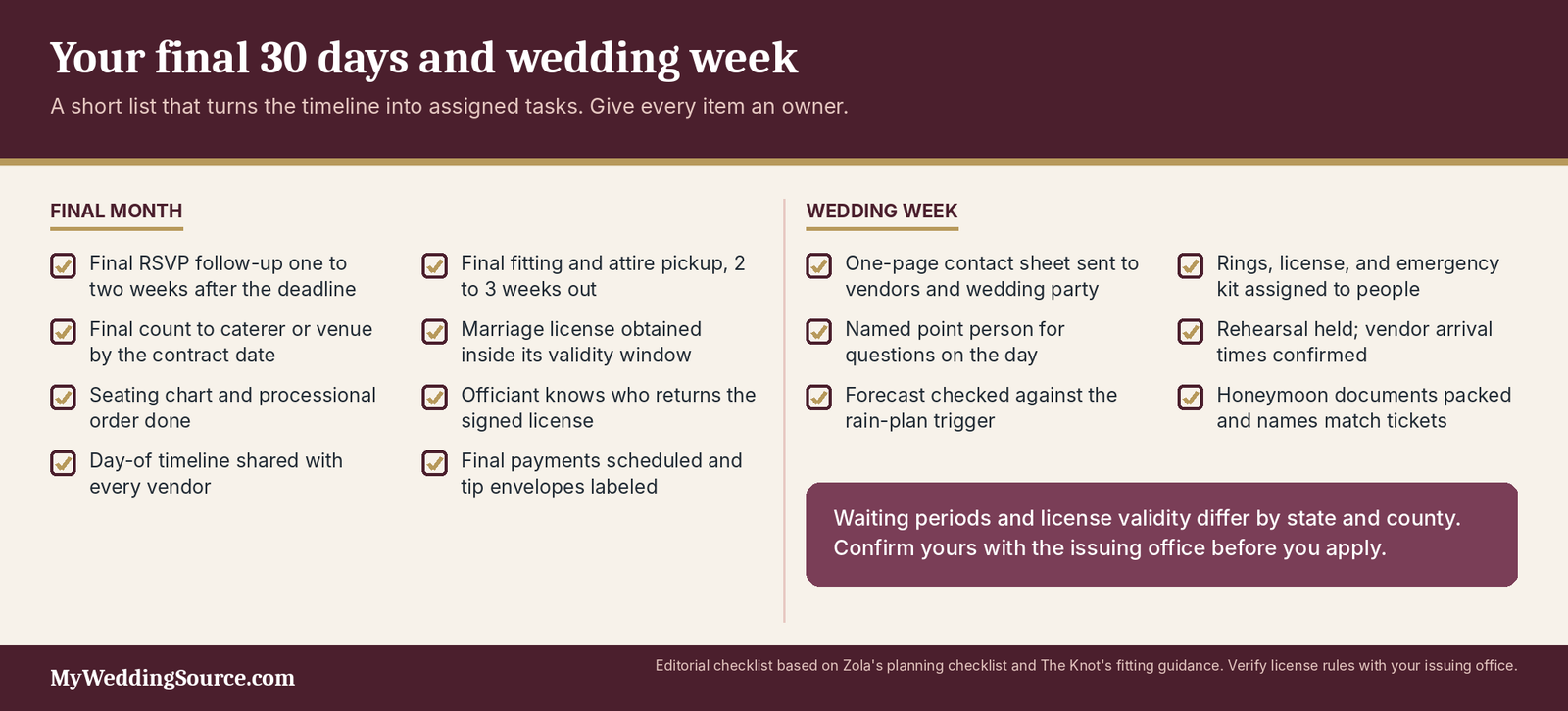
FAQ: wedding timeline questions couples ask most
These are the questions that come up most often once a couple has the outline of a timeline and starts applying it to a real date. The answers are short on purpose, and each points back to the section with the detail. If a question is not here, the dependency section is the place to look for the logic behind your own answer.
Starting and booking
These questions are about how early to begin and which bookings come first. Each answer is deliberately short. The sections linked in them carry the full reasoning, sources, and caveats.
How far in advance should you start planning a wedding?
Most couples have a year or more: The Knot’s 2026 study reports an average engagement of 14 months and Zola’s reports 18 months, and both are averages across very different situations. If you want a peak-season Saturday at a popular venue, start the venue search 12 to 18 months out. If your date is flexible or off-peak, 6 to 9 months can be enough, and the compressed schedules show how to sequence it. The first useful step is not a booking; it is a written agreement on priorities, money, and a guest-count range.
Should you book the venue or the photographer first?
Book the venue first in almost every case, because the venue fixes the date, the hours, and the rules that every other vendor inherits. Photographers and other date-limited vendors typically follow within weeks, since they can only serve one wedding per day and the in-demand ones book up early. The exception is when a particular photographer or officiant matters so much that you would move the date for them; in that case, ask for their availability before you sign the venue.
Can you plan a wedding in six months, or three?
Yes, and the dependency order stays the same. You overlap the booking steps, accept the dates and vendors that are available, and favor off-the-rack or rental attire and simpler stationery. With three months, you typically skip save-the-dates and send invitations in the first few weeks, and you check the marriage license waiting period on day one. See the 9-, 6-, and 3-month table for a week-by-week scaffold.
Paperwork, payments, and the final month
These questions cover the items that carry legal or contractual deadlines.
When should you get the marriage license?
It depends entirely on your jurisdiction, because validity windows and waiting periods differ by state and county. USA.gov reports that licenses typically expire anywhere from 30 days to a year after issuance, and the three official sources in the legal timeline table show waiting periods from 24 hours to 72 hours. Zola suggests researching the rules at about six months and obtaining the license in the final month, which is a reasonable default once you have confirmed the local validity window with the issuing office.
When is the final payment due, and when do I owe the caterer a headcount?
Neither has a universal date. Zola’s checklist lists the final numbers for the caterer in the last week, but many contracts set an earlier guarantee date, and final payments are set vendor by vendor. Read the payment and headcount clauses of every contract the week you sign it, and enter each date on a shared calendar with a reminder two weeks ahead. The payment section includes an illustrative calendar that shows why the last month is the heaviest.
What is the first thing to do after the wedding?
Order several certified copies of the marriage certificate from the vital records office in the state where you married, then use them for any name changes and benefit updates. Mark the date that is 60 days after the wedding as the likely deadline for a health-coverage Special Enrollment Period, and confirm the exact window with HealthCare.gov or your benefits administrator. After that, return rentals, check final invoices, and start the thank-you notes.
Your next steps
A cornerstone guide is only useful if it becomes a calendar, so the last section turns it into two short lists. Neither requires booking anything.
This week
Start with two sessions of about an hour each. They set up the rest. The first session settles the numbers and the second turns them into dates, and neither involves a vendor.
What should you write down in your first conversation?
Open a shared document and record three items: your top three priorities, your funding plan including who is contributing and how much, and the guest-count range for a low, expected, and high case. Add a fourth line for the season and two or three acceptable dates. These four lines are the rules every later quote will be judged against, and writing them down protects you from the pressure of a sales conversation. If you are still in the first weeks of engagement, the engagement season checklist helps you sort the order.
How do you turn the schedule into dates?
Pick the schedule that matches your runway from the chooser table, then count backward from your target date and put the first three milestones on a shared calendar: the venue decision, the first-tier vendor bookings, and the attire purchase window. Add the passport and license research dates as reminders, not tasks. Then set a recurring 20-minute weekly check-in with your partner or planning team so that the calendar gets reviewed while it is still easy to change.
Before you pay a deposit
The first deposit is the moment your timeline becomes contractual. A short pre-check keeps the calendar and the contract in agreement.
What should you read in the contract?
Find the payment schedule, the refundable portion of the deposit, the cancellation and postponement terms, the substitution policy, the overtime and service-charge rules, and the headcount and menu deadlines. Ask for an all-in estimate that shows tax and fees, and ask whether the vendor takes the payment method you plan to use. If anything is described only verbally, ask for it in writing before you pay. This is general education, so if a contract is large or unusual, a short consultation with a lawyer licensed in your state is a reasonable step.
How do you check that the contract fits your calendar?
Transfer every date in the contract to your shared calendar, including the final headcount, the last day to change the menu, and each payment. Compare the total of the next 90 days of payments to the cash you actually have, and decide in advance how any shortfall will be covered. If you have not yet checked the marriage license rules for the place where you will marry, do that before you sign anything that depends on a particular date; our marriage license verification guide shows how to confirm them with the issuing office.
Sources & methodology
- Zola: Your wedding planning checklist — month-by-month lead times for the venue, officiant, photographer, music, florist, baker, hair and makeup, hotel block, invitations, license research, final numbers, and thank-you timing.
- Zola 2026 First Look Report — average engagement of 18 months, sample of more than 11,500 couples, pre-engagement planning behavior.
- Zola: What weddings really cost — savings from winter weekend and weekday dates, Saturday-evening pricing.
- The Knot Worldwide: 2026 Real Weddings Study release — sample of 10,474 couples married in 2025, 117 average guests, $292 per guest.
- The Knot: Average wedding cost — guest count and cost-per-guest figures.
- WeddingPro: Real Weddings Study vendor insights — 14-month average engagement, 13 vendors per wedding.
- The Knot: When to buy a wedding dress — shopping and buying windows, production time, fitting schedule, deposit norms.
- The Knot: When to send save-the-dates and when to send invitations — mailing windows and special cases.
- The Knot: How many people RSVP no — decline-rate rule of thumb and attendance range.
- The Knot: How to pay for a wedding — credit card and payment-timing cautions.
- WeddingWire: Wedding planning timeline — venue-first sequencing, invitation and RSVP timing.
- USA.gov: Marriage certificate — license versus certificate, typical license expiration range, ordering certified copies.
- Fort Bend County, Texas: Formal marriage license — waiting period, validity, exceptions, fees as posted.
- New York Domestic Relations Law section 13-b — 24-hour and 60-day provisions.
- Florida Statutes section 741.04 — three-day delay and premarital course exemption.
- U.S. Department of State: Get your passport faster — routine and expedited processing times (page last updated June 28, 2025).
- U.S. Department of State: Change or correct a passport — name-change routes by passport age.
- Social Security Administration: Form SS-5 — documents needed for a name update; no fee.
- HealthCare.gov: Special enrollment period — marriage as a qualifying event, 60-day window.
- FTC: Disputing credit card charges — 60-day written dispute window and conditions.
- NAIC: Consumer insight on event insurance — liability versus cancellation coverage, timing, exclusions.
- U.S. Naval Observatory: Sun and moon data for one day — sunset and twilight lookups used to spot-check the sunset table.
Methodology. Verified facts are statements read directly on the cited official, statutory, or publisher pages, such as the license provisions, passport times, and published study samples. Survey findings (engagement length, guest counts) are reported as the sources state them and are not combined into a single figure. Booking lead times are drawn from planning checklists and are typical, not required; payment schedules, decision deadlines, and the $30,000 payment calendar are editorial illustrations and judgment, labeled as such, and no vendor policy is quoted. Sunset times were computed with the standard NOAA solar-position method and spot-checked against Naval Observatory data. We did not find a verified national dataset for vendor booking lead times or for the most popular wedding months, and we say so rather than fill the gap.
Freshness note. Recheck license waiting periods, validity windows, and fees with your own issuing office before you apply, since they change. Recheck passport processing times on travel.state.gov within a month of any international travel, and confirm the daylight saving dates for your wedding year. Review the Zola and Knot study pages each spring when new annual data are released, and update the engagement-length and cost figures at that time.