
Plus size wedding dresses are easier to find than they were even a few years ago, but the shopping process still rewards a different plan: order by your largest measurement, book appointments where samples actually exist in your range, and leave room in both the timeline and the budget for alterations.
You booked the appointment, the consultant wheels out three gowns, and every one of them is a size 12 sample that will not close over your shoulders. That moment is not a verdict on your body. It is a quirk of how bridal inventory works: salons stock a handful of sample sizes, gowns are made to order in the size you pick, and the number on the tag follows a bridal chart that has little to do with the number in your jeans. Once you know how that machinery runs, the whole process gets calmer and a lot more predictable.
This guide is built around the decisions you will actually make. It explains how bridal sizing works and how to read a brand’s chart, when to start and what the order timeline looks like, where extended sizes are sold, and how to think about silhouette, fabric and built-in support. It then covers comfort tests, heat and cold, alterations and the true cost of the gown, how to match a dress to your wedding’s dress code, and how to protect your money and your confidence when you shop. It is written for anyone who will wear a wedding gown, including grooms, nonbinary partners and second-time brides, and it never assumes that a bigger budget or a smaller size is the goal.
One honest limit before we start: extended-size ranges, prices and policies change often, and bridal brands update their collections every season. Treat every brand name and range in this article as a starting list to verify on the retailer’s own page, not as a guarantee that a size is in stock today.
What “Plus Size” Actually Means in Bridal Shopping
Bridal shopping uses its own vocabulary, and the first source of stress is usually a number. This section untangles the labels, shows what a real bridal size chart looks like, and explains why the right size to order is often higher than the size you wear every day.
How do bridal sizes work, and why do they run higher?
Why does my bridal size not match my jeans size?
Bridal gowns are cut to a bridal chart that is separate from everyday ready-to-wear, so the label on a gown is a manufacturing code, not a judgment. Maggie Sottero’s sizing guide puts the idea bluntly, saying that bridal sizes are based on your largest measurement among bust, waist and hips, and that the numbers therefore often run higher than your everyday size. Essense of Australia traces part of the gap to an older European sizing standard that the industry kept using, which is why its guide says bridal sizing usually runs one to two sizes off from ready-to-wear. The practical consequence is simple: do not shop by the tag you wear at the mall, and do not read the bridal number as anything other than the size of the pattern.
What is the difference between plus-size and standard-size bridal collections?
In most bridal catalogs, a “plus” or “curve” label simply means the pattern has been graded for a larger range, usually starting somewhere around size 14W to 18 and running up into the 20s and 30s. Brands handle this very differently: some sell a separate plus collection, some offer the same styles across one wide chart, and some make every gown to measure. The Knot’s November 2025 roundup of plus-size gowns notes, for example, that Azazie, Avery Austin and Olivia Bottega often run size 0 to 30, while Selkie goes up to 6X and Kiyonna lists 0X to 5X. Because ranges overlap and labels differ, the only reliable approach is to look at the designer’s own chart for the specific gown you like.
Who is this guide for?
Anyone who will be fitted for a wedding gown or a dress-style outfit and wants a size-inclusive process, regardless of gender, age, marriage history or wedding style. A groom or partner who prefers a gown, a bride at her second wedding, and a person wearing a dress to a courthouse ceremony all face the same sample-size and ordering questions. Where a section depends on the kind of wedding, such as a formal evening event versus a backyard afternoon, we say so. For the broader basics of buying any gown, see our wedding dresses guide. If you are choosing a suit or tuxedo instead, our guide to groom’s wedding attire covers sizing and tailoring for that route.
What do the numbers say about the people you are shopping alongside?
If you have ever felt like a size outlier in a bridal salon, the research on average clothing size is worth knowing. A widely reported 2016 study by Susan Dunn and Deborah Christel of Washington State University, published in the International Journal of Fashion Design, Technology and Education, compared national health survey measurements to apparel size standards and concluded that the average American woman wears somewhere between a misses size 16 and 18, as TODAY reported. That is a secondhand media summary of an academic paper, and vanity sizing means a label never maps cleanly onto a body, so treat it as context rather than a precise statistic. The takeaway is not that you should feel average or exceptional; it is that extended sizing serves a very large share of brides, and the industry is slowly catching up.
How do you read a size chart without second-guessing yourself?
What do real plus-size bridal measurements look like?
The fastest way to demystify the numbers is to look at an actual chart. Azazie publishes a gown chart that runs from A00 to A30, and the table below converts its centimeter figures to inches for the larger sizes so you can compare them with your own tape measure. Notice how quickly the bust, waist and hip columns diverge: in A22 the bust is about 50 inches while the hips are about 53.5, which is exactly why one number rarely describes a person. Other brands will list slightly different measurements for the same label, so use this as an illustration of how the logic works, not as a universal chart.
| Azazie size | Bust (in) | Waist (in) | Hips (in) |
|---|---|---|---|
| A16 | 43.3 | 37.4 | 46.9 |
| A18 | 45.7 | 39.8 | 48.8 |
| A20 | 47.6 | 42.1 | 51.2 |
| A22 | 50.0 | 44.9 | 53.5 |
| A24 | 53.1 | 48.0 | 56.7 |
| A26 | 55.9 | 51.2 | 59.4 |
| A28 | 59.1 | 54.3 | 62.6 |
| A30 | 63.0 | 58.7 | 66.5 |
Which measurement should you order by?
Order by the largest of your three measurements, matched to that brand’s chart, unless the stylist for that specific designer advises otherwise. Azazie’s sizing blog says to choose the size that matches your largest measurement and, if you fall between two sizes, to order the larger one, because taking a dress in is easier than letting it out. Here is an illustrative example, not your measurements: a bust of 45 inches, a waist of 38 and hips of 52 would place the bust near A18, the waist near A16 to A18 and the hips between A20 and A22, so the hip measurement governs and the order would be an A22. A seamstress then reshapes the bodice and waist, which is routine work.
How should you measure yourself at home?
Use a soft tape, stand straight, and measure over the lightweight undergarments you expect to wear under the gown. Azazie’s guidance is to record the bust at its fullest point, the waist at the narrowest part of the torso and the hips at their fullest point, and to measure at least twice or ask someone else to do it. Avoid pulling the tape tight, rounding down, or measuring right after a big meal or a workout, and write the numbers down with the date. If a salon measures you at the appointment, as Maggie Sottero says its stylists do, compare their numbers with yours and ask them to explain any difference before ordering.
What if the salon only has one chart and no plus samples?
Then the appointment becomes a conversation about translation rather than try-on. A good consultant can compare a sample in a smaller size with your measurements, clip the back to approximate fit, and explain which seams, panels and boning will carry the weight of the gown. Ask them how often they place orders in your size range and whether they have seen those gowns arrive, because experience with the finished product matters more than the sample. If the answers are vague or the consultant seems uncomfortable, that is information about the salon, and it is perfectly fine to take your business elsewhere.

When to Start, What Gets Ordered, and How Long It All Takes
The timeline is where plus-size shopping most often goes sideways, not because anyone is doing anything wrong, but because the buffer people expect in a bridal process is smaller than the one extended sizes need. This section lays out a realistic calendar and the choices that sit on it.
What does a realistic ordering calendar look like?
How early should you start shopping?
Start browsing 9 to 12 months before the wedding, and book salon appointments for roughly 8 to 10 months out. The Knot’s gown-shopping timeline recommends buying between 8 and 10 months before the wedding, while its survey respondents bought on average about 7.5 months out. The Knot’s plus-size roundup likewise advises starting salon shopping at least nine months ahead. For plus-size shoppers the extra margin matters more, since larger sizes of popular styles can sell out quickly and a second round of fittings may be needed.
How long does a made-to-order gown actually take?
Plan for about 16 to 20 weeks from order to arrival, and treat the longer end as a more honest planning number. The Knot reports that making a gown takes about 4 to 6 months depending on complexity, and that order-to-arrival is typically 16 to 20 weeks but can stretch to five months or longer. One plus-size shopping guide from The Wedding Shoppe warns that production can take six to eight months, which is a reminder that timelines vary by designer and season. Ask the salon for the designer’s stated lead time in writing, and add a month of cushion before your first fitting.
What do deposits and balances usually look like?
Many salons collect about half the price at ordering and the remainder at pickup, according to The Knot’s timeline guidance. That means a gown with a $2,000 price tag might require roughly $1,000 on the day you commit and the rest when the dress is ready, though terms differ by salon and by brand. Always ask what the deposit secures, whether a size change after ordering is allowed, and what happens if the designer discontinues the style or the salon closes. Those answers belong in a written receipt, and we return to the contract questions in the safety section below.
What are your options if the timeline is short?
You still have choices, and none of them is a lesser wedding. The Knot lists off-the-rack dresses that can sometimes be taken home the same day, sample-sale gowns, ready-to-wear looks designed for elopements and rentals as the main routes for tight schedules. For extended sizes, a quick-ship or in-stock approach is easier at retailers that carry a deep inventory in your range, and harder at boutiques that hold only a few samples. Online brands that make gowns to order may offer rush options, but ask about the rush fee and whether the gown can still be altered before your date.
How do you place the order without second thoughts?
Which sizes do salons actually keep for try-on?
Most salons stock a limited sample run, and it is often not your size. Here Comes The Guide reports that most salon samples are in sizes 8, 10 and 12, and The Wedding Shoppe’s guide says samples are often around a size 10. Maggie Sottero notes that boutiques usually stock only a few sizes of each gown and may clip or extend the back to approximate your fit. Call ahead, ask which samples exist in your range, and book an appointment only at places that can show you real silhouettes rather than hanging a gown against your body.
Should you order a bit large and plan to take it in?
When the chart says between sizes, ordering the larger one is standard advice, but ordering far larger “just in case” backfires. Azazie’s sizing guide notes that most gowns have about one to two inches of seam allowance per side and that seamstresses can make small reductions but not large ones. Maggie Sottero adds that heavy alterations can remove design details such as lace or beading. The sweet spot is the size that matches your largest measurement, with room for a skilled alterations professional to refine the rest.
What if your body changes before the wedding?
Bodies change for many reasons, from a new medication or a pregnancy to seasonal swelling, stress or training for the wedding, and none of those are failures. Order for the body you have now, because production takes months and a dress can be altered afterward, as The Wedding Shoppe’s guide advises; do not delay ordering until you reach a hypothetical size. Tell your consultant about any change you already expect, such as a pregnancy, since Maggie Sottero asks shoppers to mention that before ordering. Plan your final fitting for as close to the wedding as the seamstress allows, and ask whether the gown has enough interior seam allowance and a lace-up or corset back to accommodate small shifts.
What does a timeline look like from first browse to wedding day?
The table below puts the milestones on one calendar, using The Knot’s reported timing for the order, arrival and fitting stages. Dates are counted backward from the wedding, so a wedding in 12 months starts with browsing now and a purchase by month 3 or 4. Use it as a planning scaffold and replace each row with the dates your salon and seamstress confirm.
| Months before the wedding | What is happening | Your action |
|---|---|---|
| 12 to 9 | Browse, save styles, measure | Call salons about plus samples |
| 10 to 8 | Appointments and purchase | Order, get terms in writing |
| 8 to 4 | Gown is in production | Choose seamstress, plan shoes |
| 4 to 3 | Gown arrives, first fitting | Bring final undergarments and shoes |
| 2 | Second fitting | Test sitting, dancing, bustle |
| 2 to 3 weeks | Final fitting and pickup | Pay balance, steam, store |
Where to Find Extended Sizes: Salons, Online Brands, Off-the-Rack and Custom
Extended sizes are sold through four main routes, and each trades something different: try-on access, price, speed or control over the fit. Knowing which route you are on makes it easier to ask the right questions, and it keeps a good appointment from turning into an impulse purchase.
What are your main shopping routes?
How do bridal salons and boutiques work for larger sizes?
Salons give you what the internet cannot: a person who can look at fabric, structure and your measurements at the same time. The Knot’s plus-size roundup recommends salons for one-on-one help and for judging fabric quality in person, and also notes that a salon expert can help you find the right size and silhouette. The trade-off is inventory, because samples may stop short of your range, and most gowns are ordered rather than taken home. Use the phone call before the appointment to ask which designers the salon carries in extended sizes, what the sample range is, and whether a consultant experienced with your size range is available.
What should you expect from online made-to-order brands?
Online brands trade try-on access for convenience and often for price. Azazie, for instance, states that its dresses are made to order, with fabric cut and hand-sewn after you place the order at no added cost, and it offers free fabric swatches and a home try-on program with sample dresses. The Knot describes Azazie’s sizes as usually running 0 to 30 with generally lower prices, and it lists Avery Austin prices from under $500 to over $1,000. Before you order, read the return and exchange page, because made-to-measure gowns are often final sale, and confirm exactly how long production and shipping take.
Can chain and off-the-rack stores cover your size?
Often yes, and they can be a useful way to learn which shapes suit you before you commit to an expensive appointment. David’s Bridal’s site, for example, lists plus-size wedding dresses as a category and offers in-store appointments, though the page does not state its size range, so confirm that with the store. A wedding shop’s own plus-size guide observes that chain stores carry a wider range of sizes, which helps you learn what fits your shape. Off-the-rack gowns also solve the timeline problem, since some can be altered and taken home in far less time than a made-to-order design.
Are sample sales, trunk shows, resale and rentals worth a look?
They are worth a look when you are flexible on the exact style. Here Comes The Guide notes that sample sales and designer trunk shows increasingly include larger sizes, and The Knot names sample-sale gowns and rentals among the options for short timelines. The risk with a sample is wear and a size that may not match your measurements, so inspect seams, hooks and hems, and ask a seamstress for a rough alteration estimate before buying. With a rental or resale gown, confirm whether alterations are allowed, because some rental agreements can restrict them.
Which brands publish extended sizes, and when does custom make sense?
What size ranges do well-known brands report?
The table below pulls together ranges reported by The Knot (November 2025) and Here Comes The Guide (October 2023). Because the second source is older, its ranges may have changed, so the table is a starting list, not a catalog. Notice how much the ranges overlap and how differently they are labeled, with some brands using numbers, some using W sizes and some using X sizes. When two brands both say they go to a 30 or a 32, the cut, the ease and the proportions can still differ a great deal.
| Brand or collection | Reported size range | Where reported |
|---|---|---|
| Azazie | 0 to 30 | The Knot, Nov. 2025 |
| Avery Austin | 0 to 30 | The Knot, Nov. 2025 |
| Olivia Bottega | 0 to 30 | The Knot, Nov. 2025 |
| Selkie | Up to 6X | The Knot, Nov. 2025 |
| Kiyonna | 0X to 5X | The Knot, Nov. 2025 |
| Allure Women | 14W to 32W | Here Comes The Guide, Oct. 2023 |
| Justin Alexander plus collection | 18 to 32 | Here Comes The Guide, Oct. 2023 |
| Morilee, Julietta collection | 16 to 32 | Here Comes The Guide, Oct. 2023 |
| Wtoo by Watters | Up to 32W | Here Comes The Guide, Oct. 2023 |
| Essense of Australia | Up to 34/36 | Here Comes The Guide, Oct. 2023 |
How do you verify a range before you fall for a dress?
Open the designer’s size chart for that exact style, not the retailer’s general chart, and look for your three measurements. Then ask the retailer in writing whether the style is produced in your size or only shown in a smaller sample, because some styles are limited to part of a collection. The Knot’s roundup flags that Vow’d’s larger sizes tend to sell out quickly, which is a useful reminder to ask about stock for ready-to-ship gowns and not only about production. Save the confirmation email with the style name, size and price, since it becomes your evidence if the order arrives different from what was described.
When does a custom or made-to-measure gown make sense?
Custom is worth considering when no catalog chart matches your proportions, when you want a specific sleeve or neckline, or when you want a gown designed around a medical device, mobility aid or comfort requirement. Azazie’s sizing guide explains that custom gowns are cut to your exact measurements, are non-returnable and need extra lead time. The Wedding Shoppe’s guide adds that a custom design does not have to be prohibitively expensive with research, but it does require starting earlier and trusting the maker’s process. Commission one only after you have confirmed their experience with your size range and seen finished examples.
What should you ask a custom dressmaker?
Ask how many fittings are included, what the pricing covers, and who takes the measurements. Ask to see a muslin or mock-up stage, which lets you test the bodice, straps and movement before the final fabric is cut. Request a written timeline with milestone dates, a deposit schedule and a clear policy on what happens if your measurements change. Finally, ask whether they have made gowns for weddings with your formality and season, because a heavy skirt for a July outdoor wedding is a different engineering problem from a crepe sheath for a winter ceremony.
| Route | Try-on access | Speed | Verify before paying |
|---|---|---|---|
| Bridal salon | Samples, sometimes limited | Slowest, made to order | Sample range, designer lead time |
| Online made-to-order | Swatches or home try-on | Moderate to slow | Return terms, production time |
| Chain or off-the-rack | Often in-size or close | Fastest | Alteration cost, final-sale rules |
| Custom dressmaker | Muslin fittings | Slowest, most control | Fittings included, change policy |
Silhouettes, Fabrics, and Support: Choosing a Gown You Can Live In
Silhouette gets the attention, but structure and fabric do most of the work of making a gown feel secure for eight hours. This section treats shape as a set of design choices with trade-offs instead of a list of things to hide, and it covers the support details that are easiest to add early.
Which silhouettes are worth trying, and what should you check in each?
What does an A-line or princess silhouette offer?
A-line gowns widen gently from a fitted bodice, and princess and ball gown shapes add volume through a full skirt. The Knot lists sheath, princess and ball gown as classic options for plus-size shoppers, and Here Comes The Guide describes the A-line as a classic that defines the waist without much volume. The practical checks are skirt weight and movement: ask how many layers the skirt has, whether it needs a crinoline, and how the gown behaves when you sit, because a full skirt can make seating and bathroom visits slower. These shapes also tend to be forgiving in alterations, since the seams sit near the waist.
How do fit-and-flare and mermaid shapes behave?
Fit-and-flare and mermaid gowns follow the body through the hips and then flare lower, which can be striking and also more demanding on fit. Here Comes The Guide suggests the mermaid works especially well for balanced full-figure brides, though that is one guide’s opinion, and your own comfort test counts for more. Essense of Australia’s sizing guide warns that fit varies by silhouette and fabric, noting that a stretch satin sheath may have more room to work with than a lace mermaid. Check how far you can walk, whether you can climb stairs without holding the fabric, and how the flare affects the dance floor.
Are sheath, column and slip styles a good fit?
They can be, particularly with a stretch crepe or satin that moves with you. A sheath is simple and light, which helps for warm venues and for people who prefer to feel unfettered, but it also shows every seam and undergarment line. Test it in motion, and if you plan shapewear, wear it to every fitting so the gown is altered around it. Ask whether the style comes with a built-in bodice or lining, and whether the seamstress can add a layer without changing the drape.
What about separates, midi lengths and non-gown looks?
Separates, tea-length dresses, jumpsuits and suits are all legitimate wedding looks, and extended sizes in these categories are growing. The Knot’s roundup describes midi and tea-length styles as suited to low-key events and after-parties, and says long sleeves are harder to find but available. A two-piece set lets you size the top and bottom independently, which can reduce alterations when your bust and hip measurements fall in different sizes. For a courthouse ceremony or a backyard wedding, a polished dress or set in a color you love can be more comfortable than a full gown, and it removes the lead time entirely.
| Silhouette | What it does well | Check before ordering |
|---|---|---|
| A-line | Defines the waist, moves easily | Skirt weight, seat comfort |
| Ball gown or princess | Dramatic volume, formal presence | Crinoline, bathroom plan |
| Fit-and-flare | Follows the body, easy to dance in | Stretch, stair walking |
| Sheath or column | Light and simple | Seam and lining visibility |
| Mermaid | Strong shape through the hips | Walking range, seat comfort |
| Separates, midi | Size top and bottom separately | Waistband, length, formality |
How do fabric, structure and support work together?
Why does bodice structure matter more than the neckline?
Bodice structure is what holds everything in place, so it deserves attention before any detail on the neckline. Here Comes The Guide calls a well-structured or corseted bodice the foundation for other styles, and notes that a boned bodice should still feel good for the whole event. Essense of Australia is reported to include built-in bustiers, and Justin Alexander’s plus collection is reported to include shapewear mesh in the lining. Ask where the boning sits, whether the gown has a corset or zipper back, and how much adjustment the lacing allows, since a lace-up back can accommodate small changes between fittings.
How do straps, sleeves and necklines change comfort?
If a strapless gown would keep you tugging at the bodice, you have plenty of other options. Here Comes The Guide suggests illusion necklines, cap sleeves and spaghetti straps as alternatives that remove the need to keep adjusting, and The Knot notes that long sleeves are available even if harder to find. Wedding Shoppe’s guide says details like sleeves, hem changes or built-in support can often be added after production. Test your reach by lifting your arms, hugging someone and raising a glass, then notice whether the sleeve or strap restricts any of those motions.
Which fabrics hold their shape, and which move?
Fabric weight sets how a gown hangs. Structured fabrics such as crepe, mikado and heavy satin hold a silhouette and conceal what is under them, while lace over a stretch lining can look delicate and move more, and tulle and chiffon are light and breathable but need more lining to avoid transparency. Wedding Shoppe’s guide recommends heavier fabrics like satin for definition, and Azazie notes that stretch fabrics allow a snugger fit. Treat this as editorial guidance and verify the specific fabric, lining and care instructions on each gown, then ask for a swatch where one is offered.
What support can a seamstress add after the gown arrives?
Quite a lot. The Wedding Shoppe’s guide notes that a skilled bridal seamstress can add boning, straps or bra cups for better support, and recommends being fitted for a supportive bra or shapewear at a lingerie store. Ask your seamstress whether interior cups, waist stays and a hook-and-eye placket are possible for your gown, and have the undergarments chosen before the first fitting so the pinning reflects the final shape. For the broader vocabulary of necklines, trains and fabrics beyond plus-size needs, our wedding dress styles guide is a useful companion.

Comfort Tests and Real Wedding Conditions
A gown that looks right in a mirror under salon lighting still has to survive a ceremony, photos, a meal, a dance floor and probably a long drive afterward. These tests are cheap to run at the appointment and expensive to skip, and they apply to every size.
What should you test before you commit to a gown?
Can you sit, reach, hug and dance in it?
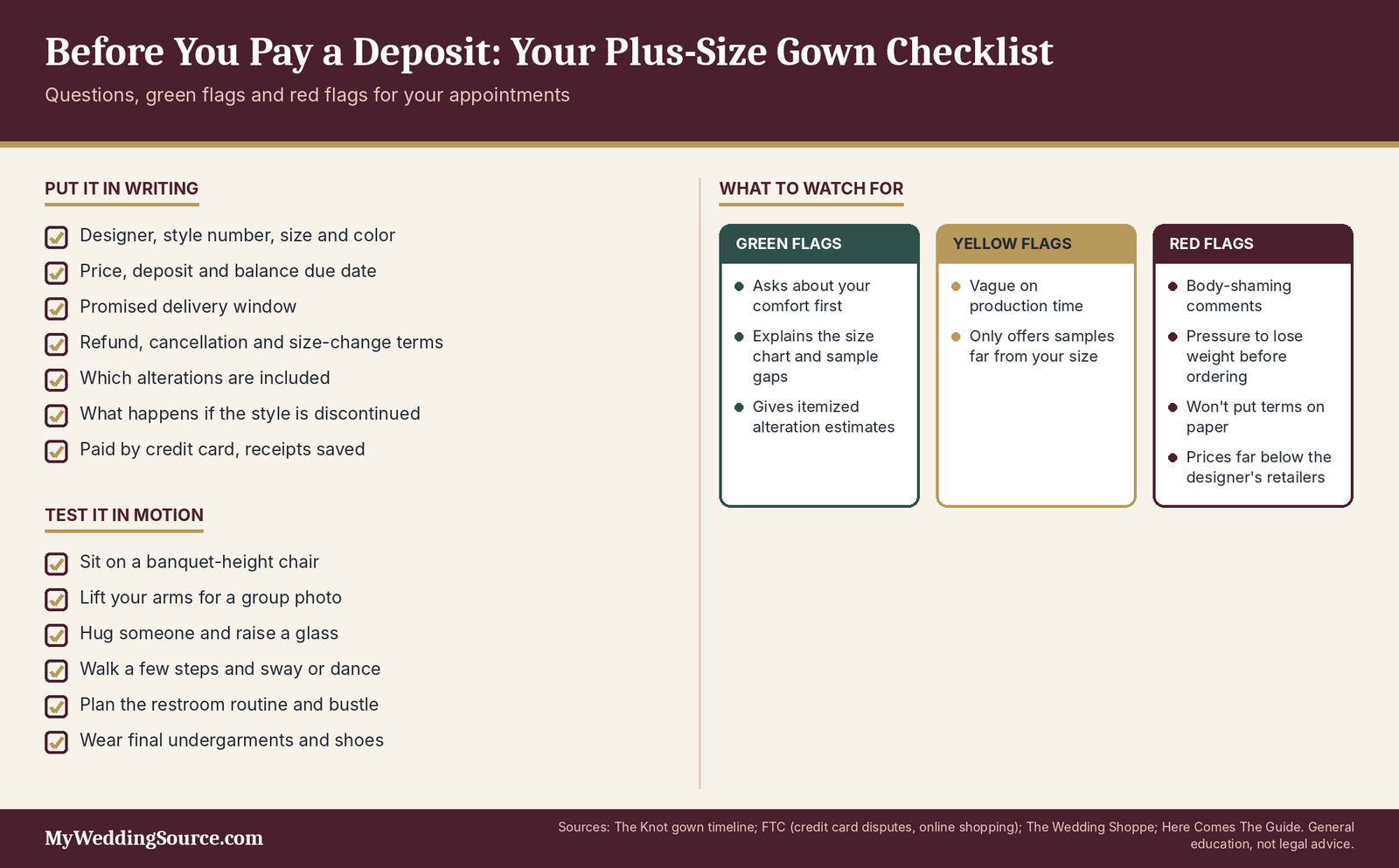
Ask the consultant for a few minutes to move around, and do the things the day will actually require. Sit down on a chair that is about the height of a banquet seat, lift your arms overhead as if for a group photo, hug your consultant or friend, and take a few steps in a quick two-step or sway. If the bodice rides up, the straps dig in or the skirt traps your knees, the seamstress may be able to fix it, but only if you notice before you order. Treat any problem that remains after ten minutes in the salon as a problem that will be louder at hour six.
How will the restroom plan work?
It is an awkward topic that deserves a plain answer, because a gown with layers, a train and a corset back can turn a thirty-second visit into a logistics project. Ask the consultant how the gown goes on and off, whether it can be handled without a helper, and how the bustle works when you are sitting. Practice the restroom routine at your final fitting with whoever will be helping you, so they know where the hooks and loops are. Also scout the venue’s restroom size and whether a private dressing room is available for any mid-event adjustments.
What do undergarments and chafing have to do with the dress?
Everything, because the gown is altered around whatever you plan to wear underneath. Here Comes The Guide advises wearing what you will wear on the day, including shapewear and a strapless bra, when you shop, since those choices change the fit, and The Knot says to lock in undergarments and shoes before the first fitting. Skin-on-skin friction is common in warm weather, so consider moisture-wicking layers or anti-chafe products, and test them during a long walk well before the wedding. If skin irritation is already a concern, ask a pharmacist or a dermatologist what is safe to use with your skin and your gown fabric.
How do heat, cold and the venue change the choice?
What if the wedding is hot?
Heat is a safety question as well as a comfort question. The CDC’s heat and health page lists symptoms such as muscle cramping, unusually heavy sweating, shortness of breath, dizziness, headaches, weakness and nausea, and it points people to its HeatRisk dashboard for local forecasts. For an outdoor summer or early-fall ceremony, that means choosing breathable linings, planning shade and water for the wedding party, and scheduling photos in the cooler part of the day. Consider a second look, such as a shorter reception dress or a removable overskirt, so you are not wearing the heaviest layer through the whole reception.
What if the wedding is in fall or winter?
Cooler weather opens up sleeves, long layers and heavier fabrics, but it also brings damp ground and evening temperature drops. The Knot’s fall attire advice, written for guests, notes that dense fabrics such as velvet, brocade and heavy satin hold up better against wind than chiffon or linen, and that closed-toe shoes keep feet warmer. It also recommends block heels or wedges over thin stilettos on soft or slick outdoor ground. For a bride or partner, the equivalent plan is a wrap, cape, jacket or coat that complements the gown, a warm place to stand between photos, and shoes you can walk in over grass.
How do surfaces, stairs and venue flow affect the gown?
Your venue determines how much dress you can manage. Ask the venue about the path from the dressing room to the ceremony, whether there is an elevator or ramp, what the ground surface is, and how wide the doors and aisles are. A long train or a full skirt that works in a ballroom may need a bustle plan and a helper at a historic building with narrow stairs. Our wedding venues hub has more on what to check about a space before you book it, and your photographer can tell you which locations on the property work with your gown.
The Real Cost of the Gown: Price, Alterations, and Everything Around Them
The gown’s price tag is the beginning of the number, not the end of it. This section separates the price from the extras that surround it, so your budget includes the work that makes the gown fit.
What goes into the full price of a plus-size gown?
Is the average gown price a useful benchmark?
It is a reasonable reference point, with caveats. The Knot’s 2026 Real Weddings Study surveyed 10,474 U.S. couples married in 2025 and reported an average wedding dress cost of about $2,100, with the figure covering primarily off-the-rack and made-to-order gowns. The Knot also states that alterations and custom additions are not included, and only 19 percent of female respondents wore custom-made attire. Treat the average as a ballpark rather than a quote for your area, size or taste, because your price depends on the designer, fabric, and whether you are buying at a salon, online or from a sample sale.
How much do alterations cost?
The Knot’s timeline guidance puts alterations at about $200 for a basic hem to more than $1,000 for major adjustments, and advises getting a quote first. In practice, price depends on the garment’s construction: lace appliques, layered skirts, beading and a corset back all take more labor than a simple crepe sheath. A bustle, strap changes, added cups and boning are typical line items, and they stack. Ask for an itemized estimate before the first fitting and ask which items are included in the gown purchase, since some salons bundle certain services.
Which smaller costs catch people off guard?
The extras are usually modest individually and noticeable together. Plan for undergarments chosen for the gown, shoes broken in before the fitting, steaming or pressing, a garment bag or travel box, a veil or wrap if you want one, and cleaning or preservation after the wedding. Add sales tax and shipping for online orders, which vary by state, and ask about rush fees if your date is close. Our editorial planning estimate is a few hundred dollars for these extras together, but it varies widely, so replace it with real quotes as you gather them.
What does a realistic total look like?
Here is an illustrative scenario, not a quote or a prediction: a $2,100 gown, $450 in alterations, $150 in undergarments and $75 in steaming and pressing comes to about $2,775 before sales tax and shipping. A lace gown with heavy beading and a corset conversion could land well above that, while a simple off-the-rack dress with only a hem could land below it. The point is to keep one running total with a line for every item, so a decision on the gown does not quietly commit you to a bill you did not plan.
| Cost layer | What it covers | What to ask |
|---|---|---|
| Sticker price | The gown as sold | Is the quoted size and color final? |
| Required work | Alterations, bustle, hem | Itemized estimate, bundled services |
| Realistic extras | Undergarments, steaming, accessories | What is included in the purchase? |
| Taxes and fees | Sales tax, shipping, rush fees | Who pays return shipping? |
| Failure cost | Deposits, custom, final sale | Refund, change and cancellation terms |
How do fittings and alterations work?
When is the first fitting, and what happens in it?
The Knot’s timeline places the first fitting once the dress arrives, about three to four months before the wedding, and advises booking the seamstress early since they fill up fast. At this appointment the seamstress pins the gown on you while you wear your final undergarments and shoes, because heel height affects the hem. Bring the person who will help you dress on the day, so they see how the closures work, and ask the seamstress to explain each planned change and its cost. If you are unsure about a change, ask for a quote and think about it before agreeing.
What happens at the second and final fittings?
The second fitting, about six to eight weeks out, is for smaller tweaks, and the final fitting, about two to three weeks out, is where you confirm everything. Use the final fitting to run the movement test again, practice the bustle, and walk in the shoes for a few minutes. The Knot cautions that fitting too early can leave the dress ill-fitting if your body shape changes, while waiting too long creates a time crunch that may trigger rush fees. If you expect your measurements to shift, tell the seamstress at the first fitting so they can plan the final one accordingly.
How do you choose a seamstress?
Look for someone who regularly works on wedding gowns and has experience with your size range, fabric and silhouette, rather than only general tailoring. Ask to see before-and-after examples, ask what their wedding-season calendar looks like, and ask how they handle last-minute changes. Get the price in writing, including the cost of each fitting and the pickup timeline. If the salon recommends in-house alterations, compare their quote with an independent seamstress, because both can be good and the prices can differ.
What can alterations not fix?
Alterations have limits, and knowing them keeps expectations realistic. Azazie’s sizing guide notes that most gowns allow only about one to two inches of seam adjustment per side, and that seamstresses can make small reductions but not large ones. Maggie Sottero warns that heavy alterations can remove design details such as lace or beading. That is the reason the right size at ordering matters, and why a gown that is far too large or far too small at pickup is a difficult rescue.
Matching Your Gown to the Dress Code, the Season, and Your Wedding Party
Your gown is also a signal. It tells guests how formal the day is and sets the tone for what everyone else wears. This section connects the dress to the dress code, the season, and the people standing next to you.
How does the dress code shape the gown you choose?
What do black tie and formal weddings call for?
Black tie and formal weddings generally call for floor-length gowns. The Knot’s dress code cheat sheet, written for guests, describes black tie as long gowns and tuxedos, usually for evening weddings at upscale venues, and notes black-tie optional allows floor-length evening gowns or elevated midi dresses. Its black-tie optional article adds that the couple and wedding party typically dress in black tie, so guests are expected to match the formality. Formal, per The Knot’s formal attire explainer, sits between cocktail and black tie, so a floor-length gown with structure and a rich fabric fits well; choose your fabric for the season.
How do cocktail, semi-formal and dressy casual weddings differ?
These codes allow shorter hemlines and simpler fabrics, which can be a relief for comfort and for budget. The Knot’s cheat sheet describes cocktail attire as formal midi or shorter dresses with structured silhouettes, semi-formal as midi dresses, wrap dresses or jumpsuits with polished details, and dressy casual as a dress, matching set or pantsuit in an elegant fabric. For a couple, that translates to a tea-length gown, a dressy jumpsuit or a two-piece set in a bridal fabric. Extended-size options in these shorter categories exist, but plan extra time to find them because the supply is smaller than for full-length gowns.
What about casual, beach, courthouse and backyard weddings?
At these weddings the gown’s job is to be comfortable and photogenic in the setting. The Knot’s cheat sheet describes beach and resort attire as flowy maxi or midi dresses with non-restrictive silhouettes, with formal gowns out of place, and casual as a dress with a nice neckline. For a courthouse ceremony, a polished dress, suit or set that you would be glad to wear at a rehearsal dinner is a good guide. Ask the venue about sand, grass or gravel before you pick shoes and hems.
How should you communicate the dress code to guests?
Say it plainly on the invitation and the wedding website, with a sentence about the setting and the weather. The Knot notes that couples sometimes use phrases like black-tie preferred, black-tie invited or black-tie encouraged, which signal a request without making it a requirement. A line such as “outdoor ceremony on grass; block heels and a wrap recommended” serves guests of every size and ability better than a bare code. Confirm what you tell guests with your own plans so the wedding looks like the invitation promised.
| Dress code | Typical bridal choice | Plus-size shopping note |
|---|---|---|
| Black tie | Floor-length gown, rich fabric | Order early; structure matters |
| Black-tie optional or formal | Floor-length or elevated midi | Broadest range of options |
| Cocktail or semi-formal | Midi, tea-length, jumpsuit | Smaller supply; allow more time |
| Dressy casual or casual | Dress, set or pantsuit | Often in-stock at chains |
| Beach or resort | Flowy maxi or midi | Check fabric weight and sand |
How do you coordinate with your partner, wedding party and guests?
How do you match your partner’s attire?
Match the level of formality and the color story, not the exact fabric. If your partner is wearing a suit or tuxedo, share fabric swatches and photos, and schedule fittings so the two outfits are finished around the same time. Our guide to grooms’ wedding attire explains suit and tuxedo styles, colors and accessories, which helps when you are coordinating. If both partners are wearing gowns or suits, coordinate silhouettes and colors so the photos feel like one story.
How does wedding party size change the shopping?
Every attendant brings another sizing and ordering conversation, and extended sizes add lead time for them as well. Our guide to how big your bridal party should be covers the numbers, and the dress side is simple: the more attendants, the more reason to pick a brand that sells bridesmaid dresses in a wide size range. Ask each attendant for measurements early, give them a deadline and choose a brand where one style can be ordered in many sizes. Choose a style and neckline that every attendant can wear comfortably, rather than one that only works on a single body type.
What about your guests’ dress code needs?
A dress code is easier to follow when guests can find outfits in their sizes. Our wedding guest dresses guide covers what to wear to different dress codes, and it is a useful link to share with guests who ask. If you have guests traveling or shopping on a tight timeline, a line on the wedding website about when to start looking helps. Guests cannot plan around surprises, so share the venue, the season and the dress code early.
Do plus-ones need to know the dress code?
Yes. A guest’s plus-one is often the person who knows least about the wedding, so the invitation and website are their only briefing. Our plus-one etiquette guide covers how to handle invitations and details, and the dress code belongs on that list. Make sure the wording works for someone who has never met you, with a plain description of the formality and the setting.
Shopping Smarter: Contracts, Payment, and Appointments That Respect You
The practical risks in bridal shopping are rarely dramatic. They are small gaps between what you thought you bought and what the paperwork says, and appointments where the tone matters as much as the gown. This section is general education, not legal advice, and terms and state laws vary, so read your own contract and ask a professional if something is unclear.
How do you protect your money when you order a gown?
What should the order form say?
Your receipt should name the designer, style number, size, color, price, deposit, balance due date and the promised delivery window. It should also say what happens if you need to change the size, whether the style is discontinued, and how a cancellation or refund is handled. Ask for the salon’s policy on alterations that are included, and make sure any promised extras, such as a free steaming or a bustle, are in writing. If a salon cannot put an answer on paper, treat that as a reason to pause before you pay.
Why does paying by credit card matter?
A credit card gives you dispute rights that a check, cash or payment app may not. The FTC’s guidance on using credit cards and disputing charges says a written billing-error dispute must reach the issuer within 60 days after the first bill showing the error, and that non-delivery of goods as agreed is a valid ground. The FTC’s online shopping tips likewise say that paying by credit card best protects you if something goes wrong. For a large deposit, ask whether the salon charges a surcharge, and keep your receipts and email confirmations in one folder.
How can you spot a fake or risky online store?
Be cautious when a brand-name gown is priced far below what the designer’s authorized retailers charge. The FTC warns that unusually low prices on brand-name items may signal counterfeit or stolen goods, and recommends searching the seller’s name with words like “complaint” or “scam” before you buy. Check the return policy, shipping promises and contact information, and be wary of sellers who ask for gift cards, wire transfers or cryptocurrency. If you are interested in a designer, go to the designer’s own site and use its store locator to find authorized retailers.
What if the gown does not arrive or the salon closes?
Start by documenting everything: your receipt, the order confirmation, messages and the payment record. Contact the designer directly, using the contact details on the designer’s official website, because the designer may be able to confirm whether your order was placed. If you paid by credit card, the FTC page above explains how to file a billing-error dispute, and the FTC encourages people to report problems at ReportFraud.ftc.gov. For questions about your rights in your state, consult your state attorney general’s consumer office or a lawyer, since this article cannot give legal advice.
How do you make the appointment work for you?
What should you say when you book?
A short script saves everyone time and tells you a lot about the salon. Try: “I wear roughly a size [your street size] and expect to order around [your bridal estimate]. Which of your designers make gowns in that range, and do you have samples I can try on?” Also ask how long the appointment lasts, whether there is a fee that is credited toward a purchase, and whether you can bring your own undergarments. A friendly, specific answer is a good sign; a vague or evasive one is worth noting.
Who should come with you?
Bring one or two people whose honesty you trust and whose opinions will not overpower yours. Here Comes The Guide advises bringing a friend or relative whose honest opinion you trust, and a crowded appointment can make decisions harder. Tell them in advance what kind of feedback you want, such as comfort and fit rather than commentary about your body or the price. If your family will pay for part of the gown, agree on the budget before you go so nobody is surprised.
What are the red flags for body shaming?
Pay attention to how the consultant talks about bodies, including their own. The Wedding Shoppe’s guide advises avoiding salespeople who body shame and choosing a specialist with no judgment who avoids negative body talk. Red flags include comments about hiding parts of your body, pressure to lose weight before ordering, repeatedly steering you toward only dark or covered styles, or leaving you alone in a dressing room with a sample that does not close. You are allowed to leave at any point, and a better consultant will make the gown the subject.
Which questions are worth asking before you leave a deposit?
A short list will carry you through most appointments. Keep it on your phone and read it before you pay.
Frequently Asked Questions About Plus Size Wedding Dresses
Sizing and ordering questions
What size should I order if I am between two sizes?
Order the larger size, matched to your largest measurement. Azazie’s sizing guide says that if you fall between two sizes you should order the larger one because taking a dress in is easier than letting it out, a point Essense of Australia’s guide makes in nearly the same words. The exception is a style where the designer’s own stylist recommends otherwise, so ask them which size they would order. Avoid ordering several sizes up in anticipation of change, since the seam allowance on most gowns is limited.
Should I wait to order until my body changes?
No. The Wedding Shoppe’s guide advises against delaying an order until you have lost weight, because production takes months and dresses can be altered afterward. Order for your current measurements, tell your consultant about any change you already expect, and plan the final fitting as close to the wedding as the seamstress allows. Whatever your body does between now and the wedding, a skilled seamstress can usually adjust a gown within the limits of its seam allowance.
Can I try on my real size at a salon?
Often not, and that is normal. Samples commonly run 8 to 12 according to Here Comes The Guide, so a consultant may clip the gown to approximate your fit. Call ahead to ask about plus-size samples and which designers the salon orders in your range. If a salon has none, a shop that carries a wide sample range, or an online brand with home try-on, can fill the gap.
Cost, style and day-of questions
How much should I budget for alterations?
Plan for a range, because the work depends on the gown. The Knot reports about $200 for a basic hem to more than $1,000 for major adjustments, and its average gown price of about $2,100 excludes alterations. A realistic plan is to set aside a separate line item, ask for a written estimate at the first fitting, and revise it as the seamstress explains the work. If your gown has lace, beading or a corset back, expect the higher end.
Do I have to wear white, a long gown or a traditional silhouette?
No. The Knot’s plus-size roundup says you do not have to stick to one silhouette, hide parts of your body or choose a modest design, and it highlights midi and tea-length styles for low-key events. Color is equally open, from ivory and champagne to blush or a bold shade. Choose the look that fits your dress code, your venue, your season and your comfort, and let the details follow.
Your Next Steps
The goal is to turn this guide into a short list of calls, measurements and documents. Work through the first group this week and the second before you pay anything.
This week
Measure, save and set a date
Take your bust, waist and hip measurements with a soft tape, over lightweight undergarments, twice, and write them down with the date. Save ten to fifteen gowns you like across silhouettes, and note the brand and style number for each. Then count backward from your wedding date using the timeline table above to find your purchase deadline. If you need a broader planning calendar, our wedding planning hub places the dress inside the full timeline.
Call three places and ask the same questions
Call a salon, a chain store and an online brand with the same short script about size range, samples, production time and return terms. Write the answers in one comparison sheet so you can see the differences side by side. Eliminate any option that cannot answer clearly, and book appointments with the two or three that can. Bring one or two trusted people and your undergarments, and give yourself permission to take your time.
Before you pay a deposit
Get the terms in writing and pay by card
Ask for the order form before you pay and check the designer, style, size, color, price, delivery date and refund terms. Pay with a credit card, and keep your receipt and every message in one folder. If the terms are unclear, take the form home overnight, since a good salon will not mind. For custom work, confirm the fitting count, timeline and change policy in writing.
Book your seamstress and fitting dates now
Seamstresses fill up, so book your fittings when you place the order instead of when the gown arrives. Put the first fitting about three to four months out, the second about six to eight weeks out and the final about two to three weeks out, matching The Knot’s reported timeline. Add your shoes and undergarments to the calendar as dates by which they must be chosen. Finally, add a rain or heat plan to the same calendar so the dress, the weather and the venue are solved together.
Sources & methodology
- The Knot, 25 Plus-Size Wedding Dresses in Every Style (updated Nov. 25, 2025) — size ranges for named brands, salon timing, silhouettes and shopping advice
- The Knot, Average Cost of a Wedding Dress (2026 Real Weddings Study) — average gown cost, survey sample and what the average excludes
- The Knot, When to Buy Your Wedding Dress — ordering timeline, production time, deposits, fittings and alteration ranges
- The Knot, Wedding Dress Code Cheat Sheet — dress code definitions (written for guests)
- The Knot, Black-Tie Optional 101 — black-tie optional definition and invitation wording
- The Knot, Formal Wedding Attire — where formal sits between cocktail and black tie
- The Knot, What to Wear to a Fall Wedding — fabrics, layers and ground conditions for fall events
- Azazie size chart — gown measurements for A00 to A30, converted to inches here
- Azazie, How Do I Choose the Right Size for My Wedding Dress? — ordering by largest measurement, seam allowance and custom sizing
- Maggie Sottero, Your Guide to Wedding Dress Sizes — bridal sizing logic, sample sizes and alteration limits
- Essense of Australia, Wedding Dress Sizing Guide — bridal versus ready-to-wear sizing and fit by fabric
- Here Comes The Guide, Plus-Size Wedding Dresses (Oct. 2023) — sample sizes, brand ranges and support features
- The Wedding Shoppe, 13 Tips for Shopping for Plus Size Wedding Dresses — appointment tips, production time and support
- TODAY, What’s average? Size 16 is the new normal for US women — media report of the Dunn and Christel 2016 study
- FTC, Using Credit Cards and Disputing Charges — billing-error disputes and the 60-day window
- FTC, Online Shopping — spotting risky sellers, payment methods and record keeping
- CDC, About Heat and Health — heat-illness symptoms and the HeatRisk dashboard
Methodology: Prices, timelines and size ranges are survey findings or editorial reports from the sources above, with the year noted where it matters; the 16-to-20-week lead time, alteration range and $2,100 average come from The Knot, and the Azazie inch figures are our own conversion of its centimeter chart. Sample-size statements, silhouette and fabric guidance, and the comfort tests are editorial judgment informed by those sources and by common salon practice, and the cost example is an illustrative scenario, not a quote. This article offers general education only; contracts, cancellation rights and consumer protections vary by state.
Freshness note: Brand size ranges, retailer policies and prices change by season, so re-verify any brand named here on its own site before you shop, and revisit this article each fall when The Knot and Zola publish new cost data. The Here Comes The Guide ranges date from October 2023 and are the most likely to be out of date.