

This exact gap is why so many couples end up researching wedding registry hidden costs only after guests have already contributed. A couple sets up a cash fund for their honeymoon, confident it’s genuinely free, since every platform advertises “no cost to create a registry.” Guests contribute generously: $3,100 in total. The couple goes to withdraw the money two weeks before their trip. They discover two things at once. A 2.5 percent processing fee has quietly taken $77 off the top. And the first transfer takes ten business days to actually land in their bank account, not the same-day access they’d assumed.
Nothing about this was hidden, exactly. Both details were disclosed somewhere in the platform’s terms. Neither got mentioned in the excited moment of actually setting up the registry. That gap is precisely what this guide exists to close.
This guide covers the fees that quietly reduce cash gifts, and the completion discount terms that expire faster than most couples realize. It covers the withdrawal timing that can catch a tight budget off guard, and the scam patterns specifically targeting registries. Some of what drives these numbers is completely standard, disclosed platform policy. Some of it is a genuine warning sign worth catching before you set anything up.
Hawaii Honeymoon Hidden Fees and Booking Terms to Check
Quick Answer: What a Wedding Registry Actually Costs, and What to Watch For
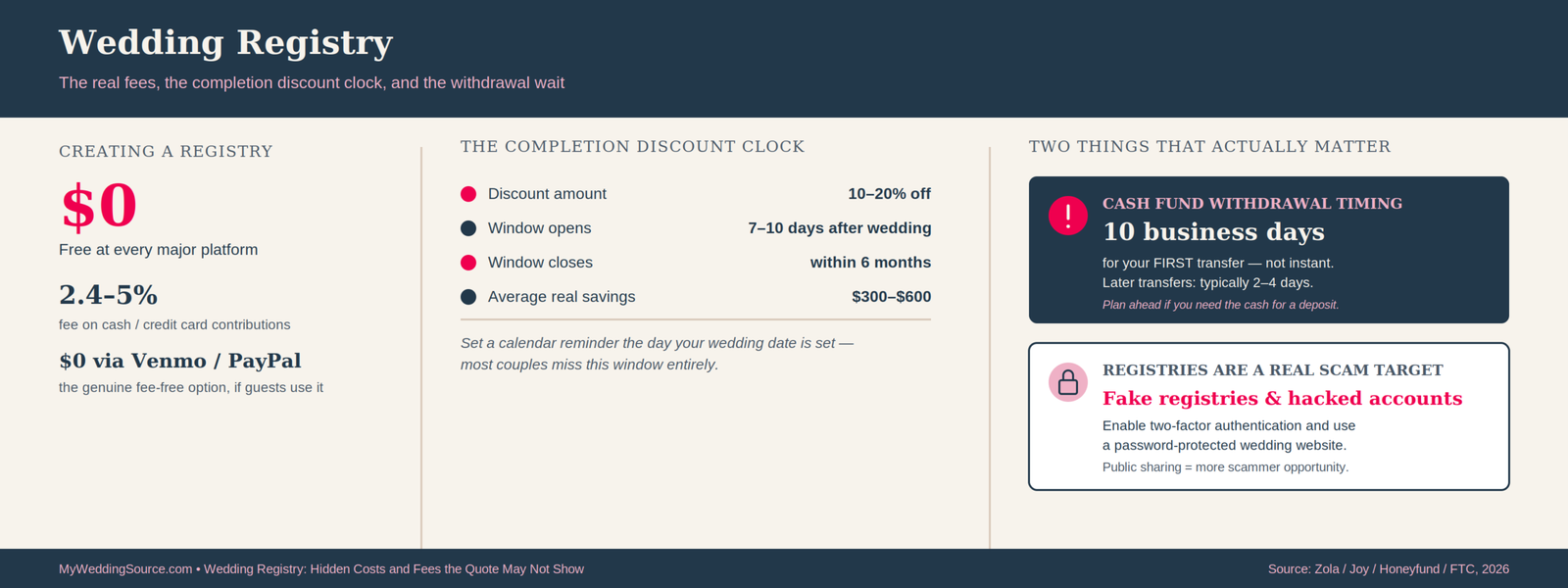
Creating a registry itself is genuinely free at every major platform. The costs that matter live elsewhere. A 2.4 to 5 percent processing fee applies on cash and credit card gift contributions. A completion discount typically runs 10 to 20 percent but expires within 6 months. Withdrawal timing can take up to 10 business days for your first transfer.
The detail that catches people off guard isn’t a fee amount. It’s timing. Cash fund withdrawals and completion discount windows both operate on specific clocks that start the moment your wedding happens, not whenever you get around to checking.
Everything below unpacks exactly how these fees and deadlines work, what’s genuinely standard across the industry, and what deserves a direct question before you set up your registry.
What Nobody Mentions Until It Happens
A few realities about wedding registries rarely make it into the simple, “just make a list” version of registering most couples picture beforehand.
“Free to create” doesn’t mean every gift arrives at full value
The registry itself costs nothing to set up. Cash and credit card contributions, however, commonly carry a processing fee, deducted before the money ever reaches you.
Your completion discount has a real, ticking expiration date
This benefit, letting you buy remaining registry items at a discount, typically activates 7 to 10 days after your wedding and expires within 6 months. Miss the window, and the discount is simply gone.
Cash fund withdrawals aren’t instant
Even after guests contribute, your first transfer to an actual bank account commonly takes up to 10 business days. Subsequent withdrawals are typically faster, but that first one can catch a couple off guard if they’re counting on quick access.
Hidden Costs to Check
These are the specific line items most likely to be missing from your initial, excited understanding of how registries work.
Typical fees, 2026
| Item | Typical cost |
|---|---|
| Registry creation | Free at all major platforms |
| Cash fund, credit card contribution | 2.4–5% per transaction |
| Cash fund, Venmo/PayPal/CashApp | Often $0 (platform fee) |
| Bank transfer withdrawal (some platforms) | Up to 3.5% |
| Completion discount | 10–20% off remaining items |
| Niche/premium platform setup fee | $0–$249 (varies by platform) |
Who actually pays the processing fee varies by platform
Some platforms let the couple decide whether the guest or the couple absorbs this fee. Others, like The Knot, structure it so the guest always pays. Confirm your specific platform’s policy directly.
The zero-fee option exists, but requires guest cooperation
Peer-to-peer payment methods like Venmo and PayPal genuinely avoid registry platform fees, though this requires guests to have and use those specific apps, not universal for every guest.
Before You Set Up Your Registry
A few concrete steps before you build your actual list protect you from most of the surprises covered so far.
Read the specific fee structure for every platform you’re considering
Don’t assume all registry platforms work identically. Compare cash fund processing fees, withdrawal timing, and completion discount terms directly before choosing where to register.
Decide upfront who absorbs the processing fee
If your platform allows a choice, decide deliberately whether guests or you will cover the cash contribution fee, and communicate this clearly if you’re passing it to guests.
Mark your completion discount window on a calendar the moment your wedding date is set
Given the 6-month expiration covered earlier, set a specific reminder well before the deadline, not a vague intention to “use it eventually.”
Set up two-factor authentication on your registry account immediately
This is a genuinely quick step that meaningfully reduces the hacked-account risk covered later in this guide’s scam section.
Questions That Feel Awkward but Are Worth Asking
These specific questions can feel oddly transactional for something framed as a gift, and they’re worth asking anyway.
“What’s your exact processing fee, and who pays it by default?”
Get a specific percentage, not a vague “small fee” description, before choosing your platform.
“How long does our first cash withdrawal actually take?”
Confirm this specific number directly, especially if you’re counting on registry cash for a near-term expense like a honeymoon deposit.
“When exactly does our completion discount start, and when does it expire?”
Get the specific start date and end date, not a general “within a few months” description.
“What happens if an item goes out of stock after a guest has already purchased it?”
Confirm the specific substitution or refund process, since this varies by platform and by retailer.
“What security measures protect our registry account from being hacked?”
A platform with genuine security features, like two-factor authentication, should be able to describe them specifically, not vaguely.
Green, Yellow, and Red Flags
Not every uncomfortable moment in this process is a genuine warning sign. Here’s how to tell the difference.
Green flags
- Clear, specific fee disclosure available before you create an account
- A zero-fee cash option genuinely available, not buried behind confusing terms
- Real-time registry updates preventing duplicate gift purchases
- Two-factor authentication and genuine account security features
- A specific, clear completion discount window with dates, not vague language
Yellow flags: normal industry practice, worth a direct conversation
- A processing fee on credit card cash contributions, standard across the industry, confirm the exact percentage
- A 10-business-day first withdrawal, common, plan your cash-flow timing around it
- A completion discount usable only once, varies by platform, confirm your specific platform’s terms
- Limited customer support hours, normal for smaller platforms, weigh against your own need for support
Red flags worth taking seriously
- No clear fee disclosure anywhere on the platform, even after searching directly
- An unfamiliar platform with no verifiable business history or reviews
- Pressure to move cash contributions to an unusual, unprotected payment method
- No security features like two-factor authentication, even as an option
- A registry account that shows changes you didn’t make, a genuine sign of a possible hack
What the Platform Terms May Not Make Obvious
Even a platform’s stated terms can leave real gaps worth checking directly.
Confirm whether your completion discount can be used multiple times or just once
Some platforms allow repeated use within the window; others limit it to a single purchase. This genuinely affects how you plan your post-wedding shopping.
Confirm what happens to unclaimed cash funds if you never withdraw them
Ask directly whether funds expire, incur a holding fee over time, or remain accessible indefinitely.
Confirm the specific return and exchange policy for registry gifts
This can differ from a retailer’s standard return policy. Ask directly whether registry purchases get extended return windows or special handling.
Confirm data privacy terms, especially for a platform requesting your address and guest information
Understand what happens to your personal data and your guests’ data, and whether it’s shared with third parties for marketing purposes.
Registry Platform Fees: The Completion Discount, Explained Fully
This deserves genuine detail, since it’s one of the more valuable, most commonly misunderstood parts of registering.
What a completion discount actually is
Once your wedding date passes, most major platforms let you purchase any remaining unpurchased registry items at a discount, commonly 10 to 20 percent off, as a thank-you for building your registry through their platform.
The timing window is specific and genuinely easy to miss
This discount typically activates 7 to 10 days after your wedding and expires within 6 months. Set a specific calendar reminder the moment your wedding date is confirmed, not after the fact.
Some platforms allow repeated use; others don’t
Certain platforms let you apply the discount across multiple separate purchases within the window. Others limit it to one single use. Confirm your specific platform’s exact terms directly.
Strategic registering can meaningfully increase your actual savings
Registering thoughtfully for higher-value items, even ones you suspect guests might skip, gives you more discount opportunity later if those specific items remain unpurchased. Real data shows couples saving $300 to $600 on average through deliberate completion discount use.
A genuine 2026 trend: using the discount for experience-adjacent gear
An increasing number of couples fund their honeymoon experience through cash gifts, then use their completion discount specifically on physical travel gear, luggage, cameras, and accessories, rather than home goods.
Item Pricing and Price-Match: What Can Change After You Register
A registry list isn’t a locked price quote, worth understanding directly.
Prices can change after you add an item to your registry
Retail prices fluctuate based on standard market factors, sales, demand, and inventory. The price a guest actually pays may differ from what you saw when you added the item.
Confirm whether your platform offers genuine price-match protection
Some registries guarantee the listed price for a set window; others simply reflect real-time retailer pricing with no guarantee. Ask directly if this matters to your specific registry strategy.
Out-of-stock items need a clear substitution or refund policy
Ask directly what happens if a guest tries to purchase an item that’s since gone out of stock, whether they’re offered a substitute, a refund, or simply an error message.
Sales and price drops can genuinely benefit your guests, not just you
If an item drops in price after a guest adds it to cart but before purchase, most platforms reflect the current, lower price automatically, a genuinely guest-friendly default.
Shipping, Delivery, and Damage
Logistics genuinely matter for a registry, particularly if you’re moving or your gifts arrive over several months.
Confirm your registry’s shipping address well before your wedding date
If you’re moving after the wedding, update your registry shipping address directly and promptly, since gifts purchased in advance often ship immediately, not held until your wedding date.
Consider controlled or delayed delivery if your platform offers it
Some platforms let you hold all gifts for a single delivery after your wedding rather than receiving items individually as they’re purchased, a genuinely useful feature if you’re managing a temporary living situation.
Confirm the specific damage and replacement process for a broken item
Ask directly what happens if a gift arrives damaged: whether you contact the retailer, the registry platform, or the original gift-giver, and how quickly a replacement typically arrives.
Understand return policies specifically for registry purchases
Registry items sometimes have extended return windows compared to standard retail purchases, though this varies by retailer. Confirm this directly rather than assuming standard policy applies.
Multiple Registry Management
Many couples register at more than one retailer, worth genuine planning to avoid real confusion.
Real-time updates across platforms prevent most duplicate gifts
Most major platforms update in real time, showing guests exactly what’s already been purchased, genuinely reducing the classic “three toasters” problem older registry systems struggled with.
A universal registry platform can consolidate multiple retailers into one view
Services designed specifically to sync registries from different stores into a single list can reduce guest confusion about where to actually buy from, worth considering if you’re registering at several places.
Confirm how closing or merging registries actually works
If you decide to consolidate or close a registry after receiving some gifts, ask directly how this affects already-purchased items and any pending completion discount eligibility.
Communicate your actual registry links clearly to avoid guest confusion
List your specific registries clearly on your wedding website, and avoid creating redundant registries at the same store, which can genuinely confuse guests about where to actually purchase from.
Cash Funds and Honeymoon Funds: A Direct Platform Comparison
Since cash funds carry the most significant fee variation, they deserve their own detailed comparison.
| Platform type | Credit card fee | Peer-to-peer option |
|---|---|---|
| All-in-one registry platforms | 2.4–2.5% | Often $0 via Venmo/PayPal |
| Honeymoon-specific platforms | 2.5–3.5% | Varies by platform |
| Zero-fee specialty platforms | $0 | Yes, built-in |
Withdrawal timing deserves genuine planning attention
Your first cash withdrawal commonly takes up to 10 business days to process. Subsequent withdrawals are typically faster, often 2 to 4 business days. If you’re relying on registry cash for a near-term payment, like a honeymoon deposit, build this timeline into your actual planning.
Some platforms offer gift-card withdrawal specifically to avoid fees
A few honeymoon-focused platforms waive fees entirely if you accept funds as a gift card rather than a direct bank transfer, worth considering if that flexibility works for your actual plans.
Decide transparently whether guests or you absorb the processing fee
Some platforms structure this as always guest-paid; others let the couple choose. If you have a choice, decide deliberately rather than defaulting without thinking about it.
Goal visibility is a genuine, if minor, strategic choice
Showing guests how close your fund is to its stated goal can meaningfully encourage contributions, particularly as the total approaches completion. Keeping it private is equally legitimate if you prefer more discretion.
Consider splitting a large goal into specific, named experiences
Rather than one large, abstract total, breaking a honeymoon fund into specific items, a sunset dinner, a snorkeling excursion, a spa day, often genuinely resonates more with guests than a single big number.
Thank-You Tracking and Etiquette
Beyond the fees and logistics, registries create a real, ongoing responsibility worth managing deliberately.
Most platforms include built-in thank-you tracking
Major registry platforms typically flag which gifts you’ve sent a thank-you for and which remain outstanding, genuinely useful for staying organized amid the volume of gifts a wedding can generate.
General etiquette suggests sending thank-yous within a few months
Traditional guidance suggests thank-you notes within three months of the wedding, though many etiquette experts now suggest sending them as gifts arrive rather than waiting until after the event.
Cash and registry gifts deserve equally genuine, specific thank-yous
A cash contribution deserves the same thoughtful acknowledgment as a physical gift, not a shorter or more generic note simply because it wasn’t a wrapped box.
Group gifts need a slightly different acknowledgment approach
If several guests contributed to one larger item or cash fund goal together, consider whether individual thank-yous or a shared acknowledgment fits your specific situation and guest relationships better.
Use your registry’s tracking feature actively, not as an afterthought
Check in regularly rather than letting outstanding thank-yous accumulate into an overwhelming backlog closer to your actual deadline.
Scam Check
Most registry platforms and guest interactions are completely legitimate. A specific set of scam patterns genuinely target wedding registries, worth understanding directly.
Fake registries at made-up retailers
Scammers sometimes create entirely fake registry accounts at fabricated store names on fake websites. Guests pay, but nothing ever ships. Only register at established, verifiable retailers and platforms.
Hacked legitimate accounts
Criminals sometimes gain access to a real couple’s actual registry account and change payment or shipping details to redirect gifts and cash to themselves. Strong, unique passwords and two-factor authentication genuinely reduce this risk.
Public sharing increases scammer opportunity
Registry links shared broadly on social media or through forwarded emails give scammers more surface area to intercept or impersonate. Tell guests to visit your registry through your official wedding website directly rather than clicking forwarded links.
Check your registry account periodically for unauthorized changes
A quick, regular check confirms your payment and shipping details haven’t been altered without your knowledge.
Report a genuine concern through the right channel
If you believe you’ve encountered registry fraud, the Federal Trade Commission’s consumer resource center is the right place to report it and research your protection options.
Safety Check
Beyond registry-specific scams, a few related safety considerations deserve direct mention.
Publicly posting wedding details creates a genuine, separate security risk
Sharing your wedding date, venue, and honeymoon destination publicly on social media broadcasts exactly when your home will be empty for a specific window. Home burglaries during honeymoons happen, and the information enabling them is almost always publicly available online.
Password-protect your wedding website if it includes registry links
Restricting access to invited guests only, rather than leaving it fully public, genuinely reduces both registry fraud risk and the home-security risk covered above.
Be thoughtful about what’s visible publicly versus what’s behind a password
You don’t need to go completely dark on social media. Simply consider what specific details, dates, locations, absence windows, are worth keeping more private.
Guest Experience Check
A few considerations affect how your registry actually feels to use, not just how it functions for you.
Offer a genuine range of price points
A registry with only expensive items can feel genuinely uncomfortable for guests on a tighter budget. Include a real range, ensuring everyone has a comfortable option regardless of what they’re able to spend.
Keep your registry reasonably current, not overloaded with items you no longer want
Review and update your list periodically rather than leaving outdated or unwanted items sitting on it indefinitely.
Make your registry genuinely easy to find
Link it clearly on your wedding website, and consider mentioning it directly, not just implying its existence, since some guests genuinely appreciate clear guidance here.
Confirm your registry displays correctly on mobile devices
Many guests will browse and purchase directly from their phones. A registry that’s difficult to navigate on mobile creates real, avoidable friction.
Accessibility Check
A few specific considerations deserve direct attention for a genuinely accessible registry experience.
Confirm your chosen platform supports screen readers and other assistive technology
Not every registry platform is built with equal accessibility in mind. Research this directly if it matters to your own needs or those of guests you know rely on assistive technology.
Offer alternative ways to contribute for guests less comfortable with online payment
Some platforms support mailed checks or cash alongside digital options, worth confirming if this matters for your specific guest list.
Legal Check: Consumer Protection Basics Worth Knowing
General consumer protection principles apply to registry platforms, though specifics vary by provider.
A platform’s terms of service function as your actual agreement
Reading these terms, however tedious, gives you real, documented understanding of fees, withdrawal policies, and dispute processes before you need them.
Understand your recourse if a platform mishandles funds
Ask directly what happens if a technical issue delays or loses a cash contribution, and confirm this is covered clearly in the platform’s actual terms.
Report a broader fraud concern through official channels
For a significant issue involving fraud or deceptive practices, the Federal Trade Commission’s consumer resource center provides guidance on reporting and understanding your protections.
Paying by credit card, where possible, offers real dispute protection
If a guest contributes via credit card and something genuinely goes wrong, your card issuer’s dispute process offers protection that cash or a direct bank transfer doesn’t.
What Pinterest and Styled Content Don’t Show You
A beautifully designed registry page or styled unboxing photo captures one curated moment, not the actual mechanics behind it.
Styled registry content rarely shows the actual fee structure
Beautiful cash fund pages don’t visually disclose their processing fee or withdrawal timeline, both genuinely important details this guide has covered throughout.
Influencer registries sometimes reflect sponsored partnerships, not typical guest behavior
Registries featured in styled content may have been partially gifted or sponsored by featured brands, not a representative picture of how a typical guest list actually contributes.
The completion discount and thank-you tracking happen quietly, off-camera
The satisfying, organized version of “using your registry perks” represents real, ongoing effort: calendar reminders, tracking outstanding thank-yous, and checking account security, none of which shows up in a single aesthetic photo.
A Realistic Scenario: How the Story at the Start of This Guide Could Have Gone Differently
Return to the couple from the opening of this guide, who assumed their $3,100 honeymoon fund was fully accessible, only to discover a $77 fee and a 10-day wait right before their trip.
What confirming the fee structure upfront would have changed
Asking directly, “what’s your exact processing fee, and can guests use a fee-free option like Venmo instead,” would have surfaced the real numbers before a single dollar was contributed.
What planning around the withdrawal timeline would have changed
Knowing the specific 10-business-day first-transfer window, they could have initiated the withdrawal weeks earlier, well ahead of their actual departure date, rather than two weeks out.
This doesn’t mean their platform acted in bad faith
Both the fee and the timeline were disclosed, standard practice. The actual gap was a lack of upfront questions, exactly the pattern this entire guide addresses.
Worst-Case Scenario, and the Backup Plan
Worth naming plainly, since knowing the realistic worst case actually reduces anxiety more than avoiding the topic does.
The worst realistic case: a hacked registry account redirecting real gifts
This is rare, but it happens, and it’s genuinely distressing when it does, since it affects both your gifts and your guests’ trust.
The backup plan
Contact your specific platform’s support team immediately if you notice unauthorized changes, and alert guests directly through a trusted channel, like your wedding website or a group message, warning them not to use any recently shared or unfamiliar links.
This is a preventable scenario, not an inevitable one
Strong, unique passwords and two-factor authentication, covered earlier in this guide, are the single most effective way to avoid this specific worst case entirely.
Three Realistic Scenarios
Numbers in the abstract are harder to apply than a concrete example. Here are three genuinely realistic, composite scenarios.
Scenario one: a straightforward registry with a fee-free cash option
A couple sets up a Venmo-linked cash fund specifically to avoid processing fees, receives $2,400 in contributions, and withdraws the full amount with no fee deducted.
Scenario two: a mixed registry with strategic completion discount use
Another couple registers for both physical items and a cash fund, deliberately includes a few higher-value items, and uses their 20 percent completion discount within the window to purchase $450 worth of remaining items for $360.
Scenario three: a couple who caught a security issue early
A third couple notices an unfamiliar shipping address on their registry account, contacts support immediately, and resolves the issue within a day, having enabled two-factor authentication from the start.
The difference across all three scenarios wasn’t luck. It was understanding the specific fee structure, timing, and security features before they became relevant.
Your Wedding Registry Checklist
- ☐ Platform fee structure compared directly (cash and credit card): ____________
- ☐ Zero-fee contribution option confirmed, if available: ____________
- ☐ Two-factor authentication enabled on registry account: ____________
- ☐ Completion discount window dates confirmed and calendared: ____________
- ☐ Cash withdrawal timeline confirmed and planned around: ____________
- ☐ Wedding website password-protected (if it includes registry links): ____________
- ☐ Return and damage policy confirmed for registry purchases: ____________
- ☐ Thank-you tracking system set up and checked regularly: ____________
- ☐ Registry account checked periodically for unauthorized changes: ____________
Frequently Asked Questions
What are the real wedding registry hidden costs most couples miss?
Processing fees on cash and credit card contributions (2.4 to 5 percent), a completion discount that expires within 6 months, and a 10-business-day wait for your first cash withdrawal are the most commonly missed details.
Is creating a wedding registry actually free?
Yes, at every major platform. The costs that matter come from processing fees on cash contributions, not from the registry itself.
How much does a wedding registry cash fund actually cost in fees?
Commonly 2.4 to 5 percent on credit card contributions. Many platforms offer a genuinely free option through Venmo, PayPal, or similar peer-to-peer payment methods.
How long does it take to withdraw cash fund gifts?
Your first withdrawal commonly takes up to 10 business days. Subsequent withdrawals are typically faster, often 2 to 4 business days.
What is a completion discount, and when does it expire?
This lets you buy remaining unpurchased registry items at a discount, commonly 10 to 20 percent, typically starting 7 to 10 days after your wedding and expiring within 6 months.
Can I use my completion discount more than once?
This varies by platform. Some allow multiple uses within the window; others limit it to a single purchase. Confirm your specific platform’s terms directly.
Are wedding registries actually targeted by scammers?
Yes, genuinely. Fake registries at made-up retailers and hacked legitimate accounts are documented, real patterns. Strong passwords and two-factor authentication meaningfully reduce this risk.
Should guests or the couple pay the cash fund processing fee?
This varies by platform. Some let the couple decide; others, like The Knot, structure it so the guest always pays. Confirm your specific platform’s default.
What happens if a registry item is out of stock when a guest tries to buy it?
It depends on the specific platform and retailer. Confirm directly whether guests get a substitution option, a refund, or another resolution.
Is it safe to share my registry link on social media?
This carries real risk, both for registry fraud and for signaling when your home will be empty during your honeymoon. Consider a password-protected wedding website instead of fully public sharing.
Should we register at multiple stores or just one?
Either works. Most modern platforms update in real time to prevent duplicate purchases, and a universal registry service can consolidate multiple stores into one guest-facing view if you register at several places.
Communicating With Your Registry Platform: A Few Habits That Prevent Most Problems
Beyond the specific questions covered earlier, a few general habits genuinely reduce your risk of a bad experience.
Get fee and policy details in writing, not just from a sales page
A platform’s actual terms of service, not just its marketing copy, is the real source of truth for fees, timing, and policies.
Keep a simple record of your specific platform’s key dates
Note your completion discount start and end dates, and any withdrawal timelines, somewhere you’ll actually check, not buried in an email you’ll forget about.
Contact support directly if anything about fees or timing feels unclear
A platform’s support team should be able to answer specific questions about your account directly, not just point you to a general help article.
A Few Wedding Registry Myths Worth Dropping
“A registry is completely free, full stop”
Creating one is free. Cash contributions commonly carry a real processing fee, covered throughout this guide, worth understanding before you assume every dollar arrives intact.
“Registering for expensive items is greedy”
Including higher-value items simply gives guests, and your future completion discount, more range. Guests choose what fits their own budget regardless of what’s listed.
“Cash gifts don’t need a registry at all”
A structured cash fund, with clear goals and genuine transparency, often feels more comfortable for guests than an unstructured request for money, and it comes with the security and tracking features covered throughout this guide.
“Once we set up our registry, there’s nothing more to manage”
As this guide has shown, active management, security checks, thank-you tracking, discount timing, genuinely affects your actual outcome, not a “set it and forget it” category.
A Glossary of Registry Terms
| Term | Plain-language meaning |
|---|---|
| Completion discount | A post-wedding discount on remaining unpurchased registry items |
| Cash fund | A registry option letting guests contribute money instead of physical gifts |
| Controlled/delayed delivery | Holding gifts for one combined delivery instead of individual shipments |
| Universal registry | A platform consolidating registries from multiple retailers into one list |
| Two-factor authentication | A security step requiring a second verification beyond your password |
If You’re Already Established, or This Is a Second Marriage
Registry etiquette has genuinely relaxed for couples who don’t need traditional household items, worth direct mention.
There’s no rule requiring a traditional household registry
Couples who already own their home essentials can register for genuinely anything meaningful: experiences, home upgrades, charitable donations, or simply a cash fund, without needing to force a traditional gift list.
A charity-based registry deserves the same security diligence as any other
If you’re directing gifts toward a charitable cause instead of yourselves, verify the charity directly and communicate this clearly to guests, since fake charity registries are a documented scam pattern covered earlier in this guide.
Consider a genuinely mixed registry that reflects your actual life
Combining a modest physical registry with a larger cash or experience fund often reflects an established couple’s real needs better than an all-or-nothing approach.
A Note on Registering for a Destination or Multi-Event Wedding
A few additional considerations apply if your celebration spans multiple events or locations.
Confirm your registry’s shipping capability matches your actual living situation
If you’re traveling extensively around your wedding, confirm your registry address and delivery timing won’t create a logistics problem while you’re away.
A single, clearly communicated registry avoids confusion across multiple wedding events
Keep your registry information consistent and clearly linked everywhere guests might look for it, particularly if you’re hosting a rehearsal dinner, ceremony, and reception in different locations.
Consider timing your completion discount window around your actual return home
If you’re honeymooning immediately after a destination wedding, confirm your completion discount’s start date doesn’t expire before you’re actually back to use it comfortably.
Comparing Multiple Registry Platforms Fairly
Once you’re weighing a few different platforms, comparing them accurately takes more structure than comparing one headline feature alone.
Confirm each platform’s complete fee picture, not just the cash fund rate
Credit card processing fees are only part of the picture. Confirm withdrawal timing, completion discount terms, and any setup fees before deciding.
Weigh customer support quality alongside fees
Slightly higher fees paired with genuinely responsive support, particularly useful if a security issue or technical problem arises, can be worth the trade-off.
Consider your specific guest list’s comfort with different payment methods
Platforms requiring guests to have specific apps for fee-free contributions work better for a tech-comfortable guest list than for one including guests less familiar with peer-to-peer payment apps.
A Note on Registry Marketing Language Versus Actual Terms
A few specific phrases deserve a closer look before you take them at face value.
“Free” typically refers only to registry creation, not every transaction
As covered throughout this guide, creating a registry costs nothing. Reading “free” as covering every subsequent transaction is a genuinely common, avoidable misunderstanding.
“Instant” cash access claims deserve direct verification
Some marketing language implies immediate fund access. Confirm the actual withdrawal timeline directly in the platform’s terms, not from a marketing headline alone.
“No fees” sometimes means “no fees for the couple,” not “no fees at all”
Some platforms shift the processing fee entirely to the guest rather than eliminating it. Read the specific language carefully to understand who actually pays.
A platform’s actual terms of service always override its marketing copy
When in doubt, verify directly in the terms rather than relying on a homepage headline or promotional email.
A Final Word on Reading Your Registry’s Terms Carefully
Every principle in this guide points toward the same underlying habit: read what you’re actually agreeing to, and ask direct, specific questions about anything unclear, before you set up a single item.
A specific final check before you go live with your registry
Reread your platform’s fee and withdrawal terms one more time before sharing your registry link with guests, confirming everything matches what you’ve understood throughout this guide.
Keep copies of key policy pages, digitally if possible
A screenshot of your platform’s fee structure and completion discount terms, saved somewhere accessible, protects you if policies change or if a dispute ever arises.
This diligence protects a good relationship with your guests, not just your platform
Clear understanding of fees and timing isn’t about distrust. It’s about being able to answer a guest’s question confidently, and about your own gifts arriving and accessing cash the way you actually expect.
More Direct Answers
Do we need to disclose the processing fee to our guests?
This isn’t required, though many couples appreciate transparency. If your platform passes the fee to guests by default, some couples mention this briefly to avoid any confusion about a contribution amount not matching what was received.
Can we change registry platforms after we’ve already started?
Yes, though confirm directly how this affects already-received gifts, any pending completion discount eligibility, and communicate the change clearly to guests who may have already bookmarked your original registry.
Should we register even if we genuinely don’t need physical items?
Not necessarily for physical goods, though a cash or experience fund still offers guests a clear, comfortable way to contribute meaningfully, with the security and tracking benefits covered throughout this guide.
What’s the single most important habit from this entire guide?
Read your specific platform’s actual fee structure, withdrawal timeline, and completion discount terms directly, before your registry goes live, rather than discovering them after gifts have already arrived.
Is it worth paying a setup fee for a premium, niche registry platform?
This depends on what the fee provides. If a specific platform’s design, features, or focus genuinely matters to you, a modest setup fee can be worth it. Compare this directly against free alternatives before deciding.
A Realistic Timeline Recap
| Timeframe | What happens |
|---|---|
| 6–9 months before | Compare platforms; confirm fee structure and security features |
| At setup | Enable two-factor authentication; build your item list |
| Throughout engagement | Check account periodically; track thank-yous as gifts arrive |
| 7–10 days after wedding | Completion discount window opens |
| Within 6 months | Use completion discount before it expires |
This timeline is a genuinely reliable default for most registries, though your specific platform’s actual terms always take priority over this general guide. Confirm their exact dates directly once you’ve registered.
One Last Practical Note on Choosing Confidently
None of the guidance in this article is meant to make a genuinely joyful part of wedding planning feel like a compliance exercise. The overwhelming majority of registries work exactly as intended, with gifts arriving smoothly and cash funds accessible without real drama. This guide exists for the gaps, and for the peace of mind that comes from knowing exactly what to check before you go live.
Choose a platform that discloses its fees clearly, offers genuine security features, and gives you confidence in the actual terms, not just an appealing homepage. That combination, more than any single feature in this guide, is what actually predicts a smooth registry experience from setup through your last thank-you note.
A Direct Comparison: Two Platforms Handling the Same $3,000 Cash Fund
Here’s a concrete way to see why comparing fee percentages alone doesn’t tell the whole story.
| Detail | Platform A | Platform B |
|---|---|---|
| Credit card fee | 2.5% | 2.5% |
| Peer-to-peer option | Yes, $0 fee | No |
| First withdrawal | 10 business days | 10 business days |
| Realistic total fees paid | ~$35 (mostly P2P) | ~$75 (all credit card) |
Both platforms advertise the identical headline fee. Platform A’s genuine peer-to-peer option, used by most guests, cuts the real total fee paid by more than half, exactly the kind of detail a simple fee-percentage comparison misses.
A Closing Thought on Value Versus Convenience
Every number in this guide describes what a registry commonly costs in fees and timing. None of it describes what a genuinely well-run registry is actually worth. A platform that discloses its terms clearly, protects your account with real security features, and gives your guests a comfortable, varied way to contribute is providing something real beyond convenience: a smoother, more trustworthy start to your life together.
Approach this process with the same combination this guide has modeled throughout: genuine appreciation for a system that makes gift-giving easier, paired with the same direct, specific questions you’d bring to any other financial decision. Both things can be true at once, and holding them together is what actually protects you, from your first added item through your last completion-discount purchase.
A Note on International or Long-Distance Guests
Guests contributing from outside the US introduce a few additional considerations worth direct attention.
International credit card contributions may carry additional fees
Beyond the platform’s standard processing fee, an international guest’s own card issuer may apply a foreign transaction fee on their end, genuinely outside your registry platform’s control.
Currency conversion happens automatically on most platforms
A contribution from an international guest typically converts to US dollars automatically, though the specific exchange rate and any conversion fee vary by platform. This isn’t something you can control directly, but it’s worth understanding if international guests ask.
Physical gift shipping internationally carries its own separate logistics
If an international guest wants to send a physical gift rather than contribute to a cash fund, confirm your registry platform actually supports international shipping before assuming it’s available.
Final Thoughts on Building Your Own Plan
This guide has covered a genuinely large amount of ground: real fee structures, the completion discount window most couples discover too late, cash withdrawal timing, and the specific scam patterns targeting registries directly. You don’t need to apply every single section in order.
Pull whatever’s relevant to your specific registry, skip what doesn’t apply, and return to any section as a reference whenever a new question comes up during your own planning process. That’s genuinely what this guide is here for.
A Concluding Note on Confidence
A wedding registry is one of the more genuinely practical, financially real parts of wedding planning, and the gap between a smooth experience and a frustrating one rarely comes down to the platform’s design or aesthetic. It comes down to information: knowing the true fee structure before guests contribute, knowing your real withdrawal timeline, and knowing the specific scam patterns worth genuine caution.
You now have everything this guide has to offer: the real fee structures, the completion discount clock most couples discover too late, the cash withdrawal timeline, and the specific scam patterns worth genuine caution. Walk into your own registry setup with that information in hand, confident rather than guessing.
A Last Practical Tip Before You Go Live
Bring a written list of questions, even a short one drawn directly from this guide’s checklist, when you’re comparing registry platforms. This keeps you grounded during the comparison and ensures you choose based on real, specific answers about fees, timing, and security, rather than which platform simply has the prettiest homepage.
A Note on Registry Add-Ons and Third-Party Marketplace Items
Many modern registries let you add items from virtually any online retailer, not just the platform’s own store, worth a few practical notes.
Third-party items may follow a different return policy than platform-native ones
An item added from an external retailer typically follows that retailer’s own return and exchange terms, not your registry platform’s policy. Confirm this distinction if a specific return timeline matters to you.
Price tracking works differently for external items
Some registries actively track and update pricing for external items in real time; others simply link out, meaning the displayed price could be stale. Confirm which applies to your specific platform.
A browser extension often makes adding external items genuinely easy
Most major platforms offer a simple browser tool letting you add any product from nearly any website directly to your registry, worth using if you want items beyond a platform’s native catalog.
A Note on Gift Exchanges and Store Credit
What happens when a gift genuinely doesn’t fit your needs deserves direct mention.
Some platforms let you exchange an unwanted gift for credit before it even ships
A few registry platforms offer a specific feature letting you swap a gift for equivalent store credit before the physical item is sent, avoiding an actual return process entirely.
Confirm the standard exchange process for gifts you’ve already received
Ask directly what documentation or receipt you need for a registry-purchased gift exchange, since this can differ from a standard retail return.
Be thoughtful about exchanging gifts from guests who might notice
While practically simple, consider your specific relationship with a gift-giver before exchanging something they chose thoughtfully, weighing genuine need against the social dynamic involved.
A Last Round of Direct Answers
Can we add items from any website to our registry, or only the platform’s own store?
Most major platforms let you add items from virtually any online retailer using a simple browser tool, though third-party items typically follow that retailer’s own return policy rather than the registry platform’s.
What if we receive a gift we genuinely can’t use?
Some platforms let you exchange an unwanted gift for store credit before it ships. For an already-received gift, confirm the standard exchange process, which can differ from typical retail returns.
Do international guests pay more to contribute to our registry?
Sometimes, due to their own card issuer’s foreign transaction fee, which is outside your registry platform’s control. Currency conversion typically happens automatically on the platform’s end.
Is it rude to exchange a gift a guest specifically chose for us?
This is a genuinely personal judgment call. Weigh your actual need against your specific relationship with the gift-giver, since exchanging is practically simple but carries a real social dimension worth considering.
What’s the very first thing we should do once we’ve chosen a registry platform?
Enable two-factor authentication immediately, before adding a single item or sharing your link with anyone, given the account-security risks covered throughout this guide.
That’s genuinely everything. From the completion discount window down to third-party item returns, you now have the complete, real picture, ready to apply to your own specific registry.
A Note on Registering for Your Wedding Party Gifts Too
Some couples use a similar registry approach for gifts they’re giving to their own wedding party, worth brief mention here.
This is a separate list from your guest-facing registry
Keep gifts you’re planning to give your wedding party entirely separate from what guests see, since this is a distinct budget category with its own timeline and purpose.
Some registry platforms offer a private wishlist feature for this exact purpose
A private, non-shared list can help you track ideas and budget for wedding party gifts without it becoming visible to your actual wedding guests.
A Brief Word on Registries for Vow Renewals and Anniversary Celebrations
The same core principles apply if you’re registering for a vow renewal or significant anniversary rather than a first wedding.
Every fee, timing, and security consideration in this guide applies identically
Regardless of which celebration prompted the registry, the same processing fees, completion discount mechanics, and scam risks apply exactly the same way.
Consider whether a registry is even the right fit for your specific celebration
Some couples celebrating an anniversary or vow renewal prefer to skip a registry entirely, simply requesting guests’ presence rather than gifts. Both choices are completely legitimate.
A Practical Note on Registry Timing Relative to Your Engagement
When you actually set up your registry, not just how, deserves brief mention.
Most couples register 3 to 6 months before the wedding
This timing gives guests, particularly those attending an engagement party or bridal shower, a real chance to purchase from it before the wedding itself, rather than scrambling right before the date.
Registering too early can mean items go out of stock or discontinued before guests shop
A registry built a full year in advance risks some items becoming unavailable by the time most guests actually purchase, closer to the wedding date. A moderate timeline genuinely balances both concerns.
Update your registry as your actual needs or preferences change
It’s completely normal to add, remove, or adjust items as your wedding planning progresses and your actual home needs become clearer.
One Genuinely Final Practical Reminder
If you take away just one action item from this entire guide, make it this: the day your registry goes live, enable two-factor authentication and write down your platform’s exact processing fee, withdrawal timeline, and completion discount dates somewhere you’ll actually check. That five-minute habit, more than any single fee comparison in this guide, is what actually keeps your registry experience predictable from your first added item through your last thank-you note sent.
A Genuinely Final Word
This guide has walked through nearly every practical corner of wedding registry planning: the real fee structures, the completion discount clock, the cash withdrawal timeline, and the specific scam patterns worth genuine caution. Carry that knowledge into your own registry setup with confidence, and let the actual experience of receiving gifts from people who care about you be exactly as warm and simple as it’s supposed to be, free of the financial surprises this guide was written to prevent.
A Short Word on Keeping Perspective
Every fee, deadline, and security tip in this guide is worth taking seriously, though none of it should overshadow what a registry actually represents: people who care about you, choosing something specific to help you start your life together. Handle the practical details carefully, and then let the actual experience of opening gifts and reading kind notes be exactly as meaningful as it deserves to be.
A Truly Final Practical Note
None of the guidance in this article is meant to make a genuinely joyful part of wedding planning feel transactional. The overwhelming majority of registries work exactly as intended, guests contribute generously, gifts arrive safely, and cash funds land in your account without real drama. This guide exists for the specific gaps, fees, timing, and security, that occasionally turn an otherwise smooth process into a frustrating surprise. Knowing them in advance is what actually keeps the experience feeling as warm as it’s meant to be.
Trust your own preparation over any single detail in this guide
Every couple’s actual guest list, budget, and platform choice genuinely differ from every other couple’s situation. Use the specific numbers and deadlines throughout this guide as a real starting framework, then adapt them thoughtfully to your own actual registry, guests, and circumstances.
A Very Last Note
Keep this guide bookmarked as a reference throughout your engagement, returning to any specific section, fees, timing, security, etiquette, whenever a new question about your registry comes up.
Where This Leaves You
Wedding registry hidden costs come down to the same handful of patterns throughout this entire guide: a processing fee that quietly reduces cash contributions, a completion discount window that closes faster than most couples expect, and a withdrawal timeline that can catch a tight budget off guard. None of this is mysterious once you know where to look, and most of it is completely standard, disclosed platform policy, not a sign anything is wrong.
The couple from the start of this guide didn’t need a different registry or a smaller cash fund. They needed two specific habits: confirming the exact fee and withdrawal timeline before guests started contributing, and planning their honeymoon cash-flow timeline around the real, disclosed numbers rather than an assumed instant transfer. Those two habits, applied consistently, are what actually separate a smooth registry experience from a stressful one.
Your next step
Before you finalize your registry platform, check its specific processing fee, withdrawal timeline, and completion discount window directly in its terms of service. Then enable two-factor authentication on your account today, before your first gift is ever purchased.
