

All inclusive wedding venues can simplify your planning and sometimes lower your total, but only if you convert the headline per-person price into a real, itemized total before you compare or sign.
You toured a venue last Saturday, and the coordinator said the words every couple hopes to hear: “It’s all inclusive.” The package covers the room, the dinner, the bar, the tables and chairs, and a staff that handles the room flip. The per-person price sounds reasonable, the deposit is due Friday, and a second couple is apparently “looking at your date.” This guide is for the decision you face in that moment: is the bundle actually a good deal for your guest count, your priorities and your date, and what do you need in writing before you pay anything?
Pricing for these venues is genuinely complicated, and that is not the same as shady. Most coordinators are describing a package the way their sales sheet describes it, and the sheet may leave out the service charge, the sales tax, the bar upgrade you will inevitably want or the overtime rule that starts the clock at load-in. The goal here is not to make you suspicious of the venue. It is to give you the vocabulary, the arithmetic and the questions that turn “all inclusive” from a marketing phrase into a document you can compare line by line against other venues. If you are still at the earlier stage of deciding what kind of space you want at all, our broader wedding venues guide covers that decision; this article goes deep on one specific pricing model.
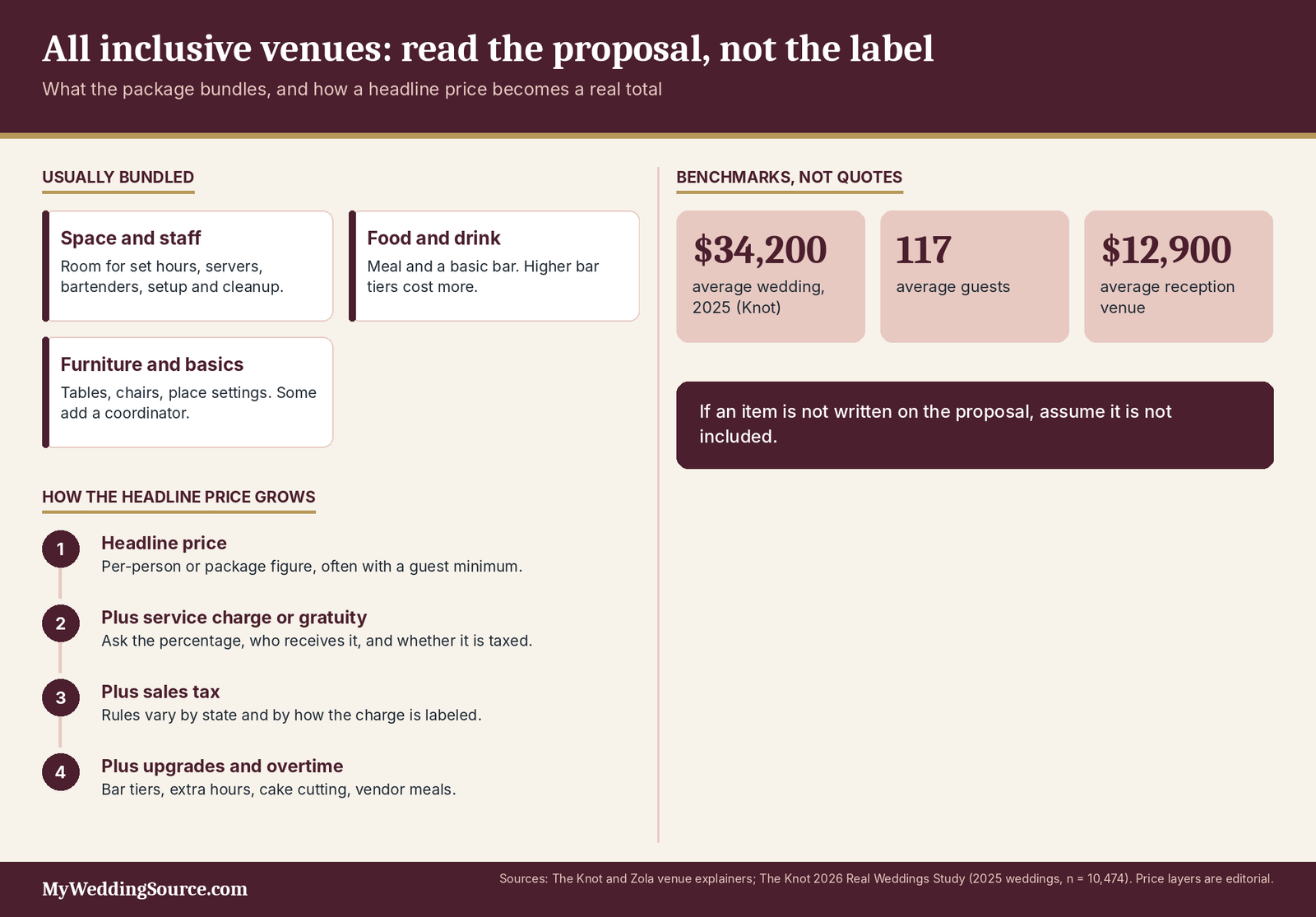
What “all inclusive” actually bundles
The phrase sounds like a single product, but couples encounter at least two quite different business models under the same label. One is the U.S. venue package, where a barn, estate, hotel ballroom, country club or event hall sells the space plus food, drinks, furniture and staff as one contract. The other is the resort or destination package, where the property sells a ceremony, a reception and a block of hotel rooms together. Knowing which model you are looking at changes almost every question that follows, so it is worth sorting that out in the first five minutes of any tour.
The two models behind the label
The venue package model
In the venue package model, you contract with one business that provides the room, the kitchen, the bar service and most of the rentals. The Knot describes an all-inclusive venue as one that typically includes an event coordinator, decor and furniture rentals, and catering and alcohol service, with some also covering a DJ, flowers or a photographer. Setup and cleanup are usually included because the venue’s in-house team handles them. The big advantage is that one company is accountable for the whole sequence, from the room being ready at 3 p.m. to the last chair being stacked. The trade-off is that you are buying their menu, their bar tiers and often their style, so the flexibility you give up is the price of the simplicity you gain.
The resort and destination model
The resort model usually starts with a smaller base package and expands through add-ons. A BeachBride guide to resort wedding packages reports that base packages often cover a symbolic ceremony for roughly 20 guests, that the price does not drop for smaller groups, and that legal ceremony costs, outside photographer access fees, extra guests, gratuities and local taxes commonly sit on top. Those figures are industry-blog estimates that vary by resort and season, so treat them as prompts for questions rather than quotes. If you are weighing this model, our companion piece on booking terms and hidden fees for a Hawaii trip shows the same pattern of base price versus final bill in a destination setting. For marriage-license and officiant rules abroad, verify requirements with the destination’s official government sources, because they differ by country.
What the label tends to cover, and where it stops
The usual core inclusions
Across venue types, the dependable core is the space for a defined number of hours, a meal, drink service, tables, chairs, basic place settings and staff to serve and clear. Zola’s pros and cons explainer, last updated in February 2024, lists the reception space, a meal, tables and place settings, and drink service as the core, with tents, lawn games, decor, a florist, a photographer, a DJ, a photo booth, cake or accommodations varying by venue. The word “varies” matters in that sentence. Two venues can both advertise as all inclusive while one includes a coordinator, a dance floor and linens and the other includes only food, a basic bar and the building.
Why the label itself proves nothing
There is no regulatory definition, industry standard or trade-association checklist for what a venue must bundle before it can use the phrase. That means “all inclusive” is a marketing description, and the only reliable document is the proposal or contract that lists each item by name, quantity and tier. A useful habit is to treat a line like “décor package” or “standard rentals” as a question rather than an answer: which linens, how many chairs, which centerpieces, what happens if you want a different style? Another is to ask whether any listed item can be swapped out for a credit, because bundles that cannot be unbundled are the ones that most often turn into paying twice for something you replaced with your own vendor.
How per-person pricing is built, and why the sticker price grows
Every all inclusive quote is built from the same few layers, but venues present them in different orders and with different labels. Once you can identify the layers, you can take any proposal and rebuild it in your own spreadsheet, which is the only way to compare two venues fairly. The structure below uses published examples for the pricing models and an illustrative calculation for how the layers stack. The calculation is not a quote and not a prediction for your area; it is arithmetic you can repeat with your own numbers.
Three common pricing structures
Flat package fee
A flat fee sells a defined bundle for a defined maximum, regardless of exact headcount within that range. Zola’s explainer gives the example of a small venue charging a fixed $10,000 for up to 50 guests, and one Colorado venue in The Knot’s all-inclusive examples lists $12,950 for 50 guests rising to $38,950 for 200. Flat pricing is easiest to budget when your guest count sits near the top of the range, because every empty seat still counts. If you expect to land at the low end, ask whether a lower tier exists, since you may be paying for capacity you will not use.
Per-person pricing with a minimum
This is the most common structure and the easiest one to misread. Zola’s example is a 50-guest minimum at $150 per guest, which comes to $7,500 before taxes and gratuity, with each additional guest adding $150. The minimum is the number that matters, because if only 42 people attend you still owe for 50. Before you tour, decide your realistic low-to-high guest range, and then ask what the venue charges at the bottom of that range, not just at the number you hope to hit.
Rental fee plus per-person charge
Some venues separate the space from the food and drink, for example a $5,000 venue fee plus $80 per head, again before taxes and gratuity, as in the Zola example. This structure can look cheaper on a sales sheet because the per-person number is smaller, but the rental fee has to be spread across your guests to compare it with a flat per-person package. At 100 guests, $5,000 plus $80 per head works out to $130 per guest before extras, so divide the total by your headcount before you compare. A single “price per person” figure is only comparable between venues when it is computed the same way.
What lifts the headline number
Service charge, gratuity and administrative fees
Many venues add a service charge, a gratuity or both, usually calculated on food and beverage. A wedding-venue blog (MayFair Farms, which is itself a venue and therefore has a marketing perspective) puts typical service charges at 18 to 23 percent of food and beverage, which is better treated as a rough range rather than an industry survey. Some venues fold the charge into the package price and say so in writing; others list it as a separate line that appears only on the second page of the proposal. The question to ask is simple: “Is the service charge or gratuity already included in this per-person price, and who receives it?” The next section explains why that distinction affects both tax and tipping.
Sales tax on the whole stack
Sales tax may apply to the food, the drinks, the service charge and sometimes the rental, depending on the state and on how the charge is labeled. Those rules differ enough that no national statement is safe, which is why the section on service charges below uses New York, California and Texas as contrasting examples rather than a rule. For budgeting, a conservative approach is to assume tax applies to the entire subtotal until the venue tells you in writing which lines are taxable and at what rate. That one assumption protects you from the most common surprise, a final invoice that is several hundred dollars higher than the proposal you approved.
Upgrades, tiers and quiet price creep
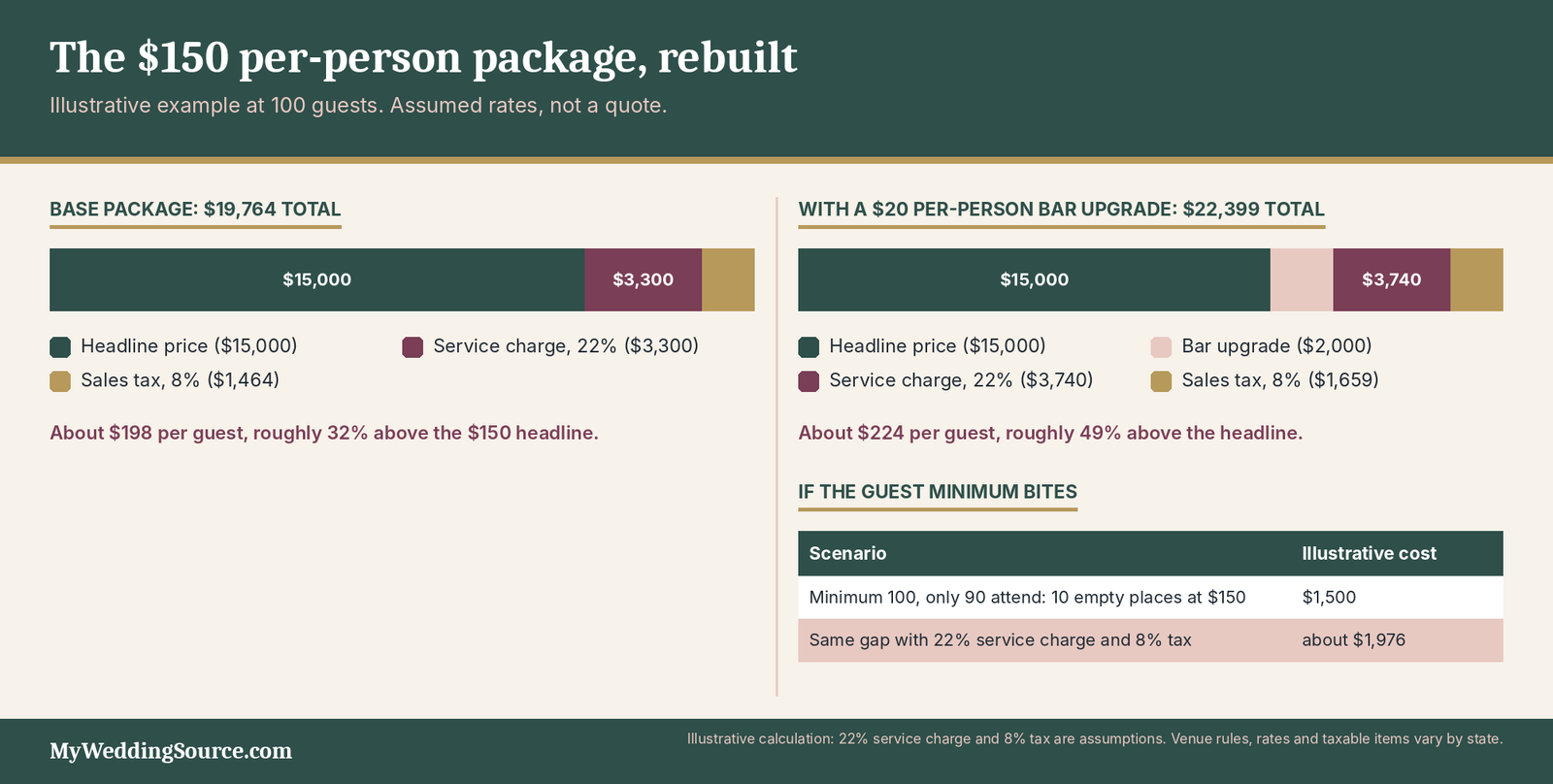
Most packages are tiered, and the tier that appeals to you is rarely the base one. The Knot notes that a basic alcohol package may only include house wine and beer, with upgrades adding top-shelf liquor or an open bar, and custom florals, cakes and open bars may cost more depending on the venue. Each upgrade is also multiplied by your guest count and then by the service charge and tax, which is why a $20 per-person bar upgrade does not cost $20. Price the bar tiers separately before you compare packages, so a cheap base rate does not hide an expensive upgrade.
The table below shows how those layers compound. It is an illustrative example built on assumed numbers, not a quote, and your venue’s service charge, tax rate and taxable items will differ.
| Layer | Base package only | With $20 per person bar upgrade |
|---|---|---|
| Headline price: $150 x 100 guests | $15,000 | $15,000 |
| Bar upgrade: $20 x 100 guests | $0 | $2,000 |
| Subtotal | $15,000 | $17,000 |
| Service charge at 22% (assumed) | $3,300 | $3,740 |
| Sales tax at 8% on subtotal plus charge (assumed) | $1,464 | $1,659 |
| Estimated total | $19,764 | $22,399 |
| Effective cost per guest | about $198 | about $224 |
That table shows the headline price growing by about 32 percent in the base case and about 49 percent with the upgrade. The $2,000 upgrade itself carried about $635 in fees and tax, or roughly 32 percent more than its face value. None of this means the package is a poor value, since the same math applies to any caterer’s quote, but it explains why comparing sticker prices between venues is unreliable.
Service charge, gratuity and tax: the fine print that moves your total
Three words show up on nearly every all inclusive proposal and are used interchangeably by almost everyone: service charge, gratuity and tax. They are not the same thing, they are not treated the same way by tax authorities, and they do not necessarily end up in the pockets of the people you assume. Understanding the difference takes about ten minutes and can prevent both a surprise on the final invoice and an awkward moment on the wedding day about whether to tip.
Service charge or gratuity: does the label matter?
How federal tax rules treat a mandatory charge
The IRS has a clear way of thinking about this. In Revenue Ruling 2012-18, the agency explains that a payment is generally a service charge rather than a tip when the customer does not freely choose the amount, and that the employer’s label does not control the result. Its example is an 18 percent charge automatically added to the bill for parties of six or more, which counts as a service charge, and any portion passed on to employees is treated as wages for payroll tax purposes. The practical meaning for you is that a mandatory percentage on your contract is the business’s revenue first, and whether and how it reaches the servers and bartenders is a decision the business makes. That is not a problem, but it is a reason to ask.
Whether you still need to tip
Because the answer depends on the contract wording, there is no universal rule. Zola’s explainer notes that gratuity may or may not be built into the rate, and The Knot advises checking whether tipping is part of the total. The cleanest approach is to ask one question in writing: “Does the service charge or gratuity on our proposal cover all of the venue staff who work our event, and is any additional tip expected or customary?” If the answer is that staff receive a share of the charge, you can decide about extra cash gestures with full information. If the answer is that the charge goes to the business, you may want to budget a separate thank-you for the team members who go above and beyond, but that is your choice rather than an obligation.
Sales tax on service charges varies by state
Three states, three answers
State tax agencies do not agree on how to treat mandatory charges at catered events, which is why a national rule cannot be given. New York’s tax bulletin TB-ST-320, issued in February 2012, says a mandatory gratuity avoids tax only when it is stated separately, labeled as a gratuity and passed entirely to employees, and it gives the example of a caterer whose 15 percent labeled gratuity was not taxable while its 8 percent service charge was. California’s CDTFA Publication 22 states that required service charges are included in taxable gross receipts and that banquet gratuities agreed to in advance are considered required, not voluntary. The Texas Comptroller’s restaurant guidance, dated March 2014, says a mandatory gratuity of 20 percent or less is not taxed if it is separately and clearly labeled and distributed to the employees who provide the service, while a mandatory gratuity above 20 percent is taxable. Treat these as three illustrations of how much the rules differ, check the current version for your state, and note that they describe restaurant and catering rules rather than every type of venue fee.
Getting the tax answer in writing
You do not need to become a tax expert, and none of this is tax advice. You need the venue to tell you, line by line, which items are taxable and at what combined rate, so that your spreadsheet matches their final invoice. A short email works well: “Can you confirm the sales tax rate that applies to our event and which lines on the proposal are taxable: food, beverage, service charge, rental fee, add-ons?” If the reply is vague, assume everything is taxable for budgeting purposes and replace that assumption when you get a firm answer. Hold on to that email, because it is the document you will point to if the invoice later shows a different number.
What an all inclusive package usually leaves out
Even the most thorough package leaves gaps, and the gaps differ depending on how the venue earns its money. A hotel ballroom that sells food and beverage may include almost everything inside the room but not the photographer, while a farm or estate that sells “the property plus a package” may include tables and chairs but expect you to bring in lighting, power and restrooms. The most reliable way to avoid surprises is to separate what the venue sells from what it merely hosts.
Items that often sit outside the bundle
Vendors and services the venue does not sell
The Knot states plainly that add-ons and external vendors you hire will be an additional charge, and Zola adds that items not on the venue’s price sheet, such as a cake or a videographer, must be sourced elsewhere. In practice that usually means photography, videography, music if the venue does not offer a DJ, florals beyond a basic design, the officiant, hair and makeup, invitations and attire. These are separate budget lines whether you are at a barn or a ballroom. Keep a list of them next to the venue proposal so that when you compare packages, you are also comparing how much work each one leaves you to finish.
Infrastructure and rentals at blank-slate sites
When a property provides the setting but not the equipment, the missing pieces can add up quickly. MayFair Farms, a venue, publishes rough estimates that include lighting packages starting around $500 and exceeding $3,000, portable dance floors at $300 to $1,200, generator rental at $200 to $600 and tent rentals starting around $1,500, all of which should be read as one vendor’s ballpark rather than a market survey. A venue that truly bundles everything should not need these items, so the question is whether the package covers them. For outdoor sites, our outdoor wedding venues guide goes deeper on tents, power, restrooms and rain plans.
Fees that arrive after you sign
Overtime, cleanup, damage and vendor meals
These are the charges that appear in the contract’s third or fourth page rather than the proposal. The Knot tells couples to check the contract for damage or overtime fees, and MayFair Farms lists overtime at $250 to $1,000 per hour, setup and cleanup at $200 to $1,000, vendor meals at $25 to $50 per vendor, and corkage at $5 to $30 per bottle, again as one venue’s rough figures. The point is not the exact amounts but the categories, because each of them is a line you can ask about before you sign. A fair question is: “Which of these fees apply to our package, and what is the rate for each?”
Insurance, licensing and security requirements
Venues commonly require some form of event liability coverage, certificates of insurance from vendors, or a licensed bartender for alcohol service, and each of these has a cost and a deadline. Consumer Reports explains that wedding insurance has two parts, cancellation or postponement coverage and liability coverage, and that you can buy either or both. The difference matters: the first protects your payments if the event cannot happen, while the second pays if a guest is injured or property is damaged. Ask the venue which type it requires, who must be named on the policy and whether its own coverage applies to your event.
The table below sorts typical items into what is usually bundled and what varies. It is an editorial summary of the sources cited in this section, not a rule, and your venue’s own list governs.
| Item | Often in the bundle | Often extra or varies | Ask |
|---|---|---|---|
| Space and time | Reception space for set hours | Ceremony space, setup time, overtime | Do the hours include load-in and load-out? |
| Food and drink | Meal, basic bar | Bar tiers, late-night food, cake cutting | Which tier is priced, and what do upgrades cost? |
| Furniture and settings | Tables, chairs, basic place settings | Specialty chairs, lounge pieces, linens | Which linens and chair styles are listed? |
| Staff | Servers, bartenders, setup and cleanup | Coordinator beyond the venue’s own, security | Who is on site, and until what time? |
| Entertainment and media | Sometimes a DJ or sound | Band, photo, video, florals | Which vendors are required or optional? |
| Money items | Sometimes service charge | Tax, gratuity, damage deposit | Which are listed on the proposal? |
Hour limits, vendor rules and guest minimums
The restrictions inside an all inclusive contract often matter more than the price, because they shape how the day actually runs. Hour limits dictate your timeline, vendor rules dictate who you can hire, and guest minimums dictate what you pay if your list shrinks. They are also the terms couples are least likely to question during a tour, since they are not on the sales sheet.
The clock and the headcount
What the booked hours really cover
Start by asking exactly when the clock starts and stops. A reception that is advertised as five hours may count from ceremony start or from guest arrival, may include or exclude vendor load-in and teardown, and may end earlier on weekdays because of staffing or noise ordinances. If your photographer needs the room an hour early, or your florist needs access in the morning, ask whether that access is free, charged hourly or bundled. Zola points out that hotels, banquet halls and country clubs may host multiple weddings in one day, so ask whether your event has exclusive use of the building and grounds. Date also affects what you pay and what your guests spend, and our Labor Day wedding travel check shows how holiday weekends change the picture.
Minimums, maximums and what happens when guests drop out
The guest minimum is typically a financial commitment, not a prediction. The BeachBride guide notes that some packages lock in a per-person rate for a minimum headcount, so if five guests drop out late you may still pay for their seats. Using the illustrative $150 package from earlier, a 100-guest minimum with only 90 attendees would still cost the 10 empty places, or $1,500, and about $1,976 once an assumed 22 percent service charge and 8 percent tax are applied. Ask for the date the final count is due, whether the number can go down after that date, whether it can go up and by how much, and how the maximum capacity is set. Ask for those answers in the contract, not just on the phone.
Who is allowed to work in the building
Exclusive caterers, preferred lists and outside vendor fees
An all inclusive venue usually has one kitchen, and the contract often requires you to use it. Some venues are fully exclusive, some have a preferred list, and some charge an outside-vendor fee for anyone not on the list. Zola advises asking whether the venue’s chef can be swapped and notes that you could incur additional costs when working with an offsite vendor. If a family member, a cultural specialist or a favorite caterer matters to you, ask early, because the answer decides whether this model works at all. Our list of wedding caterer questions helps with the conversation.
Alcohol licensing, bar rules and bringing your own
Who holds the liquor license, and under what terms, determines everything about the bar. Licensing rules are set state by state, and they change: New York, for example, signed a law in December 2022 creating a new off-premises catering license for caterers without dining facilities, which shows how much the rules depend on local law. Ask whether you can bring your own alcohol, whether corkage applies, how last call is set and what insurance the bar service requires. Also ask what the bar package includes, because tiers range from house wine and beer to full liquor service.
All inclusive versus a la carte: how to compare them fairly
The honest answer to “is all inclusive cheaper?” is that it depends on your guest count, your date and how many of the bundled items you would have bought anyway. A bundle saves money when it replaces things you were going to rent, deliver and staff separately, and it wastes money when it includes things you do not want. To find out which side you are on, you need a comparison built from the same assumptions, not two sales sheets set next to each other.
Build an apples-to-apples comparison
Same guest count, same hours, same scope
Pick three guest counts for your spreadsheet: the number you hope for, the number you fear and the number in between. Then price each venue at all three, including service charge, tax, bar tier, rentals and the extra hours you would need. For an a la carte venue, list every item the all inclusive package would have covered: the site fee, the caterer’s per-person price, bar service, tables and chairs, linens, glassware, staffing, lighting, delivery, a coordinator and cleanup. Use our wedding venues hub if you are still gathering candidates, and keep one row per cost so that you can see which venue leaves which row empty.
Using national averages as a sanity check only
National figures help you notice when a quote is far outside the normal range, but they are not a substitute for local quotes. The Knot’s 2026 Real Weddings Study, based on 10,474 U.S. couples married in 2025, reports an average of $34,200, an average of 117 guests, an average reception venue cost of $12,900, catering at $80 per person and alcohol at $2,800. Zola’s 2026 data puts typical venue and site fees at $8,573, with a typical range of $6,900 to $10,300, and catering at $6,927 in total. These are averages across very different weddings in very different places, so they cannot be added into a quote. The Knot’s own all-inclusive examples show how wide the spread is, from $56 to $126 per person at a California venue for 2025 weddings to $190 to $290 per person at a New Jersey club.
Where each model tends to win
Where all inclusive tends to save money or effort
The Knot describes convenience as the main advantage, because the venue handles much of the vendor research, and it adds that bundling can lower the overall cost and spare you multiple deposits, delivery fees and out-of-town vendor expenses. Zola similarly mentions that on-site supplies may be cheaper than delivered rentals, that a venue may offer a complimentary coordinator and that on-site lodging can reduce transportation needs. Those savings are real when the package replaces several separate bookings, and they are largest when you would otherwise rent a blank space and assemble every piece. They are smaller when your guest count is low, when you would use few of the included items, or when the per-person price is higher than a caterer you already trust.
When a la carte or a hybrid is the better fit
An a la carte approach tends to win when you have a vendor you care about, a menu with cultural or religious requirements, a detailed design or a small guest count that falls below a package minimum. A hybrid can be the middle path: some venues will price the space with a limited package, or let you remove categories for a credit. Date flexibility changes the math too. The Knot’s examples include a Virginia venue priced at $7,500 on a Sunday or weekday versus $11,500 on a Saturday, which is a reminder that the day of the week can matter as much as the model. Ask every venue for both a package price and a venue-only price for the same date, so you can see what the bundle really costs.
| Factor | All inclusive venue | A la carte venue |
|---|---|---|
| Number of contracts | Often one main contract | Venue plus caterer, rentals, bar, staff |
| Price clarity | Easier if the itemized list is complete | Harder to total, easier to adjust |
| Customization | Depends on package tiers and swaps | Usually broad, within venue rules |
| Main risk | Paying for items you do not use | Missing items that surface later |
| Strongest fit | Couples who value fewer decisions | Couples with specific vendors or menus |
Contract red flags in all inclusive agreements
The contract is where the proposal’s friendly language becomes enforceable terms. Venues generally want a smooth wedding as much as you do, and most contracts are written in good faith, but they are also written by the venue for the venue’s protection. Our broader guide to wedding vendor contract red flags covers terms that apply to every vendor, and this section focuses on the clauses that matter most when one venue is providing nearly everything. This is general education, not legal advice, and terms and state laws vary.
Language to read twice
Vague inclusions and substitution rights
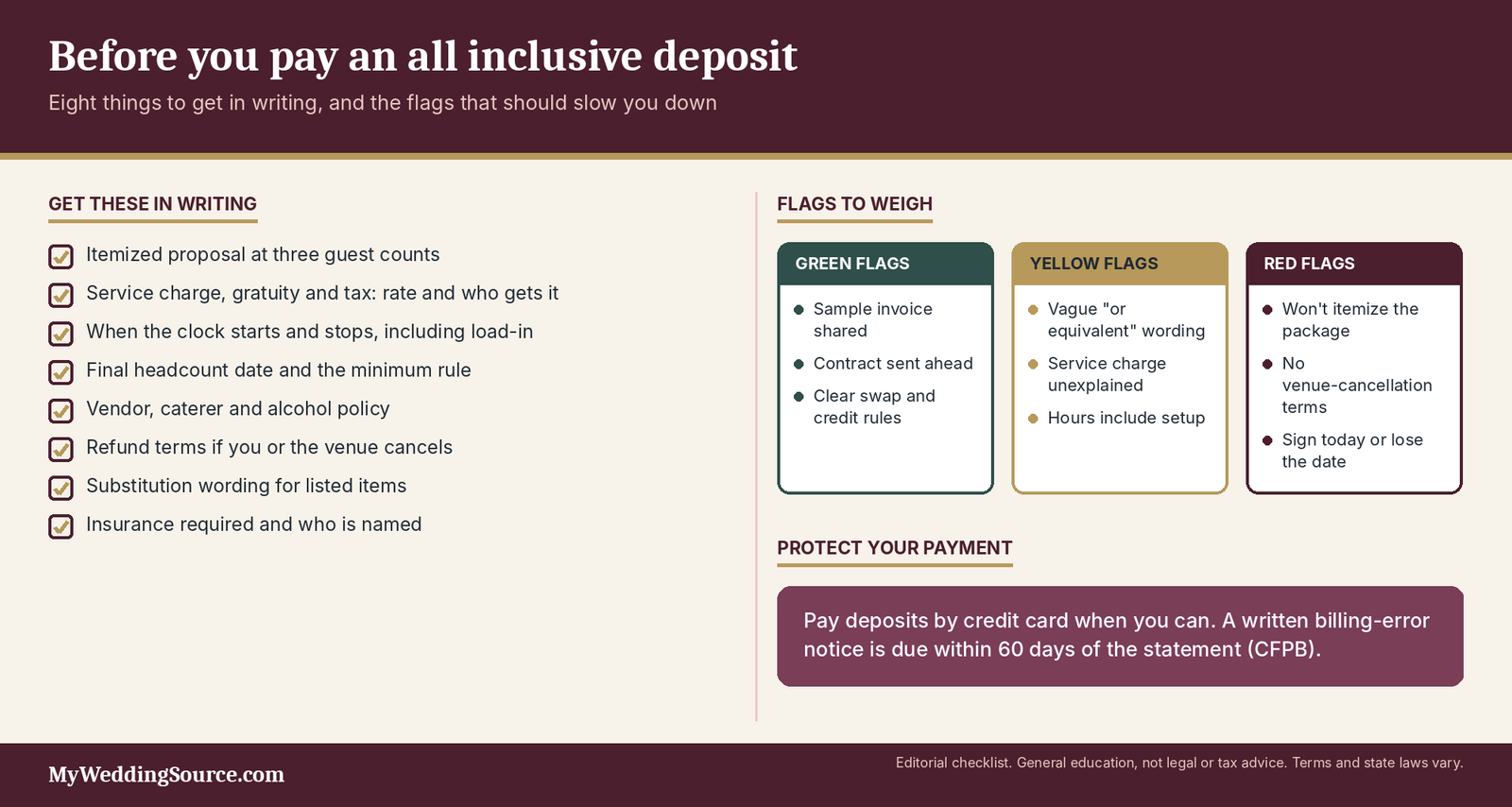
The most important phrase to hunt for is any wording that lets the venue change what you get. “Or equivalent,” “at the venue’s discretion” and “subject to availability” may be reasonable for a produce-driven menu, but they are worth clarifying for a cake, a bar tier or a linen color. Ask for each included item to be listed with quantity and style, and ask what happens if the venue cannot provide it: a substitution of equal value, a credit or a refund. If the package includes a coordinator, ask what the coordinator does before the wedding, what they do on the day and whether they stay through the end. A clear list now prevents the argument that begins with “that wasn’t what we meant by décor.”
Deposits, payment schedules and cancellation
Look for the total deposit, the due dates, which amounts are refundable and what happens if you reschedule or cancel. Some contracts use liquidated damages, which Cornell’s Legal Information Institute describes as a fixed sum or formula agreed in advance, and which courts may decline to enforce if the clause is punitive. Whether a specific clause is enforceable depends on your state and facts, so a contract question that involves a large amount is worth taking to a local attorney. Also look for the other side of the coin: what the venue owes you if it cancels, closes, sells the property or cannot host your date, and whether you get a full refund and how quickly.
Operational and sales red flags
Unclear roles, staffing and backup plans
An all inclusive venue promises to run the day, so the contract should say who is accountable for what. Ask how many staff members are assigned to your event, who is the on-site manager, what the venue’s coordinator does and does not do, and whether you still need a separate day-of coordinator for vendor management and personal items. For outdoor or partly outdoor spaces, ask where the full guest count goes in bad weather and who makes the call. Accessibility belongs in this conversation as well: the ADA Title III primer explains that businesses serving the public must remove barriers when readily achievable, and our accessible wedding venue red flags guide shows what to check on a walkthrough.
Pressure, secrecy and missing documents
Occasionally a venue pushes you to sign the day you tour, refuses to share a sample contract before you pay, will not itemize its package or cannot provide references from recent weddings. Any one of these can be innocent, because busy venues do get real competing inquiries and some contracts are updated each season, but together they are a reason to slow down. Many venues will send the contract ahead and allow a short hold on your date so you can read it, and it is fair to ask for that. If you are told the price will rise tomorrow, ask for that in writing, and compare it with the rates for your date posted publicly.
| Red flag | Why it matters | What to ask or do |
|---|---|---|
| “Or equivalent” with no definition | Substitutions can change what you receive | Ask for style, quantity and substitution rules |
| Non-refundable deposit with no reschedule option | Date changes can cost the full deposit | Ask what is refundable and when |
| Final headcount with no reduction rule | You may pay for empty seats | Ask the guarantee date and any flexibility |
| Service charge with no explanation | Tax and tipping assumptions may be wrong | Ask where it goes and whether it is taxed |
| Hours that include setup and teardown | Your party time may be shorter than advertised | Ask when the clock starts and stops |
| No answer on venue cancellation or closure | Your deposit may be at risk | Ask for refund terms in writing |
Questions to ask on the tour and checks to run before you sign
A good tour is half sightseeing and half interview. You are allowed to look at the room, imagine the first dance and still ask the coordinator to walk you through a real invoice. The questions below are the ones that turn an attractive package into one you can compare, and the checks that follow protect your money and your timeline once you decide.
Questions that expose the real package
Scope, price and timing questions
Bring a short list and ask for answers by email afterward, because tour conversations fade quickly. The most useful opening questions are about scope and price. What exactly is included, item by item? What is the per-person price at 80, 100 and 120 guests, with service charge and tax? What is the cost for each additional hour, and what time does load-in start? What changes if we move from Saturday to Friday or from peak season to off-season? If the venue has a published sample proposal, ask for it, since it will show the format of the real document.
Food, dietary and allergen questions
Because the kitchen is the venue’s, you are relying on its process for every guest. Ask whether you can do a tasting, how the menu handles vegetarian, halal, kosher, gluten-free and other dietary needs, and whether the kitchen can accommodate a specific cultural dish. For allergies, the FDA lists nine major food allergens: milk, eggs, fish, crustacean shellfish, tree nuts, peanuts, wheat, soybeans and sesame, and your question is how the venue identifies, labels and prevents cross-contact for guests who need to avoid them. This is general information, not medical advice. A guest with a serious allergy should speak with the venue directly, and the kitchen should be able to tell you its process without hesitation.
Checks before you sign
Sample invoices, references and recent events
One of the most revealing requests is a redacted final invoice from a recent wedding of a similar size and date. It shows how the venue actually bills, which lines appear and what the difference was between the proposal and the final number. Ask for two or three recent couples as references, and ask those couples what surprised them. Read recent reviews for patterns rather than one-off complaints, such as repeated comments about hidden fees or rushed timelines. If the venue declines every one of these requests, that is information too.
Protecting your payments and your plan
Where possible, pay deposits by credit card rather than check or transfer, because a card gives you a formal dispute process. The CFPB explains that to dispute a credit card billing error you should call the card company right away and send a written notice within 60 days of the statement date, and it notes that defective goods or services may need a different process. Consider whether cancellation coverage makes sense for your situation, noting that Consumer Reports reports that some experts are skeptical of its value because of exclusions. Keep your own folder with the signed contract, the itemized proposal, the emails and the payment receipts, so you can find any of them in under a minute.
| Topic | Ask | A strong answer looks like |
|---|---|---|
| Inclusions | What is listed, item by item? | A written list with quantities and tiers |
| Total cost | What is the total at three guest counts? | A single sheet with fees and tax |
| Time | When does the clock start and end? | Hours stated for setup, event and teardown |
| Vendors | Who can we bring? | Clear exclusive, preferred or open policy |
| Minimums | What if our count falls? | Dates and amounts spelled out |
| Cancellation | What is refundable? | Terms for both sides, in writing |
| Access | What is the step-free route? | A described route and restrooms |
FAQ: all inclusive wedding venues
These are the questions couples ask most often once they have a package in hand. The answers are general education, not legal, tax or financial advice, and they depend on your venue’s actual contract.
Pricing and what is included
Are all inclusive wedding venues cheaper?
Sometimes, but not automatically. A bundle can reduce the number of deposits, delivery fees and vendor coordination, and The Knot and Zola both describe potential savings. It can also cost more when you pay for items you would have skipped, or when your guest count is small relative to the minimum. The reliable test is a total-cost sheet at your real guest count compared with an a la carte version for the same date.
Is gratuity included in the package price?
It depends on the venue, and the contract is the only place to confirm it. Zola notes that gratuity may or may not be built into the rate. Ask whether the service charge or gratuity is already in the per-person price, what percentage it is, whether it is taxed and whether any additional tip is expected. Get the answer in an email so your budget and the final invoice match.
Can I bring my own caterer, bar or cake?
At many all inclusive venues the answer is limited, because the kitchen and bar are part of what you are buying. Some venues are exclusive, some offer a preferred list and some allow outside vendors for a fee. Ask about cake-cutting fees, corkage and outside-vendor insurance before you assume a vendor can come. If a particular caterer or family recipe matters to you, ask this question first, before the tour gets emotional.
Contracts and planning
Do I still need a wedding planner or day-of coordinator?
Often yes, even when the venue provides a coordinator. A venue coordinator generally manages the venue’s own staff, space and timeline, while a planner or day-of coordinator works for you and handles your vendors, family logistics and personal items. If the venue offers a coordinator, ask for a written description of what that person does before the wedding and on the day. Decide how much of that support you want before you tour, so the venue’s offer does not set your expectations.
What if my guest count drops after I sign?
Check the contract’s guarantee clause, because many venues set a final headcount date and charge for at least that number. Some allow small reductions, and some apply the original minimum. If your list is uncertain, negotiate before you sign: a lower minimum, a later guarantee date or a tiered price for smaller groups. The earlier you tell the venue about a change, the more options you tend to have.
Your next steps
Choosing among all inclusive wedding venues gets easier when you reduce each one to the same sheet of numbers and the same list of answers. The actions below are sequenced so that the paperwork happens before the emotional commitment of a deposit.
This week
Build your total-cost sheet
Open a spreadsheet with one column per venue and one row per cost: package or venue fee, per-person price, bar tier, service charge, gratuity, sales tax, rentals, extra hours and any vendors the venue does not include. Fill it in at three guest counts using the formula from the illustrative table, which is the per-person price times guests, plus upgrades, plus the service charge percentage, plus tax on the combined total. Mark every cell you had to assume in a different color so you can see what still needs confirmation. By the end of the week you should know the difference between the headline price and your real total at each venue.
Request itemized proposals in writing
Email each shortlisted venue the same request: an itemized proposal for your date, at your three guest counts, showing the service charge, gratuity and tax, plus a sample contract. Include the questions from the tour section about hours, exclusivity, vendor policy, alcohol and cancellation. Add a line asking whether the venue offers a venue-only price for comparison. Sending identical requests makes the replies directly comparable, and the way a venue responds is itself a preview of how it will communicate after you book.
Before you pay a deposit
Run the contract check
Read the contract against the table of red flags: substitution language, refund terms for both sides, final headcount rules, hour limits, vendor and alcohol rules, insurance requirements and the payment schedule. Mark anything you do not understand and ask the venue to clarify in writing rather than relying on a verbal explanation. For a large contract or a clause you are unsure about, a local attorney can review it, and the vendor contract red flags guide linked earlier lists terms to raise. Do not sign on the day of the tour unless you have already done this work.
Set payment and calendar reminders
Decide how you will pay, and keep receipts, the signed contract and the final itemized proposal in one folder. Put the due dates for each payment, the final headcount and the final menu selections on your calendar with reminders two weeks earlier. Add a reminder for roughly 30 days before the wedding to reconfirm timeline, counts and vendor access, and use our 30-day November checklist as a model for what to confirm. Then choose your catering approach with our wedding food and catering hub open beside the contract.
Sources & methodology
- The Knot: The Average Cost of a Wedding — 2026 Real Weddings Study figures for couples married in 2025 (average total, guest count, reception venue, catering per person, alcohol).
- Zola: How Much Does a Wedding Cost — 2026 venue and site fee and catering ranges.
- The Knot: All-Inclusive Wedding Venues — typical inclusions, common add-ons, example venue prices and tiered alcohol packages.
- Zola: All-Inclusive Wedding Venues, Pros and Cons — pricing structures, outside-vendor costs and multiple-wedding warning (updated February 2024).
- MayFair Farms venue blog — rough fee and rental ranges; a venue’s own marketing blog, used only as ballpark estimates.
- BeachBride: All-Inclusive Resort Wedding Packages — resort package inclusions, extras and minimums; industry blog estimates.
- IRS Revenue Ruling 2012-18 — service charge versus tip for federal payroll tax purposes.
- California CDTFA Publication 22 — treatment of mandatory service charges and banquet gratuities.
- New York State Tax Bulletin TB-ST-320 — conditions for exempt mandatory gratuities and taxable service charges.
- Texas Comptroller: Restaurants and the Texas Sales Tax (94-117) — mandatory gratuity treatment, March 2014 edition.
- Consumer Reports: Should You Buy Wedding Insurance? — cancellation versus liability coverage and expert skepticism.
- CFPB: How do I dispute a credit card charge? — 60-day written billing-error notice.
- Cornell Legal Information Institute: Liquidated Damages — what the clause is and when courts decline to enforce it.
- ADA.gov: Title III Primer — public accommodations and readily achievable barrier removal.
- FDA: Food Allergies — the nine major food allergens.
- New York Governor’s Office, December 16, 2022 — example of state-specific catering alcohol licensing.
The national averages and the Knot and Zola venue examples are survey findings or published venue listings, and the tax and agency material is verified from the primary sources named above. Fee ranges from MayFair Farms and BeachBride are industry-blog estimates, and the $150 per-person calculation, the 22 percent service charge and the 8 percent tax rate are illustrative assumptions, not quotes. Advice on what to ask, how to compare and which flags matter is editorial judgment, and nothing here is legal, tax or financial advice.
Recheck The Knot and Zola figures when their next annual studies publish, confirm the Texas, New York and California tax guidance against each agency’s current page, and review venue-fee ranges each October. Always rely on your own venue’s written proposal and your state’s current rules.