

Use these 25 wedding planner questions to compare planners on the six things that decide how a planner will actually work for you: fit, scope, backups, vendor money, contract terms, and day-of authority.
A planner’s proposal usually lands a few days after a friendly consultation, and it usually comes with a retainer invoice and a signature line. That is the moment you are really deciding: not whether this person is nice (they almost always are), but whether the package, the people, and the paperwork match what you need. The stakes are real in dollar terms, too. The Knot’s 2026 Real Weddings Study, which surveyed 10,474 U.S. couples who married in 2025, puts the average total wedding cost at $34,200 and the average spend on a planner or coordinator at about $2,100, which works out to roughly 6 percent of the total by our arithmetic. Zola’s published planner average is higher, near $4,047, and the gap between those two numbers is itself a reason to ask careful questions before you compare quotes.
This guide is built for the consultation call and for the quiet hour afterward when you read the contract. It explains what a full-service planner, partial planner, month-of coordinator, day-of coordinator, and venue coordinator each really do, then gives you exactly 25 numbered questions in six groups, each with why it matters, what a strong answer sounds like, and what to get in writing. Along the way you will find a plain-language explanation of fee structures and vendor commissions (a normal part of how some planners are paid, and something you are entitled to understand), a responsibility matrix, a green-yellow-red answer key, a scorecard for comparing planners, and a short section on tipping. Everything about contracts, deposits, cancellation, and liability here is general education, not legal advice, and terms and state laws vary, so treat your own written contract as the final word.
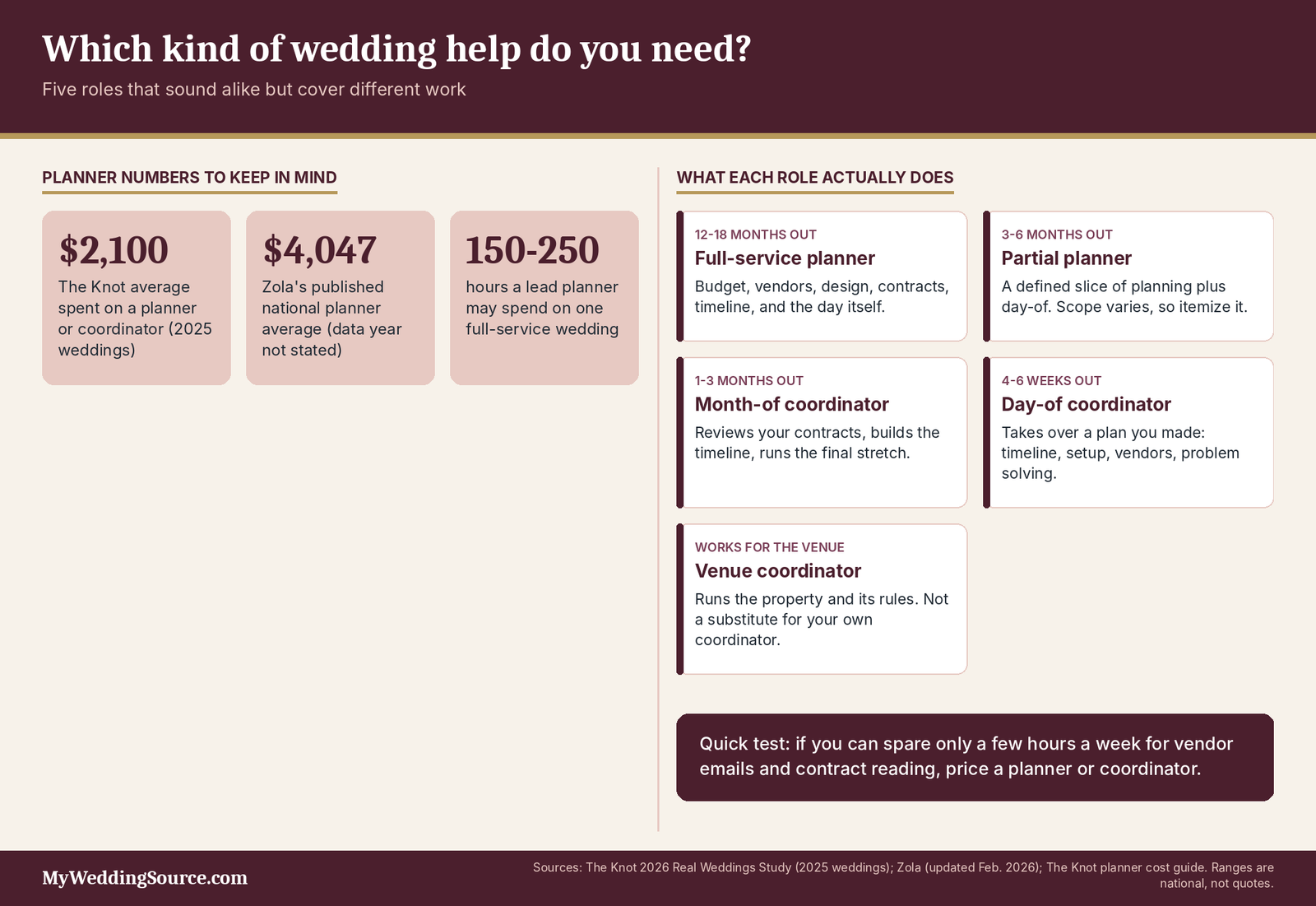
Which kind of wedding help do you need: planner, coordinator, or venue staff?
What does each type of wedding help actually do?
Full-service planner
A full-service planner works with you from early in the engagement through the wedding day: setting the budget, sourcing the venue and vendors, managing contracts and payments, designing the look, building timelines, and running the event. The Knot notes that a lead planner on a full-service wedding may spend 150 to 250 hours on it, not counting assistants, which is why the fee is the highest of any option. Zola’s coordinator guide suggests this tier for couples with large guest counts, blank-canvas venues, destination logistics, highly designed events, or very little time to spare. The tradeoff is cost and dependence: you hand over many decisions, so fit and communication matter more here than anywhere else.
Partial planner
Partial planning is the middle path, where the planner handles a defined slice of the work and you handle the rest. Zola describes partial planners as joining roughly three to six months before the wedding to help with remaining vendor selection, design, coordination, timelines, and day-of management, and prices them at about 40 to 60 percent of full-service. The Knot says partial planners spend about half the hours of a full-service planner. Because “partial” can mean three vendor referrals and a timeline or nearly everything except the venue search, the written scope matters most here. Ask for the exact deliverables and the number of meetings before you compare it with anyone else’s package.
Month-of and day-of coordinators
Month-of and day-of coordinators do not plan your wedding; they take over a plan you have already made. They review contracts, confirm details with vendors, build the day-of timeline, run the rehearsal, and manage setup and flow on the wedding day, and day-of coordinators often begin about four to six weeks before the date. The Knot’s 2026 data lists average costs of about $1,600 for a day-of coordinator and $2,400 for a month-of coordinator, while Zola gives $1,200 to $2,500 for day-of services and Joy cites $800 to $3,000. Names are not standardized, so one company’s “day-of” package may include two site visits and an assistant while another covers only the event hours. Ask what happens in the weeks before the wedding, because that is where a coordinator’s value usually shows up.
Venue coordinators and why they are a different job
A venue coordinator works for the venue, and the job is to keep the property running smoothly: access, the venue’s rentals, its staff, and its rules. They do not usually manage your photographer, florist, band, or family logistics, and they cannot advocate for you in a conflict with the venue itself. Zola says plainly that a venue coordinator is not a substitute for your own planner or coordinator. Many venue coordinators are excellent and may be all a small, simple wedding needs. Just confirm who is responsible for the rehearsal, the vendor timeline, and décor setup before you assume someone is covering them.
| Type of help | Typically starts | What it covers | Ballpark price |
|---|---|---|---|
| Full-service planner | 12-18 months out | Budget, vendors, design, contracts, timeline, day-of | $3,800-$10,000+ |
| Partial planner | 3-6 months out | Defined slice of planning plus day-of | $1,250-$6,000 |
| Month-of coordinator | About 1-3 months out | Contract review, timeline, vendor confirmation, day-of | About $2,400 (Knot) |
| Day-of coordinator | About 4-6 weeks out | Timeline, setup oversight, day-of management | $800-$3,000 |
| Venue coordinator | Venue’s schedule | Venue operations and rules only | Included in venue fee |
Do you need a wedding planner at all?
Signs a planner will earn their fee
A planner tends to pay for themselves in time and avoided mistakes when your wedding has more moving parts than your calendar can carry. Common triggers include a guest list above about 150, a destination or multi-day event, a blank-canvas venue where every rental must be sourced, a tight timeline, a highly designed look, or family dynamics that benefit from a neutral go-between. If you can only spare a few hours a week for vendor emails, contract reading, and payment tracking, a planner converts that missing time into someone else’s expertise. The consequence of going without help you needed is usually not a disaster but a pile of small decisions made late, at higher prices, by the people with the least time.
Signs a coordinator or venue team may be enough
Plenty of weddings run well without a full planner. Zola suggests you may be able to skip one if you are organized, have fewer than about 100 guests, work with a venue coordinator, have strong support, and keep a flexible timeline. Even then, most advice recommends at least a day-of coordinator, because someone has to manage the timeline so that you and your family are not directing the florist while the photographer waits. A sensible middle option is to plan on your own and hire a month-of coordinator for the final stretch. If the cost feels steep, ask a small-wedding specialist or a newer planner about reduced packages.
A simple four-factor decision framework
Score your wedding from 1 (low) to 3 (high) on four factors: complexity (guest count, number of vendors, venue type, travel), time pressure, how much you want someone else to make calls, and how stressful a slip on the day would be. A total of 4 to 6 suggests you can plan on your own with a venue coordinator or a day-of coordinator, 7 to 9 suggests partial planning or a month-of coordinator who joins early, and 10 to 12 points toward full-service planning. This framework is editorial judgment, not a standard, so use it to start a conversation rather than reach a verdict. Our wedding planning guide shows how much work sits in each phase, which helps you decide where to bring in help.
What does a wedding planner cost, and how do fee structures work?
What do planners cost nationally in 2025 and 2026?
Why published averages disagree
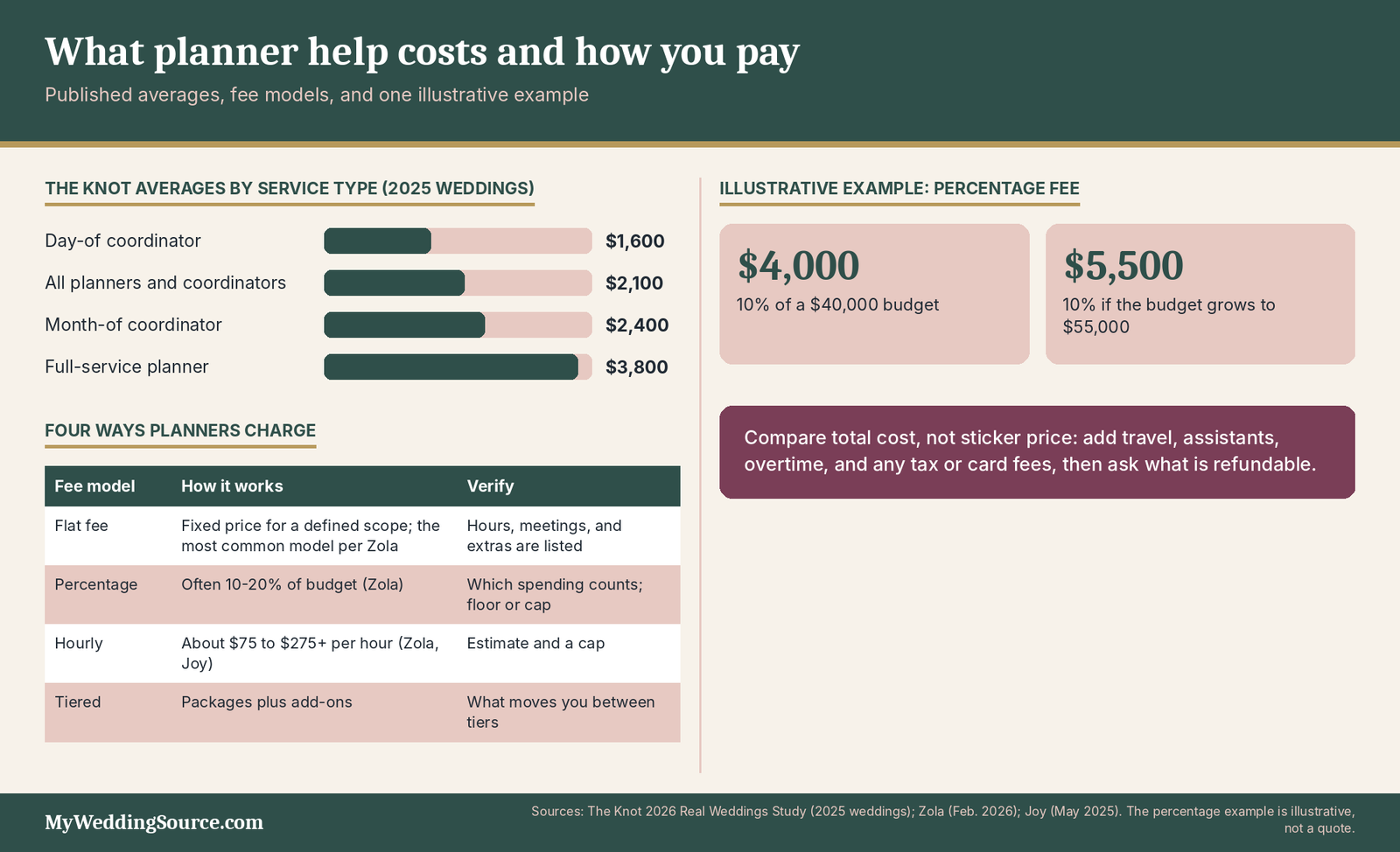
Every source defines “planner” differently and surveys different people. The Knot’s 2026 study measures what couples who married in 2025 actually paid and reports an average of about $2,100, a median of $1,400, and quartiles near $700 and $3,300. That average blends day-of coordinators with full-service planners, so it sits low. Zola’s cost index reports a higher national average of about $4,047, with most couples spending $3,200 to $4,900, and the page does not state the data year. Neither number is a quote for your city, so use them to sense-check proposals, not to negotiate against.
Price ranges by service level
The patterns are consistent across The Knot, Zola, and Joy even when the exact dollars are not. Day-of coordination clusters between about $800 and $3,000, partial planning between roughly $1,250 and $6,000, and full-service planning from about $3,800 into five figures. High-cost markets pull the numbers up: Zola lists a Manhattan average near $5,922 against about $3,654 in St. Louis, and Joy notes that New York City full-service planners can exceed $15,000. Season and size matter as well, since Zola says May through October and Saturday dates cost more, and The Knot’s averages rise from about $1,700 for 1 to 50 guests to $2,300 for 101 or more. Treat the table below as an orientation map, not a price list.
| Service level | The Knot (2025 weddings) | Zola (updated Feb. 2026) | Joy (May 2025) |
|---|---|---|---|
| Day-of coordinator | About $1,600 | $1,200-$2,500 (body text $800-$3,000) | $800-$3,000 |
| Month-of coordinator | About $2,400 | Not separately listed | Not separately listed |
| Partial planner | Not listed | $2,500-$6,000 (body text $1,500-$6,000) | About $1,250-$6,000 |
| Full-service planner | About $3,800 | $4,000-$10,000+ | $3,800-$25,000+ |
| All planners, average | About $2,100 | About $4,047 | About $1,800 |
How do flat, percentage, hourly, and tiered fees work?
Flat fee
A flat fee is a single fixed price for a defined list of services, and Zola calls it the most common model. Its strength is predictability: if your guest count creeps up, the planner’s fee does not move. Its risk is vagueness, because a flat fee only protects you if the scope spells out the number of meetings, the planner hours on site, and what counts as an extra. A strong answer sounds like “This covers X, Y, and Z; here is what triggers a change order.”
Percentage of budget
Some planners, usually on larger events, charge a percentage of the budget, which Zola puts at roughly 10 to 20 percent. The logic is that bigger budgets require more management, but the fee rises when your spending rises, so ask which costs the percentage applies to. Here is an illustrative example, not a quote: at 10 percent of a $40,000 budget the fee is $4,000, but if the budget grows to $55,000 the same percentage is $5,500. Ask whether the fee has a floor, a cap, or a recalculation moment.
Hourly and consultation fees
Hourly billing suits limited help such as a budget review, a contract read-through, or a few hours of design advice. Zola cites roughly $75 to over $200 per hour, and Joy cites $100 to $275 for experienced planners, with the caveat that not all planners offer hourly work. It is also a low-risk way to test a planner’s judgment before a larger commitment. Ask for an estimate and a cap, because open-ended hours are hard to budget.
Tiered packages and add-ons
Many planners publish tiers and price add-ons separately. Tiers make comparison easier, but they can hide differences, such as whether the premium tier includes a second coordinator on the day or only more meetings. Ask for a one-page comparison of what each tier includes and which add-ons are common for weddings like yours, so you see the realistic total, not the entry price. If a package is built around a guest count or venue type, confirm what happens if either changes.
| Fee model | How it works | Main strength | Main watch-out |
|---|---|---|---|
| Flat fee | Fixed price for a defined scope | Predictable total | Scope must be itemized |
| Percentage | Share of budget, often 10-20% | Scales with complexity | Fee rises as spending rises |
| Hourly | Rate times hours used | Pay only for needed help | Open-ended hours |
| Tiered | Packages with add-ons | Easy to compare tiers | Add-ons can inflate total |
Will this planner fit your wedding and your style?
Questions 1 through 4 are about fit, and they are worth asking first because a planner who is wrong for your wedding will be wrong no matter how good the price is. Fit is partly experience and partly temperament: how the planner thinks, how they treat the people around you, and how they behave when plans change. These are the questions where listening matters more than note-taking, since the way a planner answers tells you as much as the words themselves. Keep the same list for every consultation so you can compare answers later in the scorecard.
Does the planner have the right experience for your wedding?
Question 1: How many weddings like mine have you planned?
“Like mine” should mean something specific: a similar guest count, a similar type of venue (hotel, barn, blank-canvas tent, restaurant, outdoor park), a similar season, and any cultural or religious traditions your ceremony includes. A planner who has run twenty ballroom weddings is not automatically ready for a backyard tent with generators, rentals, and a rain plan, and the reverse is also true. A strong answer includes concrete examples, such as the types of venues they have worked in, the largest and smallest weddings they have run, and how they handled the elements specific to yours, without sharing private client details. Newer planners can be a good fit if they have assisted on many events and offer a clear scope, so ask about assisting experience, not only years in business. Get a short written description of their relevant experience in the proposal, and ask to see a sample timeline from a comparable event with names removed.
Question 2: How would you describe your planning style, and how involved will I be?
Some planners act as designers who present a vision, others as project managers who present options and track tasks, and many blend the two. Neither is better; the question is whether the style matches how much you want to decide. A strong answer describes the process in plain terms, such as “I narrow vendors to two or three per category and you choose” or “I make most design calls once we agree on a direction,” and gives an example of adapting to a client who wanted more or less control. If you love planning, you may want a collaborator who shares the work, while if you are short on time you may want a planner who makes confident recommendations. Ask the planner to describe which decisions they expect you to make and which they will handle, and get that division in the scope section of the contract.
Will you work well with your family and each other?
Question 3: How do you work with parents, partners, and other people who have opinions?
Weddings often involve more than two decision-makers, whether that is parents who contribute money, a partner’s family with strong traditions, or friends who volunteer to help. A planner’s approach to this is practical, not just personal, because it determines who can approve changes, who receives invoices, and who gets the final timeline. A strong answer starts from the couple as the primary clients, asks who is contributing financially without assuming parents are, and describes a communication plan such as a single point of contact or a shared document. It should also include a respectful way to handle disagreements, such as presenting the options and the cost and letting you decide. Get in writing who the contractual client is, who may authorize changes, and who receives payment requests.
Question 4: Tell me about a wedding that went off-script and what you did.
This question reveals judgment under pressure, which is much of what you are paying for on the wedding day. A strong answer is specific and calm: a late vendor, a weather change, a missing delivery, or a family conflict, followed by what the planner did in the first ten minutes and what they changed afterward. Listen for ownership and respect for clients; a planner who blames vendors or clients for every problem is telling you how they will talk about your wedding later. Ask what is in their day-of kit and whether they work from a written contingency plan, including a rain or heat plan if your wedding has outdoor elements. Ask for a sample contingency checklist or day-of timeline with buffers built in, and keep it with your planning notes.
What exactly will the planner do, and what is left for you?
Scope is where most misunderstandings begin, and it is the part of a planner contract that is easiest to fix before you sign and hardest to fix afterward. Planners use the same package names to describe different amounts of work, so you want to compare line items, not labels. The four questions in this group turn an abstract package into a list of deliverables, hours, exclusions, and wedding-day coverage. If a planner is reluctant to itemize, that is useful information about how the rest of the relationship may go.
What is included in the package?
Question 5: What exactly is included in my package?
Ask the planner to name every deliverable, such as venue search support, vendor referrals, contract review, budget tracking, design boards, timelines, vendor communication, the ceremony rehearsal, and wedding-day management. “Partial planning” and “month-of” can each mean very different things, so a deliverable list is the only reliable way to compare proposals apples-to-apples. A strong answer comes with a written package description and ideally a sample client schedule that shows what happens at 12 months, 6 months, 3 months, and the final month. Ask which tasks the planner does themselves and which ones they guide you through, because “we will help you with vendor selection” and “we will select and book vendors for you” are not the same promise. Get the list of inclusions as an exhibit attached to the contract, not only in the sales deck or email.
Question 6: How many meetings, hours, and site visits does the fee include?
Planning time is the main thing you are paying for, so it should be visible. The Knot notes that a lead planner on a full-service wedding may spend 150 to 250 hours on a single event, and partial planning is about half that, so a very low fee for a full-service scope deserves a question about what is actually being delivered. A strong answer gives numbers, such as the number of planning meetings, the number of vendor or venue site visits, the number of hours on the wedding day, and the typical email response time. It should also explain what happens when you need more than the package covers, for example an additional venue tour or an extra meeting with your caterer. Ask for the overage rate, and get the included meetings, site visits, and hours written into the contract.
What is not included?
Question 7: What costs extra, and what is outside your scope?
Most planners have a list of things that are not in the base fee, and a strong planner shares it before you ask. Common extras include rehearsal dinners and welcome parties, travel and lodging for destination weddings, extra site visits, décor setup and teardown, overtime on the wedding day, additional assistants, and procurement of rentals or décor. The concern is not that extras exist but that they appear as surprises after the fee has been paid. A good answer includes example prices or a rate sheet and describes how a change order works, meaning the written approval of any additional charge before work begins. Ask for the add-on rate sheet, and get a clause stating that no additional charges apply without your written approval.
Question 8: What exactly will you do on my wedding day, from what time to what time?
Coverage hours and tasks vary widely, and the details matter because weddings do not end when the cake is cut. Ask when the planner arrives, when they leave, and whether that includes vendor load-in, the ceremony, the reception, the room flip, and the pack-out at the end. A strong answer includes a task list, for example confirming vendor arrivals, cueing the processional, managing the timeline, handling vendor meals, supervising setup and breakdown, and making sure rental items, cards, and gifts end up with the right person. Ask what happens if the event runs late, and who decides to extend the coverage. Get the start time, end time, task list, and overtime rate written down, and compare them with the timeline in our wedding timeline guide so nothing falls into a gap.
Who will show up, and what happens if they cannot?
A planner contract is a promise of service by a specific business, and the service is delivered by specific people on specific dates. Small teams can be wonderful, but they also concentrate risk: one illness, one double-booked weekend, or one departing assistant can change what you receive. The questions in this group are not meant to make anyone defensive; competent planners have answered them many times. They simply turn “we have this covered” into names, numbers, and a written plan.
Who is on the team, and how many weddings do they take on?
Question 9: Who exactly will be my lead planner, and who else will be at the wedding?
Many planning companies have a lead planner who sells and designs your wedding and a team of associates or assistants who carry out the day. That structure works well when it is explained, and The Knot notes that a planner with staff on the day can offer more comprehensive coverage than a solo coordinator. The issue is when you assume the person you met will be there, and someone you have never met arrives. A strong answer names the lead, names or describes the associates, gives the total headcount for your wedding, and offers to introduce you before the day. Get the lead named in the contract, the minimum staff count for your wedding day, and a clause requiring notice before any substitution.
Question 10: How many weddings do you take on the same weekend and the same month?
Capacity is a fair question, especially for peak dates in the fall and spring when planners are busiest. Planners differ in how they manage this: some will only lead one wedding per day, some run multiple events with associates, and some take on a higher volume in peak months. A strong answer is transparent about the limit and explains how the planner prevents overlap, such as capping events per weekend or assigning a dedicated lead for each wedding. It is not a red flag for a planner to be busy; it is a flag when they cannot explain how your date will be protected. Ask whether the lead planner will personally be at your wedding for the full coverage window, and get that in the contract.
What if something goes wrong with the planner?
Question 11: What is your backup plan if you are sick or unavailable?
Everyone gets sick, and emergencies happen, so every planner needs a plan. A strong answer describes a named backup or a partnership with trusted colleagues, explains how that person will get access to your plan, and ideally offers you the chance to meet them before the wedding. The backup should be comparable in experience, not simply whoever is available, and the plan should cover both the wedding day and the final weeks. Ask what happens if no one can cover, including whether the fee is refunded or credited. Get the backup plan, the shared-document arrangement, and the planner’s cancellation or no-show remedies written into the contract.
Question 12: Can I speak with recent clients, and what credentials do you hold?
References from the last year or two are more useful than a gallery of highlights, because they show current practice and let you ask how the planner handled problems. A strong planner will provide two or three references without hesitation and may also point to vendors who regularly work with them. As for credentials, the U.S. Bureau of Labor Statistics notes that certifications for meeting, convention, and event planners are voluntary, so a certificate is a signal of training rather than a guarantee of quality. Ask about training, business registration, and how long the business has operated, and read reviews with an eye on how the planner responded to critical ones. Get the planner’s legal business name on the contract, since that is the entity you are paying and relying on.
How does the planner work with vendors and handle money?
Vendor relationships are one of the main things a planner brings to the table: they know who answers email, who loads in on time, and who has worked in your venue before. Those relationships also create questions about money that deserve a straightforward, neutral answer. In many service industries, referral fees, trade discounts, and resale markups are ordinary business practices, and they are not a sign that a planner is doing something wrong. What matters is that you know how your planner is paid, so you can judge whether a recommendation is shaped by fit, by price, or by something you were never told.
How do preferred vendors, commissions, and markups work?
Planner compensation can take four basic forms, and many planners use a blend. First, the planner may earn only the fee you pay and nothing from vendors. Second, a vendor may pay the planner a referral fee or commission when you book. Third, the planner may receive a trade discount on items such as rentals or florals and either pass it to you or keep part of it. Fourth, the planner may buy items on your behalf and resell them at a markup. None of these models is automatically good or bad, but each one changes what you should ask for in writing.
Question 13: Do you have preferred vendors, and am I required to use them?
A preferred list is usually a time-saver: these vendors have a track record with the planner, understand how the planner runs a timeline, and may have worked in your venue. It becomes a constraint if the planner requires you to use their list, charges a large surcharge for outside vendors, or declines to coordinate people you already love. A strong answer says you are welcome to choose your own vendors, explains how the planner vets them, and describes any fee for coordinating vendors who are new to them. Ask also whether any vendors on the list are owned by or affiliated with the planner. Get in writing whether outside vendors are permitted, whether any extra coordination fee applies, and whether your venue has its own required vendor list that overrides both.
Question 14: Do you receive commissions, referral fees, or markups from vendors, and how do you disclose them?
Ask the question plainly and without suspicion, because the point is transparency, not accusation. A strong answer is direct: “I charge only my fee, and any trade discount goes to you,” or “I receive a referral fee from some vendors on my list; here is which ones, and it does not change your price.” Either can be fully legitimate, and both are easier to evaluate than an answer that avoids the topic. The FTC’s endorsement guidance, written for advertising rather than planning, expresses the principle many professionals borrow: a connection that a significant minority of consumers would not expect should be disclosed clearly. That guidance is not a rule for planner referrals, but it is a useful yardstick for what good disclosure looks like. Get in writing a short compensation clause listing any referral arrangements, and ask for itemized invoices showing cost and any markup on items the planner purchases for you.
How will your budget and vendor payments be handled?
Question 15: How do you track the budget, and how often will you report on it?
Budget tracking is a daily-life service that is easy to promise and harder to deliver. A strong answer describes a shared spreadsheet or planning tool that records contracted prices, deposits paid, balances due, due dates, taxes, service charges, and tips, and a regular review such as monthly check-ins. It should include a way to flag when a decision pushes you over a category target, since a modest upgrade in three categories can quietly add thousands to the total. Ask whether you will have direct access to the live budget or only periodic summaries. Get in writing that you will receive copies of every vendor contract and payment schedule, and that the planner will alert you before committing you to any cost above an agreed amount.
Question 16: Who signs vendor contracts, and who pays the vendors?
In most arrangements, you sign vendor contracts directly and pay vendors yourselves, with the planner reviewing terms and tracking deadlines. Some planners offer to handle payments or contracts for you, which can be convenient but should come with clear safeguards, because your money would pass through their account. A strong answer says the client signs, that the planner reviews contract terms and flags concerns, and that any payment the planner handles is documented with receipts and kept separate from business funds. Remember that a planner is not a lawyer, so for anything legally complicated you may want an attorney to review it, and our guide to wedding vendor contracts covers the clauses to read for yourself. Get in writing that the planner may not sign anything on your behalf without your written approval.
What will it cost, how do you pay, and what does the contract say?
This is the group of questions that carries the most financial risk, so take your time and read the contract with a calm head. Everything here is general education, not legal advice: contract terms, cancellation rights, and consumer protections differ by state and by the language of your specific agreement. When something in your contract is unclear or high-stakes, a local attorney or your state attorney general’s consumer office can tell you what applies where you live. The goal of this section is to help you arrive at that review knowing what to look for.
What will you pay in total?
Question 17: What is your total fee, what does it cover, and how is it calculated?
Ask for a single number and then ask what it includes, because a headline price that excludes basic costs is not the real price. A strong answer states the total in dollars (or the formula, if the fee is a percentage), names the scope it covers, and identifies any conditions, such as a guest-count limit or a date range. If the fee is a percentage of your budget, ask which spending is included and whether the fee is recalculated as your budget changes, using the examples from the fee section above. Planners who use tiers should show what moves a wedding from one tier to the next. Get the total fee, the calculation method, and any conditions in the contract itself, not in the proposal alone.
Question 18: What additional costs should I expect beyond the fee?
Even with a clear fee, there may be real costs on the edges, such as travel, mileage, parking, overnight lodging for destination events, additional assistants, supplies, and overtime. A strong answer lists the likely extras for weddings like yours and gives ranges or rates, instead of saying “it depends” and moving on. Ask about card-processing fees if you pay by card, and whether sales tax applies to the planner’s services in your state, since that varies. If the planner purchases anything on your behalf, ask how it is billed and whether a handling fee applies. Get a written estimate of expected extras, with any reimbursable expenses described as “at cost with receipts” if that is what is intended.
What do the payment and contract terms say?
Question 19: What is the payment schedule, and which payments are refundable?
Most planners collect a retainer at signing and then installments, with the final balance due before the wedding. A retainer being nonrefundable is common and not unreasonable on its face, because the planner is reserving a date and starting work, but you should know exactly which payments are refundable and under what conditions. A strong answer shows a clear schedule with amounts and dates, explains what each payment covers, and explains what happens if you pause or cancel. Pay with a credit card when it is practical: the FTC explains that you can dispute billing errors, including services not delivered as agreed, but you must send a written dispute so that it reaches the issuer within 60 days after the first bill showing the error. For a retainer paid a year ahead, that window may long since have closed by the time a problem appears, so a card is a helpful backstop, not a substitute for good terms. Get the full payment schedule and a plain statement of refundable and nonrefundable amounts in the contract.
Question 20: What happens if I cancel, postpone, or change the guest count, and what if you cancel?
Weddings change, so the contract should describe in advance how changes are handled. A strong answer explains the cancellation terms by time period, for example what is owed if you cancel more than a year out versus within 90 days, what happens if you postpone to a new date, and whether your deposit can be applied to a new date. The contract should also say what happens if the planner cancels or cannot perform, including a refund of unearned fees. Some contracts use a fixed cancellation fee, and whether that is enforceable is a question of state law, so do not assume it is or isn’t. Get the cancellation schedule, postponement terms, and the planner’s own cancellation obligations in writing, and compare them to the checklist in our wedding vendor contract red flags guide.
Question 21: What insurance, liability, and dispute terms are in the contract?
Ask whether the planner carries general liability insurance, and whether the venue or any vendor requires certificates of insurance from the planner. Be clear on the different types of coverage: event cancellation insurance protects you against certain losses if the wedding is canceled, event liability insurance covers certain accidents and property damage, and a vendor’s own business insurance covers that vendor’s work. A strong answer names the coverage and offers a certificate on request, and the contract should explain how disputes are handled, such as mediation first, arbitration, or court, and which state’s law applies. Limitation-of-liability clauses that cap a planner’s responsibility at the fees you paid are common, so read that language carefully and ask about it. Get a copy of the insurance certificate and a plain explanation of the limitation and dispute clauses, and consider a short attorney review if the numbers are large.
How will you work together, and who decides on the day?
The last four questions are about the daily experience of working with the planner and about authority, meaning who decides what when time is short. A good working relationship is not mysterious: it is a set of agreed channels, response times, and decision rules that everyone understands before the pressure arrives. These are also the questions that are easiest to forget when a consultation feels warm and fast-moving. Add them to your notes before the call ends.
How will you communicate before the wedding?
Question 22: How often will we meet, and how will we communicate?
Communication is the most common source of friction in planning relationships, and most friction comes from mismatched expectations about speed and channel. A strong answer states a meeting cadence (for example monthly early on, then every two weeks and weekly in the final month), the preferred channels, and a typical response time such as one business day. It should also explain what happens after hours, on weekends, and during the wedding week. Ask who your main contact is and who covers when they are unavailable. Get in writing the response window, the number of meetings included, and any limits on call or text availability.
Question 23: How do you share plans and documents, and who has the final timeline?
Your planner’s documents, including the budget, vendor list, contact sheet, and day-of timeline, are among the most valuable pieces of your wedding, so you should know where they live and who can see them. A strong answer describes a shared folder or planning platform, version control so that only the current timeline is in circulation, and a deadline for sending the final timeline to vendors, which many planners set a few weeks before the date. Ask whether you keep access to everything after the wedding, and whether you may share documents with vendors and family. Get in writing that you will receive copies of all documents, including vendor contracts and the final timeline, in an editable format.
Who has authority on the wedding day and afterward?
Question 24: What can you decide on the day without asking me, and what needs my approval?
On the wedding day, you should not be the one answering vendor questions, which means your planner needs authority within limits. A strong answer describes pre-agreed decisions, such as adjusting the schedule by a few minutes, activating a rain plan at a set time, or paying a small unplanned cost up to a set amount, and it identifies what still requires your approval, such as extending vendor hours or spending beyond the limit. It should also name a designated person on your side, such as a friend or family member, to take calls that should not reach you. The best time to decide is before the day, in a calm setting with your planner. Get the spending limit, the rain-plan trigger, and the designated contact written into the day-of plan.
Question 25: What happens after the wedding, and what is your wrap-up process?
The work does not end when the music stops, because there are leftover items to collect, final invoices to settle, deposits to retrieve, and tips to deliver. A strong answer describes a wrap-up checklist, such as confirming return of rentals and borrowed items, collecting final vendor invoices, checking that venue or rental deposits are returned, and handing over gifts, cards, and personal items. Ask how long the planner remains available after the wedding, and whether final gratuities are delivered by them or by you; our wedding vendor tipping guide can help you plan that. A clear time window, such as a few weeks of follow-up, prevents loose ends from lingering. Get the post-wedding duties, the time window, and the handling of personal items written into the contract.
Who is responsible for what: you, the planner, the venue, or the vendors?
Most wedding-day problems that feel like someone’s fault are really gaps in who owned a task. A planner might assume the venue is handling the ceremony rehearsal while the venue assumes the planner is, and the florist waits at the door for someone to unlock it. The matrix below shows a typical division of labor and where it commonly shifts, so you can mark up your own version with each planner. It is a starting template, and your contracts decide who actually owns each task.
Who owns each task before and during the wedding?
Planning, booking, and money tasks
Before the wedding, you are usually the decision-maker and contract signer, the planner is the organizer and advisor, the venue controls its own space and rules, and vendors deliver their own services. In the table, “Lead” means the party that usually owns the task and “Support” means the party that helps or confirms. The pattern changes with the package: in a full-service arrangement the planner leads on more rows, while in a day-of package you lead nearly everything until the final weeks. Mark the rows where your planner’s answer differs, because those are the rows you will cover yourself.
| Task | You | Planner | Venue | Vendors |
|---|---|---|---|---|
| Set the overall budget | Lead | Support | – | – |
| Sign vendor contracts and pay deposits | Lead | Support | – | – |
| Track due dates and balances | Support | Lead (if in scope) | – | – |
| Build the day-of timeline | Approve | Lead | Support | Support |
| Run the ceremony rehearsal | Attend | Lead | Support | – |
| Venue rules, access, and rentals | Support | Support | Lead | – |
| Vendor arrival and load-in | – | Lead | Support | Lead for own gear |
| Final headcount and seating | Lead | Support | Support | Support |
| Wedding-day problem solving | – | Lead | Support | Support |
| Tips and final payments | Lead | Support | – | – |
Wedding-day tasks
On the day itself, a planner or coordinator is the single point of contact so that vendors, family, and venue staff stop asking you questions. That includes confirming vendor arrivals, cueing the processional and reception events, and keeping the timeline on schedule. The venue still controls its own spaces and staff, including setup rules, noise limits, and end times, and the planner works within those. Vendors still run their own work: the photographer decides how to cover the ceremony and the caterer runs the kitchen. The key point to confirm is that someone has authority to make small decisions without finding you, which is why question 24 matters.
Where do the gaps usually appear?
Gaps between the planner and the venue
Venue and planner responsibilities overlap where weddings feel most chaotic: rehearsal logistics, rentals, table and chair setup, and the room flip between ceremony and reception. A venue coordinator manages the property while an independent planner manages your plan, so each can assume the other has the other half. Ask both parties, in the same email, who handles each item and who has keys, loading dock access, and the right to approve changes. Skipping this step usually costs a thirty-minute delay and an awkward conversation that could have been avoided.
Gaps between you and the planner
The gaps on your side tend to be decisions and payments. If the planner’s package starts late, you own the early vendor research and contract signing, and if the contract says you pay vendors directly, you own the deadlines. Another common gap is information flow: a family member emails a vendor with a change and the planner never hears about it. Choose one channel for changes and tell family and vendors to use it. Write the date your scope hands off to the planner on the calendar so nobody assumes the other is watching a deadline.
How do you read the answers? Green, yellow, and red signals and a scorecard
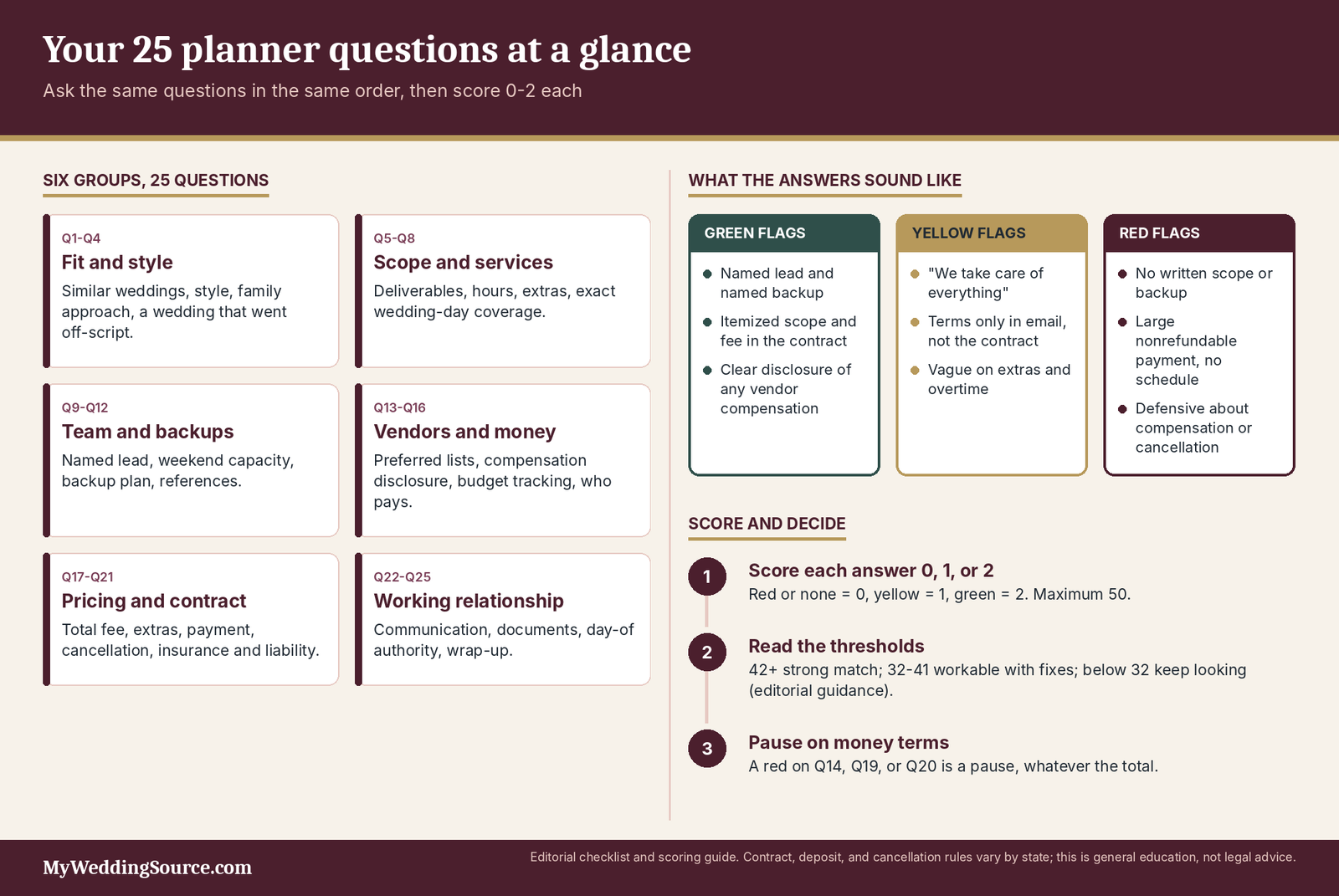
Planners are generally good at consultations, which is part of the job, so the question is not who sounds friendliest but who gives checkable answers. A green answer is specific, consistent with the contract, and offered without defensiveness. A yellow answer is incomplete and needs follow-up, and a red answer suggests you should pause before paying. Compare patterns, not perfection, because even excellent planners may have a yellow answer or two.
What do strong, mixed, and concerning answers sound like?
Green, yellow, and red answers on the highest-risk questions
The table covers the questions where a weak answer is most costly. A single yellow answer is a prompt for a follow-up email; two or three reds on money, contract, or backup questions are a reason to keep looking. For more clauses to check across every vendor, see our guide to wedding vendor contract red flags.
| Topic | Green: strong answer | Yellow: ask more | Red: pause |
|---|---|---|---|
| Scope (Q5-Q8) | Itemized deliverables and hours | “We take care of everything” | Refuses to put scope in writing |
| Team (Q9-Q11) | Named lead and named backup | Backup is “a friend” | No backup plan, lead unnamed |
| Compensation (Q14) | Clear disclosure of any referral fees or markups | Vague about discounts | Dodges or gets defensive |
| Payments (Q19) | Dated schedule, refundable terms spelled out | Schedule only in email | Large nonrefundable payment, no schedule |
| Cancellation (Q20) | Terms by time period; planner’s duties stated | Terms only for the client | No terms or one-sided terms |
| Authority (Q24) | Limits agreed before the day | “I will figure it out” | Expects you to approve everything on the day |
Judging answers fairly
Some answers sound unfamiliar without being problematic. A newer planner may have a thinner portfolio but a clear process and a lower fee, and a boutique planner may handle backups through a trusted partner instead of an in-house team. Judge answers by whether they are specific, consistent, and written down, not by whether they match a corporate model. If a planner makes a promise on the call, ask them to add it to the contract, since a candid “I do not do that” is more useful than a confident answer that turns vague on paper.
How do you compare planners with a scorecard?
The consultation scorecard
Score each question from 0 to 2 right after the call, where 0 is a red answer or no answer, 1 is yellow, and 2 is green, for a maximum of 50. As editorial guidance rather than a standard, 42 or more suggests a strong match, 32 to 41 suggests a workable match with items to fix in the contract, and below 32 suggests you should keep looking. Separately, treat a red on Q14, Q19, or Q20 as a pause regardless of the total, because money, refund, and cancellation terms are hard to repair after you sign.
| Group | Questions | What you are scoring | Max points |
|---|---|---|---|
| Fit and style | Q1-Q4 | Experience, style, family approach, problem-solving | 8 |
| Scope and services | Q5-Q8 | Deliverables, hours, extras, day-of coverage | 8 |
| Team and backups | Q9-Q12 | Named lead, capacity, backup, references | 8 |
| Vendors and money | Q13-Q16 | Vendor choice, disclosure, budget, payments | 8 |
| Pricing and contract | Q17-Q21 | Total fee, extras, payment, cancellation, liability | 10 |
| Working relationship | Q22-Q25 | Communication, documents, authority, wrap-up | 8 |
Comparing two planners fairly
Use the same questions, in the same order, with the same note-taking system for every planner, and write your scores within a day while the details are fresh. Ask each planner for a sample contract and package description before the call so you can compare specifics instead of impressions. After the call, send a short email confirming the key answers, such as the total fee, hours, backup, and compensation disclosure, and see how each planner responds. If your partner joins the calls, score separately and compare, since you may notice different things.
Do you tip a wedding planner, and how much?
Tipping a planner is customary but optional, and the guidance varies by source and by how the planner is structured. This section covers the basics, and the full range of vendor tipping is in our wedding vendor tipping guide. The figures below come from industry publications and are guidance, not obligations, so your budget and your contract come first.
How much do couples typically tip planners and coordinators?
Planners and lead coordinators
The Knot’s tipping guide, updated in January 2026, quotes a planner who says planners “definitely expect a tip” and estimates that 80 to 90 percent of her clients tip, and it suggests 15 to 20 percent of the total fee or a thoughtful gift. Zola’s cost guide takes a lighter view, calling tipping optional and suggesting roughly $50 to $200 per planner for exceptional service. The two sources do not agree, which is a reminder that tipping norms are norms and not rules. Here is an illustrative example, not a recommendation: 15 to 20 percent of a $3,800 fee would be about $570 to $760. If your budget is tight, a heartfelt note and a detailed public review are meaningful thank-yous.
Day-of coordinators, assistants, and venue staff
For month-of and day-of coordinators, The Knot suggests $50 to $150 and notes that this is not tied to a percentage of the fee. Assistants who work the event may be tipped separately. The Knot’s guide does not give an amount for venue coordinators, so ask the venue what it recommends and check your contract for a service charge, which may or may not include gratuity for staff. Do not assume a service charge goes to the people serving you, because policies vary. When in doubt, ask in writing before the wedding.
When and how should you tip?
Timing and envelopes
Many couples hand envelopes to planners at the end of the reception or have a designated person deliver them, and others send a check or gift with a thank-you note afterward. Choose whichever fits the planner’s preference, and raise it during the wrap-up conversation in question 25. If you assign a friend or family member to hand out vendor tips, give them a labeled list and the envelopes in advance. That keeps you from carrying cash during the reception and removes one last decision from the day.
Budgeting for tips and alternatives
Add tips to the budget when you add the planner’s fee so the final number is not a surprise. If the total feels high, tip at the lower end for coordinators, write a detailed review, or send a handwritten note that names specific moments of excellent work. A tip is not a substitute for paying the contracted fee in full and on time, and your contract should settle anything that is required. Keep tip amounts in the same tracker as your final payments.
FAQ: Wedding planner questions couples ask most
Is a planner worth it, and when should you book?
Is a wedding planner worth the money?
It depends on your wedding, your time, and your tolerance for risk, and nobody can promise a return on a planner’s fee. At The Knot’s 2026 average of about $2,100 against a $34,200 average wedding, the fee is a modest share of the total, and Zola calls day-of coordination almost always worth it so that you can enjoy the day instead of managing it. The value usually shows up as time saved, mistakes caught early, and someone else holding the timeline. If your wedding is small, your venue has strong coordination, and you have time and help, the value is lower. Use the decision framework earlier in this guide to weigh your own situation.
When should you book a wedding planner?
Zola says full-service planners usually start 12 to 18 months before the wedding, partial planners join about three to six months before, and day-of coordinators begin about four to six weeks out. Booking earlier matters for another reason: popular dates fill, and planners may limit how many weddings they take on, so ask each planner how far in advance they book your season. If you are inside the usual window for full-service planning, ask whether they accept shorter timelines or offer a partial package. Our wedding timeline guide shows when other decisions fall so you can place the planner in the sequence.
Can you hire a planner for just a few hours?
Yes, some planners offer hourly consultations for tasks like budget review, contract read-throughs, or a timeline check, though Joy notes that not all planners offer hourly services. Hourly help is a low-commitment way to test a planner’s judgment or fill a gap in a plan you are mostly handling yourself. Ask for an estimate and a cap before you start, and get the scope of the session in writing. It will not replace full coordination on the day, so decide separately who runs the event.
Contracts, venues, and logistics
Can the venue coordinator replace a day-of coordinator?
Sometimes, but not automatically. A venue coordinator works for the venue and focuses on its space, staff, and rules, and Zola describes the role as not a substitute for your own planner or coordinator. For a small, simple wedding at a venue with a strong in-house team, the venue coordinator may cover most needs, though you should still decide who manages your vendors and family. Ask the venue for a list of what its coordinator does and does not do, and compare it with the day-of tasks in question 8. Fill any gap with a coordinator or a clearly briefed friend with written instructions.
Should a lawyer review the planner contract?
This guide is general education, not legal advice, so for a specific contract the answer is to consider it, especially if the amounts are large, the terms are unusual, or a clause makes you uncomfortable. Contract rules, consumer protections, and the enforceability of cancellation and liability clauses vary by state, which is why a local attorney or your state attorney general’s consumer office is the right place to ask. Short, flat-fee reviews are often available, though availability and cost vary. Read the contract yourself first and bring a list of questions, and use our guide to wedding vendor contracts to know what to look for.
Your next steps
This week
Shortlist two or three planners and send the same pre-call email
Choose two or three planners whose services match the type of help you identified in the decision framework, and send each the same short email. Include your date or date range, venue or location, estimated guest count, and the level of help you are considering, and ask for a sample contract and package description before the call. Identical information makes quotes more comparable, and reading a sample contract in advance makes the consultation more productive. If a planner will not share a sample contract, note that as a yellow answer.
Choose your must-answer questions and print the scorecard
Select the five questions that matter most to you, often Q5, Q9, Q14, Q19, and Q20, and put them at the top of your notes. Print or copy the scorecard so you can score answers right after each call. Decide in advance who from your side will join the calls and who will take notes. When the call ends, spend ten minutes scoring before you talk to anyone else, since first impressions fade fast.
Before you pay a deposit
Read the full contract against your notes
Compare the contract with your scorecard line by line: the named lead and backup, the scope exhibit, the hours and meetings, the fee and extras, the compensation clause, the payment schedule, and the cancellation and liability terms. If a spoken promise is missing from the contract, ask for it to be added in writing before signing. A reasonable planner will understand that you are reading carefully, and a short pause now costs far less than a dispute later. If anything is unclear or high-stakes, ask a local attorney or your state’s consumer office, because terms and state laws vary.
Confirm the payment method and calendar the dates
Decide how you will pay, and where possible use a credit card, keeping the 60-day written-dispute window in mind. Save a receipt for every payment and put every due date on a shared calendar with a reminder a week ahead. Note the date after which payments become nonrefundable and the date by which the final timeline is due. Then share the plan with your partner and your designated day-of contact so more than one person knows where the documents live.
Sources & methodology
- The Knot: How Much Do Wedding Planners Charge? — 2026 Real Weddings Study planner averages, quartiles, service-type averages, guest-count breakdown, and planner hours (couples married in 2025).
- The Knot: Average Wedding Cost — $34,200 average total wedding cost from the 2026 Real Weddings Study.
- The Knot: Real Weddings Study — study edition and survey period (weddings held January through December 2025).
- The Knot: How Much to Tip Wedding Vendors — planner and coordinator tipping ranges (updated January 2026).
- Zola: How Much Do Wedding Coordinators Cost? — price ranges by service level, fee structures, city averages, tipping range (updated February 2026).
- Zola: Wedding Coordinator vs. Wedding Planner — definitions of planner types, start times, and guidance on when to hire or skip.
- Joy: The Real Price of a Wedding Planner — 2025 ranges by service type, hourly rates, and fee-model descriptions.
- U.S. Bureau of Labor Statistics: Meeting, Convention, and Event Planners — the occupation’s duties and the voluntary nature of certification.
- FTC: Using Credit Cards and Disputing Charges — the 60-day written dispute window, 30-day acknowledgment, and 90-day resolution timeline.
- FTC: Endorsement Guides, What People Are Asking — the principle that unexpected material connections should be disclosed clearly (used here only as an analogy for compensation disclosure).
Verified facts in this guide are the figures, dates, and rules as published by the sources above. The planner price ranges, tipping ranges, and the Knot’s study results are survey findings or industry estimates from publications that sell or promote wedding services, the percent-of-budget example, the tip calculation, and the roughly 6 percent share of total cost are our own illustrative arithmetic, and the decision framework, green-yellow-red table, and scorecard thresholds are editorial judgment rather than industry standards. Zola’s cost index does not state its data year, and its summary and body ranges differ, so we show both. Nothing here is legal or financial advice; contract, cancellation, deposit, and liability rules vary by state and by the wording of your agreement.
Freshness note: recheck The Knot’s planner figures when its next Real Weddings Study appears (typically early in the year), recheck Zola and Joy pages each spring, and confirm tipping norms before your wedding. Replace every national figure with written quotes for your date and location.