
Wedding dresses are easier to buy well when you settle your timeline, your all-in budget, and the job the outfit has to do before you fall for a specific gown, and this guide walks through that order step by step.
Most dress stress is a sequencing problem, not a taste problem. You probably have a date or a season, a number in your head, and a camera roll full of saved photos, and the real decision is not which gown is prettiest. It is which route to the outfit fits your calendar and total cost, and which version of it will still feel good at hour nine of a wedding day that includes stairs, a dance floor, and a long hug line. The route matters because a made-to-order gown, a sample off the rack, a resale listing, and a rental all carry different lead times, different fitting needs, and very different rules if something goes wrong.
The numbers give useful context. The Knot’s 2026 Real Weddings Study, which surveyed 10,474 U.S. couples married in 2025, put the average wedding dress at about $2,100, and only 19% of female respondents wore custom-made attire. That figure is a sticker price, though, and the same dress usually arrives with tax, alterations, undergarments, and accessories attached. Production for an ordered gown commonly runs four to six months before alterations even begin, so the calendar can matter as much as the budget.
Start With Three Decisions Before You Try Anything On
Shopping goes better when three decisions are made first: what the whole outfit can cost, what your venue and season require, and what you actually want to wear. Skipping them is how couples end up falling for a gown that does not fit the budget, the timeline, or the lawn it will be dragged across. These decisions also make appointments shorter, because a consultant who knows your number, your date, and your venue can pull a focused rack instead of guessing. None of this requires a final answer. A range and a few firm limits are enough to start.
How much should the outfit cost, all in?
What is a realistic starting number?
Start from the data, then adjust for your own situation. The Knot’s 2026 study put the average dress at roughly $2,100, with about $1,200 for lower-budget weddings, about $2,000 for mid-budget weddings, and about $3,200 for high-budget ones, so the typical range is wide. An earlier Knot guide to gown shopping said wedding attire commonly makes up about 7% of the overall budget, which is a useful gut check rather than a rule. If your total wedding budget is $30,000, for example, 7% is $2,100, and that should cover the dress plus its extras only if you shop strategically. Say your total outfit number to the salon consultant at the start, because it saves everyone an hour of looking at gowns you cannot buy.
Where does the outfit budget come from?
Couples fund this line item in very different ways, and no one should assume that parents or relatives contribute. Some people treat attire as a fixed percentage of the overall wedding budget, others protect it as a priority and trim catering or flowers, and others pay for it themselves from savings. If family members offer to help, ask them to name a specific amount or a specific purchase, such as the veil or the alterations, so you are not guessing at expectations later. Our wedding budget guide explains how to weigh trade-offs across categories, which matters here because dollars added to one line usually have to come out of another, such as the bar package or the length of the photography day. Whatever the source, write the number down before the first appointment and treat it as the ceiling for the all-in total.
What do your venue, season, and formality demand?
How does formality shape the choice?
Formality is set by the venue, the time of day, and the invitation more than by the dress itself. A black-tie evening ballroom wedding can carry a cathedral-length train, a structured gown, or a tuxedo-style suit, while a 4 p.m. garden ceremony with cocktail attire reads better in a midi dress, a tailored set, or a lighter gown with a short train. If you are not sure how formal your own wedding is, your planner or venue coordinator can usually describe the register in a sentence, and that sentence is a good filter for the dresses you try. Matching your outfit to your guests’ attire expectations also reduces friction, since the invitation wording sets what guests will wear. Courthouse ceremonies and micro-weddings give you the most freedom, because formality is whatever you decide it is.
How do weather, terrain, and venue logistics change it?
Season and surface decide more than most people expect. A heavy satin ballgown in an August outdoor ceremony is a heat-management project, and a sleeveless chiffon dress at a November barn wedding needs a wrap or a plan for the cold. Grass, gravel, sand, and cobblestones eat hems, so ask whether you can have a shorter hem, a detachable train, or a bustle that lifts the skirt fully off the ground. Ask the venue about dressing space, restroom access, stairs, and elevator size too, because a wide skirt in a narrow restroom is a logistics problem you can solve in advance. The same logic applies in every season: choose fabric and silhouette for the temperature, the terrain, and the longest stretch you will stand or dance.
What do you actually want to wear?
Which outfit types are worth considering?
Think in terms of the day you are planning rather than a default. A traditional gown with a long train is one end of the range, and a tailored suit, a wide-leg jumpsuit, a skirt-and-top separates set, a tea-length dress, or a mini dress for a courthouse ceremony or a reception change are others. Cultural and religious attire, from a saree or lehenga to a hanbok, a kimono, a barong, or a kente-trimmed garment, may also be the natural choice and can be worn alone or paired with a Western gown for a second look. Some couples wear matching or complementary suits, some choose different styles for each partner, and some skip white entirely. If you are shopping for a suit or tux, our guide to groom’s wedding attire covers cuts, fabrics, and fittings that apply to anyone wearing tailoring. No gender, body type, or relationship structure changes the process, only the places you shop.
How do silhouettes fit into the decision?
Silhouette is the shape of the skirt and bodice, and it affects comfort, movement, and alterations more than most people expect. In very brief terms, A-line skirts widen gradually and are easy to move in, ballgowns have the fullest skirts and the most fabric, sheaths and columns skim the body and have little structure to hide behind, fit-and-flare shapes hug the torso and open at the knee, and empire waists sit under the bust. Each has a typical alteration pattern: a ballgown needs a bustle and often more hem work, a sheath needs precise side seams, and a structured bodice needs the most careful fitting. The full breakdown of necklines, silhouettes, and what each tends to cost in alterations lives in our wedding dress styles guide, so use that page when you are ready to narrow shapes. For now, pick two or three silhouettes you are curious about and leave the rest open.
Where to Shop: Eight Routes to a Wedding Outfit
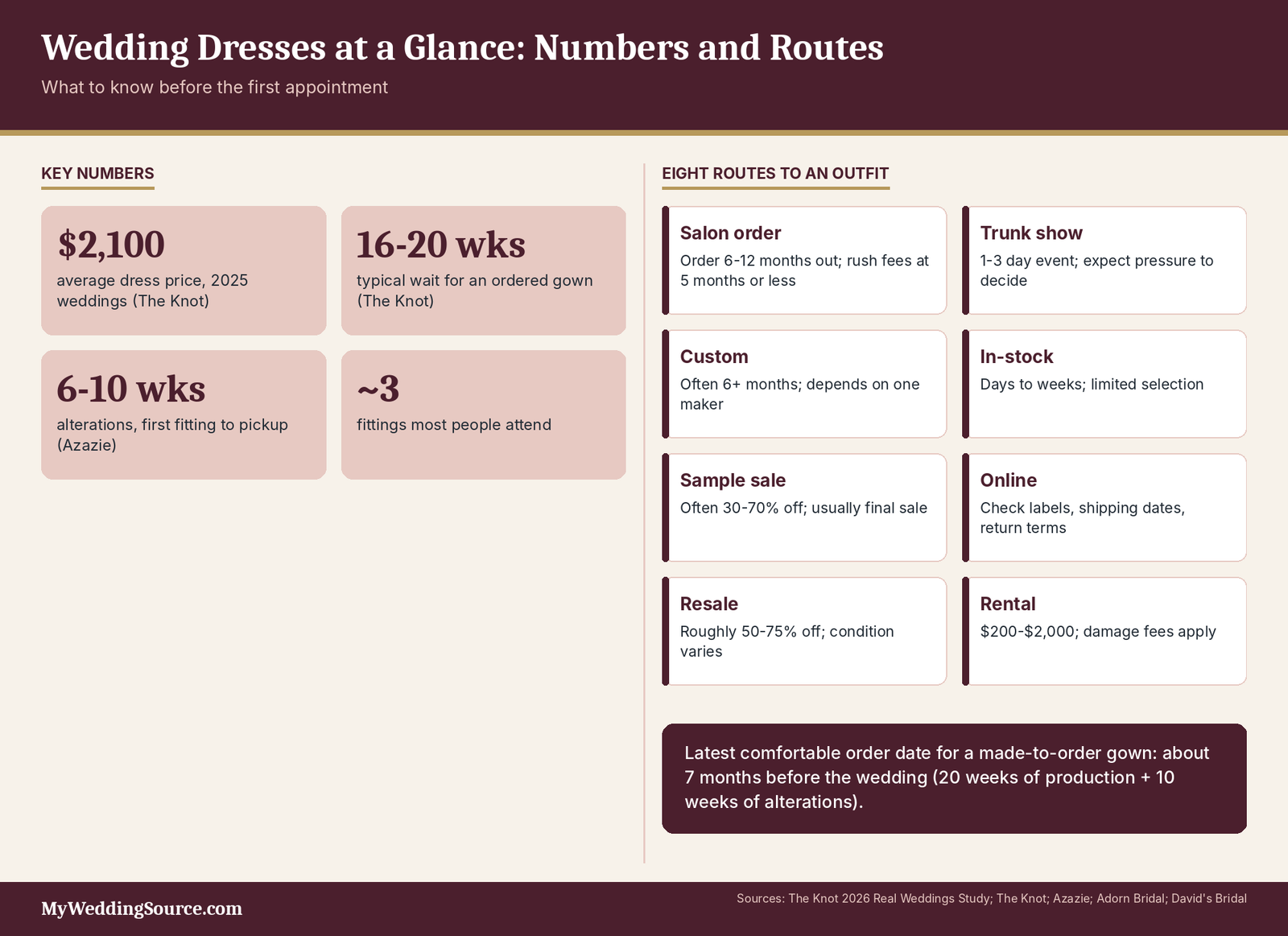
There are eight common ways to get a wedding outfit, and they sort into three groups: routes where a designer produces your dress to order, routes where you take something home in days or weeks, and routes that lower the price or the footprint by reusing something that already exists. The right route depends on your calendar first, your budget second, and your fit needs third. Each has an honest upside and an honest watch-out, and none is the right one for everyone. The table compares them, and the sections after it explain how each works in practice.
| Route | Typical timing | Main upside | Main watch-out |
|---|---|---|---|
| Bridal salon, made-to-order | Order 6 to 12 months out; 16 to 20 weeks to arrive | Wide selection, ordered in your size, expert fitting help | Deposit commitments, rush fees under about 5 months, limited changes |
| Designer trunk show | Order at the event; the dress arrives after production | Full collection visible, sometimes perks or discounts | Pressure to decide that day |
| Custom or made-to-measure | Often 6+ months plus fittings | Fit and design control | Highest planning burden; depends on one maker |
| Off-the-rack or in-stock | Days to a few weeks | Fastest, easiest to compare prices | Smaller selection, may need heavier alterations |
| Sample sale | Take it home the same day | Often 30% to 70% off | Final sale, worn samples, limited sizes |
| Online or direct-to-consumer | Varies by seller; check shipping dates | Price transparency, convenience | Fit uncertainty, counterfeit risk, return rules |
| Secondhand or resale | Weeks, depending on listings | Savings of roughly 50% to 75% | Condition varies, limited protection |
| Rental | Short lead times | Lowest cost, no preservation | Damage fees, availability, limited alterations |
Which routes involve ordering from a designer?
How does a bridal salon order work?
A salon carries sample gowns for you to try, then orders your dress from the designer in the size that matches your measurements. Boutiques generally recommend ordering six to twelve months in advance, and rush fees typically apply when you order five months or less before the wedding. The Knot’s guidance puts the buying window at 8 to 10 months before the wedding, with delivery in 16 to 20 weeks. The upside is expert help: a stylist, a measured size, and an alterations team that knows the gown. The watch-out is that the dress is produced to order, so it is generally not returnable, and the deposit, commonly 30% to 50% of the price, is where your risk begins.
What happens at a designer trunk show?
A trunk show is an in-store event, usually one to three days, where a designer sends a collection to a retailer so you can see styles the salon does not normally stock. Salons may offer incentives such as veils, waived fees, or custom changes, and one New York retailer quoted by Here Comes the Guide says many designer gowns are 10% off during its shows, though offers vary by store. The widest selection tends to run January through March, and appointments fill quickly. The drawback is the clock: you are encouraged to decide on the day, and a pressured decision is the one most likely to be regretted. It is fine to say you will take 24 hours, ask whether the offer survives overnight, and ask for the terms in writing before paying.
Which routes get you a dress in days or weeks?
What is in-stock and off-the-rack shopping?
In-stock shopping means buying a dress that already exists, either from the salon floor or from a retailer’s ready-to-ship catalog. David’s Bridal notes that made-to-order still works at four to six months with rush production and a fee, becomes unrealistic for most styles at two to four months, and that with under two months left you can often take a floor sample home the same day. The upside is speed and price clarity, since you see what you pay. The watch-out is selection: you are limited to what exists in your size, so a dress that needs heavy alteration may cost more in the end than a cleaner fit at a higher price. For short engagements and second weddings, this route is often the least stressful.
How do sample sales work?
A sample sale sells the dresses salons used for try-ons, often at 30% to 70% off retail, though the discount varies by event and brand. Most are final sale, with no returns or exchanges, and the dresses are sold as-is, so inspect seams, zippers, the bodice, and the hem under good light. Traditional samples run around size 10 to 12, so people outside that range should check inventory before attending, and many sales do not hold dresses, which means deciding on the spot. Budget for professional cleaning, estimated at $200 to $400 by one large retailer, and for alterations. A sample sale rewards people who bring a measurement list, a calm friend, and a firm ceiling number.
Which routes cost less or give you more control?
Is buying a wedding dress online safe?
It can be, if you treat it like any other significant online purchase. Check fiber content, country of origin, and a business name on the listing, which U.S. textile labeling rules require on most garments sold here. Consumer Reports has documented a counterfeit case where a bride paid $221.79 for a copy of a $1,375 design and received different fabric, a shorter train, and no underskirt, and it recommends checking the company name plus the word “scam,” the Better Business Bureau Scam Tracker, and the site’s return and privacy policies. Zola’s 2026 First Look Report found that 87% of couples made planning decisions based on something they saw on social media, which is also where look-alike ads can reach you. Pay by credit card, order your measured size, and build in time to return or alter.
What about custom and made-to-measure?
Custom work means a designer or seamstress creates a pattern for you, usually over multiple fittings, and made-to-measure means an existing design is produced to your measurements. Consumer Reports reports custom boutique orders commonly taking six to nine months, with gowns made abroad taking up to a year, and the 2026 Knot study found only 19% of female respondents wore custom-made attire. The upside is a garment built for your body and your day, including for people whose proportions fall between standard sizes. The watch-out is dependence on one maker, so ask about their timeline, their fitting schedule, their policy if they cannot finish, and who owns the patterns and fabric if the project ends. Price it as a project with several visits rather than a single purchase.
Why consider resale or rental?
Resale and rental trade novelty for savings. The Knot reports resale listings can cost 50% to 75% less than retail, and rentals commonly range from $200 to $2,000 depending on the company and package, with insurance often costing $5 to $10 and renters generally responsible for damage beyond normal wear. Resale platforms differ sharply in protection: some authenticate dresses, while others state that all sales are final unless the item is not as described. Ask for extra photos of the hem, back, and closures, ask how the dress was stored and cleaned, and budget for alterations either way. Rental also removes the question of cleaning and preserving afterward, which can be a relief for people who do not want to keep a gown.
How the Appointment Process Works, From First Visit to Order
A bridal appointment is a structured sales conversation: a consultant learns your budget, date, and style, pulls samples, and, if you like one, measures you and takes a deposit to place an order. Understanding the sequence ahead of time lets you steer it rather than be carried along by it. It also helps you separate the parts that are genuinely about the dress from the parts that are about the store’s calendar and sales targets, which are normal but worth noticing. Done well, the process takes one to three appointments and a few quiet days of thinking in between.
How do you prepare for a bridal appointment?
When should you book, and who should come?
Book early, because The Knot notes that trunk shows are highly popular with limited availability, and call ahead to confirm that a specific dress is in stock. The standard appointment is about one hour, weekday slots are easier to get than Saturdays, and shoppers typically try on around seven dresses across one to three appointments. Keep the group small, which The Knot frames as two or three trusted people, and going alone is fine too. Check the salon’s guest limit when you book, since some cap the group, and decide in advance who gets a vote and who is there for moral support. A smaller group makes it easier to hear your own reaction, which is the data you are actually collecting.
What should you bring?
Bring the undergarments you expect to wear, since Consumer Reports suggests packing both undergarments and shoes at your planned heel height so the dress sits and drapes the way it will on the day. Bring a short list with your budget ceiling, your wedding date, the venue name, and the rough formality, plus a handful of screenshots rather than a hundred. Add your measurements if you have them, and a note of anything that must be true, such as pockets, sleeves, a lace-up back, or a fabric that breathes. If you want a second opinion later, ask the salon whether you can take photos, because policies vary and some designers restrict them. Walking in with a one-page brief shortens the appointment and keeps the conversation on your priorities.
What happens during and after the try-on?
How do you judge a sample you are trying on?
Samples are not your size, so they are pinned or clipped to suggest the fit, and the consultant will describe what would change in your order. Ask what differs between the sample and the dress you would receive, including fabric, color, length, and any alterations that are included in the price. Move around in it: sit, raise your arms, climb a step, and imagine the second half of the day when you are tired and the room is warm. Pay attention to where it pinches or gapes, because those are the places a seamstress will be working, and they influence the final alteration bill. It is worth asking, in a friendly way, which parts of the dress a seamstress would have the most trouble changing, since structured bodices and heavily beaded panels are costlier to modify than simple skirts.
How do you decide without feeling pressured?
Pressure usually shows up as a deadline: a discount that ends today, a designer price increase next week, or a warning that the dress might be discontinued. Some of that is real, because trunk shows have limited runs and designers do raise prices, and some of it is a sales technique, so ask for the offer in writing and ask if it holds for 24 hours. The Knot reassures shoppers that not finding a dress on the first visit is normal, and there is no rule that you must buy at your first appointment. Take notes on each dress, including price, delivery date, deposit amount, and the return policy, then compare them away from the store. If you feel rushed, that feeling is useful information about the store, not a flaw in your decision-making.
How does the timeline work backward from the wedding?
What does the order-from-a-designer timeline look like?
Here is an illustrative backward plan using published ranges, not a promise from any store. The Knot’s checklist suggests shopping 9 to 12 months out, buying 8 to 10 months out, and expecting delivery 16 to 20 weeks after ordering, while Azazie describes alterations as taking 6 to 10 weeks from first fitting to pickup. Add those up, 20 weeks of production plus 10 weeks of alterations, and you arrive at roughly seven months before the wedding as the latest comfortable order date, before counting the weeks you spend shopping. That is why boutiques advise ordering six to twelve months ahead. Our wedding timeline guide shows where this fits among venue, photography, and invitation deadlines.
| Time before wedding | Order-from-a-designer path | Ready-now path (sample, in-stock, resale, rental) |
|---|---|---|
| 12 to 9 months | Set budget; book first appointments; shop | Browse and save listings; set size and budget |
| 10 to 8 months | Choose a dress; place the order; pay the deposit | Buy early if you find it; resale listings sell quickly |
| 8 to 4 months | Production (about 16 to 20 weeks) | Optional: buy now and store it safely |
| About 4 to 3 months | Dress arrives; book a seamstress | Book a seamstress; schedule cleaning |
| 3 months to 8 weeks | First fitting | First fitting |
| 6 to 4 weeks | Second fitting | Second fitting |
| 2 to 3 weeks | Final fitting; practice the bustle | Final fitting; practice the bustle |
| About 1 week | Pick up; try on once more at home | Pick up; try on once more at home |
What if your wedding is closer than six months away?
Short timelines limit options, but they do not end them. David’s Bridal describes a 6 to 9 month window to browse, order, and alter a made-to-order gown, notes that rush production at four to six months incurs an extra fee, and says made-to-order is off the table for most silhouettes at two to four months. At that point, in-stock dresses, sample purchases, resale, and rentals are the practical routes, and seamstresses may offer rush alterations in two to four weeks, according to Azazie. Ask any seamstress about availability before you buy, since a dress with no one to fit it is the actual deadline risk. If you are inside eight weeks, prioritize dresses that need only hemming and a bustle, which are the least time-consuming changes.
Fabrics and Construction: What You Are Really Paying For
Fabric and construction explain more about comfort, price, and alteration cost than the designer name does. They also decide whether the dress holds up through a long day of sitting, hugging, dancing, and being photographed in sun. You do not need to become a textile expert, but a few terms and checks will keep you from paying silk prices for something labeled polyester, or choosing a fabric your climate will fight.
Which fabrics suit which weddings?
How do structured fabrics behave?
Structured fabrics hold their own shape and give a gown sculpted lines. Style Me Pretty’s fabric glossary describes satin as smooth with a heavy sheen and supportive enough for structured gowns, taffeta as crisp and slightly stiff with a noticeable rustle, and crepe as soft and thin with a crinkled texture. Charmeuse is silky and fluid and tends to cling, which is why it appears in sheath dresses and shows seams and undergarments more than stiffer cloths. Structured fabrics look polished in photographs and in cooler weather, but they can be warm and may crease or mark in ways that need steaming on the day. If you love a sleek, sculpted look, ask to see the fabric in daylight, because indoor lighting can flatter in ways a garden will not.
How do lightweight and sheer fabrics behave?
Lightweight fabrics drape and move, which is why they are common for warm-weather and outdoor weddings. Chiffon is sheer and delicate and is often layered, tulle is a light open-weave net that creates volume, and organza sits between them, with more structure than chiffon and more fluidity than tulle. Allure Bridals notes that lace is the least lightweight of these, recommending lighter varieties such as Chantilly or Alençon for summer comfort, and the glossary distinguishes Alençon’s corded edges from Chantilly’s fine net ground. Light fabrics catch on rough surfaces and can snag on jewelry, so ask about lining and finishing. For a summer ceremony, the Allure fabric overview is a useful starting point for questions to ask your consultant.
| Fabric | How it behaves | Often chosen for | Check before buying |
|---|---|---|---|
| Satin | Smooth, heavy sheen, supportive | Structured, formal gowns | Heat, creasing, water marks |
| Taffeta | Crisp, slightly stiff, rustles | Full skirts, ballgowns | Noise, weight, stiffness |
| Crepe | Soft, thin, crinkled texture | Minimal, sleek dresses | How it shows lines and seams |
| Charmeuse | Silky, fluid, clings | Sheath and slip styles | Undergarments, fit precision |
| Chiffon | Sheer, delicate, airy | Warm weather, layered skirts | Snags, lining, wind |
| Tulle | Light open-weave net | Volume, veils, overlays | Scratchiness, layers |
| Organza | Between chiffon and tulle, some structure | Voluminous but light skirts | Edges, finish |
| Lace | Textured, varies by type | Overlays, sleeves, bodices | Weight, scalloped hems, repairs |
| Velvet | Heavy, plush | Cold-weather weddings | Warmth, weight |
What do labels and construction tell you about quality?
What should the label say?
In the United States, most clothing must carry fiber content and a country-of-origin statement, and the label must identify the business through its name or a Registered Identification Number, according to the FTC’s textile labeling guidance. Care instructions are required under a separate FTC rule, 16 C.F.R. Part 423, and these tell you whether the garment can be cleaned in a way you can afford. Consumer Reports recommends checking the label and hang tag for fiber content, care instructions, a business name, and where the gown was made, rather than judging fabric by touch. In a Consumer Reports test, only two of 143 people matched all five gown prices correctly, which suggests that expensive-looking fabric or embellishment does not reliably signal higher quality. Ask for the label or tag information before you buy, especially online.
What construction details affect fit and repairs?
Internal structure matters because it determines what a seamstress can change. Boning, corset backs, and built-in cups give support, but they also limit how much a bodice can be reshaped, and heavily beaded or lace-appliquéd panels cost more to alter because every change disrupts the decoration. Seam allowances, the extra fabric folded inside the seam, set how much a dress can be let out, and The Knot notes a dress can typically be taken in two sizes but let out only one. Consumer Reports adds that gowns from Italy or Spain may be less flexible for changes such as adding straps or altering a train, which is worth asking about if you want modifications. Before you order, ask the consultant to show you the inside of a sample, since the lining, seams, and closures are as informative as the front.
Fit, Sizing, and Alterations: The Reality Check
Fit is where most surprises in dress shopping occur, because bridal sizing does not follow everyday sizing and nearly every gown needs changes. The process is predictable once you understand how sizes are chosen and how fittings are scheduled. It is also an area where inclusive shopping needs extra planning, since sample inventories do not always reflect the range of bodies that buy dresses. Treat this section as the checklist you bring to the salon.
How does bridal sizing work?
Why do bridal sizes run larger?
The Knot quotes an expert saying wedding dress sizes run about three sizes larger than regular dress sizes, so a street size 12 might be roughly a bridal 18, and Kleinfeld gives a similar example, saying a 4 to 6 in jeans is a bridal 8 to 10. The conventions trace back to older European patterns, and sizing also differs between designers, so one person can be assigned different sizes by different labels. This is normal and says nothing about your body. The practical response is to ignore the number, take your measurements (or have the salon do it), and compare them with each designer’s chart before ordering.
How is the size to order chosen?
Kleinfeld explains that after you choose a dress, three measurements are taken (bust, waist, and hip), and the dress is ordered to your largest measurement, because designers do not offer split sizes. The logic is that fabric can be removed more easily than added, which is why Consumer Reports advises ordering your current size rather than a goal size and letting the salesperson choose the order size. If you are planning for weight changes, pregnancy, surgery, or medical treatment, tell the consultant and the seamstress early, and ask about adjustable elements such as corset backs. Order for the body you have now and plan one more fitting if your body is changing. Keep your measurements written down with the date, so you can check them against your final fitting.
What should you know about sample sizes and trying on?
What sample sizes do salons carry?
Sample inventories are limited. Kleinfeld says the samples you are likely to try are bridal sizes 8, 10, 12, 18, 20, and 22, and that most samples have a B cup while plus-size samples have a C or D cup, while The Knot’s source says salons usually stock bridal sizes 6 to 10, which typically translate to street sizes 2 to 6. Trunk show samples may be smaller, such as a 2 or 4, because they come from the runway. Because ranges vary so much, call ahead and ask which samples are in stock, and tell the salon your size so they can say honestly whether you will see the dress on your body or on a clipped-in approximation. If the salon cannot show your size range, ask about fabric swatches, a different salon with extended samples, or ordering after a measurement-based fitting.
How do you shop when samples do not match your body?
Samples that do not fit are still useful if you read them correctly. Look at the shape of the skirt, the neckline’s position, the weight of the fabric, and the way the train moves, and ask the consultant to describe how the dress would be cut in your size. Some retailers carry broader sample ranges, and David’s Bridal notes it carries samples across a wider size range, so it is worth asking several stores. Salons that make you feel judged for your size or your gender presentation are not the right salon, and you are free to leave. A good consultant treats your measurements as information and your preferences as the brief.
How do alterations and fittings actually go?
Who should do the work, and what do typical alterations cost?
Our guide to wedding dress alterations covers the hidden costs in more depth, and the basics are these. The Knot recommends an experienced wedding dress seamstress, since bridal gowns have multiple layers, seams, and fabric types. Its March 2025 alterations guide reports that standard alterations (a hem, a bustle, and an adjustment to the top or bottom) are about $700 to $1,000 in one expert’s estimate, with a hem at $125 to $450, taking in the sides at $100 to $200, a bustle at $75 to $175, and a corset closure at $100 to $300. Prices vary by region, the number of layers, and the amount of beading or lace. Ask for a written quote before the first fitting, ask whether the price covers all fittings or charges per appointment, and ask who does the pressing. Consumer Reports found, in 2017, that some shops charged up to $500 for unlimited fittings while others charged $100 or more per appointment, so the structure of the fee matters as much as the number.
What does the fitting schedule look like?
Most people have about three fittings. Inside Weddings describes a first fitting six to eight weeks out to confirm the basics, a second about a month before, and a third about two weeks before, with pickup at least a week before the wedding, while Azazie suggests starting eight to twelve weeks out with fittings spaced two to three weeks apart. The Knot’s guidance is to book the seamstress about when the dress arrives, since good ones book up quickly, but not to start fittings so early that your body changes before the wedding. Bring the shoes, undergarments, and any veil or jewelry you plan to wear to every fitting. At the last fitting, practice the bustle with the person who will fasten it, and ask the seamstress to show them how, because someone will be doing it in a hurry between the ceremony and the reception.
What Wedding Dresses Actually Cost: Every Layer of the Total
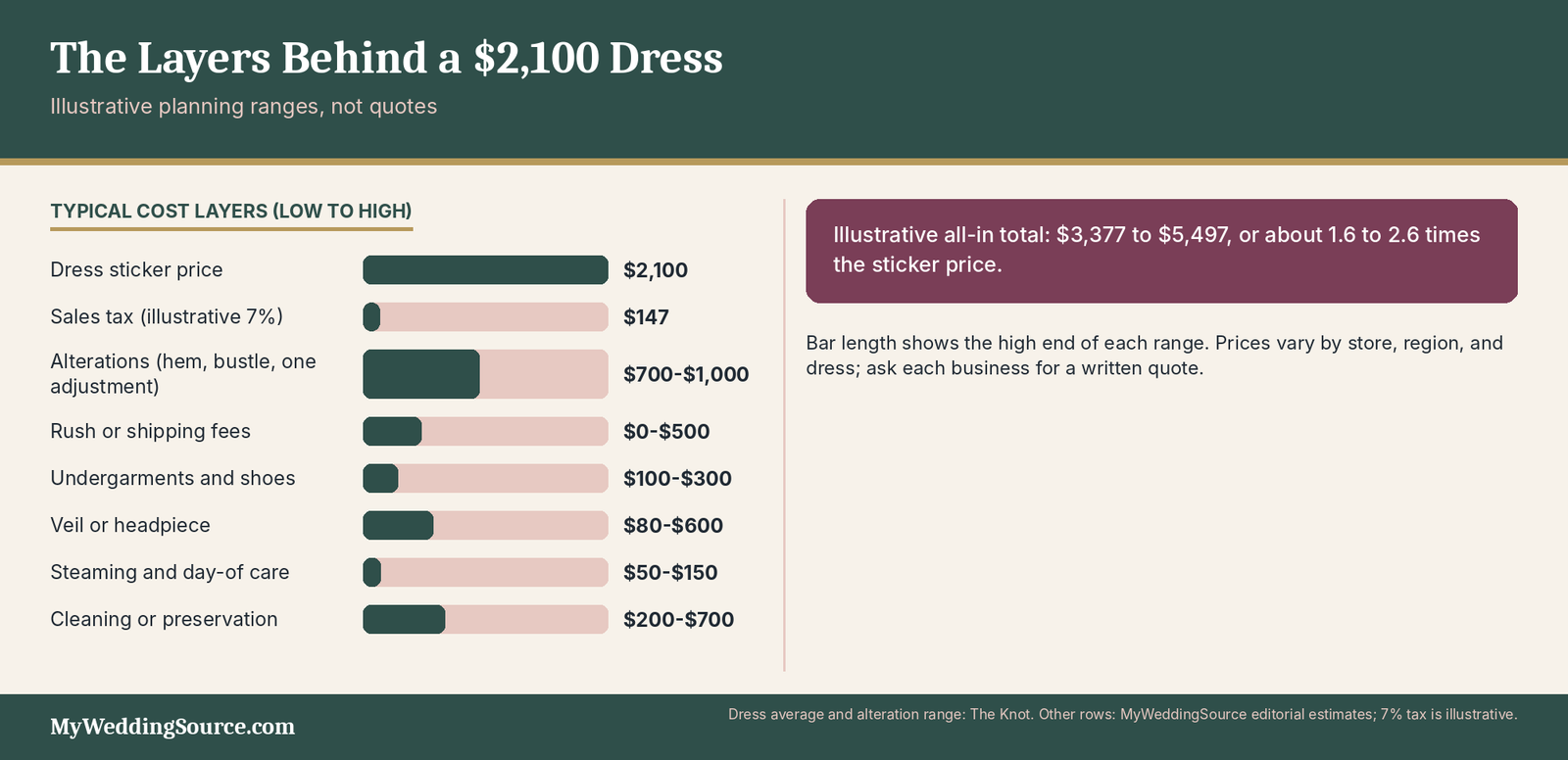
The sticker price on a gown is the beginning of the cost conversation, not the end. A typical outfit includes the dress, sales tax, alterations, rush or shipping fees, undergarments, shoes, a veil or headpiece, steaming on the day, and cleaning or preservation afterward. Pricing here is complicated rather than sinister: salons quote the dress because that is the product, and the rest comes from other businesses and other decisions. Seeing every layer early lets you set a realistic ceiling and choose where to spend. Our companion piece on wedding dress cost types and hidden fees goes deeper on price tiers, so this section focuses on how the layers stack and how routes compare.
What goes into the all-in total?
What does the sticker price include, and why does it vary?
The sticker price covers the dress as designed, in the size ordered, and typically not alterations, accessories, or taxes. The Knot’s study shows how much averages move with context: about $2,200 in the Mid-Atlantic, $2,500 in the Midwest, about $2,000 for hometown weddings, and $2,900 for international destination weddings, so a national average is a starting point and not a quote for any city. Trade policy also affects price. NPR member stations reported in June 2025 that the National Bridal Retailers Association estimates about 90% of the bridal gown market is made in China, that some designers raised prices by as much as 30%, and that one shop added a surcharge of 10% to 15%. Tariff rules have changed repeatedly, so ask whether a quoted price is locked at the time of your deposit, and whether a surcharge can be added later.
How do tax, rush fees, and shipping change the number?
Sales tax on clothing varies by state and locality, and some states exempt clothing fully or up to a price threshold, according to the Tax Foundation’s overview. Because rules also differ for services, ask your state revenue department or your seamstress whether alterations are taxable where you live. Rush fees are common when you order five months or less before the wedding, and the amount depends on the store, the designer, and the complexity of the dress, so there is no reliable national figure to plan around. Shipping and insurance for online orders add a smaller layer. For planning, assume the sales tax percentage you pay locally on the dress and ask each business what it charges for expedited work.
What do the extras add up to?
What do alterations, undergarments, and accessories cost?
Alterations are the largest extra, with The Knot’s expert estimates running $700 to $1,000 for a hem, bustle, and adjustment, and with hems at $125 to $450, taking in the sides at $100 to $200, and bustles at $75 to $175. Undergarments and shoes vary widely depending on whether you need a specific bra, shapewear, or a heel height, and an editorial planning range of $100 to $300 covers most needs. A veil or headpiece can range from about $80 for a simple piece to $600 or more for custom lace or beading, as an editorial estimate. If you are curious about veil styles and their history, our guide to wedding veil meaning and history explains the traditions so you can choose deliberately instead of by default.
What about steaming, cleaning, and preservation?
A dress arrives creased from storage and travel, and steaming on the day by a professional or a friend with a good steamer is a practical expense, which we estimate at $50 to $150 if you hire it. Afterward, cleaning and preservation are optional but common, and prices depend on the fabric, the beadwork, and whether you use a local cleaner or a mail-in service. David’s Bridal estimates cleaning of a sample dress at $200 to $400, and preservation can cost more, so check our breakdown of wedding dress preservation costs before deciding. If you plan to resell the dress, cleaning before listing is usually worth it, and some buyers ask for a cleaning record. If you do not plan to keep or sell it, you can skip preservation entirely.
| Cost layer | Illustrative low | Illustrative high | Source or basis |
|---|---|---|---|
| Dress sticker price | $2,100 | $2,100 | The Knot 2026 study average (2025 weddings) |
| Sales tax (illustrative 7%) | $147 | $147 | Varies by state and locality |
| Alterations | $700 | $1,000 | The Knot expert estimate for hem, bustle, one adjustment |
| Rush or shipping fees | $0 | $500 | Editorial estimate; varies by store |
| Undergarments and shoes | $100 | $300 | Editorial estimate |
| Veil or headpiece | $80 | $600 | Editorial estimate |
| Steaming and day-of care | $50 | $150 | Editorial estimate |
| Cleaning or preservation | $200 | $700 | Editorial estimate; see preservation guide |
| Estimated total | $3,377 | $5,497 | About 1.6 to 2.6 times the sticker price |
How do the routes compare on total cost?
What do four illustrative scenarios look like?
These are illustrative examples, not quotes, and they use a 7% sales tax and midpoint alteration figures. The salon-order scenario starts with a $2,100 gown, the sample-sale scenario takes a $3,200 designer gown at half off, the resale scenario takes a $2,100 retail gown at 60% off with shipping, and the rental scenario assumes a $600 rental with temporary alterations included. Notice that the sample sale and the resale gown start with different sticker prices and land in different places once cleaning and alterations arrive, and that rental avoids most alterations and all preservation. The totals are about $3,597, $3,062, $2,540, and $952, which shows why comparing totals, not tags, is the only fair way to decide.
| Layer | Salon order | Sample sale | Resale | Rental |
|---|---|---|---|---|
| Dress or rental | $2,100 | $1,600 | $840 | $600 |
| Sales tax (7%, where it applies) | $147 | $112 | $0 | $42 |
| Cleaning, shipping, insurance | $0 | $300 | $350 | $10 |
| Alterations | $850 | $550 | $850 | $0 |
| Undergarments and shoes | $200 | $200 | $200 | $200 |
| Veil or headpiece | $200 | $200 | $200 | $100 |
| Steaming | $100 | $100 | $100 | $0 |
| Illustrative total | $3,597 | $3,062 | $2,540 | $952 |
Where can you save without cutting corners?
The most reliable savings come from decisions made early. Buying a sample or pre-owned gown reduces the dress layer, ordering with enough lead time avoids rush fees, and choosing a simpler silhouette lowers alteration costs because there is less to reshape. Shopping with a firm ceiling avoids upgrades you did not plan, and bringing your own undergarments and shoes to fittings avoids repeated adjustments. The Knot’s note that alterations are not included in the average price is a reminder to spend on a skilled seamstress rather than a cheaper one, since a mistake in fitting costs more to fix than the price difference. If you must trim, trim accessories and the number of fittings you request, not the quality of the person doing the fitting.
Deposits, Returns, and Contracts: What to Read Before You Pay
This section is general education, not legal advice, and terms and state laws vary. Dresses are often ordered from a designer after a deposit, which makes the paperwork as important as the fabric. Most issues couples report involve late delivery, wrong sizing or color, a store that closes, or a dress that is different from the sample. Reading terms before you pay, and paying in a way that preserves your options, reduces those risks considerably. Our guide to wedding vendor contracts covers the general clauses to look for across vendors.
How do deposits and payment schedules usually work?
How large is the deposit, and is it refundable?
The Knot reports deposits are often around 50% of the dress price, and a designer quoted in its cost guide said retailers generally require 30% to 50% to confirm an order, with the balance due at pickup. Because a made-to-order gown is produced for you, many stores treat the deposit as non-refundable once the order is placed, though policies differ, so ask what happens if you cancel in the first week or the first month. Ask whether the deposit can be applied to a different dress, and whether there is a grace period. Some designers and boutiques offer installment plans, and if you use one, ask whether the plan changes the cancellation terms. A deposit is not a down payment on a returnable item, so treat it as committed money.
What should the written order say?
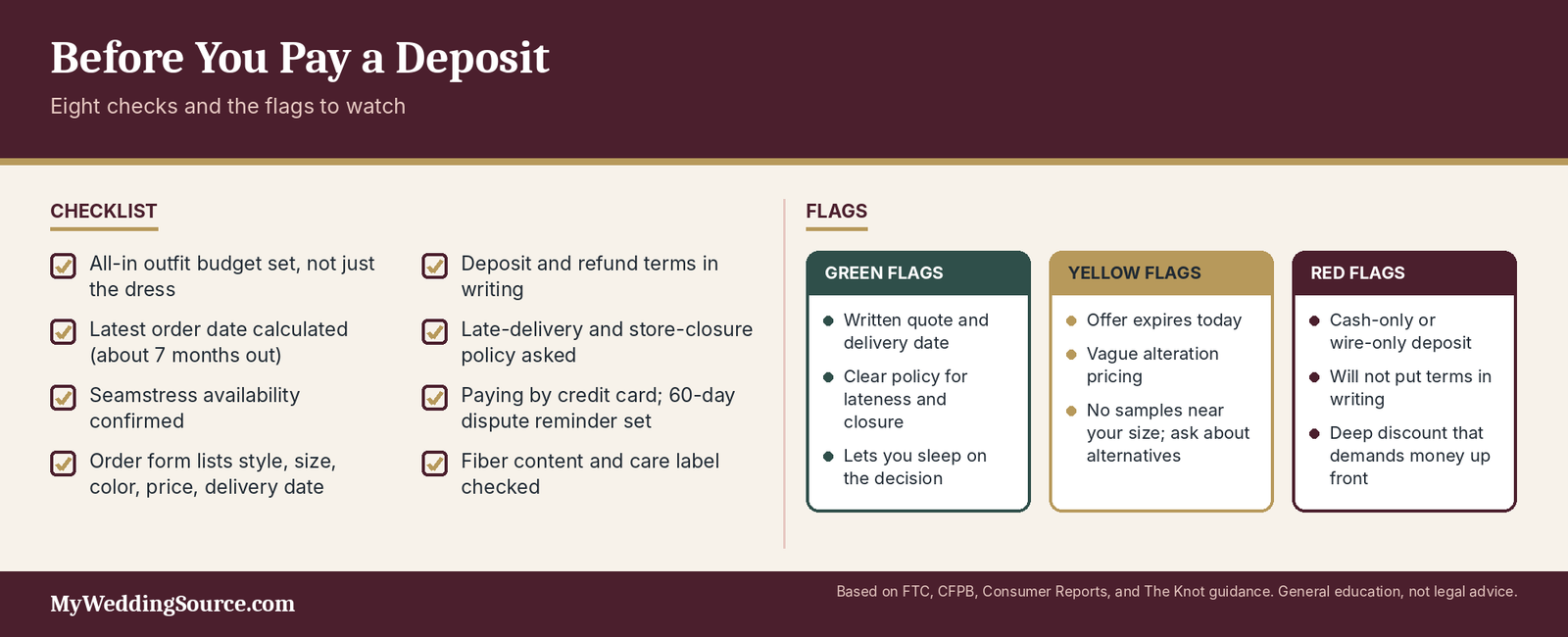
The order form is your record, and it should name the designer, style number, size ordered, color, fabric or any customizations, price, deposit paid, balance due, and estimated delivery date. Ask for the designer’s production date and the store’s delivery date separately, because the store typically receives the dress before you, and ask what the store will do if the dress arrives late for the wedding. Look for clauses about price changes, surcharges, rush fees, alterations included in the price, storage fees if you do not pick up on time, and what happens if the designer cannot fill the order. If the contract is silent on an issue that matters to you, ask for it in writing as an addendum. The same discipline applies to any vendor contract, and the checklist below applies to dresses specifically.
| Topic | Ask the store | Why it matters |
|---|---|---|
| Delivery date | When will it arrive, and what if it is late? | Alterations need a fixed start |
| Deposit | What share is refundable, and when? | Defines your cancellation risk |
| Size and measurements | What size is ordered, and why? | Disputes over fit hinge on this |
| Wrong or defective dress | What is the remedy and timeline? | Sets the fix before a problem arises |
| Price changes | Can a tariff or surcharge be added later? | Avoids surprise increases |
| Alterations | What is included, and what is extra? | Prevents bill shock |
| Store closure | What happens to my order if you close? | Protects the deposit |
| Pickup and storage | How long will you hold it, and for what fee? | Avoids late pickup charges |
What protections exist if something goes wrong?
How does paying by credit card help?
The Consumer Financial Protection Bureau says you can contact the seller first, then ask your card issuer to dispute the charge, and that you can report a billing error such as being charged for an item you never received, with notice due within 60 days of the charge appearing on your statement. The FTC’s guide to disputing credit card charges adds that billing errors include items not delivered as agreed, and that quality disputes have conditions, including a good-faith attempt to resolve it with the seller and limits tied to the purchase location and amount. This matters because dress deposits are paid months before delivery, and the 60-day clock starts at the charge, so ask your issuer how it handles long lead times. Consumer Reports also advises using a credit card for risky purchases such as deep-discount deals, because it may help you recover money if the vendor folds. None of this guarantees a refund, so keep every receipt, email, and text.
What about store closures, cooling-off rules, and online orders?
Store failures are rare but memorable. When Alfred Angelo shut down all of its stores in July 2017 and filed for Chapter 7 liquidation, UPI reported that brides who had paid deposits were left without their gowns, and the trustee said it would try to fulfill as many orders as possible. That is a reason to ask about store closure in your contract and to pay by card. The FTC’s Cooling-Off Rule gives three days to cancel certain sales made at your home or at a seller’s temporary location such as a hotel room or convention center, but it does not cover sales completed at a seller’s permanent place of business, so a purchase at the salon itself is generally not covered. For online orders, the FTC’s Mail, Internet, or Telephone Order Merchandise Rule requires sellers to have a reasonable basis for shipping dates, defaults to 30 days when none is stated, and requires delay notices with a cancel-and-refund option.
Common Mistakes and a Decision Scorecard
Most dress regrets come from a handful of predictable errors, and nearly all are preventable with a calendar and a checklist. Few of them are about taste. They are about timing, money, comfort, and paperwork, and fixing them before you buy is far easier than fixing them after. After the list of mistakes, a scorecard turns your priorities into numbers so you can compare finalists without relying on whichever one you tried on last.
Which mistakes cost couples the most?
What are the timeline and money mistakes?
The classic timeline mistake is starting late and discovering that made-to-order is no longer possible, which pushes you into rush fees or a narrower selection. The classic money mistake is shopping without a ceiling, falling for a dress above your number, and then funding alterations and accessories from whatever is left. Other common errors include ordering a goal size instead of your current size, buying before confirming that a seamstress can fit you in time, paying a large deposit by cash or transfer instead of by card, and trusting a social media ad without checking the seller. Consumer Reports found that nearly two-thirds of surveyed Americans overspent their wedding budgets by at least 20%, so building a buffer into the outfit line is sensible. Keep a spreadsheet with the all-in total for each finalist so you compare equal things.
What are the comfort and logistics mistakes?
Comfort mistakes are quieter but affect the whole day. Choosing a dress you cannot sit, eat, or dance in is the most common, followed by never practicing the bustle, choosing shoes you have not walked in, and ignoring the weather. Others include forgetting that you will need to use the restroom, underestimating how heavy a beaded train is by hour six, and not planning how the dress travels to the venue. Plan a second pair of shoes, a small repair kit, a steamer, and a person assigned to the dress. If you want a different look for the reception, such as a shorter skirt or a jumpsuit, treat it as an intentional second outfit, not a rescue plan, and budget accordingly.
How do you choose between finalists?
How does the scorecard work?
Give each criterion a weight from 1 to 3 based on how much it matters to you, score each option from 1 to 5, multiply, and add. The worked example below is illustrative: Dress A is a designer gown ordered from a salon, and Dress B is a sample-sale gown. Weights total 17, so the maximum score is 85, and Dress B wins with 68 against Dress A’s 56 because it scores higher on cost and timeline, even though Dress A scores higher on joy at first sight. Your weights will differ, and that is the point.
| Criterion | Weight | Dress A (designer order) | Dress B (sample sale) |
|---|---|---|---|
| Joy at first sight | 3 | 5 (15) | 4 (12) |
| Comfort for 10 hours | 3 | 3 (9) | 4 (12) |
| Fit with venue and season | 3 | 4 (12) | 4 (12) |
| All-in cost within budget | 3 | 2 (6) | 5 (15) |
| Timeline safety | 2 | 3 (6) | 5 (10) |
| Fit and alteration simplicity | 2 | 3 (6) | 3 (6) |
| Return and deposit terms | 1 | 2 (2) | 1 (1) |
| Total (maximum 85) | 17 | 56 | 68 |
How do you use the result?
Use the score as a conversation starter, not a verdict. If the totals are close, the tie-breaker is usually the criterion you weighted highest, and if you feel disappointed by the winner, that feeling points to a criterion you underweighted. Change a weight and see whether the result flips; a result that flips easily means the options are close and either is fine. Run the scorecard with the person who will help you dress and the person paying for any part of it, since they may weigh cost or comfort differently. Then check the top option against the contract questions above before you pay.
FAQ: Wedding Dress Questions Couples Ask
Questions about timing and shopping
How early should I order a wedding dress?
Aim to order eight to ten months before the wedding if you are buying from a designer through a salon. The Knot’s checklist suggests beginning to shop nine months to a year out and says a gown takes 16 to 20 weeks to arrive, while boutiques cited by Adorn Bridal recommend six to twelve months and note rush fees at five months or less. Alterations then need roughly six to ten weeks, so the latest comfortable order date is around seven months out. If you are inside that window, consider in-stock, sample, resale, or rental routes. Ordering earlier also gives you room to correct a mistake without paying rush fees.
Can I buy a wedding dress with only two or three months left?
Yes, though the route changes. David’s Bridal says made-to-order is off the table for most silhouettes at two to four months, and that in-stock dresses and same-day floor samples are the practical options, with rush alterations often possible. Resale and rental listings can also work, but popular ones sell quickly. Book a seamstress before you buy, because alteration availability is the real constraint, and choose a dress that needs a hem and a bustle rather than a rebuilt bodice. Expect to make faster decisions and to pay for expedited work.
Do I have to wear a gown, or white?
No. Suits, jumpsuits, separates, short dresses, and cultural garments are all legitimate choices, and color is entirely up to you. The shopping process is similar: set the budget, match the outfit to the venue and season, plan for tailoring, and allow time for fittings. For tailoring-based looks, the cuts, fabrics, and fitting steps described earlier apply to anyone wearing tailoring. Tell your consultant or tailor what you want to look and feel like, and leave the choice of gown or suit to the logistics and your taste.
Questions about money and protection
How much should I spend on wedding dresses?
There is no correct number, but data gives context. The Knot’s 2026 study of 2025 weddings reported an average of about $2,100, with about $1,200, $2,000, and $3,200 for lower-, middle-, and high-budget weddings, and an earlier Knot guide put attire at about 7% of the overall budget. Plan for the all-in total, which often runs 1.6 to 2.6 times the sticker price in our illustrative ranges. Your number should reflect your priorities and your overall budget, which is easiest to set after you have mapped the rest of your wedding budget. Spending more is not a marker of a better choice.
Is it safe to buy a wedding dress online or secondhand?
It can be safe if you verify the seller and pay in a way that preserves your options. Consumer Reports recommends checking the company name plus “scam,” the Better Business Bureau Scam Tracker, return and privacy policies, and the real label on the manufacturer’s site, and it documents a counterfeit that differed substantially from the design it copied. For resale, platforms differ in authentication and protection, and some state that sales are final, so read the policy and ask for detailed photos. Paying by credit card gives you dispute rights for non-delivery, which are time-limited. Expect to alter any dress you buy this way.
Can I get my deposit back if I change my mind?
Often not, because made-to-order dresses are produced for you and many stores treat deposits as non-refundable, but policies differ, so read the order form. Federal cooling-off rules generally do not cover purchases made at a seller’s permanent place of business, and state laws vary, so do not assume a general right to cancel. Ask before you pay whether the deposit can be transferred to another dress, whether there is a grace period, and what happens if the store cannot deliver. If a store fails to deliver as agreed, contact the store first, then your card issuer within 60 days of the charge. This is general information, not legal advice, and a local consumer protection office or attorney can advise on your situation.
Your Next Steps
The most useful thing you can do this week is turn the guide into three numbers, two appointments, and one folder of paperwork. Everything else gets easier once those exist, and none of it requires you to have chosen a dress. After that, the rest of the process is following your own timeline and keeping the paper trail clean. The two lists below are ordered by when each step matters.
This week
Set your numbers and your latest order date
Write down your all-in outfit ceiling, using the cost layers above, and your latest comfortable order date, which is roughly seven months before the wedding for a made-to-order gown. If your date is closer than five months, mark made-to-order as unlikely and list the ready-now routes you will try first. Take your measurements, or book a measuring session, and record the date. Share the numbers with whoever is helping you shop. Then check the rest of your timeline in our step-by-step wedding planning guide so the dress fits among your other deadlines.
Book two appointments and one alterations call
Book two appointments in different routes, such as a salon and a sample sale or resale try-on, so you compare approaches as well as dresses. Ask each location about sample sizes, guest limits, photo policy, and deposit terms before you go. Call one wedding dress seamstress to ask about availability and pricing for the weeks you will need. Bring undergarments, shoes, a one-page brief, and a small group you trust. If anything feels pressured, leave and decide at home.
Before you pay a deposit
Read the paper and compare totals
Ask for the order form or contract before you pay and read the delivery date, deposit terms, size, price, and closure policy against the checklist table. Calculate the all-in total for your top options and run the scorecard. If the terms are unclear, ask for changes in writing, and if the store will not clarify, treat that as a signal. Keep a copy of every document and every message about the order.
Choose a payment method that keeps your options open
Pay the deposit by credit card where you can, note the date, and set a reminder for the 60-day dispute window. Do not pay in cash for a large deposit if a card is accepted, and be cautious of deep discounts that require money up front. Keep delivery confirmations, and check on the order status at the halfway point of production. If something goes wrong, contact the store first, then your card issuer, and keep the paper trail tidy.
Sources & methodology
- The Knot: Average Wedding Dress Cost (2026 Real Weddings Study) — average dress cost, budget tiers, regional averages, custom share, deposit norms
- The Knot: When to Buy Your Wedding Dress — shopping and ordering windows, 16 to 20 week delivery, fitting schedule, attire share of budget
- The Knot: Appointment tips — appointment length, group size, booking advice
- The Knot: Wedding Dress Sizes — bridal vs. street sizing, sample sizes, take-in and let-out limits
- The Knot: Wedding Dress Alterations Cost — alteration cost ranges by task
- The Knot: Wedding Dress Rental — rental price ranges, insurance, damage responsibility
- The Knot: Used Wedding Dresses — resale platforms, savings, return policies
- Consumer Reports: How to Shop for a Wedding Dress — custom lead times, label checks, counterfeit warning, credit card advice (2017)
- Kleinfeld: Wedding Dress Sizes 101 — sample sizes, ordering to largest measurement
- Adorn Bridal: Rush Fees — ordering lead times and rush fee timing
- David’s Bridal: Short Engagement Timeline — compressed timelines
- David’s Bridal: Sample Sale Tips — sample sale discounts, final sale, cleaning
- Azazie: How Long Alterations Take — alteration timeline and fittings
- Inside Weddings: Dress Fittings — fitting schedule and pickup
- Inside Weddings: Trunk Shows — trunk show format and timing
- Here Comes the Guide: Trunk Shows — trunk show perks and timing
- Style Me Pretty: Wedding Dress Fabrics Glossary — fabric traits
- Allure Bridals: Summer Fabrics — lightweight fabric traits
- FTC: Threading Your Way Through Labeling Requirements — fiber content, origin, and care labeling
- FTC: Cooling-Off Rule — scope of the three-day rule
- FTC: Disputing Credit Card Charges — billing error deadlines and conditions
- FTC: Mail, Internet, or Telephone Order Merchandise Rule — shipping time and delay-notice requirements
- CFPB: Refunds on Credit Card Purchases — chargebacks and billing errors
- NPR/KPBS: Here Comes the Bridal Gown Tariff — industry estimate of China share and tariff effects (June 2025)
- UPI: Alfred Angelo closes all stores — 2017 closure and deposits
- Zola First Look Report 2026 — survey findings on social media and planning decisions
- Tax Foundation: State Sales Taxes on Clothing — general background on clothing sales tax variation
Verified facts here are the published figures and rules attributed to each source, such as the Knot averages and ranges, the FTC and CFPB rules, and the label requirements. Survey findings (Knot, Zola, Consumer Reports) describe the people surveyed in the year stated and are not forecasts. Estimates, scenarios, and the scorecard are illustrative editorial constructs built on those figures, labeled as such, and are not quotes from any store, and nothing here is legal or financial advice. Several sources, including the 2017 Consumer Reports piece and the 2015 and 2013 background articles, are older, so treat them as context.
Freshness note: recheck the Knot dress averages and alteration ranges when new studies publish each year, review tariff-related pricing every quarter while trade rules are changing, and confirm state sales tax rules with your state revenue department before you rely on them. Retailer policies, lead times, and sale terms change often, so verify them with each store at the time of purchase.