
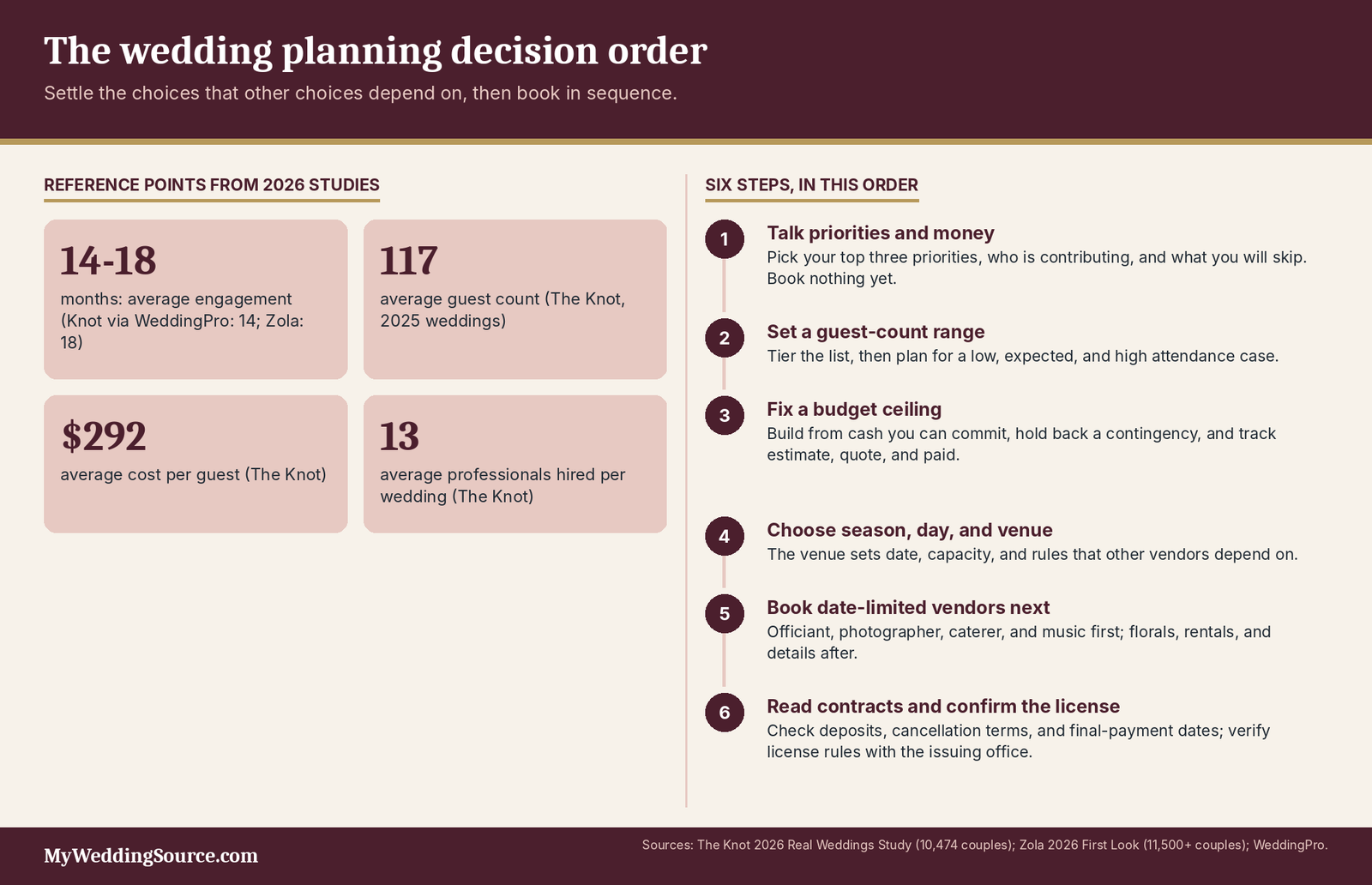
Wedding planning goes smoothly when you decide in the right order: priorities and guest count first, then budget, date, and venue, then the vendors who depend on those choices.
The hardest part of the first month after an engagement is rarely a lack of ideas. It is that everyone around you wants an answer to questions that cannot be answered yet: Where? When? How many people? Who is paying for what? Each of those questions depends on the others, and picking an answer to one at random usually forces a painful redo of two more. A couple who falls in love with a venue before agreeing on a guest count, for example, can discover that the room holds 90 people and the family list has 140.
This guide is the in-depth, start-to-finish companion to our wedding planning hub, which collects every planning topic on the site. It explains the decision order and the reasons behind it, so you can adapt it to a 25-person backyard ceremony, a 175-guest ballroom reception, or a destination weekend. Along the way it flags the points where money, contracts, and legal paperwork are involved, because those are the places where a small misunderstanding can turn into a costly one. It is general education, not financial, legal, or insurance advice, and wedding rules and contract terms vary by state, county, and vendor.
The numbers here come from large couple surveys and official sources, and each is labeled with its year and sample. The Knot’s 2026 Real Weddings Study (10,474 U.S. couples married in 2025) put the average ceremony-and-reception cost at roughly $34,000 with an average of 117 guests, while Zola’s 2026 First Look Report (more than 11,500 couples) reported an average budget of $36,000. Those figures describe what other couples spent, not what your wedding should cost, and they swing widely by region and guest count. Treat them as a sanity check, not a target.
Your first 30 days after getting engaged
The first month is for alignment, not for booking. You do not need a venue deposit in week two, and nothing in the wedding market punishes you for taking a few weeks to talk. What does help is a short list of conversations and a few protective habits that make every later decision easier. If you want a lighter, celebration-focused version of this stage, our page on what to do after getting engaged covers the human side, and the engagement season checklist covers the holiday-timed proposals and announcements.
What should you do in the first week?
The first week is mostly about enjoying the news while avoiding commitments you cannot easily undo. Decide together who gets told first, whether and when to post, and how you will answer the inevitable “have you set a date?” without feeling cornered. A simple line works well: “We’re enjoying being engaged and will share details when we have them.”
Tell people on your own schedule
Parents, grandparents, and close friends often hear the news before you have a plan, and some will immediately offer opinions, venues, or money. You can accept the enthusiasm without accepting the strings. A neutral reply such as “we are going to sort out the basics together and then we’d love your thoughts” buys you time, and it signals that planning decisions will be made by the two of you. If a relative is likely to contribute financially, it is worth knowing that early, but it is better to hear their number and their expectations separately before they shape your priorities.
Hold off on deposits and “engagement-only” deals
Vendors and venues sometimes offer limited-time discounts that reward fast decisions. Some of those offers are genuinely good, but a discount only helps if the date, the guest count, and the budget actually fit. Until you have agreed on those three things, a non-refundable deposit is a bet on a plan that does not exist yet. A reasonable rule for the first month is that you can look, ask questions, and request quotes, but you do not sign or pay anything until the priority and budget conversations in this guide are done.
Protect the practical details
If a ring was part of the proposal, check whether it is covered under a homeowners or renters policy or needs a separate rider, and photograph it with its paperwork. Save the receipt and any appraisal in a shared folder. It is also a good moment to create one shared document or spreadsheet for contacts, quotes, and decisions, because by month six the number of emails, PDFs, and text threads will be larger than anyone remembers. A single source of truth saves real time and prevents the “I thought you were handling that” argument.
What conversations should happen before you search anything?
Three conversations do more work than any app or checklist: what the wedding is for, who is helping financially and on what terms, and how decisions will be shared. They can feel awkward, but they are far cheaper than discovering a mismatch after a venue contract is signed. Block out an unhurried hour for each, ideally away from a screen full of inspiration images.
What do you want the day to feel like?
Start with feelings and logistics rather than aesthetics. Do you want everyone you love in one room, or a quiet ceremony followed by a trip? Is a long, music-heavy reception important, or would a dinner party suit you better? The answers feed directly into guest count, venue type, and budget, so write them down. Couples often find that their answers differ more than they expected, and it is much easier to negotiate those differences in a living room than in a vendor’s office with a deposit invoice on the table.
Who is contributing money, and with what expectations?
Zola’s 2026 spend survey (n=720 couples married within the past 180 days) found that 88% of couples contribute their own money, 29% fully and 59% partially. That means a large share of couples are also working with family contributions, and those contributions come with a range of expectations, from none at all to strong opinions about the guest list. Ask each person who might contribute for a rough amount, whether it is a gift or a loan, and whether it is tied to anything specific, such as paying for the rehearsal dinner. Write it down in plain terms so nobody has to rely on memory later.
How will you split the work?
Zola’s 2026 First Look Report found that 84% of women in heterosexual relationships carry more of the planning load, and 29% of same-sex couples split it equally. Whatever your own pattern is, name it early. One partner may love spreadsheets while the other would rather handle music and the ceremony, and both can be true while the work still feels fair. A weekly 20-minute check-in, with a standing agenda of decisions needed, money spent, and next vendor deadlines, prevents resentment from piling up quietly.
What should be done by day 30?
By the end of the first month you should not have booked much, but you should have a clear working draft of five things. Think of it as a decision memo you could hand to a planner, a parent, or a venue manager without having to explain yourselves. Anything you cannot fill in yet becomes the agenda for your next conversation, which is a better outcome than guessing.
The five-line wedding brief
Write a brief of five lines: the target guest-count range, the total budget ceiling and who funds it, the season or two you are considering, your top three priorities, and the two or three things you are happy to skip. Keep it to a page. A brief like this makes the first venue tour dramatically more productive, since you can tell a coordinator exactly what you need instead of letting the sales process define it for you.
A first-pass timeline
Pick a target window rather than an exact date. Zola reports an average engagement of 18 months in its 2026 report, and WeddingPro’s summary of The Knot’s 2026 study reports 14 months. The gap likely reflects different samples and definitions rather than one number being wrong, and either figure leaves room to do things in order. If your window is much shorter, the tight-timeline scenario later in this guide shows what to prioritize.
A short list of questions for parents and close family
Before the guest list becomes a negotiation, ask each key family member two things: whether anyone is essential to them, and whether anything is important to them for the ceremony itself, such as a cultural or religious element. Zola’s 2026 data show that religious elements appear in 53.9% of Gen Z weddings and 37.5% of Millennial weddings. Asking early lets you build those elements into the plan, rather than squeezing them into a schedule that is already full.
Setting priorities: the three things that decide everything else
A wedding contains hundreds of decisions, but only a handful change the outcome. Priorities are the filter that tells you where to spend extra money, extra time, and extra emotional energy, and where “good enough” is genuinely good enough. Without that filter, every vendor presentation sounds essential.
How do you choose your top three?
Most couples can name their priorities quickly once they stop treating all decisions as equal. The goal is to pick three that are specific enough to guide trade-offs, such as “great food,” “everyone we love can come,” and “an unrushed ceremony.” Broad answers like “beautiful” or “memorable” do not help with a quote comparison. If you struggle to name three, run the exercise below and let the numbers show you what you already believe.
The 100-point exercise
Give each partner 100 points to distribute across categories such as venue, food and drink, photography, music, attire, flowers and decor, guest experience, and travel. Do it separately, then compare. The categories with the highest combined scores are your priorities, and large disagreements are conversations you want to have now. This method is simple, but it works because it forces trade-offs: you cannot give 40 points to photography and 40 to flowers without noticing that something else has to give.
Turning priorities into budget rules
Once the top three are set, convert them into spending rules. A couple who ranks food first might commit to protecting the catering line even if that means simpler flowers. Another who ranks photography first might choose a smaller guest list so that the photo budget does not fight the per-guest cost. Zola’s 2026 report found couples saving on favors (48%) and stationery (36%) while spending more on venue (47%) and photography (45%), which is a useful sign that low-visibility categories are where many couples find flexibility.
How do you handle priorities that conflict?
Conflict is normal, and it usually comes in three forms: partner against partner, couple against family, and ambition against money. Each has a different fix. The shared principle is to talk about the underlying value, not the vendor or item, because values can be satisfied in several ways.
When partners disagree
Ask what the item is meant to do. If one partner wants a live band and the other wants a DJ, the real question might be energy on the dance floor versus a lower cost and a wider song range. The Knot’s 2026 averages show a live band at about $4,500 and a DJ at about $1,800, so the difference is meaningful, but it is not the only variable. You might hire a DJ for the full evening and add a small live ensemble for the ceremony and cocktail hour, which gives you the live sound at a fraction of the full-band price.
When family expectations pull the other way
If a parent is contributing and expects a larger guest list, translate the request into a cost per added guest. The Knot’s 2026 study puts the average cost per guest at $292, so adding 20 guests adds roughly $5,840 in a typical market. Showing that figure is usually more productive than debating loyalty, and it lets the person who is asking decide whether they would like to cover the difference or accept a different compromise, such as an A/B list or a separate celebration.
When your ambitions outgrow your budget
Zola found that six in ten couples say managing their real budget against online inspiration is a top pain point. That tension is common, and it is not a personal failing. A useful test is to ask whether an idea serves one of your three priorities, and if it does not, whether it is worth a trade-off. If the answer is no, you can enjoy it on a mood board without paying for it.
Guest count: the number that drives everything
If you only get one number right before you tour venues, make it the guest count. It sets the minimum room size, the catering bill, the number of invitations, the seating plan, the transportation, and even how many hotel rooms your out-of-town guests need. It also sets the emotional temperature of the day, since a 40-person dinner and a 190-person party are different experiences even in the same building.
How do you build the list without starting a family feud?
Lists get messy when they are built from the top down with no limit. A better method begins with a ceiling and sorts people into tiers, so cuts are principled rather than personal. This also gives you a neutral way to explain the decision when someone is disappointed.
Tier your list before you count it
Sort everyone into three tiers: people you cannot imagine the day without, people you would love to have, and people you would invite if there were no limits. Tier one is usually immediate family and closest friends, tier two is extended family, friends, and colleagues you see often, and tier three is everyone else. Count tier one first. If tier one alone already exceeds your ceiling, you have learned something important before spending any money.
Decide the policy questions once
Questions about plus-ones, children, coworkers, and exes cause more list drama than the names themselves. Pick a simple rule for each and apply it consistently: for example, plus-ones for married or long-term partners only, or no children under a certain age, with an exception for family. A consistent rule is easier to explain than a series of exceptions, and it protects you from being asked “why did they get one?” Several parts of this are also etiquette and family topics that vary by community, so choose rules you can say out loud without apology.
Use an A/B list if the budget is tight
An A/B list lets you invite a first group and send a second round of invitations as declines arrive. Zola describes the B list as people you wish could attend who did not make the first cut, and notes that it does not mean they matter less. It works best when your invitations go out early enough to leave a response window of several weeks, which is one reason an eight-month lead time gives you more room than a three-month one.
How many invited guests will actually show up?
The invitation count and the attending count are different numbers, and the gap is where budgets either breathe or break. Industry rules of thumb vary because attendance depends heavily on distance, season, and how many guests need to travel. The next two subsections show how to estimate the range and what to confirm with your caterer before you rely on it.
What the published estimates say
The Knot reports that some studies put “yes” responses at around 83%, with others ranging from 60% to 85%, and its senior editor suggests planning for about 20% of invitees to decline. Zola’s guest-list guide cites unnamed expert planners estimating that 25 to 40% of invitations will be declined, and gives the example of 120 to 150 attendees from 200 invitations. The difference is not an error; it reflects different assumptions, and the farther your guests have to travel, the more likely you are to land in Zola’s range.
How to plan for a range, not a point
Use your tiers to build a low, expected, and high case. If you invite 140 people, a 20% decline yields about 112 attendees and a 35% decline yields about 91. Ask your caterer and venue whether the final guaranteed count is due 7, 10, or 14 days out, and what the minimum is, because many contracts bill for the guaranteed number whether or not people arrive. The date of that guarantee, not the RSVP deadline you print, is the one that controls your costs.
How does guest count change cost?
Guest count is the largest variable cost lever you control, which is why it is the first thing to settle. Some costs scale directly with headcount, some jump in steps, and some do not move at all. Knowing which category each cost falls into tells you whether trimming the list or trimming something else is the better move.
Per-guest costs scale directly
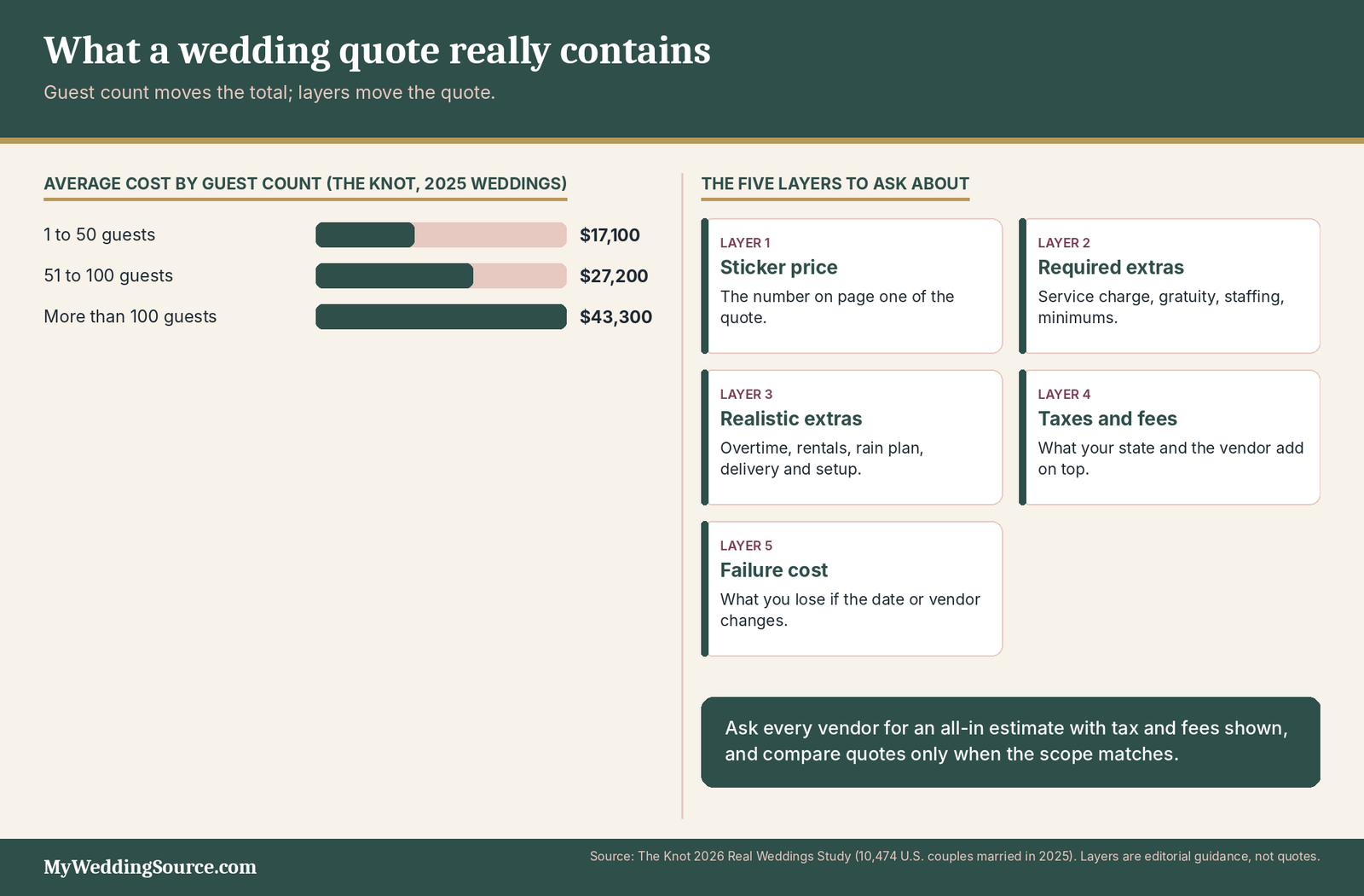
The Knot’s 2026 study puts the average at $292 per guest, which is consistent with $34,200 divided by 117 guests. Zola’s cost page describes each guest as typically adding $150 to $300 in combined costs. Catering, bar service, rentals, stationery, favors, and cake all scale with the number of guests, so these are where a smaller list produces the most visible savings. The Knot’s 2026 averages by guest count were $17,100 for 1 to 50 guests, $27,200 for 51 to 100, and $43,300 for more than 100, which shows that costs rise with headcount but not in a straight line.
Fixed and stepped costs do not move with the list
The photographer, officiant, music, and many floral and decor costs are largely fixed regardless of whether you invite 60 guests or 90. Venue costs behave in steps: a room that holds 100 stays at its price until you outgrow it, and then you pay for the next room or a tent. That is why very small guest-count cuts, such as dropping from 104 to 98, sometimes save little, while crossing a venue’s capacity threshold can change the whole structure of the day.
Building a budget framework you can defend
A budget is a set of rules for making decisions, not a prediction. Its job is to tell you when a quote fits and when it does not, and to keep a surprise from becoming a crisis. This section is general education about how couples build and track budgets; it is not personal financial advice, and your own circumstances, including income, savings, and existing debt, should drive the number. For a deeper walkthrough, see our wedding budget guide.
How much should you plan to spend?
Start from what you can fund, not from what an average says. National figures are context, but your regional market, guest list, and priorities matter far more than any national number. The sections below separate the sources of money from the target spend.
Start with cash you can commit
List the savings you can commit to the wedding without touching emergency funds, the monthly amount you can add between now and the date, and any gifts that have been confirmed. Zola’s 2026 report found that 52% of couples have put major milestones, such as buying a home or paying down student debt, on hold, which is a useful reminder that wedding spending competes with other goals and that its real price includes what it displaces. If a figure feels uncomfortable, it probably is, so adjust the number before you choose vendors.
Put family contributions in writing
Contributions are easiest to manage when you know the amount, whether it is a gift or a loan, and whether anything is attached. A short email summarizing the conversation, such as “Thank you for offering $8,000 toward the wedding, which we understand is a gift with no conditions,” protects everyone. This is not about formality; it keeps a generous offer from turning into a misunderstanding months later.
Think carefully about borrowing
Borrowing for a wedding is a personal decision, and the cost of credit matters. As an illustration, the Federal Reserve’s data on commercial bank credit card accounts that were assessed interest showed an average rate of 22.15% in May 2026, via FRED. Illustrative example, not an offer or a quote: financing $8,000 at 22% over 24 months works out to about $415 per month and roughly $1,960 in interest. Your own rate depends on the product and your credit, so compare the total cost of any option before relying on it, and consider speaking with a nonprofit credit counselor or a licensed advisor about your specific situation.
How should the total be divided?
Percentages are only a starting point, because your priorities should shift them. The table below shows what couples reported spending in two large 2026 data sets. The two sources use different methods, so the numbers do not match, and neither is a quote for your area.
| Category | The Knot 2026 (2025 weddings) | Zola 2026 index | What to check |
|---|---|---|---|
| Venue and site | $12,900 reception venue | $8,573 venue and site fees | What is included, and what is the F&B minimum |
| Catering | About $80 per person | $6,927 | Service charge, tax, and staffing |
| Bar | $2,800 alcohol | $5,542 bar services | Package vs consumption, bartender fees |
| Photography | $3,000 | $4,400 | Hours, second shooter, delivery date |
| Flowers and decor | $2,800 florist plus $1,900 lighting and decor | $6,345 | Delivery, setup, and teardown fees |
| Music | $1,800 DJ or $4,500 live band | $1,567 | Overtime, sound equipment, travel |
| Planner | $2,100 | $4,047 | Service level and hours covered |
| Wedding dress | $2,100 | $2,000 | Alterations and veil are often extra |
Read the table as ranges, not targets
Averages in the Knot data are generally calculated among couples who hired each vendor, while the Zola numbers come from its cost index, built from platform activity and vendor-reported pricing. That is why a number such as photography can differ by more than $1,000 across sources without either being wrong. Use these ranges to catch quotes that look wildly out of pattern, not to decide what you should pay.
Build a contingency line
Zola’s 2026 cost page reports that hidden or unexpected costs averaged $3,314, roughly 9% of total spend. A common planning practice is to hold back 5 to 10% of the budget for items that surface late, such as an extra rental, a venue overtime charge, a dress alteration, or a price increase. If you do not need the cushion, it becomes a honeymoon fund or a savings deposit. If you do, you will be glad it existed.
Include the costs that live outside the wedding day
The Knot’s 2026 study reported that the rehearsal dinner (about $2,800), engagement ring (about $4,600), and honeymoon (about $5,500) sit outside the $34,200 average. Zola’s index shows a similar pattern, with a rehearsal dinner near $2,700 and a honeymoon near $5,300. Add these lines to your budget deliberately, along with tips, welcome bags, hotel blocks, and any hair, makeup, and attire costs for your wedding party if you are covering them.
How do you track the budget once real quotes arrive?
A plan that cannot be updated is a plan that gets ignored. The simplest workable tracker has three columns for every vendor: the estimate you started with, the quote you were given, and what you have actually paid. Review it after every booking, because the budget changes shape the moment a venue is signed.
One ledger, three columns
Estimate, quote, paid. When the sum of quotes drifts above the ceiling, it is time to make a choice, not to hope. The ledger also gives you a clean answer to “where did the money go?” and a ready-made reference for the final payment schedule in the month before the wedding. Update it the same day you receive a quote or send a payment, since a ledger that is a week behind is not much better than none.
Decide in advance what gives
Before the first overrun, agree with your partner on the order in which you will trim: for example, favors and printed extras first, then guest count, then duration, and only then a priority category. Zola’s 2026 data showed couples most often saving on favors and stationery. Having an agreed order of trims turns a stressful argument into a quick check against a list you made when you were calm.
Choosing your date and season
A date is not just a square on a calendar. It determines which venues and vendors are available, how crowded the market is, what the weather and daylight will do, and how easy it is for guests to travel. Many couples choose the date first and then discover that their top-choice venue is booked, which is why we recommend choosing a season and a flexible window instead, and letting the venue help finalize the day.
Which season and month fit your priorities?
Season affects cost, comfort, and mood in ways that are easy to underestimate. The Knot reports that Saturday is the most popular day to wed and that the most popular dates are usually Saturdays in October, September, or June, and it has also reported that more than 67% of couples married in summer or fall in 2023. When many couples want the same weekends, vendors can be selective and prices tend to reflect demand.
Peak season trade-offs
Peak months bring reliable weather in many regions and strong guest availability, but they also bring the highest competition for venues and vendors. If you want a peak-season Saturday, expect to book earlier, and expect less room for negotiating on minimums or package terms. Zola’s suggested timeline begins researching venues at 12 months or more, and a peak date in a popular market may need even more lead time than that.
Shoulder and off-peak options
Shoulder months, such as late spring and early fall in many regions, can offer more availability with comfortable conditions. Off-peak months, such as winter in cold climates, can mean more flexibility on pricing but also practical trade-offs like early sunsets and holiday-season travel. Ask each venue for its published seasonal pricing and what is different about the off-peak package, because “off-peak” can mean a lower rental fee while catering or service-charge terms stay the same.
Which day of the week and time of day?
Day of week is often the quickest way to widen your options, because Saturday evening is the most contested slot. Moving the date by a day or changing the start time can change the room’s availability and sometimes its rental structure. The sections below cover the main options and what to ask about each, so you can compare them on practical grounds rather than habit.
Friday, Sunday, and weekday weddings
A Friday or Sunday wedding can open dates that are otherwise full and may come with different pricing, although that is not guaranteed. Weekday weddings can work well for smaller guest lists, but your guests’ ability to take time off and travel becomes a real factor. If most of your guests are traveling, a Friday evening or Sunday afternoon often fits more easily into a work week than a Tuesday.
Ceremony time, light, and sunset
Sunset time shifts by several hours across the year in most of the country, so a 5 p.m. ceremony in June and a 5 p.m. ceremony in December feel completely different. If you are planning outdoor portraits, ask your photographer to check the sunset time for your date and plan the schedule around it. At the planning stage the main point is simple: build your ceremony start around the light, not the other way around.
| Date choice | Typical advantage | Trade-off | What to ask |
|---|---|---|---|
| Peak-season Saturday | Strong weather and guest availability | Highest demand; earlier booking and less flexibility | Is there a seasonal minimum or surcharge? |
| Shoulder-season Saturday | More date options with comfortable weather | Weather is less predictable | What is the rain or cold plan? |
| Friday or Sunday | Opens dates that are otherwise full | Some guests may need extra time off | Is the rental or food minimum different? |
| Weekday | Most flexible venue availability | Harder for some guests to attend | Are vendors available on that day? |
| Holiday weekend | Built-in travel time for guests | Hotels, flights, and staff costs can rise | What are the holiday staffing and travel charges? |
How do you avoid date conflicts?
Before you commit to a date, run a short check for conflicts that would be hard to fix later. This is one of the least glamorous and most effective steps in the entire process. Two quick checks, one on the guest side and one on the vendor side, catch most of the problems.
Check the guest-side calendar
Look for religious holidays, major local events, school breaks, graduation weekends, and large sports or conference dates that could affect hotel prices and traffic. If your close family has a firm commitment on a given weekend, ask them before you finalize. Sending a quick message to your top-tier guests with two or three possible dates is a courtesy that often prevents a conflict you cannot repair after save-the-dates go out.
Confirm the date in writing before telling anyone
A verbal “we have that date open” does not hold anything. Ask the venue for a written date hold and find out how long it lasts, whether it requires a deposit, and what happens if another couple asks about the same date. Do not announce a date to your guest list until a signed contract or a written hold is in hand.
Venue first: why it anchors almost every other decision
A venue is more than a location. It sets your capacity, your date, your ceiling on the guest count, whether you need to rent tables and chairs, what your catering options are, and in many cases what your rain plan looks like. For that reason, couples and planners usually treat the venue as the first major booking, and almost everything else is planned around it. Our dedicated guide to wedding venues goes into costs, questions, and red flags in detail; this section explains the logic.
Why does the venue come before the photographer, florist, or caterer?
The venue determines the options for the vendors who follow. A vendor cannot quote accurately without knowing the layout, the load-in rules, and the date, so quotes collected before a venue is chosen are often rough guesses. Booking the venue early therefore gives every later quote a fixed foundation, which makes the numbers you collect more reliable.
The venue sets your date and capacity
Capacity limits vary by layout. A room that holds 150 for a standing reception may hold fewer for a plated dinner with a dance floor, and the safe number is set by local fire and building rules and the venue’s own policies. Ask for the capacity for your specific setup, such as seated dinner with dancing, and ask whether the number includes vendors and staff. Choosing a venue that comfortably fits your high-end guest estimate prevents a last-minute squeeze.
The venue dictates the vendor menu
Many venues have required or preferred vendor lists, in-house catering, or restrictions on outside alcohol. The Knot reports that couples booked a venue in 89% of cases, a photographer in 88%, and a caterer in 85%, and many couples find that venue policies shape the latter two. Ask early whether you can bring your own caterer, bartender, or florist, and whether an outside vendor owes the venue a fee, proof of insurance, or both.
What are the main venue types and what do they include?
Venue types vary in what the sticker price covers. The cheapest base rate can be the most expensive final price if the space is a blank canvas that requires you to rent everything. Knowing which category a space falls into helps you ask the right questions on the first tour.
All-inclusive venues
Some venues bundle the space, tables, chairs, catering, and a coordinator into a package priced per guest. These can simplify budgeting, but check the service charge, the gratuity, tax, and the minimum spend. Ask for a sample invoice from a recent event of your size so you can see the pre-tax subtotal, the added fees, and the final total.
Raw-space and outdoor venues
Barns, gardens, parks, and private properties often have lower rental fees, but they may require you to bring in a caterer, rentals, restrooms, lighting, a tent, permits, and insurance. Zola’s 2026 report found outdoor garden venues were the top venue choice for the second year in a row, so demand is high. Because raw spaces shift logistics onto you, price the whole setup, not only the rental.
Restaurants, galleries, and unexpected spaces
Restaurants, breweries, museums, and historic buildings can offer a lot of character and often an included kitchen, but they may have strict hours, capacity limits, noise rules, or buyout minimums. Ask about the schedule for load-in and load-out, whether you can access the room before the event, and whether other guests or events will be on the property. These spaces also tend to have quieter weeknights and slower seasons, so asking about flexibility on days can reveal workable options.
What should you check before you sign?
Before a venue contract, your job is to confirm what the price includes, what the rules are, and what happens if plans change. Doing this on the first tour saves a lot of back-and-forth later. Bring a short written list to every tour so that each venue answers the same questions, which makes them easier to compare.
The questions that reveal the true price
Ask what is included in the rental fee, whether there is a food-and-beverage minimum, what the service charge and tax are, whether setup and cleanup are included, and what the overtime rate is. Also ask about the vendor meal count, the ceremony and reception time windows, and whether a second room is needed for a rain plan. A clear written answer to these questions is the best predictor of a smooth contract.
Rain plans, access, and accessibility
Ask what the rain plan is, who decides when to use it and by when, and whether it carries a cost. Ask about parking, restroom capacity, step-free access, and whether guests with mobility needs can reach every part of the event. These details affect guest comfort and, in some cases, legal obligations that the venue must meet, so ask for specifics rather than general reassurance.
Vendor booking order: who to book first and why
Once your date and venue are set, vendor booking becomes a sequencing exercise. Some vendors can only work one wedding per day, so their calendars fill quickly. Others depend on information from earlier decisions, such as the venue layout or the guest count. The order below is built on that logic, not on a fixed formula.
What determines the booking order?
Three questions determine the order: how limited is the vendor’s capacity on your date, how much does their work depend on other decisions, and how long does it take to deliver? The vendors who are limited by date and difficult to replace come first. The sections below apply those questions to the vendors most couples hire.
Capacity-limited vendors
A photographer, a videographer, an officiant, a DJ or band, and often a caterer can usually serve one event on a given day. If your date is popular, these calendars fill. Booking them after the venue but before decor details keeps your first-choice vendors available. If you are flexible about the date, you can sometimes let the vendor you care about most pick among your options.
Dependent vendors
Florists, rental companies, lighting, and decor designers depend on the venue layout, the guest count, and your color and style decisions. They can be booked later, once those inputs exist, and a quote earlier is a rough range. Hair, makeup, transportation, and the cake often follow the same logic, and they can wait until the date is secured and the schedule is clearer.
Long-lead items
Attire, custom stationery, and some rentals can take months to deliver. A wedding dress, for instance, is often special-ordered, and alterations come on top. Ask each shop for its production time and alterations window in writing, and work backward from your date.
| Order | Vendor or decision | Zola’s suggested window | Why it comes here |
|---|---|---|---|
| 1 | Budget, guest list, planner (if hiring) | 12+ months out | Everything else depends on these |
| 2 | Venue | About 11 months out | Fixes date, capacity, rules |
| 3 | Officiant and photographer | About 10-11 months out | Limited calendars, style matters |
| 4 | Caterer and florist | About 9 months out | Depend on venue and headcount |
| 5 | Band or DJ | About 8 months out | Calendars fill; depends on room and timeline |
| 6 | Save-the-dates | 6-8 months out | Gives guests time to plan travel |
| 7 | Hair and makeup, attire finalization | About 5 months out | Depends on style and schedule |
| 8 | Baker, transportation, signage | About 4 months out | Depends on headcount and logistics |
| 9 | Invitations | Mail by about 6-8 weeks out | RSVP window and final count |
How do you compare quotes fairly?
A quote is only useful if it can be compared to others. The goal is to make each quote describe the same thing: the same hours, the same deliverables, the same fees. Without that discipline, a lower number often just reflects a smaller scope, which becomes clear only after you have paid a deposit.
Build a same-scope request
Send each vendor the same short brief: date, venue, guest count, hours of coverage or service, and your top priorities. Ask for an itemized quote with taxes and fees. The Knot’s 2026 study reports that 37% of couples contacted more vendors than they initially planned in order to find budget-friendly options, which suggests that comparing three to five quotes is common and normal.
Pay attention to responsiveness and fit
The Knot reports that 52% of couples cite responsiveness as key to building trust with a vendor, and that personality is a top factor for 53% choosing a DJ and 50% choosing a planner. A vendor who takes two weeks to reply before you have paid anything may not speed up afterward. Fit matters too, since you will be spending a long day with these people.
Where does this fit on a calendar?
The sequence above fits into a schedule of five phases. This guide keeps the calendar brief on purpose; the full version lives in our month-by-month wedding timeline. Think of the phases as a map of when each kind of decision becomes useful rather than as deadlines carved in stone.
The five phases in brief
Phase one (12+ months out) is foundations: priorities, guest range, budget, and a planner if you want one. Phase two (11 to 8 months) is the big bookings: venue, officiant, photographer, caterer, and music. Phase three (7 to 4 months) is design and guest communication: save-the-dates, attire, florals, and invitations. Phase four (3 to 1 months) is logistics: licenses, final counts, seating, and the day-of schedule. Phase five is the final week and the day itself.
Where to find the full schedule
If you want specific tasks by month, the full timeline guide breaks the process down in more detail than this overview. Use this page for decisions and reasoning, and use the timeline page as your checklist. A short engagement, covered in the scenarios section below, compresses the phases rather than skipping them.
Planner, DIY, or partial help: how much support do you need?
The honest answer is that it depends on your time, your guest count, and how many moving parts the venue leaves to you. A wedding does not require a planner, and a planner does not guarantee a calmer process. But the work is real: Zola’s planner guidance cites average planning time of over 200 hours, which is roughly the equivalent of five full-time work weeks spread across a year or more. The useful question is not whether planners are worth it in general, but which parts of the job you want to hand off.
What does each level of help actually do?
Planning help comes in tiers, and the labels are not standardized across companies. Always read the scope in the proposal instead of relying on the name of the package. Use the descriptions below as a starting vocabulary, and ask every planner to list exactly which tasks are included.
Full-service planning
A full-service planner typically helps from early in the engagement through the wedding day: budget, venue search, vendor selection, contracts, design, and day-of management. The Knot’s 2026 data put the average full-service cost at about $3,800, and Zola’s index reports an average of $4,047 with a typical range of $3,200 to $4,900. The Knot quotes planner Ashley Allan as saying a lead planner spends 150 to 250 hours on a wedding, which is a helpful way to understand why the fee can be several thousand dollars. Zola suggests hiring a full-service planner within the first month or two of the engagement, since the value is highest when they help with the earliest decisions.
Partial and month-of planning
Partial planners take on part of the process, often joining a few months before the wedding to review contracts, build the timeline, confirm vendors, and run the day. Zola describes partial planning as costing about 40 to 60% of full-service, usually $1,500 to $2,800. The Knot’s data show an average of about $2,400 for month-of coordination. This tier suits couples who have made the major bookings themselves and want help with the final stretch.
Day-of coordinators and venue coordinators
A day-of coordinator manages the wedding day itself, usually beginning contact four to six weeks ahead. The Knot reports an average of $1,600 for day-of coordinators, and Zola cites a range of $800 to $3,000. A venue coordinator is different, because that person works for the venue and handles on-site logistics but not your other vendors or personal preferences. Ask each venue what its coordinator does and does not cover, and do not assume the two roles are interchangeable.
How do you decide which level fits?
A simple decision framework uses three tests: time, complexity, and risk tolerance. None of them is about whether you can afford help in the abstract; they are about how you want to use your hours. Answer them honestly with your partner, because the same couple can reach different conclusions depending on how much time they will really have.
The time test
If both partners work demanding jobs, if you are planning from out of state, or if you have a short engagement, the hours required may exceed what you can give. Zola suggests that couples who plan alone budget about three to five hours per week. If that is more than you can protect, you may want a partial or full-service planner, or a smaller wedding.
The complexity test
Complexity comes from guest count, venue type, and number of vendors. The Knot reports that couples hire an average of 13 wedding professionals, and a raw-space venue or a multi-day event adds more. Zola’s guidance suggests that a guest list over 150, a blank-canvas venue, or an unfamiliar location are all reasons to consider a full-service planner. In contrast, a 60-person dinner in a restaurant with an event manager usually does not need one.
Where AI tools fit
Zola’s 2026 First Look Report found that 54% of couples used AI in planning, most often for etiquette questions (54%), timelines and to-do lists (44%), and drafting vendor or guest emails (40%), and that 99% agree human vendors remain essential. The Knot’s 2026 press release reports a lower figure, with AI adoption among engaged couples reaching 36%, which probably reflects a different sample and definition. In practice, AI works well as a drafting and organizing assistant, but it cannot confirm that a vendor is available, interpret your specific contract, or know your county’s license rules, so verify anything that carries money or legal weight against the original source.
| Task | You (DIY) | Venue coordinator | Day-of coordinator | Full-service planner |
|---|---|---|---|---|
| Budget tracking | You | Not included | Not included | Yes |
| Finding and comparing vendors | You | Venue’s preferred list | Not included | Yes |
| Reviewing contracts | You | Reviews venue contract only | Often reviews the final-month details | Yes |
| Design and decor | You | Limited | Executes your plan | Designs and sources |
| Day-of timeline | You or a friend | Venue’s portion only | Yes | Yes |
| Managing vendors on the day | You or a friend | Not included | Yes | Yes |
| Guest questions and logistics | You | Venue-related only | Day-of questions | Yes |
How do you do it yourself without burning out?
A DIY approach works best when it has structure. The couples who thrive typically assign owners, set a weekly rhythm, and put one trusted person in charge of the wedding day so neither partner has to answer questions during their own ceremony. Handled well, a self-planned wedding can feel more personal and cost less, but only if the workload is shared and the day itself is delegated.
Divide the work by decision, not by task
Give each partner ownership of whole areas, such as food and beverage for one and music and ceremony for the other, instead of splitting tasks randomly. Ownership means one person does the research, collects quotes, and brings a recommendation. This reduces the number of conversations needed and makes it easier to track who is waiting on what.
Appoint a day-of point person and write the binder
If a professional coordinator is not in the budget, Zola recommends asking an organized friend or relative to act as the coordinator with a detailed binder of timelines, contacts, and floor plans. Pick someone who is not in the wedding party and not a close family member who will want to enjoy the day. Give that person authority to make small decisions, and give vendors their phone number so questions do not reach you.
Contracts, deposits, payment schedules, and insurance
Contracts are where a wedding stops being a plan and becomes a set of obligations. Because the average couple hires 13 wedding professionals, according to The Knot’s 2026 study, the typical wedding comes with a stack of vendor agreements, each with its own deposit, cancellation terms, and deadlines. This section is general education, not legal advice. Contract terms and state laws vary, so read your own agreements closely and consider having an attorney review anything with significant financial exposure. For a deeper treatment, see our wedding vendor contract guide.
What should every wedding contract say?
A good contract is specific enough that a stranger could read it and know exactly what was promised. The goal is not suspicion; it is clarity. Vendors benefit from clear contracts too, since they protect everyone when plans change.
Scope, dates, and names
Check that the contract lists your name, the date, the venue, the start and end times, the specific services, and the person or team who will perform them. If a photographer’s style is why you hired them, check whether the contract allows them to send a substitute. Vague language such as “full coverage” or “standard package” should be replaced with defined hours and deliverables.
Deposit, final payment, and cancellation terms
Look for the deposit amount, whether it is refundable, the dates for each payment, and what you owe if you cancel or postpone. Ask whether a date change is allowed and at what cost, because postponement terms differ from cancellation terms. Illustrative example, not a standard: some couples see a schedule such as a deposit at signing, a second payment a few months before, and a balance one to four weeks before the wedding, but every vendor sets its own.
Fees that are easy to miss
Look for service charges, gratuity, overtime, travel fees, delivery and setup fees, equipment rentals, and sales tax. Ask whether the stated price includes them. If a fee is “TBD,” ask for a cap or a written estimate before you sign.
| Clause | Why it matters | A clear answer looks like | A reason to pause |
|---|---|---|---|
| Deposit refundability | Determines what you lose if plans change | States whether any amount is refundable, and when | Vague or verbal-only terms |
| Cancellation and postponement | Controls the cost of changing course | Written schedule with dates and amounts | Only the vendor can cancel without penalty |
| Final payment date | Affects your cash flow | A specific date and method | A date that is earlier than the service is delivered, with no explanation |
| Substitution | Protects the person or style you hired | Names the lead and sets a replacement process | “Or a similar professional” with no standard |
| Overtime and extras | Prevents surprise charges | Hourly rate listed in advance | Rates “to be determined” |
| Venue closure or force majeure | Covers events outside anyone’s control | Explains refunds or rescheduling | Silence on what happens if the venue cannot open |
| Liability insurance | Required by many venues | States coverage required and any named insured | Requirements revealed after signing |
How do you pay in ways that protect you?
Paying is where documentation matters most. The best habit is to treat every payment as something you may need to prove later. Small habits here, such as one folder for contracts and one payment method per vendor type, make disputes and reconciliations far easier.
Use traceable payments and keep records
Pay by methods that leave a record, such as a credit card or a check or bank transfer to a business account that matches the contract. Save every invoice, receipt, and email confirmation in your shared folder. Be cautious with requests to pay by gift card, cryptocurrency, or personal peer-to-peer apps, and be wary of last-minute changes to payment instructions, which can signal a scam.
Know your credit-card dispute window
The FTC explains that a billing dispute letter must reach the card issuer within 60 days after the first bill showing the error was sent, and lists purchases that “weren’t delivered as agreed” among disputable billing errors. That is a tight window, so a problem noticed after a long delay may not qualify, and the rules for quality disputes are different and require trying to resolve things with the seller first. Treat this as general information and check with your card issuer about its terms. See the FTC’s guidance on disputing credit card charges.
What insurance should you understand?
Wedding insurance is easy to oversimplify. There are three separate things people mean by it, and each covers something different. Separating them helps you ask the right questions of both your agent and your venue before you spend money on a policy.
Cancellation coverage versus event liability
The National Association of Insurance Commissioners (NAIC) distinguishes liability insurance, which covers injury or property damage to others as a result of your event, from cancellation insurance, which provides coverage for expenses arising from delays, rescheduling, or cancellations. Reimbursement is typically unavailable if you voluntarily call off the event. Read the exclusions and the definition of covered reasons before you buy, and note that coverage may take several days to take effect, so purchase it once vendor contracts or deposits are in place. The details are in the NAIC consumer guidance on event insurance.
Vendor insurance and venue requirements
Some venues require a minimum amount of event liability insurance and may ask to be named as an additional insured on your policy. Many venues also require outside vendors to carry their own insurance and provide a certificate. Ask for the venue’s requirement in writing early, since it can affect your vendor choices and your budget. If you host at home or on private property, ask your homeowners or renters insurance agent whether the policy extends to a scheduled event.
Food, drink, and dietary needs: decisions that shape the guest experience
Food and drink are usually the largest per-guest expense, and they are also what guests remember most vividly. The decisions here are about format, staffing, alcohol, and dietary safety, and each one has cost and logistics implications that are easy to miss in a tasting. The goal is not to find the most impressive menu but to match a format to your venue, schedule, and priorities.
Which catering format fits your wedding?
Format drives staffing, timing, rentals, and the feel of the evening. The Knot’s 2026 study reported an average catering cost of about $80 per person, while Zola’s index reports $6,927 as the average catering line, and both numbers depend heavily on region and format. Whatever you choose, ask for the per-person price with labor, service charge, and rentals included, so you compare totals instead of menus.
Plated, buffet, stations, and family style
A plated dinner gives a formal feel and predictable pacing but requires more servers and often a choice of entrées decided in advance. A buffet can lower staffing needs and offer variety, although long lines can slow the evening if the guest count is high. Stations and family-style service add interaction and a more relaxed feel, but they need more equipment and sometimes more space. Ask each caterer for a per-person total for the format you prefer, including labor, rentals, and service charge, instead of comparing menu prices alone.
Venue kitchen and caterer rules
Some venues have an in-house kitchen and required caterer, while others allow outside caterers with conditions. Ask whether a caterer needs a commercial kitchen, how much setup time they need, and who handles trash, staffing, and cleanup. In raw-space venues, a caterer who has worked there before often knows the quirks, which can prevent timing surprises.
The tasting and the headcount
A tasting is your chance to test quality, portion size, and dietary options, but it is not a full rehearsal for service for 120 people. Ask how the caterer scales recipes for large events and what the plan is for vegetarian, vegan, and allergy-friendly meals. Confirm when the final guaranteed headcount is due, because that number usually sets what you pay.
How should you plan the bar?
Bar decisions are partly about money and partly about how you want your guests to feel. Alcohol is also regulated, so the venue, caterer, and bartender should be able to explain what license or permit covers service at your location. Cost is easiest to manage when you decide the structure of the bar before you choose the drinks.
Package, consumption, or limited bar
Open-bar packages charge per person per hour and are predictable. Consumption bars charge for what is poured and can cost more or less depending on guest behavior. A limited bar, such as beer, wine, and a signature cocktail, can reduce cost while keeping the experience social. The Knot’s 2026 averages show alcohol at about $2,800 and Zola’s index reports $5,542 for bar services, a gap that reflects differences in what each source counts and in the markets they cover.
Licensing, liability, and non-alcoholic options
Rules about who may serve alcohol, whether you can bring your own, and what permits are needed vary by state and sometimes by county. Ask your venue or caterer to confirm in writing who holds the license and what the liability coverage is, and check your state’s alcohol control agency if you plan to bring your own. Include appealing non-alcoholic drinks, since some guests do not drink for health, religious, or personal reasons.
How do you handle allergies and dietary needs responsibly?
Dietary safety is operational, not decorative. The goal is to give the caterer accurate information in time and to make the process visible to guests who need it. This is general information and not medical advice; guests with serious allergies should make their own decisions with their healthcare providers.
Collect the information early
Add a dietary needs line to your RSVP so guests can note allergies and restrictions. The FDA recognizes nine major food allergens: milk, eggs, fish, crustacean shellfish, tree nuts, peanuts, wheat, soybeans, and sesame (see the FDA’s food allergy overview). Share the list with the caterer well before the final headcount and ask them to confirm how they will prevent cross-contact in the kitchen and on the line.
Make it clear at the event
Ask the caterer how allergy-friendly plates will be labeled and delivered, who the servers should ask if they have a question, and whether the kitchen can prepare these meals separately. Buffets and stations raise cross-contact risks that a plated meal can reduce, so for a guest with a severe allergy it is worth asking for a plated alternative. A short conversation with the guest in advance, rather than a surprise on the day, is usually the kindest and safest approach.
Invitations, attire, entertainment, and decor: the details that shape guest experience
Once the major bookings are in place, the work shifts to details that guests actually touch and see. These choices benefit from restraint: pick the few that serve your priorities, and make the rest easy. The decisions below are described at a decision level, because detailed buying guides for flowers, dresses, and photography live in their own articles.
How do you handle invitations, the website, and RSVPs?
Guest communication is a sequence: a first notice, details, and a response deadline. The timing matters more than the paper stock. Each piece should answer the question a guest has at that stage, and the website should hold everything that does not fit on paper.
Save-the-dates and invitations
Zola advises sending save-the-dates six to eight months before the wedding and mailing invitations no later than six weeks before, with around two months a common target. If many guests are traveling, or if your date falls on a holiday weekend, lean toward the earlier end. A sensible buffer is to set the RSVP deadline at least three weeks before your caterer’s guarantee date, so you have time to follow up with late responders.
The wedding website and registry
A website saves you from answering the same question fifty times. Include the schedule, directions, parking, lodging options, dress code, and registry links. Zola reports that 87% of couples include at least one cash fund in their registry, so that option is now widely expected. Keep personal details, such as a private address or your full itinerary, in the invitation or on a password-protected page if you are concerned about privacy.
How do you decide on attire and the ceremony?
Attire and ceremony choices are personal, and they carry deadlines that are easy to miss. Wedding dresses and suits can take months to order and alter, so start with the timeline instead of the style. Starting with the calendar keeps you from falling in love with something that cannot arrive in time.
Lead times and fittings
Zola’s timeline schedules attire appointments about ten months out and the first fitting about two months before the wedding. Ask each shop for the production time, the alterations window, and the cost of alterations in writing. Build in a buffer for shipping delays and a final fitting close enough to the date that your measurements are current.
Ceremony structure and personal touches
The Knot reports that 61% of couples wrote their own vows, and 32% incorporate religious, ethnic, or cultural elements. Decide how long the ceremony should run, who will officiate, whether to include readings or music, and whether you want a unity ritual. Meet your officiant early, confirm that they are authorized to perform marriages in the state where you are marrying, and share a draft of the program so everyone is working from the same plan.
How do you choose entertainment, photography, and video?
Entertainment and media are the vendors who most shape the feel and the memory of the day. Their contracts also contain the most technical details, so a few questions up front go a long way. Both categories reward asking for specifics before you sign, because the details of hours, equipment, and rights are where surprises tend to hide.
Music and the flow of the evening
A DJ costs about $1,800 on average in The Knot’s 2026 data, and a live band about $4,500, with Zola’s music index at $1,567. Think about the flow of the evening: ceremony music, cocktail hour, dinner, and dancing, each with different needs. Ask about equipment, backup plans, overtime, and the process for giving a do-not-play list.
Photo and video priorities
The Knot reports that couples spend about $3,000 on photography and $2,300 on videography on average. Zola’s 2026 data found that 67% of couples prefer natural, unposed photography, and that 45% say they are spending more on photography. Ask about coverage hours, second photographers, delivery timeline, usage rights, and backup procedures, and write your must-capture list early so it is built into the schedule.
How do you approach decor and flowers?
Decor can be where costs expand quietly, because each element adds delivery, setup, and teardown. Start with what the venue already offers and add only what supports your priorities. Deciding what you will not decorate is as useful as deciding what you will.
Work with the venue, not against it
A venue with strong natural features may need little decoration, while a plain room may need lighting and structure to feel finished. The Knot’s 2026 averages show about $2,800 for florals and about $1,900 for lighting and decor, while Zola’s index reports $6,345 for flowers and decor combined. Ask your venue about restrictions such as open flames, hanging items, and confetti, and about delivery and teardown windows.
Reuse, rent, and repurpose
Zola reports that 49% of couples use locally sourced or seasonal blooms and 39% use vintage or pre-loved decor. Seasonal flowers, ceremony pieces that move to the reception, and rented items can lower cost and waste. Decide whether the bouquet, centerpieces, or ceremony arch is your priority and spend around that, and confirm who is responsible for moving and returning rentals after the event.
Legal basics: the marriage license and what varies by state
The legal side of a wedding is smaller than the party but not optional. A marriage license is the document that legally permits you to marry, and the rules for getting one vary by state and sometimes by county. This section is a general overview and not legal advice. Always confirm requirements with the official office in the place where you will marry, and see our guide on marriage license verification for a step-by-step way to check.
What is a marriage license, and how is it different from a certificate?
USA.gov explains the distinction clearly: a marriage license legally allows you to marry, and a marriage certificate proves that you got married. You apply for the first before the ceremony and receive the second, or a certified copy, afterward. The practical consequence is that the license is the step with deadlines, and the certificate is the document you will need for years afterward.
Where do you apply?
USA.gov directs people to contact the vital records office in the state where they plan to marry, and in practice many states route applications through a county or local clerk. Because the process is administered locally, the right office depends on where the ceremony will take place, not where you live. Search for the official government site for that state or county, and be cautious of third-party sites that charge extra fees for a form that the government provides directly.
How long is a license valid?
USA.gov notes that most marriage licenses expire within 30 days to a year, depending on the issuing state, and that if a license expires or is lost before the wedding, you must apply for a new one. This means the timing of your application matters. Applying too early can be as problematic as applying too late, so check the validity window before you pick an application date.
What varies by state and county?
Almost everything about the mechanics varies: the fee, the waiting period, the documents required, who may officiate, whether witnesses are needed, and how the signed license is returned. A single example illustrates the range without describing the nation. The examples below show how much variation exists, so that you know to check rather than assume.
An example from one Texas county
As an illustration only, Fort Bend County, Texas, describes a 72-hour waiting period between purchasing a license and the ceremony, with exemptions for certain groups and for couples who complete a state-approved premarital course, and a license valid for 90 days. Its published fee was $71, reduced to $11 with proof of the course. Other states and counties set different periods, fees, and exemptions, so this is not a template for anywhere else, and you should read the Fort Bend County requirements only if that is where you are marrying.
Officiants and witnesses
A 1988 CDC handbook on marriage registration (older, but still a useful statement of the principle) notes that the licensing authority permits marriage by any person duly authorized under the laws of the state, and advises officiants to know the state and local regulations. Whether a friend can officiate, whether a one-day designation is available, and whether witnesses are required are all state-specific. Ask the issuing office before assuming that a friend’s online ordination will be accepted.
| Step | What it is | Typical timing | Where to verify |
|---|---|---|---|
| Find the issuing office | State, county, or local clerk | Research about 6 months out (Zola) | Official state or county government site |
| Gather documents | ID, and sometimes other records | Before application | The issuing office’s checklist |
| Waiting period | A required gap before marrying, in some places | Varies | Issuing office |
| License validity window | The period in which you must marry | 30 days to a year, by state | Issuing office; USA.gov overview |
| Officiant authorization | Who may legally perform the ceremony | Confirm early | State law and issuing office |
| Witnesses | Required in some places | Confirm early | Issuing office |
| Return of the signed license | Usually done by the officiant or couple | Within a set time after the ceremony | Issuing office |
| Certified copies | Needed for name changes and other records | Order after recording | State vital records office |
What about weddings outside your home state or country?
Legal rules follow the place where you marry. A destination wedding adds layers: local legal requirements, residency or paperwork rules, and the need for documents that your home state will accept later. Plan for extra time at every step, and keep official copies of anything you submit.
Getting married in another state
If you marry in a different state, you generally use the license process for the state where the ceremony takes place. That means checking its waiting period and validity window against your travel dates, and finding out whether you must apply in person. Couples who are traveling for the license should plan for a buffer day in case of delays.
Marrying abroad
Requirements for marrying in another country are set by that country, and they can include documents, residency periods, and translations. USA.gov directs people married abroad to the embassy or consulate of the country where the marriage occurred for copies of certificates. Check the destination’s rules through its official embassy or consulate, and confirm current travel document requirements at travel.state.gov before you commit to dates.
How the plan changes for different couples and wedding sizes
The decision order in this guide holds for almost every wedding, but the emphasis shifts with size, location, and timeline. A 30-person dinner and a 180-person ballroom reception share a skeleton and almost nothing else. The scenarios below show where each type of wedding should spend its attention, using real reference points where they exist and clearly labeled judgment where they do not.
Small weddings: micro and intimate
Small weddings are not simply scaled-down large ones. Fixed costs take up a larger share of a smaller budget, and the guest list becomes a more emotional topic because every name matters. The upside is flexibility, since small groups fit venues that large ones cannot.
The micro wedding
A micro wedding is usually described as about 50 guests or fewer. The Knot’s 2026 averages put total costs at $17,100 for weddings of 1 to 50 guests, which is lower than the larger tiers but still not trivial, because venue, photography, and officiant costs do not shrink in proportion. The best use of a smaller headcount is often quality per guest, such as a restaurant buyout, a private dining room, or a rented house, instead of a stripped-down version of a large reception. Check that the space’s minimum spend does not exceed what a small group can reasonably consume.
Elopements and courthouse ceremonies with a later celebration
Some couples handle the legal ceremony privately and hold a celebration later, which separates a time-sensitive legal step from a flexible social one. Check the county’s license process, since some offices offer same-day ceremonies and others require advance appointments or waiting periods. If you plan a later party, you can keep the paperwork simple and spend your planning energy on the part that guests will actually attend.
Mid-size and large guest lists
Once a list passes about 100 guests, logistics start to dominate: seating charts, traffic flow, catering service speed, and sound. This is also the range where a planner or coordinator moves from nice-to-have to practical. The Knot’s 2026 average for weddings over 100 guests was $43,300, and the overall average guest count was 117.
The 100-guest wedding
At about 100 guests, you are in the middle of the market, and most venue types are available. Typical priorities include a firm RSVP deadline, an organized seating plan, and a catering format that serves everyone without long waits. The Knot’s 2026 average for 51 to 100 guests was $27,200. Pay special attention to the ratio of venue capacity to your guest count, since a room that holds exactly 100 will feel crowded with a dance floor.
The 150-plus guest wedding
Large weddings reward early booking, a coordinator, and strong communication. Costs also swing with location: Zola’s cost page reports a 150-guest wedding at about $84,649 in San Francisco and $42,571 in Milwaukee, a gap of more than $40,000 for the same headcount. Consider a room flip schedule if the ceremony and reception share a space, ask your caterer about service staff ratios, and plan transportation and parking in advance.
When logistics are the constraint
Some weddings are defined by distance or time. These two are the most common, and both reward couples who decide the big items fast and keep the rest simple. Each also changes how to read the budget, because the main cost drivers shift.
Destination weddings
A destination wedding adds travel, lodging, legal paperwork, and a guest list that shrinks because travel is hard. The Knot notes that out-of-town and out-of-country guests are more likely to decline, so plan for a lower attendance rate than a local wedding. The Knot’s 2026 data put the average destination planner at about $2,700, and notes that most couples planning from afar hired full-service planners. Check legal requirements for marrying in the destination, confirm passport and entry rules at travel.state.gov, reserve a hotel room block, and ask your insurance agent whether a policy covers events in other countries, since the NAIC cautions that a general event policy may not cover costs incurred abroad. Treat the destination as its own sub-project with its own checklist, legal research, and travel timeline.
Tight timelines
Planning in six months or less is entirely possible, but the order matters more. Pick the date and venue within the first few weeks, because availability is the main constraint, and consider off-peak days of the week to widen the field. Choose attire that is in stock or has a short production window, simplify the vendor list, and send invitations as soon as the date is set. Hire a partial planner or coordinator early, because a compressed schedule leaves less time to correct mistakes, and keep reading contracts carefully even when the pace is quick.
| Scenario | Biggest lever | Main watch-out | Reference point |
|---|---|---|---|
| Micro wedding (about 50 or fewer) | Venue type and quality per guest | Fixed costs and minimum spends | Knot 2026: $17,100 average, 1-50 guests |
| 100 guests | Format and flow | Capacity vs. dance floor | Knot 2026: $27,200 average, 51-100 guests |
| 150+ guests | Coordinator and logistics | Region drives cost | Knot 2026: $43,300 average, over 100; Zola: $42,571 (Milwaukee) to $84,649 (San Francisco) for 150 guests |
| Destination | Legal paperwork and guest travel | Lower attendance; insurance abroad | Knot 2026: $2,700 average destination planner |
| Tight timeline (6 months or less) | Fast date and venue decision | Availability and lead times | Zola suggests 11 months for venue, so expect fewer options |
Wedding week and day-of handoffs
The last weeks are where early organization pays off. The goal is for the wedding to run without you being the person who answers every question. That means decisions made in advance, written down, and handed to someone else.
What happens in the final month and week?
The final month is mostly confirmation. Almost nothing here is new work, but it has deadlines that cannot slip. Treat this stage as a checklist of conversations instead of a list of tasks to invent.
Final counts, payments, and tips
Give your caterer the final guaranteed headcount by the date in your contract. Zola’s week-of guidance calls for making final payments and placing tips in labeled envelopes for vendors, and reviewing everything on a call with your planner or coordinator. Make a payment calendar from your ledger so that no vendor balance is missed. If you plan to tip, check each contract, because some include a service charge that covers gratuity and others do not.
Confirm every vendor in writing
A week out, send each vendor the final timeline, venue address, contact numbers, and load-in details, and ask for a written confirmation of arrival time. Share a day-of contact who is not you. Confirm delivery windows for flowers, rentals, and cake, and ask for the vendor’s backup plan if a person or truck is delayed.
The rehearsal and the emergency kit
Rehearse the ceremony with the wedding party the day before, confirming where everyone stands and how they move through the processional. Assemble an emergency kit with items such as sewing supplies, stain remover, pain relievers, tape, phone chargers, snacks, and a copy of your marriage license paperwork. Keep the kit with the day-of point person, not in a bag you have to retrieve yourself.
How should the day be handed off?
On the day, your job is to be the couple. A clear handoff means someone else owns every task between getting dressed and the last dance. The steps below show how to assign responsibilities and build a schedule that tolerates delay.
Who owns what
List every responsibility on the day, such as vendor arrival, ceremony cues, family photos, payments, and cleanup, and assign a name to each. A planner or coordinator usually holds most of these. If you do not have one, spread the roles across several reliable people and give them a one-page sheet.
Build the schedule with buffers
Add 10 to 15 minutes of buffer to anything involving transportation, group photos, or costume changes. The most common timeline failure is not a disaster but a series of small delays that stack. Share the schedule with vendors, the wedding party, and your day-of lead, and keep a printed copy.
What to prepare for when plans change
A written plan for rain, a late vendor, or a missing item turns a crisis into a decision. Ask your coordinator which problems they see most often, and decide in advance who has authority to approve changes and costs. Keep the license, the officiant’s contact, and your vendor list in one folder.
| Risk | Likelihood | Impact | Prevention | Backup |
|---|---|---|---|---|
| Weather disrupts outdoor plans | Varies by season | High | Rain plan in the contract | Indoor space or tent with a decision deadline |
| Vendor arrives late | Low to moderate | Moderate | Written arrival times | Day-of lead and vendor backup contact |
| Timeline slips | Moderate | Moderate | Buffers and a coordinator | Pre-agreed items to cut |
| Headcount mismatch | Moderate | Moderate | Firm RSVP deadline | Caterer’s overage policy |
| Dietary reaction | Low | High | Allergy information collected early | Labeled plates, a staff contact, and a plan for emergencies |
| License or documents missing | Low | High | One folder, copies in two places | Contact the issuing office |
After the wedding: paperwork, money, and wrapping up
The wedding ends on a Saturday night, but the administrative tail runs for weeks. It is not exciting, but doing it in order prevents small problems from becoming larger ones, such as a name mismatch on a passport or a missed vendor dispute window. A short, ordered list keeps the work manageable, and most of it can be done in a single afternoon.
What legal and name-change paperwork comes first?
The sequence matters because later steps depend on earlier ones. Begin with the document that proves the marriage, then update identity records in a sensible order. Gathering certified copies first saves repeated trips and fees later.
Return the license and order certified copies
Make sure the signed license is returned to the issuing office within the time that office allows. Then order several certified copies of the marriage certificate, because most agencies want an original or certified copy and will not accept a photocopy. If you are not sure whom to ask, USA.gov explains that copies come from the vital records office in the state where the marriage took place.
Changing your name, if you choose to
A name change is optional and personal. The Social Security Administration’s Form SS-5 states that applying for a card is free and that it accepts only original or certified copies of documents, so update Social Security first and then work through your driver’s license, passport, banks, employer, and other accounts. For a U.S. passport, the State Department says that if less than a year has passed since your passport was issued, you can use Form DS-5504 by mail with a certified marriage certificate at no fee for the name change, while a passport more than a year old follows the renewal or in-person route. For the full sequence, see our name change after marriage guide.
What financial and vendor loose ends remain?
Money matters do not end when the party does. A short checklist protects you from missed payments, missed disputes, and lost files. Most of these steps have deadlines that are easy to miss in the first weeks of married life.
Reconcile invoices and pay final balances
Compare every final invoice against your contract, and ask about any charge you do not recognize quickly, since billing disputes have short windows. The FTC says a dispute letter must reach your card issuer within 60 days after the first bill showing the error was sent. Keep digital copies of contracts, invoices, and receipts for at least the period your tax and legal advisors recommend.
Health coverage and other life updates
HealthCare.gov lists getting married among the life events that can qualify you for a Special Enrollment Period, and says you usually have 60 days before or after the event to enroll, although the exact window depends on the situation. Review beneficiary designations, insurance, and workplace benefits with the relevant providers. For tax or legal questions, consult a qualified professional, since the right answer depends on your circumstances.
How do you wrap up the experience?
Wrapping up is also about gratitude and memory. A few small steps preserve what the day produced. These steps cost little and are easiest to do while the memories and paperwork are still fresh.
Thank-you notes, reviews, and photos
Zola suggests sending thank-you cards within three months. Check your photographer’s delivery timeline against the contract, back up all files in two places, and leave honest reviews for the vendors who did well, since reviews help other couples. If a vendor missed something, contact them first in writing so there is a record.
Preserve what you want to keep
Decide what to do with the dress, bouquet, and keepsakes within a few weeks, because delays can affect how well they can be cleaned or preserved. Return rentals on time to avoid late fees, and settle any deposit refunds, such as for a venue damage deposit. Then take a moment to rest, since a planning process that lasted a year or more is allowed to end.
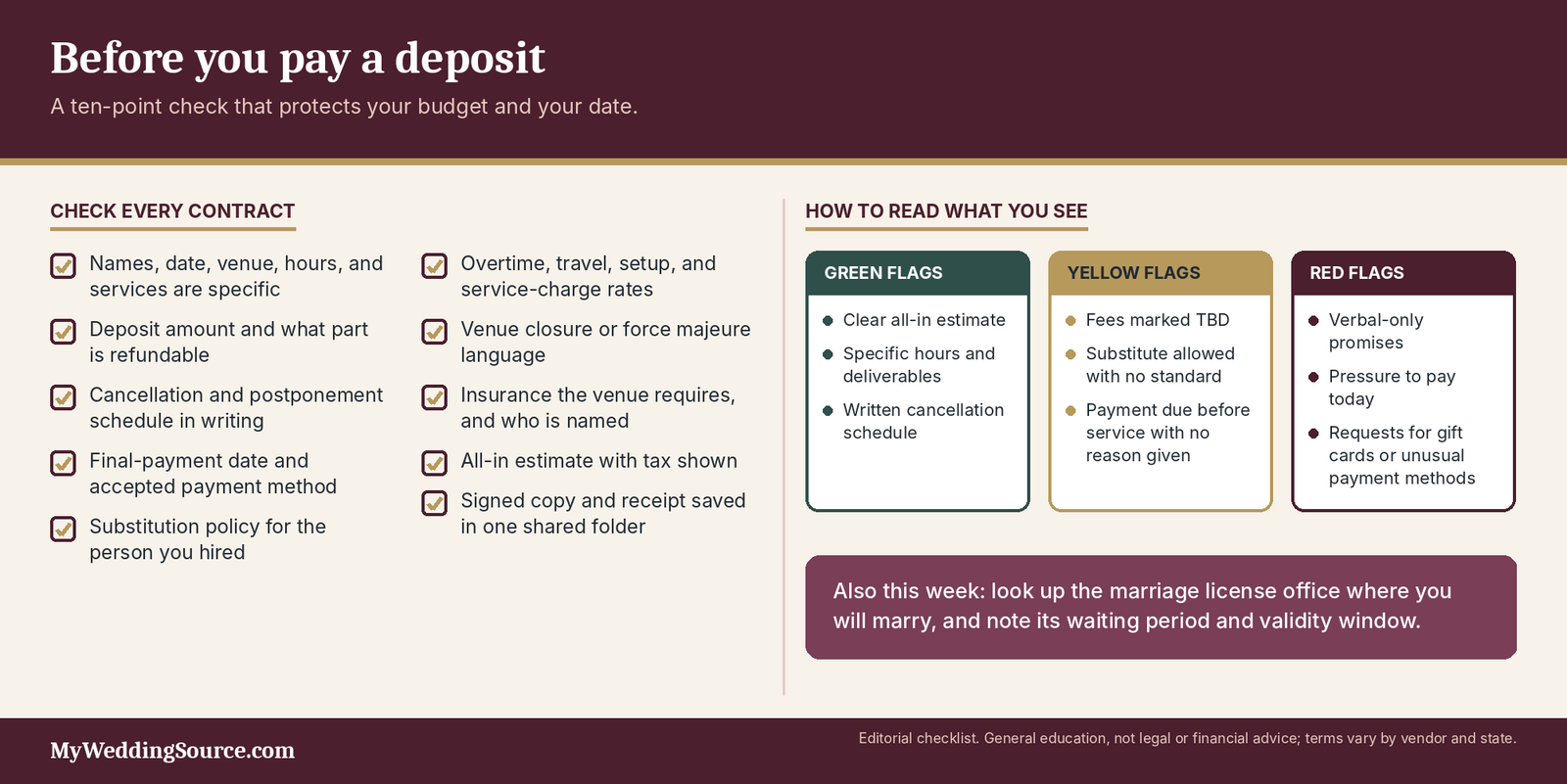
FAQ: wedding planning questions couples ask most
These answers condense the guide for readers who arrived with a specific question. Each links back to the section with the full reasoning, and each is general education rather than personal advice. Where an answer depends on your jurisdiction, we say so and point you to the official office.
Starting and scheduling
Timing questions come first because they set the pace for everything else. The honest answers depend on your market, your season, and how much you are willing to simplify. Use the ranges as starting points and adjust them to your own market.
How far in advance should I start wedding planning?
Most couples plan for 12 to 18 months. Zola’s 2026 report puts the average engagement at 18 months, and WeddingPro’s summary of The Knot’s 2026 study puts it at 14 months, so a 12-month runway is within the normal range. Peak-season Saturdays in popular markets can fill earlier than that, and shorter timelines are workable if you decide on a date and venue quickly and keep the vendor list simple. The key is to start the foundation work, meaning priorities, guest range, and budget, before you start touring.
What should I do first after getting engaged?
Hold the priorities and money conversations before you book anything. Agree on your top three priorities, a guest-count range, a total budget ceiling, and who is contributing, then write a one-page brief you can share with a venue or planner. After that, choose a season and begin touring venues, because the venue fixes the date and capacity that other vendors depend on. If you want a short checklist of the first steps, the first-30-days section above covers the early weeks.
Can I plan a wedding in six months or less?
Yes, if you accept fewer options and decide quickly. Choose the date and venue first, consider off-peak days, pick attire that is in stock or has a short production time, and hire a partial planner or coordinator early. Zola’s standard timeline books a venue about 11 months out, so you will have fewer choices than a couple with a longer runway, and you may need to be flexible about the exact date. Read contracts as carefully as you would on a longer timeline, since speed does not change your obligations.
Money, contracts, and paperwork
These are the questions with the highest stakes, so the answers lean on sources and point to official offices instead of generalizing. That is why prices are labeled with their source and year, and why legal answers point you to the issuing office. Treat each answer as a starting point for your own verification.
How much does a wedding cost in 2026?
It depends on your location and guest count. The Knot’s 2026 Real Weddings Study reports an average of roughly $34,000 for 2025 weddings with an average of 117 guests and $292 per guest, while Zola’s 2026 First Look Report reports an average budget of $36,000. State averages in The Knot’s data range from $17,000 in Wyoming to $57,000 in New Jersey, and city averages run higher in expensive markets. Use the averages as a sanity check and build your own budget from your priorities and your guest list, as described in the budget section above.
When should I apply for a marriage license?
Check the validity window and waiting period for the place where you will marry, then choose an application date inside that window. USA.gov notes that most licenses expire within 30 days to a year depending on the issuing state, and some places require a waiting period before the ceremony, as one Texas county’s published rules illustrate. Because rules differ by state and county, confirm with the issuing office instead of relying on a general rule. The legal basics section above shows what to verify and with whom.
Is it worth paying for a wedding planner?
It is worth it if the hours and complexity exceed what you can handle, and not necessary if your wedding is small and simple. The Knot’s 2026 data put averages at about $1,600 for a day-of coordinator, $2,400 for month-of, and $3,800 for full-service, while Zola’s index reports $4,047 for full-service planning. The right level depends on your guest count, venue type, and available time, and the cost should be compared with the value of the hours it replaces. If you decide to hire, confirm scope in writing and ask what happens if your planner is unavailable.
Your next steps
Planning is a long process, but the next ten days can be short and concrete. The aim is to leave this page with a few finished decisions and a clear rule about when to pay. Both parts of this checklist are designed to take under two hours in total.
This week
The first week should produce alignment, not bookings. Two conversations and one page of notes are enough. Do these in order, since the second depends on the first.
Hold the priorities and money conversation
Set aside an hour with your partner, and with any person who is contributing, to do the 100-point exercise and agree on a total budget ceiling. Write down who is contributing, how much, and whether it is a gift or a loan. Decide the order in which you will trim costs if quotes arrive above the ceiling. Schedule a 20-minute weekly check-in so the conversation continues.
Write the five-line brief and a guest range
Draft the brief: guest range, budget ceiling, season, top three priorities, and what you will skip. Build a tiered guest list and calculate a low, expected, and high attendance range. Send that brief, and only that brief, to the venues you want to tour. Start the shared folder for quotes and contracts.
Before you pay a deposit
A deposit is the point at which a plan becomes an obligation. A short review before each one protects your budget and your options. Run the checklist below before every deposit, even small ones.
Run the contract checklist
For every deposit, check the contract for the scope and date, the refundable portion, the cancellation and postponement schedule, the final-payment date, the substitution policy, and any fees not included in the price. Ask for an all-in estimate with tax and service charges. Use a payment method that leaves a record, and save the signed contract and receipt in your shared folder. If the stakes are high, consider asking an attorney to review the agreement.
Confirm the legal basics for your location
Identify the office that issues marriage licenses where you will marry, and read its requirements for ID, waiting period, validity window, and officiant rules. Put the application window on your calendar based on the license’s validity period. If you are marrying in another state or country, check the destination’s rules through the official government source before you commit to travel dates. Keep this information with your contracts so everything is in one place.
Sources & methodology
- The Knot Worldwide: 2026 Real Weddings Study press release — 10,474 U.S. couples married in 2025; about $34,000 average, 117 guests, $292 per guest, 13 vendors, AI adoption of 36%, and methodology.
- The Knot: average wedding cost — vendor category averages, cost by guest-count tier, state and city averages.
- The Knot: how much wedding planners charge — planner averages by service type (updated May 2026) and hours estimates.
- WeddingPro: vendor insights from The Knot’s 2026 Real Weddings Study — average engagement length of 14 months and planner hiring by generation.
- The Knot: percentage of wedding guests who RSVP yes — attendance and decline estimates.
- Zola: 2026 First Look Report — more than 11,500 couples; $36,000 average budget, 18-month engagement, AI use, social media influence, and planning load.
- Zola: what weddings really cost — Zola Wedding Cost Index categories, hidden costs, spend survey (n=720), and 150-guest city examples.
- Zola: wedding planning checklist — recommended booking and task timeline.
- Zola: wedding coordinator vs. wedding planner — service levels, cost ranges, and when to hire.
- Zola: how many people to invite — guest-list tiers, A/B list, and decline estimates.
- USA.gov: marriage certificates and licenses — license versus certificate and where to get them; license validity varies by state.
- Fort Bend County, Texas: formal marriage license — one county’s waiting period, validity, and fee, used only as an illustration.
- CDC/NCHS: Handbook on Marriage Registration (1988) — state law governs license requirements and who may solemnize.
- FTC: disputing credit card charges — the 60-day billing dispute window and undelivered services.
- NAIC: event insurance consumer insight — liability versus cancellation coverage and venue requirements.
- FDA: food allergies — the nine major food allergens.
- Federal Reserve data via FRED: credit card interest rate, accounts assessed interest — 22.15% in May 2026, used in the illustrative borrowing example.
- Social Security Administration: Form SS-5 — documents required and no fee for a card.
- U.S. Department of State: change or correct a passport — name change after marriage routes.
- HealthCare.gov: Special Enrollment Period — marriage as a qualifying life event.
Methodology. Verified facts come from official or primary sources: USA.gov, county and federal agencies, the FTC, NAIC, FDA, the SSA, and the State Department. Survey findings and averages come from The Knot’s and Zola’s studies, which use different samples and methods, so their figures differ and should be read as ranges; sample sizes are stated where the source gives them. Dollar examples labeled illustrative are editorial calculations, not quotes, and judgments about sequencing and trade-offs are editorial opinion informed by those sources. This is general educational information; laws, license rules, and contract terms vary by jurisdiction and agreement.
Freshness note. Cost averages reflect 2025 weddings reported in 2026; recheck The Knot and Zola figures each February to April when new editions publish. Recheck license requirements, fees, and waiting periods with your issuing office before you apply, and recheck the FRED credit card rate and passport procedures before relying on them. Last researched October 12, 2026.