
This wedding trends 2027 practical guide turns inspiration into decisions, with a six-question score, a regret test, vendor questions and an order-by timeline that show which ideas to adopt, shrink or skip.
You have a board with 200 pins, a florist who just used the word “install,” and a nagging suspicion that the plum-and-olive tablescape on your phone costs more than the venue. Trend reports tell you what is popular. They rarely tell you what happens next, when the idea meets a floor plan, a load-in window and a quote with four line items you did not expect. That gap is where budgets quietly drift, and couples are far from alone in falling into it: Zola’s 2026 survey found that 87% of couples made planning decisions based on something they saw on social media, and 48% updated their budget to achieve something they saw online. Nothing about that is embarrassing. It is a pattern, and patterns are easier to manage with a process than with willpower.
This article is that process. It does not rank the year’s trends or catalog colors, because our evidence-sorted review of wedding trends 2027 does that, and our companion on trend signals and pricing covers what the numbers say. Here the question is practical: given an idea you already like, how do you decide whether to adopt it, shrink it or skip it, what do you ask your vendors, when do you have to order, and how do you protect your money if the plan changes? Along the way you get a scoring worksheet, a regret test, three cost behaviors, a vendor question bank, an order-by timeline and a set of small-budget swaps.
A note on evidence before the first number. Dollar figures come from The Knot’s 2026 Real Weddings Study (10,474 U.S. couples married in 2025) and Zola’s 2026 First Look Report (11,500+ engaged and newly married couples). Both are surveys of platform members, not quotes for your market. Examples labeled illustrative are our own arithmetic, and growth percentages from Pinterest and The Knot measure platform interest, not Google search volume or confirmed bookings.
Start with a decision, not a mood board
Wedding inspiration works well when it stays a wish list, and a wish list needs a different kind of attention than a plan. This section separates the two. It explains why saved ideas feel more settled than they are, what job an idea is meant to do, and how much room it should be allowed to take up before any vendor gets a call.
What job is the trend supposed to do?
Why does a saved pin feel like a decision when it is not one yet?
Saving an idea costs nothing and takes one tap, and the feed answers by showing you ten more like it, which makes a preference feel like momentum. A saved idea has no price, no venue permission, no delivery date and no vendor attached, so the board never pushes back. Pinterest’s 2026 wedding report says people made more than 7 billion wedding-related searches and saved more than 16.7 billion wedding ideas globally in the prior year, which is a lot of unpriced inspiration. The first real pushback arrives with a quote, and by then you may have shown the board to a partner, a parent and a florist who are all attached to it. Treat the board as a wish list, and let an idea become a decision only when it has a cost, an owner and a deadline attached.
What four jobs can a trend do in your wedding?
An idea earns its place by doing at least one of four jobs: setting the atmosphere of a room, improving what guests do or eat, saying something true about the two of you, or creating a photograph you will want to keep. A flower bar can do two of those at once if guests use it and it replaces a favor, while a decorative arch that no one stands under does one at best. The Knot’s 2026 study found that guest experience ranked first, cost second and personalization third among the factors couples weighed during planning. That ordering is a helpful tiebreaker. When two ideas cost the same, favor the one that improves the guest experience or carries personal meaning, and be suspicious of an idea that does no job beyond being on trend.
How much should a trend change your plan?
What is the difference between adopting, shrinking and skipping?
Most couples treat a trend as a yes or no, but there are three honest answers. Adopting means the idea gets a line in the budget, a vendor and a place in the schedule at its full size. Shrinking means you keep the feeling and reduce the footprint, such as a drapery backdrop behind the ceremony only, a single station instead of a roaming service, or a trend color in the bouquet rather than on every table. Skipping means you enjoy the pin and move on, which is not a failure of imagination. Shrinking is the answer people forget, and it is usually the one that saves the most money while keeping most of the visual payoff.
How does your baseline budget frame the choice?
Every trend lands on top of a budget that is probably tighter than it feels. The Knot’s study puts the average 2025 wedding at $34,200 with 117 guests, or $292 per guest, and the median at $24,000, which means half of couples spent less than the average suggests. In the same study, 41% went over budget, 34% stayed on track, 4% came in under and 21% had no budget at all, and roughly one in two said their initial budget was lower than the real cost. If your baseline is not firm, every new idea gets paid for by default from the contingency fund. Our 2027 wedding budget reality report covers the whole cost picture, and this guide assumes you have at least a working number to defend.
Who gets a vote, and when?
Ideas gather supporters, and the supporters are often the people paying or helping. In The Knot’s data, parents or family covered 52% of the average total and couples covered 48%, but that is an average and your arrangement may look nothing like it. A simple fix is to give each person with a stake, including you, your partner and any major contributor, one veto and one wildcard. A veto removes an idea without needing a reason, and a wildcard is an idea that gets considered seriously even if the others are lukewarm. Decide this before the venue tour season, because the conversation is much kinder when it is about a pin than when it is about a deposit that has already left your account.
The six-question trend worksheet
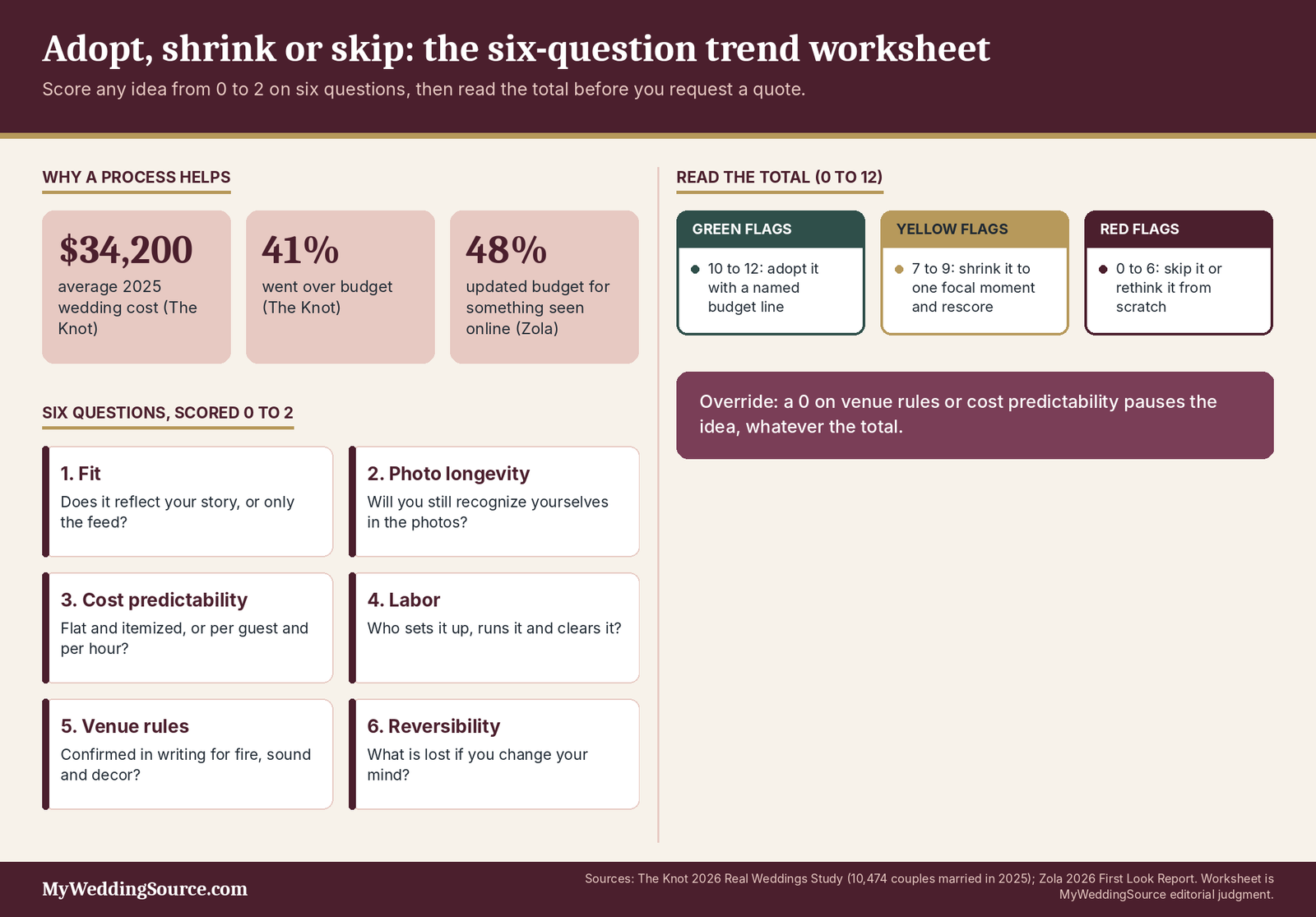
A worksheet is useful because it turns a gut feeling into something two people can compare. The one below takes about ten minutes per idea, uses a 0 to 2 scale, and is deliberately simple. It is an editorial tool, not a statistical model, and the point is to expose the question you have not asked yet rather than to produce a precise score.
How do you score an idea in about ten minutes?
Which six questions go on the worksheet?
The six questions cover fit, photo longevity, cost predictability, labor, venue rules and reversibility. Fit asks whether the idea looks like you rather than like the feed. Photo longevity asks whether you will still recognize yourselves in the pictures once the trend has moved on. Cost predictability asks whether the price is a flat number or something that grows with guests and hours. Labor asks who sets it up, runs it and clears it. Venue rules ask whether the space permits it in writing, and reversibility asks how much money is lost if you change your mind. Table 1 shows what a 2, a 1 and a 0 look like for each.
| Question | Score 2 | Score 1 | Score 0 |
|---|---|---|---|
| Fit | Reflects your story, culture or taste | Likes it, but it is mostly borrowed | Chosen because it is everywhere |
| Photo longevity | Works with a neutral, timeless base | Date-stamped but easy to edit out | Dominates every photo and cannot be removed |
| Cost predictability | Flat price, itemized | Range or partly estimated | Per guest or per hour, open-ended |
| Labor | Vendor handles setup and teardown | You or a helper handle part | You or friends carry it on the wedding day |
| Venue rules | Confirmed in writing | Probably fine, not yet asked | Possible conflict with fire, sound or decor rules |
| Reversibility | Refundable or easy to swap | Partial deposit at risk | Custom, printed or nonrefundable |
How do you read the total?
Add the six scores for a total from 0 to 12. A total of 10 to 12 means the idea is a strong candidate for a full-size budget line, 7 to 9 means shrink it to one focal moment and rescore, and 6 or lower means skip it or rethink the idea from scratch. Two overrides matter more than the total. A 0 on venue rules means you should not spend a dollar until the venue confirms in writing, and a 0 on cost predictability means you need a capped quote before the idea moves forward. An idea that scores 11 with a venue 0 is still a no for now, because rules do not bend for a good score.
Who should fill it in?
Have you and your partner score the same idea separately, then compare. The numbers matter less than the gaps, because a 2 and a 0 on fit tells you the idea means something different to each of you. One partner might love a vintage detail because it echoes a grandparent’s home, while the other likes it because it matched a feed. Both reasons are legitimate, but they lead to different decisions about how much to spend on it. If you are working with a planner, send them the filled-in worksheets before your next meeting, since a planner can usually spot a venue or labor problem in a minute that would take you a week to find.
What does the worksheet look like on real ideas?
How would a drapery backdrop score?
Take a fabric drapery backdrop behind the ceremony, an idea that Pinterest lists among the fastest-growing decor ideas in its 2026 wedding report. Illustrative scoring, based on editorial judgment rather than a quote: fit 2 if you love the soft, theatrical look, photo longevity 1 because it is very recognizable, cost predictability 2 if it is a flat rental, labor 1 because installation takes skilled time, venue rules 1 until someone confirms where it can hang, and reversibility 2 if it is rented with a refundable deposit. That is a 9, which says to shrink it. A single backdrop at the ceremony spot gets most of the visual payoff, and you can reuse the fabric for a photo corner instead of draping the whole room.
How would a roaming food station score?
Interactive food and drink is one of the stronger signals in The Knot’s 2027 report, with search interest up 66%. Scored as a roaming service across the whole reception, our illustrative example looks like this: fit 2, photo longevity 2 because food does not date a photo, cost predictability 0 because the price is usually per guest, labor 0 because staff must run it, venue rules 1 pending kitchen access, and reversibility 1 because menus are often locked at a final-count date. That totals 6, which says to rethink it. Rescored as one station during cocktail hour with the caterer’s staff included, the cost and labor scores rise to 1 each, and the idea reaches 8.
How would a custom crest or monogram score?
Custom crests and monograms are up 100% in The Knot’s 2027 search-interest data, yet THE WED’s April 2026 forecast lists logomania among the trends it expects to step back, which is a good reminder that sources disagree. Our illustrative scoring: fit 2 if the crest draws on your initials or a family symbol, photo longevity 1, cost predictability 2 because a designer’s fee is usually flat, labor 2 because it is digital art, venue rules 2 because nothing is installed, and reversibility 0 once it is printed on paper, napkins and signage. That is a 9. The cost is small, but the idea cannot be unprinted, so the way to protect it is to use the crest in a few places and keep everything else simple. Table 2 compares all four scenarios.
| Idea (illustrative) | Scores: fit, photo, cost, labor, venue, reverse | Total | Verdict |
|---|---|---|---|
| Drapery backdrop, ceremony only | 2, 1, 2, 1, 1, 2 | 9 | Shrink to one spot, confirm hanging points |
| Roaming food, whole reception | 2, 2, 0, 0, 1, 1 | 6 | Rethink before requesting quotes |
| One food station at cocktail hour | 2, 2, 1, 1, 1, 1 | 8 | Shrink, ask for a capped per-person price |
| Custom crest on paper and signage | 2, 1, 2, 2, 2, 0 | 9 | Shrink to a few uses, proof twice |
Low-regret and high-regret ideas
The worksheet tells you whether an idea is a good fit. The regret test asks a different question: if you are wrong, how expensive is it to change course? Two ideas can score the same total and still carry very different risk, and this section shows how to tell them apart before money moves.
What makes an idea low-regret?
Why do reversible choices beat trendy ones?
The cheapest mistake is one you can still undo, and reversibility matters more than novelty when a trend is new and its staying power is unknown. A refundable rental, an item you can resell, a playlist request, or a flower swap made a few weeks before the wedding can all be changed without a penalty. A custom, nonrefundable, hand-made or printed item cannot. When two ideas score close together on the worksheet, choose the one you can walk back, because your taste will change between a 2026 engagement and a 2027 wedding more than you expect. Zola reports an average engagement of 18 months while The Knot’s study reports 14 months, and a year is long enough for a feed to move on.
Which categories of ideas tend to be low-regret?
Think in categories rather than lists. Ideas that live in the soft layer of the day tend to be low-regret: a signature drink with a new name, a request to your DJ, a lawn game, a guest-book alternative, a hair or makeup look you can trial in advance, or a color accent in the bouquet. They are small, they cost little to change, and they can be dropped without anyone noticing. Flowers sit in the middle, since florists usually finalize designs closer to the event than printers or dressmakers do, but you should confirm your florist’s design-lock date in the contract. The common thread is that a change of heart costs you a text message rather than a deposit.
Why do printed and personalized items need extra care?
Anything with your names, a date or a trend-specific design printed on it is a one-way door. That includes invitations, menus, napkins, signage, matchbooks and favors, all of which look charming in a mockup and feel final when they arrive in a box. The Knot’s average spend on invitations and stationery was $510 and on favors $480, small lines on their own that add up when each has a custom trend element. Proof twice, read every date and name aloud, and keep the trend element to a single motif that you can drop from the second print run. If you are unsure, use a plain base with one trend accent, such as a stamp or a ribbon, so that the rest of the suite still works when tastes change.
What makes an idea high-regret?
Which costs are hardest to undo?
Three kinds of cost are hard to reverse: custom-made goods, nonrefundable deposits and anything that leaves your hands for good. A made-to-order gown is a common example. The Knot’s dress guide says a made-to-order dress takes 16 to 20 weeks to arrive and can take up to five months, and the average gown costs $2,100 before alterations that run from roughly $200 for a basic hem to more than $1,000 for major changes. Rings are another example, with an average of $3,000 in The Knot’s study. If you want a trend in one of those categories, make sure it is the version of the trend you will still want in ten years, and ask what happens if the maker cannot deliver on time.
When does an idea lock you into a vendor or venue?
Some trends are really commitments in disguise. An unexpected venue, such as a theater, greenhouse or club, may come with a required caterer, a minimum spend, restricted decor or limited hours, which means saying yes to the venue also says yes to a set of vendors and rules. A multi-day format is another: The Knot’s 2027 report says nearly one in three weddings now span three days or more, and each extra event needs space, food and often a hotel block. Hotel contracts sometimes include attrition clauses, so read what happens if fewer rooms are used than you reserved. The question to ask is how many other decisions this one decides for you.
What if you love a high-regret idea anyway?
Loving a risky idea is allowed, and there are ways to hedge it without giving it up. Reduce the size, as in a smaller print run, one custom piece rather than five, or a rental version before you commit to buying. Move the commitment later by asking whether the vendor will hold your date with a smaller deposit, and put the cancellation terms and any substitution rights in writing. Add a fallback to the plan, such as an alternate floral palette or a second song, so that a late delivery does not become a crisis. Finally, set a number: the most you are willing to lose if the idea fails, and do not exceed it. Table 3 summarizes how the signals compare.
| Dimension | Low-regret signal | High-regret signal | Hedge |
|---|---|---|---|
| Refundability | Refundable or transferable deposit | Nonrefundable or custom-order deposit | Smaller deposit, written terms |
| Where it lives | Digital, verbal or day-of | Printed, engraved or sewn | One motif, proof twice |
| Dependence | Works with any vendor | Needs one named vendor or venue | Backup option in the contract |
| Permanence | Rented or borrowed | Bought, custom-cut or altered | Rent first, buy later |
| Timing | Can change late | Locked early by lead time | Freeze date on the calendar |
What a trend actually costs
Trend pricing is hard to read because the sticker price often covers the item and not the labor around it. Pricing is genuinely complicated for custom and rental work, and the variety of ways to charge for it is a feature of the work rather than a sign of bad intent. This section explains the three ways a cost can grow, where the hidden layers sit, and how to cap the total with an allowance.
How do flat, per-guest and per-hour costs behave?
Which trend costs stay flat?
Flat costs do not change with the size of your guest list, and they are the friendliest category for a trend. A backdrop, an arch, a designer’s fee for a custom crest, a rented neon sign or a photo-corner setup is usually priced as a package. They are predictable, and they let you plan around a single number. The caveat is that flat does not mean small, so check that the package includes delivery, installation and removal, and ask what happens if the event runs long. If an idea is flat and reversible, it is often the lowest-risk way to try a trend.
Which trend costs grow with every guest?
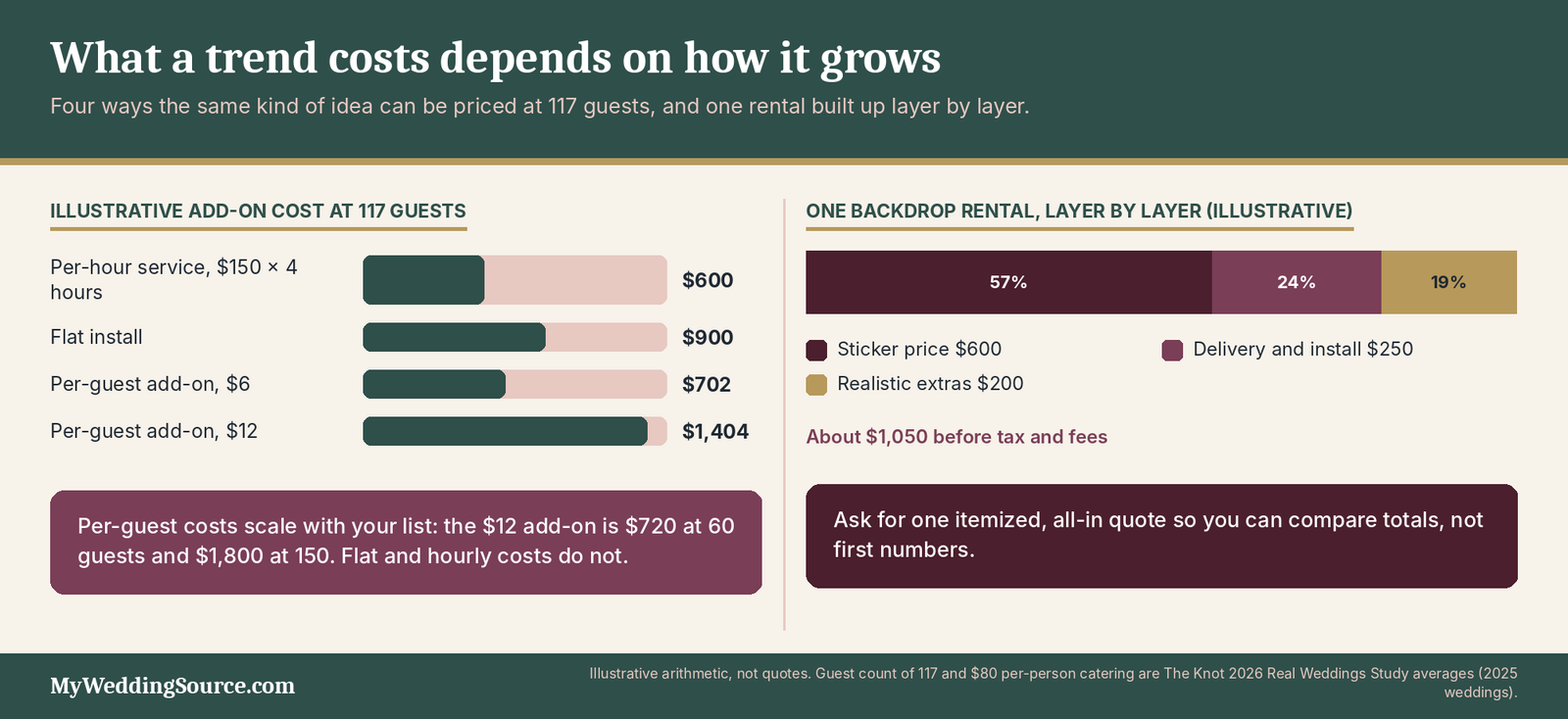
Per-guest costs multiply with your list, which is why guest count is the engine of the budget. The Knot’s average catering cost is $80 per person, so 117 guests at that rate is $9,360 before service charge or tax. A station or tasting experience that adds $6 a person is a modest-sounding $702 at 117 guests, and $12 a person is $1,404 (illustrative arithmetic, not a quote). The Knot also reports that 40% of couples scaled back their guest count because of rising costs, which changes the math in the other direction. Table 4 shows how the same idea behaves at three list sizes.
| Cost type | Illustrative price | 60 guests | 117 guests | 150 guests |
|---|---|---|---|---|
| Flat install | $900 | $900 | $900 | $900 |
| Per-guest add-on | $6 per person | $360 | $702 | $900 |
| Per-guest add-on | $12 per person | $720 | $1,404 | $1,800 |
| Per-hour service | $150 per hour, 4 hours | $600 | $600 | $600 |
Which trend costs grow with the clock?
Time-based costs show up in music, live art, photography, bar service and any experience that needs a person on hand. The Knot’s average spend is $1,800 for a DJ and $4,500 for a live band, with $1,500 for additional non-musical entertainment, and each has overtime or add-on rules in its contract. Hour-based pricing makes a trend feel cheap in a short event and expensive in a long one. Ask for the hourly rate, the minimum booking, the overtime rate and whether travel or setup time counts toward the clock. A multi-day format multiplies these costs, since each event block may need its own booking.
Where do the hidden layers sit?
Who pays for setup, delivery and teardown?
Labor is the layer people miss most, and it is usually not hidden so much as left out of the headline price. A rental backdrop may include delivery but not installation, a station may include food but not the people to run it, and a cake may include the cake but not the cutting fee. Venues can add their own charges for rentals brought in from outside, for use of their staff or for after-hours load-out. Ask for a quote that lists setup, staffing and breakdown as separate lines so you can compare quotes on an apples-to-apples basis. If a vendor says everything is included, ask them to write that sentence in the contract.
How do service charges and taxes change the total?
Many caterers and venues add a service charge and sales tax to the food and beverage subtotal, and the combined effect can be a noticeable percentage on top of the menu price. How service charges and gratuity are taxed, and whether they are optional, varies by state and by vendor, so there is no national rule to rely on. The practical step is to ask for the all-in number at your guest count, including every fee. Compare that figure rather than the per-person menu price, because two caterers with the same sticker price can differ by hundreds of dollars once the extras are added. Do the same for rentals, where delivery windows and damage waivers are common line items.
What does it cost if the plan fails?
Failure cost is the layer that does not appear on a quote, and it deserves a line in your planning. It is the deposit you lose if you cancel, the replacement cost if a vendor cannot deliver, and the price of a backup if a weather forecast changes the plan. Terms and state laws vary, so read the contract and consider asking a lawyer to review a large one. Table 5 shows the layers for one illustrative rental, built from the framework we use throughout this site.
| Layer | What it covers | Illustrative amount | What to ask |
|---|---|---|---|
| Sticker price | Fabric panels and frame rental | $600 | What exactly is in the package? |
| Required extras | Delivery, installation, strike | $250 | Is labor included or billed separately? |
| Realistic extras | Steaming, lighting, lift or ladder access | $200 | What do similar installs usually need? |
| Taxes and fees | Sales tax, service charge | Varies by location | What is the all-in total? |
| Failure cost | Deposit lost if you cancel | Often a share of the price | What are the cancellation terms? |
How do you set a trend allowance?
Why name a dollar amount instead of a percentage?
A percentage of the budget feels flexible, which is exactly why it fails. A named dollar amount, such as $1,500 for all trend items combined, gives you a number to check every quote against. When someone suggests an extra idea, the question becomes whether it fits inside the allowance rather than whether it is a nice thing to want. Set the amount after you know your venue and guest count, not before, because per-guest ideas can swallow a small allowance quickly. Review it each time a quote arrives and write the running total in one place.
Which budget lines can fund it?
Funding a trend by replacing something is better than funding it from the contingency fund. Zola’s survey found couples save most often on favors (48%) and stationery (36%) and splurge on the venue (47%) and photography (45%), which is one pattern, not a rule for you. Using The Knot’s averages, favors ($480), stationery ($510) and cake ($540) are small lines, so a trend that replaces one of them can stay close to budget-neutral. Replace, don’t add, whenever you can. If an idea does not replace anything and does not fit the allowance, it needs a decision about what to give up.
What should happen when quotes exceed the allowance?
Quotes will exceed the allowance sometimes, and that is useful information rather than a failure. Rescore the idea at a smaller size, ask the vendor for a lower tier, or move the idea to a later stage when you know your remaining budget. Take money from the essentials last: food, photography, the venue and the people who run the day are the parts that guests and photos will show. Write down what you decided and why in the planning document so the question does not return in three weeks. If you keep going over, it is a sign the allowance is too small for the plan, and that is a more honest conversation to have with yourself than a series of small exceptions.
Questions to ask before you say yes
Vendors are usually happy to talk through a trend they have done before, and the most useful conversations happen before anyone sends a deposit. The questions below are organized in the order that tends to matter: the venue decides what is possible, and the vendor who delivers the idea decides what it costs. Write the answers down, or better, ask for them by email so the reply can go into your folder.
What do you ask the venue first?
Which rules decide whether an idea is possible?
Venues set the outer boundary for decor, music and food, and the boundary is rarely visible from a photo gallery. Ask about open flame, sound limits and curfew, what may be attached to walls, ceilings or trees, ceiling height and rigging points, power access, and whether anything must be flame-retardant. Fire rules are local and specific: Fairfax County, Virginia, for example, requires a fire prevention permit for open flame at public gatherings in many assembly spaces and generally bars candles where guests stand or in aisles and exits, and other jurisdictions differ. Use that as an example of how detailed the rules can be, not as a rule for your location. If an idea involves flame, haze, hanging fabric or amplified sound, ask for the written policy before you sign anything.
What are the load-in and load-out windows?
A beautiful plan can fail on timing alone. Ask when vendors may arrive, how long the room is available before guests, how quickly the ceremony space flips to the reception, and when everything must be gone. Installations such as drapery, arches or floral walls often need hours, and a venue that gives vendors 90 minutes will not fit an idea designed for four. Ask whether the venue requires a certificate of insurance from outside vendors, since many do and a vendor without one can be turned away at the door. Share the load-in schedule with every vendor involved so that no one finds out on the wedding day that another team has the loading dock until noon.
Does the venue charge for outside items or services?
Some venues charge for bringing in an outside cake, rental or decorator, and some require specific vendors for food, bar or rentals. These charges may be reasonable, since the venue has its own costs and responsibilities, but they change the true cost of a trend. Ask for a list of fees that apply if you bring in anything not on the venue’s own menu, and ask whether the venue has preferred vendors who have worked in the space before. A vendor who knows the room can sometimes solve a problem in five minutes that would cost you an hour. If the venue is part of a package, check what counts toward any food and beverage minimum.
What do you ask the person who would deliver it?
What should the quote itemize?
A good quote says what is included, what is not and what could change the price. Ask for separate lines for the item, delivery, setup, staffing, breakdown, tax, service charge and any travel or overtime. Ask what the quote assumes about your guest count and hours, and what happens to the price if either changes. If a price is a range, ask what pushes it to the top. Pricing for custom work really is hard to standardize, and an itemized quote is not an accusation; it is a shared document that keeps both sides from guessing.
Have they done this at a venue like yours?
Experience with the idea matters more than enthusiasm for it. Ask to see photos from a similar event, ideally in a room of similar size and layout, and ask what went wrong the last time and how they fixed it. A vendor who has hung drapery in an old building or run a station in a tight kitchen can anticipate problems, while one who has only seen it online may be learning on your day. Ask whether they can visit your venue before the contract is signed, or whether another vendor on your team has worked there. A reference you can call is worth more than another gallery.
What is the backup plan?
Every idea has a way of failing, and a good vendor has already thought about it. Ask what happens if a material is out of stock, if the weather changes the plan, if staff cannot attend, or if an item arrives damaged. Ask for substitution rights in writing, including whether you approve the substitute and whether the price changes. For outdoor ideas, ask about the rain plan and what it costs. A vendor who answers quickly and specifically is usually a good sign, and a vague answer is a reason to keep asking.
Who is on site, and for how long?
Many trend ideas depend on a person being present, such as a station attendant, a live artist or an installer who can adjust the setup. Ask who will be there, what time they arrive, how long they stay and whether anyone can answer questions during the event. If the vendor is sending a team, ask who the lead is and how to reach that person on the day. Confirm the coordinator or planner has their contact details too. A planner, which The Knot’s study prices at an average of $2,100, or a day-of coordinator can make this smoother, but only if every vendor’s schedule is in one place.
| Who you ask | What to ask | Why it matters | Get in writing |
|---|---|---|---|
| Venue | Fire, sound, attachments, load-in window, outside vendor fees | Decides whether the idea is possible | Written policy or email reply |
| Caterer | Per-person price, staffing, equipment, service charge | Food ideas scale with guests | Itemized menu and staffing |
| Florist or decor rental | Install time, strike time, substitutions, delivery | Labor is often the missing line | Design lock date and substitution terms |
| Photographer | Time for the feature, lighting, shot list | Photos are why many trends exist | Timeline and shot list |
| DJ or band | Hours, overtime, requests, equipment | Time-based pricing grows | Hours and overtime rate |
| Stationer | Proof rounds, production time, reprint cost | Printed items cannot be undone | Proof approval and delivery date |
When to order, decide and stop adding
Trend timing has two clocks. One is the lead time of the item itself, such as a dress, a printed suite or a rental that must be reserved. The other is the age of the idea, since an idea saved 14 months before the wedding is likely to look different by the time it arrives. This section helps you place both on a calendar.
Which decisions should come first?
Why do venue and date come before aesthetics?
The venue sets the limits, so choosing it first prevents you from designing around a room you do not have. Wedding colors, in particular, look different in different light, and a palette that glows in a photo from a sunlit greenhouse can go flat in a windowless ballroom. The season matters too: fall wedding ideas such as deep reds, plum and olive tones, candlelight and seasonal blooms work with the light and the flower supply in autumn, but earlier sunsets change the photo timeline. Zola reports that 49% of couples use locally sourced or seasonal blooms, which suggests many couples build the palette around what is in season. Pick the room and date, then judge the wedding aesthetic against them.
What is a freeze date, and why set one?
A freeze date is a calendar day after which you stop adding new ideas to the plan. It is an editorial suggestion, not an industry standard, and it exists because the cost of a late change rises as vendors lock their schedules. A sensible freeze date comes before your invitations are due, since The Knot suggests having invitations in hand at least 10 weeks before the wedding and mailing them six to eight weeks out. After the freeze date, new ideas go on a “next time” list, or they swap in for something that already exists. A freeze date also protects relationships, because the answer to a new suggestion is a date rather than a debate.
How should a long engagement change your approach?
A long engagement is a gift for planning and a hazard for trends. The Knot’s study reports an average engagement of 14 months and Zola reports 18, and in that much time the feed will change several times. Make the large, slow decisions early, such as the venue, the date, the guest count and the major vendors, and leave the small, fast-moving trend items for last. Avoid buying decor or accessories more than a few months ahead unless they are one-of-a-kind, since an early purchase is a bet on your own taste staying fixed. If your engagement is short, pick two or three trend moments and let everything else go.
What are realistic lead times?
How long do attire and alterations take?
Attire is the longest lead item in most weddings. The Knot recommends buying a gown 8 to 10 months before the wedding and starting to shop 9 to 12 months out, with made-to-order dresses taking 16 to 20 weeks to arrive and up to three alteration fittings at roughly 3 to 4 months, 6 to 8 weeks and 2 to 3 weeks before the date. A trend silhouette or fabric may mean a smaller pool of makers, so ask early about production time and whether rush fees apply. Off-the-rack, sample and rental options can be taken home the same day, which makes them a lower-risk way to try a bold look. The same lead-time questions apply to suits, accessories and shoes.
How long do paper and signage take?
Paper is one of the more forgiving categories, but only if you leave room for proofs. The Knot suggests ordering pre-designed online invitations 12 to 14 weeks before the wedding to allow for shipping delays or a reprint, having them ready by 10 weeks and mailing six to eight weeks out. Custom designs take longer, so ask the stationer for a production schedule, including the number of proof rounds and the reprint cost if a mistake is found after printing. Experiential paper, such as folding fans or pop-up menus, adds assembly time, so allow extra. Signage, menus and place cards should be proofed against the final guest list.
What protects you when you order shipped goods?
Many trend items are ordered online, from custom signs to favors and fabrics, so it helps to know the baseline for shipping. The FTC’s Mail, Internet or Telephone Order Merchandise Rule says a seller must have a reasonable basis for any stated shipping time, or for shipping within 30 days if none is stated, and must give you a chance to cancel for a refund if it cannot ship on time. The FTC’s summary does not address custom or made-to-order goods, and the rule excludes services, so ask the seller directly about custom work. Order early enough to leave a buffer before your freeze date, and keep every confirmation email.
Which deadlines belong to your vendors?
Florists, caterers, rental companies and bakers set their own deadlines, and they live in your contract. Ask each one for a list that includes the design-lock date, the final-count date, the date the final payment is due and the last day to change a menu or rental order. Put all of them in a single shared calendar with a reminder two weeks ahead. If an idea requires a special order from the vendor, such as a particular flower, ask when it must be ordered and what happens if it is unavailable. Table 7 pulls the dates in this section together.
| Item | Start looking | Commit or order by | Source or basis |
|---|---|---|---|
| Venue and date | As soon as you have a rough guest count and budget | Before aesthetics, decor and most vendors | Editorial sequence |
| Made-to-order gown | 9 to 12 months before | Buy 8 to 10 months before; arrival takes 16 to 20 weeks | The Knot gown timeline |
| Alterations | When the dress arrives | Fittings at 3 to 4 months, 6 to 8 weeks, 2 to 3 weeks | The Knot gown timeline |
| Pre-designed invitations | About 4 months before | Order 12 to 14 weeks before; in hand by 10 weeks; mail 6 to 8 weeks | The Knot invitation guide |
| Custom decor and signage | After the venue confirms its rules | Maker’s production time plus a buffer before your freeze date | Ask each maker |
| Florals, rentals, menu | At vendor signing | Design-lock and final-count dates in the contract | Your contract |
Small-budget swaps that keep the look
A modest budget does not need to mean a modest plan. Most of what makes an idea feel special is the feeling rather than the footprint, and that can usually be kept at a lower cost. This section covers the smaller versions of popular ideas and the places where saving is not worth it.
How do you get the look for less?
Why does one focal moment beat a room full of small touches?
In our editorial judgment, a few strong moments register with guests more than a long list of small details. One striking ceremony backdrop, one well-lit photo corner or one memorable station will register in photos and conversations, while ten small touches can disappear into the room. Spending the same money in one place also makes quotes easier to compare and installations easier to manage. Pick the moment guests will experience most, such as the aisle, the cocktail hour or the first dance, and put the idea there. If the idea works at that scale, you can add a second moment later without having committed to the whole room.
When does borrowing, renting or buying used make sense?
Anything used once is a candidate for borrowing, renting or secondhand purchase. Zola reports that 39% of couples incorporate vintage or pre-loved decor, which suggests that couples are using secondhand pieces in large numbers, and The Knot’s study found that 44% of couples spending under $12,000 relied on DIY decor. Rentals reduce the risk of owning something you do not want afterward, and borrowing can be free if a friend or family member has what you need. Ask before you buy whether the item can be resold, and check rental terms for damage waivers and return deadlines. For the planning side, our wedding planning checklist has a place to record who is responsible for each borrowed item.
How do you DIY without letting it take over the week of the wedding?
DIY saves money when the work is simple, can be done well ahead and does not depend on perishable materials. Dried flowers, printed signs from a professional printer, hand-lettered welcome cards and playlists are good candidates, while fresh floral arches and anything near flame belong with professionals. Set a time limit, assign tasks to named helpers and set up a “done by” date at least two weeks before the wedding. Decide who will transport and install the pieces on the day, because that person will not be able to take photos or greet guests. If the project would be stressful in the final week, buy the version you do not have to make.
Where should you protect the budget instead of trimming?
What happens if you reduce the guest count instead?
The strongest lever on a trend budget is often the guest list, not the trend. Per-guest costs shrink with every person removed, which frees money for an idea that would have been unaffordable at a larger size. The Knot reports that couples spending under $12,000 had an average of 92 guests, compared with 117 for the middle band and 141 for couples spending over $41,000. A smaller list is not for everyone, since guest lists often reflect family and community obligations. Where it is an option, it can also make a more personal experience possible.
Which food and service lines should not be trimmed for a trend?
Food safety and staffing are not good places to economize for a trend. The USDA says that perishable food left at room temperature for more than two hours should be discarded, and that the limit drops to one hour above 90 degrees Fahrenheit. Interactive stations, grazing tables and open displays all depend on someone keeping food hot or cold, replenishing it and clearing it. If a station costs less because the staff is trimmed, ask who will manage the time and temperature. Our guide to wedding food and catering covers menu and service decisions in more detail.
Which parts of the day carry the memories?
When money is tight, protect the parts of the day that guests will experience and that you will keep. Zola’s couples report that they splurge on the venue (47%) and photography (45%), and 67% prefer natural, unposed photos, which suggests that people value images of real moments over staged ones. A trend that looks good in a stylized photo but does nothing for the room is a candidate for the smaller version. A trend that makes guests laugh, eat or dance is probably worth more. Use the four jobs from earlier in this guide as a final filter.
| Full-size idea | Smaller version | What you save | Watch-out |
|---|---|---|---|
| Flower bar for every guest | One flower bar at cocktail hour, or bar for the wedding party | Per-guest flowers and staffing | Fresh stems need water and shade |
| Roaming food service | One station or a late-night snack | Staff and per-person premium | Time and temperature rules still apply |
| Giant statement cake | Small display cake plus sheet cake | Tiers, labor and delivery | Ask about cutting fees |
| Whole-room drapery | One backdrop at the ceremony | Fabric, hours of install | Hanging points and fire rules |
| Custom printed everything | One printed menu and digital extras | Print runs and reprints | Proof once, then freeze |
| Live artist all night | Hour-long set during cocktails | Hourly fees and overtime | Confirm what the hour includes |
Protect your money, your guests and your data
Once an idea passes the worksheet and the quote looks right, the last step is making sure the paperwork, the payment method and the safety checks match the plan. None of this is legal or financial advice, and contract terms and state laws vary, so treat it as a checklist of things to ask rather than a ruling on your situation.
How should you pay, and what should the paperwork say?
What belongs in the contract for a trend item?
A contract for a trend-driven item should say what you are buying in plain words, not just a product name. Look for the itemized price, the deposit amount and due dates, the cancellation and refund terms, the date by which you can change the design or count, and what happens if the item or the person is unavailable. Check for substitution language, since a florist who substitutes a different bloom or a vendor who swaps in a colleague should need your approval. If the vendor promised something verbally, such as an install time or a backup plan, ask them to add it. For a large contract, consider having a lawyer review it, especially if the cancellation terms are strict.
Why pay deposits by credit card when you can?
A credit card gives you a dispute process that cash, checks and many transfers do not. Under the Fair Credit Billing Act, as the FTC explains, a billing error includes services that were not delivered as agreed, and your written dispute must reach the card issuer within 60 days after the first bill showing the error was sent. The FTC adds that the issuer must acknowledge your letter within 30 days and resolve it within 90. There are limits, and claims about the quality of a purchase carry extra conditions such as a minimum amount and a distance from your billing address, so treat this as a safety net and not a plan. Keep contracts, receipts and emails in one folder, since the dispute depends on records.
Which safety and disclosure checks apply to common trend items?
What about open flame, haze and hanging decor?
Candles, flame effects, haze machines and anything hung from ceilings or trees can trigger fire-code requirements, and those requirements are set locally. Ask the venue for its written policy, and ask whether the local fire marshal’s office requires a permit or inspection for your event. Fire marshal offices are usually the right source for a definitive answer, as the Fairfax County example earlier shows. Battery-operated candles and LED lighting are common alternatives that deliver the look with fewer approvals, but still ask the venue whether they are allowed. If the decision slips to the last week, you may find yourself without time to change the plan.
What should you know about lab-grown stones and ring trends?
Ring choices have grown more varied, and lab-grown stones are a mainstream option. The FTC’s Jewelry Guides expect sellers to be clear when a stone is not mined, and the agency has said that terms such as “laboratory-grown” and “laboratory-created” are appropriate disclosures that should appear near the word “diamond.” Ask any jeweler to put the stone’s origin and the specifications on the receipt. A ring is also one of the high-regret items in the earlier test, so it is worth checking the return and resizing policy before you commit. The trend is the stone’s origin and design, and the checks are the same as for any significant purchase.
How should you use AI tools and apps without oversharing?
Zola reports that 54% of couples use AI in some capacity, and 99% say human vendors remain essential. AI tools can help draft emails, timelines and question lists, but a person should verify every date, price and policy before relying on it. Do not paste contracts, payment details or guests’ personal information into a chatbot, and review what each planning app can access on your phone. The FTC suggests checking app permissions and turning off unnecessary ones. Treat AI as a drafting assistant and keep the final decisions with you and your vendors.
FAQ about using wedding trends 2027
Questions about deciding
How many trends should one wedding use?
There is no verified benchmark, so this is an editorial suggestion: choose two or three trend moments and let the rest of the day reflect you. A few strong choices read as a point of view, while a dozen read as a collage. Pick them from different jobs, such as one for atmosphere, one for guest experience and one for a photo moment. If an idea does not score well on the worksheet, it is probably not one of your two or three.
What if my partner and I disagree about a trend?
Score the idea separately, then compare the gaps and talk about what each of you is hoping the idea will do. Often one person wants the feeling and the other wants the object, and a smaller version can satisfy both. Use the veto-and-wildcard approach so each of you has a way to say yes or no without a debate. If you still cannot agree, leave it out of the main plan and revisit it after the freeze date.
Questions about money and timing
How much should I set aside for trends?
There is no national benchmark for a trend allowance, and The Knot’s averages are for entire budget lines rather than trend add-ons. A practical approach is to name a dollar amount after you know your venue and guest count, and fund it by replacing smaller lines such as favors, stationery or cake. Check the number against real quotes, because a vendor’s price is the only figure that matters for your event. If quotes exceed the allowance, shrink the idea before you move money from essentials.
Is it too late to add a trend if my wedding is a few months away?
It depends on the item. Printed pieces and made-to-order attire have the longest lead times, while music requests, drink names, a lawn game or a color accent in the flowers can usually still change. Ask each vendor for their design-lock and final-count dates, and check whether rush fees apply. A smaller version of the idea is often still possible when a full version is not. If your invitations have already gone out, avoid changes that affect guests, such as dress code or timing.
Your next steps
This week
Score your top five ideas
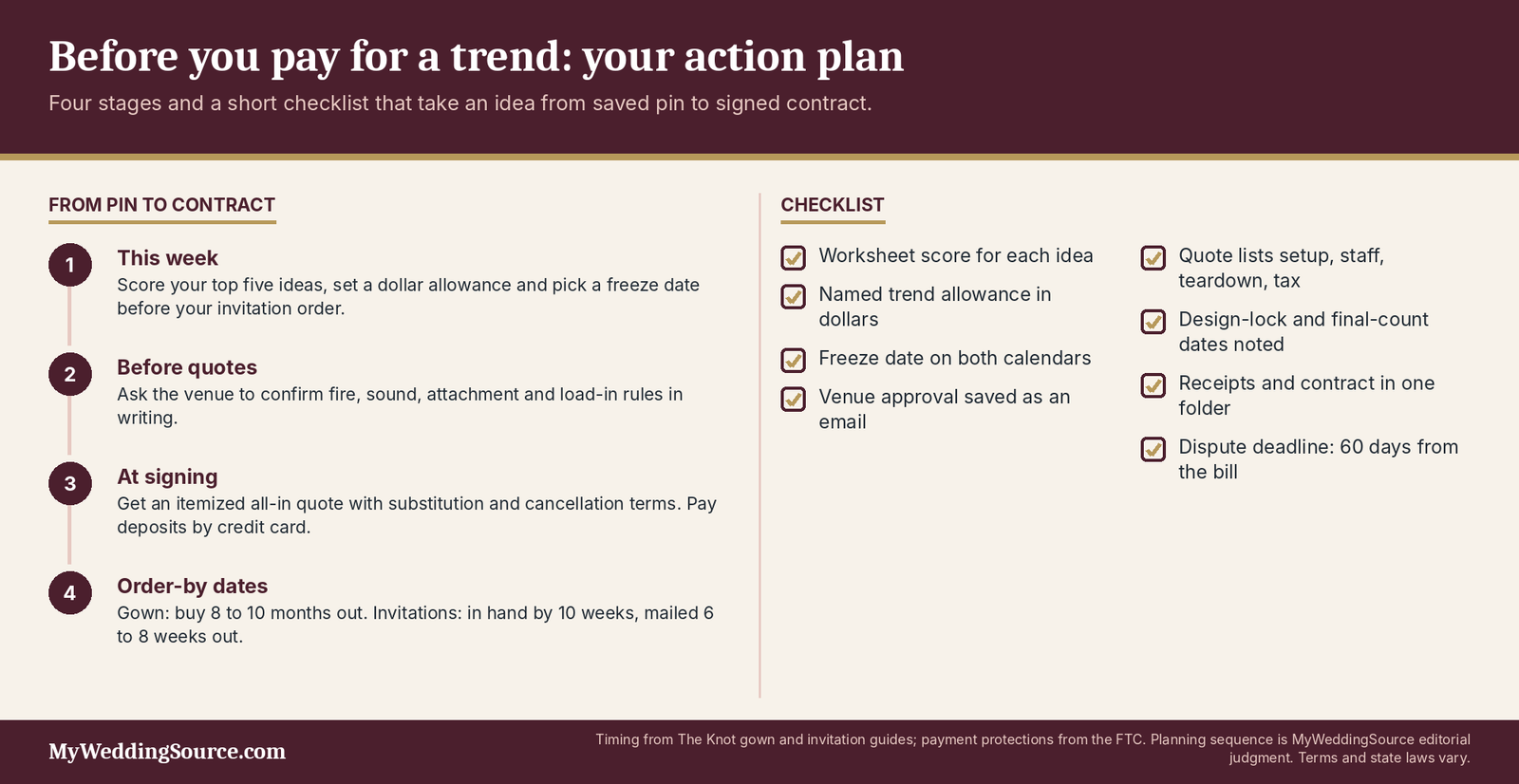
Pick the five ideas you keep returning to and score them on the six-question worksheet, separately from your partner. Compare the totals and the gaps, then sort each idea into adopt, shrink or skip. Write one sentence about the job each adopted idea does. If an idea scores 6 or lower, move it to a “pins only” folder and let it go without guilt.
Set the allowance and freeze date
Choose a dollar amount for trend items and write it at the top of your budget. Pick a freeze date that comes before your invitation order, and put it on both calendars. Review the larger planning picture with our wedding planning checklist and the wedding planning hub so the trend decisions sit in the right order with everything else. Share the date with anyone who tends to send you new ideas.
Before you pay a deposit
Get the itemized quote and the venue approval in writing
Ask each vendor for an all-in quote that lists setup, staffing, breakdown, tax and service charge. Ask your venue to confirm in writing that the idea is allowed, including fire, sound, attachment and load-in rules. Browse our wedding venues hub if you are still comparing spaces and want to see how rules differ. Do not pay until both documents are in your folder.
Pay by card and file everything
Use a credit card for deposits when the vendor accepts one, and save the contract, the receipt and the key emails in a single folder. Note the cancellation deadline and the design-lock date on your calendar. If something goes wrong, contact the vendor first and the card issuer within 60 days of the first bill showing the problem. Come back to this guide for each new idea, and for the evidence behind a trend, return to our wedding trends 2027 review.
Sources & methodology
- The Knot: average wedding cost — $34,200 average, 117 guests, $292 per guest, vendor line averages
- The Knot Real Weddings Study landing page — scope of the 2025 weddings study, data collection period
- The Knot 2026 Real Weddings Study data read-out (PDF) — 10,474 couples, over-budget share, median cost, engagement length, DIY, planning priorities
- The Knot: average wedding guest list size — guest counts by year and budget band, couples who scaled back
- The Knot: wedding gown shopping timeline — when to buy, production time, alteration fittings and cost range
- The Knot: when to send wedding invitations — ordering and mailing timeline
- The Knot 2027 Wedding Trends Report (Business Wire, Sept. 28, 2026) — search-interest percentages, multi-day weddings, methodology
- Pinterest Wedding Trend Report 2026 — growth percentages, global search and save totals, no stated baseline
- Zola 2026 First Look Report — social media influence, budget changes, spending priorities, vintage decor, AI use, engagement length
- THE WED: 13 wedding trends on their way out for 2027 — editorial forecast, no data cited
- FTC: Mail, Internet or Telephone Order Merchandise Rule — shipping time and delay-notice requirements
- FTC: Disputing credit card charges — Fair Credit Billing Act steps and deadlines
- FTC business blog on lab-created diamonds — Jewelry Guides disclosure expectations
- FTC: How to protect your privacy online — app permissions and privacy settings
- USDA FSIS: Leftovers and food safety — two-hour and one-hour rules for perishable food
- Fairfax County Fire Marshal: open flame and decorative devices — one example of local open-flame rules
We treated figures from The Knot’s and Zola’s surveys as reports of what respondents said, and growth percentages from Pinterest and The Knot’s 2027 report as platform-interest signals without a known baseline. The six-question worksheet, the freeze date, the two-or-three-trends suggestion and every example labeled illustrative are editorial judgment and arithmetic, not research findings or quotes. Fire rules, contract terms, tax treatment and consumer-protection rights vary by location and by vendor, so check the rules where you are marrying. Recheck The Knot and Zola for updated studies in early 2027, Pinterest’s newsroom for its next wedding report in spring 2027, and your venue, fire marshal and vendor contracts before you pay a deposit.