
Thanksgiving Weekend Wedding: Costs, Travel Problems, and Guest Etiquette
Is a Thanksgiving Weekend Wedding a Good Idea?
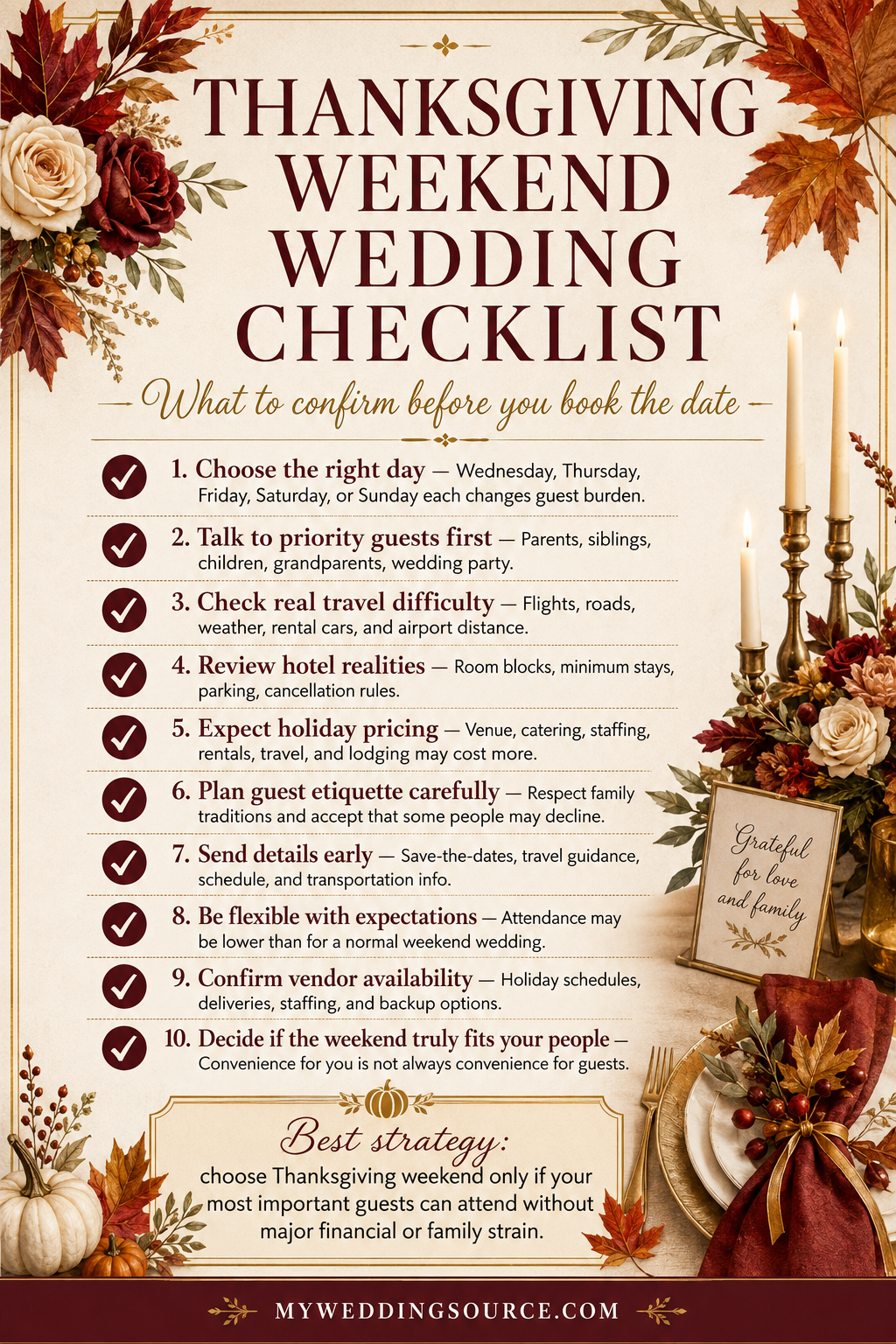
A Thanksgiving weekend wedding can work well when most important guests are already available, travel demands are manageable, and the couple does not expect everyone to sacrifice established holiday plans. It becomes more difficult when attendance depends on expensive long-distance travel, several vacation days, or abandoning traditions that are important to close relatives.
The most useful question is not whether holiday weddings are generally good or bad. Ask whether this particular weekend is workable for the people whose presence matters most. Begin with your partner, parents or parental figures, siblings, children, grandparents, wedding-party members, and anyone who would need to participate in several events. Their practical constraints should be understood before you sign a nonrefundable venue agreement.
You do not need unanimous enthusiasm from every possible guest. Almost every wedding date creates conflicts for someone. However, a holiday date affects several interconnected decisions at once, so it deserves more preliminary research than an ordinary weekend. You need to understand travel patterns, school and work schedules, hotel inventory, family expectations, and vendor capacity before assuming that the long weekend will make attendance easier.
A Thanksgiving weekend wedding is most workable when the holiday and the wedding can coexist. It becomes harder when guests are expected to treat the wedding as a complete replacement for Thanksgiving without having participated in that decision.
The day you choose also changes the level of conflict. A wedding on Thanksgiving Day asks guests to give the holiday itself to the event. A Friday wedding may require travel on Thanksgiving or an early departure from a family gathering. A Saturday wedding usually creates more separation between the holiday meal and the ceremony, although guests may still face difficult travel days. A Sunday wedding may allow more family time beforehand but can create return-travel and Monday work problems.
When the Date Is More Likely to Work
The weekend may be a practical choice if the majority of your priority guests live within driving distance, your families already celebrate Thanksgiving together, or your wedding location is close to where relatives normally gather. It can also work for a small wedding where each invited household has been consulted and understands the schedule before formal plans are made.
Couples with many teachers, university employees, or guests whose workplaces close for several days may find that the calendar provides useful flexibility. That benefit should still be verified. A long weekend on a calendar does not mean every guest has Friday off, and it does not mean hospitality, healthcare, retail, transportation, public safety, and service-industry workers are available.
A holiday weekend may also work if you are comfortable with a lower acceptance rate. Some couples prefer an intimate event and understand that distant acquaintances or extended relatives may decline. The date becomes more problematic when the budget, room block, transportation contract, or emotional expectations depend on nearly everyone attending.
When the Date Creates Greater Risk
The date deserves additional caution when many essential guests need to fly, when either family has deeply established Thanksgiving traditions, or when several guests share custody of children. It can also create difficulties if the wedding is held at a remote venue with limited hotels, rental cars, restaurants, or transportation options.
A large destination wedding during Thanksgiving weekend combines two demanding commitments: holiday travel and wedding travel. Guests may need to purchase flights for an entire household, reserve several hotel nights, arrange pet care, manage children’s schedules, and miss gatherings with relatives who are not invited. Some guests will be pleased to turn the weekend into a trip. Others may decline even though they care about you.
Consider the date carefully if disappointment about declines will be difficult for you or your partner. The invitation can express how meaningful someone’s attendance would be, but it should not make the guest responsible for solving an expensive or emotionally complicated conflict.
How Each Day of Thanksgiving Weekend Changes the Wedding
“Thanksgiving weekend” can refer to several different schedules, and each one creates distinct consequences. Before discussing the date with family or vendors, define the full event window. Include the rehearsal, rehearsal dinner, welcome event, ceremony, reception, brunch, hotel check-in, and expected departure time.
Wednesday Before Thanksgiving
A Wednesday wedding may be attractive because the venue is available or less expensive, but it can require guests to travel earlier in the week and take additional time away from work. The date may also overlap with guests’ plans to prepare meals, host relatives, collect family members from airports, or drive to another destination.
Some guests may face a choice between attending the wedding and reaching their Thanksgiving destination. Others may attend but leave immediately after the reception or skip a morning-after gathering. A late reception can be particularly difficult for guests who need to drive several hours on Thursday morning.
A Wednesday event is generally more realistic for a local guest list or a small group that has intentionally decided to spend the entire holiday period together. It is less suitable when guests are expected to attend the wedding and then begin a separate long-distance Thanksgiving trip.
Thanksgiving Day
A wedding on Thanksgiving Day makes the marriage celebration the central event of the holiday. This can be meaningful when the invited guests already form the couple’s usual holiday group or when all close family members have agreed that the wedding will become that year’s gathering.
The trade-offs are substantial. Guests may give up traditions with relatives who are not invited. Vendors and their employees may be working instead of spending the holiday with their households. Restaurants, rental operations, transportation companies, florists, and delivery services may use limited schedules. Holiday labor charges or minimums may apply, and replacement options can be scarce if a vendor, vehicle, shipment, or piece of equipment becomes unavailable.
Do not describe a Thanksgiving Day wedding as convenient simply because many offices are closed. For some guests and vendors, the date is the least flexible day of the entire weekend.
If you choose Thursday, discuss the plan with immediate family before booking. Make meal expectations explicit, provide a realistic event timeline, and avoid adding unnecessary morning activities that prevent guests from having personal or family time.
Friday After Thanksgiving
A Friday wedding can separate the ceremony from Thanksgiving dinner, but it may require guests to arrive on Wednesday or travel on Thursday. A Friday afternoon ceremony may also require early hair, makeup, photography, setup, and vendor arrivals after a major holiday.
Guests who normally divide Thanksgiving Day between households may not have time to reach the wedding location by Friday. Families with children may need to pack, check out, and travel immediately after a late holiday gathering. Vendors may need to receive flowers, food, rentals, or supplies before the holiday because normal Thursday delivery is unavailable.
Friday can work when the venue is near the family gathering location or when guests are invited to arrive earlier for a shared Thanksgiving meal. That meal should be optional unless the wedding is intentionally structured as a multi-day hosted event.
Saturday After Thanksgiving
Saturday often creates the most separation between the holiday itself and the wedding. Guests may celebrate Thanksgiving on Thursday, travel on Friday, attend the wedding on Saturday, and return home on Sunday. This schedule can be workable, but it still compresses travel into a busy period and may require several hotel nights.
Saturday is not automatically an off-season bargain. Venues and vendors may recognize it as a desirable holiday-weekend date, particularly in mild-weather destinations or markets where November weddings remain popular. Ask for complete pricing rather than assuming that a late-fall date will receive a discount.
A Saturday wedding also creates pressure on Sunday departures. Guests may need to check out early, reach airports, return rental cars, or drive home before work and school resume. A farewell brunch should therefore be optional and scheduled so it does not create guilt for guests who need to leave.
Sunday After Thanksgiving
A Sunday wedding may offer more venue availability or a lower rental fee, and guests have several days before the ceremony. The difficulty moves to the end of the weekend. Guests may need to travel late Sunday night, take Monday off, or leave the reception early.
Return flights and highways can be demanding at the end of a holiday period. A Sunday evening reception is particularly difficult for guests facing an early Monday. A daytime ceremony and early dinner may reduce that pressure, but it changes the atmosphere and vendor schedule.
If many guests work remotely, do not assume they can simply work from a hotel on Monday. They may have children, limited internet, transportation deadlines, or employers who expect them to be in a particular location.

Thanksgiving Weekend Wedding Travel Costs
Travel is one of the largest sources of uncertainty for a Thanksgiving weekend wedding. The guest does not pay only for a flight or tank of gas. The full travel cost may include baggage, seat assignments, parking, airport transfers, rental cars, hotel nights, meals, pet care, childcare, and missed work.
Couples do not need to pay every guest’s travel expenses, but they should understand the likely burden before choosing the date. This is especially important if many invitees live far away or if the venue is not served by a major airport.
Airfare and Flight Restrictions
Airline prices change according to route, timing, demand, capacity, and ticket conditions. Rather than promising guests a particular fare, give them enough information to compare options early. The U.S. Department of Transportation recommends considering flexible travel dates, alternate airports and routings, and the restrictions attached to a fare. Its guidance on finding airline fares can help guests evaluate more than the initial ticket price.
A low fare may involve a long connection, restrictive change conditions, an inconvenient airport, or additional baggage and seat costs. Families traveling with children may reasonably choose a more expensive nonstop flight because a connection creates greater disruption. Older guests or people with mobility needs may prefer an airport with better ground transportation even if another airport has a lower advertised fare.
Provide the wedding address, recommended arrival window, ceremony time, hotel information, ground transportation plan, and the distance from each practical airport. Guests can then compare the complete trip rather than buying a cheap flight that creates an expensive rental-car or hotel problem.
Do Not Publish an Unrealistic “Book By” Price
Wedding websites sometimes state that flights are “about $300” based on one search made months earlier. That amount can create false expectations because prices differ by origin, date, baggage needs, and booking time. It is more useful to list airports, travel windows, and transportation options than to promise an average price.
If you find a temporary fare, you may share it privately with relevant guests while making clear that it can change. Avoid pressuring people to purchase nonrefundable tickets before the major wedding contracts and schedule are secure.
Hotel Availability and Room Blocks
Hotel demand varies by location. A downtown business district may have strong weekend availability, while a tourist destination, college town, resort area, or small community may have limited rooms. Local sports, festivals, holiday events, family visits, and shopping travel can further affect inventory.
Contact hotels before booking the venue if the area has few lodging options. Ask for the public rate, group rate, parking cost, resort or destination fee, taxes, minimum stay, cancellation deadline, and the date on which unused rooms return to general inventory.
Pay particular attention to attrition clauses in contracted room blocks. An attrition clause can make the couple financially responsible when guests do not reserve an agreed percentage of rooms. This matters on a holiday weekend because guests may stay with relatives, use reward points, choose vacation rentals, or decline after the block is signed.
A courtesy block, where available, may reduce financial exposure because rooms are held without the same purchase commitment. The rate may be less favorable or the number of rooms more limited. Compare the risk as well as the discount.
Minimum-Stay Requirements
Some hotels or vacation properties may require two or three nights during a holiday period. That can turn a one-night wedding visit into a significantly more expensive trip. Ask before advertising the property as the recommended guest option.
If minimum stays are common near the venue, provide at least one alternative with fewer restrictions. Guests should not have to discover after receiving the invitation that the practical lodging options require an extended holiday vacation.
Driving and Holiday Traffic
A drivable wedding is not automatically a simple trip. Guests may encounter congestion, winter weather, limited daylight, construction, or long distances after a holiday meal. A drive that usually takes three hours may require a larger buffer, particularly near metropolitan areas, shopping districts, airports, and major highway interchanges.
Do not schedule required wedding-party activities based on ideal travel time. If attendants are expected at a Friday rehearsal, they may need to leave their Thanksgiving gathering early or travel on Wednesday. Ask each person about the route and realistic departure time before finalizing the rehearsal.
Provide parking instructions, road conditions to expect, venue entrance details, and a contact number for transportation problems. For rural or mountain venues, explain whether guests will use unpaved roads, steep routes, toll roads, ferries, or areas with limited cellular service.
Rental Cars and Local Transportation
A destination served by an airport may still require a rental car. Availability, pickup hours, age requirements, deposits, insurance decisions, and vehicle size can affect guests. A family of five carrying luggage and formal clothing may need a larger and more expensive vehicle than two adults traveling with carry-on bags.
Shuttles can reduce rental-car needs, but the schedule must align with realistic flight and hotel arrangements. A single shuttle from one hotel does not solve transportation for guests staying elsewhere or arriving after the final pickup.
If you offer transportation, explain exactly what is included. State which hotel is served, when vehicles depart, whether seats are guaranteed, whether child safety seats are available, and how guests return if they leave the reception early.
How the Holiday Can Change Your Wedding Budget
A Thanksgiving weekend wedding may include both savings and premiums. The venue might offer a lower November rental fee, but another vendor may charge holiday labor. A florist may need to receive flowers earlier. A rental company may require a longer rental period because it does not deliver or collect on Thanksgiving Day. The hotel rate may be favorable while airfare is difficult for guests.
Compare the total cost of the holiday date with a nonholiday alternative using the same guest count and event design. Do not compare only the venue’s advertised fee.
Vendor Holiday Charges
Vendors decide independently whether they work during the holiday period and how they price the date. Some may charge their normal rate. Others may require a premium, longer minimum, additional staffing cost, or adjusted schedule. A family-owned company may close for several days, while a large company may maintain limited service.
Ask each vendor whether the quote includes holiday labor, delivery restrictions, overtime, travel, accommodation, meals, setup, breakdown, and emergency support. If a vendor needs to work on Thanksgiving Day to prepare for a Friday wedding, the premium may apply even though the ceremony occurs after the holiday.
A holiday surcharge is not necessarily an attempt to exploit the date. It may compensate employees for working during a major holiday, arranging special delivery, or completing several days of production within a shortened operating week.
Extended Rental Periods
Tables, chairs, linens, tents, lighting, dishes, glassware, and decor may need to arrive earlier because the rental company is closed on Thursday. Earlier delivery can create additional venue storage requirements or multi-day rental fees.
Ask who accepts the delivery, where the equipment will be secured, and whether the venue charges for early access. If items remain through Monday, confirm who is responsible for loss, weather exposure, or damage during the extended period.
Catering and Food Costs
Caterers may face holiday labor schedules, supply changes, and competing Thanksgiving orders. A familiar seasonal menu is not necessarily less expensive simply because the ingredients resemble a holiday meal. Turkey, side dishes, pies, staffing, equipment, service style, and presentation still have costs.
Ask whether the caterer prepares Thanksgiving meals for other clients and how that affects production capacity. Confirm delivery schedules, refrigeration, kitchen access, staffing, and the deadline for final menu changes.
If the venue or caterer requires a food and beverage minimum, verify whether the minimum or service charge changes on the holiday weekend. Review taxes, gratuity policies, administrative fees, cake cutting, bar staffing, rentals, and overtime rather than comparing menu price per person alone.

Shipping and Printed Materials
Holiday closures and heavy shipping volume can affect invitations, attire, favors, decor, gifts, and personalized items. Build additional time into any order that must arrive before the wedding week.
A product scheduled to arrive on Wednesday leaves little recovery time if it is delayed, damaged, or incorrectly personalized. Move essential deadlines earlier and distinguish necessary items from optional decor. A wedding can proceed without custom cocktail napkins. It cannot proceed as planned if required attire, rings, or ceremony materials remain in transit.
Three Thanksgiving Weekend Wedding Budget Scenarios
The following examples are hypothetical. They show how the same holiday weekend can produce different financial outcomes depending on location, guest travel, vendor terms, and event structure.
Scenario One: Mostly Local Saturday Wedding
A couple invites 90 guests, and approximately 75 live within two hours of the venue. The wedding takes place on Saturday evening. The venue charges $2,000 less than its October Saturday rate, and most vendors use standard pricing. A courtesy hotel block is available, and only 15 rooms are expected to be used.
The couple spends an additional $800 for an extended rental period and $600 for Friday rehearsal-space access. The venue saving remains meaningful because guest travel is limited and the couple avoids contracted hotel liability.
This version works because the event does not require most guests to fly, Thanksgiving Day remains free, and the Saturday schedule is independent from the family meal. The couple still accepts that some relatives will decline because they travel elsewhere for the holiday.
Scenario Two: Regional Wedding With Significant Guest Travel
A couple invites 140 guests, and approximately half would need flights or a drive longer than four hours. The venue offers a $3,500 seasonal discount. However, vendors add $2,200 in combined holiday labor and extended-delivery costs. The hotel requires a two-night minimum, and the couple signs a contracted block.
Several households decline because the trip is too expensive, so the block performs below expectation. The couple owes $1,500 under the attrition provision. The venue discount is largely absorbed by holiday-related charges and hotel liability.
The wedding may still be the right choice if the date has personal significance, but it should not be described as a budget date. The financial decision needs to include the likely attendance pattern and contractual exposure.
Scenario Three: Thanksgiving Destination Weekend
A couple plans a 60-person resort wedding from Wednesday through Sunday. Thanksgiving dinner, the Friday welcome event, Saturday wedding, and Sunday brunch are all hosted. The venue provides package pricing, but most guests need flights, four hotel nights, and airport transportation.
The couple covers several meals and subsidizes transportation, increasing the hosting budget. Guests who attend receive a complete multi-day experience, but the trip requires substantial time and money. The acceptance rate is lower than it might be for a normal weekend.
This option works only if the couple prefers a smaller destination gathering, communicates early, and does not pressure invited households that cannot make the trip. It is less suitable if the couple expects a large guest count or assumes the holiday automatically makes everyone available.
Family Traditions and Thanksgiving Wedding Etiquette
The emotional difficulty of a Thanksgiving weekend wedding often comes from family traditions rather than logistics alone. Every guest may have a different relationship with the holiday. Some households host the same meal every year. Others alternate between families, combine several households, travel to see aging relatives, or do not celebrate Thanksgiving at all.
The wedding should not assume that one family’s tradition is universal. Ask questions before making promises about attendance. A relative who appears available may already be responsible for hosting 25 people. A divorced parent may need to attend two gatherings. A guest may use the holiday to visit a relative who cannot travel to the wedding.
Talk to Priority Guests Before Booking
Contact the people whose absence would materially affect your decision. This is not the same as asking for permission from every relative. It is practical research before making a nonrefundable commitment.
You might say:
“We are considering a wedding on the Saturday after Thanksgiving. We have not booked anything yet, and we know the weekend may involve existing family plans. Before we make a decision, could you tell us honestly whether traveling that weekend would be realistic for you?”
The wording gives the person room to identify a problem without appearing unsupportive. Do not ask the question if only one answer will be accepted.
Do Not Frame Attendance as a Loyalty Test
A guest can value your relationship and still choose an established holiday commitment, a lower-cost trip, or time with relatives who are not invited. Some households may not be able to afford both holiday and wedding travel. Others may protect the only weekend each year when their extended family gathers.
A decline on a holiday weekend is not reliable evidence that the guest does not care about the wedding. Treat the RSVP as a practical decision rather than a ranking of relationships.
Handle Family Contributions Carefully
If parents or relatives are contributing financially, discuss whether the holiday date affects their expectations. A person helping pay for the wedding may assume that customary Thanksgiving guests will be invited, that the rehearsal dinner will become the family meal, or that out-of-town relatives will stay at their home.
Financial support does not automatically give someone control over the date or guest list, but unstated assumptions create conflict. Clarify the hosting plan, invitation boundaries, event costs, and household responsibilities before accepting a contribution linked to the holiday weekend.
Guest Declines and RSVP Expectations
You should expect that a Thanksgiving weekend date may produce different response patterns from a standard weekend. Some guests will appreciate the extra travel days. Others will decline quickly because the date conflicts with family plans. A third group may wait while coordinating custody, airfare, work schedules, or several households.
Set an RSVP deadline that gives you enough time to finalize catering, rentals, seating, and transportation without forcing guests to decide before they can reasonably research travel. The correct timing depends on your vendor deadlines and whether guests need flights.
Do Not Build the Budget Around an Optimistic Attendance Rate
Before signing contracts, calculate what happens if attendance is lower than expected. Review food and beverage minimums, room-block attrition, shuttle capacity, venue minimums, and rental quantities.
A lower guest count may reduce catering and rental costs, but it does not reduce every expense. Venue rental, photography, entertainment, attire, and many floral costs may remain similar. If the venue requires a minimum spend, the couple may need to upgrade food or beverages rather than receive a lower invoice.
Responding to a Holiday Conflict
A useful response to a decline is brief and does not require the guest to justify the decision:
“We understand. We knew the holiday weekend would not work for everyone, and we appreciate you letting us know. We will miss you, but we hope you have a good Thanksgiving with your family.”
Avoid asking whether the guest can attend only the ceremony, skip their family meal, change flights, or leave children behind unless the guest has already asked for help exploring options.
Invitation and Save-the-Date Timing
Holiday-weekend guests need information earlier than guests attending a straightforward local wedding. They may compare flights, request time away from work, coordinate family plans, reserve lodging, and arrange childcare or pet care.
Send save-the-dates as soon as the venue, date, and location are secure and the priority guest list is sufficiently stable. For a travel-heavy Thanksgiving weekend wedding, many couples may reasonably send them earlier than they would for an ordinary local event.
Early notice is useful only when it contains practical information. At minimum, provide the city, wedding date, wedding website, and a clear indication that the event falls during Thanksgiving weekend. Do not make guests search a calendar to discover the conflict after they have become emotionally committed.
What the Wedding Website Should Explain
The website should state which events are required, which are optional, when guests should arrive, and when they can reasonably depart. List airports, hotel options, transportation, parking, weather expectations, dress code, childcare information, and whether Thanksgiving Day includes a hosted event.
If the ceremony is Saturday, avoid implying that guests must arrive on Wednesday unless there is a genuine reason. A welcome event can be enjoyable, but requiring multiple days of attendance increases the financial and scheduling burden.
Sample Save-the-Date Note
“Our wedding will take place on Saturday, November 28, during Thanksgiving weekend. We know the holiday is an important time for many families, so we are sharing the date early. The ceremony and reception will be held in Columbus, Ohio, and no wedding events are scheduled on Thanksgiving Day. Travel and hotel information is available on our website.”
This wording identifies the potential conflict, gives guests useful information, and avoids apologizing for the date.
Sample Invitation-Website Travel Note
“Please choose the travel schedule that works best for your household. The wedding ceremony begins at 4:00 p.m. on Saturday, and guests do not need to attend Friday’s informal welcome gathering. Because holiday travel can be busy, we recommend reviewing transportation and lodging options early.”
Rehearsal Timing During Thanksgiving Weekend
The rehearsal can create more conflict than the wedding because it is often scheduled with less attention. A Friday rehearsal may require the wedding party and immediate family to travel on Thanksgiving. A Thursday rehearsal can directly replace the holiday meal. A Wednesday rehearsal may require several additional vacation days.
Begin by deciding who genuinely needs to rehearse. The officiant, couple, processional participants, readers, musicians, and anyone with a complicated ceremonial role may need to attend. Partners of attendants, extended family members, and guests who are not part of the ceremony generally do not need to be present.
Do not turn a 30-minute logistical rehearsal into a mandatory multi-hour holiday event unless the additional gathering is intentionally hosted and clearly communicated.
Friday Rehearsal for a Saturday Wedding
A Friday afternoon or early-evening rehearsal is common, but ask whether participants can reach the venue without traveling on Thanksgiving Day. If not, consider a later Friday time, a Saturday morning walkthrough, or a virtual briefing for uncomplicated roles.
The rehearsal dinner does not need to be formal. A restaurant reservation, private meal, catered gathering, or casual welcome event can work. Availability may be limited because restaurants are managing holiday schedules and private gatherings, so confirm the space early.
Thursday Rehearsal and Thanksgiving Meal
If the rehearsal takes place Thursday, decide whether the following meal is the official Thanksgiving gathering. If it is, clarify who is invited. Traditional rehearsal-dinner guest lists may exclude relatives or partners who would normally share the holiday, creating an uncomfortable division.
You may expand the meal, hold a simple rehearsal without dinner, or separate the ceremony walkthrough from a broader Thanksgiving gathering. Each option changes the budget and guest expectations.
Saturday Morning Rehearsal
A same-day rehearsal can reduce holiday conflicts when the ceremony is later in the day and the venue is available. It works best for a relatively simple ceremony with reliable participants.
The schedule must protect hair, makeup, photography, setup, transportation, and personal preparation. A 10:00 a.m. walkthrough that becomes a 90-minute discussion can create delays throughout the day. Provide the ceremony order in advance and use the rehearsal to practice movement rather than redesign the ceremony.

Children, School Schedules, and Custody Arrangements
Families with children may appreciate a wedding during a school break, but the holiday does not remove every complication. Travel can be more expensive for an entire household, children may miss traditions, and parents may need to coordinate custody or visits with several relatives.
Decide your children policy early enough that households can plan. An adults-only Thanksgiving weekend wedding may require guests to find childcare during a family holiday when their usual caregivers are unavailable. That does not mean you must invite children, but the practical effect should be understood.
If Children Are Invited
Explain which events include them. A child may be invited to the wedding but not a late rehearsal dinner, or the couple may welcome children throughout the weekend. Inconsistent assumptions can create last-minute confusion.
Consider meal timing, seating, transportation, hotel-room capacity, quiet areas, and the length of the event. A 6:00 p.m. ceremony followed by a formal dinner may be challenging for young children who have already traveled or attended several holiday gatherings.
If the Wedding Is Adults Only
Use clear invitation addressing and website language. Do not imply that hotel childcare will be available unless you have confirmed the provider, cost, age limits, background checks, booking process, and location.
Acknowledge declines without argument. Some parents will not leave children during Thanksgiving weekend, particularly when they have traveled to spend the holiday together. Their decision is not necessarily criticism of the adults-only policy.
Shared Custody and Blended Families
Holiday custody schedules may be determined far in advance and can be difficult to change. A parent may not know whether a child can attend until reviewing a legal agreement or coordinating with another household.
Avoid placing the guest in the position of explaining private family arrangements. Give early notice, allow time for a response, and accept that the invited adult or child may be unavailable.
Thanksgiving Meal Expectations
A late-November wedding does not require turkey, stuffing, cranberry sauce, or pumpkin pie. It also does not need to avoid those foods. The menu should be based on the event time, guest needs, catering capability, and the experience you want to create.
The difficulty arises when guests are uncertain whether the wedding replaces their Thanksgiving meal. If the ceremony occurs on Thursday, they will reasonably expect substantial food and may expect familiar holiday elements. If the wedding occurs Saturday, a standard wedding menu is generally easier to understand.
Traditional Thanksgiving-Inspired Menu
A traditional menu can feel generous and familiar, particularly if the wedding is the family’s holiday gathering. However, serving Thanksgiving food to a large wedding requires professional production, holding, service, and dietary planning. A holiday menu prepared for 150 guests is not simply a larger version of a home dinner.
Ask the caterer how turkey will be prepared and served, how sides will remain at the intended temperature, whether buffet lines can move efficiently, and which dishes accommodate dietary restrictions. A plated service may provide consistency, while a buffet or family-style meal may create a more communal atmosphere.
Seasonal but Not Thanksgiving-Themed
You can use late-fall ingredients without recreating the holiday meal. Roasted vegetables, squash, apples, pears, herbs, mushrooms, grains, braised meats, soups, and seasonal desserts can feel appropriate without repeating what guests ate on Thursday.
This approach may be useful for a Friday or Saturday wedding when guests have already attended several Thanksgiving meals. Ask the caterer to balance richer dishes with fresh, acidic, or lighter elements so the menu does not feel excessively heavy.
Completely Different Menu
There is no etiquette requirement to serve traditional holiday food. Regional cuisine, cultural dishes, brunch, Italian food, barbecue, seafood, vegetarian menus, or another style may better represent the couple.
If the wedding occurs on Thanksgiving Day, communicate enough information that guests understand a full meal will be served even if the menu is unconventional. Guests should not eat an entire dinner beforehand because they assumed the wedding offered only cocktails and appetizers.
Dietary Needs
Holiday dishes can contain hidden dairy, eggs, gluten, nuts, meat stock, or other ingredients. Collect dietary information through the RSVP process and discuss it with the caterer. A guest who cannot eat the main entrée should receive a complete alternative rather than several side dishes assembled as an afterthought.
Do not assume that a vegetable side is vegetarian or that a familiar holiday dish is safe for a guest with an allergy. Recipes, preparation areas, garnishes, sauces, and serving utensils matter.
Vendor Availability and Contract Questions
Vendor availability should be researched before the venue contract is signed if the wedding depends on specific professionals or complex services. Photographers, planners, caterers, florists, rental companies, transportation providers, beauty teams, musicians, and officiants may limit holiday work.
A vendor who is available for the wedding may not be available for the rehearsal, Thanksgiving meal, or next-day brunch. Request a quote for the complete event schedule rather than adding holiday events after the main contract is signed.
Questions for Every Major Vendor
Ask whether the price includes holiday labor, travel, accommodation, delivery, setup, breakdown, overtime, assistant fees, and taxes. Confirm when the vendor receives supplies, what happens if normal delivery days change, and whether a backup professional is available.
Review cancellation, postponement, illness, weather, and force-majeure provisions. A holiday date can make replacement more difficult because fewer comparable professionals may be working.
Photography and Videography
November daylight may be limited, depending on the wedding location. A Saturday ceremony scheduled late in the afternoon may leave little time for outdoor family and couple portraits. The holiday date does not cause the early sunset, but travel and rehearsal schedules may make it harder to move preparations earlier.
Discuss first-look options, portrait timing, indoor locations, and artificial lighting before finalizing the ceremony time. If the photographer travels from another market, confirm lodging and arrival plans so holiday traffic does not threaten coverage.
Florals and Rentals
Friday and Saturday weddings may require flowers and rentals to arrive before Thanksgiving. Ask where products will be stored and who controls the environment. Flowers need appropriate temperature and water; linens and furniture need a dry, secure area.
If the venue cannot accept early delivery, the florist or rental company may need to store items longer or make a special holiday-weekend trip. Those requirements should appear in the quote.
Transportation
Confirm vehicle availability, driver schedules, holiday premiums, hotel routes, airport transfers, parking, and cancellation terms. A provider may have vehicles available for Saturday night but limited staff for Thursday or Friday activities.
Build additional time into every route. Guests should not miss the ceremony because the shuttle schedule assumes ordinary traffic and immediate boarding.
Communication Scripts for Common Holiday-Wedding Situations
Asking Immediate Family About the Date
“We are considering the Saturday after Thanksgiving for the wedding. We know that weekend may affect family traditions and travel, so we want your honest practical input before we book. Would attending be realistic, and is there a specific conflict we should understand?”
Telling Guests the Wedding Will Be Adults Only
“Although we know the holiday is usually family time, the ceremony and reception will be for adults only. We are sharing this early because we understand that holiday-weekend childcare may be difficult. We completely understand if the arrangement prevents you from attending.”
Explaining That Thanksgiving Day Is Unscheduled
“No wedding events are scheduled on Thanksgiving Day. Please spend the holiday in the way that works best for your household. The optional welcome gathering begins at 7:00 p.m. on Friday, and the wedding takes place Saturday afternoon.”
Inviting Guests to an Optional Thanksgiving Meal
“Guests who will already be in town are welcome to join us for a casual Thanksgiving dinner at 4:00 p.m. Attendance is completely optional, and we understand that many guests have separate family plans. Please RSVP for the meal through the wedding website so we can plan seating and food.”
Responding to a Guest Concerned About Cost
“We understand that holiday travel can be expensive, and we do not want you to stretch your budget to attend. We would be glad to celebrate with you another time if the trip is not practical.”
Decision Criteria: Should You Choose Thanksgiving Weekend?
A useful decision requires more than listing advantages and disadvantages. Identify the conditions that must be true for the date to work and test them before signing contracts.
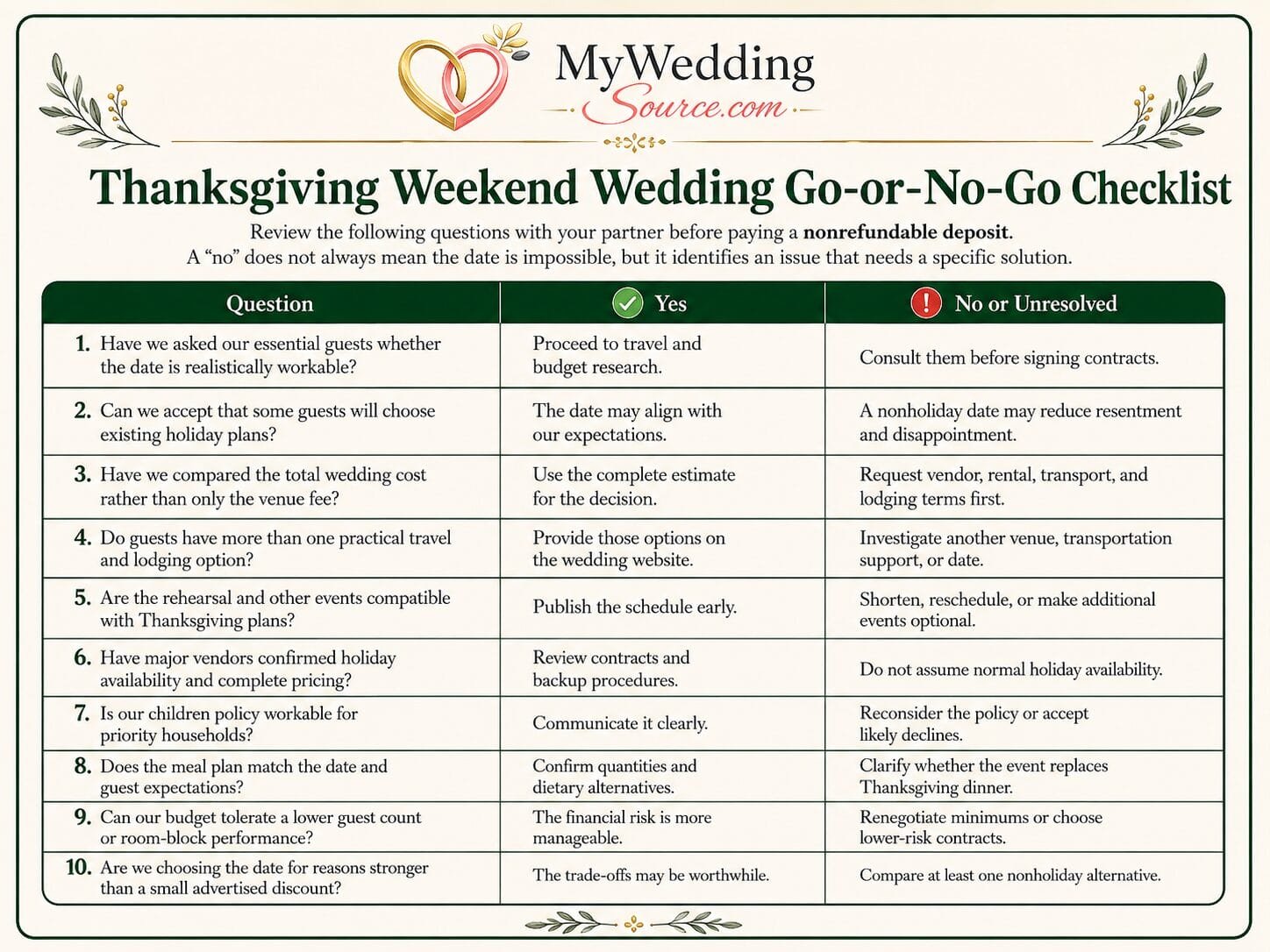
Thanksgiving Weekend Wedding Go-or-No-Go Checklist
Review the following questions with your partner before paying a
nonrefundable deposit. A “no” does not always mean the
date is impossible, but it identifies an issue that needs a specific
solution.
Common Thanksgiving Weekend Wedding Mistakes
Assuming the Long Weekend Makes Attendance Easier
A common mistake is treating the holiday as automatic vacation time. This overlooks guests who work during the weekend, host family, travel elsewhere, share custody, or cannot take additional days off.
Prevent the problem by checking with priority guests before booking and communicating the complete schedule early. If you have already booked, make optional events genuinely optional and accept declines without trying to renegotiate the guest’s holiday.
Comparing Only the Venue Price
A lower November rental fee can make the date appear economical. The saving may be reduced by holiday labor, longer rentals, early deliveries, lodging commitments, transportation, or hosted multi-day events.
Create side-by-side budgets using complete estimates. Include what guests may need to pay as well, even if their expenses are not part of your wedding budget. A date can be affordable for the couple and unaffordable for much of the guest list.
Sending Save-the-Dates Too Late
Guests need time to coordinate holiday plans and compare travel. Late notice can lead to higher costs, unavailable lodging, and preventable declines.
If the date is already close, send accurate digital notice after the venue and schedule are secure. Do not wait for finished photographs or elaborate stationery while guests need practical information.
Making Every Weekend Event Mandatory
A Thursday meal, Friday welcome event, Saturday wedding, and Sunday brunch can create a generous itinerary. It can also require four hotel nights and eliminate guests’ ability to maintain their own traditions.
Identify which events are essential. For most guests, the ceremony and reception should be the only required events. State optional status clearly rather than using language that makes attendance feel expected.
Ignoring Children and Childcare
An adults-only policy may be appropriate, but holiday childcare can be unusually difficult. Usual caregivers may be traveling or attending family events.
Communicate early, provide verified childcare information where feasible, and accept that some parents will decline. Do not describe the problem as poor planning by the guest.
Expecting Thanksgiving Food Without Confirming the Catering Plan
Couples may assume a caterer can provide a traditional meal easily because the dishes are familiar. Large-scale preparation, staffing, service, dietary alternatives, and holiday production schedules still require planning.
Approve the menu, service style, quantities, kitchen access, and timing in writing. If the wedding replaces Thanksgiving dinner, ensure guests receive a complete meal.
Forgetting Vendor Employees
A vendor may personally agree to the date while still needing photographers, servers, drivers, cooks, designers, assistants, and setup crews. Holiday staffing can affect capacity and cost.
Ask whether the quoted team is confirmed and how the company handles employee absences. Respectful planning includes realistic setup windows, vendor meals, breaks, and agreed holiday compensation.
Taking Guest Declines Personally
The holiday creates conflicts unrelated to the quality of the relationship. Responding with disappointment or repeated persuasion can damage the relationship more than the decline itself.
Acknowledge the response, adjust your numbers, and find another way to connect later if the relationship is important.
Frequently Asked Questions
Is it rude to have a wedding on Thanksgiving weekend?
No, a Thanksgiving weekend wedding is not automatically rude. The etiquette depends on how the date is planned and communicated. Give guests substantial notice, acknowledge that they may have established traditions, and avoid pressuring people who cannot attend.
The date becomes less considerate when the couple assumes that everyone is available, hides the holiday conflict until invitations arrive, or expects several mandatory days of attendance. A Saturday wedding with no Thursday requirements is generally easier for many guests than a ceremony on Thanksgiving Day, but individual circumstances still vary.
How early should save-the-dates be sent?
Send them after the venue, date, and location are secure and early enough for guests to research holiday travel and family commitments. Travel-heavy holiday weddings generally benefit from earlier notice than simple local weddings.
The save-the-date should explicitly identify Thanksgiving weekend and direct guests to practical travel information. Early notice is less useful when the website contains no hotel, airport, or schedule details.
Will a Thanksgiving weekend wedding be cheaper?
It may be cheaper in some markets, but the date is not automatically a budget option. A venue may offer seasonal pricing while vendors, rentals, hotels, transportation, or holiday staffing cost more.
Compare complete written estimates for the holiday date and a nonholiday alternative. Include extended rental periods, delivery changes, minimum stays, room-block liability, rehearsals, and any Thanksgiving meal you intend to host.
Should we serve a traditional Thanksgiving dinner?
You may, but it is not required. The menu should match the event time and the experience you want. A Thursday wedding that replaces the usual holiday gathering should provide a substantial meal and clear advance information.
A Friday or Saturday wedding can use seasonal food without repeating the traditional meal. You can also choose an entirely different menu that reflects your culture, location, or preferences.
What if important relatives already host Thanksgiving?
Talk with them before booking. Ask whether the wedding can coexist with the gathering, whether the host would attend, and whether other relatives would face a difficult choice.
You do not need to preserve every tradition unchanged, but understanding the impact allows you to choose the date knowingly. Possible solutions include a Saturday ceremony, no Thursday events, a shared holiday gathering, or a different weekend.
Should we invite all relatives who normally attend Thanksgiving?
No. Your wedding guest list does not need to duplicate the holiday guest list. However, holding the wedding on Thanksgiving Day can make exclusions more visible because invited family members may be unavailable for their normal gathering.
Use consistent invitation rules and avoid describing a limited wedding as the family’s Thanksgiving celebration when several usual participants are not included.
How should we handle guests who cannot afford holiday travel?
Respond without pressure or embarrassment. You can provide early information, several lodging options, shuttles, shared transportation resources, or selective assistance when your budget allows. You are not required to pay for every trip.
Make clear that declining is acceptable. Do not encourage guests to use debt, buy restrictive tickets they are uncomfortable with, or sacrifice essential expenses.
Is Friday or Saturday better for a Thanksgiving wedding?
Saturday often gives guests more separation from Thanksgiving Day, while Friday may offer better venue availability or pricing. The better choice depends on travel distance, rehearsal timing, vendor access, and family plans.
A Friday wedding may force some people to travel on Thursday. A Saturday wedding may require a longer hotel stay and create difficult Sunday return travel. Compare the full itinerary rather than the ceremony day alone.
Can we require the wedding party to arrive before Thanksgiving?
You can request it, but consider the time and financial burden carefully. Arriving Wednesday may require additional vacation days, hotel nights, and missed family gatherings.
Limit early requirements to activities that genuinely need in-person attendance. Provide the schedule before attendants accept the role, and do not assume they can absorb added holiday costs.
What should we do if many guests decline?
First, review contractual deadlines and adjust catering, rentals, transportation, seating, and room blocks where possible. Ask vendors whether minimum spending can be redirected toward menu or service upgrades.
Do not immediately invite a large second group solely to fill seats unless those people were always people you wanted at the wedding. A smaller celebration may be more appropriate than creating invitations that appear to depend on earlier declines.
Make the Decision Based on the Full Weekend
A Thanksgiving weekend wedding can be thoughtful, practical, and enjoyable when it is designed around the realities of the holiday rather than the assumption that everyone has extra free time. The date works best when priority guests are consulted, travel options are reasonable, family traditions are acknowledged, and additional events remain limited or optional.
Evaluate the total financial picture. Compare airfare and hotel burdens for guests, holiday labor for vendors, delivery schedules, extended rentals, transportation, room-block terms, and catering requirements. A venue discount is useful only when it remains a saving after these connected costs are included.
Communication matters as much as logistics. Tell guests early that the wedding falls during Thanksgiving weekend. Explain which events are required, which are optional, whether children are invited, what meal will be served, and when guests can arrive and leave. Accept that some people will decline because of cost, custody, work, travel, or family tradition.
Your next step is to complete the go-or-no-go checklist with your partner and privately contact the five to ten people whose attendance matters most before signing a venue contract. Once you understand their practical constraints and have complete holiday pricing from the venue and key vendors, you can choose the date based on realistic information rather than assumptions about a long weekend.
