
Holiday Wedding Invitations: When to Send Them and What Guests Need to Know
The Practical Answer
For many holiday weddings involving travel, send save-the-dates earlier than you would for a straightforward local wedding and mail the formal invitations with enough time for guests to review the final schedule before the RSVP deadline. A common planning range is approximately eight to twelve months before the wedding for save-the-dates and roughly ten to fourteen weeks before the wedding for formal invitations, but the right timing depends on distance, hotel requirements, international travel, school calendars, and vendor deadlines.
The invitation itself should remain readable. Use a details card and wedding website for travel instructions, hotel blocks, weather notes, transportation, children, plus-ones, accessibility, and schedule updates. Most importantly, guests should understand the date, location, level of commitment, and response deadline before they need to spend money.
When to Send Holiday Wedding Invitations
There is no single mailing date that fits every holiday wedding. A local Saturday wedding on December 12 creates different planning needs from a destination wedding on New Year’s Eve. Your invitation timeline should reflect how difficult it is for guests to attend, not simply how formal the wedding will be.
Begin by working backward from your caterer’s final count, seating-plan deadline, rental quantities, transportation contract, hotel cutoff, and venue requirements. The RSVP deadline must give you enough time to contact nonresponders, resolve meal selections, assign tables, confirm accessibility requests, and provide final numbers. The invitations then need enough mailing and response time before that deadline.
Save-the-Date Timing for a Holiday Wedding
A save-the-date is particularly useful when guests need to protect a holiday weekend before making other commitments. It tells them that the wedding is real, the city is confirmed, and the date should be considered before they book flights or agree to host another event.
For a wedding with substantial domestic travel, sending save-the-dates around eight to twelve months in advance often gives guests a useful planning window. An international destination, a remote location, or a date requiring several hotel nights may justify even earlier notice. A local wedding with few travelers may not require the same lead time, although a major holiday date still deserves clear advance communication.
Do not send a save-the-date until the date and location are secure. Guests may purchase transportation or reserve accommodations after receiving it. Changing the city or weekend later can create direct financial consequences for them.
When Early Notice Matters Most
Earlier save-the-dates are especially helpful when the wedding falls on Thanksgiving weekend, Christmas week, New Year’s Eve, or a school-break period. They also matter when most guests need to fly, when the destination has limited lodging, when families will travel with children, or when the wedding requires passports or international planning.
Early notice does not require a complete wedding website. You should, however, provide the city, date, wedding website address, and a clear statement that additional travel information will follow. Avoid publishing hotel or transportation details that have not been confirmed.

Formal Invitation Timing
Formal holiday wedding invitations generally need more mailing time than invitations for a low-travel local event. Mailing roughly ten to fourteen weeks before the wedding can give guests time to review the completed details, finalize travel, and respond before your deadline. Some couples may need a longer interval, particularly for international destinations or complicated multi-day events.
Mailing too early can create a different problem. Guests may receive the invitation before the hotel block, shuttle schedule, meal selections, or website is ready. They may misplace the invitation or postpone responding because the deadline feels distant. The goal is not to mail as early as possible. The goal is to mail when the information is accurate and guests still have enough time to act.
A Local Holiday Wedding
Imagine that most guests live within a two-hour drive, the wedding takes place on a Saturday evening in early December, and no hotel stay is required. The couple may send save-the-dates eight months ahead and invitations ten weeks before the wedding. The RSVP deadline might fall four weeks before the event if the caterer requires final numbers three weeks out.
A Travel-Heavy New Year’s Eve Wedding
Now imagine that most guests need flights, hotels require a three-night minimum, and the couple is arranging airport transportation. Save-the-dates may go out twelve months ahead, followed by a travel update after the room block opens. Formal invitations might be mailed fourteen to sixteen weeks before the wedding, with the RSVP deadline six to eight weeks before the event.
The second timeline is earlier because each RSVP affects more than the meal count. It may determine shuttle capacity, room-block commitments, event tickets, welcome meals, and transportation.
What to Do When the Timeline Is Already Short
A short engagement or delayed stationery order does not prevent you from communicating effectively. If the wedding is less than six months away, send a digital save-the-date or direct announcement as soon as the date and location are confirmed. The printed invitation can follow when the final details are ready.
For a wedding less than three months away, the invitation and save-the-date may effectively become one communication. Contact essential travelers directly before mailing so they are not relying on postal delivery to make expensive decisions. A clear email or phone call is more useful than pretending the normal timeline still applies.
When time is limited, prioritize accurate information over elaborate stationery production. A simple invitation that arrives in time is more useful than a complex suite that reaches guests after travel decisions have already been made.
Plan for Holiday Mail and Production Delays
Mail delays are only one part of the stationery timeline. Before an envelope enters the postal system, the invitation must be written, proofread, designed, printed, assembled, addressed, stamped, and delivered to the mailing location. Each stage can require more time during the holiday season.
Printers may have seasonal order cutoffs. Specialty paper, envelopes, ribbons, wax seals, and custom colors can take longer to source. Calligraphers and invitation assemblers may limit holiday work. Weather can interrupt deliveries between the printer, couple, and mailing destination.
Work Backward From the Mail Date
If you intend to mail on September 15, do not schedule final proof approval for September 13. Allow time for printing, shipping, inspection, addressing, postage, assembly, and corrections. A practical production schedule often includes at least one recovery week between the expected arrival of the stationery and the planned mailing date.
When the suite arrives, open every box and inspect more than the top invitation. Confirm names, dates, addresses, colors, paper quantities, envelope sizes, RSVP cards, details cards, and inserts. If the printer needs to replace part of the order, discovering the problem immediately gives you more options.
Use the Current USPS Holiday Information
The United States Postal Service publishes updated seasonal mailing information. Because service recommendations and annual holiday dates can change, review the current guidance rather than copying a deadline from an older blog post. The official USPS holiday shipping dates page is a useful place to check the latest information before finalizing your mailing schedule.
Wedding invitations are not ordinary packages, and the exact delivery time can vary by origin, destination, postage, addressing, local conditions, and weather. Mailing several days before the final possible date creates more room for uneven delivery across the guest list.
Take a Complete Sample to the Post Office
Before buying postage for the full order, assemble one complete invitation exactly as a guest will receive it. Include every insert, ribbon, belly band, wax seal, envelope liner, or decorative element. Ask the postal clerk to weigh it, measure it, and explain whether the shape or thickness requires additional postage or special handling.
A square envelope, rigid insert, bulky knot, wax seal, or uneven thickness may affect processing. Decorative choices can be worth the additional cost, but the cost and delivery implications should be understood before assembling 150 invitations.
Do not estimate postage based only on the empty envelope. The completed suite is the item being mailed.
Consider Hand-Canceling Carefully
Some couples ask about hand-canceling to reduce machine processing marks or protect decorative envelopes. Availability and procedures can vary by location. Speak directly with the post office where you plan to mail the invitations, and do not assume the service is guaranteed simply because another couple used it elsewhere.
Even hand-canceled mail may continue through other parts of the postal system. Delicate decorations should still be designed to survive ordinary handling. If an envelope must remain completely pristine, a standard mail stream may not provide that certainty.
Coordinate Invitations With Travel Booking
Holiday guests often need to spend money before the formal invitation arrives. Flights, hotel rooms, vacation rentals, trains, and rental cars may become more expensive or less available as the date approaches. This is why the save-the-date and website need to provide useful travel context early.
Tell Guests Which Days Matter
Guests should know whether the wedding is a single evening or a multi-day commitment. If the ceremony is Saturday but the wedding party must attend a Friday rehearsal, communicate that difference directly to the affected people. Do not make all guests assume they must arrive Thursday because an optional welcome event appears on the website.
List required and optional events separately. A useful travel page might state that the ceremony begins Saturday at 4:30 p.m., the Friday welcome gathering is optional, and no events are scheduled on Thanksgiving Day. This helps guests avoid unnecessary hotel nights.
Provide Airport and Ground-Transportation Context
Rather than naming only the nearest airport, explain practical options. A small airport may be closer but offer fewer flights and expensive rental cars. A larger airport 60 miles away may provide more choices but require a longer drive.
Include approximate driving distances, shuttle coverage, parking information, and any transportation guests must arrange independently. Do not promise that a shuttle will serve every hotel unless the contract is confirmed.
Explain Weather and Route Conditions Calmly
A winter travel note should be useful without sounding alarming. Tell guests if the venue is in a mountain area, reached by an unpaved road, located several miles from the hotel, or likely to require winter footwear. Mention whether parking is outdoors and whether a shuttle is available.
Avoid vague statements such as “Be prepared for anything.” Guests need to know what preparation means. A better note might explain that the ceremony and reception are indoors, but guests will walk approximately 300 feet from the shuttle drop-off to the entrance on a covered, paved path.
Coordinate Hotel Blocks Before Mailing Invitations
A hotel block is often one of the most important pieces of a holiday invitation plan because guests may compete with tourists, family travelers, conferences, sporting events, and seasonal celebrations for rooms. Secure the block before directing guests to a specific hotel.
Understand the Type of Room Block
A courtesy block generally holds a limited number of rooms until a cutoff date without requiring the couple to purchase every unused room. A contracted block may offer stronger rates or more rooms but can include financial responsibility if the group does not meet the required booking percentage.
The terms vary, so read the actual agreement. Review the cutoff date, cancellation terms, minimum stay, parking charges, resort fees, taxes, accessible rooms, suite availability, breakfast, and whether guests may extend the group rate before or after the wedding.
Do Not Hide Extra Hotel Costs
Guests should not discover a mandatory destination fee, expensive parking, or three-night minimum after clicking the booking link. Present the estimated nightly rate and major mandatory charges clearly on the website.
If the primary hotel is expensive, provide alternatives when possible. A lower-cost hotel without shuttle service may still help guests who prefer to drive. A vacation rental can work for families, although the couple should not imply that a private rental has the same cancellation protections or accessibility features as a hotel.
Place the Block Information in More Than One Location
The details card can direct guests to the website, while the website contains the booking link, group code, cutoff date, transportation coverage, and cancellation information. For guests who may not use the website comfortably, provide a phone number or printed summary when appropriate.
Do not print a private booking code on a public website without confirming that the hotel permits it. Ask how the hotel wants guests to reserve and whether the link can be shared openly.
What Belongs on Holiday Wedding Invitations
The primary invitation should remain focused. It needs to identify the hosts where applicable, the couple, the wedding date, the ceremony time, the location, and the form of the celebration. Additional logistics can move to a details card or website.
Trying to fit every weather note, hotel address, dress-code explanation, transportation schedule, and children policy on the main invitation usually makes the design harder to read. Information should be layered according to importance.
The Main Invitation
The main invitation generally includes the names of the couple, date, time, ceremony location, city and state, reception information if necessary, and a clear invitation phrase. Formality can vary, but clarity should not.
Use a date format that cannot easily be misread. If the wedding begins at 4:30 p.m., state that time rather than writing “late afternoon.” If the reception is at another address, include it on a separate card or provide a clear transition to the website.
The Details Card
A details card can contain the wedding website, hotel information, transportation summary, dress code, adult-only wording, or a concise weather note. It should direct guests toward actions without recreating the entire website.
For example, the card might state that rooms are held at two hotels until October 15 and that complete travel and shuttle information is available online. This tells guests what has a deadline and where to find the details.
The Response Card or Online RSVP
The RSVP process should collect the information you actually need. That may include attendance, meal selection, dietary needs, event attendance, shuttle use, and accessibility requests. Do not ask guests to choose from menu descriptions that are not final.
If you use online RSVPs, provide a simple web address and clear instructions. Consider offering a paper or phone alternative for guests who may have difficulty with the system.
The Wedding Website
The website is the best location for information likely to change. It can include travel details, hotel links, weather updates, shuttle times, parking maps, accessibility information, frequently asked questions, children policies, plus-one explanations, local recommendations, and schedule changes.
The website should not become a maze. Place urgent information near the top, group related details, and show the date of the latest update when conditions may change.
How to Set the RSVP Deadline
The RSVP deadline should be based on operational needs rather than a standard number copied from another invitation. Ask every relevant vendor for the date they need final information, then work backward.
Start With the Earliest Vendor Deadline
Your caterer may need final attendance three weeks before the wedding, while the transportation company needs shuttle quantities five weeks ahead and the hotel block closes eight weeks ahead. The earliest meaningful deadline may determine when guests should respond.
Give yourself time to contact guests who have not responded. Even a well-designed invitation will not produce a complete response list by the printed date. Build approximately one week for follow-up and another buffer for updating vendors.
Do Not Place the Deadline Too Early Without a Reason
An RSVP deadline four months before a local wedding may create inaccurate responses. Guests’ work, health, childcare, and travel plans can change. They may accept and later cancel, which reduces the value of the early count.
Ask for early responses only when a real contract or logistical dependency requires them. Explain the reason when appropriate, especially for a destination or New Year’s event with limited hotel inventory.
Use a Clear Date
“Kindly reply by October 15” is clearer than “Please respond four weeks before the wedding.” Guests should not need to calculate the deadline. Place the date on the response card and website.
If the invitation reaches a guest after the RSVP deadline because of a mailing problem, contact the guest directly rather than treating the missing response as discourteous.
How to Communicate Plus-Ones
Holiday weddings can make plus-one decisions more sensitive because guests may be traveling and spending a family-oriented weekend away from home. That does not mean every guest must receive an unrestricted additional invitation, but the policy should be consistent and clearly communicated.
Name Invited Guests
The clearest approach is to address the invitation to every invited person by name. If a guest may bring any companion, use “and guest” where appropriate. If a particular partner is invited, name that person rather than treating them as an interchangeable plus-one.
The online RSVP should display only the invited names or the number of seats assigned to the household. This reduces uncertainty and prevents guests from assuming they can add someone independently.
Consider Travel and Relationship Context
A guest traveling alone for several days may reasonably experience the event differently from a local coworker attending for one evening. You may choose to prioritize companions for long-distance travelers, wedding-party members, and guests in established relationships.
The rule does not need to be identical for every person, but it should be explainable and financially realistic. Avoid offering plus-ones casually before confirming venue capacity and catering costs.
Sample Plus-One Wording
Named partner“We have reserved two seats in your honor for Jordan Lee and Casey Morgan.”
Open plus-one“We have reserved two seats in your honor. Please include your guest’s name with your response.”
One invited guest“We have reserved one seat in your honor.”
If a guest asks to bring someone who is not included, answer privately and directly. You might explain that venue capacity or budget limits prevent additional guests. Avoid blaming another family member or describing the guest’s relationship as insufficiently serious.
How to Communicate Whether Children Are Invited
Holiday weekends often involve family travel, which makes children policies especially important. Parents may need to arrange care during a period when their usual caregivers are unavailable. Early and unambiguous communication gives them a fair opportunity to decide whether attendance is practical.
Address Invitations Precisely
List the names of invited children on the envelope or RSVP. If only the adults are invited, address the invitation to the adults. Do not rely entirely on envelope etiquette, because not every guest will interpret it the same way.
Use Direct but Neutral Wording
Adults-only wedding“Although we care about the children in our lives, the ceremony and reception will be for adults only.”
Limited children“Due to venue capacity, we are able to include only the children named on each invitation.”
Children welcome“Children are welcome at the ceremony and reception. Please include them in your RSVP so we can prepare seating and meals.”
If childcare is offered, provide verified information about the provider, location, ages accepted, cost, reservation deadline, and whether parents remain responsible for registration. Do not describe an informal suggestion as on-site childcare.
An adults-only policy may lead some parents to decline a holiday wedding. Accepting that outcome is part of choosing the policy.
Holiday Wedding Dress Code Wording
A dress-code label explains formality, but holiday guests may also need practical information about weather, walking surfaces, and outdoor exposure. “Formal attire” does not tell someone whether they will walk through snow or spend 25 minutes on an open terrace.
State Formality First
Use familiar terms such as black tie, black-tie optional, formal, cocktail attire, semi-formal, or casual. If you use a creative phrase such as “festive winter formal,” explain what it means on the website.
Add Practical Guidance Separately
Indoor formal wedding“Formal attire. The ceremony and reception will be held indoors, and coat check will be available.”
Outdoor ceremony“Cocktail attire. The ceremony will take place outdoors for approximately 20 minutes, followed by an indoor reception. Please bring a warm coat and choose footwear suitable for a paved outdoor path.”
Festive but nonreligious“Festive cocktail attire. Seasonal colors and textures are welcome but not required.”
Do not require guests to purchase a particular color of coat, avoid practical footwear, or follow a decorative theme that creates unnecessary expense. The dress code should help guests participate comfortably.
Weather Notes for Winter Invitations
Weather information belongs primarily on the website because conditions can change. The invitation suite can provide a concise note directing guests to the current plan.
Describe the Environment, Not the Forecast
You cannot predict exact conditions months in advance, but you can explain which portions are outside, how far guests will walk, whether transportation is provided, and what the venue surface is like.
Mountain venue“The venue is located in a mountain area where winter driving conditions are possible. Please review the travel page before departure for current route, shuttle, and weather information.”
Short outdoor ceremony“The ceremony is planned for an outdoor terrace, weather permitting, with an indoor reception immediately afterward. Updated plans will be posted on our website during wedding week.”
Explain Who Makes the Weather Decision
Guests do not need the full vendor decision process, but they should know where the final update will appear and when. For example, state that any ceremony-location change will be posted by noon on the wedding day and sent by text to attending households.
Avoid sending frequent speculative messages. Communicate when the plan changes or when guests need to take a specific action.
Sample Wording for Thanksgiving Weddings
Thanksgiving wedding wording should acknowledge the date without apologizing for it. Guests need to know whether the wedding replaces Thanksgiving dinner, whether other events are optional, and which day they need to arrive.
Thanksgiving Weekend Save-the-Date
Save-the-date“Please save Saturday, November 28, 2027, for the wedding of Taylor Morgan and Avery Chen in Columbus, Ohio. Our celebration will take place during Thanksgiving weekend, and no wedding events are scheduled on Thanksgiving Day. Travel information will be available at examplewedding.com.”
Thanksgiving Day Wedding Invitation
Formal invitation“Together with their families, Taylor Morgan and Avery Chen invite you to celebrate their marriage on Thursday, November 25, 2027, at four o’clock in the afternoon at The Foundry, Philadelphia, Pennsylvania. Dinner and dancing will follow.”
Details-card note“The reception will include a full Thanksgiving dinner. Please review hotel, transportation, and holiday-weekend information at examplewedding.com.”
Saturday After Thanksgiving
Website wording“Our ceremony and reception will take place on Saturday. Friday’s welcome gathering is optional, and no events are planned for Thanksgiving Day. Please choose the travel schedule that works best for your household.”
Sample Wording for Christmas-Season Weddings
A Christmas-season wedding may be culturally or religiously connected to Christmas, or it may simply take place in December. Your wording can reflect the couple’s traditions without assuming that every guest celebrates the same holiday.
Christmas-Season Save-the-Date
Seasonal wording“Save the date for the wedding of Riley Brooks and Morgan Patel on Saturday, December 18, 2027, in Chicago, Illinois. Formal invitation and winter travel details to follow.”
Wedding Near Christmas Day
Travel-aware details note“Because our wedding takes place during Christmas week, we encourage guests to review lodging and transportation options early. The ceremony and reception are on December 27, and no wedding events are scheduled on December 24 or 25.”
Religious Christmas Wedding
Church ceremony“With joy and gratitude, Riley Brooks and Morgan Patel invite you to witness their marriage during the Christmas season on Monday, December 27, 2027, at three o’clock in the afternoon at Saint Mark’s Church. Dinner and dancing will follow at The Grand Hall.”
If the ceremony includes a religious service, tell guests what to expect when that information affects timing, attire, transportation, or participation. Do not assume every guest understands the customs of the ceremony.
Sample Wording for New Year’s Weddings
New Year’s Eve wedding invitations should communicate the schedule clearly because guests may assume the reception continues through midnight. They also need information about transportation, lodging, departure plans, and whether children are invited.
New Year’s Eve Save-the-Date
Save-the-date“Celebrate the new year with us. Please save Friday, December 31, 2027, for the wedding of Cameron Ellis and Jordan Rivera in Austin, Texas. The evening will include dinner, dancing, and a midnight countdown.”
New Year’s Eve Formal Invitation
Formal invitation“Cameron Ellis and Jordan Rivera request the pleasure of your company as they exchange marriage vows on Friday, December 31, 2027, at six o’clock in the evening at The Modern House, Austin, Texas. Reception and midnight celebration to follow.”
Transportation Note
Details-card wording“Complimentary shuttles will operate between the designated hotels and venue. Please reserve your shuttle seat with your RSVP and review the final departure schedule on our website.”
If the reception ends before midnight, state that clearly. If it continues after midnight, explain the expected end time and transportation options. Guests should not need to infer the schedule from the date alone.
Sample Wording for a Nonreligious Winter Wedding
A winter wedding can feel seasonal without using Christmas, Hanukkah, or New Year’s language. Focus on the date, setting, formality, and shared celebration.
Nonreligious Winter Save-the-Date
Modern wording“Please save Saturday, January 15, 2028, for the wedding of Alex Kim and Drew Walker in Denver, Colorado. Invitation and winter travel information to follow.”
Nonreligious Formal Invitation
Formal invitation“Alex Kim and Drew Walker invite you to join them as they celebrate their marriage on Saturday, January 15, 2028, at four-thirty in the afternoon at North Gallery, Denver, Colorado. Dinner and dancing will follow.”
Seasonal Details Note
Winter logistics“The ceremony and reception will be held indoors. Please visit examplewedding.com for hotel, transportation, parking, accessibility, and winter-weather updates.”
Keep the Wedding Website Updated
The website is not finished when the invitations are mailed. Holiday travel conditions, shuttle schedules, hotel availability, venue access, and weather plans can change. Assign one person to maintain the information and confirm that updates are accurate.
Separate Confirmed Information From Pending Plans
Do not publish a tentative shuttle time as though it were final. Use language such as “Final shuttle times will be posted by November 1” and replace it once confirmed. Guests can then distinguish between information they can act on and information still being developed.
Date Important Updates
Add “Last updated” dates to weather, transportation, and lodging sections. This reassures guests that the information is current and prevents old screenshots from circulating after a change.
Use Direct Communication for Material Changes
A website update alone is not enough when a change affects the ceremony location, start time, hotel, transportation, or safety. Send an email or text to attending households and update the website at the same time.
Guests should not be expected to monitor the website continuously. Use it as the central source of information, but push urgent changes directly.
Common Holiday Wedding Invitation Mistakes
Sending Save-the-Dates Before the Venue Is Contracted
This often happens because couples want to give guests early holiday notice. If the venue or city changes, guests may lose money on travel. Wait until the date and location are contractually secure.
Mailing Too Late for Holiday Travel
A conventional invitation timeline may not account for flights, limited lodging, school schedules, or family traditions. Send advance notice early and make travel details available as soon as they are confirmed.
Mailing Too Early With Incomplete Information
An early invitation can still be unhelpful if guests cannot find the hotel block, determine whether children are invited, or understand the event schedule. Complete the essential logistics before mailing.
Using the Main Invitation for Every Detail
Overloading the invitation reduces readability. Keep the central card focused and move secondary information to the details card and website.
Assuming Envelope Addressing Explains Plus-Ones or Children
Not every guest interprets addressing conventions. Reinforce the invited names through the RSVP system and concise website wording.
Using Vague Dress-Code Language
“Winter elegance” may sound attractive but does not tell guests whether the event is black tie, cocktail, indoors, or outdoors. Pair creative language with a recognizable formality level and practical guidance.
Forgetting to Test the RSVP System
Before mailing, test the website on a phone and computer. Confirm that names appear correctly, household members can respond, meal choices work, and confirmation messages are sent.
Printing Information Likely to Change
Detailed shuttle times, weather plans, and room availability may change after printing. Put stable information on paper and changing information online.
Failing to Budget for Complete Postage
Paper weight, shape, thickness, RSVP envelopes, and decorative elements can increase mailing costs. Test a complete suite before purchasing all postage.
Treating a Missed RSVP as a Personal Offense
Holiday schedules and mail problems can contribute to late responses. Follow up directly and politely. You need a usable answer more than an explanation.
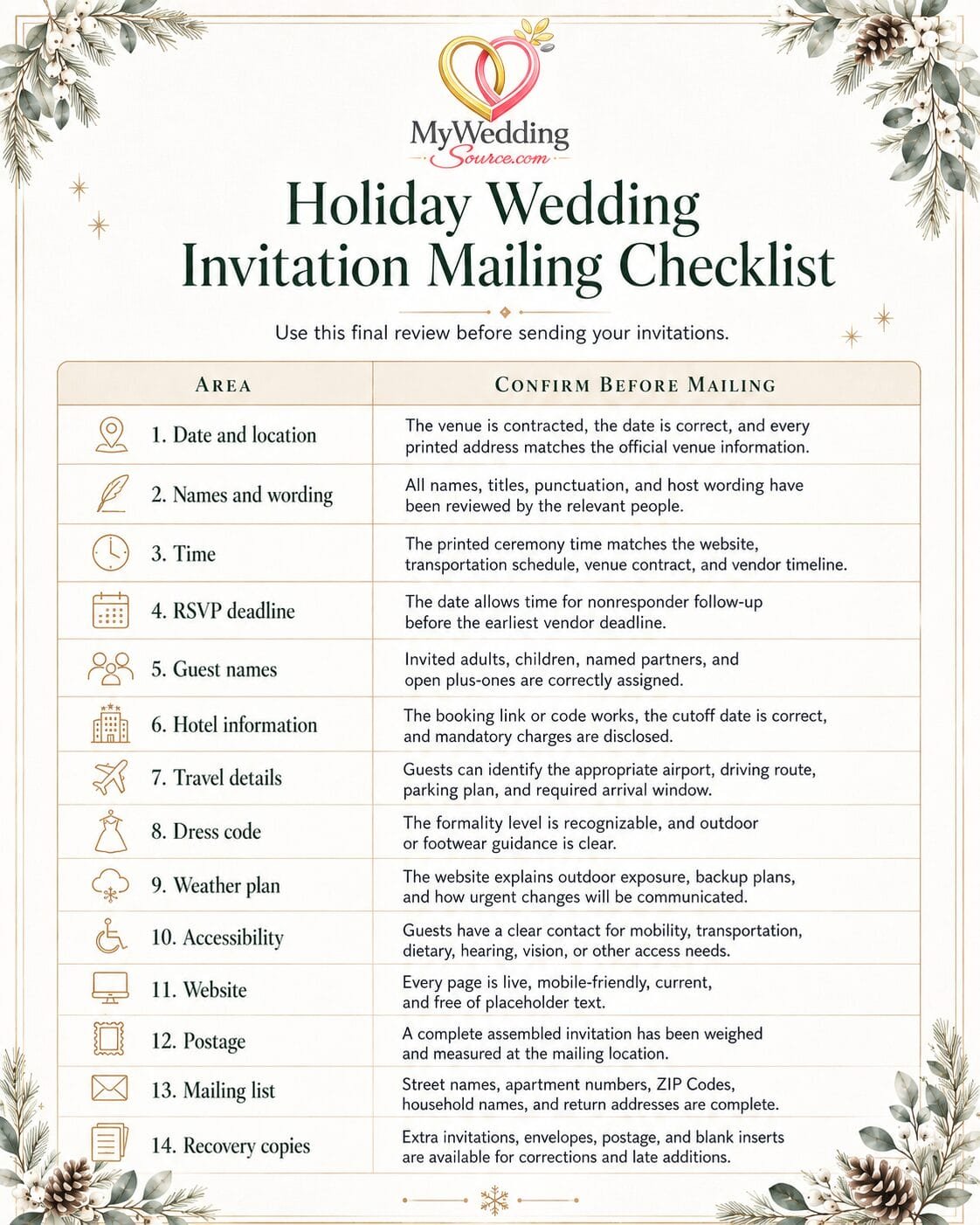
Holiday Wedding Invitation Final Checklist
Use this checklist before approving the final proof and again before mailing. The goal is to catch errors while they are still inexpensive to correct.
Frequently Asked Questions
How early should holiday wedding save-the-dates be sent?
For many travel-heavy holiday weddings, eight to twelve months of notice is useful. A destination or international wedding may justify more time, while a mostly local event may need less.
The important issue is whether guests need to make expensive or competitive arrangements. If they need flights, several hotel nights, passports, childcare, or time away from work, earlier notice helps them evaluate the commitment. Do not send the save-the-date before the venue and location are secure.
Is six months too early to send holiday wedding invitations?
Six months may be earlier than necessary for the formal invitation, although it can be appropriate for a destination event with early contractual deadlines. For many weddings, a save-the-date provides the early notice while the formal invitation follows after the schedule, hotel, and RSVP information are finalized.
Sending formal invitations too early can result in misplaced cards, delayed responses, and inaccurate RSVPs. Mail early only when the guests need to take a specific action that cannot wait.
Do holiday wedding invitations need special wording?
No special formula is required, but the wording should acknowledge practical timing when the holiday affects travel or family commitments. The invitation itself can remain traditional, modern, religious, or nonreligious according to the couple’s preferences.
Use the details card and website to explain whether events take place on the holiday itself, whether a holiday meal is provided, and which gatherings are optional. Clear logistics matter more than inserting seasonal phrases into every card.
Should the invitation apologize for using a holiday date?
No. You can acknowledge that the weekend may not work for everyone without presenting the wedding as something that requires an apology. A calm note such as “We know Thanksgiving weekend includes important family plans, so we are sharing the date early” is sufficient.
Respect is demonstrated through advance notice, realistic expectations, optional events, and gracious responses to declines. Excessive apologetic wording can make the invitation feel uncertain.
What should be printed instead of placed on the wedding website?
Print information that is stable and essential: the couple’s names, date, ceremony time, location, RSVP instructions, deadline, and website address. A details card may also include the hotel cutoff date, dress code, or adult-only note.
Place changing information online, including weather updates, exact shuttle times, room availability, route changes, and expanded travel guidance. Guests should still be able to understand the basic invitation without visiting several website pages.
What if the invitations are delayed at the printer?
Contact priority travelers directly and send a clear digital notice with the confirmed date, location, website, and RSVP deadline. Then adjust the printed suite or mailing method according to the remaining time.
You may simplify assembly, remove a nonessential insert, use printed addressing, or shift some details online. Do not wait silently for the stationery if guests need immediate travel information.
Can we send digital holiday wedding invitations?
Yes. Digital invitations can be practical for short timelines, small weddings, international guests, or couples who prefer online communication. They also allow quick corrections and direct links to travel information.
Test the design on several devices, confirm that messages do not go to spam, and provide an alternative for guests who do not use email comfortably. A digital format still needs clear addressing, RSVP instructions, guest limits, and deadlines.
How should we handle guests who have not responded?
Contact them directly shortly after the deadline. A brief message can ask whether they will attend and provide a firm date by which you need the answer.
You might write: “We are finalizing our wedding numbers and did not receive your RSVP. Could you let us know by Friday whether you will be able to attend?” Avoid public reminders or messages that imply the guest has intentionally disrespected you.
Should we include a holiday card with the invitation?
You may, but it is not necessary. Combining communications can reduce mailing, but it can also blur the purpose of the invitation or create confusion about who is invited.
If you add a seasonal greeting, keep the invitation and RSVP information visually distinct. Do not send wedding details to people who are receiving a holiday card but are not invited to the wedding.
How many extra invitation suites should we order?
Ordering approximately 10 to 15 percent more than the immediate mailing quantity is a common practical approach, although the correct number depends on guest-list stability and printer minimums. Extras can cover addressing errors, damaged envelopes, returned mail, keepsakes, photography, and later additions.
Reprinting a small quantity may be disproportionately expensive. Include extra envelopes because they are often needed more frequently than full invitation sets.
Give Guests Enough Information to Make a Real Decision
The strongest holiday wedding invitations are not necessarily the suites with the most decorative pieces or the earliest mailing date. They are the invitations that reach guests while they still have useful choices and provide enough information for them to evaluate travel, cost, family schedules, weather, children, and lodging.
Use the save-the-date to protect the weekend and introduce the destination. Use the formal invitation to confirm the ceremony and response deadline. Use the details card for concise action points, and use the wedding website for information that is detailed or likely to change.
Before mailing, review the complete guest experience. Ask whether a person receiving the suite can identify who is invited, when they need to arrive, where they can stay, what they should wear, how they will travel, and when they must respond. If any answer remains unclear, revise the wording or website before the envelopes leave your hands.
Your next step is to create a backward invitation timeline beginning with the earliest vendor deadline. Add one week for RSVP follow-up, the guest response period, expected mailing time, invitation assembly, printing, and final proof approval. Once every stage has a real date, you will know when your holiday stationery must be ordered and which details need to be confirmed first.
