
The wedding DJ questions that matter most fall into eight areas, from music approach and equipment backups to overtime and cancellation terms, and a simple 0-to-2 scorecard lets you compare any two DJs on the same footing.
Two DJs have sent quotes for your reception. One is $1,700 and one is $2,300, both emails are friendly, and neither says what the number includes. Is the cheaper one quoting four hours or five? Does the pricier one bring a backup system, run the microphone for toasts, and charge by the hour after the contracted end time? Without the answers you are comparing two prices, not two services, and the difference tends to show up as a surprise on the night or on the final invoice.
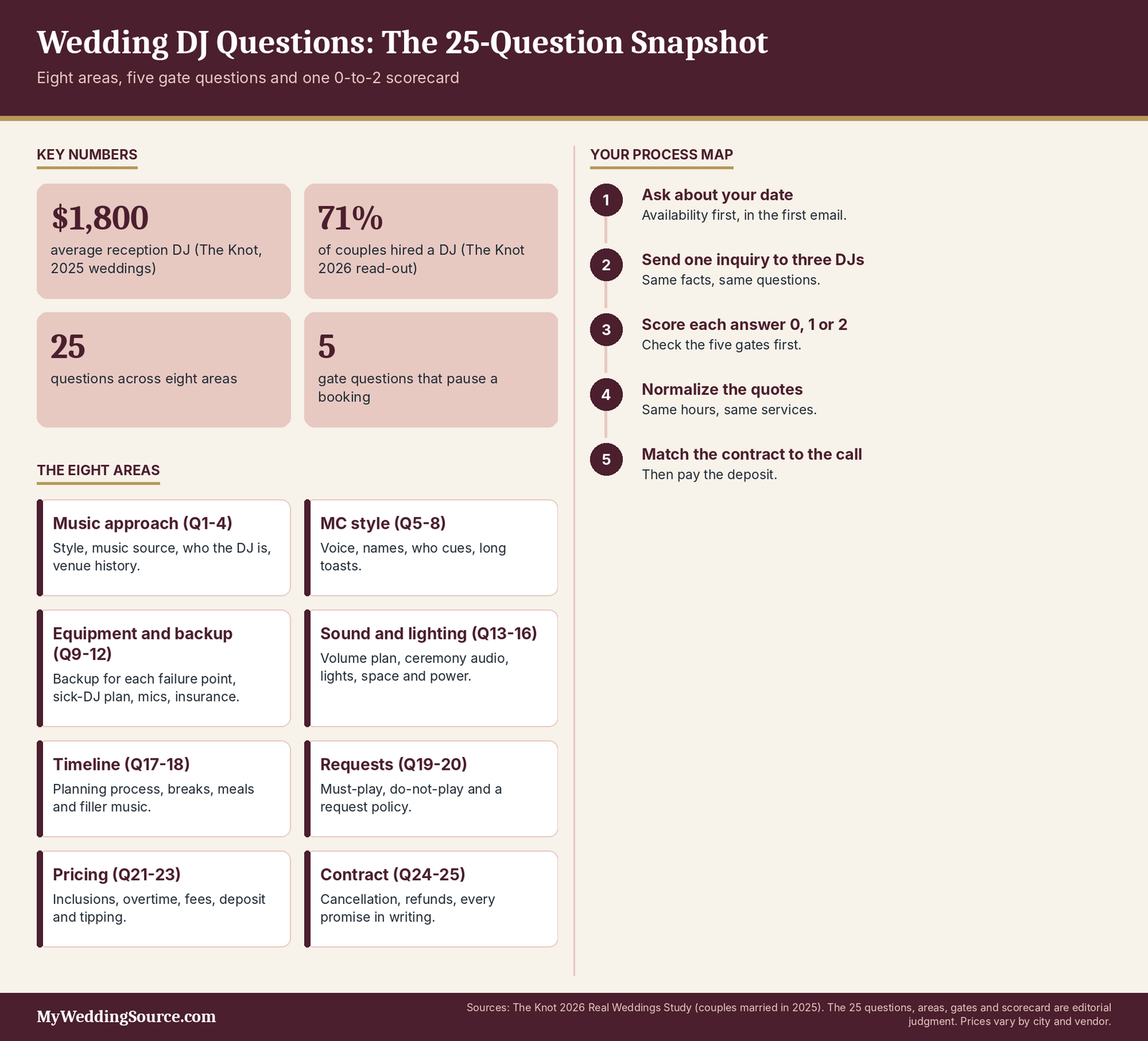
This guide gives you 25 questions in eight areas: music approach, MC style, equipment and backup, sound and lighting, timeline, do-not-play and request policy, pricing and overtime, and the contract. Each question comes with what a strong answer sounds like and what should make you pause, so you can run a 20-minute call or a short email exchange and walk away with something you can score. The tables turn the answers into a side-by-side comparison, and the last sections show how to read a DJ contract line by line and what to do this week.
Two honest limits first. Prices come from national surveys and published guides, which describe a range and not a quote from any DJ in your city, and the contract sections are general education, not legal advice, because terms and state laws vary. This article also covers DJs only. If you are still deciding between a DJ and a live band, our wedding DJ vs band cost breakdown and our DJ-versus-band decision guide handle that choice, and the wedding band questions article covers the equivalent list for a band.
How should you use these 25 wedding DJ questions?
The questions work best as a repeatable routine and not as a one-time interview. You ask the same questions of each DJ on your shortlist, record the answers in the same format, and compare them after you have heard from everyone. That sounds mechanical, but it protects you from the most common shopping mistake, which is choosing the DJ who was the most charming on the phone and discovering later that charm was the only thing in the quote.
When should you start asking, and who should you ask?
The timing matters because the DJs who fit best on popular dates are often committed first, and a polished list of questions is useless if the person you want is already booked. The choice of who to ask is just as practical, because a shortlist of three is enough to compare and still short enough to finish in one week. Three candidates is a workable number, since every extra conversation adds notes you will not have time to reread.
How early do popular DJs book up?
Joy’s wedding DJ cost guide recommends booking eight to twelve months ahead because popular DJs fill their calendars early, and The Knot’s list of DJ questions tells couples to ask about date availability in the very first inquiry. Those are general guidelines from consumer publications, not rules. A weekday or a winter date may stay open much longer, while a Saturday in peak season at a popular venue may be gone sooner. The practical move is to ask about your exact date before spending time on anything else, since a DJ who is already booked cannot be rescued by a good answer to question 17. If your wedding is within the next 30 days, skip ahead to our November wedding checklist, which covers final confirmations for a DJ you have already booked, and treat this guide as the tool for the choosing stage.
What should your first inquiry email include?
A DJ cannot quote accurately without a handful of facts, and a vague inquiry produces a vague quote. Include your date, the ceremony and reception venue names and addresses, whether you want music at the ceremony and cocktail hour or only the reception, your approximate guest count and the hours you expect the party to run. Add one sentence on the feel of the evening, such as a formal dinner followed by a loose dance party, and mention any cultural or religious elements that need music or announcements. Then ask three things in the same email: whether the date is open, what the quote includes, and whether they can send a sample contract. Reading a sample contract before the call saves time, because half your questions will already be answered or exposed as unanswered.
How does the scorecard work?
The scorecard exists to turn a pleasant conversation into data you can compare a week later. It takes about two minutes per question to fill in, and it stops one good moment on a call from outweighing three missing details. It is a decision aid, not a ranking system, and the final choice is still yours.
How do you score each answer?
Give each answer 0, 1 or 2 points. A 0 means the DJ could not answer, deflected or said something that conflicts with what you need. A 1 means a reasonable verbal answer with no detail or no willingness to write it down, and a 2 means a specific answer the DJ is willing to put in the contract. Twenty-five questions at two points each gives a maximum of 50, but the total matters less than the pattern, so look for zeros and for categories where one DJ is consistently stronger. A DJ who scores 44 with a zero on the backup plan is a riskier pick than one who scores 38 with no zeros.
Which answers are gates, and which are preferences?
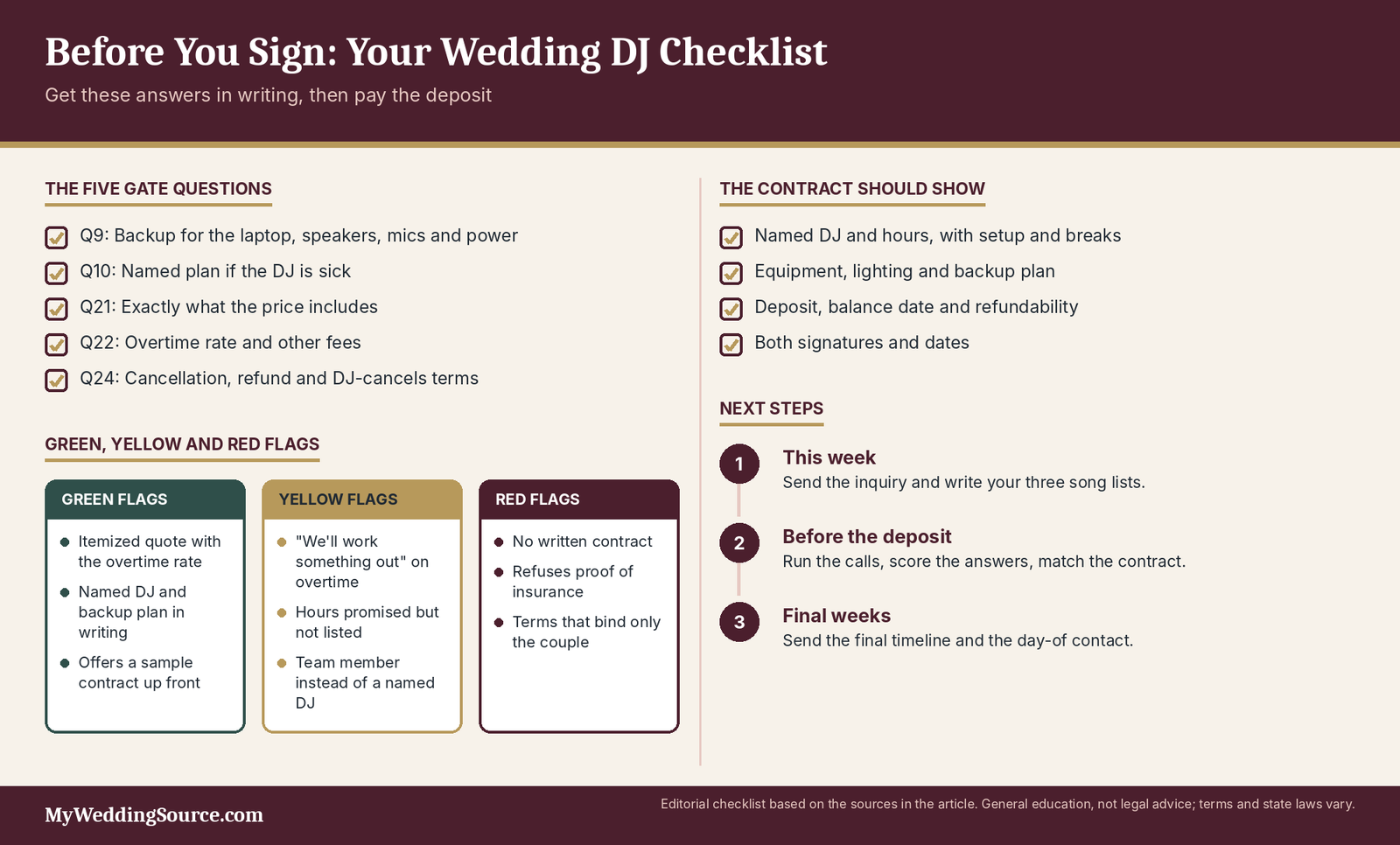
Some questions measure fit and some measure risk, and they deserve different weight. Fit questions, such as the DJ’s style and MC personality, are matters of taste where two reasonable couples would choose differently. Gate questions, such as the equipment backup, the sick-DJ plan, the inclusions, the overtime rate and the cancellation terms, protect you from a failure you cannot fix on the day. The table below lists all eight areas, the question numbers and the marker of a strong answer, and the five gate questions are flagged so you can pause the booking on any zero among them.
| Area | Questions | A strong answer sounds like | Gate? |
|---|---|---|---|
| Music approach | 1 to 4 | Specific style, a named DJ and a clear music source | No |
| MC style | 5 to 8 | A defined role, examples and a plan for long toasts | No |
| Equipment and backup | 9 to 12 | A backup for each failure point and proof of insurance | Q9 and Q10 |
| Sound and lighting | 13 to 16 | Volume plan, venue sound limits and priced lighting | No |
| Timeline | 17 to 18 | Planning meetings, a deadline for the timeline, a break plan | No |
| Requests and do-not-play | 19 to 20 | A three-list system and a script for guest requests | No |
| Pricing and overtime | 21 to 23 | An itemized quote with an overtime rate in writing | Q21 and Q22 |
| Contract | 24 to 25 | Clear cancellation terms and every promise in writing | Q24 |
What should you ask a wedding DJ about music approach and MC style?
These first eight questions decide whether the person behind the equipment is a good match for your guests, and they are the ones a DJ enjoys answering. Listen less for a polished answer and more for specifics, because a DJ who can describe how a recent wedding went is usually better at the job than one who recites a slogan. The first four cover how the DJ thinks about music, and the next four cover how the DJ talks to your guests.
Questions 1 to 4: How does the DJ choose, source and read the music?
Music approach is the area couples most often skip, because it feels subjective, and it is the area where the biggest differences show up on the dance floor. A DJ’s style is made of choices about mixing, genre range and crowd reading, and those choices are easier to compare when every DJ answers the same prompts. A shared set of prompts makes those differences visible before you hear them on the dance floor.
Question 1: How would you describe your approach to a wedding dance floor?
This is the open question that reveals how a DJ thinks. The Knot’s DJ question list suggests asking about mixing style and nightclub experience, and quotes Nicole Otero of TCM DJ Events on the value of asking both. A strong answer describes how the DJ builds an evening: reading who is on the floor, moving between decades and tempos, and giving older guests a familiar song before the room turns toward the younger crowd. A weak answer lists genres or says they “play anything,” which is true of every playlist and tells you nothing about how the night will move. Ask for an example, such as how they rebuilt the floor at a wedding where the dance floor emptied after dinner.
Question 2: Where does your music come from, and who handles licensing?
Many professional DJs work from a purchased or subscription-based library and not from a personal streaming account, and a clear answer here shows the DJ runs a business and not a hobby. Ask how they get their music, whether they hold the song you care about most, and who is responsible for public-performance licensing at your venue. The licensing organizations say the business or venue generally obtains the license: BMI’s FAQ says it licenses the owner of the establishment, and ASCAP says it is the business owner who obtains the license, although neither page addresses weddings by name. So the useful version of the question is “What do you handle, and what should I confirm with the venue?” Our wedding reception playlist guide covers the licensing picture in more detail.
Question 3: Who exactly will DJ my wedding, and can I see them work?
Many DJ companies employ several DJs, and the person who sells you the package is not always the person who shows up. The Knot’s list asks directly, “Will they be the DJ at your wedding?” and advises meeting the actual DJ before signing. Ask for a video of the specific person performing, a reel from a recent wedding, or a call with the DJ assigned to your date. Then ask whether the contract will name that DJ, because a name on a website is a marketing statement and a name in a contract is a commitment. The named-DJ promise returns in question 25, because a company that cannot tell you who is coming cannot tell you what you are buying.
Question 4: Have you worked at my venue, or in rooms like it?
A DJ who has worked your venue knows where the power is, how the room carries sound, where the load-in path runs and what the staff expects. The Knot’s list makes the same point, noting that a DJ who knows the venue knows the setup spot, the acoustics and the rules. If the DJ has not played there, the answer to look for is a willingness to do a walkthrough or a call with the venue’s event manager before the day. Ask about the quirks of rooms like yours, such as a tent, a barn or a ballroom with a divider wall, since a DJ who can name the problems in advance has probably solved them before.
Questions 5 to 8: How will the DJ run the microphone?
Most couples hire a DJ for the music and learn on the day that the DJ is also the emcee, the timekeeper and the person who tells ninety guests where to stand. The MC role is where a DJ’s personality meets your family, so it is worth specifying how much of it you want. Asking about the role now keeps the evening from depending on assumptions you never discussed.
Question 5: What is your MC style?
MC styles range from a warm, minimal voice that introduces the couple and then gets out of the way to an energetic host who jokes with the crowd, and neither is wrong. The Knot’s sample reception timeline gives the emcee a long list of duties, from announcing the wedding party and calling guests to their seats to cueing parent dances and directing buffet lines. Ask the DJ to describe their style in three sentences, ask for a clip of them making an announcement, and say which end of the range you prefer. If the DJ does not offer MC services, The Knot suggests talking to your planner about who should take over, which is a fine answer as long as someone is named.
Question 6: How do you handle names, languages and family traditions?
Announcements go wrong most often on the details that matter most to families, such as a name read incorrectly, a tradition that needs explanation or a song in a language the DJ has never heard. A strong answer includes a pronunciation process, such as a phonetic list or a short audio note from you, and a willingness to rehearse unfamiliar words. If your wedding includes traditions like a dollar dance, a cultural dance set or a bilingual toast, ask what experience the DJ has and how much lead time they need to prepare. A DJ who asks follow-up questions about your family is showing you the right instincts.
Question 7: Who calls the order of the evening: you, the DJ, or a planner?
Someone has to decide when the toasts start and when the cake gets cut, and the answer should be a named person and not “we’ll see how it goes.” The Knot’s timeline assigns those cues to the emcee, but your planner or venue coordinator may hold that role instead, and two people cueing the same moment is how a first dance starts twice. Ask how the DJ coordinates with the planner and venue, and whether they will work from a written timeline. If you have no planner, the DJ’s habits matter more, and hiring even a day-of coordinator, as our wedding planner questions article explains, can take the cue-calling off the DJ’s plate.
Question 8: How do you handle a long toast, an open mic or a guest who grabs the microphone?
Toasts run long and microphones attract volunteers, so the DJ’s plan for gentle interruption deserves a direct question. A good answer includes a way to keep speeches on schedule, such as agreeing a speaker list in advance, having a signal for the toast-giver and keeping a second wireless microphone ready. Ask how the DJ cuts music for speeches and brings it back, because abrupt silence is awkward and a long fade is clumsy. This is also the moment to ask what the DJ will do if a guest takes over the mic with a joke you would have vetoed, since the answer reveals whether the DJ treats the microphone as yours or theirs.
What should you ask a wedding DJ about equipment, backup, sound and lighting?
This is the part of the interview where you stop being a music fan and start being a risk manager, and it is the section most likely to keep your reception running when something goes wrong. Equipment questions are not an accusation. Every DJ has seen a laptop freeze, a cable fail or a breaker trip, and the professionals are the ones who can tell you in one breath what they do about it. Listen for a plan with specifics, such as a second laptop already running or a spare wireless microphone in the bag, and be cautious about answers that amount to “that never happens.”
Questions 9 to 12: What happens when something breaks or someone is sick?
Two of the five gate questions live here, because these are failures you cannot repair from a dance floor. The aim is to hear a plan for each one before you sign, and to see the plan reflected in the contract. A confident, specific answer is a good sign, and an unwilling one is information too.
Question 9: What equipment do you bring, and what is your backup for each failure point?
Ask the DJ to walk through the chain from the music source to your guests’ ears: the laptop or controller, the mixer, the speakers, the microphones and the power. For each link, ask what is duplicated. A strong answer names specifics, such as a backup laptop running in parallel, a spare speaker or amplifier and extra batteries for wireless microphones, while a weak answer says the DJ has “never had a problem.” The Knot’s DJ question list asks directly about backup equipment, noting that venues in unusual locations may not have equipment to lend. The table below maps the most common failure points to what should already be in place, and each row can be turned into a follow-up question.
| Failure point | What can go wrong | What should already be in place |
|---|---|---|
| Music source | Laptop freezes or a file will not play | A second source ready to take over, plus an offline library |
| Speakers or amplifier | A speaker blows or cuts out mid-dance | A spare speaker or a system that keeps playing at reduced power |
| Microphones | A battery dies during a toast | A second wireless microphone and spare batteries at the booth |
| Power | A breaker trips when the room is plugged in | A power plan agreed with the venue, with separate circuits where possible |
| The DJ | Illness, a car accident or a family emergency | A named backup DJ or company bench, with the plan written into the contract |
| Weather | Rain or heat on an outdoor setup | A covered setup or a plan to protect equipment and keep playing |
Question 10: What happens if you are sick or have an emergency?
An individual DJ can be the entire business, and a person can get sick, so you need to know who steps in and whether you have a say. A larger company may have a bench of DJs, which makes the answer easier, while a solo DJ may name a trusted colleague at another company. The MN Disc Jockeys question list, a vendor-written article, frames the same question as asking whether the DJ has a backup for emergencies through a teammate or a trusted industry contact. Ask whether the backup has played weddings and whether you can review a clip, and ask what the contract says if no replacement can be found. A strong answer commits to a substitute of comparable quality or a full refund, and it is the answer to ask the DJ to write down.
Question 11: What microphones do you provide for the ceremony and toasts?
Microphones are the most visible equipment at a wedding, since every officiant, parent and best friend relies on them. Ask how many wireless microphones are included, whether they are handheld or lavalier, and whether one can be placed at the ceremony site if it is far from the reception. The Knot’s list asks whether a DJ provides wireless microphones for both ceremony and reception, and the answer matters because some DJs include one microphone for toasts and charge extra for a ceremony setup. If your ceremony is outdoors, ask how the sound will carry and whether the DJ has done similar setups, since a ceremony nobody can hear is the quickest route to a complaint from the back row.
Question 12: Do you carry liability insurance, and can you send a certificate?
Many venues require their vendors to carry liability insurance, and the question is worth asking even if yours has not mentioned it. The Knot’s DJ list says couples should ask about it and notes that electrical equipment can be hazardous, and the attorney quoted in The Knot’s music contract article advises specifying whether performers carry liability insurance and asking for proof. A DJ with a policy can usually email a certificate of insurance within a day, and can add your venue as an additional insured if the venue asks. A vendor’s liability coverage is separate from your own event insurance and from cancellation coverage, so treat it as one layer in the picture and not a substitute for the others.
Questions 13 to 16: How loud, how bright and how big is the setup?
Sound, light and space look like technical details, but they shape how guests experience the night. They are also where a quote most often hides an extra, such as a ceremony speaker that costs a few hundred dollars or uplighting the venue needs to be plugged in to power.
Question 13: How do you set the volume, and what is your plan for the venue’s sound limit?
Volume is a shared problem between you, the DJ and the venue, and the plan should include a dinner volume as well as a dance volume. The National Institute on Deafness and Other Communication Disorders lists normal conversation at 60 to 70 decibels and concerts at 94 to 110, and it says long or repeated exposure to sounds at or above 85 decibels can cause hearing loss. The CDC’s NIOSH sets its recommended limit for workers at 85 dBA averaged over eight hours, which applies to the DJ and venue staff as well as your guests. In practice, ask whether the DJ keeps dinner at conversation level, how they handle a guest who asks for it louder, and what they do if the venue enforces a sound limit or an outdoor ordinance cuts the night short. A simple plan, such as a loud zone for dancing and a quieter zone for talking, keeps both groups of guests comfortable.
Question 14: How are the ceremony and cocktail hour handled?
Ceremony and cocktail hour audio is often a separate line item, because it means a second setup, an earlier arrival and sometimes a second set of speakers. Paperlust, a wedding publication whose figures are its own estimates and not a survey, lists ceremony sound at roughly $200 to $500 and cocktail-hour music at $100 to $300, which gives you a ballpark, not a quote. Ask whether the price covers one continuous setup or a ceremony system plus a reception system, and whether the DJ moves from one area to another during the cocktail hour. If a different musician plays the ceremony, ask how the DJ coordinates the handoff and who cues the processional, since a missed cue is a more visible mistake than a missed song.
Question 15: What lighting is included, and what costs extra?
Lighting varies more between DJ packages than almost anything else. Joy’s DJ cost guide says packages often include basic dance floor lighting but not all DJs offer lighting, and it lists special effects and fog machines as extras. The Knot’s question list asks about patterned, sound-activated or laser lighting if the venue lacks event lighting. Paperlust’s estimates for uplighting run from about $150 to $700 and for monogram or pattern projection about $100 to $400. Ask what is included in plain terms, whether the DJ is bringing the lights or subcontracting, and who takes them down, so a mood-lighting upgrade does not turn into a late-night scramble with a ladder.
Question 16: How much space, power and setup time do you need?
A DJ setup is smaller than a band’s, but it still needs a table, a power source and a clear line of sight to the dance floor. Ask how much space the DJ needs, what time they plan to arrive, how long setup and soundcheck take, and what they need from the venue. The Knot’s list adds that most entertainers need a soundcheck on the day, and asks whether the DJ will coordinate arrival with the venue because venues may restrict early access. For an outdoor wedding, ask where the setup will sit if it rains, and how the DJ protects equipment, because our outdoor wedding rain plan guide only works for a sound system that the DJ has already planned to move.
How do you plan the timeline and the do-not-play list with a DJ?
Four questions cover the planning phase, and they separate DJs who run a process from DJs who show up and improvise. A good process takes work off your plate, such as a form for songs and a deadline for the timeline, while a loose process leaves you answering text messages the week of the wedding. Neither kind of DJ is a bad person, but only one kind fits a couple who wants fewer decisions late in the game.
Questions 17 and 18: How does the DJ plan the evening with you?
Timeline questions look administrative, but they decide whether toasts, dances and dinner flow or collide. The Knot’s sample reception timeline runs from a 5:30 p.m. cocktail hour to a 10:50 p.m. last dance and an 11:00 p.m. send-off, and the DJ is usually the person making that sequence audible. A DJ who has built hundreds of these sequences can usually tell you where yours is likely to snag.
Question 17: What is your planning process, and when is the final timeline due?
Ask how many planning conversations are included, whether the DJ uses an online planning portal and what date the final timeline and song lists are due. The Knot’s article quotes DJ Duerell Jones, who uses a portal where couples sort songs into categories, which is one example of a structured process. A strong answer includes a meeting or call, a written timeline you can approve and a stated deadline, with the DJ confirming details with your planner and venue before the day. A weak answer is “send me your songs whenever,” because it moves the work onto the days when you have the least attention to spare. If the DJ will join your timeline meeting, that is a point in their favor, since it shows they expect to coordinate with the other vendors.
Question 18: How do breaks, vendor meals and filler music work?
A DJ working a five-hour reception needs to eat and use the restroom, and you need to know what plays when the DJ leaves the booth. The Knot’s DJ list asks what filler music plays during breaks and whether the DJ has a vendor meal requirement, and the MN Disc Jockeys list notes that many DJs work six or more hours straight and request a meal. Ask whether breaks happen during dinner, when the music is quieter, and not during a dance set, and add the DJ to the caterer’s vendor meal count so the question does not surface at 7 p.m. Also ask about the end of the night, because The Knot’s sample timeline allows 11:15 p.m. to 12:15 a.m. for cleanup and load-out and warns that venues often charge premium rates past a contracted hard stop. A DJ who knows the venue’s hard stop will plan the last dance and the teardown around it.
Questions 19 and 20: How does the DJ handle must-play, do-not-play and requests?
The song lists are the part couples enjoy and the part that causes the most late-night text messages. A shared system for them prevents arguments between you and your partner about a song, and prevents a guest-request standoff at the booth. Settling the system early means the actual song choices can be fun.
Question 19: How do you use must-play, play-if-possible and do-not-play lists?
Most DJs expect a short must-play list and a do-not-play list, and the more advanced systems add categories. Duerell Jones, quoted by The Knot, lets clients sort songs into must-play, play-if-possible, dedications, play-only-if-requested and do-not-play, which gives the DJ room to read the crowd without breaking a promise. Ask how long the lists should be, whether the DJ plays clean edits for explicit songs and how they treat songs you list as must-play when the crowd does not respond. A strong answer commits to the must-play songs and the do-not-play list as written and explains how the in-between list gives flexibility. A short must-play list, with the rest of the evening left to the DJ’s judgment, tends to give a DJ more room to read the crowd.
Question 20: How do you handle guest requests?
Requests are a policy decision, and you can choose any point on a range from fully open to fully closed. The Knot’s article quotes Anthony Hernandez of Infinity Sound Productions, who says DJs do not tell guests the couple refused a song and instead say something like “We’re steering away from that style tonight” or promise to work it in later. Andrea Smith of The Band Method describes playing along with a joke and sometimes pretending not to have a song before playing it a few minutes later. Tell your DJ how much flexibility you want, and ask how they handle a request on your do-not-play list, a request from an intoxicated guest or a request that would empty the floor. The article also suggests optional song prompts on the RSVP card or wedding website, which gives guests a place to ask that is not the booth.
What should you ask a wedding DJ about price, overtime and extra fees?
Pricing questions are where a quote becomes comparable, and three of the 25 questions live here. DJ pricing is complicated more than it is secretive. A package can be built around hours, around services, around the DJ’s reputation or around all three, and two quotes can look the same while pricing different things. The goal is not to find the lowest number but to find the number that covers what your evening needs.
Question 21: What is in the price, and how does it compare?
The inclusions question is the one that turns a price into a product, which is why it is a gate. Everything you value should be named in the answer, and everything unnamed should be treated as extra until the DJ says otherwise. Writing the list down also gives you something concrete to hold up against the next quote.
Question 21: What hours, services and equipment are included in the quote?
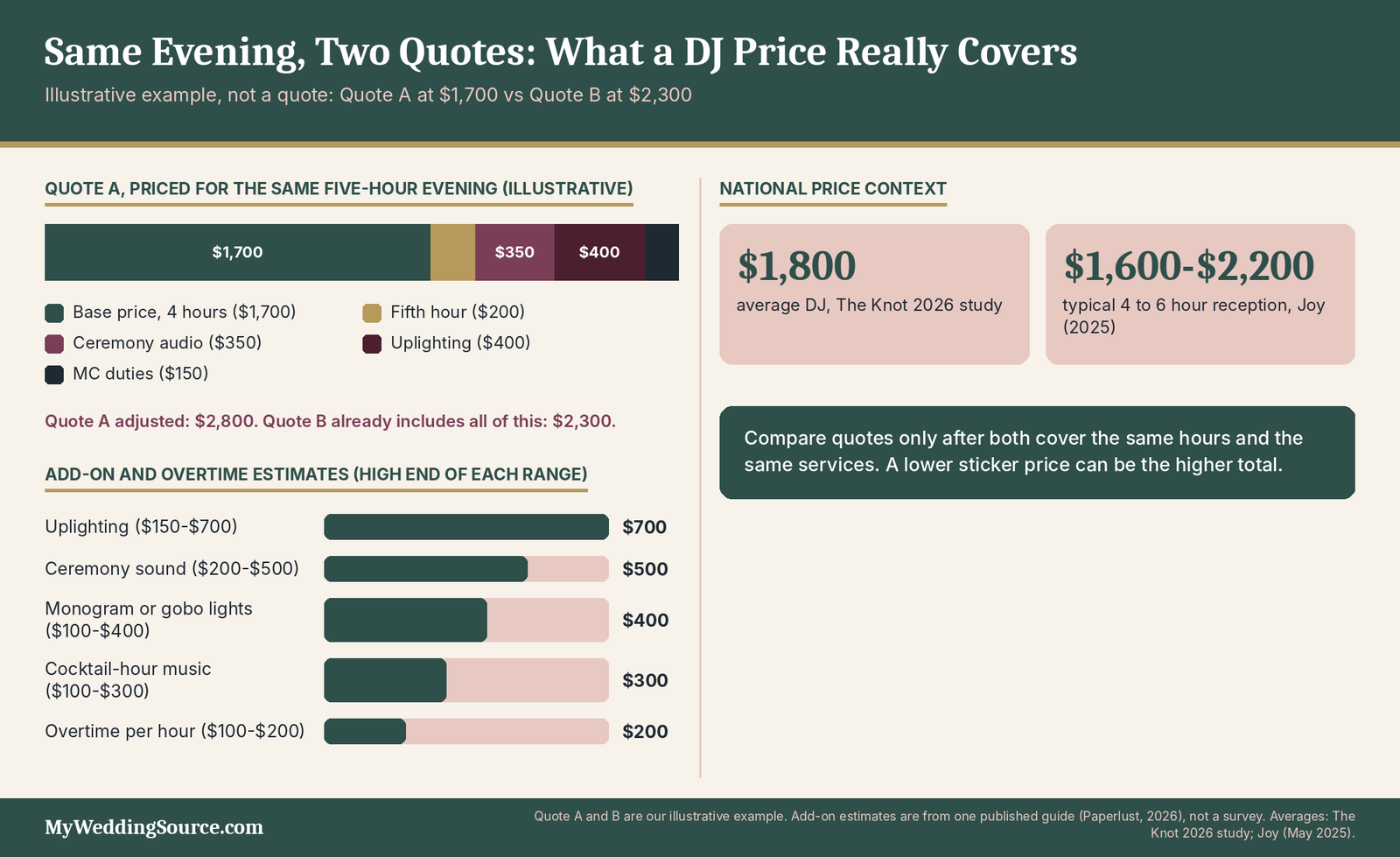
Ask the DJ to list the hours of music, whether setup and breakdown are inside or outside those hours, whether MC services are included, what lighting is included, and whether ceremony or cocktail-hour sound is part of the package. The Knot’s questions ask whether the rate includes setup and breakdown and whether the package includes lighting, and Joy’s guide lists emceeing, equipment setup, a backup plan and basic dance lighting among typical inclusions while treating photo booths, special effects and ceremony audio as add-ons. Ask for an itemized quote even when the DJ sells a flat package, because the itemization lets you compare. The illustrative table below shows how two quotes from the opening of this article can compare very differently once they are normalized to the same evening.
| Item | Quote A: $1,700 | Quote B: $2,300 |
|---|---|---|
| Hours in the base price | 4 hours | 5 hours |
| MC duties | Extra, $150 | Included |
| Ceremony audio | Extra, $350 | Included |
| Uplighting | Extra, $400 | Included |
| Cost of a fifth hour | $200 | Included |
| Adjusted total for the same evening | $2,800 | $2,300 |
How do national surveys describe wedding DJ prices?
National figures show a wide range, so treat them as context and not as a target. The Knot’s 2026 Real Weddings Study, based on 10,474 U.S. couples married in 2025, reports an average reception DJ cost of $1,800, and its data read-out says 71% of couples hired a DJ. Joy’s guide, last updated in May 2025, cites about $1,600 to $2,200 in major metros, $1,400 to $2,000 in smaller cities and $1,000 to $1,600 in rural areas and lower-cost cities, attributing those figures to a DJ company. Averages combine a Tuesday-night reception in a small town with a Saturday in a major city, so use them to spot a quote that is far outside the range and not to decide whether a fair quote is $1,800. If a quote sits well below the range, ask what is missing, and if it sits well above, ask what is included that other quotes omit.
Questions 22 and 23: What are the overtime, extra fees and payment terms?
Question 22: What is your overtime rate, and what other fees might apply?
The Knot’s list asks whether the contract has an overtime clause, and advises confirming with both the venue and the DJ before extending the party. Paperlust’s estimate of $100 to $200 per hour for overtime is a ballpark and not an industry standard, so the relevant number is the one in your contract. Ask how overtime is calculated, whether it is billed in full hours or increments, and who has the authority to approve it, because a guest cannot authorize an extra hour on your behalf. Also ask about travel fees for distant venues, parking or load-in fees at city venues and holiday or peak-date premiums, and remember that your venue’s hard stop may end the party before your DJ’s contract does. A DJ who gives you a one-line overtime answer such as “we’ll work something out” has given you a gate failure.
Question 23: What are the deposit, the payment schedule and the tipping expectation?
The Knot’s list says to ask about the deposit and when it is due before leaving the first consultation, and The Knot’s music contract article says a date usually is not reserved until the contract is signed and the retainer is paid. Neither source gives a deposit percentage, so treat the amount as a vendor-specific term and ask whether any part is refundable. Ask when the final balance is due, which payment methods the DJ accepts and whether a processing fee applies to cards. On tipping, The Knot’s tipping guide calls a DJ tip optional but preferred, with a typical range of $50 to $150 handed over at the end of the reception, while Joy suggests 10 to 15% for excellent service and notes some DJs include gratuity in the price. The gap between those two suggestions is a reminder to read the contract first, and our wedding vendor tipping guide covers who to tip and when.
What should the wedding DJ contract say before you sign?
A DJ’s verbal answers are only useful if they survive in writing, which is why the last two questions carry the most weight. A wedding vendor contract should be a record of the conversation you just had, with the hours, the named DJ, the equipment and the money all in the same place. Terms and state laws vary, so this section is general education and not legal advice, and a lawyer can review a contract that worries you.
Question 24: What are the cancellation and refund terms?
Question 24: What happens if I cancel or reschedule, and what happens if you cancel?
The Knot’s music contract article, quoting attorney Leah Wise, advises specifying the conditions for canceling or rescheduling, the refund policy, the notice required and what happens in unforeseen circumstances such as illness or emergencies. Ask for the terms in a sample contract, and ask the same question in reverse: what does the DJ owe you if they cancel? The answer should include a substitute of comparable quality or a refund of everything you paid, which is the kind of promise a DJ with a real backup plan is comfortable writing. If a postponement is possible, ask whether the deposit transfers to a new date, and see our wedding cancellation and postponement guide for how those terms usually interact with other vendors.
Does paying by credit card protect a deposit?
A credit card can add a layer of protection, though it is not a guarantee. The FTC’s consumer guidance on disputing credit card charges says billing errors, including goods or services not delivered as agreed, can be disputed by writing to the card issuer within 60 days after the first bill with the error was sent. For the federal protection on a quality dispute, the FTC says you generally must have tried to resolve the problem with the seller first, and it describes limits based on the purchase amount and where the purchase was made. A deposit paid months before the wedding may be outside that 60-day window by the time a problem appears, so ask your card issuer how its policy applies, and keep receipts.
Question 25: Does the contract list every promise and carry both signatures?
The final question is a document check more than a question. If the contract does not contain the promise, the promise is not enforceable in any practical sense, and a signature from only one party is not a finished agreement.
Question 25: Is every answer from this call in the contract, and will you countersign?
Compare the contract to your scorecard line by line, and ask the DJ to add anything missing. The Knot’s contract article quotes attorney Leah Weinberg advising couples to make sure the vendor countersigns after they do, and notes that a date is usually not reserved until the contract and retainer are complete. The table below turns the answers from the 25 questions into a clause checklist, and the third column shows the kind of wording that should make you stop and ask.
| Clause | What to look for | Red flag |
|---|---|---|
| The DJ | Name of the DJ, or a company commitment to comparable quality | “DJ or team member” with no named person |
| Hours and schedule | Start, end, setup, breaks and any ceremony or cocktail coverage | Hours quoted verbally but not listed |
| Equipment and backup | Systems, microphones, lighting and the backup plan | No mention of backup equipment or a substitute DJ |
| Overtime and fees | Hourly rate, increments, travel and any other fee | “To be determined” or a rate that applies only on the day |
| Payment | Deposit, balance date, accepted methods and refundability | A full nonrefundable payment far in advance with no reason stated |
| Cancellation | Notice, refund, rescheduling and the DJ’s obligations | Terms that bind only the couple |
| Insurance | Proof of liability coverage on request | A refusal to provide a certificate |
| Signatures | Both parties sign and date | Only the couple’s signature |
Which red flags should pause a booking?
Pause for any answer that is vague on a gate question, a DJ who will not put promises in writing or a quote that changes after the call. Paperlust’s cost guide lists a missing written contract as a red flag, and The Knot’s guidance assumes a signed agreement is the norm. Other signs include pressure to sign the same day, an unwillingness to name who is coming, a rate that only applies if you pay in full today or a refusal to share proof of insurance. Most DJs will answer all of this calmly because they have seen these questions before, so a defensive response tells you something too. Our guide to wedding vendor contract red flags goes through the warning signs that apply to every vendor.
How do you compare DJs after the calls and make the final choice?
Once the calls are done, you will have three sets of notes and a vague feeling about each DJ, and the scorecard is meant to sharpen that feeling without replacing it. The comparison works in two passes. First you check the gates, then you compare fit, and only then do you look at price, because a low price on a DJ with a gate failure is not a saving.
How do you read a completed scorecard?
A finished scorecard shows patterns that a pile of notes hides. You are looking for gate zeros first, area-by-area strengths second and the total last, and the total is the least informative of the three. Looking at gates first keeps one dazzling category from hiding a missing basic.
What does a completed scorecard look like for three DJs?
The table below is an illustrative example with invented scores, not real DJs. Each area’s maximum is two points per question, so music approach and MC style top out at eight each, and the grand total is 50. DJ A has the strongest style and the highest MC and equipment scores but answered the overtime question with “we’ll work something out,” which is a gate zero. DJ B scores steadily across every area with no zeros. DJ C is the lowest on style and planning but answered the pricing and contract questions clearly, and the sticker price is the lowest of the three.
| Area (maximum) | DJ A | DJ B | DJ C |
|---|---|---|---|
| Music approach (8) | 7 | 6 | 5 |
| MC style (8) | 7 | 6 | 4 |
| Equipment and backup (8) | 7 | 7 | 5 |
| Sound and lighting (8) | 6 | 6 | 4 |
| Timeline (4) | 3 | 3 | 2 |
| Requests and do-not-play (4) | 4 | 3 | 2 |
| Pricing and overtime (6) | 3 | 5 | 6 |
| Contract (4) | 2 | 4 | 4 |
| Total (50) | 39 | 40 | 32 |
| Gate zeros | Q22 overtime | None | None |
How much should price count against the score?
Price should enter the decision after the gates and the fit scores, and it should be compared on normalized quotes. In the illustration above, DJ A’s total is almost level with DJ B’s, but DJ A’s gate zero means the overtime rate is unknown, so DJ A’s real price is unknown too. The sensible next step is to ask DJ A for the overtime rate and the rest of the missing terms in writing, rescore the answer and then compare prices. If DJ A answers well, the style advantage may be worth a modest premium, and if the answer stays vague you have learned something important cheaply.
What if the scores and your gut disagree?
Numbers help most when they surface what you already half-know, and they help least when they are used to override a strong reaction. A scorecard is a way of asking your gut better questions. When the two disagree, the most useful move is to find out why before you decide.
When is a lower score the right pick?
A lower total can be the right choice when the gap sits in categories that matter less to you. If your wedding has a guest list of forty and a quiet dinner with a short dance set, sound and lighting points matter less than a warm MC and a clean contract. If your family has traditions that need careful announcements, the DJ who scored highest on question 6 may be a better match than the one with the highest total. The rule is to let the preferences move the decision only after every gate question has a satisfactory answer, because gates protect the whole evening and preferences flavor it.
Should finalists get a second call or a venue conversation?
If two DJs are close, a second call or a short video meeting with the assigned DJ is worth the time. Ask each to walk you through a sample timeline for your wedding, which shows how they think about your specific evening. You can also ask your venue’s event manager whether they have seen the DJ work, since venue staff watch many vendors and often have a view on who arrives on time and cooperates with the kitchen. Treat that view as one more data point and not as a verdict, because venues may have preferred-vendor relationships. Then update the scorecard, make the call and send the deposit only after the contract matches.
FAQ: Wedding DJ Questions Couples Ask Most
These answers are general education and not legal or financial advice, and your contract and venue rules control the details.
Booking, price and contract questions
How far in advance should you book a wedding DJ?
Joy’s wedding DJ cost guide recommends eight to twelve months ahead, because popular DJs book early. That is a consumer-publication guideline and not a rule, and your own date, season and venue change the picture. A Saturday in peak season may need more lead time, while a weekday or winter date may stay open longer. The safest approach is to ask about your date in the first email, since availability is the only answer that decides whether the other 24 questions matter.
Do you have to tip your wedding DJ?
No. The Knot’s tipping guide calls a DJ tip optional but preferred, suggests $50 to $150 depending on the total cost, and says an attendant or the planner can hand it over at the end of the reception. Joy suggests 10 to 15% of the fee for excellent service and notes that some DJs include gratuity in their pricing. Read the contract first so you do not tip twice, and put the tip in an envelope with a name on it. If your tipping budget covers many vendors, plan the total before the day.
Is a DJ cheaper than a live band?
On national averages, yes. The Knot’s 2026 study puts the average reception DJ at $1,800 and the average live band at $4,500, but the averages hide wide ranges, and the cost of a band depends heavily on size. This article does not try to settle the choice, because DJ versus band involves energy, sound, space and guest mix as well as price, and those tradeoffs have their own guides that this article links to in its introduction.
Music, volume and day-of questions
Can guests request songs, or can you ban requests entirely?
You can choose any policy, from fully open to fully closed, and a good DJ will follow it. The Knot’s article suggests telling the DJ in advance how much flexibility you want, and quotes DJs who politely deflect with phrases like “We’re steering away from that style tonight.” A closed policy works well when your list is carefully built, and a filtered policy works well when guests are eager to contribute. Whichever you choose, put it in the planning form and tell your coordinator or a trusted friend so the DJ is not caught between you and a persistent guest.
How loud should the music be at a wedding reception?
Loud enough for the dance floor and quiet enough for conversation during dinner, and the two are different volumes. The NIDCD lists normal conversation at 60 to 70 decibels, says sounds at or below 70 dBA are unlikely to cause hearing loss, and says long or repeated exposure at or above 85 dBA can. A reception is not a full work shift, but those numbers explain why dinner music should stay low and why guests with hearing sensitivity may need a quieter spot away from the speakers. Ask your DJ how they set levels and whether they will check with you or your planner during the night.
What happens if the DJ does not show up?
A no-show is rare, but the contract should answer the question before it happens. Start with the contract’s substitute or refund clause, call the DJ’s listed emergency number and ask your planner or venue coordinator to start a backup, such as a venue playlist system, a speaker and a friend running a playlist, while you wait. After the wedding, document what happened, request any refund the contract promises and ask your card issuer about a dispute, remembering the FTC’s 60-day window from the first bill with the error. A named backup DJ and a clear refund clause are the reason questions 10 and 24 are gates.
Your next steps
The checklist below turns 25 questions into a sequence you can finish in two weeks. Nothing here requires more than an hour at a time, and the order matters because each step feeds the next.
This week
Start with the work you can do before any DJ answers, because the shortlist and the song lists are what let the calls run quickly. Both tasks take an evening each and can be done with your partner.
Build your shortlist and send the inquiry email
Pick three DJs from referrals, your venue’s experience list or vendor directories and send each the same inquiry. Include your date, venues, hours, guest count, ceremony and cocktail-hour needs and the feel of the evening, and ask three things: availability, what the quote includes and a sample contract. Copy the 25 questions into a document with space for a 0, 1 or 2 beside each. Note the date and time of each reply, because a DJ who answers within a day or two is showing you a preview of how they will communicate in the months before the wedding.
Write your must-play, play-if-possible and do-not-play lists
Sit down with your partner and write three short lists before you talk to any DJ. A short must-play list of songs you cannot imagine skipping, a longer play-if-possible list and a do-not-play list cover most of what a DJ needs. Add the moments that need specific music, such as the entrance, first dance, parent dances and last dance. Having these ready lets you answer questions 19 and 20 with concrete examples, and it shows a DJ how much freedom you want them to have.
Before you pay a deposit
Run the calls and fill in the scorecard
Schedule 20 minutes with each DJ, ask the 25 questions in order and score each answer straight afterward while the details are fresh. Flag any gate zero, and send one follow-up email to each DJ asking for the missing answers in writing. Compare the three scorecards, check the gates first and treat price as a tiebreaker among DJs who pass them. If you have a planner or coordinator, share your top two and ask whether either has worked with your venue.
Check the contract against the clause table
Read the contract slowly, with the clause table beside you, and confirm each row is covered: the named DJ, the hours, the equipment and backup, the overtime rate, the payment schedule, the cancellation terms, proof of insurance and both signatures. Ask for corrections as written edits and not as promises, and keep the signed copy where you and your partner can both find it. Add the DJ’s arrival time, contact number and the final timeline to your day-of binder or your coordinator’s folder, and put the final-timeline deadline in your calendar. If anything in the contract is unclear or high stakes, ask a lawyer to review it, since this guide cannot do that for you.
Sources & methodology
- The Knot, average wedding vendor costs — 2026 Real Weddings Study of 10,474 U.S. couples married in 2025; average reception DJ $1,800 and live band $4,500.
- The Knot Real Weddings Study overview — scope of the 2026 study: couples married in 2025, data collected January to December 2025.
- The Knot Real Weddings Study 2026 data read-out (PDF) — 71% of couples hired a DJ; sample of 10,474 couples.
- The Knot, questions to ask a wedding DJ — 33 questions, including backup equipment, insurance, overtime, soundcheck and cancellation; expert comments from DJs Nicole Otero and Duerell Jones.
- The Knot, wedding reception timeline — sample 5:30 to 11:00 p.m. timeline, emcee duties and load-out guidance.
- The Knot, wedding band and DJ contracts — contract points from attorneys Leah Wise and Leah Weinberg: deposits, cancellation, insurance and countersignature.
- The Knot, personalizing your reception music — DJ and bandleader advice on requests, do-not-play lists and RSVP song prompts.
- The Knot, how much to tip wedding vendors — DJ tip optional but preferred, typically $50 to $150.
- Joy, how much does a wedding DJ cost — price ranges, typical inclusions, add-ons, 8 to 12 month booking guidance and tipping suggestion; last updated May 9, 2025.
- Paperlust, how much does a wedding DJ cost (2026 guide) — add-on and overtime estimates and the missing-contract red flag; secondary source with uncited estimates.
- MN Disc Jockeys, questions to ask your wedding DJ — vendor-written question list covering backup DJs, vendor meals and overtime; secondary source.
- FTC, disputing credit card charges — 60-day written dispute window and coverage of goods or services not delivered.
- BMI, licensing FAQ — license is obtained by the business owner for music performed by a DJ or band; does not address weddings by name.
- ASCAP, licensing help — business owner obtains the license; does not address weddings by name.
- NIDCD, noise-induced hearing loss — decibel examples and the 85 dBA guidance.
- CDC NIOSH, noise — recommended exposure limit of 85 dBA over eight hours for workers.
Methodology: the DJ average and the 71% hiring share are survey findings from The Knot’s 2026 study of couples married in 2025, and they describe national averages and not quotes. The Joy and Paperlust price ranges are published guide estimates whose underlying data we could not verify, and The Knot’s pages do not state what the DJ average includes. The 25 questions, the 0-to-2 scorecard, the five gate questions and the sample quotes and scores are editorial judgment and illustrative examples, not survey data or quotes. The contract and card-dispute sections are general education, not legal advice, and terms and state laws vary.
Freshness note: recheck The Knot’s vendor cost figures when its next Real Weddings Study appears, and recheck your own DJ’s overtime, deposit and cancellation terms, your venue’s sound limit and hard stop and your card issuer’s dispute policy before you sign. Prices from guides published in 2025 and 2026 may not reflect your market.