
Barn wedding venues can give you the beams, the string lights and the open fields you have pictured, but the questions that decide whether a barn works are about heat, restrooms, fire-code approval, noise limits and who pays when the weather turns, not the photos on the booking page.
You scrolled past a hundred reception rooms and then landed on a barn: weathered wood, a long farm table under a ceiling of lights, a quoted rental fee that is lower than the hotel ballrooms on your list. The tour is booked, a deposit feels close, and a quieter set of questions is starting to nag. Will 120 guests be comfortable in a building with no air conditioning in July, where do the restrooms sit relative to the dance floor, and is the barn legally allowed to host paid events at all? Barns are often priced as a shell with a story attached, which means the missing pieces become your line items, your vendors’ logistics and sometimes your stress.
This guide is for couples comparing barn wedding venues who want to shop with open eyes rather than talk themselves out of a place they love. It sorts the main barn types, explains how capacity is really counted, and walks through cost layers with national benchmarks and a labeled illustrative example. It then covers season and climate, bugs and allergies, restrooms and power, zoning and fire code, decor rules, noise and curfews, caterer and bar rules, rural logistics, accessibility, rain plans, contracts and insurance, red flags and tour questions. Nothing here assumes a particular guest count, budget, religion or style, since a 40-person ceremony in a restored dairy barn and a 200-guest reception in a purpose-built event barn raise many of the same questions at different scales.
Two honest limits before we start. Zoning, occupancy and fire rules for event barns are set by states, counties and local fire officials, and they differ widely, so the examples below show how real agencies think about the question rather than what your county will require. And pricing varies enormously by region and season, so every number is a benchmark to question your own venue with, not a quote. Get the answers that matter in writing before you pay.
Which Kinds of Barn Wedding Venues Exist, and Which One Fits You?
“Barn” is a style word more than a building category. It can describe a hand-hewn timber frame that sheltered cattle in the 1880s, a steel-frame building finished with reclaimed wood last year, or a glass-walled pavilion with a barn-shaped roof. Each type comes with its own trade-offs in comfort, character, regulation and price, and knowing which one you are touring changes the questions you ask. The Knot’s barn venue guide (updated July 2025) groups examples into restored historic barns, converted dairy barns, working farms and ranches, vineyards and berry farms, and modern or industrial-style barns, which is a handy starting map.
What are the main barn venue types?
What is a restored historic barn?
A restored historic barn is an older agricultural building that has been repaired and updated for guests, often with new flooring, electrical service, lighting, restrooms and a catering area added inside or beside the original structure. The appeal is texture: aged timber, uneven boards, original doors and loft railings that no new building can fully copy. The trade-offs usually come from the age of the building. Floors may be uneven, ceilings may be low in places, insulation is often limited, and original structures can carry stricter rules about nails, candles, weight on beams and decor. Ask what was restored, who approved the change of use, and which parts of the building are still original, because those answers explain both the charm and the limits you will live with on the day.
What is a converted working-farm or dairy barn?
A converted working-farm barn is still part of an active farm or ranch, and the event space may be a repurposed dairy barn, equipment shed or stable. These barns can feel the most authentic, and they sometimes come with fields, vineyards, orchards or animals that guests enjoy. They can also be the least predictable, since farm operations come first: harvest, livestock schedules, dust, tractors and fertilizer smells do not pause for your cocktail hour. Ask which parts of the property you can use, what is happening on neighboring fields that weekend, how animals are kept away from food and guest areas, and whether the venue hosts weddings as a side business or as a core operation with dedicated staff.
What is a purpose-built event barn?
A purpose-built event barn is a new building designed from the start for weddings, with the look of a barn and the systems of a modern venue: heating and air conditioning, a catering kitchen, restrooms, a bridal suite, parking and sometimes an accessible entry from the car to the dance floor. Reporting by The Hustle in October 2024 describes these “faux barns” appearing across the country since the barn trend took off around 2011, and notes that barns are not necessarily cheaper than traditional venues. For couples, a purpose-built barn often trades authenticity for predictability, which can be a good bargain if comfort, accessibility and a dependable rain plan rank higher than history. The thing to confirm is what you are paying for: an authentic setting, or a standard event hall with rustic finishes.
What about modern barns, barn pavilions and open-sided sheds?
Some “barns” are modern or industrial interpretations with large glass walls, steel frames or open sides, and others are pavilions with a barn roof and no walls at all. Light and views improve, but the building may behave more like a tent than a room: heat comes in, wind blows through and sound travels. An open-sided structure is not shelter in a lightning storm, and the National Weather Service says the only completely safe action during thunderstorms is to get inside a safe building or vehicle. When a listing says “barn,” ask whether it has four walls, a full roof, doors that close, and heating and cooling that work with the doors shut. If the answer is no to any of these, treat the building as a covered outdoor space and price it that way.
How do you tell what you are actually touring?
What clues in the building tell you its type?
Look at the floor, the ceiling and the edges of the space on your tour. A poured-concrete floor topped with wood, a drop ceiling hidden above the beams, recessed lighting and a bank of mini-split units suggest a modern build or major renovation, while a sloped plank floor, original hay doors and visible repairs point to an older structure. Neither is better by default, but each predicts different problems: older barns raise questions about insulation, uneven footing and code approvals, and newer buildings raise questions about whether the setting delivers the character you came for. Walk the whole building, including the loft, the restrooms and the back-of-house area where caterers work, since a barn that photographs well from the front door can hide its weakest features behind it.
What should you ask about the barn’s history and legal status?
Ask when the barn was built, when it started hosting weddings, whether the building was approved for events when the use changed, and how many weddings it hosts per season. A venue that has hosted events for years with inspections on file is a lower-risk booking than a new operation still working through approvals. The question is not accusatory, since owners often welcome it and many keep a binder ready. If the answers are vague, or the owner says the farm is “grandfathered” without being able to say what that covers, treat it as a prompt to ask for documents rather than a reason to walk away, which is where the legal-safety section below picks up.
Which barn type suits which couple?
Which type suits a couple who wants authentic character?
If weathered wood, a real loft and a working-farm setting are the whole point, a restored historic or converted barn is the straightforward choice. Plan for the building’s limits instead of fighting them: budget for heating or cooling rentals, a restroom trailer if the building has none, and a rain plan that accounts for muddy parking. Prefer smaller guest counts, since older structures tend to feel crowded sooner than their square footage suggests. Ask to see photos of weddings from the same season you are considering, and look for how guests were dressed, whether doors were open or closed and how the lighting looked after dark.
Which type suits a couple who wants predictability and comfort?
Couples who prioritize comfortable temperatures, accessible routes, dependable restrooms and a straightforward vendor day often do better in a purpose-built event barn. These venues usually have wedding-specific infrastructure, a coordinator who has run hundreds of events in the space and a standard contract. The cost is typically a less singular setting, and sometimes restrictions that come with running many weddings a season, such as a preferred vendor list, tight load-in windows and a hard end time. If your guest list includes older relatives, young children or guests who use mobility aids, this type can remove many of the day’s quiet stress points.
| Barn type | What you usually get | Common trade-off | First question to ask |
|---|---|---|---|
| Restored historic barn | Original timber, patina, loft, strong photo setting | Uneven floors, limited insulation, decor and flame rules | What was restored, and what approvals cover event use? |
| Converted working-farm barn | Fields, animals, farm setting, often lower base fee | Farm operations, dust, bare-bones amenities | Which areas are mine, and what else is happening on the property? |
| Purpose-built event barn | Climate control, restrooms, kitchen, standard process | Less singular character, vendor lists, tight timing | What does the all-in package include, and what is optional? |
| Modern or open-sided barn pavilion | Light, views, large openings | Heat, wind and noise behave like outdoors | Do doors close, and does heating or cooling work with them shut? |
How Many Guests Will a Barn Really Hold, and How Should the Room Be Laid Out?
Capacity is where optimistic listings and real evenings part ways. A barn advertised for 250 may hold 250 people standing, or 250 seated at rounds with no dance floor, or 250 only if the caterer works from a trailer outside. The Knot’s venue guide shows how wide the range is, with listings from a maximum of about 100 at one Massachusetts barn inn to several hundred at larger sites, and the average wedding in The Knot’s 2026 Real Weddings Study had 117 guests. Your guest count, the layout you want and the rules the building must meet all feed the same number, so it is worth asking three separate questions.
What does the capacity number actually mean?
Is the number for standing, seated or the full evening layout?
Ask the venue to state the capacity for each layout in writing: ceremony in rows, seated dinner with a dance floor, cocktail-style standing and the backup layout if weather moves the ceremony inside. A seated dinner needs far more floor space per guest than a standing reception, and a dance floor, bar, band, buffet line or photo booth takes more again. Ask for a floor plan with dimensions, then lay your own list over it: if 130 guests are sitting at tables, a 20-by-20-foot dance floor, a two-person band and a bar at the back, does it fit with aisles wide enough for servers and a wheelchair? A venue with a real answer will usually have sample layouts from past weddings to show you.
How does fire code limit the number of guests?
Fire and building officials calculate how many people a room can hold from its size, its exits and whether it has sprinklers and alarms, and the legal ceiling can be lower than the number a marketing page uses. Maryland’s State Fire Marshal guidelines for wedding barns, for example, describe determining occupant load either by a square-foot method or from the actual layout of tables and chairs with adequate aisles, and require at least two remote exits for up to 600 people. The same guidance sets sprinkler and alarm triggers at certain sizes, which can make a larger event more complicated than a small one. Ask what the venue’s approved occupant load is, who set it and whether the approval covers your layout including any loft or second level.
Does a loft, mezzanine or second floor change the count?
Lofts are a favorite photo spot and a common source of surprise. Kansas State Fire Marshal guidance on agricultural venue properties says converted barns with multiple levels, such as a loft used for part of a ceremony, must have an automatic sprinkler system under the 2006 building and fire codes it applies. Even where the rules differ, officials generally treat stairs, weight and exits on upper levels more strictly than flat floors. If you were hoping to seat family in a loft, stage a first dance on a mezzanine or use the hayloft for a bridal suite, ask whether it is approved for guests, how many people it can hold and whether it is accessible.
How should the room be laid out so the evening flows?
Where do ceremony, cocktail hour and dinner happen?
Many barn weddings use three zones: an outdoor ceremony site, an outdoor or porch cocktail hour and an indoor dinner and dance. The value of a barn is that it can do all three, but the room flip, the move from ceremony or cocktail hour to dinner, needs space and time. If the same barn floor hosts the ceremony, then dinner, the room needs a crew and a cocktail-hour-sized window to reset, and guests need somewhere to wait that is not the venue’s loading area. Ask how the venue handles the flip, how many staff are assigned and where guests wait, and whether that space is covered and heated or cooled if the day does not cooperate.
Where do the band, the bar, the kitchen and the buffet go?
Every large function in a barn competes for the same walls: a bar needs water, ice and a way to restock, a band needs power and a stage, a kitchen needs a prep zone away from guests and a buffet needs room for lines on both sides. Ask the venue to mark these on the floor plan, then check whether the loudest function, usually the band or DJ, sits at the opposite end from the quietest, which is usually the head table where grandparents sit. A barn is a single resonant box, so a dance floor beside the family table will mean shouted conversations for the whole dinner. If the venue has an existing layout that works, such as a bar in an annex or a catering lean-to, take advantage of it.
How much space do you need for guests with different needs?
Layouts should leave room for the people who take up more space: a wheelchair user, a guest with a walker, a stroller, an older relative who needs a chair at the edge of the dance floor. Aim for at least one wide, clear aisle from the entrance to the restrooms and from the restrooms to the main seating area, and avoid placing the accessible table in a corner behind the buffet. Ask whether the barn’s floor has thresholds, ramps or uneven boards that could affect these routes, an issue the accessibility section below treats in detail. Planning space for varied needs early is easier than rearranging tables on the day.
| Question | Why it matters | What a solid answer sounds like |
|---|---|---|
| Capacity for each layout? | Rows, rounds and standing differ | A written number per layout, with floor plans |
| Approved occupant load? | Legal ceiling can be lower than marketing | Number, who approved it and when |
| Is the loft or mezzanine approved? | Upper levels face stricter rules | Yes or no, with a stated maximum |
| Where does the room flip happen? | Dinner needs a reset window | A time, a crew and a place for guests to wait |
| What is the backup layout? | Weather moves the ceremony indoors | A floor plan showing all guests seated |
What Do Barn Wedding Venues Really Cost Once Everything Is Added?
Pricing is complicated, and barn pricing is complicated in a particular way: the building is often cheap to look at and expensive to equip. A barn that rents for a modest fee may provide a roof and four walls while leaving tables, restrooms, heating, power and staffing to you. Another barn may charge several times as much and include nearly everything. The point of this section is to help you compare the two on total event cost, using national benchmarks for context and a labeled illustrative example for the arithmetic.
What do national benchmarks say about venue cost?
What did The Knot and Zola report for 2025 and 2026?
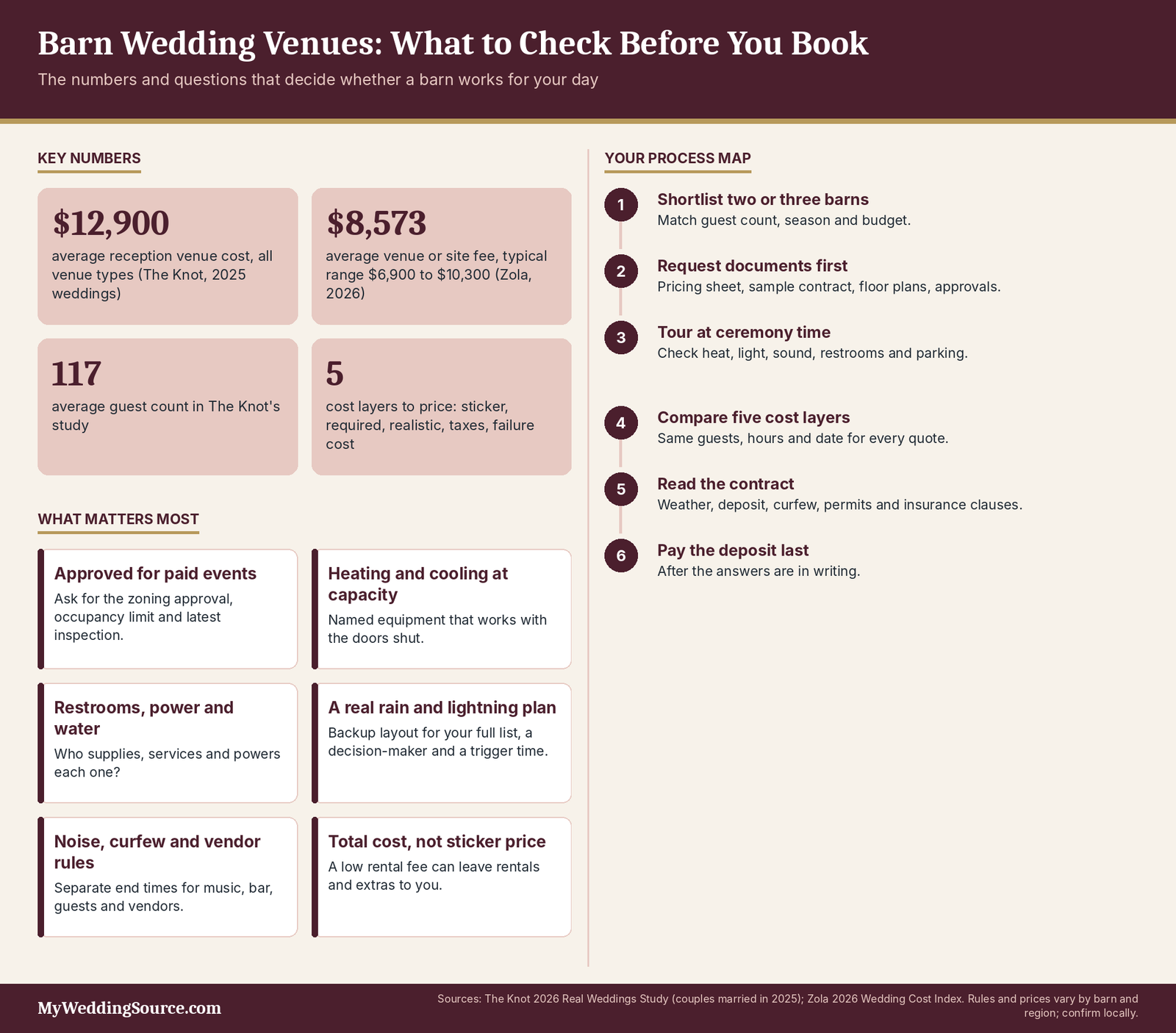
The Knot’s 2026 Real Weddings Study, covering 10,474 U.S. couples married in 2025, reports an average total wedding cost of $34,200, an average of 117 guests and an average reception venue cost of $12,900. Its venue guide (updated May 2026) shows the national average moving from $9,000 in 2016 to $12,200 in 2024 and $12,900 in 2025. Zola’s 2026 data, from its Wedding Cost Index and a Wedding Spend Survey of 720 couples, reports an average wedding cost of $36,000, an average venue or site fee of $8,573 with a typical range of $6,900 to $10,300, and average catering of $6,927. The two sources use different samples and definitions, which is why the venue numbers differ, and neither is a quote for your area.
How do guest count and region move the number?
Guest count and location are the two largest levers. The Knot’s venue data shows averages of about $6,500 for weddings with 1 to 50 guests, $10,400 for 51 to 100 and $16,000 for 101 or more, and it reports state averages ranging from the low thousands in states such as Wyoming and Idaho to well above $20,000 in New Jersey and New York. The same page notes that urban venues and popular destinations generally cost more than rural or suburban ones. Barns are more likely to be rural, which can lower the rental fee but raise other costs, such as travel for vendors, lodging for guests and the price of renting what the property lacks. Treat any national figure as a way to notice when a quote is unusually high or low for your region, not as a target.
Are barn wedding venues cheaper than other venues?
Sometimes, but not reliably, and no authoritative national dataset we found breaks out the average price of a barn specifically. Zola’s 2026 cost guide describes barns and outdoor gardens as lower-cost venue options on average, while The Hustle’s October 2024 reporting on the barn trend notes that barns are not necessarily cheaper than traditional venues and that purpose-built barns have contributed to rising wedding costs. A venue blog published by MayFair Farms in May 2026 makes a related point about “blank slate” venues, including unrenovated barns: the rental might be about $2,000 while the total production cost can easily exceed $30,000. That is one venue’s marketing perspective, not a study, but it captures how a low sticker price can invite a long list of rentals. The reliable approach is to price the whole event on paper for every finalist.
What does the sticker price usually leave out?
What are the required extras to look for?
Required extras are the charges you cannot decline, and they hide in the contract more often than on the pricing page. Ask whether the fee includes a venue manager or coordinator on the day, how many hours of rental are included and when the clock starts for load-in and setup. Ask about cleaning and trash fees, security or fire-watch staffing, parking attendants, required liability insurance for you and your vendors, and a refundable damage deposit and the conditions for getting it back. Some barns also require you to use a specific caterer, rental company or bar service, which turns an apparent venue fee into a package. The vendor-side version of these clauses is worth reading in our guide to vendor contract red flags, and the venue-side hidden charges are covered in what venue contracts hide.
Which realistic extras does a barn often lack?
A barn that is not a dedicated venue often arrives without the infrastructure a 100-guest dinner needs. MayFair Farms’ May 2026 blog gives ballpark ranges for the kinds of rentals involved: portable restrooms at roughly $100 to $200 each and luxury restroom trailers at $500 to $1,500, generator rental at $200 to $600, chair rental at $3 to $15 per chair, a dance floor at $300 to $1,200, plates, silverware and glassware for 150 guests at $800 to $2,500, linens at $500 to $1,500 and a day-of coordinator at $800 to $2,500. These are a single venue blog’s estimates, so use them as a ballpark for the shape of the list and replace them with local quotes. Add heating or cooling, which Zola’s barn guide mentions couples may need to rent in the form of heaters or fans, plus lighting beyond string lights if the evening runs after dark.
What about taxes, service charges, overtime and failure cost?
Taxes and service charges depend on state law and on how the venue words its contract, so ask whether the quote includes them and how they are calculated. If the barn has a hard end time and charges by the hour for overage, ask what the rate is and whether it applies to cleanup as well as music. For failure cost, find the payment schedule and the refund terms: how much is due at signing, when the rest is due and what happens to your money if the venue cannot host you because of weather, a permit problem or a closure. Deposits are often a substantial share of the rental fee, so treat the money as at risk until you have read the cancellation language, as discussed in the contract section later.
How do two barn quotes compare in practice?
| Layer | What it contains in a barn | What to ask |
|---|---|---|
| Sticker price | Rental of building and grounds for stated hours | Which hours, which spaces, which days of access? |
| Required extras | Cleaning, security, damage deposit, mandatory vendors | Which fees are required, and which are refundable? |
| Realistic extras | Tables, chairs, restrooms, heating or cooling, power, lighting | Who supplies, places and removes each item? |
| Taxes and fees | Sales tax, service charge, overtime | Are they in the quote, and at what rate? |
| Failure cost | Deposits and payments at risk in a cancellation | What is refundable if weather or permits block the date? |
What does a blank-slate barn look like in an illustrative budget?
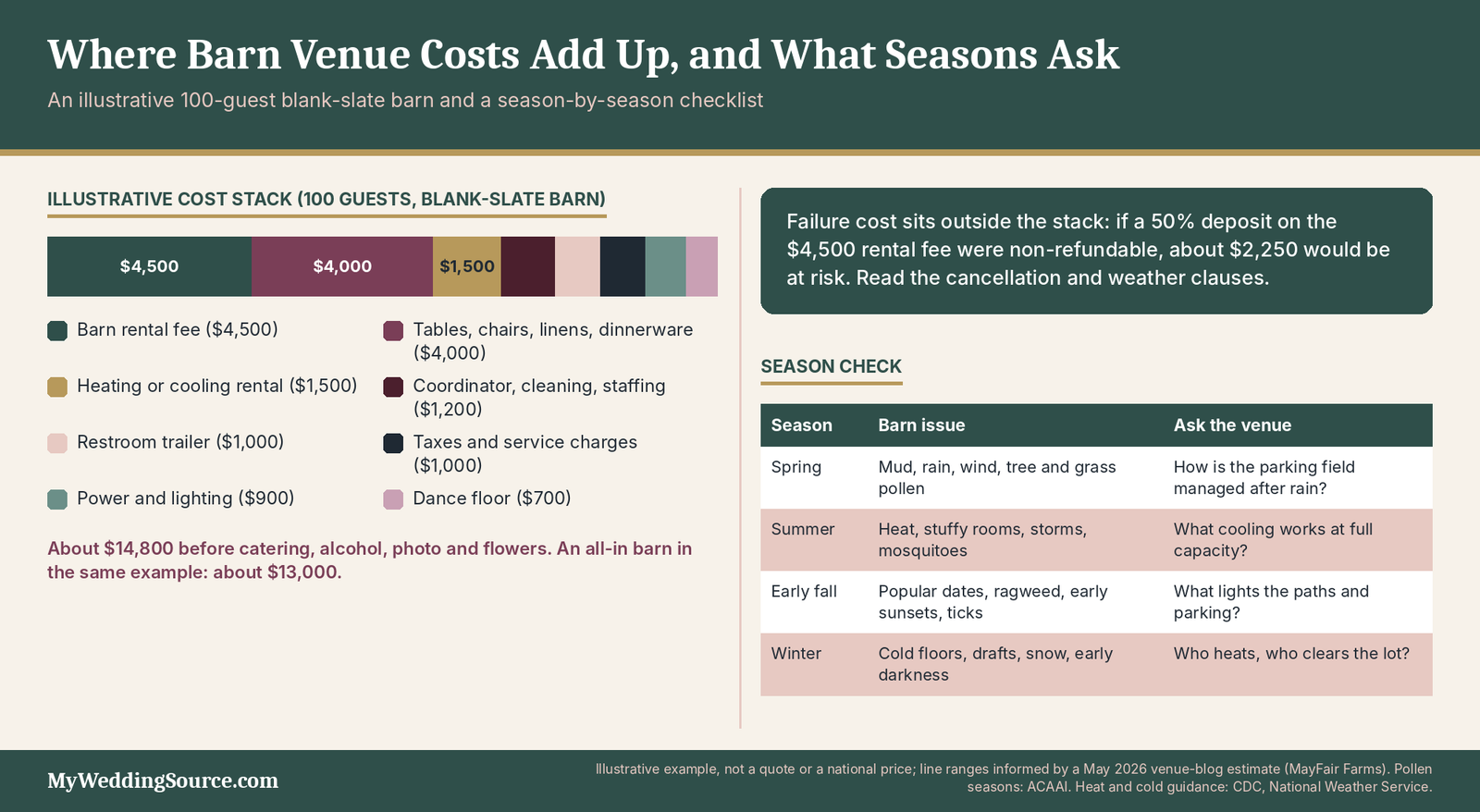
Here is an illustrative example, not a quote or a national price: a barn with a $4,500 rental fee for a 100-guest wedding. Add about $4,000 for tables, chairs, linens, dinnerware and glassware, $1,000 for a restroom trailer, $900 for a generator and lighting, $1,500 for a heating or cooling rental, $700 for a dance floor, $1,200 for a coordinator and cleaning and staffing fees, and $1,000 in taxes and service charges. The total is about $14,800 before catering, alcohol, photography, flowers and everything else. The fee started at $4,500, but the venue-related total was more than three times that, which is why we recommend building the full stack before comparing barns.
What does an all-in barn look like in the same example?
Now the other side of the example: a purpose-built barn that charges an $11,000 site fee including tables, chairs, basic linens, restrooms, heating and cooling and an on-site coordinator. Add $1,300 in taxes and service charges and $700 for optional upgrades such as an extra hour and nicer lighting, and the venue-related total comes to about $13,000. The sticker price of the all-in barn is more than twice that of the blank-slate barn, yet the totals sit within about $1,800 of each other, and the all-in version removes several coordination tasks. That does not make the all-in barn the better deal, because a blank-slate barn may allow an outside caterer, a bring-your-own bar and decor freedom that save money elsewhere. Our guide to all-inclusive wedding venues explains how those packages are structured and what to check before assuming everything is included.
Which layers should you compare line by line?
Put each finalist’s quote into the same table, with the same guest count, hours and season, and include the layers you would otherwise miss: restrooms, power, heating or cooling and failure cost. Ask each venue to mark which lines are included, optional or required, and which are billed by someone else, such as a rental company. If one barn is cheaper because it excludes something, add an honest estimate for the missing item and compare again. When the totals are within a few thousand dollars, let the non-price factors decide: comfort, accessibility, the strength of the rain plan and how clearly the contract is written.
| Line | Blank-slate barn | All-in barn |
|---|---|---|
| Rental or site fee | $4,500 | $11,000 |
| Tables, chairs, linens, dinnerware | $4,000 | Included |
| Restrooms | $1,000 | Included |
| Power and lighting | $900 | Included |
| Heating or cooling | $1,500 | Included |
| Dance floor | $700 | Included |
| Coordinator, cleaning, staffing | $1,200 | Included |
| Optional upgrades | Not applicable | $700 |
| Taxes and service charges | $1,000 | $1,300 |
| Venue-related total | About $14,800 | About $13,000 |
How Should Season and Climate Shape Your Barn Choice?
A barn is a big box with a roof, and a big box with a roof stores whatever weather you give it. In July the roof can hold heat, in January the walls can let it escape, and in every season the doors, the floor and the surrounding fields shape how comfortable guests feel. This section covers cooling, heating and the quirks of each season, so you can decide whether a barn suits your date or whether the date should move.
How do you keep guests cool in a barn?
Why can a barn feel hotter than an outdoor wedding?
Large barns often have high roofs, limited cross-ventilation and a lot of people producing body heat, and the combination can turn a warm afternoon into a stuffy evening. Doors that stay closed for sound control or to keep out bugs also trap warm air, while doors that stay open invite the outdoors in. The National Weather Service notes that heat index values are calculated for shady, light-wind conditions and that exposure to full sunshine can increase them by up to 15°F, which matters for any outdoor portion of your day, such as a ceremony or a cocktail hour on a gravel patio. Heat risk is not evenly shared: the CDC lists adults 65 and older, infants and young children, pregnant people, those with chronic conditions such as heart disease or asthma and people who work or exercise outdoors as higher risk, and your guest list probably includes several of these.
What cooling should a barn have, and what should you ask?
Ask exactly what the barn provides for cooling: central air conditioning, mini-split units, ceiling fans, evaporative coolers, large fans on the floor, or nothing but open doors. Ask whether the equipment has been tested with a full room, since a system that cools an empty barn can lag badly once 120 guests and a hot kitchen are inside. The CDC notes that fans should be used indoors only when the temperature is below 90°F, because above that they can raise body temperature, so a plan built on fans alone is thin for a heat wave. If the barn relies on rented cooling, ask who orders it, who pays, what the power requirement is and whether the building’s electrical service can support it alongside your caterer and band.
How can timing, shade and water reduce heat risk?
Timing is the cheapest cooling system. Late-afternoon or early-evening ceremonies, shaded cocktail areas, a schedule that moves the most active moments, such as the grand entrance and dancing, to the cooler part of the evening and visible water stations all help. The CDC advises scheduling outdoor activity during the coolest parts of the day and staying in shade as much as possible, drinking regularly and limiting alcohol, sugary drinks and caffeine when it is hot. Tell guests ahead of time what to expect, such as outdoor seating and a barn with doors open, so they can dress for it. Ask the venue whether it has a cooler area for guests who need a break, such as an air-conditioned bridal suite or office.
How do you keep guests warm in a barn?
How is the barn heated, and is it safe?
Heating ranges from radiant floors and forced-air systems to rented propane or electric heaters, and the difference matters for comfort, safety and budget. The Knot’s barn guide lists venues with heated floors, climate control and owners who handle heating and cooling, which shows the spectrum, and it also shows that many listings do not say. Ask whether the barn is heated by a permanent system, whether portable heaters are allowed, who provides and monitors them, and whether a fire official has approved fuel-burning heaters inside. Heaters need clearance from decor, straw and fabric, as the Maryland wedding barn guidelines illustrate by prohibiting hay bales and dried natural decorations and requiring candles to be on stable noncombustible bases with protected flames.
What about drafts, doors and cold floors?
Even a heated barn can feel cold at the edges: sliding doors seldom seal tightly, concrete or plank floors hold cold and a high ceiling lets warm air drift upward. The CDC’s guidance on cold exposure recommends layered, loose-fitting clothing, a water-resistant coat and covering the head, face and extremities, and it lists older adults and babies among those at risk. Practical steps for a winter barn wedding include a coat check or a warm-up room, blankets for outdoor photos, warm wraps and layers for the wedding party, and a plan to keep the ceremony short if it is outside. If the weather forecast turns, our guide to cold-weather wedding backup plans walks through the decisions in order.
Which seasons suit barn weddings, and what changes in each?
What should you expect in spring and early summer?
Spring brings mild temperatures and pretty fields, and it brings mud, rain, wind and rising tree and grass pollen. The American College of Allergy, Asthma and Immunology says tree pollen begins earliest, often around February in many areas and lasting into early summer, with grass pollen following in late spring and summer. Barn grounds in rainy seasons can turn parking fields into mud, so ask about gravel, mats and tow service. A barn with a strong indoor plan and a flexible ceremony location handles spring better than one that depends on a lawn.
What should you expect in late summer and early fall?
Late summer and early fall are the classic barn seasons, so the most requested dates tend to book early and sometimes cost more. The trade-offs are heat in August and early September, ragweed pollen that the ACAAI says runs roughly August to November and often peaks in early to mid-September, and insects such as mosquitoes and ticks. Sunsets arrive earlier by October, so plan the ceremony and photos around when the light fades and how guests will see their way to the parking field. Ask about lighting on paths and the parking area, since a barn that is charming at 5 p.m. can be dark and uneven underfoot at 9.
What should you expect in winter?
Winter barn weddings offer cozy lighting and often lower date prices, with real risks: snow and ice on driveways, early darkness, expensive heating and guests traveling on rural roads. Ask who clears the lot and the path, how the venue handles a closure for a storm and what happens to your date if the road is impassable. Heating costs may be passed on to you, and a building that is cheap to book in January may be expensive to warm. Build flexibility into the guest experience, with a lodging block close by and a plan for guests who decide to leave early.
| Season | Typical barn issue | What to ask |
|---|---|---|
| Spring | Mud, rain, wind, tree and grass pollen | How is the parking field managed after rain? |
| Summer | Heat, stuffy rooms, storms, mosquitoes | What cooling works at full capacity with doors shut? |
| Early fall | Popular dates, ragweed, early sunsets, ticks | What lighting covers paths, parking and the entrance? |
| Winter | Cold floors, drafts, snow, early darkness, road closures | Who heats, who clears the lot, and what if roads close? |
What Should You Check About Bugs, Allergies, Dust and Animals at a Barn?
A barn sits in the middle of the natural world, which is what makes it beautiful and what lets insects, pollen, hay dust and sometimes livestock join the guest list. None of this is a reason to avoid barns, and most of it is manageable with a little planning and honest communication with guests. The goal of this section is to turn vague discomfort into specific questions for the venue and specific steps for you.
How do you plan for insects?
Which insects should you expect, and when?
Mosquitoes, ticks, flies and, in warmer months, wasps are the usual suspects around fields, ponds and wooded edges. The CDC says ticks are most active from April to September, though exposure can happen year-round, and it advises avoiding tall grass, brush and leaf litter. It also advises emptying or scrubbing containers that hold water weekly to reduce mosquito breeding, so ask whether the property has standing water, a pond or a creek near guest areas. If your ceremony or portraits will take place in a meadow, ask when the grass was last mowed and whether the venue treats its grounds, and plan photo locations that keep guests on paths or mown lawn.
What can the venue do, and what can you do?
Venues can mow regularly, keep trash and food waste covered and away from guest areas, use fans to move air on patios and close doors at dusk when lights draw insects in. If the grounds are treated with pesticides, ask which products are used, when they were applied and what the waiting period is before guests arrive, because that is a reasonable question for any food-service site. On your side, the CDC recommends EPA-registered repellents with active ingredients such as DEET, picaridin, IR3535, oil of lemon eucalyptus, PMD or 2-undecanone, with the registration number on the label, and applying sunscreen before repellent. A small basket of repellent wipes or spray near the ceremony site, plus a note in your wedding website suggesting guests check for ticks after an outdoor event, is a thoughtful, low-cost step.
How do you plan for allergies and dust?
How does pollen affect an outdoor-adjacent barn wedding?
A barn with open doors, a lawn ceremony and fields all around is effectively a pollen collector. The American College of Allergy, Asthma and Immunology says tree pollen starts earliest in the year, grass pollen follows in later spring and summer and ragweed runs roughly August to November, often peaking in early to mid-September. It adds that tree and grass pollen tend to be highest in the evening, ragweed in the morning, that calm days keep pollen grounded, warm, windy days raise counts and counts can spike after rain. If you or several guests have seasonal allergies, consider the month before you consider the barn, and share a note on the wedding website suggesting guests take their usual medications beforehand. This is general education rather than medical advice, and guests with serious conditions should talk to their own clinicians.
What about hay, straw, dust and mold in the building itself?
Older barns can hold dust in the rafters, hay or straw in storage and damp corners where mold grows, and some guests with asthma or sensitivities will notice. Ask whether hay or feed is stored in the same building or a neighboring one, whether the space has been cleaned and aired before events and whether the venue runs air filtration or ventilation. If your decor plan includes hay bales or straw for seating or styling, check the rules, because many venues ban them for fire safety, and the Maryland State Fire Marshal’s wedding barn guidelines list hay bales, straw and dried natural vegetation as prohibited decorations. Fresh flowers and greenery are generally a safer choice than dried material, both for allergies and for flame-safety rules.
What about animals and working-farm conditions?
Are animals part of the property, and where will they be?
Some barns have goats, horses, cattle, dogs or chickens that are part of the charm, and others keep animals far from event spaces. Ask which animals are on site, where they are kept relative to guest areas, the cocktail hour and the food, and who supervises any animal interactions. A guest with an animal allergy or a fear of dogs should know in advance, and guests with young children may need a plan for supervision. If animals will be near guests, ask whether the venue provides handwashing stations, and keep animals and food service in separate zones.
How do farm smells, dust and operations affect the day?
A working farm does not pause for weddings, so ask what is happening on the property and on neighboring land that weekend: harvest, manure spreading, spraying, equipment moving or construction. A reasonable venue will tell you honestly what is typical for the season and will block off areas when it can. Wind direction, rainfall and temperature can change how strongly a farm smells, and a faint odor in the morning can be a strong one by afternoon. If the barn is next to an active operation, tour on a day when you can see and smell the property at its ordinary level, not only on a staged open-house afternoon.
How Do Restrooms, Power, Water and Cell Service Work at a Barn?
At a ballroom, utilities are invisible because they work. At a barn they can be the main logistical story: a building that was never designed for a hundred guests must now supply toilets, electricity, water, light and, increasingly, a phone signal. These details do not appear on Pinterest, but they shape guest comfort and vendor performance more than almost anything else. Ask about each one specifically and get the answers in writing.
How should restrooms be handled?
Are the restrooms indoor, portable or a luxury trailer?
Restrooms at barn venues vary from full indoor facilities to a few shared units to nothing at all. Zola’s barn guide notes that couples may need to rent bathroom trailers, and MayFair Farms’ May 2026 blog lists standard portable units at roughly $100 to $200 each and luxury restroom trailers at $500 to $1,500, which are venue-blog ballparks to check against local quotes. A trailer with sinks, running water and finished interiors is a different guest experience from a row of portable units, and it is worth deciding which you want before you compare prices. Ask whether the existing restrooms are indoors, how many stalls each has, whether any are accessible and who cleans and restocks them during the event.
How many restrooms do you actually need?
Supplier guidance can serve as a starting point. Satellite Industries, a portable restroom manufacturer, suggests one standard portable unit per 50 to 75 guests for events up to four hours, adding 15 to 30 percent for longer events and 15 to 20 percent more when alcohol is served. It also suggests at least 5 percent of units be accessible and roughly one handwash station per four to six restrooms, and for luxury trailers about one stall per 40 to 60 guests at long events with food and alcohol. As an editorial arithmetic example, not a standard: 100 guests at a six-hour reception with alcohol would need roughly three standard units on the supplier’s math, or about two to three trailer stalls, plus one accessible unit and a handwash station. Because the building’s septic system or holding tank may also limit capacity, ask whether it has been sized for an event of your size.
How will the barn get power, light and water?
Is there enough electrical service for everything?
Power is the invisible constraint on most barn weddings. A band, a DJ, a caterer with warming equipment, heating or cooling rentals, uplighting and a coffee station all draw from the same service, and an older barn may have only a few circuits. Ask the venue for the service’s capacity in amps, the number and location of outlets, whether the vendors’ needs have been mapped and whether a generator is available or required. If a generator is used, ask who rents it, where it will sit and how it will be fueled and monitored, because generators produce exhaust and noise and belong outdoors and away from doors, windows and guests.
Where does the water, ice and waste go?
Caterers and bartenders need potable water, ice, dishwashing space and a place for trash and recycling, and a barn on a well or septic system has limits on all of them. Ask whether the water is from a municipal line or a well, whether it has been tested, where the caterer’s prep area is and whether a hose bib or sink is near it. Ask who removes trash during and after the event, how many dumpsters are available and whether you will be charged for extra hauling. A caterer’s site visit before you sign is a smart step, since experienced caterers can usually spot a missing sink or an undersized outlet in minutes.
Will guests and vendors have cell service and Wi-Fi?
How do you test the signal before you book?
Rural barns often sit where coverage is patchy, and the problem is not abstract: a DJ who streams music, a photographer who uploads to a gallery, a card reader at the bar and guests calling rideshares all rely on a signal. On your tour, check your own phone, ask the staff to test theirs and ask whether the barn has Wi-Fi that vendors can use. If coverage is weak, ask whether a booster is available and plan for offline music, printed directions and a written ride plan for guests. This matters for safety too, since a guest who needs to call for help should be able to do so.
Who is responsible when something is not working?
Venues differ on whether they provide a point person during the event who can fix a tripped breaker, a locked restroom or a dead outlet. Ask who is on site during your wedding, what they are authorized to do and how to reach them in an emergency, then confirm that the contract names this person or role. A venue that can describe how it handled a power outage at a past wedding is usually better prepared than one that has never had one. Add the answer to your vendor packet so your day-of coordinator, caterer and band all know whom to call.
Is the Barn Approved for Weddings? Zoning, Occupancy and Fire Safety
This is the section that couples often skip and wish they had read. Hosting paid events in a barn can involve zoning approval for the land, building or fire code compliance for the structure, health and sanitation approvals for food and restrooms and liquor licensing, each set by a different local, county or state authority. Most barn venues operate with approvals in place, and many are proud to show them. The point is that a venue’s legal status is part of what you are paying for, and it is reasonable to ask, as general education rather than legal advice.
Why does zoning matter for a barn wedding?
Can any farm host paid weddings?
Not automatically. The Kentucky Department of Agriculture’s guide to special events on the farm (revised June 2025) says many towns do not define events as agriculture, so a farmer may need a conditional use permit, and it stresses that zoning is a local issue to be confirmed with the county clerk, city clerk or planning and zoning office. The same guide points owners to the state’s building and fire code requirements, to the local health department for food safety and to an insurance agent about coverage. The practical result for you is simple: ask whether the property has the local approval to host paid events and ask to see it, since a barn that cannot document its status carries risk that can land on your date.
What do court cases tell us about the risk?
Ohio provides cautionary examples, and they are worth describing carefully because they involve real disputes and fact-specific rulings. Ohio State University’s Agricultural and Resource Law Program reported that in September 2022 a state appeals court upheld an injunction barring a farm owner from renting a barn for weddings and other events for a fee, finding the barn had been built for events rather than agriculture, and that a trial court separately fined the owner $50,000 for continuing to hold weddings. An earlier 2020 Ohio ruling upheld a township’s decision that weddings were not “agriculturally related” on a farm, even though activities such as corn mazes and hayrides qualified. These cases do not mean barn weddings are unlawful, since outcomes depend on local law and facts, but they show why a venue’s approvals matter and why an unresolved dispute is a red flag.
How do building and fire codes apply to barns?
What do fire officials look at in an event barn?
State examples show the typical concerns. The Maryland State Fire Marshal’s inspection guidelines for wedding barns, written under the 2015 Life Safety Code, treat a wedding barn as a change of use from agricultural storage to assembly occupancy, and they call for sprinklers where food or drink is consumed and the occupant load is 100 or more or the fire area exceeds 5,000 square feet, a fire alarm above 300 occupants, emergency lighting on exits and at least two remote exits. The same document bars indoor smoking, fog and pyrotechnics, limits candles and calls for two certified crowd managers at every event. Kansas State Fire Marshal guidance says most converted barns will be classified as A-2 or A-3 assembly occupancies, notes that barns often cannot meet noncombustible wall-finish requirements and describes variances with compensating safeguards. Your state or county may follow different editions and thresholds, so treat these as a picture of the questions officials ask.
What does “exempt” or “grandfathered” really mean?
Some states exempt certain farm buildings from some codes, and venues sometimes say the barn is “grandfathered” or “agricultural,” but the exemption can be narrow. A University of Florida extension publication on agritourism building and fire codes, for instance, describes nonresidential farm buildings as exempt from the state building code, but sorts fire-code treatment by size and use: small buildings with 35 or fewer occupants and certain open pole barns are exempt, buildings of up to 100 or 300 people can be exempt with annual inspection and buildings that house the general public in larger numbers fall fully under the fire code. That publication addresses agritourism generally and never mentions weddings, so it shows how an exemption can come with conditions rather than describing any particular barn. If a venue says it is exempt, ask what exactly it is exempt from, what the limits are for guest count and number of events per year and whether anyone inspects the building.
What documents can you ask for?
Which documents show a barn is ready for events?
Ask for the documents most relevant to your guest count and plans: proof of the venue’s event or zoning approval, the most recent fire or building inspection or certificate of occupancy where one applies, the posted or approved maximum occupancy, the septic or health department approval if guests use on-site restrooms, any liquor license or alcohol rules and the venue’s certificate of liability insurance. Not every item will apply everywhere, and a small venue may produce a letter from the county instead of a certificate, which is fine. A venue that hands you a folder in a few minutes is giving you a very good sign. Our guide to venue scam warning signs covers the pressure tactics and missing paperwork worth taking seriously.
How can you ask without sounding accusatory?
Frame the request as part of your own due diligence and your vendors’ requirements: “Our insurer and caterer will ask for your occupancy and event approvals, so could you send us what you have?” Most venue managers hear this regularly and have a standard answer. Put the request in an email so the answer is in writing, and note the date. If you receive evasive answers, repeated delays or an insistence that “everyone books without this,” treat it as information about how the venue will handle problems later and consider whether a different barn offers more certainty.
| Approval or document | Who often decides | What to ask |
|---|---|---|
| Zoning or event use | County or city planning office | Is paid event use approved, and may I see it? |
| Building and fire safety | Local or state fire official | When was the last inspection, and what is the occupancy limit? |
| Health and food safety | Local health department | Which approvals cover the kitchen, catering and restrooms? |
| Septic or well capacity | County health or environmental office | Is the system rated for an event of my size? |
| Alcohol rules | State alcohol agency | Who holds the license, and what are the bar rules? |
| Insurance | Venue’s insurer and agent | Can you provide a certificate, and what do you require from me? |
What Decor, Lighting and Setup Rules Will a Barn Put on Your Plans?
Barns come with a ready-made look, which is a gift when your vision matches it and a source of friction when it does not. Decor rules at barns tend to be shaped by three things: the age and fragility of the building, fire safety and the venue’s own wear and tear from hosting many weddings. Learning those rules before you buy or rent decor saves money and prevents awkward conversations during setup.
What can you attach, hang or light?
Can you use nails, tape, hooks or hang things from beams?
Venues vary from “no nails, no tape, no exceptions” to “hang whatever you like with a ladder and a signed form.” Older timber can be fragile or historically valued, and ceilings may be unsuited to weight or rigging, so florists who want to suspend installations need written permission and sometimes proof of insurance. Ask what is allowed on walls, beams, posts and the loft rail, what the venue uses to hang its own lights and who is permitted to climb ladders or lifts. If you want a floral chandelier, a hanging backdrop or fabric draping, ask for the maximum weight and the approved attachment points before you design it.
What are the rules on candles, string lights, sparklers and fog?
Flame rules are the most consistent across barns because dry wood, hay and fabric burn quickly. The Maryland State Fire Marshal’s wedding barn guidelines permit candles only on a substantial noncombustible base with the flame protected, and they prohibit fog, smoke effects and pyrotechnics inside, indoor smoking and hay bales, straw and dried natural vegetation as decor. Your venue may be stricter, with flameless candles only, no sparklers for the exit or a designated outdoor area for smoking. Ask for the list in writing and share it with your florist, planner, photographer and anyone building a send-off, so nobody discovers the rule while holding a box of sparklers.
How do you make the barn look like you without fighting it?
How do you work with a strong existing look?
A barn already has texture, scale and warm tones, so the most effective decor tends to add contrast and ease rather than repeat the rustic theme. Linens, florals and lighting in one or two chosen colors can carry the design, while a few large pieces, such as a statement arrangement or a candlelit table runner of approved lighting, read well in a tall space. Small centerpieces can disappear in a room with a thirty-foot ceiling, so ask the venue what scale works. Ask to see photos of weddings in the same season and room, including after dark, because lighting changes how every color looks, and warm string lights can wash out soft pastels.
Who sets up, who tears down and when can they start?
The setup window is one of the most important lines in a barn contract and one of the most overlooked. Ask when vendors can enter, whether you have access the day before, how long the venue allows for load-in and load-out and what happens if the barn is hosting another event the day before or after. Some barns restrict access to a few hours, which is tight for a florist, a rental company and a lighting crew at the same time. Ask whether the venue provides setup help, who removes decor and rentals after the event and what fee applies if items are left behind.
Which rules shape photos and vendor choices?
What should you ask about photography, drones and off-limits areas?
Barns are photogenic outdoors and dim indoors, so photographers care about window light, ceiling color, how late the sun sets and whether the venue allows flash or additional lighting. Ask about rules for drones, which some venues ban for safety, privacy or neighbors, and about areas that are off-limits for photos, such as the loft, animal pens, equipment sheds or a neighbor’s field. Ask to walk the property with your photographer if possible, and share the sunset time for your date so portraits are not planned for a spot that is in shadow.
Do preferred vendor lists and exclusivity clauses apply?
Some barns require or favor a list of approved vendors, often because those vendors know the building and carry the insurance the venue requires. A preferred list is a convenience when it is a starting point, and a cost when it is a requirement with no alternatives. Ask whether you may bring outside vendors, what fee or insurance requirement applies and whether any vendor category, such as catering, bar, rentals or planning, is exclusive. If the venue requires a certain caterer or coordinator, compare that vendor’s total price as part of the venue’s total, the way the cost section above describes.
How Do Noise Limits, Curfews and Neighbors Affect a Barn Reception?
A barn is a large, hard-surfaced room that holds sound in and, once the doors open, sends it far across quiet fields. Rural quiet makes noise travel and makes neighbors notice, so many barns operate under local noise ordinances, conditions attached to their event approvals or simply good-neighbor rules. These limits can shape your timeline more than any other rule on this list.
What do sound rules look like in practice?
Why do barns echo, and how do they leak sound?
Hard floors, bare timber walls and high ceilings reflect sound, which can make speeches hard to follow and dance floors painfully loud. Open doors then carry the music outward, which is why some barns have a policy that doors close once amplified music begins, and why that policy interacts with heating and cooling. Ask the venue whether there is a sound limiter or a decibel limit, who enforces it and whether any past wedding has been asked to turn the volume down. Ask your band or DJ to visit the barn or share experience at similar buildings, since acoustics differ by structure and the right speaker placement helps with both clarity and volume.
What do the curfew and end time actually mean?
Venues use different words for different deadlines, and a contract that says “ends at 11 p.m.” might mean the music stops at 10, the bar closes at 10:30, guests leave by 11 or the vendors finish loading out by 11. Ask for each in writing: when amplified music must stop, when alcohol service ends, when guests must leave the property and when vendors must be out. Ask about the overtime rate, which often applies per hour or fraction of an hour, and whether it covers cleanup. Then reverse-engineer your timeline from the earliest deadline, so the last dance, the cake and the send-off all fit inside it.
How do you plan around neighbors and the schedule?
Who are the neighbors, and have they raised concerns?
On a country road, “no neighbors” might mean the nearest house is within earshot across a field. Ask the venue about neighboring properties, any history of complaints and whether the county or township has attached conditions to the venue’s event approval, such as limits on the number of events per year or on amplified music. A venue with a good relationship with neighbors tends to be a better bet than one that never discusses them, because a neighbor complaint is one of the more common ways an event gets cut short. If the barn has a policy on sending guests off with sparklers, cheers or a loud exit, ask how that interacts with the curfew.
How should you design the evening around the curfew?
Put the highest-energy moments earlier than you think you need to, since a curfew punishes a late start and a slow dinner. Many couples schedule the cake cutting, bouquet toss and first dance in the first half of the reception, leaving the final part for dancing, then arrange a quiet send-off such as a lantern-lit walk or a bubble exit that does not depend on loud music. Share the end times with your band, caterer, rental company and shuttle provider so everyone is working from the same clock. If a venue offers an extra hour as an option, decide in advance whether it is worth the fee, rather than making that decision at 9:45 p.m.
Which Caterer, Kitchen and Bar Rules Should You Check at a Barn?
Food is where barn venues most visibly diverge from standard banquet halls. Some barns have an in-house caterer and a commercial kitchen, others allow only approved caterers and others have nothing but a table in a lean-to. Rural distance, summer heat and local alcohol laws add to the picture. This section is about the rules and conditions you should clarify before you sign, and our guide to wedding catering cost covers the pricing side in detail.
What do the catering rules look like?
Does the barn require or recommend a caterer?
Barns generally fall into three groups: in-house catering required, a list of approved caterers or open catering where you hire anyone who meets the venue’s insurance and licensing rules. Each affects your total cost, since in-house catering may bundle rentals and service while open catering may require you to supply rentals, staffing and bar service separately. For context, The Knot’s 2026 Real Weddings Study reports average catering of about $80 per person, and Zola’s 2026 data reports average catering of $6,927, so use these to sanity-check proposals rather than as a target. If the venue charges an outside caterer fee, add it to the comparison and ask what it covers.
What kitchen does the barn provide?
Kitchens range from a full commercial kitchen to a warming kitchen with outlets and a sink to no kitchen at all. A caterer working in a bare barn may need tents, prep tables, refrigerated trucks, generators and handwashing stations, and those costs show up in the quote, often under logistics. Invite your caterer to the tour or send photos and measurements, and ask them to name what they would need to bring. Ask the venue and the caterer which health department approvals cover the setup, since local rules differ, and who is responsible for obtaining them.
How do heat and distance affect food safety?
What does the two-hour rule mean at a barn reception?
The USDA says perishable food should not be left out for more than two hours, or one hour when the temperature is above 90°F, and it warns that bacteria multiply rapidly between 40°F and 140°F. A barn in summer, with doors open and guests wandering, can create exactly the conditions that make those limits matter, especially at buffets, cocktail-hour stations and dessert tables. Ask the caterer how they hold hot food at or above 140°F and cold food at or below 40°F, how long food sits out and how they replace or refresh trays. A reliable caterer will have a clear answer and the equipment to match.
What about long drives, food trucks and cake?
When the caterer’s kitchen is an hour away, travel time becomes part of the food-safety plan, so ask how food is transported, held and finished on site. Food trucks add a late-night option, but they need access, a flat spot, power or fuel and sometimes permits, so confirm the barn’s rules and who coordinates them. A wedding cake in a warm barn can slump, particularly if it sits near a window or a heater, so ask your baker how long the cake can safely stand and where it should be placed. If a dessert or snack plan depends on a particular vendor, check with the venue about access and timing early.
Who can serve alcohol, and who carries the risk?
Who may pour, and can you bring your own?
Alcohol rules vary by state and sometimes by county. Some barns require a licensed caterer or bartender, some hold a license that allows them to serve and some allow you to bring your own with a licensed bartender. Others restrict outside alcohol altogether or charge a corkage fee, a per-bottle or per-person charge for serving alcohol you supplied. Ask the venue who is responsible for compliance, what the service hours are and whether your own purchases must be sold through the venue or a caterer.
How do you handle liquor liability and safe rides?
Liquor liability is a separate question from rental and catering, and the risk follows the people who serve alcohol. Zola’s insurance guide explains that liquor liability covers damages from alcohol-related accidents guests cause after leaving, that it may come bundled with a wedding liability policy or be sold separately and that sometimes the venue maintains it. Ask what the venue’s policy covers, whether it requires you to buy your own and whether bartenders are trained and have authority to stop service. On a rural road with few rideshare options, arrange shuttles, a taxi plan or a lodging block close by, and communicate it before the day.
What Does a Rural Location Mean for Guests, Parking and Vendors?
Remote is part of a barn’s charm, and it also determines whether a 70-year-old great-aunt can get to the ceremony, whether the band can load in through a gate and whether anyone can find a hotel. The cost of rural logistics is easy to overlook because it is spread across several vendors and guests rather than on the venue invoice. A short logistics review early in your search can reveal that a slightly more convenient barn is the better fit.
How do guests get there and get home?
How far are hotels, and will you need a shuttle?
Check the drive time from the nearest hotels and airports, and then check it at night, on winding roads, since GPS estimates often miss the last few unlit miles. If the closest hotel is 30 minutes away, a shuttle, a group rideshare plan or a nearby room block becomes part of the budget. Ask the venue whether it has on-site lodging, preferred hotels or a shuttle partner and whether the property can accommodate buses. Give guests clear directions and an address that works on mapping apps, as some rural addresses lead to the wrong gate.
How will parking, mud and emergency access work?
A parking field is a significant piece of infrastructure: grass, gravel, a few attendants and a way to get vehicles out in the rain. Ask where guests park, how many cars the property holds, how the lot is lit and whether it has a plan for wet ground, such as mats, gravel or a tractor to tow stuck cars. Ask also whether emergency vehicles can reach the barn, where the gate codes are kept and how emergency services would find the property. For guests who use mobility aids, ask for accessible parking close to the entrance on a firm surface.
How do vendors manage a countryside setup?
What do travel fees and load-in access mean for vendor costs?
Many vendors charge travel fees beyond a certain distance, and a barn 60 miles from a city can add charges across photographers, florists, bands, rental companies and caterers. Load-in is another constraint: narrow gravel roads, locked gates, soft ground and stairs can slow delivery of heavy equipment. Ask the venue about truck access, the gate width, where vendors may park and whether the ground can support rental trucks, and ask your vendors to confirm they have worked in similar settings. Having the venue and the vendors talk before the wedding is often the simplest way to catch a surprise.
What if something is forgotten or breaks?
In a city, a missing extension cord is a ten-minute errand, and in the countryside it may be a forty-minute round trip. Build a day-of kit with extension cords, tape, scissors, safety pins, sewing supplies, first-aid supplies, bug spray, sunscreen, blankets and phone chargers, and ask your planner or day-of coordinator to carry it. Know where the nearest hospital, pharmacy and store are, and confirm that the venue has a first-aid kit and fire extinguishers on site. Some of this is easy to dismiss until the moment it is needed, and a modest kit rarely goes unused.
How Accessible Is a Barn for Guests With Mobility, Sensory or Health Needs?
Barns are among the most photogenic venues and, without planning, among the harder ones for guests with mobility, sensory or health needs to navigate. Gravel lots, plank floors, sliding-door thresholds and hayloft stairs were not designed with wheelchairs, walkers or canes in mind. A good barn venue can still be a welcoming place for everyone, and the difference is usually a few specific features and a venue willing to talk about them. Our guide to accessible wedding venue red flags goes deeper on the broader checklist, and this section focuses on what is distinctive about barns.
Can every guest get around the property?
Can guests get from parking to seats and restrooms on a stable surface?
The U.S. Access Board’s guidance on floor and ground surfaces says accessible surfaces must be stable, firm and slip resistant, that hard materials such as concrete, asphalt and wood meet the standard and that most loose materials, including gravel, do not unless they are treated with binders or compaction, which usually need repeated maintenance. That is an immediate flag for the typical barn parking field and walkway. Walk the route from the accessible parking spot to the ceremony seats, the restrooms and the dance floor, and note any grass, gravel, mud, steps or slopes. If the barn does not provide a firm path, ask whether the venue or your rental company can lay mats or temporary pathways and who pays for them.
What about thresholds, lofts, stairs and uneven floors?
Sliding barn doors often have raised thresholds or tracks, and old plank floors may have gaps, dips and splintered edges. The Access Board’s guide says changes in level up to one-quarter inch are permitted without treatment, up to one-half inch need a bevel and larger changes need a ramp or similar treatment, which gives you a useful reference when you see a door sill. If any part of the experience is on a second level, such as the bridal suite, the bar or the dance floor, ask whether a ground-floor alternative exists, since a hayloft with a ladder is a different proposition from a staircase and neither is available to every guest. Aim for all key moments to happen on one accessible level so nobody is separated from the celebration.
How does the law and practice apply?
Does the ADA apply to a barn venue?
The ADA.gov Title III primer explains that businesses serving the public are public accommodations, that existing facilities must remove barriers when it is readily achievable, meaning easily accomplishable without much difficulty or expense, and that the duty is continuing. It also says “grandfather provisions” in local building codes do not exempt a business from ADA obligations. How this applies to a given barn depends on its facts, such as how it is used and what has been altered, so this is general education, not legal advice. For you as a couple, the useful question is practical: ask what accessibility features the venue already has, what it has changed in recent years and how it handles requests.
Which accommodations can you arrange yourself?
You can do a lot even when the barn is imperfect. Temporary ramps, mats over gravel, a shuttle from the lot to the door, a reserved parking row, seating close to exits and restrooms and a quieter space for guests who need breaks can all be arranged with a few phone calls. Supplier guidance from Satellite Industries suggests at least 5 percent of portable restroom units be accessible, so ask any rental company about an accessible unit and a path to it. Ask guests on your RSVP or website how you can make the day comfortable, rather than guessing, and thank them for the answers without making anyone explain more than they want to.
What about sensory and health needs beyond mobility?
How do heat, cold, noise and light affect guests?
Temperature extremes, loud music in an echoing room and low light can affect guests with heart conditions, respiratory conditions, sensory sensitivities, hearing or vision loss, or those caring for infants. The CDC lists older adults, young children, pregnant people and people with chronic conditions among those at higher risk in hot weather and older adults and babies among those at risk in the cold, which makes your barn’s heating, cooling and rest areas an inclusion issue. A quiet room away from the music, seating that is not next to the speakers and softer lighting during the dinner can all help. If you have guests who rely on lip reading or assistive devices, tell your DJ or band so they can adapt microphone use and speaker placement.
What about medical needs and emergency access?
Rural locations lengthen the distance to help, so it is sensible to know where the nearest hospital or urgent care is and how long an ambulance would take to arrive. Ask the venue whether staff are trained in first aid, where the first-aid kit and fire extinguishers are kept and how emergency vehicles reach the building. If a guest has a medical condition that needs refrigeration for medication, a quiet place to rest or a place to charge a device, tell the venue ahead of time. This is general planning, not medical advice, and guests with specific conditions should rely on their own clinicians.
What Is the Rain Plan, and Is the Barn Itself the Backup?
Many couples book a barn partly because it feels like a built-in weather plan, and sometimes it is. A barn can shelter a ceremony that would otherwise be on a lawn, but only if its backup layout fits your whole guest list, the decision is made in time and the building is safe in the conditions you are worried about. Our guide to outdoor wedding rain plans covers the decision process in more depth, and this section focuses on the questions that are specific to barns.
Is the barn a true backup for an outdoor ceremony?
Does the backup layout fit everyone and everything?
If the ceremony is planned on a lawn with the reception in the barn, the rain plan usually means holding the ceremony inside, which means sharing one room for ceremony, cocktail hour and dinner. Ask for a floor plan of the backup layout, including chairs in rows, the aisle, the officiant’s spot, the band and any décor, and check that every guest has a seat. Then ask how quickly the room can be flipped from ceremony to dinner and where guests will wait during the flip, since a smaller space can force a delay that ripples through the evening. The venue should be able to show photos of real weddings that used the backup layout.
Who decides, and by what time?
A rain plan is only a plan if someone has authority to call it by a stated time. Ask the venue who makes the weather decision, what time it is made, what sources they use and who tells the vendors. A common structure is a soft check a few days out and a hard call on the morning of the wedding, but your venue and vendors may have their own deadlines, particularly if tents, shuttles or outdoor rentals are involved. Put the decision-maker, the time and the notification chain in writing so that the flower delivery, the rental truck and the photographer all hear the same answer.
How should you think about lightning, wind and wet ground?
What does lightning mean for a barn wedding?
The National Weather Service says that the only completely safe action in a thunderstorm is to get inside a safe building or vehicle, that a tent offers no protection from lightning and that people should wait 30 minutes after the last thunder before going back outside. Its guidance treats open-sided picnic shelters as unsafe, which is relevant to pavilions and open-sided barn sheds. A fully enclosed barn with walls, a roof and electrical service is a very different situation from an open-air structure, so ask which type you are booking and where guests would go if lightning approached during an outdoor ceremony or cocktail hour. A written plan that names the shelter and the person who sends guests there is better than assuming everyone will figure it out.
How do wind, mud and power outages change the plan?
Wind can affect tents, decor and outdoor ceremonies, mud can strand cars and slow guests in dress shoes and storms can knock out power and with it lighting, air conditioning, heating and the band. Ask whether the venue has a backup generator and what it powers, whether emergency lighting and flashlights are available and how the parking field is managed after heavy rain. Ask the rental company about its wind thresholds for tents and sidewalls, and your florist about what is movable. If a storm threatens, a venue that has clear procedures and a calm manager is worth far more than a prettier barn with no plan.
What do the contract and insurance say about weather?
Does the venue’s weather clause protect you?
Many venue contracts say nothing about weather, or say that weather is not a reason to cancel or reschedule. Zola’s insurance guide says that rainy weather is not considered a reason to cancel or postpone in the eyes of most insurance companies, though severe weather that prevents travel or damages the venue may be covered under cancellation policies, and some states require that cancellation coverage be bought at least two weeks before the event. Ask the venue what happens if the barn cannot be used because of a storm, flood, fire or power failure, whether they offer a reschedule or refund and what they do about vendors you have already paid. A clause you do not like is better known before you sign than after.
What if the barn becomes unusable?
Barn weddings are vulnerable to a few specific problems: storm damage, a flooded access road, an unsafe roof or floor, a heating failure in winter and a code or permit issue. Ask what the venue’s contingency plan is, whether it has a partner property for emergencies and who pays the difference if you must move. Some couples keep a backup venue short list for a year out, while others rely on a flexible date clause. Whatever route you choose, treat the answer as a piece of the price, because a low rental fee with no contingency is not a bargain if your money is stuck.
What Should a Barn Venue Contract and Insurance Policy Cover?
A barn contract is where the friendly conversation on the tour becomes an enforceable set of obligations. Contracts and insurance involve state law and individual facts, so treat what follows as general education, not legal advice, and consider having an attorney review a large agreement. The aim is to know what to look for so you can ask about it before you pay a deposit.
Which contract clauses matter most?
Which payment, cancellation and refund terms should you check?
Read the payment schedule first: how much is due at signing, when the balance is due and what portion is refundable under what conditions. Ask whether the deposit is refundable if you cancel, whether it can be applied to a new date and what happens if the venue cancels, loses its approvals or sells the property. Look for language on liquidated damages, late fees and whether the venue must try to rebook your date. If anything is unclear, ask for it in writing, since an email from the venue manager that explains a term is easier to rely on than a memory of a conversation.
Which operational clauses are particular to a barn?
Several clauses matter more in barns than in ballrooms. Look for the hours of access and the curfew, the vendor rules and any fee for outside vendors, the damage deposit and conditions for its return and rules on decor, candles, nails and animals. Look for the capacity clause and whether it matches your layout and for any language about permits, approvals or code compliance and who is responsible if one is denied or revoked. Look for the venue’s right to host other events nearby on your day, its right to relocate your event in an emergency and any waiver or indemnification requirements for you and your guests.
| Clause | What to look for | Why it matters at a barn |
|---|---|---|
| Payment and refund | Amounts, due dates, refundable portion | A deposit can be a large share of your venue budget |
| Venue cancellation | Refund, relocation or reschedule rights | Approvals, storms or damage can close a barn |
| Capacity and layout | Maximum guests per layout | Prevents a late surprise about your list |
| Approvals and permits | Who obtains and pays for them | A denied or missing approval can end the event |
| Hours, curfew, overtime | Music, bar, guests and vendors out | Rural noise rules can shorten the night |
| Vendor rules | Preferred or required vendors, outside fees | Changes the total cost |
| Damage and cleaning | Deposit, conditions, fees | Rustic decor and candles raise disputes |
| Weather and force majeure | Who decides, what is refunded | Storms and outages are the main barn risk |
| Type | What it generally covers | Where to ask |
|---|---|---|
| Event cancellation | Lost deposits if you must cancel for a covered reason | Insurance agent or event insurer |
| Event liability | Guest injury and third-party property claims | Insurance agent, venue requirements |
| Liquor liability | Alcohol-related claims after guests leave | Venue, bartender and insurer |
| Vendor insurance | A vendor’s own coverage for work on site | Each vendor, via a certificate |
What insurance should you ask about?
What are the main kinds of wedding-related insurance?
Zola’s insurance guide (updated February 2024) distinguishes cancellation coverage, which can reimburse lost deposits for a covered reason, from liability coverage, which helps pay for guest injuries and third-party property damage, and from liquor liability coverage, which addresses alcohol-related claims. It also notes that an existing umbrella policy may already cover special events, so check its exclusions, and that some venues require you to buy liability coverage before they will host you. Each type answers a different question, which is why couples sometimes buy the wrong one. Ask your insurance agent which parts you need for your event, and compare quotes once you know your guest count and date.
What does the barn’s own insurance cover, and what should you request?
Ask the venue for its certificate of liability insurance and what it requires from you and your vendors, such as additional-insured status or a certificate from each vendor. An Ohio State University Extension article on agritourism liability notes that a typical farm insurance policy does not cover agritourism activities, so confirm whether a farm or ranch hosting weddings has the right coverage, and that is a question to put to the venue. Some states, such as Kentucky, give agritourism operators limited liability protection if they post warning signs or use signed waivers, and in that case you may be asked to sign one. A waiver does not remove your need for your own coverage where it is advisable, and you can ask the venue to explain what it covers and what it does not.
Which Red Flags and Green Flags Should Shape Your Barn Decision?
Every venue has strengths and weaknesses, and a flag is not a verdict. A red flag is a reason to ask more, to get the answer in writing and, if the answer is not satisfactory, to look elsewhere. A green flag is a sign that the venue has done this before and respects your decision. The goal is to weigh them in proportion, so that one small problem does not scare you away from a good barn and one big problem is not smoothed over by a lovely sunset.
What are the red flags?
Which red flags concern paperwork and safety?
The most serious flags involve legal status and safety. Be cautious if the venue cannot show approvals for paid events, cannot say what its approved occupancy is, has no clear plan for exits, alarms or extinguishers, allows open flames near hay or dry decor or is evasive about inspections. A venue that is involved in a zoning or building dispute may still operate, but ask how it affects your date and what happens if it loses. Where the answers are missing, pause the deposit.
Which red flags concern pricing and pressure?
Watch for quotes that list only a rental fee with “some extras” and no itemization, for fees that appear only in the contract and for requirements that were not mentioned on the tour. Be wary of pressure to sign the same day, claims that the date will vanish within hours and refusal to provide a sample contract before you commit. Be cautious about large non-refundable deposits paired with no venue-cancellation protection. Pricing is complicated, so ask for the itemized version, but a venue that will not provide it deserves a longer look.
Which red flags concern comfort and logistics?
Look for a backup room smaller than your guest list, no heating or cooling plan, restrooms that are far from the party, a dark or uneven parking area, no cell service and no accessible route. Look also for vague answers about the end time or who is on site during your event. These flags are less about the venue’s honesty and more about whether your guests will be comfortable, so weigh them against your guest list and season.
What are the green flags?
Which green flags show experience?
A venue that hosts weddings regularly can usually show sample floor plans, timelines from past events, a clear setup schedule and a coordinator who has run similar days. It will describe what went wrong at a past wedding and how it fixed it, which is a better sign than saying nothing ever goes wrong. It will let you speak with a recent couple or a vendor who worked there. It will also know the building’s quirks: where the breaker is, which door sticks and how the barn feels at 3 p.m. in July.
Which green flags show transparency?
Transparency looks like an itemized estimate, a sample contract sent in advance, a folder of approvals, a documented rain plan and straight answers about limits. It looks like a venue that tells you when your guest count is too large or your decor idea will not work, rather than saying yes to everything. It looks like a manager who explains fees without defensiveness. These habits matter because the rest of your relationship with the venue will run on the same communication style.
How do you weigh a mix of flags?
What do you do with yellow flags?
A yellow flag is an issue you can solve with money, planning or a written promise: no restrooms but a trailer is available, heat but a cooling rental is offered, a short setup window that the venue is willing to extend. Add the fix to your cost comparison, get it in the contract and decide whether the barn still comes out ahead. The question is not whether the barn is flawless but whether the remaining risks are ones you understand and accept.
When is it time to walk away?
Walk away when a safety or legal issue is unresolved, when the venue will not put promises in writing, when the contract shifts all risk to you without a fair explanation or when your gut keeps flagging the same unanswered question. Losing a favorite barn hurts, and a deposit that is lost to a collapsed booking hurts more. If you are weighing whether to proceed despite a concern, our guide to outdoor wedding venues helps if the barn’s lawn and grounds are part of the appeal, and the comparison steps near the end of this guide work for any venue type.
| Flag | Severity | What to do next |
|---|---|---|
| No proof of event approval or occupancy | High | Request documents; pause deposit until received |
| Backup space smaller than guest list | High | Ask for a larger layout or reconsider |
| Vague end time or overtime terms | Medium | Get each deadline in writing |
| No heating or cooling at capacity | Medium | Price a rental and confirm power |
| Gravel or mud route to restrooms | Medium | Ask for mats, shuttle or an alternate path |
| Pushy deadline to sign | Medium | Ask for the sample contract; take time to review |
| Itemized quote and sample contract provided | Green | Compare line by line with other finalists |
What Should You Ask and Look For on a Barn Tour?
A tour is your main chance to turn a beautiful listing into facts. It is also the moment when it is easiest to be charmed and forget to ask about restrooms. The approach that works is to prepare a short list, bring a second set of eyes, look at the unglamorous parts of the building and capture the answers in an email afterward. Think of it as a friendly audit by someone who is excited to book if the answers hold up.
How should you prepare before the tour?
Which documents and numbers should you request in advance?
Ask the venue to send, before you visit, its current pricing sheet, a sample contract, a floor plan with capacity by layout, the list of included and excluded items, the vendor policy, the rain plan and its insurance requirements. Doing this saves time on the tour and tells you something about the venue’s organization. If the venue sends a thorough packet within a day or two, that is a green flag, and if it prefers to share everything only after a deposit, that is worth noticing. Bring your estimated guest count, preferred date range and a rough layout of what you want, so the venue can answer specifically.
When should you tour, and who should come?
If possible, tour at the time of day your ceremony would occur, in the season you are considering, because light, heat, noise and insects behave differently at 4 p.m. in October than at noon in March. Consider a second visit after dark if you are shortlisting, or ask to see the venue set for a wedding. Bring your partner, and if possible a parent, planner or the person most likely to notice access issues, plus your caterer if you already have one. Take photos and short videos of the restrooms, the electrical panel area, the parking field, the backup space and the path between them.
What should you do during the tour?
What should you inspect with your own eyes?
Walk the route a guest would take: the parking area, the path to the barn, the entrance, the seating, the restrooms, the bar area and the exit. Check the floor for unevenness, test the doors, stand where the ceremony would be and look at where the sun will fall. Find the thermostat or cooling equipment, count the electrical outlets, look for exit signs, extinguishers and smoke detectors and check your phone signal in several spots. Visit the back-of-house space where caterers and vendors work, since a barn that photographs well from the front can hide its weakest features behind it.
Which questions turn the tour into usable answers?
The list above is a starting point, and the table below shows what a solid answer sounds like for several of them. Listen for specifics, such as numbers, names, dates and documents, rather than reassurance such as “we’ve never had a problem.” A confident answer that you can verify is better than an enthusiastic one that you cannot. Ask the same questions of every finalist so the answers are comparable, and note who answered, since a rotating cast of staff can mean uneven policies.
| Question | Why it matters | What a solid answer sounds like |
|---|---|---|
| What is the approved capacity? | Legal ceiling may differ from marketing | A number, a source and a layout |
| How is the barn cooled and heated? | Comfort and safety at full capacity | Named equipment and a tested example |
| How many restrooms, and who services them? | Guest comfort over several hours | A count, a service plan and an accessible unit |
| What is the rain plan? | Weather is the main barn risk | A trigger time, decision-maker and backup layout |
| What is included in the fee? | Avoids surprise rentals | An itemized list in the proposal |
| What are the end times? | Rural noise rules shape the night | Separate times for music, bar, guests and vendors |
| What if you must cancel on me? | Failure cost is part of price | Written refund or relocation terms |
What should you do after the tour?
How do you compare finalists in writing?
Within a day, email the venue a short recap of what you heard, such as capacity, inclusions, restroom count, rain plan, end times and total estimate, and ask them to confirm or correct it. Put every finalist’s numbers in the same cost table, with the same guest count, hours and date, and add the layers that are missing from each quote. Then score the non-price factors that matter to you, such as comfort, accessibility, atmosphere and clarity of the contract. The written recap does double duty: it protects you from misunderstandings and shows how responsive the venue is.
What if your heart says yes and the numbers say maybe?
It happens often with barns, because the building does much of the persuading. If you love a venue and the total is higher than expected, look for specific trade-offs instead of a vague stretch: a smaller guest list, a weekday or off-peak date, an outside caterer if the barn permits or a simpler decor plan that leans on the building. If the issue is not money but an unresolved risk, such as an unclear approval or an inadequate backup, the better move is usually to wait for the answer. You are allowed to say, “We love it, and we need these three items in writing before we sign.”
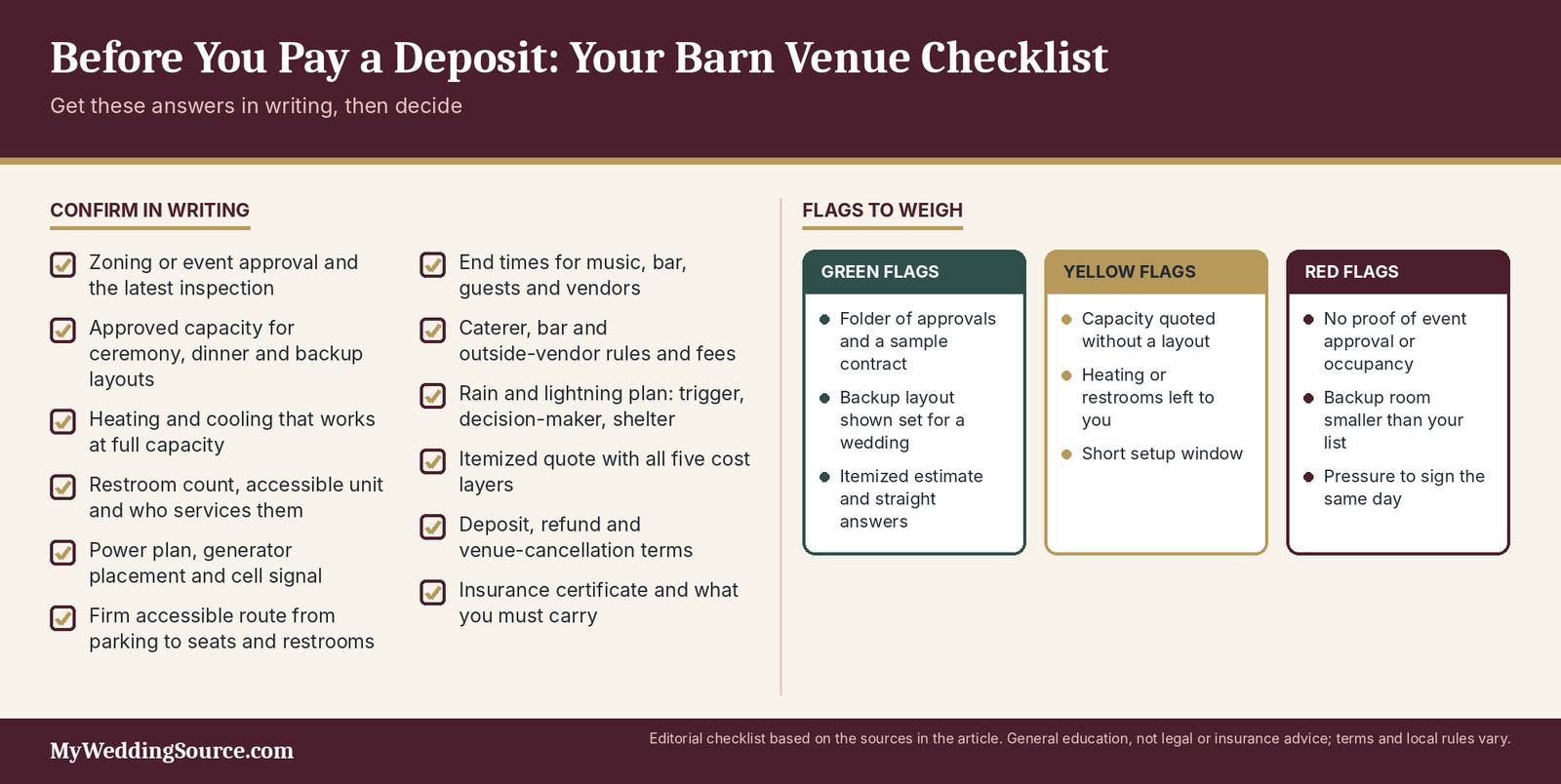
Frequently Asked Questions About Barn Wedding Venues
These are questions couples tend to ask when comparing barn wedding venues. The answers are general, and your venue’s written terms and your local rules come first.
Cost and booking questions
Are barn wedding venues cheaper than hotels or banquet halls?
Sometimes the rental fee is lower, but the total event cost depends on what the barn includes. Zola’s 2026 data describes barns and gardens as lower-cost venue options on average, while The Hustle’s 2024 reporting notes that barns are not necessarily cheaper than traditional venues. A barn that does not provide tables, restrooms, heating or cooling and staffing can end up costing as much as an all-in venue, as the illustrative comparison earlier in this guide shows. The reliable way to decide is to compare the full five-layer total for each finalist with the same guest count and date.
What does a barn rental fee usually include?
It varies widely, which is why the written proposal matters more than the website. Some barns include tables, chairs, linens, restrooms, a coordinator and heating or cooling, while others include only the building, the grounds and a set number of hours. The Knot’s venue data reports that 74 percent of respondents’ reception venues included rentals, 41 percent included catering and 7 percent were space only, but those are all venue types, not barns specifically. Ask for a line-by-line list of included items and note what must be rented separately.
How many guests can a barn hold?
From about 100 to over 1,000 depending on the property, according to the examples in The Knot’s barn venue guide, but your real number depends on layout, fire-code approval and what else goes in the room. The legal occupant load can be lower than a marketing figure, and a seated dinner with a dance floor needs more space than a standing reception. Ask for capacity in writing for each layout, including the rain-plan layout, and ask who set the approved limit.
Comfort, safety and legal questions
Is a barn wedding comfortable in summer and winter?
It can be, if the barn has real heating and cooling or you budget for rentals and plan the timeline around the weather. Barns can trap heat in summer and leak warmth in winter, and the CDC lists older adults, young children, pregnant people and people with chronic conditions as higher risk in heat and older adults and babies as higher risk in cold. Ask what equipment the barn has, whether it works at full capacity and what the venue does when temperatures are extreme. A shoulder-season date with a flexible plan for both warm and cool hours is often the easiest.
Do you need wedding insurance for a barn venue?
It depends on the venue’s requirements, your contract and how much money you would lose if the event were disrupted. Many venues require event liability coverage, some require liquor liability and cancellation coverage is optional and usually does not cover rain on its own, according to Zola’s insurance guide. Check whether an existing umbrella or homeowners policy already covers special events, and ask your insurance agent about your particular situation. This is general education rather than insurance advice.
How do you know a barn is legally allowed to host weddings?
Ask the venue to show its event or zoning approval, the most recent fire or building inspection or certificate of occupancy where applicable, its approved occupancy and its insurance certificate. Rules differ by state and county, so the venue and the local planning or fire office are the authorities, not an article. A venue that is organized will have a folder ready, and one that avoids the question is giving you useful information. If you are still unsure, you can call the county planning office to ask whether the property is approved for events.
Your Next Steps
You do not need to answer every question in this guide at once. The sequence below puts the most useful steps first, so you can narrow your list quickly and avoid paying a deposit before the risky questions are answered. Treat it as a short working plan you can adapt to your own timeline.
This week
Build a shortlist and request the documents
Choose two or three barns that fit your guest count, season and rough budget, and email each one with a request for its pricing sheet, sample contract, floor plan with capacity by layout, rain plan, vendor policy and proof of approvals. Note how fast and how clearly each venue responds. Eliminate any barn that cannot hold your list in a layout that works, even if it is lovely. If you want a wider comparison first, our wedding venues guide offers a process that applies to any venue type.
Run the five-layer cost comparison
Put each finalist into one table with the same guest count, hours and season, and fill in the five layers: sticker price, required extras, realistic extras, taxes and fees and failure cost. Add honest estimates for anything missing, such as restrooms, heating or cooling, tables and chairs, power or staffing. Then decide how much room your budget has for the gap between the cheapest and the most expensive total. If one barn is much cheaper because it excludes things, you will see it clearly on paper.
Before you pay a deposit
Confirm approvals, capacity and the rain plan in writing
Ask each finalist to confirm in an email that the property is approved for paid events, its occupant limit for your layout, the rain-plan trigger and backup layout and its heating and cooling plan. Ask for the end times for music, bar, guests and vendors. Ask who holds the permits and who pays if one is delayed or denied. If an answer is a promise instead of a document, ask when you can see the document.
Read the contract and check the insurance
Read the payment schedule, cancellation and refund terms, venue-cancellation protection, damage deposit, curfew and vendor rules, then compare them against the table in this guide. Ask the venue for its certificate of insurance and its requirements for you and your vendors, and talk to an insurance agent about cancellation, event liability and liquor coverage. Consider having an attorney review a large contract, particularly if the terms are unusual. Pay the deposit only after the answers you need are in writing.
Sources & methodology
- The Knot: The Average Wedding Cost, According to The Knot Data — 2026 Real Weddings Study: 10,474 U.S. couples married in 2025, average cost $34,200, 117 guests, $12,900 reception venue and $80 per person catering.
- The Knot: Average Cost of a Reception Venue — venue cost by year, guest count and state, what venues include (updated May 2026).
- The Knot: Barn Wedding Venues — barn venue types, capacity examples and heating and cooling examples (updated July 2025).
- Zola: How Much Does a Wedding Cost — 2026 average cost, venue and site fee range, catering average and the note on lower-cost barns and gardens (updated March 2026).
- Zola: Barn Wedding Venues — barn types, cons and possible need for bathroom trailers, heaters or fans.
- Zola: Wedding Insurance Guide — cancellation, liability and liquor coverage; rain and weather exclusions (updated February 2024).
- The Hustle: Weddings in barns and rustic venues — Knot survey figures on barn, farm and ranch receptions in 2009 and 2017, purpose-built barns (October 2024).
- MayFair Farms: venue cost blog — ballpark rental ranges and the blank-slate venue example (May 2026); a venue’s marketing blog used only as a rough estimate.
- Maryland State Fire Marshal: Inspection Guidelines for Wedding Barns — example of assembly occupancy, sprinkler, alarm, exit, candle and decor requirements for wedding barns (2015 Life Safety Code; file dated 2016).
- Kansas State Fire Marshal: Agricultural Venue Properties — example of occupancy classification, sprinklers for multi-level barns and variances.
- UF/IFAS Extension: Florida Agritourism Building and Fire Codes — example of exemption tiers by occupant count (August 2025).
- Kentucky Department of Agriculture: Special Events on the Farm — zoning, conditional use, building codes, health department, insurance and agritourism liability (revised June 2025).
- Ohio State University Farm Office: wedding barn court decisions — 2020 and 2022 Ohio appeals court rulings on event barns and agricultural zoning.
- Ohio State University Farm Office: Agritourism liability and risk management — farm insurance policies and agritourism coverage (May 2024).
- National Weather Service: Lightning Safety Outdoors — safe buildings, tents offer no protection and the 30-minute rule.
- National Weather Service: Heat Index — full sunshine can raise heat index values by up to 15°F.
- CDC: Heat and Your Health — higher-risk groups, hydration, shade and fan guidance.
- CDC: Preventing Cold-Related Illness — layering, risk groups and warning signs.
- CDC: Preventing Tick Bites — repellents, seasonal activity and post-event checks.
- CDC: Preventing Mosquito Bites — repellents, standing water and screens.
- ACAAI: Seasonal Allergies — tree, grass and ragweed pollen seasons and timing tips.
- USDA: Food safety and the two-hour rule — two-hour rule, one hour above 90°F and the 40°F to 140°F danger zone.
- U.S. Access Board: Floor and Ground Surfaces — stable, firm and slip-resistant surfaces, gravel and level changes.
- ADA.gov: Title III Primer — public accommodations, readily achievable barrier removal and grandfather provisions.
- Satellite Industries: Portable restroom to guest ratios — supplier guidance on restroom counts, accessible units and trailers (industry guidance, not a legal standard).
This article separates four kinds of information. The Knot and Zola figures are survey and platform findings for couples married in 2025 and surveyed in 2026, with the Knot barn share figure dating from 2017 data reported in 2024; fire, zoning and court details are verified examples from the agencies and publications named and are not a rule for your area; the $14,800 and $13,000 comparisons, the restroom calculation and the vendor-blog price ranges are illustrative or estimated arithmetic, not quotes; and the advice on questions, red flags and comparisons is editorial judgment. We did not find a reliable national dataset on the average price of barn venues specifically, so we do not state one. Contracts, insurance, zoning and building rules are general education, and terms and state laws vary, so confirm details with your venue, local officials, an insurance agent and, where needed, an attorney.
Freshness note: sources were read in October 2026. Recheck The Knot and Zola cost data when their next annual studies publish (typically early in the year), recheck venue-fee ranges and rental prices before booking and verify every approval, occupancy limit, curfew and fee directly with the venue and local authorities for your date, since codes, editions and local rules change.