

A wedding registry checklist works best as a sequence of nine short jobs, from choosing a start date to filing your last thank-you note, because every decision downstream (how many items, which stores, whether to add a cash fund) gets easier once the one before it is settled.
Most couples open a registry builder the way they open a new streaming service: curious, a little excited, and with no plan for what comes next. Forty minutes later there are 60 items in the cart, three tabs from three different stores, a half-written fund description, and a nagging question about whether a guest who wants to spend $35 can find anything to buy. The registry is not hard; it simply has a lot of small moving parts, and they have deadlines that arrive at different times. Some fall before the wedding (when to publish, when to refill), and some fall months after it (completion discounts, return windows, thank-you notes).
This guide is the process version. It walks the registry from first decision to final thank-you in the order the jobs actually come up, with the timing, the numbers and the questions to ask at each step. If what you need is inspiration for what to put on the list, our companion piece on wedding registry ideas covers categories, a worked price-tier example and charity options, so this article does not repeat it. For card fees, payout delays and the fine print behind cash funds, see our guide to wedding registry hidden fees. Where a figure comes from a survey, a retailer page or our own arithmetic, the text says which.
Nothing here assumes that parents are paying, that your wedding is formal, or that a long registry is a better one. A couple eloping with a reception dinner might finish the whole checklist in an evening with 25 items and one fund; a couple hosting 200 guests across an engagement party, a shower and a wedding will use every step. Pick the steps that match your situation and skip the rest without guilt.
When Should You Start a Wedding Registry?
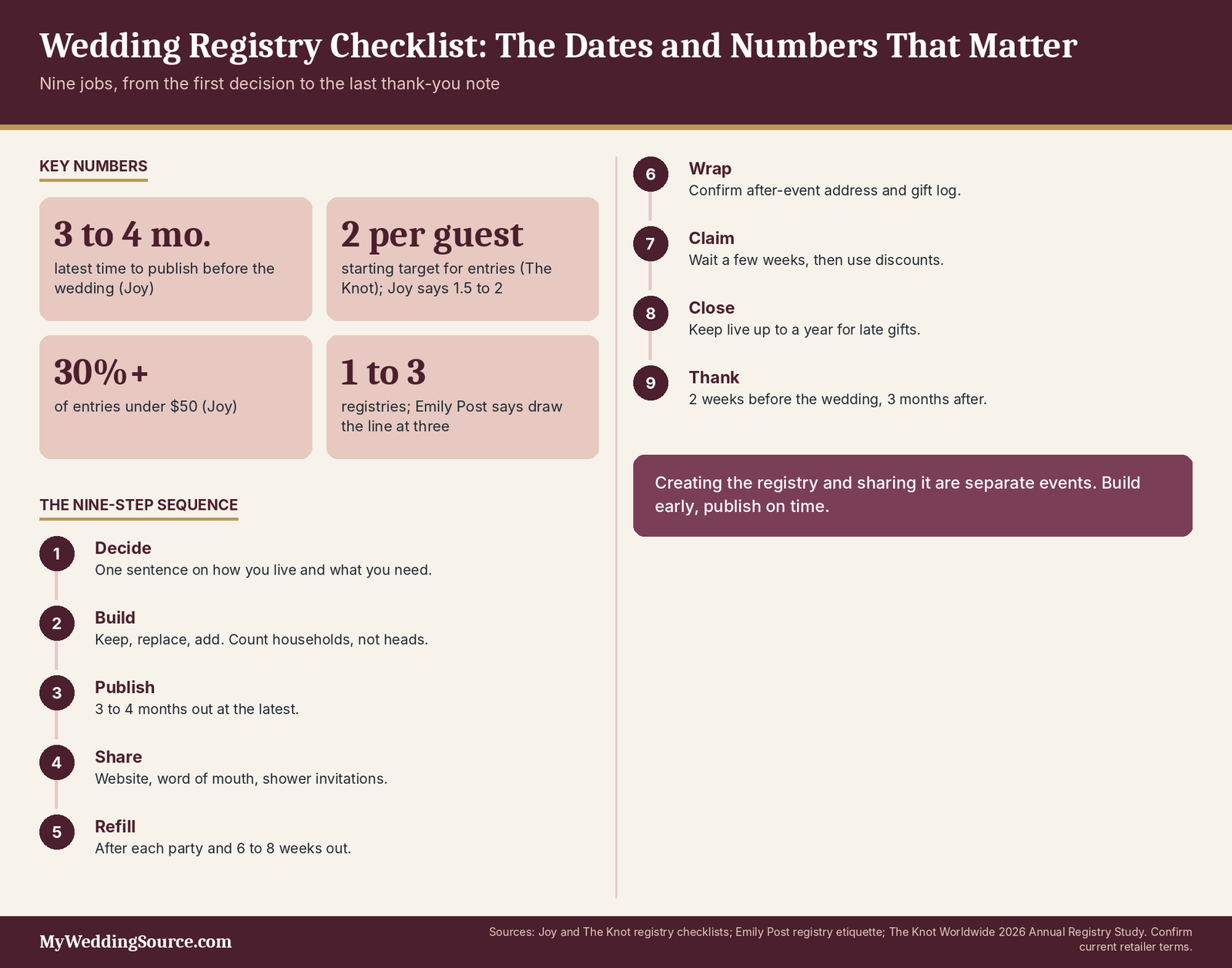
The honest answer is “earlier than you think, and published later than you think.” Creating the registry and sharing it are separate events, and the checklist works better when you treat them that way. This section sorts out the sources that disagree about timing, then lays the whole sequence out as a calendar you can copy into your phone.
What is the right start date?
When should you create the registry?
Shortly after you are engaged, according to The Knot’s registry etiquette guidance, which says the registry should be maintained from the time you are engaged until you walk down the aisle. Joy’s registry checklist gives a later outer limit: create it three to four months before the wedding and fill in the core kitchen, bedding and bath items first. The two sources are not really in conflict, because one describes the earliest sensible moment and the other the latest comfortable one. In our editorial view, the deciding factor is whether anyone is hosting a party. An engagement party or shower host needs a link, and a guest at either event may well want to bring a gift, so a registry that exists only in your head can quietly cost you gifts you would have enjoyed. Building a first draft the month after the proposal also spreads the work out, which matters more than it sounds when the same evenings are going to venue tours and tastings.
What actually triggers the deadline?
Four events decide how late is too late: the first party where guests might bring gifts, your save-the-dates, your invitations, and the date the first shipment could arrive. Joy suggests sharing the link on your wedding website alongside the save-the-dates, which for many couples lands well ahead of the three-to-four-month mark. Keep in mind that a new registry is not always visible instantly. The Knot’s registry help page says a new registry or a profile change can take up to 72 hours to appear online, and Target’s registry page notes that a new registry can take up to 24 hours to show on The Knot. Those delays are short, but they are long enough to be a problem if you create a registry at 11 p.m. the night before a shower and tell the host to look it up in the morning. Our guide to the first 30 days after getting engaged covers the holiday-season version of this, when family members ask about gifts before you have a date.
What does the full timeline look like?
What belongs in each phase?
The table below combines the published timing from The Knot and Joy with our own judgment about where the work naturally falls. Treat the months as anchors rather than rules, because a short engagement compresses everything and a long one stretches it. If your wedding is eight months away, for example, “draft” and “build” can happen in the same week.
| Phase | Typical timing | Job | Source |
|---|---|---|---|
| 1. Decide | Shortly after engagement | Write your registry goal; choose categories | Editorial; The Knot |
| 2. Build | 6+ months out if parties are planned | Draft the list and price mix; pick 1 to 3 stores | Editorial; Joy |
| 3. Publish | 3 to 4 months out at the latest | Go live; add link to your website | Joy |
| 4. Share | With save-the-dates and shower invitations | Tell hosts, wedding party, close family | Joy; Emily Post |
| 5. Refill | After each party; 6 to 8 weeks out | Replace purchased items; fill gaps | Joy; The Knot |
| 6. Wrap | Wedding week | Confirm shipping address and tracker | Editorial |
| 7. Claim | After the wedding | Wait a few weeks, then use discounts | The Knot |
| 8. Close | Up to a year after | Archive only after late gifts stop | The Knot |
| 9. Thank | Ongoing; 2 weeks / 3 months | Log gifts; send notes | The Knot; Joy |
What if the wedding is closer than three months?
Compress the sequence rather than skipping it. Spend one evening on phase 1 (a single sentence about how you live), a second on the list itself, and a third on the platform questions in the platform section below, then publish and tell your wedding party the same day. A shorter lead time means two practical adjustments: choose retailers with quick, reliable shipping and clear return terms, because there is little room to fix a mistake, and weight your list toward items that ship from stock rather than made-to-order furniture. If you are a few weeks out, a smaller list with a cash fund and a clearly worded note on your website is a legitimate choice, and none of the etiquette pages we read treats a late registry as a breach of manners. The broader sequence of tasks around it lives in our wedding planning checklist.
How Do You Decide What Belongs on the List?
Before you add a single item, spend an hour on a decision that most checklists skip: what does your home actually need? The categories you register for matter less than the honesty of this audit, because a list built from an audit gets used, and a list built from browsing gets returned. This section covers the audit itself, the category checklist, and the quantities that tend to trip couples up.
How do you audit what you own, need and want?
What is the keep, replace, add method?
Walk through each room and sort what you see into three piles: keep (works, you like it), replace (worn, broken or mismatched) and add (you do not have it, or you want to upgrade). Only the second and third piles belong on a registry. This is an editorial method rather than a published rule, but it lines up with Joy’s advice to remove items you already own, personal items and duplicates, and to avoid trendy pieces or ones with no lower-priced version. Couples who already live together usually end up with a short “replace” pile and a thoughtful “add” pile, which is a good reason to lean on funds and experiences for the rest of the list. A concrete example: if your skillet has a scratched coating and your towels are a decade old, those are replacements guests can understand at a glance, while a third air fryer is a decision you should talk yourselves out of before anyone else has to buy it.
How do two households become one list?
Do the audit together, in the same room, with both partners holding the same list. Zola’s etiquette checklist recommends building the registry together so it reflects both partners, and the practical reason is duplicates: two people each owning a good chef’s knife and a decent blender is how a couple ends up with four of something. Merge the two kitchens on paper first, decide which version of each tool survives, and register only for the gaps and upgrades. If one partner is moving into the other’s home, agree before you start on which pieces of existing furniture and cookware stay, since that decision shapes whether you need a registry full of replacements or a short one full of extras. Treat disagreements about taste as a feature, not a failure: a list that includes one thing each partner is excited about will read as warm to guests.
Which categories belong on the checklist?
What do couples register for most often?
The Knot’s 2026 Annual Registry Study, a survey of 1,759 engaged and married members with wedding dates from April 2025 onward, reports that 82% of engaged couples created a registry. Among registered items, bakeware appeared on 79% of lists, cookware on 75%, bath items on 73% and bedding on 69%, followed by storage and organization (34%), grilling and outdoor entertaining (32%), electronics (31%) and luggage and travel gear (30%). A separate Zola survey of 555 active registry users, reported on Zola’s registry checklist page, found a similar pattern, with kitchen and cookware at 78%, bedding and bath linens at 63%, and experiences at 36%. Both surveys come from companies that sell registries, so read them as a description of common practice and not as a recommendation. The useful signal is that the four home basics are the base of almost every list, and everything else is optional.
Which items do couples overlook?
The Knot’s list of forgotten registry items includes a vacuum, a tool set, a coffee maker, a Dutch oven, food storage containers, a garbage can, picture frames, suitcases, pet supplies, cleaning supplies and yard care supplies. What the overlooked items have in common is that they are unglamorous, which is exactly why they are useful: nobody is tempted to register for a garbage can in the first excited hour, and nearly every home needs one. Add a handful of these everyday items in the under-$50 tier, where they give guests an easy and practical choice. Check the same list against your own routines, including hobbies, pets and outdoor space, because a gardener’s registry and a renter’s registry will look different. If you have limited storage, The Knot suggests favoring multi-use pieces, such as a multicooker, over single-purpose gadgets.
How many of each item do you need?
What do the published quantity guides say?
Quantity advice varies a little from source to source, which is a reason to treat the numbers as a starting range and then compare them to how many people you actually host. The table below sets Joy’s and The Knot’s figures side by side. Where only one source gives a number, the other cell is blank rather than guessed.
| Item | Joy | The Knot |
|---|---|---|
| Dinner plates | 8 to 12 | 6 to 12 |
| Salad or dessert plates | 8 to 12 | 6 to 12 |
| Mugs | 6 to 8 | 6 to 8 |
| Water or juice glasses | 12 | 12 |
| Sheet sets per bed | 2 to 3 | 2 to 3 |
| Bath towels | 6 to 8 | 6 minimum |
| Hand towels | 4 to 6 | 6 minimum |
| Washcloths | 6 to 8 | 6 minimum |
| Flatware | 5-piece sets, 6 to 12 |
How should you adjust the quantities for your own home?
Start from the number of people at your table on an ordinary night and the number you realistically host a few times a year, and then pick the higher figure within the range only if you will use it. A couple who hosts a holiday meal for eight can justify 8 to 12 place settings; a couple who has never hosted more than two can stop at six and register for serving pieces instead. Registering for multiples of one item, such as six towels in one color, also raises a question about how guests buy them: a guest can purchase one towel set at $40, so you may need to list the item with a quantity of several, or as separate entries, so it does not disappear after the first purchase. Check how each registry handles quantity before you set the number, and test it by viewing your own list as a guest would. Matching the list to your style and season is a separate question, and this section stays with the mechanics.
How Many Items Should You Register For, and at What Prices?
This is the step where couples want a single number, and the published guidance gives a range instead. The good news is that the range is forgiving: a list that is a little long costs you nothing, while a list that is too short and too expensive is the one that frustrates guests. This section turns the sources into a working method, shows it for three different guest counts, and explains how to test your price mix before you publish.
How do you calculate the number of entries?
Which formula should you use?
Use the simplest published formula first and refine it with your household count. The Knot’s registry checklist says to multiply your guest list by two and add a few extras, and its companion guide gives ranges by guest count, for example 100 to 150 entries for 51 to 100 guests. Joy recommends 1.5 to 2 items per guest, which works out to roughly 150 to 200 items for 100 guests. The household method is an editorial refinement: couples and families usually give one gift together, so multiply the number of gift-giving households by two instead. Pick whichever number you will actually finish, because a list built to a smaller target and then refilled works better than an ambitious one abandoned at 70% complete.
What does it look like for different guest counts?
The scenarios below are illustrative, not quotes or averages. We assume that about 60% to 65% of invited guests belong to a couple or family unit that will give one gift, which is an editorial assumption rather than a survey result, so replace it with your own count from the guest list. The Knot’s ranges and Joy’s per-guest figure are from the sources linked above.
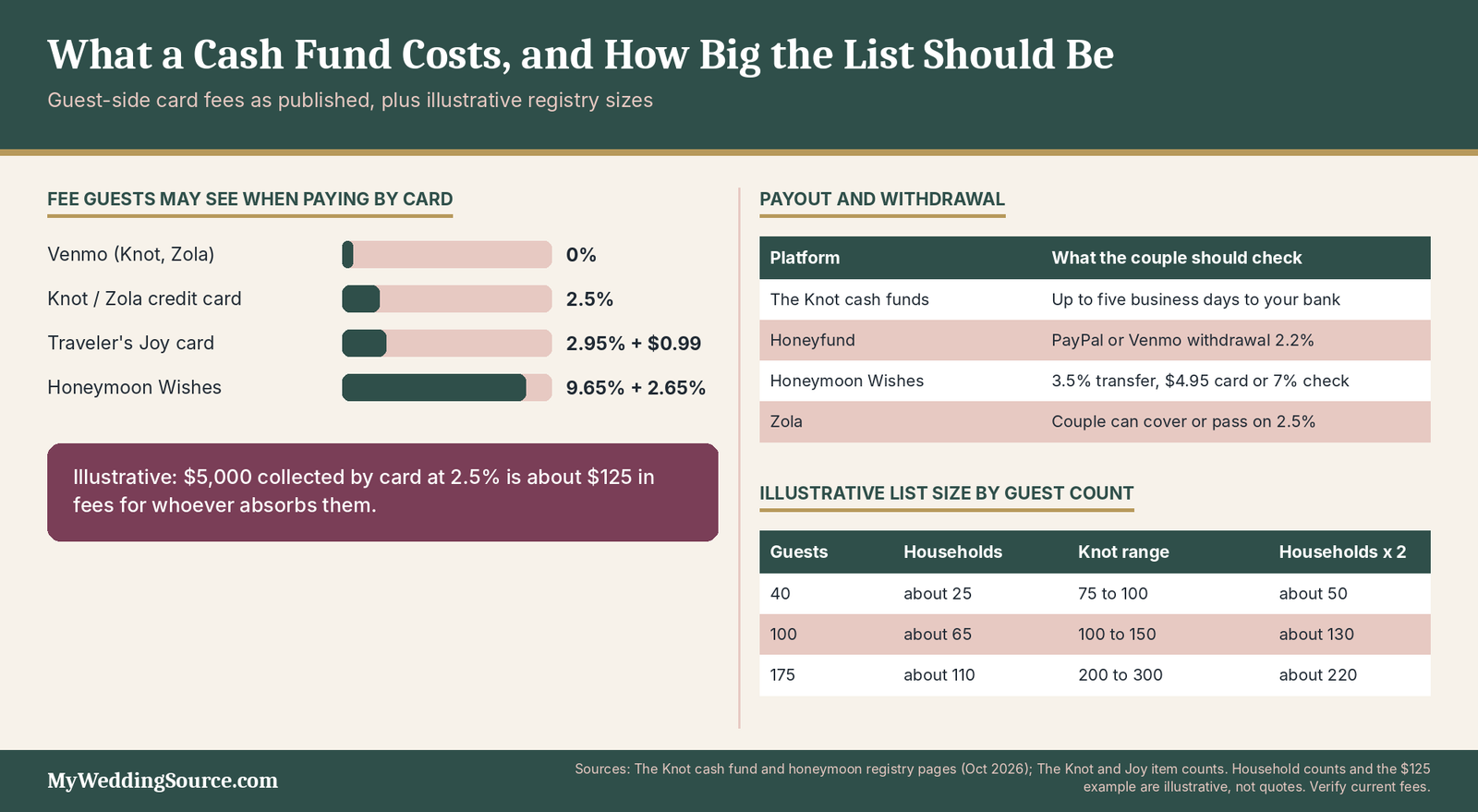
| Guests | Assumed households | The Knot range | Joy (1.5 to 2 per guest) | Households x 2 |
|---|---|---|---|---|
| 40 | about 25 | 75 to 100 | 60 to 80 | about 50 |
| 100 | about 65 | 100 to 150 | 150 to 200 | about 130 |
| 175 | about 110 | 200 to 300 | 263 to 350 | about 220 |
For the 40-guest example, a draft of 60 to 75 entries is a sensible first target: it sits near the bottom of The Knot’s range and above the household figure, which leaves room for engagement-party and shower shoppers who are not on the wedding guest list. The 100-guest couple can aim for about 130 and let the list grow toward 150 as items sell. The 175-guest couple faces a different problem, which is effort. A list of 220 entries is a lot of clicks, so lean on bundles, sets and a couple of funds to keep the build manageable. Our companion registry-ideas article includes a full 130-entry worked example with tier values if you want to see the arithmetic.
How should you spread the prices?
What mix do the sources recommend?
The two main published mixes are close enough to be useful together. The Knot’s guidance suggests roughly 42% of items under $50, 30% from $50 to $99, 16% from $100 to $149 and 12% at $150 or more, while Joy’s checklist asks for at least 30% under $50, about 40% from $50 to $150 and the remaining 30% or so above $150. Emily Post’s registry advice goes further at the low end, saying that even items in the $1 to $10 range are welcome and that too many higher-priced items should be avoided. In plain terms, the middle of your list should be affordable, not luxurious. As a quick conversion for a list of 100 entries, The Knot’s mix means about 42 under $50, 30 at $50 to $99, 16 at $100 to $149 and 12 at $150 or more.
How do you test your mix before you publish?
Run three quick checks. First, sort the list by price and count how many entries cost under $50; if that number is below 30% of the total, add inexpensive everyday items such as dish towels, a cutting board or a set of mixing bowls. Second, look at the top of the list: a few generous items are fine, but if more than about a quarter of your entries cost $150 or more, shift some into group-gift form or remove them. Third, add up the list and compare it to what guests are likely to spend. The Knot’s guest spending article reports an average of $150 per wedding gift in its most recent guest study (the page does not state the year or the sample size), with about 40% of guests giving cash, 50% a physical gift and 10% a gift card. A list worth somewhat more than your guests’ likely spending leaves real choice, while a list worth several times that amount is a sign you have priced it for a different audience.
What about big-ticket items and group gifts?
How do guests chip in on something expensive?
Many registries let guests combine contributions. Crate & Barrel’s registry FAQ describes a group gift option in which you mark an item as a group gift, guests enter a dollar amount, and the contributions are added to a gift card sent to you to spend on that item, usable at Crate & Barrel and CB2. The mechanics differ by platform, and the key question is what happens if the item is only partly funded, so ask before you list a $900 piece. The Knot’s etiquette article for guests also suggests that friends pool funds for a pricey item, which is a reminder that group gifting is a normal and welcome habit. Keep the number of group-gift items small, perhaps two to four, so they feel like an invitation rather than a fundraiser.
When should you add more items?
Add items whenever the list starts to thin out, and plan specific check-ins. The Knot’s guidance quotes one expert suggesting a review after major milestones, namely the engagement party, the shower and a few weeks before the wedding, and Joy recommends a full review six to eight weeks out. Joy also warns that guests tend to buy early and that a depleted list discourages later shoppers. Zola adds a useful counterweight, noting that there is no rule about when to stop adding but that later additions give guests less time to see them. So the practical rule is: refill the under-$50 and $50 to $99 tiers first, since those sell fastest, and avoid making large changes in the final two weeks. A 10-minute refill after each party is worth more than a three-hour rebuild a month later.
Which Stores and Platforms Should You Register With?
The store decision looks like a branding choice, but it is really a logistics choice: where gifts ship, how returns work, how long the registry stays open and what happens when two registries need to stay in sync. This section covers how many registries to keep, how the major platforms handle the practical details, and a short list of questions to ask before you commit.
How many registries should you have?
What do etiquette sources say about the number?
Keep it to one to three. Emily Post’s registry etiquette page says you can have more than one but advises you to draw the line at three, and Joy’s checklist suggests two to three registry sources: one general store, one specialty store and one universal platform. The reasoning is guest-friendliness more than rules. Each additional registry is another site for a guest to find, another set of return policies for you to remember and another place where a duplicate can slip in. Emily Post also suggests including at least one traditional option, and notes that a brick-and-mortar registry helps guests who prefer shopping in person, which matters for older relatives who would rather hold the item than click a link.
How do universal registries work with store registries?
A universal registry lets you add items from many stores to one page, and a platform-hosted registry can also display partner-store registries alongside it. Zola’s registry FAQ says that gifts from its universal store are bought through Zola, items from other stores can send the guest to that store’s website, or you can receive the cash equivalent and buy the item yourself. The Knot’s help page lists ten partner registries, including Amazon, Anthropologie, Belk, Bloomingdale’s, Crate & Barrel, Etsy, GoFundMe, Sur La Table, Target and Traveler’s Joy, while Target’s page says The Knot lists more than 20 retailers, so the network is evolving and you should check the current list. Target adds a specific caution: products that are unavailable or in-store only will not show on The Knot’s registry. The simplest sync test is to add one item, view the registry as a guest and confirm that it shows up correctly.
What should you compare before you choose?
Which logistics differ between platforms?
The table below compares four platforms on the details that tend to surprise couples later. It reflects what each platform’s own page or The Knot’s help page said in October 2026, and a blank means we did not find the point stated. Completion discount percentages are compared in the registry-ideas article, and fee details are in the hidden-fees guide, so this table sticks to shipping, returns and registry life.
| Platform | Shipping and addresses | Returns and exchanges | Registry life and sync |
|---|---|---|---|
| Zola | You choose when each physical gift ships | Exchange for Zola credit before shipping; guests are not notified | Gift Tracker dashboard handles returns |
| The Knot | Shipping address set in account | Separate returns article (not reviewed) | Visible until deleted; new registry up to 72 hours |
| Target | Address entered at setup | Up to one year after the wedding, no receipt, per Target’s page | Changes sync to The Knot same day; new registry up to 24 hours |
| Crate & Barrel | Separate “before” and “after” event addresses | Staff will help return or exchange duplicates | Active 18 months after the event; updates within 15 minutes |
What questions should you ask before you commit?
Write the answers in one document, one row per platform, before you publish. The shipping question deserves extra attention: The Knot notes that some stores hold purchased gifts and ship them after the wedding, while others send each order as it is placed, which affects whether packages pile up while you are also moving or traveling. If you are changing addresses between the engagement and the wedding, a platform with separate before and after addresses removes one common source of lost parcels. For the pre-wedding tasks that surround this decision, our month-by-month wedding timeline shows where registry work sits among venue, vendor and invitation deadlines.
Money on a registry is the part with the most fine print and the most feelings. Guests may love the idea or hesitate over it, platforms charge for it in different ways, and two partners have to manage one set of accounts. This section walks through setting up a fund, comparing what it costs, running a registry as a pair, and wording and recording everything so it stays graceful.
How do you set up a cash or honeymoon fund?
What are the setup steps?
The steps are similar on most platforms, and The Knot’s cash fund walkthrough shows a typical version: create a free account, choose “Add cash funds”, pick a suggested fund or build a custom one, name it, write a short note for guests, set a goal and contribution amounts, add a photo and link your bank account. The Knot says there is no limit on the number of funds, that you can hide the goal number from guests, and that you receive an email for each contribution and can see who gave what. Name each fund after something specific, such as “New sofa” or “Two nights in Asheville”, because a named fund reads as a plan and gives the guest a reason to choose an amount. On the trend side, The Knot’s 2026 study found that 75% of couples include a cash fund and 41% say cash is the gift they want most; among those planning uses, 31% name the honeymoon, 18% general savings and 4% a home down payment. Zola’s First Look Report, as cited on Zola’s checklist page, says 87% of its couples have or plan a cash fund, which shows how common the practice is without telling you whether it suits your guests.
What do the fees and payouts look like?
Fees depend on the platform and on who pays them, and The Knot’s honeymoon registry roundup is the clearest side-by-side we found. It is published by a company that offers its own cash funds and ranks them first, so treat it as a starting point and confirm each platform’s current terms. The table below pulls out the numbers.
| Platform | Guest pays | Couple pays | Payout notes |
|---|---|---|---|
| The Knot cash funds | Venmo: $0; credit card: 2.5% | Nothing taken by The Knot | Up to five business days to your bank |
| Zola | Venmo: $0; credit card: 2.5% | Can cover or pass on the 2.5% | Timing not stated on page read |
| Traveler’s Joy | Card: 2.95% + $0.99; check or cash: none | No sign-up fees | Bank check or PayPal; you choose when |
| Honeyfund | No guest fees listed | PayPal or Venmo: 2.2%; bank deposits: Stripe fees | Prepaid card or digital gift card: no fee |
| Honeymoon Wishes | 9.65% service plus 2.65% card processing | 3.5% transfer, $4.95 prepaid card or 7% check | Requires a specific itinerary |
Two choices follow from the table. If your guests skew older and prefer checks or cash, a platform that supports those without a fee is worth more than a slightly lower card rate. If most contributions will arrive by Venmo, the 2.5% card fee applies to fewer gifts than the headline suggests, and The Knot’s own 2026 study reports that 89% of couples rate ease of use for guests as the most important factor in a cash fund. Our guide to registry hidden fees walks through withdrawal charges and payout delays in more detail.
How do two partners (and hosts) share one registry?
Who manages the account?
Decide on one primary account holder and one co-registrant, and write down who receives which notifications. Crate & Barrel’s FAQ notes that the registrant must provide contact and shipping information but the co-registrant does not, which shows how platforms assign responsibility. The partner who handles the household email and the packages should usually be the primary contact, even if the other partner makes more of the product choices. Both partners should be able to log in and view the tracker, because a registry only one person can see tends to fall behind during busy weeks. Also set up the account with an email address you will still use a year from now, since completion codes and return confirmations arrive there long after the wedding.
Should showers and engagement parties have their own lists?
Sometimes, and it is worth a short decision. Emily Post’s registry etiquette page says a separate, lower-priced shower registry can make sense, especially for a themed shower, and that preprinted registry enclosures are fine with shower invitations. The advantage is clarity: a themed shower list of low-priced items (say $15 to $60, an illustrative range) stops guests at that party from choosing from a catalog that runs into the hundreds. The cost is more maintenance, and a second registry counts against the three-registry limit. If you have only one party, skip the extra list and mark a few under-$50 entries as shower-friendly in your notes to the host. Shower hosts are often the people most likely to ask for the link first, so give it to them as soon as the registry is live.
How should you word a fund and keep records?
What wording keeps a fund gracious?
Lead with the goal and treat the fund as one option among several, not as a demand. The Knot’s honeymoon fund wording guide says a single sentence works where space is tight and that fuller explanations belong on a website or a separate card. Something like “We have a well-stocked kitchen, so we are saving toward a first trip together; a small registry and a travel fund are on our website” does the job and leaves guests free to choose. Note that sources differ on placement: The Knot’s wording examples include invitation-based ones, while Emily Post advises keeping registry details off the wedding invitation and its enclosures. In our editorial view, the safest default is to keep wording on your wedding website and in conversation, and to use the shower invitation for registry details if you have a shower.
What records and taxes should you think about?
Keep a simple log of every cash gift: who gave it, when and how much. The log helps with thank-you notes and with any question later. On taxes, this is general education rather than tax advice: the IRS gift tax FAQ says the donor is generally responsible for paying federal gift tax and lists a 2026 annual exclusion of $19,000 per recipient, far above typical guest gifts. A relative planning a very large gift, such as a down-payment contribution, should check with their own tax professional. If you are listing a charity in your registry, verify it with the IRS Tax Exempt Organization Search, which shows whether an organization is eligible to receive tax-deductible contributions.
Publishing the registry is the moment it becomes social, and that is where most etiquette worries live. The rules are looser than they are often presented, and the major sources disagree on a few points, so the useful approach is to know the conservative default and then decide how far to stray. This section covers where the link goes, who gets it first and what to do when guests go off-list.
Where should the registry link go?
Which channels do etiquette sources approve?
Emily Post says to share registry information by word of mouth and on your wedding website, and to keep it off the wedding invitation and enclosures. The same page says not to share it on social media, even when an online registry suggests it, and that registry enclosures with a shower invitation are fine because showers are for giving gifts. The Knot’s etiquette article takes a slightly looser line: it recommends sharing through your wedding website, warns against listing the registry on formal invitations, and suggests an information insert with your website link in the invitation envelope. The practical overlap is the wedding website, which both sources endorse. For the detail on what a wedding site should and should not reveal, see our guide to wedding website privacy, and for wording on the cards themselves, the wedding invitation etiquette article covers enclosures.
Who should get the link first?
Tell the people guests will ask, namely the wedding party, close family and anyone hosting a party. Emily Post’s guidance is explicit that guests will ask these people where you are registered, so a one-line message with the link saves everyone from guessing. Send it by text or email, not a group post, and include a sentence that gifts are never expected so the message reads as information, not instruction. If a host asks whether to include the registry on a shower invitation, the answer from the sources is yes. A short note to those few people also gives you a reason to test the link on a phone before the wider group sees it.
What happens when guests go off the list?
How do you respond to off-registry gifts?
Accept them with thanks and without comment. Emily Post’s registry advice states that you do not have to buy from the registry, and the etiquette page notes that the choice of gift is always the giver’s. The Knot’s guidance suggests that a guest who skips the registry may pick a gift card to a registered store, a local restaurant or cash with a note, because those are lower-risk choices than guessing at taste. If an off-list gift is a duplicate or not your style, save the gift receipt if there is one and ask the store about exchanges; do not mention the swap to the giver unless they ask. A good test for yourself is whether the thank-you note could be read aloud to the giver: if it can, you have said the right thing.
What if guests say your list is too expensive, or too cheap?
Respond by adjusting the list, not by defending it. The Knot notes that couples often add items closer to the wedding, and that guests are told to check back a few weeks before the event, which is consistent with Joy’s six-to-eight-week review. If you hear that the list feels pricey, add a handful of items under $50 and a few under $25. If you hear it feels thin, add mid-range pieces and a group gift or two. Guest counts also shape the answer, and if your invitation list is still moving, our piece on real guest-list problems helps you settle a headcount before you finalize the registry size.
Which Registry Mistakes Cost the Most, and How Do You Fix Them?
Registry mistakes are rarely dramatic. They are small friction points, such as an item nobody can afford, a package sent to an old address or a discount that expired in the spam folder. This section sorts them by when they happen, so you can catch the build-stage mistakes before you publish and the maintenance mistakes while there is still time to fix them.
Which mistakes happen while you build the list?
What goes wrong in the list itself?
The most common problems are a narrow price range, items chosen on impulse and categories that do not match the home. Joy’s checklist advises removing items you already own, personal items and duplicates, and avoiding trendy pieces or ones with no lower-priced alternative. Zola’s etiquette checklist adds a practical reason to research items before you add them: returns and exchanges cost time and money. The Knot’s checklist makes a related point about outdoor items, suggesting you check the area’s measurements and any HOA restrictions before adding patio furniture or a fire pit. A good habit is to add every item to a “maybe” group for a day, then promote only the ones you can picture in use, which weeds out roughly the impulse purchases you would have returned. If you are tempted by personalized or engraved pieces, which Zola’s tips suggest for a personal touch, ask the store about its return rules first, since personalized goods are often harder to return (an editorial caution, so confirm with the retailer).
What goes wrong with setup and logistics?
Setup mistakes include too many registries, a wrong or outdated shipping address, a registry that does not sync the way you expected and an account tied to an email you rarely check. Emily Post’s advice to stop at three registries is partly a guard against exactly this. Test the guest view of each registry on your phone, confirm that items from partner stores display correctly, and check the shipping option before you publish, because Target’s page notes that unavailable and in-store-only products will not show on The Knot’s registry. Make sure the address on the account is one where you will actually receive packages, and if you are moving between engagement and wedding, set the after-event address now if the platform allows it. Finally, give yourself a way to see all the registries in one place: a single note listing each store, login email and link takes five minutes and prevents several awkward searches later.
Which mistakes happen after you publish?
What happens when you let the list go stale?
A registry that is full at publish and half empty at week six is a registry that is quietly steering guests toward cash or off-list guesses. Joy’s guidance is to review the registry six to eight weeks before the wedding and add replacements for purchased items, noting that guests buy early and a depleted list discourages later shoppers. The Knot’s guidance recommends checking after major milestones. Set a standing 10-minute check after each party and each batch of invitations going out, and refill the lower tiers each time. If something popular sells out, add two similar items at nearby prices instead of one, because a guest who finds an empty tier usually leaves rather than moves up.
What happens when you close the registry too early?
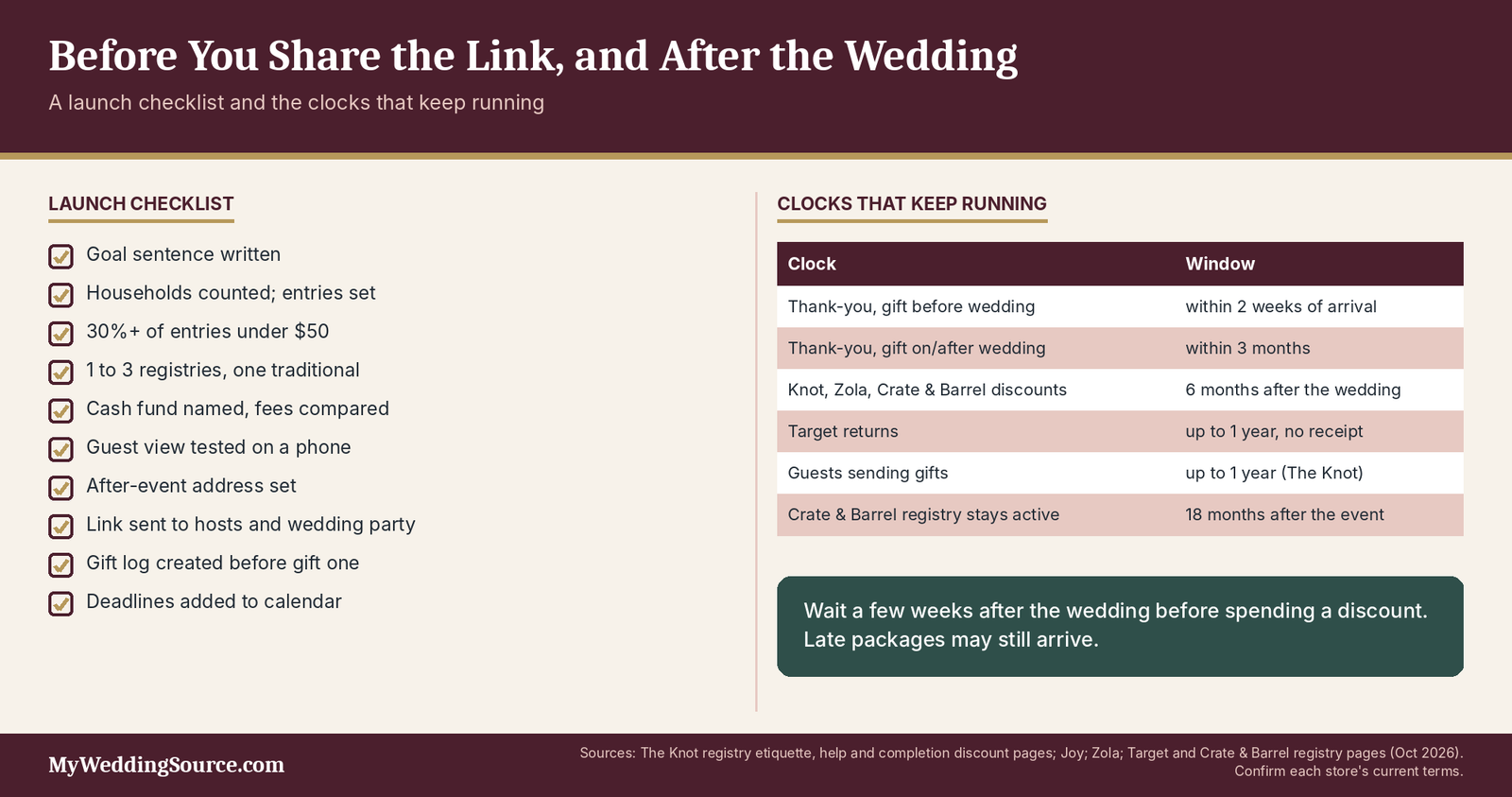
You miss late gifts and the discount that comes with them. The Knot’s registry help page advises waiting until a year after your wedding date to take the registry down, since guests have up to a year to send a present. Crate & Barrel’s FAQ says its registries stay active for 18 months after the event date, which gives a sense of how retailers treat the period. A registry that disappears at month two leaves a late guest holding a link that no longer works, and it also removes your own shopping list for the completion discount. Archive the registry only after your thank-you notes are finished and the discount windows have closed, which in most cases means keeping it live for six months to a year.
What Happens After the Wedding: Discounts, Returns and Thank-You Tracking?
The registry does not end at the reception, and the weeks after it are where deadlines pile up. Discounts expire in months, returns have windows, and thank-you notes have an etiquette clock that runs alongside both. This section gives you a post-wedding calendar, explains how returns and duplicates work, and shows how to run a gift log so nobody is missed.
How should you use the registry once the wedding is over?
When do you use the completion discount?
Wait a few weeks, then use it before the window closes. The Knot’s completion discount article says to hold off briefly because more packages may still arrive, and it notes that guests traditionally have up to a year to send a gift. The terms differ by retailer: The Knot’s own store offers 20% on leftover items for six months, usable once, and requires you to set your wedding date, have added at least one gift 45 days before you redeem, and have at least one gift purchased by a guest before the wedding. Zola offers 20% for six months and says it can be used multiple times, Crate & Barrel offers 15% for six months through a completion card that can be used more than once, and Target offers 15%. A calendar entry on the day the discount opens, and another a month before it closes, is the easiest insurance.
| When | What to do | Why it matters |
|---|---|---|
| Week 1 | Switch to your “after” address; collect cards | Keeps packages and cards from getting lost |
| Weeks 2 to 4 | Log every gift; send first notes | Notes stay manageable in small batches |
| Months 1 to 2 | Build a “second list” from unsold items | Gives the discount a purpose |
| By month 3 | Finish thank-you notes | The Knot and Joy: within three months |
| Months 4 to 5 | Place discount orders | Windows at several stores close at six months |
| Month 6 | Confirm discounts were used | Many windows end here |
| Up to month 12 | Keep registry live for late gifts; use return windows | Guests have up to a year; Target returns run a year |
| After month 12 | Archive the registry | The Knot advises waiting a year |
How do returns and duplicates work?
Rules differ, so read each store’s policy page before you list anything you are unsure about. Zola says you can exchange a physical gift for Zola credit before it ships and the guest is not notified, with returns handled through the Gift Tracker. Target’s registry page says registry gifts can be returned or exchanged up to a year after the wedding, no receipt needed. Crate & Barrel’s FAQ says its team will help return or exchange a duplicate purchase and points to a separate returns policy. Because refunds can arrive as store credit instead of cash, plan the return as a trade into something you want from that store, and keep any gift receipts that arrive in cards. A quick rule: return duplicates inside the first month, while the guest’s memory of the gift and the store’s sales record are both fresh.
How do you track gifts and write the thank-yous?
What should a gift log contain?
A good log has one row per gift and the same few columns every time. The Knot’s registry help describes a “Track Gifts” tab that shows who bought what and updates automatically at checkout, though store registries can take a few hours to a few days to update, and Zola has a similar Gift Tracker. A platform tracker misses cash handed over in a card, off-registry gifts and anything given at an engagement party, so keep your own sheet as well. The table below shows a simple layout with invented example rows.
| Date | Giver | Gift | Event | Note sent |
|---|---|---|---|---|
| Jun 3 | A. Rivera | Dutch oven | Shower | Jun 9 |
| Jun 14 | Chen family | $100 travel fund | Registry fund | Jun 20 |
| Jul 2 | R. Okafor | Framed print | Off-registry | Not yet |
| Aug 15 | J. Miller | Card with check | Wedding | Not yet |
Assign one person, ideally the wedding-day card-box keeper or a trusted family member, to bring every card and envelope home and hand it to you unopened, then open them within a day or two and log them. This is an editorial practice, not a published rule, but it prevents the most common source of missing notes.
What are the deadlines, and what should the notes say?
The Knot’s registry etiquette article sets two clocks: send thank-you cards within two weeks of arrival for gifts received before the wedding, and within three months for gifts received on or after the wedding day. Joy’s checklist also says three months after the wedding, and Zola’s etiquette checklist adds that engagement and shower gifts deserve notes, too. Treat these as targets, not as grounds for guilt: a note that arrives in month four is far better than one that never does. For pacing, an illustrative example: 65 gift-giving households at five notes a day takes 13 days, so a couple of focused weekends handles the whole batch. Each note can be short: name the specific gift, say how you plan to use it and mention something personal about the giver. For cash, name the plan the money will serve, such as the first big meal or the new sofa, and avoid mentioning the amount.
FAQ: Wedding Registry Checklist
These are the questions couples ask most often once the checklist is underway. The answers lean on the sources cited above and say where the sources are silent.
Timing and setup
Is it too late to start a registry when the wedding is two months away?
No. Joy’s checklist puts the ideal window at three to four months, and The Knot’s etiquette guidance favors starting early, but neither suggests a shorter runway is a problem. With eight weeks to go, compress the process: pick one or two platforms, build a list of 40 to 60 items with plenty under $50, add a fund if you want one and tell your wedding party the same day. Guests who shop on short notice tend to prefer clear, easy choices, and a smaller list gives them that. Then review once more at the six-week mark.
Do you need a registry if you already live together and own most things?
You do not need one, but a short one still helps guests who want to give something. The Knot’s checklist suggests that couples who own most household items consider cash funds, charity donations, gift cards, honeymoon travel essentials and consumables, and its guidance quotes an expert recommending 50 to 75 physical items across a range of prices even for couples focused on cash funds. A modest list of replacements and upgrades, plus one fund, is a common middle path. Emily Post’s advice that a registry is a suggestion and not an obligation applies here, too.
How long should you keep the registry open after the wedding?
Plan on up to a year. The Knot’s registry help advises waiting until a year after your wedding date, because guests have up to a year to send a gift, and Crate & Barrel states that its registries stay active for 18 months after the event date. Keep it live at least through your discount windows, which at several stores run six months. Close it only after your last thank-you note is out.
Guests, gifts and thank-yous
How long do guests have to send a wedding gift?
According to The Knot’s registry help page, up to one year. That is a common etiquette norm rather than a legal deadline, and it is the reason the guidance says to hold off closing the registry. If a gift has not arrived and the guest attended, a quiet wait is usually the right response. Keep your log current so you know who has and has not given, and avoid chasing anyone.
Will a guest know if you return or exchange a gift?
Not usually. Zola says that exchanging an item for Zola credit before it ships does not notify the guest, and the other stores we read do not describe any notification to the purchaser on a return or exchange. Still, be thoughtful about large visible returns, such as a group gift. Thank the guest for the gift as it was given, and say nothing about the swap unless they ask.
Do you owe a thank-you note for a gift from someone who did not attend?
Yes, in our editorial view. The Knot’s guidance is to notify guests as soon as a wedding gift arrives, even months before or after the wedding, and Zola recommends notes for engagement, shower and wedding gifts. Someone who could not come and still sent a gift has made an extra effort, so a note is the minimum courtesy. Use the same timing as for any gift: within two weeks if it arrives before the wedding and within three months if it arrives on or after it.
Your Next Steps
The checklist only helps if the first few actions are small enough to finish. These two groups of steps take you from reading to a registry that is live and tracked.
This week
What should you decide first?
Write one sentence about how you live and what you want your first year to look like, then count your likely gift-giving households. Pick the number of entries from the scenario table, decide whether you want a cash fund, and choose one to three platforms by answering the seven questions in the platform section. Put the answers in one document. If the wedding is under four months away, do all of this in a single evening and publish within the week.
What goes on your calendar?
Add the dates that the rest of the process depends on: the day you will publish the registry, a refill check after each party, the six-to-eight-week review, the two-week and three-month thank-you deadlines, and the open and close dates of each completion discount. Set reminders a week ahead for the ones with money attached. If you are using a wider planner, our wedding planning hub collects the related guides, and our November wedding guide to what to confirm in the last 30 days covers the final month.
Before you share the link
What should you test?
Open each registry as a guest would, on a phone, without being logged in. Confirm that items display, prices are right, quantities are sensible, partner-store items appear and your cash fund shows the description and amounts you chose. The Knot lets you preview a cash fund as a guest, so use that before publishing. Check the shipping address, and ask each platform where your return and exchange rules live. If something looks wrong, fix it before the link goes to the first person.
How do you set up thank-you tracking before the first gift arrives?
Create the gift log on the day you publish, not the day the first box shows up. Add a row template with the columns from the sample table, share it with your partner and decide who writes to whom. Add the two-week and three-month note deadlines to your calendar as recurring reminders. A log that exists before the gifts do is the cheapest way to keep a registry from becoming a source of guilt later.
Sources & methodology
- The Knot Worldwide: 2026 Annual Registry Study — registry adoption, item categories, cash fund statistics (1,759 respondents).
- Joy: Wedding registry checklist — timing, item counts, price mix, quantities, thank-you window.
- Zola: Wedding registry checklist — etiquette checklist, Zola survey figures, thank-you advice.
- Zola: How does Zola registry work? — universal store, cash fund fees, exchange policy, completion discount.
- The Knot: Wedding registry etiquette — start timing, sharing, thank-you deadlines.
- The Knot: Wedding registry checklist essentials — quantities and category lists.
- The Knot: How many gifts to register for — entries by guest count and price tiers.
- The Knot: Forgotten registry items — commonly overlooked items.
- The Knot: Registry help — tracking, partner stores, 72-hour delay, one-year guidance.
- The Knot: Registry completion discount — discount terms and timing.
- The Knot: Cash funds — setup, fees, payout time.
- The Knot: Honeymoon registry roundup — platform fee comparison.
- The Knot: Honeymoon fund wording — wording guidance.
- The Knot: How much to spend on wedding gifts — guest spending and gift-type split.
- The Knot: Expensive or budget registry items — guest options.
- The Knot: Target registry — Target discount, returns and sync.
- Emily Post: Wedding registry etiquette — number of registries, sharing, shower registries.
- Emily Post: All about registries — price mix, off-registry gifts, donation registries.
- Crate & Barrel: Gift registry FAQ — group gifts, addresses, registry life, completion card.
- IRS: Frequently asked questions on gift taxes — donor responsibility and 2026 annual exclusion.
- IRS: Tax Exempt Organization Search — verifying charities.
Methodology. Verified facts are retailer and platform policies as read on their own pages in October 2026 and the IRS statements. Survey findings come from The Knot Worldwide’s 2026 Annual Registry Study (1,759 members, data collected May 2026), The Knot’s guest figures (year and sample not stated on the page) and a Zola survey of 555 active registry users; all are from companies that sell registries, so they describe common practice, not best practice. The scenarios, household counts, the 13-day thank-you example, the gift log rows and the post-wedding calendar are our own illustrative arithmetic or editorial judgment, and recommendations labeled “in our editorial view” are exactly that. Where sources disagree (item counts, price mixes, whether to put a website insert in the invitation envelope), the article shows both.
Freshness note. Recheck completion discounts, return windows, cash-fund fees and partner-store lists on each platform’s own page before you publish your registry and again before the wedding, because retailers revise terms often. The Knot’s help page and Target’s page disagree about how many partner retailers exist, which is a sign the network changes. Refresh this article when The Knot publishes its next annual registry study and each January when the IRS announces the annual exclusion.