

The wedding registry ideas that work for most guest lists are a layered mix: roughly 130 home items spread across four price tiers for a 100-guest wedding, plus a cash or experience fund and, if you want one, a short list of charities, so every guest finds something at a comfortable price.
You open the registry builder, the search box blinks, and suddenly a decision that sounded simple (“we should probably register for something”) has turned into dozens of smaller ones. Do you add a stand mixer or a honeymoon fund? How many towels is too many towels when you already own towels? Will your college roommate who has $40 to spend feel welcome, and will your aunt who wants to give something substantial find a gift worth giving? A registry is less a shopping list than a menu you write for other people, and menus work when they offer range.
This guide is organized around the choices that actually shape a registry: which categories fit your situation, what to put in each, how many items to list, how to spread the prices, how to handle couples who already share a home, and how group gifts, returns and completion discounts work in practice. It also includes a worked price-tier example you can copy and scale to your own guest list. Fee schedules, return windows and payout times are covered in detail in our separate piece on wedding registry hidden fees, so this article stays focused on what to register for and why. Where a number comes from a survey, a retailer’s policy page or our own arithmetic, the text says so.
One note on tone: nothing here assumes that parents are paying, that your wedding is formal, or that a bigger registry is a better one. Some couples register for forty items and a charity; others build a 200-item list with three stores. Both are reasonable when the list matches the guests and the home you actually have.
Which Registry Categories Fit Your Situation?
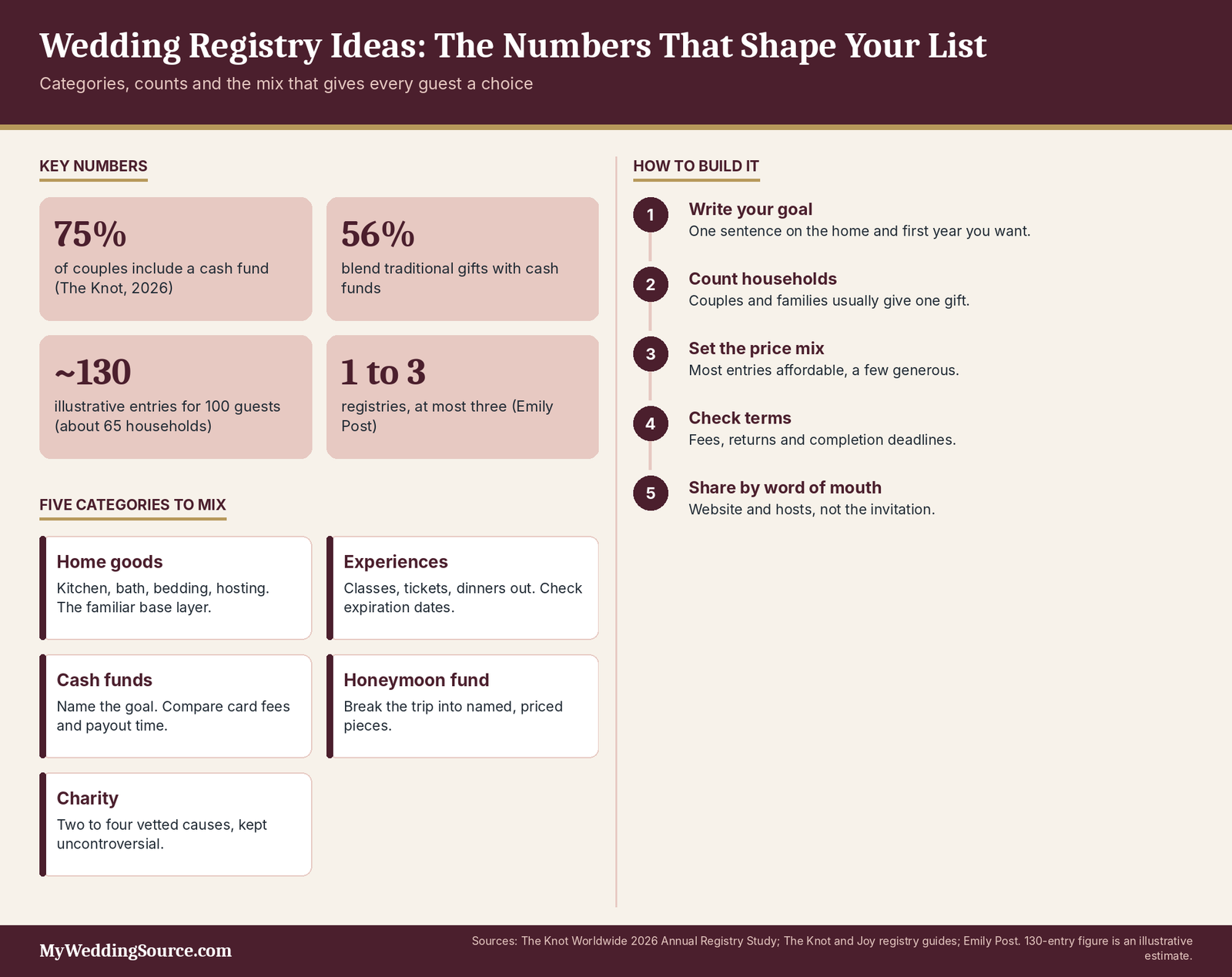
Registry ideas fall into five working categories: home goods, experiences, cash funds, honeymoon funds and charity gifts. Most couples use two or three of them, and the mix says more about how you live than about etiquette. This section compares the categories and explains how to choose a split without leaning on a formula.
What are the main kinds of wedding registry ideas?
Which five categories do couples actually choose from?
The five categories are home goods (kitchen, bath, bedding, entertaining), experiences (classes, tickets, spa days, dinners out), cash funds (general savings or a named goal like a house), honeymoon funds (cash broken into trip pieces), and charity donations (a cause chosen by you). Each answers a different question for the guest: “What would you use?”, “What would you like to do?”, “What would help you most?” or “What do you care about?” A single registry can hold all five, and platforms such as Zola let you build cash funds for honeymoons, down payments or charities alongside physical products. The simplest way to start is to write one sentence about what you want your first year of marriage to feel like, then see which categories support that sentence. If the sentence is “we want to host dinners,” home goods lead. If it is “we want to travel,” a honeymoon fund leads, with a small physical list behind it for guests who prefer to wrap something.
How do the categories compare on cost, effort and guest comfort?
The table below compares the five categories on the points couples most often ask about. The columns describe typical patterns rather than rules, and platform terms change, so verify any fee or timing detail on the platform’s own page before you commit.
| Category | Best for | Guest comfort | Watch for |
|---|---|---|---|
| Home goods | Couples building or upgrading a home | High: familiar, tangible | Duplicates across stores; shipping delays |
| Experiences | Couples who own most things already | Medium to high: feels personal | Expiration dates; blackout dates |
| Cash fund | Couples with a clear goal or an established home | Varies by guest age and culture | Card fees; payout time; wording |
| Honeymoon fund | Couples planning a trip | High when tied to named pieces | Fund fees; trip changes |
| Charity | Couples with a cause they care about | Medium: depends on the cause | Vetting; receipts; guest choice |
How do you choose a split without overthinking it?
What does a sensible starting mix look like?
A workable starting point is to treat the physical home list as the base layer, because it is the most familiar thing for guests to shop for, and then add one or two optional layers on top. The Knot’s registry guidance quotes an expert recommending 50 to 75 physical items across a range of prices even for couples focusing mainly on cash funds or experiences like a honeymoon. That keeps a door open for guests who want to hand someone a wrapped box, and it protects you if a particular guest group dislikes giving money. As a working example, a couple with a modest home list, one honeymoon fund and one house fund could sensibly present roughly 60% of line items as products and the rest as funds. Treat that ratio as a starting draft and adjust it after you see how your first shower guests behave.
How common is it to mix traditional gifts with cash funds?
Quite common, according to the industry’s own data, though the usual caution applies: this is a survey from a company that sells registries. The Knot Worldwide’s 2026 Annual Registry Study reports that 75% of couples include a cash fund and 56% combine traditional gifts with cash funds, based on 1,759 engaged and married members. It also reports that 41% say cash is the gift they want most. The takeaway is not that you should add a cash fund because everyone does, but that a hybrid registry no longer looks unusual to guests. If you prefer a traditional list only, you are in good company too, since the same study finds that bakeware, cookware, bath items and bedding remain the most commonly registered categories.
Home Registry Ideas Guests Will Actually Buy
Home goods are still the backbone of most registries, and The Knot’s 2026 study says that 51% of couples cite home upgrades as their main reason for registering. The challenge is not finding things to add but choosing items you will use, at prices that guests can reach. This section covers the core categories, the items couples forget, and how to align your list with your home rather than your wedding palette.
What belongs on the core home list?
Which categories do couples register for most often?
The Knot’s 2026 registry study lists the share of couples registering in each category: bakeware at 79%, cookware at 75%, bath items at 73%, bedding at 69%, storage and organization at 34%, grilling and outdoor entertaining at 32%, electronics at 31%, and luggage and travel gear at 30%. These are survey percentages from couples who registered, so they describe habits rather than a recommended list. They are still a useful reality check, because the top four are items that wear out, get replaced and arrive in sets, which makes them easy for guests to buy and easy for you to use. Kitchen appliances were named the most-wanted category in the same release, though no percentage was published. If your first draft does not touch the top four categories, ask yourself whether that is a deliberate choice or just a gap.
How much of each item should you register for?
Quantities are where lists go wrong, because couples add one of everything and then run short on the things that need multiples. Joy’s registry checklist suggests 2 to 3 sheet sets, 2 to 4 bed pillows, 6 to 8 bath towels and 8 to 12 dish place settings, with 12 settings for couples who host often. Those figures are a vendor’s editorial suggestions, not a standard, so scale them to your space and laundry habits. A useful rule of thumb is to register for the number you would actually replace in the next five years, then add one extra of anything guests tend to buy in pairs. Sets count as a single gift in most counting methods, so a four-piece cookware set is one entry at a higher price rather than four entries at a lower one.
Which items do couples forget?
What are the overlooked items that make a home run smoothly?
Registries tend to skew toward the pretty and the expensive, while the things you reach for every week get skipped. Joy’s checklist points to home maintenance basics such as a vacuum, a tool kit and an iron, kitchen gaps such as knives, a kitchen scale and glass storage containers, guest bedding, luggage and fitness items. The Knot publishes a similar list of frequently forgotten registry items, which suggests these gaps are common enough to plan for. These items are also useful on the budget side, because many of them land under $50 and give your budget-conscious guests a real choice. Walk through your home room by room, including the closet, the garage and the bathroom cabinet, and write down what you have borrowed, improvised or patched.
Should you add consumables and small everyday pieces?
Yes, in moderation. Low-cost items such as dish towels, a good spatula, a set of mixing bowls or a cast-iron trivet give guests an easy way to join a group gift or add a small extra to a larger one. Emily Post’s registry guidance notes that even things in the $1 to $10 range are great to include, because they keep every guest from feeling priced out. If you worry that small items look cheap, group them in your own mind as “table-setting extras” or “kitchen upgrades” and let the platform’s categories do the organizing. The practical benefit shows up at showers and engagement parties, where guests often want to bring something modest and will be glad to find it on the list.
Matching Your Registry to Your Home, Style and Season
A registry that mirrors your wedding palette can feel coherent in October and strange by March. The better test is whether an item suits the home it will live in. This section looks at aesthetics, trends and seasonal timing, including a few ideas for couples marrying in the fall or winter.
Should your registry follow your wedding colors or your home?
Why is your home palette a better guide than your wedding colors?
Wedding colors are chosen for a single day, a venue and a season, while a registry fills rooms you will live in for years. A burgundy-and-gold color scheme may look lovely on the reception tables, but it makes a poor reason to register for burgundy napkins and gold flatware you will not otherwise use. Pick registry colors from your actual walls, floors and existing dishes, and favor neutrals or one accent you already own. If you want the wedding and the registry to share a mood, borrow a material or a texture (linen, stoneware, brass) rather than a color. That approach keeps your list flexible enough that a new apartment or a repainted kitchen does not turn your gifts into misfits.
How do you handle trends without regretting them?
Trends are fine in small doses, and a registry is a place to be cautious with them. An Inside Weddings expert quoted in a registry article warns against registering for pieces such as a trendy gold deer head, arguing that a registry is a chance for “nicer décor items” that last. A simple filter is to ask whether you would still want the item in five years if you saw it in a different store. For items that fail the test but still tempt you, buy them yourself at the discount you receive after the wedding, or save them for the completion-discount window described later in this guide.
What fits a fall or winter wedding?
Which seasonal hosting items earn their shelf space?
If your wedding falls in autumn or winter, you will probably spend the first cold months at home, which makes cozy, practical hosting items easy to justify. A Dutch oven, a roasting pan, a set of soup bowls, throw blankets, candle holders and a good slow cooker all fit that pattern, and most land in the $50 to $150 range. Hot-drink gear, such as a kettle, a French press or insulated mugs, adds a few entries under $50. Think of these as “first winter at home” picks rather than decorative theme items, since you will use them well beyond the season. If you are still choosing a style direction for the day itself, our guide to unique wedding ideas covers that side of the planning.
When is it smart to schedule your registry around the calendar?
Guests often shop in bursts around showers, the engagement party and the weeks before the wedding, so The Knot suggests reviewing your registry after the engagement party, after the bridal shower and a few weeks before the wedding. For an autumn wedding, that means checking stock in late summer, because popular items can run out before the season picks up. Joy’s guidance is to create a registry three to four months ahead of the wedding, ideally before save-the-dates go out, which is a reasonable minimum. In our editorial view, starting earlier than that costs nothing if you plan any pre-wedding parties, because hosts need the link in advance. Whatever timing you choose, keep adding items as gifts are purchased so that the list never looks picked over.
Experience, Honeymoon and Cash Fund Ideas
Funds and experiences let guests give toward something you will remember rather than something you will store. They also raise questions of wording, fees and etiquette that a toaster never does. This section covers how to split a honeymoon into giftable pieces, which experiences work beyond travel, and how to describe a cash fund so it reads as a plan.
How do you build a honeymoon or experience registry?
How do you turn a trip into pieces guests can fund?
The most guest-friendly honeymoon funds break the trip into named parts with their own prices: a dinner for two, a day of airport transfers, a snorkeling afternoon, a rental car day. Emily Post’s registry guidance says honeymoon registries are acceptable when contributions are tied to specific items, such as a rental car day, and suggests describing how each contribution will be used. That framing gives the guest a picture, which tends to feel warmer than “contribute to our honeymoon fund.” A sensible spread might include two or three pieces under $50 (a coffee stop, a museum entry), several between $50 and $150 (a dinner, a day tour), and one or two larger pieces such as a night of lodging. If you are planning a trip tied to the wedding itself, our destination wedding checklist covers the travel logistics that sit behind those line items.
Which experiences work beyond a honeymoon?
Experience gifts are a good fit for couples who already own most household items. Joy’s registry checklist lists classes, spa days, tickets and gift cards among its experience ideas, and The Knot’s registry store files experiences under its gift cards and experiences category. Pottery or cooking classes, a season of concert tickets, a weekend at a nearby inn, a ski day or a museum membership all work, and each can be priced in the $50 to $300 range. Two cautions apply. First, check expiration and blackout dates before listing anything, because an unused voucher is a problem you create for yourself. Second, remember that experiences need time to schedule, so spread them across your first year instead of stacking them into the same month as the wedding.
How do you word a cash fund so it feels like a plan?
What makes a cash fund read as a goal and not a request?
A named goal changes how guests feel about the same dollars. “House fund” is more concrete than “cash gift,” and “first-year travel fund” gives guests an image to attach to the gift. The Knot’s cash-gift guidance says some couples earmark funds for uses like a honeymoon or home down payment, and The Knot’s 2026 study reports planned uses of gifted cash of 31% honeymoon, 18% general savings and 4% home down payment. Those percentages come from one survey, and the release does not make clear what base they use, so read them as a rough sense of where cash goes rather than a benchmark. A short description with a real number (“a month of mortgage payments, $1,800”) makes the fund concrete without turning it into a demand.
How do you keep wording gracious for guests who prefer a physical gift?
Offer the fund as one option among several, and keep your language invitational: “If you’d like to contribute toward our house fund, we’d be grateful. If you’d rather choose a gift, our registry has options at every price.” Emily Post’s guidance on registries is that they are merely suggestions for guests, and that the choice of gift is always up to the giver. Avoid language that implies an amount, and avoid tying the fund to a guest’s relationship to you. Keeping a small traditional registry alongside the fund also lets older relatives or guests from cultures where wrapped gifts are the norm give in the way that feels natural to them.
What do cash funds actually cost, and how fast do they pay out?
Which fees and payout times should shape your choice of platform?
Fees vary by platform, payment method and who pays them, so the useful move is to compare two or three platforms on the same few questions. Zola lists zero fees for Venmo contributions and 2.5% on credit cards, which you can cover or pass to guests. The Knot’s honeymoon-registry roundup reports the same 2.5% credit-card fee on Knot Cash Funds, a standard five-day deposit to your bank account, and Honeyfund fees of 2.2% for PayPal or Venmo withdrawals. These details are published by the platforms or by The Knot, which ranks itself first in that roundup, so check each platform’s current terms yourself. Our deeper walk-through of withdrawal fees, payout delays and gift-tax questions is in the wedding registry hidden fees guide.
Is a gift fund taxable to you?
For most couples, no, though this is general education rather than tax advice. The IRS’s gift tax FAQ says the donor is generally responsible for paying gift tax, and it lists an annual exclusion of $19,000 per recipient for 2026 ($38,000 when spouses give jointly property they own together). A guest gift in the range of tens or hundreds of dollars is far below those thresholds, and large family gifts are the donor’s filing question, not the recipient’s. If a relative offers something very large, such as a down-payment contribution, encourage them to check with their own tax professional. Keep a simple log of who gave what, because it helps with thank-you notes and any later question.
Charity and Values-Based Registry Ideas
Some couples have everything they need and would rather direct gifts toward a cause. A donation registry can express that, but it works best when it is simple, vetted and optional. This section covers how to set one up, how to check a charity, and what to tell guests about taxes.
How do you set up a donation registry?
Which approach fits: a charity fund on your registry or a separate page?
There are two common routes. You can create a cash fund labeled for a charity inside your main registry, which keeps everything in one link; Zola, for example, says its cash funds can be set up for charities as well as honeymoons and down payments. Or you can link a separate charity page or fundraising platform; The Knot’s cash-gift article mentions couples who connect a charity registry through GoFundMe or create a cash fund for donations. The first route is easier for guests, since there is one checkout and one link. The second can be more transparent if you want donations to go straight to the organization. In either case, tell guests exactly where the money goes and who receives it.
How many causes should you list?
Emily Post’s guidance on registries says donation registries are acceptable for appropriate causes and suggests offering several options without political or religious affiliations, or a diverse set so guests can choose causes that fit their values. In practice, two to four charities is plenty: a local one, a national one and perhaps one tied to your story, such as the hospital where a parent was treated or an animal shelter where you adopted a pet. Keep descriptions to one sentence each, with a link. If you want to avoid a debate at the reception, choose causes that most people would call uncontroversial and keep your own politics out of the registry copy.
How do you check a charity and handle taxes?
How can you verify that a charity is real before listing it?
Start with the IRS’s Tax Exempt Organization Search, which lets you look up an organization’s tax-exempt status and its Form 990 filings, and lets donors confirm whether it can accept tax-deductible gifts. The FTC’s donating to charity page describes steps to take before donating so that you are not giving to a fake charity or scammer. Small and brand-new organizations may not appear in every database, so call or email them if you are unsure. If you route donations through a platform, confirm whether the donation goes to the charity directly and who issues the receipt.
Can guests deduct donations made in your honor?
Sometimes, but the couple cannot promise it, and it is the guest’s own tax question. The IRS says charitable contributions are deductible if made to qualified organizations and if you itemize, and that contributions must be paid before the close of the tax year. A gift to a cash fund that you control is a gift to you, not to a charity, so it would not qualify. If a guest gives directly to a qualified charity in your honor, the deduction question is theirs to work out. The safest wording for your registry is neutral: describe the cause, link to the organization, and say nothing about tax benefits.
How Many Items Should a Wedding Registry Have, and What Should They Cost?
This is where most couples want a number. The honest answer is that published rules of thumb disagree, and the right number depends on how many households are invited and how much you expect them to spend. This section walks through the counting methods, the price-tier mix, and a worked example you can adapt.
How do you decide how many items to list?
What do the published rules of thumb say?
They run about two entries per invited guest, with some variation. The Knot’s guidance, drawn from two registry experts, says to have at least two gifts per guest and gives ranges by guest count: 75 to 100 items for up to 50 guests, 100 to 150 for 51 to 100 guests, 150 to 225 for 101 to 150, 200 to 300 for 151 to 200, 250 to 375 for 201 to 300 and 300 to 450 beyond that. Joy’s checklist recommends about 1.5 to 2 items per guest, or 150 to 200 items for a 100-guest wedding. The two sources overlap but do not match, and Joy’s own budget article gives a different formula based on invitations, so treat all of them as ranges. Add roughly 30% more items than your guest count if you expect shower and engagement-party shoppers, as Joy suggests.
Why count households instead of guests?
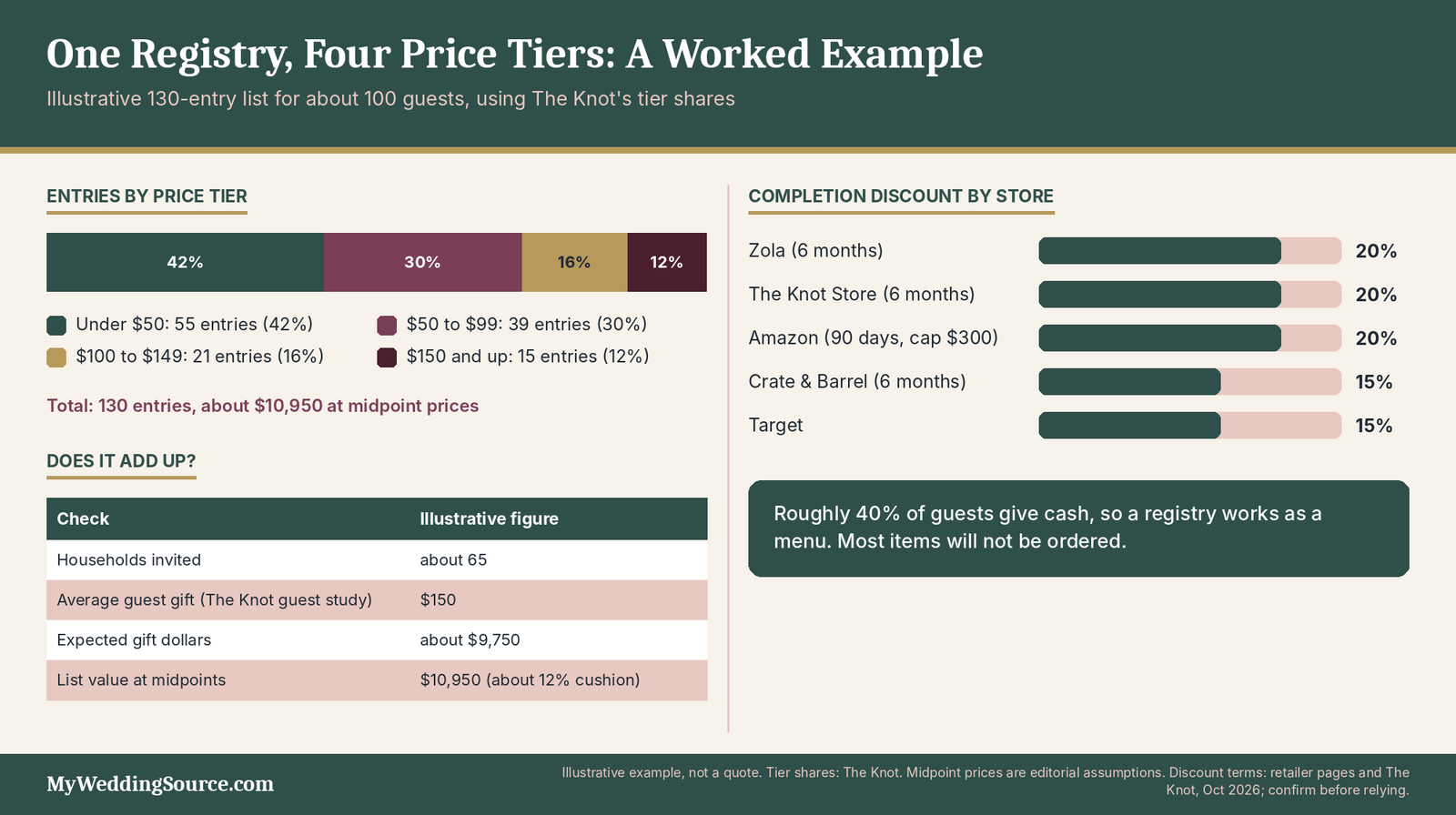
Because couples, families and housemates usually give one gift together, a guest list of 100 may represent only 60 to 70 gift-giving households. The Knot’s guidance says to count couples as a single party, since they often give one higher-priced gift instead of two cheaper ones. Counting households also helps you notice who is likely to buy: coworkers who attend alone, cousins who come as a family of four, a table of college friends who may chip in together. For our worked example, we assume 100 invited guests who represent about 65 households, and we plan for two entries per household, or roughly 130 entries. That is inside The Knot’s 100 to 150 range for 51 to 100 guests and a little below Joy’s 150 to 200, which is a reasonable place to land.
How should the price tiers be spread?
What mix of price points do the sources recommend?
The Knot’s guidance suggests roughly 42% of items under $50, 30% from $50 to $99, 16% from $100 to $149, and 12% at $150 or more. Joy’s checklist offers a simpler three-tier version: at least 30% under $50, about 40% from $50 to $150, and the remaining 30% above $150. The difference is a matter of emphasis, and either way the idea is the same: most entries should be affordable, a solid middle should be mid-priced, and a handful should be generous. Emily Post’s advice is to include a mix of price points and types so that guests at every budget can find something, and to avoid too many high-priced items. In our editorial view, the Knot mix suits a guest list that skews toward friends and coworkers, and the Joy mix suits one that skews toward close family.
How does a worked price-tier example look?
Suppose 100 guests (about 65 households), 130 entries and the Knot mix. The table below applies the tiers and prices each one at a representative midpoint. These midpoints are our illustrative choices, not quotes, and the dollar totals are meant to test whether the list is in a sensible range rather than to predict what you will receive.
| Price tier | Share | Entries | Midpoint | List value |
|---|---|---|---|---|
| Under $50 | 42% | 55 | $30 | $1,650 |
| $50 to $99 | 30% | 39 | $75 | $2,925 |
| $100 to $149 | 16% | 21 | $125 | $2,625 |
| $150 and up | 12% | 15 | $250 | $3,750 |
| Total | 100% | 130 | $10,950 |
Does the total make sense against what guests are likely to spend?
Check the list value against an expected guest budget. The Knot reports that guests spent an average of $150 on a wedding gift in its most recent guest study, though it does not state the year or sample, and its own gift table puts acquaintances and coworkers at $100 to $150 while the article text says $50 to $100. If 65 households each spend an average of $150, total spending would be about $9,750, and the list value of $10,950 is about 12% higher, which is a healthy cushion that gives guests real choice. The same study says roughly 40% of guests give cash, 50% a physical gift and 10% a gift card, so the number of registry purchases will be lower than the number of households. Treat that as a reason to list generously, not to expect every item to sell; most registries work as menus, with only a portion of the items ever ordered.
Registry Ideas for Couples Who Already Live Together
Most couples now share a home before the wedding, so the old model of “stock the empty apartment” no longer matches reality. Bowling Green State University’s National Center for Family and Marriage Research reports that roughly 80% of marriages from 2020 to 2022 were preceded by cohabitation, though that analysis covers only ever-married women aged 19 to 44 in different-sex couples. The registry question changes accordingly: what would make a home you already run work better? This section covers upgrades, merged households and other situations where the standard list needs adjusting.
What do you register for when you already own a kitchen?
How do the upgrade, replace, consume and host categories work?
Four filters help a lived-in home. Upgrade: swap the pan that has warped, the blender that rattles or the sheets that pill for versions you will enjoy for a decade. Replace: list the mismatched mugs, the chipped plates and the towels from your first apartment. Consume: add things that get used up, such as candles, good olive oil, coffee subscriptions or a spice collection, because guests like gifts that feel generous and cannot be regifted. Host: put your first real dinner-party kit on the list, including serving platters, a cheese board, a pitcher and enough glassware for eight. Sorting your list into these four groups also keeps you from registering for duplicates, which is the most common complaint from couples with established homes.
Which experiences and funds suit couples with full homes?
When the household is already furnished, funds and experiences often carry more weight than products. The Knot’s 2026 study says 51% of couples register mainly for home upgrades, which leaves a sizeable group registering for other reasons. For couples who own the basics, a house or renovation fund, a travel fund, a class series, restaurant gift cards and a small physical list of upgrades can all coexist. Joy’s checklist suggests a lifestyle split for travelers of roughly 70% cash funds and experiences and 30% physical items. That ratio is a vendor’s suggestion, but it shows what a fund-forward registry can look like. Keep a few items under $50 on the list regardless, so guests who prefer to wrap something have a path.
How do you merge two households on a registry?
What do you do with duplicates and different tastes?
Merging two kitchens exposes quiet disagreements: one of you owns a beloved cast-iron skillet, the other a nonstick set, and neither wants to give up the toaster oven. An Inside Weddings article for couples moving in together suggests that you review what you own and keep what your partner loves, and let go of items that are neither necessary nor sentimental. Its advice for couples who already live together is to pick your battles when design tastes differ. A practical step is to make a three-column list before you register: keep, replace, add. Anything in “replace” becomes a registry entry, anything in “keep” stays off, and anything you cannot agree on gets postponed until after the wedding discount arrives.
How should the registry handle big-ticket items you actually want?
Large items such as a sofa, a mattress or a television are tempting to add and awkward to receive. The same Inside Weddings article cautions that guests will not buy a 70-inch flat screen, and suggests leaving that room for more reasonably priced items. If you want a big purchase, create a fund with a clear name and an incremental structure (a “new couch” fund with contributions from $25), or plan to buy it yourselves with the completion discount. The Knot’s registry articles include a piece on whether furniture belongs on a registry, which indicates it is a question many couples ask. You can include a single large item as an aspirational entry as long as the rest of the list stays within reach.
What about second weddings, small weddings and destination weddings?
Do second marriages and small weddings need a registry at all?
They can skip it, but an optional registry still helps guests who ask. Emily Post’s registry guidance describes registries as merely suggestions for guests, which means a short list for a small wedding carries no pressure. If you are combining two established households, favor consumables, experiences and a donation or fund over more kitchen equipment. A line on your wedding website such as “Your presence is the gift; if you’d like to give something, we’ve listed a few ideas” gives guests the information without making it a requirement. Small weddings often have guests who are close enough to ask directly, so a ten-item list with two funds may serve you better than a long catalog.
How should guests who travel be considered?
Guests who fly in for a destination wedding have already spent real money on tickets and lodging, and many will not want to ship a gift or carry one in a suitcase. For that reason a smaller registry, a fund and a few shippable items are friendlier than a long product list. If you are building the travel side of your plans, the destination wedding checklist walks through the timeline and the details that tend to get missed. Whatever you decide, avoid hinting that traveling guests owe you a bigger gift, and consider stating plainly on your website that attendance is the priority.
Group Gifts, Gift Cards and Big-Ticket Items
Group gifting lets several guests share the cost of an item that none of them would buy alone. It is useful for the top of your price range, but each platform handles it differently. This section explains the mechanics, the risks of partial funding, and where gift cards fit.
How does group gifting work?
How do the major platforms handle contributions?
The mechanics differ by platform, and the differences matter if you have a particular item in mind. On Zola, a registrant can turn any Zola-hosted gift into a group gift, and multiple givers contribute through normal checkout by credit card, while each contributor’s name appears in your Gift Tracker. Crate & Barrel’s version turns contributions into a gift card that can be spent at Crate & Barrel or CB2 rather than buying one item directly. Zola’s page also says group gifting is not available for items linked from another store, because those purchases run through the other store’s checkout. Before you mark something as a group gift, confirm that it is a store-hosted item on a platform that supports the feature.
What happens if a group gift is only partly funded?
On Zola, partial funding returns the contributed amount to you as store credit, and a fully funded gift can be shipped or converted to store credit for any item in the store. That means a $400 item with $240 contributed leaves you with $240 of credit and no item, so choose group-gift items you would still be glad to buy at a discount. As an illustration, a $400 item split five ways is $80 per guest, which sits comfortably inside the typical guest budget. Emily Post’s guidance suggests offering ways to contribute toward a larger purchase without buying it outright, so guests are not priced out. Add a short note to the item that says how much a share costs, which makes it easier for guests to choose.
Where do gift cards and large items fit?
Why would you put a gift card on a registry?
Gift cards are flexible, shippable and easy to pair with a small physical gift. The Knot’s registry advice includes an article on why you need gift cards on a registry, and its registry navigation groups gift cards with experiences. They suit guests who want to give a fixed amount and couples who expect to buy things they cannot yet name, such as paint, plants or a washer repair. Note that Amazon’s completion discount excludes certain gift cards and group gifting contributions from the qualifying purchase total for events on or after August 31, 2023, so a gift-card-heavy registry may not trigger the discount you expect. Check each retailer’s rules before you decide how much weight to give gift cards.
How do you avoid a registry that sells out of its best items?
Popular items run out, and showers tend to clear the middle of a list first. The Knot’s guidance suggests registering with one or two sites and adding items as needed if more guests than expected buy gifts. Review the list after the engagement party, after the shower and a few weeks before the wedding, and refill any tier that has emptied. In our editorial view, the under-$50 and $50 to $99 tiers deplete fastest because most guests buy in those ranges, so those are the tiers to replenish first. If a favorite item sells out permanently, swap it for a similar one and note the change on your website rather than leaving a gap.
Returns, Completion Discounts and Common Registry Mistakes
The registry does not end when the wedding does. Return windows, completion discounts and thank-you notes all run on deadlines, and missing them costs money. This section compares major store policies as published in 2026, lays out a timeline, and lists the mistakes that come up most.
What do the major retailers allow?
How do the completion discounts and return windows compare?
The table below compares what each retailer’s own page or The Knot’s roundup said when checked in October 2026. Policies change, eligibility rules are fiddly, and the numbers here come from a mix of retailer pages and a third-party summary, so confirm anything you plan to rely on at the source. The point of the table is to show how much the terms differ, not to settle which store to choose.
| Retailer | Completion discount | Window | Notable condition |
|---|---|---|---|
| Zola | 20% on remaining registry items | 6 months after wedding | Can be used multiple times |
| The Knot Registry Store | 20% on leftover items | 6 months after wedding | One use; a guest purchase before the wedding required |
| Amazon | 20% on one order up to $1,500 (max $300) | Use within 90 days of the event | $500 in qualifying purchases; Amazon-sold items only |
| Crate & Barrel | 15% | 6 months after the event | Unlimited uses; registry stays active 18 months |
| Target | 15% | Not stated in sources checked | Once in store and once online; returns up to a year |
How do you use a completion discount without wasting it?
Wait a few weeks after the wedding so late-arriving gifts do not duplicate what you plan to buy. The Knot’s completion-discount article says exactly this, and adds that if you are registered at several stores you can use each store’s discount provided you meet its eligibility rules. Build a “second list” of items you actually want, such as the things guests did not buy and the bigger purchases you postponed, and then place the order inside the window. As an illustration, a 15% discount on a $1,200 set of cookware saves $180, while a 20% discount on the same set saves $240, which is why the exact percentage matters for larger items. Put every deadline in your calendar the day you set your wedding date, since the codes arrive by email and are easy to miss.
What are the most common registry mistakes?
Which mistakes cost couples money or goodwill?
Most registry problems fall into a handful of patterns. They are easy to avoid when you know the list, so the table below pairs each mistake with a fix.
| Mistake | Why it happens | Simple fix |
|---|---|---|
| Too few low-priced items | Couples list what they want most | Aim for about 40% of entries under $50 |
| Too many registries | Each store has a perk | Keep to one to three, per Emily Post |
| Missing the discount window | Codes arrive by email | Calendar every deadline |
| Putting registry on the invitation | Convenience | Use your wedding website and word of mouth |
| Forgetting to track gifts | Gifts arrive in batches | Log each gift when it arrives |
How do you handle returns and duplicates gracefully?
Duplicates happen, and the fix is usually a return or exchange. Target’s registry page says you can return items up to one year after the wedding without a receipt, while Zola lets you exchange an item for Zola credit before shipping, with no notice to guests. Crate & Barrel says it will help return or exchange duplicates and points to its returns FAQ for the window. Because windows vary and refunds are sometimes issued as store credit, read the policy page before you list anything you are unsure about. For a step-by-step version of this process, see our wedding registry checklist.
When and how should you share your registry?
When should you create and share your registry?
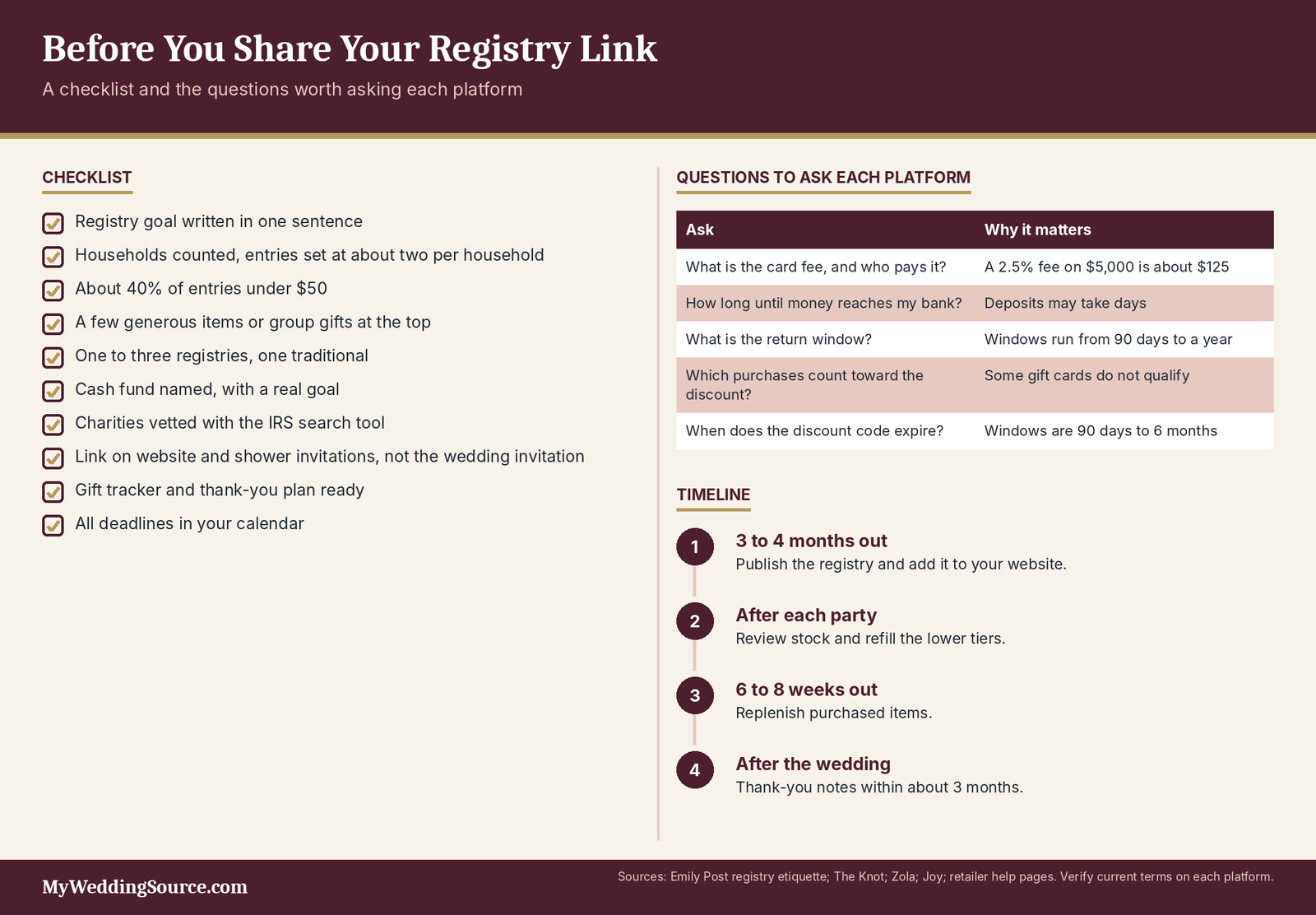
Joy recommends creating a registry three to four months before the wedding, ideally before save-the-dates go out, and reviewing it six to eight weeks ahead. In our editorial view, earlier is better if anyone is hosting an engagement party or shower, because hosts need a link to share. The table below sketches a timeline that combines those sources with our own judgment.
| When | What to do | Source |
|---|---|---|
| 6+ months out (if parties planned) | Draft the list; share with hosts | Editorial judgment |
| 3 to 4 months out | Publish the registry; add to website | Joy |
| After each party | Review stock and refill tiers | The Knot |
| 6 to 8 weeks out | Replenish purchased items | Joy |
| After the wedding | Log gifts; send notes within 3 months | Joy |
| Within 6 months | Use completion discounts | Retailer pages |
How do you tell guests without breaking etiquette?
Emily Post’s guidance is to share registry information by word of mouth and on your wedding website, and to leave it off the wedding invitation and enclosures. It also says to tell close family and the wedding party where you are registered, since guests will ask them, and to avoid posting registry details on social media. Shower invitations are the exception: the same guidance says it is fine to put registry information on a shower invitation. If you are managing budget questions alongside gift planning, our wedding budget calculator gives the bigger money picture. For a broader view of the planning timeline, the wedding planning hub collects the related guides.
FAQ: Wedding Registry Ideas
These are the questions couples ask most often once the first draft of a registry exists. The answers lean on the sources cited above and note where etiquette sources or retailers disagree.
Building the registry
Is it acceptable to skip a registry or keep it very small?
Yes. Emily Post’s registry guidance describes registries as suggestions rather than obligations, and notes that the choice of gift is always up to the giver, so a short list or no list breaks no rule. The practical cost of skipping is that guests will ask family and the wedding party what you want, and some will guess. A compromise that works for many couples is a ten-to-twenty-item list with one fund and a sentence on your website saying that attendance matters most. If your wedding is small, that approach may serve you better than a 130-entry catalog.
What should you do about gifts that are not on the registry?
Accept them graciously and log them like any other gift. Emily Post’s guidance says guests may choose a gift outside your registry, and many will, especially older relatives and friends who prefer to give something personal. Keep gift receipts when they are provided, and if you receive a duplicate, check the giver’s store for an exchange policy before you ask them anything. A gift tracker, whether the platform’s own or a simple spreadsheet, makes the thank-you notes easier later. Never imply that an off-registry gift was a mistake, since the sender chose it with care.
How many registries is too many?
Emily Post’s guidance says you may have more than one registry but no more than three, and recommends keeping at least one traditional registry even if it is small. The Knot’s guidance suggests one or two sites to avoid overwhelming guests, and Joy recommends two to three sources. A universal registry, which lets you add items from many stores to one page, can reduce the number of links you share. The tradeoff is that completion discounts usually require you to register directly with each store, as The Knot’s discount article notes, so a hybrid of one universal page and one or two store registries is a common compromise.
Money and etiquette
Is asking for cash rude?
Etiquette sources treat it as a matter of framing and guest comfort rather than a rule. The Knot’s 2026 study reports that 75% of couples include a cash fund, and Emily Post’s guidance accepts honeymoon registries when contributions are tied to specific items. Phrase the request as an option, name the goal, and keep a small physical list for guests who prefer to wrap something. Expect that a share of guests will still give physical gifts or cards with cash, which The Knot’s guest figures (40% cash, 50% physical, 10% gift card) suggest is normal.
When should thank-you notes go out?
Joy’s registry checklist suggests sending notes within three months of the wedding, and logging each gift as it arrives so that nothing is missed. In our editorial view, writing notes for shower and engagement gifts as they come in prevents a large pile after the honeymoon. Mention the specific gift and one real use you have planned for it, and for cash or fund gifts, mention what the money will go toward. If you are running late, a sincere note sent a little after the window is better than no note.
Do registry gifts count as income or trigger gift tax for you?
For most couples, no. The IRS says the donor is generally responsible for any gift tax, and the 2026 annual exclusion is $19,000 per recipient, so ordinary wedding gifts fall far below the threshold. This is general education, not tax advice, and state or personal circumstances can differ. If a family member plans an unusually large gift, they may want to ask their own tax professional about filing. Keep a simple record of large gifts for your own files.
Your Next Steps
A registry gets easier once the first draft exists. These steps turn the ideas above into a working list, and they are ordered so that the decisions that cost money come before the link goes out.
This week
What should you decide first?
Write one sentence about the kind of home and first year you want, then count gift-giving households on your draft guest list. Choose your categories (home, experiences, cash fund, honeymoon, charity) and pick no more than three. Decide whether a cash fund fits your guests, and if it does, name the goal. Those four decisions take under an hour and prevent most of the rework later.
How do you draft the first version of the list?
Use the worked example as a template: take your household count, multiply by two, and apply the tier shares to get your entry counts. Fill the under-$50 and $50-to-$99 tiers first, since they are the largest. Then add a few mid-priced and generous entries from your keep, replace, add, upgrade and host lists. If you want a step-by-step companion, the wedding registry checklist breaks the process into dated tasks, and our blog hub gathers related reading.
Before you share the link
Which terms should you check on each platform?
Open each platform’s fee, return and completion-discount pages and write the key numbers in one note: card fees on cash funds, payout timing, return windows, discount percentages and deadlines. Compare them against the retailer table in this guide, and use the wedding registry hidden fees guide for the fine print on withdrawals and group gifts. If something is unclear, ask the platform’s support team in writing and keep the reply. It takes ten minutes now and avoids a surprise later.
How do you set up tracking and calendar reminders?
Create a simple spreadsheet or use the platform’s gift tracker, with columns for giver, gift, date received, thank-you sent and return deadline. Add calendar reminders for the registry review after the engagement party and shower, the six-to-eight-week check, the completion-discount window and the thank-you deadline. Share the link first with hosts, then on your wedding website, and tell your wedding party and close family by word of mouth. Review the list after each wave of gifts and refill the lower-price tiers first.
Sources & methodology
- The Knot Worldwide: 2026 Annual Registry Study — registry and cash-fund survey figures (1,759 respondents).
- The Knot: How many gifts to register for — item counts by guest count and price-tier shares.
- The Knot: How much to spend on wedding gifts — guest gift spending and cash versus physical split.
- The Knot: How to give cash for wedding gifts — cash-fund framing, fees and payout time.
- The Knot: Best honeymoon registries — honeymoon fund fee comparisons.
- The Knot: Registry completion discount — discount terms by retailer.
- The Knot: Target registry — Target completion discount and return window.
- Emily Post: Wedding registry etiquette — sharing, invitations, number of registries, honeymoon registries.
- Emily Post: All about registries — price mix, donation registries, shower registries.
- Zola: How does Zola registry work? — cash funds, fees, completion discount.
- Zola: Group gifting — group gift mechanics and partial funding.
- Amazon: Wedding registry completion discount — Amazon discount caps and eligibility.
- Crate & Barrel: Gift registry FAQ — completion card, group gifts, registry shipping.
- Joy: Wedding registry checklist — timing, quantities, price mix and thank-you window.
- Inside Weddings: Couples who live separately — merged-household and big-ticket advice.
- BGSU NCFMR: Trends in cohabitation prior to marriage — share of marriages preceded by cohabitation.
- IRS: Frequently asked questions on gift taxes — 2026 annual exclusion and donor responsibility.
- IRS: Tax Exempt Organization Search — verifying charities.
- IRS: Charitable contribution deductions — qualified organizations and itemizing.
- FTC: Donating to charity — steps for checking charities before giving.
Methodology. Verified facts here are retailer and platform policies read on their own pages in October 2026, and the IRS and BGSU statements. Survey findings come from The Knot Worldwide’s 2026 Annual Registry Study and The Knot’s guest figures, both from a company that sells registries, and Joy’s checklist reflects a vendor’s editorial suggestions. The 130-entry price-tier example, the household count and the midpoint prices are our own illustrative arithmetic, not quotes or averages, and recommendations labeled “in our editorial view” are judgment. Where sources disagree (item counts, tier shares, acquaintance gift ranges), the article shows both rather than picking one.
Freshness note. Recheck completion-discount percentages, return windows and cash-fund fees on each platform’s own page before you publish your registry, and again before the wedding, since retailers revise terms often. The Knot’s guest-study year is not stated on the page we read, so treat the $150 average as a rough guide. Refresh this article when The Knot publishes its next annual registry study and each January when the IRS annual exclusion is announced.