

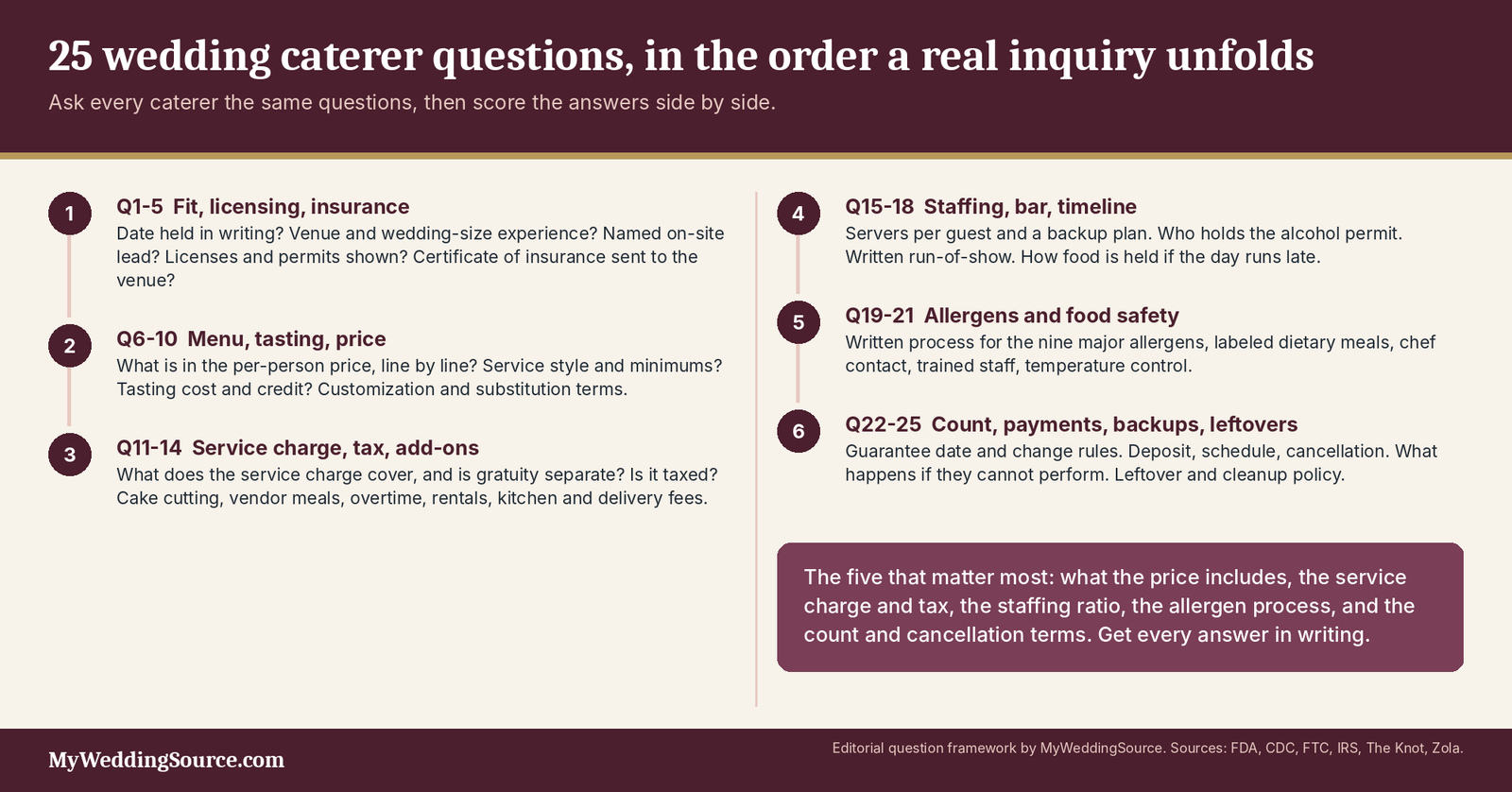
These 25 wedding caterer questions turn a friendly tasting into a written, comparable offer: what the per-person price really includes, which fees land on top, how allergies are handled, and what happens if something goes wrong.
You have two or three caterers you like, and each one has sent a proposal that looks different from the others. One quotes a price per person, one quotes a package, and one mentions a “service fee” in a footnote. The real decision is not “whose menu sounds best?” but “which of these offers will still look the same on the final invoice?” A tasting tells you how the food will taste on a quiet afternoon; the questions below tell you how the company will behave at 6:40 p.m. on a Saturday when the cocktail hour runs long, the ceremony starts late, and a guest mentions a shellfish allergy to a server who just met them.
This guide is built for the conversation you have before you sign. The questions come in the order a real inquiry unfolds: can they do your date and your venue, what does the price include, what gets added, who works the room, how food and allergens are handled, and what the contract says when plans change. Each question explains why it matters, what a clear answer sounds like, and what to get in writing. If you are already inside the final month, our November wedding checklist covers the count deadlines and day-of confirmations; this page is for the earlier stage, when you can still compare, negotiate, and walk away.
A note on tone before we start. Caterers are not villains, and pricing is genuinely complicated: food costs move, labor is the biggest line, and every venue has its own rules about kitchens, rentals, and alcohol. Most surprises come from vague proposals, not bad intentions, which means a good question list protects both sides. This is general education, not legal, tax, or insurance advice; licensing, sales tax, and contract law vary by state and county, so verify the rules that apply to your wedding with your venue, your local health department, and, for contracts, a qualified professional.
Before you ask: set up the conversation
A caterer can only give you a useful answer if you give them useful inputs. The couples who get the cleanest proposals tend to send the same short brief to every company, so the quotes line up and the questions can focus on differences rather than basics. This section covers what to decide first and how to run the inquiry so the answers are comparable.
Know your constraints first
Three facts shape almost every caterer answer: whether your venue controls the kitchen, your approximate guest count, and your rough budget for food and drink. Settle those before the first call, and the rest of the conversation becomes much shorter. Skipping this step is the most common reason a first round of quotes cannot be compared.
Does your venue require or restrict the caterer?
Some venues have an exclusive in-house caterer, some keep a preferred list, and some allow outside caterers for a kitchen or “outside vendor” fee. Read that clause in your venue contract before you request quotes, because it decides whether you are comparing caterers at all or comparing menu tiers from one company. If the venue requires its own caterer, your questions shift toward the package: what is included, what is negotiable, and which fees are set by the venue rather than the kitchen. Our wedding venues guide walks through how venue contracts bundle food, rentals, and alcohol, which is worth skimming first if you have not signed yet.
What guest count and budget range should you share?
Give a realistic guest range and a food-and-drink target, even if the target is a stretch. The Knot’s 2025 Real Weddings Study, which surveyed 10,474 U.S. couples married in 2025, reported an average of 117 guests, an average total cost of about $34,000, and a median of $24,000, so your plan may sit far from the headline number in either direction. A caterer who hears “about 80 guests, around $90 a person for food, service included” can tell you honestly whether that works, while a caterer given no numbers will quote a mid-range package and leave you to discover the gap later. Sharing a range is not a negotiating weakness; it is the fastest way to get a proposal you can use.
Run the inquiry so the answers are comparable
Once the inputs are settled, standardize the process. You want the same questions, the same format, and the same date for every caterer, so a difference in the answer reflects a real difference in the offer. That discipline also shows you which companies answer clearly when the questions are identical.
Which questions belong in the first email?
Use the first email for the yes-or-no screens: date availability, venue experience, service style, minimum spend, and whether they are licensed and insured. Those answers save you a tasting with someone who cannot do your date, will not serve your venue, or has a minimum that does not fit. Send the same message to each company, ask for a sample proposal or a price sheet, and note how quickly and clearly each one responds, since that pattern usually continues after you book. Keep the deeper questions about fees, allergens, and contract terms for the proposal stage, when you have something concrete to mark up.
What should you have in writing before a tasting?
Request an itemized proposal before you schedule a tasting, not after. A tasting is persuasive by design: the food is excellent, the team is friendly, and it becomes psychologically harder to ask about fees after you have already pictured the menu on your table. Having the proposal in hand lets you walk in with two or three specific questions, and it lets you compare what you ate with what you would actually be charged for. If a company will only share numbers after a tasting, that is a data point about how they handle pricing conversations.
Questions 1 to 5: Can they do your wedding, legally and logistically?
The first five questions screen for fit. They are fast to ask, they eliminate options early, and they cover the unglamorous basics, such as licensing and insurance, that are easy to skip when the menu looks delicious. A caterer who answers these five clearly has probably thought about the rest.
Do they have the date, the experience, and the people?
Question 1: Is our date available, and how long can you hold it?
A caterer’s calendar can fill faster than a venue’s, especially for Saturdays in peak months, because one kitchen team handles only so many events per day. Ask whether the date is open, whether you can place a courtesy hold, and exactly when that hold expires; a hold with no stated end date is not a hold. Also ask whether they take a second event that day, since a company running two weddings may split its senior staff or its equipment. The practical next step is to get the hold in an email with the expiry date, so you know how long you have to finish the venue and tasting steps.
Question 2: Have you cooked at our venue, and at weddings of this size and style?
Experience at your venue is worth more than a long portfolio, because every kitchen, loading dock, and elevator has quirks. A team that has worked there before knows whether the space has a prep kitchen, how far plates travel, where the power is limited, and what the venue allows in the way of open flame, outdoor grills, or food trucks. If they have not worked there, ask how they plan a site visit and whether it costs extra. Ask for two or three recent weddings of a similar guest count and service style, because a caterer excellent at 60-person family-style dinners may not run a 200-guest plated service the same way.
Question 3: Who is the on-site lead, and will that person be there from load-in to last call?
The title varies, such as banquet captain, event manager, or catering director, but the question is the same: who is in charge of the food team on the day, and will the person you meet during planning be the person on site? A sales contact who books you and then hands off to an unknown manager is common, and it is fine as long as you meet the day-of lead before the wedding. Ask how that person coordinates with your planner or day-of coordinator, who calls the kitchen to fire the first course, and how timeline changes get communicated. If you hire help, our wedding planner questions guide covers how to divide responsibilities between a planner and the vendor team.
Are they properly licensed and insured?
Licensing and insurance are the questions that feel awkward and matter most when something goes wrong. Asking is routine, and a professional caterer will have the answers at hand. These two questions take five minutes and can prevent a venue from turning a vendor away at load-in.
Question 4: What licenses and permits do you hold, and who obtains the ones this event needs?
Requirements vary by state, county, and venue, so the answer should be specific to your location rather than a general “yes, we are fully licensed.” Food businesses are typically regulated by state or local health departments, many of which base their rules on the FDA Food Code, a model that jurisdictions adopt, and sometimes modify, on their own schedule. Alcohol is regulated separately by the state; California, for example, has no license type specifically for weddings, but lists a caterer’s permit and a caterer’s on-sale license among the options that may apply depending on the situation, and it directs people to a local ABC office to confirm. Ask who is responsible for any temporary event permit, health permit for an outdoor or off-site kitchen, or alcohol authorization, and ask to see a copy of the relevant license or permit before you sign.
Question 5: Can you provide a certificate of insurance, and what does your venue require?
Many venues require every vendor to carry general liability insurance and to name the venue as an additional insured on a certificate of insurance, or COI. Ask the caterer whether they carry general liability, workers’ compensation for their staff, and liquor liability if they serve alcohol, and ask them to send a COI directly to the venue well before the wedding. This is a vendor-side protection and it is separate from the policies a couple might buy: Consumer Reports distinguishes cancellation or postponement coverage, which reimburses deposits when an event is called off, from liability coverage, which responds if a guest is injured or property is damaged. Its price examples date from 2018, so treat them as background, but the distinction still helps: vendor insurance protects the vendor’s operations, event liability protects you as host, and cancellation coverage protects your deposits.
Questions 6 to 10: Menu, tasting, and what the price includes
Menu questions are where the conversation is most fun, which is exactly why they need structure. The goal is to understand what you are buying (food, labor, equipment, or all three), how the service style changes the cost, and how much the tasting actually predicts about the wedding day. Treat the tasting as one data point and the written proposal as the other.
What is inside the per-person price?
Two proposals with the same headline number can contain very different things. These two questions make the contents visible. Both answers should end up on paper, with the same wording in the proposal and the contract.
Question 6: What exactly does the per-person price include, line by line?
Ask for the price in layers: food, preparation labor, servers and kitchen staff, basic plates, glassware and flatware, linens, setup and breakdown, bar service, and any service charge. A per-person price that covers only food and kitchen labor is a different product from one that includes service staff, china, and cleanup, even if the two numbers look close. Ask which items are included, which are optional, and which are “available upon request,” since that last phrase usually means “extra.” The most useful artifact you can leave with is a one-page itemized proposal you could hand to a friend and have them explain back to you.
Question 7: How does the service style change the price, and is there a minimum?
Plated dinners, buffets, family-style service, and food stations use staff, equipment, and food quantity differently, so the same menu costs different amounts under each. The Knot’s 2025 study found that 60% of couples chose a buffet or self-serve stations and 30% chose a plated sit-down meal, so buffets are common, but common does not always mean cheaper, a point we unpack in plated vs buffet wedding hidden costs. Also ask about minimums: many caterers have a minimum spend or a minimum guest count, and Zola’s 2026 catering guide reports caterer minimums of $2,500 to $4,000 that raise the effective per-person cost at small weddings. If your guest count could drop, ask how the minimum is calculated and whether it applies to food alone or to food and beverage together.
| Service style | Zola-reported per-person range | What changes the cost | Question to ask |
|---|---|---|---|
| Plated dinner | $65 to $85 | More servers and tighter kitchen timing, fewer food-waste surprises | How many servers per table, and how long to serve all courses? |
| Buffet | $40 to $65 | Fewer servers, more food prepared for refills, longer guest line | How many lines, and how is food replaced rather than topped off? |
| Family-style | $50 to $70 | Large platters and extra serviceware, plus table space | Do the platters fit our table size, and who refills them? |
| Cocktail reception | $35 to $55 | Number of passed items and stations, and how long guests graze | How many bites per person per hour does the price assume? |
Does the tasting predict the wedding day?
A tasting is a sample, a preview, and a sales moment all at once. These three questions help you use it as information rather than as persuasion. Bring the same list to every tasting so the experiences are comparable.
Question 8: How does the tasting work, what does it cost, and is it credited to the contract?
Policies vary widely, so ask whether the tasting is complimentary, how many people can attend, whether you can taste your actual menu or a rotating sample, and whether a fee is credited back after you book. Zola reports that complimentary tastings are typically included for weddings over 100 guests or contracts above $10,000, while smaller weddings may pay $100 to $300, often credited to the final bill. Ask whether the plates are portioned and plated the way they will be on the day, because a tasting served on a nice platter at a leisurely pace is not the same as 120 plates leaving a kitchen in 18 minutes. Bring the proposal and a pen, taste with a notebook, and leave the booking decision for the next day.
Question 9: How much can we customize, and what does a change cost?
Some caterers work from set packages, and some build a menu around you, which changes both the experience and the price. Ask whether you can swap an entree, add a family recipe, or build a menu around a cultural tradition, and whether those changes carry an upcharge. If your wedding includes a dish that matters to your family, ask the chef directly how they would prepare it for 100 guests rather than for 10, because scaling is where a recipe often changes. Also ask how late you can change selections and what the price effect is, since a menu locked six months out may meet a different ingredient market on the actual date.
Question 10: What happens if an ingredient is unavailable or the price changes?
Contracts sometimes include a substitution clause that lets the caterer swap an ingredient of “equal or greater value” when supply is short, and a price-adjustment clause tied to food costs. Neither is unreasonable, but you should know what they say. Ask what the menu price is based on, how long the quote is valid, whether it can rise before the wedding, and who decides about a substitution. A helpful written answer sounds like: “The per-person price is guaranteed through your final count date; if a specific item is unavailable, we will offer a comparable substitute and confirm it with you in writing.”
Questions 11 to 14: Service charges, taxes, and add-on fees
This is the section where national averages stop helping and your contract starts to matter. The headline price rarely includes the service charge, taxes, extra staff time, and equipment, so these four questions are your protection against a bill that looks nothing like the proposal. Bring a calculator and the proposals side by side, because a comparison is only fair once the same layers appear in each.
What is the service charge, and who gets it?
A “service charge,” a “gratuity,” and an “administrative fee” can mean three different things. Ask for the definition in writing, not just the percentage. Until you have read the definition, treat each word as a question rather than an answer.
Question 11: What is the service charge, what does it cover, and is gratuity separate?
Zola’s 2026 guide reports service charges of 18% to 22% of food and beverage costs, typically retained by the company rather than distributed to individual staff, with an additional 15% to 20% gratuity expected by some caterers, though practice varies, and the same page notes that couples should budget separately for tips if the contract does not include them. Ask whether the service charge covers payroll, equipment, and overhead, whether any portion goes to the servers, and whether a tip is still customary on top. The wording matters for a technical reason: under IRS Revenue Ruling 2012-18, a mandatory charge that the customer does not freely set is treated as a service charge, and therefore wages when paid to employees, regardless of what the business calls it. That is a tax classification, not a statement about fairness, but it explains why a line labeled “gratuity” may not be a tip in the legal sense and why you should simply ask where the money goes.
Question 12: Are the service charge and the other fees subject to sales tax?
The answer depends on the state, and sometimes the city, so ask the caterer to show tax on the proposal as its own line. As one example of how rules differ, New York’s tax department explains that a mandatory gratuity is not taxable only if it is separately stated, identified as a gratuity, and paid entirely to employees, while service charges are generally taxable. Other states draw the line elsewhere, and some tax prepared food and services differently from rentals or delivery. On a $12,000 food-and-service subtotal at a 7% rate, whether the 20% service charge is taxed moves the bill by about $170, which is small beside the whole wedding but large enough to affect a comparison between two proposals. Ask both caterers the same tax question, and compare them with tax included.
What do the add-ons really cost?
Add-ons are small individually and surprisingly large together. Ask for a complete list rather than waiting to discover each one. The list below shows the ones that come up most often, along with the follow-up that clarifies each.
Question 13: What other fees might appear, such as cake cutting, vendor meals, overtime, or cleanup?
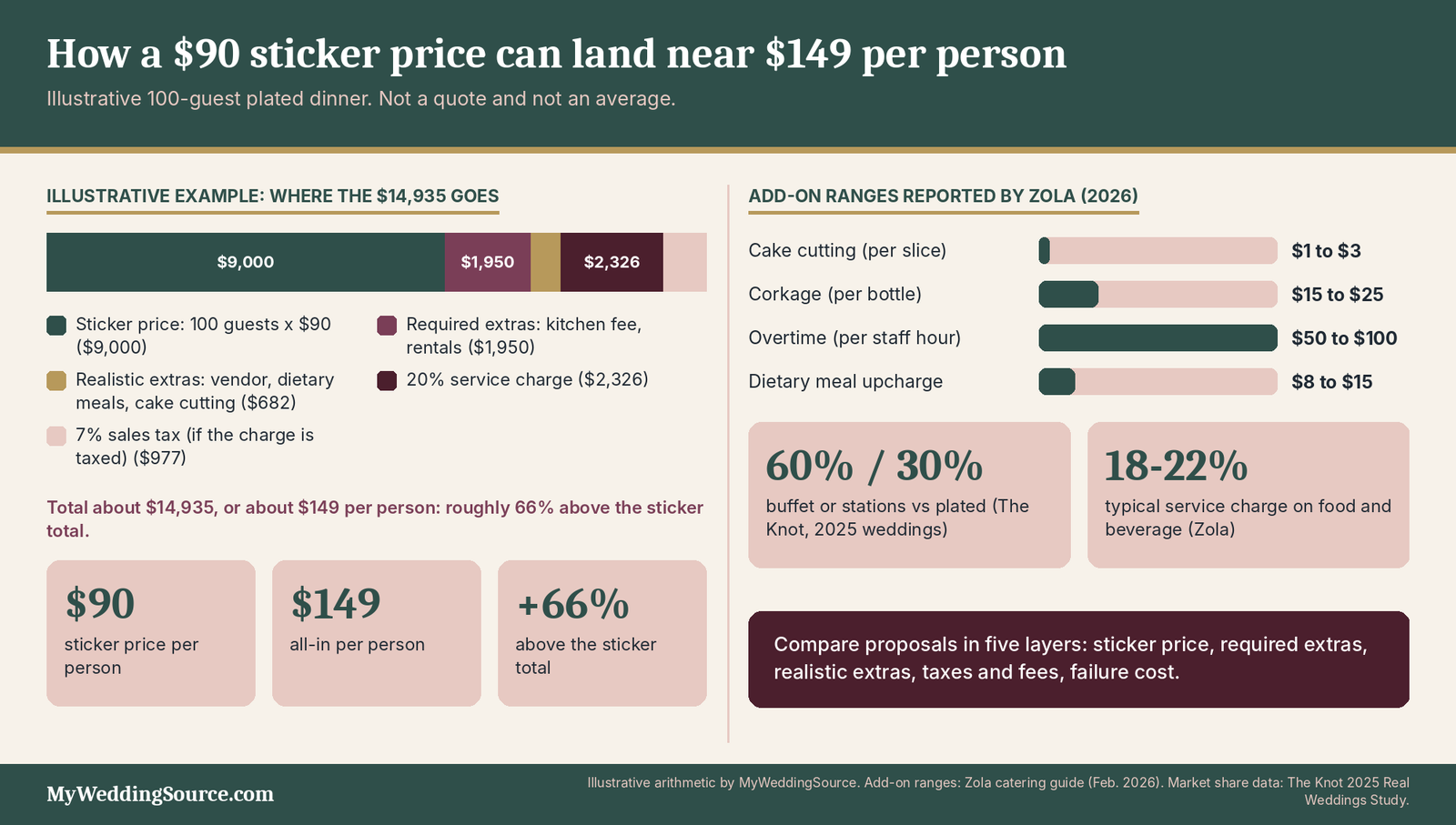
Request a “fees not listed in the proposal” answer in writing. Zola lists typical add-ons as cake cutting at $1 to $3 per slice, corkage at $15 to $25 per bottle, overtime at $50 to $100 per staff member per hour, and kitchen fees of $500 to $2,000 for outside caterers in some venues. It also reports that caterers often charge 50% to 75% of the per-person price for vendor meals, and you may be feeding 8 to 12 vendors. Ask how children’s meals, vendor meals, and dietary meals are priced, and whether a cake-cutting fee applies when the cake comes from a bakery; The Knot found that 72% of couples included a cake cutting and 76% hired a cake vendor, so this line applies to most weddings.
| Add-on to ask about | Typical range reported by Zola | Why it appears | Ask this |
|---|---|---|---|
| Cake cutting | $1 to $3 per slice | Staff time to cut, plate, and serve | Is it waived if you also supply dessert? |
| Corkage | $15 to $25 per bottle | Glassware, service, and handling for outside alcohol | Is there a cap, and does it apply to champagne for the toast? |
| Overtime | $50 to $100 per staff hour | Events that run past the contracted end time | When does the clock start and stop? |
| Tasting | $100 to $300 if not included | Ingredients and staff time | Is it credited to the contract? |
| Outside-caterer kitchen fee | $500 to $2,000 | Venue charge for using the kitchen | Who bills it, you or the caterer? |
| Dietary meal upcharge | $8 to $15 per meal | Specialized ingredients and separate prep | Is it per meal or per guest? |
Question 14: What about rentals, delivery, setup, and load-in?
Rentals, which include linens, chairs, tables, china, glassware, and flatware, are a common source of confusion because some caterers include them and others route them through a rental company. Ask who orders them, who is responsible if an item is damaged or missing, and when they are returned. Ask about delivery and setup fees, travel time for off-site venues, and any charges for stairs, long carries, or tight loading windows. A good answer includes a specific load-in time and a statement of who handles breakdown, since the question “who stacks the chairs at midnight?” is easier to settle in March than at 11:45 p.m.
How do you compare two proposals fairly?
Once you have the layers, you can build a single comparable number. The method is the same every time. It takes about twenty minutes per proposal and often changes which caterer looks like the better value.
Building a true-cost total from two proposals
Put each proposal into the same five layers: the sticker price, required extras, realistic extras, taxes and fees, and the cost if something goes wrong. Then calculate the total at your expected guest count and at a lower count, since the final number might shift. This is the “apples-to-apples” comparison that removes the pressure to choose the lowest headline. It also gives you a negotiation list, because layers that look high are the ones you can ask to adjust.
Illustrative example: a $90 sticker price that lands near $149
Here is the arithmetic for a made-up 100-guest plated dinner. This is an illustrative scenario, not a quote or an average, and it assumes the caterer applies a 20% service charge to the whole subtotal and that sales tax of 7% applies to the subtotal plus the charge; many contracts apply the charge only to food and beverage, and taxability depends on the state. Change the assumptions to match your own quotes and the picture will shift, but the pattern of fees stacking on the sticker price tends to hold.
| Layer | What is in it | Illustrative amount |
|---|---|---|
| Sticker price | 100 guests at $90 per person | $9,000 |
| Required extras | Kitchen fee $750; rentals at $12 per person $1,200 | $1,950 |
| Realistic extras | 8 vendor meals at 60% of $90; cake cutting $2 per slice; 5 dietary meals at $10 | $682 |
| Subtotal before fees | Layers 1 through 3 | $11,632 |
| Taxes and fees | 20% service charge $2,326; 7% sales tax $977 | $3,303 |
| Estimated total | About $149 per person | $14,935 |
In this example the all-in cost is about 66% above the sticker total, and the failure-cost layer is still unpriced: a 25% deposit would put roughly $3,700 at risk if the wedding were canceled, depending on the refund terms. Another caterer quoting $105 per person with rentals and staffing included might land lower. The point is to find out before you sign.
Questions 15 to 18: Staffing, the bar, and the day-of timeline
The food on the plate gets the attention, but the experience your guests have depends mostly on how many people serve it, how the bar runs, and whether the evening’s timing holds together. These four questions turn “we have a great team” into numbers, names, and times. Treat the answers as numbers to write down, since a staffing ratio or a start time is easier to compare than a description.
Who is working the room?
Staffing is the largest cost behind a catering price and the least visible. Asking for specifics lets you compare proposals on service, not just on food. The two questions here cover headcount and the bar, which are the places where proposals diverge the most.
Question 15: What is your staffing ratio for service and kitchen, and what happens if someone calls out?
Ask for the number, not the adjective. A statement like “we have plenty of staff” says nothing; “one server per 12 guests at plated dinners, one captain per 100 guests, and two kitchen leads” can be compared across companies. As an illustration only, a 120-guest plated dinner at a ratio of one server per 15 guests needs eight servers, while the same wedding at one per 10 needs twelve, and that difference shows up in both the price and in how fast the third course reaches the back tables. Ask how many staff are on the payroll versus hired for the day through an agency, how they are trained, and how the company covers a sick-call on a Saturday morning; the strongest answers include a named backup plan rather than a promise of “we always manage.”
Question 16: Who provides the alcohol and bartenders, and what are the license and pricing rules?
Bar policies vary by state, by venue, and by caterer: some caterers hold their own alcohol authorization and supply everything, some provide only bartenders while you buy the alcohol, and some venues prohibit outside alcohol altogether. Ask who holds the license or permit for your event, whether the company carries liquor liability insurance, how bartenders are trained to check IDs and manage overservice, and whether the bar is priced per person, per drink, or per bottle. Zola’s 2026 catering guide reports beer-and-wine service adding about $12 to $18 per person, with premium bars running $25 to $35, but the structure of the contract changes the real total more than the headline figure does. Our guide to open bar wedding hidden costs goes deeper on pricing models, glassware, ice, mixers, and last-call rules, so read it before comparing bar quotes.
How does the day actually run?
A timeline is a promise about the sequence and duration of events. These two questions ask the caterer to share theirs. Ask for the caterer’s version in writing and then reconcile it with your own, so the differences show up before the day.
Question 17: What is the timeline from arrival to last call?
Ask for a written run-of-show for catering that covers kitchen arrival, setup, the first-look and photo window if they affect dinner, cocktail hour service, the time guests are seated, the length of each course, toasts, cake service, any late-night snack, and breakdown. A clear plan will tell you how long dinner service takes for your guest count and style: for example, “plated service for 120 guests takes about 55 minutes from salad to entree cleared.” Ask when staff arrive, when the clock starts for billing, and when overtime begins; the contract should state both the service period and the rate that applies afterward. Share the same timeline with your photographer, planner, and DJ, since a 25-minute delay in the ceremony ripples straight through the kitchen.
Question 18: What happens to the food if the schedule slips, and how is it kept safe?
Weddings run late, and a good caterer plans for that. Ask how food is held (in warming cabinets, insulated carriers, or chafing fuel), how long it can be held without a change in quality, and who decides whether to delay a course or re-fire it. Food safety guidance from the CDC warns that bacteria multiply rapidly between 40°F and 140°F, and advises refrigerating perishable food within 2 hours, or within 1 hour when the temperature is above 90°F, so a late, hot, outdoor reception shortens the margin for cold salads and dairy-based desserts. You are not expected to inspect thermometers, but you can ask whether the team monitors temperatures and what they do when the schedule runs long. A confident answer includes specifics, such as which dishes are cooked to order and which are held.
Who is responsible for what?
The common failure in wedding logistics is not a bad vendor but a task that belongs to no one. A short responsibility matrix catches those gaps before the day. Spending thirty minutes on the matrix usually saves an awkward scramble during setup.
Use a matrix to divide responsibilities
Write down the unglamorous tasks and assign each to the caterer, the venue, a planner or coordinator, or yourselves. Doing this once, in a shared document, prevents the classic moment when the caterer assumes the venue is providing the cake plates and the venue assumes the opposite. It also gives each vendor a chance to say “that is actually not included,” which is better to learn at the planning stage. Our wedding planner questions guide explains how a coordinator can own the matrix on the day.
| Task | Caterer | Venue | Planner or coordinator | Couple |
|---|---|---|---|---|
| Rentals: linens, china, glassware | Often | Sometimes | Orders if hired | Approves |
| Alcohol permit or license | Depends on the state | Often holds it | Verifies | Confirms in writing |
| Cake delivery and service | Cuts and plates | Provides space | Confirms timing | Hires baker |
| Dietary meal labels | Prepares | Not usually | Relays list | Collects guest information |
| Vendor meals | Prepares | Not usually | Confirms count | Pays |
| Trash, cleanup, and leftovers | Contract decides | Contract decides | Checks | Asks before signing |
| Day-of timeline owner | Shares kitchen timing | Shares site rules | Owns the master | Approves |
Where the gaps usually hide
The gaps tend to appear in three places: tasks that cross two vendors, tasks that happen after the guests leave, and tasks that only matter in a surprise. Cake plates and forks, for example, require the baker, caterer, and venue to agree who supplies them. Cleanup and trash removal are easy to overlook until the venue’s contract assigns a fee for leaving anything behind. Surprises such as rain, a power trip, or a guest with a medical emergency involve a chain of calls, so ask the caterer who they call, and ask your planner who calls them.
Questions 19 to 21: Allergens, dietary needs, and food safety
This is the section where a clear question can matter more than a clear price. The goal is not to alarm anyone; most weddings serve every guest safely. But the people who are affected have a direct stake in the process, and a caterer’s willingness to explain theirs is one of the best signs you can get.
How do they handle allergies and dietary needs?
Packaged foods carry ingredient labels. A plate at a wedding does not, so the safeguard is a conversation and a process. That process should be described in the same detail as the menu.
Question 19: What is your process for guests with food allergies, from the menu to the plate?
Start with what is at stake. The FDA recognizes nine major food allergens in the U.S.: milk, eggs, fish, crustacean shellfish, tree nuts, peanuts, wheat, soybeans, and sesame, and the federal labeling law covers packaged foods, not most unpackaged food prepared and served at a catered event. Food Allergy Research & Education, or FARE, estimates that approximately 32 million people in the United States have food allergies, including nearly 11% of adults, so a 120-person wedding will probably include at least a few guests who manage one. Ask the caterer who writes the allergen information for the menu, how cross-contact is prevented (separate utensils, cutting boards, and prep areas), how the kitchen team identifies an allergy plate, and whether the chef will speak directly with a guest who has a serious allergy. A caterer who has a documented process will describe it without hesitation.
Question 20: How do you collect, count, label, and serve dietary meals?
Dietary needs go beyond allergies: vegetarian, vegan, halal, kosher, gluten-free, and medical diets all require advance planning. Ask how and when you should submit guest information, whether the caterer needs it with the final count, and how the meals are marked at service, such as a place-card code, a table list, or a plate tag. Gluten-free is worth special attention: the FDA describes “gluten-free” as a voluntary claim that manufacturers can use on food labels, which is a labeling standard for packaged products, so for a plated dish you are relying on the kitchen’s practices. Ask how the caterer handles kosher or halal requests, whether they can source certified ingredients, and whether certification requires a separate preparer. Also ask how they price the meals, as Zola reports dietary accommodations adding about $8 to $15 per special meal.
How does the kitchen keep everyone safe?
Food safety rules exist whether or not a guest has an allergy. Two questions cover the foundation. You do not need to inspect a kitchen to ask good questions, and the answers tell you how seriously the company treats routine safety.
Question 21: What food safety training and inspection history can you share?
Health departments inspect food businesses, and a caterer should be able to say who licenses their kitchen, when they were last inspected, and what certifications their lead staff hold. Many state and local rules follow the FDA Food Code, which the agency describes as a model that governments adapt rather than a federal law, and the 2022 edition made sesame the ninth major allergen and said that employee food safety training must include food allergy awareness of the nine major allergens. Because jurisdictions adopt different editions on different schedules, ask what applies in your county rather than assuming. FARE notes that under the 2022 Food Code, managers must know how to avoid cross-contact during preparation and service and must know the nine major allergens, which gives you a reasonable basis for asking the on-site lead about both.
Hot weather, buffets, and outdoor service
Outdoor receptions, summer heat, and self-serve lines change the food safety picture. The same CDC guidance noted above calls for chilling perishable food within one hour when the temperature is above 90°F, so ask how salads, seafood, dairy, and desserts are kept cold at a patio or tented venue. For buffets, ask who monitors the line, how often trays are replaced instead of topped off, and whether serving utensils are exchanged on a schedule. Our plated vs buffet comparison covers how those choices affect both cost and cross-contact risk. If your date falls in July or your venue is a field, make the cold-holding plan part of the conversation.
Questions 22 to 25: Guest counts, payments, backups, and leftovers
The final four questions live in the contract, and they decide what happens when real life departs from the plan. They are also where wording matters most, so each one asks you to find the exact clause rather than rely on a reassuring conversation. Bring a highlighter, because this is the part of the process where the details of a clause can matter more than the tone of a conversation.
How do counts and payments work?
Two numbers drive the financial side of catering: the guest count that locks in and the schedule on which you pay. Knowing both, in dates and dollars, removes most of the stress of the final weeks. Put both in your calendar on the day you sign.
Question 22: When is the final guarantee due, and what happens if the count changes?
Most caterers set a guarantee date, often one to two weeks before the wedding, after which the number of meals you pay for is fixed. The question to ask is what the contract does with a change: can the count go up after the deadline, can it go down, and what is the price per added meal? Many agreements allow small increases but not reductions, which means the number you guarantee is the number you pay for even if guests cancel. Ask how children, vendors, and dietary meals are counted, whether the guarantee applies to food only or to food and bar, and whether the caterer plans a few extra portions for late additions or no-shows. The November wedding checklist includes a short script for submitting final numbers and getting written acknowledgment.
Question 23: What are the deposit, payment schedule, and cancellation and postponement terms?
Ask for the full schedule in dollars and dates: the retainer or deposit at signing, the installments, and the final balance. Ask which payments are refundable, what percentage of the contract is owed if you cancel at six months, three months, and two weeks, and whether a postponement is treated differently from a cancellation. Ask what happens if you reduce your guest count significantly and whether the caterer can reuse your date if they rebook it. If you pay by credit card, the FTC explains that under the Fair Credit Billing Act you generally must write to your card issuer within 60 days after the first bill containing the error, and that disputes about goods or services not delivered as agreed can qualify; card protection is a backstop for a billing error, though, and it does not replace a clear refund clause. Ask whether the caterer adds a surcharge for card payments before deciding how to pay.
What if something goes wrong?
Question 24: What is your backup plan if staff, equipment, weather, or supply fails, and what if you cannot perform?
A caterer’s answer should cover four contingencies: staff illness or no-shows, equipment failure (an oven, a refrigerated truck, a generator), supply shortages, and weather at an outdoor or tented site. Ask how many backup staff the company can bring, whether it owns or leases a second set of key equipment, and who makes the call to move service indoors. Then ask the hardest version: if the company cannot perform at all, for any reason, what does the contract require? A careful clause says what is refunded, how quickly, and whether the caterer will help you find a replacement. Ask also how “force majeure” (events outside either party’s control) is defined, since the definition decides whether a storm, a closure order, or a power outage excuses a party from the contract.
Question 25: What is your policy on leftovers, cleanup, and donating extra food?
Policies differ by company and by local health code, and some caterers will not allow food to leave the event for safety reasons. Ask whether guests can take home boxed dessert or whether the kitchen packs sealed leftover entrees for the couple, and whether a late-night takeaway is a separate charge. If you want unserved food donated, ask whether the caterer has a nonprofit partner, since a federal law, the Bill Emerson Good Samaritan Food Donation Act, provides limited liability protection for good-faith donations of apparently wholesome food to nonprofits, and expressly includes caterers; the USDA’s article notes that donations made directly to individuals are not covered, and that it is not legal advice. Finally, ask who handles trash, who hauls rental returns, and how the venue’s cleanup rules interact with the caterer’s.
Reading the contract itself
A proposal describes what the caterer intends to do; the contract describes what the caterer is obligated to do. The two should match. If they diverge, the signed document is the one that governs, so fix the gap before you sign.
Clauses to verify before you sign
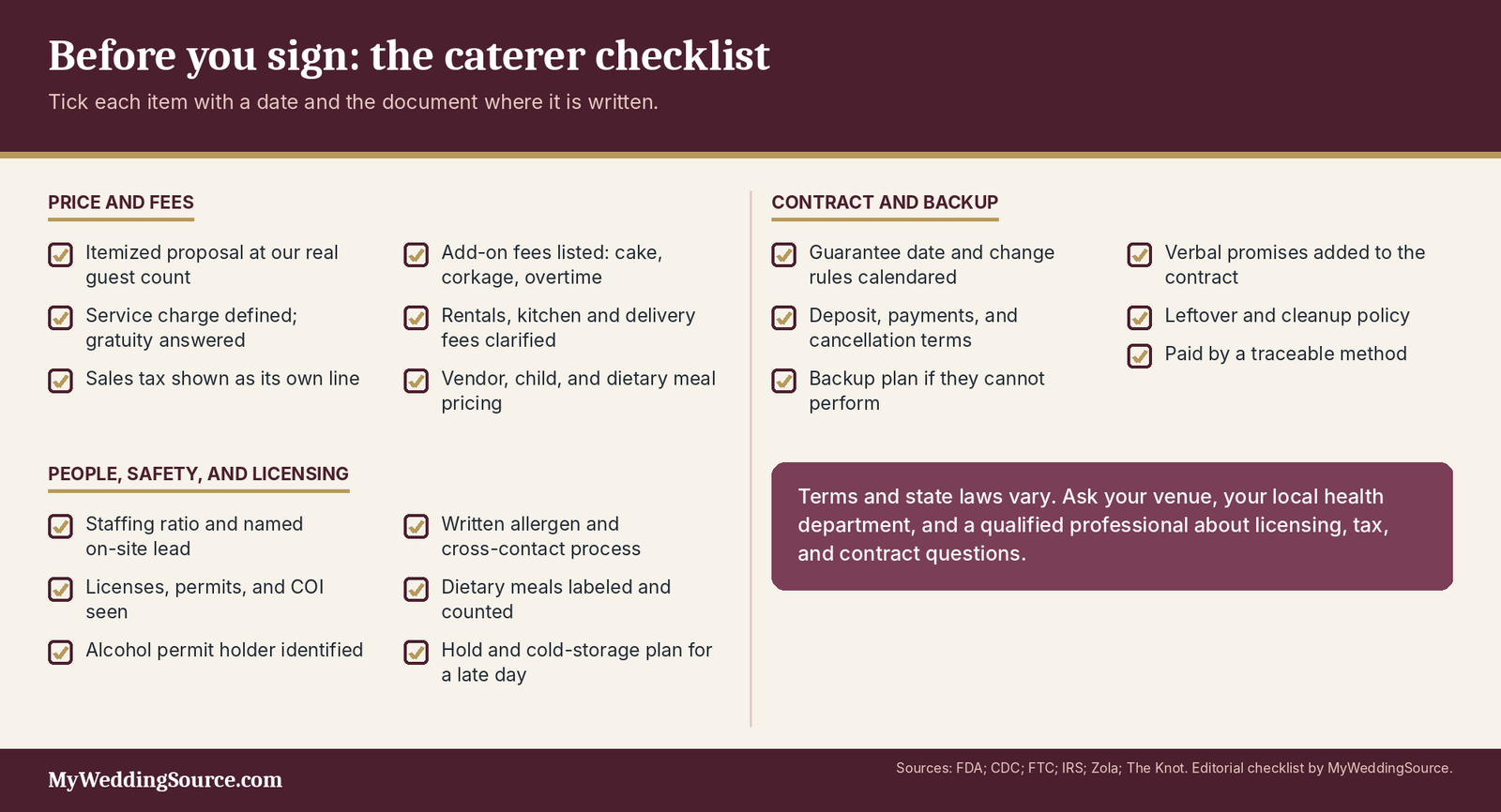
Read the contract with the question list beside it and mark each answer you were given verbally. Look for the per-person price and what it includes, the service charge definition, the tax treatment, the guarantee date, the payment and cancellation schedule, the substitution clause, the staffing and timeline commitments, the alcohol and insurance terms, and the leftover and cleanup terms. If the document says “see proposal,” make sure the proposal is attached and dated. Terms and state laws vary, and this is general education rather than legal advice; if a clause is unclear or the contract is large, a local attorney or an experienced coordinator can review it for a modest fee.
Matching the contract to what you were told
The most common mismatch is subtle: a verbal assurance such as “oh, we always waive that” that is absent from the paper. Ask the caterer to add any promised waiver, credit, or inclusion to the contract by name, or to confirm it by email that references the contract. Recheck the guest count, the date, the venue address, and the menu selections, since a typo in a headcount can carry through to the final invoice. When the signed copy arrives, save a PDF and a calendar entry for each payment date and for the guarantee deadline.
Scoring the answers: a scorecard and red flags you can use
Twenty-five answers across two or three caterers is a lot of information. A simple scorecard turns it into a decision you can explain to your partner, your parents, or your planner, and it helps you see when a charming personality is covering a weak answer. Scoring also gives you something concrete to share if another person has a say in the decision.
Build a scorecard you will actually use
Choose five categories and weight them
Group the 25 questions into five categories: fit and licensing (Questions 1 to 5), menu and tasting (6 to 10), fees and total cost (11 to 14), service and safety (15 to 21), and contract and backup (22 to 25). Score each caterer from 1 to 5 on each category, and weight the categories by what matters in your wedding: a couple with a guest who has a severe allergy may weight safety higher, while a couple on a tight budget may weight total cost. Write the weights before you score, so you do not adjust them to favor the caterer you already like. Keep one column for notes, since the quotes and phrases you record are often more useful than the number.
| Category | Questions | Suggested weight | What a 5 looks like |
|---|---|---|---|
| Fit and licensing | 1 to 5 | 15% | Date held in writing, venue experience, license and COI shown |
| Menu and tasting | 6 to 10 | 20% | Itemized price, honest tasting, clear substitution terms |
| Fees and total cost | 11 to 14 | 25% | All fees listed, tax shown, total at your real guest count |
| Service and safety | 15 to 21 | 25% | Staffing ratio in writing, documented allergen process |
| Contract and backup | 22 to 25 | 15% | Clear count, payment and cancellation terms, backup plan |
Compare totals, then compare behavior
After scoring, compare the all-in totals at your expected guest count. A caterer with a strong score and a slightly higher total may be better value than a cheaper proposal with gaps, but you should make that trade deliberately and not by accident. Then look at behavior: who answered promptly, who put things in writing without being asked, and who made you feel comfortable asking a follow-up. The way a company handles the planning phase is the best predictor available of the way it will handle the day.
Recognize green, yellow, and red answers
Most answers are not clearly good or bad. A short set of signals helps you decide when to push for clarity and when to move on. The table below sorts typical responses into three groups so that you know when to follow up.
What clear, cautious, and concerning answers sound like
A clear answer is specific, offered without prompting, and consistent between the call, the email, and the contract. A cautious answer is vague but fixable: “we usually include that” can become “it is included” with a request. A concerning answer is one that avoids the question, refuses to put terms in writing, or changes between conversations. Ask the same question twice in different words if you are unsure; consistent answers are a good sign.
| Signal | Green: clear | Yellow: ask again | Red: reconsider |
|---|---|---|---|
| Pricing | Itemized, with tax and service charge shown | Per-person number with fees “to be determined” | Refuses to itemize or says fees “come up later” |
| Allergens | Written process, chef available | “We can usually accommodate” | Dismisses the question or shifts all responsibility to guests |
| Staffing | Ratio stated with a backup plan | “Plenty of staff” with no number | Cannot say who will lead on the day |
| Licensing | Shows licenses and COI | Needs time to find them | Says permits are not needed without naming the rule |
| Contract | Matches the proposal; terms explained | Verbal promises not on paper | Pressure to sign or pay before you have read it |
When to negotiate and when to walk away
Negotiate when the issue is a line item: a fee that can be waived, a service charge that can be reduced for a Friday date, a tasting that can be credited, or a rental that can be dropped. Zola reports that Friday and Sunday events often cost 10% to 20% less than Saturday evenings, which makes date flexibility a negotiating tool. Walk away when the issue is trust: refusal to put terms in writing, inconsistent answers about licensing or allergens, or pressure tactics like a “price good only today.” Declining politely, and early, costs nothing and frees up a date for the next couple.
FAQ: Wedding caterer questions couples ask
These are the questions couples most often raise once the 25 are answered. The answers are general; confirm details with your own contract and local rules. Each answer points back to the numbered question where the topic is covered in more depth.
Pricing and tastings
How much should we budget for catering?
There is no single number, because catering interacts with your guest count, your date, your location, your service style, and your bar choices. For context, The Knot’s 2025 study reported an average total wedding cost of $34,000 and about $292 per guest, while Zola’s 2026 Wedding Cost Index put average catering at roughly $6,927 and bar services at $5,542 inside an average total of about $36,000. The two organizations survey different couples with different methods, so treat the numbers as ranges. The more reliable approach is to collect two or three itemized proposals at your real guest count and build the five-layer total from each.
Is gratuity included in the service charge?
Sometimes, and sometimes not, which is why Question 11 matters. Zola reports that service charges typically go to the company, and that couples may need to budget an additional tip for the service team. Under IRS Revenue Ruling 2012-18, whether a payment counts as a tip or as a service charge depends on factors such as whether the customer freely sets the amount, not on the label on the invoice. Ask the caterer in writing what the charge covers, whether any portion goes to staff, and whether an additional tip is expected.
Do we have to pay for a tasting?
Not always. Zola reports that tastings are often complimentary for larger weddings or bigger contracts, and that smaller events may pay $100 to $300, sometimes credited toward the final bill. Ask before you schedule, and ask whether additional guests cost extra. If a caterer charges and does not credit it, factor the fee into your comparison.
Allergies, venues, and contracts
What should we tell the caterer about a guest’s food allergy?
Share the allergen, the severity as the guest describes it, the guest’s name and table, and a contact so the chef can speak with them. The FDA recognizes nine major allergens, and packaged-food labels do not follow a plated dish to the table, so a conversation with the kitchen is the safeguard. Ask for written confirmation of how the meal will be prepared and delivered. The guest should also carry their own prescribed medication and plan, as they would at any restaurant.
Can we hire an outside caterer or a food truck at our venue?
It depends on the venue contract, which may require an in-house caterer, maintain a preferred list, or allow outside vendors for a fee. Zola notes that exclusive caterer lists can limit price shopping and some venues charge kitchen fees of $500 to $2,000 for outside caterers. Get the policy in writing before you sign with a venue, and ask whether a food truck needs its own permit, power, and insurance certificate.
What happens if the caterer cancels on us?
The answer is in the contract, which is why Question 24 asks about it directly. Look for the refund amount and timing, any help finding a replacement, and the definition of events outside the caterer’s control. If you paid by credit card, you may have additional dispute rights for services not delivered, but you must act within the deadlines and the process the FTC describes. Event cancellation insurance, bought separately by the couple, may also be worth pricing; read its exclusions carefully.
Your next steps
Twenty-five questions are only useful if you ask them. The plan below is small enough to start today. Each step below takes under an hour, and none of them commits you to a vendor.
This week
Two actions will move you from reading to comparing.
Send one brief to two or three caterers
Write a short email with your date, venue, estimated guest count, service style preference, and food-and-drink target, and ask each caterer for an itemized sample proposal, their minimum, their licensing and insurance details, and their availability. Send the identical message to all of them. If your venue is not yet booked, our wedding venues guide shows what to check in the venue contract first, and the food and catering hub lists related guides.
Build the scorecard before the tastings
Copy the five categories from the scorecard section into a spreadsheet, write your weights, and leave a notes column. Put the questions you most want answered at the top of the page, and bring it to the first call or tasting. If you are also interviewing a photographer, our wedding photographer questions guide uses the same approach, so you can reuse the template.
Before you pay a deposit
Check the paper against the answers
Compare the proposal, the contract, and your notes, line by line, and ask for corrections in writing. Confirm the per-person price, the service charge and tax, the guarantee date, the payment schedule, the cancellation terms, the allergen process, and the backup plan. Ask for the license and certificate of insurance if you have not seen them. If anything is unclear, ask a local attorney or an experienced planner to review the contract before you sign.
Pay in a way you can trace, and calendar every date
Use a method that leaves a record, such as a credit card or a check, and ask about surcharges first. Save the signed contract and the receipt together, and add the guarantee date, each payment date, and the final-confirmation call to your calendar with reminders. Share the dates with whoever helps you plan. Then book the tasting, with your scorecard in hand.
Sources & methodology
- The Knot 2025 Real Weddings Study (data read-out page) — sample size of 10,474 couples married in 2025; average and median cost, average guest count, service style shares, and cake statistics.
- Zola: Wedding Catering Costs — service style ranges, service charge and gratuity, add-on fees, minimums, tasting policies, and bar add-ons (last updated February 2026).
- Zola: What Weddings Really Cost — Zola Wedding Cost Index averages for catering, bar service, and total cost.
- FDA: Food Allergies — the nine major allergens and the scope of federal allergen labeling.
- FDA: Addition of sesame to the 2022 Food Code — allergen training and awareness provisions in the model Food Code.
- FDA: Food Code — the Food Code as a model adopted by jurisdictions.
- FDA: Gluten-Free Labeling of Foods — gluten-free as a voluntary label claim for manufacturers.
- FARE: Food allergies and restaurants — state variation and Food Code manager knowledge requirements.
- FARE: Food allergy facts — prevalence estimates for U.S. adults and the population overall.
- CDC: Food Safety Prevention — the 40°F to 140°F danger zone and the 2-hour and 1-hour chilling guidance.
- FTC: Disputing Credit Card Charges — the 60-day written notice window and the scope of the dispute process.
- IRS Revenue Ruling 2012-18 — how mandatory service charges are distinguished from tips for payroll tax.
- New York State Department of Taxation and Finance: Gratuities and service charges — one state’s sales tax treatment of mandatory gratuities and service charges.
- California ABC: License Types — an example of how a state separates caterer alcohol permits and licenses.
- USDA: Bill Emerson Good Samaritan Food Donation Act — limited liability protection for good-faith food donations, including by caterers.
- Consumer Reports: Should you buy wedding insurance? — the distinction between cancellation and liability coverage (2018 article).
Methodology. Statistics from The Knot, Zola, FARE, and the CDC are survey findings or organizational estimates, labeled with their source and year; they are context, not quotes for any caterer or location. Statements about the FDA, IRS, FTC, and state agencies are verified against the linked pages as of October 2026. The illustrative cost example, the staffing-ratio arithmetic, the scorecard weights, and the green, yellow, and red signals are editorial judgment and are not drawn from a dataset. Some figures, such as Zola’s per-person service style ranges, come from a single company’s published guide and differ from other sources.
Freshness note. Recheck the Zola and Knot cost figures each spring when new data is released, recheck the New York tax bulletin and any state rule you rely on before signing, and confirm your county’s Food Code edition and alcohol rules with your local agencies. Review the FDA and FARE allergen pages if federal rules change. Consumer Reports’ wedding-insurance prices are from 2018 and should be replaced with current quotes.