
This is precisely the gap that sends so many couples searching for wedding cake cost hidden costs after their own invoice arrives. A couple gets a quote of $4.50 a slice for a three-tier buttercream cake. They do the math against their 140-guest list and land on a comfortable $630. They book it. Three months later, the actual invoice arrives at $890. The gap breaks down into three pieces: a $150 delivery and setup fee neither remembered discussing in detail, a $75 “cake stand rental” they didn’t know they needed since their venue didn’t own one, and a $35 tasting fee applied retroactively once they’d committed. That fee is standard practice at this particular bakery, buried in a sentence on page two of a contract they’d skimmed.
None of these charges were secret, exactly. They were disclosed, technically, the way most hidden costs in wedding planning are disclosed. Present in the paperwork. Absent from the conversation that actually shaped the couple’s expectations. Closing that specific gap is what this guide exists to do.
This guide covers what a real 2026 quote typically includes, and what commonly gets billed separately. It covers the specific minimums and service fees that catch couples off guard. And it covers the food safety, allergen, and structural realities that most cake content skips entirely. Some of what drives a final invoice up is completely normal, well-documented industry practice. Some of it is a genuine warning sign worth catching before you sign anything.
Quick Answer: What a Wedding Cake Actually Costs, All In
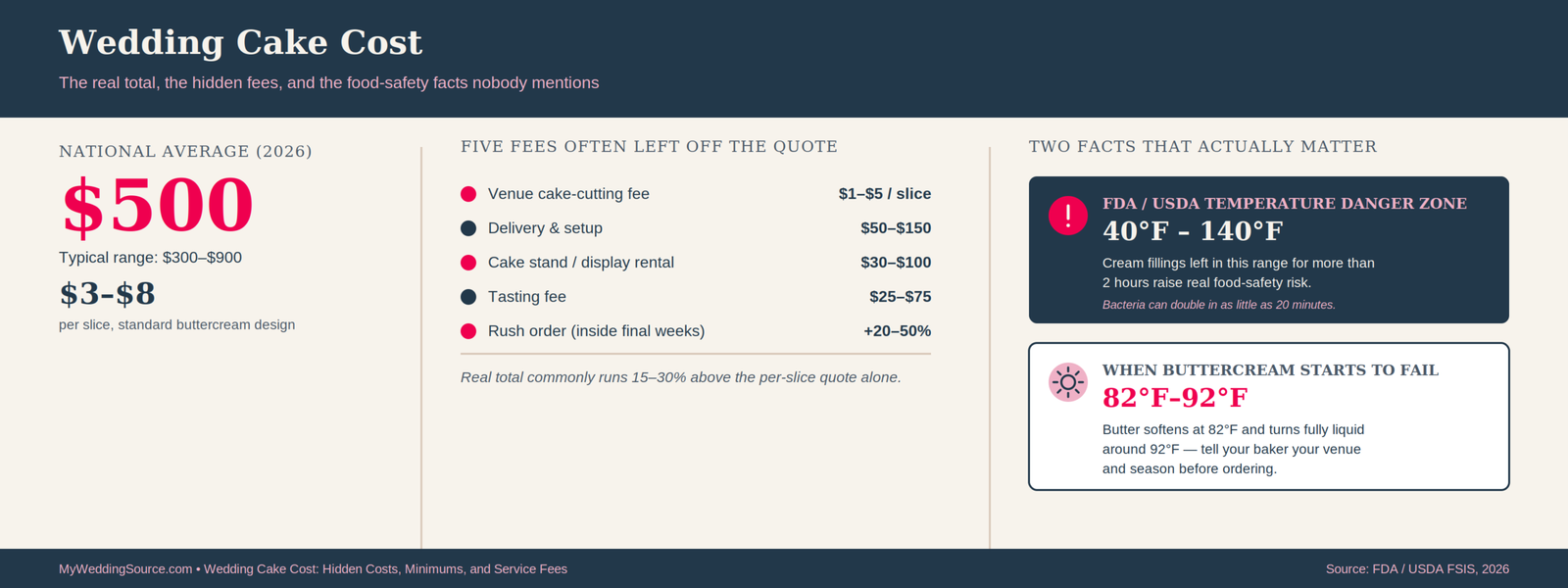
Most couples spend $300 to $900 on the cake itself for a 100-guest wedding, commonly priced at $3 to $8 per slice. That number is the starting point, though, not the total.
The real total commonly runs 15 to 30 percent higher than the per-slice quote alone. Delivery, setup, a cake stand or display rental, a tasting fee, and your venue’s separate cake-cutting fee, commonly $1 to $5 per slice, all typically sit outside the headline number.
Everything below unpacks exactly where that gap comes from, what’s genuinely standard, and what deserves a direct question before you commit a deposit.
What Nobody Mentions Until It Happens
A few realities about wedding cake pricing rarely make it into the simple, decorative version of cake shopping most couples picture beforehand.
The per-slice price and the total price are two different conversations
Bakers commonly quote per slice, which sounds simple until you realize delivery, setup, stands, and tastings frequently sit outside that number entirely, priced and billed separately.
Minimum order sizes are genuinely common and rarely advertised upfront
Some bakeries, particularly smaller or higher-demand studios, set a minimum order total or minimum guest count, regardless of your actual needs. A couple planning a 40-guest wedding can still be quoted for 75 servings if that’s the bakery’s stated floor.
Your venue’s cake-cutting fee is a completely separate line item
Many venues and caterers charge $1 to $5 per slice to cut, plate, and serve your cake, a charge that comes from the venue, not the bakery, and rarely appears in early cake-focused conversations.
Hidden Costs to Check
These are the specific line items most likely to be missing from a simple per-slice quote.
Typical add-on costs, 2026
| Item | Typical cost |
|---|---|
| Delivery and setup | $50–$150 |
| Venue cake-cutting fee | $1–$5 per slice |
| Cake stand or display rental | $30–$100 |
| Tasting fee (sometimes credited toward order) | $25–$75 |
| Rush order fee | 20–50% surcharge |
| Dietary/allergen-specific cake | +$1–$3 per slice |
Minimum order requirements
Ask directly whether your bakery has a minimum guest count, minimum dollar amount, or minimum tier count, regardless of your actual wedding size. This single question prevents a genuinely common surprise for smaller weddings.
The tasting deposit or fee
Some bakeries charge for tastings upfront, sometimes credited toward your final order if you book, sometimes not. Confirm this directly before scheduling.
Rush fees for a compressed timeline
Ordering inside the final few weeks before your wedding commonly triggers a rush surcharge, on top of standard per-slice pricing.
Delivery distance charges
A base delivery fee commonly covers a set radius, often 20 to 30 miles from the bakery, with additional mileage charged beyond that.
Before You Pay Anything
A few concrete steps before any deposit changes hands protect you from most of the surprises covered so far.
Get a fully itemized quote, not a single bundled number
Ask directly for every line item broken out separately: per-slice or total cake price, delivery, setup, stand rental, and any tasting fee. A single bundled total makes it genuinely difficult to compare against another bakery’s quote.
Confirm your venue’s cake-cutting fee before finalizing your cake budget
This is a venue charge, not a bakery charge, and it’s easy to research separately from your actual cake conversations. Get the exact per-slice rate in writing from your venue directly.
Ask about minimums before you fall in love with a specific design
If your guest count is smaller than average, confirm any minimum order requirement directly before requesting a custom design quote, since a beautiful design at a bakery with a high minimum may cost considerably more than a comparable option elsewhere.
Confirm the payment schedule and deposit terms in writing
Ask when the deposit is due, when the balance is expected, and what happens if your guest count changes closer to the wedding.
Questions That Feel Awkward but Are Worth Asking
These specific questions can feel uncomfortable to ask a vendor you’re hoping to trust, and they’re worth asking anyway.
“What’s your actual total cost, including delivery and any stand rental?”
Get a specific number, not a vague estimate, before you compare this bakery against another.
“Do you have a minimum order size or dollar amount?”
A direct, upfront answer here protects a smaller wedding from an unpleasant surprise partway through a design consultation.
“What happens if our guest count changes after we’ve placed our order?”
Confirm whether you can adjust servings later, and what the cutoff date for changes actually is.
“How do you handle allergies and cross-contact in your kitchen?”
This deserves a specific, confident answer, not a vague reassurance, particularly if a guest has a genuine, severe allergy. This is covered in more detail later in this guide.
“What’s your plan if the cake is damaged during delivery?”
A reputable bakery should have a clear answer here, ideally backed by their own contingency plan or insurance.
Green, Yellow, and Red Flags
Not every uncomfortable moment in this process is a genuine warning sign. Here’s how to tell the difference.
Green flags
- A fully itemized quote provided without you having to ask twice
- A clear, upfront answer about minimums, if any apply
- A specific, confident answer about allergen and cross-contact procedures
- A documented plan for delivery, setup, and what happens if something goes wrong
- Willingness to discuss your specific venue’s conditions, including heat or humidity risk
Yellow flags: normal industry practice, worth a direct conversation
- A tasting fee, common, confirm whether it’s credited toward your final order
- A minimum order requirement, standard at many bakeries, confirm the exact threshold
- A rush fee for a tight timeline, standard, confirm the exact percentage
- Limited availability during peak wedding season, normal, plan around it
Red flags worth taking seriously
- No written quote offered, even after you ask directly
- Vague or dismissive answers about allergen handling
- Pressure to pay the full balance far in advance with no contract
- No clear plan for what happens if the cake is damaged or delayed
- Refusal to discuss how they handle heat or humidity risk for your specific venue
What the Contract May Not Make Obvious
Even a written agreement can leave real gaps worth checking directly.
Confirm the exact serving count, not just the tier count
“Three tiers” doesn’t tell you how many guests it actually serves. Different bakers size and cut tiers differently. Get the specific serving count in writing, matched against your actual guest list.
Confirm what’s included in delivery versus what’s a separate charge
Some contracts bundle delivery and setup into one fee; others itemize them separately. Get the specific breakdown in writing before comparing quotes.
Confirm the cancellation and refund policy
Ask directly what happens to your deposit if your wedding is postponed or canceled, and get this answer in writing before you need it.
Confirm who’s responsible if the cake is damaged before serving
Ask directly whether the bakery carries liability coverage for delivery-related damage, and what recourse you have if something goes wrong on their end.
Serving Size and Portions: Getting the Real Number Right
This is one of the more genuinely confusing parts of cake ordering, worth understanding clearly before you commit to a size.
A standard wedding slice is smaller than most people picture
A standard serving is a 1-inch by 2-inch piece, considerably smaller than the generous slice you might cut at home. This is why a cake serving 100 guests looks smaller than many couples expect.
Order for your actual confirmed guest count, plus a small buffer
Plan for 5 to 10 percent more servings than your exact headcount, since some slices get cut larger in practice and some guests return for seconds.
Dessert-only guests versus full-meal guests can affect your real number
If you’re also serving a dessert bar or other sweets alongside the cake, you may need fewer full servings than your total guest count, worth discussing directly with your baker.
Display cake plus sheet cake: a genuinely common strategy
Many couples order a smaller, elaborately decorated display cake for the cutting photo, paired with a plain sheet cake cut in the kitchen for actual serving. This gets the visual impact without tier-pricing every single slice.
Pricing, Design, and Labor: What Actually Drives the Number
Beyond the base per-slice rate, several specific factors shift your total meaningfully.
Design complexity is the single biggest driver
Hand-piped detail, sugar flowers, and elaborate finishes take genuine skilled time to execute, reflected directly in cost. A clean, simple buttercream finish is considerably faster, and less expensive, than intricate decorative work.
Buttercream versus fondant
Buttercream commonly costs $1 to $2 less per slice than fondant, while also being many people’s genuine flavor preference. Fondant creates a smoother, more sculptural finish at a real cost premium.
Tier count and total servings
| Tiers | Typical cost | Serves roughly |
|---|---|---|
| 1 tier | $120–$250 | 20–30 guests |
| 2 tiers | $200–$600 | 30–60 guests |
| 3 tiers | $300–$850 | 75–175 guests |
| 4 tiers | $600–$1,200+ | 120–200 guests |
Baker reputation and location
An established studio with strong demand charges more than a newer baker offering genuinely comparable skill. Major metro areas typically run higher than smaller markets.
Flavor, Fillings, and Dietary Planning for a Mixed Guest List
Flavor and filling choices affect both cost and genuine guest experience, worth planning deliberately.
Classic flavors sit at the lower end of most pricing
Vanilla and chocolate remain the most universally appealing options and commonly the least expensive, since they don’t require specialty ingredients or extra preparation steps.
Specialty flavors and multiple fillings add real cost
Fresh fruit purees, multiple filling layers, and premium ingredients like imported chocolate commonly add $1 to $3 more per slice, worth factoring into your budget if a specific flavor combination matters to you.
Gluten-free and vegan options have genuinely improved, at a real premium
Most experienced bakers now offer credible gluten-free and vegan cake options, commonly $1 to $3 more per slice, reflecting specialized ingredients and, ideally, dedicated preparation space to prevent cross-contact.
You don’t need your entire cake to accommodate every dietary need at once
A small, dedicated allergy-friendly or dietary-specific cake alongside your main cake is often more practical and less costly than making your whole order accommodate every possible restriction.
Delivery, Setup, and Handoff: The Logistics Nobody Photographs
This is genuinely where a lot of hidden cost and hidden risk lives, worth its own detailed section.
Confirm your venue’s actual delivery access
Stairs, narrow hallways, and limited loading access can all affect delivery logistics and, in some cases, trigger an additional fee. Confirm this directly with both your baker and venue before the wedding day.
Confirm refrigeration and display timing
Ask your baker how long the cake can safely sit at room temperature before serving, and confirm your venue has adequate refrigeration space if the cake arrives well before the reception starts.
Confirm exact table placement and timing with your venue directly
A cake delivered to the wrong location, or too early relative to setup, can create real logistical headaches on an already busy day. Confirm this specific detail with your coordinator or venue contact.
Confirm who signs off on the handoff
Designate someone other than the couple, a coordinator or trusted family member, to inspect and accept the cake at delivery, confirming it matches the order before the baker leaves.
Allergens and Food Safety: What the FDA Actually Says
This is the section most wedding cake content skips entirely, and it genuinely matters, both for cost planning and for guest safety.
The temperature danger zone applies directly to cream-based fillings
The FDA and USDA define the temperature danger zone as 40°F to 140°F, the range where bacteria grow most rapidly, doubling in as little as 20 minutes. Foods in this zone for more than two hours should not be consumed. Cream cheese frosting, custard fillings, and fresh dairy fillings all fall under this rule, meaning your cake’s actual time sitting at room temperature genuinely matters, not just its taste or appearance.
Ask your baker directly how long your specific cake can safely sit out
A cake with a stable buttercream or fondant exterior and a shelf-stable filling has more flexibility than one with a fresh cream or custard filling. Confirm your specific cake’s real safety window, and plan your reception timeline around it.
Allergen cross-contact is a genuine, documented risk in bakery settings
According to the FDA, bakery products are among the food categories most frequently involved in allergen-related recalls, with milk representing the most common undeclared allergen across all food categories. The FDA’s food safety rules require facilities to maintain written procedures specifically preventing allergen cross-contact between products.
Ask specific, direct questions about cross-contact, not just ingredient lists
A bakery can honestly say a specific cake “doesn’t contain nuts” while still processing nut-containing products on shared equipment. For a guest with a genuine, severe allergy, ask directly about shared equipment, shared workspace, and specific cleaning protocols between orders.
Communicate known severe allergies to your caterer and coordinator too, not just your baker
If a guest has a severe allergy, make sure everyone serving or handling the cake on the actual day knows about it, not just the person who baked it weeks earlier.
Heat, Humidity, and Structural Risk: The Science Behind a Melting Cake
This deserves genuine technical explanation, not just a vague warning about “hot weather.”
Butter has a specific, known melting behavior
Butter softens noticeably around 82°F and turns fully liquid around 92°F. Since most buttercream is butter-based, a cake sitting in genuine heat isn’t being dramatic when it starts to sag; it’s following predictable physics.
Buttercream and fondant fail for different reasons
Buttercream’s enemy is heat directly, since its fat content softens and eventually melts. Fondant’s enemy is humidity specifically, since it’s primarily sugar and readily absorbs moisture from the air, becoming sticky, soft, and prone to collapsing in a humid environment even without extreme heat.
Structural support matters as much as recipe
A well-built cake uses internal dowels and support boards to handle real-world conditions. An experienced baker builds a cake for your specific venue’s actual conditions, not a generic recipe, which is exactly why telling your baker your venue and season matters.
Tell your baker your venue, season, and expected conditions directly
A baker who knows your reception is outdoors in August can adjust the recipe, structure, and even flavor stability accordingly. This single conversation prevents the majority of structural wedding cake disasters covered throughout wedding planning content.
Keep the cake indoors and away from direct sun, even briefly
Cakes have genuinely melted from sitting too close to a sunny window indoors, not just from outdoor heat directly. Confirm your cake’s display location avoids direct sun exposure, regardless of whether your reception itself is indoors or outdoors.
Safety Check
Beyond allergens and temperature, a few additional safety considerations deserve direct attention.
Non-edible decorations need explicit labeling
Some decorative elements, certain florals, wires supporting sugar flowers, or decorative picks, aren’t meant to be eaten. Confirm directly with your baker which elements need to be removed before serving, and communicate this to whoever cuts the cake.
Fresh flowers on a cake need food-safety vetting too
Not every flower is food-safe, and some require a barrier between the bloom and the cake itself. Confirm your baker or florist has specifically vetted any fresh flowers touching the cake.
Alcohol-infused fillings deserve clear labeling for guests
If any tier or flavor contains alcohol, make sure this is clearly communicated to guests, particularly relevant for anyone avoiding alcohol for health, religious, or personal reasons.
Scam Check
Most wedding cake bakers are legitimate, skilled professionals. A small number of patterns are worth genuine caution.
Pressure to pay the full balance far in advance with no written contract
A legitimate baker typically works on a deposit-plus-balance structure with clear written terms, not full payment demanded upfront with nothing in writing.
No verifiable business presence or portfolio
A baker with no reviews, no verifiable business history, and no real examples of past wedding cakes deserves real caution, particularly for a significant order this close to your wedding date.
Refusal to provide anything in writing
A consistent refusal to put pricing, minimums, or policies in writing, even after you ask directly, is a genuine reason to look elsewhere.
Report a genuine concern through the right channel
For food safety concerns specifically, the FDA’s Food Safety Modernization Act resources outline current federal food safety standards and how concerns get addressed.
Guest Experience Check
A few considerations affect how your cake actually lands with the people eating it, not just how it looks.
Confirm serving happens promptly once cutting begins
A cake that sits cut and exposed for an extended period can dry out or, for temperature-sensitive fillings, raise the food-safety timing concerns covered earlier. Confirm your catering team serves cut cake promptly.
Consider a clearly labeled dietary station if you have several accommodations
If you’re serving gluten-free, vegan, or allergen-specific options alongside your main cake, clear labeling helps guests self-select confidently without needing to ask and potentially feel singled out.
Cutting order matters for a smooth guest experience
Confirm with your caterer whether cake gets served table by table or as a self-serve station, affecting both timing and how quickly guests actually get their slice.
Accessibility Check
A few specific considerations deserve direct attention for a genuinely inclusive cake experience.
Confirm serving format works for guests with dexterity limitations
A fork-free option, like individually portioned cake bites, can help guests with limited hand mobility enjoy dessert alongside everyone else.
Clear allergen and ingredient labeling supports guests with visual impairments too
Large-print or clearly spoken labeling at a dessert station helps guests who can’t easily read small standard signage make informed, confident choices.
Confirm your cake table itself is physically accessible
If cake gets served from a display table, confirm the table height and surrounding space work for a guest using a wheelchair or other mobility device.
Weather Check
Beyond the heat and humidity science covered earlier, a few additional weather-specific logistics deserve attention.
Confirm your baker’s actual delivery contingency for severe weather
Ask directly what happens if a storm or extreme heat affects delivery timing or road conditions on your wedding day.
An outdoor cake display needs a genuine shade and cooling plan, not just “we’ll figure it out”
Confirm specifically where the cake will sit, how it’s shaded, and how long it will realistically be displayed before serving, given the heat and humidity risks covered earlier in this guide.
Have a backup indoor location identified, even for an indoor reception
Air conditioning failures happen. Knowing a genuinely cool backup spot for your cake, even briefly, is a reasonable precaution rather than an overreaction.
Legal Check: Consumer Protection Basics Worth Knowing
General consumer protection principles apply to bakery contracts, though specifics can vary by state.
A written estimate creates real accountability
In many states, a written contract for services functions as a meaningful reference point if a dispute arises, giving you documented terms rather than relying on memory of a verbal conversation.
Food safety regulation happens at multiple levels
Federal guidance through the FDA sets baseline food safety standards, while state and local health departments typically license and inspect bakeries directly. A legitimate bakery should hold current local health department licensing, worth confirming if anything feels uncertain.
Where to go if something genuinely goes wrong
For a significant dispute, your state’s consumer protection office and, for food-safety-specific concerns, your local health department are appropriate resources alongside the FDA’s food safety guidance.
What Pinterest and Styled Photos Don’t Show You
A beautifully styled wedding cake photo captures one perfect moment, not the actual logistics or cost behind it.
Styled shoots often happen in climate-controlled studios, not real wedding conditions
A cake photographed indoors under controlled lighting and temperature doesn’t reveal how that same design would hold up during a real outdoor summer reception, exactly the heat and humidity risk covered earlier in this guide.
The photo doesn’t show the delivery van, the setup time, or the coordination behind it
An effortless-looking cake display represents real logistics: careful transport, precise setup timing, and coordination between baker, venue, and coordinator, none of which is visible in the final photo.
Some elaborate cakes in styled content aren’t fully edible
A dramatic, multi-tier showpiece in a styled photo sometimes uses non-edible dummy tiers for height and visual impact, a detail that affects both apparent cost and practical feasibility if you’re trying to recreate the exact look.
A Realistic Scenario: How the Story at the Start of This Guide Could Have Gone Differently
Return to the couple from the opening of this guide, quoted $630, invoiced $890, once delivery, a stand rental, and a retroactive tasting fee were added.
What an itemized quote request would have changed
Asking directly for every line item, delivery, setup, stand, tasting fee, before booking would have surfaced the real total upfront, letting them compare it honestly against other bakeries’ all-in pricing.
What confirming the tasting fee policy would have changed
A direct question, “is this tasting fee credited toward my order, and when is it charged,” would have prevented the retroactive surprise entirely.
This doesn’t mean the bakery acted in bad faith
Every individual fee was standard practice at this specific bakery, disclosed in the contract. The actual issue was a conversation that never happened clearly, not a hidden scheme.
Worst-Case Scenario, and the Backup Plan
Worth naming plainly, since knowing the realistic worst case actually reduces anxiety more than avoiding the topic does.
The worst realistic case: a cake that fails structurally on the wedding day itself
This is rare with an experienced baker who’s been told your actual venue conditions, but it happens, particularly with an inexperienced baker or a genuinely extreme weather day.
The backup plan
Keep your baker’s day-of contact information easily accessible, and ask in advance whether they offer any emergency repair service. For a severe failure, some venues or caterers can provide a simple backup dessert on short notice, worth asking about during your original venue walkthrough.
This is a low-probability scenario, not a reason for ongoing anxiety
The overwhelming majority of wedding cakes arrive, display, and serve exactly as planned. This section exists for the rare exception, not as a prediction.
Comparing Multiple Bakery Quotes Fairly
Once you have quotes from a few bakers, comparing them accurately takes more structure than comparing headline numbers alone.
Confirm each quote covers the same actual scope
One baker’s price might include delivery and setup; another’s might not. Confirm exactly what’s included in each quote before comparing per-slice rates side by side.
Normalize for serving count, not just tier count
As covered earlier, tier count alone doesn’t tell you actual servings. Confirm each quote’s real serving count matches your guest list before comparing value.
Weigh portfolio, reviews, and communication style alongside price
The least expensive quote isn’t automatically the wrong choice, and the most expensive isn’t automatically the right one. A baker who answers your allergen and logistics questions clearly and confidently is telling you something real about the experience ahead.
Three Realistic Budget Scenarios
Numbers in the abstract are harder to apply than a concrete example. Here are three genuinely realistic, composite scenarios.
Scenario one: a simple, budget-conscious order
A couple with 60 guests orders a two-tier buttercream cake, confirms there’s no minimum order issue, and skips the stand rental since their venue already owns one. Total cost: $340, including delivery, confirmed in writing with no surprises.
Scenario two: a mid-range order with real dietary needs
Another couple with 130 guests orders a three-tier cake with one gluten-free tier for several guests with celiac disease, confirmed with the baker’s specific cross-contact protocol in writing. Total cost: $780, including the dietary premium, delivery, and setup.
Scenario three: an outdoor summer wedding with real heat risk
A third couple, marrying outdoors in July, tells their baker directly about the venue and season. Their baker recommends a stabilized buttercream recipe and reinforced internal structure, adding $60 to their original estimate, a cost they understand and accept because it directly prevents the structural risk covered throughout this guide.
The difference between a smooth experience and a frustrating one in all three scenarios wasn’t the price. It was whether the full scope, minimums, delivery, dietary needs, and venue conditions, was discussed clearly before any deposit changed hands.
Your Wedding Cake Cost Checklist
- ☐ Fully itemized quote obtained, all fees included: ____________
- ☐ Minimum order requirement confirmed directly: ____________
- ☐ Venue’s cake-cutting fee confirmed separately: ____________
- ☐ Tasting fee policy confirmed in writing: ____________
- ☐ Allergen and cross-contact procedures confirmed directly: ____________
- ☐ Venue conditions (heat, humidity, season) shared with baker: ____________
- ☐ Delivery, setup, and handoff logistics confirmed with venue: ____________
- ☐ Final guest count and serving size confirmed before deadline: ____________
- ☐ Backup plan identified for delivery or structural issues: ____________
Frequently Asked Questions
What are the real wedding cake cost hidden costs most couples miss?
Delivery and setup fees, a cake stand rental, a tasting fee sometimes applied retroactively, and your venue’s separate cake-cutting fee, commonly $1 to $5 per slice, are the most commonly missed costs.
How much does a wedding cake actually cost in 2026?
Most couples spend $300 to $900 for the cake itself at a 100-guest wedding, commonly $3 to $8 per slice. The real total, including delivery and other add-ons, commonly runs 15 to 30 percent higher.
Do wedding cake bakers have minimum order requirements?
Many do, particularly smaller or high-demand studios. Confirm this directly before requesting a custom design quote, especially for a smaller wedding.
What is the cake-cutting fee, and do I have to pay it?
Many venues and caterers charge $1 to $5 per slice separately from the bakery cost, for cutting, plating, and serving your cake. This is genuinely common, worth confirming directly with your venue.
How long can a wedding cake safely sit out before serving?
This depends on the filling. Cream cheese frosting, custard, and fresh dairy fillings fall under the FDA’s temperature danger zone rules, meaning more than two hours at room temperature between 40°F and 140°F raises real food safety concerns. Ask your baker for your specific cake’s safe window.
Why does my wedding cake need to know my venue’s conditions?
Heat and humidity affect buttercream and fondant differently, and an experienced baker adjusts recipe and structure based on your actual venue and season, genuinely preventing most structural cake failures.
How do bakeries handle allergies and cross-contact?
This varies by bakery. Ask directly about shared equipment, shared workspace, and specific cleaning protocols, since a cake can technically not contain a specific allergen while still carrying real cross-contact risk from a shared kitchen.
Is it normal for a bakery to charge a tasting fee?
Yes, commonly $25 to $75, sometimes credited toward your final order if you book. Confirm the specific policy directly before scheduling.
What should I do if my cake arrives damaged?
Contact your baker immediately, document the damage with photos, and confirm your contract’s specific policy for this situation, ideally established before you ever needed it.
Can I negotiate a wedding cake quote?
Some room exists, particularly around package inclusions or timing, though a well-established baker with strong demand may have less flexibility on the base rate. It costs nothing to ask directly.
What’s the single biggest mistake couples make with wedding cake budgeting?
Comparing bakeries by per-slice price alone, without confirming delivery, setup, minimums, and the venue’s separate cutting fee, then discovering the real total only once the final invoice arrives.
Communicating With Your Baker: A Few Habits That Prevent Most Problems
Beyond the specific questions covered earlier, a few general communication habits genuinely reduce your risk of a bad experience.
Get everything meaningful in writing, every time
A verbal promise about price, flavor, delivery, or fees should appear in your written contract or a follow-up email, not relied on from memory alone months later.
Tell your baker your venue and season upfront, not as an afterthought
This single piece of information, covered throughout the heat and humidity section of this guide, genuinely shapes how your specific cake gets built.
Address a concern directly and early, not after it’s compounded
If something feels off, an unclear fee, a vague answer about allergens, raise it directly and early rather than hoping it resolves itself before the wedding.
Keep a simple record of every conversation
A quick note after each call or email, what was discussed, what was promised, prevents genuine confusion later if questions come up.
A Few Wedding Cake Myths Worth Dropping
“A higher price always means better quality”
Price reflects location, overhead, and demand as much as it reflects skill. A genuinely talented newer baker can offer comparable, or better, work at meaningfully lower cost.
“If it’s not on the price list, it’s not a real cost”
As this entire guide has shown, minimums, delivery, stand rental, and tasting fees are all genuinely common, even when they don’t appear on a simple advertised per-slice rate.
“Weather only matters for outdoor weddings”
Indoor receptions with unreliable air conditioning, or a cake displayed near a sunny window, face real heat risk too, covered directly in this guide’s structural science section.
“Any bakery can safely handle a severe allergy if you just ask”
Genuine cross-contact prevention requires specific protocols, not just good intentions. Ask direct, specific questions rather than accepting a general reassurance.
Regional and Seasonal Pricing Differences
The national ranges throughout this guide tell only part of the story, since when and where you’re getting married genuinely shifts the number.
Major metro areas commonly run higher
Coastal cities and major metro areas generally see wedding cake pricing above the national average, reflecting both higher business overhead and stronger local demand.
Peak wedding season means busier bakers and less flexibility
Late spring through early fall remains peak wedding season across most of the country, meaning popular bakers book up faster and pricing tends to sit at the higher end of the ranges covered throughout this guide.
Summer weddings carry real structural risk premiums too
As covered in this guide’s heat and humidity section, a summer wedding, particularly outdoors, may require additional structural reinforcement or a stabilized recipe, a real, legitimate cost addition beyond simple seasonal demand pricing.
Get a local quote rather than assuming the national average applies directly
Use the figures throughout this guide as a planning baseline, then confirm actual current pricing with bakers in your specific area before finalizing your cake budget.
Timeline: When to Actually Order Your Cake
Wedding cakes need less lead time than a bridal gown, but genuine planning still matters.
Book your baker 4 to 6 months out for most weddings
Popular bakers, particularly for peak wedding season dates, can book up considerably earlier than this. If a specific baker’s work genuinely matters to you, reach out as soon as your date and venue are confirmed.
Finalize design and flavor 2 to 3 months before the wedding
This gives your baker real time to source specific ingredients without a rush, and gives you time to schedule and attend a tasting comfortably.
Confirm your final guest count as close to the deadline as possible
Most bakeries need your final serving count 2 to 4 weeks before the wedding. Confirm your specific baker’s exact deadline directly.
Destination Wedding Cake Considerations
A destination wedding changes the cake conversation meaningfully, worth its own direct attention.
Local baker versus transporting a cake is rarely a real choice
Given the heat, humidity, and structural risks covered throughout this guide, transporting a finished cake any real distance, especially internationally, is genuinely impractical. Plan to work with a local baker at your destination.
Confirm local food safety standards and licensing
Food safety regulation varies by country. Ask your destination baker directly about their local health licensing and food safety practices, since the FDA standards covered throughout this guide apply specifically within the United States.
Climate at your destination deserves the same direct conversation covered earlier
A tropical or high-humidity destination requires the same explicit conversation about structural reinforcement and stabilized recipes as any domestic summer outdoor wedding.
Alternative Dessert Options: A Brief Cost Comparison
A tiered cake isn’t the only dessert path, worth a brief, honest comparison.
| Option | Typical cost per person |
|---|---|
| Traditional tiered cake | $3–$8 |
| Cupcakes | $2–$6 |
| Dessert bar | $5–$11 |
Cupcakes and dessert bars carry fewer heat and humidity risks than a tall tiered cake, worth considering directly if your wedding is outdoors in genuinely challenging conditions.
A Glossary of Wedding Cake Terms
| Term | Plain-language meaning |
|---|---|
| Dummy tier | A non-edible foam form, decorated to match, used to add height without added cost |
| Sheet cake backup | A plain cake cut in the kitchen to serve guests, paired with a smaller display cake |
| Temperature danger zone | The 40°F–140°F range where bacteria grow most rapidly in food |
| Cross-contact | Unintended transfer of an allergen from one food or surface to another |
| Dowel | An internal support rod keeping upper tiers from sinking into lower ones |
| Stabilized buttercream | A buttercream recipe adjusted to better resist heat and humidity |
A Note on Working With a Wedding Planner for This Category
If you’re working with a planner, cake logistics is one category where their existing relationships can genuinely help.
Planners often know which local bakers handle heat and humidity well
An experienced planner has typically seen which bakers in your specific region build genuinely reliable cakes for your actual climate, valuable insight beyond a general online search.
Confirm who’s managing delivery-day logistics
If your planner is coordinating cake delivery and setup, confirm exactly who inspects and signs off at handoff, so accountability stays clear if any issue arises.
This doesn’t replace your own direct review of the contract
Even with a trusted planner involved, review the written agreement yourself using the questions and checklist throughout this guide. It’s your deposit and your name on the contract.
More Direct Answers
Should we tell our baker about a guest’s severe allergy even if they’re not the one eating cake near others?
Yes, always communicate a known severe allergy clearly, both to your baker during ordering and to whoever serves the cake on the actual day, regardless of seating arrangements.
Is it worth paying extra for a stabilized buttercream recipe?
For an outdoor or genuinely warm-weather wedding, yes. This directly addresses the heat-related structural risk covered throughout this guide and is considerably cheaper than an emergency fix on the day itself.
What if our venue doesn’t have a refrigerator for the cake?
Confirm this directly with your baker in advance, since it affects both delivery timing and how long the cake can safely sit before serving, tied to the food safety window covered earlier.
Do dummy tiers actually save real money?
Yes, meaningfully, since you’re paying for decoration and structure rather than a full tier of cake and filling. This is a completely legitimate way to achieve a tall, dramatic look at lower cost.
Should we ask our caterer or our baker about the cake-cutting fee?
Ask your venue or caterer directly, since this is typically their charge, separate from anything your baker controls.
A Final Word on Reading Your Specific Agreement Carefully
Every principle in this guide points toward the same underlying habit: read what you’re actually agreeing to, and ask direct, specific questions about anything unclear, before any deposit changes hands.
A specific final check before you sign or pay a deposit
Reread your written quote one more time before paying, confirming it matches everything discussed verbally, including delivery, minimums, and dietary accommodations.
Keep copies of everything, digitally and on paper if possible
A photo of your written agreement, saved to your phone and backed up elsewhere, ensures you have access to it even if the original gets misplaced during a genuinely busy planning season.
This diligence protects a good relationship, not just guards against a bad one
Clear documentation isn’t about assuming your baker will act in bad faith. It’s about giving both of you a shared, reliable reference point, the same practice that protects any professional relationship involving a significant service and a real deadline.
A Note on Multi-Event Cake Needs
Some celebrations involve more than one event, each potentially needing its own cake or dessert consideration.
Rehearsal dinners and welcome events often call for something simpler
These pre-wedding events commonly need a smaller, less elaborate dessert than your main wedding cake, worth budgeting and ordering as its own separate line item.
A groom’s cake, if you’re including one, is its own separate order
This Southern-origin tradition, a smaller, often more personalized cake, commonly costs $1 to $8 per slice depending on size and design, worth planning as its own distinct budget line, not folded into your main cake estimate.
Budget each event’s dessert separately for a clearer overall picture
Treating each event as its own line item, rather than one combined estimate, prevents a genuine scramble as multiple events approach and helps you see your true total dessert spending clearly.
A Closing Thought on Value Versus Price
Every number in this guide describes what a wedding cake commonly costs. None of it describes what a genuinely well-built, well-communicated cake experience is actually worth. A baker who asks about your venue’s conditions, explains allergen protocols clearly, and gives you an honest, complete quote upfront is providing something real beyond the cake itself: a predictable, trustworthy experience during a week that already has enough moving pieces.
Approach this process with the same combination this guide has modeled throughout: genuine warmth toward a professional doing skilled, often underappreciated work, paired with the same direct, specific questions you’d bring to any other significant purchase. Both things can be true at once, and holding them together is what actually protects you, start to finish, from the first tasting through the final slice served.
A Realistic Timeline Recap
| Timeframe | What happens |
|---|---|
| 4–6 months before | Book your baker; confirm minimums and get an itemized quote |
| 2–3 months before | Finalize design and flavor; share venue and season details |
| 2–4 weeks before | Confirm final guest count and serving size |
| 1 week before | Confirm delivery time, access, and point of contact |
| Wedding day | Cake delivered, inspected, and ready for display |
This timeline is a genuinely reliable default for most weddings, though your specific baker’s actual requirements always take priority over this general guide. Confirm their exact deadlines directly once you’ve booked.
One Last Practical Note on Choosing Confidently
None of the guidance in this article is meant to make a genuinely routine cake order feel fraught. The overwhelming majority of wedding cakes arrive on time, look beautiful, and serve exactly as planned, with no dispute over cost or structure at all. This guide exists for the exceptions, and for the peace of mind that comes from knowing exactly what to ask before you sign.
Choose a baker who answers your questions directly, puts real numbers and policies in writing without being asked twice, and treats your specific venue and dietary needs as genuinely worth planning around. That combination, more than any single price point in this guide, is what actually predicts a smooth experience from your first tasting through the final slice.
A Note on Sustainability and Local Sourcing
Some couples factor environmental and local-economy considerations into their cake decision, worth genuine mention.
Local, independent bakers support your local economy directly
Choosing an independent local bakery over a large chain keeps your spending within your community, a real consideration for couples who prioritize this.
Seasonal, local ingredients can reduce environmental impact
A baker sourcing seasonal fruit and local dairy where possible genuinely reduces the environmental footprint of your cake compared to out-of-season, shipped ingredients.
Ask directly if sourcing genuinely matters to you
A baker’s specific answer about where ingredients come from tells you more than a general “locally sourced” marketing claim alone. Ask directly rather than assuming.
Final Thoughts on Building Your Own Plan
This guide has covered a genuinely large amount of ground: real pricing, the fees that catch people off guard, serving size logistics, food safety and allergen realities most cake content skips, and the actual science behind heat and structural failure. You don’t need to apply every single section in order.
Pull whatever’s relevant to your specific wedding, skip what doesn’t apply, and return to any section as a reference whenever a new question comes up during your own planning process. That’s genuinely what this guide is here for.
A Direct Comparison: Two Bakeries Quoting the Same Cake
Here’s a concrete way to see why comparing per-slice price alone is genuinely misleading.
| Line item | Bakery A | Bakery B |
|---|---|---|
| Per-slice rate (100 guests) | $4.00 ($400) | $5.50 ($550) |
| Delivery and setup | +$120 | Included |
| Cake stand | +$65 | Included |
| Real total | $585 | $550 |
Bakery A’s headline per-slice rate looked $150 cheaper. Once delivery and a stand are added in, Bakery B is actually the better value, exactly the kind of comparison a simple per-slice quote hides.
A Last Round of Direct Answers
Should we get everything in writing even from a baker we already trust?
Yes, always. Clear documentation isn’t about distrust; it’s about giving both sides a shared, reliable reference point, the same practice that protects any professional relationship involving a real deadline.
What if two bakers quote the same per-slice price but different totals?
This confirms exactly why itemized quotes matter, covered throughout this guide. The same headline rate can hide very different delivery, setup, and add-on costs.
Is it reasonable to ask a baker for references from past weddings?
Yes, this is a completely reasonable, professional request. A confident, established baker will have genuine references or reviews readily available.
Should we bring a list of questions to our first bakery consultation?
Yes, genuinely helpful. Use the questions throughout this guide as a starting checklist, ensuring you cover pricing, minimums, allergens, and delivery logistics in one conversation rather than several follow-ups.
What’s the very last thing we should confirm before finalizing our cake order?
Reread your written, itemized quote one final time, confirming the total cost, delivery details, allergen protocols, and cancellation policy all match what was actually discussed, before any deposit changes hands.
A Concluding Note on Confidence
A wedding cake is one of the more visually memorable, budget-modest categories in an entire wedding, and the gap between a smooth experience and a stressful one rarely comes down to the cake itself. It comes down to information: knowing the true all-in cost before you compare quotes, knowing your specific cake’s real food-safety window, and knowing how your venue’s actual conditions shape what your baker needs to build.
You now have that information laid out clearly, drawn from real industry practice, official FDA and USDA food safety standards, and the genuine physics of butter, sugar, and heat. Walk into your own bakery relationship with it, confident rather than guessing, informed rather than surprised by the final invoice.
A Brief Word on Vendor Meals and Cake for Your Wedding Party
A small, easy-to-overlook detail worth a direct mention before you finalize your serving count.
Confirm whether working vendors get a slice
Some couples offer cake to their photographer, coordinator, or other working vendors as a small gesture. This is entirely optional, not an expected cost, though worth deciding deliberately rather than defaulting either way.
Wedding party cake service is typically included in your standard count
Your wedding party is generally counted within your total guest count for cake-serving purposes, not treated as a separate category requiring extra planning or extra cost.
One Last Practical Note on Leftover Cake
Confirm who’s responsible for any leftover cake at the end of the night, whether that’s the couple, a family member, or simply left with the venue, so this isn’t a last-minute decision during reception cleanup. Refrigerate leftover buttercream cake promptly, and it typically stays fresh for a few days, following the same food safety principles covered throughout this guide. If you’re saving a top tier for a future anniversary, freeze it properly wrapped as soon as possible after the reception ends, since the same temperature and moisture principles that protect your cake on the wedding day also protect it in storage afterward.
A Final Practical Tip Before You Go
Bring a written list of questions, even a short one drawn directly from this guide’s checklist, to every bakery consultation. This keeps you grounded during the conversation and ensures you leave with real, specific answers rather than a beautiful design and only a vague sense of the total cost you’ll actually owe.
Where This Leaves You
Wedding cake cost hidden costs come down to the same handful of patterns throughout this entire guide: a per-slice quote that’s only the starting point, minimums that aren’t always advertised upfront, delivery and stand fees priced separately, and real food safety and structural realities that most cake content skips entirely. None of this is mysterious once you know where to look, and most of it is completely normal, well-documented industry practice, not a sign anything is wrong.
The couple from the start of this guide didn’t need a different bakery or a smaller cake. They needed one specific habit: asking for a complete, itemized total, including every fee, before comparing any quote against another. That single habit, more than any other piece of advice in this guide, is what actually separates a smooth cake experience from a stressful one.
You now have everything this guide has to offer: the real pricing, the specific fees that catch people off guard, the food safety science behind cream fillings and temperature limits, and the structural physics behind a cake that holds up beautifully through an entire reception, start to finish. Walk into your own cake order with that information in hand, ask the direct questions this guide has modeled throughout, and trust that a reasonable, well-run bakery will answer them clearly and completely.
Your next step
Before you book, ask your baker directly: “Can you give me a complete, itemized total, including delivery, setup, any minimum, and your tasting fee policy?” Then confirm your venue’s separate cake-cutting fee. Get both in writing before any deposit changes hands.
