

Somewhere between the initial happy blur and the first “so, have you set a date?” question from a well-meaning relative, most newly engaged couples hit the same wall: nobody actually tells you what to do first. Wedding content jumps straight to color palettes and venue tours, as if the engagement itself came with an instruction manual you somehow missed.
It didn’t. So here is one.
This guide walks through the actual first steps, in a sensible order, starting with the one nobody expects: doing nothing at all for a little while. From there, it covers who to tell and how, and insuring the ring you’re now wearing constantly. It covers the conversations worth having before any vendor conversations happen, a realistic timeline based on real data, your very first budget draft, and the handful of early decisions that genuinely shape everything after them. Along the way, wherever money or a real commitment enters the picture, you’ll get the actual numbers, not a vague gesture toward “it depends.”
Whether you got engaged last night or three weeks ago and are only now surfacing to actually plan something, this is where to start.

What to Do After Getting Engaged
Quick Answer: Your First Two Weeks, at a Glance
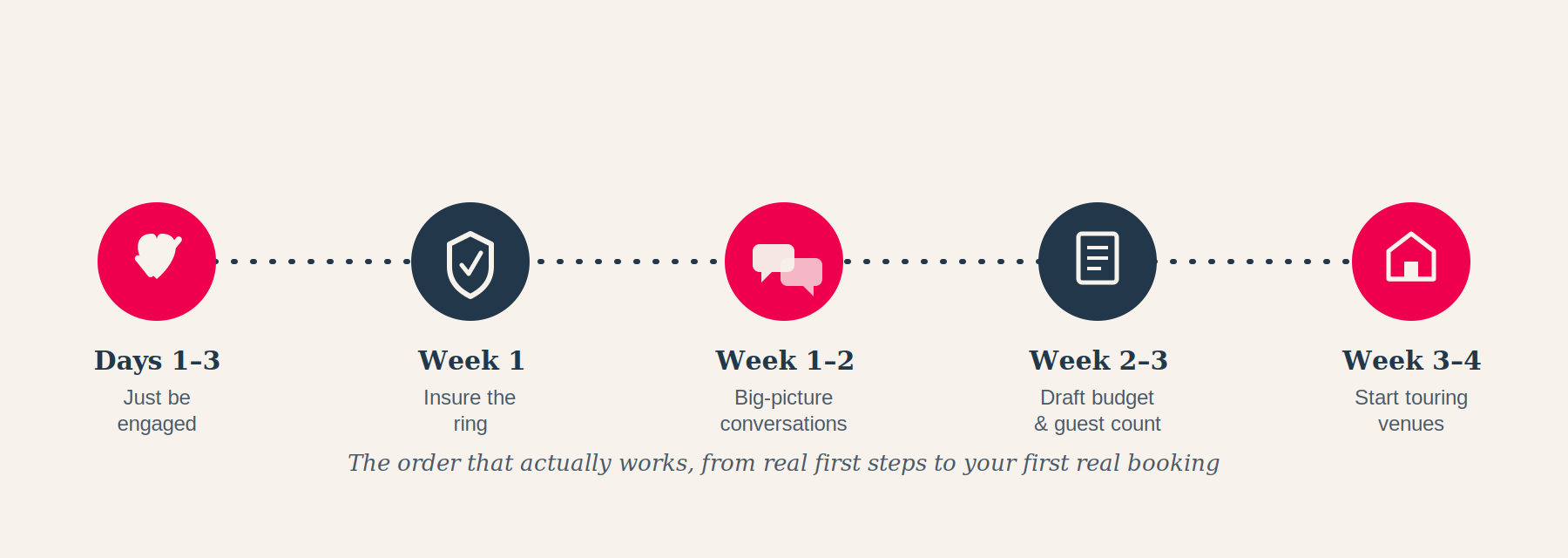
Newly engaged checklist: your first two weeks
If you read nothing else, this is the order that actually works.
Days 1–3: Just be engaged. Tell your closest people in person or by call before anything goes on social media. Take a breath before taking a single planning action.
Week 1: Get the ring insured. This takes twenty minutes and protects a purchase you’re now wearing during dish-washing, hiking, and everything else daily life involves.
Week 1–2: Have the big-picture conversations. Cover vision, rough budget, timeline, and who else is financially or emotionally involved, before a single vendor enters the picture.
Week 2–3: Draft a guest count range and a real budget number. Neither needs to be final. Both just need to be real enough to guide every decision that follows.
Week 3–4: Start looking at venues. This is usually the first actual booking, and the one every other vendor and decision keys off of.
Everything below builds out each of these steps, with the real numbers and the real reasoning behind them.
Knowing what to do after getting engaged can help ease the transition into planning your future together.
First: Actually Let Yourselves Be Engaged for a Minute
This sounds like filler advice. It genuinely isn’t.
The jump from “we’re engaged” to “here’s our seating chart” happens faster than it should, mostly because everyone around you starts asking about dates before you’ve had a chance to just enjoy the news. Give yourselves permission to skip that for a few days. Order the good takeout. Call the people who matter most. Stare at the ring, or don’t, if a ring wasn’t part of your particular proposal. There is no rule requiring you to have opinions about venues by Tuesday.
Couples who take this pause tend to report feeling calmer through the rest of planning. It’s not because the pause changes any logistics. It’s because it separates “we’re getting married” from “we’re now project managers” by even a few days. That separation matters more than it sounds like it would.
Telling People: Who, How, and in What Order
There’s no single correct sequence here, but a few patterns genuinely help avoid hurt feelings.
Close family and closest friends first, before social media
A parent, sibling, or best friend finding out from a Facebook post instead of a phone call is one of the more common early sources of real hurt in this process. It’s almost always avoidable with a short list made in advance. Spend twenty minutes deciding who is on your “hears it directly from us” list before you tell anyone else.
Both families, roughly in parallel
If both of you have living parents or a family structure you’re close to, try to tell both sides around the same time, rather than one family finding out days before the other. This is a small gesture that avoids a genuinely common source of early tension between families who haven’t met yet.
There’s no rule that says you owe anyone an announcement timeline
Blended families, complicated family relationships, estranged parents, and non-traditional family structures are all common, not exceptions to work around apologetically. Tell the people who matter to you, in the order that makes sense for your actual relationships, and don’t let anyone else’s expectations dictate a sequence that doesn’t fit your life.
Social media: whenever you’re ready, if ever
Some couples post within hours. Some wait weeks. Some never post at all. None of these is more correct, and there is no expiration date on sharing good news on your own terms.
Why you should insure your engagement ring right after getting engaged
Get the Ring Insured — This Week, Not Eventually
This is the single most skipped step in the entire first month, and the one with the most real financial exposure attached to it.
Why this can’t wait
The ring is uninsured from the moment it’s on your finger until you actually set up coverage. It’s now traveling with you through gym bags, kitchen sinks, and airport security lines instead of sitting safely in a jewelry box. Most engagement ring loss and damage claims involve completely ordinary daily life, not dramatic theft.
What coverage actually costs
A dedicated jewelry insurance policy or a rider added to your renters or homeowners policy commonly runs 1 to 2 percent of the ring’s value per year. On a $4,000 ring, that’s roughly $40 to $80 annually, considerably less than most people assume before they actually look into it.
Get an independent appraisal first
Your insurer needs a specific dollar value to insure, and the jeweler who sold you the ring has a built-in conflict of interest in stating that value. An independent appraiser, typically $50 to $150, gives you a number your insurance provider will actually accept.
Check your existing renters or homeowners policy too
Standard renters and homeowners policies often cover jewelry only up to a few hundred dollars total, far below what most engagement rings are worth. Confirm your specific limit directly rather than assuming you’re already covered.
The whole process, appraisal to active policy, typically takes one to two weeks and one afternoon of actual effort. It’s genuinely one of the highest-value twenty-minute tasks in this entire guide.
The Conversations Worth Having Before Any Vendor Does
Before a single venue tour or Pinterest board, a handful of conversations between the two of you save real time and real conflict later.
What does “our wedding” actually look like to each of you?
Big and formal, small and casual, a weekend-long celebration, an elopement followed by a party later — these are genuinely different events requiring genuinely different planning. It’s worth confirming you’re both picturing something similar before either of you gets attached to a specific vision.
Who else is emotionally or financially involved?
If parents or other family members are contributing financially, or simply have strong feelings about the day, have this conversation directly and early. Money conversations get harder, not easier, the longer they’re avoided.
What’s your actual timeline preference?
A shorter engagement and a longer one both come with real trade-offs, covered in detail in the next section. Talk about your instinct here before external pressure, like a specific venue’s availability, makes the decision for you.
Who is doing the planning?
One partner leading with the other weighing in, a fully shared division of labor, or outsourcing significant chunks to a planner are all legitimate structures. Decide this explicitly rather than assuming your partner shares your assumption about who does what.
Setting a Realistic Timeline
How long should you actually be engaged before the wedding itself? The honest answer is: it depends, but here’s real data to anchor that decision.
The current average, and why it’s grown
The average engagement now runs around 15 months, according to The Knot’s 2025 data, longer than it was a decade ago. Popular venues and photographers booking a year or more in advance are a major driver of this shift. It’s not a change in how couples feel about long engagements.
Shorter engagements: real trade-offs
A shorter engagement, six months or less, works well for couples prioritizing a smaller, simpler wedding, an elopement, or a specific date tied to something meaningful. It genuinely limits your options for in-demand venues and vendors, though, particularly during popular wedding months.
Longer engagements: real trade-offs
A longer engagement, eighteen months or more, gives you more vendor choice and more time to save. It also means answering “so when’s the big day?” for a genuinely long time, which some couples find wears thin faster than the planning itself does.
If you got engaged during engagement season, you have company
Nearly half of all US engagements happen between Thanksgiving and Valentine’s Day, according to The Knot’s 2025 Real Weddings Study. If that’s your timing, you’re planning alongside a genuinely large wave of other couples, which matters most for popular venues in peak wedding months like May through October. Starting your venue search early is worth more than usual this specific season.
What This Actually Costs: Building Your First Real Budget
This is the section most newly engaged couples avoid the longest, usually because a vague sense of “weddings are expensive” feels easier than an actual number. A rough real number, even an uncomfortable one, is genuinely more useful than avoidance.
Start with what you can actually spend, not an industry average
National averages get quoted constantly, and they’re genuinely unhelpful for your specific planning. They blend enormous, all-inclusive celebrations with modest backyard ceremonies into one misleading number. Start instead from your own combined finances: what you can save monthly between now and the wedding, plus what any contributing family members are actually offering, not what you assume they might.
Where the money typically goes
| Category | Typical share of budget |
|---|---|
| Venue and catering | ~40–45% |
| Photography and videography | ~10–12% |
| Attire for both partners | ~6–8% |
| Flowers and decor | ~8–10% |
| Music and entertainment | ~6–8% |
| Invitations and stationery | ~2–3% |
| Planner, if hired | ~8–10% |
| Everything else (favors, transport, cake, misc.) | ~5–8% |
Venue and catering will almost certainly be your single largest line item, commonly running close to half of a total budget once food, drink, and rentals are included together.
Build in a real contingency, not an optimistic one
Set aside 5 to 10 percent of your total budget specifically for the unplanned: a guest count that grows, a rental you didn’t anticipate, a vendor price increase between booking and the actual date. Nearly every couple uses this cushion. Treat it as a real line item, not a hopeful afterthought.
Decide your two or three actual priorities early
You cannot maximize every category at once. Naming your genuine top two or three priorities, exceptional food, a specific photographer’s style, an open bar, whatever matters most to you specifically, gives you real permission to spend less deliberately everywhere else.
A note on family contributions
If parents or other family members are contributing, get specific about the actual dollar amount and any expectations attached to it. Ideally, put it in writing, or at minimum have a clear conversation both sides remember the same way. Vague contributions (“we’ll help out”) create more stress down the line than direct, specific numbers do.
Your First Guest List Draft
You don’t need final names yet. You need a real number, because guest count drives venue capacity, catering cost, and rental needs more than almost any other single decision.
Draft in tiers, not one flat list
Sort names into “absolutely,” “would love if budget allows,” and “if we end up with a bigger celebration” tiers. This gives you a genuine range rather than one number that’s either uncomfortably rigid or quietly unrealistic.
Have the plus-one conversation early
Decide your general plus-one policy, everyone gets one, only long-term partners do, or some other rule, before individual requests start arriving and each one feels like a personal negotiation.
Talk about children as a category, not case by case
An adults-only wedding, a kids-welcome wedding, or something in between are all legitimate choices. Deciding this as a general policy up front, rather than making individual exceptions as they come up, keeps the decision feeling fair rather than arbitrary.
Remember that guest count is a budget lever, not just a headcount
Every guest added to a plated dinner or open bar adds real, specific cost. If your dream number and your realistic budget don’t currently match, guest count is often the single most effective place to close that gap.
Why the wedding venue is usually your first booking
Venue: Usually Your First Real Booking
Once you have a rough budget and a real guest count range, venue searching is typically the next actual step, and usually the first vendor contract you’ll sign.
Why venue comes before almost everything else
Your venue locks in your date, your guest capacity, and often a required or preferred vendor list. Nearly every other booking waits on this decision. Booking photography or florals before a venue is confirmed risks having to unwind and rebook once your actual date and location are set.
Start touring before you’re “ready,” not after
Popular venues, especially for peak months, book out a year or more in advance. If you got engaged during engagement season and want a May-through-October date, starting venue research within your first month or two is genuinely worth it.
What This Actually Costs: the venue quote gap
A venue’s advertised rental fee is rarely the full number. Ask directly about a required catering minimum, a separate ceremony fee, service charges, security deposits, and overtime rates before comparing any two venues by their headline price alone. A venue quoted at $6,000 with a $15,000 catering minimum costs meaningfully more than one quoted at $9,000 with a $10,000 minimum. The first number just looks smaller.
Bring your real numbers to every tour
Walk into every venue visit with your actual guest count range and budget ceiling already decided. This lets you ask direct, useful questions instead of falling for a beautiful space that doesn’t actually fit either number.
Building Your Vendor Team: Who to Hire, and in What Order
Once your venue is booked, a natural hiring order emerges, driven by which vendors get booked out earliest.
The general order that works for most couples
Venue first, since everything else depends on the date and space. Then photographer and, if you want one, videographer. These are typically the vendors booked earliest by other couples and the ones most likely to sell out for your date. Then catering, if not already included with your venue. Then florist, music, and everyone else, roughly in the order that matters most to you personally.
Consider a planner or day-of coordinator early, not as an afterthought
A full planner helps from the very beginning; a day-of coordinator joins closer to the wedding to manage logistics on the actual day. Deciding which, if either, you want early affects how much of the vendor search you handle yourselves versus delegate.
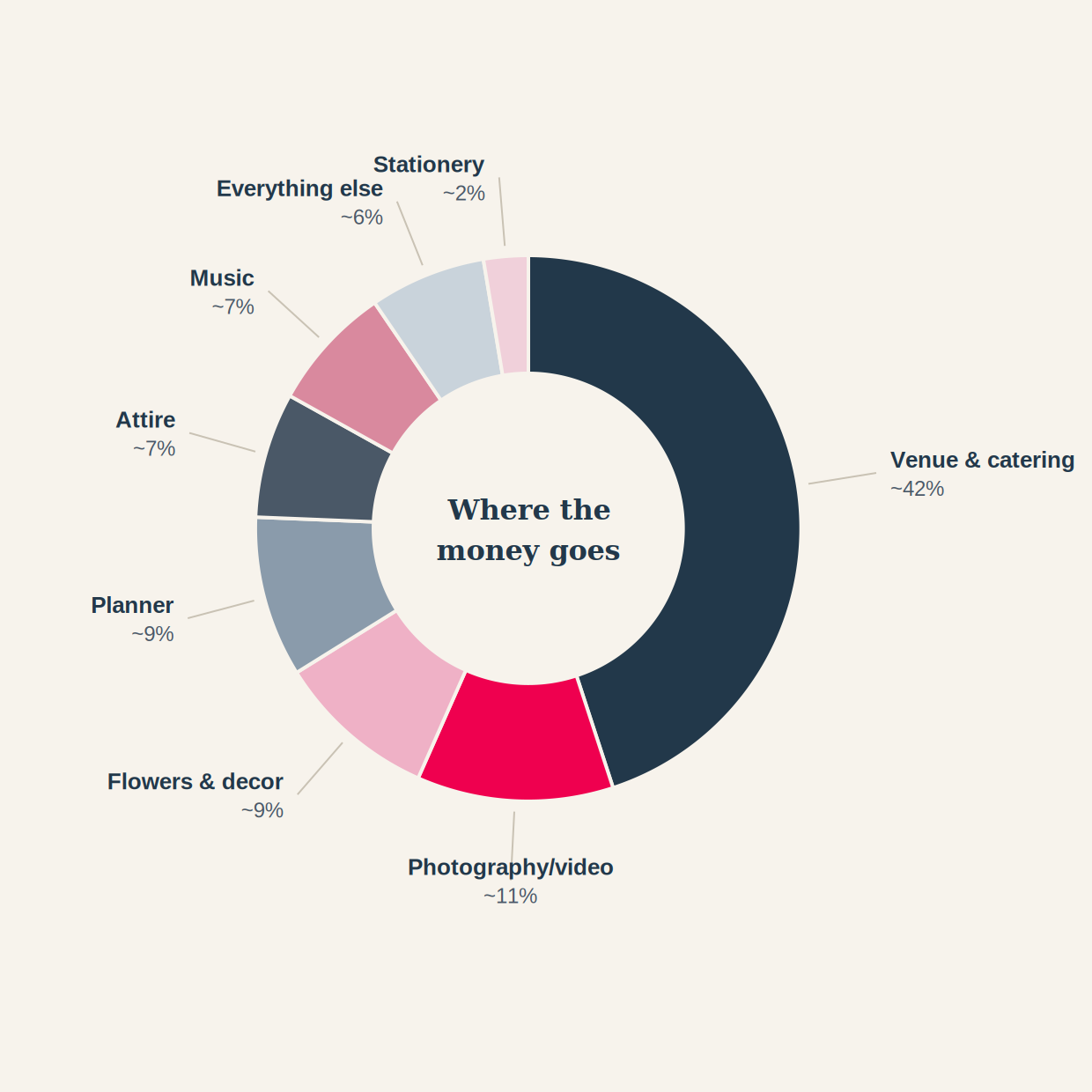
First wedding budget: where the money typically goes
What This Actually Costs: planner pricing reality
Full-service planning commonly runs 10 to 20 percent of your total budget. Day-of coordination alone typically costs $1,000 to $3,000 flat, considerably less, and a genuinely worthwhile investment for many couples who want to actually enjoy their own wedding day instead of managing it.
Don’t book everything at once out of anxiety
It’s tempting to lock in every vendor within the first month to feel secure. This can mean rushing decisions on categories, like florals or cake, where you’d benefit from more time to actually explore your options. Venue and any genuinely in-demand vendor are worth prioritizing; the rest can wait.
Your Wedding Website: Set It Up Sooner Than You Think
This has become genuinely useful infrastructure, not just a nice-to-have extra.
Why this matters more than it used to
A wedding website now commonly handles RSVP tracking, accommodation details with booking deadlines, registry links, and travel logistics for guests, effectively becoming the operational hub for your entire guest experience, not just a pretty landing page.
Set it up early, even with minimal information
You don’t need every detail finalized to create the site. A basic version with your names, the date, and a “details coming soon” note gives you a shareable link the moment people start asking, which they will, often before you’ve booked anything at all.
What to actually include
Names and date at minimum. Add your venue and general location once confirmed, an RSVP system as your date approaches, accommodation recommendations with any group booking deadlines, and registry links whenever you’ve set those up. Update it as real information becomes available rather than waiting for a single “complete” launch moment.
Engagement Photos: Worth It, and Not as Complicated as It Feels
Not required by any rule, but genuinely useful for more than just a pretty photo session.
Why couples do this beyond just having nice pictures
Engagement photos double as save-the-date images, wedding website content, and a low-stakes trial run with your photographer before the actual wedding day. This last part matters more than it sounds. You’ll learn how you both photograph together and whether your photographer’s style and your comfort level actually mesh, while the stakes are genuinely low.
Timing
Most couples schedule these two to six months after getting engaged. That’s early enough to use the images for save-the-dates if you want that, but late enough that the initial engagement flurry has settled and you can actually enjoy the session.
What This Actually Costs
Many wedding photographers include an engagement session in their package; if not, standalone sessions commonly run $200 to $600. Ask directly whether this is bundled with your wedding photography before booking either separately.
You don’t need a dramatic location or a stylist
A park, your own neighborhood, or somewhere meaningful to your relationship works just as well as an elaborate location. It often photographs more authentically, too. The best engagement photos usually capture how you two actually are together, not a performance of it.
Engagement Parties: Genuinely Optional, and Here’s the Etiquette If You Want One
Not every couple has one, and skipping it entirely is completely fine.
Who typically hosts
Traditionally, the bride’s family hosted, though this convention has loosened considerably. Today, either family, close friends, or the couple themselves commonly host. There’s no rule dictating who it has to be.
Timing
Most engagement parties happen within a few months of the actual engagement, well before the wedding itself, distinct from a rehearsal dinner or shower which happen much closer to the wedding date.
Gift etiquette varies genuinely by region and family
Some regions and families consider engagement party gifts standard; others don’t expect them at all. If you’re hosting or being invited, a simple, direct note on the invitation (“no gifts, please” or general registry information) removes the guesswork for guests.
Guest list overlap with the wedding itself
General etiquette suggests inviting only people who will also be invited to the wedding itself, avoiding an awkward gift-then-exclusion situation. This isn’t a hard rule, but it’s worth considering if your engagement party and wedding guest lists might differ significantly.
Save the Dates: When and How
Not the same as an invitation, and often sent earlier than couples expect.
Timing
Send save-the-dates six to eight months before the wedding for a typical domestic guest list, and up to a year ahead for a destination wedding or a holiday-weekend date. This gives guests real time to plan travel and time off work.
What actually needs to be on it
Both your names, the wedding date, and the general location, city and state at minimum, are genuinely enough. Full details belong on your wedding website, which you can simply link or reference on the card itself.
Who gets one
Only send save-the-dates to people you’re certain will be invited to the wedding itself. Unlike a save-the-date for a more casual event, this genuinely commits you to inviting that person, so finalize at least a firm draft of your guest list before this step, not after.
Common First-Month Mistakes, and How to Avoid Them
A few patterns show up often enough in early planning to deserve direct, specific mention.
Booking vendors before setting any real budget
Falling for a beautiful venue or photographer before you know your actual numbers often means discovering a genuine mismatch after you’re already emotionally attached to a choice you can’t comfortably afford.
Assuming family contributions without confirming them directly
A vague, hopeful assumption about who’s paying for what creates real risk of a budget built on money that was never actually promised. Confirm specific numbers directly, even if the conversation feels awkward.
Trying to please everyone’s opinion at once
Family, friends, and the internet will all have thoughts about your choices. This is your wedding, planned by the two of you, and you’re allowed to make decisions that don’t match everyone else’s preferences.
Skipping the ring insurance step because it feels unglamorous
This is genuinely the most commonly delayed task in this entire guide, and the one with the most real financial exposure attached to putting it off.
Comparing your planning pace to everyone else’s
Some couples book everything within weeks; others take a year to even start seriously. Neither pace is wrong. Plan at the speed that fits your actual life, not a pace borrowed from someone else’s timeline.
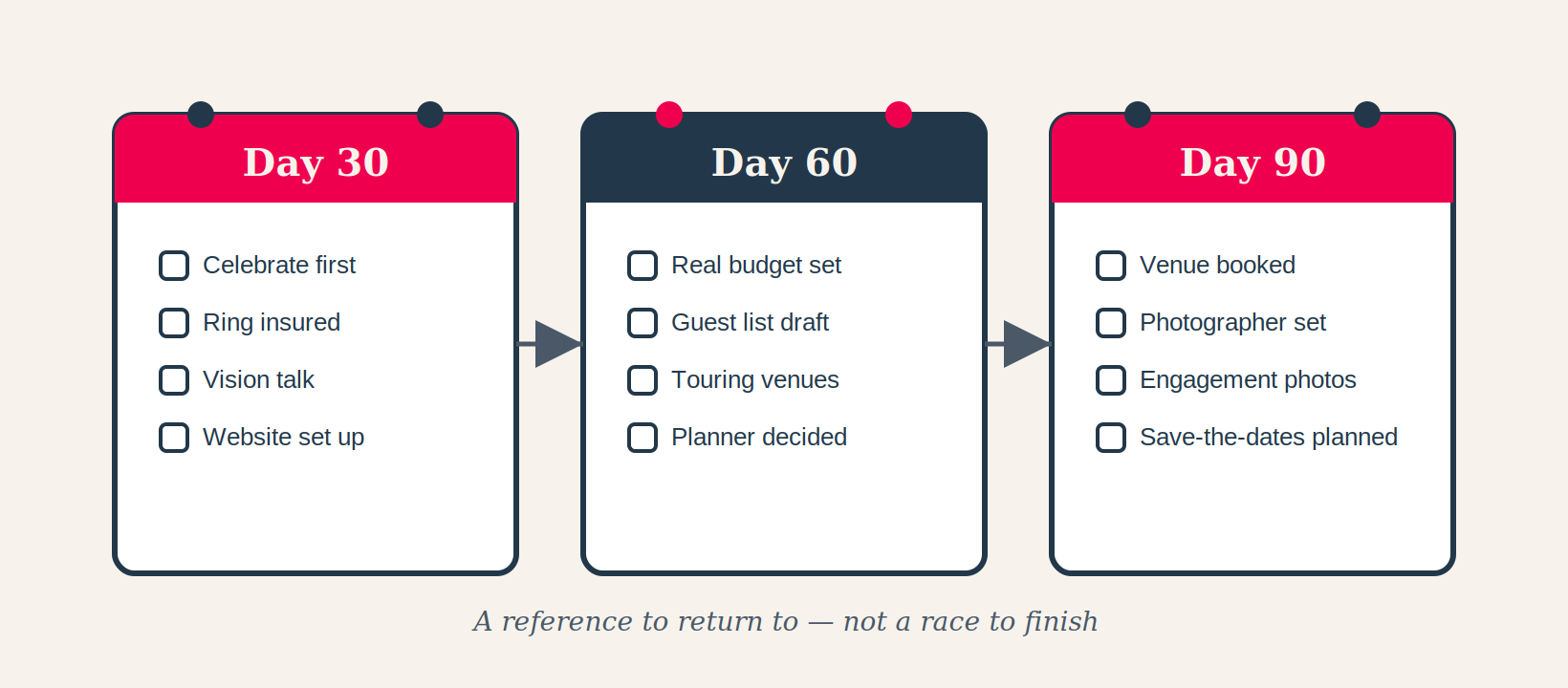
30/60/90-day newly engaged checklist
Your 30/60/90-Day Checklist
First 30 days
- ☐ Celebrate before planning anything: ____________
- ☐ Tell close family and friends directly: ____________
- ☐ Get the ring appraised and insured: ____________
- ☐ Have the vision, budget, and timeline conversation: ____________
- ☐ Set up a basic wedding website: ____________
Days 30–60
- ☐ Draft a real budget with a contingency line: ____________
- ☐ Draft a tiered guest list: ____________
- ☐ Decide on a planner or day-of coordinator, or neither: ____________
- ☐ Begin touring venues: ____________
- ☐ Confirm any family financial contributions in specific numbers: ____________
Days 60–90
- ☐ Book your venue: ____________
- ☐ Begin booking photographer and other high-demand vendors: ____________
- ☐ Schedule engagement photos, if you want them: ____________
- ☐ Decide whether to have an engagement party: ____________
- ☐ Start your save-the-date timeline planning: ____________
A Word on Doing This as Non-Traditional Couples, Because Most Couples Are
Everything in this guide applies regardless of who’s planning, who’s paying, or what your wedding actually looks like.
This guide doesn’t assume a bride, a groom, or a straight couple
Same-sex couples, couples where both partners identify as grooms or both as brides, and couples who don’t use either term all plan weddings using essentially the same real decisions. Budget, guest list, venue, vendors, timeline: none of it changes based on who’s getting married. The etiquette guidance in this guide applies regardless of gender.
This guide doesn’t assume parents are paying
Many couples fund their own weddings entirely, partially, or with contributions from a mix of family members in any configuration. The budgeting guidance here works the same way regardless of whose money is actually involved.
This guide doesn’t assume you want a big, formal wedding
An elopement, a courthouse ceremony followed by a party, a fifteen-person backyard gathering, and a three-hundred-guest ballroom event are all genuinely valid. Most of the planning steps in this guide, minus a few that only apply at scale, still apply in some form to all of them.
Frequently Asked Questions
What should we do in the very first week after getting engaged?
Tell your closest people directly, take a genuine breather before diving into planning, and get the ring appraised so insurance can follow shortly after. Nothing else is truly urgent in week one.
How soon do we need to set a wedding date?
There’s no fixed deadline, though setting at least a rough season or year helps guide venue searching, which is usually the first real booking. A specific date typically firms up once your top venue choice confirms availability.
Do we need a wedding planner?
No, this is entirely optional. A planner or day-of coordinator can genuinely reduce stress, particularly for a larger or more complex event, but plenty of couples plan successfully without one.
How much does engagement ring insurance actually cost?
Commonly 1 to 2 percent of the ring’s appraised value annually, meaning roughly $40 to $80 a year on a $4,000 ring. Get an independent appraisal first so your insurer has an accurate value to work from.
What’s the average length of an engagement right now?
Around 15 months, according to The Knot’s 2025 data, driven largely by popular venues and vendors booking a year or more in advance rather than couples wanting longer engagements specifically.
Should we announce our engagement on social media right away?
Whenever you’re genuinely ready, if at all. There’s no expiration date or obligation here. Just tell your closest people directly first, before anything goes public.
How do we decide our wedding budget if we have no idea where to start?
Start from your own actual combined finances and any specific, confirmed family contributions, not a national average, which blends wildly different types of weddings into one unhelpful number.
What’s the very first vendor we should actually book?
Your venue, in almost every case, since it locks in your date and guest capacity and determines the timeline for every other vendor decision that follows.
Is it normal to feel overwhelmed right after getting engaged?
Completely normal, and genuinely common. This is exactly why the first real recommendation in this guide is to pause before planning, not push straight into decisions.
Do we have to have an engagement party?
No, this is entirely optional. Plenty of couples skip it without any negative consequence, and there’s no rule requiring one before you move on to wedding planning itself.
When should we send save-the-dates?
Six to eight months before the wedding for most guest lists, up to a year ahead for a destination wedding or a holiday-weekend date, giving guests real time to plan travel.
What if our families disagree about how big or formal the wedding should be?
Have this conversation directly and early, decide together what you both actually want, and communicate that decision clearly to family rather than letting differing expectations quietly shape your choices by default.
How many venues should we tour before deciding?
Three to five is a reasonable range for most couples, enough to compare real options without an exhausting, indefinite search.
Should we get engagement photos even if we’re not sending save-the-dates?
Yes, if you want them, since they’re also useful for your wedding website and simply as photos of this specific moment in your relationship, independent of any save-the-date use.
What’s a realistic timeline for booking all our vendors?
Venue and any high-demand vendor, like photography, within the first three to six months; everything else can typically follow over the following several months without real risk, outside of exceptionally popular dates or vendors.
Do we need to know our exact guest count before booking a venue?
A real range, not an exact final number, is genuinely enough for most venue conversations, since capacity limits and catering minimums typically work off a range rather than a precise headcount this early.

What to Do After Getting Engaged
Registry: When to Start, and How to Think About It Differently Now
Registries have changed meaningfully in recent years, worth understanding before you default to the traditional dish-and-towel version out of habit.
Timing
Most couples set up a registry within the first few months, well before it needs to be public. It takes real time to research and select items thoughtfully, rather than rushing through it right before guests need the information.
Traditional registries still make sense for many couples
If you’re setting up a first household together, kitchen items, linens, and home goods remain genuinely useful, and there’s nothing outdated about wanting them.
Experience and cash registries have become genuinely mainstream
Couples who already live together and don’t need a third set of wine glasses increasingly set up honeymoon funds, home down-payment funds, or experience-based registries instead of physical goods. This is now a completely normal choice, not an apologetic workaround.
Many couples blend both approaches
A registry mixing a handful of genuinely wanted physical items with a cash or experience fund gives guests real choice without forcing an all-or-nothing decision.
Attire: You Don’t Need to Decide This Month, But Start Thinking About It
Not an immediate task, but worth understanding the realistic timeline so it doesn’t sneak up on you.
Realistic ordering timelines
A custom or made-to-order wedding dress or suit commonly takes four to eight months from order to final fitting, including alterations. If your wedding is within a year, this deserves attention sooner than most other style decisions.
You don’t have to know your exact style yet
Early appointments are often more about narrowing silhouette, fabric, and general direction than finding “the one” immediately. Treat early browsing as research, not a final decision under pressure.
What This Actually Costs
Wedding attire, across both partners, commonly runs 6 to 8 percent of a total wedding budget, though this varies enormously by whether you buy new, buy sample or off-the-rack, rent, or wear a family heirloom piece. None of these approaches is more “real” than another.
Talking to Family: Boundaries, Blended Families, and Real Expectations
Family dynamics genuinely shape wedding planning more than almost any other factor, and addressing this directly early saves real stress later.
Set expectations about involvement early
Whether family members are contributing financially or not, clarify directly how much input they should expect to have in decisions. Financial contribution and decision-making input are related but genuinely separate conversations worth having explicitly.
Blended and divorced families need direct planning, not avoidance
If either of you has divorced parents, remarried parents, or a complicated family structure, decide together how this affects seating, walking down the aisle, toasts, and photos. Don’t leave it to be figured out awkwardly as it comes up.
You’re allowed to set boundaries, even with people who mean well
A relative offering constant unsolicited opinions, even out of genuine excitement, doesn’t obligate you to incorporate every suggestion. A calm, direct “we’ve decided on this one, but thank you” is a complete, acceptable response.

Honeymoon: Why Early Planning Actually Saves Money
This feels like a later-stage decision, but a few early moves genuinely pay off.
Book flights and major travel earlier than you’d think
International flights and popular destinations, especially during peak travel seasons, often price up considerably as your date approaches. If you have a specific honeymoon destination in mind, watching prices and booking key travel components early can mean real savings.
Consider a minimoon if a full honeymoon isn’t realistic right after the wedding
A short, local getaway right after the wedding, followed by a longer trip later when time and budget allow, has become a genuinely common and practical approach. It’s particularly useful for couples with limited time off work immediately following the wedding.
Passport timing matters more than people expect
If either of you needs a new or renewed passport for an international honeymoon, start this process months in advance. Processing times fluctuate and have run considerably longer than expected in various periods, and a wedding date is a genuinely bad time to discover a passport delay.
What This Actually Costs
Honeymoon budgets vary enormously by destination and length, but many couples now use a dedicated honeymoon fund as part of their registry specifically to offset this cost, rather than paying entirely out of post-wedding savings.
Wedding Insurance: A Different Thing From Ring Insurance
Worth understanding as a genuinely separate consideration from the ring insurance covered earlier.
What wedding event insurance actually covers
This type of policy, purchased by the couple, typically covers event cancellation or postponement due to specific covered circumstances, along with certain liability protection for the event itself. It does not cover your ring; that requires the separate jewelry policy already covered in this guide.
Is it worth it?
For a significant financial investment in your wedding, particularly with a large deposit already paid to a venue, many couples find the modest cost of event insurance a reasonable safeguard. It’s genuinely optional, not a required step like ring insurance functionally is.
Check what your venue and vendors already require
Some venues require the couple to carry liability insurance as a condition of booking. Confirm this directly with your specific venue rather than assuming it either is or isn’t required.
Bachelor and Bachelorette Parties: Early Considerations
Usually planned by your wedding party, not you directly, but a few early decisions genuinely help.
Share your general preferences early, even if someone else is planning
A quiet weekend away, a big destination trip, or a low-key night out are genuinely different experiences. Let whoever’s planning know your general comfort level and any real constraints, budget, timing, specific activities you’d rather skip, well before detailed planning begins.
Timing relative to the wedding
Most of these events happen one to several months before the wedding, giving enough separation that recovery time isn’t a concern and enough proximity that it still feels connected to the upcoming celebration.
Cost transparency matters for your wedding party
If your friends are planning and funding this themselves, be mindful that a destination trip can represent a genuinely significant expense for some members of your wedding party. A quieter, more affordable option is a completely reasonable preference to express.

If a Legal Name Change Is Part of Your Plan
Not every couple changes a name, and if you do, early awareness of the process helps.
This isn’t required by any rule
Keeping your own name, hyphenating, combining names, or either partner taking the other’s name are all equally legitimate choices. There’s no obligation tied to gender or tradition here.
The process takes real, specific time after the wedding
If you do plan to change your name, the actual process, updating your Social Security card, driver’s license, passport, and various accounts, typically takes several weeks to a few months of paperwork after the wedding itself. This isn’t a pre-wedding task, but knowing the realistic timeline now helps you plan for it rather than being surprised by it later.
Where to verify the current, official process
Requirements vary by state, and the process itself can change. The official USA.gov guide to changing your name is the most reliable place to confirm current federal and state-level requirements when you’re ready to start that process.
Cultural and Religious Engagement Customs Worth Knowing
If either of your families has specific cultural or religious engagement traditions, this is worth exploring directly and early, with genuine curiosity rather than treating it as an obstacle to plan around.
Many traditions have their own formal engagement customs, separate from the ring itself
Family blessing ceremonies, formal introduction rituals between families, and specific gift exchanges appear across many cultural and religious traditions, often carrying real significance distinct from a Western-style proposal and ring.
Ask, rather than assume
If a tradition matters to one or both of your families, ask directly what it actually involves and what matters most about it, rather than guessing or skipping it out of uncertainty. Most families genuinely appreciate the question.
Blending two different traditions is increasingly common and doesn’t require choosing just one
Couples from different cultural or religious backgrounds increasingly find ways to honor both families’ customs rather than picking a single tradition to follow. This might mean separate events, a blended ceremony, or distinct elements woven into one celebration.
Managing Wedding Planning Stress From the Very Start
This deserves direct mention, not as an afterthought.
The stress is genuinely common, not a sign you’re doing something wrong
Over half of engaged couples report finding wedding planning stressful at some point, according to industry survey data. If you’re feeling this, you’re not uniquely bad at planning; you’re having a completely normal experience.
Build in breaks from planning, deliberately
Set explicit times when you’re not discussing the wedding, whether a full evening or a weekend, protecting your relationship from becoming entirely consumed by logistics for the entire engagement.
Disagreements about the wedding are normal, not a bad omen
Two people making dozens of joint decisions under time and financial pressure will disagree sometimes. This reflects the genuine difficulty of the task, not a problem with your relationship.
It’s okay to simplify, even after you’ve started planning something bigger
If the scale of what you originally planned starts feeling like too much, scaling back is a completely legitimate choice at any point, not a failure or a disappointment to anyone who matters.

Choosing a Season and Date: What Actually Matters Beyond Weather
Beyond the obvious weather considerations, a few less-discussed factors genuinely affect this decision.
Peak season means peak pricing, across nearly every vendor category
May through October remains peak wedding season across most of the country, meaning venue and vendor pricing typically runs highest during exactly these months. An off-peak date, even by a few weeks, can mean genuinely meaningful savings.
Consider your guests’ actual calendars, not just your own preference
A date competing with major holidays, the start of a school year, or a widely celebrated cultural or religious observance can affect attendance for guests managing their own conflicting obligations. This doesn’t mean avoiding every popular date, but it’s worth a deliberate choice rather than an accidental one.
A weekday or off-peak-season wedding is a genuinely legitimate cost-saving choice
Some couples specifically choose a Friday, Sunday, or off-season date for meaningful vendor savings and easier availability. This isn’t a lesser choice or a consolation prize; it’s a deliberate trade-off many couples make happily.
Asking Your Wedding Party: Timing and Etiquette
Worth doing relatively early, since your wedding party often factors into other decisions.
Timing
Many couples ask within the first few months of the engagement, though there’s no strict deadline. Asking earlier gives your wedding party more time to plan for costs like attire and any bachelor or bachelorette event.
There’s no required size or structure
A large wedding party, a small one, an uneven number of attendants on each side, or no formal wedding party at all are all completely legitimate. This is a personal choice, not a category with a “correct” size.
Be upfront about realistic costs early
Attire, travel for a destination wedding or bachelor and bachelorette events, and other wedding party expenses add up. A direct, early conversation about the realistic financial ask lets the people you’re inviting into this role make an informed choice.

A Brief Word on Vendor Contracts, Since You’ll Be Signing Several
This deserves its own full treatment elsewhere, but a few early principles matter from your very first vendor conversation.
Read every contract fully before signing, not just the price and date
Scope, cancellation terms, and payment schedule all belong in writing, not assumed from a friendly conversation. This applies to your very first vendor booking as much as your last.
Get every verbal promise added to the written contract
A specific verbal assurance that never makes it into the signed document is difficult to enforce if a disagreement arises later. Ask for anything meaningful to be added explicitly.
Keep every contract in one organized place from the start
Build this habit with your very first booking, since you’ll likely sign six or more vendor contracts before the wedding. A single organized system started early saves real confusion later.
If You’re Considering a Destination Wedding
This changes the early timeline and priorities meaningfully, worth addressing directly if it’s even a possibility you’re considering.
Start earlier than you would for a local wedding
Guest travel planning, passport requirements, and often more limited vendor availability all mean a destination wedding typically needs a longer runway. If this is on the table, begin research within your first month or two, not later.
Give guests genuinely more notice
Save-the-dates for a destination wedding commonly go out nine to twelve months ahead, considerably earlier than a typical domestic timeline, since guests need real time to plan travel, request time off, and budget for the trip.
What This Actually Costs
A destination wedding sometimes costs less per guest for the couple, particularly with an all-inclusive resort package, but guest travel costs shift meaningfully onto your guests themselves. Consider this honestly when deciding whether a destination wedding fits your specific priorities and guest list.
Confirm legal marriage requirements for your specific destination early
Marriage license requirements, waiting periods, and required documentation vary considerably by country and even by specific region within a country. Confirm this directly and early, since some destinations require residency periods or specific paperwork timelines that affect your entire schedule.
A Realistic First-Month Example
Here’s what a genuinely realistic, unglamorous first month can actually look like, composited from common real patterns.
A specific, worked scenario
A couple gets engaged on a Saturday in early October, right in the middle of engagement season. They spend the first weekend simply telling close family by phone and enjoying the news, deliberately avoiding any planning conversation until the following week. On day four, they get the ring appraised; by day ten, it’s insured. Over the next two weekends, they have the big conversations. They land on a rough guest count around 90. They also settle on a budget ceiling based on their actual combined savings plus a specific, confirmed contribution from one set of parents, and a shared preference for a warm-weather date the following October.
By week six, they’ve toured four venues and booked the one that fit both their guest count and budget without requiring painful trade-offs elsewhere. By week ten, their photographer is booked, since venue and photographer were their two genuine priorities. Everything else, florals, music, attire, is still undecided, and that’s completely fine. They’re not behind. They’re exactly on the pace that fits their actual life.
What made the difference
Nothing about this required unusual resources or exceptional organization. It required a short pause before planning, one honest budget conversation, and booking the two decisions that actually needed early urgency while genuinely letting everything else wait.

If This Is a Second Marriage, or You’re Blending Existing Families
A genuinely different planning context deserves direct acknowledgment, not folded quietly into generic advice written for first weddings.
There’s no reduced version of celebration you’re required to have
A second wedding can be exactly as celebratory, large, or small as you want. There’s no unwritten rule requiring a smaller or more subdued event the second time around.
Children from a previous relationship deserve early, direct conversation
If either of you has children, decide together how they’ll be included, in the ceremony, in photos, in the celebration generally, and have this conversation with them directly and early, appropriate to their age.
Blending two existing households affects logistics, not just emotions
Merging homes, finances, and family routines alongside wedding planning is genuinely more complex than planning a wedding as two individuals starting fresh. Give yourselves real grace and realistic timelines for this additional layer.
Military Couples and Deployment Considerations
A genuinely different set of timeline pressures applies here, worth its own direct mention.
Deployment schedules sometimes dictate your actual timeline more than preference does
If deployment orders affect your available window, work backward from that firm date rather than a preferred one, and communicate this constraint clearly and early to any vendor you’re considering.
Some vendors offer specific military accommodation
Ask directly whether a venue or vendor offers any flexibility or discount for military families, particularly around date changes that deployment orders can force.
A courthouse ceremony now, celebration later is a genuinely common, valid approach
Many military couples marry legally before a deployment, then hold a larger celebration afterward. This is a completely legitimate structure, not a lesser version of “the real wedding.”
Realistic Ways to Actually Save Money, Beyond the Obvious
Beyond guest count, a few genuinely effective, less-discussed strategies exist.
An off-peak day or season, covered earlier, remains one of the single biggest levers
A Friday or Sunday wedding, or a date outside May through October, can mean meaningfully lower pricing across nearly every vendor category simultaneously.
A shorter reception genuinely reduces cost, not just time
Bar service, staffing, and certain rental costs scale directly with event length. A well-planned four-hour reception can feel just as complete as a six-hour one, at real savings.
Ask every vendor directly what’s negotiable
Specific add-ons, timing, and sometimes package inclusions have more flexibility than couples assume, particularly for a vendor with an otherwise open date. It costs nothing to ask directly.
Consider which “must-haves” are actually inherited assumptions
A specific tradition, item, or expense you’ve assumed is required is often, on closer inspection, simply common rather than mandatory. Question this list honestly before building your budget around it.
Guest Accommodations and Travel: Early Planning Pays Off
Not urgent in week one, but worth setting up earlier than most couples realize, especially for a wedding drawing significant out-of-town travel.
Room blocks: reserve one before your guests need to book
A hotel room block reserves a set number of rooms at a negotiated rate for your guests, typically arranged once you’ve confirmed your venue and rough guest count. Setting this up early, even months before you need guests to actually book, secures better availability and rates than waiting.
Share this information on your wedding website as soon as it exists
Once a room block is confirmed, add it to your wedding website immediately, along with any booking deadline, so guests who want to plan early travel logistics have real information to work with.
Consider guest transportation needs honestly
A remote venue, a location with limited rideshare availability, or an older or less mobile portion of your guest list may need shuttle service or clear transportation guidance. Address this in your planning, not as a last-minute scramble.

Weather and Backup Plans: Think About This Earlier Than the Month Before
Not a first-week task, but worth genuine consideration once your venue and date are set, rather than left until weeks before the wedding.
Any outdoor element needs a real indoor or covered backup, confirmed in writing
Ask your venue directly what their actual backup plan looks like for outdoor ceremonies or receptions, and get this specific plan in writing as part of your contract, not just a verbal assurance.
Check your venue’s actual capacity for the backup option specifically
A beautiful outdoor space with an indoor backup that can’t comfortably fit your full guest count isn’t a real backup plan. Confirm the actual numbers work for both scenarios before assuming they do.
Seasonal risk varies by both region and specific month
A late-summer date in a hurricane-prone region, or an early-spring date somewhere with genuinely unpredictable weather, carries different real risk levels worth factoring into both your date choice and your contingency planning specifically.
More Questions, Answered Directly
How long should we wait before telling extended family and coworkers?
Close family and closest friends typically hear first, directly, within the first few days. Extended family, coworkers, and wider social circles usually follow within the first couple of weeks, often once you’re comfortable with the news being more broadly known.
What’s the very first thing we should do with our actual budget number once we have one?
Rank your top two or three genuine priorities, then allocate more generously there and more conservatively everywhere else. A budget without priorities tends to spread evenly and satisfy nothing specifically.
Should we hire a wedding planner if we’re on a tight budget?
A day-of coordinator, considerably less expensive than full planning, is worth genuine consideration even on a tight budget. It protects the investment you’re already making in every other vendor by ensuring the day actually runs smoothly.
Do we need to finalize our guest list before booking a venue?
A solid range is enough for most venue conversations. A final, exact list typically comes together closer to your invitation deadline, considerably later than your venue booking.
What if we can’t agree on a wedding date?
Identify what’s actually driving each preference, availability, meaning, budget, weather, and look for a date that reasonably satisfies the most important factors for both of you, rather than either partner simply deferring.
Is it rude to ask guests to help pay for their own hotel rooms?
No, this is standard, expected practice. Most couples arrange a room block at a negotiated rate but don’t cover the cost itself, and guests generally expect to pay for their own travel and lodging.
How soon should we start dress or suit shopping?
Within the first six months if you’re ordering something custom or made-to-order, given realistic production and alteration timelines. Off-the-rack or rental options allow considerably more flexibility on timing.
What if our families want a much bigger or much smaller wedding than we do?
Have the conversation directly, explain your actual reasoning, and remember that this is ultimately your decision to make as a couple, even when family input comes from genuine love and excitement.
Should we set up a wedding website even if we haven’t booked a venue yet?
Yes, a basic version with just your names and date is genuinely useful as soon as people start asking for information, well before every detail is confirmed.
How do we handle divorced parents who don’t get along?
Plan seating, walking arrangements, and photo groupings thoughtfully and in advance, communicate the plan clearly to both parents ahead of time, and consider asking a neutral coordinator to help manage any tension on the actual day.
What’s a reasonable first-month goal if we’re both extremely busy?
Even with limited time, getting the ring insured and having one honest budget conversation are genuinely achievable in a busy first month and set up everything that follows.
Do we need travel insurance for our honeymoon?
This is worth considering, particularly for an international trip or a significant financial investment in travel, though it’s a separate product from the wedding event insurance and ring insurance covered elsewhere in this guide.
Should we tell people our wedding budget?
This is entirely your choice. Some couples share openly; others keep this private. Neither approach is wrong, though sharing a general range with close family can sometimes prevent well-meaning but mismatched suggestions later.
What if we get engaged but aren’t ready to start planning for a while?
That’s completely fine. Beyond ring insurance, which genuinely shouldn’t wait, there’s no rule requiring you to start active planning immediately after getting engaged.
How do we know if we’re spending too much time on planning versus enjoying being engaged?
If planning conversations are crowding out everything else in your relationship, or you can’t remember the last non-wedding conversation you had together, that’s a genuine signal worth noticing and adjusting.

Planning Tools: What Actually Helps Versus What’s Just Noise
The number of apps, spreadsheets, and planning platforms available can feel like its own project to research, so here’s what genuinely matters.
A shared, simple system beats a complicated one you won’t actually use
Whether it’s a shared spreadsheet, a dedicated wedding planning app, or a simple shared notes document, the best system is the one you’ll both actually open and update consistently, not the one with the most features.
Your wedding website platform often includes planning tools already
Many wedding website builders include built-in guest list management, budget tracking, and checklist features, meaning you may not need a completely separate planning app at all.
A physical folder or binder for contracts still genuinely works
Alongside any digital system, a simple physical folder holding printed contracts and receipts remains a genuinely reliable backup, especially useful in a venue meeting where pulling up a document on your phone isn’t practical.
What Wedding Inspiration Content Doesn’t Show You in the First Month
A beautifully styled proposal photo or a gorgeous venue tour represents a moment, not the actual texture of early planning.
The real first month involves a lot of undramatic logistics
Appraisal appointments, insurance paperwork, and budget spreadsheets don’t photograph well, but they’re genuinely where a large share of your actual early time goes, alongside the fun parts.
Not every early decision feels exciting, and that’s fine
Choosing a caterer’s payment schedule or confirming a venue’s overtime rate isn’t glamorous. It’s also exactly the kind of unglamorous groundwork that prevents a genuinely stressful problem later.
Comparison to other couples’ curated planning content is rarely useful
What you see online is typically the highlight reel: the booked venue, the finished invitation suite, the completed registry. The actual process behind any of it involved just as much uncertainty and back-and-forth as yours currently does.
Preparing for Your First Vendor Meetings
A little preparation makes your very first venue tours and vendor conversations considerably more productive.
Write down your actual questions before every meeting
It’s easy to get swept up in a beautiful space or a compelling pitch and forget to ask about pricing structure, availability, and included services. A written list, even a short one, keeps you grounded.
Bring your real numbers, every time
Your guest count range and budget ceiling, decided earlier in this guide, should come with you to every single vendor conversation, not just the venue tours. This prevents falling for something genuinely outside your range before you’ve even realized it.
Take notes or photos during every visit, immediately
After touring three or four venues in a short period, details blur together fast. A quick note or photo after each visit, while it’s fresh, saves real confusion when you’re comparing options later.
Ask about the total cost, not just the headline number, every time
This principle, covered in the venue section earlier, applies to every vendor category. Ask directly what’s included, what’s extra, and what the realistic full cost looks like before comparing any two options by sticker price alone.
Thank-You Notes: Start the Habit Now, Not Later
This feels like a distant, post-wedding task, but the habit is worth building early.
Engagement gifts deserve their own timely thank-you
If you receive gifts around your engagement itself, from an engagement party or simply well-wishers, send thank-you notes within a few weeks, the same general etiquette that will apply to wedding gifts later.
Keep a running list as gifts and generous gestures come in
A simple running note, whether a shared document or a physical list, tracks who gave what and whether you’ve sent a thank-you. This prevents the genuinely common problem of losing track once gifts start arriving from multiple directions.
A handwritten note remains the standard, though the bar is genuinely reasonable
A few genuine, specific sentences matter more than length or elaborate stationery. This doesn’t need to be a production; it needs to be sent.
Engagement Timeline Comparison: Six Months vs. Twelve vs. Eighteen
Here’s how the same early decisions actually play out differently depending on how long your engagement runs.
| Factor | 6-month engagement | 12–18-month engagement |
|---|---|---|
| Venue booking | Within days to weeks; limited to open dates | Within a few months; more selection |
| Popular photographers | Often already booked for your date | Realistic availability for top choices |
| Attire | Off-the-rack or rush order likely required | Custom or made-to-order genuinely possible |
| Savings runway | Limited; budget mostly fixed at engagement | More time to save toward the total |
| Guest travel notice | Tight; some guests may not be able to attend | Comfortable planning window for most guests |
| Overall stress pattern | Intense, compressed, over quickly | Spread out; risk of planning fatigue instead |
Neither timeline is objectively better. A shorter engagement suits couples who want simplicity and speed; a longer one suits couples prioritizing selection and savings. Know which trade-offs you’re actually choosing.
Music, Catering Style, and Photography: Early Research Without Early Commitment
You don’t need to book these yet, but early, low-pressure research genuinely helps once you do.
Start a shared folder of styles you like, for each category
Save photos, playlists, or menu styles that genuinely appeal to you as you come across them naturally, rather than trying to define your exact taste from scratch when you finally sit down with a vendor.
Ask your venue what’s included or required before researching elsewhere
Some venues include catering, restrict outside vendors, or have exclusive relationships with specific photographers or bands. Confirm this before spending significant time researching options your venue won’t actually allow.
A tasting or sample session is worth waiting for, not rushing
Catering tastings in particular benefit from waiting until your guest count and general style are settled, so you’re evaluating options against your actual event rather than a hypothetical one.

Invitations and Stationery
Invitations and Stationery: A Realistic Timeline
This comes later than save-the-dates, but the design and ordering process itself needs real lead time.
Design and order invitations three to four months before the wedding
This allows time for proofing, any custom printing process, addressing, and mailing, with invitations typically going out six to eight weeks before the wedding itself.
Custom or specialty printing needs even more runway
Letterpress, foil, or fully custom-illustrated invitation suites can take considerably longer than standard printing. If a specific stationery style matters to you, research this earlier than you’d expect to need it.
Digital invitations have become a genuinely accepted option
For a smaller, more casual wedding, or simply as a personal preference, digital invitations are now widely accepted, not a lesser or less polite choice than paper.
A Third Round of Direct Answers
What should we prioritize if we’re overwhelmed and don’t know where to start?
Ring insurance first, since it’s quick and genuinely time-sensitive. Then one honest budget conversation. Everything else in this guide can reasonably wait a few more weeks.
Is it normal to change our minds about wedding size after we start planning?
Yes, extremely common. Real venue tours and real cost conversations often shift a couple’s sense of what they actually want, and adjusting your plan based on new information is a sign of good planning, not indecision.
Should both partners be equally involved in every decision?
Not necessarily. Some couples split decisions by category, one leading catering while the other leads music, for instance, rather than making every single choice jointly. What matters is that the division feels fair to both of you.
How do we handle a family member who keeps bringing up budget concerns?
If they’re not contributing financially, gently redirect that this is your decision to make; if they are contributing, have a direct conversation about their specific concerns and what flexibility genuinely exists.
What’s the biggest difference between planning now versus a decade ago?
The wedding website has become genuinely central infrastructure rather than an afterthought, and inspiration and list-style planning content, once considered less serious, is now treated as equally valuable as purely financial or logistical guidance.
Do we need separate savings accounts for the wedding?
Not required, but many couples find a dedicated account genuinely useful for tracking wedding savings separately from everyday finances, particularly when multiple people are contributing.
Should we wait to get engagement photos until we’ve lost weight, changed our hair, or “gotten ready” in some other way?
No. There’s no required state of readiness for photos that capture how you actually look and feel right now, in this specific chapter of your life.
What’s the single most important takeaway from this entire guide?
Pause before you plan, get your ring insured quickly, have one honest budget and vision conversation, and then move at whatever pace genuinely fits your actual life, not a pace borrowed from anyone else’s timeline or expectations.
Accessibility Considerations Worth Planning for Early
If accessibility matters for you, your partner, or guests you already know will need specific accommodations, addressing this early prevents a difficult retrofit later.
Ask about accessibility directly during your very first venue tours
Confirm accessible parking, step-free routes, and restroom accessibility during your initial venue visits, not after you’ve already fallen for a space that turns out not to work.
Consider your own needs, not just your guests’
If either of you has a mobility, sensory, or other accessibility need, factor this into venue and vendor decisions from the very beginning, rather than treating it as a secondary consideration layered on afterward.
Communicate specific known needs to vendors directly and early
A specific guest’s wheelchair, a sensory sensitivity, or a dietary restriction tied to a medical need is worth flagging to your venue and caterer as soon as you reasonably can, giving them real time to plan properly.

If You’re Planning Around a Full-Time Job and Limited Free Time
Most couples plan a wedding while also working full-time, and this deserves practical acknowledgment, not an assumption of unlimited planning hours.
Batch planning tasks into dedicated blocks, rather than constant small check-ins
A weekly one-hour planning session together tends to work better than scattered five-minute conversations throughout a busy week, since it creates focused time without letting wedding planning bleed into every single evening.
Divide research tasks so you’re not duplicating effort
One partner researching photographers while the other researches catering, then comparing notes, covers more ground than both of you separately researching the same categories.
It’s fine to outsource what genuinely doesn’t need your personal touch
A planner, a day-of coordinator, or simply a detail-oriented friend willing to help with logistics can meaningfully reduce your actual time burden, particularly valuable if your schedules are already full.
Weekday evenings and lunch breaks are realistic windows for vendor calls
Many vendors accommodate calls or virtual meetings outside standard business hours specifically because so many couples are planning around full-time jobs. Ask directly about this flexibility rather than assuming you need to take time off work for every vendor conversation.
Dietary Needs and Guest Comfort: Start This Conversation Early
Worth raising with your caterer from your very first conversation, not as an afterthought once the menu is otherwise finalized.
Ask about allergy and dietary accommodation before you fall in love with a specific caterer
If you or close family members have significant dietary restrictions, confirm directly and early whether a caterer you’re considering can genuinely accommodate them well, not just technically.
Build a simple system for collecting guest dietary information
Your wedding website’s RSVP system can collect this information directly from guests, giving your caterer real, specific numbers instead of vague estimates closer to the wedding.
This is about genuine hospitality, not just logistics
A guest who can’t eat anything at your reception doesn’t feel like a minor oversight to them, even if it’s a minor line item to you. Getting this right is a real act of care, not just a box to check.
A Note on Pets in Your Wedding
Genuinely common now, and worth planning for if this matters to you.
Confirm your venue’s actual pet policy directly
Some venues welcome pets throughout the event; others allow them only for photos beforehand; some don’t allow them at all. Confirm this specifically rather than assuming.
Consider a dedicated pet handler for the actual day
A friend, family member, or professional pet-sitter dedicated specifically to your pet’s needs during the event lets you actually enjoy the day without managing a nervous or excited animal yourself.
Have a backup plan if your venue doesn’t allow pets during the ceremony itself
Many couples do pet-inclusive photos beforehand, then have the pet head home or to a sitter before the ceremony itself begins, getting the meaningful moment without the full-day logistics.

Officiant and Ceremony Planning: Don’t Leave This for Last
Easy to overlook amid venue and reception planning, but genuinely worth early attention.
Confirm who’s actually legally allowed to officiate in your state
Requirements vary by state, and a friend or family member wanting to officiate may need to complete a specific registration process well before the wedding. Confirm your specific state’s requirements early rather than discovering a problem close to the date.
Book a professional officiant early if that’s your route
Popular officiants, particularly those experienced with specific religious or cultural ceremonies, can book up considerably in advance, similar to photographers and other in-demand vendors.
Decide your ceremony structure and length early, since it affects your whole timeline
A short civil ceremony and a lengthy religious service with specific ritual elements require genuinely different time allocations in your overall day-of schedule. Settle this before finalizing your reception timeline.
Marriage License: A Practical Note for Early Planning
Not an early-month task in most cases, but worth knowing the general shape of the requirement now.
This typically happens close to the wedding, not right after engagement
Most states have marriage license validity windows measured in weeks or a few months, meaning applying too early can mean the license expires before your actual wedding date. Confirm your specific state’s timing requirement as your date approaches, not now.
Requirements vary genuinely by state
Waiting periods, required documentation, and validity windows differ considerably across states. This deserves its own dedicated research closer to your wedding date rather than action right now.
Premarital Counseling: Worth Considering Regardless of Religious Background
Not required, and not exclusively a religious tradition anymore, worth genuine consideration on its own merits.
Many secular couples pursue this now too
Beyond couples marrying through a religious institution that requires it, many secular couples voluntarily pursue premarital counseling or a structured relationship course. The goal is discussing finances, expectations, and communication before the wedding, not because of a problem, but as genuine preparation.
Timing
If you’re pursuing this, starting six months to a year before the wedding gives enough sessions to actually work through meaningful topics without rushing through a checklist right before the ceremony.
What This Actually Costs
Secular premarital counseling commonly runs $75 to $200 per session, while many religious institutions offer this as part of ceremony preparation at low or no direct cost.
A Final Practical Checklist: Everything in One Place
- ☐ Told closest people directly, before social media: ____________
- ☐ Ring appraised and insured: ____________
- ☐ Vision, budget, and timeline conversation had: ____________
- ☐ Real budget number set, with contingency included: ____________
- ☐ Guest list drafted in tiers: ____________
- ☐ Venue booked: ____________
- ☐ Wedding website set up: ____________
- ☐ High-demand vendors (photographer, etc.) booked: ____________
- ☐ Registry started: ____________
- ☐ Save-the-date timeline planned: ____________
- ☐ Wedding party asked, if applicable: ____________
- ☐ Room block arranged, if needed: ____________
- ☐ Officiant and ceremony structure discussed: ____________
You don’t need every box checked in the first month, or even the first three. This is a reference to return to, not a race to finish.
One Last Round of Questions
Is premarital counseling only for couples with relationship problems?
No, this is a common misconception. Many couples with strong, healthy relationships pursue it specifically as proactive preparation, covering topics like finances and communication before they become sources of real conflict.
What if we’re planning a wedding with no officiant requirement, like an elopement?
Confirm your specific state’s legal requirements for marriage regardless of ceremony format, since even a simple elopement typically still requires a legally authorized officiant and a marriage license.
Should we get renter’s or homeowner’s insurance updated when we move in together, separate from ring insurance?
This is worth reviewing whenever your living situation changes, as a separate consideration from the specific jewelry coverage covered throughout this guide.
How do we know if we’re ready to book our venue, or if we should wait?
If you have a real guest count range, a real budget ceiling, and a general sense of your preferred season, you have enough to start touring seriously, even without every other detail decided.
What’s the most common regret couples report about their first few months of planning?
Waiting too long to have an honest budget conversation, and discovering a mismatch between assumptions and reality only after becoming emotionally attached to a specific vendor or vision.
Is there such a thing as starting to plan too early?
Genuinely, no, beyond the simple first recommendation in this guide to pause and enjoy the news for a few days first. Early, unhurried research rarely causes problems the way rushed, late decisions do.
What should we do if two people in our life are recommending completely opposite approaches?
Recognize that both are offering opinions, not rules, and that you’re allowed to weigh them against your own actual priorities and disregard either one entirely if it doesn’t fit what you both want.
How do we stay connected as a couple, not just as wedding co-planners, during this period?
Protect specific, regular time for your relationship that has nothing to do with the wedding, deliberately, the same way you’d protect time for any other priority genuinely worth protecting.

Wedding Planning
A Few Wedding Planning Myths Worth Dropping Right Now
A handful of “rules” get repeated so often they feel mandatory. They aren’t.
“You need to book everything a year in advance”
This is true for genuinely popular venues and photographers in peak season, and simply not true across the board. Plenty of vendors, particularly outside peak months, have real availability just a few months out.
“The bride plans, the groom just shows up”
This dated framing doesn’t reflect how most couples, of any gender combination, actually approach planning today. Shared planning, or planning led by whichever partner has more time or interest, is genuinely the norm now.
“You need a big wedding party to have a real wedding”
A wedding party of any size, including none at all, is a complete, valid wedding. This detail has never actually determined whether a wedding “counts.”
“Every tradition you skip needs a justification”
You don’t owe anyone an explanation for skipping the garter toss, the bouquet toss, a first dance, or any other specific tradition that doesn’t feel like you. “We’re not doing that one” is a complete sentence.
DIY vs. Hiring Out: An Honest Framework
Beyond just cost, a few honest questions help decide where DIY genuinely makes sense.
Do you actually enjoy this specific task, or just the idea of having done it?
DIY invitations, florals, or favors work well when you genuinely enjoy the process. They work considerably less well when you’re doing them purely to save money but resent the time cost once you’re actually in it.
What does your actual time realistically allow?
A demanding job, a long commute, or simply a full life outside wedding planning can make a DIY project that looked reasonable on paper genuinely unsustainable in practice. Be honest about your actual available hours, not an idealized version of your schedule.
What This Actually Costs, including the version that isn’t obvious
DIY genuinely saves money on labor, but material costs, mistakes requiring redone work, and the real value of your own time all factor into whether it’s actually cheaper. For some categories, particularly ones requiring specialized skill or equipment, hiring out costs less once you account for the full picture.
One More FAQ Round: Specific Situations
What if we got engaged but one of us isn’t from the US and travel or visa logistics are involved?
Start researching visa and travel documentation requirements as early as possible. These processes often take considerably longer than domestic wedding planning tasks, and can affect guest attendance or your own eligibility to marry in a specific location.
How do we handle an ex or complicated past relationship connected to a family member who might attend?
Decide your guest list boundaries based on your own comfort, communicate the decision clearly and kindly if needed, and remember that you’re not obligated to invite someone simply because of a family connection.
What if we want a completely unplugged wedding, no phones at all?
Communicate this clearly on your invitations or wedding website, and consider a brief, friendly announcement at the ceremony itself. Most guests respect a clear, direct request.
Should we worry about wedding planning affecting our credit or finances long-term?
Avoid financing a wedding through high-interest debt if at all possible, and build your budget around what you can genuinely afford without long-term financial strain, rather than stretching to match an aspirational number.
What if we already live together and don’t need a traditional registry at all?
Skip it entirely, or lean fully into a cash, honeymoon, or experience-based registry. There’s no requirement to register for physical items you genuinely don’t need.
How do we handle wedding planning if we’re in a long-distance relationship during the engagement?
Schedule dedicated video calls specifically for planning conversations, use shared digital tools for budget and guest list tracking, and be realistic about which decisions genuinely need to wait until you’re together in person, like venue tours.
What if we’re not sure we want a “wedding” in the traditional sense at all?
A courthouse ceremony, a small gathering, or any other format that doesn’t match the traditional image is a complete, valid wedding. Nothing in this guide requires a specific scale or format to apply to your actual plans.
Is it too soon to think about any of this if we just got engaged yesterday?
Not too soon to read about it, but genuinely fine to wait before acting on most of it, beyond the ring insurance and simply enjoying this specific moment for what it is.
A Comparison: What Actually Changes Once You’re Engaged
A quick, honest look at what genuinely shifts, versus what people assume shifts, once the ring is on.
| Assumption | Reality |
|---|---|
| You need a wedding date immediately | A rough season or year is genuinely enough at first |
| Everyone is watching your every planning move | Most people are focused on their own lives, not yours |
| You must have opinions about every category right away | Priorities can be identified gradually, not all at once |
| A long engagement means something is wrong | Average engagements now run around 15 months |
| You need to follow every tradition you’ve ever seen | Most “required” traditions are optional by design |
If You’re Reading This During Engagement Season Specifically
Given how many proposals happen between Thanksgiving and Valentine’s Day, there’s a real chance you’re reading this during exactly that window, worth one final, specific note.
You’re not behind, even though it might feel that way
If you got engaged over the holidays and are already seeing others further along, remember that engagement length varies enormously and there’s no synchronized schedule you’re supposed to be matching.
Popular vendors do book up faster during this specific window
Because so many couples get engaged during this same season, popular venues and vendors for the following year’s peak wedding months can book up noticeably faster than usual. If a specific date or vendor matters greatly to you, this is genuinely worth acting on sooner rather than later.
The holidays themselves can make early planning feel rushed
Getting engaged during an already busy holiday season, surrounded by family gatherings and year-end obligations, can make the pressure to immediately start planning feel more intense than it needs to be. The advice throughout this guide, pause first, plan deliberately after, applies just as much here.
A Few Words on Vendor Communication From Day One
How you communicate with vendors from your very first inquiry sets a tone worth being intentional about.
Be direct about your budget range in initial inquiries
Sharing a general budget range upfront, rather than waiting to be asked, saves time for both you and the vendor. It quickly surfaces whether a specific option is realistic, before you invest hours in a conversation that was never going to work.
Ask about response time expectations early
A vendor’s communication style during the booking process is a genuinely reasonable predictor of what working with them will feel like afterward. Notice this pattern from your very first exchange.
Keep a simple record of every vendor conversation
A quick note after each call or email, even just a date and key points discussed, prevents confusion later about what was actually said or promised, especially once you’re managing multiple vendor relationships simultaneously.
The Bigger Picture: What This Season of Your Life Is Actually About
It’s worth stepping back from the logistics for a moment, since this guide has spent a lot of time on them.
An engagement is a genuinely short chapter in a much longer relationship. The planning tasks in this guide, real and worth doing well as they are, aren’t actually the point of this time. The point is the two of you, building toward a life together, of which the wedding day is one meaningful afternoon or evening, not the entire achievement. Couples who remember this tend to look back on their engagement with more warmth than couples who let it become entirely consumed by spreadsheets and vendor calls.
You can do both. Plan thoroughly, using everything in this guide, and also simply enjoy being engaged, not as competing priorities, but as two parts of the same genuinely good season of your life.

Wedding Planning
Final Direct Answers Before You Go
What’s the single biggest financial mistake couples make in their first month?
Booking a venue or vendor based on emotional appeal before confirming it actually fits a real, agreed-upon budget, then discovering the mismatch only after becoming attached to the choice.
Should we start following wedding accounts and inspiration content right away?
Sure, if you enjoy it, but hold it loosely. Remember that curated content shows finished results, not the actual, often uncertain process behind them, including yours.
How do we know when we’ve done “enough” in the first month?
When you’ve told your close people, insured the ring, and had one honest conversation about vision and budget. Everything beyond that is genuinely bonus progress, not a requirement.
What if our engagement doesn’t match the “engagement season” narrative at all?
That’s completely fine. This guide’s core advice, pause, insure, talk honestly, plan at your own pace, applies regardless of when your specific engagement happened.
Is it okay to hire a professional for parts of planning and DIY the rest?
Yes, this hybrid approach is genuinely common and often the most practical one, letting you hire out your weakest areas or least enjoyable tasks while keeping the parts you actually want to do yourselves.
What should we do if we disagree about whether to follow this guide’s suggested order?
Use it as a starting framework, not a rigid rulebook. Adjust the order to fit what actually matters most to you both; the underlying principle, real information before real commitments, matters more than the exact sequence.
A Note on Sustainability and Intentional Choices, If This Matters to You
An increasing number of couples factor environmental and ethical considerations into early planning decisions, worth genuine mention.
This can shape vendor and venue choices from the very beginning
Local, seasonal florals, vendors with genuine sustainable practices, and venues with real environmental commitments are all considerations worth researching early if they matter to you, since they can influence which vendors you prioritize touring or contacting first.
Digital invitations and save-the-dates reduce paper waste meaningfully
If minimizing environmental impact is a genuine priority, digital options for save-the-dates, invitations, and even your registry itself all offer a lower-waste alternative to fully traditional paper and physical-gift approaches.
Secondhand and rental options extend well beyond attire
Decor, furniture, and even certain jewelry pieces are increasingly available through rental or secondhand marketplaces specifically serving weddings, offering both cost savings and reduced waste simultaneously.

Bringing This Full Circle
Everything in this guide traces back to the same handful of ideas, worth restating plainly one last time.
Pause before you plan. Tell the people who matter most, directly, before anyone else. Insure the ring this week, not eventually. Have honest, specific conversations about vision, budget, and timeline before a single vendor enters the picture. Use real numbers, not vague impressions, for your budget and your guest count. Book venue and any genuinely high-demand vendor with real urgency; let everything else follow at a pace that fits your actual life. And remember, especially if you’re navigating this during the exact engagement-season window so many other couples are experiencing right now, that there is no synchronized schedule you’re supposed to be matching.
You have what you need to start. Take it one real decision at a time.
A Few More Practical Answers
Should we consider a wedding coordinator even if we’re only having a small, simple wedding?
Even a small wedding benefits from someone other than the couple managing day-of logistics, though this can genuinely be a trusted friend or family member rather than a paid professional for a simpler event.
What if our venue doesn’t allow outside vendors for certain categories?
Confirm this restriction during your very first venue conversation. It directly affects your ability to research and book other vendors independently, so factor this limitation into your venue decision itself.
How should we handle guests who ask invasive questions about our budget or plans?
A brief, friendly deflection, “we’re still figuring out details,” works well without requiring you to disclose information you’d rather keep private.
Is it normal for engagement excitement to fade into planning stress fairly quickly?
Yes, this is a common pattern, which is exactly why this guide opens with permission to pause and simply enjoy the news before planning begins in earnest.
What if we want to elope but still want to celebrate with family later?
This is a genuinely common, completely legitimate structure. Marry legally through elopement, then hold a separate celebration event later, on your own timeline, with none of the pressure of the legal ceremony itself.
Should we worry about “wedding season” pricing if we’re planning a winter wedding?
Winter dates, outside major holidays, often come with genuinely lower vendor pricing and better availability. This is one of the more effective ways to reduce costs covered in this guide.
What’s the most important mindset to carry into this whole process?
That you’re allowed to make choices that fit your actual relationship, budget, and values, even when they diverge from tradition, other people’s expectations, or what you see most often online.
A Last Practical List: Documents and Numbers Worth Having Handy
A small, practical list of things worth gathering or noting early, since you’ll reference them repeatedly through planning.
Your actual combined monthly savings capacity
A real number, not an aspirational one, that you can consistently set aside toward the wedding between now and the date.
Any confirmed family contribution amounts, in writing if possible
Specific dollar figures, not general offers to “help out,” ideally noted somewhere both of you can reference later if memory differs.
Your ring’s appraised value and insurance policy details
Keep this with your other important documents, alongside photos of the ring itself, in case you ever need to reference either for a claim.
A running guest list with tiers, updated as it evolves
Your working document, not a final version, updated as conversations and decisions shift the actual numbers.
Key vendor contract dates: deposits, balances, and cancellation deadlines
A simple calendar or spreadsheet tracking every payment deadline across every vendor, checked regularly rather than trusted to memory alone.
None of this needs to be elaborate. A single shared document covering these five things will genuinely serve you better than any specialized app or elaborate system you don’t actually maintain consistently.
One Truly Final Question
What if we’ve already made some of these decisions differently than this guide suggests?
That’s genuinely fine. This guide offers a sensible default order, not a mandatory sequence. If you’ve already booked a photographer before your venue, or sent save-the-dates before finalizing every guest, you haven’t done anything wrong; you’ve simply made decisions that fit your specific situation, which is exactly what this entire guide has been encouraging you to do all along.
Where This Leaves You
None of this needs to happen at once, and very little of it needs to happen this week beyond the ring insurance and a genuine pause to enjoy the news. What actually matters, across every section in this guide, is the same underlying habit: real conversations before real commitments, real numbers before real decisions. Add a pace that fits your actual life, rather than a borrowed timeline from someone else’s wedding, someone else’s family, or someone else’s Instagram feed.
You have real time. Most of engagement season’s newest couples are having this exact same conversation with themselves right now, wondering where to start. You now know.
Your next step
Today, do two things: get your ring appraised, and pick one evening this week to sit down together and talk through your real budget number and your general vision for the day. Everything else in this guide can wait for that conversation to happen first.
