

Newly Engaged During the Holidays? Your First 30 Days of Wedding Planning
You got engaged in a house full of relatives, or on a trip, or in a quiet moment between two holiday obligations. Within an hour, several people knew. Within a day, someone asked for a date, someone else volunteered a venue, and an aunt mentioned that she assumed her three children would be invited. You have made exactly one decision — to marry each other — and you are already being treated as though you have made forty.
That gap is the whole problem with the first month, and it is why the most useful thing to know when you are newly engaged what to do first and, just as importantly, what not to touch yet. Almost every question you are being asked depends on three decisions you have not made, and nearly everything you could buy right now depends on those same three.
Holiday engagements make the pressure sharper for a specific reason: the announcement, the extended family, and the questions all arrive at once, in the same room, in the same week. A couple engaged in April tells people gradually over a month. You told forty people in an afternoon, several of whom now consider themselves consultants.
There is also a real timing factor behind the noise. A large share of U.S. proposals happen between late November and Valentine’s Day, which means that in January, venues and popular vendors receive their heaviest inquiry volume of the year. That does not mean you must rush. It does mean that if a specific venue matters to you, checking its availability is worth doing sooner than the rest of the list.
What follows is a four-week sequence built around what actually unlocks progress: a private start and an announcement order, then one budget number, then an approximate guest count with a season and a place, and only then venue research. It also includes a deliberately long list of things you can ignore for months, the holiday-specific quirks that catch couples out, and a checklist for the end of the thirty days. The goal for month one is not a planned wedding. It is three decisions and a calm household.
Why a Holiday Engagement Compresses the First Month
Everyone finds out at once
The usual announcement runs over days: parents, then close friends, then wider circles, with your own pace controlling it. A holiday engagement collapses that into a single gathering. The upside is genuine — shared joy, everyone present, no repeating the story twenty times. The cost is that you skip the private buffer where couples normally decide what they think before anyone else weighs in.
If you are reading this within a few days of the proposal, you can still reclaim some of that. An hour where neither of you is answering a question is worth more right now than any planning task on this list.
The January wave is real, and mostly irrelevant to you
Because proposals cluster in December, January is when venue inquiry forms, planner consultations, and photographer emails spike. You will see this reflected in your own feed: engagement announcements, vendor advertising, and a general atmosphere of urgency.
Two things are true at once. Popular venues and in-demand vendors do book twelve to eighteen months ahead for peak-season Saturdays, so if there is a specific place you have wanted for years, checking its calendar in January is reasonable. And the urgency you feel in January is mostly manufactured by the same seasonal pattern that produced your engagement, not by any real deadline of yours. Most couples have far more time than the atmosphere suggests.
Everything waits on three decisions
Almost every question you are currently being asked — venue, date, dress, colors, who is invited, what kind of food — depends on three things: your total budget, your approximate guest count, and your season and location. Those three interact with each other, which is why they are decided together rather than in isolation, and why nothing downstream can be settled until they are.
You do not need precision. A budget range, a guest count within twenty, and a season plus a city is enough to move. The four weeks below are structured to get you there without either of you spending an evening arguing about linens.
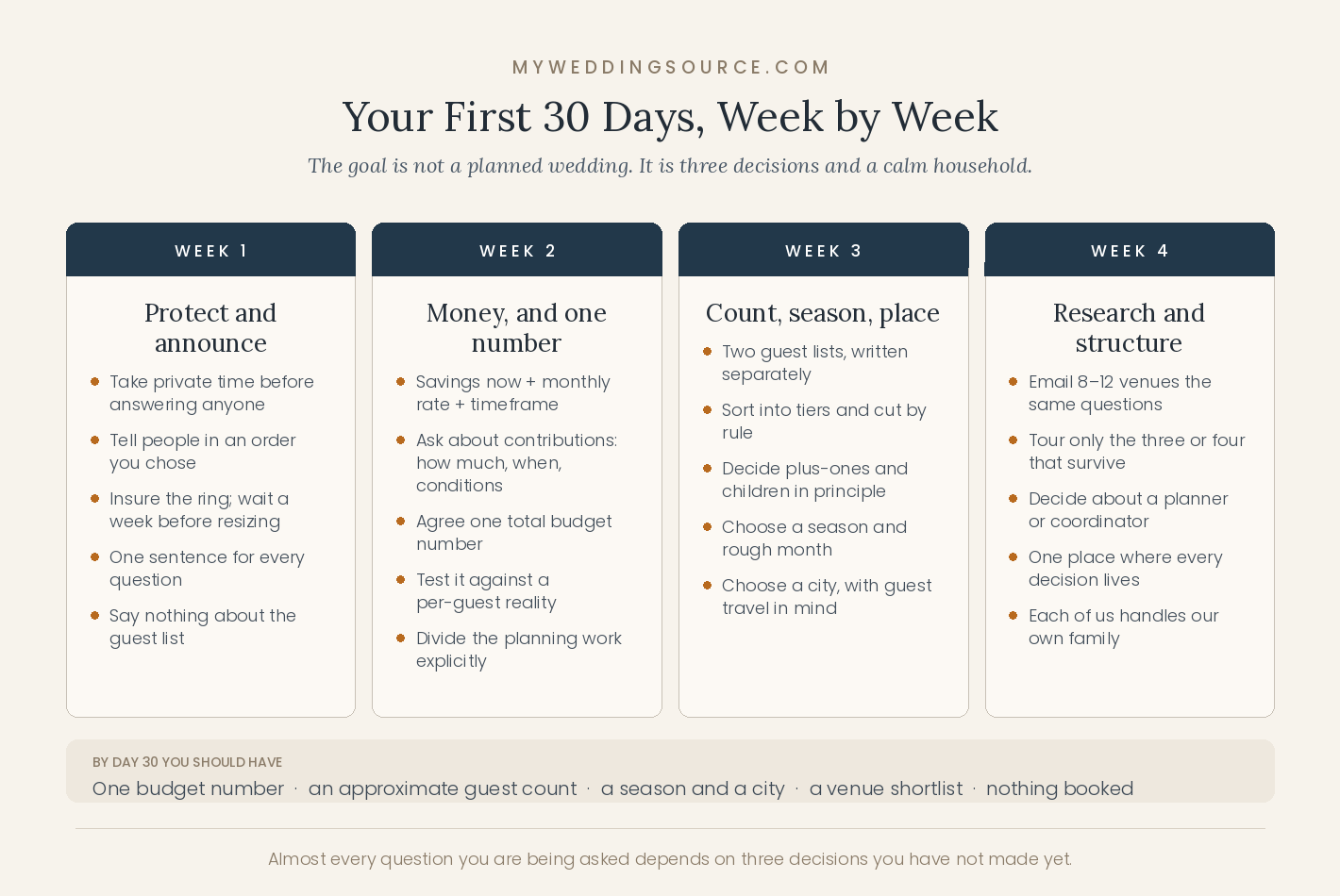
Week 1 — Celebrate, Protect, and Tell People in Order
The only planning task this week is not planning. Everything below either protects something valuable or prevents a problem later.
Days 1 and 2: keep some of it for yourselves
If the proposal happened publicly, this may already be gone, and it is still worth carving out. Take a walk, a drive, a dinner where you tell no one and answer nothing. Many couples describe the quiet hours right after as the part they most wanted back once the announcements started.
Agree together when you will tell people and in what order before either of you starts messaging. Ten minutes of coordination prevents most of the hurt feelings that come later.
Ring care and insurance
If there is a ring, three tasks belong in the first week rather than the first month.
- Insure it. A standard renters or homeowners policy usually caps jewelry coverage well below replacement value. The common routes are adding it as a scheduled item on an existing policy or taking a standalone jewelry policy. Ask specifically what is covered — theft, damage, and simply losing it are treated differently — and whether coverage applies while travelling, which matters if you are still away.
- Appraise it, if your insurer requires it, and keep the grading report, the appraisal, and photographs somewhere separate from the ring itself.
- Wait a week before resizing. Hands swell in heat and shrink in cold, and a holiday week of travel and salt is not a representative sample. If it spins or is hard to remove after seven ordinary days, get it sized.
Two habits are worth starting immediately: take it off for lifting, cleaning products, and swimming, and decide where it lives when it is off. The most common way rings are lost is not theft but being set down somewhere unfamiliar, which describes almost every surface you will encounter over the holidays.
The announcement order, and the holiday complication
A workable order: children first if either of you has them, privately. Then parents and anyone who would be genuinely hurt to hear it secondhand — by call or in person, not by message. Then close family and friends. Then everyone else, in whatever form suits you.
The holiday complication is that some of those people were in the room, so the order is partly out of your hands. Two adjustments help. Call the people who were not there before the news reaches them from someone who was. And ask everyone who was present not to post anything until you have. Well-meaning relatives announcing your engagement to your own friend group is a common and entirely preventable problem.
If there are complicated relationships involved — a divorced parent, an estranged sibling, a friend going through a loss or a breakup — a separate, earlier, private message is usually the kind thing to do.
Social media, on your terms
Decide together whether you post at all, whether the ring appears, and whether your employers or clients will see it. A public post functions as an announcement to everyone you have not told yet, which is why it comes after the calls rather than before.
The one sentence that saves your week
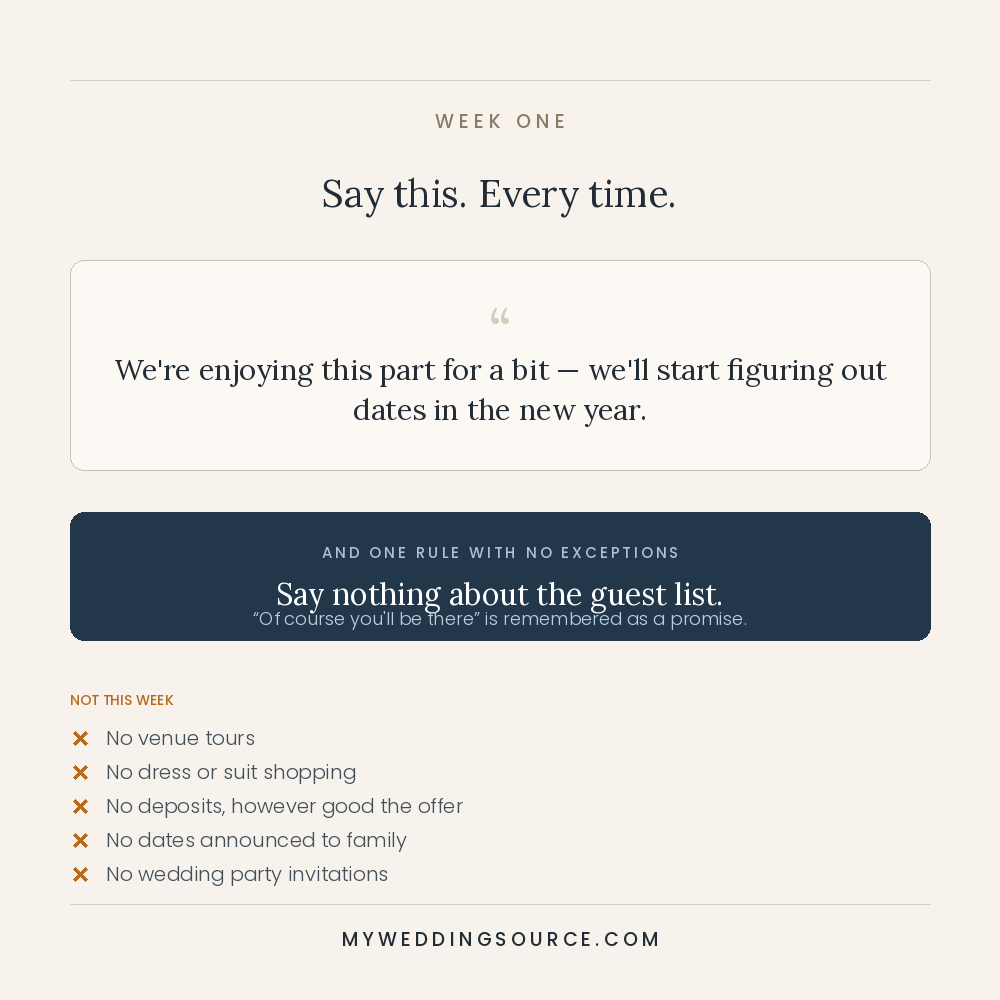
You will be asked for a date, a venue, and a guest list within hours. You will not know. Agree on a single warm sentence and use it consistently, all week, with everyone:
Say this, every time
“We’re enjoying this part for a bit — we’ll start figuring out dates in the new year.”
And one rule with no exceptions this week: say nothing specific about the guest list. Anything said in the first fortnight is remembered precisely and quoted back later. “Of course you’ll be there” is the single most expensive sentence in early wedding planning, and at a holiday gathering you will have twenty opportunities to say it.
What not to do in week one
- No venue tours. You have no budget number and no guest count, so a tour produces enthusiasm and no decisions.
- No dress or suit shopping. It depends on season, formality, and venue, none of which exist yet.
- No date announcements, even approximate ones, to family.
- No deposits on anything, however good the “engagement season” offer looks.
- No wedding party invitations. That decision benefits enormously from a few weeks of thought.
Week 2 — The Money Conversation and One Number
This is the least enjoyable week and the one that determines everything else. The goal is a single number you are both comfortable with, built from real inputs rather than a figure you saw in an article.
Start with what you can actually save
Work from three inputs: what you have set aside now, what you can realistically add per month, and how many months until a plausible wedding date. A couple saving $900 a month with eighteen months and $6,000 already saved is working with roughly $22,000 of their own money, before any contributions.
Be honest about the monthly figure. A savings rate you can sustain for eighteen months is worth more than an ambitious one you abandon in April, and a wedding budget that quietly relies on debt is a decision, not an accident — worth making deliberately if you make it at all.
Asking about contributions
Do not assume anyone is contributing until they have said so specifically, and do not assume the traditional split still applies, because in most families it no longer does. If someone offers, three questions belong in that same conversation, asked warmly and early:
- How much, as a number rather than a gesture.
- By when, since deposits come long before the wedding.
- With what expectations, which is the one people avoid asking.
A script that works
“That’s really generous, thank you. It would help us enormously to know roughly what you had in mind and when it would be available, so we can plan around it properly.”
And if it is offered with conditions: “That makes sense. Can we talk about what that would mean for the guest list, so we’re all working from the same picture?”
Money in a wedding almost always carries some influence, and it is far easier to agree what kind in advance than to renegotiate after a deposit is paid. A contribution earmarked for a category — the catering, the photographer, the bar — is usually easier for everyone than a lump sum with unstated conditions.
What your number actually buys
Before you fall in love with a figure, translate it into a per-guest reality, because catering and beverage are usually the largest category in a U.S. wedding and they scale directly with headcount.
As a rough orientation in many markets, a simple buffet or family-style dinner runs somewhere between $45 and $85 per guest for food alone; plated service commonly runs higher; and service charge plus tax typically adds another 25 to 35 percent on top of that. Add bar, rentals, and staffing and the all-in food-and-beverage figure per guest climbs well beyond the menu price.
The practical exercise: divide your total number by a plausible guest count and see what remains after catering. If the answer is uncomfortable, you have learned something useful in week two rather than in month six. Guest count is the most powerful lever in any wedding budget, and it is the only one that gets harder to pull the longer you wait.
Set up one place where money lives
A shared spreadsheet is enough. Four columns: category, estimated cost, actual cost, and payment dates. Add deposits as you pay them and note when balances are due. It does not need to be sophisticated; it needs to be visible to both of you and updated by whoever pays.
Decide how the work will be divided
Do this now, in week two, while nothing is urgent. Uneven planning labor is one of the more reliable sources of resentment across an engagement year, and it rarely gets corrected once the pattern sets.
Some couples split by category, some by task type, some by who cares more about what. What rarely works is one person defaulting into project management while the other is consulted at the end. Write down who owns what, and agree to revisit it in a couple of months.
Week 3 — Guest Count, Season, and Location
Two lists, written separately
Each of you writes a guest list independently, without discussion, then compare. The gap between the two lists is the actual conversation, and it is much easier to have when both versions already exist on paper than when one person is proposing cuts to the other’s family.
Expect the first combined list to be larger than your budget supports. That is normal and it is the point of doing this early.
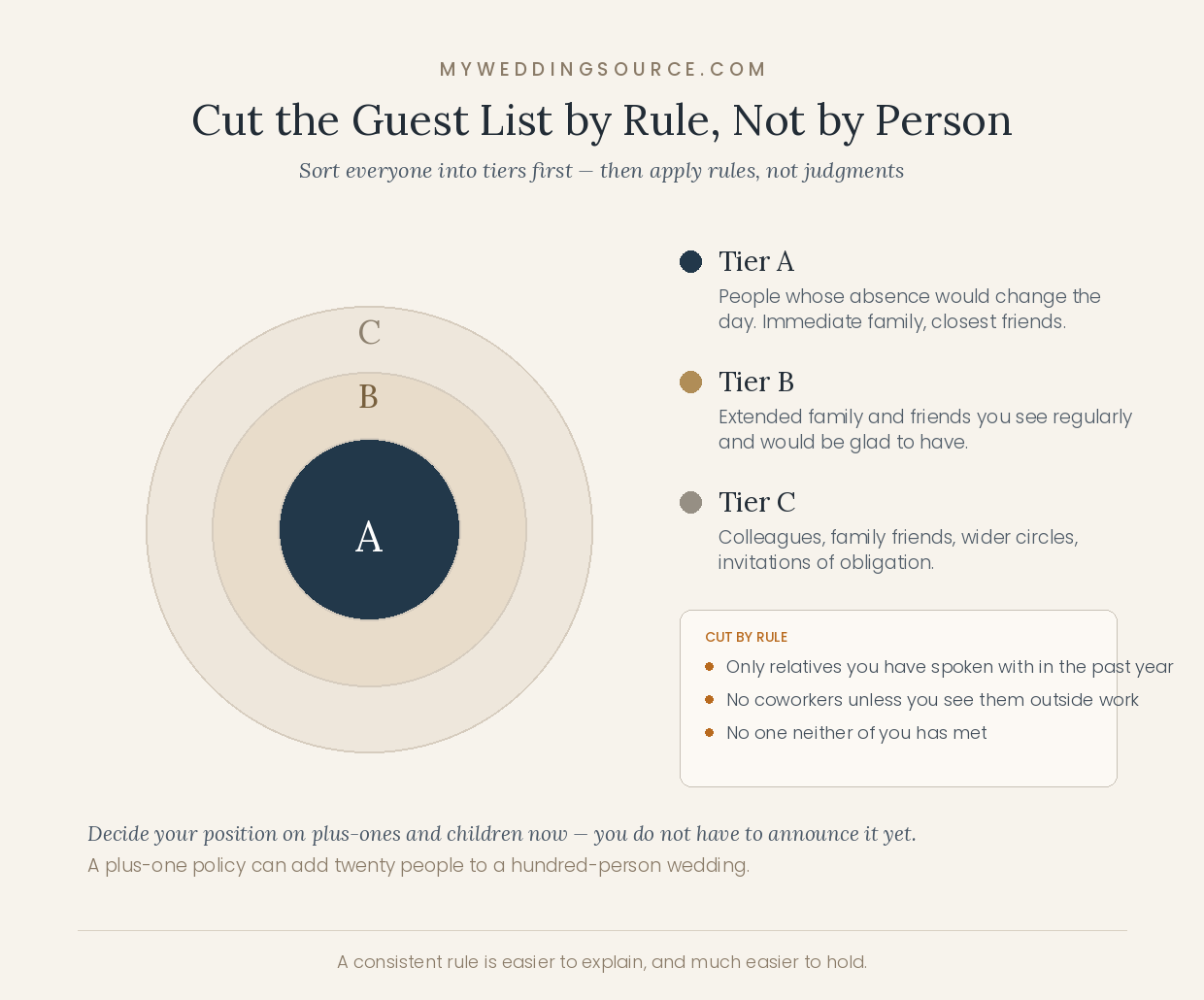
The tier method
Rather than cutting individuals, sort everyone into groups and cut by rule. It removes most of the personal sting and produces a defensible answer when someone asks why they were not invited.
- Tier A: people whose absence would change the day for you — immediate family, closest friends.
- Tier B: extended family and friends you see regularly and would be glad to have.
- Tier C: colleagues, family friends, wider circles, people invited out of obligation.
Then apply rules rather than judgments: only relatives you have spoken with in the past year, no coworkers unless you spend time together outside work, no one neither of you has met. A consistent rule is easier to explain and much easier to hold than a series of individual decisions.
Two policies to settle now, in principle: plus-ones and children. You do not have to announce either yet, but knowing your position prevents accidental promises. Both decisions change your headcount significantly — a plus-one policy can add twenty people to a hundred-person wedding.
Season and date range
You need a season and a rough month, not a date. What the season changes:
| Choice | What it tends to change |
|---|---|
| Peak season Saturday | Highest venue and vendor rates; books furthest ahead; best guest attendance |
| Friday or Sunday | Often meaningfully cheaper; some guests need an extra night or day off |
| Off-season month | Lower rates and more availability; weather contingency becomes real planning |
| Holiday weekend | Guests get an extra day; travel and lodging cost them more |
| A short engagement | Fewer options, less saving time, and often less agonizing |
How long an engagement should be is genuinely up to you. Twelve to eighteen months is common because it matches how far ahead popular venues book, not because anything requires it. Shorter engagements work well, particularly with a smaller guest count or a weekday date.
Location
Three realistic options, each with a different set of consequences: where you live now, where one of you is from, or somewhere neither of you lives. The question that actually decides it is where most of your guests are, since whoever is furthest from the venue pays the most to attend.
If you are considering a destination or a hometown far from both of you, be honest about the attendance effect. It is a legitimate choice — it usually produces a smaller, more committed guest list — but it should be a choice rather than a surprise.
What week three unlocks
With a budget number, a guest count within twenty, and a season plus a city, you can now do something productive with a venue’s website. Before that, you could not, which is why nobody should have toured anything in week one.
Week 4 — Venue Research, Tools, and Boundaries
Research from a laptop before you tour anything
Touring venues is time-consuming, emotionally persuasive, and mostly avoidable at this stage. Nearly everything that disqualifies a venue can be found from home.
Build a simple list of eight to twelve candidates, then email each one the same short message asking for: capacity for your guest count in your preferred layout, availability in your month, the rental fee, whether catering is in-house or outside, the food and beverage minimum, and what is included. The reply tells you more than a tour does, and it filters your list by half before you spend a Saturday.
A first-contact email you can send
“Hi — we’re planning a wedding for around 110 guests, ideally in September or October next year. Could you let me know your availability in that window, your rental fee, whether catering is in-house, any food and beverage minimum, and what’s included in the base price? A sample estimate for 110 guests would be very helpful if you have one.”
Send it to every venue on your list, unchanged. Comparable questions produce comparable answers.
Only tour the three or four that survive that filter, and try to see them at the same time of day as your event.
Do you need a planner?
Worth deciding early because it affects how much of the rest you do yourselves. The common tiers:
- Full-service planning: involved from the start, often priced as a percentage of the wedding budget or a flat fee in the several-thousand range. Useful for large weddings, complex venues, and couples short on time.
- Partial planning: joins partway, typically after the venue and a few key vendors are booked.
- Month-of or day-of coordination: takes over the timeline and vendor management in the final weeks. Commonly the best value for couples planning their own wedding, and it is the one thing many couples say they wish they had booked.
- Venue coordinator: included with many venues, and not the same thing. They represent the venue, manage its staff and spaces, and generally will not run your timeline or manage your outside vendors. Ask exactly what they do and do not cover.
Choose one place where decisions live
Pick a tool you will both actually open — a shared spreadsheet, a planning app, a shared note, a physical binder — and use it for everything: budget, guest list, vendor contacts, contracts, deadlines, and decisions made. The specific tool matters far less than having exactly one of them.
Add a folder for contracts and receipts, and put every deposit deadline into a shared calendar as you go. Most planning stress in later months comes from information living in four places and a decision nobody can find.
Boundaries with family
The first month is when patterns set. Two agreements prevent most of the friction that follows.
First: decide as a couple before responding. When someone asks for something — an invitation, a role, a venue suggestion, a date change — the answer is “let us talk about it and come back to you,” not an on-the-spot yes from whichever of you was asked.
Second: each of you handles your own family. This one prevents more conflict than any other habit in wedding planning. Your partner should not be explaining your mother’s disappointment to her, and you should not be defending their father’s expectations to him.
A phrase worth having ready: “That’s a good idea — we’re not making that decision yet, but we’ll think about it.” It buys time without a confrontation and works on almost everything.
The 30-day check
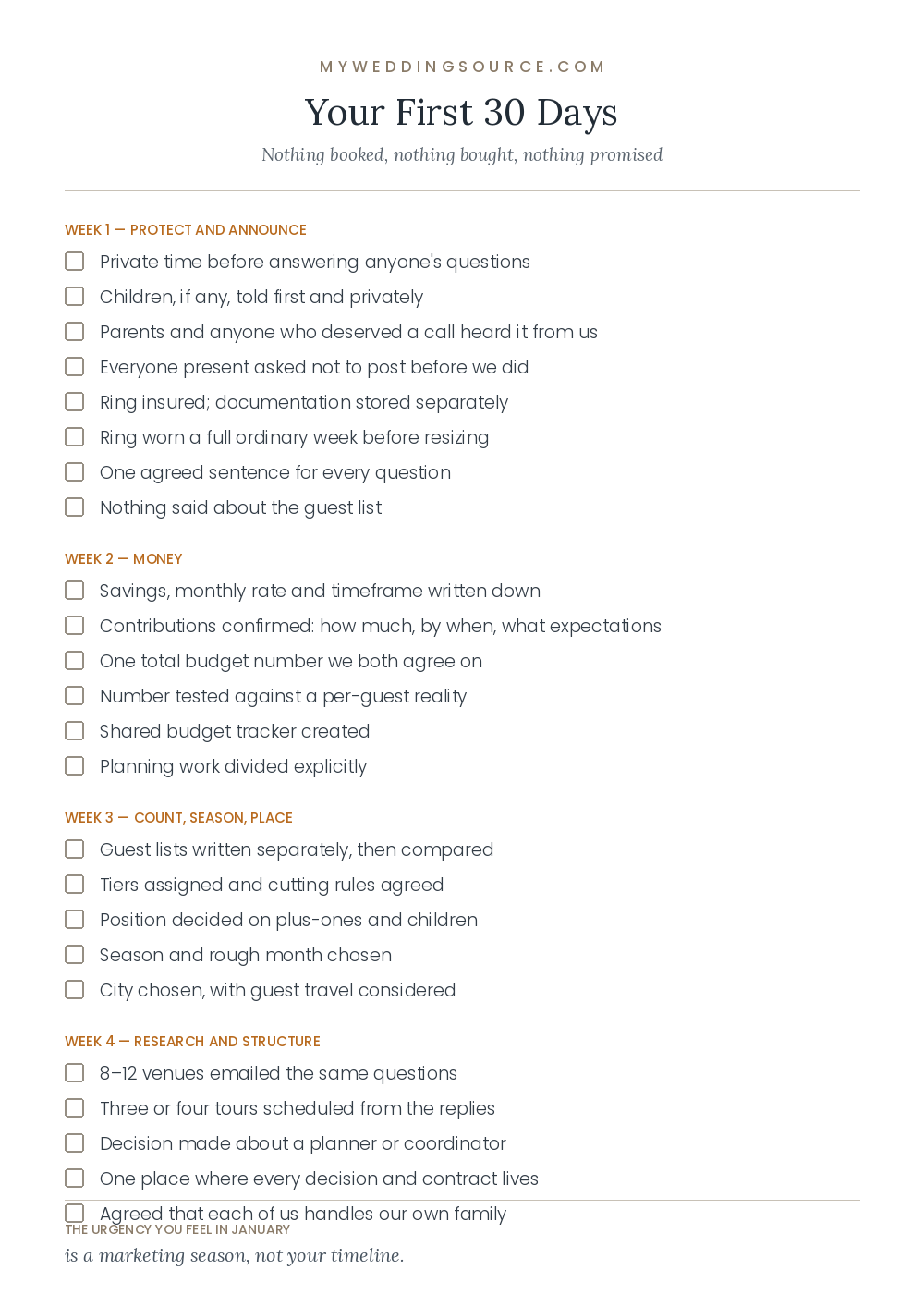
By the end of the month you should have: a budget number, an approximate guest count, a season and a city, a shortlist of venues you have contacted, one place where decisions live, and an agreement about who handles which family. Nothing booked, nothing bought, nothing announced beyond the engagement itself.
If you have that, you are further ahead than a couple who spent the month touring venues, and considerably calmer. If you want a sense of the shape of the longer timeline that follows, Emily Post’s overview of what typically happens twelve to twenty-four months out is a reasonable map of what comes next.
Newly Engaged? What to Do First
The Two Conversations Nobody Schedules
These fit anywhere in the four weeks and are worth an evening each. They are the difference between a year of decisions that feel connected and a year of decisions that feel like arguments about linens.
What does a good day actually look like to each of you?
Before priorities or budgets, describe the day in ordinary language rather than in wedding vocabulary. Not “rustic barn with string lights” but “I want to be able to talk to everyone,” or “I want it to feel like a really good party,” or “I mostly want it to be over quickly and then eat with my family.”
Do this separately first, in writing, then read each other’s. Couples are frequently surprised here, and it is a much better surprise in month one than in month eight. The description tells you what the wedding is for, and every later trade-off gets easier once you both know that. A couple whose answer is “we want to talk to everyone” should be looking at guest counts and floor plans, not at ceremony arches.
The three-priorities exercise
Each of you writes down the three things that matter most, in order, from a list like: food and drink, photography, music and dancing, the guest experience, the venue itself, attire, flowers and design, and having as many people there as possible. Then compare.
Two rules make it useful. Only three, which forces a real ranking rather than a wish list. And whatever is not in either of your top three gets the leftover budget, deliberately and without guilt. This single exercise resolves most future budget disagreements before they happen, because the argument shifts from “is this worth it” to “does this serve one of our six things.”
Where your lists differ, that is not a problem to fix. It is a division of authority: you each get to be the deciding vote on your own priorities, and to accept the other’s on theirs.
How to talk about money without it becoming a fight
Money conversations go badly when they mix three separate things: the facts, the feelings, and the decisions. Separate them deliberately.
Start with facts only, written down and unjudged: savings, income, debt, what each of you can add monthly, what has been offered. Then, separately, the feelings — what money meant in the house each of you grew up in, what makes each of you anxious about spending, what “too much” feels like. Only then the decisions.
Two habits help across the whole year. Agree on a threshold above which any purchase requires a conversation, so neither of you is policing the other. And revisit the number at the three-month mark rather than treating it as fixed, since real quotes will have arrived by then and pretending otherwise creates a quiet gap between the plan and the spreadsheet.
A note on the wedding you may not want
Somewhere in these conversations, one of you may say something that is hard to say: that you do not want a big wedding, or a traditional one, or a wedding at all in the usual sense. Month one is the right moment for that, while nothing has been booked and no one has begun imagining a guest list on your behalf. It is a far kinder conversation now than after a deposit and a family announcement.
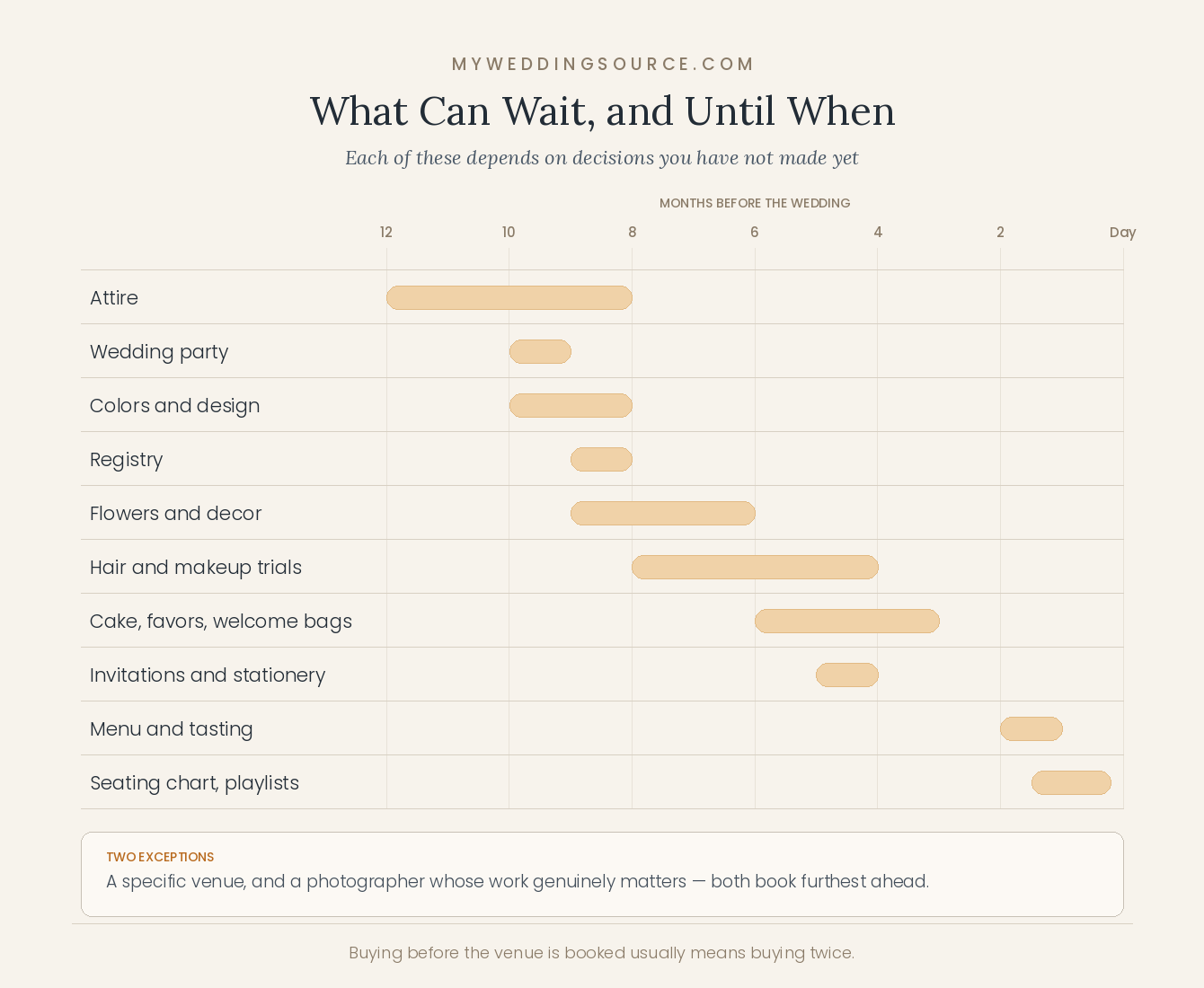
The Long List of Things That Can Wait
This section exists because the pressure you are feeling is not matched by any real deadline. Each of these depends on decisions you have not made, and buying or choosing now usually means doing it twice.
| Can wait | Because it depends on | Roughly when |
|---|---|---|
| Attire | Season, venue, formality | 8–12 months out |
| Colors and design | The venue’s own colors and materials | After booking the venue |
| Flowers and decor | Season, venue, budget remaining | 6–9 months out |
| Menu | Caterer, service style, final count | 4–8 weeks out |
| Wedding party | Nothing — but it benefits from thought | After the venue is booked |
| Registry | Nothing urgent | Before save-the-dates go out |
| Invitations and stationery | Date, venue, formality | 4–5 months out |
| Cake, favors, welcome bags | Almost everything else | 3–6 months out |
| Hair, makeup, trials | Attire and date | 4–8 months out |
| Seating chart, hashtags, playlists | RSVPs and the timeline | Final 6 weeks |
Two exceptions worth acting on early if they apply to you. If a specific venue or a particular photographer genuinely matters, check their availability now, because those are the two categories that book furthest ahead. And if either of you is changing a name, dealing with a visa, or navigating anything with a legal timeline, start researching that immediately — those clocks do not care about your wedding date.
Holiday Timing Quirks Worth Knowing
Nobody is answering email between the holidays
If you got engaged around Christmas, expect a slow response from venues, planners, and photographers until the first full week of January. Many are small businesses operating on reduced holiday schedules. Silence in that window means nothing; do not read it as unavailability, and do not send four follow-ups.
January is the busiest inquiry month of the year
Because of the same seasonal pattern that produced your engagement, venues and vendors receive their heaviest volume in January. Two practical consequences: replies may take longer than usual, and if a specific venue is important to you, sending your inquiry in the first half of January is better than the second.
This is also why you will see a wall of advertising aimed at newly engaged couples. The urgency in your feed is a marketing season, not your timeline.
Engagement parties and save-the-dates
An engagement party is optional and traditionally hosted by someone else. If it is offered, one guideline is worth holding: anyone invited to an engagement party is generally expected to be invited to the wedding, which makes it a guest-list decision disguised as a celebration. Given that you do not have a guest list yet, later is better.
Save-the-dates come after a date and venue are confirmed, typically eight to twelve months before the wedding, and earlier for a destination or a holiday-weekend date. Nothing about the first thirty days involves them.
The “when’s the wedding” question at every gathering
Between the engagement and the new year you will likely attend several more gatherings, each with the same conversation. Keep using the one sentence. If someone pushes, “we’re figuring out the budget first, then a date” is both true and conversation-ending in a pleasant way.
Common Mistakes in the First Month
Touring venues before you have a number and a count
The most common and most expensive first-month mistake. Venues are persuasive in person and the reason is that they are designed to be. Without a budget and a guest count, you cannot evaluate what you are seeing, and falling for a venue you cannot afford at your guest count makes every subsequent decision harder.
Making guest-list promises at holiday gatherings
The circumstances are perfect for it: everyone is warm, someone asks, and the generous answer is easy. It is remembered exactly. Use the one sentence, all month.
Assuming a contribution rather than confirming it
“They’ll probably help” is not a budget input. Ask for a number, a timing, and any expectations attached to it. If nobody is contributing, that is also useful information and better known in week two.
Letting one person become the default planner
It happens quietly in the first month and is hard to correct later. Divide the work explicitly now, while there is nothing urgent to divide.
Buying anything
Engagement-season sales are aimed precisely at people in your position. Decor bought before a venue is decor bought twice. There is no discount worth a decision made in the wrong order.
Announcing a date you have not confirmed
An approximate date shared with family becomes fixed in their minds and, occasionally, in their own calendars. Wait until a venue holds it.
Trying to solve the whole wedding in January
The atmosphere pushes for this, and it does not survive contact with the actual timeline. Three decisions in thirty days is the target, and it is a good one.
Comparing your first month to someone else’s sixth
The couples in your feed announcing venues and dates got engaged earlier or are further along. The comparison produces urgency without producing information.
The 30-Day Checklist
Week 1 — protect and announce
- ☐ We took private time before answering anyone’s questions
- ☐ Children, if any, were told first and privately
- ☐ Parents and anyone who deserved a call heard it from us
- ☐ Everyone present was asked not to post before we did
- ☐ Ring insured or scheduled on a policy; documentation stored separately
- ☐ Ring worn a full ordinary week before deciding on resizing
- ☐ One agreed sentence for every “when’s the wedding?”
- ☐ Nothing said about the guest list, to anyone
Week 2 — money
- ☐ Current savings, monthly saving rate, and plausible timeframe written down
- ☐ Contributions confirmed: who, how much, by when, with what expectations
- ☐ One total budget number we both agree on
- ☐ Number tested against a per-guest reality check
- ☐ Shared budget tracker created
- ☐ Planning work divided explicitly between us
Week 3 — count, season, place
- ☐ Guest lists written separately, then compared
- ☐ Tiers assigned and cutting rules agreed
- ☐ Position decided on plus-ones and children (not announced yet)
- ☐ Season and rough month chosen
- ☐ City or region chosen, with guest travel considered
Week 4 — research and structure
- ☐ Eight to twelve venues identified and emailed the same questions
- ☐ Three or four tours scheduled from the replies
- ☐ Decision made about a planner or month-of coordinator
- ☐ One place chosen where every decision and contract lives
- ☐ Agreement that each of us handles our own family
- ☐ A shared phrase ready for unsolicited suggestions
Frequently Asked Questions
What should we do first after getting engaged?
Nothing that costs money. In the first week, tell people in an order you chose, insure the ring if there is one, and agree on a single sentence to answer the questions you will be asked constantly. Then, over the following three weeks, settle the three decisions everything else depends on: one budget number, an approximate guest count, and a season plus a location. Those three are the actual first steps. Venue tours, dress shopping, and colors all come after them, and doing them first tends to mean doing them twice.
How soon do we have to pick a date?
You do not need a date in the first month. You need a season and a rough month, which is enough to check venue availability. The date usually gets fixed by the venue rather than the other way around, since you will be choosing from what is open. If a specific venue matters to you, check its calendar early — popular venues book twelve to eighteen months ahead for peak-season Saturdays. Otherwise there is no penalty at all for taking a couple of months.
Everyone is asking about the guest list. What do we say?
Nothing specific, warmly. “We haven’t got to that part yet — we’re still figuring out the budget” is true and closes the conversation kindly. Anything more specific gets remembered as a promise, and holiday gatherings produce a lot of opportunities to be generous in a way that costs you later. Once you do have a count, a consistent rule is much easier to explain than individual decisions, which is why the tier method is worth doing before you tell anyone anything.
How do we ask our parents whether they are contributing?
Directly and without assuming. Something like: “We’re starting to work out a budget, and it would really help to know whether you were planning to contribute and roughly what you had in mind.” If they offer, ask how much, by when, and whether any expectations come with it — the third question is the one people skip and later regret. If the answer is no, that is genuinely useful information in week two rather than in month six, and plenty of couples fund their own wedding entirely.
Should we hire a wedding planner?
It depends on your budget, your time, and the complexity of your venue. Full-service planning is most valuable for large or logistically complicated weddings and is usually priced as a percentage of the budget or a substantial flat fee. For couples planning their own wedding, a month-of or day-of coordinator is frequently the better value: they take over the timeline and vendor management in the final weeks, which is exactly when it becomes overwhelming. Be aware that a venue coordinator is not the same thing — they represent the venue, and generally will not run your timeline or manage your outside vendors.
How long should our engagement be?
Long enough to save what you need and to book the venue you want, which for most couples lands somewhere between twelve and eighteen months. Shorter engagements work well, particularly with a smaller guest list, a weekday or off-season date, or a venue that includes catering. Longer engagements suit couples saving toward a specific number or waiting on a life event. The main practical constraint is venue availability, not any rule about the right length.
Is it too early to book anything?
Yes for almost everything, and no for two things. Once you have a budget number, a guest count, and a season, booking a venue is appropriate — it is the decision everything else keys off. And if a particular photographer’s work genuinely matters to you, they book early too. Everything else, including attire, flowers, and stationery, depends on the venue and should follow it. Be especially careful with “engagement season” offers, which are timed precisely at couples in your position.
How do we handle family opinions without a fight?
Two habits cover most of it. First, never answer a request on the spot: “let us talk about it and come back to you” is a complete answer and it stops one of you agreeing to something the other has not considered. Second, each of you handles your own family. Your partner should not be the one explaining a decision to your mother, and you should not be defending their father’s expectations. If a family member is contributing money and using it as leverage, that is a specific conversation worth having directly — including the option of declining the contribution.
We are completely overwhelmed. Is that normal?
Very, and it is usually a symptom of one thing: being asked forty questions that all depend on three decisions you have not made. The fastest relief is not doing more, it is narrowing the field. Settle a budget number, an approximate guest count, and a season and city, and most of the noise resolves itself because you can finally answer people. Until then, one agreed sentence in response to everything is a legitimate and sufficient strategy.
What if we do not want a big wedding at all?
Then say so early, to each other and then to family, and let the budget number reflect it. Small weddings, courthouse ceremonies followed by a party, and elopements are all complete choices rather than compromises, and they get considerably harder to choose once expectations have formed and deposits are paid. The first month is exactly the right moment to say it out loud — before anyone has begun imagining a guest list on your behalf.
Three Decisions, Not Forty
The first thirty days are not for planning a wedding. They are for protecting the beginning of your engagement and settling the three decisions that make everything after it possible. A budget number, an approximate guest count, and a season and a city. Everything you are being asked about right now depends on those three, which is why you cannot answer yet and do not need to.
The sequence that keeps the month calm: take private time before the announcements, tell people in an order you chose, insure the ring, and say nothing about the guest list. Then one number in week two, a count and a season in week three, and venue research from a laptop in week four. Nothing booked, nothing bought, nothing promised.
The urgency you are feeling in January is a seasonal pattern, not a deadline. The couples who look further ahead in your feed got engaged earlier. You have more time than the atmosphere suggests, and the couples who spend month one on these three decisions consistently find the following eleven easier than the ones who spent it touring venues.
Your next step
Put ninety minutes in the calendar this week, before anything else on this list. In the first half, each of you writes a guest list separately, without discussion. In the second half, compare them and write down one budget number you both agree on. Those two things, in one sitting, unlock the entire rest of the year — and they cost nothing but an evening.
