

Engagement Season Checklist: Key Points to Remember
From late November through Valentine’s Day, proposals cluster. Families gather, people travel home, calendars fill with occasions that feel significant, and a season that is mostly about logistics starts to feel like a deadline. If you have been together a while, you can feel that pressure from several directions at once: relatives asking pointed questions over dinner, friends announcing their own news, and a general sense that something is supposed to happen soon.
As you navigate the engagement season checklist, remember that the key is open communication and understanding.
This engagement season checklist is built around a different premise. The strongest engagements are not the ones that happen at the most photogenic moment. They are the ones where both people already know what they are agreeing to — roughly when they want to marry, what marriage means to each of them, how money will work, and what kind of wedding is realistic. Those conversations are less romantic than a proposal and considerably more useful.
This evolving engagement season checklist will help ensure both partners are on the same page.
The difficulty is that the two halves of this process usually run in the wrong order. The proposal is planned in detail and the substance is left for afterward, so couples end up negotiating fundamental questions — children, location, debt, family expectations, how much a wedding should cost — while also fielding congratulations and being asked for a date they have not chosen. That is a genuinely hard sequence, and it is avoidable.
Refer back to your engagement season checklist to keep conversations on track.
The consequences of skipping the groundwork are rarely dramatic. More often they are slow: a first year of engagement spent discovering mismatched assumptions, a wedding budget that becomes a proxy argument about something else, a family conflict that could have been anticipated, or a ring that does not suit the person wearing it and cannot be exchanged because the return window closed.
Each conversation can be tied back to the engagement season checklist for clarity.
What follows separates two things that are usually mixed together: the conversations that belong before a proposal, and the practical steps that follow after one. It assumes nothing about who proposes, whether there is a ring at all, whether the proposal is a surprise, or who is paying for anything. It covers marriage expectations, money, ring preferences and costs, privacy, announcements, insurance and resizing, the first planning decisions, and the things that can safely wait. There is a checklist at the end you can work through in an evening.
Completing the engagement season checklist helps manage expectations and reduces stress.
What Engagement Season Is, and Where the Pressure Comes From
Your Ultimate Engagement Season Checklist
Your engagement season checklist should include everything from finances to guest lists.
The calendar effect
A large share of U.S. proposals happen between Thanksgiving and Valentine’s Day. The reasons are practical rather than mystical: families are already gathered, travel is already booked, time off is already scheduled, and the occasions themselves supply a ready-made setting. Jewelers plan their year around it, and social media fills with announcements for about ten weeks.
Make sure to revisit your engagement season checklist as you plan your big day.
That concentration produces a visible effect. When four people you know get engaged in six weeks, a relationship that is perfectly healthy can start to feel behind schedule. Nothing about your relationship changed; the visibility of other people’s relationships changed.
Where the pressure actually comes from
Understanding the engagement season checklist can ease the pressure you feel.
Three sources, and it helps to name them separately because they call for different responses.
Family. Direct questions at gatherings, usually well-intentioned and often repeated. These are best handled with a short, warm, non-committal answer agreed on in advance rather than improvised at the table.
Your engagement season checklist will guide you through these discussions.
Peers. Comparison is largely involuntary and mostly unhelpful. Other couples’ timelines reflect their circumstances, not a standard.
Internal. The hardest one. If you have been waiting for a proposal and the season passes without one, that can be painful in a way that has nothing to do with social media. It is worth saying out loud to your partner rather than carrying quietly, and it is a reason to have the timing conversation directly rather than hoping.
Keep your engagement season checklist handy for these emotional conversations.
A proposal is a decision two people make
Popular framing treats a proposal as a question one person asks and the other answers. In practice, most well-handled engagements involve two conversations: an ongoing one about whether and roughly when to marry, and then a moment that marks it. The moment can be a complete surprise, partially planned, or fully planned together, and none of those is more legitimate than the others.
Two engaged couples should reference their engagement season checklist together.
If a surprise matters to one or both of you, the surprise can be the timing, the setting, or the ring, while the decision itself is already shared. That is a common approach and it removes the single biggest risk in a surprise proposal, which is not embarrassment but mismatch.
A note on how this guide is written
This guide serves as an engagement season checklist, helping couples clarify their goals.
Nothing here assumes who proposes, that there is a ring, that a proposal should be a surprise, that parents are involved or paying, or that a wedding follows quickly. Use the parts that apply and skip the rest.
Before a Proposal: The Conversations Worth Having
The engagement season checklist serves as a roadmap for your journey.
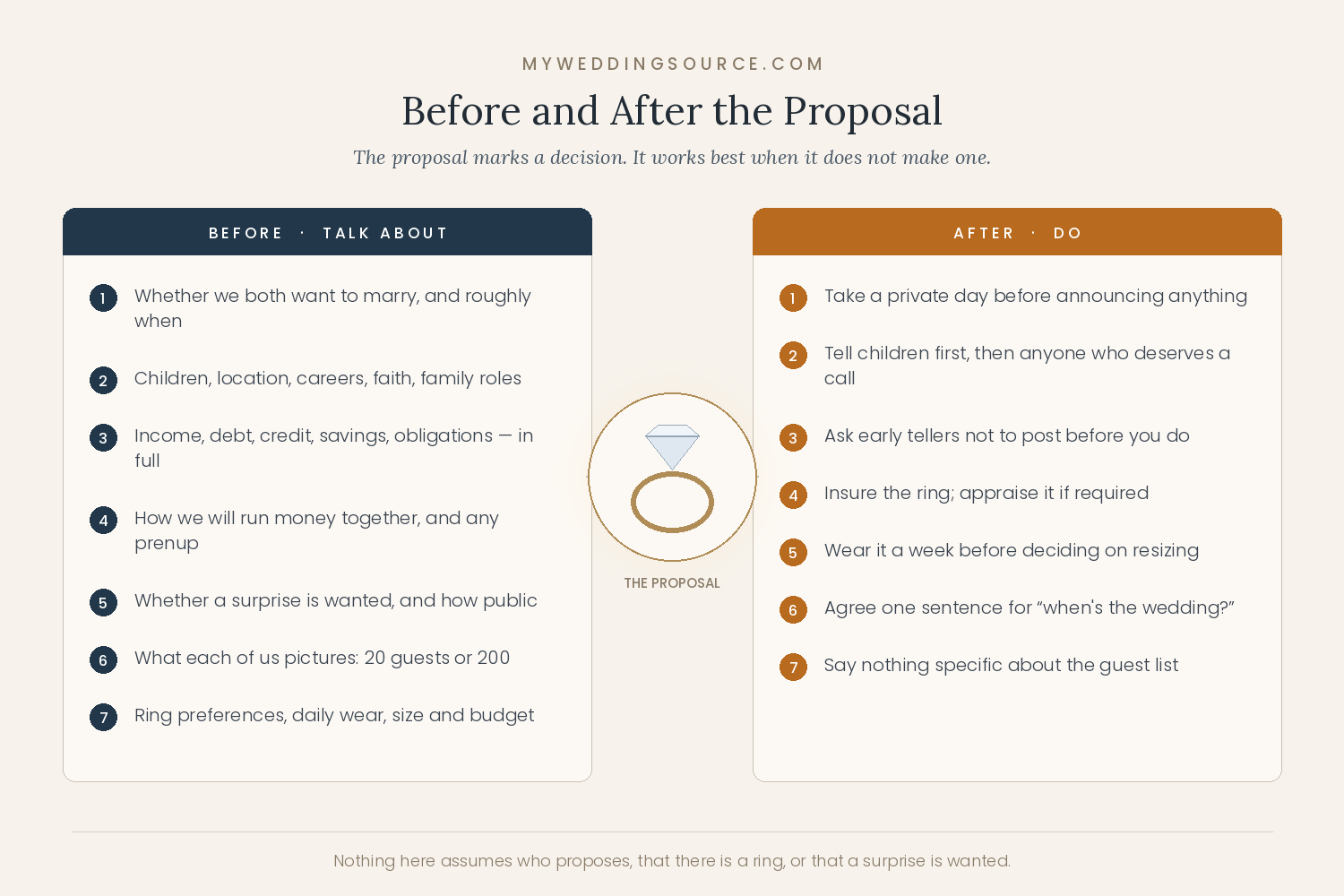
These are not tests to pass. They are subjects where unspoken assumptions tend to be different, and where discovering that difference early is much easier than discovering it later. Spread them over weeks rather than attempting all of them in one evening.
1. Do we both want to be married, and roughly when?
The most basic question, and the one most often assumed rather than asked. Marriage and long-term commitment are not the same thing for everyone; some people want one without the other, and that is a legitimate position worth knowing about.
The engagement season checklist helps ensure both partners agree on their vision.
If you both want it, the useful follow-up is timing in broad terms: this year, next year, after a degree finishes, after a lease ends, after a visa process resolves, after saving a certain amount. You do not need a date. You need to know whether you are in the same year.
2. What does marriage actually mean to each of us?
People carry very different pictures of married life, usually inherited from what they grew up around, and they frequently assume the other person shares it. Worth discussing:
- Children: whether, roughly when, how many, and how you would each feel if that turned out not to be possible. Also fertility timelines, adoption, and existing children.
Use the engagement season checklist to guide your discussions about family.
- Location: where you expect to live in five and ten years, proximity to family, and whether either of you would relocate for the other’s work.
- Careers: ambitions, expected hours, travel, and what happens if one career requires the other to bend.
- Faith and culture: practice, traditions you want in a marriage, and expectations from either family.
- Household and care work: how you split it now and whether that would change with children or an aging parent.
- Family relationships: how involved your families will be, and what boundaries you both want.
None of these needs to be resolved permanently. What matters is that neither of you is surprised later by something the other considered settled.
3. Health, family history, and how you handle hard things
Less discussed and quietly important. How each of you responds to stress, illness, grief, and conflict is more predictive of a good marriage than any shared preference. If either of you has a chronic condition, a mental health history, or caregiving responsibilities, those belong in the conversation before an engagement rather than after.
These topics are part of your engagement season checklist for a healthy relationship.
4. Privacy and how public you want this to be
Some people want a proposal witnessed by everyone they love; others would find that mortifying. Some want photographs; some want no camera present. Some want to tell family within the hour; some want a week to themselves first.
Ask directly rather than inferring from what your partner enjoys generally. Someone who loves parties may still want a proposal to be private, and someone reserved may want a public one. This is also the moment to agree what gets posted, by whom, and when — including whether anyone else may post before you do.
5. Whether a surprise is wanted at all
Worth asking plainly, because the answer varies and the assumption runs strongly in one direction. Some people genuinely want to be surprised. Others find surprise stressful, dislike being unprepared in photographs, or want to participate in choosing a ring. Some want to propose themselves, or to propose to each other.
A short conversation covers it: do you want to be surprised, do you want to know it is coming but not when, or would you rather plan it together? Any answer makes the next steps easier.
Understanding each partner’s preferences is crucial to your engagement season checklist.
6. Family involvement and traditions
Some families expect to be asked or told in advance; some would find that odd. The tradition of asking a parent for permission has largely shifted toward telling parents beforehand, or asking for a blessing, and plenty of couples skip it entirely.
The engagement season checklist should also address family traditions.
The workable approach: ask your partner what they would want. If a parent’s involvement matters to them, do it in the form they would want. If it would bother them, do not do it because your family expects it. The person you are marrying gets the deciding vote on their own proposal.
7. What kind of wedding, in rough terms
Not a plan — an order of magnitude. Twenty people or two hundred. Local or destination. This year or in two years. Religious, civil, or something else. Elopement followed by a party is a real and increasingly common option.
This one matters before an engagement because it is where family expectations and money collide hardest, and because a mismatch here shapes the entire first year. If one of you is picturing a courthouse and the other a 200-person church wedding, that is worth knowing before anyone spends money.
Be clear about your long-term vision while working through the engagement season checklist.
Money: The Conversation Most Couples Postpone
This is the subject most likely to be avoided before an engagement and most likely to cause friction afterward. It does not require agreeing on everything. It requires knowing the facts and understanding how each of you thinks about money.
Nothing here is financial or legal advice. It is a list of what to put on the table, so you can make your own decisions and, where it matters, get qualified help.
What you should each actually know
The engagement season checklist can help you navigate these financial conversations.
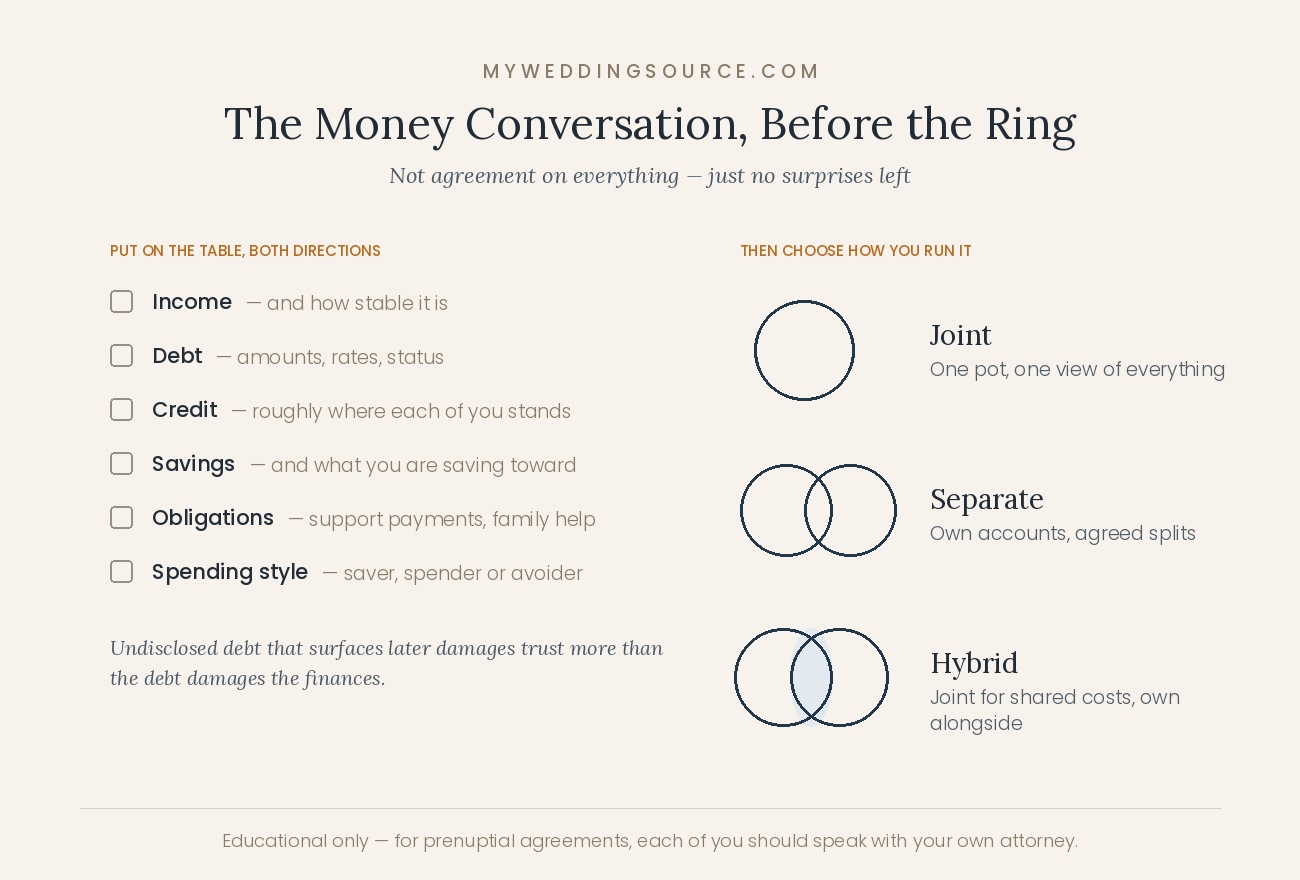
- Income, including how stable it is and how it might change.
- Debt: student loans, credit cards, car loans, medical debt, money owed to family. Amounts, rates, and payment status.
- Credit: roughly where each of you stands, since it affects renting, mortgages, and rates.
- Savings and retirement, and what each of you is saving toward.
- Obligations: child support, alimony, family support you send regularly.
- Spending style: saver, spender, or avoider, and how each of you was raised around money.
Full disclosure before an engagement is the standard worth holding. Discovering significant undisclosed debt afterward is one of the more damaging things that can happen in a first year, and it is nearly always worse for having been hidden than for existing.
How you will actually run money together
Revisit your engagement season checklist regularly to stay on track.
There is no correct system. Common approaches include fully joint accounts, fully separate accounts with agreed splits, and a hybrid with a joint account for shared costs and personal accounts alongside. What matters is choosing deliberately and revisiting it.
Useful questions: How do we split shared costs — evenly, or proportionally to income? What purchase size requires a conversation? Who tracks bills? What are we each saving toward, and what would we sacrifice for it?
Prenuptial agreements
Worth discussing before an engagement rather than during wedding planning, and worth discussing without treating the subject as an accusation. They are especially relevant when either person has children from a previous relationship, significant assets or debt, a business, an inheritance, or when the couple lives in a state whose default rules they have not examined.
Having a clear engagement season checklist makes planning easier.
This is a legal matter with rules that vary by state, including requirements about timing, disclosure, and independent representation. If you are considering one, each of you should speak with your own attorney, and early rather than close to the wedding.
Who pays for the wedding, and what that implies
Do not assume anyone is contributing until they have said so specifically. Traditional assumptions about which family pays for what have largely dissolved, and many couples now fund most of their own wedding.
If a family member offers, three questions are worth asking early and kindly: how much, when is it available, and what expectations come with it. Money in a wedding almost always carries some influence, and it is much easier to agree on that in advance than to negotiate it after a deposit is paid. A contribution earmarked for a specific category — the catering, the photographer — is often easier for everyone than a lump sum with unstated conditions.
Rings: Preferences, Budget, and What to Check
A ring is optional. Plenty of couples skip one, choose matching bands, use a family piece, or buy something later. If you are buying one, this section covers what tends to cause regret and what prevents it.
Learning preferences without spoiling anything
If a surprise is wanted, you can still gather good information. Useful sources: what your partner already wears daily, what they have saved or pointed out, what they have said about other people’s rings, and what a close friend or sibling knows. A trusted third party can ask questions that would be obvious coming from you.
The specifics worth knowing are fewer than people think: metal color, stone shape, whether they prefer something delicate or substantial, whether their work makes a raised setting impractical, and whether they have a strong feeling about natural versus lab-grown stones or about a non-diamond center stone entirely.
The single most common ring regret is a style that does not suit the wearer’s daily life — a high setting that catches on gloves, patients, keyboards, or climbing holds. That is worth more attention than the stone size.
Share the engagement season checklist with trusted friends or family for support.
Budget: the “months of salary” rule is marketing
The familiar guideline about spending a set number of months’ salary originated in advertising, not in any financial principle. There is no correct amount. What is useful is deciding a number you can pay without debt, before you start looking, and treating it as a limit rather than a starting point.
Two practical notes. Ring budgets and wedding budgets compete for the same money, so decide the split deliberately. And a ring can be upgraded or added to later; many couples buy a modest setting and change it at an anniversary.
What actually drives the price
Consider all factors on the engagement season checklist before finalizing decisions.
For diamonds, price is driven largely by the combination of carat weight, cut quality, color, and clarity — the properties commonly summarized as the 4Cs. The Gemological Institute of America’s overview of how to approach buying an engagement ring is a reasonable neutral primer if you are starting from zero.
Some practical levers most buyers find useful:
Your engagement season checklist should include resizing and paperwork.
- Cut quality is what makes a stone look alive. Many buyers get better results prioritizing cut over carat weight.
- Shape changes price per carat considerably, and some shapes look larger for the same weight.
Address these points from your engagement season checklist with your partner.
- Lab-grown diamonds are chemically the same material as mined ones and typically cost substantially less. Their resale behavior differs, and prices have moved a great deal in recent years, so ask about current pricing rather than relying on an older article.
- Alternative stones — sapphire, moissanite, and others — are common center stones. Hardness matters for daily wear; ask specifically.
- The setting can be a significant share of the cost, especially with pavé, hidden halos, or custom work.
Sizing and resizing
Getting the size right before a proposal is genuinely difficult when it is meant to be a surprise. Common approaches: borrowing a ring they already wear on the correct finger and having a jeweler measure it, asking a friend or family member, or accepting that resizing will happen afterward.
Practical points to know: fingers change size with temperature, time of day, and over the years. Some designs resize easily; eternity bands, tension settings, and certain patterned bands are difficult or impossible to resize. Ask before buying how much a ring can be resized, in which direction, and at what cost, since a ring that cannot be adjusted is a real constraint. Resizing typically takes a jeweler days to a couple of weeks.
Paperwork, appraisal, and return windows
Whatever you buy, keep the documentation. For a significant stone, that usually means an independent grading report; for insurance, an appraisal with a description and replacement value. Photograph the ring from several angles.
Use the engagement season checklist to remind you of important tasks.
Ask about the return and exchange window before purchase, and note the deadline in your calendar. If there is any chance the recipient will want to change the design, that window is the mechanism, and it is short. Also ask what warranty or service plan exists, whether inspections are required to keep it valid, and what it costs.
Family stones and heirlooms
Using a family ring is meaningful and carries two considerations worth handling early. First, resetting: an heirloom stone can usually be reset into a new design, and asking permission before altering something sentimental avoids a difficult conversation later. Second, expectations: a family ring can come with an implied claim on the marriage or a sense that it must be worn even if it does not suit. Talk about that with the person giving it, and make sure your partner would actually want it.
After the Proposal: The First Two Weeks
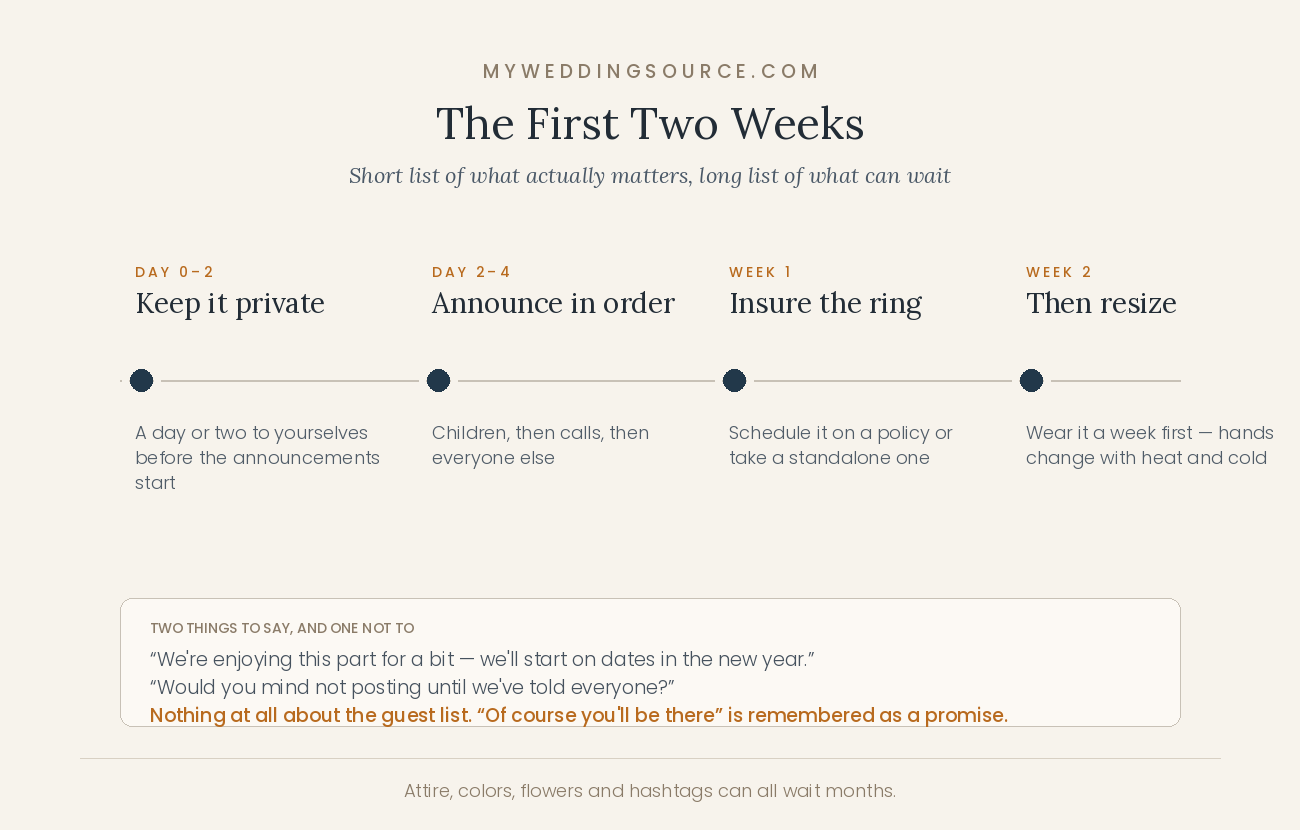
The first two weeks have a specific character: everyone wants to talk to you and you have not decided anything yet. A short list of things genuinely worth doing, and a long list of things that can wait.
During these weeks, check your engagement season checklist frequently.
Take a beat before announcing
You are allowed a private day or two. Many couples say the quiet hours right after were the part they most wanted back once the announcements started. Agree between yourselves when you will tell people and in what order before either of you starts texting.
Consult your engagement season checklist to prioritize announcements.
Ring care, insurance, and the appraisal
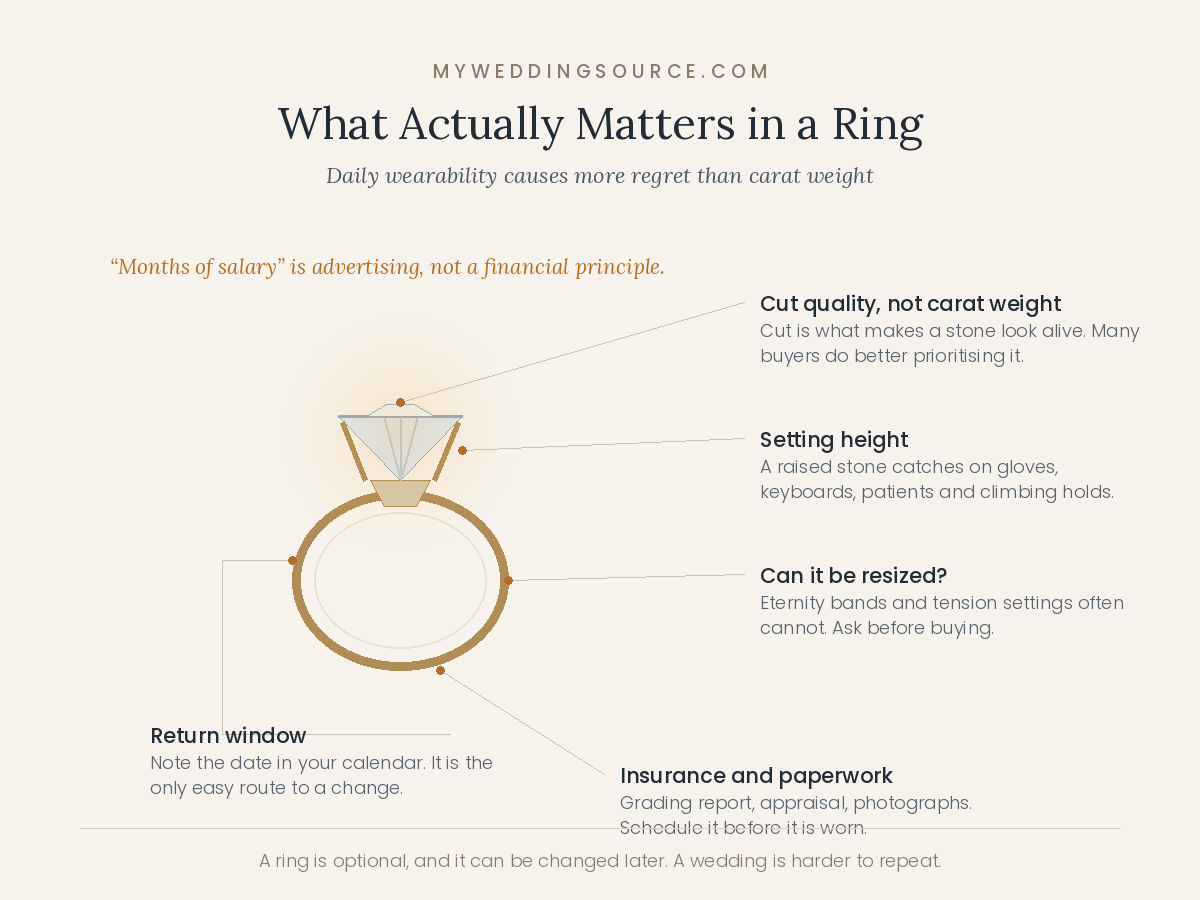
If there is a ring, three practical tasks in the first weeks:
- Insurance. A valuable ring is usually not fully covered by a standard renters or homeowners policy, which often caps jewelry coverage. Options generally include a scheduled item added to an existing policy or a standalone jewelry policy. Ask what is covered — loss, theft, damage, disappearance while traveling — and what documentation is required. Do this before the ring gets worn to a beach, a gym, or a wedding.
- Appraisal, if the insurer requires one, with a written description and replacement value.
- Sizing. Wear it for a week before deciding; hands swell in heat and shrink in cold. If it spins or is hard to remove, get it sized rather than living with it.
Basic care habits matter more than people expect: remove it for lifting, cleaning products, gardening, and swimming; have prongs inspected periodically; and decide where it lives when it is off, since the most common loss is not theft but a ring set down somewhere unfamiliar.
Announcement order
Clearly defined roles on your engagement season checklist will ease planning.
There is no universal order, but a workable one is: children, if either of you has them, first and privately. Then parents and anyone who would be genuinely hurt to hear it secondhand, ideally by call or in person. Then close family and friends. Then everyone else, in whatever form you like.
Two things prevent most hurt feelings. Tell people in a form that matches your relationship — a phone call for a grandparent, a text for a group chat — and ask the people you tell early not to post anything until you have. Well-meaning relatives announcing your news is a common and avoidable problem.
If there are complicated relationships involved — a divorced parent, an estranged sibling, a friend going through a loss or a breakup — a separate, earlier, private message is usually the kind thing to do.
Social media and privacy
Use the engagement season checklist for managing social media expectations.
Decide together what is public: whether you post at all, whether the ring appears, whether your faces do, and whether either of your employers or clients will see it. A public post also functions as an announcement to everyone you have not told yet, which is why order matters.
Handling the questions
Within a day you will be asked when the wedding is, where it will be, and who is in the wedding party. You will not know. Agree on one warm sentence and use it consistently: something like, “We’re enjoying this part for a bit — we’ll start figuring out dates in the new year.”
Answer the guest-list question with nothing at all. Anything said in the first weeks tends to be remembered as a promise, and “of course you’ll be there” is the most expensive sentence in early wedding planning.
Find answers on your engagement season checklist when facing common questions.
After the Proposal: The First Month or Two
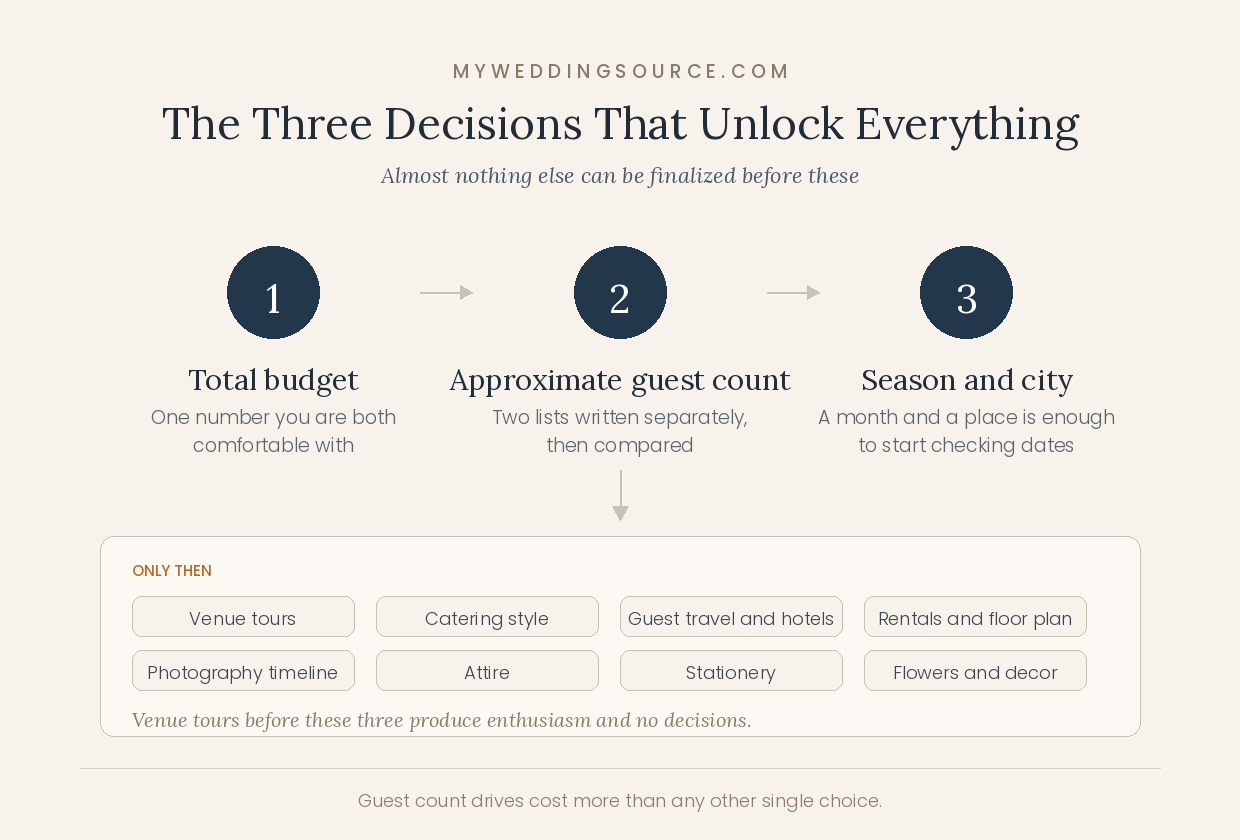
Three decisions unlock nearly everything else, and almost nothing can be finalized before them. Everything else can wait longer than you think.
The three decisions that come first
1. Total budget. Not a line-item plan — one number you are both comfortable with, built from what you can save by a plausible date plus anything a family member has firmly committed. This number determines the guest count and the type of venue, so it comes first even though it is the least enjoyable.
2. Approximate guest count. Each of you writes a list independently, then compare. The gap between the two lists is usually the real conversation. Guest count drives catering, venue size, and rentals more than any other choice, which is why an approximate number is needed before touring anything.
3. Season, location, and rough date range. A month or a season and a city. This is enough to check venue availability and to understand what your budget buys in that market.
With those three, you can look at venues productively. Without them, venue tours produce enthusiasm and no decisions.
Money conversations that follow
Document the decisions made from your engagement season checklist for reference.
Once you have a number, confirm contributions specifically: who, how much, by when, and what they expect in return. Ask directly rather than assuming, and write the answers down. If a contribution comes with a guest-list expectation, that is useful to know before the number feels settled.
Set up a simple system for tracking: one shared document with a budget, deposits paid, and dates due. It does not need to be sophisticated. It needs to exist and be visible to both of you.
Choosing how you will plan
Decide early how the labor will be divided, because an uneven split is one of the more common sources of resentment in an engagement year. Some couples split by category, some by task type, some by who cares more about what. What rarely works is one person defaulting into project management while the other is consulted at the end.
Pick a tool you will both actually open — a shared spreadsheet, a planning app, a notebook — and one place where decisions live.
Boundaries with family and friends
Engagement invites opinions, and the early weeks are when patterns get set. Two habits help. First, decide as a couple before responding to a request, rather than one of you answering on the spot. Second, agree that each of you handles your own family, which prevents the most common conflict pattern in wedding planning.
A gentle phrase to keep ready: “That’s a good idea — we’re not making that decision yet, but we’ll think about it.” It buys time without a confrontation and works on almost everything.
Reflect on the engagement season checklist to guide your planning approach.
What can safely wait
Attire, colors, flowers, favors, hairstyles, cake, stationery design, welcome bags, a wedding hashtag, and the seating chart. All of these depend on decisions you have not made yet, and shopping for them early usually means buying twice.
Two things worth doing early even though they feel premature: securing a date with the venue and any vendor whose work you genuinely care about, since the best-matched vendors book furthest ahead, and starting the paperwork research if either of you is changing a name or dealing with visas.
Situations That Do Not Fit the Standard Script
One of you is ready and the other is not yet
This situation may not be on your engagement season checklist but is important to discuss.
Common and survivable. What matters is distinguishing “not yet” from “not with you,” and asking directly rather than waiting to find out. If it is timing, ask what specifically needs to be true first and whether that is a matter of months or years. If the answer is vague across several conversations, that vagueness is itself information.
If you are the one waiting, say so plainly and without an ultimatum: “I want to be married, ideally within the next couple of years. I’d like to know whether you’re in the same place.” That is a fair thing to ask for and a reasonable thing to want an answer to.
Either of you has been married before, or has children
Two additions to the checklist. Children hear about it first and privately, in an age-appropriate way, with room to react however they react — including badly, which is normal and not a verdict. And the legal and financial conversation is more substantial: existing obligations, estate planning, beneficiary designations, and how a new marriage interacts with them. Those are questions for an attorney and, where relevant, a financial professional.
Immigration or visa considerations
If either of you is not a citizen or permanent resident, the timing of an engagement and a marriage can carry legal consequences, and rules are detailed and change. Speak with an immigration attorney before making timing decisions, and be careful about relying on general advice online, including this article.
You both want to propose
Increasingly common, and it works well. Options include proposing to each other at different times, planning a shared moment, exchanging rings or another object, or one person proposing and the other reciprocating later. Agree loosely on whether both proposals are surprises, because two people separately planning surprises for the same month can produce a comedy.
Make sure your engagement season checklist reflects both partners’ desires.
You do not love the ring
Uncomfortable and fixable. If a return or exchange window exists, that is the cleanest route, so check it quickly. Beyond that, most rings can be reset, resized, or have the setting changed while keeping the stone. The conversation is easier if it is framed around wearability rather than taste: how it sits, how it catches, how it works with your hands and your days.
If the ring is a family heirloom and does not suit you, resetting the stone is usually the diplomatic answer, and it is worth asking the family member before rather than after.
Engaged during a family holiday
If the proposal happens with relatives present, you lose the private window by default. Two things help: agree in advance who gets a call that day rather than hearing it from someone at the table, and give yourselves a private hour before or after. Also decide beforehand what happens to the rest of the gathering — whether it becomes a celebration or stays as planned — since one family’s assumption and the other’s can differ.
You would rather elope, or skip the wedding entirely
A complete option, not a compromise. If this appeals to either of you, say it during the “what kind of wedding” conversation rather than after deposits are paid. Many couples marry privately and host something later, which separates the legal and the social event and often reduces both cost and pressure.
Discuss elopement options within your engagement season checklist framework.
Common Mistakes
Treating the season as a deadline
A proposal timed to a holiday because the holiday is coming, rather than because you are both ready, front-loads pressure onto a decision that deserves none. The calendar will produce another occasion. Nothing about a December proposal is more valid than an ordinary Tuesday in April.
Proposing without the timing conversation
Pressure linked to the engagement season checklist can be mitigated through honest conversation.
The most consequential omission on this list. A yes given under surprise, in front of an audience, is a difficult moment to say anything else in. If you have not talked about whether and roughly when, that is the conversation to have first — and it does not spoil a surprise, because the timing and setting can still be entirely unknown.
Skipping full financial disclosure
Debt that surfaces after an engagement damages trust more than the debt itself damages the finances. Put the numbers on the table beforehand, both directions.
Buying a ring based on a rule instead of a person
The salary guideline is advertising. The stone size is the least important variable in daily wear. What matters is whether the person can wear it every day without taking it off, and whether it suits them.
Announcing before telling the people who should hear it directly
Review the engagement season checklist periodically to ensure you stay aligned.
A public post reaches everyone at once, including the grandparent who would have wanted a call and the friend who is having a hard month. Order the announcements, and ask early tellers not to post.
Making guest-list promises in the first two weeks
“Of course you’ll be there” is remembered precisely and cited later. Say nothing about the guest list until you have a number.
Letting one person become the default planner
Uneven planning labor is a slow source of resentment across an engagement year. Divide it explicitly at the start, and revisit it if it drifts.
Shopping before the three decisions
The engagement season checklist ensures that both partners contribute.
Attire, decor, and stationery all depend on budget, guest count, and venue. Buying early usually means buying twice.
Accepting money without asking what comes with it
Contributions are often generous and occasionally conditional. Ask what expectations accompany the money at the moment it is offered, when the question is easy and warm rather than late and awkward.
The First-Step Checklist
As you work on your engagement season checklist, remember to communicate openly.
Work through the first section before a proposal, and the second in the weeks after. Nothing here needs to be done in one sitting.
Before a proposal
- ☐ We have both said out loud that we want to be married, and roughly when
- ☐ We have talked about children, location, careers, faith, and family expectations
- ☐ We have each disclosed income, debt, savings, credit, and ongoing obligations
- ☐ We have discussed how we would run money together
- ☐ We have discussed whether a prenuptial agreement makes sense, and will each get our own advice if so
- ☐ We know whether a surprise is wanted, and how public the proposal should be
- ☐ We know what each of us wants regarding family involvement beforehand
- ☐ We have a rough sense of the size and type of wedding we each picture
- ☐ If there is a ring: size, style, metal, and daily-wear practicality are understood
- ☐ If there is a ring: budget set, return window noted, paperwork kept
First two weeks after
- ☐ We took a private day or two before announcing
- ☐ Children, if any, were told first and privately
- ☐ Announcement order agreed; early tellers asked not to post
- ☐ Ring insured or scheduled on a policy, with appraisal if required
- ☐ Ring worn for a week before deciding on resizing
- ☐ We agreed one sentence to answer “when’s the wedding?”
- ☐ We said nothing specific about the guest list to anyone
First month or two
- ☐ Total budget agreed as one number
- ☐ Contributions confirmed: who, how much, by when, with what expectations
- ☐ Independent guest lists written and compared
- ☐ Season, city, and rough date range chosen
- ☐ Planning tool chosen and shared, with one place decisions live
- ☐ Planning labor divided explicitly between us
- ☐ Agreed that each of us handles our own family
- ☐ Name-change or visa research started, if relevant
Frequently Asked Questions
How long should we date before getting engaged?
There is no number that predicts anything useful on its own. What matters more is whether you have lived through some ordinary difficulty together — money stress, illness, a move, a family conflict — and whether you have had the concrete conversations about children, location, careers, and finances. Some couples have all of that in eighteen months; others are together for six years without having discussed a single item on that list honestly. Use the conversations as your measure rather than the calendar.
Is it wrong to talk about the proposal beforehand?
Not at all, and it is increasingly the norm. Discussing whether and roughly when to marry, and even choosing a ring together, does not diminish the moment; it means both people are agreeing to the same thing. If a surprise matters, the timing and setting can still be entirely unknown while the decision itself is shared. The version that causes trouble is a fully unilateral surprise where the couple has never discussed marriage at all.
Who is supposed to pay for the engagement ring?
Whoever is buying it, and increasingly that is a shared decision or a shared cost. The traditional expectation is not a rule, and plenty of couples split the cost, buy rings for each other, choose matching bands, or skip rings entirely. What is worth avoiding is going into debt for a ring, or spending an amount that meaningfully reduces what you can put toward a wedding or a home. Set a limit before shopping, since it is much harder to hold one afterward.
How much should we spend on a ring?
An amount you can pay without borrowing, decided before you start looking. The familiar guideline about months of salary came from advertising rather than from any financial reasoning. If it helps to have a framework, decide your total budget for the ring plus the wedding first, then split it deliberately — a ring is far easier to upgrade later than a wedding is to repeat. Prioritizing cut quality over carat weight usually produces a better-looking stone at the same price.
When should we insure the ring?
In the first weeks, before it is worn anywhere unfamiliar. Standard renters and homeowners policies often cap jewelry coverage well below what a ring is worth, so the usual options are adding it as a scheduled item to an existing policy or taking a standalone jewelry policy. Ask specifically what is covered — theft, damage, and simply losing it are treated differently — and what documentation the insurer requires, since many want an appraisal or a grading report.
Do we have to tell our parents before we announce publicly?
You do not have to, but hearing significant news secondhand is the most common source of hurt feelings in the first week. A practical order is children first, then parents and anyone who would be genuinely upset to learn it from a post, then wider family and friends, then public. Match the medium to the relationship — a call for close family, a message for a group chat — and ask early tellers to hold off posting until you have.
What if our families expect a bigger wedding than we want?
Address it early, together, and with a number. Vague resistance invites negotiation; a stated budget and guest count is much harder to argue with. It also helps enormously if each of you handles your own family rather than defending the other’s decisions to them. If a family member is contributing money and using it as leverage, that is a specific conversation worth having directly — including the option of declining the contribution if the conditions attached to it are not ones you want.
How soon do we need to pick a date?
You do not need one in the first month, but you do need a season, a city, and a budget before you can do anything productive. Popular venues and in-demand vendors book twelve to eighteen months out for peak Saturdays, so if a particular venue matters to you, checking availability early is worth it. Otherwise there is no penalty for taking a couple of months. Anyone asking for a date in week one is making conversation, not requesting information.
Should we consider a prenup, and when do we bring it up?
It is worth discussing if either of you has children from a previous relationship, significant assets or debt, a business, an expected inheritance, or simply wants clarity rather than relying on your state’s default rules. The best time to raise it is before or around the engagement, not close to the wedding, partly because rushed agreements can create legal problems and partly because it is a calmer conversation when nothing is booked. Each of you should have your own attorney; this is a legal question, not a wedding-planning one.
We got engaged and now we feel overwhelmed. Is that normal?
Very. The gap between being congratulated by everyone and having decided nothing is genuinely uncomfortable, and the volume of questions in the first weeks is higher than most people expect. The most reliable fix is narrowing the field: settle the three decisions — a budget number, an approximate guest count, and a season and city — and most of the noise resolves itself, because nearly every other question depends on those. Until then, one agreed sentence in response to everything is a legitimate strategy.
Decide together on your engagement season checklist, then celebrate.
An engagement works best when the proposal marks a decision rather than makes one, following your engagement season checklist.
Afterward, the sequence that keeps the first months calm is short. Take a private day. Tell people in an order you chose, in the form they deserve. Insure the ring if there is one. Say nothing about the guest list. Then settle the three decisions that unlock everything else: one budget number, an approximate guest count, and a season and city. Everything you are currently being asked about depends on those three, which is why you cannot answer yet and do not need to.
And if this season passes without a proposal, that is not a verdict on your relationship. It is a calendar.
Your next step: Use the engagement season checklist to guide your conversations.
Pick one evening this week and take the first block of the checklist above — the before-a-proposal conversations — one section at a time. If you are already engaged, do the same with the three decisions: write your guest lists separately, compare them, and agree on a single budget number before you tour a single venue. Both versions of that evening are worth more than anything else you could do right now.
