

This exact gap is why so many couples end up researching honeymoon budget hidden fees only after they’re already home. A couple prices out a week-long all-inclusive honeymoon at $5,800, books it, and feels genuinely good about the number. By the time they’re home, they’ve actually spent $7,150. Nothing dramatic happened. No emergency, no scam, no disaster. Just a $65-a-night resort fee that wasn’t in the room rate. A $240 round-trip airport transfer at a resort too remote for a regular taxi. $180 in foreign transaction fees on a card that charged three percent per swipe. And gratuities they hadn’t budgeted, because “all-inclusive” sounded, reasonably, like it meant everything.
It’s a documented pattern, not a coincidence. Real 2026 industry data shows this exact gap consistently. A couple planning $5,800 typically ends up spending $6,700 to $7,250 once every real cost lands. The boring line items, resort fees, transfers, currency conversion, tips, are individually small and collectively enormous. That’s exactly why they’re so easy to underprice.
The guide below covers the specific costs that inflate a headline number, and the booking terms that determine how much flexibility you actually have if plans change. It covers a travel insurance deadline almost nobody knows exists, and the documents and health checks worth completing before, not during, your trip. Some of what drives a final cost up is completely normal, well-documented industry practice. Some of it is a genuine warning sign worth catching before you book.
Quick Answer: What a Honeymoon Actually Costs, All In
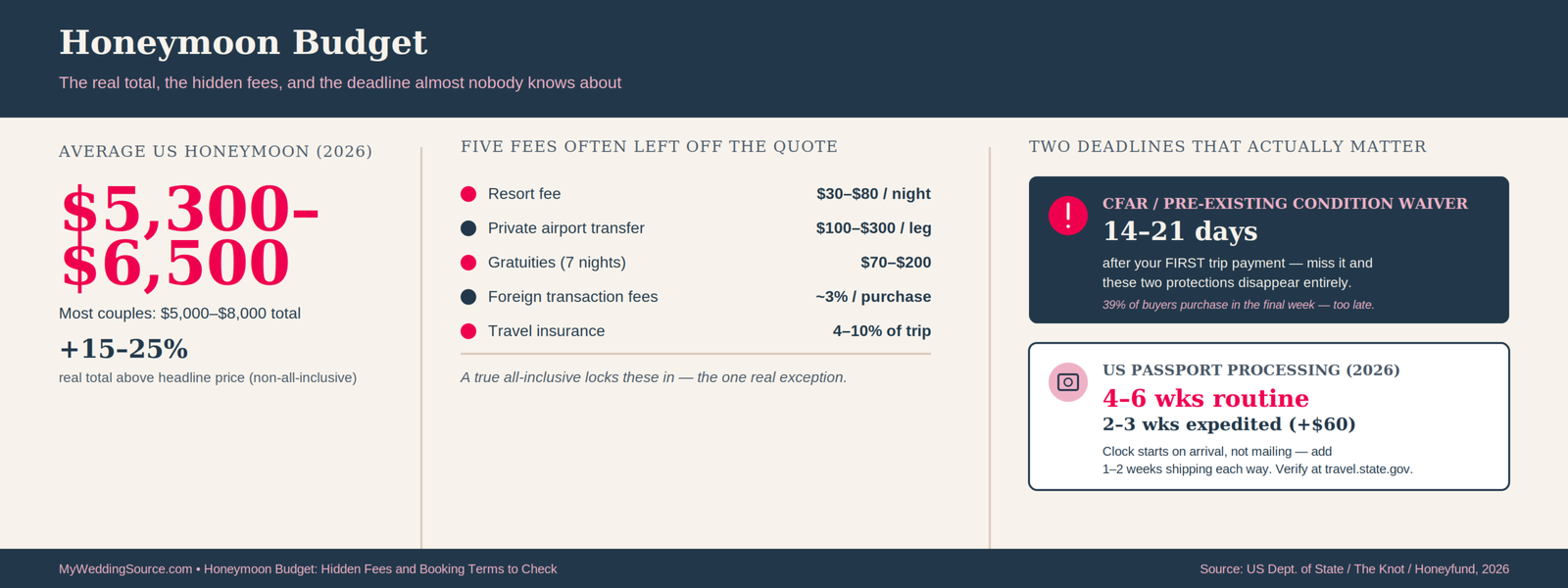
Real numbers help here: the average US honeymoon costs $5,300 to $6,500 in 2026, according to The Knot’s survey of roughly 17,000 couples and Honeyfund’s 2026 trends report. Most couples land between $5,000 and $8,000, depending on destination, length, and season.
The real number is commonly 15 to 25 percent above whatever you originally planned, unless you book a genuine all-inclusive. Resort fees ($30 to $80 a night), private transfers ($100 to $300 per leg), foreign transaction fees, and gratuities are the specific costs most likely to be missing from your original estimate.
Everything below unpacks exactly where that gap comes from, what’s genuinely standard, and what deserves a direct question before you put down a deposit.
What Nobody Mentions Until It Happens
A few realities about honeymoon budgeting rarely make it into the dreamy, aspirational version of trip planning most couples picture beforehand.
“All-inclusive” doesn’t always mean all-inclusive
Top-shelf alcohol, off-site excursions, spa treatments, and certain specialty restaurants are frequently excluded from a resort’s base all-inclusive rate, priced as premium add-ons instead. Confirm exactly what’s included before assuming a specific price covers everything.
A quoted room rate rarely includes the resort fee
This mandatory daily charge, commonly $30 to $80 a night, gets added at checkout in many cases, not disclosed clearly during initial booking. On a 7-night stay, that’s $210 to $560 that can genuinely surprise you.
Travel insurance has a hard deadline almost nobody knows about
Two specific, valuable protections, Cancel For Any Reason coverage and pre-existing medical condition waivers, are only available if you purchase within 14 to 21 days of your first trip payment. Miss that window, and those options disappear entirely, regardless of how much you’re willing to pay later.
Hidden Costs to Check
These are the specific line items most likely to be missing from an initial headline price.
Typical add-on costs, 2026
| Item | Typical cost |
|---|---|
| Resort fee | $30–$80 per night |
| Private airport transfer | $100–$300 per leg |
| Gratuities (7 nights) | $70–$200 |
| Foreign transaction fees | ~3% per purchase |
| International connectivity (roaming/eSIM) | $10–$50 total or $10–$15/day |
| Checked baggage, round trip | $100–$300+ per person |
| Travel insurance | 4–10% of trip cost |
Currency conversion fees quietly compound
A 3 percent foreign transaction fee sounds small until it’s applied to every single purchase on the trip. On a $6,000 honeymoon, that’s roughly $180, entirely avoidable with a no-foreign-transaction-fee credit card.
Meal plan gaps at “included” restaurants
Some all-inclusive resorts limit specialty dining to a set number of visits per stay, charging full price beyond that limit. Confirm the specific number of included specialty dinners before assuming unlimited access.
Before You Pay Anything
A few concrete steps before any deposit changes hands protect you from most of the surprises covered so far.
Get a fully itemized quote, not a single bundled number
Ask directly for resort fees, transfer costs, and any excluded categories to be listed separately, not folded into a single “starting from” price.
Confirm what “all-inclusive” actually includes at this specific resort
The term isn’t standardized across the industry. Ask specifically about alcohol tier, excursion inclusion, specialty dining limits, and any activity surcharges.
Check your passport’s actual expiration date now, not later
Many countries require six months of remaining validity from your entry or departure date. Confirm this specific requirement for your destination directly, and renew now if you’re close to that threshold.
Set a calendar reminder for the travel insurance deadline
Mark the date 14 days after your first trip deposit, since that’s commonly when Cancel For Any Reason and pre-existing condition waiver eligibility closes.
Questions That Feel Awkward but Are Worth Asking
These specific questions can feel uncomfortable to ask a travel provider you’re hoping to trust, and they’re worth asking anyway.
“What’s the actual total, including resort fees and mandatory transfers?”
Get a specific number, not a vague estimate, before you compare this booking against another option.
“What happens to our deposit if we need to cancel or change dates?”
Confirm the exact refund and change policy in writing, including any specific deadlines that affect your options.
“Is our fare price locked, or can it still change before departure?”
Some fares and packages are fully locked at booking; others carry real price-change risk until final payment. Ask directly which applies to your specific booking.
“What’s your policy if our flight is delayed and we miss a connection?”
A reputable airline or booking platform should have a clear, specific answer here, not a vague reassurance.
“Do you require proof of marriage, and by when?”
Many honeymoon packages require documentation and travel within a specific window, commonly 90 days of the wedding. Confirm this directly if it applies to your booking.

Green, Yellow, and Red Flags
Not every uncomfortable moment in this process is a genuine warning sign. Here’s how to tell the difference.
Green flags
- A fully itemized quote provided without you having to ask twice
- Clear, specific written answers about what “all-inclusive” actually covers
- A documented cancellation and refund policy, with specific dates
- A travel provider who proactively mentions the insurance deadline
- Transparent pricing on transfers and resort fees, disclosed before booking
Yellow flags: normal industry practice, worth a direct conversation
- A resort fee charged separately from the room rate, common, confirm the exact nightly amount
- Limited specialty dining inclusions, standard at many all-inclusives, confirm the specific number
- A deposit required well in advance, normal for popular destinations, confirm the refund terms
- Price fluctuation before final payment, common for flights specifically, confirm your fare’s actual lock-in terms
Red flags worth taking seriously
- No written itemization offered, even after you ask directly
- Vague or shifting answers about what’s included in an all-inclusive rate
- Pressure to pay the full balance immediately with no cancellation policy in writing
- A deal that seems significantly cheaper than comparable options with no clear explanation
- Refusal to provide a booking confirmation number or verifiable reservation details
What the Contract May Not Make Obvious
Even a written booking confirmation can leave real gaps worth checking directly.
Confirm the exact cancellation timeline, with specific dates
“Cancellation policy applies” isn’t a real answer. Get the specific dates and specific dollar amounts at each stage: full refund deadline, partial refund deadline, and nonrefundable deadline.
Confirm what happens if the resort or airline cancels on their end
Ask directly about your rights and any compensation if the provider, not you, cancels or significantly changes the itinerary.
Confirm whether your price is genuinely locked or subject to change
Some packages guarantee your price at booking; others reserve the right to adjust for fuel surcharges or currency fluctuation. Get this specific detail in writing.
Confirm the specific refund method and timeline if you do cancel
Ask whether refunds come as cash, credit, or a mix, and how long processing actually takes, since this varies considerably by provider.
Trip Budget and Total Cost: A Realistic Breakdown
This is one of the more genuinely confusing parts of honeymoon planning, worth understanding clearly before you commit to a destination.
What actually drives your total
Accommodations commonly represent 35 to 50 percent of a total honeymoon budget. Flights add another 20 to 35 percent. Food, activities, and the hidden costs covered throughout this guide fill in the rest.
Destination comparison: real numbers
| Destination type | Typical cost, 7 nights |
|---|---|
| Caribbean all-inclusive | $3,500–$7,500 |
| Domestic (Hawaii, national parks) | $3,500–$6,000 |
| Europe, shoulder season | $4,000–$7,000 |
| Maldives / Bora Bora overwater villa | $8,000–$20,000+ |
All-inclusive genuinely locks in your cost; à la carte planning doesn’t
A true all-inclusive resort, once booked, keeps your major costs predictable. Planning flights, hotel, food, and activities separately gives more flexibility but introduces real price uncertainty until every piece is actually booked.
Domestic honeymoons have grown genuinely popular for real value reasons
Roughly 41 percent of couples chose a domestic honeymoon in 2026, avoiding passport complexity and international fees while still accessing well-developed luxury options in destinations like Hawaii and California.
Build in a real buffer, not an optimistic one
Budget 15 to 25 percent above your planned spend for a non-all-inclusive trip, covering the hidden costs detailed throughout this guide. This isn’t pessimism; it’s what the actual 2026 data shows real couples spending.
Honeymoon registries can meaningfully offset your total
Platforms like Honeyfund, Zola Travel, and Joy let guests contribute directly to specific trip experiences instead of physical gifts. A well-used registry commonly covers 30 to 50 percent of a mid-range honeymoon.
Booking Timeline and Deposits
When you book, and how you structure payments, genuinely affects both your price and your flexibility.
Book 3 to 6 months out for most destinations, earlier for peak season
Popular destinations during peak travel windows can sell out or price up considerably closer to departure. Booking earlier generally means more selection and more predictable pricing.
Understand your deposit structure before you pay it
Most bookings require a percentage deposit at reservation, with the balance due 30 to 90 days before departure. Confirm your specific provider’s exact schedule and what happens if a payment is missed.
Off-peak and shoulder-season booking genuinely saves real money
Traveling during shoulder season commonly costs 20 to 40 percent less than peak season for comparable destinations and accommodations, and combining this with an all-inclusive booking can compound those savings even further.
Weekday flights are consistently cheaper than weekend departures
Tuesday, Wednesday, and Thursday departures commonly run $100 to $300 less per person than weekend flights. If your schedule allows flexibility, this is a genuinely easy way to reduce cost.
Keep some portion of your itinerary flexible if your budget allows
Fully locking every detail months in advance removes flexibility if a better price or option appears later. Balance the security of early booking against the value of staying adaptable where it’s genuinely low-risk to do so.
Insurance and Cancellation Coverage: The Deadline Almost Nobody Knows About
This deserves its own detailed section, since it’s genuinely one of the most valuable, least understood parts of honeymoon planning.
Most travel insurance benefits have no deadline. Two specific ones do.
Standard trip cancellation, emergency medical coverage, and baggage protection can be purchased any time before departure. Cancel For Any Reason upgrades and pre-existing medical condition waivers are different: both are only available within 14 to 21 days of your first trip payment.
Most travelers miss this window without realizing it
Real industry data shows the median traveler buys insurance just 11 days before departure, and 39 percent buy within the final week. If your first deposit happened months earlier, as most honeymoon deposits do, you’ve likely already missed the window for these two specific protections by the time you’re thinking about insurance at all.
What Cancel For Any Reason actually covers
This upgrade lets you cancel for literally any reason, not just a covered event like illness or a natural disaster, typically reimbursing up to 50 percent of your nonrefundable trip cost. It costs more than standard cancellation coverage but offers genuinely broader flexibility.
What the pre-existing condition waiver actually requires
Beyond the purchase-timing deadline, you typically must be medically able to travel at the moment you buy the policy. This waiver removes the standard exclusion that would otherwise deny a claim related to a condition you already had.
Budget 4 to 10 percent of your total trip cost for insurance
On a $5,300 honeymoon, that’s roughly $200 to $650, a genuinely modest cost relative to the protection it provides for a trip built on nonrefundable deposits.
Set a specific reminder the day you pay your first deposit
Given how easy this window is to miss, mark your calendar the same day you make any trip payment, not weeks later when you finally get around to researching insurance options.

Documents, Entry, and Health: What to Verify Directly
This section covers process and timing. For the specific, current entry requirements of your actual destination, always verify directly through official sources, since rules genuinely change.
Current US passport processing times
As of 2026, routine passport processing runs 4 to 6 weeks, with expedited service available in 2 to 3 weeks for an additional $60. These figures cover only processing time at the agency; add 1 to 2 weeks of mailing time in each direction for a realistic door-to-door estimate of 6 to 10 weeks for routine service.
The processing clock starts when your application arrives, not when you mail it
This specific detail catches people off guard. Factor in mailing time on both ends, not just the advertised processing window, when planning your actual timeline.
Genuine emergencies have a faster path
If your travel is confirmed within 14 days, you may qualify for expedited, in-person service at a regional passport agency. This requires a documented appointment through the official system, not a walk-in visit.
Confirm your passport’s remaining validity, not just whether it’s expired
Many countries require six months of validity remaining from your entry or departure date, a completely separate requirement from simple expiration. Renew now if you’re within that window, even if your passport isn’t technically expired yet.
Verify current entry requirements directly through official sources
Visa requirements, health documentation, and entry rules genuinely change and vary by destination. Check the US State Department’s official country-specific travel information directly for your actual destination before finalizing plans, and check again closer to departure since requirements can shift.
Confirm any required vaccinations or health documentation early
Some destinations require specific vaccinations or health certificates for entry. This isn’t something to discover at check-in; verify it directly through official sources well before departure, since some vaccines require weeks to become effective.
Check State Department travel advisories for your specific destination
Advisory levels change based on current conditions and genuinely affect both safety planning and, in some cases, travel insurance coverage. Check this directly rather than relying on general destination reputation.
Transfers, Connections, and Pacing
The logistics between “arriving in the country” and “actually relaxing at the resort” deserve real planning attention.
Confirm whether airport transfer is included or separate
A resort’s marketing may not clarify this upfront. A remote or island destination without reliable taxi service can mean a mandatory, sometimes expensive, private transfer, covered earlier in this guide’s cost table.
Build in a genuine buffer for connections, especially on your outbound leg
A missed connection on the way to your honeymoon costs you actual vacation time, not just inconvenience. A slightly longer layover is usually worth the trade-off for genuine peace of mind.
Avoid scheduling anything demanding on arrival day
International travel, time zone changes, and a long transfer are genuinely tiring. Plan your first day for rest, not an ambitious excursion, so you actually start your trip relaxed rather than exhausted.
Consider your overall itinerary pacing, not just individual bookings
A honeymoon packed with back-to-back excursions can end up feeling like a demanding trip rather than a relaxing one. Build in genuine unstructured time, not just scheduled activities.
Backup Plan and Emergency Planning
Most honeymoons go smoothly. Having a real plan for the ones that don’t costs nothing and prevents genuine panic if something goes wrong.
Keep digital and physical copies of every reservation and document
Save confirmation numbers, passport copies, and insurance policy details in a cloud folder accessible from your phone, plus a physical copy packed separately from your phone and wallet.
Know your travel insurance provider’s emergency contact number before you leave
Save this number directly in your phone, not just in an email you’d need internet access to find during an actual emergency.
Research your destination’s local emergency services number in advance
This varies by country and is genuinely useful to know before you need it, not something to search for in the middle of an actual emergency.
Have a financial backup plan beyond your primary card
Bring a secondary card, ideally from a different network, and a modest amount of local currency as backup in case of a card issue, lost wallet, or system outage at your destination.
Confirm your resort or hotel’s actual policy for illness or injury during your stay
Ask directly whether on-site medical support exists and what the process looks like if you need care during your trip.

Scam Check
Most travel providers are legitimate. A small number of patterns are worth genuine caution, particularly for a significant, often once-in-a-while travel purchase.
A price significantly below comparable options, with no clear explanation
If one deal is dramatically cheaper than every other quote for the same destination and dates, verify the booking directly with the actual resort or airline before paying.
Pressure to pay immediately via wire transfer or an unusual payment method
A legitimate travel provider accepts standard payment methods offering real consumer protection. Wire transfers and unusual payment requests are a genuine red flag.
No verifiable business presence or booking confirmation
Confirm any unfamiliar booking platform has genuine reviews, a real business address, and provides an actual confirmation number you can verify directly with the resort or airline.
Fake or misleading “free upgrade” and timeshare-adjacent offers
An unsolicited offer for a dramatically discounted stay in exchange for attending a “brief presentation” often involves a high-pressure timeshare sales pitch. Approach these offers with genuine skepticism.
Verify current entry and safety information through official channels
The US State Department’s travel resources provide official, current guidance for verifying legitimate concerns about a specific destination.
Safety Check
Beyond scams specifically, a few additional safety considerations deserve direct attention.
Research your destination’s specific local laws before you travel
Laws around alcohol, public behavior, and even photography vary considerably by country. What’s completely normal at home can carry real legal consequences elsewhere.
Confirm your accommodation’s actual safety features
Ask directly about room security, on-site safety measures, and the property’s general safety reputation, particularly for a remote or less-developed destination.
Register your trip with the State Department’s Smart Traveler Enrollment Program
This free service helps the government locate and assist you in a genuine emergency, and it’s a completely reasonable precaution for any international trip.
Share your itinerary with someone at home
Leave a copy of your travel plans, accommodation details, and emergency contacts with a trusted family member or friend before you depart.
Weather Check
Seasonal weather patterns genuinely affect both cost and experience, worth checking directly for your specific destination and dates.
Understand your destination’s actual seasonal risk, not just “peak season”
Hurricane season, monsoon patterns, and extreme heat windows vary by region and genuinely affect both pricing and trip reliability. Research your specific destination’s seasonal risk directly, not just general tourism marketing.
Off-peak pricing sometimes reflects genuine weather trade-offs
A lower price during shoulder season can reflect real weather risk, not just lower demand. Weigh the savings against your own risk tolerance for a possible weather disruption.
Confirm your travel insurance’s actual weather-related coverage
Standard trip cancellation coverage typically covers named storms under specific conditions, though exact terms vary by policy. Confirm this directly rather than assuming general coverage applies.
Have a realistic backup plan for a significant weather disruption
Know your airline’s rebooking policy and your travel insurance’s specific weather provisions before you need them, not after a storm is already approaching your destination.
Legal Check: Consumer Protection Basics Worth Knowing
General consumer protection principles apply to travel bookings, though specifics vary by provider and, for international travel, by country.
A written confirmation creates real accountability
Keep every booking confirmation, itinerary, and payment receipt as documented proof of your actual agreement with a provider.
Understand the difference between booking through an agent versus directly
A travel agent or booking platform may have different cancellation and dispute policies than booking directly with an airline or resort. Confirm which applies to your specific situation.
Paying by credit card offers real dispute protection
A credit card payment gives you access to chargeback and dispute processes through your card issuer if a provider fails to deliver what was promised in writing.
Where to go if something genuinely goes wrong
For a significant dispute, your credit card issuer’s dispute process, your travel insurance provider, and your state’s consumer protection office are all appropriate resources, alongside official government travel resources for destination-specific concerns.

Accessibility Check
A few specific considerations deserve direct attention for a genuinely accessible trip.
Confirm accessibility directly with your specific accommodation, not just general marketing
Ask specifically about room accessibility, elevator access, and any mobility accommodations you need, since “accessible” isn’t always consistently defined across properties.
Research transportation accessibility at your destination
Airport transfers, local transportation, and excursion vehicles vary considerably in accessibility. Confirm this directly if it matters to your specific needs.
Confirm any medical equipment or medication travel requirements in advance
Some destinations have specific rules about bringing certain medications or medical equipment. Verify this directly through official sources well before departure.
What Pinterest and Styled Content Don’t Show You
A beautifully curated honeymoon photo captures one perfect moment, not the actual planning or cost behind it.
Influencer trips are frequently sponsored, not representative pricing
A stunning resort featured in travel content may have been a complimentary or heavily discounted partnership, not a reflection of what a typical couple actually pays for that same stay.
The photo doesn’t show the resort fee, the transfer cost, or the insurance deadline
An effortless-looking honeymoon represents real planning: itemized budgets, insurance timing, and document verification, none of which shows up in a beautiful sunset photo.
Styled content rarely shows the arrival-day exhaustion or a missed connection
Real travel involves genuine logistics and occasional friction. Comparing your actual trip to a curated highlight reel sets an unrealistic expectation for what honeymoon travel genuinely involves.
A Realistic Scenario: How the Story at the Start of This Guide Could Have Gone Differently
Return to the couple from the opening of this guide, who planned $5,800 and actually spent $7,150.
What confirming the resort fee upfront would have changed
Asking directly, “what is your nightly resort fee, and is it included in this quoted rate,” would have surfaced the real $65-a-night charge before booking, letting them compare true costs across options.
What researching transfer costs in advance would have changed
A quick check of their specific resort’s transfer requirements would have revealed the $240 round-trip cost before arrival, letting them budget for it or research alternatives.
What a no-foreign-transaction-fee card would have changed
Simply using a different, genuinely free card for the trip would have eliminated the $180 in currency conversion fees entirely, a completely avoidable cost.
This doesn’t mean their resort or airline acted in bad faith
Every individual fee was standard, disclosed practice. The actual gap was a lack of upfront questions, not a hidden scheme, exactly the pattern this entire guide addresses.
Worst-Case Scenario, and the Backup Plan
Worth naming plainly, since knowing the realistic worst case actually reduces anxiety more than avoiding the topic does.
The worst realistic case: a significant trip disruption with inadequate insurance coverage
This happens when a couple either skips travel insurance entirely or misses the Cancel For Any Reason and pre-existing condition deadlines covered earlier in this guide.
The backup plan
Even without those specific upgrades, standard trip cancellation and emergency medical coverage remain available up until departure. Purchase this at minimum, even if you’ve missed the earlier deadline for the broader protections.
This is a preventable scenario, not an inevitable one
Setting the insurance reminder covered earlier in this guide, right when you make your first deposit, is the single most effective way to avoid this specific worst case entirely.
Three Realistic Budget Scenarios
Numbers in the abstract are harder to apply than a concrete example. Here are three genuinely realistic, composite scenarios.
Scenario one: a true all-inclusive, budget-conscious trip
A couple books a Caribbean all-inclusive for $4,200, confirms the resort fee is genuinely included in the quoted rate, and purchases travel insurance within the 14-day window for full Cancel For Any Reason eligibility. Total cost: $4,650, including insurance, with no surprise charges at checkout.
Scenario two: a mid-range trip with real hidden costs identified early
Another couple plans a $6,000 European honeymoon, confirms transfer costs and resort fees upfront, and budgets a genuine 20 percent buffer. Total actual cost: $7,100, matching their buffer almost exactly because they built it in deliberately rather than discovering it as a surprise.
Scenario three: a domestic trip funded partly through a registry
A third couple plans a $5,500 Hawaii honeymoon, sets up a Honeyfund registry specifically for excursions and dinners, and receives $2,100 in guest contributions. Their actual out-of-pocket cost: $3,400, a genuinely significant reduction through deliberate planning rather than luck.
The difference between a smooth experience and a frustrating one in all three scenarios wasn’t the destination. It was whether resort fees, transfers, and insurance timing were confirmed clearly before any deposit was paid.
Your Honeymoon Budget Checklist
- ☐ Fully itemized quote obtained, resort fees and transfers included: ____________
- ☐ “All-inclusive” scope confirmed directly (alcohol, dining, excursions): ____________
- ☐ Cancellation and refund policy confirmed with specific dates: ____________
- ☐ Travel insurance purchased within 14 days of first deposit: ____________
- ☐ Passport validity confirmed (6+ months remaining): ____________
- ☐ Current entry requirements verified via official sources: ____________
- ☐ No-foreign-transaction-fee card confirmed or obtained: ____________
- ☐ Trip registered with State Department (if international): ____________
- ☐ Emergency contacts and document copies saved digitally: ____________
Frequently Asked Questions
What are the real honeymoon budget hidden fees most couples miss?
Resort fees ($30 to $80 a night), private airport transfers ($100 to $300 per leg), foreign transaction fees, and gratuities at all-inclusive resorts are the most commonly missed costs.
How much does the average honeymoon actually cost in 2026?
The average US honeymoon costs $5,300 to $6,500, according to The Knot’s 2026 survey data and Honeyfund’s trends report. Most couples land between $5,000 and $8,000 depending on destination and length.
Is a resort fee always disclosed when I book?
Not always clearly. This mandatory nightly charge, commonly $30 to $80, is sometimes added at checkout rather than shown prominently during initial booking. Ask directly before booking.
What’s the deadline for Cancel For Any Reason travel insurance?
Typically 14 to 21 days after your first trip payment. This is a hard deadline; missing it means the option disappears entirely, regardless of how much you’re willing to pay later.
How long does it take to get a US passport in 2026?
Routine processing runs 4 to 6 weeks, expedited runs 2 to 3 weeks for an additional $60. Add 1 to 2 weeks of mailing time in each direction for a realistic total timeline.
Does “all-inclusive” really mean everything is included?
Not always. Top-shelf alcohol, off-site excursions, spa treatments, and certain specialty dining are frequently excluded from the base rate. Confirm the specific inclusions directly before booking.
How much should we budget for travel insurance?
Commonly 4 to 10 percent of your total trip cost. On a $5,300 honeymoon, that’s roughly $200 to $650.
Should we book a true all-inclusive or plan everything separately?
A true all-inclusive locks in your major costs at booking, genuinely useful for predictable budgeting. Planning separately offers more flexibility but carries real price uncertainty until every piece is booked.
What’s the single biggest mistake couples make with honeymoon budgeting?
Comparing destinations by headline room rate alone, without confirming resort fees, transfer costs, and insurance timing, then discovering the real total only once they’re already home.
Can a honeymoon registry actually offset real costs?
Yes, genuinely. Platforms like Honeyfund, Zola Travel, and Joy commonly cover 30 to 50 percent of a mid-range honeymoon through guest contributions.
Do we need six months of passport validity even for a short trip?
Many countries require this regardless of trip length. Confirm your specific destination’s requirement directly, since this varies by country.
Comparing Multiple Travel Quotes Fairly
Once you have quotes from a few providers, comparing them accurately takes more structure than comparing headline prices alone.
Confirm each quote covers the same actual scope
One package’s price might include resort fees and transfers; another’s might not. Confirm exactly what’s included in each quote before comparing totals side by side.
Normalize for genuine all-inclusive versus partial inclusion
A package labeled “all-inclusive” at one resort may exclude categories another resort genuinely includes. Get the specific inclusion list for each option you’re comparing.
Weigh cancellation flexibility alongside price
The least expensive option isn’t automatically the best value if its cancellation policy is considerably less favorable than a slightly pricier alternative.

Communicating With Travel Providers: A Few Habits That Prevent Most Problems
Beyond the specific questions covered earlier, a few general habits genuinely reduce your risk of a bad experience.
Get everything meaningful in writing, every time
A verbal promise about price, inclusions, or cancellation terms should appear in your written confirmation, not relied on from memory alone months later.
Keep a simple record of every booking conversation
A quick note after each call or email, what was discussed, what was promised, prevents genuine confusion later if questions come up.
Address a concern directly and early, not after it’s compounded
If something feels off, an unclear fee, a vague cancellation answer, raise it directly and early rather than hoping it resolves itself before departure.
A Few Honeymoon Budget Myths Worth Dropping
“All-inclusive is always the more expensive option”
Not necessarily. When you factor in the alcohol, dining, and activities an all-inclusive rate bundles together, it frequently costs less than booking everything separately at a comparable property.
“Travel insurance is unnecessary if we’re healthy and careful”
Trip cancellation, interruption, and delay coverage protect against far more than personal illness, including provider cancellations, weather, and family emergencies unrelated to your own health.
“A cheaper flight is always the better deal”
A significantly cheaper fare sometimes comes with stricter change and cancellation terms, genuinely worth weighing against a slightly higher fare with real flexibility.
“Resort fees are rare and only apply to budget properties”
Resort fees appear across a wide range of price points, including luxury properties. Confirm this directly regardless of how upscale a specific resort appears.
A Glossary of Honeymoon Booking Terms
| Term | Plain-language meaning |
|---|---|
| Resort fee | A mandatory nightly charge separate from the room rate |
| Cancel For Any Reason (CFAR) | An insurance upgrade allowing cancellation for any reason, time-limited |
| Pre-existing condition waiver | Removes standard exclusion for a known health condition, time-limited |
| Shoulder season | The travel window between peak and off-peak, often with real savings |
| Foreign transaction fee | A percentage charge added to purchases made abroad |
| Smart Traveler Enrollment Program (STEP) | Free State Department trip registration for emergency assistance |
If You’re Combining a Destination Wedding and Honeymoon
Some couples marry and honeymoon in the same location, worth its own direct consideration.
Confirm whether “proof of marriage” requirements affect your specific timeline
Some all-inclusive honeymoon packages require documentation showing you married within a specific window, commonly 90 days, before the honeymoon travel date. If your wedding and honeymoon happen in the same trip, confirm this requirement doesn’t create an unexpected conflict.
Separate your wedding and honeymoon budgets clearly, even in the same location
Treating these as one combined expense can make it genuinely hard to see where your actual honeymoon costs, and the hidden fees covered throughout this guide, actually sit within the total.
Confirm your venue and honeymoon accommodations don’t have conflicting logistics
If you’re staying at the same resort for both events, confirm room transitions, any rate changes between the wedding block and honeymoon stay, and general logistics directly with the property.
Multi-Stop and Multi-Destination Honeymoons
Some couples plan a honeymoon spanning several destinations, worth its own specific budgeting approach.
Each leg introduces its own separate hidden-cost risk
A multi-stop trip means resort fees, transfers, and insurance considerations at every single destination, not just one. Apply the same itemized-quote discipline covered throughout this guide to each individual leg.
Connecting flights and transfers between destinations add real cost and risk
Budget genuine buffer time between destinations, and confirm whether any internal flights or transfers carry their own baggage fees or timing restrictions.
Travel insurance for a multi-destination trip needs the same 14-day rule applied to your first payment
Regardless of how many destinations you’re visiting, the Cancel For Any Reason and pre-existing condition deadlines still count from your very first trip payment, not from each individual booking.
If You’re Deferring or Taking a “Minimoon” Instead
Some couples take a shorter trip right after the wedding, saving a longer honeymoon for later, worth genuine mention.
A minimoon still deserves the same budgeting discipline
Even a short, local getaway benefits from confirming resort fees, cancellation terms, and any applicable insurance, at a smaller scale but with the same underlying principles.
Deferring your main honeymoon gives real planning advantages
A later trip means more time to save, more flexibility in timing for better pricing, and less pressure stacked directly onto an already demanding wedding week.
Confirm any “honeymoon package” requirements still apply to a deferred trip
Some resorts’ honeymoon-specific perks require travel within a set window after the wedding. Confirm this directly if you’re planning to defer your main trip.

Working With a Travel Agent: When It Genuinely Helps
Some couples book independently; others use a travel agent specializing in honeymoons. Both are legitimate paths, worth an honest comparison.
An experienced honeymoon-specific agent often knows real resort fee structures upfront
Agents who book honeymoons regularly typically know which specific properties have genuinely all-inclusive rates versus significant hidden add-ons, potentially saving you real research time.
Confirm how your agent is compensated
Most travel agents earn commission from the resort or airline, not a direct fee from you, though some charge a planning fee for complex itineraries. Ask directly how your specific agent is compensated.
An agent doesn’t replace your own direct review of terms
Even with a trusted agent, review your actual booking confirmation and cancellation policy yourself using the questions and checklist throughout this guide.
Independent booking works well for confident, detail-oriented planners
If you’re comfortable researching resort fee structures, insurance timing, and cancellation terms directly, independent booking can offer more control and sometimes better pricing on certain properties.
A Note on Currency and Payment Strategy
Beyond the foreign transaction fee covered earlier, a few additional currency considerations deserve attention.
Notify your bank and credit card companies before international travel
An unexpected international charge can trigger a fraud hold on your card at the worst possible moment. Confirm your travel dates and destinations with your card issuers before departure.
Research your destination’s actual cash culture
Some destinations are genuinely card-friendly; others expect cash for many transactions, particularly for tips and smaller vendors. Research this directly for your specific destination rather than assuming.
Avoid airport currency exchange when possible
Airport exchange counters commonly offer meaningfully worse rates than a bank, ATM, or your destination’s local exchange options. Withdraw a modest amount at the airport if genuinely needed, then use better-rate options for the bulk of your currency needs.
More Direct Answers
Should we use a travel agent or book everything ourselves?
Both are legitimate. An experienced honeymoon agent often knows real fee structures upfront; independent booking offers more control for detail-oriented planners comfortable with direct research.
Do we need to tell our bank we’re traveling internationally?
Yes, genuinely worth doing. An unexpected international charge can trigger a fraud hold on your card at an inconvenient moment. Confirm your travel dates with your card issuers before departure.
Is it better to exchange currency at the airport or wait until we arrive?
Generally wait if possible. Airport exchange counters commonly offer meaningfully worse rates than a bank, ATM, or local exchange options at your actual destination.
What if we’re planning a multi-destination honeymoon?
Apply the same itemized-quote and insurance-timing discipline to each leg, and remember that travel insurance deadlines count from your very first trip payment, not from each individual booking.
Should we take a minimoon instead of a full honeymoon right after the wedding?
This is a genuinely common, practical choice, giving you more time to save and plan while still celebrating right after your wedding. The same budgeting discipline still applies at a smaller scale.
A Final Word on Reading Your Booking Confirmation Carefully
Every principle in this guide points toward the same underlying habit: read what you’re actually agreeing to, and ask direct, specific questions about anything unclear, before any deposit changes hands.
A specific final check before you confirm your booking
Reread your written confirmation one more time before paying the balance, confirming it matches everything discussed, including resort fees, transfers, and cancellation terms.
Keep copies of everything, digitally and on paper if possible
A photo of your booking confirmation and insurance policy, saved to your phone and backed up elsewhere, ensures you have access to it even if the originals get misplaced during travel.
This diligence protects a good relationship, not just guards against a bad one
Clear documentation isn’t about assuming your travel provider will act in bad faith. It’s about giving both of you a shared, reliable reference point for a trip built on real money and real deadlines.
A Realistic Timeline Recap
| Timeframe | What happens |
|---|---|
| 3–6 months before | Book destination; confirm itemized total and cancellation terms |
| Within 14 days of first deposit | Purchase travel insurance for full CFAR/pre-existing eligibility |
| 8–12 weeks before | Apply for or renew passport if needed |
| 4–6 weeks before | Verify current entry requirements and advisories |
| 1–2 weeks before | Notify bank, confirm final payment, pack documents |
| Departure | Digital and physical copies of all documents secured |
This timeline is a genuinely reliable default for most trips, though your specific destination’s requirements always take priority over this general guide. Verify current specifics directly before finalizing plans.
One Last Practical Note on Choosing Confidently
None of the guidance in this article is meant to make a genuinely exciting trip feel like a compliance exercise. The overwhelming majority of honeymoons go smoothly, arrive on budget within a reasonable range, and create exactly the memories couples hope for. This guide exists for the gaps, and for the peace of mind that comes from knowing exactly what to ask before you book.
Choose a destination and provider that answers your questions directly, puts real numbers and policies in writing without being asked twice, and gives you confidence in the actual total, not just the headline price. That combination, more than any single destination in this guide, is what actually predicts a smooth trip from booking through your last day away.
A Note on Sustainable and Off-the-Beaten-Path Honeymoons
Some couples factor environmental impact or a genuine desire to avoid heavily touristed destinations into their honeymoon decision, worth mention.
Smaller, locally-owned accommodations often have different fee structures
A boutique or locally-owned property may not follow the same resort-fee conventions as large chain resorts, worth asking about directly rather than assuming either way.
Off-the-beaten-path destinations can mean genuinely different transfer logistics
Less-touristed destinations may have more limited transportation infrastructure, worth researching directly rather than assuming standard resort-area logistics apply.
Ask directly about a property’s specific sustainability practices if this matters to you
Specific, direct answers tell you more than a general “eco-friendly” marketing claim alone.
Final Thoughts on Building Your Own Plan
This guide has covered a genuinely large amount of ground: real pricing, the specific fees that catch people off guard, a travel insurance deadline most couples never learn about until it’s too late, and the documents and health checks worth completing well before departure. You don’t need to apply every single section in order.
Pull whatever’s relevant to your specific trip, skip what doesn’t apply, and return to any section as a reference whenever a new question comes up during your own planning process. That’s genuinely what this guide is here for.
A Direct Comparison: Two Resorts Quoting the Same Trip
Here’s a concrete way to see why comparing headline price alone is genuinely misleading.
| Line item | Resort A | Resort B |
|---|---|---|
| Quoted rate, 7 nights | $3,600 | $4,100 |
| Resort fee | +$455 ($65/night) | Included |
| Airport transfer | +$240 round trip | Included |
| Real total | $4,295 | $4,100 |
Resort A’s headline rate looked $500 cheaper. Once the resort fee and transfer are added in, Resort B is actually the better value, exactly the kind of comparison a simple quoted rate hides.
A Last Round of Direct Answers
Should we always choose the resort with the lower headline price?
Not automatically. As the comparison above shows, a lower quoted rate can end up costing more once resort fees and transfers are added, so always compare real, all-in totals.
What if two resorts both claim to be “all-inclusive” but seem priced very differently?
Confirm the specific inclusion list for each directly. The term isn’t standardized, and one resort’s “all-inclusive” can genuinely cover more than another’s.
Is it worth paying more for a resort that includes everything upfront?
Often yes, for the predictability alone, beyond just the potential cost savings. Many couples find real value in not tracking every expense during a trip meant to be relaxing.
A Closing Thought on Value Versus Price
Every number in this guide describes what a honeymoon commonly costs. None of it describes what a genuinely well-planned trip is actually worth. A provider who discloses resort fees upfront, explains cancellation terms clearly, and doesn’t require you to discover the real total after the fact is offering something real beyond the destination itself: a predictable, trustworthy experience for a trip that’s supposed to be the opposite of stressful.
Approach this process with the same combination this guide has modeled throughout: genuine excitement about the trip itself, paired with the same direct, specific questions you’d bring to any other significant purchase. Both things can be true at once, and holding them together is what actually protects you, start to finish, from your first deposit through your last day away.

A Brief Word on Honeymoon Registries and Guest Contributions
Since registries were mentioned earlier as a real cost-offset strategy, a few practical details deserve direct attention.
Set up your registry early, ideally alongside your general wedding registry
Guests often appreciate seeing this option from the start of your planning, rather than as an afterthought added closer to the wedding.
Break your trip into specific, fundable experiences
Rather than one lump “honeymoon fund,” list specific items: a sunset dinner, a snorkeling excursion, a spa treatment. Guests often prefer contributing to something concrete and personal over an abstract total.
Confirm how and when funds actually become available to you
Different registry platforms have different payout timelines and any associated fees. Confirm this directly before assuming funds are immediately accessible for your actual trip payments.
Thank contributing guests the same way you would for a physical gift
A registry contribution deserves the same genuine thank-you as any other wedding gift, regardless of whether it funded a dinner or a full night’s stay.
A Concluding Note on Confidence
A honeymoon is one of the more emotionally significant, financially substantial trips a couple takes together, and the gap between a smooth experience and a stressful one rarely comes down to the destination itself. It comes down to information: knowing the true all-in cost before you compare quotes, knowing your real travel insurance deadline, and knowing your actual document and entry requirements well before departure.
You now have everything this guide has to offer: the real pricing, the specific fees that catch people off guard, the insurance timing most couples never learn about until it’s too late, and the document checks worth completing well before you ever board a plane. Walk into your own booking with that information in hand, confident rather than guessing.
A Last Practical Tip Before You Book
Bring a written list of questions, even a short one drawn directly from this guide’s checklist, to every booking conversation, whether with a travel agent, a resort directly, or an airline. This keeps you grounded during the conversation and ensures you leave with real, specific answers about resort fees, cancellation terms, and total cost, rather than a beautiful destination and only a vague sense of what you’ll actually owe once every fee lands.
One Truly Final Practical Reminder
If you take away just one action item from this entire guide, make it this: the day you pay your very first honeymoon deposit, whether that’s a flight, a resort, or a full package, open your calendar immediately and set a reminder for 14 days later. That single reminder protects your access to the broadest possible travel insurance coverage, the one deadline in this entire guide that cannot be recovered once it passes, regardless of how much you’re later willing to pay.
Trust your own preparation over any single piece of advice, including this guide
Every couple’s actual trip, budget, and risk tolerance genuinely differ from every other couple’s. Use the specific numbers and deadlines throughout this guide as a real starting framework, then adapt them thoughtfully to your own actual circumstances, destination, and priorities.
A Genuinely Final Word
This guide has walked through nearly every practical corner of honeymoon budgeting: the real costs, the fine print, the insurance deadline, and the documents worth checking early. Carry that knowledge into your own planning with confidence, and let the actual trip be exactly as relaxing as it’s supposed to be, free of the financial surprises this guide was written to prevent.
Where This Leaves You
Honeymoon budget hidden fees come down to the same handful of patterns throughout this entire guide: a headline price that doesn’t include resort fees or transfers, an “all-inclusive” label that isn’t fully standardized, and a travel insurance deadline that closes quietly just two to three weeks after your first deposit. None of this is mysterious once you know where to look, and most of it is completely normal, well-documented industry practice, not a sign anything is wrong.
The couple from the start of this guide didn’t need a different resort or a smaller trip. They needed two specific habits: asking for a complete, itemized total before booking, and setting an insurance reminder the same day they paid their first deposit. Those two habits, applied consistently, are what actually separate a smooth honeymoon experience from a stressful one.
Today, do two things: ask your resort or booking provider directly, “What is your nightly resort fee, and is it included in this quoted rate?” Then set a calendar reminder for 14 days from your most recent trip payment, since that’s your real deadline for the broadest travel insurance protection.
