Hawaii Honeymoon: Planning Guide: Cost, Weather, and Trip Length
A Hawaii honeymoon looks simple on an inspiration board: an overwater-adjacent bungalow, a sunset with two silhouettes, a mai tai balanced on a railing. The real trip depends on decisions that never make it onto that board. Which island, which season, which side of the island, and which taxes quietly add nearly a fifth to your hotel bill. All of it shapes whether your honeymoon feels relaxed or rushed.
None of that makes a Hawaii honeymoon a bad idea. It makes it a trip worth planning deliberately rather than booking off a single photo. This guide compares realistic costs, the best travel windows, flight time, lodging areas, a flexible itinerary, documentation, safety, and local taxes. It closes with a sample budget, a booking timeline, and answers to the questions couples ask most before they commit nonrefundable money to the trip.
Why a Hawaii Honeymoon Costs What It Costs
Couples researching a Hawaii honeymoon usually start with a single number in mind, borrowed from a friend’s trip or a headline. That number rarely holds up, because five separate variables move independently of each other and stack on top of the base airfare and hotel rate.
The five variables that actually set your price
Season sets the baseline: a Hawaii honeymoon booked over a school break or a major holiday costs meaningfully more than the same trip in September or October. Island choice matters next, since Oahu generally runs cheaper than Maui or Kauai for comparable lodging. Room type and location on the property add another layer. An ocean-view or oceanfront room often costs 40 to 80 percent more than a garden-view room in the same hotel. Activities and dining swing the total further than most couples expect, particularly with a luau, a helicopter tour, or multiple boat excursions added on. Local taxes and resort fees, covered in detail later in this guide, add still more — close to a fifth of your entire lodging bill, before you have chosen a single excursion.
Treat any published average with real skepticism
You will find plenty of “average honeymoon cost” figures online. Most blend a weekend in Waikiki with a two-week, multi-island trip into one meaningless number. A more useful approach is building your own total from your actual island, season, and hotel tier. Check it against real listings for your travel dates. Prices for flights and hotels also shift from year to year and season to season. Treat every dollar figure in this guide as an illustrative range rather than a locked-in quote. Confirm current pricing directly with airlines and hotels before you book.
Best Time for a Hawaii Honeymoon: Weather, Crowds, and Price Together
Hawaii’s climate stays warm and pleasant nearly year-round. That is exactly why timing a Hawaii honeymoon well comes down to crowds, rain patterns, and price rather than temperature alone.
The shoulder seasons work in your favor
Late April through early June, and September through mid-November, are widely considered the best windows for value on a Hawaii honeymoon. School is in session on the mainland, and major holidays have passed. Airfare and hotel rates both tend to soften compared with summer and the winter holidays. These shoulder months also tend to have noticeably fewer crowds at popular beaches, trailheads, and restaurants, which matters more for a honeymoon than for an ordinary vacation.
What to expect from peak season
Mid-December through mid-April is Hawaii’s peak travel season, driven by winter-weary mainland travelers. It also brings, on the North Shore of Oahu and parts of Maui, some of the best surf of the year. Prices climb accordingly, and popular restaurants and activities book out further in advance. Summer, roughly June through August, brings a second peak tied to school vacation, with family travel adding crowds that can feel at odds with a quiet honeymoon mood.
Rain, humidity, and where it falls
Hawaii’s islands have distinct wet and dry sides, driven by trade winds hitting mountain ranges. The west and south shores of each island, sometimes called the leeward sides, stay drier and sunnier for more of the year. The windward, north, and east-facing coasts see considerably more rain. Wet season runs roughly November through March, though showers tend to be brief rather than day-long. Resort areas are deliberately built on the drier leeward coasts for exactly this reason.
Hurricane season, briefly
The Central Pacific hurricane season runs June through November, with the highest activity typically in August and September. Direct hits on Hawaii are historically rare. Tropical storms and their outer bands do occasionally affect travel plans during these months, though. Factor that into travel insurance decisions if you are booking a Hawaii honeymoon in late summer.
Getting There: Flight Time and Realistic Travel Days
Flight time affects a Hawaii honeymoon more than most couples plan for. It eats into the first and last day of the trip, and it can leave you jet-lagged for your first sunset dinner.
Typical flight times by region
| Departure region | Typical flight time | Notes |
|---|---|---|
| West Coast (LAX, SFO, SEA) | 5–6 hours | Frequent nonstop options to Honolulu and often to Maui and Kauai directly |
| Central U.S. (DFW, DEN, ORD) | 7.5–9 hours | Some nonstops exist; many routes connect through the West Coast |
| East Coast (JFK, ATL, BOS) | 10–11 hours nonstop | A long day regardless of route; a connection often breaks it up |
Interisland flights, if you visit more than one island
Flights between Hawaiian islands run short, typically 30 to 50 minutes in the air. Budget closer to two to three hours door to door, though, once you add airport arrival time, security, and baggage. A common mistake is underestimating how much a multi-island Hawaii honeymoon eats into total vacation time through repeated airport transitions. This is one reason many couples now choose to base themselves on a single island and take day trips instead.
Build in a recovery day
For East Coast and international connections especially, plan your first evening as a quiet one. Arriving after a ten-hour travel day and expecting a lively dinner out is a common setup for disappointment. It produces a cranky, jet-lagged start to a Hawaii honeymoon that both of you were looking forward to.
Choosing Your Island, or Islands
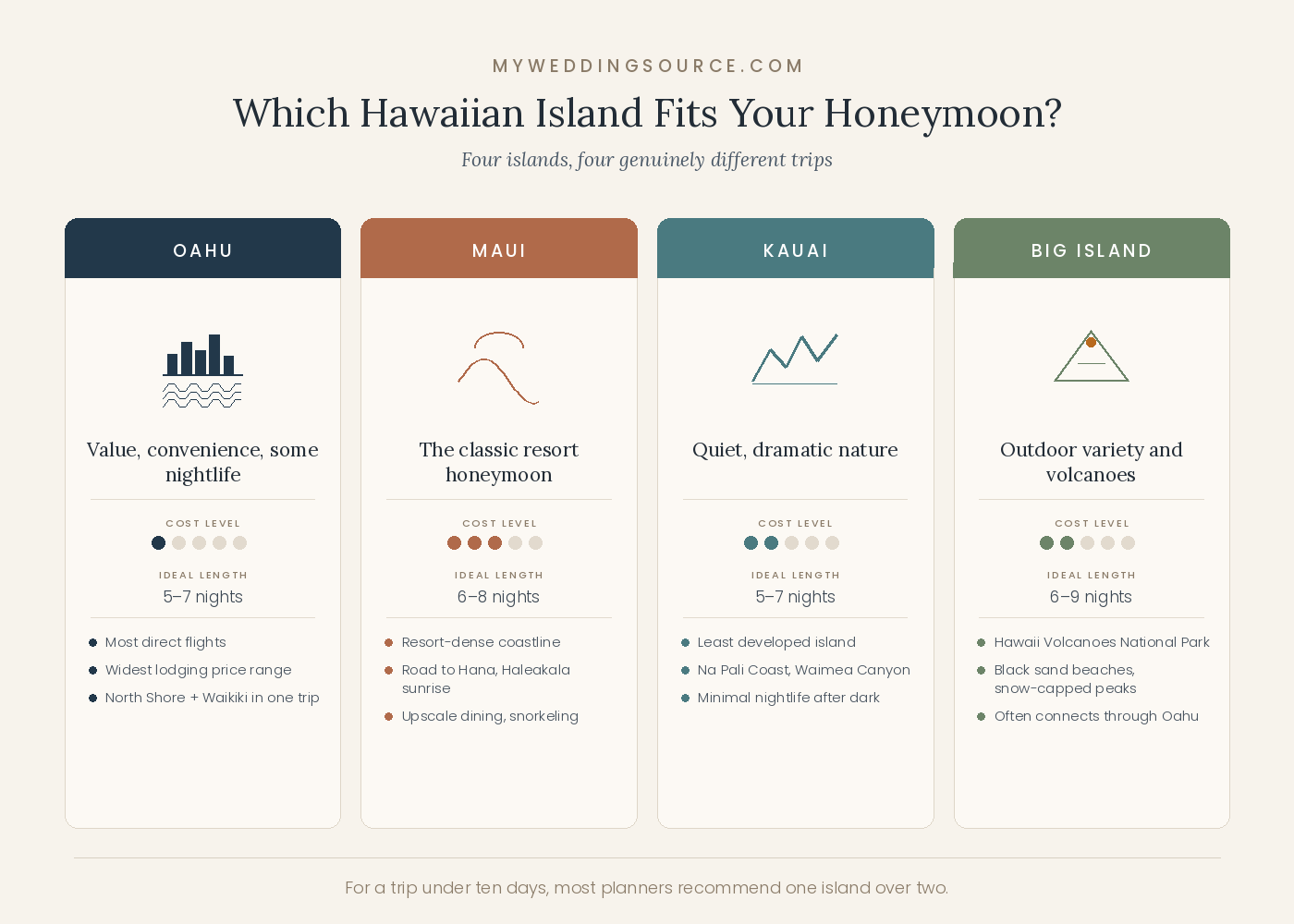
Each main Hawaiian island offers a genuinely different honeymoon. Choosing well matters more than choosing the “best” one, since the right fit depends entirely on what you both want from the trip.
Oahu: convenience, nightlife, and value
Oahu offers the most direct flights, the widest range of hotel price points, and easy access to both Waikiki’s energy and quieter North Shore beaches. It suits couples who want some nightlife and dining variety alongside beach time. It is usually the most budget-friendly island, too, for a Hawaii honeymoon on comparable lodging.
Maui: the classic honeymoon island
Maui built its reputation on resort-dense coastlines, the scenic Road to Hana, and sunrise views from Haleakala’s summit. It costs more than Oahu on average. It suits couples prioritizing a polished resort experience with easy access to snorkeling, whale watching in season, and upscale dining.
Kauai: quiet, dramatic, and less developed
Kauai has the least development of the main tourist islands and the most dramatic scenery, including the Na Pali Coast and Waimea Canyon. It suits couples who want a quieter, more nature-focused Hawaii honeymoon and are comfortable with fewer nightlife options and a slower pace after dark.
The Big Island: size, variety, and active volcanoes
Hawaii Island, generally called the Big Island, is large enough to include snow-capped peaks, black sand beaches, and an active volcanic landscape within a single island. It appeals to couples who want more outdoor variety and are drawn specifically to Hawaii Volcanoes National Park, covered in more detail in the safety section below.
One island or several
Splitting a week or ten days across two islands sounds appealing, and it often backfires. Packing and travel time eat into the relaxation a honeymoon is supposed to provide. For a trip under ten days, most travel planners recommend choosing one island and going deeper rather than skimming two. Save the second island for a return trip, or plan at least four to five nights per island if you do split the stay.

Where to Stay: Lodging Areas and Price Tiers
Where you stay shapes your Hawaii honeymoon as much as which island you pick. The price spread within a single island is often larger than the spread between islands.
Resort areas versus independent hotels and condos
Large beachfront resorts offer pools, multiple restaurants, spa access, and daily activities, and they price accordingly. That is often before you add the resort fee covered in the taxes section below. Boutique hotels and condo-style rentals typically cost less, especially with a kitchen that lets you skip a meal or two out per day. You give up some of the resort’s built-in activities and concierge service, though.
A rough price-tier guide
| Tier | Illustrative nightly rate | What you typically get |
|---|---|---|
| Budget-conscious | $180–$320 | Condo or smaller hotel, often not beachfront, sometimes with a kitchenette |
| Mid-range resort | $400–$650 | Full-service resort, garden or partial ocean view, pools and dining on-site |
| High-end resort | $800–$1,500+ | Oceanfront, elevated service, honeymoon-specific packages and upgrades |
These figures are illustrative starting points, not quotes, and they exclude the taxes and resort fees covered later in this guide. Confirm current rates directly with the property for your actual travel dates before you commit.
Ask about honeymoon packages directly
Many resorts offer honeymoon-specific perks: a room upgrade, a bottle of wine, a couples’ spa credit, or a late checkout. Sometimes these come at no extra cost, if you simply mention the occasion when booking. These packages rarely appear automatically online, so call the resort directly or ask your travel agent to request honeymoon amenities rather than assuming the standard booking includes them.
A Flexible Hawaii Honeymoon Itinerary
This seven-night, single-island itinerary is deliberately loose. A honeymoon rewards unscheduled time more than a packed checklist, so treat this as a starting frame rather than a script.
| Day | Focus |
|---|---|
| 1 | Arrival, check-in, an early dinner, and an early night to reset your clock |
| 2 | Resort day: pool, beach, no plans beyond recovering from travel |
| 3 | One signature activity: snorkeling tour, sunset sail, or a guided hike |
| 4 | A scenic drive day — Road to Hana on Maui, Na Pali lookout on Kauai, or a North Shore loop on Oahu |
| 5 | Slow morning, spa treatment or couples massage, quiet evening |
| 6 | A special dinner out, ideally booked a few weeks ahead for a sunset table |
| 7 | Open day for anything missed, souvenir shopping, or simply the beach again |
Resist the urge to book something for every single day. The single most common feedback from couples after a Hawaii honeymoon is wishing they had planned less, not more. Unstructured time is often what makes the trip feel like a honeymoon rather than a sightseeing tour.
Adjusting the pace for a shorter or longer trip
Five nights compresses this frame into a shorter version: cut one resort day and one open day, and keep the scenic drive and the special dinner. Ten to fourteen nights gives room to add a second signature activity, a full rest day with no plans at all, or a short add-on to a second island if you genuinely want to see two places. Whatever the length, protect at least one full day with nothing booked, since that is consistently the day couples remember most fondly after a Hawaii honeymoon ends.

Documentation and Entry: What You Actually Need
This section trips up more couples than it should, because generic honeymoon advice often assumes an international trip. Hawaii is a U.S. state, and a Hawaii honeymoon is domestic travel for U.S. citizens and lawful residents.
No passport or visa required for U.S. citizens
You do not need a passport, a visa, or any international entry document to travel to Hawaii from anywhere else in the United States. There is no customs process and no international arrival procedure, since you are simply flying to another U.S. state. If any part of your trip involves an international connection or a visit to another country before or after Hawaii, that separate leg has its own passport and entry requirements. Verify those independently.
What you do need: acceptable identification for TSA
Every traveler 18 or older needs an acceptable photo ID to clear airport security for a domestic flight. This is where the REAL ID Act now matters directly. Since TSA began full enforcement, travelers without a REAL ID-compliant driver’s license face real friction. An accepted alternative, such as a valid U.S. passport, passport card, or a small number of other federally recognized documents, avoids it. Without one, travelers have faced delays and, as of a policy that began in February 2026, a nonrefundable fee for additional identity verification at the checkpoint. Check that both of your IDs are REAL ID-compliant well before your Hawaii honeymoon, since a state DMV appointment can take weeks to schedule in busy periods. A REAL ID-compliant license typically shows a star marking in the corner; if you are unsure, your state’s DMV website will confirm it.
If you are not a U.S. citizen
Lawful permanent residents and visa holders already in the United States generally do not need additional permission to travel between states, including to Hawaii. Carrying your relevant immigration documents while flying is still sensible practice, though. If you are traveling to Hawaii as your first arrival point from outside the United States, that is a different case. Standard U.S. entry requirements apply, exactly as they would for any other U.S. destination. The U.S. Department of State’s international travel information is the authoritative source for entry requirements, visa categories, and current guidance if this applies to you or to any international leg of your trip.
Safety and Health Considerations
A Hawaii honeymoon carries the same general health considerations as any warm-climate U.S. destination, plus a handful of genuinely local factors worth knowing about in advance.
No special vaccination or health notice applies
Because Hawaii is domestic travel, the CDC’s international travel health notices do not apply, and there is no special vaccination requirement to enter the state. Standard travel-health common sense still applies: sun protection, hydration, and caution with unfamiliar food or drink if you have a sensitive stomach.
Ocean safety deserves real attention
More visitors are affected by ocean conditions than by any other hazard in Hawaii. That includes strong currents, shore break, and surf that looks calmer from the beach than it is in the water. Swim at beaches with lifeguards when possible, and take posted ocean condition signs seriously rather than as a formality. Snorkeling and swimming spots that are safe on a calm day can become genuinely dangerous during high surf, particularly on north-facing shores in winter.
Sun and heat
Hawaii’s sun is stronger than most mainland visitors expect, even on overcast days, and dehydration sneaks up during a full day of hiking or beach activity. Reef-safe sunscreen is required by state law at some protected areas, and it is a reasonable choice everywhere. It reduces harm to coral reefs that ordinary sunscreen chemicals can damage.
Volcanic activity on the Big Island
If your Hawaii honeymoon includes the Big Island, know that Kilauea has been in a periodic eruption cycle within Hawaii Volcanoes National Park since late 2024. Activity has stayed confined to the closed summit crater, and it is viewable safely from marked overlooks when conditions allow. The National Park Service and the USGS Hawaiian Volcano Observatory publish current status and any closures. Conditions can change quickly, so check their sites shortly before your visit rather than relying on older information. Occasional volcanic gas, known locally as vog, can affect air quality downwind and is worth monitoring if anyone in your party has respiratory sensitivities.
Local Taxes and Fees That Change Your Total Cost
This is the section most Hawaii honeymoon budgets get wrong, because the advertised nightly rate is rarely the number you actually pay at checkout.
The tax stack, explained
Hawaii lodging is subject to three layers of tax. A state Transient Accommodations Tax, a county-level Transient Accommodations Tax on top of it, and the state’s General Excise Tax. Properties are permitted to pass all three on to guests. As of a change that took effect January 1, 2026, the state TAT rose to 11 percent. All four counties have also adopted the maximum additional 3 percent county TAT. Add the General Excise Tax pass-on, commonly around 4.7 percent. The combined lodging tax on a Hawaii honeymoon commonly lands close to 18 to 19 percent before any resort fee is added.
What that looks like in practice
A $300-a-night room, taxed at roughly 18.7 percent combined, adds about $56 a night before any resort fee. Over seven nights, that is close to $392 in taxes alone on that single room. Always compare the final, all-in total when pricing a Hawaii honeymoon, not the headline nightly rate.
Resort fees are separate from taxes
Many hotels and resorts charge a daily resort fee, often $35 to $60 per night. It covers items like Wi-Fi, beach chairs, and fitness center access, whether you use them or not. This fee is not a tax, and it is not always clearly disclosed until the final booking step. Ask directly what the total nightly cost is, including tax and resort fee, before you compare two properties on their advertised rate alone.
Tax rates change; verify before you book
Hawaii’s tax rates have changed multiple times in recent years and may change again. Confirm the current combined tax rate directly with your hotel or through the Hawaii Department of Taxation before finalizing your Hawaii honeymoon budget. Do not rely on the figures in this guide as fixed.
Ground Transportation and Getting Around
Renting a car is worth it on most islands
Central Waikiki is the exception, where walking and rideshare cover most needs. Elsewhere, a rental car is genuinely useful on Maui, Kauai, and the Big Island. Beaches, trailheads, and restaurants spread across long stretches of coastline with limited public transit there. Book your rental early for peak weeks, since availability tightens and prices climb closer to popular travel dates.
Rideshare and public transit on Oahu
Oahu has the most developed public bus system of the islands, along with wide rideshare availability in and around Honolulu and Waikiki. Many couples on an Oahu-based Hawaii honeymoon skip a rental car entirely and rely on rideshare for day trips. A car still opens up more of the North Shore and windward coast, though, on your own schedule.
Airport transfers
Resort shuttles, rideshare, and rental car counters are all available at each island’s main airport, and pre-booking a transfer removes one decision from your arrival day. If you are arriving late or jet-lagged, a pre-arranged transfer is worth the modest extra cost over navigating a rental counter after a long travel day.
Sample Hawaii Honeymoon Budget
These figures are illustrative examples for a seven-night, single-island trip for two, built from the variables discussed above. Treat them as a planning frame, not a quote, and verify current pricing for your own dates.
| Category | Modest | Mid-range | Elevated |
|---|---|---|---|
| Flights (both, round trip) | $800 | $1,200 | $1,800 |
| Lodging, 7 nights incl. tax/fees | $1,900 | $3,900 | $8,200 |
| Car rental, 7 days | $350 | $450 | $650 |
| Food and dining | $700 | $1,300 | $2,400 |
| Activities and excursions | $400 | $900 | $1,800 |
| Approximate total | ~$4,150 | ~$7,750 | ~$14,850 |
Notice how much of the spread between tiers comes from lodging alone, not flights. Choosing a mid-tier room over an oceanfront suite is consistently the single biggest lever for lowering the total cost of a Hawaii honeymoon.
Booking Timeline: When to Reserve What
| Timing | What to book |
|---|---|
| 6–9 months out | Flights and your main hotel or resort, especially for peak-season dates |
| 3–4 months out | Rental car, any interisland flights, and headline excursions like a helicopter tour |
| 4–6 weeks out | Special-occasion dinner reservations and any luau with limited seating |
| 1–2 weeks out | Confirm all reservations, check REAL ID/passport status, check current volcano or weather advisories |
Alternatives for Different Budgets
A Hawaii honeymoon does not have to mean a beachfront resort suite. Several adjustments preserve the core experience while changing the total cost meaningfully.
Shift your dates instead of your destination
Moving your Hawaii honeymoon a few weeks off a major holiday or school break can meaningfully lower both airfare and lodging cost. This works even within the same season, without changing anything else about the trip. A late-September or early-June date often captures summer-like weather at shoulder-season prices.
Choose a condo or vacation rental over a resort
A condo with a kitchen lets you handle breakfast and some lunches yourselves. That adds up over a week, and it often costs less per night than an equivalent resort room, particularly on Maui and Kauai where resort rates run high. You give up daily housekeeping and some resort amenities in exchange.
Consider a shorter, more focused trip
A five-night Hawaii honeymoon on one island, done well, often feels more relaxing. A ten-night trip stretched across two islands, with several travel days baked in, rarely feels as restful. Fewer nights at a nicer property can cost about the same as more nights somewhere modest, so run both scenarios before assuming longer is automatically better.
If Hawaii genuinely does not fit the budget
Some couples considering a Hawaii honeymoon are really drawn to the general idea of a beach-and-nature trip rather than Hawaii specifically. Destinations like the Florida Keys or Puerto Rico can deliver a comparable warm-weather, ocean-forward honeymoon at a lower total cost, particularly on flights. They are worth a genuine look if the numbers above feel out of reach this year.
Common Mistakes
Booking off the headline nightly rate
Taxes and resort fees commonly add close to a fifth to a Hawaii honeymoon’s lodging cost. Always compare the final, all-in total.
Packing every day with activities
An overscheduled honeymoon starts to feel like a work trip. Leave real unstructured time in the itinerary.
Splitting a short trip across too many islands
Interisland travel eats more time than it looks like on paper. For under ten days, one island usually serves a Hawaii honeymoon better than two.
Assuming REAL ID does not apply because Hawaii is domestic
The destination is domestic, but the airport security requirement is not new or optional. Confirm both travelers have compliant identification well before departure.
Ignoring ocean conditions
Beaches that look calm can carry serious currents. Check posted conditions and swim near lifeguards when possible.
Skipping travel insurance during hurricane season
June through November carries a real, if historically low, chance of tropical weather affecting travel. Weigh insurance seriously if your Hawaii honeymoon falls in this window.
Not asking about honeymoon perks when booking
Many resorts offer complimentary upgrades or extras for honeymooners, but rarely apply them automatically. Ask directly when you book.
Frequently Asked Questions

Do we need a passport for a Hawaii honeymoon?
No, not if you are U.S. citizens or lawful residents flying from anywhere else in the United States. Hawaii is a U.S. state, and this counts as domestic travel. You do need acceptable photo identification for airport security. REAL ID enforcement is now in effect, so a standard non-compliant driver’s license may not be enough on its own. A valid U.S. passport works as identification for domestic flights even though it is not required for entry to Hawaii itself.
How much does a typical Hawaii honeymoon cost?
It varies enormously by island, season, and lodging choice. A reasonable seven-night range for two people runs from around $4,000 at a modest level to $15,000 or more at a luxury level. That range covers flights, lodging, a rental car, food, and activities. Local taxes and resort fees can add close to a fifth of your lodging cost on top of the advertised nightly rate. Always compare the all-in total rather than the headline price when budgeting your own Hawaii honeymoon.
What is the best time of year for a Hawaii honeymoon?
Late April through early June and September through mid-November are generally considered the best value windows. They combine pleasant weather with lighter crowds and softer pricing than summer or the winter holidays. Mid-December through mid-April is peak season with the highest prices, and June through August brings a second, family-driven peak. Rain patterns vary by coast more than by month, so ask about your specific hotel’s location relative to the wetter, windward side of the island.
Which island is best for a honeymoon?
There is no single best answer, since it depends on what you want. Oahu offers the most value and easiest flights. Maui delivers the classic resort-heavy honeymoon experience. Kauai suits couples wanting quiet and dramatic scenery, and the Big Island offers the most outdoor variety, including an active volcanic landscape. Most couples on a trip under ten days get more out of choosing one island thoroughly than splitting time across several.
Is it safe to visit the Big Island with the volcano active?
Generally yes, with reasonable awareness. Kilauea’s ongoing eruption has been confined to the closed summit crater within Hawaii Volcanoes National Park. The National Park Service and USGS closely monitor conditions and close areas when hazards warrant it. Check current status directly with the National Park Service and the USGS Hawaiian Volcano Observatory in the days before your visit. Conditions and viewing access can change quickly.
How far in advance should we book a Hawaii honeymoon?
Book flights and your primary hotel six to nine months ahead for the best combination of availability and price, especially for a peak-season date. Rental cars, interisland flights, and headline activities like a helicopter tour are worth booking three to four months out. Restaurant reservations for a special dinner and any luau with limited capacity are best locked in four to six weeks before you travel.
Should we rent a car for the whole trip?
On Maui, Kauai, and the Big Island, yes, in almost every case. Beaches, trailheads, and restaurants spread across long stretches of coastline there, with limited public transit. On Oahu, particularly if you are staying in or near Waikiki, many couples get by comfortably with rideshare and the island’s public bus system. They add a car only for specific day trips, if at all.
What should we budget for taxes and fees beyond the room rate?
Plan for roughly 18 to 19 percent in combined state and county lodging tax plus the general excise tax pass-on. Separately, budget for any daily resort fee, which commonly runs $35 to $60 per night and is not included in that tax figure. Together these can add a meaningful percentage to your total lodging cost. Request the full, all-in nightly rate from any hotel before comparing it against another property.
Is travel insurance worth it for a Hawaii honeymoon?
It depends on your own risk tolerance and how nonrefundable your bookings are, and this guide cannot make that decision for you. Worth factoring in: Hawaii sits within the Central Pacific hurricane season from June through November. A nonrefundable resort deposit or a multi-leg flight itinerary both carry more financial risk if something forces a change of plans. Compare a policy’s cost against your actual nonrefundable exposure before deciding either way.
Can we combine two islands without regretting it?
Yes, if you give each island enough time and keep the itinerary loose. Plan a minimum of four to five nights per island rather than splitting a week into two rushed halves, and build a slow, low-key day right after each interisland flight rather than scheduling activities on arrival day. Couples who regret a multi-island Hawaii honeymoon usually regret the number of transitions, not the choice of islands itself, so the fix is fewer switches with more time on each end rather than avoiding the idea altogether.
Plan the Trip You Actually Want, Not the One in the Photo
A Hawaii honeymoon works best when the season, the island, the lodging tier, and the pace of the itinerary all get chosen together. Starting from a single resort photo and working backward rarely serves you as well. The taxes alone can shift your real budget by close to a fifth. And the difference between a five-night focused trip and a rushed two-island tour often comes down to how much unstructured time you leave yourselves.
Start with your season and your realistic total budget. Choose one island to go deep on rather than several to skim. Confirm your identification, current tax rates, and any Big Island volcano conditions in the weeks before you fly. Those decisions, made deliberately, do more for how the trip actually feels than any single amenity on a hotel’s website.
Your next step
Pick your season and your one island. Then request an all-in nightly quote, including tax and resort fees, from two or three properties in your target price tier. That single number, not the advertised rate, is what your Hawaii honeymoon will actually cost — and it is the number worth comparing before you put down a deposit.