

How to Plan a Christmas Proposal Without Making the Holiday About the Ring
December is the most popular month in the United States to get engaged, and Christmas Day is one of the most popular days. The appeal is obvious: the people you love are already in one place, the house looks its best, everyone has time off, and the day already feels significant. You do not have to manufacture an occasion.
That convenience is also the complication. Most Christmas proposal ideas circulating online treat the holiday as a backdrop and stop there — a tree, a ring box in a stocking, snow falling on cue. What they leave out is that Christmas is not an empty stage. It already has a host, a schedule, other people’s traditions, an audience you did not choose, and in many families at least one person for whom the day is complicated. A proposal placed carelessly inside that does not just risk an awkward moment. It can quietly take over a day that belonged to everyone.
For those searching for inspiration, curated lists of Christmas proposal ideas can provide excellent options to consider.
When brainstorming Christmas proposal ideas, think about intimate settings and personal touches that will make the moment unique.
Consider various Christmas proposal ideas that reflect your partner’s personality and interests to create a memorable experience.
There are practical difficulties too. Winter daylight ends around 4:30 in much of the country, which affects any plan involving photographs or an outdoor setting. Travel is unreliable in the last week of December. Photographers, restaurants, and hotels book out early and charge holiday rates. A ring has to get from a store to a hiding place to your pocket, sometimes through an airport and a relative’s guest room, without being found.
Many couples find that Christmas proposal ideas can range from simple and heartfelt to elaborate and grand.
None of this argues against proposing at Christmas. It argues for deciding a few things deliberately: whether your partner wants an audience, whose day you are borrowing, when in the schedule it happens, who has the ring and where, and what you will do if the weather, the flight, or the mood does not cooperate.
Make sure to research different Christmas proposal ideas that suit your partner’s preferences and the overall holiday spirit.
This guide works through those decisions, then compares fourteen settings across four categories — at home, with family present, out privately, and away — with what each one needs, roughly what it costs, and where it tends to go wrong. It covers photography, ring security and travel, family dynamics, contingency plans, three budget scenarios, and a short framework you can use to choose. It assumes nothing about who is proposing, or that the answer to “should this be a surprise” is automatically yes.
Some of the best Christmas proposal ideas combine holiday traditions with personal significance for the couple.
From cozy home settings to exciting trips, Christmas proposal ideas can be adapted to fit any couple’s style.
Why Christmas Raises the Stakes
The day already has a shape
Every family Christmas runs on a schedule someone else built: a service to attend, a meal timed to an oven, presents at a particular hour, relatives arriving and leaving on specific trains. A proposal inserted into that schedule is not neutral. It moves the day’s center of gravity, sometimes for several hours.
Consider how different Christmas proposal ideas align with your partner’s values and family traditions.
That is fine when everyone is expecting it or would welcome it. It is harder when the host has been cooking since six, when a grandparent is only there for two hours, or when the day was already emotionally loaded for someone in the room. The question worth asking is not only “will this be a lovely moment” but “whose day am I borrowing, and have I asked them.”
Involving family or friends can enhance the joy of Christmas proposal ideas, creating memorable shared experiences.
The audience is the biggest variable
Almost every difference between a Christmas proposal that people remember warmly and one they remember awkwardly comes down to audience. Proposing in front of family produces immediate shared joy and gives your partner no privacy in which to react. Proposing alone produces intimacy and requires you to manage the announcement separately.
Remember, the most meaningful Christmas proposal ideas are those that reflect the unique bond you share.
As you explore Christmas proposal ideas, take time to consider what will resonate most with your partner.
Neither is better. What matters is which one your partner would want, and that is knowable — usually by asking, sometimes by paying attention. It is the single most consequential planning decision in this guide.
The problem of the ring becoming the holiday
There is a version of this where the proposal happens at ten in the morning and the entire remaining day becomes about the ring: relatives passing it around, phones out, the same story retold for eight hours, and a quiet person at the center who wanted twenty minutes to process. Some people love that. Others find it exhausting, and by evening they are managing everyone else’s excitement instead of feeling their own.
You can avoid it without proposing at a different time. Two techniques work well: propose late enough in the day that the celebration has somewhere to end, and build in a deliberate hour away — a walk, a drive, a room upstairs — that you both know is coming.
The Two Questions That Decide Everything Else
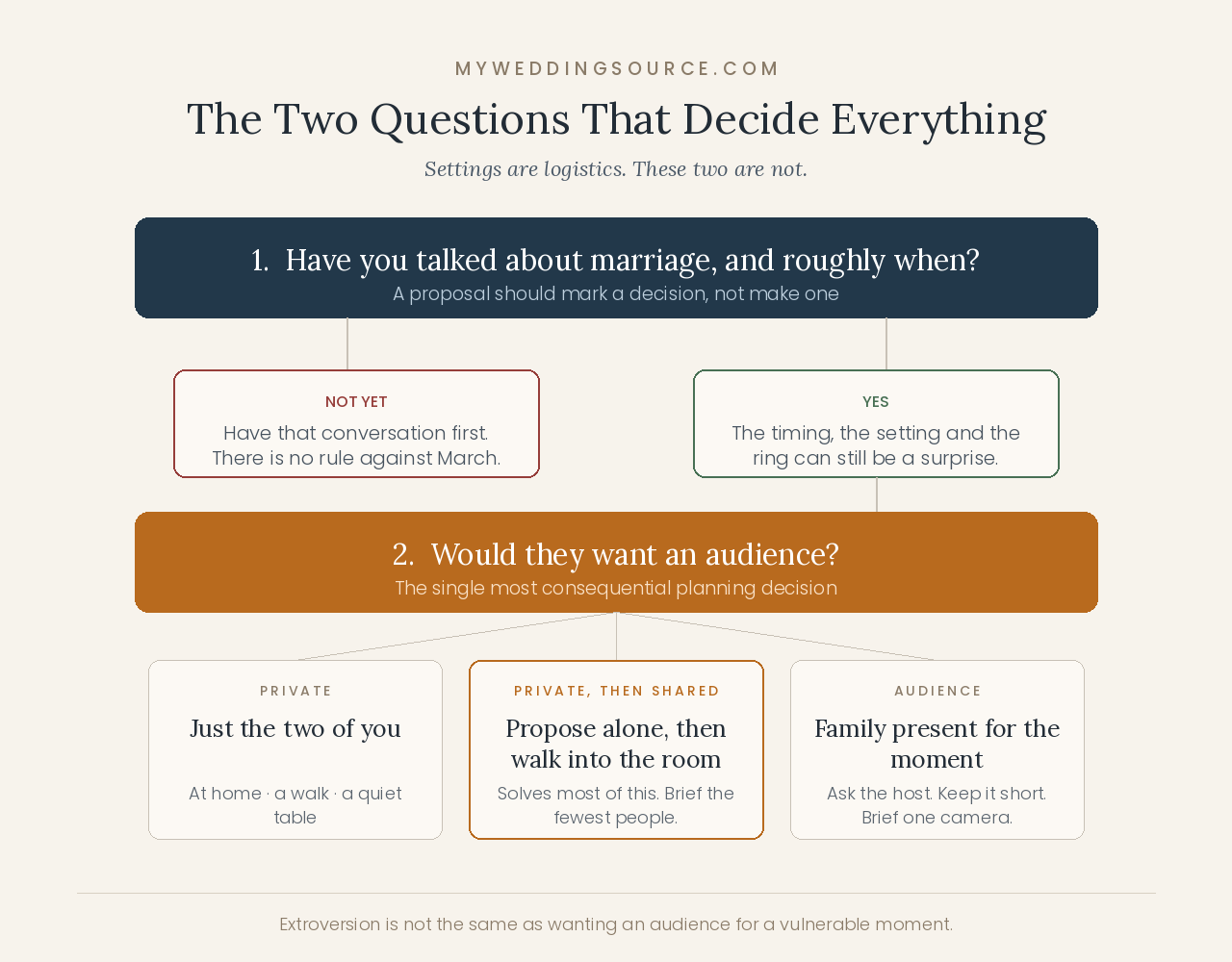
1. Do you already know you are getting married?
The most important preparation for any proposal happens weeks earlier, in a conversation about whether and roughly when you both want to marry. A proposal works best when it marks a decision rather than makes one, and that is doubly true when there is an audience, because a public question is a very difficult place to say anything other than yes.
This does not spoil a surprise. If you have already talked about marriage, the timing, the setting, and the ring can all still be completely unknown. What you remove is the only genuinely serious risk: a mismatch between what you are asking and what they are ready for.
If you have not had that conversation, the more useful December project is having it — and there is no rule against proposing in March.
2. Does your partner want an audience?
Ask if you can. “If we ever got engaged, would you want people around or would you rather it be just us?” is a normal thing to say in a relationship where marriage has been discussed, and it does not reveal timing.
If you cannot ask directly, some reasonable signals: how they behave when a restaurant sings happy birthday to them, whether they like being photographed, whether they share personal news publicly or privately, and how they react when someone else’s proposal video goes around. Extroversion in general is not the same as wanting to be the center of attention in a vulnerable moment, and plenty of very sociable people want this one private.
A middle path exists and is underused: propose privately, then walk into the room where everyone is waiting. Your partner gets the moment to themselves and the family still gets to be part of the day.
If you only take one thing from this guide
Ask the audience question, and decide whose day you are borrowing. Everything else on this list is logistics, and logistics can be fixed on the day.
Creative Christmas Proposal Ideas for Your Special Moment
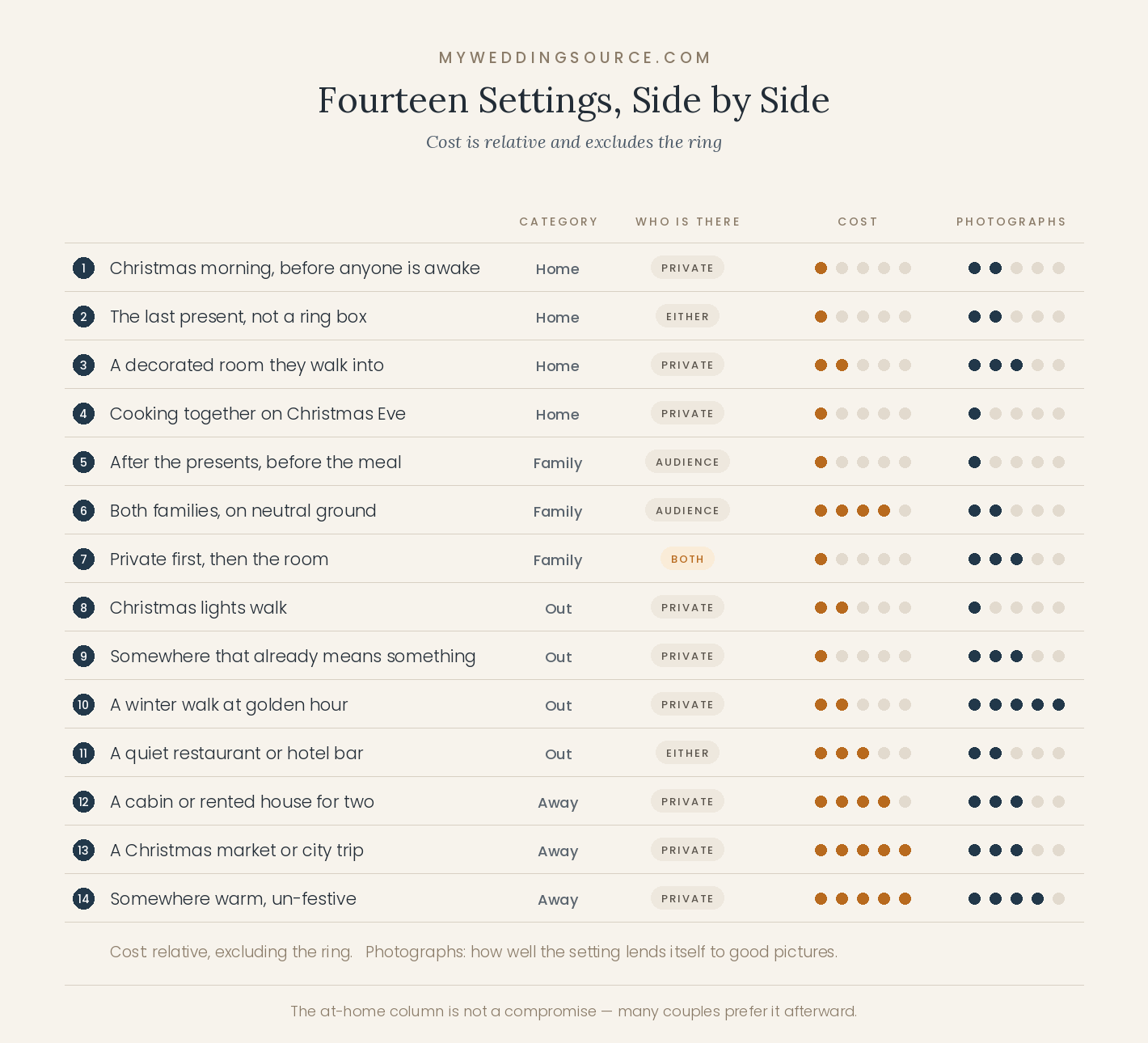
Fourteen Christmas Proposal Settings, Compared
For many couples, experimenting with different Christmas proposal ideas can lead to unexpected and delightful moments.
When considering Christmas proposal ideas, think about incorporating elements that highlight your journey together.
Each of these includes what it actually needs, a rough cost band, how it photographs, and the conditions under which it works less well. Cost bands are illustrative and assume U.S. prices excluding the ring.
At home, just the two of you
Capturing the essence of the moment is crucial, and unique Christmas proposal ideas can assist in creating unforgettable memories.
The most controllable category and the most underrated. You know the space, nothing depends on weather or a reservation, and your partner can react however they react without an audience.
1. Christmas morning, before anyone else is awake
What it is: the tree lit, coffee, no one else up, no schedule yet. Quiet and specific to the day without needing anything staged.
Needs: almost nothing. Lights on a timer so the room is already glowing, and a plan for where the ring slept.
Cost band: minimal. Photographs: low light; a tripod and a warm lamp beat a phone flash. Works less well when: you are staying in someone else’s house, where “before anyone is awake” is unreliable.
2. The last present, deliberately not a ring box
What it is: a wrapped gift that leads to the question — a framed photo, a book, a note — with the ring appearing afterward rather than as the reveal itself. Slower and less startling than a box handed over cold.
Needs: a decoy package that does not feel like a letdown, and a wrapping job that hides the shape.
Cost band: minimal. Photographs: good, because the sequence is slow. Works less well when: the gift-opening happens with everyone watching and you wanted privacy — check the family’s order of events first.
3. A decorated room they walk into
What it is: candles, greenery, string lights, and something personal — photographs, a playlist, a handwritten note. Set up while they are out.
Needs: two to three hours, an accomplice to keep them busy, and honest attention to fire safety with candles and greenery. Battery candles are the sensible choice in a room full of pine.
Cost band: $50–$300 depending on flowers and lighting. Photographs: excellent if warm lights are at eye level rather than overhead. Works less well when: the setup is elaborate enough to be discovered, or so styled it feels like a set.
4. Cooking together on Christmas Eve
What it is: an ordinary evening you both like, interrupted. Low production value, high proportion of couples who say afterward that they preferred it this way.
Needs: nothing but the ring nearby and a moment where the kitchen is calm.
Cost band: minimal. Photographs: a tripod in the corner, or none. Works less well when: one of you wanted something visibly planned. Some people read effort as care, and that is legitimate.
With family present
Joy is immediate and shared, and it is the version most likely to go wrong for the person being asked. Three rules make it work: confirm they want an audience, get the host’s permission, and keep it short.
5. After the presents, before the meal
What it is: a natural pause in the day when everyone is already together and nothing is in the oven at a critical stage.
When you hear about creative Christmas proposal ideas, remember that the best ones often come from the heart.
Needs: the host’s agreement, one person quietly briefed to film, and a plan for the twenty minutes afterward so the room is not standing around.
Consider personal touches when exploring Christmas proposal ideas, as they will elevate the overall experience.
Cost band: minimal. Photographs: unpredictable — phones, mixed light, people in the way. Brief one person rather than hoping. Works less well when: your partner has never said they would want this.
6. Both families, on neutral ground
From intimate dinners to festive gatherings, Christmas proposal ideas are as diverse as the couples who use them.
What it is: a gathering at a restaurant or rented space where both sides are present, so neither family’s Christmas is displaced and nobody is hosting.
Needs: a booking made weeks ahead at holiday rates, and coordination that is genuinely difficult in late December.
Cost band: $300–$2,000+. Photographs: good if you brief someone and choose a well-lit table. Works less well when: family relationships are strained; a neutral venue does not neutralize the people in it.
7. Private first, then the room
For those who love the holiday season, Christmas proposal ideas can enhance the festive spirit and create lasting memories.
What it is: the compromise that solves most of this category. Propose alone — another room, the porch, a short walk — then come back in and tell everyone together.
Needs: an excuse to step away, and family who can hold a straight face for ten minutes.
Cost band: minimal. Photographs: the return is the best photo of the day; someone can be ready for it. Works less well when: nobody can keep the secret — brief the fewest people possible.
Out in the world, privately
8. Christmas lights walk
Sharing your Christmas proposal ideas with family may also help you refine them to ensure they align with your partner’s desires.
What it is: a neighborhood known for decorations, a botanical garden light trail, or a town square tree. Seasonal, cheap, and genuinely pretty.
Needs: a scouted spot away from the main path, and awareness of crowds — popular light trails in late December are busy from opening to close.
Finding the right time amidst holiday festivities is key when implementing Christmas proposal ideas.
Cost band: $0–$60 in tickets. Photographs: difficult. Colored lights and darkness are hard on cameras; a photographer with a fast lens or nothing at all. Works less well when: tickets are timed and sold out, which is common. Book early.
9. Somewhere that already means something to you
What it is: the place you met, the bench, the trailhead, the bar you closed on your first date — visited during the holidays.
Needs: a plausible reason to be there, and a check that it is open and accessible in winter.
Incorporating your partner’s interests into Christmas proposal ideas can make the moment even more special.
Cost band: minimal. Photographs: plan around light; in December, anything outdoors needs to happen well before 4:00 p.m. Works less well when: the meaning is one-sided. Make sure the place matters to both of you.
10. A winter walk or hike at golden hour
What it is: low sun, bare trees, frost, and no one else around. The best-looking option on this list if the weather cooperates.
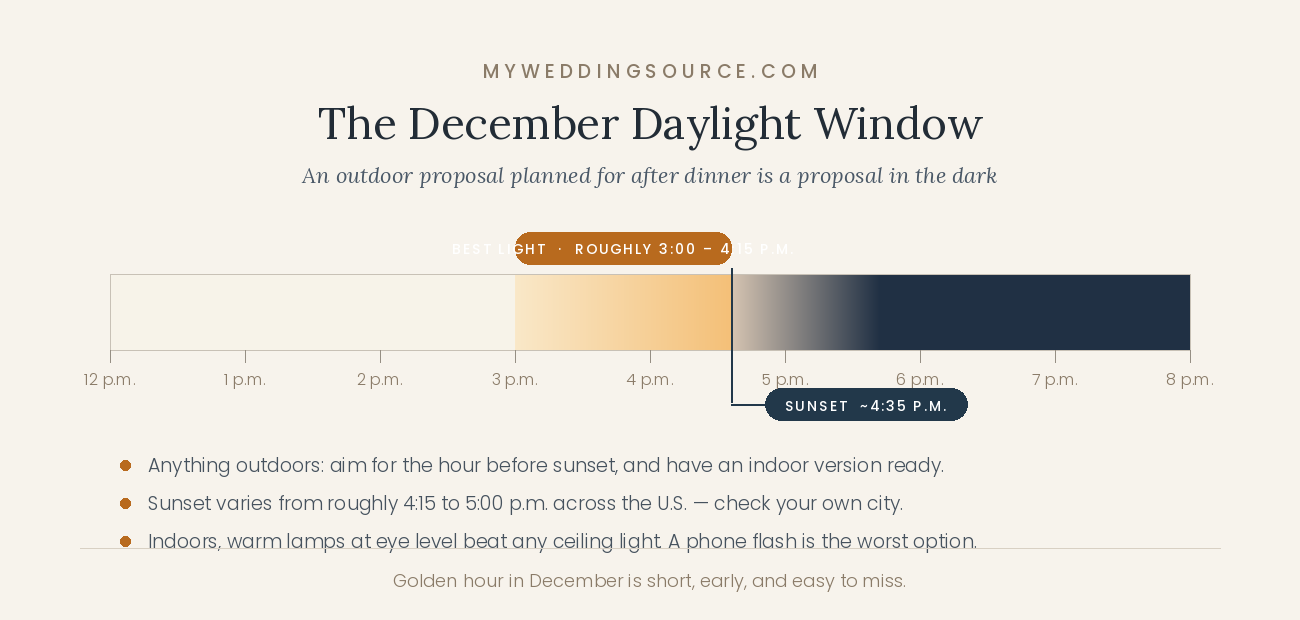
Needs: a route you have walked before, warm layers, footwear for ice, and a hard time check. In December, golden hour is roughly 3:00 to 4:15 p.m. across much of the country, and full dark follows quickly.
Cost band: minimal, or $300–$900 with a photographer. Photographs: the best of any option here. Works less well when: the ground is icy or the trail is unfamiliar — a proposal is a bad time to be lost or cold.
11. A quiet restaurant or hotel bar
What it is: dinner somewhere decorated for the season, with the question at the table or in a booked private corner.
Needs: a reservation made well in advance — good restaurants fill for the week of Christmas by early December — and a conversation with the staff about what you want and, importantly, what you do not want. Ask them not to bring the room in on it unless your partner would enjoy that.
Cost band: $150–$600. Photographs: ask about lighting; many restaurants are very dim. Works less well when: the restaurant has its own idea of how to help.
Away: destinations and travel
12. A cabin or rented house for two
Make sure to also consider logistical aspects when planning your Christmas proposal ideas; timing can be crucial.
What it is: a few days away, a fire, no family schedule, and a proposal that can happen whenever the moment appears rather than at a fixed hour.
Needs: booking months ahead for the holiday week, and a plan for hiding the ring in a small shared space.
Cost band: $400–$2,500 for a few nights. Photographs: a tripod, warm lamps, or a local photographer. Works less well when: either family expected you at Christmas and was not told — that conversation belongs in November.
Consider how location can impact your Christmas proposal ideas and create an unforgettable experience.
13. A Christmas market or European city trip
What it is: the postcard version. Mulled wine, lights, cobblestones, cold air.
Needs: flights booked early at holiday prices, travel insurance worth actually reading, and a ring plan that survives airport security and a hotel room.
Cost band: $1,500–$6,000+. Photographs: crowds are the constraint; markets are busiest in the evening. Works less well when: the trip is exhausting. Propose early in the trip, not on the last night, so you both get to enjoy it engaged.
Take advantage of the holiday spirit while deciding on Christmas proposal ideas that reflect your relationship.
14. Somewhere warm, deliberately un-festive
As you finalize your Christmas proposal ideas, ensure that they align with your partner’s preferences and expectations.
What it is: escaping the season entirely. Worth including because for some people December is not a happy month, and a proposal that avoids the holiday framing is the kinder plan.
Needs: the same travel logistics, plus honesty about why you are going.
Cost band: $1,200–$5,000+. Photographs: easy, with real daylight. Works less well when: your partner actually loves Christmas and would have wanted it woven in.
Which Day, and Which Hour
Choosing the day
Keep your Christmas proposal ideas flexible to accommodate for any unexpected developments on the day.
| Day | Why it works | What to watch |
|---|---|---|
| Christmas Eve | Calmer than the day itself; the evening has a natural quiet | Often the busiest day for cooking and travel |
| Christmas morning | Everyone is together and unhurried | Leaves ten hours of holiday for the news to dominate |
| Christmas afternoon or evening | The day’s obligations are done; celebration has an end | People are tired, and some have already left |
| The days between Christmas and New Year | Quiet, unhurried, and does not compete with anything | Less inherently seasonal, which some people prefer |
| New Year’s Eve | Symbolically clean; everyone is already out | Crowded, loud, and heavily anticipated by anyone paying attention |
The most underrated option is the quiet week between the holidays. It carries the season without borrowing anyone’s day, travel has settled, restaurants have space, and your partner is unlikely to be expecting it.
Before or after the family gathering
If family will be present at some point, decide whether the proposal comes before or after the main event. Before means the whole gathering becomes a celebration, which is joyful and completely displaces whatever else the day held. After means the day proceeds as planned and the news becomes the evening.
A practical middle: propose privately in the late afternoon and share it at dinner. The host’s work is done, the day happened as intended, and there is still an audience for the announcement.
The morning-of pressure problem
If you have been carrying the ring for three days, waiting for a moment, the pressure builds and judgment narrows. People end up proposing in a hallway at 11 p.m. because the moment never arrived.
Two things prevent that. Choose a specific window in advance — Christmas Eve after dinner, or the walk on the 27th — rather than “sometime over the holidays.” And give yourself explicit permission to move it if the day turns out badly. A postponed proposal costs nothing; a forced one is remembered.
Photography Without Turning It Into a Shoot
The four options
- A hired photographer, hidden. Produces the best images and the most planning. Common rates for a short proposal session run roughly $300 to $900 depending on the market, and December books early. You will need a precise location, a time window, and a signal.
- A friend or family member with a phone. Free, flexible, and dependent on their nerve. Brief them concretely: where to stand, when to start recording, and to keep filming for thirty seconds after — the reaction afterward is usually better than the moment itself.
While planning Christmas proposal ideas, make sure to keep the focus on what matters most: your partner.
- A tripod or a propped phone. Works well indoors. Start it early, frame wide, and forget it.
- Nothing. A legitimate choice, and the one some people are happiest with afterward.
Winter light is the real constraint
Anything outdoors needs to happen in daylight, and December daylight is short. Across much of the United States, sunset falls between roughly 4:15 and 5:00 p.m., and the best light is the hour before that. An outdoor proposal planned for “after dinner” in December is an outdoor proposal in the dark.
Indoors, the enemy is overhead light. Warm lamps at eye level, a fire, or a lit tree produce far better photographs than a ceiling fixture, and a phone flash produces the worst results of anything on this list.
Consent about the camera
Some people would be delighted by a photographer in the bushes and others would be mortified to discover the moment was recorded. This is worth including in the audience question you already asked. It also extends to afterward: agree before posting anything, and if a family member filmed it, ask them to send it to you rather than posting it themselves.
Sharing Christmas proposal ideas with trusted friends may help you fine-tune the details.
Ring Security, Travel, and Hiding Places
Getting it there
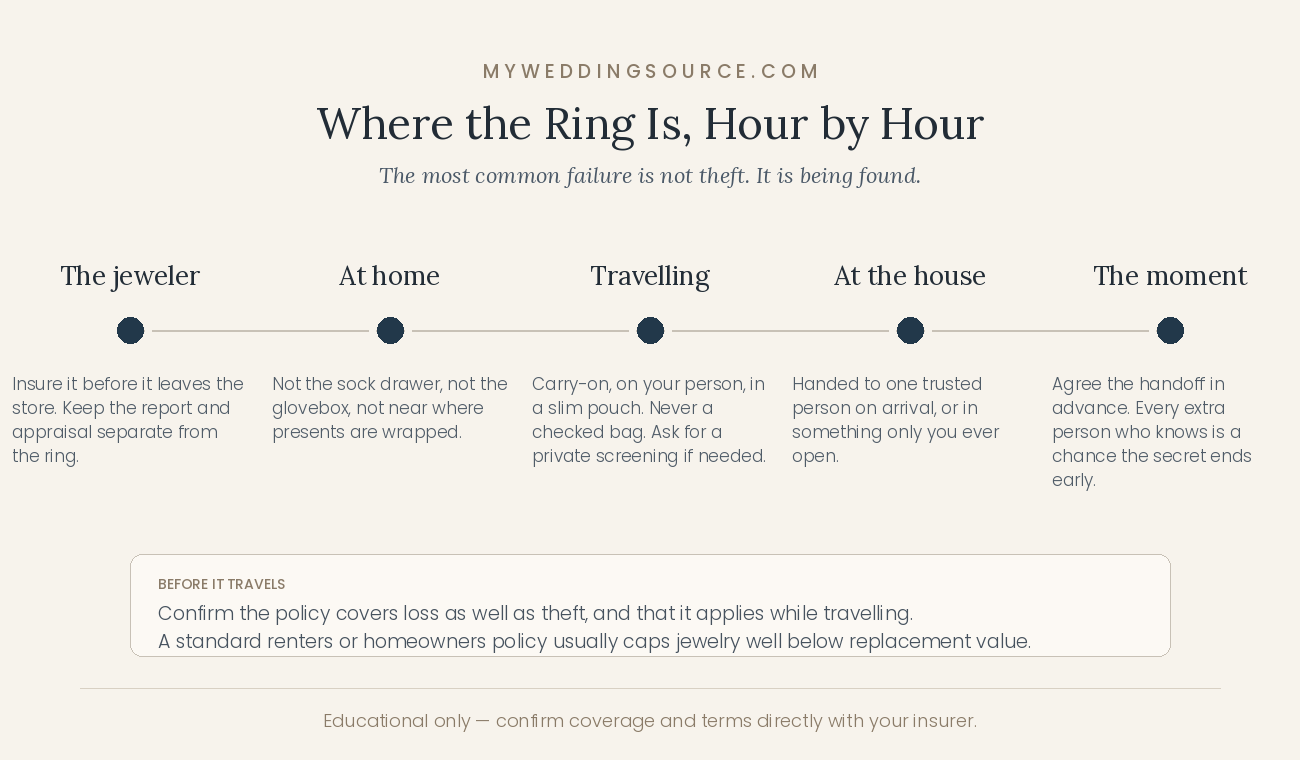
If you are flying, the ring goes in your carry-on, on your person, and never in a checked bag. Keep it in a slim pouch rather than the jeweler’s box, which is bulky and conspicuous. If security asks to inspect it, you can request a private screening rather than opening it at the belt in front of your partner.
In a car, it stays with you rather than in a bag someone might unpack. At a relative’s house, the safest hiding places are the ones your partner has no reason to open: a coat pocket in a bag you carried, a toiletry case, or — best of all — handed to a trusted person on arrival.
Hiding it at home
The usual failures are predictable: sock drawers, coat pockets, the car glovebox, and anywhere near where wrapping paper lives in December. If someone else in the house wraps presents, assume they will find it.
Better options: with a friend or family member until the day, in a work bag, or in something you own alone and they never touch. If you must keep it at home, put it inside something already wrapped and labeled with someone else’s name.
Insurance before you travel
Arrange coverage before the ring leaves the house rather than after the proposal. A standard renters or homeowners policy often caps jewelry coverage below the replacement value, so the usual routes are a scheduled item on an existing policy or a standalone jewelry policy. Ask specifically about coverage while traveling, and about loss as distinct from theft, which are treated differently.
Keep the paperwork somewhere separate from the ring: the grading report, the appraisal, and a photograph. If you want a primer on what the documentation actually describes, the GIA’s guide to buying an engagement ring is a neutral place to start.
If someone else is holding it
Handing the ring to a sibling or friend on arrival solves the hiding problem and creates a new one: the handoff. Agree in advance exactly when and where it comes back to you, keep the number of people who know as small as possible, and do not rely on someone slipping it to you mid-gathering. Every additional person who knows is another chance the secret ends early.
Finding the right balance is essential when considering Christmas proposal ideas and family dynamics.
Family, Traditions, and Other People’s Plans
Whose day are you borrowing
If the proposal happens at a gathering, tell the host in advance and ask. Not for permission to marry — for permission to place something significant inside a day they are running. Most hosts are delighted. The ones who are not usually have a reason worth knowing: a relative who is unwell, a schedule that cannot move, a sibling with news of their own.
Check whether anyone else is planning something. Two engagements at one Christmas, or a proposal on the day a cousin planned to announce a pregnancy, is a genuinely awkward outcome and entirely avoidable with one quiet question.
Telling family in advance: the trade-off
Telling people beforehand buys you help, a camera in the right place, and family who are prepared rather than startled. It costs secrecy, and the risk scales with the number of people told.
A reasonable rule: tell only the people whose help you need, plus anyone whose feelings genuinely require it — often a parent, sometimes a child. Ask them explicitly not to tell anyone, including their partner, and give them a specific job so they have something to do with the knowledge.
Asking a parent first
This is a preference, not an obligation, and it belongs to your partner rather than to tradition. Some people would find it meaningful; others would find it uncomfortable or would object to the premise. If it matters to your partner or their family, do it in the form they would want — increasingly that is telling parents beforehand or asking for a blessing rather than permission.
When the holiday is complicated
Christmas is the first hard anniversary for a lot of families: a first year without someone, a recent divorce, an illness, a job loss. A proposal in the middle of that can be a genuinely lovely thing, and it can also land badly on the person having the hardest day.
If the year has been difficult for someone close, consider proposing privately and choosing your moment to announce, rather than making the gathering itself the venue. It costs you nothing and it lets someone else keep their space.
Children present
If either of you has children, they should not learn this at the same moment as thirty other people. Tell them first, privately, in an age-appropriate way, with room to react however they react — including badly, which is normal. Some children love being part of the proposal itself; others need to hear it quietly first and then decide how they feel.
Contingency Plans
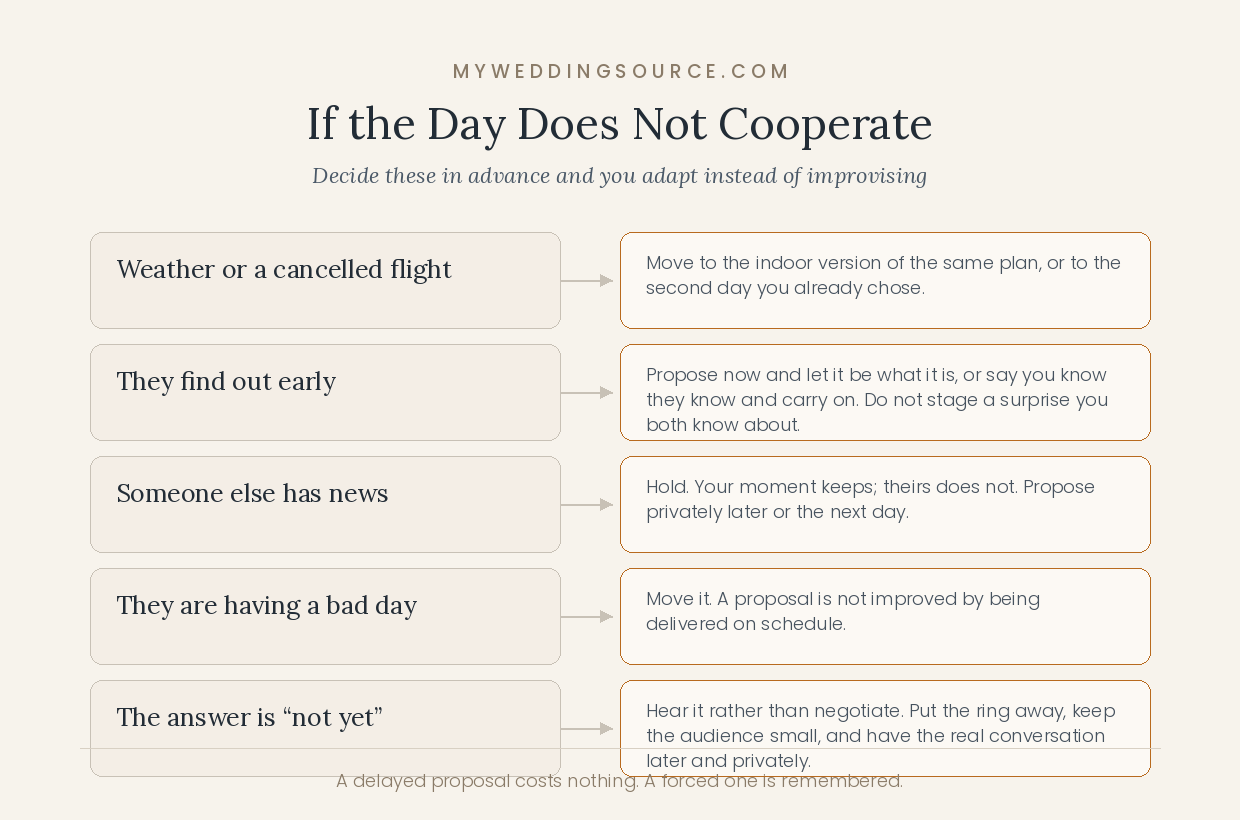
Every December plan meets at least one of these. Deciding in advance is the difference between adapting and improvising.
Weather and travel
Flights cancel, roads close, and outdoor plans get rained out. Have a second location in the same category — an indoor version of your outdoor plan — and a second date. Decide in advance who you would need to notify if the day moves, particularly a photographer, and check their cancellation terms.
The holiday season presents a unique opportunity to explore Christmas proposal ideas that shine with creativity.
The plan is discovered early
Someone talks, a receipt is found, the ring surfaces. This is not a disaster. You can propose immediately and let the moment be what it is, or acknowledge it and keep going as planned. What does not work is pretending nothing happened and then performing a surprise both of you know about.
Someone else has news
If a family member announces an engagement, a pregnancy, or bad news at the gathering, hold. Your moment keeps; theirs does not. Propose privately later, or the next day.
Your partner is having a bad day
Grief, illness, an argument, exhaustion, a difficult conversation with a relative. If the day has turned, move it. A proposal is not improved by being delivered on schedule, and being asked in the middle of a bad hour is remembered as being asked in the middle of a bad hour.
If the answer is not a straightforward yes
Rare when the marriage conversation happened first, which is the strongest argument for having it. If the answer is “not yet,” the kind response is to hear it rather than negotiate: put the ring away, get through the day with as little audience as possible, and have the real conversation somewhere private and later. Try to have an exit from the gathering available — a walk, a drive, a reason to leave early — for both your sakes.
Three Budget Scenarios
Excluding the ring. These are illustrative and vary considerably by region.
| Item | At home | Local, with photos | Away for a few days |
|---|---|---|---|
| Flowers, candles, decor | $60 | $120 | $100 |
| Photographer | — | $550 | $450 (local hire) |
| Travel and lodging | — | — | $1,400 |
| Dinner or celebration | $0 (cooking) | $220 | $300 |
| Ring insurance (annual) | $120 | $120 | $120 |
| Approximate total | $180 | $1,010 | $2,370 |
Two observations worth taking from this. The photographer is the single largest optional line in most local plans, so it is the first thing to cut or keep deliberately rather than by default. And the at-home column is not a compromise: a meaningful share of couples say afterward that they are glad it was quiet.
After the Yes: The First Hour and the Rest of the Holiday
Protect the first fifteen minutes
Whatever the setting, the minutes immediately afterward belong to the two of you. If family is present, that can be a walk outside or a few minutes in another room. If you are alone, it means not reaching for a phone straight away. Almost everyone who describes regret about a proposal describes the same thing: the moment was immediately absorbed into logistics.
Announcing, in order
Children first if either of you has them, privately. Then parents and anyone who would be genuinely hurt to hear it secondhand — by call or in person, not by message. Then close family and friends. Then everyone else.
Two things prevent most hurt feelings during a holiday, when everyone is together and phones are out. Ask anyone who was present not to post before you do, and if relatives were there, agree between yourselves which of you calls which side of the family before the news outruns you.
Handling the questions for the rest of the day
You will be asked for a date, a venue, and a guest list within the hour. Agree on one sentence in advance and use it all day: “We’re enjoying this part for a bit — we’ll start thinking about dates in the new year.” Say nothing specific about who will be invited. In a room full of relatives at Christmas, “of course you’ll be there” is the most expensive sentence available.
Ring care in the first days
If the ring needs sizing, wear it for a week before deciding, since hands change with cold and heat. Confirm insurance is active rather than pending. And decide where it lives when it comes off, because the most common way rings are lost is not theft but being set down somewhere unfamiliar — which describes most holiday travel.
Common Mistakes
Proposing without the marriage conversation
The one that matters. A surprise about timing and setting is lovely; a surprise about whether you are getting married is a risk taken with someone else’s answer, in front of an audience.
Assuming your partner wants an audience
The second most consequential. Ask, or choose the private version and bring the audience in afterward.
Not asking the host
It is their day, their kitchen, their schedule. Most say yes immediately and are pleased to be asked.
Proposing first thing on Christmas morning
It works for some couples and leaves ten hours in which the day becomes entirely about the ring. Later in the day gives the celebration a natural end.
Planning an outdoor moment after dark
December sunset is early. Anything outdoors needs to happen by mid-afternoon, and a plan built around “after dinner” outdoors is a plan built in the dark.
Telling too many people
Every person who knows is a chance the secret ends early, usually accidentally. Tell only those whose help you actually need.
Letting a restaurant improvise
Tell them explicitly what you want and what you do not — no announcement, no singing, no dessert with writing on it, unless your partner would love that.
Hiding the ring where presents are wrapped
The one room in the house guaranteed to be searched in December.
Making the whole trip about it
If you travel, propose early in the trip rather than on the last night. You will both enjoy the rest of it more, and the pressure does not compound day after day.
A Decision Framework
Answer these in order. Each one narrows the options meaningfully, and by the end the setting usually chooses itself.
Step 1 — the non-negotiables
- ☐ Have we talked about marriage and roughly when? If not, do that first.
- ☐ Would they want an audience, a private moment, or private-then-shared?
- ☐ Would they want it photographed?
Step 2 — whose day is it
- ☐ Whose home or gathering is involved, and have I asked the host?
- ☐ Is anyone else planning news or navigating a hard first Christmas?
- ☐ If children are involved, when and how do they hear it first?
Step 3 — the window
- ☐ A specific day and a two-hour window, not “sometime over the holidays”
- ☐ If outdoors: in daylight, which in December means before about 4:00 p.m.
- ☐ A second window on a second day, in case the first one does not work
Step 4 — logistics
- ☐ Where the ring is, hour by hour, from purchase to the moment
- ☐ Insurance active before it travels
Remember that Christmas proposal ideas should focus on the love you share and the future you wish to create together.
- ☐ Photography decided: hired, briefed friend, tripod, or none
- ☐ Reservations made, with holiday availability confirmed
- ☐ The smallest possible list of people who know
Step 5 — afterward
- ☐ Fifteen private minutes built into the plan
- ☐ Announcement order agreed, and nobody posts before you do
- ☐ One sentence ready for “when’s the wedding?”
- ☐ Nothing said about the guest list, all day
Frequently Asked Questions
Should I propose in front of family or in private?
Whichever your partner would want, which is worth asking about directly if marriage has already been discussed. Family proposals produce immediate shared joy and give the person being asked no privacy to react, which some people love and others find genuinely difficult. If you are unsure, the safest option is the hybrid: propose privately, then walk into the room where everyone is waiting. Your partner gets the moment to themselves, the family still gets to be there, and nobody is put on the spot.
Is Christmas Day too obvious?
For some people, yes — if your partner has been half expecting a December proposal for two years, the day itself will not surprise them. That is not necessarily a problem, since the setting and the moment can still be unexpected. If surprise matters a lot, the quiet days between Christmas and New Year are the most underrated window: seasonal enough to feel special, unexpected enough to be a genuine surprise, and free of anyone else’s schedule.
Should I ask her father, or her parents, first?
It is a preference, not a rule, and the preference that matters is your partner’s. Some people find it meaningful, others find the premise uncomfortable. Ask your partner how they feel about it, or reason from what you know about them and their family. If you do want to involve parents, telling them beforehand or asking for a blessing is now more common than asking permission — and if a family expects it but your partner would object, your partner’s view is the one to follow.
How do I get the ring through airport security without them seeing?
Keep it in your carry-on, on your person, in a slim pouch rather than the jeweler’s box. Never put it in a checked bag. If a bag is pulled for inspection, you can ask for a private screening rather than having it opened at the belt. Some people hand the ring to a travelling friend or family member for the flight, which works if you have agreed exactly when it comes back. Insurance should be active before you leave, and confirm that the policy covers you while travelling.
Where should I hide the ring at home?
Anywhere your partner has no reason to go, and specifically not in a sock drawer, a coat pocket, the glovebox, or near where wrapping paper and gifts are kept in December. The most reliable option is not keeping it at home at all: leave it with a friend or family member until the day, or in a work bag. If you must hide it in the house, put it inside something already wrapped with someone else’s name on it.
Do I need a photographer?
No, and plenty of couples are glad they did not have one. If photographs matter to you, the options are a hired photographer hidden nearby, a briefed friend with a phone, or a propped phone recording video. If you hire someone, book early — December fills fast — and expect roughly $300 to $900 for a short session in many markets. Whichever you choose, brief them to keep recording for at least thirty seconds after the question, because the reaction is usually better than the moment.
What if it snows, the flight is cancelled, or the plan falls apart?
Have a second version of the plan in the same category and a second day. An indoor alternative to an outdoor setting, or a different evening in the same week, covers most failures. Check the cancellation terms for anything you booked, particularly a photographer. And give yourself explicit permission to move it: a delayed proposal costs nothing, while one forced through a bad day gets remembered that way.
What if someone finds out before I propose?
It happens, and it is recoverable. You can propose right away and let the moment be what it is, or acknowledge that they know and continue with the plan anyway. What tends not to work is pretending the discovery did not happen and then staging a surprise you both know about. Most people, asked afterward, care far more about the fact that it happened than about whether it was a surprise.
How do I keep the proposal from taking over Christmas for everyone else?
Propose later in the day rather than first thing, so the celebration has a natural end. Ask the host in advance, which usually turns a disruption into something they are pleased to be part of. Build in a deliberate hour away — a walk, a drive — so neither of you spends eight hours being the centre of attention. And if someone in the family is having a hard first Christmas, consider proposing privately and choosing your own moment to share it.
Is it a bad idea to propose during a difficult holiday for the family?
Not necessarily — good news can be genuinely welcome in a hard year, and some families would be glad of it. What matters is the placement. If someone is navigating a first Christmas after a loss, a divorce, or a serious illness, making the gathering itself the venue puts them in the position of performing happiness on their hardest day. Proposing privately and telling people when it suits everyone gets you the same engagement without asking that of anyone.
Plan the Moment, Not the Production: The key to successful Christmas proposal ideas is ensuring they are personal and meaningful.
A Christmas proposal goes well when two things are true: your partner already knows this is where you are both heading, and the setting matches how they would want to be asked. Everything else in this guide — the lights, the photographer, the restaurant, the trip — is decoration on those two decisions, and no amount of it compensates if either one is wrong.
Ultimately, well-thought-out Christmas proposal ideas can lead to a moment that both of you will cherish forever.
The practical sequence is short. Have the marriage conversation first. Ask, directly or indirectly, whether they would want an audience. Ask the host whose day you are borrowing. Choose a specific window rather than a vague holiday, and if it is outdoors, choose one in daylight. Decide where the ring is at every hour, and insure it before it travels. Then build in fifteen minutes afterward that belong only to the two of you.
And keep the escape hatch open. If the day turns — weather, travel, an argument, someone else’s news, a hard hour for someone you love — moving the proposal costs you nothing at all. The person will still be there on the 27th.
Your next step
Be sure to share your Christmas proposal ideas with a trusted friend to receive valuable feedback.
Your next step is to take action on your Christmas proposal ideas, ensuring they reflect your partner’s dreams and desires.
